
Smart Supply Chain Management Integrating Lean Six Sigma and Industry 4.0–5.0: Framework, Applications, and Challenges for Sustainability and Resilience
Smart Supply Chain Management Integrating Lean Six Sigma and Industry 4.0–5.0: Framework, Applications, and Challenges for Sustainability and Resilience
Received: 28 January 2026 Revised: 30 March 2026 Accepted: 02 April 2026 Published: 13 April 2026

© 2026 The authors. This is an open access article under the Creative Commons Attribution 4.0 International License (https://creativecommons.org/licenses/by/4.0/).
1. Introduction
Modern supply chains are increasingly complex, global, and digitally interconnected, spanning multiple tiers of suppliers, manufacturers, distributors, and customers. This complexity exposes them to demand volatility, supply disruptions, quality inconsistencies, inventory inefficiencies, and growing ESG pressures [1,2,3]. Rapid technological advancements, globalization, and evolving customer expectations further intensify these challenges, requiring supply chains to become more agile, resilient, adaptive, and sustainable. Traditional strategies focused solely on cost reduction or process efficiency are no longer sufficient. To remain competitive, organizations must adopt integrated approaches that combine operational excellence, advanced digital technologies, and human-centric practices, enabling intelligent and future-ready supply chains [4,5,6].
1.1. Problem Statement
Despite significant advancements in supply chain management, critical challenges persist in integrating process improvement methodologies, digital technologies, and human-centric practices. Existing approaches remain fragmented, resulting in siloed implementations, limited interoperability, and weak alignment between operational excellence and digital transformation. These gaps lead to fragmented digital adoption, constrained human–AI collaboration, and insufficient integration of sustainability and ESG objectives. Consequently, supply chains struggle to achieve efficiency, resilience, adaptability, and social responsibility simultaneously. A unified and structured framework integrating Lean Six Sigma (LSS), Industry 4.0 (I4.0), and Industry 5.0 (I5.0) is therefore required to enable next-generation Smart Supply Chain Management (SSCM).
1.2. SCM Functions and Frameworks
Effective Supply Chain Management (SCM) depends on structured frameworks that align operational activities with strategic objectives. Core functions include demand and supply planning, production and operations, logistics, digitalization, human capital, risk and compliance, sustainability, performance measurement, finance, service delivery, and organizational agility [7]. These functions drive measurable outcomes such as inventory optimization, process efficiency, regulatory compliance, technology adoption, collaboration, sustainability, and market responsiveness. Table 1 presents a comprehensive SCM framework linking functions to actionable objectives, supporting continuous improvement, digital transformation, and the development of smart, resilient, and sustainable supply chains [6,8].
Table 1. SCM Functions Framework.
|
# |
Cluster |
Category |
Key Functions |
Objective |
|---|---|---|---|---|
|
1 |
Demand & Supply Management |
Demand & Supply Planning |
Demand Forecasting |
Accurately predict demand to optimize production and inventory levels |
|
Inventory & Warehouse Management |
Maintain optimal stock levels and efficient storage |
|||
|
Strategic Sourcing & Supplier Development |
Ensure reliable suppliers and supply continuity |
|||
|
Customer & Market Management |
CRM & Demand Alignment |
Align supply chain operations with customer needs and market trends |
||
|
2 |
Operations & Production Management |
Operations & Production |
Manufacturing & Process Optimization |
Achieve efficient, high-quality production |
|
Product Lifecycle Management |
Manage products from design to end-of-life efficiently |
|||
|
Cost & Profitability Management |
Operational & Production Cost Optimization |
Monitor and control costs, margins, and resources |
||
|
3 |
Logistics & Distribution |
Transportation & Logistics |
Movement of Goods |
Plan, optimize, and track transportation across the supply chain |
|
Order Management & Customer Service |
Order Fulfillment |
Ensure timely and accurate order processing |
||
|
Reverse Logistics & Returns |
Returns & Product Recovery |
Collect, repair, recycle, and redistribute products efficiently |
||
|
4 |
Digitalization & Technology |
Digital Transformation |
Digital Enablement |
Integrate intelligent, connected, and automated processes |
|
Innovation & Future Readiness |
Emerging Technology Adoption |
Apply AI, robotics, predictive analytics, and advanced digital tools |
||
|
Knowledge & Information Management |
Data Governance & Analytics |
Ensure reliable, standardized data and actionable insights |
||
|
5 |
Human Capital & Collaboration |
Workforce & Collaboration |
Human-Centric Practices |
Develop workforce skills, engagement, and an innovation culture |
|
Ecosystem Collaboration |
Supplier & Partner Integration |
Foster collaboration, co-creation, and network coordination |
||
|
6 |
Risk, Resilience & Compliance |
Risk & Resilience |
Disruption Management |
Identify and mitigate risks to ensure continuity |
|
Regulatory & Compliance |
Legal & Regulatory Adherence |
Ensure compliance across operations and regions |
||
|
Security & Ethics |
Cybersecurity & Ethical Sourcing |
Safeguard supply chain integrity, data, and ethics |
||
|
Global Trade Management |
Global Sourcing & Compliance |
Navigate tariffs, sanctions, and international trade effectively |
||
|
7 |
Sustainability & ESG |
Sustainability & ESG |
Environmental & Social Responsibility |
Reduce environmental footprint and implement sustainable practices |
|
Circular & Regenerative Supply Chains |
Closed-Loop Operations |
Reuse, recycle, remanufacture, and regenerate resources |
||
|
8 |
Performance & Continuous Improvement |
Performance Measurement |
KPI Tracking & Benchmarking |
Monitor performance and benchmark against best practices |
|
Lean Six Sigma & Continuous Improvement |
Process Optimization |
Reduce waste, improve quality, and standardize operations |
||
|
Strategic Planning & Decision Support |
Strategic Alignment |
Align operations with organizational strategy for long-term success |
||
|
9 |
Financial & Supply Chain Finance |
Financial Management |
Cash Flow & Cost Optimization |
Optimize working capital, trade financing, and cost-to-serve |
|
10 |
Service & After-Sales Management |
Service & After-Sales |
Post-Sale Support |
Manage warranties, maintenance, and repairs to enhance customer satisfaction |
|
11 |
Agility, Flexibility & Responsiveness |
Adaptive Supply Chains |
Dynamic Response |
Rapidly adjust operations to market changes and evolving demand |
1.3. Lean Six Sigma for Process Excellence
Lean Six Sigma (LSS) integrates Lean’s waste-elimination principles with Six Sigma’s defect-reduction focus, enabling organizations to improve efficiency, reduce lead times, minimize errors, and lower costs [5,9]. Beyond operational gains, LSS enhances delivery reliability, scalability, supplier collaboration, and sustainable resource utilization. Tools such as DMAIC, Value Stream Mapping, and root-cause analysis provide structured approaches for process improvement and strategic alignment. Table 2 presents a 13-cluster LSS-driven SCM framework, mapping tools to applications and demonstrating how LSS supports efficiency, quality, resilience, responsiveness, and sustainability [5,7,10,11].
Table 2. LSS-Driven SCM Framework.
|
# |
Cluster/Group |
Purpose/Focus |
Representative LSS Tools |
SCM Applications/Impact |
|---|---|---|---|---|
|
1 |
Structured Problem Solving & Root Cause Analysis |
Systematically identify, analyze, and resolve supply chain issues |
DMAIC, A3 Problem Solving, Six Sigma Project Charter, RCA, RCCA, FMEA, Fishbone/Ishikawa Diagram |
Optimize order fulfillment, reduce defects, enhance production quality, and prevent logistics disruptions |
|
2 |
Process Visualization & Workflow Mapping |
Map, analyze, and optimize end-to-end processes |
Value Stream Mapping (VSM), Process Mapping, SIPOC, Spaghetti Diagrams |
Streamline procure-to-pay, order-to-cash, warehouse layouts, transportation flows, and overall process efficiency |
|
3 |
Waste Elimination & Operational Efficiency |
Eliminate waste, prevent errors, and enhance efficiency |
5S, TIMWOOD, Kanban/Pull Systems, SMED, Poka-Yoke, Bottleneck Analysis |
Optimize inventory, production scheduling, warehouse operations, transportation, and JIT replenishment |
|
4 |
Statistical Analysis & Quality Control |
Monitor, measure, and improve process performance |
SPC, Control Charts, Cp/Cpk, Histograms, Box Plots, Pareto Analysis, Scatter Plots, DOE, Hypothesis Testing |
Track supplier quality, production consistency, inventory accuracy, defect reduction, and delivery reliability |
|
5 |
Customer Insight & Alignment |
Align supply chain operations with customer requirements |
Voice of the Customer (VOC), Quality Function Deployment (QFD) |
Improve demand forecasting, service levels, order fulfillment accuracy, and customer satisfaction |
|
6 |
Performance Measurement & Financial Management |
Measure and optimize operational and financial performance |
Lean Accounting, KPI Dashboards, Benchmarking, Strategic KPI Tracking |
Reduce cost-to-serve, optimize cash flow, monitor supplier and logistics performance, and enhance SCM efficiency |
|
7 |
Risk Management & Predictive Analysis |
Anticipate and mitigate supply chain risks |
Monte Carlo Simulation, Failure Tree Analysis, Scenario Planning |
Predict demand variability, inventory shortages, supplier disruptions, and transportation delays |
|
8 |
Continuous Improvement & Knowledge Sustainability |
Standardize, sustain, and embed improvements |
Kaizen, Control Plans, Process FMEA |
Maintain excellence across procurement, production, logistics, and supplier management; preserve operational knowledge |
|
9 |
Digital & Data-Driven Integration |
Enable connected, intelligent, and predictive supply chains |
Digital Twins, IoT Monitoring, ERP Analytics, Big Data Analytics, AI Forecasting |
Achieve real-time visibility, predictive maintenance, smart inventory, automated logistics, and data-driven decisions |
|
10 |
Supplier & Ecosystem Collaboration |
Strengthen supplier performance and strategic partnerships |
Supplier Scorecards, Joint KPIs, Collaborative Platforms |
Enhance supplier reliability, co-innovation, and joint process optimization |
|
11 |
Regulatory Compliance & Sustainability |
Ensure legal, ethical, and environmental compliance |
ESG Reporting Tools, Compliance Dashboards, Sustainability KPIs |
Support circular supply chains, green logistics, regulatory adherence, and ESG alignment |
|
12 |
Agile & Adaptive Supply Chains |
Enhance responsiveness and flexibility |
Scenario Modeling, Dynamic Planning, Rapid Reconfiguration Tools |
Quickly adapt to demand fluctuations, market changes, and operational disruptions |
|
13 |
Service Excellence & After-Sales Management |
Optimize post-sale support and customer experience |
Service Management Software, Warranty Tracking, Spare Part Analytics |
Improve warranty management, repair operations, after-sales efficiency, and customer satisfaction |
1.4. Industry 4.0–5.0 Technologies for Digital and Human-Centric Supply Chains
Industry 4.0 (I4.0) and Industry 5.0 (I5.0) technologies are transforming supply chains by embedding intelligence, connectivity, automation, and human-centric innovation. I4.0 technologies—including IoT, AI, machine learning, big data analytics, digital twins, cloud computing, and robotics—enable real-time monitoring, predictive analytics, autonomous decision-making, and improved operational efficiency [2,4,12].
I5.0 extends this paradigm by emphasizing human creativity, ethical governance, and resilience, leveraging collaborative robots (Cobots), AR/VR, human digital twins, blockchain, and emerging technologies such as quantum computing and brain–computer interfaces [6,13]. Table 3 outlines 15 technology groups, linking technologies to supply chain capabilities and applications, showing how I4.0 drives automation and intelligence while I5.0 enables human-centric and sustainable practices [4,6,14,15,16].
Table 3. Technology Groups for Industry 4.0–5.0 Smart Supply Chain Management.
|
# |
Technology Group |
Key Technologies |
SCM Capabilities |
Representative SCM Applications |
|---|---|---|---|---|
|
1 |
Digital Connectivity & Infrastructure |
IoT, Edge Computing, Cloud Computing, Cyber–Physical Systems (CPS) |
Real-time data capture, seamless integration, end-to-end visibility |
Shipment tracking, inventory monitoring, cold-chain management |
|
2 |
Intelligent Analytics & Decision Support |
AI, Machine Learning, Big Data Analytics, Prescriptive Analytics, Explainable AI (XAI), Federated Learning |
Predictive and prescriptive analytics, optimization, data-driven decision-making |
Demand forecasting, inventory optimization, supplier performance evaluation |
|
3 |
Simulation & Autonomous Optimization |
Digital Twins, Multi-Agent Systems, Swarm Intelligence, Quantum-Inspired Optimization |
Scenario modeling, network optimization, autonomous decision-making |
Disruption simulation, adaptive routing, decentralized logistics |
|
4 |
Automation & Operational Execution |
Advanced Robotics, Autonomous Vehicles, Drones, Cognitive Automation |
Process automation, material handling, operational execution |
Automated warehousing, autonomous transport, last-mile delivery |
|
5 |
Collaboration & Ecosystem Integration |
Blockchain, Smart Contracts, Digital Platforms, Marketplaces |
Multi-tier coordination, traceability, inter-organizational trust |
End-to-end traceability, automated contracting, collaborative planning |
|
6 |
Human-Centric & Industry 5.0 Technologies |
Collaborative Robots (Cobots), AR/VR, Human Digital Twins, Emotional AI, Human–Machine Collaboration |
Workforce augmentation, human–AI collaboration, co-created decision-making |
Assisted picking, immersive training, ergonomic optimization, and safety improvement |
|
7 |
Sustainability & Circularity |
ESG Analytics, Circular Economy Platforms, Green AI, Energy-Aware AI |
Sustainability management, circular supply chain enablement, and regulatory compliance |
Carbon footprint tracking, green logistics, closed-loop supply chains |
|
8 |
Resilience, Risk & Governance |
Resilience Analytics, Cybersecurity Systems, Ethical AI Governance Frameworks |
Risk anticipation, disruption management, governance assurance |
Supply chain stress-testing, cyber-risk mitigation, regulatory monitoring |
|
9 |
Supply Chain Finance & Smart Contracting |
FinTech Platforms, Blockchain-Based Finance, AI-Driven Credit Analytics |
Financial flow optimization, liquidity management, risk mitigation |
Dynamic discounting, supplier financing, automated payments |
|
10 |
Sensing & Intelligent Monitoring |
Computer Vision, Smart Sensors, RFID, Image/Video Analytics |
Quality inspection, condition monitoring, anomaly detection |
Automated defect detection, damage inspection, and asset condition monitoring |
|
11 |
Knowledge & Cognitive Systems |
Knowledge Graphs, Neuro-Symbolic AI, Cognitive Automation |
Knowledge integration, reasoning, and organizational learning |
Intelligent exception handling, hybrid rule-based and learning-driven planning |
|
12 |
Control Towers & Orchestration Platforms |
Digital Control Towers, AI-Orchestration Engines |
End-to-end coordination, real-time exception management |
Integrated SCM orchestration, alert-driven decision-making |
|
13 |
Advanced Planning, Forecasting & Market Intelligence |
Advanced Planning & Scheduling (APS) Systems, Demand Sensing, Sentiment Analytics |
Strategic and tactical planning, market responsiveness |
Short-term demand sensing, market-driven production, and distribution planning |
|
14 |
Additive & Distributed Manufacturing |
3D Printing, Distributed Manufacturing Platforms |
Production flexibility, localization, and rapid response |
On-demand spare parts, decentralized and localized manufacturing |
|
15 |
Emerging Frontier & Industry 6.0–Ready Technologies |
Quantum Computing, AGI, Brain–Computer Interfaces (BCI) |
Hyper-optimization, cognitive interaction, system-level intelligence |
Ultra-complex network optimization, advanced human–AI collaboration |
1.5. Integrating LSS with I4.0–5.0 for Smart Supply Chain Management
Integrating LSS with I4.0–5.0 provides a holistic approach to Smart Supply Chain Management (SSCM). LSS ensures structured process optimization and performance measurement; I4.0 enables real-time visibility, predictive analytics, and automation; and I5.0 fosters human-centric collaboration and ethical governance [1,4,6]. This integration enables supply chains that are efficient, resilient, sustainable, and adaptive, bridging the performance-driven focus of I4.0 with the human-centered vision of I5.0 [17,18,19].
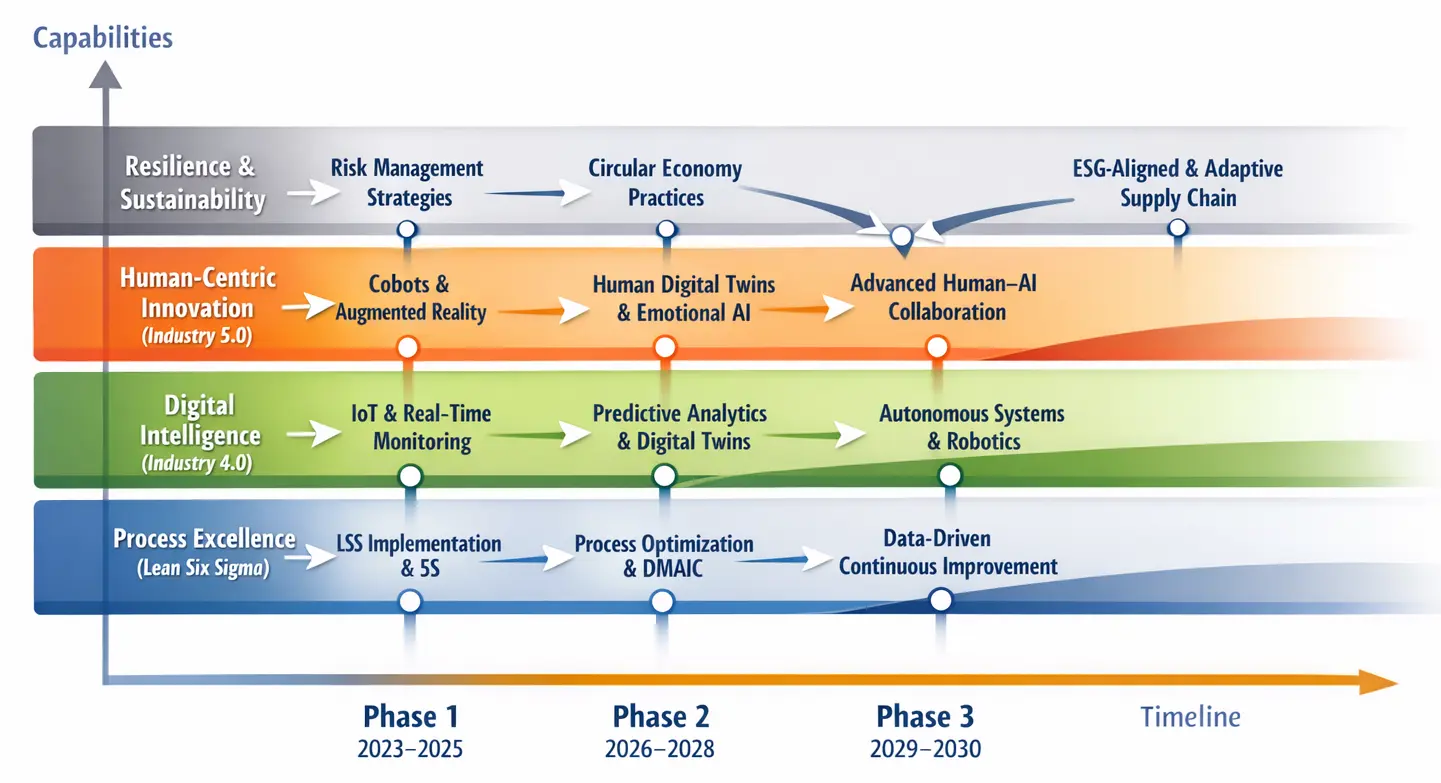
Figure 1 illustrates the phased evolution of smart supply chain capabilities from Phase 1 (2023–2025) to Phase 5 (2029–2030), integrating LSS, I4.0, I5.0, sustainability, and resilience. Key milestones include process optimization, IoT-enabled visibility, predictive analytics, digital twins, collaborative robots, AR/VR engagement, ethical decision-making, and circular economy integration. The roadmap highlights temporal progression and interdependencies, demonstrating how integrated adoption addresses digital fragmentation, limited human–AI collaboration, operational inefficiencies, and sustainability challenges, while guiding the transformation toward intelligent and socially responsible supply chains.
1.6. Study Objectives and Contribution
Despite extensive research, critical technical bottlenecks persist in integrating and operationalizing Lean Six Sigma (LSS), Industry 4.0 (I4.0), and Industry 5.0 (I5.0) within supply chain systems. Existing studies highlight fragmented adoption, weak alignment between process improvement and digital transformation, limited human–AI collaboration, insufficient ESG integration, and a lack of comprehensive frameworks for adaptive and resilient operations.
This study addresses these gaps by proposing a Smart Supply Chain Management (SSCM) framework that integrates LSS with I4.0–5.0 technologies. The framework combines process excellence, digital intelligence, and human-centric innovation to deliver a structured roadmap for operational improvement, predictive decision-making, and sustainable performance. It bridges the performance-driven paradigm of I4.0 with the human-centered vision of I5.0, offering both theoretical and practical contributions.
The paper is organized as follows: Section 2 reviews Lean Six Sigma (LSS), Industry 4.0–5.0 technologies, and sustainable supply chain management (SCM); Section 3 identifies research gaps and technical bottlenecks; Section 4 develops the SSCM framework; Section 5 provides a discussion of the findings; and Section 6 concludes with key insights and recommendations.
2. Literature Review
Effective Supply Chain Management (SCM) is critical for manufacturing competitiveness, enabling organizations to deliver high-quality products efficiently, reliably, and cost-effectively. In today’s volatile and globalized markets, continuous optimization and strategic alignment of supply chain processes are essential for sustaining competitive advantage. Flexible, responsive, and cost-efficient supply chains reduce operational costs, enhance customer satisfaction, and improve long-term organizational performance [1,4,20,21].
This study reviews literature from 2011 to 2025, indexed in Scopus, Web of Science, and ScienceDirect, focusing on the integration of Lean Six Sigma (LSS) methodologies with Industry 4.0 and 5.0 technologies to enhance supply chain performance, resilience, and sustainability. Modern supply chains are complex, globally dispersed, and digitally interconnected, facing challenges such as demand volatility, operational disruptions, geopolitical risks, and rising environmental and social pressures. Traditional cost- and efficiency-focused approaches are increasingly insufficient, driving the adoption of Smart Supply Chain Management (SSCM), which integrates process excellence, digital intelligence, and sustainability-oriented practices.
SSCM is redefining traditional supply chains through Industry 4.0 technologies, including artificial intelligence (AI), the Internet of Things (IoT), robotics, big data analytics, cloud computing, and digital twins [22,23]. These technologies enable real-time monitoring, seamless data exchange, and predictive analytics, providing end-to-end visibility, operational transparency, and enhanced responsiveness across manufacturing, logistics, and distribution networks. By embedding these digital capabilities, SSCM supports distributed production, mass customization, and customer-centric value creation, allowing organizations to respond rapidly to dynamic market demands and shifting consumer preferences [24].
Through intelligent automation and advanced analytics, SSCM enhances operational efficiency, reduces unplanned downtime, ensures consistent product quality, and optimizes resource utilization. Decision-making is strengthened by predictive analytics, cyber-physical systems, and digital twins, facilitating proactive planning, risk mitigation, and continuous performance improvement [25,26,27]. These capabilities enable manufacturers to simulate scenarios, anticipate disruptions, and implement agile responses without interrupting ongoing operations, thereby improving flexibility and resilience.
Furthermore, SSCM drives strategic cost reduction, waste minimization, and faster production cycles through flexible, reconfigurable, and synchronized operations [28,29,30,31,32]. Beyond operational and financial benefits, SSCM supports sustainability and long-term resilience by optimizing energy and resource usage, reducing environmental impacts, and promoting circular supply chain practices. By bridging the efficiency-driven paradigm of Industry 4.0 with the human-centric, resilient, and sustainability-focused vision of Industry 5.0, SSCM fosters adaptive, agile, and globally competitive supply chains that thrive in complex, dynamic, and uncertain global environments [4].
2.1. Lean Six Sigma in Supply Chain Management
Lean Six Sigma (LSS) is a cornerstone methodology for enhancing SCM, providing a structured approach to reduce waste, minimize variability, and improve operational performance. By integrating Lean principles—focused on process efficiency and elimination of non-value-added activities—with Six Sigma methodologies—emphasizing defect reduction, statistical rigor, and process reliability—LSS enables holistic optimization of supply chain performance. Its implementation consistently improves lead times, inventory management, product quality, and responsiveness [33].
When aligned with strategic planning, LSS connects operational improvements with long-term organizational goals such as profitability, quality, sustainability, and customer satisfaction. This alignment enhances agility, risk management, and cross-functional collaboration, enabling supply chains to adapt dynamically to market volatility and global disruptions [34]. Incorporating sustainability into LSS initiatives allows firms to optimize energy use, reduce carbon emissions, and implement circular economy practices while maintaining operational efficiency.
Empirical and bibliometric studies underscore LSS’s growing significance in SCM. Gera et al. [35] synthesized empirical studies highlighting the impact of lean practices, quality management, green supply chain initiatives, innovation, and Industry 4.0 technologies on operational, environmental, and economic performance. Mahdikhani [5] identified key trends and research gaps, particularly in integrating sustainability and digitalization into LSS-driven supply chains. Barbosa et al. [1] proposed frameworks for Green LSS adoption and highlighted challenges such as cultural resistance and technology integration.
Integration of LSS with digital technologies further strengthens its strategic value. AI, IoT, predictive analytics, and automation enhance LSS by enabling real-time monitoring and data-driven optimization [36,37]. Lean Six Sigma combined with Industry 4.0—often referred to as LSS 4.0—has been shown to reduce waste, defects, and lead times while improving resilience and flexibility [38]. Overall, LSS has evolved from a process improvement methodology into a strategic enabler of supply chain excellence.
2.2. Industry 4.0 and Industry 5.0 Technologies in Supply Chain Management
Industry 4.0 has reshaped SCM by enabling digitally integrated, automated, and real-time decision-making systems. Through cyber-physical systems and intelligent automation, traditional supply chains are transformed into adaptive, interconnected networks capable of responding dynamically to disruptions and demand fluctuations. Core technologies such as AI, IoT, digital twins, big data analytics, cloud computing, and robotics enhance visibility, agility, and operational responsiveness [4,39].
IoT and cyber-physical systems enable continuous data collection and decentralized decision-making, improving traceability, predictive maintenance, and operational monitoring across supply chain networks [40,41]. Blockchain integration further strengthens transparency, traceability, and trust by enabling secure and immutable data sharing [42]. AI, big data analytics, and digital twins enhance predictive and prescriptive decision-making, supporting demand forecasting, risk analysis, and scenario planning [43,44,45].
Digital twins provide virtual representations of supply chain systems for simulation, optimization, and disruption forecasting. Cloud and edge computing enable scalable real-time data processing, while robotics and collaborative robots improve flexibility and human–machine interaction [46]. Integrating Lean principles with Industry 4.0 technologies (Lean 4.0/LSS 4.0) enhances operational efficiency through real-time optimization and automation [38].
Industry 5.0 builds on this foundation by introducing a human-centric paradigm that emphasizes creativity, ethics, and sustainability. Unlike Industry 4.0’s automation focus, Industry 5.0 integrates human intelligence with advanced technologies to co-create value in socio-technical systems [47,48]. It prioritizes workforce empowerment, ethical governance, and resilience, ensuring that digital transformation aligns with societal and environmental goals.
Empirical studies confirm that Industry 5.0 technologies improve supply chain efficiency, visibility, responsiveness, and ESG performance [49,50]. Supply chain integration plays a critical role in translating technological adoption into performance outcomes by aligning material, financial, and informational flows [51,52,53]. However, challenges such as high costs, cybersecurity risks, and workforce skill gaps remain significant barriers to implementation [54,55,56].
3. Challenges and Research Gaps Analysis
The convergence of Lean Six Sigma (LSS), Industry 4.0 (I4.0), and Industry 5.0 (I5.0) offers substantial potential to enhance supply chain efficiency, resilience, and sustainability. However, organizations continue to face technological, operational, organizational, and socio-environmental challenges, revealing critical research gaps that must be addressed to develop fully integrated Smart Supply Chain Management (SSCM) frameworks capable of delivering operational excellence, agility, sustainability, and human-centric value.
3.1. Challenges in Lean Six Sigma Implementation
While LSS remains a cornerstone for operational efficiency and quality improvement, its application in modern, multi-tier supply chains faces notable constraints:
- (1)
-
Limited digital integration: Traditional LSS relies on historical data and manual monitoring, with minimal real-time IoT, predictive analytics, or automated decision support, limiting agility in dynamic supply networks [5,7].
- (2)
-
Sustainability alignment gaps: LSS initiatives rarely embed ESG principles or circular economy practices systematically, due to measurement complexity and competing operational priorities [1,21].
- (3)
-
Organizational and cultural barriers: Resistance to change, siloed structures, and weak strategic alignment hinder cross-functional collaboration and scaling of LSS initiatives [21,57].
- (4)
-
Scalability and network complexity: Multi-tier global supply chains challenge coordination, variability reduction, and disruption management, which conventional LSS approaches cannot fully address [58,59].
- (5)
-
Dynamic performance measurement limitations: LSS KPIs typically focus on historical efficiency, lacking predictive, resilience-oriented, and sustainability-linked metrics.
3.2. Challenges in Industry 4.0 Adoption
I4.0 technologies—including AI, IoT, digital twins, cloud computing, and robotics—enable real-time, data-driven supply chain management, yet adoption faces several hurdles:
- (1)
-
High investment costs: Implementation requires substantial capital and operational expenditure, particularly for SMEs [49].
- (2)
-
Technical complexity and interoperability: Integration across heterogeneous legacy systems and multi-tier networks demands standardization and robust IT infrastructure [39,43].
- (3)
-
Data governance and cybersecurity risks: Interconnected supply chains are vulnerable to cyberattacks, data breaches, and regulatory non-compliance, requiring strong governance frameworks [23].
- (4)
-
Workforce capability gaps: Successful adoption depends on digital literacy, analytical expertise, and automation skills, which are often insufficient [60].
- (5)
-
Operational complexity in multi-tier networks: Coordinating predictive analytics, automation, and IoT-enabled processes across distributed supply chains remains challenging [61].
3.3. Challenges in Industry 5.0 Integration
I5.0 emphasizes human-centricity, ethical governance, and sustainability, introducing additional implementation challenges:
- (1)
-
Human–technology collaboration: Effective co-working between humans and intelligent systems requires organizational redesign, leadership development, and updated operational routines [48,62].
- (2)
-
Institutional and regulatory constraints: Weak or fragmented institutions hinder infrastructure, skill development, and technology diffusion, especially in emerging economies [63,64].
- (3)
-
Integration with SCI and sustainability: Translating I5.0 adoption into measurable ESG and operational outcomes relies on effective Supply Chain Integration (SCI), which remains underexplored [65,66].
- (4)
-
Ethical and systemic risks: AI-driven decisions may introduce bias, accountability challenges, and systemic vulnerabilities, requiring robust ethical frameworks [67,68,69].
- (5)
-
Workforce capability development: Skills in creativity, ethical reasoning, and strategic decision-making are essential but often underrepresented in adoption strategies [70,71].
3.4. Research Gaps in Smart Supply Chain Management
Despite significant advances, substantial research gaps remain that constrain the creation of fully integrated, resilient, and sustainable SSCM frameworks. Table 4 summarizes the key challenges, research gaps, and strategic implications, grouped into four dimensions: Technology & Digitalization, Human & Organizational Factors, Sustainability & Governance, and Performance Measurement & Sectoral Coverage [2,72,73,74,75,76,77,78,79,80].
Table 4. Challenges, Research Gaps, and Strategic Implications in SSCM.
|
# |
Dimension |
Key Challenges |
Research Gaps |
Strategic Implications |
|---|---|---|---|---|
|
1 |
Technology & Digitalization |
Fragmented LSS–I4.0/I5.0 adoption; Limited resilience metrics; Platform heterogeneity; AI ethics underexplored |
Few integrated frameworks; Lack of interoperability standards; Limited resilience measurement; AI governance underexplored |
Develop integrated SSCM; Standardize platforms; Embed predictive resilience metrics; Implement AI governance |
|
2 |
Human & Organizational |
Skill gaps; Resistance to change; Limited human–AI collaboration |
Weak research on creativity, ethics, and collaboration; Underdeveloped change management; SCI’s mediating role unclear |
Invest in training; Promote cultural change; Leverage SCI for operational, social, and environmental outcomes |
|
3 |
Sustainability & Governance |
ESG and circular economy gaps; Cybersecurity/compliance issues |
ESG/circular practices rarely embedded; Limited secure, compliant SSCM practices, especially in SMEs/emerging economies |
Integrate ESG and circular economy principles; Strengthen governance and cybersecurity; Align sustainability with strategy |
|
4 |
Performance & Coverage |
Limited predictive KPIs; Short-term studies; SMEs and emerging markets underrepresented |
Few frameworks link operational, digital, human-centric, and sustainability performance; Limited longitudinal and cross-sectoral evidence |
Develop predictive metrics; Conduct longitudinal, cross-sectoral studies; Adapt SSCM for SMEs and diverse sectors |
- (1)
-
Technology & Digitalization: This dimension highlights the need for holistic integration of digital and operational capabilities. Few frameworks combine LSS with I4.0/I5.0 technologies, human-centric practices, and sustainability principles. Measurement and management of supply chain resilience under volatility, disruptions, and geopolitical risks are underdeveloped. Integration of heterogeneous platforms, legacy systems, and multi-tier networks remains challenging, while ethical considerations, transparency, and accountability in AI-driven decisions are underexplored.
- (2)
-
Human & Organizational Factors: The impact of collaborative intelligence, creativity, and ethical decision-making on supply chain performance and sustainability is insufficiently studied. Change management and workforce readiness strategies are limited, and the mediating role of SCI in translating technology adoption into operational, environmental, and social outcomes across multi-tier networks remains largely unexplored. Addressing these gaps is crucial for developing adaptive, resilient, and innovative supply chains.
- (3)
-
Sustainability & Governance: Sustainability and governance considerations are often fragmented from operational and digital initiatives. ESG metrics, carbon footprint monitoring, and circular economy practices are rarely embedded in LSS or I4.0/I5.0 frameworks. Similarly, comprehensive approaches to data governance, cybersecurity, and regulatory compliance remain underdeveloped, particularly for SMEs and emerging economies. Integrating sustainability principles alongside technological adoption ensures long-term performance, ethical alignment, and regulatory compliance.
- (4)
-
Performance Measurement & Sectoral Coverage: Key gaps exist in performance measurement and contextual applicability. Few studies link operational efficiency, digital adoption, human-centric practices, and sustainability to predictive KPIs, limiting strategic monitoring. Most research emphasizes short-term outcomes, with limited longitudinal evidence on the long-term effects of LSS, I4.0, or I5.0 adoption. Moreover, SMEs, service industries, emerging markets, and non-traditional sectors remain underexplored, highlighting the need for broader, cross-sectoral studies.
In summary, addressing these gaps is critical for developing holistic, adaptive, human-centric, and sustainable SSCM frameworks. Future research should focus on creating empirically validated models that integrate operational excellence, digital technologies, human creativity, ethical governance, and sustainability, while also conducting longitudinal, cross-sectoral, and multi-geographical studies to assess long-term impacts. Additionally, practical implementation challenges—such as digital integration, workforce readiness, ESG alignment, and Supply Chain Integration (SCI) adoption—must be addressed. By combining LSS with I4.0/I5.0 technologies and sustainability-driven human-centric practices, SSCM frameworks can bridge the efficiency-oriented focus of Industry 4.0 with the resilient, ethical, and sustainable vision of Industry 5.0, enabling adaptive, future-ready, and globally competitive supply chains.
4. Integrated Smart Supply Chain Management (SSCM) Framework
The Integrated Smart Supply Chain Management (SSCM) Framework provides a comprehensive and actionable roadmap for modern supply chains by systematically integrating core SCM functions, Lean Six Sigma (LSS) methodologies, and Industry 4.0–5.0 technologies. By combining operational excellence, advanced digital intelligence, and human-centered practices, the framework transforms strategic objectives into measurable outcomes and practical applications, enabling organizations to achieve efficiency, agility, resilience, and sustainability across complex and dynamic supply chain networks.
Figure 2 illustrates the SSCM ecosystem, highlighting the synergy among LSS, Industry 4.0 (I4.0), and Industry 5.0 (I5.0). LSS provides the operational foundation, driving process optimization, quality improvement, and waste reduction. I4.0 technologies—including AI, IoT, big data analytics, digital twins, cloud computing, and robotics—enable real-time monitoring, predictive insights, and adaptive decision-making. I5.0 complements these capabilities with human-centered, ethical, and collaborative practices, fostering supply chains that are not only efficient and resilient but also socially responsible. Cross-cutting enablers such as supply chain integration, institutional support, workforce capability, and cybersecurity ensure that operational and technological initiatives are strategically aligned, promoting continuous improvement and innovation.
Modern supply chains face increasing complexity, including demand volatility, supply disruptions, operational inefficiencies, intricate logistics networks, regulatory pressures, and rising sustainability expectations. Traditional approaches focused solely on cost reduction or standardization are no longer sufficient. The SSCM framework addresses these challenges by integrating Lean-driven process optimization, predictive automation, real-time analytics, and human-centered innovation. Table 5 maps twenty-two critical supply chain functions—including demand and supply planning, inventory and warehouse management, sourcing, production, logistics, product lifecycle management, customer service, reverse logistics, workforce collaboration, risk and resilience management, compliance, sustainability, finance, and performance measurement—to corresponding LSS tools, enabling technologies, and operational applications. LSS methodologies—DMAIC, Kaizen, FMEA, Value Stream Mapping, SIPOC, and Voice of the Customer (VOC)—support continuous improvement, quality enhancement, and waste reduction, ensuring alignment with organizational strategy and long-term operational goals.
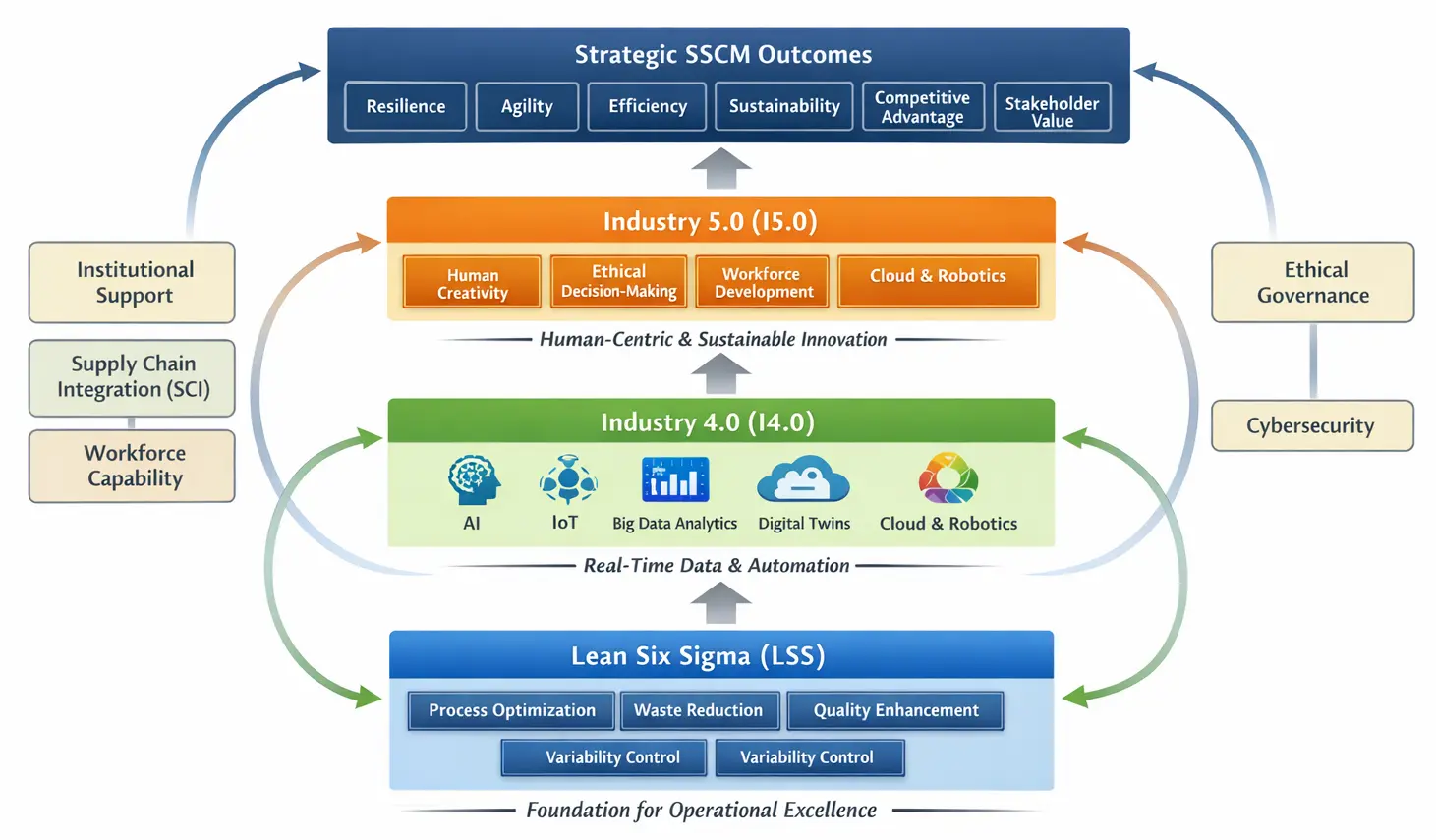
Table 5. Integrated SSCM Framework.
|
# |
SCM Function |
Representative LSS Tools |
Enabling Technologies (Industry 4.0–5.0) |
Applications/Impact |
|---|---|---|---|---|
|
1 |
Demand & Supply Management |
DMAIC, VOC, QFD, Value Stream Mapping |
AI/ML, Big Data Analytics, Digital Twins, IoT |
Accurate demand forecasting, optimized inventory, supplier performance monitoring, adaptive production planning |
|
2 |
Inventory & Warehouse Management |
5S, Kanban, SMED, Process Mapping |
IoT, Edge Computing, Cloud, Autonomous Robotics, RFID, Smart Sensors |
Real-time inventory visibility, automated warehousing, JIT replenishment, cold-chain monitoring |
|
3 |
Strategic Sourcing & Supplier Development |
Supplier Scorecards, Joint KPIs, RCA, FMEA |
Blockchain, AI, Predictive Analytics, Digital Platforms |
Supplier evaluation, risk mitigation, collaborative planning, automated contracting |
|
4 |
Customer & Market Management |
VOC, QFD, SIPOC, Spaghetti Diagram |
Big Data Analytics, APS Systems, Sentiment Analytics |
Align operations with customer demand, improve service levels, enhance order fulfillment accuracy |
|
5 |
Operations & Production Management |
DMAIC, Kaizen, Control Plans, Bottleneck Analysis |
Advanced Robotics, Autonomous Vehicles, Digital Twins, 3D Printing |
Optimize production processes, improve efficiency, enhance quality, enable on-demand manufacturing |
|
6 |
Product Lifecycle Management |
Process FMEA, Value Stream Mapping, Process Mapping |
Digital Twins, ERP Analytics, AR/VR |
End-to-end product oversight, predictive maintenance, lifecycle tracking from design to disposal |
|
7 |
Cost & Profitability Management |
Lean Accounting, KPI Dashboards, Benchmarking |
AI, Big Data Analytics, FinTech Platforms |
Optimize cost-to-serve, manage cash flow, improve operational efficiency, mitigate financial risks |
|
8 |
Transportation & Logistics |
Kanban, SMED, Bottleneck Analysis, Process Mapping |
Autonomous Vehicles, Drones, IoT, Cloud, Digital Control Towers |
Route optimization, real-time shipment tracking, automated transport, last-mile delivery |
|
9 |
Order Management & Customer Service |
VOC, SIPOC, Service Management Software |
AI Forecasting, ERP Analytics, IoT |
Timely order processing, demand alignment, improved customer satisfaction, predictive service |
|
10 |
Reverse Logistics & Returns |
DMAIC, Kaizen, FMEA |
IoT, Digital Platforms, AR/VR |
Efficient returns handling, repair, and recycling operations, closed-loop supply chains |
|
11 |
Digital Transformation & Innovation |
Value Stream Mapping, Process FMEA, Kaizen |
IoT, Cloud, Edge Computing, AI, Robotics, AR/VR, Digital Twins |
Smart, connected operations, predictive planning, human–AI collaboration, data-driven decision-making |
|
12 |
Knowledge & Information Management |
Knowledge Graphs, Cognitive Automation, Control Plans |
Neuro-Symbolic AI, Big Data Analytics, AI Forecasting |
Knowledge integration, organizational learning, intelligent exception handling, data-driven SCM decisions |
|
13 |
Workforce & Collaboration |
Kaizen, SIPOC, 5S |
Cobots, Human Digital Twins, AR/VR, Emotional AI |
Workforce augmentation, immersive training, ergonomic and safety optimization, human–AI co-created decision-making |
|
14 |
Ecosystem Collaboration |
Supplier Scorecards, Joint KPIs, Collaborative Platforms |
Blockchain, Digital Platforms, Marketplaces |
Multi-tier coordination, trust building, joint process optimization, collaborative planning |
|
15 |
Risk & Resilience |
FMEA, Monte Carlo Simulation, Scenario Planning |
Resilience Analytics, Cybersecurity Systems, AI |
Anticipate disruptions, stress-testing, continuity planning, cyber-risk mitigation |
|
16 |
Regulatory & Compliance |
Compliance Dashboards, ESG Reporting Tools |
ESG Analytics, Blockchain, AI |
Ensure regulatory compliance, sustainability reporting, and ethical sourcing |
|
17 |
Security & Ethics |
Control Plans, FMEA, Ethical AI Frameworks |
Cybersecurity Systems, Ethical AI |
Maintain supply chain integrity, protect against cyber threats, support ethical decision-making |
|
18 |
Sustainability & Circular Supply Chains |
Kaizen, Control Plans, ESG KPIs |
ESG Analytics, Circular Economy Platforms, Green AI |
Reduce carbon footprint, implement green logistics, enable closed-loop operations, and circular supply chains |
|
19 |
Performance Measurement & Continuous Improvement |
KPI Dashboards, Lean Accounting, DMAIC, Kaizen |
AI Analytics, Digital Twins, Big Data |
Track operational performance, benchmark processes, reduce waste, and enable continuous improvement |
|
20 |
Financial Management & Supply Chain Finance |
Lean Accounting, KPI Dashboards, Blockchain Finance |
FinTech Platforms, Blockchain, AI |
Dynamic discounting, liquidity optimization, automated payments, and financial risk management |
|
21 |
Service & After-Sales Management |
Service Management Software, Warranty Tracking |
AI Forecasting, IoT, ERP Analytics |
Manage warranties, predictive maintenance, and optimize after-sales service |
|
22 |
Agility, Flexibility & Adaptive Supply Chains |
Scenario Modeling, Dynamic Planning, Kaizen |
AI, Digital Twins, IoT, Robotics |
Rapidly respond to market changes, dynamically adjust operations, and maintain resilient logistics |
The framework harnesses Industry 4.0 and 5.0 technologies to enable transformative supply chain capabilities. I4.0 tools—including AI, machine learning, big data analytics, digital twins, IoT, cloud/edge computing, autonomous robotics, drones, and additive manufacturing—provide operational visibility, predictive insights, automation, and advanced decision support. I5.0 innovations—including collaborative robots (Cobots), AR/VR, human digital twins, emotional AI, and brain–computer interfaces—introduce human-centered intelligence, enhancing workforce engagement, collaboration, creativity, and ergonomic safety. Integrating I4.0 and I5.0 enables data-driven decision-making, predictive maintenance, intelligent exception handling, and scenario-based planning, ensuring supply chains are technologically advanced, human-centered, and socially responsible.
The SSCM framework delivers multi-dimensional benefits. Operational efficiency is improved through streamlined processes and optimized production, inventory, and logistics management. Customer-centricity is strengthened via accurate demand fulfillment, predictive services, and responsive operations. Agility allows rapid adaptation to market fluctuations and disruptions, while sustainability and ESG compliance are advanced through green logistics, circular operations, and ethical sourcing. Risk management and governance are reinforced through proactive disruption anticipation, cyber-risk mitigation, and regulatory compliance. Human–AI collaboration enhances workforce productivity, decision-making, and ergonomic safety, bridging technological advancement with human-centered innovation. Strategically, the framework provides a roadmap for designing future-ready supply chains that can dynamically respond to technological, market, and societal pressures while fostering continuous improvement and sustainable innovation.
The DMAIC framework—Define, Measure, Analyze, Improve, Control—offers a structured, data-driven methodology for process optimization, quality enhancement, and waste reduction. Applied to SSCM, DMAIC enables adaptive, resilient, and sustainable supply chains by systematically aligning operational processes with digital technologies, human-centered practices, and ESG objectives. Table 6 demonstrates how each DMAIC phase integrates with I4.0 technologies, I5.0 human-centered innovations, and sustainability principles, providing a practical roadmap for implementing structured improvements across all supply chain functions.
Table 6. Integration of Lean Six Sigma DMAIC Framework into SSCM.
|
DMAIC Phase |
SSCM Objectives |
Industry 4.0 Enablement |
Industry 5.0/Human-Centric Focus |
Sustainability Integration |
Strategic Benefits |
|---|---|---|---|---|---|
|
Define |
Identify critical supply chain processes, bottlenecks, and improvement opportunities |
Digital twins, process mapping, and network visualization |
Cross-functional collaboration, ethical decision-making |
Align ESG goals and circular economy targets |
Strategic clarity, stakeholder alignment, prioritized improvement opportunities |
|
Measure |
Quantify current performance, variability, and sustainability metrics |
IoT sensors, AI-powered data collection, cloud analytics |
Workforce engagement for accurate interpretation |
Monitor energy use, emissions, and resource efficiency |
Real-time visibility, reliable baselines, data-driven insights |
|
Analyze |
Determine root causes of inefficiencies, delays, and environmental/social impacts |
Predictive analytics, AI-based anomaly detection |
Collaborative problem-solving, human creativity |
Assess environmental footprint and circularity gaps |
Evidence-based strategies, risk reduction, process innovation |
|
Improve |
Optimize processes, enhance quality, reduce waste, and implement sustainable practices |
Automation, AI-assisted simulations, process optimization |
Human–machine collaboration, ethical and inclusive decision-making |
Reduce carbon footprint, optimize resource use, implement circular practices |
Efficiency gains, resilience, innovation, and sustainability improvements |
|
Control |
Sustain improvements, monitor performance, and ensure compliance |
Real-time dashboards, predictive KPIs, automated alerts |
Continuous learning, adaptive workforce development |
Track ESG compliance, lifecycle impacts, circularity metrics |
Operational stability, continuous improvement, and long-term performance alignment |
In the Define phase, organizations clarify supply chain objectives, identify critical processes, and align initiatives with ESG and circular economy principles. Digital twins and process-mapping platforms provide end-to-end visibility, supporting scenario modeling, risk assessment, and informed strategic decision-making. Human-centered practices emphasize cross-functional collaboration, ethical governance, and stakeholder engagement, establishing a foundation for resilient, sustainable operations. The Measure phase captures operational, environmental, and human-centered performance data to establish a baseline. IoT sensors, AI analytics, and cloud platforms deliver real-time insights, while workforce engagement ensures accurate interpretation. Key metrics—including energy consumption, emissions, resource utilization, and workforce performance—enable informed, data-driven decisions.
During the Analyze phase, predictive analytics, simulations, and collaborative problem-solving uncover root causes of inefficiencies, quality deviations, and sustainability gaps. The Improve phase implements targeted interventions—including AI-driven optimization, automation, robotic collaboration, and human–machine interaction—to enhance efficiency, quality, and sustainability while fostering creativity, ethical decision-making, and ergonomic safety. The Control phase sustains improvements through continuous monitoring, dashboards, predictive KPIs, ESG-aligned performance tracking, and workforce training, embedding long-term operational resilience and sustainability.
By integrating DMAIC into SSCM, organizations create a holistic, adaptive framework where operational excellence, predictive intelligence, human creativity, and sustainability converge. Each DMAIC phase aligns with I4.0/5.0 technologies, human-centered practices, and circular economy principles, transforming supply chains into intelligent, resilient, and socially responsible systems. Predictive analytics, digital twins, and collaborative robotics optimize planning, inventory, sourcing, production, logistics, and customer service, ensuring competitiveness and ESG alignment.
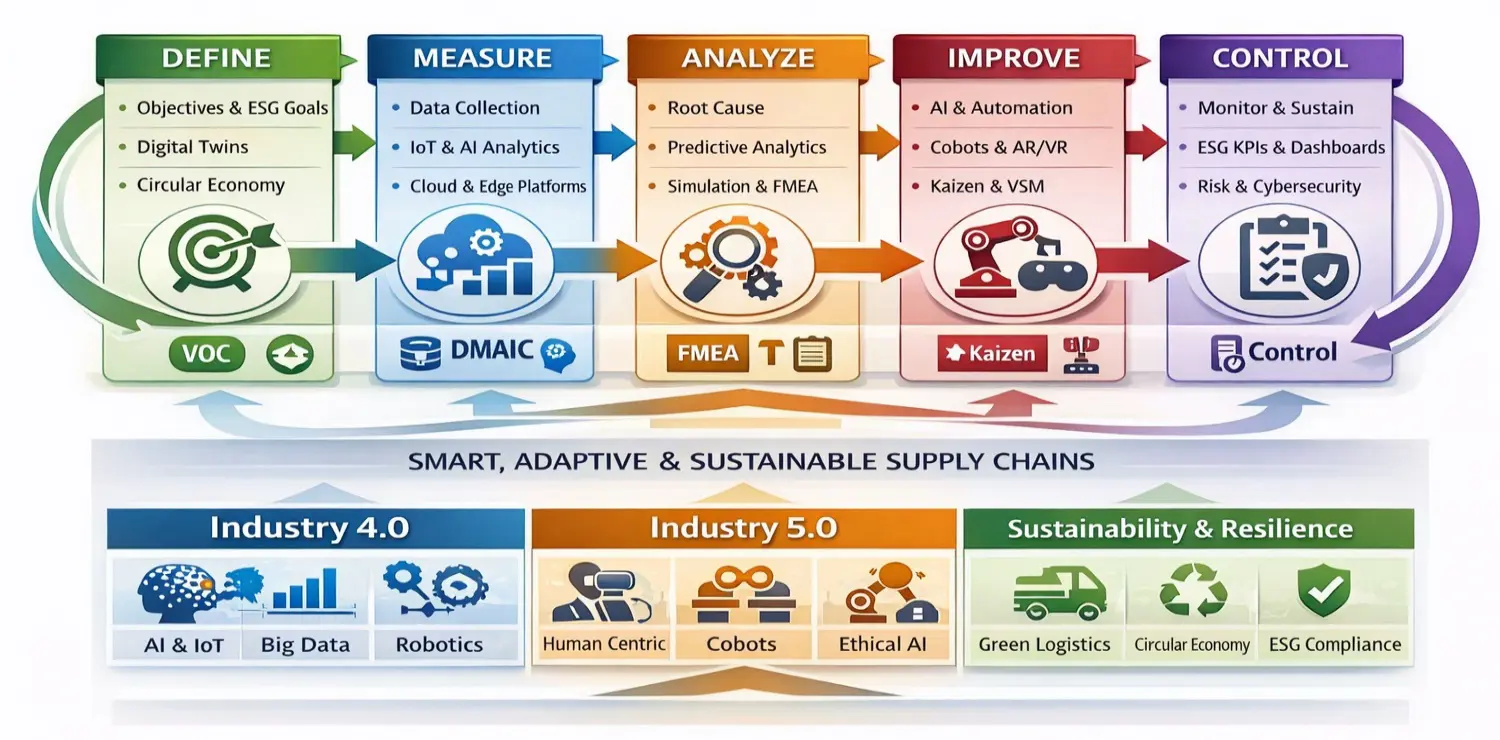
Figure 3 illustrates the integration of the Lean Six Sigma (LSS) DMAIC framework within Smart Supply Chain Management (SSCM), highlighting how each phase—Define, Measure, Analyze, Improve, and Control—is enabled by Industry 4.0/5.0 technologies and sustainability principles. Define sets objectives, ESG targets, and digital twin models; Measure captures real-time operational, environmental, and workforce data; Analyze applies root cause analysis and predictive analytics; Improve implements AI-driven optimization, automation, Cobots, AR/VR, and Lean tools; and control ensures continuous monitoring, ESG compliance, and risk management. Together, these elements create a data-driven, adaptive, resilient, and socially responsible supply chain capable of addressing complex operational, environmental, and societal challenges.
In conclusion, DMAIC-driven SSCM establishes a future-ready, integrated framework that unites structured process improvement, advanced digital technologies, and human-centered sustainability. By linking each DMAIC phase with Industry 4.0/5.0 capabilities and ESG objectives, organizations can develop supply chains that are efficient, adaptive, resilient, and socially responsible, bridging operational excellence with ethical and sustainable practices. This approach enhances process efficiency, enables predictive decision-making, fosters human-centered innovation, and provides a strategic roadmap for next-generation supply chain management.
5. Discussion
This study presents an integrated Smart Supply Chain Management (SSCM) framework that systematically combines Lean Six Sigma (LSS), Industry 4.0 (I4.0) digital technologies, and Industry 5.0 (I5.0) human-centric innovations. The framework addresses operational, technological, organizational, and socio-environmental challenges by providing a structured methodology for achieving efficiency, resilience, agility, and sustainability. Unlike existing models, it operationalizes interactions across layers, showing how process optimization, predictive intelligence, and human-centered practices work together to generate actionable outcomes.
Theoretical Significance: The SSCM framework contributes to supply chain theory by formalizing a multi-paradigm integration. LSS provides the operational foundation, driving process optimization, waste reduction, and quality improvement. I4.0 technologies—including AI, IoT, digital twins, cloud computing, and robotics—enable predictive analytics, real-time monitoring, and adaptive decision-making. I5.0 innovations, such as Cobots, AR/VR, human digital twins, and emotional AI, facilitate human-centered creativity, ethical governance, and collaborative decision-making. By embedding resilience, ESG principles, and circular economy practices alongside operational excellence, the framework extends digital supply chain literature beyond efficiency and automation, incorporating human-centric and sustainable dimensions.
Operationalization and Layer Integration: The framework provides practical guidance for implementation. LSS tools identify inefficiencies and quality gaps, I4.0 technologies provide predictive insights and automation, and I5.0 practices enhance workforce engagement, creativity, and ethical decision-making. ESG and circular economy objectives are integrated into processes to ensure alignment with organizational strategy and societal expectations. Operationalization occurs through continuous feedback loops: predictive analytics from I4.0 inform LSS-driven improvements, human-centered practices validate decisions, and real-time monitoring sustains adaptive performance. This transforms the SSCM framework from a conceptual model into an actionable roadmap for integrated, resilient, and socially responsible supply chains.
Strategic Benefits: Organizations adopting this framework can enhance agility and resilience through scenario planning, cross-functional coordination, and predictive insights, enabling rapid adaptation to disruptions. Competitive advantage is strengthened by combining operational excellence, predictive intelligence, and human-centric innovation, improving efficiency, service quality, and sustainability performance. The framework formalizes inter-layer interactions: the process layer (LSS) standardizes operations and identifies improvements, the technology layer (I4.0) provides real-time insights and automation, and the human-centric layer (I5.0) guides ethical decision-making, creativity, and collaboration. Together, these layers create continuous feedback loops connecting operational, strategic, and sustainability objectives, enabling adaptive and resilient supply chains.
DMAIC Implementation in SSCM: The DMAIC methodology operationalizes the framework. In the Define phase, organizations clarify objectives, identify critical processes, and align initiatives with ESG and circular economy principles. Measure captures operational, environmental, and human-centered performance using IoT, AI analytics, and workforce engagement. Analyze applies predictive analytics, simulations, and collaborative problem-solving to uncover inefficiencies and sustainability gaps. Improve implements AI-driven optimization, automation, Cobots, AR/VR, and Lean tools, while Control sustains improvements via real-time dashboards, predictive KPIs, ESG tracking, and workforce development. This structured approach transforms supply chains into intelligent, resilient, and socially responsible systems.
Limitations and Future Directions: While the framework offers theoretical and practical contributions, empirical validation is needed to assess scalability and effectiveness across industries. Longitudinal studies are required to evaluate sustained impacts on performance, resilience, and sustainability. Implementation challenges—including workforce readiness, multi-tier coordination, and human–digital integration—must be addressed. Ethical governance, AI accountability, and transparency mechanisms also need further development to ensure responsible adoption.
In conclusion, the proposed SSCM framework formalizes the integration of process optimization, predictive intelligence, and human-centric practices, offering both theoretical and practical guidance for next-generation supply chains. By linking operational excellence with ethical and sustainable practices, it enables organizations can develop adaptive, resilient, and globally competitive supply chains that are future-ready and socially responsible.
6. Conclusions and Future Research Directions
This study presents an integrated Smart Supply Chain Management (SSCM) framework that aligns Lean Six Sigma (LSS) methodologies with Industry 4.0 (I4.0) digital technologies and Industry 5.0 (I5.0) human-centric innovations, enabling supply chains that are intelligent, adaptive, resilient, and sustainable. The framework translates strategic objectives into actionable mechanisms and measurable outcomes, linking process excellence, digital intelligence, and human-centered value creation across complex supply networks. LSS provides the structured foundation for process optimization, quality improvement, and waste reduction. I4.0 technologies—including AI, IoT, digital twins, robotics, and cloud computing—enable real-time visibility, predictive analytics, and intelligent decision-making. I5.0 innovations, such as collaborative robots, AR/VR, human digital twins, and emotional AI, embed ethical, inclusive, and collaborative principles, enhancing workforce engagement, creativity, safety, and ergonomic performance. Cross-cutting enablers—supply chain integration, workforce development, institutional support, and cybersecurity—ensure alignment, scalability, and continuous improvement.
The framework operationalizes the DMAIC (Define–Measure–Analyze–Improve–Control) methodology to integrate process improvement with digital technologies, human-centric practices, and ESG objectives. In Define, critical processes and improvement opportunities are identified and aligned with sustainability targets. Measure captures operational, environmental, and workforce data through IoT, AI, and cloud platforms. Analyze applies predictive analytics and collaborative problem-solving to uncover inefficiencies and sustainability gaps. Improve implements AI-assisted optimization, automation, and human–machine collaboration. Control sustains improvements via predictive KPIs, ESG-aligned monitoring, and workforce training. This approach clarifies how LSS, I4.0, and I5.0 layers interact, operationalizing a multi-layered strategy that connects process excellence, digital intelligence, and human-centered value creation.
Theoretical Contributions: This study contributes to supply chain theory by conceptualizing a unified, multi-paradigm framework integrating LSS, I4.0, and I5.0. It extends operational excellence and digital supply chain literature by embedding human-centricity, ethical governance, resilience, and sustainability within a structured methodology, providing a foundation for empirical validation and formal theoretical development.
Practical Implications: For practitioners, the framework provides a structured roadmap for designing and implementing smart, resilient, and sustainable supply chains. It supports process optimization, predictive decision-making, quality improvement, waste reduction, and ESG alignment, translating strategic objectives into operational results.
Managerial Implications: Managers can use the framework to guide technology adoption, organizational transformation, and workforce empowerment. It enhances human–AI collaboration, strengthens risk and resilience management, and institutionalizes sustainability in multi-tier supply chains.
Study Limitations: The study is conceptual, based on literature and secondary data. Empirical validation is needed to assess effectiveness, adaptability, and performance impacts across industries, organizational sizes, and geographical regions.
Future Research Directions: Future research should empirically test and refine the framework through case studies, surveys, experiments, and longitudinal studies. Key areas include developing quantitative metrics for I5.0 adoption, exploring advanced human–AI collaboration, and assessing long-term impacts on sustainability, resilience, and operational performance. Further studies should examine applicability in emerging economies, high-risk or regulated industries, and culturally diverse supply chains. Advancing these directions will strengthen theoretical generalization and provide evidence-based guidance for intelligent, ethical, resilient, and sustainable supply chains in dynamic environments.
Statement of the Use of Generative AI and AI-Assisted Technologies in the Writing Process
The author acknowledges that ChatGPT (OpenAI) was used exclusively for language editing and stylistic refinement of the author’s text, including improvements to clarity, grammar, and academic tone. The tool was not used to generate original scholarly content, data, analyses, or references. The author has carefully reviewed and verified the final manuscript and accept full responsibility for its content.
Ethics Statement
Not applicable.
Informed Consent Statement
Not applicable.
Data Availability Statement
All data supporting this study are contained within the article.
Funding
This research received no external funding.
Declaration of Competing Interest
The author declares that he has no known competing financial interests or personal relationships that could have appeared to influence the work reported in this paper.
References
-
Barbosa FTA, Peruchi RS, Morioka SN, Rotella Junior P. Lean, six sigma and sustainability case studies on supply chain management: A systematic literature review. Rev. De Gestão E Secr. 2023, 14, 15509–15536. DOI:10.7769/gesec.v14i9.2806 [Google Scholar]
-
Fatorachian H, Kazemi H. Impact of Industry 4.0 on supply chain performance. Prod. Plan. Control 2021, 32, 63–81. DOI:10.1080/09537287.2020.1712487 [Google Scholar]
-
Gomaa AH. Boosting Supply Chain Effectiveness with Lean Six Sigma. Am. J. Manag. Sci. Eng. 2024, 9, 156–171. DOI:10.11648/j.ajmse.20240906.14 [Google Scholar]
-
Gomaa AH. Improving productivity and quality of a machining process by using lean six sigma approach: A case study. Eng. Res. J. 2024, 53, 1–16. DOI:10.21608/erjsh.2023.226742.1194 [Google Scholar]
-
Mahdikhani M. Total quality management and lean six sigma impact on supply chain research field: Systematic analysis. Total Qual. Manag. Bus. Excell. 2023, 34, 1921–1939. DOI:10.1080/14783363.2023.2214506 [Google Scholar]
-
Cui L, Wu H, Wu L, Kumar A, Tan KH. Investigating the relationship between digital technologies, supply chain integration and firm resilience in the context of COVID-19. Ann. Oper. Res. 2023, 327, 825–853. DOI:10.1007/s10479-022-04735-y [Google Scholar]
-
Gomaa AH. Optimizing Manufacturing Supply Chains Using a Strategic Lean Six Sigma Framework: A Case Study. Int. J. Inven. Eng. Sci. 2025, 12, 20–33. DOI:10.35940/ijies.F8211.12030325 [Google Scholar]
-
Talmoudi R. Supply Chain Management, Sustainability, Performance and Technology: A Bibliometric Analysis. J. Cult. Anal. Soc. Change 2025, 10, 2188–2203. DOI:10.64753/jcasc.v10i3.2734 [Google Scholar]
-
Gomaa AH. Improving Supply Chain Management Using Lean Six Sigma: A Case Study. Int. J. Appl. Phys. Sci. 2023, 9, 9–25. DOI:10.20469/ijaps.9.50002 [Google Scholar]
-
Gultom GDP, Wibisono E. A framework for the impact of lean six sigma on supply chain performance in manufacturing companies. In IOP Conference Series: Materials Science and Engineering; IOP Publishing: Bristol, UK, 2019; Volume 528, p. 012089. [Google Scholar]
-
Gomaa AH. Green Lean Six Sigma for Smart and Sustainable Manufacturing: A Comprehensive Review and Strategic Framework in the Industry 4.0–5.0 Era. Interdiscip. Syst. Glob. Manag. 2026, 2, 25–39. DOI:10.55578/isgm.2601.002 [Google Scholar]
-
Samper MG, Florez DG, Borre JR, Ramirez J. Industry 4.0 for sustainable supply chain management: Drivers and barriers. Procedia Comput. Sci. 2022, 203, 644–650. DOI:10.1016/j.procs.2022.07.094 [Google Scholar]
-
Leng J, Chen Z, Huang Z, Zhu X, Su H, Lin Z, et al. Secure blockchain middleware for decentralized iiot towards industry 5.0: A review of architecture, enablers, challenges, and directions. Machines 2022, 10, 858. DOI:10.3390/machines10100858 [Google Scholar]
-
Gomaa AH. SCM 4.0 Excellence: A Strategic Framework for Smart and Competitive Supply Chains. Int. J. Manag. Humanit. 2025, 11, 24–44. DOI:10.35940/ijmh.G1798.11080425 [Google Scholar]
-
Agrawal S, Agrawal R, Kumar A, Luthra S, Garza-Reyes JA. Can Industry 5.0 technologies overcome supply chain disruptions?—A perspective study on pandemics, war, and climate change issues. Oper. Manag. Res. 2024, 17, 453–468. DOI:10.1007/s12063-023-00410-y [Google Scholar]
-
Argyropoulou M, Garcia E, Nemati S, Spanaki K. The effect of IoT capability on supply chain integration and firm performance: An empirical study in the UK retail industry. J. Enterp. Inf. Manag. 2024, 37, 875–902. DOI:10.1108/JEIM-06-2022-0219 [Google Scholar]
-
Lewandowska A, Berniak-Woźny J, Ahmad N. Competitiveness and innovation of small and medium enterprises under Industry 4.0 and 5.0 challenges: A comprehensive bibliometric analysis. Equilibrium. Q. J. Econ. Econ. Policy 2023, 18, 1045–1074. DOI:10.24136/eq.2023.033 [Google Scholar]
-
Hmamed H, Cherrafi A, Garza-Reyes JA, Hamani N. Zero trust architecture for digital, sustainable, and resilient supply chains in the era of Industry 5.0/4.0. Supply Chain. Manag. Int. J. 2026, 31, 253–274. DOI:10.1108/SCM-05-2025-0387 [Google Scholar]
-
Khanum S, Firos A. Enhancing Supply Chain Management in Industry 5.0 with Fuzzy Artificial Intelligence. In Advanced Metaheuristics for Scheduling in Distributed Manufacturing Systems; IGI Global Scientific Publishing: Hershey, PA, USA, 2026; pp. 99–120. [Google Scholar]
-
Oubrahim I, Sefiani N, Happonen A. The influence of digital transformation and supply chain integration on overall sustainable supply chain performance: An empirical analysis from manufacturing companies in Morocco. Energies 2023, 16, 1004. DOI:10.3390/en16021004 [Google Scholar]
-
Duarte S, Cruz-Machado V. Green and lean supply-chain transformation: A roadmap. Prod. Plan. Control 2019, 30, 1170–1183. DOI:10.1080/09537287.2019.1595207 [Google Scholar]
-
Namjoshi J, Rawat M. Role of smart manufacturing in industry 4.0. Mater. Today Proc. 2022, 63, 475–478. DOI:10.1016/j.matpr.2022.03.620 [Google Scholar]
-
Kayikci Y. Sustainability impact of digitization in logistics. Procedia Manuf. 2018, 21, 782–789. DOI:10.1016/j.promfg.2018.02.184 [Google Scholar]
-
Solanki SM. Industry 4.0 and Smart Manufacturing: Exploring the integration of advanced technologies in manufacturing. Rev. Rev. Index J. Multidiscip. 2023, 3, 36–46. DOI:10.31305/rrijm2023.v03.n02.005 [Google Scholar]
-
Zheng P, Wang H, Sang Z, Zhong RY, Liu Y, Liu C, et al. Smart manufacturing systems for Industry 4.0: Conceptual framework, scenarios, and future perspectives. Front. Mech. Eng. 2018, 13, 137–150. DOI:10.1007/s11465-018-0499-5 [Google Scholar]
-
Yang H, Kumara S, Bukkapatnam ST, Tsung F. The internet of things for smart manufacturing: A review. IISE Trans. 2019, 51, 1190–1216. DOI:10.1080/24725854.2018.1555383 [Google Scholar]
-
Mittal S, Khan MA, Purohit JK, Menon K, Romero D, Wuest T. A smart manufacturing adoption framework for SMEs. Int. J. Prod. Res. 2020, 58, 1555–1573. DOI:10.1080/00207543.2019.1661540 [Google Scholar]
-
Tripathi V, Chattopadhyaya S, Mukhopadhyay AK, Saraswat S, Sharma S, Li C, et al. A novel smart production management system for the enhancement of industrial sustainability in Industry 4.0. Math. Probl. Eng. 2022, 2022, 6424869. DOI:10.1155/2022/6424869 [Google Scholar]
-
Davis J, Edgar T, Graybill R, Korambath P, Schott B, Swink D, et al. Smart manufacturing. Annu. Rev. Chem. Biomol. Eng. 2015, 6, 141–160. DOI:10.1146/annurev-chembioeng-061114-123255 [Google Scholar]
-
Supekar SD, Graziano DJ, Riddle ME, Nimbalkar SU, Das S, Shehabi A, et al. A framework for quantifying energy and productivity benefits of smart manufacturing technologies. Procedia CIRP 2019, 80, 699–704. DOI:10.1016/j.procir.2019.01.095 [Google Scholar]
-
Litster J, Bogle IDL. Smart process manufacturing for formulated products. Engineering 2019, 5, 1003–1009. DOI:10.1016/j.eng.2019.02.014 [Google Scholar]
-
Akbari M. Data-driven review of additive manufacturing on supply chains: Regionalization, key research themes and future directions. Comput. Ind. Eng. 2023, 184, 109600. DOI:10.1016/j.cie.2023.109600 [Google Scholar]
-
Rossini M, Powell DJ, Kundu K. Lean supply chain management and Industry 4.0: A systematic literature review. Int. J. Lean Six Sigma 2023, 14, 253–276. DOI:10.1108/IJLSS-05-2021-0092 [Google Scholar]
-
Gomaa AH. Achieving operational excellence in manufacturing supply chains using lean six sigma: A case study approach. Int. J. Lean Six Sigma 2025, 17, 614–648. DOI:10.1108/IJLSS-03-2024-0045 [Google Scholar]
-
Gera R, Yadav R, Khera GS, Saxena A, Chadha P, Dixit S, et al. A systematic literature review of supply chain management practices and performance. Mater. Today Proc. 2022, 69, 624–632. DOI:10.1016/j.matpr.2022.10.203 [Google Scholar]
-
Gomaa AH. Lean six sigma for improving supply chain management—A literature review. Glob. J. Res. Eng. Technol. 2022, 1, 018–031. DOI:10.58175/gjret.2022.1.1.0013 [Google Scholar]
-
Garcia-Buendia N, Moyano-Fuentes J, Maqueira-Marín JM, Cobo MJ. 22 Years of Lean Supply Chain Management: A science mapping-based bibliometric analysis. Int. J. Prod. Res. 2021, 59, 1901–1921. DOI:10.1080/00207543.2020.1794076 [Google Scholar]
-
Gomaa AH. LSS 4.0: A Conceptual Framework for Integrating Lean Six Sigma and Industry 4.0 for Smart Manufacturing Excellence. Indian J. Manag. Lang. 2025, 5, 8–29. DOI:10.54105/ijml.H1810.05010425 [Google Scholar]
-
Frazzon EM, Rodriguez CMT, Pereira MM, Pires MC, Uhlmann I. Towards supply chain management 4.0. Braz. J. Oper. Prod. Manag. 2019, 16, 180–191. DOI:10.14488/BJOPM.2019.v16.n2.a2 [Google Scholar]
-
Tjahjono B, Esplugues C, Ares E, Pelaez G. What does industry 4.0 mean to supply chain? Procedia Manuf. 2017, 13, 1175–1182. DOI:10.1016/j.promfg.2017.09.191 [Google Scholar]
-
De Vass T, Shee H, Miah SJ. The effect of “Internet of Things” on supply chain integration and performance: An organisational capability perspective. Australas. J. Inf. Syst. 2018, 22, 1–29. DOI:10.3127/ajis.v22i0.1734 [Google Scholar]
-
Wang Y, Yang Y, Qin Z, Yang Y, Li J. A literature review on the application of digital technology in achieving green supply chain management. Sustainability 2023, 15, 8564. DOI:10.3390/su15118564 [Google Scholar]
-
Helo P, Hao Y. Artificial intelligence in operations management and supply chain management: An exploratory case study. Prod. Plan. Control 2022, 33, 1573–1590. DOI:10.1080/09537287.2021.1882690 [Google Scholar]
-
Pant RR, Prakash G. Artificial intelligence enabled transparency traceability and performance framework for dairy supply chain networks for industry 5.0. In AI and Sustainable Transformations; CRC Press: Boca Raton, FL, USA, 2025; pp. 142–147. [Google Scholar]
-
Patel KR. Enhancing global supply chain resilience: Effective strategies for mitigating disruptions in an interconnected world. BULLET J. Multidisiplin Ilmu 2023, 2, 257–264. Available online: https://www.neliti.com/publications/592257/enhancing-global-supply-chain-resilience-effective-strategies-for-mitigating-dis (accessed on 28 Febuary 2023).
-
Hofmann E, Sternberg H, Chen H, Pflaum A, Prockl G. Supply chain management and Industry 4.0: Conducting research in the digital age. Int. J. Phys. Distrib. Logist. Manag. 2019, 49, 945–955. DOI:10.1108/IJPDLM-11-2019-399 [Google Scholar]
-
Leng J, Sha W, Wang B, Zheng P, Zhuang C, Liu Q, et al. Industry 5.0: Prospect and retrospect. J. Manuf. Syst. 2022, 65, 279–295. DOI:10.1016/j.jmsy.2022.09.017 [Google Scholar]
-
Alves J, Lima TM, Gaspar PD. Is industry 5.0 a human-centred approach? A systematic review. Processes 2023, 11, 193. DOI:10.3390/pr11010193 [Google Scholar]
-
Abd Elghany M, Elessawi N. The role of Industry 5.0 Internet of Things adoption on sustainable performance of manufacturing SMEs through the integration of supply chain. Discov. Comput. 2026, 29, 28. DOI:10.1007/s10791-025-09797-7 [Google Scholar]
-
Guo L, Sun D, Warraich MA, Waheed A. Does industry 5.0 model optimize sustainable performance of Agri-enterprises? Real-time investigation from the realm of stakeholder theory and domain. Sustain. Dev. 2023, 31, 2507–2516. DOI:10.1002/sd.2527 [Google Scholar]
-
Tiwari S. Supply chain integration and Industry 4.0: A systematic literature review. Benchmarking Int. J. 2021, 28, 990–1030. DOI:10.1108/BIJ-08-2020-0428 [Google Scholar]
-
Fraga-Lamas P, Lopes SI, Fernández-Caramés TM. Green IoT and edge AI as key technological enablers for a sustainable digital transition towards a smart circular economy: An industry 5.0 use case. Sensors 2021, 21, 5745. DOI:10.3390/s21175745 [Google Scholar]
-
Minculete G, Bârsan G, Olar P. Conceptual approaches of industry 5.0. Correlative elements with supply chain management 5.0. Rev. De Manag. Comp. Int. 2021, 22, 622–635. Available online: https://www.ceeol.com/search/article-detail?id=1047415 (30 December 2021). [Google Scholar]
-
Movahed AB, Movahed AB, Nozari H. Opportunities and challenges of smart supply chain in Industry 5.0. In Information Logistics for Organizational Empowerment and Effective Supply Chain Management; IGI Global Scientific Publishing: Hershey, PA, USA, 2024; pp. 108–138. [Google Scholar]
-
Jraisat L, Upadhyay A, Ghalia T, Jresseit M, Kumar V, Sarpong D. Triads in sustainable supply-chain perspective: Why is a collaboration mechanism needed? Int. J. Prod. Res. 2023, 61, 4725–4741. DOI:10.1080/00207543.2021.1936263 [Google Scholar]
-
Liu L, Song W, Liu Y. Leveraging digital capabilities toward a circular economy: Reinforcing sustainable supply chain management with Industry 4.0 technologies. Comput. Ind. Eng. 2023, 178, 109113. DOI:10.1016/j.cie.2023.109113 [Google Scholar]
-
Jakhar SK, Rathore H, Mangla SK. Is lean synergistic with sustainable supply chain? An empirical investigation from emerging economy. Resour. Conserv. Recycl. 2018, 139, 262–269. DOI:10.1016/j.resconrec.2018.08.019 [Google Scholar]
-
Liu Z, Costa C, Wu Y. Data-Driven Optimization of Production Efficiency and Resilience in Global Supply Chains. World J. Innov. Mod. Technol. 2024, 7, 47–57. DOI:10.53469/wjimt.2024.07(05).05 [Google Scholar]
-
Emon MMH, Khan T, Siam SAJ. Quantifying the influence of supplier relationship management and supply chain performance: An investigation of Bangladesh’s manufacturing and service sectors. Braz. J. Oper. Prod. Manag. 2024, 21, 2015. DOI:10.14488/BJOPM.2015.2024 [Google Scholar]
-
Mubarik MS, Khan SA. Firms Intellectual Capital and Digital Supply Chain Management. In The Theory, Methods and Application of Managing Digital Supply Chains; Emerald Publishing Limited: Leeds, UK, 2024; pp. 77–92. [Google Scholar]
-
Mhaskey SV. SCM 4.0: Navigating the Impact of Industry 4.0 on Supply Chain Management through Digitalization and Technology Integration. Int. J. Comput. Eng. Res. Trends 2024, 11, 1–12. DOI:10.22362/ijcert/2024/v11/i10/v11i1001 [Google Scholar]
-
Leng J, Zhong Y, Lin Z, Xu K, Mourtzis D, Zhou X, et al. Towards resilience in Industry 5.0: A decentralized autonomous manufacturing paradigm. J. Manuf. Syst. 2023, 71, 95–114. DOI:10.1016/j.jmsy.2023.08.023 [Google Scholar]
-
Alamsjah F, Yunus EN. Achieving supply chain 4.0 and the importance of agility, ambidexterity, and organizational culture: A case of Indonesia. J. Open Innov. Technol. Mark. Complex. 2022, 8, 83. DOI:10.3390/joitmc8020083 [Google Scholar]
-
Le TT, Nhu QPV, Behl A. Role of digital supply chain in promoting sustainable supply chain performance: The mediating of supply chain integration and information sharing. Int. J. Logist. Manag. 2025, 36, 1439–1462. DOI:10.1108/IJLM-01-2024-0031 [Google Scholar]
-
Fatima Z, Tanveer MH, Waseemullah, Zardari S, Naz LF, Khadim H, et al. Production plant and warehouse automation with IoT and industry 5.0. Appl. Sci. 2022, 12, 2053. DOI:10.3390/app12042053 [Google Scholar]
-
Ghosh S, Dagiuklas T, Iqbal M, Wang X. A cognitive routing framework for reliable communication in IoT for industry 5.0. IEEE Trans. Ind. Inform. 2022, 18, 5446–5457. DOI:10.1109/TII.2022.3141403 [Google Scholar]
-
Benitez GB, Ferreira-Lima M, Ayala NF, Frank AG. Industry 4.0 technology provision: The moderating role of supply chain partners to support technology providers. Supply Chain Manag. Int. J. 2022, 27, 89–112. DOI:10.1108/SCM-07-2020-0304 [Google Scholar]
-
Chauhan S, Singh R, Gehlot A, Akram SV, Twala B, Priyadarshi N. Digitalization of supply chain management with industry 4.0 enabling technologies: A sustainable perspective. Processes 2022, 11, 96. DOI:10.3390/pr11010096 [Google Scholar]
-
Fogaça D, Grijalvo M, Sacomano Neto M. An institutional perspective in the industry 4.0 scenario: A systematic literature review. J. Ind. Eng. Manag. 2022, 15, 309–322. DOI:10.3926/jiem.3724 [Google Scholar]
-
Alojaiman B. Technological modernizations in the industry 5.0 era: A descriptive analysis and future research directions. Processes 2023, 11, 1318. DOI:10.3390/pr11051318 [Google Scholar]
-
Gargari FJ, Saeidi-Mobarakeh Z, khalili HA. Synergizing industry 5.0 development factors into sustainable circular closed-loop supply chains through a hybrid approach: Case studies. Environ. Dev. Sustain. 2025, 1–43. DOI:10.1007/s10668-025-06835-8 [Google Scholar]
-
Gomaa AH. Transforming Manufacturing from Industry 4.0 to Industry 6.0: A Comprehensive Review, Gap Analysis, and Strategic Framework. Interdiscip. Syst. Glob. Manag. 2025, 1, 29–51. DOI:10.55578/isgm.2508.003 [Google Scholar]
-
Gupta S, Modgil S, Gunasekaran A, Bag S. Dynamic capabilities and institutional theories for Industry 4.0 and digital supply chain. In Supply Chain Forum: An International Journal; Taylor & Francis: Abingdon, UK, 2020; Volume 21, pp. 139–157. [Google Scholar]
-
Jamil MA, Mustofa R, Hossain NUI, Rahman SA, Chowdhury S. A structural equation modeling framework for exploring the industry 5.0 and sustainable supply chain determinants. Supply Chain Anal. 2024, 6, 100060. DOI:10.1016/j.sca.2024.100060 [Google Scholar]
-
Jauhar S, Tilasi P, Choudhary R. Integrating Lean Six Sigma and supply chain practices for improving the supply chain performance. Undergrad. Acad. Res. J. 2012, 1, 67–74. DOI:10.47893/UARJ.2012.1016 [Google Scholar]
-
Jraisat L, Jreissat M, Upadhyay A, Kumar A. Blockchain technology: The role of integrated reverse supply chain networks in sustainability. In Supply Chain Forum: An International Journal; Taylor & Francis: Abingdon, UK, 2023; Volume 24, pp. 17–30. [Google Scholar]
-
Nazarian H, Khan SA. The impact of industry 5.0 on supply chain performance. Int. J. Eng. Bus. Manag. 2024, 16, 18479790241297022. DOI:10.1177/18479790241297022 [Google Scholar]
-
Saif-Ur-Rehman K, Barson N, Hamdan YH. Industry 4.0 technologies and firm performance with digital supply chain platforms and supply chain capabilities. Pak. J. Commer. Soc. Sci. 2024, 18, 893–924. DOI:10.64534/Comm.2025.021 [Google Scholar]
-
Shashi, Cerchione R, Centobelli P, Shabani A. Sustainability orientation, supply chain integration, and SMEs performance: A causal analysis. Benchmarking Int. J. 2018, 25, 3679–3701. DOI:10.1108/BIJ-08-2017-0236 [Google Scholar]
-
Varriale V, Cammarano A, Michelino F, Caputo M. Industry 5.0 and triple bottom line approach in supply chain management: The state-of-the-art. Sustainability 2023, 15, 5712. DOI:10.3390/su15075712 [Google Scholar]