
How Internet Control Beliefs and Involvement Shape Older Adults’ Social Adaptation Through Differential Internet Use

How Internet Control Beliefs and Involvement Shape Older Adults’ Social Adaptation Through Differential Internet Use
Xueping Liu
1,†
 Heng Zhao
2,†
Xiaofei Mao
3,†
Huamao Peng
2,*
Jingxuan Wu
2
Heng Zhao
2,†
Xiaofei Mao
3,†
Huamao Peng
2,*
Jingxuan Wu
2
Received: 26 January 2026 Revised: 24 February 2026 Accepted: 27 March 2026 Published: 09 April 2026

© 2026 The authors. This is an open access article under the Creative Commons Attribution 4.0 International License (https://creativecommons.org/licenses/by/4.0/).
1. Introduction
The “Healthy China 2030” initiative highlights the critical need to enhance digital inclusion for aging populations, as evidenced by China’s rapid growth to 161 million Internet users aged 60+ (52.0% penetration rate in 2025, up from 43.2% in 2021) [1], achieved through national strategies like the Smart Health and Elderly Care Promotion Catalog (2024). While successful aging in digital societies necessitates effective adaptation, older adults encounter multifaceted barriers to social adaptation. These challenges stem not only from biological constraints (e.g., age-related cognitive declines) [2], psychosocial barriers (e.g., computer anxiety) [3], and structural limitations (e.g., inaccessible designs) [4], but also from their non-digital-native status [5]. Having missed early-life technology immersion, they lack the intuitive digital literacy that enables younger generations to adopt technology seamlessly, thereby compounding existing adaptation difficulties [6,7]. Paradoxically, while the Internet has become indispensable for social participation, empirical investigations into its specific impacts on older adults’ sociocultural adaptation remain strikingly limited. Although prior research has demonstrated the Internet’s potential to foster social engagement [8] and enhance social inclusion through resource accessibility [9], these studies have largely focused on superficial connectivity metrics rather than examining the complex mechanisms underlying adaptation processes. To address this critical gap, our study applies the Theory of Planned Behavior (TPB) [10] to examine (1) whether different types of Internet use exert differential effects on older adults’ social adaptation, and (2) the psychological mechanisms through which Internet control beliefs and involvement affect adaptation via differential Internet use. This dual focus helps to advance theoretical understanding of digital engagement in aging populations while informing targeted inclusion strategies.
The adaptation process in aging populations comprises two theoretically distinct but functionally interrelated domains: sociocultural adaptation (referring to behavioral competencies in navigating changing social environments) and psychological adaptation (pertaining to emotional regulation and subjective well-being maintenance) [11,12,13]. While successful aging frameworks emphasize that maintaining social engagement and adaptive functioning is essential for well-being in later life [14,15], existing research has predominantly focused on the psychological benefits of Internet use among older adults—such as loneliness reduction [16] and enhanced emotional resilience [17]—leaving the sociocultural adaptation dimension critically understudied. Critical gaps persist in understanding whether distinct patterns of Internet engagement exert differential effects on older adults’ social adaptation [18]. These conceptual limitations are compounded by two persistent methodological issues that may contribute to inconsistent findings across studies [17,19]. First, many studies rely on an oversimplified, unidimensional conceptualization of Internet use [20], which fails to capture the behavioral diversity inherent in various online activities. Second, prevailing measurement approaches often depend on crude proxies—such as the number of digital devices owned or a simple binary indicator of Internet access [21]. Such measures neglect critical dimensions, including usage intensity, functional diversity, and qualitative aspects of engagement, all of which are known to mediate psychosocial outcomes [22]. Consequently, despite growing interest in this area, few studies have systematically examined whether varied Internet use behaviors exhibit differential associations with social adaptation outcomes in older adult populations.
To systematically address these research gaps, our study adopts a typological approach to investigate the heterogeneous relationships between Internet use modalities and adaptation outcomes in older adults. Building upon extensive empirical evidence [16,20,22,23], we operationalize Internet engagement into four theoretically distinct dimensions: (1) informational use (e.g., accessing online news and health information) [22,24], (2) social use (e.g., maintaining interpersonal connections through digital platforms) [16,25], (3) instrumental use (e.g., conducting digital transactions including online banking, mobile payments, and utility bill payments) [26], and (4) recreational use (e.g., engaging with digital entertainment and creating digital contents) [20,27].
Existing research suggests these modalities exert differential psychosocial influences through distinct mechanisms. Informational use contributes to subjective well-being by reducing anxiety through knowledge access while enhancing health literacy and social awareness [22,24]. However, older users face particular challenges in navigating online misinformation [28] and derive less emotional satisfaction from passive information consumption [20]. Consequently, informational use may exhibit weaker associations with social adaptation, as its passive nature and limited emotional resonance constrain its adaptive potential. Social use operates primarily through relationship maintenance—enabling strong tie preservation and weak tie reactivation [16,25]—which can mitigate loneliness. Yet excessive online engagement may displace face-to-face interactions [29], disrupting digital-life balance [30,31,32]. This duality suggests social use may show inconsistent associations with social adaptation, as offline displacement may offset relationship benefits. Instrumental use supports independent living by facilitating essential daily activities [26], helping older adults to solve practical problems and maintain functional independence [33]. Instrumental use is theorized to enhance social adaptation through gains in practical autonomy [34], suggesting a positive association with adaptation outcomes. Recreational use offers robust psychological benefits, combining cognitive protection through mental stimulation with mood regulation via enjoyable activities [20,27]. Creative self-expression through content sharing enhances self-esteem and social bonding [35,36]. By fulfilling emotional needs and strengthening social connections, recreational use is theorized to support social adaptation through socioemotional pathways, pointing to a positive association with adaptation outcomes. Despite these insights, literature remains inconsistent regarding the impacts of Internet use on older adults, particularly concerning social adaptation. Our study addresses this gap by comprehensively examining how these four Internet use modalities differentially associate with social adaptation outcomes in older adults.
To systematically examine the psychosocial determinants (e.g., intrinsic motivation, beliefs, and attitudes toward technology) and adaptive consequences of Internet use among older adults, we begin with a critical evaluation of dominant technology adoption paradigms. While the Technology Acceptance Model (TAM) [37,38] and the Unified Theory of Acceptance and Use of Technology (UTAUT) [39,40] have been widely applied, their organizational origins limit their capacity to explain the complex socioemotional motivations—such as social connectivity, leisure pursuits, and mitigating social isolation—underlying older adults’ digital engagement [41,42]. TAM, though parsimonious in predicting technology acceptance through perceived usefulness and ease of use [37,38], is rooted in workplace settings where task performance is the primary concern. Its task-oriented focus thus fails to capture the emotionally meaningful goals that, according to Socioemotional Selectivity Theory [42], increasingly drive behavior in later life. UTAUT, while more comprehensive in incorporating social influence and facilitating conditions [39,40], retains an organizational origin and emphasizes the prediction of adoption intentions rather than the psychological mechanisms linking beliefs to behavioral outcomes. Critically, neither model explicitly incorporates perceived behavioral control—a construct of particular salience for older populations navigating age-related challenges such as declining self-efficacy or physical limitations in digital environments. Domain-specific frameworks like Internet Locus of Control (I-LOC) offer valuable insights into perceived control online [43], yet they do not account for the attitudinal dimension—namely, the personal relevance and motivational significance of online activities—that is equally critical to understanding older adults’ digital engagement. The TPB [10] addresses this gap by providing a comprehensive foundation that explicitly encompasses both control-related and attitudinal determinants—perceived behavioral control and attitude—which we operationalize as Internet control beliefs and Internet involvement, respectively. These theoretical advantages position TPB as an particularly suitable framework for examining how older adults’ control beliefs and attitudes translate into diverse digital engagement patterns [10]. Moreover, recent scholarship on behavioral and motivational aging reinforces this theoretical choice by highlighting the role of motivational processes in information communication technology engagement [44], the relevance of social norms and perceived factors among Chinese older adults [45], and the impact of aging attitudes on technology adoption [46]—all of which align with the core focus of our study.
Within the TPB framework, we focus on two constructs that operationalize key components in the digital domain: Internet control beliefs and Internet involvement. Internet control beliefs capture individuals’ perceptions of their capability to navigate online environments, encompassing both personal mastery (one’s sense of behavioral efficacy in using digital technologies) and perceived constraints (awareness of external barriers that may hinder Internet use). This construct directly corresponds to the perceived behavioral control dimension of TPB [47]. Complementing this, Internet involvement represents the attitudinal component, defined as the perceived personal relevance of Internet activities based on inherent needs, values, and interests [48,49,50]. It is important to note that while TPB also includes subjective norms and behavioral intention as core constructs, the present study does not directly measure these components. Rather than testing the full TPB model, we employ the theory as a conceptual foundation for understanding how control beliefs and attitudes may shape older adults’ internet usage behaviors, which in turn relate to social adaptation outcomes. This selective focus is justified by our research aim to examine the psychological precursors (control and attitudes) and behavioral patterns that are most directly relevant to adaptation among older adults.
Empirical evidence underscores the significant role of Internet control beliefs among older adults, demonstrating positive associations with both proficiency and frequency of Internet use [51]. These beliefs inform not only initial barriers to technology adoption [52] but also engagement patterns in specific online activities [53], aligning with the I-LOC framework [43], which emphasizes the critical role of perceived control—whether internal (e.g., self-efficacy in solving online tasks) or external (e.g., attributing success to luck or algorithms)—in shaping online behaviors. Internet involvement has similarly been identified as a predictor of various online activities, including social media use [54] and e-commerce participation [55]. The relationship between control beliefs and involvement is supported by self-efficacy theory [56], which posits that efficacy beliefs influence cognitive and affective processes. Empirical studies confirm that individuals with higher self-efficacy develop more positive attitudes toward technology, as evidenced in contexts such as healthcare technology adoption [57] and general computer use [58]. This reinforces the proposition that control beliefs shape technology-related attitudes. Within the TPB framework, attitude constitutes a key predictor of behavioral intention and subsequent behavior. Accordingly, it is theoretically warranted to conceptualize Internet involvement—as an attitudinal factor—as a mediator between Internet control beliefs and Internet usage behaviors.
Therefore, building on the TPB framework, our study innovatively examines the dual influences of Internet control beliefs and involvement on older adults’ digital engagement, while systematically tracing their downstream effects on social adaptation through behavioral mediators. Grounded in the TPB’s core propositions that perceived behavioral control and attitude shape subsequent behavior [10], we propose that Internet control beliefs (operationalizing perceived behavioral control) and Internet involvement (operationalizing attitude) will be associated with various types of Internet use, which in turn will be associated with social adaptation outcomes.
Building upon the theoretical framework and empirical evidence [59,60], we propose the following hypotheses:
H1. Distinct types of Internet use will be differentially associated with social adaptation among older adults.
H2. Internet control beliefs and Internet involvement will each be positively associated with the four types of Internet use.
H3. The associations of Internet control beliefs and Internet involvement with social adaptation will be mediated by Internet use behaviors.
2. Methods
2.1. Participants and Procedures
Our study sample comprised 405 community-dwelling older adults aged 60 years and above. The primary cohort consisted of 332 neurologically healthy participants recruited from communities in Beijing, each of whom completed comprehensive one-on-one interviews conducted either in person or by telephone. To enhance geographic diversity, we supplemented this sample with 73 additional participants recruited nationwide through Credamo (https://www.credamo.com/, accessed date: 1 June 2024), a validated online research platform specializing in Chinese populations. Following standard quality control procedures, we excluded 17 participants who either failed embedded attention checks or did not complete the survey, yielding a final analytical sample of 388 participants. The age range of our final sample spanned from 60 to 83 years (M ± SD = 64.85 ± 3.70), with complete demographic characteristics detailed in Table 1.
Table 1. Participants’ descriptive information.
|
Variable |
Category |
Frequency |
Percentage (%) |
|---|---|---|---|
|
Gender |
Male |
138 |
35.6 |
|
Female |
250 |
64.4 |
|
|
Household income per month |
4999 CNY or below |
189 |
48.7 |
|
5000–9999 CNY |
154 |
39.7 |
|
|
10,000 CNY or above |
45 |
11.6 |
|
|
Education |
Middle school or below |
102 |
26.3 |
|
High school |
183 |
47.2 |
|
|
Bachelor degree or above |
103 |
26.5 |
|
|
Living status |
Living alone |
30 |
7.7 |
|
Living with children and spouse |
39 |
10.1 |
|
|
Living with spouse only |
264 |
68.0 |
|
|
Living with children only |
55 |
14.2 |
|
|
Self-rated health status |
Poor/Not good |
12 |
3.1 |
|
Fair |
131 |
33.8 |
|
|
Good/Very good |
245 |
63.1 |
Note. N = 388; CNY = Chinese Yuan Renminbi.
2.2. Measures
2.2.1. Internet Use
Internet use frequency was assessed using a culturally adapted 31-item checklist based on Rosell et al.’s framework and tailored to the digital behaviors of older Chinese adults [22]. The development process incorporated: (1) in-depth interviews with 27 adults aged 60+ to identify context-relevant activities, and (2) insights from the 2018 Research Report on Middle-aged and Elderly People’s Internet Life (Institute of Sociology in Chinese Academy of Social Sciences and Tencent Social Research Center). The instrument captures four distinct domains: informational use (5 items; e.g., “Read online news”), social use (8 items; e.g., “Chat on WeChat”), instrumental use (10 items; e.g., “Book train/plane tickets online”), and recreational use (8 items; e.g., “Record and upload short videos”). Participants indicated their usage frequency on a 5-point Likert scale ranging from 1 (very rarely) to 5 (very frequently). Given the behavioral and frequency-based nature of the measure, test–retest reliability over a 10-day interval served as the primary validation metric, yielding satisfactory stability coefficients: informational = 0.79; social = 0.72; instrumental = 0.89; recreational = 0.81. Internal consistency (Cronbach’s α) was also robust across subscales: α = 0.82 (informational), 0.88 (social), 0.88 (instrumental), and 0.88 (recreational), supporting the reliability of the scale for use with older Chinese adults. The full item set is provided in Supplementary Material.
2.2.2. Social Adaptation
Social adaptation was measured using a 9-item Social Adaptation Scale adapted from the China Longitudinal Aging Social Survey (CLASS; http://class.ruc.edu.cn, accessed date: 1 May 2024) [61]. This scale was specifically modified for older adult populations to assess two key dimensions: (1) adaptation to macro-level social changes (e.g., “Social changes are occurring too rapidly for me to adapt”), and (2) adjustment to micro-level role transitions (e.g., “I continue to be a valuable contributor to society”). Participants rated each item on a 5-point Likert scale ranging from 1 (strongly disagree) to 5 (strongly agree), with four reverse-scored items to control for response bias. Scale scores were computed as the mean of all items after appropriate reverse coding, where higher scores reflect better social adaptation outcomes. Psychometric evaluation revealed acceptable internal consistency (α = 0.76) in our sample, supporting the scale’s reliability for use with older Chinese adults.
2.2.3. Internet Control Beliefs
Internet control beliefs were assessed using a culturally adapted Chinese version of the Sense of Control Scale [62], which underwent rigorous translation procedures including forward-translation, back-translation, and cultural adaptation for older Internet users. The final 12-item instrument utilizes a 7-point Likert scale (1 = strongly disagree to 7 = strongly agree) and measures two theoretically distinct but related dimensions: personal mastery (4 items assessing perceived competence in Internet use, e.g., “Using the Internet, I can do anything I set my mind to”) and perceived constraints (8 reverse-scored items evaluating external limitations, e.g., “What happens online is often out of my control”). Scale scoring involved computing dimension means after reverse-coding constraint items, with higher composite scores indicating stronger Internet control beliefs. Psychometric evaluation demonstrated strong reliability: excellent internal consistency for both personal mastery (α = 0.86) and perceived constraints (α = 0.89) subscales, with good overall reliability (α = 0.88). Test-retest reliability over a 10-day interval was strong for personal mastery (r = 0.87) and acceptable for perceived constraints (r = 0.66), consistent with previous findings that perceived environmental constraints show greater temporal variability than internal mastery beliefs [63,64].
2.2.4. Internet Involvement
Internet involvement was measured using a culturally adapted Chinese version of the Personal Involvement Inventory [48,50], which was carefully translated from the original English version through a rigorous translation and back-translation process. During cultural adaptation, one item (“uninvolving-involving”) was removed due to its ambiguous meaning in Chinese, resulting in a refined 9-item scale. The measure employs a 7-point semantic differential scale, in which participants rated their perceptions of the Internet across nine bipolar adjective pairs: unimportant-important, boring-interesting, irrelevant-relevant, unexciting-exciting, meaningless-meaningful, unappealing-appealing, ordinary-fascinating, worthless-priceless, and unnecessary-necessary. Scale scores were calculated by averaging responses across all items, with higher mean scores indicating greater Internet involvement. In the current study, the adapted scale demonstrated excellent psychometric properties, showing high internal consistency (α = 0.95) and strong test-retest reliability over a 10-day interval (r = 0.89).
2.3. Data Analysis
All analyses were performed using Mplus 8.3 [65]. The analytical procedure comprised four main stages: First, descriptive statistics and correlations were computed for core study variables, including Internet use types (informational, social, instrumental, recreational), Internet control beliefs, Internet involvement, and social adaptation. Second, structural equation modeling (SEM) was conducted following Anderson and Gerbing’s two-step approach [66]. A confirmatory factor analysis (CFA) specified the four Internet use types as latent variables, based on the theoretical rationale that these behavioral patterns represent underlying dimensions of digital engagement [22]. Other constructs (Internet control beliefs, Internet involvement, social adaptation) were treated as observed variables, as they were measured using established reflective scales in which items serve as effect indicators of the latent construct. Third, the full structural model was estimated, incorporating both latent and observed variables. Model fit was assessed using standard criteria: CFI and TLI ≥ 0.90, RMSEA ≤ 0.08, and SRMR ≤ 0.08. Bootstrap resampling with 3000 draws was used to estimate bias-corrected confidence intervals for indirect effects. Fourth, nested model comparisons were conducted by constraining parallel paths (e.g., instrumental vs. recreational use effects) and evaluating χ2 difference tests to examine whether associations varied significantly across Internet use types.
2.4. Sensitivity Power Analysis
We conducted a sensitivity power analysis based on Fritz and MacKinnon’s [67] recommendations for mediation analysis with bias-corrected bootstrap methods. With our sample size of N = 388, the analysis indicated that we had adequate power (≥0.80) to detect hypothesized indirect effects assuming a small effect for α paths (0.14) and a small-to-medium effect for β paths (0.26)—the SH combination in Fritz and MacKinnon’s table, which requires 377 observations. This threshold is met by the current sample.
3. Results
3.1. Descriptive Statistics and Intercorrelations Among Study Variables
Table 2 presents descriptive statistics (means and standard deviations) and correlations among core study variables. Analysis revealed that among the four Internet use types, social use demonstrated the highest frequency, whereas recreational use showed the lowest engagement level. Importantly, all measured constructs—including informational, social, instrumental, and recreational Internet use, Internet involvement, Internet control beliefs, and social adaptation—exhibited statistically significant positive intercorrelations.
Table 2. Descriptive statistics and Pearson correlations for core study variables.
|
1 |
2 |
3 |
4 |
5 |
6 |
7 |
|
|---|---|---|---|---|---|---|---|
|
1. Informational use |
1 |
||||||
|
2. Social use |
0.53 *** |
1 |
|||||
|
3. Instrumental use |
0.56 *** |
0.49 *** |
1 |
||||
|
4. Recreational use |
0.59 *** |
0.56 *** |
0.61 *** |
1 |
|||
|
5. Internet involvement |
0.40 *** |
0.32 *** |
0.35 *** |
0.31 *** |
1 |
||
|
6. Internet control beliefs |
0.40 *** |
0.31 *** |
0.43 *** |
0.41 *** |
0.39 *** |
1 |
|
|
7. Social adaptation |
0.33 *** |
0.27 *** |
0.37 ** |
0.37 ** |
0.36 *** |
0.50 *** |
1 |
|
Mean |
3.56 |
3.74 |
2.93 |
2.72 |
5.95 |
4.44 |
3.75 |
|
SD |
0.84 |
0.82 |
0.99 |
0.92 |
0.96 |
1.07 |
0.58 |
Note. N = 388; ** p < 0.01, *** p < 0.001. The four Internet use variables are presented as observed composites in this correlation table but were specified as latent constructs in the subsequent structural equation model.
3.2. The Relationships of Internet Control Beliefs, Internet Involvement, Different Types of Internet Use, and Social Adaptation
We first established a measurement model using CFA, which conceptualized the four types of Internet use as latent variables to capture their multidimensional structure and reduce measurement error bias. The model demonstrated good fit to the data: χ2 = 930.06, df = 418, χ2/df = 2.23, CFI = 0.92, TLI = 0.91, RMSEA = 0.056 (90%CI [0.051, 0.061]), and SRMR = 0.057. Following conventional guidelines [68], the CFI and TLI values approach the recommended threshold of 0.95, while the RMSEA falls within the acceptable range (<0.08), collectively indicating adequate model fit.
Building on this validated measurement model, we tested a comprehensive structural equation model incorporating: (a) the four Internet use latent variables, (b) core theoretical constructs (Internet control beliefs, Internet involvement, and social adaptation), and (c) demographic covariates significantly associated with social adaptation (age, health, income, and education). Consistent with their measurement properties, health, income, and education were specified as categorical variables in Mplus to appropriately handle their non-continuous nature and minimize potential measurement bias. The model simultaneously estimated both direct effects from psychological antecedents to adaptation outcomes and indirect effects mediated through the differential Internet use patterns. The overall model fit was acceptable: χ2 = 1244.42, df = 642, χ2/df = 1.94, CFI = 0.90, TLI = 0.89, RMSEA = 0.049 (90%CI [0.045, 0.053]); SRMR = 0.055. While the CFI and TLI values fall slightly below the conventional 0.95 threshold [68], the RMSEA and SRMR indices suggest reasonable fit. We interpret these fit indices collectively as indicating acceptable model fit, acknowledging that the CFI and TLI values suggest potential areas for model refinement. Additionally, given the sensitivity of the chi-square statistic to sample size [69], we rely primarily on the approximate fit indices for model evaluation.
Figure 1 summarizes the key results of the path analysis. Internet control beliefs demonstrated significant positive effects on both Internet involvement (β = 0.35, p < 0.001) and all four Internet use types: informational (β = 0.28, p < 0.001), social (β = 0.20, p < 0.01), instrumental (β = 0.31, p < 0.001), and recreational (β = 0.32, p < 0.001), providing support for H2. Similarly, Internet involvement was positively associated with each type of Internet use: informational (β = 0.28, p < 0.001), social (β = 0.20, p < 0.01), instrumental (β = 0.18, p < 0.01), and recreational (β = 0.14, p < 0.01), in support of H2. Notably, only instrumental use (β = 0.22, p < 0.01) and recreational use (β = 0.17, p < 0.05) significantly predicted social adaptation, whereas informational (β = 0.18, p = 0.07) and social use (β = −0.01, p = 0.92) showed no significant effects, consistent with H1.
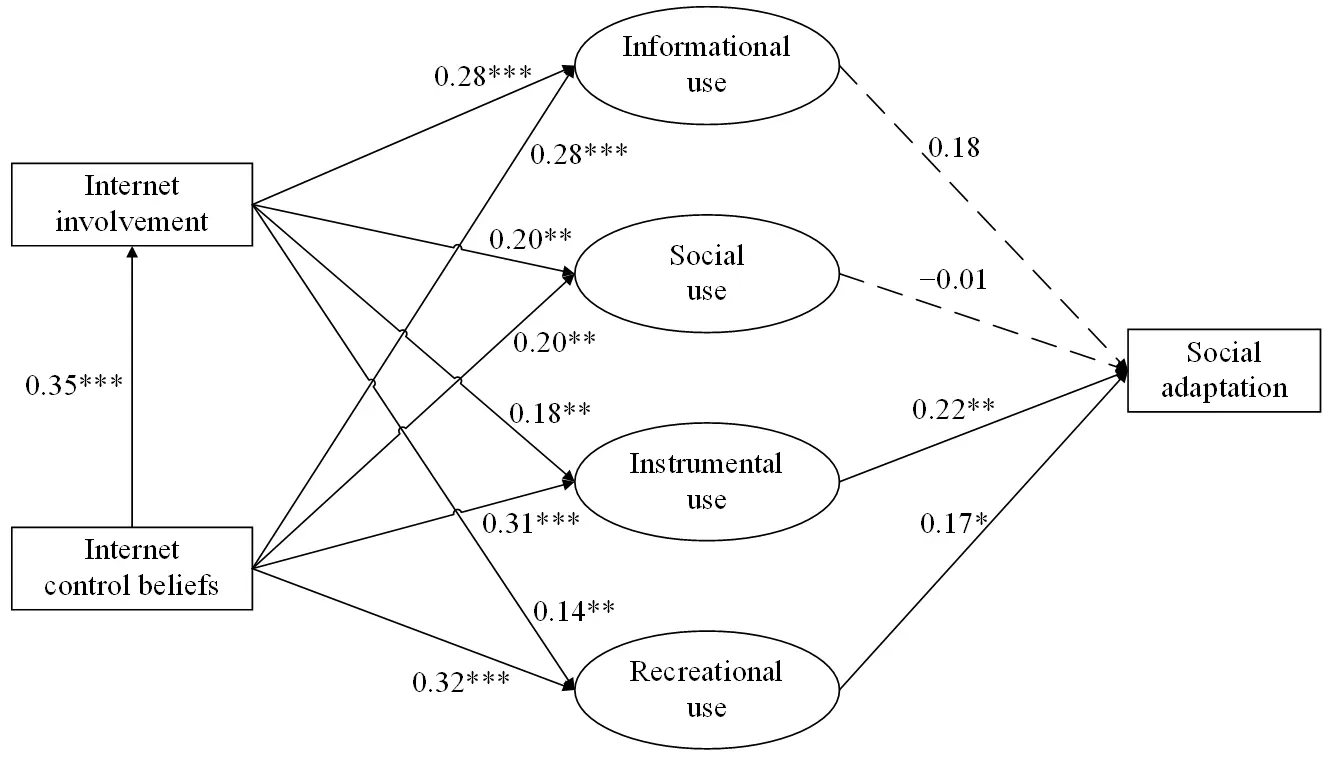
Figure 1. The relationships of Internet control beliefs, Internet involvement, different types of Internet use, and social adaptation. Note: The values presented in the figure represent standardized path coefficients (direct effects) derived from the structural equation model. For detailed results regarding indirect effects, please refer to Table 3. * p < 0.05, ** p < 0.01, *** p < 0.001.
As shown in Table 3, the mediation analysis supported H3, revealing six significant indirect effects with bootstrap confidence intervals excluding zero. Specifically, Internet control beliefs indirectly influenced social adaptation through instrumental use and recreational use, respectively. Internet involvement showed similar indirect effects through both types of Internet use. Moreover, two serial mediation pathways were identified: Internet control beliefs influenced social adaptation sequentially via Internet involvement and instrumental use, as well as via Internet involvement and recreational use.
Table 3. Indirect effects of Internet use on the relationships between Internet control beliefs, Internet involvement, and social adaptation.
|
Model Paths |
Indirect Effect |
95%CI |
|---|---|---|
|
Internet control beliefs→Instrumental use→Social adaptation |
0.069 |
[0.013, 0.140] |
|
Internet control beliefs→Recreational use→Social adaptation |
0.054 |
[0.005, 0.122] |
|
Internet involvement→Instrumental use→Social adaptation |
0.039 |
[0.008, 0.080] |
|
Internet involvement→Recreational use→Social adaptation |
0.024 |
[0.001, 0.060] |
|
Internet control beliefs→Internet involvement→Instrumental use→Social adaptation |
0.013 |
[0.003, 0.030] |
|
Internet control beliefs→Internet involvement→Recreational use→Social adaptation |
0.008 |
[0.000, 0.022] |
Comparative analyses of the differences between instrumental and recreational Internet use across multiple influence pathways on social adaptation revealed no statistically significant differences. Specifically, the direct effect of instrumental use was not significantly greater than that of recreational use (t = 0.015, p = 0.87). Similarly, no significant differences were observed in the indirect effects of Internet control beliefs on adaptation—whether mediated through instrumental or recreational use (t = 0.008, p = 0.75). The indirect effect of Internet involvement, mediated by these two types of use, also did not differ significantly (t = 0.009, p = 0.56). Furthermore, the serial mediation effect of Internet control beliefs through Internet involvement and subsequently through either type of Internet use showed no significant difference (t = 0.003, p = 0.75). These consistently non-significant findings across all pathways indicate that instrumental and recreational Internet use contribute equally to social adaptation among older adults, suggesting that both play comparably important and statistically equivalent roles in promoting adaptive outcomes.
4. Discussion
Against the backdrop of China’s rapidly aging population and its ongoing digital transformation, this study provides timely evidence on how Internet engagement is associated with social adaptation among older Chinese adults. Framed by the Theory of Planned Behavior, the research advances current understanding by investigating two key psychological antecedents—Internet control beliefs and involvement—and their role in shaping four distinct types of Internet use (informational, social, instrumental, and recreational), which in turn, show differential associations with social adaptation. Regarding H1, which proposed differential associations between Internet use types and social adaptation, instrumental and recreational use demonstrated positive associations with social adaptation, whereas informational and social use exhibited weaker associations. Regarding H2, which proposed positive associations between psychological antecedents and Internet use types, Internet control beliefs and Internet involvement were positively associated with all four types of Internet use. Regarding H3, which proposed mediation pathways, the associations of control beliefs and involvement with social adaptation were mediated by instrumental and recreational use, but not by informational or social use. Taken together, these findings advance theoretical understanding of the differentiated pathways through which psychological antecedents relate to social adaptation via distinct Internet use behaviors.
4.1. Differential Associations of Internet Use Types with Social Adaptation (H1 and H3)
This study advances our understanding of how functionally distinct Internet behaviors differentially correspond to social adaptation in older adults. Moving beyond monolithic conceptualizations of Internet use, we developed and validated a multidimensional scale that captures the complexity of older adults’ digital engagement with greater precision. Our findings demonstrate that while all four types of Internet use show positive correlations with social adaptation—with instrumental and recreational use exhibiting stronger relationships (supporting H1)—only these two usage types emerge as significant mediators between psychological antecedents (Internet control beliefs and involvement) and adaptation outcomes, whereas informational and social use do not (supporting H3).
The finding that instrumental use mediates the link between psychological antecedents and social adaptation may be understood through its capacity to address essential survival needs and bolster practical competence [33]. Older adults with stronger Internet control beliefs and greater involvement tend to be better equipped to engage in instrumental activities such as online banking, shopping, and accessing transportation services. These activities, in turn, may be connected to enhanced social adaptation through their potential to enable individuals to maintain independence and solve practical daily problems [33]. This mediating role appeared especially salient during public health emergencies like the COVID-19 pandemic, where instrumental Internet use was vital for sustaining independence while reducing exposure to health risks [70]. Theoretically, instrumental use represents a generative form of Internet behavior [54], characterized by proactive engagement that yields concrete outcomes. Taken together, these findings suggest that control beliefs and involvement may translate into adaptive benefits through their affiliation with instrumental activities that enhance practical autonomy and functional independence [54].
Recreational use similarly mediates the pathways between psychological antecedents and social adaptation, though potentially through distinct mechanisms rooted in socioemotional processes. Consistent with Socioemotional Selectivity Theory’s emphasis on emotionally meaningful goals [64], older adults with stronger Internet control beliefs and greater involvement tend to gravitate toward leisure-oriented online activities rather than information-seeking behaviors. Notably, recreational use encompasses a spectrum of engagement—from passive consumption (e.g., watching videos) to active creation (e.g., sharing digital content)—which may carry different implications for adaptation [32,33]. Active recreational pursuits—such as creating and sharing digital content—may foster self-worth and strengthen social connectedness [32,33], thereby channeling psychological antecedents into socioemotional benefits that correspond to adaptation. In contrast, informational use did not emerge as a significant mediator, aligning with its weaker direct tie to adaptation. This pattern may be explained by older adults’ challenges in verifying online information [28] and their tendency to derive less emotional gratification from passive knowledge acquisition compared to younger users [64]. These characteristics may constrain the capacity of informational use to transmit effects of control beliefs and involvement to adaptation outcomes.
The non-significant mediating role of social Internet use calls for nuanced interpretation. While some studies have reported positive correlates of online social interaction with life satisfaction [20], our findings suggest that such potential benefits could be offset by a corresponding reduction in face-to-face social contact [29]. For older adults with strong control beliefs and high involvement, engagement in social Internet use may displace in-person relationships rather than complement them, thereby potentially limiting its capacity to serve as an adaptive pathway. This interpretation is supported by the Digital Life Balance framework [30,31,32], which posits that online social interactions should complement, rather than replace, in-person relationships. Further consistent with this perspective, Shi et al. identified an inverted U-shaped pattern between Internet use and well-being, indicating that moderate, complementary engagement with social technologies appears most conducive to older adults’ social adaptation [60]. Taken together, these considerations suggest that even when psychological antecedents motivate social Internet use, its potential to carry forward adaptive outcomes may be constrained by its tendency to displace offline connections.
Collectively, these findings challenge the assumption of uniform benefits from digital engagement, revealing a functional dichotomy in how psychological antecedents relate to adaptation. Instrumental and recreational use emerged as the primary behavioral pathways—the former potentially reflecting gains in practical autonomy, the latter socioemotional fulfillment. In contrast, informational and social use showed negligible mediating roles, a pattern that may reflect their passive consumption characteristics and potential to displace offline activities [29]. The adaptive significance of Internet use thus appears to vary by usage type, perhaps depending on whether engagement addresses practical needs or socioemotional goals. This interpretation finds partial support in observations during public health emergencies, where instrumental use proved vital for maintaining independence [70]. At the same time, concerns remain that excessive passive consumption could be linked to accelerated cognitive aging [71]. The Digital Life Balance framework offers a valuable lens, emphasizing that successful aging may depend on harmonizing online and offline experiences [30,31]. Future research should identify contextual thresholds and individual difference factors that distinguish adaptive engagement from compensatory overuse [30].
4.2. Internet Control Beliefs and Internet Involvement as Predictors of Internet Use (H2)
This study further elucidates the psychological antecedents linked to Internet use patterns among older adults through an examination of two core predictors—Internet control beliefs and Internet involvement—grounded in the theoretical framework of the TPB. Consistent with H2, both constructs showed positive correlations with all four types of Internet use, though the strength of these relationships varied.
Internet control beliefs exhibited stronger ties to instrumental (β = 0.31) and recreational use (β = 0.32) than to informational (β = 0.28) and social use (β = 0.20). This pattern may reflect the distinct cognitive and behavioral demands associated with each usage type. Instrumental use—often involving complex digital interfaces such as online banking or e-government platforms—appears to require robust control beliefs, extending previous research on perceived mastery in aging populations to technology-intensive contexts [44]. Recreational use, meanwhile, spans a spectrum of complexity: passive activities like video streaming require relatively basic skills, whereas generative behaviors such as creating and sharing digital content demand more advanced competencies, thereby potentially heightening the importance of control beliefs.
Internet involvement demonstrated the strongest connection with informational use (β = 0.28), compared with social use (β = 0.20), instrumental use (β = 0.18), and recreational use (β = 0.14). Older adults who perceive the internet as personally relevant may be more motivated to engage in information-seeking, consistent with research on motivational complexity in older users’ online behaviors [38]. This finding underscores the role of perceived relevance in shaping engagement with content-driven online activities.
The differential patterns observed across usage types suggest that while simpler Internet activities may require only foundational control beliefs and moderate involvement, more sophisticated online behaviors may depend on—and could further reinforce—advanced perceptions of both digital mastery and personal relevance. These variations help explain the heterogeneity in predictive effects across usage types and highlight the multidimensional nature of digital adaptation in aging populations. Taken together, these findings support H2, demonstrating that the relationships between psychological antecedents and Internet use are not uniform but rather vary in ways that correspond to the specific demands and motivational salience of each activity type.
4.3. Limitations and Future Directions
Several limitations should be considered when interpreting the findings. First, the sampling approach limits generalizability. Online recruitment and the requirement for basic Internet skills likely overrepresented digitally literate, well-educated, and predominantly female older adults (64.4% female; majority with high school education or above). This composition reflects currently connected urban seniors but does not represent the broader aging population, particularly rural residents or those with limited education. Consequently, findings may not extend to Internet non-users or older adults with limited digital experience. Future research should employ more diverse sampling strategies, including offline recruitment through community centers and rural outreach programs. Second, the reliance on self-report measures introduces potential bias. While appropriate for assessing subjective constructs such as control beliefs and involvement, self-reports may not fully capture objective usage patterns. Future research could complement these with digital trace data or informant reports. Third, the cross-sectional design precludes causal inferences. Although the observed associations align with theoretical expectations, alternative interpretations are equally plausible—for example, socially adapted individuals may develop stronger control beliefs, or bidirectional relationships may exist. Longitudinal designs are needed to establish temporal precedence. Fourth, the broad categorization of Internet use may obscure within-category variations. Recreational use, for instance, encompasses both passive consumption and active creation, which may operate through distinct psychosocial mechanisms. Future research should develop more refined typologies to account for such functional differences. Finally, the absence of subjective norms and behavioral intention measures limits full testing of the TPB framework. Future studies should incorporate these constructs using longitudinal designs. Despite these limitations, this study provides valuable insights into the differentiated pathways linking psychological antecedents to social adaptation through distinct Internet use behaviors.
4.4. Implications
This study advances theory by demonstrating that the psychological antecedents of technology use—namely, Internet control beliefs and involvement—influence social adaptation through distinct usage behaviors. This finding challenges the assumption of uniform benefits from digital engagement, highlighting instead the functional specificity of its outcomes. The I-LOC framework provides a valuable theoretical extension by incorporating domain-specific control perceptions [39], which effectively capture the nuanced sense of agency required across different digital contexts. Collectively, our findings advocate for a differentiated theoretical perspective in gerontechnology research, one that moves beyond monolithic models to account for how behavior-specific mechanisms translate psychological drivers into adaptive outcomes.
From a practical standpoint, this study advocates for precisely targeted interventions to enhance digital inclusion among older adults in China. Intervention efforts should prioritize promoting instrumental Internet use (e.g., online banking, e-health) and recreational use (e.g., content creation, digital hobbies), as these demonstrated the strongest benefits for social adaptation. Digital literacy programs should move beyond basic skill training to specifically strengthen Internet control beliefs—particularly for complex tasks—and cultivate Internet involvement to foster meaningful engagement. In the Chinese cultural context, family-based approaches could prove particularly effective. Adult children often serve as informal technology tutors for their aging parents, and programs facilitating intergenerational technology learning may simultaneously strengthen Internet control beliefs and family bonds—an approach consistent with Confucian values of filial piety. Crucially, interventions must account for individual psychological needs to prevent overuse and support digital-life balance. We recommend integrated initiatives that combine psychological support, personalized behavioral training, and age-friendly interface design. By recognizing both the benefits and risks of digital technologies, policymakers and practitioners can develop more effective strategies to support older adults’ psychosocial well-being in an increasingly digital society, ensuring that technology complements rather than replaces essential offline interactions and traditional social ties.
5. Conclusions
This study reveals that different types of Internet use correspond to distinct roles in their associations with social adaptation among older adults, with instrumental use and recreational use emerging as particularly influential pathways. Framed within the TPB, the findings highlight Internet control beliefs and Internet involvement as key psychological antecedents linked to these digital engagement patterns. Although all four usage types showed positive correlations with social adaptation, only instrumental and recreational uses significantly mediated the relationship between the aforementioned psychological factors and adaptive outcomes. Taken together, this study underscores the theoretical value of distinguishing the functions of Internet use and identifies instrumental and recreational use patterns as potential targets for interventions aimed at supporting social adaptation in later life.
Supplementary Materials
The following supporting information can be found at: https://www.sciepublish.com/article/pii/958, Internet Use Behavior Checklist.
Statement of the Use of Generative AI and AI-Assisted Technologies in the Writing Process
The authors used DeepSeek during the writing of this manuscript to fine-tune the grammatical structures of the introduction and conclusion. After using this tool, the authors reviewed and edited the content as needed and take full responsibility for the content of the published article.
Acknowledgments
The authors thank all participants for their support.
Author Contributions
Conceptualization, H.Z., X.L. and H.P.; Methodology, H.Z. and X.L.; Investigation, H.Z.; Data Curation, X.L.; Writing—Original Draft Preparation, H.Z. and X.L.; Writing—Review & Editing, X.L., X.M. and J.W.; Resources, H.Z.; Supervision, H.P.; Project Administration, H.P.; Funding Acquisition, H.P. and X.L.
Ethics Statement
The study was conducted according to the guidelines of the Declaration of Helsinki, and approved by the Ethics Committee of the Faculty of Psychology at Beijing Normal University. The ethical approval number is BNU202404300250 and the approval date is 30 April 2024.
Informed Consent Statement
Informed consent was obtained from all subjects involved in the study.
Data Availability Statement
All data analyzed during the current study are available from the corresponding author upon reasonable request.
Funding
This research was funded by the National Social Science Fund of China, grant number 24BSH133, and Beijing Institute of Petrochemical Technology 2024 Zhiyuan Research Fund, grant number 2024206. The APC was funded by the National Social Science Fund of China.
Declaration of Competing Interest
The authors declare that they have no known competing financial interests or personal relationships that could have appeared to influence the work reported in this paper.
References
- China Internet Network Information Center. The Statistical Report of the Development of China Internet Network. 2025. Available online: https://www.cnnic.cn/n4/2025/0721/c88-11328.html (accessed on 21 July 2025).
- Czaja SJ, Charness N, Fisk AD, Hertzog C, Nair SN, Rogers WA, et al. Factors predicting the use of technology: Findings from the Center for Research and Education on Aging and Technology Enhancement (CREATE). Psychol. Aging 2006, 21, 333–352. DOI:10.1037/0882-7974.21.2.333 [Google Scholar]
- Chen K, Chan AH. Gerontechnology acceptance by elderly Hong Kong Chinese: A senior technology acceptance model (STAM). Ergonomics 2014, 57, 635–652. DOI:10.1080/00140139.2014.895855 [Google Scholar]
- Mitzner TL, Savla J, Boot WR, Sharit J, Charness N, Czaja SJ, et al. Technology Adoption by Older Adults: Findings from the PRISM Trial. Gerontologist 2019, 59, 34–44. DOI:10.1093/geront/gny113 [Google Scholar]
- Friemel TN. The digital divide has grown old: Determinants of a digital divide among seniors. New Media Soc. 2016, 18, 313–331. DOI:10.1177/1461444814538648 [Google Scholar]
- Prensky M. Digital natives, digital immigrants part 2: Do They Really Think Differently? Horiz. 2001, 9, 1–6. DOI:10.1108/10748120110424843 [Google Scholar]
- Helsper EJ, Eynon R. Digital natives: Where is the evidence? Br. Educ. Res. J. 2010, 36, 503–520. DOI:10.1080/01411920902989227 [Google Scholar]
- Nguyen MH, Hunsaker A, Hargittai E. Older adults’ online social engagement and social capital: The moderating role of Internet skills. Inf. Commun. Soc. 2022, 25, 942–958. DOI:10.1080/1369118X.2020.1804980 [Google Scholar]
- Forsman AK, Nordmyr J. Psychosocial links between Internet use and mental health in later life: A systematic review of quantitative and qualitative evidence. J. Appl. Gerontol. 2017, 36, 1471–1518. DOI:10.1177/0733464815595509 [Google Scholar]
- Ajzen I. The theory of planned behavior. Organ. Behav. Hum. Decis. Process 1991, 50, 179–211. DOI:10.1016/0749-5978(91)90020-T [Google Scholar]
- Bagrova N, Papkova NE. Problems of social-psychological adaptation of elderly people and methods of their overcoming. Contemp. Probl. Soc. Work. 2018, 4, 65–73. DOI:10.17922/2412-5466-2018-4-3-65-73 [Google Scholar]
- Ward C, Kennedy A. The measurement of sociocultural adaptation. Int. J. Intercult. Relat. 1999, 23, 659–677. DOI:10.1016/S0147-1767(99)00014-0 [Google Scholar]
- Zhang Y, Guo C, Hou X, Chen W, Meng H. Variants of social adaptation in Chinese adolescents: A latent profile analysis. Curr. Psychol. 2021, 42, 10761–10774. DOI:10.1007/s12144-021-02362-7 [Google Scholar]
- Rowe JW, Kahn RL. Human aging: Usual and successful. Science 1987, 237, 143–149. DOI:10.1126/science.3299702 [Google Scholar]
- Rowe JW, Kahn RL. Successful aging. Gerontologist 1997, 37, 433–440. DOI:10.1093/geront/37.4.433 [Google Scholar]
- Szabo A, Allen J, Stephens C, Alpass F. Longitudinal analysis of the relationship between purposes of Internet use and well-being among older adults. Gerontologist 2019, 59, 58–68. DOI:10.1093/geront/gny036 [Google Scholar]
- Guo H, Feng S, Liu Z. The temperature of internet: Internet use and depression of the elderly in China. Front. Public. Health 2022, 10, 1076007. DOI:10.3389/fpubh.2022.1076007 [Google Scholar]
- Martin P, Kliegel M, Rott C, Poon LW, Johnson MA. Age differences and changes of coping behavior in three age groups: Findings from the Georgia centenarian study. J. Aging Hum. Dev. 2008, 66, 97–114. DOI:10.2190/AG.66.2.a [Google Scholar]
- Elliot AJ, Mooney CJ, Douthit KZ, Lynch MF. Predictors of older adults’ technology use and its relationship to depressive symptoms and well-being. J. Gerontol. B Psychol. Sci. Soc. Sci. 2014, 69, 667–677. DOI:10.1093/geronb/gbt109 [Google Scholar]
- Lifshitz R, Nimrod G, Bachner YG. Internet use and well-being in later life: A functional approach. Aging Ment. Health 2018, 22, 85–91. DOI:10.1080/13607863.2016.1232370 [Google Scholar]
- Hunsaker A, Hargittai E. A review of Internet use among older adults. New Media Soc. 2018, 20, 3937–3954. DOI:10.1177/1461444818787348 [Google Scholar]
- Rosell J, Vergés A, Miranda-Castillo C, Sepúlveda-Caro S, Gómez M. Predictors, types of Internet use, and the psychological well-being of older adults: A comprehensive model. J. Gerontol. B Psychol. Sci. Soc. Sci. 2022, 77, 1186–1196. DOI:10.1093/geronb/gbac054 [Google Scholar]
- Wagner N, Hassanein K, Head M. Computer use by older adults: A multi-disciplinary review. Comput. Human. Behav. 2010, 26, 870–882. DOI:10.1016/j.chb.2010.03.029 [Google Scholar]
- Hong YA, Cho J. Has the digital health divide widened? Trends of health-related Internet use among older adults from 2003 to 2011. J. Gerontol. B Psychol. Sci. Soc. Sci. 2017, 72, 856–863. DOI:10.1093/geronb/gbw100 [Google Scholar]
- Chen YR, Schulz PJ. The effect of information communication technology interventions on reducing social isolation in the elderly: A systematic review. J. Med. Internet Res. 2016, 18, e18. DOI:10.2196/jmir.4596 [Google Scholar]
- Wójcik G, Kniaziuk K, Zawisza K, Tobiasz-Adamczyk B, Grodzicki T. Internet use for instrumental purposes in relation to the quality of life among elderly females and males in Poland—Mediating effects of loneliness and social support. Int. J. Occup. Med. Environ. Health 2022, 35, 169–185. DOI:10.13075/ijomeh.1896.01820 [Google Scholar]
- Zhang C, Wang Y, Wang J, Liu X. Does internet use promote mental health among middle-aged and older adults in China? Front. Psychol. 2022, 13, 999498. DOI:10.3389/fpsyg.2022.999498 [Google Scholar]
- He L, Yang H, Xiong X, Lai K. Online rumor transmission among younger and older adults. SAGE Open 2019, 9, 2158244019876273. DOI:10.1177/2158244019876273 [Google Scholar]
- Neves BB. Social capital and Internet use: The irrelevant, the bad, and the good. Sociol. Compass 2013, 7, 599–611. DOI:10.1111/soc4.12059 [Google Scholar]
- Duradoni M, Serritella E, Avolio C, Arnetoli C, Guazzini A. Development and validation of the digital life balance (DLB) scale: A brand-new measure for both harmonic and disharmonic use of ICTs. Behav. Sci. 2022, 12, 489. DOI:10.3390/bs12120489 [Google Scholar]
- Duradoni M, Serritella E, Severino FP, Guazzini A. Exploring the Relationships Between Digital Life Balance and Internet Social Capital, Loneliness, Fear of Missing Out, and Anxiety. Hum. Behav. Emerg. Technol. 2024, 2024, 5079719. DOI:10.1155/2024/5079719 [Google Scholar]
- Duradoni M, Severino FP, Bellotti M, Guazzini A. How Mattering and Anti-Mattering Experiences Across Offline and Online Environments Contribute to People’s Digital Life Balance and Social Media Addiction. J. Community Appl. Soc. Psychol. 2024, 34, e70008. DOI:10.1002/casp.70008 [Google Scholar]
- Shapira N, Barak A, Gal I. Promoting older adults’ well-being through Internet training and use. Aging Ment. Health 2007, 11, 477–484. DOI:10.1080/13607860601086546 [Google Scholar]
- Heo J, Chun S, Lee S, Lee KH, Kim J. Internet use and well-being in older adults. Cyberpsychol. Behav. Soc. Netw. 2015, 18, 268–272. DOI:10.1089/cyber.2014.0549 [Google Scholar]
- Lee DS, Jiang T, Crocker J, Way BM. Social Media Use and Its Link to Physical Health Indicators. Cyberpsychol. Behav. Soc. Netw. 2022, 25, 87–93. DOI:10.1089/cyber.2021.0188 [Google Scholar]
- Verduyn P, Ybarra O, Résibois M, Jonides J, Kross E. Do social network sites enhance or undermine subjective well-being? A critical review. Soc. Issues Policy Rev. 2017, 11, 274–302. DOI:10.1111/sipr.12033 [Google Scholar]
- Davis FD. Perceived usefulness, perceived ease of use, and user acceptance of information technology. MIS Q. 2009, 13, 319–340. DOI:10.2307/249008 [Google Scholar]
- Mitzner TL, Boron JB, Fausset CB, Adams AE, Charness N, Czaja SJ, et al. Older adults talk technology: Technology usage and attitudes. Comput. Human. Behav. 2010, 26, 1710–1721. DOI:10.1016/j.chb.2010.06.020 [Google Scholar]
- Venkatesh V, Morris MG, Davis GB, Davis FD. User acceptance of information technology: Toward a unified view. MIS Q. 2003, 27, 425–478. DOI:10.2307/30036540 [Google Scholar]
- Macedo IM. Predicting the acceptance and use of information and communication technology by older adults: An empirical examination of the revised UTAUT2. Comput. Human. Behav. 2017, 75, 935–948. DOI:10.1016/j.chb.2017.06.013 [Google Scholar]
- Yang S, Jang JW. Understanding older adults’ Internet use and psychological benefits: The moderating role of digital skills. Behav. Inf. Technol. 2024, 43, 1228–1239. DOI:10.1080/0144929X.2022.2153082 [Google Scholar]
- Carstensen LL. The influence of a sense of time on human development. Science 2006, 312, 1913–1915. DOI:10.1126/science.1127488 [Google Scholar]
- Duradoni M, Salvatori G, Meacci S, Panerai G, Guazzini A. Development and validation of the Internet Locus of Control Scale (I-LOC). New Media Soc. 2023, 25, 1227–1247. DOI:10.1177/14614448211019495 [Google Scholar]
- Tyler M, De George-Walker L, Simic V. Motivation matters: Older adults and information communication technologies. Stud. Educ. Adults 2020, 52, 175–194. DOI:10.1080/02660830.2020.1731058 [Google Scholar]
- Ma J, Cui J, Zhang Q. A “Motivation” model of couple support for digital technology use among rural older adults. Front. Psychol. 2023, 14, 1095386. DOI:10.3389/fpsyg.2023.1095386 [Google Scholar]
- Yeh TF, Chang YC, Yang SY, Yang CC. Effect of successful aging on technology acceptance: The moderating role of selection, optimization, and compensation strategies. Soc. Sci. Comput. Rev. 2025, 43, 649–671. DOI:10.1177/08944393241258218 [Google Scholar]
- Ajzen I. Nature and operation of attitudes. Annu. Rev. Psychol. 2001, 52, 27–58. DOI:10.1146/annurev.psych.52.1.27 [Google Scholar]
- Akhter SH. Privacy concern and online transactions: The impact of internet self-efficacy and internet involvement. J. Consum. Mark. 2014, 31, 118–125. DOI:10.1108/JCM-06-2013-0606 [Google Scholar]
- Zaichkowsky JL. Measuring the involvement construct. J. Consum. Res. 1985, 12, 341–352. DOI:10.1086/208520 [Google Scholar]
- Zaichkowsky JL. The personal involvement inventory: Reduction, revision, and application to advertising. J. Advert. 1994, 23, 59–70. DOI:10.1080/00913367.1943.10673459 [Google Scholar]
- Chopik WJ, Rikard RV, Cotten SR. Individual difference predictors of ICT use in older adulthood: A study of 17 candidate characteristics. Comput. Human. Behav. 2017, 76, 526–533. DOI:10.1016/j.chb.2017.08.014 [Google Scholar]
- Van Deursen AJAM, Helsper EJ. The third-level digital divide: Who benefits most from being online? In Communication and Information Technologies Annual; Robinson L, Cotten SR, Schulz J, Eds.; Emerald Group Publishing Limited: Leeds, UK, 2015; Volume 10, pp. 29–52. DOI:10.1108/S2050-206020150000010002 [Google Scholar]
- Schehl B, Leukel J, Sugumaran V. Understanding differentiated internet use in older adults: A study of informational, social, and instrumental online activities. Comput. Human Behav. 2019, 97, 222–230. DOI:10.1016/j.chb.2019.03.031 [Google Scholar]
- Yang T. The decision behavior of Facebook users. J. Comput. Inf. Syst. 2012, 52, 50–59. DOI:10.1080/08874417.2012.11645558 [Google Scholar]
- Bosnjak M, Galesic M, Tuten T. Personality determinants of online shopping: Explaining online purchase intentions using a hierarchical approach. J. Bus. Res. 2007, 60, 597–605. DOI:10.1016/j.jbusres.2006.06.008 [Google Scholar]
- Bandura A. Self-efficacy: Toward a unifying theory of behavioral change. Psychol. Rev. 1977, 84, 191–215. DOI:10.1037/0033-295X.84.2.191 [Google Scholar]
- Rahman MS, Ko M, Warren J, Carpenter D. Healthcare technology self-efficacy (HTSE) and its influence on individual attitude: An empirical study. Comput. Human Behav. 2016, 58, 12–24. DOI:10.1016/j.chb.2015.12.016 [Google Scholar]
- Durndell A, Haag Z. Computer self-efficacy, computer anxiety, attitudes towards the Internet and reported experience with the Internet, by gender, in an East European sample. Comput. Human Behav. 2002, 18, 521–535. DOI:10.1016/S0747-5632(02)00006-7 [Google Scholar]
- Nimrod G. Aging Well in the Digital Age: Technology in Processes of Selective Optimization with Compensation. J. Gerontol. B Psychol. Sci. Soc. Sci. 2020, 75, 2008–2017. DOI:10.1093/geronb/gbz111 [Google Scholar]
- Shi J, Liu M, Fu G, Dai X. Internet use among older adults: Determinants of usage and impacts on individuals’ well-being. Comput. Human Behav. 2023, 139, 107538. DOI:10.1016/j.chb.2022.107538 [Google Scholar]
- Chen B. Aging Is Not a Problem: The Status and Countermeasures of Social Adaptation of the Elderly; Beijing Normal University Press: Beijing, China, 2010. [Google Scholar]
- Lachman ME, Weaver SL. Sociodemographic variations in the sense of control by domain: Findings from the MacArthur studies of midlife. Psychol. Aging 1998, 13, 553–562. DOI:10.1037/0882-7974.13.4.553 [Google Scholar]
- Infurna FJ, Gerstorf D, Zarit SH. Examining dynamic links between perceived control and health: Longitudinal evidence for differential effects in midlife and old age. Dev. Psychol. 2011, 47, 9–18. DOI:10.1037/a0021022 [Google Scholar]
- Lachman ME. Perceived control over aging-related declines. Curr. Dir. Psychol. Sci. 2006, 15, 282–286. DOI:10.1111/j.1467-8721.2006.00453.x [Google Scholar]
- Muthén LK, Muthén BO. Mplus User’s Guide. 2017. Available online: https://www.statmodel.com/html_ug.shtml (accessed on 25 February 2022).
- Anderson JC, Gerbing DW. Structural equation modeling in practice: A review and recommended two-step approach. Psychol. Bull. 1988, 103, 411–423. DOI:10.1037/0033-2909.103.3.411 [Google Scholar]
- Fritz MS, MacKinnon DP. Required sample size to detect the mediated effect. Psychol. Sci. 2007, 18, 233–239. DOI:10.1111/j.1467-9280.2007.01882.x [Google Scholar]
- Hu L, Bentler PM. Cutoff criteria for fit indexes in covariance structure analysis: Conventional criteria versus new alternatives. Struct. Equ. Modeling 1999, 6, 1–55. DOI:10.1080/10705519909540118 [Google Scholar]
- Kline RB. Principles and Practice of Structural Equation Modeling, 4th ed.; Guilford Press: New York, NY, USA, 2016. [Google Scholar]
- Xie B, Charness N, Fingerman K, Kaye J, Kim MT, Khurshid A. When Going Digital Becomes a Necessity: Ensuring Older Adults’ Needs for Information, Services, and Social Inclusion During COVID-19. J. Aging Soc. Policy 2020, 32, 460–470. DOI:10.1080/08959420.2020.1771237 [Google Scholar]
- Fancourt D, Steptoe A. Television viewing and cognitive decline in older age: Findings from the English Longitudinal Study of Ageing. Sci. Rep. 2019, 9, 2851. DOI:10.1038/s41598-019-39354-4 [Google Scholar]