
Dialogue of Water Stories as a Methodology: Storytelling Water Struggles and Embracing Resonance in Lake Titicaca
Dialogue of Water Stories as a Methodology: Storytelling Water Struggles and Embracing Resonance in Lake Titicaca
Received: 28 September 2025 Revised: 14 October 2025 Accepted: 30 January 2026 Published: 06 February 2026

© 2026 The authors. This is an open access article under the Creative Commons Attribution 4.0 International License (https://creativecommons.org/licenses/by/4.0/).
1. Introduction
On 7 August 2025, the Regional Government of Puno (Peru) issued the Regional Ordinance No. 000011-2025-GRP/GR Puno, declaring Lake Titicaca as a rights holder. The decision recognizes the regional interest of granting the integral protection of Lake Titicaca, “preserving its ecological balance, its biodiversity, and the spiritual, cultural, and social values of Indigenous Peoples, local communities, and social organizations that inhabit it, and that are involved in its management and conservation” ([1], p. 3).
The Ordinance was promoted by the network of women defenders of Lake Titicaca, who have worked for at least four years on the reflection, content development, and advocacy of this legal initiative in the region of Puno (Peru), with the support of the NGO Centro Bartolomé de las Casas1. In this period, the network has also advanced its own organization as a collective with a legitimate voice and political agency to speak on behalf of the aquatic territories that have been inhabited by generations in the Altiplano region, and that have become toxic to every form of life in the last decades [2]. This declaration stands as the second precedent for the recognition of rights for water bodies in the Peruvian geography, following the judicial ruling in March 2024 that granted rights to the Marañón River, which flows through the Peruvian Amazon and is severely affected by oil spills.
Meanwhile, in Bolivia, various attempts to declare Lake Titicaca a bearer of rights have been promoted by different political actors through legislative initiatives, which so far have not materialized into a concrete recognition. Nevertheless, various community sectors, activists, and social movements remain committed to Titicaca’s decontamination, ecological restoration, and the transformation of the lake’s governance, advancing different initiatives beyond the legal sphere.
Amidst the local debate process surrounding the regional ordinance recognizing the lake’s rights, Bread for the World (Germany) and Mission 21 Basel (Switzerland), international non-profit organizations supporting various local communities and organizations in the Titicaca basin, promoted a process of capacity building and action research conducted between February and August 2025. This involved creating a space for storytelling and dialogue on international experiences in the defense of water bodies, encouraging reflections on the issues and realities of Lake Titicaca.
Then, this article offers conceptual and methodological reflections derived from that process, serving as a concrete example of how to foster valuable spaces for co-learning, listening, and collective reflection. Embracing the call made by de Souza et al. to “develop activist research and arenas for co-learning and reflexive multi-actor interactions that integrate diverse epistemologies and ontologies” ([3], p. 60),, the text aims to be a contribution to the literature on rivers as “socio-ecological entanglements”, participatory action research, and social movements in defense of water and watercourses [3,4,5,6,7,8].
In this regard, the article provides a comprehensive overview of the socio-environmental conflicts and the community actions against contamination in the binational Titicaca region. The subsequent statement delineates the methodology that was collaboratively devised and implemented in conjunction with local organisations. Thirdly, substantial content-related contributions of the workshops are presented, with an emphasis on the plurality of values and practices of water care in the circum-lacustrine area of Titicaca. In conclusion, the outcomes and primary contributions of the ‘Dialogue of Water Stories’ methodology are outlined as a proposal that can be followed in other cases to transform water- and climate-related conflicts.
2. Overview of Socio-Environmental Conflicts in the Titicaca Region and the Socio-Political Mobilization
Lake Titicaca is located at 3812 m above sea level and covers an area of approximately 8.000 km2, integrating thirteen tributary basins. It is considered the highest lake in the world and the largest lake of South America ([9], p. 4). It has been a territory occupied for at least 8000 years by different ancient civilizations that have developed diverse production systems in the basin, generating complex relationships in a binational aquatic territory between Peru and Bolivia [10]. In this vein, Erickson considers Lake Titicaca a clear example of an ecosystem built and transformed by anthropogenic interventions over several generations of farmers and herders and “reflects a rich indigenous knowledge system” ([11], p. 314).
Currently, Lake Titicaca suffers from high levels of environmental degradation due to a confluence of factors and conflicts located both along the vast extent of its shores and throughout its tributary basins [12,13]. Some of the most critical contamination factors documented are: (i) the dumping of domestic, municipal, and industrial wastewater as a consequence of explosive and disorderly urban and economic development; (ii) toxic discharges from mining operations; (iii) contamination from plastics and solid waste; and (iv) contamination derived from increased aquaculture, livestock, the use of pesticides and agrochemicals in conventional agriculture [14].
Regarding the impacts of mining activities, it is noteworthy that on the Peruvian side, the department of Puno ranks third nationally in the number of mining liabilities registered in the last three years [15]. This is especially true for formal and informal2 mining activities that discharge their toxins directly into the tributaries that feed the lake. Then, the environmental impacts of mining operations and their direct discharges into surrounding water sources account for at least 70% of Titicaca’s contamination sources(See Figure 1).
These causes of the lacustrine ecosystem’s destabilization are increasing, given the considerable resurgence of mining concessions in the department of Puno and in transboundary basins flowing into Lake Titicaca, particularly the Ccallaccama, Pusuma, and Mauri Chico rivers [15]. The areas surrounding Titicaca are key for the extraction of lithium and uranium, which are strategic minerals in the current political and commercial agenda on “energy transition” [15].
Consequently, the population living on the shores of the circum-lacustrine body, several of its tributary basins, and wells has been exposed to contamination by heavy metals and other toxic chemical substances. Some studies over the years have stressed the pollution in the major Titicaca’s basin particularly by copper, zinc, arsenic3, iron, boron, aluminum, nickel, cadmium, manganese, cyanide, and mercury, some of them exceeding international safety standards in different locations [9,12,16,17]. Thus, since 2019, for example, on the Peruvian side, the communities of Coata, Huata, Capachica, and Paucarcolla (Puno province) and Caracoto (San Román province), in addition to the Chilla sector in Juliaca (also in San Román), have been declared in a state of emergency 12 times due to the imminent danger of contamination of water for human consumption [15,18].
Other concrete impacts include critical effects on biodiversity. For example, in 2015, a longer rainy season caused an algal bloom, leading to the death of 10.000 endemic giant water frogs ([9], p. 5). An even more critical issue is the results of scientific reports underlying the presence of microplastics in the lake’s aquatic species, which, in tandem with the introduction of foreign species4 and the bioaccumulation of toxins, are leading to the extinction of native fish5 [14]. Additionally, among the socio-economic effects of the Titicaca’s degradation, the massive displacement of communities migrating to peri-urban areas of cities has become critical, due to the transformation of the territory by contamination, drought, lack of potable water, and loss of harvests [17].
In light of the critical context, institutional6, academic7, and civil society8 actors have initiated endeavours to enhance comprehension of the serious ongoing problems in Titicaca’s region. Therefore, a range of strategies has been undertaken across diverse domains to encourage ecosystem rehabilitation. At the institutional level, a Titicaca’s Binational Authority (ALT) has been established as an interstate coordination body. Its mission is to implement studies and projects to monitor water quality and environmental health standards, and to take action to address these issues [12].
However, representatives of civil society organisations stated that there are bureaucratic, clientelistic, and technocratic practices within this institution. They also noted the dominance of a top-down intervention approach, which involves hiring experts and consultants, without sufficient consideration of the needs, priorities, knowledge, and proposals of local communities. They also highlighted the enormous challenges they face as an organised civil society in counteracting state dynamics of corruption, lack of political will, and institutional centralism when it comes to addressing the Titicacas’ problems. This operates in addition to the political and judicial persecution against environmental defenders and social actors who are critical of mining concessions and extractive operations, particularly in the peruvian context [19,20].
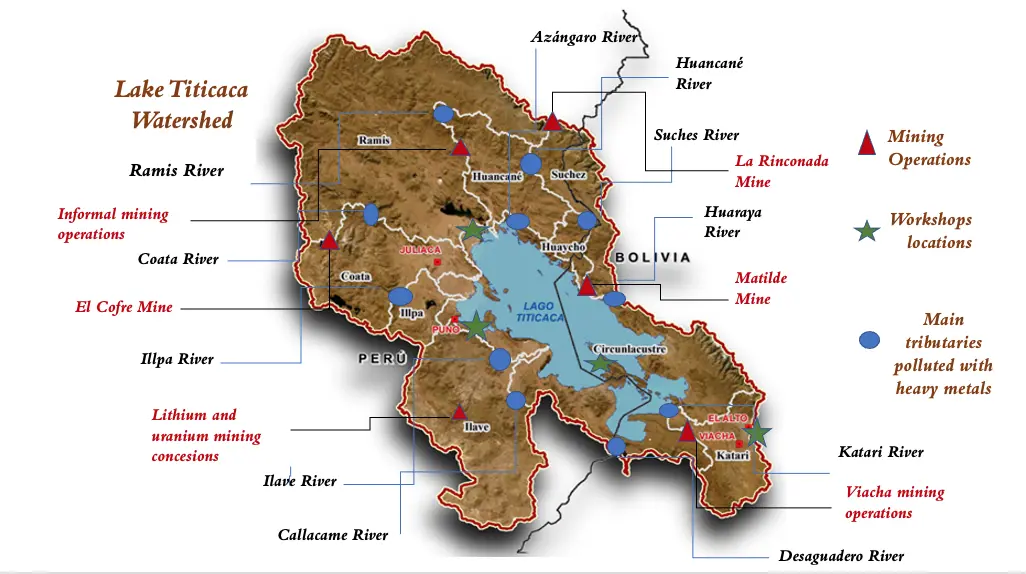
Figure 1. Titicaca Watershed, showing main tributary polluted basins, the main cities around the lake, the borderline between Peru and Bolivia, and the workshops locations. Own elaboration based on ALT map (2022).
Nonetheless, in the face of the worsening climate and socio-environmental crisis in the Titicaca’s region in recent years, with no effective response from the institutions of either country, other actors have emerged to promote change. For instance, rural women’s collectives Aymaras and Quechuas, as well as peri-urban youth groups, supported by certain binational NGOs, have grown in strength and influence. Their leadership has been instrumental in raising awareness of the urgency of rescuing the lake, conducting sensitization campaigns in the media, as well as advocacy in decision-making arenas.
As a result, community monitoring and interdisciplinary research on water quality have notably increased to identify sources and effects of pollution in the region9. Additionally, agroecological production projects have been fostered, in conjunction with the placement of community infrastructure and technologies for water harvesting and reservoirs, which ensure minimum conditions of access to water and sustainable food for local communities that continue to live along the watershed, avoiding forced displacement.
In the last five years, numerous coordinated binational actions have been deployed by local communities and civil society organizations in the areas of environmental education, communication, and clean-up campaigns, including the recent creation of “Titicaca sin Fronteras” (Titicaca without Borders), a binational civil society platform for action coordination. Notwithstanding the efforts and numerous actions undertaken, the absence of a unified and collective long-lasting strategy has served to diminish projects’ impact, giving rise to a state of repetition, competition, and activism without reaching common and longlasting objectives.
3. Methods
Amids this critical socio-envirinmental Titicaca’s conflicts, in December 2024, I received an invitation from Bread for the World (Germany) and Mission 21 Basel (Switzerland), international cooperation organizations that support the work of various civil society organizations in the Titicaca basin, to undertake a consultancy process titled, “Social Processes and Legal Strategies in Defense of Nature and Water Bodies: A Comparative Look to Nourish the Binational Defense Process of Lake Titicaca”.
Consulting began at a time when alliances and collaborations were run by binational civil society organisations, promoting actions in defence of Lake Titicaca. The consultancy also coincided with the legal recognition of the Titicaca Lake as a rights holder through a Puno regional government ordinance. The declaration was mobilized by the Network of Women Defenders of Titicaca in the Puno region, inspired by other cases at national and international levels.
The consultancy’s objective was to enhance the capabilities of civil society organisations dedicated to protecting the lake and its tributary rivers. To this end, insights were offered from four experiences in various locations worldwide, with a view to showcasing processes for defending and restoring degraded and contaminated water systems. The intention was to generate internal dialogues, reflections, and courses of action that would empower the role and common strategies of local actors. The international experiences selected had in common the fact that they were promoted by alliances of diverse civil society groups, with a priority placed on local knowledge, practices, and solutions.
3.1. A Participatory Action Research Approach
The consultancy entailed the formulation of a Participatory Action Research approach, predicated on dialoguing as a means of engendering both world transformation and the production of knowledge. This approach facilitates the identification, critical analysis, collective reflection, and subsequent action on oppressive conditions. The process was designed and implemented with representatives of various social organisations, emphasising the significance of local knowledge, ground-up truth-building, and centring the experiences of marginalised communities as change-makers [8,21,22].
The methodological design employed a dialogical and interdisciplinary multi-methods [23,24], comprising the following stages. First, a review of a broad body of scientific, institutional, and community literature on the socio-environmental problems of the Titicaca region; Then, the realization of 10 online semi-structured interviews10 with representatives of civil society organizations from Peru and Bolivia involved in developing initiatives for the protection and recovery of Lake Titicaca, representing different perspectives.
The interviews were followed by the preparation, design, and implementation of five field workshops, which involved 154 representatives from local communities, ancestral authorities (Aymaras and Quechuas), members of social organizations, and NGOs in the Titicaca region. The number of participants per workshop ranged from 23 to 45. These encounters took place in April 2025 at a binational level in Arapa, Puno South zone, Puno North zone (Peru), Copacabana, and La Paz (Bolivia).
On the Peruvian side, the workshops were organized and convened by: Centro Ecuménico de Promoción y Acción Social (Cedepas Peru)11, Centro Bartolomé de las Casas -Puno12, Red de Mujeres defensoras del Titicaca13, Instituto de Estudio de las Culturas Andinas (IDECA)14, Mission 21, and Bread for the World. On the Bolivian side, the workshops were organized and convened by the Plataforma Nacional de Suelos15, Fundación Prodiasur16, Misión 21, with the support of Fundación Tierra17, Instituto de Investigación, Desarrollo y Acción Social (IIADI)18, Agua Sustentable19, and Bread for the World.
3.2. Positionality and Engagement with International Water Stories
My consulting work on the Titicaca’s realities was based on my role as a Colombian activist, lawyer, and researcher. For fifteen years, I worked with Indigenous, Black, and peasant communities, leading collective strategies to defend territories and rivers affected by extractive economies, both inside and outside the courts. I served as a human rights and environmental litigator in several cases, including the first river rights case in Latin America. Subsequently, I pursued an academic path on issues of environmental conflicts, extractivism, social movements, and human and non-human rights. This led to my doctoral studies in social and legal mobilization processes in defense of water and rivers in Colombia and Guatemala. Lastly, I perform as an independent researcher and consultant on environmental justice, water conflicts, environmental peace-building, and engaging with local processes and water-related realities.
This particular positionality gave orientation to the international water stories chosen to be part of the dialogues during the workshops’ implementation, due to my direct engagement with them as part of my professional, academic, and consulting trajectory.
The “stories in defense of water” invited to the dialogue were:
- (i)
-
The process of defending the Jordan River promoted between 2009 and 2022 by civil society organizations in Jordan, Palestine, and Israel, under the focus of “environmental peacebuilding”, based on robust strategies of river-based learning with nature (an approach to environmental education), climate diplomacy, and multiscalar cooperation20 [25,26].
- (ii)
-
The process of declaring the Whanganui River in New Zealand as a natural entity with “legal personality”, promoted by local Iwi tribes of the Indigenous Māori people, a case that offers important practical lessons on the decolonization of water law and the governance of water bodies considering Indigenous water values [27,28].
- (iii)
-
The defense of the Atrato River in Colombia, the first river declared a “subject of rights” in Latin America in 2016, and the strategies of Afro-descendant communities in transforming hegemonic law through community mobilization and organization around the river [29].
- (iv)
-
The socio-legal process advanced by the articulation of Indigenous Peoples and social organizations in Guatemala between 2010 and 2019 to promote a legal framework that encompasses indigenous water values. This experience offers important lessons on the creation of multiscalar political articulations and the construction of community-based frameworks for water protection [30,31].
These experiences also have in common that they are social processes in defense of water that, on the one hand, have been led by local actors, as Indigenous Peoples or civil society organizations, and on the other, prioritize working directly with grassroots communities affected by contamination and climate change effects, following diversified strategies and approaches to confront them.
3.3. Dialogue of Water Stories: Design and Implementation
In this section, I present some key elements of the workshop cycle’s preparation, design, and execution that are instrumental to framing the dialogue of water stories as a useful methodological approach for water struggles fertilization, allowing educational, exchange, and capacity-building encounters among different social actors involved in the transformation of socio-environmental conflicts over water bodies.
3.3.1. Assembling a Tandem to Conceptualize and Facilitate a Dialogue of Water Stories
The preparation and implementation of the workshop cycle were made possible by the formation of a working team involving a variety of stakeholders with differential roles. As a facilitator, I was responsible for preparing the content for each international experience by developing supporting materials, including written and visual content, to accompany the water stories that I presented.
I developed a Methodological Guide for each workshop, proposing the core content of each session and the dynamics of collective work with participants on their own realities. This guide was discussed in five preparatory meetings with representatives of local NGOs working with local stakeholders and implementing several approaches in the Titicaca region.
Thematic, methodological, and logistical coordination of the workshops was carried out with the following civil society organisations (See Table 1).
Table 1. Civil society organizations at binational level part of the workshops’ methodological design.
|
Organization |
Titicaca’s Work Approach |
Social Groups Targeted |
Geographic Scope |
|---|---|---|---|
|
Centro Bartolomé de las Casas (CBC), Puno21 |
Capacity-building of local organizations, environmental education, and advocacy on the lake as a subject of rights. |
Women and youth organizations, particularly the networks of women and young defenders of Lake Titicaca. |
Several provinces in the region of Puno, Peru. |
|
Instituto de Estudio de las Culturas Andinas (IDECA)22 |
Capacity-building on environmental issues, indigenous and human rights, gender, and democratization. |
Aymara and Quechua communities. |
Several provinces in the region of Puno, Peru. |
|
Centro Ecuménico de Promoción y Acción Social (CEDEPAS-Perú)23 |
Capacity-building, advocacy and technical assistance in agroecology projects and local water management interventions. |
Farmers, fishers, and pastoralists communities. |
The Arapa province in Puno, Perú. |
|
Instituto de Defensa Legal (IDL)24 |
Human rights education and environmental litigation. |
Local communities affected by pollution and degradation of the Torococha, Coata Rivers and Lake Titicaca. |
Region of Puno and Lima, Peru. |
|
Fundación Prodiasur25 |
Capacity-building, technical assistance, and recovery of ancestral knowledge in agroecology projects. |
Small farmers’ communities, particularly with Aymara women. |
Catari river basin. Municipalities of El Alto, Viacha, Laja and Copacabana, Bolivia. |
|
Plataforma Nacional de Suelos26 |
Advocacy platform on food sovereignty and agroecology. |
Ngos in Bolivia. |
National scope in Bolivia. |
At least three preparatory meetings were also held with the Misión 21 and Pan Para el Mundo team, who assigned two representatives from their programmes in the Titicaca region to serve as a support team and act as liaisons with local organisations to define key logistical, organisational, and evaluation aspects.
3.3.2. Creating an Atmosphere of Trust and Ontological Openness
To introduce each workshop, we applied the presentation dynamic “Let’s form a Stream”, in which we used an eight-meter-long blue cotton cloth that circulated among the attendees, symbolizing a moving waterway(See Figure 2). Each person with the cloth in their hands had to introduce themselves, stating their name, the local organization or community they belonged to, and answering two questions: “What does water mean to you?”; “What river or water body holds special significance in your life story, and why?”.
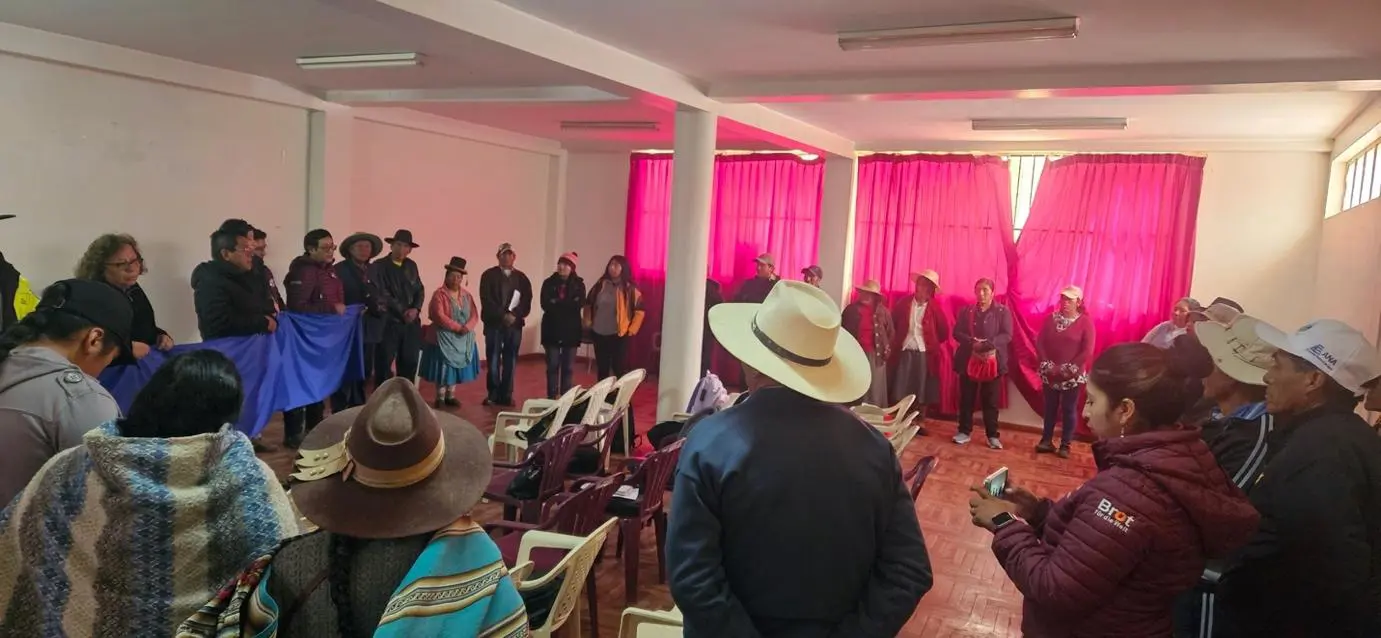
Figure 2. Image of the dynamic “Let’s form a Stream”, Arapa workshop, 21 April 2025. Photo: Cedepas Perú.
Next, some fragments of participants’ interventions during the “Let’s Form a Stream” dynamic across the workshops are presented, in which they shared their understandings of water.
“Water is important for the consumption of living beings, of plants and animals. We know that in the communities without water, there is no life.”
(Arapa Workshop Attendee, 21 April 2025).
“Without water, we cannot work, neither agriculture nor livestock farming. Otherwise, where will we generate the economy from?”
(Arapa Workshop Attendee, 21 April 2025).
“Water signifies the union of peoples, the union of processes, the union of histories.”
(Puno North Zone Workshop Attendee, 23 April 2025).
“Water is life, water connects people, it is like the veins we have in the body, they go everywhere, and if one place is contaminated, everything is infected.”
(Puno North Zone Workshop Attendee, 23 April 2025).
“Rivers are history, but they are also life for humans, for animals, and for people.”
(Puno North Zone Workshop Attendee, 23 April 2025).
“Water is very important for us, it cares for us, it makes us live. It is like a mother. Water sustains us all, and that is why we say that water is life.”
(Copacabana Workshop Attendee, 26 April 2025).
“Water is connection between people, communities, histories, cultures. Therefore, it is an entity that can guide the path.”
(La Paz Workshop Attendee, 30 April 2025).
“Water is also plurality, multiplicity; it connects us. Water weaves together diversity.”
(La Paz Workshop Attendee, 30 April 2025)
In total, approximately 150 workshop participants were in contact with the cloth-river, giving form with their bodies, energy, and voices to a symbolic water body that framed us and simultaneously circulated us. In this setting, participants shared their visions on the importance of water, as well as their memories and meanings associated with water bodies that accompanied their childhoods or milestone moments in the course of their lives. “And if the cloth could speak?... all that it would tell us”, we reflected with the organizing team in the evaluation session.
The “Let’s Form a Stream” dynamic was carried out to create space for the communion of different visions of water, as well as for reminiscences about water bodies that have marked personal or communal histories. This fostered an atmosphere of opening to the “ontological diversity of water” [32,33]. The dynamic, on the one hand, welcomed different conceptions and understandings that go beyond the hegemonic vision, which, on the one hand, strictly conceives of water and tributaries as natural resources, and on the other, silences other types of relationships between human communities and nature(s) [34,35]; On the other hand, the dynamic unfolded a scenario in which all the individuals were integral components of the symbolic aquatic community, envolved as the cloth flowed from hand to hand, ensuring that each voice was acoorded agency, space, and received attentive listening from others.
3.3.3. Storytelling Water Stories and Facilitating Their Fluency within the Local Context
To ensure a meaningful exchange of experiences regarding water defense at different contexts, the methodological design followed the approach of de Souza, et al., of “Rivers as co-learning arenas (RCAs)”, that is, as “places, platforms, networks and encounters that invite and support learning, reflection, creation, and shared action” ([3], p. 61).
Following this direction, in preparation for the workshops, I, as a facilitator, employed meditation and mindfulness techniques based on the teachings of the Buddhist master Thich Nhat Hanh [36]. These techniques allowed me to invoke the rivers and experiences in defence of water symbolically and sensorially. Before the workshops began, I dedicated a moment to focus my attention, enabling the stories of rivers affected by contamination and the struggle to defend them to connect with the realities of Lake Titicaca and its defenders.
I have first-hand experience of these water defence initiatives and have met their protagonists in other contexts, in my roles as a lawyer, researcher, and consultant. I have travelled to some of the affected basins and collaborated with community leaders and river defenders who are leading initiatives to protect them. These moments of personal introspection with the aquatic stories were therefore fundamental to ‘inviting these water bodies and their spokespeople to the table’, honouring their stories of struggle and giving thanks for their legacy. The intention was for the workshops to become welcoming spaces that transmit their messages and examples of resistance.
Drawing on my previous experience, I prepared the content and materials for each water story in advance and presented them during the workshops, recounting water struggles using a storytelling methodology. Storytelling is a means of ‘learning, confirming and contesting reality; building and preserving community; and conveying knowledge, values, beliefs and emotions’ [37]. It enables contextualised self-reflection and constructive self-criticism [38,39].
Following the guidelines of the local organizations facilitating the workshop cycle, I elaborated three versions of the narrative for each international experience, placing distinct emphasis in each workshop based on participants’ backgrounds, positionality, and types of engagement with the transformation of watercourse problems.
For instance, in the Copacabana and Arapa workshops, the attendees comprised local small farmers, fishers, pastoralists, ancestral authorities, and members of water committees who inhabit villages in the region around Lake Titicaca. Therefore, they were more interested in knowing what kind of strategies were applied in international experiences related to local livelihoods adaptation to environmental degradation and climate change. In contrast, participants in the Puno North-Zone and Puno South-Zone workshops were mainly representatives of youth and women local organizations directly engaged in campaigns to recover the lake, involving educational, political, and communication initiatives.
While in the La Paz workshop, participants were directors and coordinators of several NGOs that work with local communities around the lake, implementing different kinds of projects. They were interested in fostering networks and alliances to regenerate watercourses. Then, each river story was adapted according to the profiles of the participants attending the workshops and the type of debates and discussions we aimed to encourage.
Thus, in the Arapa and Copacabana workshops, the stories of the struggle for water concerning the Jordan River and the Atrato River in Colombia emphasized the community-based approach to conflict transformation, that is, initiatives that center the vision of change and change-making on local communities and territories. Therefore, it was possible to share experiences of productive transition, food sovereignty, and water management. In the Puno South Zone workshop, by sharing the experiences of the Whanganui River in New Zealand and Indigenous water values in Guatemala, emphasis was placed on the worldviews and community practices of water care, and on their importance in defining directions for collective strategies in defense of rivers.
In the Puno North Zone workshop with the Red de Mujeres Defensoras del Titicaca, the stories of the Atrato River in Colombia, and the Whanganui River in New Zealand, as well as the Marañon River in Peru, which was presented directly for the peruvian lawyer that conducted its litigation who performed as a co-facilitator in this workshop, allowed us to address the theme of rivers and water bodies as subjects of rights and legal personality. In La Paz workshop, conversely, through the stories of the Jordan River and the Whanganui River in New Zealand, it was possible to exemplify how joint strategies for river defense are structured directly by Indigenous Peoples and local communities, in some cases with the support of civil society organizations.
As the facilitator of this segment, I intentionally used my words, calling on participants to engage in action-reflection towards conflict’s transformation. As Freire pointed out, “The word is more than just an instrument which makes dialogue possible (...) Within the word, we find two dimensions, reflection and action (...) There is no true word that is not at the same time a praxis. Thus, to speak a true word is to transform the world” ([8], p. 68).
Various resources were incorporated into the recounting of each experience, including multiple narratives, visuals, and references. From direct testimonies of community representatives to artistic pieces, giving space to poems, songs, and photographs. The information was enriched with legal provisions, public policy reports, scientific studies, and specialised literature. The materials were compiled into a Content Guide, which was shared with participants, along with PowerPoint presentations documenting the international experiences in defence of watercourses.
3.3.4. Multivocality and Collective Reflection in the Internal Dialogues About Titicaca Lake
Following the presentation of international experiences, the third crucial stage of the workshops involved participants working in groups to discuss the problems facing the Titicaca region from different angles, based on a series of key questions prepared for each workshop. These questions aimed to connect the reflections conveyed through the water stories with the specific realities and problems experienced in the Titicaca region. The workgroup discussions were followed by presentations in plenary.
These spaces for dialogue and open discussion were characterised by honesty, breadth, and realism, thanks to three fundamental factors. Firstly, it was important to have a diverse group of key individuals attending the workshops who could contribute to the debates by offering different viewpoints and insights into the realities of the territory and the challenges faced by different sectors of the local population. Secondly, the NGOs that supported the workshop’s design and organisation played a key role in invigorating the group discussions on the problems of Titicaca by making their management, technical, and communication staff available. Having built relationships of trust and closeness with participants over the medium and long term, they were instrumental in facilitating more in-depth conversations and providing space for exchanges in different languages (Aymara, Quechua, and Spanish).
As a result, in each workshop, it was possible to engage with different expressions and nuances of Titicaca’s realities and experiences. On the one hand, in the Arapa and Puno South Zone workshops, where a conjunction of elders from the countryside communities and younger people mainly inhabiting the peri-urban areas occurred, the most important contributions from the participants offered a glimpse into significant changes the region has undergone in the last 30 and 40 years, offering an intergenerational panorama of socio-environmental transformations. Some of their words mentioned:
“Before, the lake was clearer, clean, and crystalline; there were fish like the karachi, boga, ispi, maure, umantu, año, and suche. There was Totora (reed), and there were birds. Before, everyone would take their cows to the lake at midday so they could eat the Totora, and with that, there was also an abundance of milk for the sustenance of each family. Before, there were also frogs. The lake level was high. Before, there was mauri in the rivers that flowed into the lake. Before, there were no trout farms like there are now. Before, there were plenty of eggs in the lake. There were wild ducks, pana, and chocas, and they made their nests in the Totora. Today, there is little.”
(Arapa Workshop Attendee, 21 April 2025).
“The lake water is no longer crystal clear; it is somewhat dark and greenish. There is no longer any totora; the fish species once abundant in the markets have disappeared, and the number of bird species in the fields has decreased. The pollution of the lake with insecticides, detergents, plastics, and cans, as well as the pollution of the rivers that flow into the lake, is serious. The reality of the lake now is complete chaos. The fish brought from the larger lake, such as Karachi, when you open them, you see their insides are yellowish. We ourselves are polluting the water with solid waste and, in doing so, we are also polluting our bodies.”
(Arapa Workshop Attendee, 21 April 2025).
“The settlement around the lake has been decreasing, people have been leaving, and that has generated a change in the lifestyle of the population, which was previously dedicated to artisanal fishing. Now that has changed; there has been a great migration, and the areas that were in the bay have been depopulated. One observes that there are only the grandmothers, some children, while the population that needs to work has migrated, and that has also generated a lifestyle change.”
(Puno South Zone Workshop Attendee, 23 April 2025).
In the Copacabana workshop, in contrast, the participants’ contributions broadened the panorama of local water care and management practices and how these have changed over time, placing special emphasis on the relationship women have with water. In the Puno North Zone workshop with the Red de Mujeres Defensoras del Titicaca, the importance of strengthening and supporting the organizational processes of women was also examined, as they have maintained special relationships with water and water bodies over time, calling themselves, “those who speak and advocate for the lake” (Red de Mujeres Defensoras del Titicaca, Puno South Zone Workshop, April 2025) (See Figure 3).
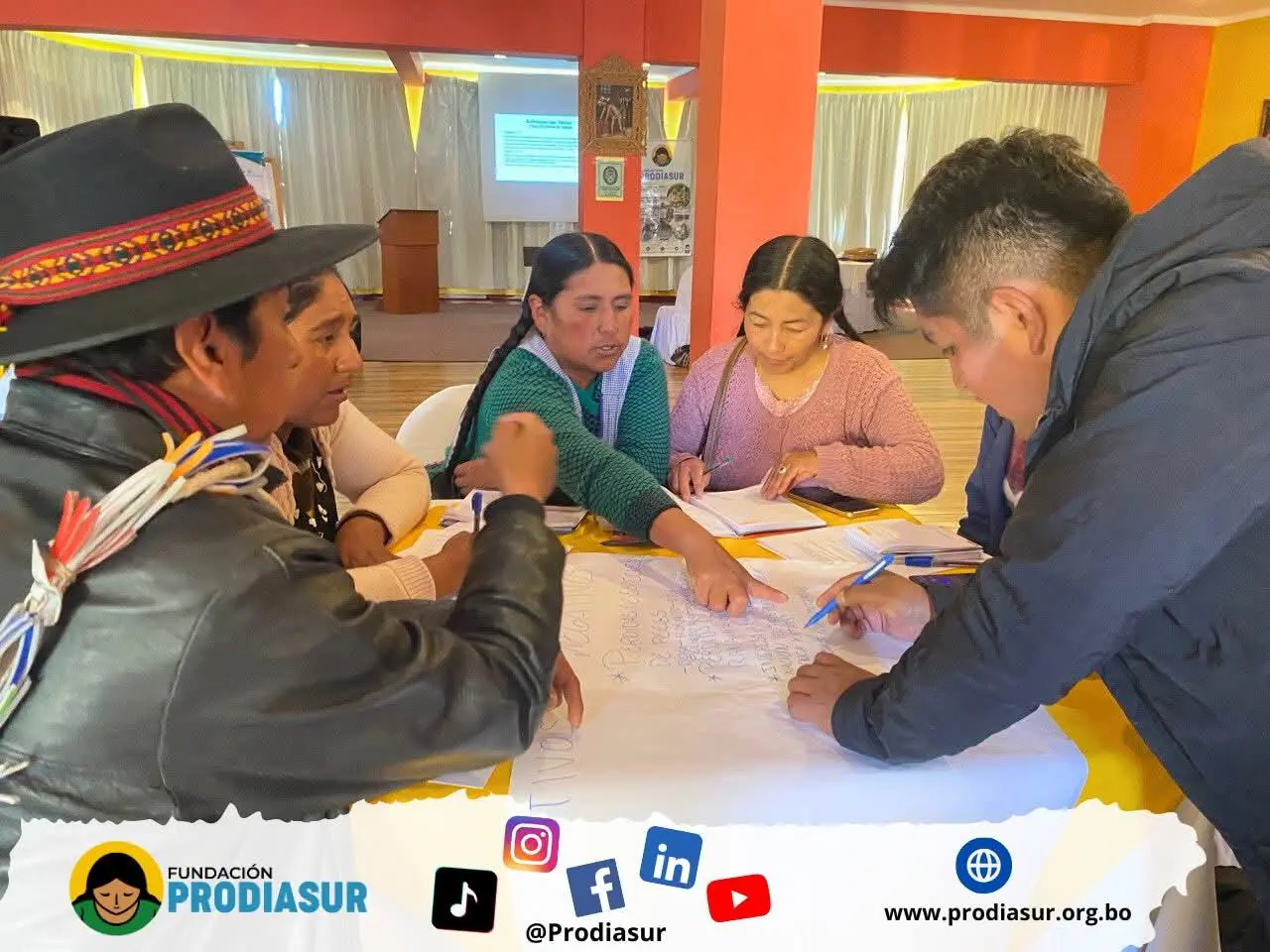
In the La Paz workshop, which was mainly attended by representatives of NGOs working with local communities in Titicaca from different approaches, the group work provided very clear guidance on how to build a unified strategy to defend the lake, identifying objectives, progress, necessary steps, and strategic lines, among other components. In each workshop, collective concerns were addressed about the declarations of water bodies as subjects of rights, and important reflections emerged about the community process that led to Puno’s regional ordinance declaring the lake a subject of rights, analyzing its repercussions and the next steps for its materialization.
This meant that in these workshops’ segments, my role as facilitator shifted to one of observation and active listening, identifying key points from the group work sessions and plenary presentations. The reflections, contributions, and debates presented by participants in the workshops were duly recorded, documented, processed, and analyzed.
In sum, in my role as facilitator, I exercised attentive listening to participants’ contributions, both in real-time during the workshops and in the su bsequent stage of processing the field data. For instance, in the phase of processing the information gathered in the field, I chose to perform a conventional transcription of the recordings of each meeting, without resorting to transcription programs or applications, recognizing that it was an opportunity to listen again, to listen several times, and thereby iteratively connect with the word, expression, and multilingual voices of the participants. This occasionally required seeking support for the translation of some interventions made in Quechua or Aymara, or verifying specific expressions used by the participants on more than one occasion. Nevertheless, most of the dialogues were held in Spanish.
To carry out this process, I followed the reflections of Rivera-Cusicanqui [40,41] regarding how decolonial practices are fundamental in research and knowledge generation. Along this line, through silence, deep attention, and attentive listening, “we can recognize the knowledge embedded in experience” ([42], p. 11). As the Buddhist master Thich Nhat Hanh teaches, “With the energy of mindfulness and concentration you can get a breakthrough and begin to see the true nature of what is there” ([36], p.15).
Beyond the design and execution of the workshop cycle, the consultancy process also generated concrete inputs that were returned to local organizations. These included creating a map of actors and socio-environmental conflicts in the Titicaca region, documenting the main elements discussed by the workshops’ participants, and documenting the contributions of local organization representatives during the interviews. Additionally, based on the multiple insights collected on Titicaca’s participatory research process and the learnings from the international stories in defense of water, a document of observations was prepared for civil society organizations committed to the Titicaca defense process, containing guidelines and recommendations for developing a collective strategy for the binational defense of the lake and its tributary basins. Rather than “products” delivered by a classical consultant, the documents presented were research fruits elaborated under the premise that knowledge is constructed in a ‘dialogical relationship among subjects who are differentially situated’ ([43], p. 315).
4. Content-Related Findings on Titicaca’s Water Care Practices
As revealed by Stone’s [10] ethnographic observations, there is a long history of veneration for Lake Titicaca and water in that region, through a set of artistic and ritual practices, including dances, oral histories, and pilgrimages to sacred sites. Thus, “archaeological and ethnographic sources indicate that ritual activity involving the veneration of water has been important in this high desert plateau for millennia.” ([10], p.123).
Along the same lines, the workshop attendees “could speak in their own voice” ([44], p. 174) about social, political, economic, emotional, symbolic, and ritual practices that are part of their daily lives, and their ways of understanding and inhabiting the multiple realities of Lake Titicaca.
The exercise brought together a miscellany of participants’ experiences and imaginations, which highlighted, for example, how the rivers and water bodies of Titicaca’s region, beyond being mere physical spaces or material components flowing through landscapes, act as symbolic referents and containers of memories, since diverse histories of individuals, peoples, and natures flow through them. In this regard, there was also an interesting synchronicity with the case of the Atrato River in Colombia, which shows how the defense of water provokes and brings together processes of sociopolitical organization [29].
Next, some fragments of participants’ interventions in the workshops are presented, particularly those that elevate the voices of women, who recount the affective, spiritual, and political aspects of their plural relations with Lake Titicaca and their water care practices. These elements are, moreover, the heart of the collective demands of the Red de Mujeres Defensoras del Titicaca regarding the declaration of the lake as a subject of rights.
“This Lake Titicaca represents a lot to me, the Q’ota mama (Mother Lake), the maiden, the playful one, the one who converses with the Apus (sacred mountains), because without this Q’ota mama there would be no life (...). The most beautiful and important thing of all is that this lake connects me spiritually; I even dream of it, and it warns me. That is why I perform rituals and offerings for it.”
(Puno South Zone Workshop Attendee, 23 April 2025).
“As my grandmother used to say, Q’ota Awiicha (grandmother lake) is where we used to graze when I was little and where we went to drink water. Right now, when I fell ill, I went there to jog on the shore of Lake Titicaca. And when I have worries, I go to talk to the lake. You can hear its sound, which is very beautiful and important.”
(Puno South Zone Workshop Attendee, 23 April 2025).
“Water gives us energy; it gives us vitality. Water represents the woman who gives life, which is why we say, Cocha mama in Quechua—Q’ota mama in Aymara."
(Copacabana Workshop Attendee, 26 April 2025)
“Before, the women needed water more; the women were more in contact with the water, and had a lot of respect for it. We always went to the eye of water, to the river, and we felt that respect, that value that we gave to that jar of water, and sometimes we made it last for the whole day, for two days. We economize from the heart, and when we feel, we give more value.”
(Puno South Zone Workshop Attendee, 23 April 2025).
“Before, rituals were practiced at the eye of water, which we called Umanaira in Aymara and Cochas in Quechua. Dialogues with the water were practiced.”
(Puno South Zone Workshop Attendee, 23 April 2025).
“Wakay q’aña, was the ritual in which a place was prepared, a table on which flowers were placed, and offerings were given. There is still a moment in June, during the rainy season, when it is practiced: we bring offerings to a well-covered, sacred little well, and that little water is never lost; every year, we do a ritual for it. In October and November, which are the dry season, we bring water to a very sacred place. After saying a mass, we put flowers, little black aguayos (textiles), and black blankets; we cover it, we adorn it, and no one can approach it until the rain arrives. We still apply that.”
(Copacabana Workshop Attendee, 26 April 2025).
In this context, it is appreciated that women cultivate direct relationships of care, dialogue, respect, and reciprocal nourishment with Lake Titicaca, the rivers, and the other water sources of the region, on which life and the food, spiritual, and economic sustenance of households depend [45]. Nevertheless, water values have been shifting within communities as generations change, lifestyles evolve, the environment transforms, and daily economic practices shift.
“Now we have lost our values and respect for water. Today, young people no longer practice, but for my contemporaries and those before us, water was sacred. Who is to blame for this? We, the mothers and grandmothers, must instill these values in young people and recover our ancestral values. This is our responsibility.”
(Puno South Zone Workshop Attendee, 23 April 2025).
“Another factor that is related to the deterioration of care practices is the abandonment of the communities, the massive migration from the countryside to the cities. There are communities where only elderly people live, and people only return for the local festival season, for carnivals, and for patron saint festivals. No one remembers the well that was there anymore, due to the abandonment of the communities. It is an important factor in why young people no longer value their roots.”
(Copacabana Workshop Attendee, 26 April 2025).
Participants also explored a geographical and spatial dimension of water, referring to how the location of sources guided the construction of roads, the development of productive activities, and the conditioning of sacred places for worship and veneration of water, fostering a kind of community-based territorial planning around water and its care. With this, communities not only ensured their access to water by taking it from wells, springs, streams, and ojos de agua (water eyes), as they are locally called, but also maintained relationships of care toward it, which are celebrated through dances and pilgrimages [46].
“In our case, each little well of water, each water spring has its history. For example, we all know the Virgin of Copacabana, and where the Virgin is, what is there? There was one of the most important sacred water sources in this region of the lake. (…) On the other hand, the sewenka, which is a plant, was used as a signpost to indicate that in that place there was a well underground, or sacred and ancient waters.”
(Copacabana Workshop Attendee, 26 April 2025).
Additionally, participants explained the concrete ways in which water source care and maintenance tasks are performed. In this, they highlighted, on the one hand, a dimension of differentiated use of water sources when they had to take water directly from the well and transport it manually to homes or reservoirs, a task done especially by women. In those times, there was greater closeness, effort, and respect in the relationship established with water, accompanied by constant ritual practices. These aspects have changed notably with the installation of collective and domestic water infrastructures, such as public faucets, showers, tanks, and reservoirs, where all the water for community use is collected.
“Instead of having a single well for all uses, before there were small wells (Q’otañas) with a different use: one for livestock, one for washing clothes, one for consumption.”
(Copacabana Workshop Attendee, 26 April 2025).
“Before, water was more valued, more cared for. Before, communities brought the water from kilometers away, but they still praised it, cared for it, respected it. And now that they have it close by, they no longer take care of it.”
(Copacabana Workshop Attendee, 26 April 2025).
“Before, when women had to transport water from another sector, they had spaces to socialize. They had spaces to talk, converse, transmit their values and culture, or share what was happening to them. These shared spaces have been lost.”
(Copacabana Workshop Attendee, 26 April 2025).
On the one hand, the system of water access through differentiated-use wells implied a great physical effort and time for the women of the communities. The installation of public faucets and reservoirs has transformed that closer, more everyday contact with water, which also forged social ties. Part of the rituals have been lost, but the harshness of the work has also been alleviated.
Despite these changes in social dynamics, the workshops highlighted that, currently, in some communities, other types of water care practices have emerged, with an organizational and community-based self-governance dimension gaining relevance. Thus, through the constitution of water committees and spring boards (juntas de vertientes), communities have local teams in charge of making decisions about water management. This implies, for example, the implementation of old and new techniques, such as “water sowing and harvesting” (siembra y cosecha de agua), to create and maintain reservoirs that ensure supply during increasingly frequent and unpredictable dry seasons. Furthermore, these committees have among their functions the ability to issue resolutions and statutes that establish individual and collective measures, actions, and responsibilities for water care.
Nevertheless, given that a whirlwind of changes has been unleashed in the Titicaca’s environment in recent decades, the truth is that communities, and particularly women, are raising their voices amidst the irony of conceiving water as a sacred element that, in turn, contaminates their bodies, farms, and food. That is the reason for the struggle, narrate the women defenders, who call themselves guardians of the lake. For this collective, they are the ones who can raise a consistent voice for change. A voice that reclaims the importance of the plurality of water values and daily care practices, and helps raise awareness about the fatal effects of the problem. It is with this meaning that they have promoted the ordinance in the Puno region that declared Lake Titicaca as a subject of rights.
“Today, how many people are sick, contaminated with arsenic and other heavy metals in their blood. Those people, in their hearts, in their feelings, suffer because they are sick. That is the cry that we are making, we are demanding.”
(Puno North Zone Workshop Attendee, 23 April 2025).
5. Discussion and Final Remarks
The Dialogue of Water Stories methodology, as framed in the previous sections, proposes an authentic dialogue, conceived as an encounter between people that aims, firstly, to name the world in their own terms, secondly, to reflect and act to transform the world ([8], p. 71).
The application of this methodological approach in the Titicaca context employed water stories that involved the interaction among humans and non-humans facing oppression and disruption. In this dialogue, then, watercourses are not static referents belonging to their specific locations, but rather they travel symbolically, poetically, and politically to different territories, permeating other struggles and inspiring social processes.
As de Souza and others have stated, rivers and watercourses can be conceptualised as Movements. “Rivers move, catalyse, and inspire people and actions, (…) may movements engage with manifold scales (…) embedding their struggles in discourses much beyond managerial river scales such as the “river basin”. ([3], p. 62).
From these author’s conception, rivers can also be understood as “networked relational spaces” that are at once material, technical, social, and symbolic, in which different narratives circulate (de Souza et al., 2024, 61). From this standpoint, the workshop cycle initiated a trans-local dialogue between stories in defense of watercourses, to mobilize the transformative action of local actors in a specific context [4].
The “Dialogue of Water Stories” methodology stimulated attentive listening and reflexivity among the attendees engendering “resonance” around water defense, coincived as a previous stage of transformative action. The concept of resonance as proposed by Rosa [44] is defined as a “cognitive, affective, and bodily relationship to the world in which subjects are touched and occasionally even ‘shaken’ down to the neural level by certain segments of the world, but at the same time are also themselves ‘responsively’, actively, and influentially related to the world and experience themselves as effective in it” ([44], p. 163). In this way, resonance is a useful approach that invites us to appreciate the ways in which we enter into relation to the world, establishing meaningful connections that break alienation, characterized by arousing feelings of emptiness, disconnection, and exhaustion.
Thus, one of the main outcomes from Dialogue of Water Stories as a methodological intervention was that it enabled a systematic engagement with communities to understand their own waterways, experiences, and social movement spaces. Storytelling and dialoguing on water stories served not only as an external reference for other ongoing cases but also as a bridge to address internal dialogues among different actors in the Titicaca binational civil society, facing constant frustration, helplessness, and devastation. Through the narration of international water experiences, symbolic connections were established between social processes in defense of water bodies, generating receptivity, openness, and empathy among participants, as well as feelings of affinity and complicity, and indignation regarding the harsh realities and devastating problems faced in each context.
By highlighting the complexities of social processes in defense of rivers, their long-term strategies, challenges, achievements, and weaknesses, an atmosphere conducive to honest reflection on sensitive aspects of their realities, the problems of Titicaca, and the possible routes for their transformation was generated among the workshops’ participants. Hence, international experiences in defence of water performed as reflective mirrors to open up discussions, deliberations, and knowledge exchange among participants on Titicaca’s problematics and challenges, addressing questions on how they can move collectively and strategically towards their transformation.
The methodology also afforded engagement with a range of stakeholders operating at the local level, drawing on a variety of perspectives and approaches, disrupting the idealisation, homogenisation, and romanticisation of local communities, and connecting with their remarkable internal diversity. Therefore, at was already mentioned in the previous sections, the international water stories resonated differently in the workshops depending on participants’ profiles, knowledge, positionality and type of involvement to Titicaca’s recovery initiatives. Then, this methodology enables multiple narratives and multiple communities to coexist within the complexity of a social movement.
Particularly, the group exercises allowed the facilitation and participants to address sensitive and even uncomfortable issues, with at least two concrete expressions. On the one hand, in my capacity as facilitator, I have previously been directly involved in one international water experience. This was in the declaration of the Atrato River as the first watercourse with rights on the continent, in which I performed as part of the litigation team [29]. In my presentation of this case as a storyteller, I covered not only a tale of brilliance and radiance. In light of the circumstances surrounding the mobilisation of this legal mechanism by women’s associations in the Titicaca region, I sought to address a comprehensive array of inquiries and observations, including a critical self-reflecion of my role in this case. This endeavour aimed to foster a deeper understanding of the socio-legal mechanism in question, including an analysis of its potential and limitations in amplifying efforts to safeguard Titicaca Lake.
On the other hand, regarding the internal debates on Titicaca’s situation, participants highlighted their own role in Titicaca’s degradation. They not only pointed to states and private actors as the causes of the lake’s problems and the lack of effective solutions, but also questioned themselves. By enabling a “safe space” for conversation, attendees emphasized the co-responsibility incumbent upon the communities and inhabitants of Titicaca’s feeding shores in its degradation.
Participants revealed how local communities living around the lake for millennia have significantly transformed their lifestyles, productive activities, patterns of consumption, imaginaries of living better, and even their diets, against a backdrop of extractive policies, socio-ecological inequalities, structural racism, and institutional corruption. Consequently, the confluence of these complex aspects has had a considerable impact on the bodies, families, and community relationships of Indigenous communities, as well as on the vast aquatic territory they inhabit, which they are progressively leaving to settle seasonally in peri-urban areas [17].
On this matter, De Vries and Kappor [47] underscore the importance of being open to contentious oppositions, interpellations, and contradictions that lead to areas of uncertainty or possible inconsistency in socio-environmental struggles. From their perspective, it is within that boundary, which exceeds what is certain and safe, where new possibilities, actions, and horizons for reconstructing socio-natural interactions in an emancipatory manner can be conceived and set in motion.
Thus, after learning about water defense experiences in other territories, the workshop attendees shared their memories about local understandings of the lake, traditional and contemporary water care practices, current threats, conflicts, and disturbances affecting the region. That means that the workshops were valuable spaces for uncovering and revealing different angles of community knowledge, creating precious moments of intergenerational exchanges.
Moreover, the storytelling methodology enabled the creation of a counter-narrative that challenges the prevailing interpretation in the Titicaca context. This interpretation asserts that the recovery of the lake can only be achieved through multi-million dollar civil infrastructure projects for water management and waste treatment, which are dependent on state determination and multilateral financing. The accounts of the struggle for water that were recounted provided further references, indicating that local communities and organisations, through their knowledge, experiences, and practices relating to the environment, have the capacity to play a decisive role in the rescue and revitalisation of their living environments.
In this regard, the workshop’s cycle has presented a novel array of prospects for civil society organisations, signifying a shift from a predominantly reactive approach to one that is proactive in nature. That means that rather than addressing urgent issues and solving immediate problems, through the execution of multiple projects and scattered interventions, the seed of building up a coordinated, long-term strategy has been nurtured though the methodological intervention. In this reflection, placing significant emphasis on the leadership and transformative role of local communities and civil society organisations operating within the region, an approach that has been successfully employed in other riverine contexts, was one of the central methodological contributions [7,29,48].
Then, afterwards the consultancy’s implementation, a broader spectrum of civil society organizations acting at a binational scale are strengthening strategic articulations at different scales to get a deeper and wider impact on socio-environmental conflicts’ transformation.
Finally, it is imperative to comprehend the limitations and challenges inherent to the methodology of the Dialogue of Water Stories. In its present state, the methodology does not encompass a proper interrelation of international water experiences. As a consequence, in this inaugural instance, the application failed to establish a direct connection between the protagonists of each water story. Instead, the methodology, in its present state, contributes to the empowerment and strengthening of the diversity of civil society actors and local communities confronting a particular socio-environmental conflict. The Dialogue of Water Stories is then conceptualised as a community-based methodological framework that can be theoretically enriched and practically developed in different directions and scales. This development aims to empower local communities as protagonists of the transformation of water-related conflicts with a great potentiality of brothering water stories.
Footnotes
-
Bartolomé de las Casas Centrum.
-
On the Suches River, which exceeds the maximum permissible levels of heavy metals, the largest informal mine in Peru, La Rinconada, operates. Its waste ends up in watersunderlying that flow toward Lake Titicaca, contaminating several surrounding populations.
-
George et al. conducted studies to determine arsenic contamination in Puno, taking groundwater and surface water samples from 2005 to 2012 in the districts of Achaya (Azángaro), Ananea (upper Ramis River basin), Caracoto, Juliaca, Platería, Puno, San Antón, and Taraco. Of these, all wells in Juliaca and 95% of those in Caracoto had As concentrations that exceeded the WHO recommended limit of 10 μg/L.
-
Mainly the introduction of Pejerrey argentino (Odonthestes bonariensis), and trucha arco iris (Oncorhyinchus mikiss) have impacted the native fisheries in Lake Titicaca.
-
Some of the most iconic Titicaca’s native fish in critical danger are: Carachi Amarillo (Orestias luteus), Carachi negro (Orestias agasii), Boga (Orestias petlandi), Umanto (Orestias cuvieri), Suche (Trychomicterus rivulatus), Mauri (Trychomicterus dispar), Ispi (haso facilitate, AmidLakerunrunrun Orestias ispi), Sábalo y Tambaquí.
-
For example, the Binational Authority of Lake Titicaca (ALT) has installed measurement units in basins and tributaries to perform monitoring campaigns. Based on the results obtained, they prepared a diagnosis of water resources and pollutant sources in Lake Titicaca in 2022, triangulating satellite images, institutional reports, and field work. Additionally, the same year, the ALT published a study on the dynamics of heavy metals affecting Lake Titicaca and a map of actors of the basin.
-
The Institute of Molecular Biology—Genotoxicological Environmental Surveillance Unit of the Universidad Mayor de San Andres in La Paz has conducted studies on the presence of heavy metals in basins and tributaries to amplify the comprehension of Titicaca’s problems.
-
For example, DHUMA and Agua Sustentable have trained children, youth, and women to perform basic community monitoring of the water quality in the Titicaca’s feeder basins, for example, the Coata River in Puno.
-
Through combining community methodologies with the installation of high-technology devices, monitoring contamination patterns has advances, with a particular emphasis on the dynamics of heavy metals present in water bodies.
-
The interviews were conducted remotely with the following individuals and institutions: Sadia Huamán, coordinator of the (CBC) Puno (Perú); José Egoavil, representative of CEDEPAS Perú; Miriam Corrales, project coordinator of Fundación Prodiasur Bolivia; Rolando Pico, representative of (IDECA) Perú; Juan Pablo Chumacero, director of the Fundación Tierra, Bolivia; Juan Carlos Molleda and Maritza Qusipe, lawyers of Instituto de Defensa Legal (Institute of Legal Defense) (IDL) Perú; José Bayardo, lawyer of Derechos Humanos y Medio Ambiente (Human Rights and the Environment) (DHUMA) Perú; Jaime Quispe, director of Agua Sustentable Bolivia; and Carlos Revilla, coordinator of (IIADI) Bolivia.
-
Ecumenic Center of Promotion and Social Action.
-
Centro Bartolomé de las Casas (Bartolomé de las Casas Center).
-
Network of women defenders of Lake Titicaca.
-
Institute of Study for the Andean Cultures.
-
National Soils Platform from Bolivia.
-
Prodiasur Foundation.
-
Earth Foundation.
-
Institute of Research, Development and Social Action.
-
Sustainable Water.
-
I learned about the Jordan River defense process, and met some of its leaders and promotors through a consultancy contracted by the ZfD-CPs program, carried out in tandem with Lisa Piccot, to facilitate an international encounter of 19 international experiences on “Environmental Peacebuilding” in Germany, October 2024 from grass roots were made.
-
Bartolomé de las Casas Center. Available online: https://cbc.org.pe/, accessed 30 January 2026.
-
Study of the Andean Cultures Institute. Available online: https://idecaperu.org/, accessed 30 January 2026.
-
Ecumenic Center of Promotion and Social Action. Available online: https://www.cedepas.org.pe/, accessed 30 January 2026.
-
Legal Defense Institute. Available online: https://www.idl.org.pe/, accessed 30 January 2026.
-
Prodiasur Foundation. https://prodiasur.org.bo/index.php/es/, accessed 30 January 2026.
-
National Soils Platform of Bolivia.
Statement of the Use of Generative AI and AI-Assisted Technologies in the Writing Process
During the preparation of this manuscript, the author(s) used Deepl Pro in order to dobble check grammar and punctuation. After using this tool/service, the author(s) reviewed and edited the content as needed and take(s) full responsibility for the content of the published article.
Acknowledgments
I would like to express my gratitude to the civil society organizations working to transform the conflicts in Titicaca at the binational level for their trust, openness, and committed work. In particular, I would like to thank CBC Puno, Cedepas Peru, Fundación Prodiasur, Plataforma Nacional de Suelos, IDECA, IDL, and the Network of Women Defenders of Titicaca in the Puno region. I would also like to thank Mission 21 Basel (Switzerland) and Bread for the World (Germany) for inviting me to learn about the wonderful process of defending Lake Titicaca and bringing me closer to the many communities, organizations, and individuals committed to defending water and territory.
Ethics Statement
Not applicable.
Informed Consent Statement
Not applicable.
Data Availability Statement
Not applicable.
Funding
The research was part of a consulancy funded by Bread for the World (Germany) and Mission 21 Basel (Switzerland).
Declaration of Competing Interest
The author declares that she has no known competing financial interests or personal relationships that could have appeared to influence the work reported in this paper.
References
- Regional Government of Puno (Peru). Regional Ordinance No 000011-2025-GRP/GR Puno, Which Declare the Regional Interest the Recognition of Lake Titicaca and Its Tributaries as Subjects of Rights. Available online: https://sinia.minam.gob.pe/normas/ordenanza-regional-que-declara-preferente-interes-regional (accessed on 30 January 2026).
- Ruiz Molleda JC. El reconocimiento del Lago Titicaca como sujeto de derechos si tiene base normativa en la Constitución Política y en el Derecho Internacional de los Derechos Humanos; Documento de Trabajo; Instituto de Defensa Legal (IDL): Lima, Peru, 2025. [Google Scholar]
- de Souza DT, Hommes L, Wals A, Hoogesteger J, Boelens R, Duarte-Abadía B, et al. River co-learning arenas: Principles and practices for transdisciplinary knowledge co-creation and multi-scalar (inter)action. Local Environ. 2024, 30, 58–80. DOI:10.1080/13549839.2024.2428215 [Google Scholar]
- Boelens R, Escobar A, Bakker K, Hommes L, Swyngedouw E, Hogenboom B, et al. Riverhood: Political Ecologies of Socionature Commoning and Translocal Struggles for Water Justice. J. Peasant. Stud. 2022, 50, 1125–1156. DOI:10.1080/03066150.2022.2120810 [Google Scholar]
- Vos J. River Defence and Restoration Movements: A Literature Review. Water Altern. 2024, 17, 239–265. Available online: https://www.water-alternatives.org/index.php/alldoc/articles/vol17/v17issue2/752-a17-2-10/file (accessed on 30 January 2026).
- Routledge P, Derickson KD. Situated solidarities and the practice of scholar-activism. Environ. Plan. D Soc. Space 2015, 33, 391–407. DOI:10.1177/0263775815594308 [Google Scholar]
- Byambajav D. The river movements’ struggle in Mongolia. Soc. Mov. Stud. 2015, 14, 92–97. DOI:10.1080/14742837.2013.877387 [Google Scholar]
- Freire P. Pedagogy of the Oppressed; Penguin Books: London, UK, 1996. [Google Scholar]
- Maligaya VH, Baltodano A, Agramont A, van Griensven A. Exploring Trends and Variability of Water Quality over Lake Titicaca Using Global Remote Sensing Products. Remote Sens. 2024, 16, 4785. DOI:10.3390/rs16244785 [Google Scholar]
- Stone M. Dance for Mother Lake on the Arid Titiqaqa Plateau: Observations from Fieldwork Seasons 1993–2005. Archeological Review from Cambridge. 2019. Available online: https://www.repository.cam.ac.uk/bitstreams/4033aad8-38fa-40bf-ac12-9dd69accf351/download (accessed on 30 January 2026).
- Erickson C. The Lake Titicaca Basin: A Pre-Columbian Built Landscape. In Imperfect Balance: Landscape Transformations in the Precolumbian Americas; Lentz D, Ed.; Columbia University Press: New York, NY, USA, 2000; pp. 311–356 [Google Scholar]
- Autoridad Binacional del Lago Titicaca (ALT). Inventario de Recursos Hídricos y Fuentes Contaminantes en la Cuenca Lago Titicaca—Bolivia; ALT: La Paz, Bolivia, 2022. [Google Scholar]
- Guédron S, Point D, Acha D, Bouchet S, Baya PA, Tessier E, et al. Mercury contamination level and speciation inventory in lakes Titicaca and Uru-Uru (Bolivia): Current status and future trends. Environ. Pollut. 2017, 231, 262–270. DOI:10.1016/j.envpol.2017.08.009 [Google Scholar]
- Autoridad Binacional del Lago Titicaca (ALT). Dinámica de metales pesados que afectan los cuerpos de agua del sistema hídrico lago Titicaca, río Desaguadero, lago Poopó y salar de Coipasa—TDPS; ALT: La Paz, Bolivia, 2021. [Google Scholar]
- DHUMA y Tierra Justa. Minería Tranfronteriza. Cuenca Binacional del Lago Titicaca—río Desaguadero. Caso Subcuencas Callaccame, Posuma y Mauri Chico Perú-Bolivia. 2024. Available online: https://terra-justa.org/dc_2017/wp-content/uploads/2024/12/INFORME-FINAL-LIVIANO-Mineria-Transfronteriza-TerraJusta-DHUMA-Octubre-2024.pdf (accessed on 30 January 2026).
- Monroy M, Maceda-Veiga A, de Sostoa A. Metal concentration in water, sediment and four fish species from Lake Titicaca reveals a large-scale environmental concern. Sci. Total Environ. 2014, 487, 233–244. DOI: 10.1016/j.scitotenv.2014.03.134. [Google Scholar]
- Revilla C. ¿Somos nosotros mismos? Desigualdades socio ecológicas y urbanización en la cuenca del río Katari; CEDLA: Amsterdam, The Netherlands, 2021. [Google Scholar]
- Orihuela R. Mining in Peru: The Wood That Continues to Bleed. 2023. Available online: https://pulitzercenter.org/projects/mining-peru-wound-continues-bleed (accessed on 30 January 2026).
- Flemmer R, Schilling-Vacaflor A. Unfulfilled promises of the consultation approach: the limits to effective indigenous participation in Bolivia’s and Peru’s extractive industries. Third World Q. 2016, 37, 172–188. DOI:10.1080/01436597.2015.1092867 [Google Scholar]
- Conde M. Resistance to mining. A review. Ecol. Econ. 2017, 132, 80–90. DOI:10.1016/j.ecolecon.2016.08.025 [Google Scholar]
- Tuhiwai Smith L. Decolonizing Methodologies. Research and Indigenous Peoples; University of Otago Press: Dunedin, New Zealand, 2012. [Google Scholar]
- Raphael C, Matsouka M. (Eds.). Ground Truths: Community-Engaged Research for Environmental Justice; UC Press Luminos: Oakland, CA, USA, 2024. [Google Scholar]
- Seawright J. Multi-Method Social Science. Combining Qualitative and Quantitative Tools; Cambridge University Press: Cambridge, UK, 2016. [Google Scholar]
- Brown E, Kirshner J, Dunlop L, Friend R, Brooks S, Redeker K, et al. Learning trough interdisciplinary dialogue: Methodological approaches for bridging epistemological divides. Methodol. Innov. 2023, 16, 329–340. DOI:10.1177/20597991231202887 [Google Scholar]
- Carnevalli A. Crossing Border through environmental cooperation. In Civil Society and Environmental Peace Building in the Lower Part of the Jordan River, the Case of Ecopeace Middle East Between 1994–2020; Utrecht University: Utrecht, The Netherlands, 2021. [Google Scholar]
- Eco Peace Middle East y Friends of the Earth Middle East. River out of the Eden: Water, Ecology, and the Jordan River in Islam; Eco Peace Middle East: Amman, Jordan, 2014. [Google Scholar]
- Charpleix L. The Whanganui River as Te Awa Tupua: Place-based law in a legally pluralistic society. Geogr. J. 2017, 184, 1930. DOI:10.1111/geoj.12238 [Google Scholar]
- Cribb M, Macpherson E, Borchgrevink A. Beyond legal personhood for the Whanganui River: Collaboration and pluralism in implementing the Te Awa Tupua Act. Int. J. Hum. Rights 2024, 1–24. DOI:10.1080/13642987.2024.2314532 [Google Scholar]
- González-Serrano MX. The Atrato River as a Bearer and Co-creator of Rights: Unveiling Black People’s Legal Mobilization Processes in Colombia. Law Soc. Inq. 2024, 49, 2493–2522. DOI:10.1017/lsi.2024.31 [Google Scholar]
- Copeland, N. Politicizing water: Rescaling resistance to extractive development in Guatemala. Geoforum 2023, 140, 103704. DOI:10.1016/j.geoforum.2023.103704 [Google Scholar]
- González-Serrano MX. Aguas y ríos en el Derecho: Ontologías diversas, reivindicaciones históricas y disputas legales de los pueblos negros e indígenas en Colombia y Guatemala. Ph.D. Thesis, Universidad Carlos III de Madrid, Getafe, Spain, 2024. [Google Scholar]
- Yates JS, Harris LM, Wilson NJ. Multiple ontologies of water: Politics, conflict and implications for governance. Environ. Plan. D Soc. Space 2017, 35, 797–815. DOI:10.1177/0263775817700395 [Google Scholar]
- Laborde S, Jackson S. Living Waters or Resource? Ontological differences and the governance of waters and rivers. Local Environ. 2022, 27, 357–374. DOI:10.1080/13549839.2022.2044298 [Google Scholar]
- Bakker K. Water: Political, Biopolitical, Material. Soc. Stud. Sci. 2012, 42, 616–623. DOI:10.1177/0306312712441396 [Google Scholar]
- Artmann M. Human-nature resonance in times of social-ecological crisis—A relational account for sustainability transformation. Ecosyst. People 2023, 19, 2168760. DOI:10.1080/26395916.2023.2168760 [Google Scholar]
- Hanh Nhat T. Yen and the Art of Saving the Planet; Rider: London, UK, 2021. [Google Scholar]
- Roig A. Our Future Stories: Approaches to Collective Storytelling for Climate Futures and Action Through an Integrative Review. Environ. Commun. 2025, 19, 337–350. DOI:10.1080/17524032.2024.2393776 [Google Scholar]
- Ravitch M, Shaw Borish P. Storytelling, Relational Inquiry, and Truth-Listening; Sege Research Methods Community: Thousand Oaks, CA, USA, 2020. [Google Scholar]
- Rigon A. A review of intersectionality and climate change and the potential of intersectional participatory methods and storytelling to co-produce climate justice. Clim. Dev. 2025, 17, 892–904. DOI:10.1080/17565529.2025.2477105 [Google Scholar]
- Rivera-Cusicanqui S. Ch’ixinakax Utxiwa. Una Reflexión Sobre Prácticas y Discursos Descolonizadores; Tinta Limón Ediciones: Buenos Aires, Argentina, 2010. [Google Scholar]
- Rivera-Cusicanqui S. Un Mundo ch’ixi es Posible. Ensayos Desde un Presente en Crisis; Ediciones Tinta Limón: Buenos Aires, Argentina, 2018. [Google Scholar]
- Furlong K, Roca-Servat D, Acevedo-Guerrero T, Botero-Mesa M. Everyday practices, everyday water: From Facault to Rivera-Cusicanqui (with a few steps in between). Water 2019, 11, 2046. DOI:10.3390/w11102046 [Google Scholar]
- Stoetzler M, Yuval Davis N. Standpoint Theory, Situated Knowledge and the Situated Imagination. Fem. Theory 2002, 3, 315–333. DOI:10.1177/146470002762492024 [Google Scholar]
- Rosa H. Resonance: A Sociology of the Relationship to the World; Polity Press: Medford, MA, USA, 2019. [Google Scholar]
- Mamani V. Identidad y Espiritualidad de la Mujer Aymara; CIMA: La Paz, Bolivia, 2000. [Google Scholar]
- Bauer BS, Stanish C. Ritual and Pilgrimage in the Ancient Andes: The Islands of the Sun and the Moon; University of Texas Press: Austin, TX, USA, 2001. [Google Scholar]
- De Vries P, Kapoor I. Psychoanalytic political ecology. Political Geogr. 2025, 118, 103297. DOI:10.1016/j.polgeo.2025.103297 [Google Scholar]
- Branagan M. Collaborative wilderness preservation and the Franklin River campaign: Environmentalists, aboriginal people and the creative arts. In Rethinking Wilderness and the Wild: Conflict, Conservation and Co-Existence; Bartel R, Branagan K, Harris S, Eds.; Routledge: London, UK, 2020; pp. 50–67. [Google Scholar]