
Sustainable Economics: Systems Thinking and the More-Than-Global Pluriverse
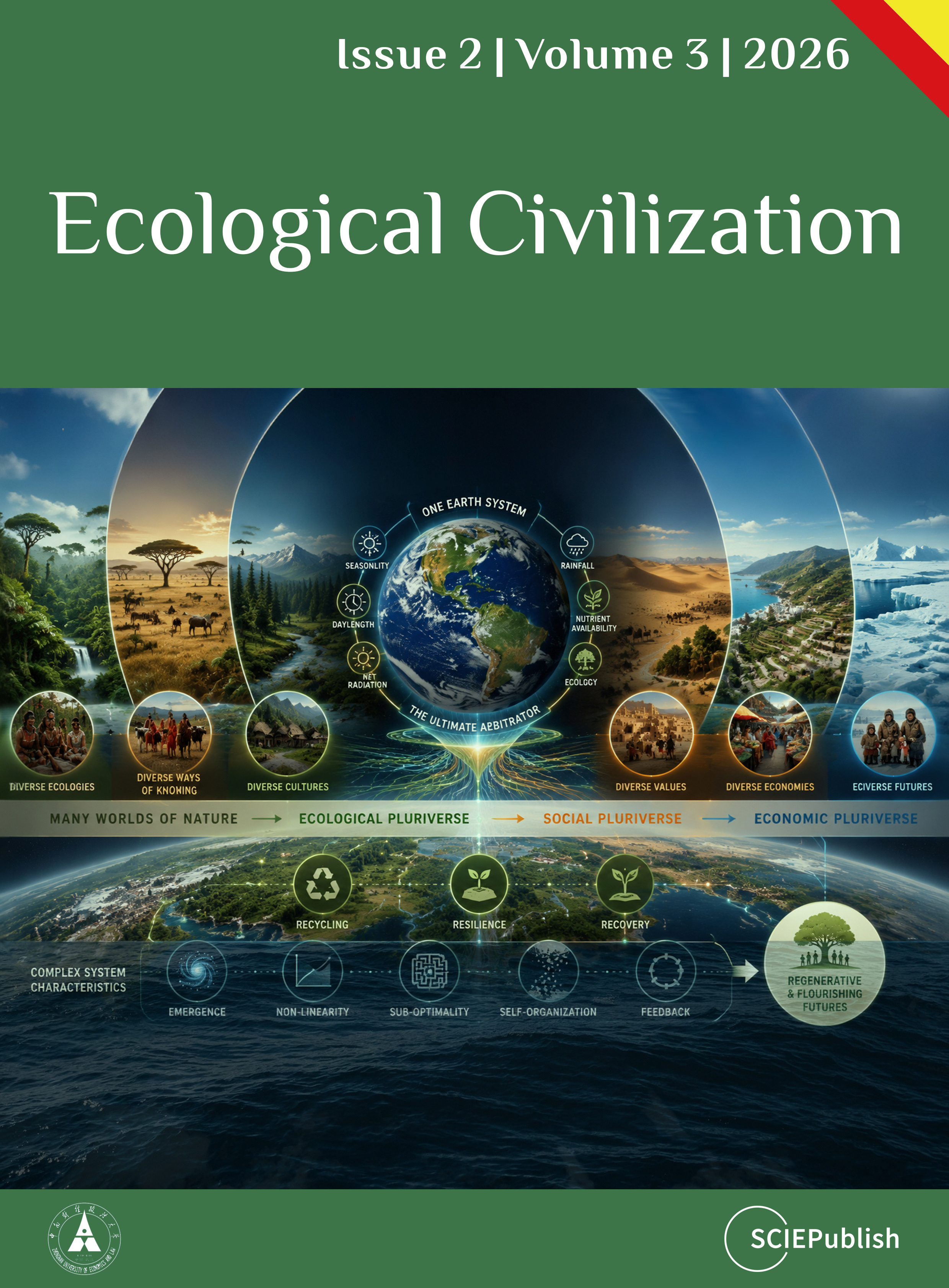
Sustainable Economics: Systems Thinking and the More-Than-Global Pluriverse
Keith R. Skene
1,2,*

Received: 19 November 2025 Revised: 05 December 2025 Accepted: 29 January 2026 Published: 04 February 2026

© 2026 The authors. This is an open access article under the Creative Commons Attribution 4.0 International License (https://creativecommons.org/licenses/by/4.0/).
1. Introduction
As concerns grow relating to the environmental and social challenges facing humanity, the impacts of our economic activities have increasingly come under the spotlight in terms of their contribution to the causes of and solutions to these problems. The recent history of modern humanity is a brief one, particularly in the Northern Hemisphere, which has seen the most rapid development of separation between humanity and its natural ecology, and of treating the planet merely as a sink and a source for economic gain and power. This period stems back to the end of the Younger Dryas ice age in the late Pleistocene, some 11,600 years ago [1].
What was so dramatic about the Younger Dryas ice age was that Northern Europe went from temperate forest conditions to an ice-covered landmass unfit for human habitation within a few decades [2]. Yet today, many people are largely ignorant of the huge impacts of the immense geological and climatological events of the past, and the power of the Earth system to dramatically alter the conditions that we rely upon for our survival.
Interestingly, many indigenous societies have narratives, passed down through oral traditions, which go back much further in time, informing their understanding of the planet and of societies [3,4,5] through geomythology. Geomythology is defined as seeking to “find the real geologic event underlying a myth or legend to which it has given rise” ([6], p. 5). MacCormick, who spent years gathering ancient Gaelic tales from the people of the island of Mull, off the west coast of Scotland, came across an intriguing tale about Cailleach, the goddess of creation and destruction, and guardian of nature, referencing her as saying “When forests grew where now the billows play, I was then a winsome maid” ([7], p. 69). Furthermore, MacCormick refers to another legend that cites Cailleach as utilizing the fertile grazing grounds between Torrin Rocks and Dubh Artach Lighthouse off the southeast coast of Mull for her numerous herds of deer. These ‘grounds’ now all lies beneath the Atlantic Ocean.
This tantalizing quote could reflect on a time when the oceans were in recession, during the ice ages, and trees grew on what is now the sea floor. Recent archaeological work has uncovered a submerged forest off the island of Benbecula, just south of Harris, in the Outer Hebrides, dating to 6600 BCE [8]. Joyce ([9], p. 462) noted that “the Gaelic tales abound in allusions to a beautiful country situated under the [Irish] sea—an enchanted land sunk at some remote time, and still held under spell. In some romantic writings, it is called Tir-fa-tonn, the land beneath the wave”.
Thus, much traditional knowledge, in the forms of myths and legends, recognizes the immense power and dynamic nature of our planet. Some also reference how to manage cataclysmic events, such as tsunamis. In Simeulue, Indonesia, traditional knowledge is passed down over generations in many poems, songs, and stories, collectively called ‘Smong’, that warn of the signs of an impending tsunami and what to do, including information on animal behaviour to watch out for. This led to almost all of the population surviving the 2004 magnitude 9.2 earthquake, whereas neighbouring islands, without such a heritage, had devastating losses [10,11]. Thus, a close association with the planet, as seen in all indigenous cultures, leads to a practical insight into the dangers inherent in this system, ultimately saving lives.
Fundamental to all of this is the Earth system, the complex, interactive sphere within which all of life exists. It is essential to understand how this arbitrator of our existence functions in order to begin elucidating how we can best contribute to a sustainable world within which we can all achieve our full potential. Complex systems theory underpins the key properties of the Earth system.
Understanding the interactions between the individual, society, and the Earth system as a whole is also important. It has been the focus of philosophy and broader social and environmental studies for as long as records exist, going back thousands of years to the cave paintings of Lascaux and the many indigenous narratives from across the globe. Economic theory itself has been understood as a behavioural science, with Robbins ([12], p. 16) writing that: “Economics is the science which studies human behaviour as a relationship between ends and scarce means which have alternative uses”, adding that “humans want what they can’t have”.
Adam Smith [13] suggested that an invisible hand, preventing excess, emerged from a functional society. He discussed this emergent morality in his first book, The Theory of Moral Sentiments [14], and developed this idea in his later treatise on economics and the free market in his second book, An Inquiry into the Nature and Causes of the Wealth of Nations. In The Theory of Moral Sentiments, ([14], pp. 184–185), he noted: “[The rich] consume little more than the poor, and in spite of their natural selfishness and rapacity... they divide with the poor the produce of all their improvements. They are led by an invisible hand to make nearly the same distribution of the necessaries of life, which would have been made, had the earth been divided into equal portions among all its inhabitants, and thus without intending it, without knowing it, advance the interest of the society, and afford means to the multiplication of the species”. This became known as virtuous self-interest. However, the economic thesis of his second book is built upon a functioning society as described in his first book, which is central to any understanding of Smith’s vision of an equitable, sustainable economy [15].
Humboldt saw the relationship between humans and their ecological context as fundamental to how we live, writing: “In considering the study of physical phenomena, not merely in its bearings on the material wants of life, but in its general influence on the intellectual advancement of mankind; we find its noblest and most important result to be a knowledge of the chain of connection, by which all natural forces are linked together, and made mutually dependent upon each other; and it is the perception of these relations that exalts our views and ennobles our enjoyments” ([16], p. 23).
These ‘chains of connection’ underpinned his concept of ‘Zusammenhang’ (literally, hanging together), wherein what we now refer to as the Earth system acts as a super-organism (sensu Hutton [17]), of which we are a part. Thus, we can conceive of an extended invisible hand, or invisible embrace, wherein the relationships between self, society, and environment inform our decisions and behaviour, including those relating to economics [15].
2. Aims and Objectives
This paper sets out to understand the basis of a sustainable economy in terms of its impact on societal and environmental sustainability. Firstly, the Earth system is understood as the organizational framework within which we find our existence. Its key characteristics are explained. We then explore how the Earth system is an ecological pluriverse, a world of many worlds, with different bio-geophysical contexts across our planet. The paper then explains why these contexts are important in terms of the functionality of the system locally, and for social and economic sustainability.
The natural economics of these different ecosystems vary across the planet, and examples are given. Over our evolution, cultural practices have emerged from within each of these ecological worlds within the global Earth system, at the level of the landscape, place, and people, the social pluriverse, with many different philosophical frameworks in resonance both with the global and the local. Finally, for millennia, humans have practice economics in resonance with the local landscapes, tuned to the functional identity and the natural economy of the ecosystems within which they live: an embedded economy [18,19,20,21,22]. We explore what this means for modern humanity in terms of an economic pluriverse.
In order to understand these relationships, this paper sets out an integrated approach where economics is nested within society and society is nested within the Earth system, each representing a set of worlds within one world: the pluriverse.
In this synthetic review, a literature search was conducted across major academic databases, including Scopus, Web of Science, IEEE Xplore, Google Scholar, ResearchGate, ScienceDirect, and SpringerLink, using multiple search terms including: embedded economics, ecological lag, regional economic policy, pluriverse, more-than-human, complex system, Earth system, emergence, natural economics, non-linearity, sub-optimality, territorialism, glocal, and Dùthchas. Critical reviews were included. Over 1000 papers and chapters were studied across these areas, and where papers overlapped in content, the most cited papers were referenced, provided they made the clearest contribution (a decision made by the author, based on many years of working and teaching in this field). Priority was given to Open Access papers in order to facilitate easy access for readers.
3. The Nature of the Earth System
Bianconi et al. [23] define a complex system as “a distributed set of entities with many interconnections (usually networked), where each entity self-operates locally with its neighbouring entities, and exhibiting globally emergent behavior”. The International Geosphere-Biosphere Programme [24] defined the term ‘Earth System’ as the suite of interlinked physical, chemical, biological, and human processes that cycle (transport and transform) materials and energy in complex dynamic ways within the system.
The Earth system is the arbitrator of our future prospects and has always been so. Mass extinction events were a natural outcome of the Earth system’s response to perturbations. While Crutzen and Stoermer [25] have suggested the term ‘Anthropocene’ to describe the geological era in which human activity has been the dominant influence upon the natural world, in reality, it is the Earth system that has always held this role, determining the biogeophysical conditions and the envelope of life (the biosphere) [26].
Complex systems have a number of key characteristics that should enlighten all sustainability policy and practice, since our futures are predicated upon ‘hanging together’ (sensu Humboldt [16]) within the Earth system.
Firstly, they self-assemble and self-organize, properties that are observed throughout the cosmos, from flocking birds to galaxies [27,28,29]. Mass extinctions throughout the history of the Earth system have led to re-assembly and re-organization of life on earth [30]. What is interesting is that the new assemblies, while functionally similar (with detritivores, herbivores, and carnivores), are structurally very different. For example, following the K/T mass extinction event 65 million years ago, the dinosaurs were replaced by mammals and, to a lesser extent, birds, as the dominant herbivores, omnivores, and carnivores.
Thompson [31] referred to the importance of this organizational drive when he wrote, “We rise from the conception of form to an understanding of the forces which gave rise to it… forces that have sufficed to convert the one form into the other”. Thus, transformation, while evidenced by structural change, can best be understood as an emergent outcome of the greater system, which is ‘hanging together’ as a dynamic, interactive whole, wherein feedback across the system acts as the invisible embrace across the entirety.
Secondly, these systems demonstrate emergence, in which the system’s properties belong to the system itself rather than to any given component [32]. Lewes ([33], p. 413) noted that “the emergent is unlike its components in so far as these are incommensurable, and it cannot be reduced to their sum or their difference”. This is an important point, highlighting the fact that reductionist thinking is irrelevant here. Resilience is an emergent property and cannot be built [34]. A loss of resilience occurs before catastrophic population collapse and thus is symptomatic of further emergent outcomes, the causes of which are still unknown [35].
Only by careful monitoring can we pick up on signals of dramatic shifts in system functionality, and, thus, real time feedback is essential. The communication channels between the components of the Earth system, both biological and physical, include ions and other chemicals, as well as mass and energy, acting as key sources of information [36]. There are some 30 billion smart devices on the planet, and thus we have the power, through the internet of things, to monitor these channels across the Earth system, providing some knowledge of how the system is responding to our inputs and giving us the opportunity to respond [37,38,39,40].
Non-linearity is another important characteristic of complex systems. Strogatz ([41], p. 182) observed that “every major unsolved problem in science—from consciousness to cancer to the collective craziness of the economy, is non-linear”. Non-linearity can be understood as the existence of multiple unstable states between which the system can shift, often leading to regime shifts and tipping points that are difficult to predict. Many examples have been observed across economic, ecological, and social arenas, and, more often, simultaneously across all three [42,43,44,45,46,47,48]. Given the complexity of the interactions leading up to dramatic change, feedback across a wide range of indicators is essential.
Trade-offs are extremely important in complex systems. Because there are so many demands across the system, no single demand can be resolved optimally without jeopardizing the solution space of all other demands; otherwise, the system will fail [49,50]. For example, if we optimize DNA correction, there will be no genetic variation, meaning that there will be insufficient options to meet changing conditions [51]. By optimizing for agricultural productivity, humanity has created eutrophication, due to runoff of fertilizers [52], impacting freshwater and coastal shores and creating dead zones. Soil compaction has increased due to increasingly heavy, complexed machinery [53]. Soil salinity has increased due to increased irrigation [54]. Herbicide resistance has increased with the widespread use of herbicides (much like antibiotic resistance) [55]. And so, our attempts to optimize crop productivity have sown the seeds of agricultural collapse. We see sub-optimality across the Earth system, and it is a sign of a working system [56,57,58,59].
What is important is the level of sub-optimality that best serves the system. However, because the Earth system is a dynamic non-equilibrium system, the trade-offs necessary will change over time. Here, again, feedback is essential, as is the inclusion of dynamic sub-optimality in any design process. Much as carrying capacities do not remain constant for a given landscape [60,61], in similar ways, appropriate trade-offs will increase or decrease over time.
Thus, the Earth system has a number of characteristics that pose challenges in terms of sustainable outcomes. Table 1 summarizes these and explores important approaches to responding to these challenges in business and more generally.
Table 1. Summary of key challenges posed by Earth system characteristics, and possible approaches to meeting these challenges.
|
Characteristics |
Challenges |
Approaches |
|---|---|---|
|
Self-organization |
Implications for our own organizational plans; occurs at every level of organization with unexpected consequences |
Emphasise process-based planning rather than structure-based planning; develop multi-level appraisal of development, not merely single component level |
|
Emergence |
Difficult to predict and impossible to control; barriers to recognizing the system as the centre of control |
Increase ecological intelligence and technological feedback to monitor impacts of actions at every level of organization |
|
Non-linearity |
Difficult to design adaptation, given potential regime shifts; difficulties in forecasting and planning |
Study and monitor changes in resilience, which often occur prior to regime shifts; prioritize research into other warning signs of imminent transformation |
|
Real-time feedback |
Decline in socio-ecological knowledge due to dualism; ignorance of systems theory due to reductionism |
Actively increase formal and informal education programmes for system awareness for all ages; increased training in Earth system economics; major adoption of 30 billion smart devices, citizen science and the internet-of-things to restore feedback links |
|
Sub-optimality |
Drive for efficiency and optimization; silo thinking leads to denial of the necessity of trade-offs at every level of organization and of embeddedness of all components |
Increased awareness of the importance of trade-offs in design; eradication of silos; system-level planning, research into appropriate sub-optimality operons for process design; trade-offs as part of policy; system-level assessment of impact |
4. The Global and the Local: ‘Ways of Being’ within the Earth System
The Earth is not a singular, uniform entity. Due to its spherical shape (resulting in higher levels of incident radiation at the equator than at the poles), its axial tilt, the location of its land masses, tectonic plate movement, global oceanic and atmospheric circulatory systems and changing atmospheric gas content, very different conditions occur across the planet, both in temporal (seasonal and across geological time) and spatial (altitude and latitude) terms. Climatic differences impact on the biodiversity, both structurally and functionally.
While the characteristics of the Earth system operate globally, they are expressed differently depending on the local biogeographical conditions. This is fundamentally due to the energetic context, which drives everything else, from natural economics (i.e., the economics observed within natural ecosystems in terms of growth, resource allocation, marketing (e.g., for pollinators), and storage), through to meteorological conditions (where energy drives atmospheric/oceanic circulation patterns and the hydrological cycles).
Table 2 explores the economic activities of a particular organism and how they compare to business economics. Two points are important here. Firstly, Earth system economics operates at every level of organization and across these levels, because all levels are integrated and dependent on one another, from individuals to populations, communities, and ecosystems. Secondly, because of temporal and spatial heterogeneity, these natural economies are structured with very different emphases and financial strategies, depending on the conditions prevailing at that particular place and time.
The natural economies of the different ecosystems across the globe vary radically. For example, a tropical rainforest behaves very differently than a savanna or a tundra ecosystem (see Table 3). Indigenous populations located in these ecosystems also differ significantly.
Table 2. Economic terminology in nature and their parallels in business.
|
Natural Property |
Example |
Business Equivalent |
|---|---|---|
|
Gross productivity |
Total energy income |
Gross income |
|
Net productivity |
Production minus costs |
Cash flow |
|
Ecological disturbance and competition |
Increasing costs in acquiring resources |
Inflation |
|
Free energy |
Available energy for work |
Capital |
|
Stored resources |
Tubers/corms/bulbs/starch |
Assets |
|
Resource allocations |
Root to shoot ratio |
Asset allocation |
|
Respiration |
Maintenance and growth |
Liabilities |
|
Nutrient turnover |
Asset realization |
Liquidity |
Table 3. Differences between three major biomes across the planet.
|
Characteristic |
Tundra |
Tropical Rainforest |
Savanna |
|---|---|---|---|
|
Annual precipitation (mm) [62] |
200–1000 |
2000–4600 |
400–1500 |
|
Mean temperature (°C) [62] |
−15 to −5 |
20 to 30 |
18 to 30 |
|
Carbon turnover time (years) [63] |
65 |
16 |
14 |
|
Root to shoot ratio [64] |
6.6 |
0.19–0.34 |
0.7 |
|
Roots in top 30 cm of soil (%) [64] |
93 |
69 |
57 |
|
Incoming radiation (watts·m−2) [65] |
180 |
260 |
250 |
|
Net radiation (watts·m−2) [65] |
−125 |
75 |
50 |
|
Seasonality [65] |
Extreme |
Moderate |
Moderate |
|
Fire risk [66] |
Moderate |
High |
Very high |
|
Economy [67] |
Store/spend |
Spend |
Spend |
This paper suggests that our economic activities should also align with the natural economy to reduce our impact. We will explore this through the lens of the pluriverse concept.
5. Pluriverse Thinking
The concept of a pluriverse was defined by James ([68], p. 125) who described it as: “Things are with one another in many ways, but nothing includes everything or dominates over everything”. More recently, pluriversal thinking has been limited to the domains of post-globalization and post-development philosophy, insisting that different ontological approaches produce different materialities and realities, and that these approaches can and should exist concurrently [69,70,71]. Thus, it is argued, there are many ways of being in the world and being of the world, rather than a universalist, globalist approach based on a single, reductionist, individualist, and dualistic (where humans and nature are separated) mode of being [72,73].
The concept of a pluriverse has been critically received [74]. Pluriversal thinking can appear as a set of alternative economies reflecting a very different cosmovision than that of the globalized one-world world (OWW) of Western economics: a biverse rather than a pluriverse. This alternative vision is often an emergent outcome of indigenous political, social, natural, and religious-spiritual theory [70,75]. Such an approach can appear very challenging for a more rectilinear, empirical school of thought, as in OWW philosophy, meaning there can be little consensus between these two positions [76,77].
Hence, there is a risk that the concept of the pluriverse could represent a politico-social divide, preventing integration of the many indigenous and post-development philosophies with Enlightenment philosophies within one world of many worlds [70]. Furthermore, potential issues arise at the economic level. How can a global and a local economy function alongside each other? Localized differences in ethical philosophy, culture, and legislation could impact governance and supply chain accountability [39,78]. What does this ‘world within which many worlds fit’ actually represent? Can it function, and what evidence exists for this? In this paper, it is argued that a fully functioning pluriverse does exist: the ecological pluriverse. Over many thousands of years, indigenous traditional communities have formed embedded, cohesive societies within this ecological pluriverse: the social pluriverse. In turn, the economic activities of these communities have formed an economic pluriverse.
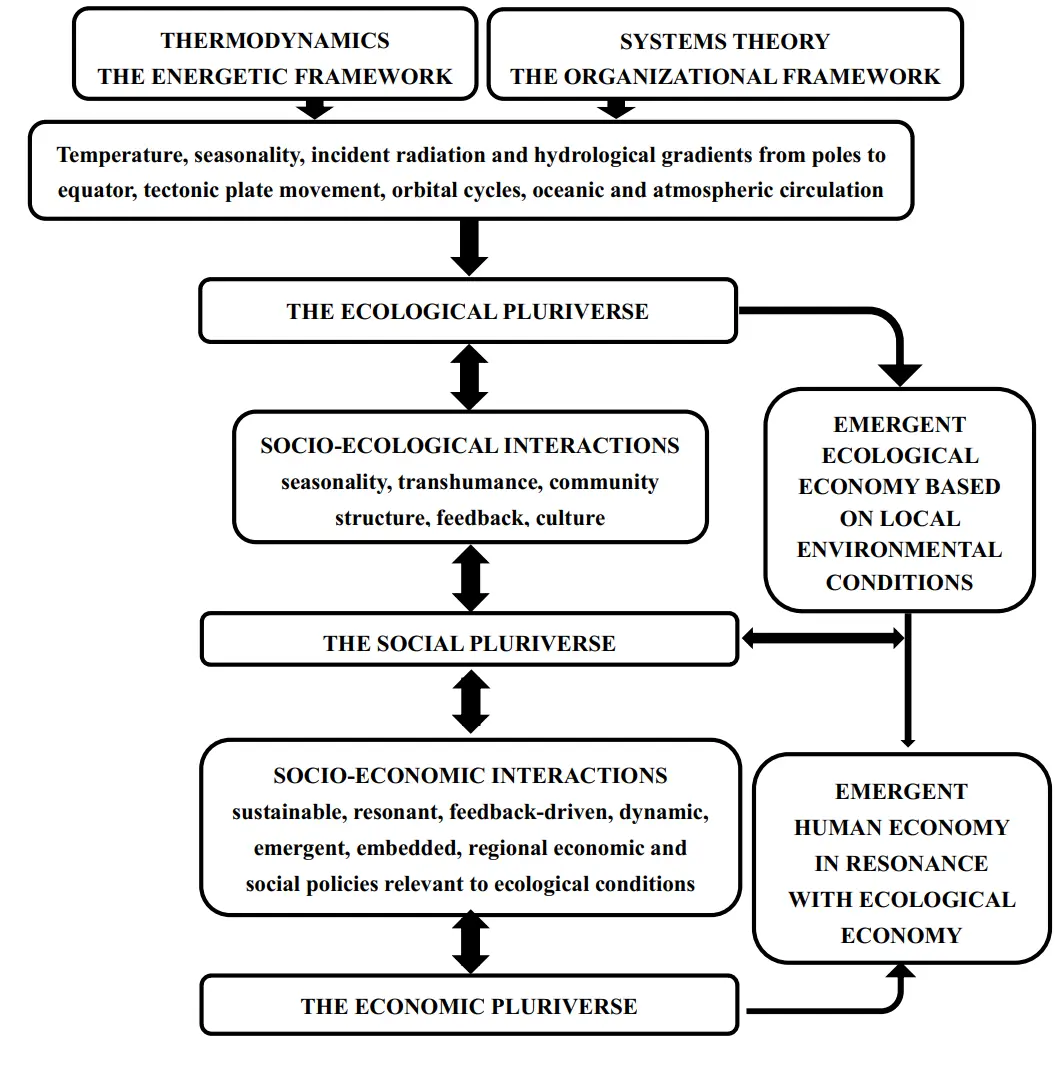
In this paper, the pluriverse will be considered at these three levels: the ecological pluriverse, the sociological pluriverse, and the economic pluriverse. These are viewed as nested within each other, in which society emerges from the ecology, while economics emerges from a nested society. Thus, as mentioned above, we have the concept of an invisible embrace [15], which drives appropriate behaviour within the Earth system, wherein our economics is both sustainable and healing for our social and environmental relationships.
At the heart of this lies real-time feedback (Table 1). Only when our economic activities are embedded within our environmental and social contexts can we contribute to a sustainable future [18,19,20,21,22]. It is not enough to reduce our negative impact; rather, we must positively contribute to the Earth system to increase resilience and reduce the risk of non-linear regime shifts. Murray et al. [79] stress that what is needed is: “an economic model wherein planning, resourcing, procurement, production, and reprocessing are designed and managed, as both process and output, to maximize ecosystem functioning and human well-being”. Human well-being is dependent on ecosystem functioning [80]. This is the Zusammenhang of Humboldt, as encountered earlier. The British economist, Dasgupta ([81], p. 497), emphasises the interplay between communities, nature and well-being, observing that: “If contact with the natural world is a means to furthering personal well-being, connectedness with Nature is an aspect of well-being itself”.
6. The Ecological Pluriverse
While many argue that the pluriverse is an abstract concept, the Earth system acts as a fully functioning example. As we have noted, the biosphere is spread across a number of biomes, each with very different properties. The global, complex Earth system, with its core characteristics, as noted earlier, is realized in different ways depending on the biogeographical context of its location. Here, place is everything, and complex systems theory operates through the local conditions (Table 3).
Each world within the pluriverse of worlds has a unique economy, which is energetically fitted to the conditions, with an appropriate fiscal strategy. The economy is not the property of one single individual or species, but is a highly integrated whole, operating within local and global contexts. Thus, it is an emergent outcome, non-linear and sub-optimal at any given component level [18,82], with the system expressing itself locally, within the greater whole. Indeed, sustainability within this context can be seen to require local, regional policies and approaches [83], rather than applying a global bauplan and global policies across the pluriverse [84]. Strategies and policies designed for a tropical rainforest are unlikely to achieve success in the tundra, for example (Table 3).
7. The Social Pluriverse
The social pluriverse is seen as emerging from the ecological pluriverse, in which early human societies were obligated to embed within the landscape and ecology to survive [85,86,87]. As a result, socio-ecological cultures emerged [88,89], and ecological ethics developed [90]. Linkages were strengthened through myths and legends, and through art and the oral tradition [91,92,93].
Here, the social pluriverse is seen as emergent from the ecological pluriverse, in resonance with the global Earth system and the local biogeography. Change through time is also fundamental, as the Earth system is a dynamic, far-from-equilibrium entity. By developing ways of being that are tuned to the boundaries and patterns that define the ecological space available, a sustainable paradigm arises. This avoids the tragedy of the commons (sensu Hardin [94]), wherein humans drive themselves to destroy the ecology that provides for their survival.
Thus, the Earth system represents a global integrity and a local plurality, which represents a form of ‘glocalism’, combining the global and the local [95,96,97,98]. Mihr ([99], p. 15) defines glocalism as “a process of norm diffusion from the local to the global and from the global to the local”. Interestingly, the term is thought to have been inspired by the Japanese concept of ‘dochakuka’, referring to the adaptation of farming techniques to local contexts. In many ways, the glocal represents a functional pluriverse, where common values and local emphases operate together.
8. The Economic Pluriverse
The natural economic pluriverse exists throughout the Earth system and is itself an emergent form of the ecological pluriverse. Each organism, population, community and ecosystem practice economics that are relevant to and resonant with the temporal and spatial conditions specific to their landscape and climate (see Table 3). Fiscal planning is finely tuned to the energetic, nutrient and hydrological context, but sub-optimal for systems theory reasons and because of ecological lag [22,100]. Ecological lag means that the system takes time to catch up in terms of any significant changes that have occurred in the past. For example, Trinidad was once connected to mainland South America, only becoming separated a few thousand years ago [101]. As a consequence, species diversity has been decreasing since this time due to the species richness-area relationship (i.e., the smaller the area, the lower the species richness). Hence, any study of decreasing species richness in Trinidad must take into account changes due to a lag in adjustment to dramatic events millennia ago. Ecological feedback can act over huge timescales. Another example of lag is isostatic lift, where landmasses previously covered in ice can be rising relative to sea level, thus masking sea level rise [102].
Seasonality, incident radiation, fire ecology, nutrient turnover rates, competition, and opportunity all provide input to natural economic decision-making. This is because survival depends on an embedded economy, responsive to the state of the commons and the dynamics of the system as a whole [69]. Real-time feedback is an essential component, and drastic economic collapse can occur through non-linearity if tipping points are crossed [103]. As Bloom ([104], p. 98) observed: “A pattern of resource acquisition and allocation that is efficient in one climate may prove disastrous in another”. Thus, it seems clear that human economics should follow a similar path for a sustainable future.
This paper suggests that rather than a global, one-world world (OWW) economy, a set of alternative economies, rooted in localism, place, and ecology, while emergent from the ecological and social pluriverse, would be more likely to lead to sustainable, resilient outcomes, within the human, ecological, and economic arenas, since these arenas are tightly interdependent. This also requires a policy pluriverse, where, rather than global sustainable development goals, for example, we have regional, relevant sets of policies that are resonant with the local conditions [83,84,105,106]. For example, turnover rates vary hugely across the ecological pluriverse (Table 3), and what might appear as a renewable resource in a region with fast turnover rates may not be renewable in a region with slow turnover rates. Also, disturbance events will take much longer to naturally ameliorate in areas with slow turnover rates. Furthermore, resilience varies across regions, depending on functional redundancy and disturbance regimes [107,108,109].
In terms of policy, it is fundamentally important to assess economic growth as net economic growth (i.e., man-made capital) with social costs (such as increased healthcare expenditure) and environmental costs (such as sea level rise, red tide events, soil salinity and air pollution) subtracted, and gains, both (such as reductions in healthcare costs relating to asthma and healthcare costs related to extreme temperatures) and environmental (such as reduction in agricultural failure relating to climate destabilization, and insurance payouts related to flooding, for example) added, rather than gross growth [18]. Governance processes that can more fully recognize complex system outcomes such as tipping points and emergence, should be implemented [110]. Furthermore, priority should be given to information governance in the shape of policies around disclosure, while shifting governance approaches from merely reporting to delivering action [106]. Only by doing this can a true understanding of productivity be calculated. Policies should also recognize heterogeneity across the ecological and social pluriverse, with relevant measures reflecting the characteristics of the landscape and ecology. An analytical framework is presented in Figure 1.
9. Urban Contexts of the Ecological, Social, and Economic Pluriverse
The ecological pluriverse is easily appreciated in rural settings, where the landscape is evident. However, 55% of humans live in urban settings, and this is predicted to rise to 68% by 2050 [111]. Thus, if the ecological pluriverse is to be a foundational principle upon which to base sociological and economic sustainability, then how can an urban setting be relevant to the surrounding rural landscapes? In fact, much research has been carried out on this, beginning with the theoretical and practical work of the city planner, Patrick Geddes. Geddes understood the city as being situated within the cultural and ecological contexts of its surroundings, knitting together landscape ecology and green urban city space. He brought together people, their social structures, and the environment [112], approaching town planning as a holistic endeavour.
Geddes [113] explored the importance of the local landscape and ecology in terms of regional planning. He rejuvenated urban slums by referencing cultural history and the ecology of the territory in which the city was located, bringing a multi-dimensionality to urban renovation. This thinking stemmed from his ‘valley section’ concept [114], which saw the city as expressing the region, and vice versa. Geddes ([115], p. 106) wrote: “As the river carries down contributions from its whole course, so each complex community, as we descend, is modified by its predecessors”.
Cosgrove [116] noted that the valley section defines our modern concept of community as emerging from the environmental context and the social history. Economic activity is reflected in both ecology and sociology, as Geddes referred to it, in his trinity of folk, work, and place. The region and the city are seen as integrated and embedded within each other, forming true regionality. Thus, urban planning should be informed by this nature/culture context.
Magnaghi, the founder of the Italian school of Territorialism, discussed the emergence of a consciousness of place, challenging the contemporary economic logic that dislocates the relationship between environment, work, and living. The rebalancing of this relationship implies a reappropriation of economic processes by local populations. Magnaghi [117] envisaged the territory as a living being, with an identity stemming from its geophysical configuration and from reciprocal adaptations between ecology and society over time. By understanding these relationships, regional planning can further embed economics, ecology, and sociology within each other.
Magnaghi discussed Olivetti’s work on territorial justice, reflecting that Olivetti set out “a practice of community self-government of territories which advocates for a general reform of the institutional hierarchy. Such progress, founded on a ‘holistic’ conception of territory as a historical-social subject pre-existent to production relationships, and resulting in an apolitical project in which the primary decision-making level resides in local territories” ([118], p. 57).
All of this relies on a connectivity between community and place, and we see this explored in a number of ways. The Gaelic philosophy of sustainability, Dùthchas (in Scottish Gaelic) or Dùchas (in Irish Gaelic), from the Gaelic word ‘dùth/dù’, meaning earth or land, is relevant here. Starmore [119] described it as: “a feeling of belonging, of where everything is linked, completely linked. Where you belong to the land, and the land belongs to you—there is no distinction”. Ó Tuama ([120], p. 28) notes that in this philosophy, “there is a sense in which place finally becomes co-extensive in the mind, not only with personal and ancestral memories, but with the whole living community culture. Community becomes place, place community”. Newton ([121], p. 453) writes that these ideas “encode, transmit, and reinforce particular ways of thinking about the relationship between people and nature”. These ideas are prevalent in much traditional thinking, such as the sub-saharan African concept of ubuntu, and the South American sumak kawsay and buen vivir, where reciprocity, connection, and relationality are core characteristics [122,123].
10. Conclusions
Sustainable economics must be practiced within the Earth system, embedding itself within the multitude of feedback loops that form the lifeblood of the system itself and of the many components within it. At a local level, the ecological, social, and economic pluriverse can be seen as emergent entities, and by having regional policies and practices, relevant to the local ecology, we give ourselves a much better opportunity for a sustainable future. Technology can be important, both in terms of feedback through the vast array of smart devices and the internet-of-things, and in implementing appropriate sub-optimality operons that manage trade-offs across the social, ecological, and economic arenas, rather than optimizing for efficiency and economic growth. Indeed, the depreciation of natural capital will overwhelm any gross profit unless addressed, and so a system-based, pluriversal economic programme is the only profitable direction. An analytical framework and roadmap for implementing the ideas set out in this paper are detailed elsewhere [124]. A re-evaluation of our activities in light of complex systems theory and pluriversal thinking can be seen to not only provide a positive way forward, but also represents an essential step, given the fact that the Earth system acts as the arbitrator of our future prospects, both socially and economically.
Ethics Statement
Not applicable.
Informed Consent Statement
Not applicable.
Data Availability Statement
Not applicable.
Funding
This research received no external funding.
Declaration of Competing Interest
The author declares that he has no known competing financial interests or personal relationships that could have appeared to influence the work reported in this paper.
References
-
Crombé P, Pironneau C, Robert P, van der Sloot P, Boudin M, De Groote I, et al. Human response to the Younger Dryas along the southern North Sea basin, Northwest Europe. Sci. Rep. 2024, 14, 18074. DOI:10.1038/s41598-024-68686-z [Google Scholar]
-
Carlson AE. The younger dryas climate event A2. In Encyclopedia of Quaternary Science, 2nd ed.; Mock CJ, Scott AE, Eds.; Elsevier: Amsterdam, The Netherlands, 2013; pp. 126–134. [Google Scholar]
-
Nunn PD. Geohazards and myths: Ancient memories of rapid coastal change in the Asia-Pacific region and their value to future adaptation. Geosci. Lett. 2014, 1, 3. DOI:10.1186/2196-4092-1-3 [Google Scholar]
-
Walsh K, Brown AG, Gourley B, Scaife R. Archaeology, hydrogeology and geomythology in the Stymphalos valley. J. Archaeol. Sci. Rep. 2017, 15, 446–458. DOI:10.1016/j.jasrep.2017.03.058 [Google Scholar]
-
Haslett SK, Willis D. The ‘lost’ islands of Cardigan Bay, Wales, UK: Insights into the post-glacial evolution of some Celtic coasts of northwest Europe. Atl. Geosci. 2022, 58, 131–146. DOI:10.4138/atlgeo.2022.005 [Google Scholar]
-
Vitaliano DB. Geomythology: The impact of geologic events on history and legend with special reference to Atlantis. J. Folk. Res. 1968, 5, 5–30. DOI:10.2307/3813842 [Google Scholar]
-
MacCormick J. The Island of Mull: Its History, Scenes and Legends; Alex MacLaren and Sons: Glasgow, UK, 1923; 215p. [Google Scholar]
-
Hardy K, Ballin T, Bicket A. Rapidly changing worlds. Finding the earliest human occupations on Scotland’s Scotland’s north-west coastline. Quat. Int. 2021, 584, 106–115. DOI:10.1016/j.quaint.2020.10.060 [Google Scholar]
-
Joyce PW. Old Celtic Romances; Translated from Gaelic; Longmans, Green and Co.: London, UK, 1920; 504p. [Google Scholar]
-
McAdoo BG, Dengler L, Prasetya G, Titov V. Smong: How an oral history saved thousands on Indonesia’s Indonesia’s Simeulue Island during the December 2004 and March 2005 tsunamis. Earthq. Spectra 2006, 22 (Suppl. S3), 661–669. DOI:10.1193/1.2204966 [Google Scholar]
-
Suciani A, Islami ZR, Zainal S, Sofiyan, Bukhari. “Smong” as local wisdom for disaster risk reduction. IOP Conf. Ser. Earth Environ. Sci. 2018, 148, 012005. DOI:10.1088/1755-1315/148/1/012005 [Google Scholar]
-
Robbins LC. An Essay on the Nature and Significance of Economic Science; MacMillan and Company: London, UK, 1932; 141p. [Google Scholar]
-
Smith A. An Inquiry into the Nature and Causes of the Wealth of Nations; W. Strahan and T. Cadell: London, UK, 1776; 540p. [Google Scholar]
-
Smith A. The Theory of Moral Sentiments; Printed for Andrew Millar, in the Strand; A. Kincaid and J. Bell: Edinburgh, UK, 1759; 322p. [Google Scholar]
-
Skene KR. Steering the circular economy: A new role for Adam Smith’s Smith’s invisible hand. In Sustainability and the Circular Economy; Stefanakis A, Nikolaou I, Eds.; Elsevier: London, UK, 2022; pp. 21–33. [Google Scholar]
-
Von Humboldt A. Cosmos: A Sketch of the Physical Description of the Universe; Otté EC, Translator; Johns Hopkins University Press: Baltimore, MD, USA, 1997; 424p. [Google Scholar]
-
Hutton J. Theory of the Earth; or an investigation of the laws observable in the composition, dissolution, and restoration of land upon the globe. Earth Environ. Sci. Trans. R. Soc. Edinb. 1788, 1, 209–304. DOI:10.1017/S0080456800029227 [Google Scholar]
-
Skene KR. How can economics contribute to environmental and social sustainability? The significance of systems theory and the embedded economy. Front. Sustain. 2022, 3, 980583. DOI:10.3389/frsus.2022.980583 [Google Scholar]
-
Brailly J, Favre G, Chatellet J, Lazega E. Embeddedness as a multilevel problem: A case study in economic sociology. Soc. Netw. 2016, 44, 319–333. DOI:10.1016/j.socnet.2015.03.005 [Google Scholar]
-
Morris C, Kirwan J. Ecological embeddedness: An interrogation and refinement of the concept within the context of alternative food networks in the UK. J. Rural Stud. 2011, 27, 322–330. DOI:10.1016/j.jrurstud.2011.03.004 [Google Scholar]
-
Timmerman P. The ethics of re-embedding economics in the real: Case studies. In Ecological Economics for the Anthropocene: An Emerging Paradigm; Brown PG, Timmerman P, Eds.; Columbia University Press: New York, NY, USA, 2015; pp. 21–65. [Google Scholar]
-
Zhu DE, Du H, Zhou G, Hu M, Huang Z. The spatiotemporal dynamics and evolutionary relationship between urbanization and eco-environmental quality: A case study in Hangzhou City, China. Remote Sens. 2025, 17, 1567. DOI:10.3390/rs17091567 [Google Scholar]
-
Bianconi G, Arenas A, Biamonte J, Carr LD, Kahng B, Kertesz J, et al. Complex systems in the spotlight: Next steps after the 2021 Nobel Prize in Physics. J. Phys. Complex. 2023, 4, 010201. DOI:10.1088/2632-072X/ac7f75 [Google Scholar]
-
IGBP. Global Change and the Earth System: A Planet Under Pressure; The International Geosphere-Biosphere Programme Book Series; Springer: New York, NY, USA, 2004; 346p. [Google Scholar]
-
Crutzen PJ, Stoermer EF. The ‘Anthropocene’. IGBP 2000, 41, 17–18. [Google Scholar]
-
Vernadsky VI. The Biosphere: An envelope of the Earth. In The Biosphere; Springer: New York, NY, USA, 1998; pp. 91–102. [Google Scholar]
-
Nozakura T, Ikeuchi S. Formation of dissipative structures in galaxies. Astrophys. J. 1984, 279, 40–52. DOI:10.1086/161863 [Google Scholar]
-
Ramaswamy S. The mechanics and statistics of active matter. Annu. Rev. Condens. Matter Phys. 2010, 1, 323–345. DOI:10.1146/annurev-conmatphys-070909-104101 [Google Scholar]
-
Pakter R, Levin Y. Stability of planetary systems: A numerical didactic approach. Am. J. Phys. 2019, 87, 69–74. DOI:10.1119/1.5079541 [Google Scholar]
-
Skene KR. Life’s a gas: A thermodynamic theory of biological evolution. Entropy 2015, 17, 5522–5548. DOI:10.3390/e17085522 [Google Scholar]
-
Thompson DW. On Growth and Form, 1st ed.; Cambridge University Press: Cambridge, UK, 1917; 793p. [Google Scholar]
-
Bedau MA, Humphreys PE. Emergence: Contemporary Readings in Philosophy and Science; MIT Press: Cambridge, MA, USA, 2008; 464p. [Google Scholar]
-
Lewes GH. Problems of Life and Mind; Truebner: London, UK, 1879; 189p. [Google Scholar]
-
Hollnagel E, Woods DD, Leveson N. Resilience Engineering: Concepts and Precepts; Ashgate Publishing Ltd.: Aldershot, UK, 2006; 414p. [Google Scholar]
-
Dai L, Vorselen D, Korolev KS, Gore J. Generic indicators for loss of resilience before a tipping point leading to population collapse. Science 2012, 336, 1175–1177. DOI:10.1126/science.1219805 [Google Scholar]
-
Lucia U. Bio-engineering thermodynamics: An engineering science for thermodynamics of biosystems. Int. J. Thermodyn. 2015, 18, 254–265. DOI:10.5541/ijot.5000131605 [Google Scholar]
-
Moriguchi Y. Material flow indicators to measure progress toward a sound material-cycle society. J. Mater. Cycles Waste Manag. 2007, 9, 112–120. DOI:10.1007/s10163-007-0182-0 [Google Scholar]
-
Rodrigues VP, Pigosso DCA, McAloone TC. Process-related key performance indicators for measuring sustainability performance of ecodesign implementation into product development. J. Clean. Prod. 2016, 139, 416–428. DOI:10.1016/j.jclepro.2016.08.046 [Google Scholar]
-
Skene KR. Artificial Intelligence and the Environmental Crisis: Can Technology Really Save the World?; Routledge: Abington, UK, 2020; 276p. [Google Scholar]
-
Skene KR. What is the unit of intelligence? Artificial intelligence, relational ethics and the Earth system. Topoi 2025, in press. DOI:10.1007/s11245-025-10329-7 [Google Scholar]
-
Strogatz S. Sync: The Emerging Science of Spontaneous Order; Hyperion Books: New York, NY, USA, 2003; 353p. [Google Scholar]
-
Rocha JC, Peterson GD, Biggs R. Regime shifts in the Anthropocene: Drivers, risks, and resilience. PLoS ONE 2015, 10, e0134639. DOI:10.1371/journal.pone.0134639 [Google Scholar]
-
Wernberg T, Bennett S, Babcock RC, Bettignies T, Cure K, Depczynski M, et al. Climate-driven regime shift of a temperate marine ecosystem. Science 2016, 353, 169–172. DOI:10.1126/science.aad8745 [Google Scholar]
-
Cooper GS, Willcock S, Dearing JA. Regime shifts occur disproportionately faster in larger ecosystems. Nat. Commun. 2020, 11, 1175. DOI:10.1038/s41467-020-15029-x [Google Scholar]
-
Dietz S, Rising J, Stoerk T, Wagner G. Economic impacts of tipping points in the climate system. Proc. Natl. Acad. Sci. USA 2021, 118, e2103081118. DOI:10.1073/pnas.2103081118 [Google Scholar]
-
Meyer-Gutbrod EL, Greene CH, Davies KTA, Johns DG. Ocean regime shift is driving collapse of the North Atlantic right whale population. Oceanography 2021, 34, 22–31. DOI:10.5670/oceanog.2021.308 [Google Scholar]
-
Juhola S, Filatova T, Hochrainer-Stigler S, Mechler R, Scheffran J, Schweizer PJ. Social tipping points and adaptation limits in the context of systemic risk: Concepts, models and governance. Front. Clim. 2022, 4, 1009234. DOI:10.3389/fclim.2022.1009234 [Google Scholar]
-
Li CZ, Crépin AS, Lindahl T. The economics of tipping points: Some recent modelling and experimental advances. Int. Rev. Environ. Resour. Econ. 2024, 18, 385–442. DOI:10.1561/101.00000167 [Google Scholar]
-
Farnsworth KD, Niklas KJ. Theories of optimization, form and function in branching architecture in plants. Funct. Ecol. 1995, 9, 355–363. DOI:10.2307/2389997 [Google Scholar]
-
Grumbach S, Hamant O. How humans may co-exist with Earth? The case for suboptimal systems. Anthropocene 2020, 30, 100245. DOI:10.1016/j.ancene.2020.100245 [Google Scholar]
-
Skene KR. In pursuit of the framework behind the biosphere: S-curves, self-assembly and the genetic entropy paradox. Biosystems 2020, 190, 104101. DOI:10.1016/j.biosystems.2020.104101 [Google Scholar]
-
Dorgham MM. Effects of eutrophication. In Eutrophication: Causes, Consequences and Control; Springer: Dordrecht, The Netherlands, 2014; Volume 2, pp. 29–44. [Google Scholar]
-
Nawaz MF, Bourrie G, Trolard F. Soil compaction impact and modelling. A review. Agron. Sustain. Dev. 2013, 33, 291–309. DOI:10.1007/s13593-011-0071-8 [Google Scholar]
-
Butcher K, Wick AF, DeSutter T, Chatterjee A, Harmon J. Soil salinity: A threat to global food security. Agron. J. 2016, 108, 2189–2200. DOI:10.2134/agronj2016.06.0368 [Google Scholar]
-
Owen MD, Zelaya IA. Herbicide-resistant crops and weed resistance to herbicides. Pest Manag. Sci. 2005, 61, 301–311. DOI:10.1002/ps.1015 [Google Scholar]
-
Parrish JK, Edelstein-Keshet L. Complexity, pattern, and evolutionary trade-offs in animal aggregation. Science 1999, 284, 99–101. DOI:10.1126/science.284.5411.99 [Google Scholar]
-
Rodríguez JP, Beard TD Jr., Bennett EM, Cumming GS, Cork SJ, Agard J, et al. Trade-offs across space, time, and ecosystem services. Ecol. Soc. 2006, 11, 28. DOI:10.5751/ES-01667-110128 [Google Scholar]
-
Shoval O, Sheftel H, Shinar G, Hart Y, Ramote O, Mayo A, et al. Evolutionary trade-offs, Pareto optimality, and the geometry of phenotype space. Science 2012, 336, 1157–1160. DOI:10.1126/science.1217405 [Google Scholar]
-
Tendler A, Mayo A, Alon U. Evolutionary tradeoffs, Pareto optimality and the morphology of ammonite shells. BMC Syst. Biol. 2015, 9, 12. DOI:10.1186/s12918-015-0149-z [Google Scholar]
-
Arrow K, Bolin B, Costanza R, Dasgupta P, Folke C, Holling CS, et al. Economic growth, carrying capacity, and the environment. Ecol. Econ. 1995, 15, 91–95. DOI:10.1016/0921-8009(95)00059-3 [Google Scholar]
-
McKeon GM, Stone GS, Syktus JI, Carter JO, Flood NR, Ahrens DG, et al. Climate change impacts on northern Australian rangeland livestock carrying capacity: A review of issues. Rangel. J. 2009, 31, 1–29. DOI:10.1071/RJ08068 [Google Scholar]
-
Woodward FI, Lomas MR, Kelly CK. Global climate and the distribution of plant biomes. Philos. Trans. R. Soc. Lond. B Biol. Sci. 2004, 359, 1465–1476. DOI:10.1098/rstb.2004.1525 [Google Scholar]
-
Carvalhais N, Forkel M, Khomik M, Bellarby J, Jung M, Migliavacca M, et al. Global covariation of carbon turnover times with climate in terrestrial ecosystems. Nature 2014, 514, 213–217. DOI:10.1038/nature13731 [Google Scholar]
-
Jackson RB, Canadell J, Ehleringer JR, Mooney HA, Sala OE, Schulze ED. A global analysis of root distributions for terrestrial biomes. Oecologia 1996, 108, 389–411. DOI:10.1007/BF00333714 [Google Scholar]
-
Huntley BJ. Ecology of Angola: Terrestrial Biomes and Ecoregions; Springer International Publishing: Cham, Switzerland, 2023; pp. 95–125. [Google Scholar]
-
Oom D, Silva PC, Bistinas I, Pereira JM. Highlighting biome-specific sensitivity of fire size distributions to time-gap parameter using a new algorithm for fire event individuation. Remote Sens. 2016, 8, 663. DOI:10.3390/rs8080663 [Google Scholar]
-
Skene KR, Oarga-Mulec A. Sustainable economics: Uniting the environmental, social and economic pluriverse. In Green International Business: Strategies, Research and Goals; Alvares Risco A, Muthu SS, Del-Aguila-Arcentales S, Eds.; Springer: Berlin/Heidelberg, Germany, 2026; Chapter 1, in press. [Google Scholar]
-
James W. A Pluralistic Universe; Longmans: London, UK, 1909; 405p. [Google Scholar]
-
Escobar A. Sustainability: Design for the pluriverse. Development 2011, 54, 137–140. DOI:10.1057/dev.2011.28 [Google Scholar]
-
Querejazu A. Encountering the pluriverse: Looking for alternatives in other worlds. Rev. Bras. Polít. Int. 2016, 59, e007. DOI:10.1590/0034-7329201600207 [Google Scholar]
-
Savransky M. Around the Day in Eighty Worlds: Politics of the Pluriverse; Duke University Press: Durham, NC, USA, 2021; 200p. [Google Scholar]
-
Blaser M. Ontological conflicts and the stories of people in spite of Europe. Curr. Anthropol. 2013, 54, 547–568. DOI:10.1086/672270 [Google Scholar]
-
Escobar A. Pluriversal Politics: The Real and the Possible; Duke University Press: Durham, NC, USA, 2020; 232p. [Google Scholar]
-
Dunlap A, Tornel C. Was post-development too much? Autonomous struggle, academic coloniality & the radical roots of the pluriverse. Globalizations 2025, 22, 221–244. DOI:10.1080/14747731.2024.2349317 [Google Scholar]
-
Hutchings K. Decolonizing global ethics: Thinking with the pluriverse. Ethics Int. Aff. 2019, 33, 115–125. DOI:10.1017/S0892679419000169 [Google Scholar]
-
Bastian M. Inventing nature: Re-writing time and agency in a more-than-human world. Aust. Humanit. Rev. Eco-Humanit. Corner 2009, 47, 99–116. DOI:10.22459/AHR.47.2009.10 [Google Scholar]
-
Nieto-Romero M, Valente S, Figueiredo E, Parra C. Historical commons as sites of transformation. A critical research agenda to study human and more-than-human communities. Geoforum 2019, 107, 113–123. DOI:10.1016/j.geoforum.2019.10.004 [Google Scholar]
-
Prabhu R. Big data—Big trouble? Meanderings in an uncharted ethical landscape. In Internet Research Ethics; Fossheim H, Ingierd H, Eds.; Cappelen Damm Akademisk: Hellerup, Denmark, 2015; pp. 157–172. [Google Scholar]
-
Murray A, Skene K, Haynes K. The circular economy: An interdisciplinary exploration of the concept and application in a global context. J. Bus. Ethics 2017, 140, 369–380. DOI:10.1007/s10551-015-2693-2 [Google Scholar]
-
Bennett EM, Cramer W, Begossi A, Cundill G, Díaz S, Egoh BN, et al. Linking biodiversity, ecosystem services, and human well-being: Three challenges for designing research for sustainability. Curr. Opin. Environ. Sustain. 2015, 14, 76–85. DOI:10.1016/j.cosust.2015.03.007 [Google Scholar]
-
Dasgupta P. The Economics of Biodiversity: The Dasgupta Review; HM Treasury: London, UK, 2021; 610p. [Google Scholar]
-
Skene KR. Systems theory, thermodynamics and life: Integrated thinking across ecology, organization and biological evolution. Biosystems 2024, 236, 105123. DOI:10.1016/j.biosystems.2024.105123 [Google Scholar]
-
Diez MA. Evaluating new regional policies: Reviewing the theory and practice. Evaluation 2022, 8, 285–305. DOI:10.1177/135638902401462439 [Google Scholar]
-
Skene KR. No goal is an island: The implications of systems theory for the Sustainable Development Goals. Environ. Dev. Sustain. 2020, 23, 9993–10012. DOI:10.1007/s10668-020-01043-y [Google Scholar]
-
Atkins P, Simmons I, Roberts B. People, Land and Time: An Historical Introduction to the Relations Between Landscape, Culture and Environment, 1st ed.; Routledge: London, UK, 1998; 304p. [Google Scholar]
-
Wu J. Landscape of culture and culture of landscape: Does landscape ecology need culture? Land. Ecol. 2010, 25, 1147–1150. DOI:10.1007/s10980-010-9524-8 [Google Scholar]
-
Nassauer J. Placing Nature: Culture and Landscape Ecology; Island Press: Washington, DC, USA, 2013; 80p. [Google Scholar]
-
Uchida Y, Takemura K, Fukushima S. How do socio-ecological factors shape culture? Understanding the process of micro–macro interactions. Curr. Opin. Psychol. 2020, 32, 115–119. DOI:10.1016/j.copsyc.2019.06.033 [Google Scholar]
-
Das M, Das A, Seikh S, Pandey R. Nexus between indigenous ecological knowledge and ecosystem services: A socio-ecological analysis for sustainable ecosystem management. Environ. Sci. Pollut. Res. Int. 2022, 29, 61561–61578. DOI:10.1007/s11356-021-15605-8 [Google Scholar]
-
Maru Y, Gebrekirstos A, Haile G. Indigenous ways of environmental protection in Gedeo community, Southern Ethiopia: A socio-ecological perspective. Cogent Food Agric. 2020, 6, 1766732. DOI:10.1080/23311932.2020.1766732 [Google Scholar]
-
MacDonald M. Seeing colour in the Gàidhealtachd: An ecology of mind? Scott. Aff. 2010, 73, 1–10. DOI:10.3366/scot.2010.0052 [Google Scholar]
-
Tetlow A. Celtic Pattern: Visual Rhythms of the Ancient Mind; Bloomsbury: New York, NY, USA, 2013; 64p. [Google Scholar]
-
Avery LM, Hains BJ. Oral traditions: A contextual framework for complex science concepts—Laying the foundation for a paradigm of promise in rural science education. Cult. Stud. Sci. Educ. 2017, 12, 129–166. DOI:10.1007/s11422-016-9761-5 [Google Scholar]
-
Hardin G. The tragedy of the commons. Science 1968, 162, 1243–1248. DOI:10.1126/science.162.3859.1243 [Google Scholar]
-
Cecilia de Burgh-Woodman H. Homogeneity, “glocalism” or somewhere in between? A literary interpretation of identity in the era of globalization. Eur. J. Mark. 2014, 48, 288–313. DOI:10.1108/EJM-03-2011-0132 [Google Scholar]
-
Roudometof V. The glocal and global studies. Globalizations 2015, 12, 774–787. DOI:10.1080/14747731.2015.1016293 [Google Scholar]
-
Goffman E. In the wake of COVID-19, is glocalization our sustainability future? Sustain. Sci. Pract. Policy 2020, 16, 48–52. DOI:10.1080/15487733.2020.1765678 [Google Scholar]
-
Meng X, Ji Z. Reconstructing and translating regional cultural ideo-symbols through comparative glocalism: The case of Jiangsu. Lang. Semiot. Stud. 2025, 11, 175–186. DOI:10.1515/lass-2025-0044 [Google Scholar]
-
Mihr A. The Glocal Between the local and the global. In Glocal Governance: How to Govern in the Anthropocene?; Springer: Cham, Switzerland, 2022; pp. 14–49. [Google Scholar]
-
Hocherman T, Trop T, Ghermandi A. Time lags in environmental governance: A critical review. Ambio 2025, 54, 2042–2059. DOI:10.1007/s13280-025-02211-y [Google Scholar]
-
Boomert A. Trinidad, Tobago, and the Lower Orinoco Interaction Sphere: An Archaeological/Ethnohistorical Study; Cairi Publications: Alkmaar, The Netherlands, 2000; 578p. [Google Scholar]
-
Peltier WR. Global sea level rise and glacial isostatic adjustment. Glob. Planet. Change 1999, 20, 93–123. DOI:10.1016/S0921-8181(98)00066-6 [Google Scholar]
-
Dakos V, Matthews B, Hendry AP, Levine J, Loeuille N, Norberg J, et al. Ecosystem tipping points in an evolving world. Nat. Ecol. Evol. 2019, 3, 355–362. DOI:10.1038/s41559-019-0797-2 [Google Scholar]
-
Bloom AJ. Plant economics. Trends Ecol. Evol. 1986, 1, 98–100. DOI:10.1016/0169-5347(86)90033-9 [Google Scholar]
-
Zhang J, Skene KR, Wang S, Ji Q, Zheng H, Zhou C, et al. Beyond borders: Assessing global sustainability through interconnected systems. Sustain. Dev. 2025, 33, 1909–1920. DOI:10.1002/sd.3218 [Google Scholar]
-
Bebbington J, Blasiak R, Larrinaga C, Russell S, Sobkowiak M, Jouffray JB, et al. Shaping nature outcomes in corporate settings. Phil. Trans. Roy. Soc. B 2024, 379, 20220325. DOI:10.1098/rstb.2022.0325 [Google Scholar]
-
Waide RB, Lugo AE. A research perspective on disturbance and recovery of a tropical montane forest. In Tropical Forests in Transition: Ecology of Natural and Anthropogenic Disturbance Processes; Golldammer JG, Ed.; Birkhäuser Verlag AG: Basel, Switzerland, 1992; pp. 173–190. [Google Scholar]
-
Cole LE, Bhagwat SA, Willis KJ. Recovery and resilience of tropical forests after disturbance. Nat. Commun. 2014, 5, 3906. DOI:10.1038/ncomms4906 [Google Scholar]
-
Burton PJ, Jentsch A, Walker LR. The ecology of disturbance interactions. BioScience 2020, 70, 854–870. DOI:10.1093/biosci/biaa088 [Google Scholar]
-
Bebbington J, Rubin A. Accounting in the Anthropocene: A roadmap for stewardship. Account. Bus. Res. 2022, 52, 582–596. DOI:10.1080/00014788.2022.2079780 [Google Scholar]
-
Dash B, Sharma P. Role of artificial intelligence in smart cities for information gathering and dissemination (a review). Acad. J. Res. Sci. Publ. 2022, 4, 58–75. DOI:10.52132/Ajrsp.e.2022.39.4 [Google Scholar]
-
Geddes P. Civics: As applied sociology. Sociol. Rev. 1904, sp1, 100–118. DOI:10.1177/0038026104SP100110 [Google Scholar]
-
Geddes P. Cities in Evolution: An Introduction to the Town Planning Movement and to the Study of Civics; Williams & Norgate: London, UK, 1915; 409p. [Google Scholar]
-
Leonard S. The Valley Section Concept of Patrick Geddes and Aspects of His Regional Planning Work. In Proceedings of the European Conference of Landscape Architecture Schools, Edinburgh, UK, 11–13 August 1994. [Google Scholar]
-
Geddes P. Civics: As applied sociology II. Sociol. Pap. 1905, 1, 104–144. [Google Scholar]
-
Cosgrove D. Apollo’s Eye: A Cartographic Genealogy of the Earth in the Western Imagination; Johns Hopkins University Press: Baltimore, MD, USA, 2003; 352p. [Google Scholar]
-
Magnaghi A. Le Projet Local; Mardaga Pierre: Sprimont, Belgium, 2000; 128p. [Google Scholar]
-
Magnaghi A. Concrete community and territorial principle in Adriano Olivetti’s thought. In Critical Planning and Design: Roots, Pathways, and Frames; Perone C, Ed.; Springer International Publishing: Cham, Switzerland, 2022; pp. 57–68. [Google Scholar]
-
Starmore A. Landed Part 2: Restorying the Landscape. 2022. Available online: https://soundcloud.com/farmerama-radio/landed-part-2-re-storying-the-landscape (accessed on 16 November 2025).
-
Ó Tuama S. Stability and ambivalence: Aspects of the sense of place and religion in Irish literature. In Ireland: Towards a Sense of Place; Lee L, Ed.; Cork University Press: Cork, Ireland, 1985; pp. 21–33. [Google Scholar]
-
Newton MS. Warriors of the Word: The World of the Scottish Highlanders; Birlinn: Edinburgh, UK, 2019; 486p. [Google Scholar]
-
Ewuoso C, Hall S. Core aspects of ubuntu: A systematic review. S. Afr. J. Bioeth. Law 2019, 12, 93–103. DOI:10.7196/SAJBL.2019.v12i2.00679 [Google Scholar]
-
Coral-Guerrero CA, García-Quero F, Guardiola J, Olavarria M. What is Sumak Kawsay? Lat. Am. Perspect. 2021, 48, 35–50. DOI:10.1177/0094582X211004913 [Google Scholar]
-
Oarga-Mulec A, Skene KR. A dynamic biome-specific governance approach that integrates indigenous knowledge and pluriversal thinking. Humanit. Soc. Sci. Commun. 2026, 13, 97. DOI:10.1057/s41599-025-06402-6 [Google Scholar]