SciEPublish

An Evaluation of Process Factors Affecting Water Hyacinth Based Bio Briquettes Production

Article Open Access

An Evaluation of Process Factors Affecting Water Hyacinth Based Bio Briquettes Production

Author Information
1
Sustainable Technology Environmental Management Company, Harare 0263, Zimbabwe
2
Sustainability and Future Technologies Centre, Faculty of Engineering and Technology, University of South Africa, Pretoria 0003, South Africa
3
Germany Biomass Research Centre, 04347 Leipzig, Germany
*
Authors to whom correspondence should be addressed.

Received: 12 August 2026 Revised: 28 September 2026 Accepted: 14 October 2026 Published: 29 October 2026

Creative Commons

© 2026 The authors. This is an open access article under the Creative Commons Attribution 4.0 International License (https://creativecommons.org/licenses/by/4.0/).

Views:155
Downloads:78
Clean Energy Sustain. 2026, 4(4), 10024; DOI: 10.70322/ces.2026.10024
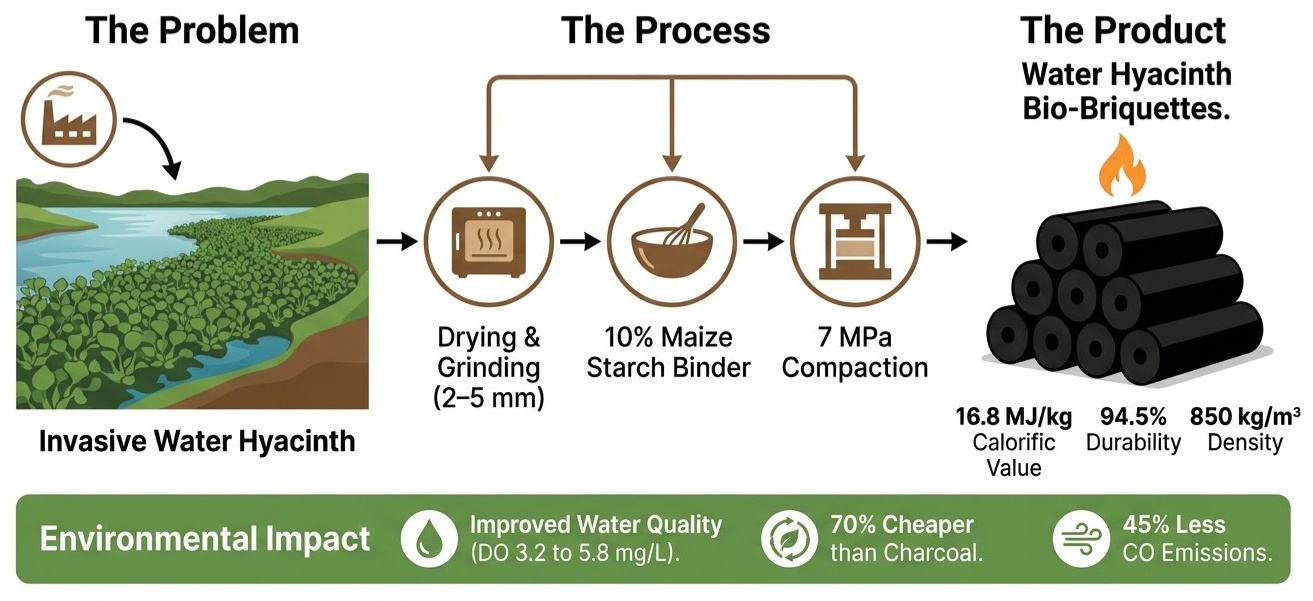
ABSTRACT: Water hyacinth (Eichhornia crassipes) is a highly invasive aquatic weed that degrades freshwater ecosystems and creates severe socioeconomic burdens. This study addresses the dual challenge of invasive weed management and lack of affordable clean cooking fuel by converting water hyacinth biomass into high-quality bio-briquettes as a sustainable alternative to firewood and charcoal. The knowledge gap addressed is the lack of systematic, multi-factor optimization for water hyacinth briquetting under Southern African conditions, as well as the limited quantification of environmental benefits. Fresh water hyacinth was collected from Lake Chivero, Zimbabwe, characterized, and processed using a manual compression method. Sixteen process factors, including particle size, compression pressure, and moisture content, were systematically investigated. Raw water hyacinth exhibited 88.5% moisture, 65.2% volatile matter, 12.8% ash, 15.6% fixed carbon, and 14.2 MJ/kg calorific value. Water hyacinth-based briquettes were produced using 2–5 mm particles, 12–15% moisture, 10% maize starch binder, and 7 MPa compaction pressure, achieving 16.8 MJ/kg calorific value, 850 kg/m3 density, and 94.5% durability. Carbonized briquettes reached a calorific value of 24.5 MJ/kg. Environmental assessment showed harvesting removed 2.5 kg nitrogen and 0.5 kg phosphorous per ton of fresh biomass, increased dissolved oxygen from 3.2 to 5.8 mg/L, and avoided 0.12 kg CH4 per kg dry biomass. The briquettes were 70% cheaper than charcoal and produced 45% less carbon monoxide and 67% less particulate matter than firewood. This study demonstrates that water hyacinth bio-briquettes offer a viable, low-cost, and environmentally beneficial solid fuel for rural communities while simultaneously addressing invasive weed management.
Keywords: Ash content; Binder type; Calorific value; Moisture content; Particle size; Water hyacinth

Graphical Abstract

TOP