SciEPublish

Feasibility Study of Designing a Sustainable Off-Grid Solar Photovoltaic System for Household Power Generation

Article Open Access

Feasibility Study of Designing a Sustainable Off-Grid Solar Photovoltaic System for Household Power Generation

Author Information
1
National Centre for Energy Research and Development, University of Nigeria, Nsukka 410105, Nigeria
2
Energy Commission of Nigeria, Abuja 900107, Nigeria
*
Authors to whom correspondence should be addressed.

Received: 23 May 2026 Revised: 02 July 2026 Accepted: 21 September 2026 Published: 27 October 2026

Creative Commons

© 2026 The authors. This is an open access article under the Creative Commons Attribution 4.0 International License (https://creativecommons.org/licenses/by/4.0/).

Views:169
Downloads:91
Clean Energy Sustain. 2026, 4(4), 10023; DOI: 10.70322/ces.2026.10023
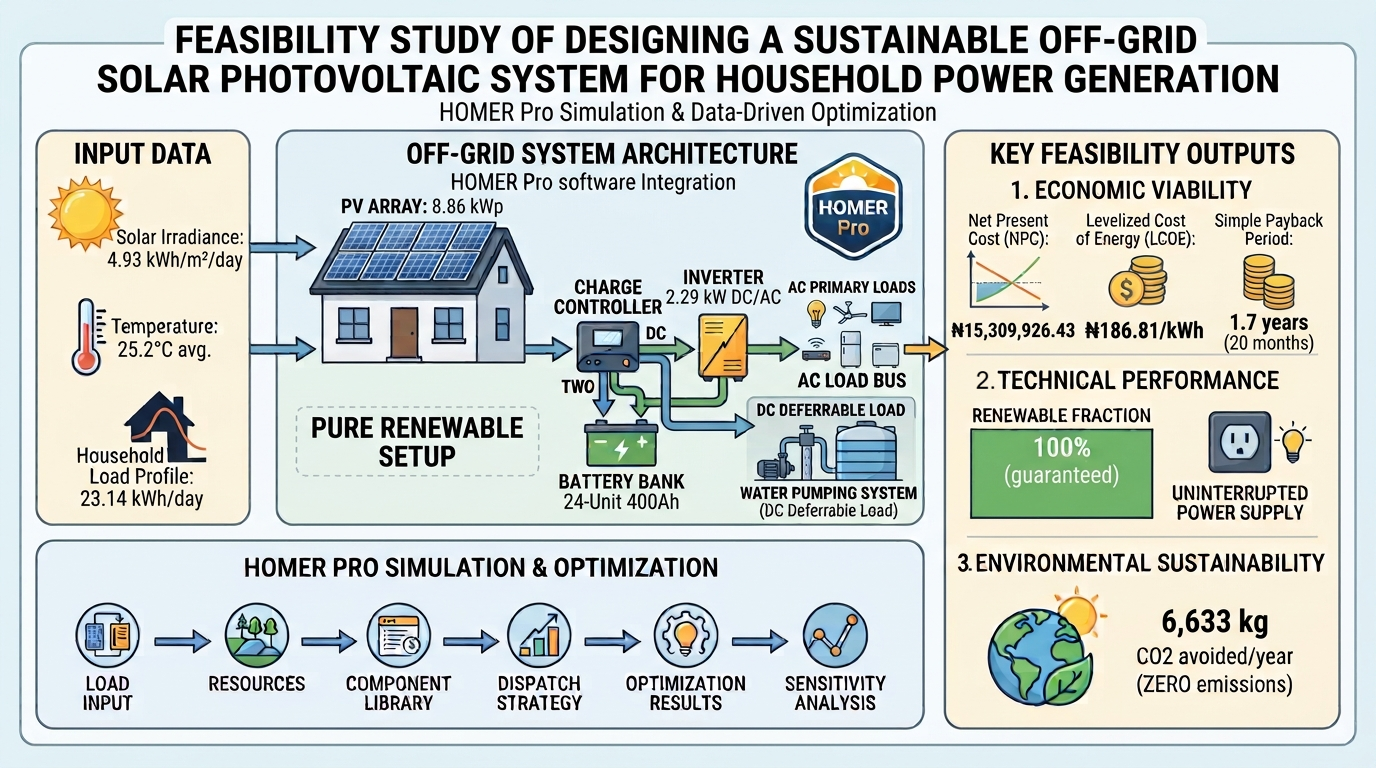
ABSTRACT: Household solar photovoltaic (SPV) systems often experience failures shortly after installation, primarily due to design deficiencies. Consequently, systems composed of well-designed, high-quality components installed by professionals can maintain efficiency and ensure long-term profitability. This study presents a methodology for accurately sizing an off-grid SPV system to ensure reliable electricity generation. A mathematical model was employed to assist in the design of an SPV system that consistently meets energy demands. A stochastic approach was developed using the hybrid optimization of multiple energy resources (HOMER) Pro software (version 3.18.4) to accurately design and predict the performance of the SPV system. This approach incorporates time-series data to model the inherent uncertainty and variability associated with solar resources and load demands. A sensitivity analysis was performed to evaluate the effects of variations in solar irradiance and load growth on system performance. The findings suggest that the proposed system methodology is applicable to other regions of Nigeria and other developing countries with different climatic conditions and load profiles. The insights and findings presented in this study could assist the Energy Commission of Nigeria (ECN) in developing policies for deploying solar-powered household systems across Nigeria. A potential policy could require prospective clients intending to install SPV systems for household electricity generation to submit a pre-feasibility study. This study should include the residential load profile, solar irradiation of the location, and appropriate system sizing. Such a requirement should precede the approval of any physical project proposal to reduce system failures in PV systems in Nigeria.
Keywords: Energy Commission of Nigeria; Off-grid SPV systems; HOMER software; Stochastic approach; Sensitivity analysis; LPSP

Graphical Abstract

TOP