SCIEPublish

Multi-Physics Performance Assessment of Three Lab-Scale Solar-Powered Alkaline Water Electrolyzers for Green Hydrogen Production

Article Open Access

Multi-Physics Performance Assessment of Three Lab-Scale Solar-Powered Alkaline Water Electrolyzers for Green Hydrogen Production

Author Information
Department of Mechanical Engineering, Faculty of Engineering, University of Tabuk, Tabuk 47913, Saudi Arabia
*
Authors to whom correspondence should be addressed.

Received: 12 July 2026 Revised: 07 September 2026 Accepted: 28 September 2026 Published: 14 October 2026

Creative Commons

© 2026 The authors. This is an open access article under the Creative Commons Attribution 4.0 International License (https://creativecommons.org/licenses/by/4.0/).

Views:216
Downloads:37
Clean Energy Sustain. 2026, 4(4), 10022; DOI: 10.70322/ces.2026.10022
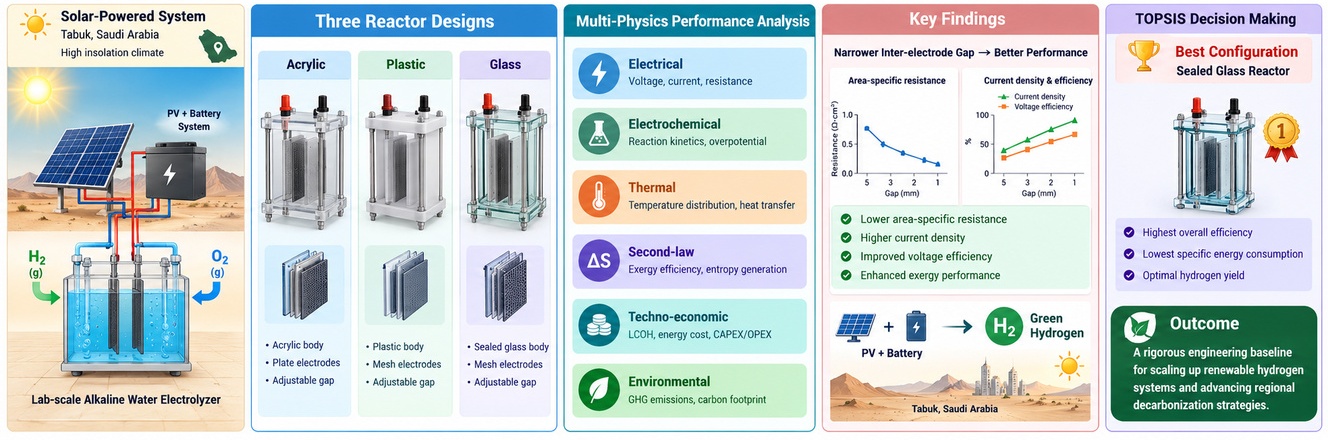
ABSTRACT: Solar-driven alkaline water electrolysis (AWE) is a promising low-cost route to green hydrogen. This study experimentally evaluates three laboratory-scale solar-powered AWE reactors with different tank materials, electrode materials, inter-electrode gaps, and electrolyte concentrations: Design 1 (acrylic, nickel foam, 30 cm, 30 wt% NaOH), Design 2 (plastic, SS316, 13 cm, 7 wt% NaOH), and Design 3 (glass, SS316, 6 cm, 5 wt% NaOH). All reactors were powered by a photovoltaic-battery system and tested under the climate of Tabuk, Saudi Arabia. A unified framework assessed electrical, electrochemical, thermal, energy, exergy, entropy, dimensionless, techno-economic, and environmental performance, and ranked the designs using TOPSIS. Reducing the electrode gap from 30 cm to 6 cm decreased the area-specific resistance from 1103 to 55 Ω·cm2 and increased voltage efficiency from 11.6% to 18.6%. Design 3 achieved the highest current density (942 A·m−2), energy efficiency (18.6%), exergy efficiency (15.4%), gas-collection efficiency (57%), and the lowest specific energy consumption (212 kWh·kg−1). Its levelized cost of hydrogen decreased from 95 to 23 USD·kg−1 when projected to a commercial specific energy consumption of 50 kWh·kg−1. Wagner numbers of 0.03–0.06 indicated ohmic control. Design 3 ranked first (TOPSIS = 1.00). The analysis reproduced reported values within 0.33% while exactly satisfying first- and second-law balances.
Keywords: Green hydrogen; Alkaline water electrolysis; Solar-driven electrolysis; Overpotential; Exergy analysis; Techno-economic analysis; Multi-criteria decision analysis

Graphical Abstract

TOP