
SCIEPublish

Progress in Chemical Transformations of Glyoxylic Acid as C1 and C2 Synthon

Review Open Access

Progress in Chemical Transformations of Glyoxylic Acid as C1 and C2 Synthon

Author Information
School of Chemistry and Chemical Engineering/State Key Laboratory Incubation Base for Green Processing of Chemical Engineering, Shihezi University, Shihezi 832003, China
*
Authors to whom correspondence should be addressed.

Received: 05 May 2026 Revised: 03 September 2026 Accepted: 16 September 2026 Published: 08 October 2026

Creative Commons

© 2026 The authors. This is an open access article under the Creative Commons Attribution 4.0 International License (https://creativecommons.org/licenses/by/4.0/).
Views:85
Downloads:163
Green Chem. Technol. 2026, 3(4), 10033; DOI: 10.70322/gct.2026.10033
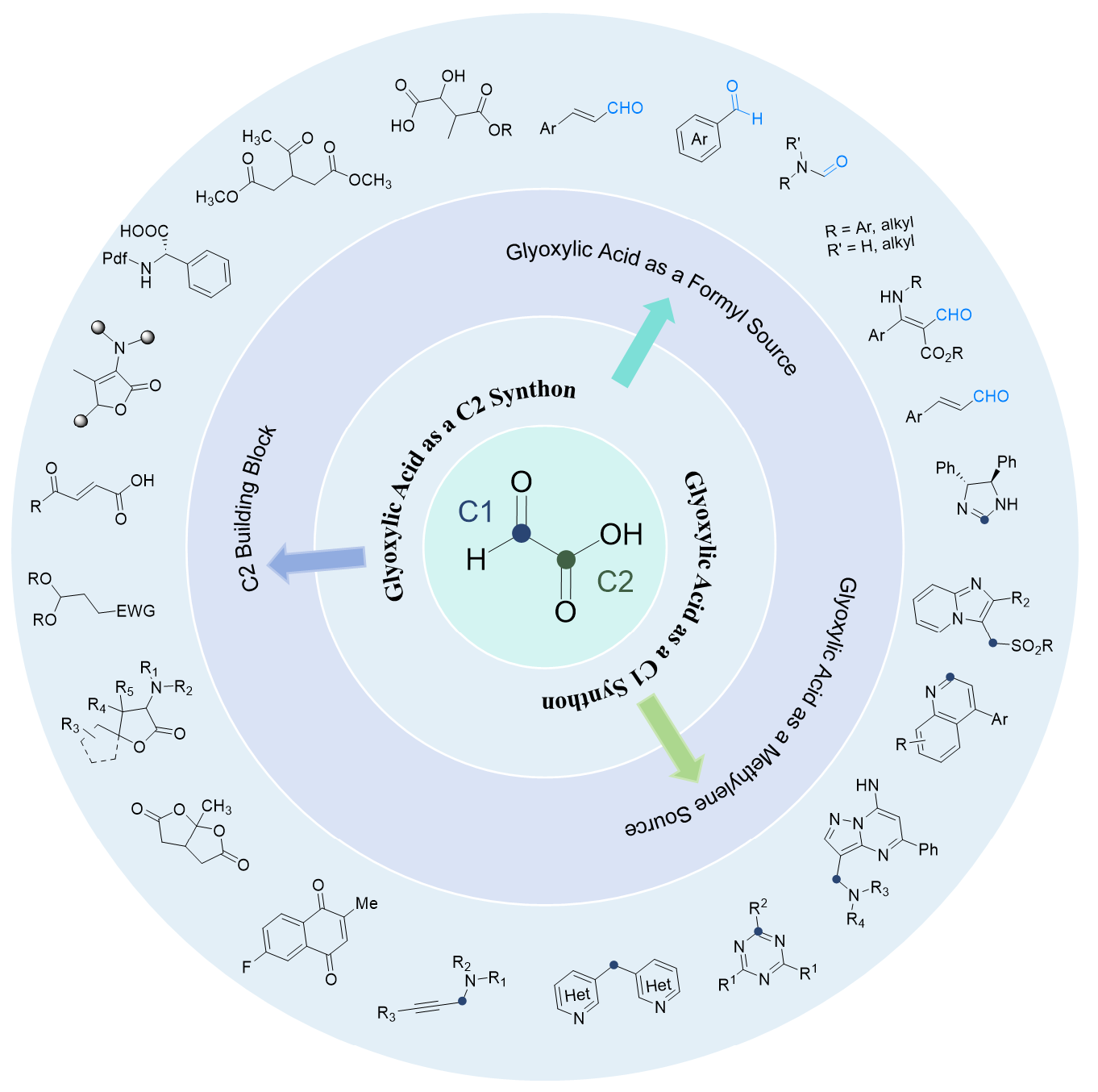
ABSTRACT: Glyoxylic acid, the simplest α-keto acid, contains both aldehyde and carboxyl groups in its molecule and exhibits the reactivity of both. This compound features low toxicity, low cost, ease of storage and handling, and has become a highly valuable C1 and C2 synthon in organic synthesis. In recent years, new reactions based on decarboxylative coupling, condensation, and cyclization strategies of glyoxylic acid have emerged, providing green and efficient routes for the construction of aldehydes, carboxylic acids, amines, heterocycles, and other structural motifs. This review systematically summarizes representative advances in the past five years in the chemical transformations of glyoxylic acid as a C1 synthon (formyl source, carboxylic acid source, methylene source) and as a C2 synthon (participating in Petasis reaction, Morita-Baylis-Hillman reaction, and cyclization reactions), with emphasis on reaction design, substrate scope, functional group compatibility, and mechanistic features. Future directions are also discussed.
Keywords: Glyoxylic acid; C1 synthon; C2 synthon; Decarboxylative coupling; Formylation; Multicomponent reaction

Graphical Abstract

TOP