
Biopolymer and Cellulose-Based Aerogels: The Next-Generation Porous Materials for Sustainable Applications
Biopolymer and Cellulose-Based Aerogels: The Next-Generation Porous Materials for Sustainable Applications
Kuchangi Naraseeyappa Santhosh
1,†
Divakar Sannagowdar Aditya
1,2,†
Ajjipura Basavarajappa Hemavathi
3,*
 Akhil Babu
3
Billava Ramachandra Vedhika
3
Shivanand Bindya
4
Meenakshi Srinivasa Iyer
5
Akhil Babu
3
Billava Ramachandra Vedhika
3
Shivanand Bindya
4
Meenakshi Srinivasa Iyer
5
Received: 20 May 2026 Revised: 17 June 2026 Accepted: 17 July 2026 Published: 14 August 2026

© 2026 The authors. This is an open access article under the Creative Commons Attribution 4.0 International License (https://creativecommons.org/licenses/by/4.0/).
1. Introduction to Biopolymer-Derived Aerogels
Biopolymers and cellulose-derived aerogels have advanced from initial laboratory research to a well-established category of ultralight porous materials with a hierarchical pore network, ultra-low densities, and high compatibility with aqueous and mild processing techniques [1,2]. While their growing importance is often discussed in the context of the sustainability story, this alone does not adequately explain the scientific basis of their rapid growth. The unique feature of these materials is their capability to utilise intrinsic molecular functionalities and supramolecular interactions for the construction of three-dimensional networks through assembly-driven mechanisms [3]. Biopolymer-based aerogels are prepared via hydrogen bonding, physical entanglement, and coordination interactions that spontaneously form in aqueous environments, in contrast to inorganic and synthetic polymer aerogels, which rely on irreversible covalent condensation processes. This critical difference allows for the formation of percolated networks at ultra-low solid loadings. It represents a paradigm shift in aerogel science, from chemical reaction-driven synthesis to architecturally driven design, where the structural configuration and processing dynamics have a more dominant impact on performance than the severity of chemical conditions [2].
In the conventional processing of aerogels, particularly those derived from silica, the preservation of the nanoscale porosity involves the steps of alkoxide hydrolysis followed by condensation, and then meticulous procedures of solvent exchange and supercritical drying. These approaches provide superb surface area and ultralow density characteristics, but suffer from major disadvantages in terms of energy consumption, process complexity, and scalability [4]. Inorganic sol-gel processes produce rigid, covalently bonded networks that are very sensitive to capillary stresses and require very severe drying conditions to prevent the collapse of the pore structures. Thus, the environmental impact and the production complexity are inherently related to the production process. On the other hand, biopolymer aerogels, in particular those derived from cellulose, form mechanically adaptive networks reinforced by reversible supramolecular interactions. This structural flexibility enhances the distribution of stresses induced during solvent extraction throughout the hierarchical pore networks rather than concentrating them at weak junctions. Consequently, drying protocols such as freeze-drying, and ambient pressure drying in carefully engineered systems, are made possible without catastrophic densification. This tolerance for mild drying conditions fundamentally changes the processing structure dynamic, and decouples the aerogel fabrication from supercritical processing technologies, thus redefining the operating and environmental parameters of aerogel production [5].
Among the various precursors of biopolymers, cellulose stands out for its unique properties, such as abundant availability, diverse molecular structure, and high surface hydroxyl group content. Thus, when modified to nanofibrillated cellulose or cellulose nanocrystals, cellulose efficiently self-assembles into percolated three-dimensional networks that bridge molecular, fibrillar, and mesoscale dimensions. These multiscale frameworks display a crucial trade-off between rigidity and flexibility: crystalline domains confer dimensional stability, whereas amorphous portions and fibrillar linkages endow elasticity and resilience to damage [6]. Such an equilibrium state is especially beneficial for the aerogel synthesis process in that it enables the network to sustain open porosity while receiving stresses introduced during the drying process. It is important to note that cellulose-Aerogels are not to be considered as simple elementary counterparts of inorganic Aerogels. Their open structures are not passive leftovers of a liquid phase but are the result of intentional assembly and structuring processes mediated by drying. Processing methods such as freeze-casting, directional freezing, and controlled gelation enable the rational design of pore orientation, connectivity, and hierarchical organization to produce aligned, Janus, and multilevel architectures with anisotropic mechanical and transport properties. Such progress makes cellulose aerogels architecturally designed materials in which the structure is deliberately sculpted rather than passively constrained [7].
Beyond cellulose, a larger family of biopolymers, including chitosan, alginate, agar, and regeneratable polysaccharides, further expands the design space of bio-based aerogels by providing additional avenues for ionic responsiveness, coordination chemistry, and stimuli-sensitive gelation. These features enable multifunctionality to be incorporated directly during network formation instead of being added by post-synthetic modification. Hybrid aerogel systems prepared via in situ composite approaches demonstrate that the functional enhancement is most effective when secondary phases co-assemble with the biopolymer network, resulting in structural integration and homogeneous distribution [8]. But these improvements have not solved all the problems. Variability in biomass-derived feedstocks, sensitivity of supramolecular networks to processing history, and intrinsic trade-offs between porosity and mechanical integrity continue to limit reproducibility and scalability. More importantly, the increasing incorporation of nanocarbons, metal oxides, and coordination-based components raises concerns on interfacial stability, durability, and long-term manufacturability. In this context, the present review offers a focused and critical review of biopolymer and cellulose-based aerogels integrating molecular fundamentals, precursor processing, gelation and drying physics, functional architecture, and manufacturing constraints. Thus, the review intends to formulate design principles for lightweight, multifunctional, structurally intelligent aerogels that are compatible with realistic, sustainable manufacturing pathways [8].
Several reviews have summarized the synthesis routes, drying strategies, functionalization approaches, and application-specific developments of cellulose and biopolymer-based aerogels. However, these reviews largely emphasize material composition, preparation methods, or end-use performance, while comparatively little attention has been devoted to the fundamental relationships among structure, processing conditions, functional performance, manufacturability, and scalability. The present review adopts a different perspective by critically examining cellulose and biopolymer-based aerogels through structure–process–property–manufacturability framework. Rather than treating synthesis, drying, functionalization, and application development as independent themes, this review highlights how hierarchical architecture, supramolecular interactions, gelation pathways, and drying-induced structural evolution collectively govern the final performance and industrial viability of aerogel systems. Furthermore, the review challenges the commonly held assumption that increasing material refinement, functional loading, or structural complexity necessarily improves aerogel performance. Instead, emphasis is placed on processing realism, structural tolerance, scalability constraints, and sustainable manufacturing considerations that ultimately determine the practical translation of laboratory-scale aerogels into real-world applications. By integrating molecular fundamentals, processing science, functional design, and manufacturing limitations into a unified framework, the review provides critical design principles for the development of next-generation cellulose-based aerogels that combine high performance with industrial feasibility and environmental sustainability. Table 1 compares the differences between present and existing reviews on the aerogels.
Table 1. Comparison of recent reviews and the present review.
|
Sl. No. |
References |
Main Focus |
Limitation of Previous Review |
Present Contribution |
DOI |
|---|---|---|---|---|---|
|
1 |
Long et al., 2018, Cellulose Aerogels: Synthesis, Applications, and Prospects |
Preparation methods, cellulose aerogel classification, and applications |
Primarily descriptive; limited discussion of scalability, manufacturing constraints, and structure–process relationships |
Establishes an integrated structure–process–property–manufacturability framework |
10.3390/polym10060623 |
|
2 |
Budtova, 2019, Cellulose II Aerogels: A Review |
Cellulose II aerogel preparation, dissolution, and regeneration routes |
Focused mainly on cellulose II systems and processing chemistry |
Expands discussion to architecture-driven design, functionalization, sustainability, and industrial translation |
10.1007/s10570-018-2189-1 |
|
3 |
Stark et al., 2025, Cellulose-Based Aerogels for Environmentally Sustainable Applications |
Production, modification, and contaminant adsorption |
Environmental remediation-oriented review with limited discussion of mechanical architecture and manufacturability |
Critically links processing physics, structural hierarchy, scalability, and multifunctionality |
10.3390/polym17020236 |
|
4 |
McCord et al., 2026, From Structure to Multifunctional Performance: Fibrous Cellulose for Advancing Phase Change Materials |
Fibrous cellulose for thermal energy storage and phase change materials |
Focused on PCM systems rather than aerogel manufacturing and drying science |
Develops a comprehensive framework for cellulose aerogel design and processing |
10.1016/j.rser.2025.116612 |
|
5 |
Baniasadi et al., 2026, Advances in Polysaccharide-Based Food Packaging |
Functionalization and sustainability of polysaccharide packaging |
Packaging-focused; limited relevance to aerogel network formation and hierarchical porosity |
Provides a detailed analysis of gelation, drying, and structural evolution in aerogels |
10.1016/j.mser.2025.101128 |
|
6 |
Present Review |
Biopolymer and cellulose-based aerogels |
— |
Integrates molecular interactions, hierarchical architecture, gelation, drying, functionalization, carbonization, scalability, and sustainability into a unified design framework |
Present Review |
2. Fundamentals of Biopolymer and Cellulose Aerogel Structure
2.1. Cellulose and Biopolymers as Structurally Viable Aerogel Precursors
Biopolymers, especially cellulose, are effective aerogel precursors not because of their renewable origin, but because of their inherent ability to assemble into percolated, mechanically compliant networks at very low solid fractions. Cellulose is a linear polysaccharide of β-(1→4)-linkages with a high density of hydroxyl groups along its backbone, which favours extensive intermolecular hydrogen bonding and leads to a strong tendency for self-organization in aqueous environments. Such a supramolecular interaction landscape allows the spontaneous formation of three-dimensional frameworks without the need for covalent crosslinking or kinetically constrained sol-gel reactions. As a result, the network formation of cellulose-based aerogels is dominated by physical connections and assembly rather than by permanent chemical condensation, a significant departure from conventional aerogel preparation techniques [9]. When converted in nano fibrillated cellulose or cellulose nanocrystals, the cellulose is further converted from a bulk polymer to a colloidal building-block system where the gelation is dictated by percolation thresholds rather than reaction kinetics. At ultralow density, the high aspect ratio of the cellulose nanofibrils allows space-spanning networks to be formed at concentrations well below the gelation threshold of conventional polymers, providing structural stability. This behaviour is in stark contrast with inorganic aerogels, where the porosity is preserved by inhibiting the condensation reactions and not by the intrinsic connectivity of the network. The introduction of other biopolymers, e.g., chitosan, alginate, agar, and regeneratable polysaccharides, further enriches this design space by adding charged and ion-coordinating functionalities that enable alternative gelation pathways, e.g., pH-responsive and ion-mediated assembly. This enhanced chemical versatility, however, also leads to increased process sensitivity, as the network integrity is strongly related to local chemical conditions, stressing the importance of exact control of composition and processing history [10].
2.2. Supramolecular Bonding: Advantage and Vulnerability
Biopolymer aerogels are mainly stabilised by supramolecular interactions, with hydrogen bonding being the most important, and ionic coordination occurring in some systems. Hydrogen bonding between neighbouring fibrils in cellulose aerogels controls the mechanical response and the network integrity, resulting in the formation of cohesive and yet deformable porous structures. If these interactions are well balanced, the resulting networks can undergo significant deformations while still maintaining open porosity, a crucial feature for structural integrity during solvent removal. This supramolecular stabilisation, from a materials perspective, replaces rigid covalent junctions with dynamic inter-fibrillar contacts, fundamentally changing the transmission of mechanical loads through the aerogel network [11].
The existence of non-covalent bonding gives rise to elastic compliance and enables stresses produced during drying to redistribute throughout the network instead of being concentrated at junctions. This compliance is responsible for the ability of cellulose aerogels to withstand freeze-drying and, in carefully designed cases, ambient pressure drying processing routes that are generally not available to rigid inorganic aerogels. But the very reversibility that allows stress accommodation also introduces an inherent vulnerability. The supramolecular assemblies are sensitive to processing conditions; minor changes in solids concentration, thermal history, or ionic environment result in network rearrangement, densification, or collapse. Coordination-driven interactions provide a partial solution, reinforcing the connection points through reversible bonding with multivalent ions or coordination centres, thus improving the mechanical stability while retaining adaptability. However, too much coordination increases the local stiffness, suppresses the flexibility of the network, and promotes brittle failure. This interplay of effects illustrates one of the key design principles for biopolymer aerogels: stabilisation of the network must be carefully balanced because optimal junction strength can compromise the compliance that is crucial for drying tolerance and long-term structural integrity [12].
2.3. Hierarchical Porosity as a Structural Requirement Rather Than a Design Preference
While hierarchical porosity is often regarded as a desirable functional feature in aerogel studies, in the case of biopolymer aerogels, it is a structural necessity, rather than a design feature of choice or aesthetics. The pore size distributions of inorganic aerogels are mainly controlled by sol-gel reaction kinetics. On the other hand, biopolymer aerogels form porosity by spatial organization of fibrils, bundles, and higher-order aggregates. Nanoscale void originates from inter-fibrillar spacing, mesoporosity from fibril bundling and network branching, and macroporosity from phase separation, ice templating, or controlled structuring during gelation and drying. This multilevel pore architecture is therefore intrinsically related to the biopolymer network assembly pathway rather than being imposed via chemical suppression of densification [13].
Macroporous backbones are decisive for the network to survive drying from both mechanical and processing perspectives. In the absence of sufficient macroporosity, capillary stresses that develop during removal of solvent become localised in fine pores, leading to densification or collapse even in otherwise compliant supramolecular networks. Hierarchical porosity provides a mechanism for stress redistribution, allowing deformation to be accommodated over multiple length scales rather than being localised at fragile junctions. This understanding questions the traditional aerogel paradigm of uniform mesoporosity and maximisation of surface area as primary design targets. For biopolymer aerogels, pore accessibility, connectivity, and multiscale stress dissipation are the keys to structural integrity and functional performance, often overcoming the advantages of extreme surface area. Successful biopolymer aerogel design, therefore, requires conscious architectural hierarchy, where porosity is engineered to serve mechanical resilience and processing tolerance as well as mass transport [14].
2.4. Anisotropy, Crystallinity, and Programmable Aerogel Architectures
Cellulose has intrinsic anisotropy arising from its molecular orientation and fibrillar assembly, which can be purposefully transferred to aerogel structures through controlled processing routes. Techniques like directional freezing, gradient induced gelation and templated assembly allow for the preferential orientation of fibrils and pores, resulting in aerogels with an anisotropic mechanical response and mass transport behaviour. Such approaches enable spatial programming of porosity and functionality rather than uniform distribution, which allows different regions of the aerogel to perform different roles. This ability emphasises a key difference of cellulose-based aerogels, which is the active design of structure during gelation and drying, rather than the passive maintenance of a precursor structure [15]. Crystallinity also governs the response of these anisotropic architectures to mechanical and processing stresses. The crystalline domains confer stiffness and dimensional stability, acting as load-bearing elements in the network, whereas the amorphous parts confer flexibility, energy dissipation, and tolerance to deformation. The balance between these domains is therefore important. Excessive crystallinity reduces network compliance, increases stress concentration, and susceptibility to drying-induced fracture. Conversely, insufficient crystallinity leads to inadequate mechanical integrity. This highlights that optimal aerogel performance is achieved through controlled structural heterogeneity, in which a balance of crystalline and amorphous regions is deliberately struck to achieve both stability and adaptability. Anisotropy and crystallinity are not independent parameters in this context; they are coupled design variables that govern the mechanical resilience and functional efficiency of cellulose aerogels [16].
2.5. Structure-Property Relationship and Its Inherent Limitations
The structure-property relationships of biopolymer aerogels are fundamentally different from those of inorganic aerogel systems in that they rely on supramolecular assembly and fibrillar connectivity rather than rigid covalent networks. The mechanical behaviour of these materials is controlled by network connectivity, fibril orientation, and junction density rather than just bulk density, while transport properties are controlled by pore continuity and accessibility rather than extreme surface area. An implication of this is that aerogels with moderate surface area but well-connected hierarchical porosity often perform better in terms of functional performance than highly microporous architectures that limit mass transport. However, this structural balance is often disrupted when efforts are made to increase functional complexity by incorporating secondary phases such as nanocarbons, metal oxides, or coordination-based components. Overloading causes stress concentrations, decreases drying tolerance, and compromises long-term mechanical stability by disrupting the cohesion of the native network. These limitations highlight a key design challenge in biopolymer aerogels: functionalisation must be incorporated in a manner that complements, rather than competes with, the underlying structural architecture, as the structural integrity ultimately defines the upper limit of achievable performance [17].
2.6. Critical Synthesis and Design Implications
Biopolymer- and cellulose-based aerogels are examples of the shift from chemistry dominated aerogel fabrication to architecture driven materials engineering at the fundamental level. Their key advantages (aqueous processability, tolerance to benign drying routes, and intrinsically hierarchical porosity) stem from the supramolecular assembly and multiscale structural organization and not from the chemically severe synthesis routes. But these same features also impose inherent constraints on them, such as considerable sensitivity to processing history and a limited capacity to withstand large functional loads without structural degradation. Understanding this duality is key to the rational design of cellulose aerogels that simultaneously achieve porosity, mechanical robustness, and manufacturability. In this context, architectural coherence and network integrity finally limit performance, and the choice of materials and processing must be guided by structural principles. Accordingly, the next section discusses precursor sources and processing strategies in which these structure process relationships directly intersect with scalability, reproducibility, and sustainable manufacturing issues [18].
3. Precursors and Processing of Biopolymer and Cellulose Networks
3.1. Cellulose Feedstocks: Abundance Versus Structural Suitability
Cellulose is usually considered an ideal aerogel precursor because of its abundance and renewable origin. But feedstock availability does not correlate with structural suitability for aerogel fabrication. The properties of cellulose as a material are determined by the origin of the network formation, reproducibility, and processing tolerance. The properties of plant-derived cellulose, such as molecular weight distribution, crystallinity, residual hemicellulose content, and inorganic impurities, are highly variable and affect both fibril isolation efficiency and inter-fibrillar interactions. Cellulose aerogels are percolation-dominated systems, and thus even small changes in fibril aspect ratio or surface chemistry can alter the gelation threshold, change the pore hierarchy, and compromise the network continuity. Thus, uncontrolled precursor heterogeneity often leads to non-uniform density distribution, anisotropic shrinkage during drying, and poor batch-to-batch reproducibility. Together, these factors indicate that although attractive from a sustainability perspective, cellulose from biomass cannot be taken for granted as a plug-and-play precursor for scalable aerogel manufacturing without tight control over chemical and structural consistency [19].
On the other hand, bacterial cellulose is a structurally different feedstock with high purity and an inherently entangled nanofibrillar network similar to an aerogel architecture already before processing. This natural structural organization makes bacterial cellulose particularly well suited to form homogeneous, mechanically coherent aerogel networks. However, this advantage is offset by practical limitations: bacterial cellulose is produced slowly, is resource and difficult to scale spatially, which limits its use to high-value and niche applications. The plant and bacterial cellulose juxtaposition highlights a fundamental tension in aerogel precursor selection. Feedstocks with improved structural control are not usually industrially scalable, and feedstocks that are plentiful and inexpensive introduce variability that hinders reproducible manufacturing. This trade-off is an illustration of a more general principle in biopolymer aerogel design: structural excellence and industrial feasibility are rarely aligned at the precursor level, and therefore a careful compromise between material performance and process realism is necessary [20].
3.2. Nanocellulose Extraction: Structural Benefits Versus Energetic and Mechanical Trade-Off
Nanocellulose, in particular cellulose nanofibrils, has been recognised as a preferred precursor for mechanically robust cellulose aerogels due to its high aspect ratio, which allows for efficient network formation and mechanical stability at very low solid contents, an essential requirement for ultralight architectures. But the isolation of nanocellulose is neither energetically trivial nor structurally neutral. Mechanical fibrillation demands high energy input. Chemical pretreatments to facilitate fibril liberation alter surface chemistry and break native hydrogen-bonding interactions. Such modifications improve dispersion and processability, but at the same time weaken the supramolecular cohesion and increase the susceptibility to collapse and structural degradation induced by drying. This trade-off is more evident when comparing cellulose nanofibrils with cellulose nanocrystals: nanocrystals provide stiffness and rigidity but decrease network compliance and lead to brittle failure under capillary stress. The choice of nanocellulose should be viewed as a fundamental structural design choice, not a simple refinement step, as too much emphasis on nanoscale regularity and rigidity can often sacrifice drying tolerance, reproducibility, and scalability [21].
3.3. Regenerated Cellulose: Structural Uniformity Versus Processing Complexity
Aerogel networks with a high degree of structural uniformity and narrow pore size distributions are often produced by regenerated cellulose routes based on the dissolution of the polymer followed by reprecipitation. However, the apparent uniformity is obtained at the expense of large processing complexity. Solvent-mediated dissolution disrupts the native fibrillar hierarchy of cellulose, stripping off the multiscale architecture that underpins mechanical compliance and stress tolerance of fibril-based aerogels. Consequently, regenerated cellulose networks often lack the inherent flexibility to survive stresses caused by drying and need additional crosslinking, templating, or reinforcement strategies to maintain porosity. Such compensating measures also introduce chemical and processing complexity, reduce robustness, and complicate scale-up. Furthermore, solvent recovery and recycling are still open questions that erode the sustainability advantage often attributed to regenerated cellulose, as depicted in Figure 1. Collectively, these factors point to an important principle in the design of cellulose aerogels, namely that structural uniformity alone does not lead to structural resilience, and loss of hierarchical organization often necessitates process intensive interventions that degrade both manufacturability and sustainability [22].
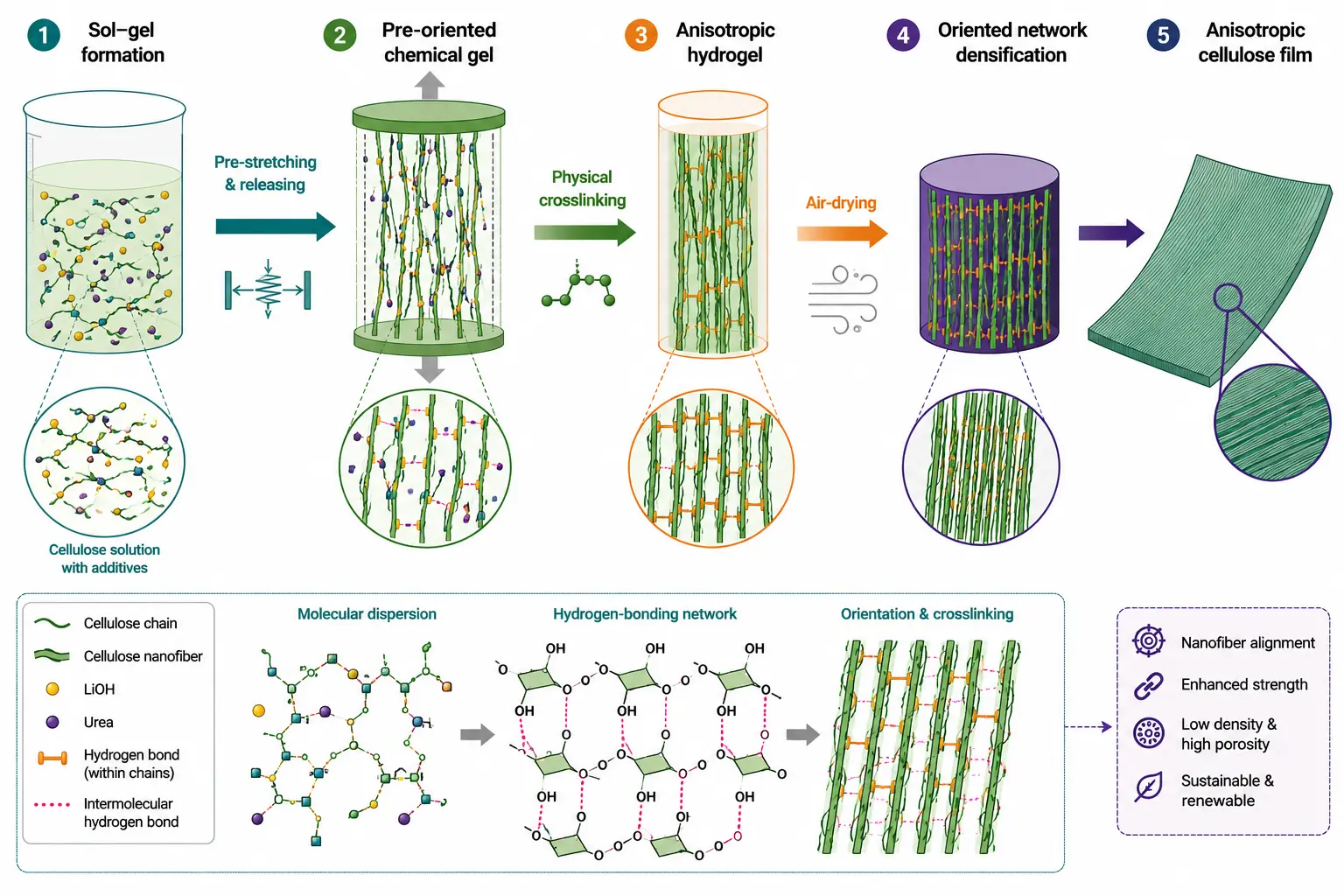
Figure 1. Schematic illustration of anisotropic cellulose film fabrication: (1) sol–gel formation, (2) pre-oriented chemical gel, (3) anisotropic hydrogel, (4) oriented network densification, and (5) anisotropic cellulose film.
3.4. Non-Cellulosic Biopolymers: Functional Diversity Versus Process Fragility
Non-cellulosic biopolymers such as chitosan, alginate, agar, and regenerable polysaccharides expand the design space of aerogels by providing functionalities that are not easily accessible in cellulose alone, such as ionic crosslinking, pH-responsiveness, and reversible gelation behaviour. These features are attractive from both the functional and the circular-materials points of view as they enable to regenerate and the stimuli-controlled assembly. But this chemical versatility comes with a strong process fragility. Gelation in such systems is very sensitive to local chemical conditions such as ionic strength, pH gradients, and temperature fluctuations, and it is therefore difficult to achieve reproducible network formation at scale. Unlike cellulose, which assembles through robust hydrogen bonding and physical entanglement, these biopolymers require tightly controlled chemical environments to avoid phase separation, heterogeneous crosslinking, or premature collapse. Therefore, their most pragmatic application in the production of aerogels is not as freestanding scaffolds but as secondary or complementary components in cellulose-rich networks, as shown in Figure 2. Their functionality can be exploited without giving up structural tolerance or process robustness [23].
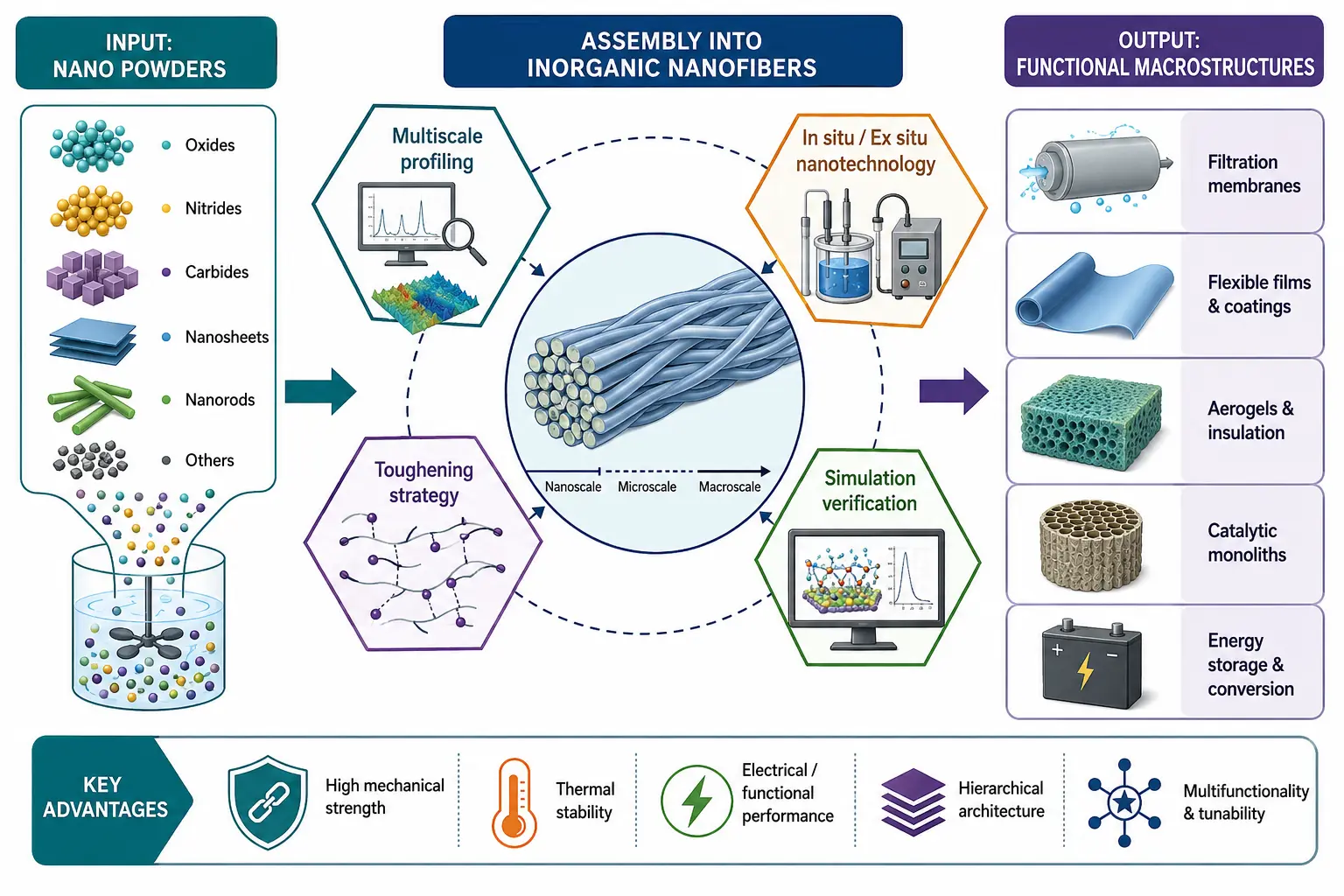
Figure 2. Conceptual overview of inorganic nanofiber assembly from nanopowders via multiscale engineering for advanced functional macrostructured materials.
3.5. Hybrid Precursors and Composite Formulation
Hybrid precursor strategies like those that couple cellulose with nanocarbons, metal oxides, or coordination-based building blocks are widely investigated to introduce multifunctionality, but the success of such systems depends much more on the integration strategy than on the material selection itself. Functional components incorporated during gelation can co-assemble with the cellulose network to promote uniform dispersion, strong interfacial bonding, and effective load transfer. Whereas, post-gelation or post-drying impregnation often results in aggregation, pore blockage, and weak interfaces, compromising both mechanical integrity and transport pathways. Furthermore, the problems are aggravated even more by a disruption in the pore connectivity, higher density, and a lower drying tolerance caused by the over functional loading. These results suggest a key design rule for composite aerogels, i.e., functional additives should actively participate in network formation rather than be used as passive fillers. Failure to follow this principle leads to density gradients, sedimentation during gelation, and structural failure during drying, ultimately limiting both performance and scalability [24].
3.6. Sustainability and Scalability: Precursor Practicality over Material Ideology
Biopolymers and cellulose precursors are often described as intrinsically sustainable, but practical sustainability outcomes are more a function of processing intensity than of the identity of the feedstock. Energy intensive nanocellulose extraction, solvent dependent regeneration routes, and chemical sensitive gelation pathways can easily outweigh the environmental benefits of renewable feedstocks if not carefully controlled. From a manufacturing standpoint, the scalable production of aerogels benefits from precursors that accommodate moderate processing, possess wide gelation windows, and retain structural integrity during benign drying conditions. Highly refined or chemically modified systems are attractive at the lab scale but often have narrow process windows and high energy demands that make them industrially infeasible, as shown in Figure 3. This fact questions the current belief that the greater the molecular refinement, the better the aerogels, and instead highlights the importance of the precursor realism where structural tolerance and process robustness are valued above the maximum degree of material sophistication [25].
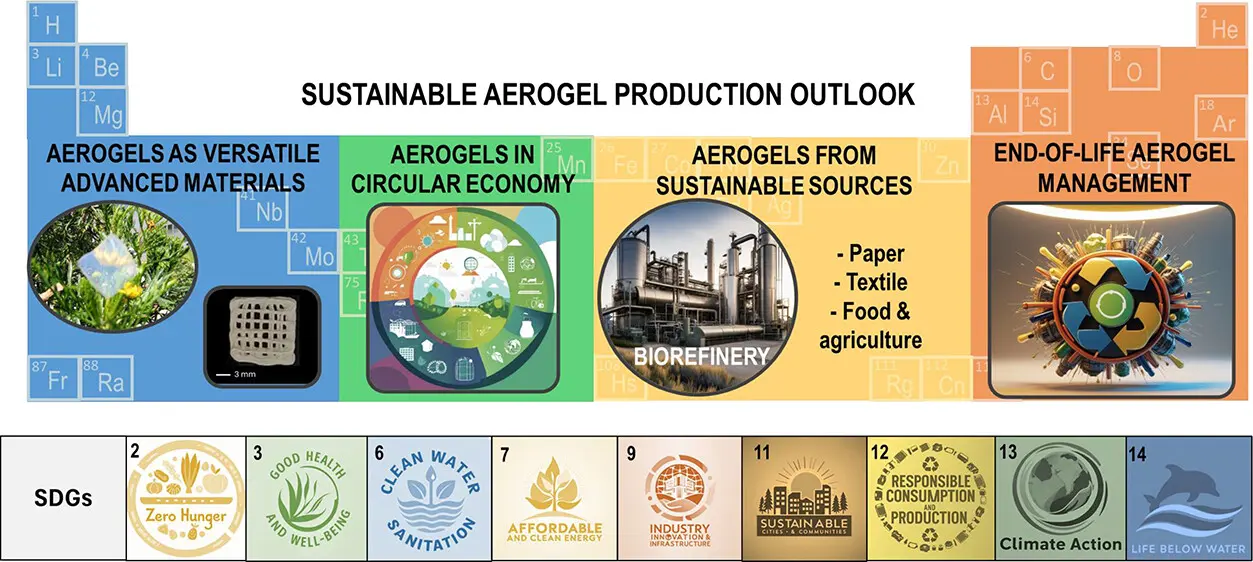
Figure 3. Outlook of sustainable aerogel production integrating circular economy, biorefineries, advanced applications, and end-of-life management.
3.7. Critical Synthesis and Transition
The selection of precursors for biopolymer and cellulose-based aerogels is a basic structural and processing decision, not a preliminary choice of material. Native and fibrillated cellulose provide a unique blend of network connectivity, mechanical flexibility, and drying resistance that is difficult to duplicate with other biopolymers. Non-cellulosic and hybrid components introduce functional gains at the cost of increased sensitivity and complexity. Therefore, sustainable and scalable aerogel production relies on mild precursor modification, preservation of the hierarchical structure, and functional integration during network formation, rather than aggressive chemical refinement. Such considerations directly influence the importance of gelation and drying routes, which ultimately determine whether the chosen precursors can be translated into robust aerogel architectures. In the following section, therefore, gelation, network formation, and drying mechanisms are discussed, in which precursor chemistry, supramolecular assembly, and process physics meet to determine the performance of the final aerogel [26].
4. Gelation, Network Formation, and Drying of Cellulose Aerogels
4.1. Gelation as a Percolation-Controlled Phenomenon
The gelation of cellulose aerogels is controlled by percolation rather than reaction limited sol-gel chemistry. Unlike the formation of inorganic aerogels from alkoxides, where the network is formed by irreversible covalent condensation, the network in cellulose aerogels is formed when the fibrils are connected above a critical percolation threshold. Thus, network integrity depends on structural parameters like fibril aspect ratio, dispersion quality, and junction density, rather than reaction kinetics or catalyst concentration. This difference moves control of gelation from the chemical rate to the architecture. Cellulose nanofibrils at low solid content form space spanning networks stabilised by hydrogen bonding and physical entanglement. But, close to the percolation threshold, there is an opportunity and a vulnerability. Low junction density leads to slow gelation and collapse after gelation, and too much aggregation of fibrils results in heterogeneous networks that concentrate stress and reduce mechanical resilience. Effective gelation, therefore, takes place within a narrow structural window where the connectivity is sufficient to ensure continuity of the network but not so dense as to inhibit adaptability.
Ion-assisted gelation makes this balance even more complicated. Multivalent ions strengthen junctions and accelerate the formation of the network, but also localise rigidity in the network. If coordination density is too high, junctions act as brittle nodes that limit stress redistribution during drying. This behaviour indicates a fundamental principle that is unique to cellulose aerogels: an improved gelation strength does not necessarily correlate with an improved drying tolerance, but can lead to premature failure instead [27].
4.2. Network Maturation and Aging: Structural Reinforcement Versus Destabilization
The cellulose aerogels develop their structure through ageing after the first gelation. The ageing process is triggered by supramolecular rearrangement, not polymerisation. Moderate ageing improves load-bearing junctions by reorganising hydrogen bonds, resulting in enhanced elastic recovery and resistance to deformation. In this regime, ageing is a step of structural reinforcement that improves the network coherence without decreasing the porosity. But after a certain length of time, ageing is in fact counterproductive. Ongoing rearrangement of hydrogen bonds causes bundling of fibrils, coarsening of pores, and densification of local regions, thereby decreasing the overall network compliance, as seen in Figure 4. Such over-aged networks are stiffer but less tolerant of fracture and are especially prone to cracking during drying. Ageing is thus a structural amplifier rather than a beneficial step, capable of stabilising or destabilising the gel depending on solids content, temperature, and time [28].
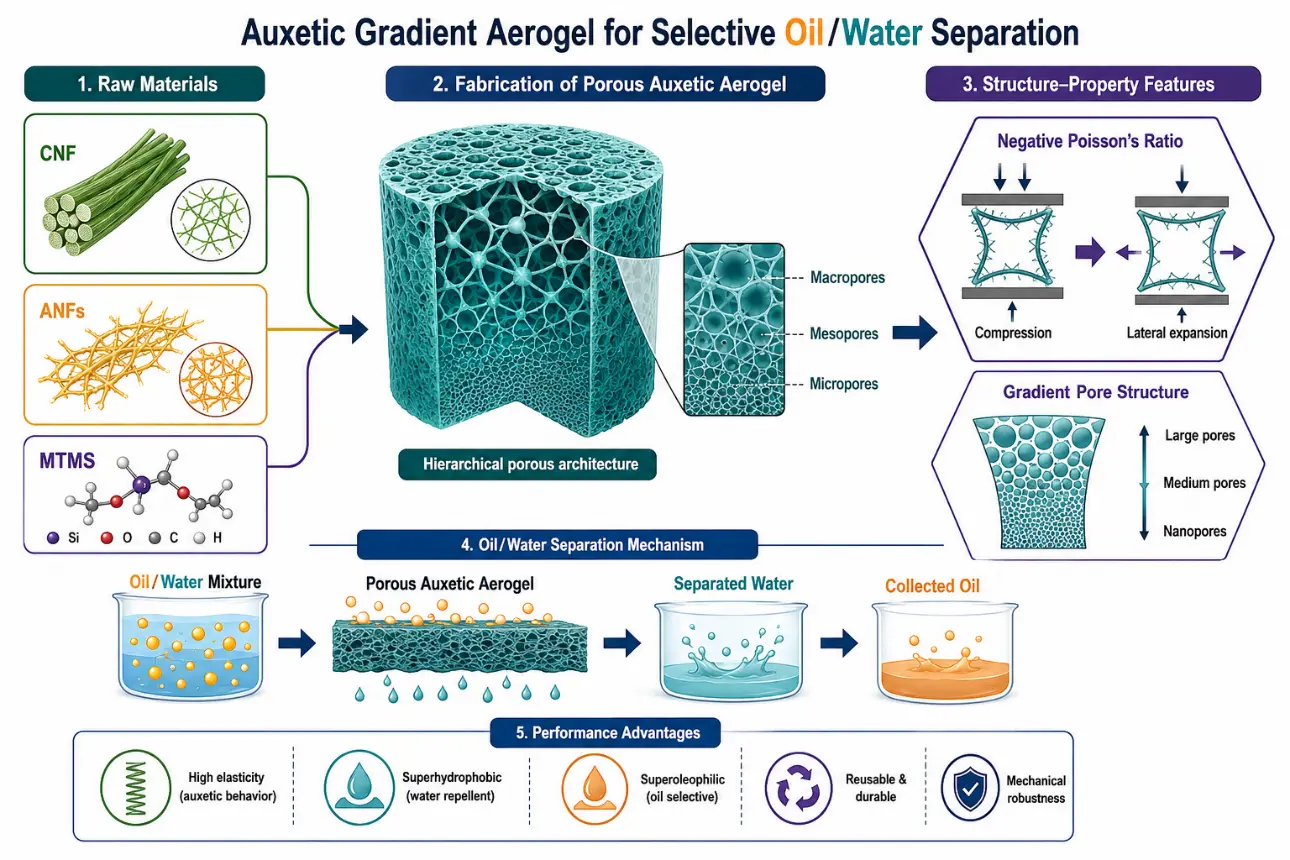
Figure 4. Schematic representation of auxetic porous aerogel for selective oil/water separation: (1) raw materials, (2) porous aerogel fabrication, (3) structure–property characteristics, (4) oil/water separation mechanism, and (5) performance advantages.
4.3. Freeze-Drying: Suppression of Capillary Stress with Imposed Structural Bias
Cellulose aerogel fabrication extensively uses freeze-drying. It removes liquid-vapor interfaces and hence capillary pressure. This approach preserves porosity but introduces a dominating and often overlooked structuring mechanism: ice crystallisation. The macropore orientation, spacing, and connectivity are mostly governed by the ice growth during freezing, often dominating the structure formed during gelation. The potential to control directional ice growth during precisely defined freezing has led to the design of anisotropic and multilevel pore architectures to improve transport and functional properties. Unrestrained freezing leads to broad pore-size distribution, weak inter-lamellar bonding, and anisotropic failure. Thus, success in freeze-drying is less a matter of sublimation per se than of the thermal route imposed during solidification. From a processing viewpoint, freeze-drying is structurally conservative, but intrinsically intolerant to defects. Freeze-drying is very sensitive to scale, geometry, and thermal gradients as the freezing-induced heterogeneities are permanently locked into the aerogel and cannot be corrected post-drying [29].
4.4. Ambient Pressure Drying as a Structural Selection Mechanism
Ambient pressure drying of cellulose aerogels places them under capillary stresses that are inversely proportional to the pore radius, providing a stringent test of network architecture. The survival of these conditions depends on the ability of the network to elastically redistribute stress over many length scales. Therefore, ambient drying success requires a synergistic combination of fibrillar compliance, hierarchical porosity, and moderate junction strength. Without macroporous backbones, networks undergo catastrophic failure during ambient drying, irrespective of surface modification. This behaviour directly questions the approaches based only on chemical hydrophobization to reduce capillary stress. Surface modification can reduce the liquid-solid interfacial tension, but often at the expense of disrupting hydrogen bonding and long-term mechanical integrity. Thus, ambient drying functions as a structural filter selecting intrinsically stress tolerant architectures. Architecture, not chemistry, determines survivability in cellulose aerogels [30].
4.5. Architected Gelation and Drying: Cellulose Aerogels as Programmable Matter
A major advantage of cellulose aerogels is that the structure can be programmed during gelation and drying, rather than only maintaining a pre-existing network. Directional freezing, asymmetric gelation, and gradient-controlled drying are techniques that can provide deliberate spatial control over the orientation, connectivity, and functionality of pores. Such process coupling may allow the engineering of cellulose aerogels with transport behaviour, mechanical response, and functional performance that is specific to the region. These systems reveal that cellulose aerogels are not passive porous solids but rather process-programmable materials in which drying is an active design tool rather than a preservation challenge. Cellulose aerogels, however, are adaptable but have different and predictable failure modes. Failure by delayed collapse at the percolation threshold, by brittle fracture at high solid contents, by lamellar delamination during uncontrolled freezing, and by capillary-induced densification during ambient drying. The absence of self-limiting stabilisation in supramolecular networks makes them intrinsically sensitive to minute changes in processing parameters. Hybrid aerogels provide new failure modes. Too high incorporation of inorganic or functional phases leads to the discontinuity of the network, sedimentation during gelation and cracking during drying. These observations reinforce a non-negotiable design rule: functional components must co-assemble with the cellulose network, rather than be a passive inclusion, or structural destabilisation is inevitable [31].
Gelation and drying in cellulose aerogels are not independent or sequential steps but are structurally inseparable processes that jointly define network topology, defect tolerance, and scalability. Assembly-controlled gelation allows aqueous processing and architectural flexibility, but requires judicious balancing of percolation thresholds, junction density, and ageing. Freeze drying retains structure but introduces a bias defined by freezing. Ambient pressure drying imposes architectural discipline through capillary stress selection. A common takeaway across all cellulose aerogel systems is that the key is not to avoid physical constraints, but to instead leverage them through hierarchical and process-aware design. Failure to co-design gelation and drying pathways leads to collapse, irreproducibility, and poor scalability. The following section builds on these insights and discusses the integration of functional elements into cellulose aerogels without violating the structural tolerance established during network formation and drying [32].
5. Functional Biopolymer and Cellulose-Based Aerogels
5.1. Functionalization as a Structural Perturbation
Functionalisation in biopolymer and cellulose based aerogels needs to be understood as a structural intervention, not a superficial chemical modification. In contrast to inorganic aerogels, where surface chemistry can often be tuned with little impact to the underlying network, cellulose aerogels rely on supramolecular cohesion and continuous fibrillar connectivity for porosity and mechanical stability. Any functional change has direct consequences on the network architecture, the stress distribution, and the drying tolerance. Methods that handle functionality as a separate design layer tend to produce materials with very good initial static performance that quickly degrades during drying, cyclic use, or scale-up. This behaviour is a manifestation of a fundamental coupling of function and structure that cannot be decoupled by post-synthetic chemistry alone. The hydroxyl-rich fibrils of cellulose intrinsically provide a chemically active surface which enables adsorption, interfacial interactions, and wetting control without extensive grafting. Often, this native surface chemistry alone, when combined with accessible hierarchical porosity, is sufficient to achieve high functional efficiency, as shown in Figure 5. This observation challenges the idea that functional performance scales with chemical modification density and points to a recurring design principle where excessive functionalisation often undermines the very supramolecular interactions that stabilise the aerogel network [33].
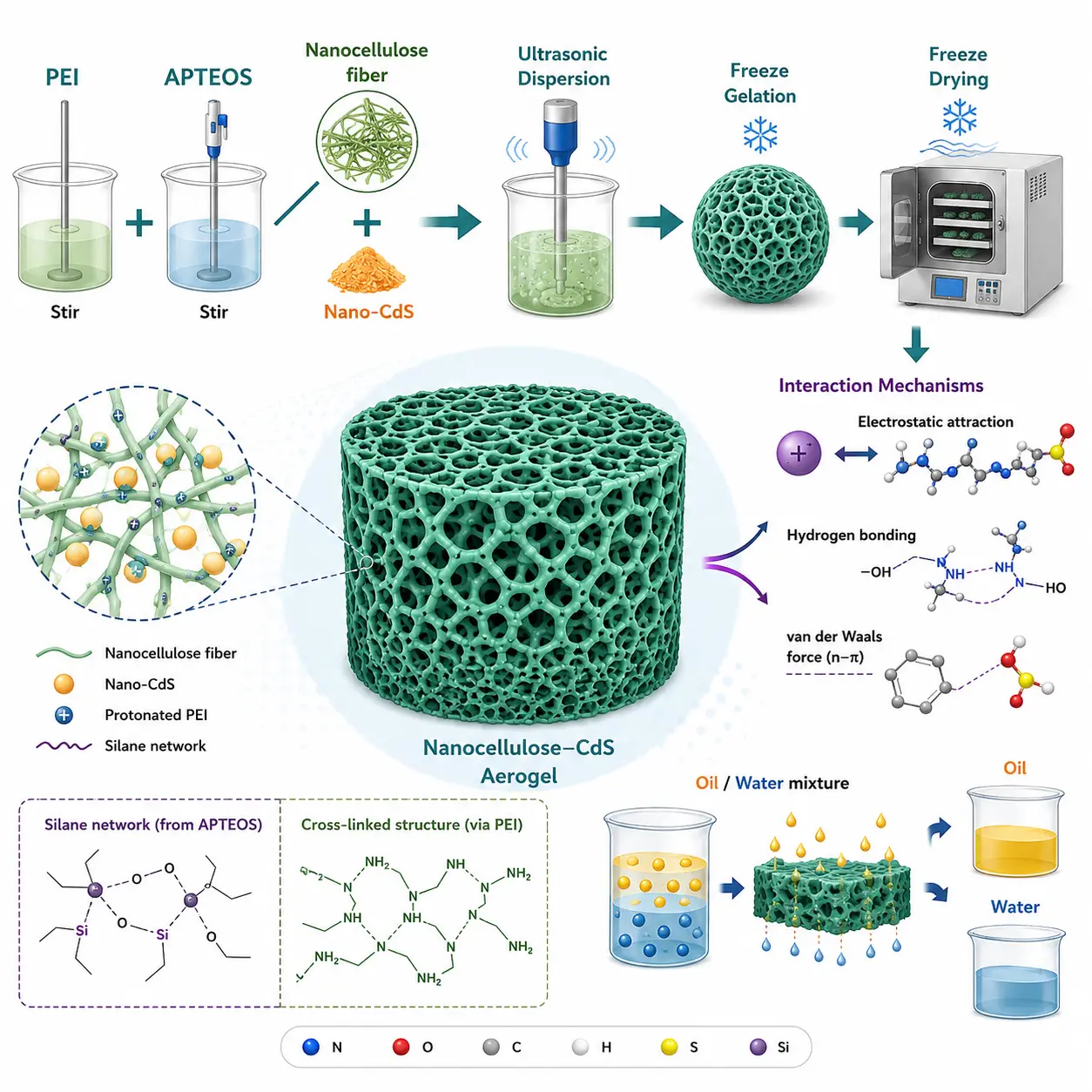
Figure 5. Fabrication pathway, interfacial interactions, and selective oil/water separation mechanism of nanocellulose–CdS hybrid aerogel.
5.2. Adsorptive and Separation Performance: Accessibility over Extremity
Adsorptive cellulose aerogels are qualitatively different from the design paradigms of conventional porous materials that typically seek to maximise surface area. Absolute surface area is less important to the functional performance of biopolymer aerogels than transport accessibility, pore continuity, and network elasticity. The hierarchical pore architectures with interconnected macropores and mesoporous junctions promote fast mass transport and efficient utilisation of adsorption sites. In contrast, highly microporous structures often suffer from diffusion limitations and poor kinetics. This principle is especially relevant for separation and sorption systems, where high functional loading or pore refinement leads to increased tortuosity and the hindrance of transport paths. Therefore, from a structural point of view, the efficiency of adsorption is a property at the network level, arising from the connectivity of the pore network and mechanical adaptability, rather than from the density of adsorption sites. Extremal surface metric optimised designs always perform worse than those designed for resilience and accessibility [34].
5.3. Wetting Control and Oil Absorption: Architectural Control over Chemical Intensity
Oil-water separation aerogels are a clear example of the limitations of chemistry-driven functionalisation. Hydrophobic modification is a common strategy to improve the affinity for oil. But the harsh surface treatment often breaks the hydrogen-bond networks, decreases the elastic compliance, and accelerates the structural fatigue in cyclic use. These effects reduce durability and long-term performance, especially in cyclic wetting and drying conditions. In contrast, aerogels based on macro and mesoporous architectural design can achieve similar oil uptake with minimal chemical modification and maintain mechanical integrity. In such systems, wetting behaviour is primarily an emergent property of pore geometry and connectivity, with chemistry playing a secondary, fine-tuning role. Thus, over-reliance on chemical modification is a structurally inefficient strategy that trades resilience for short-term performance gains [35].
5.4. Electro-Functional and Energy-Related Aerogels
Structure over composition remains of prime importance for energy-related cellulose aerogels. In these systems, functional output is determined by multilevel porosity, directional transport pathways, and spatially programmed architectures, rather than the intrinsic electronic properties of cellulose. Here, the cellulose network is an active framework controlling moisture transport, ion migration, and mechanical response rather than a passive scaffold. We show that anisotropy can be purposefully exploited to segregate electrical, thermal, and mechanical functions into different spatial domains through aerogels designed by coupled gelation and drying pathways. Importantly, these properties stem from process-controlled phase distribution and structural programming rather than post-synthetic addition of conductive fillers. Such attempts to retrofit functionality into isotropic aerogels generally lead to aggregation, pore blockage, and loss of mechanical compliance, highlighting the need for embedding function during network formation [36].
5.5. Hybrid and Composite Aerogels
Functional overload in the design of functional aerogels is the most frequent failure mode in hybrid cellulose aerogels with nanocarbons, metal oxides, or coordination-based components. Functional phases need to be co-assembled with the cellulose network during gelation to enable uniform dispersion, strong interfacial coupling, and effective load sharing for successful hybrid systems. In contrast, impregnation after gelation often leads to density gradients, weak interfaces, and crack initiation during drying. From the mechanical point of view, functional fillers that do not contribute to the load-bearing network behave as stress concentrators, promoting failure under compression, swelling, or solvent removal. Thus, hybrid cellulose aerogels are only successful if the functional components are still structurally subservient to the cellulose framework. Designs in which cellulose serves only as a scaffold for additive overloading always fail to deliver durability or scalability [37].
5.6. Regenerability and Durability as Functional Performance Metrics
In particular, the functional performance of biopolymer aerogels cannot be meaningfully assessed from single-cycle measurements. Regenerability and durability in repeated use cycles expose the real benefit of supramolecular assembled networks. When functionalisation maintains reversible interactions and network compliance, performance can be maintained over multiple regeneration cycles without catastrophic degradation. Furthermore, highly cross-linked or chemically grafted systems show a rapid loss of performance due to microcracking, pore collapse, and loss of elasticity. Such behaviours make regenerability a structural metric, not a second-class citizen. Functional strategies that optimise initial performance at the expense of reversibility are ultimately incompatible with sustainable design goals and long-term usability. The conclusion applies to all of the applications in adsorption, separation, and energy: the functional performance of the cellulose aerogels is dictated primarily by architecture and not chemistry alone.
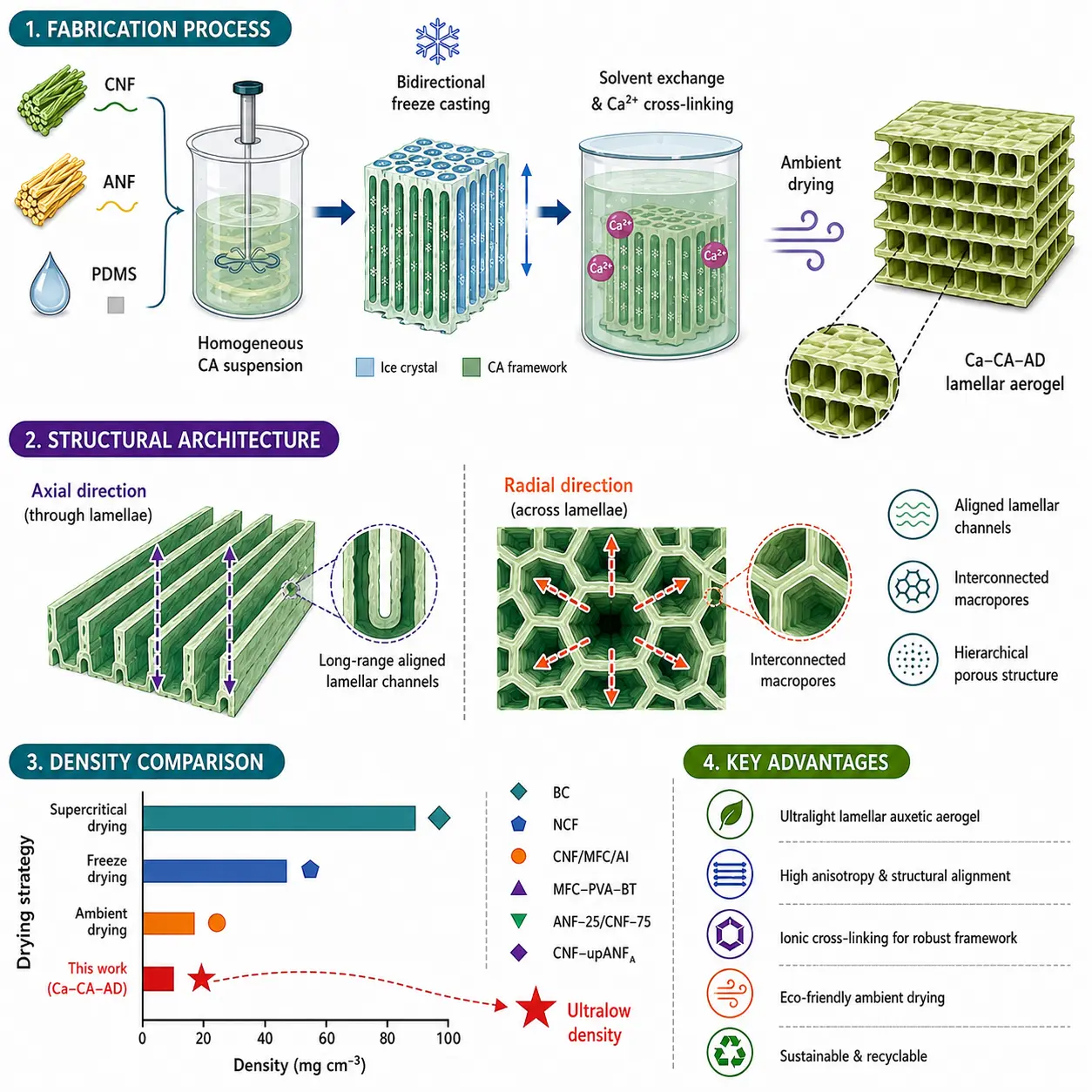
Accessibility, durability, and reproducibility are defined by hierarchical porosity, fibrillar continuity, and stress-tolerant networks. Excessive chemical modification or filler loading undermines these attributes. The most successful functional cellulose aerogels incorporate function in the assembly logic of the network, incorporate functional phases during gelation, and retain supramolecular interactions that allow for regeneration and scale-up (Figure 6). Whereas design strategies that are mainly driven by function generally fail at the structural and process levels. These insights directly motivate the next section, where we explore carbon and hybrid aerogels from cellulose, with thermal transformation imposing new constraints for structural integrity and functional integration [38].
6. Carbon and Hybrid Aerogels Based on Cellulose
6.1. Carbonization as a Destructive-Constructive Structural Transformation
The conversion of cellulose aerogels to carbon aerogels should not be considered as a simple value-adding step but rather as a coupled destructive–constructive structural transformation. Supramolecular hydrogen bonding and fibrillar entanglement stabilise cellulose aerogels. Dehydration, depolymerisation and aromatisation produce carbon aerogels with rigid covalently bonded frameworks. This transformation inevitably perturbes the initial network topology: large mass losses, volumetric shrinkage, pore-wall densification, and partial loss of connectivity are unavoidable. Therefore, the resulting carbon aerogel is not a preserved replica of the cellulose precursor but a reorganised structure and its properties depend on the efficiency of the original hierarchy to accommodate thermal collapse. Therefore, considering carbonization as an innocent pathway to “carbonize porosity” is an oversimplification that conceals the essential structural limitations that determine the final performance [39].
6.2. Hydrothermal and Low-Temperature Carbonization
Hydrothermal and other low temperature carbonization routes are often promoted as sustainable alternatives to traditional high temperature pyrolysis because they avoid fast devolatilization and extreme thermal gradients. From a structural point of view, these methods partially preserve the macroscopic shape and reduce catastrophic pore collapse. But this apparent conservation is at the cost of carbon microstructural development. The resulting frameworks are usually oxygen-rich, amorphous, and weakly conductive, with little formation of ordered carbon domains. Such structures may be advantageous for adsorption-dominated or wettability-controlled processes, but inherently limit mechanical stiffness and electrical transport. The subsequent high temperature annealing to increase carbon order adds energy intensity and structural shrinkage, thus cancelling out the original sustainability advantage. Low-energy carbonization does not remove the structure energy trade-off but shifts its position, thus setting an upper limit to the attainable degree of order of carbon [40].
6.3. Pore Evolution, Shrinkage, and the Misconception of Surface-Area Maximization
In cellulose-derived carbon aerogels, it is a common misconception that a higher initial surface area leads to better carbon materials. In practice, fine mesoporous networks experience disproportionate shrinkage upon carbonization, favouring pore coalescence and severe loss of accessible porosity. By contrast, cellulose aerogels with hierarchical architectures, particularly those incorporating macroporous stress-relief domains—retain connectivity and permeability more effectively after thermal treatment. This observation demonstrates a counterintuitive but critically important design principle: carbon aerogels made from structurally “imperfect” cellulose aerogels often perform better than those made from highly refined, delicate networks. Post-carbonization performance is less determined by pre-carbonization parameters such as surface area or uniformity of pores, but rather the tolerance of the network to collapse induced by thermal shock. Thus, designing cellulose aerogels for carbonization implies sacrificing initial extremity for functionality and robustness after carbonization [41].
6.4. Hybrid Carbon Aerogels: Structural Compatibility Versus Functional Ambition
Hybridisation of cellulose-derived carbon aerogels with inorganic or conductive phases is frequently explored to increase functional scope, but such systems are brittle if structural compatibility is not carefully controlled. Inclusion of secondary phases prior to carbonization can result in partial templating of carbon microstructure and enhanced dispersion, but also comes with new failure modes arising from differential thermal expansion, phase segregation, and catalytic degradation. High inorganic loading leads to pore collapse and densification, degrading percolation and compromising both transport and mechanical integrity. Little advantage is achieved by post-carbonization impregnation, as collapsed pore networks prevent infiltration and weak interfacial bonding limits functional utilisation. These results together demonstrate that the failure of hybrid carbon aerogels is not caused by a lack of chemistry but by incompatible structural evolution during thermal treatment [42].
6.5. Functional Performance as Structural Inheritance
The architectural logic defined prior to carbonization has a much more decisive influence on the functional performance of the cellulose-derived carbon aerogels than the transformations taking place during the thermal treatment itself. Carbonization does not introduce new functionality in an uncontrolled manner, but selectively preserves, degrades, or amplifies structural features that are already present in the precursor aerogel. Therefore, properties like adsorption capacity, mass transport efficiency, electrical response, and directional anisotropy are direct consequences of macroporous connectivity, pore hierarchy, and spatial organization inherited from the cellulose network. Precursor aerogels with continuous macroporous pathways and well-defined multiscale architecture serve as structural scaffolds to guide pore evolution and prevent collapse during carbonization. Crucially, the carbonization process involves rapid dehydration, depolymerisation and aromatisation reactions that induce intense internal stresses within the network. The controlled thermal treatment enables the accommodation of these stresses in architectures with pre-designed gradients or anisotropy without erasing directional features. This opens up the possibility for functional behaviour such as directional adsorption or anisotropic conductivity due to the presence of aligned transport channels, asymmetric pore distributions and hierarchical connectivity in the carbonized state. Conversely, in the case of poor control of thermal treatment or lack of structural hierarchy in the precursor architecture, the carbonization process leads to homogenisation by pore-wall densification and coalescence. This process irreversibly erases spatial differentiation, collapses functional gradients, and locks in performance limitations that cannot be corrected post hoc [43].
Therefore, carbonization acts more as a strict structural filter than a creative processing step. It enhances the strengths of well-designed precursor networks and irreversibly fixes any architectural deficiencies prior to thermal treatment. This finding has important design implications: optimising precursor aerogels for extreme surface area or uniform microporosity prior to carbonization often compromises post-carbonization functionality, whereas architectures engineered for connectivity, stress tolerance, and hierarchical organization yield superior functional performance. Hence, successful design of cellulose-derived carbon aerogels demands a paradigm shift from post-carbonization modification to intentional architecture programming at the precursor stage, acknowledging that performance is ultimately determined by functional inheritance rather than thermal transformation [44].
6.6. Scalability and Sustainability: Carbonization as the Dominant Bottleneck
Although the cellulose-based carbon aerogels are derived from renewable sources, the most critical limitations in sustainability and scalability occur during carbonization. The life-cycle footprint is dominated by high energy demand, low mass yield, and shrinkage induced defects, which often outweigh the advantages of bio-based precursors. Highly refined nanocellulose feedstocks, which are often assumed to be better, tend to show more collapse and yield loss during carbonization than moderately processed cellulose. This behaviour illustrates a frequently encountered principle: structural constraint enhances manufacturability; maximal refinement eliminates it. From an industrial perspective, carbonization efficiency, defect tolerance, and yield consistency will ultimately determine viability and not feedstock origin.
Cellulose-derived carbon and hybrid aerogels are not upgraded versions of cellulose aerogels but structurally reconstituted materials governed by fundamentally different physical rules. The irreversible carbonization of supramolecular networks into rigid frameworks leads to a set of processing-induced intrinsic performance ceilings, such as shrinkage and connectivity loss, which cannot be fixed during processing. Therefore, the architecture of successful carbon aerogels must be designed upstream, with carbonization-tolerant architecture, controlled hierarchy, and restrained functional ambition. All efforts to maximise surface area, graphitic order or additive loading inevitably compromise structural fidelity, scalability and sustainability. This renders them a powerful but narrowly viable platform, whose practical relevance cannot be established without accepting a controlled compromise rather than chasing theoretical performance limits. The conclusions directly motivate the next section, dealing with manufacturing challenges, scalability and industrial feasibility of biopolymer-derived aerogels [45].
7. Manufacturing Challenges, Scalability, and Sustainability
7.1. Reproducibility Limits Imposed by the Supramolecular Network
One of the defining limitations of biopolymer- and cellulose-derived aerogels is that their structural integrity is based on supramolecular assembly rather than irreversible covalent fixation. Hence, reproducibility is not only a downstream processing issue but an intrinsic materials limitation defined by the physics of the network. The gelation in these systems is driven by percolation phenomena, such that small variations in the solids concentration, fibril aspect ratio, dispersion quality, or gelation time can trigger disproportionate variations in the network topology, pore connectivity, and mechanical response. Since supramolecular networks lack intrinsic self-correction mechanisms, any local heterogeneities introduced during mixing or gelation remain and propagate through the final aerogel structure [46]. Such parameters can be well controlled on the laboratory scale, but on the manufacturing scale, variations in shear fields, thermal gradients, and batch-to-batch precursor variability are unavoidable. Thus, structural variability should be considered as a normative outcome rather than a processing failure. This reality imposes a fundamental upper limit on the achievable uniformity in large-format or high-throughput production of cellulose aerogels and requires embracing controlled variability as a design constraint. Robust manufacturing strategies must therefore value tolerance of variability over pursuit of idealised uniformity [47].
7.2. Geometric Scale Effects in Gelation and Drying
With increasing characteristic dimensions, diffusion-limited transport of heat and mass becomes more significant, leading to gradients in fibril concentration, junction density, and solvent composition across the sample. These gradients often create networks that are spatially heterogeneous, especially within thick monoliths, where interior regions gel later and have different stress histories than exterior regions. Drying accentuates these differences. Increasing thickness in freeze-drying results in non-uniform growth and nucleation of ice, which promotes anisotropic pore formation and interlamellar delamination. In ambient pressure drying, capillary stresses bridge macroscopic distances, coupling forces at the pore scale to the bulk geometry. Only networks that are able to dissipate stress over multiple length scales, by hierarchical porosity and elastic compliance, can survive such conditions without collapse, not for chemical incompatibility but for geometrical incompatibility. Many formulations that work well at small scales fail catastrophically as dimensions increase. The effects suggest that scale is not a neutral variable in the manufacturing of cellulose aerogels, but rather a fundamental architectural parameter to take into account from the very beginning of the design. Geometric non-scalability is by definition a property of aerogels that are not designed for scale [48].
7.3. Energy Intensity as the Dominant Sustainability Determinant
The energy consumption of the lifecycle is dominated by energy intensive steps such as nanocellulose extraction, freeze-drying, and carbonization, which often outweigh the benefits of bio-based sourcing. Highly refined nanocellulose systems are structurally impressive and scientifically informative, but require extensive mechanical fibrillation or chemical pretreatment that diminishes sustainability gains due to high energy demand and low material yield. Additional burdens with solvent use, water use, and solvent recovery in regenerated cellulose routes are introduced. However, at the systems level, the sustainability benefits of reducing processing severity (e.g., reduction of refinement steps, avoidance of solvent intensive pathways, and adoption of energy efficient drying strategies) often outweigh incremental improvements in material performance. This observation contradicts the assumption that the more refined or structurally sophisticated the molecules, the greener the aerogels. Instead, the leading metrics of sustainability are energy efficiency and yield retention, and process simplicity. The most sustainable cellulose aerogels are therefore often those that sacrifice moderate performance for significant reductions in processing energy [49].
7.4. Functional Complexity
The uniform integration of secondary phases like nanocarbons, metal oxides, or coordination-based components is only possible in narrow dispersion and gelation windows. With increased production scale, it becomes more difficult to suppress sedimentation, aggregation, and phase segregation, leading to spatial heterogeneity and high defect rates. High functional loading further reduces pore connectivity and increases density and susceptibility to failure by drying. Adding more functional components adds more interfaces, new sources of dispersion, and new failure modes, and multiplies the process risk. Impressive lab-scale metrics of functionally ambitious aerogels often come at the expense of poor yield, inconsistent performance, and limited durability at scale. The net result is a consistent and often uncomfortable conclusion: the best-scalable cellulose aerogels are generally those with a restrained functional ambition, where performance derives from architectural design rather than additive complexity. In practice, simplicity often provides more effective scalability than multifunctionality [50].
7.5. Yield Loss, Defect Rejection, and Real Material Efficiency
Shrinkage during drying, cracking, structural collapse, and mass loss during post-processing can dramatically reduce usable output even when nominal synthesis yields appear good. Defect rejection exacerbates such losses, especially in large-format aerogels, where localised failures can render entire monoliths useless. Regeneration and reuse strategies can partially compensate for the yield loss, but only if the aerogel networks retain mechanical compliance and reversible interactions. Repeated regeneration cycles lead to irreversible damage; thus, highly crosslinked or heavily modified aerogels are intolerant to regeneration. Thus, the efficiency of the cycle depends more on damage tolerance, reversibility, and defect resilience than on peak single-cycle performance. Designs that maximise initial mechanical or functional metrics at the cost of durability are often inefficient when assessed over realistic operational lifetimes. True material efficiency must therefore be considered from an industrial perspective across the full lifecycle, in terms of yield retention, regeneration potential, and failure tolerance, rather than as isolated performance benchmarks [51].
7.6. Industrial Feasibility and Contraction of the Viable Design Space
Industrially realistic systems share common features: moderate porosity, hierarchical architecture, aqueous processing, and broad gelation windows that tolerate variability. Many laboratory-scale aerogels achieve extraordinary metrics precisely because they avoid such constraints by using narrow processing windows and energetically demanding steps. These are scientifically instructive but industrially irrelevant systems. Therefore, it is critical to differentiate between exploratory materials and manufacturable technologies to ensure translational impact of future research. Physical and energetic constraints of biopolymer and cellulose based aerogels are non-negotiable in the manufacturing and sustainability considerations. Supramolecular assembly physics limits reproducibility, geometric and thermal gradients limit scalability, energy intensity, not feedstock identity limits sustainability and increased failure probability limits functional complexity. Successful cellulose aerogels are collectively conceived in the domain of manufacturing, not outside of it. Progress in this field will be less about finding ever more complex formulations and more about rethinking performance targets to focus on reproducibility, yield, and lifecycle efficiency. The final conclusions are built on these insights, combining scientific progress with practical feasibility [52].
8. Conclusions and Future Outlook
As discussed, their defining properties arise from the intrinsic chemistry of biopolymers, supramolecular network assembly, and the ability to intentionally engineer hierarchical pore architectures via aqueous and low-severity processing routes. Unlike traditional inorganic aerogels, whose structure is largely limited by the kinetics of the reaction and the extreme drying requirements, the structure-process-property relationship of cellulose-based aerogels is fundamentally different by employing physical entanglement, hydrogen bonding, and coordination-driven interactions. A major message is that in these systems, it is structure that drives function to a larger extent than composition alone: Hierarchical porosity, fibrillar continuity, and network compliance determine mechanical resilience, mass transport, adsorption efficiency, and long-term durability more than the advantages of extreme surface area or aggressive chemical modification. This viewpoint recasts cellulose aerogels as architected materials, where performance is programmed during gelation and drying rather than appended post-synthesis. This also demonstrates that the choice and processing of precursors are key constraints on the aerogel performance. Native and moderately fibrillated cellulose exhibit an optimal balance among connectivity, adaptability, and processing tolerance, whereas highly refined or solvent-regenerated systems achieve uniformity at the cost of scalability and robustness. The importance of the drying and post-treatment processes is found to be on par with that of freeze-drying (structure preservation and anisotropic design), ambient pressure drying (architectural correction), and carbonization (irreversible network chemistry change, pre-treatment structural design to preserve functionality). These insights together suggest that manufacturability and sustainability are less about the feedstock origin and more about processing realism, where energy consumption, reproducibility, and yield determine practical viability. Future developments in this area will rely on a transition to process-aware materials design, where precursor chemistry, supramolecular assembly, drying pathways, and functional integration are co-optimized in realistic manufacturing envelopes. Biopolymer and cellulose-based aerogels, guided by structural intelligence and disciplined processing strategies, are well positioned to serve as a versatile and durable platform for next-generation porous materials with genuine translational potential.
Statement of the Use of Generative AI and AI-Assisted Technologies in the Writing Process
During the preparation of this manuscript, the authors used ResearchRabbit (OpenAI) for literature survey and gathering related references. The authors reviewed and revised the content and take full responsibility for the final manuscript.
Acknowledgments
The authors gratefully acknowledge their respective institutions for providing the necessary facilities and support to prepare this review article.
Author Contributions
K.N.S.: Conceptualization, literature survey, methodology, writing-original draft, supervision. D.S.A.: Literature survey, data curation, visualization, writing-original draft, writing-review and editing. A.B.H.: Conceptualization, supervision, writing-review and editing, project administration. A.B.: Literature survey, data curation, visualization. B.R.V.: Literature survey, data curation. S.B.: validation. M.S.I.: validation. All authors have read and agreed to the published version of the manuscript.
Ethics Statement
Not applicable. This article is a review and does not involve studies with human participants or animals.
Informed Consent Statement
Not applicable.
Data Availability Statement
Data sharing is not applicable to this article because no new datasets were generated or analyzed during the current study.
Funding
This research received no external funding.
Declaration of Competing Interest
The authors declare that they have no known competing financial interests or personal relationships that could influence the work reported in this paper.
References
- Liu W, Dai C, He L, Liu X, Zhao Z, Yan W, et al. Biomass aerogel: An emerging eco-friendly material for adsorbing pollutants in water. Chem. Eng. J. 2025, 513, 162977. DOI:10.1016/j.cej.2025.162977 [Google Scholar]
- Hassan MW, Elshazly TM, Ponnamma D. Cellulose-inspired approaches to sustainable EMI shielding materials: A comprehensive review. Int. J. Biol. Macromol. 2024, 273, 132920. DOI:10.1016/j.ijbiomac.2024.132920 [Google Scholar]
- Liu H, Du H, Zheng T, Liu K, Ji X, Xu T, et al. Cellulose based composite foams and aerogels for advanced energy storage devices. Chem. Eng. J. 2021, 426, 130817. DOI:10.1016/j.cej.2021.130817 [Google Scholar]
- Syeda HI, Muthukumaran S, Baskaran K. Investigation of regeneratable biopolymer-based aerogels for heavy metal decontamination from water: Quantum chemical analysis and experimental investigation. Sep. Purif. Technol. 2025, 353, 128311. DOI:10.1016/j.seppur.2024.128311 [Google Scholar]
- Dowson M, Grogan M, Birks T, Harrison D, Craig S. Streamlined life cycle assessment of transparent silica aerogel made by supercritical drying. Appl. Energy 2012, 97, 396–404. DOI:10.1016/j.apenergy.2011.11.047 [Google Scholar]
- Rocky MMH, Rahman IMM, Biswas FB, Rahman S, Endo M, Wong KH, et al. Cellulose-based materials for scavenging toxic and precious metals from water and wastewater: A review. Chem. Eng. J. 2023, 472, 144677. DOI:10.1016/j.cej.2023.144677 [Google Scholar]
- Su S, Li D, Tang X, Ma J, Zou L, Chen Q, et al. A moist-electric generator fabricated from the multilevel porous cellulose-based aerogel enhanced by incorporating MOF-801 and conductive PEDOT:PSS. Chem. Eng. J. 2026, 530, 172615. DOI:10.1016/j.cej.2026.172615 [Google Scholar]
- Wang PL, Zhang W, Yuan Q, Mai T, Qi MY, Ma MG. 3D Janus structure MXene/cellulose nanofibers/luffa aerogels with superb mechanical strength and high-efficiency desalination for solar-driven interfacial evaporation. J. Colloid Interface Sci. 2023, 645, 306–318. DOI:10.1016/j.jcis.2023.04.081 [Google Scholar]
- Zhao S, Malfait WJ, Guerrero‐Alburquerque N, Koebel MM, Nyström G. Biopolymer Aerogels and Foams: Chemistry, Properties, and Applications. Angew. Chem. Int. Ed. 2018, 57, 7580–7608. DOI:10.1002/anie.201709014 [Google Scholar]
- Wang L, Li K, Copenhaver K, Mackay S, Lamm ME, Zhao X, et al. Review on Nonconventional Fibrillation Methods of Producing Cellulose Nanofibrils and Their Applications. Biomacromolecules 2021, 22, 4037–4059. DOI:10.1021/acs.biomac.1c00640 [Google Scholar]
- Chen L, Yu L, Qi L, Eichhorn SJ, Isogai A, Lizundia E, et al. Cellulose nanocomposites by supramolecular chemistry engineering. Nat. Rev. Mater. 2025, 10, 728–749. DOI:10.1038/s41578-025-00810-5 [Google Scholar]
- Ma Y, Liu X, Xu X, Wu M, Sun J, Niu N, et al. A compressible and underwater superelastic hydrophilic molecularly imprinted resin composite cellulose nanofiber aerogel to separate and purify catechins from tea. Chem. Eng. J. 2023, 472, 145043. DOI:10.1016/j.cej.2023.145043 [Google Scholar]
- Zhang CW, Si M, Chen C, He P, Fei Z, Xu N, et al. Hierarchical Engineering for Biopolymer‐based Hydrogels with Tailored Property and Functionality. Adv. Mater. 2025, 37, 2414897. DOI:10.1002/adma.202414897 [Google Scholar]
- Ferreira ES, Rezende CA, Cranston ED. Fundamentals of cellulose lightweight materials: Bio-based assemblies with tailored properties. Green Chem. 2021, 23, 3542–3568. DOI:10.1039/D1GC00326G [Google Scholar]
- Li L, Escobar AR, Zanganeh S, Dautta M, Sajeeb MMH, Ye F, et al. Mechanically-directed assembly of nanostructured biopolymer with tunable anisotropy, hierarchy, and functionality. Next Mater. 2024, 2, 100140. DOI:10.1016/j.nxmate.2024.100140 [Google Scholar]
- Seantier B, Bendahou D, Bendahou A, Grohens Y, Kaddami H. Multi-scale cellulose based new bio-aerogel composites with thermal super-insulating and tunable mechanical properties. Carbohydr. Polym. 2016, 138, 335–348. DOI:10.1016/j.carbpol.2015.11.032 [Google Scholar]
- Wu Z, Chen S, Li J, Wang B, Jin M, Liang Q, et al. Insights into Hierarchical Structure–Property–Application Relationships of Advanced Bacterial Cellulose Materials. Adv. Funct. Mater. 2023, 33, 2214327. DOI:10.1002/adfm.202214327 [Google Scholar]
- Ganesan K, Dennstedt A, Barowski A, Ratke L. Design of aerogels, cryogels and xerogels of cellulose with hierarchical porous structures. Mater. Des. 2016, 92, 345–355. DOI:10.1016/j.matdes.2015.12.041 [Google Scholar]
- Klemm D, Heublein B, Fink H, Bohn A. Cellulose: Fascinating Biopolymer and Sustainable Raw Material. Angew. Chem. Int. Ed. 2005, 44, 3358–3393. DOI:10.1002/anie.200460587 [Google Scholar]
- Shaghaleh H, Xu X, Wang S. Current progress in production of biopolymeric materials based on cellulose, cellulose nanofibers, and cellulose derivatives. RSC Adv. 2018, 8, 825–842. DOI:10.1039/C7RA11157F [Google Scholar]
- Signori-Iamin G, Aguado RJ, Putaux JL, Santos AF, Thielemans W, Delgado-Aguilar M. Energy and property trade-offs in nanocellulose production: High-pressure homogenization at different processing consistencies. Chem. Eng. J. 2025, 509, 161257. DOI:10.1016/j.cej.2025.161257 [Google Scholar]
- Tu H, Zhu M, Duan B, Zhang L. Recent Progress in High‐Strength and Robust Regenerated Cellulose Materials. Adv. Mater. 2021, 33, 2000682. DOI:10.1002/adma.202000682 [Google Scholar]
- Jacob J, Linson N, Mavelil-Sam R, Maria HJ, Pothan LA, Thomas S, et al. Poly(lactic acid)/nanocellulose biocomposites for sustainable food packaging. Cellulose 2024, 31, 5997–6042. DOI:10.1007/s10570-024-05975-w [Google Scholar]
- Huang Y, Qian Y, Chang Y, Yu J, Li Q, Tang M, et al. Intense Left‐handed Circularly Polarized Luminescence in Chiral Nematic Hydroxypropyl Cellulose Composite Films. Adv. Mater. 2024, 36, 2308742. DOI:10.1002/adma.202308742 [Google Scholar]
- Szabó L, Milotskyi R, Sharma G, Takahashi K. Cellulose processing in ionic liquids from a materials science perspective: Turning a versatile biopolymer into the cornerstone of our sustainable future. Green Chem. 2023, 25, 5338–5389. DOI:10.1039/D2GC04730F [Google Scholar]
- Wang J, Wang L, Gardner DJ, Shaler SM, Cai Z. Towards a cellulose-based society: opportunities and challenges. Cellulose 2021, 28, 4511–4543. DOI:10.1007/s10570-021-03771-4 [Google Scholar]
- Budtova T. Cellulose II aerogels: A review. Cellulose 2019, 26, 81–121. DOI:10.1007/s10570-018-2189-1 [Google Scholar]
- Parale VG, Kim T, Choi H, Phadtare VD, Dhavale RP, Kanamori K, et al. Mechanically Strengthened Aerogels through Multiscale, Multicompositional, and Multidimensional Approaches: A Review. Adv. Mater. 2024, 36, 2307772. DOI:10.1002/adma.202307772 [Google Scholar]
- Jiménez-Saelices C, Seantier B, Cathala B, Grohens Y. Effect of freeze-drying parameters on the microstructure and thermal insulating properties of nanofibrillated cellulose aerogels. J. Sol-Gel Sci. Technol. 2017, 84, 475–485. DOI:10.1007/s10971-017-4451-7 [Google Scholar]
- Toivonen MS, Kaskela A, Rojas OJ, Kauppinen EI, Ikkala O. Ambient‐Dried Cellulose Nanofibril Aerogel Membranes with High Tensile Strength and Their Use for Aerosol Collection and Templates for Transparent, Flexible Devices. Adv. Funct. Mater. 2015, 25, 6618–6626. DOI:10.1002/adfm.201502566 [Google Scholar]
- Sun X, Sun H, Zhu P, Wu Y, Palmer A, Jiang F. Transforming Cellulose Into Functional Three‐Dimensional Structures. Adv. Funct. Mater. 2025, 35, 2504778. DOI:10.1002/adfm.202504778 [Google Scholar]
- Li Y, Grishkewich N, Liu L, Wang C, Tam KC, Liu S, et al. Construction of functional cellulose aerogels via atmospheric drying chemically cross-linked and solvent exchanged cellulose nanofibrils. Chem. Eng. J. 2019, 366, 531–538. DOI:10.1016/j.cej.2019.02.111 [Google Scholar]
- Li X, Wan C, Tao T, Chai H, Huang Q, Chai Y, et al. An overview of the development status and applications of cellulose-based functional materials. Cellulose 2024, 31, 61–99. DOI:10.1007/s10570-023-05616-8 [Google Scholar]
- Zhang Q, Li L, Wu H, Cheng Y, Liu C, Fang C. Recent advances in cellulose based aerogels with various dimensions: design, functionalization, and applications. Cellulose 2025, 32, 1–27. DOI:10.1007/s10570-024-06256-2 [Google Scholar]
- Zhang H, Li Y, Xu Y, Lu Z, Chen L, Huang L, et al. Versatile fabrication of a superhydrophobic and ultralight cellulose-based aerogel for oil spillage clean-up. Phys. Chem. Chem. Phys. 2016, 18, 28297–28306. DOI:10.1039/C6CP04932J [Google Scholar]
- Liu Y, Li B, Guan Y, Dong L, Li B, Zhang W, et al. Superhydrophobic fiber felt integrated with shipborne oil recovery device for all-weather cleanup of viscous oil spills. Chem. Eng. J. 2025, 514, 163126. DOI:10.1016/j.cej.2025.163126 [Google Scholar]
- Ren J, Tan R, Huang C, Chen J, Huang M, Zhang Q. Self-assembled cellulose nanofibers/graphene aerogel-supported phase change composites with a three-dimensional network structure for enhanced solar-thermal energy conversion and storage. J. Colloid Interface Sci. 2025, 700, 138343. DOI:10.1016/j.jcis.2025.138343 [Google Scholar]
- Chen Y, Zhang C, Tao S, Chai H, Xu D, Li X, et al. High-performance smart cellulose nanohybrid aerogel fibers as a platform toward multifunctional textiles. Chem. Eng. J. 2023, 466, 143153. DOI:10.1016/j.cej.2023.143153 [Google Scholar]
- Chen L, Yu X, Gao M, Xu C, Zhang J, Zhang X, et al. Renewable biomass-based aerogels: From structural design to functional regulation. Chem. Soc. Rev. 2024, 53, 7489–7530. DOI:10.1039/D3CS01014G [Google Scholar]
- Wang YY, Zhou ZH, Zhu JL, Sun WJ, Yan DX, Dai K, et al. Low-temperature carbonized carbon nanotube/cellulose aerogel for efficient microwave absorption. Compos. Part B Eng. 2021, 220, 108985. DOI:10.1016/j.compositesb.2021.108985 [Google Scholar]
- Rahmanian V, Pirzada T, Wang S, Khan SA. Cellulose‐Based Hybrid Aerogels: Strategies toward Design and Functionality. Adv. Mater. 2021, 33, 2102892. DOI:10.1002/adma.202102892 [Google Scholar]
- Liang L, Zhang Z, Song F, Zhang W, Li H, Gu J, et al. Ultralight, flexible carbon hybrid aerogels from bacterial cellulose for strong microwave absorption. Carbon 2020, 162, 283–291. DOI:10.1016/j.carbon.2020.02.045 [Google Scholar]
- Zhang C, Wang H, Gao Y, Wan C. Cellulose-derived carbon aerogels: A novel porous platform for supercapacitor electrodes. Mater. Des. 2022, 219, 110778. DOI:10.1016/j.matdes.2022.110778 [Google Scholar]
- Sen S, Singh A, Bera C, Roy S, Kailasam K. Recent developments in biomass derived cellulose aerogel materials for thermal insulation application: A review. Cellulose 2022, 29, 4805–4833. DOI:10.1007/s10570-022-04586-7 [Google Scholar]
- Chen Y, Zhang L, Yang Y, Pang B, Xu W, Duan G, et al. Recent Progress on Nanocellulose Aerogels: Preparation, Modification, Composite Fabrication, Applications. Adv. Mater. 2021, 33, 2005569. DOI:10.1002/adma.202005569 [Google Scholar]
- Wang M, Jiang G, Guo X, Zeng S, Zhao D. Cellulose Functional Gels: Physical Design and Promising Applications. Adv. Phys. Res. 2025, 4, 2500020. DOI:10.1002/apxr.202500020 [Google Scholar]
- Ellebracht NC, Jones CW. Functionalized cellulose nanofibril aerogels as cooperative acid–base organocatalysts for liquid flow reactions. Carbohydr. Polym. 2020, 233, 115825. DOI:10.1016/j.carbpol.2019.115825 [Google Scholar]
- Buchtová N, Pradille C, Bouvard JL, Budtova T. Mechanical properties of cellulose aerogels and cryogels. Soft Matter 2019, 15, 7901–7908. DOI:10.1039/C9SM01028A [Google Scholar]
- Luan P, Zhao X, Copenhaver K, Ozcan S, Zhu H. Turning Natural Herbaceous Fibers into Advanced Materials for Sustainability. Adv. Fiber Mater. 2022, 4, 736–757. DOI:10.1007/s42765-022-00151-w [Google Scholar]
- Ashori A, Chiani E, Shokrollahzadeh S, Madadi M, Sun F, Zhang X. Cellulose-Based Aerogels for Sustainable Dye Removal: Advances and Prospects. J. Polym. Environ. 2024, 32, 6149–6181. DOI:10.1007/s10924-024-03394-3 [Google Scholar]
- Liu K, Zhang W, Cheng H, Luo L, Wang B, Mao Z, et al. A Nature-Inspired Monolithic Integrated Cellulose Aerogel-Based Evaporator for Efficient Solar Desalination. ACS Appl. Mater. Interfaces 2021, 13, 10612–10622. DOI:10.1021/acsami.0c22245 [Google Scholar]
- Jiang S, Jiang S, Yan J, Lin C, Wang W, Jiang S, et al. Large-scale continuous production of cellulose/hollow SiO2 composite aerogel fibers for outdoor all-day radiation cooling. Nano Energy 2025, 136, 110688. DOI:10.1016/j.nanoen.2025.110688 [Google Scholar]