
Energy-Aware Thermomechanical Processing and Corrosion Response of Rare-Earth Magnesium Sheets: A Perspective for Sustainable Manufacturing

Energy-Aware Thermomechanical Processing and Corrosion Response of Rare-Earth Magnesium Sheets: A Perspective for Sustainable Manufacturing
Eduardo Luis Schneider
1,*
 Lisete Cristine Scienza
1
Guilherme Kusler Possani
1
Rafaela Rocha Cunha
1
Jakson Manfredini Vassoler
2
Claudia Trindade Oliveira
3
Diego Tolotti de Almeida
4
Lisete Cristine Scienza
1
Guilherme Kusler Possani
1
Rafaela Rocha Cunha
1
Jakson Manfredini Vassoler
2
Claudia Trindade Oliveira
3
Diego Tolotti de Almeida
4
Received: 02 July 2026 Revised: 23 July 2026 Accepted: 06 August 2026 Published: 12 August 2026

© 2026 The authors. This is an open access article under the Creative Commons Attribution 4.0 International License (https://creativecommons.org/licenses/by/4.0/).
Graphical Abstract
1. Introduction
Magnesium alloys remain attractive for structural lightweighting because of their low density and high specific properties [1,2]. In contemporary materials selection, however, mechanical performance must be considered alongside manufacturability, process-energy demand, durability, and resource availability [3]. For Mg sheet alloys, widespread industrial adoption has historically been constrained by limited room-temperature formability and pronounced anisotropy [4,5]. Warm forming has therefore become central to viable sheet-manufacturing routes, although the energy and throughput penalties associated with elevated-temperature processing remain practical constraints.
From an industrial perspective, Mg adoption is also intertwined with scalable forming, joining, surface-engineering, and quality-control routes, as well as with the broader development of magnesium technologies documented in recent reviews [4,5,6,7]. Consequently, a manufacturing-oriented assessment should not isolate alloy performance from the process chain required to obtain and preserve that performance.
Rare-earth alloying has emerged as an effective route to improve ductility and reduce anisotropy in wrought Mg products, largely by modifying texture development and deformation mechanisms [6,8,9,10]. Recent efforts targeting room-temperature and lower-temperature warm forming have emphasized Mg sheet alloys that combine formability with microstructural robustness [11]. Mg–Zn–RE sheet systems, such as ZE10A, therefore provide a relevant platform for examining how thermomechanical history generates deformation-induced microstructural states and how these states may subsequently couple to corrosion response.
An energy-aware and resource-aware perspective is timely. Process-optimization studies explicitly target energy-economizing hot-stamping and warm-forming schedules for Mg [12], while rare-earth supply concerns motivate transparent discussion of alloying choices without over-claiming environmental superiority. In this perspective, environmental and criticality considerations are therefore treated as screening-level, database-dependent indicators rather than as a full life-cycle assessment (LCA) [3]. The objective is not to label Nd-containing Mg–Zn–RE sheets as intrinsically “green”, but to show how forming windows, durability, and alloy selection can be discussed within a transparent sustainable-manufacturing framework.
The novelty of this perspective lies not in the presentation of new experimental data, but in the integration of three bodies of evidence that are often discussed separately: warm-deformation mechanisms in Mg–RE sheets, the dynamic and non-passivating nature of Mg corrosion films, and screening-level sustainability constraints associated with forming energy and rare-earth use. Compared with the authors’ previous ZE10A study, which reported mechanical and microstructural evolution between 250 and 300 °C, the present article uses ZE10A only as an anchor case to formulate a broader working hypothesis for Mg–Zn–RE sheets. Compared with existing Mg–RE and Mg-corrosion reviews, the emphasis here is placed on how deformation-induced defect architecture and film kinetics may mediate processing sensitivity in recovery-dominated forming windows.
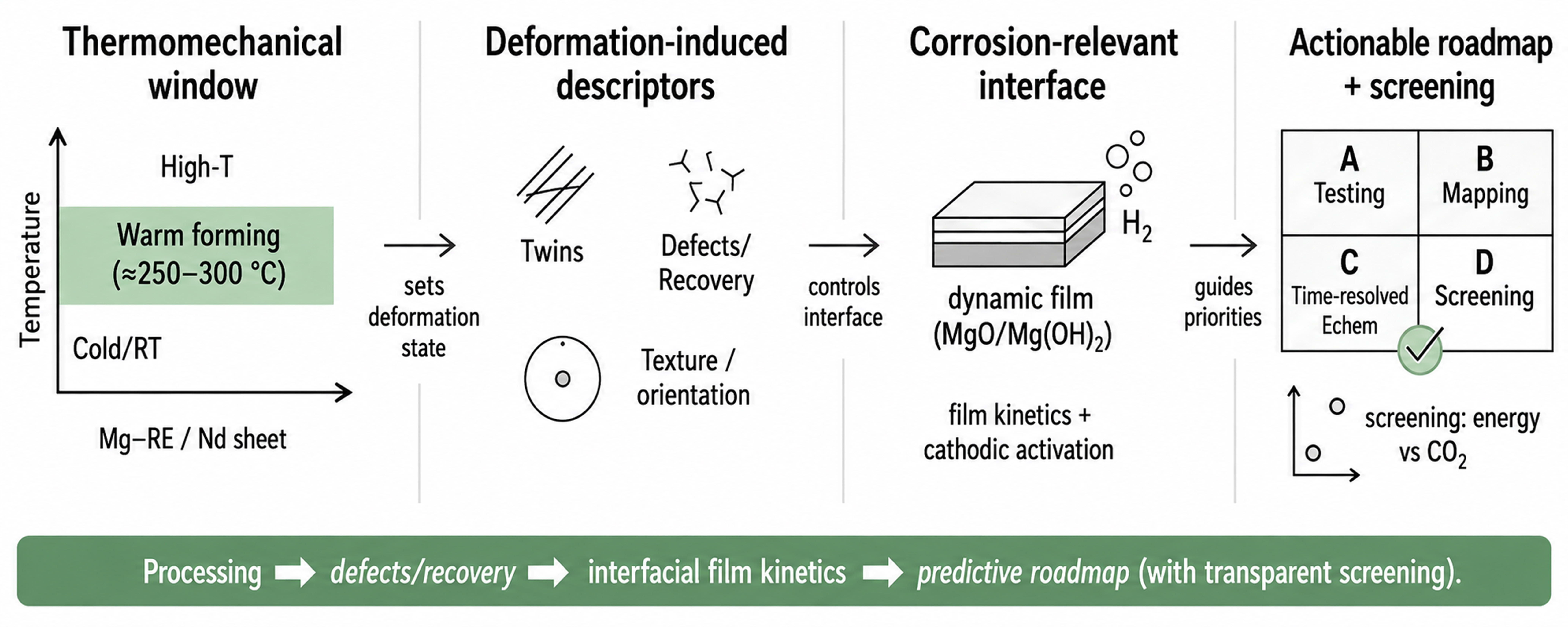
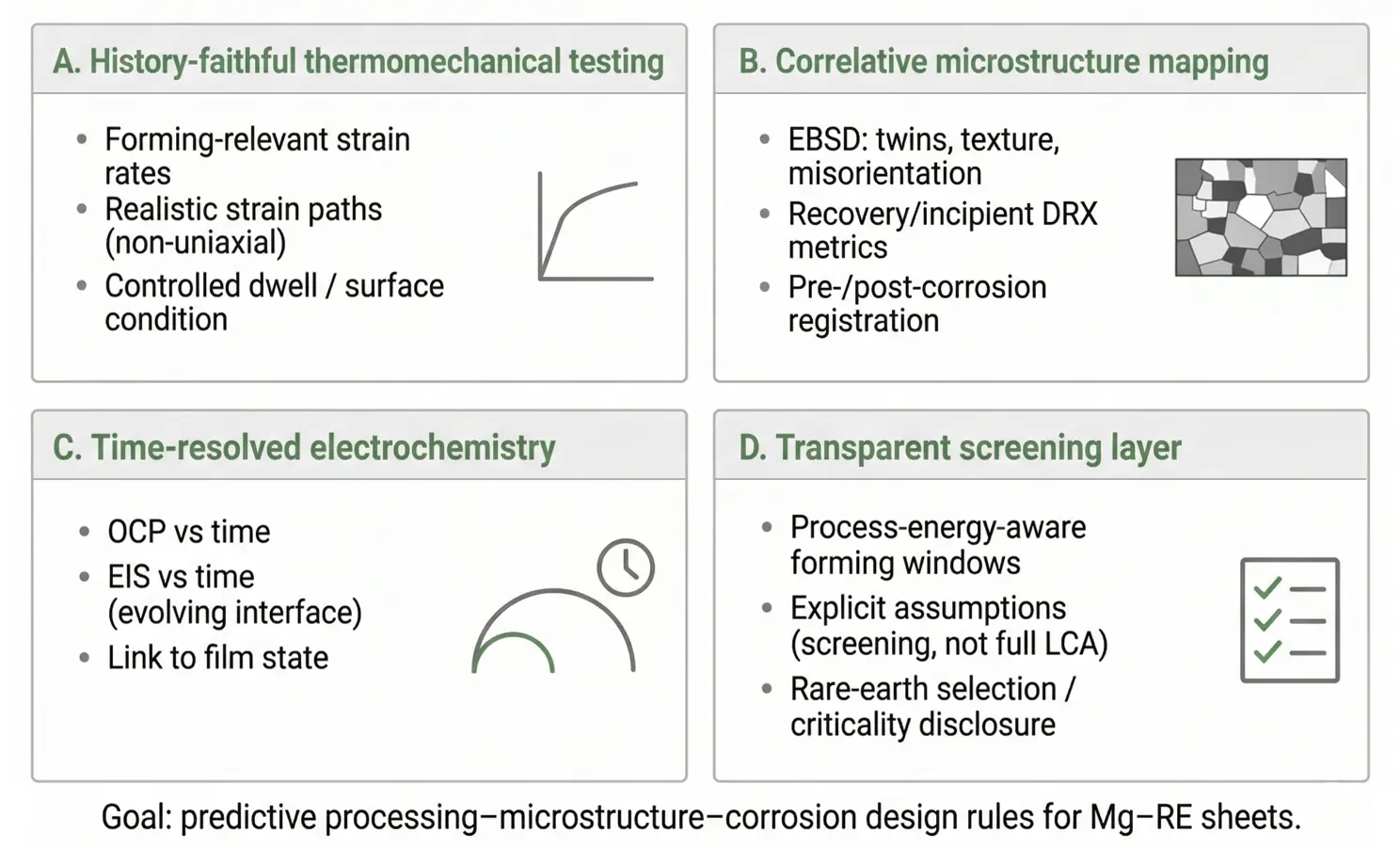
This perspective focuses on low-temperature warm-forming windows, the resulting deformation-induced microstructural states and stability (Figure 1), and the implications of those states for corrosion coupling in chloride environments (Figure 2). It then integrates process-energy and rare-earth criticality considerations through a deliberately conservative screening layer (Figure 3) and proposes a research roadmap for predictive processing–microstructure–corrosion design rules (Figure 4).
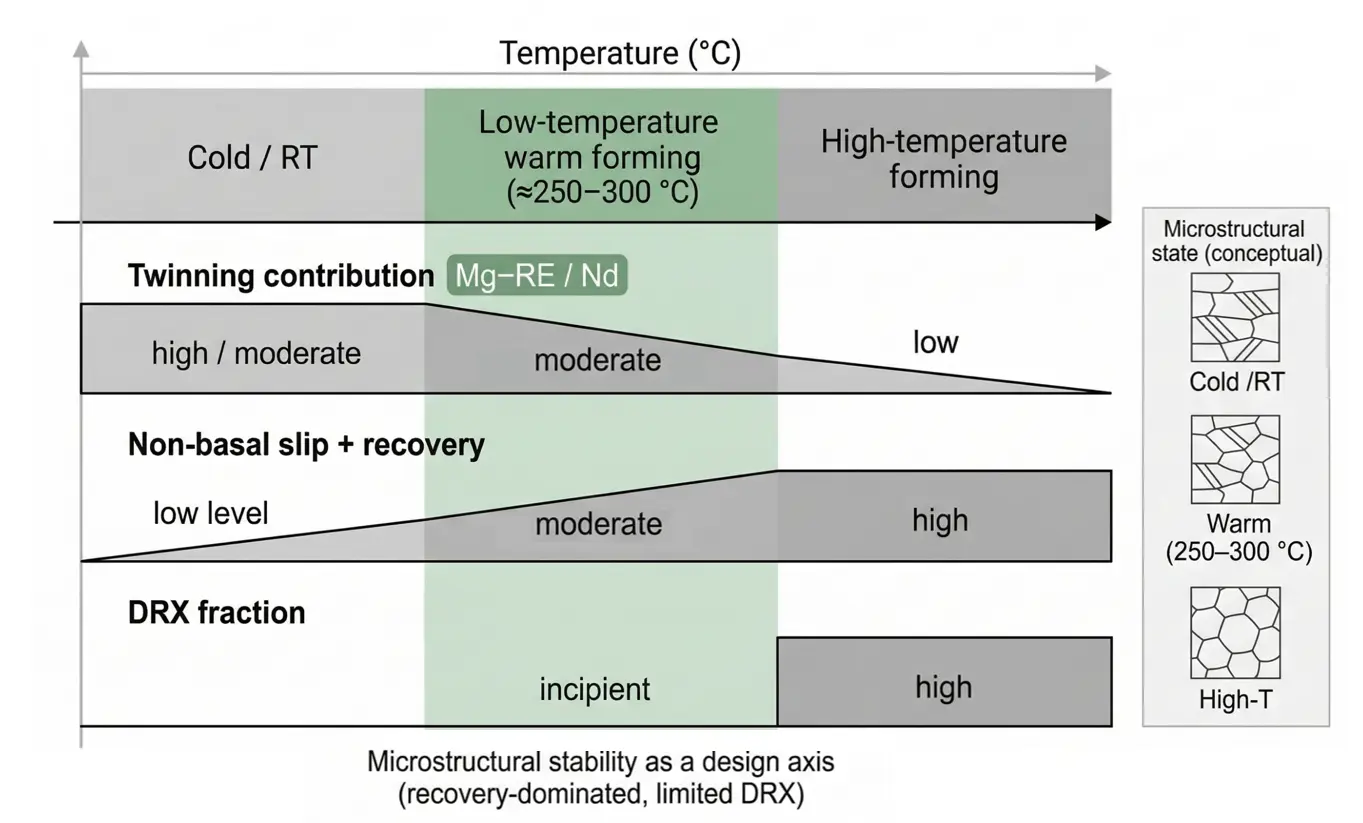
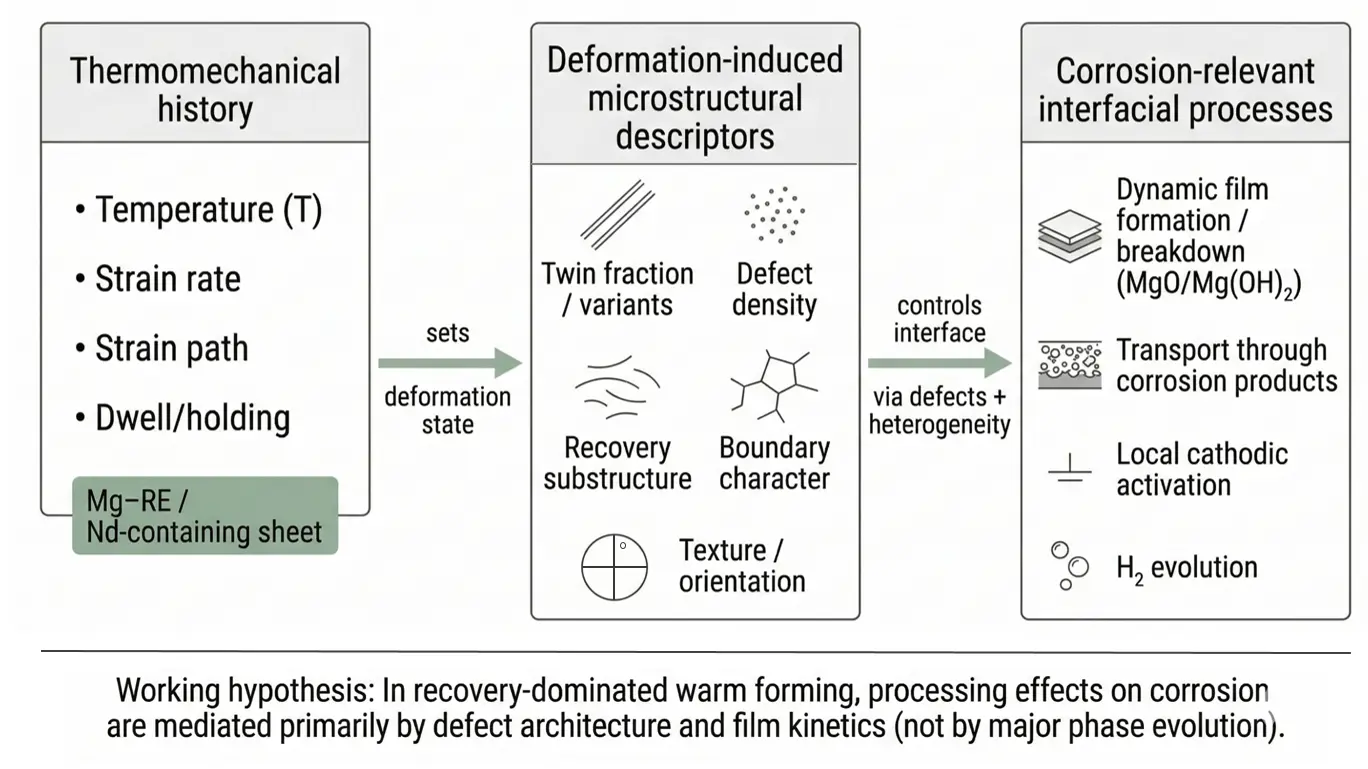
Figure 2. From thermomechanical history to corrosion response: a coupling framework for Mg–RE sheets.
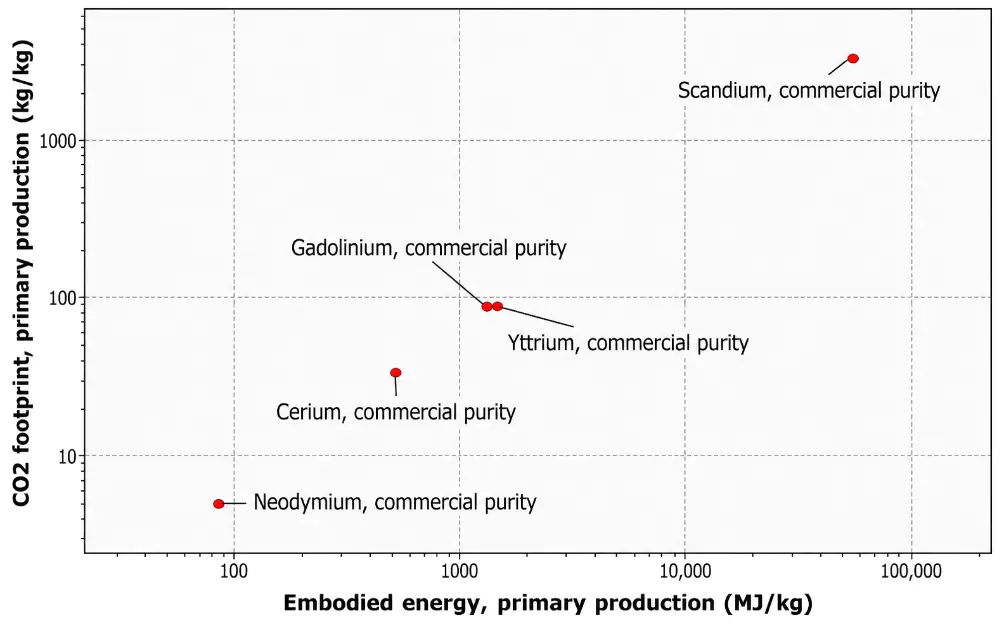
Figure 3. Screening comparison of embodied energy and carbon footprint for selected rare-earth elements using commercial-purity, primary-production elemental records from the CES Selector, accessed through the authors in 2026. Both axes are logarithmic. Carbon-footprint values are expressed as kg CO2-eq per kg of element. These elemental values are not weighted by alloy composition and do not represent the environmental footprint of ZE10A or of a manufactured component.
2. Current Understanding: Thermomechanical Processing of Mg and Mg–RE Sheet Alloys
2.1. Deformation Mechanisms in Mg Sheets: Temperature, Strain Rate, and Anisotropy
In Mg sheet, the hexagonal close-packed (HCP) crystal structure restricts slip at low temperature and promotes strong anisotropy and twinning activity. Classic work on Mg crystal plasticity established strong temperature effects on flow stress and hardening [13]. In rolled Mg alloys, deformation twinning plays a major role in strain accommodation and can strongly influence strain hardening and texture evolution [14]. The limited availability of non-basal slip at lower temperatures contributes to plastic anisotropy, as documented extensively in AZ31-type sheets [15]. Twinning–ductility relations further emphasize the sensitivity of macroscopic formability to crystallographic mechanisms [16].
As temperature and strain rate move into warm-forming regimes, the balance shifts: non-basal slip becomes increasingly active, and recovery processes become more significant, leading to smoother hardening responses and reduced anisotropy in many Mg sheets [17]. At still higher temperatures, dynamic recrystallization (DRX) becomes increasingly influential; mechanistic links between plastic deformation and DRX in Mg are established [18], and high-temperature DRX behavior has been detailed for Mg alloys [19].
Recent work continues to refine this mechanism picture by quantifying texture and anisotropy in Mg–Zn–RE sheets, deep-drawing behavior in AZ31 versus ZE10, and the viscoplastic responses of AZ31B versus Elektron 717 across warm-forming regimes [20,21,22].
2.2. What Changes with Rare-Earth Additions: Texture Modification and Microstructural Robustness
Rare-earth additions are well known to modify texture and improve ductility in wrought Mg products [6]. Mechanistically, grain-boundary segregation and solute effects can alter texture evolution and deformation behavior [8,10]. In rolled sheet specifically, RE additions have been shown to affect microstructure and texture development [9].
A practical implication is that many Mg–RE sheets exhibit enhanced microstructural stability during warm deformation: extensive DRX may be delayed or remain limited under thermomechanical histories in which conventional Mg–Al systems would exhibit stronger recrystallization and texture turnover. This shifts the processing “control knobs” from wholesale grain-structure transformation toward tuning of defect architecture, recovery substructure, and texture.
Recent reviews and comparative assessments reinforce the breadth of the Mg–RE alloy-design space, including WE-series alloys and broader RE versus non-RE strategies, and provide context for interpreting texture engineering, precipitation effects, and corrosion-relevant microstructural descriptors in sheet products [23,24,25,26,27].
2.3. Low-Temperature Warm Forming as an Energy-Aware Target
Energy-economizing optimization of Mg hot stamping has been explicitly addressed as a process-design goal [12]. For sheet alloys, the preferred processing window is not simply the temperature that maximizes ductility. A manufacturing-relevant “sweet spot” must provide adequate formability at the lowest feasible temperature while maintaining acceptable heating time, throughput, dimensional control, surface condition, and microstructural stability. This places emphasis on windows where deformation is aided by recovery and incipient DRX, while phase evolution and grain growth remain restrained (Figure 1). Figure 1 conceptually summarizes the transition from twinning-assisted plasticity toward increasing non-basal slip and recovery, with incipient DRX near the upper end of low-temperature warm forming.
3. Emerging Insights: Microstructural Stability in ZE10A Within 250–300 °C
A recent study on ZE10A subjected to thermomechanical treatments between 250 and 300 °C provides an anchor example of the low-temperature warm-forming window [28]. Within this range, strength decreases with temperature while microstructural evolution remains modest: grain morphology transitions toward partially equiaxed features consistent with incipient DRX, and diffraction indicates a nearly single-phase α-Mg response with no clear evidence of Mg–Nd precipitates within the detection limits [28]. These observations support the view that deformation in this window is accommodated predominantly through slip and recovery, with reduced twinning activity as temperature rises, rather than through extensive recrystallization.
This interpretation must be treated with appropriate limits. The absence of clear Mg–Nd precipitate peaks in diffraction data does not exclude nanoscale precipitation, solute clustering, or low-volume-fraction phases below the detection limits of the techniques used. Likewise, the 250–300 °C window should not be generalized uncritically to all Mg–Zn–RE sheets, because composition, initial texture, rolling history, strain path, strain rate, and dwell time may shift the balance between recovery, twinning, precipitation, and DRX. Thus, ZE10A is used here as an anchor case for hypothesis generation rather than as a universal benchmark for Mg–RE sheets.
For practical engineering use, ZE10A/Elektron 717 property baselines and application context are also supported by industry datasheets and broader overviews of magnesium technologies and high-volume automotive adoption pathways [29,30,31].
This response elevates microstructural stability from a byproduct to a design axis. If large-scale microstructural transformations are limited, thermomechanical history primarily modifies defect density and arrangement, recovery substructures, twin population and relaxation, and stored-energy heterogeneity near the surface. In that situation, corrosion sensitivity to processing is not expected to follow simple “grain size → corrosion” heuristics. Instead, the coupling plausibly shifts toward film kinetics and defect-mediated interfacial behavior (Figure 2). The working descriptor set, therefore, includes twins, defects and recovery, boundary character, and texture, all of which may govern corrosion-relevant interfacial processes through defect architecture and film kinetics.
4. Corrosion Response of Mg Alloys: Requirements for Processing–Corrosion Narratives
4.1. Corrosion Films on Mg Are Dynamic and Non-Passivating in Chloride Media
A foundational framework for understanding Mg corrosion emphasizes the inherently active nature of Mg in aqueous environments and the dynamic, evolving character of its surface films [32]. This remains consistent with broader mechanistic discussions applicable to biomedical and structural contexts [33] and with the widely used view that coatings and surface treatments are often necessary in practice even when alloy chemistry is optimized [34]. For Mg–RE sheets, “corrosion resistance” therefore often reflects altered interfacial kinetics rather than true passivation.
4.2. Why Deformation History Can Matter Even When Phase Evolution Is Limited
Even when phase constitution and grain size remain stable after warm deformation, plastic straining introduces dislocations, twins, and localized strain gradients. These features are expected to influence film rupture and reformation rates, local cathodic activation and hydrogen evolution, transport through corrosion products, and the time dependence of impedance and polarization response; however, the relative contribution of each defect class remains insufficiently quantified for Mg–RE sheet alloys.
Transmission electron microscopy (TEM) and tracer-based studies demonstrate that film formation and evolution involve complex uptake and transport of hydrogen and oxygen species. TEM studies of aqueous film formation provide microstructural evidence of interfacial evolution [35]. Tracer studies quantify film-growth contributions from hydrogen and oxygen during corrosion in water and humid environments [36,37]. Notably, tracer work comparing AZ31B and ZE10A in dilute NaCl shows that alloy-system differences can manifest through film-growth behavior even in a weakly aggressive environment [38]. These observations reinforce the central message that dynamic interfacial states govern Mg corrosion—precisely the domain in which deformation-induced defect architectures can be consequential.
Complementary studies further emphasize the sensitivity of Mg–RE systems to microstructure and near-surface states, including links between heat-treated WE-series microstructures and corrosion behavior, microstructure-controlled corrosion in ZEK-type alloys, and the time-dependent evolution of corrosion-film nanoporosity and hydrogen ingress in chloride solutions [39,40,41].
Natural aging after warm forming is another factor that requires explicit control. Storage time and ambient exposure may modify surface films, near-surface defect relaxation, solute redistribution, and early corrosion-film stability. Therefore, comparisons between warm-formed and naturally aged Mg–RE sheets should report the time between deformation and corrosion testing, storage environment, and surface-preparation procedure.
4.3. Microgalvanic Narratives Remain Relevant—But Must Be Positioned Correctly for Mg–RE Sheets
In Mg–Al alloys, corrosion is often linked to intermetallic particles and microgalvanic coupling. Model-electrode studies examining intermetallic size and spacing support that these factors can substantially affect corrosion localization and kinetics [42]. For many Mg–RE sheets formed in recovery-dominated windows, however, a working hypothesis is that processing sensitivity may be less dominated by newly formed precipitates and more by the way deformation modifies surface-near defect states and, in turn, film kinetics.
Anodic dissolution can itself enhance catalytic activity on Mg surfaces, reinforcing non-classical coupling between anodic and cathodic processes [43]. This again motivates a “film and surface state” framework rather than a purely bulk-microstructure narrative.
5. A Coupling Framework for Mg–RE Sheets: Defects and Film Kinetics as Primary Mediators
To structure the discussion beyond composition-only narratives, Figure 2 proposes a working processing–microstructure–corrosion coupling framework. Thermomechanical history—temperature, strain rate, strain path, and dwell—generates a deformation-induced state characterized by twin fraction and variants, recovery substructure and defect density, boundary character and texture, and near-surface stored energy. This state is hypothesized to influence corrosion predominantly through interfacial processes: dynamic film formation and breakdown, transport through corrosion products, local cathodic activation, and hydrogen evolution.
For Mg–RE sheets formed in low-temperature warm-forming windows where extensive DRX and phase evolution are suppressed [28], this framework suggests that processing effects on corrosion—if present—may appear primarily as changes in interfacial resistance and film kinetics rather than as dramatic shifts in corrosion type, such as a transition from active to passivating behavior. This interpretation is consistent with established Mg-corrosion frameworks [32,33], and tracer-based insights into film-growth dynamics [36,37,38], but direct validation for controlled deformation histories remains necessary. Table 1 separates direct observations, supported inferences, the working hypothesis, and unresolved mechanisms.
Table 1. Evidence hierarchy supporting the proposed processing–microstructure–corrosion coupling framework in Mg–RE sheets.
|
Evidence Level |
Current Basis |
Implications for the Proposed Framework |
|---|---|---|
|
Observed |
Literature reports dynamic, evolving Mg corrosion films and time-dependent film growth in Mg alloys, including AZ31B and ZE10A. |
Corrosion response should be interpreted as an evolving interfacial process rather than as true passivation. |
|
Supported inference |
Warm deformation modifies twins, dislocations, recovery substructures, surface heterogeneity, and stored energy. |
These features may affect film rupture/reformation, local cathodic activation, and transport through corrosion products. |
|
Working hypothesis |
In recovery-dominated Mg–RE sheets with limited phase evolution, processing sensitivity may be controlled more by defect architecture and film kinetics than by newly formed precipitate-driven microgalvanic effects. |
This hypothesis requires direct validation by correlative EBSD/localized electrochemistry and controlled thermomechanical histories. |
|
Unresolved |
The relative roles of natural aging, solute clustering, nanoscale precipitation, surface preparation, and exposure time remain insufficiently separated. |
Future studies should control storage time, environment, surface condition, and aging state before corrosion testing. |
6. Sustainability and Nd: Using the Argument Without Over-Claiming
Beyond mechanical performance, alloy and process selection for Mg–RE sheets is also influenced by manufacturing energy demand and the criticality of rare earths. The Nd-related argument is deliberately framed here at the screening level—indicative, comparative, and database dependent—rather than as an ISO-compliant LCA. Figure 3, therefore, contextualizes selected rare-earth elements using commercial-purity, primary-production elemental records from the CES Eco Audit module in Ansys Granta EduPack/CES Selector, accessed through the authors’ institutional license in 2026, while the broader criticality discussion draws on geological and policy assessments [3,44,45]. The comparison is cradle-to-gate at the elemental level, expressed per kg of element, and is not weighted by the composition of ZE10A or any manufactured component.
For sustainable manufacturing, a lower forming temperature is not automatically equivalent to a lower-impact process. The net benefit depends on furnace and tool efficiency, heating and dwell time, production rate, forming yield, scrap generation, reheating, lubrication, and the downstream need for corrosion protection. Accordingly, process-energy indicators should be reported together with the mechanical window and surface-integrity outcome, rather than being used as a stand-alone claim of environmental superiority.
In multi-step forming routes, repeated heating, reheating between forming passes, and prolonged tool-temperature stabilization may offset part of the energy benefit expected from a lower nominal forming temperature. Process-energy screening should therefore be reported on a per-part or per-batch basis and should include the number of heating cycles, dwell time, reheating events, rejected parts, and any intermediate thermal treatments required to complete the forming route.
The same caution applies to Nd. Its relatively low addition level in Mg–Zn–RE sheets may support a favorable mass-based screening result, but supply concentration, recovery routes, purity assumptions, and database boundaries can change the interpretation. The practical objective is therefore traceable decision-making: state the data source, functional basis, production route, and uncertainty, and use the screening layer to identify trade-offs that warrant a full LCA rather than to replace one.
Durability and surface engineering also remain part of the manufacturing system. Anodizing and related treatments may improve Mg corrosion performance, but they add process steps, chemicals, energy demand, and maintenance considerations [46]. Recent studies of deformation mechanisms in Mg–RE–Zn systems [47], alloy-design evidence on Nd-containing Mg alloys [48], and application-level assessments of Mg in aerospace and automotive sectors [49] further demonstrate why material performance, process design, durability, and supply considerations should be evaluated together.
The knowledge gaps and actionable research directions emerging from this integrated view are summarized in Table 2. The table is intended as a concise checklist for future processing–microstructure–corrosion studies in Mg–RE sheets, including component-scale warm forming, plasma electrolytic oxidation (PEO), automotive deployment, aerospace applications, and design constraints [50,51,52,53,54].
Table 2. Summary of key knowledge gaps and actionable protocols for linking processing, microstructure, corrosion, and sustainable manufacturing in Mg–RE sheets.
|
Theme |
State of the Art (Selected) |
Gaps/Open Questions and Actionable Protocols |
|---|---|---|
|
Warm forming of Mg–Zn–RE alloys |
Classical and recent studies describe Mg plasticity across temperature and strain-rate regimes, emphasizing anisotropy and activation of slip and twinning mechanisms in sheet alloys [15,16,17,18,19,20,21,22]. Component-scale warm-forming studies provide an industrial reference point [50]. |
Intermediate warm-forming windows remain insufficiently systematized. Future studies should report rolling-direction orientation, strain path, forming-relevant strain rate or crosshead speed, dwell, tool-contact condition, heating efficiency, throughput, number of reheating cycles, and the approximately 250–300 °C window under microstructural-stability constraints [21,22,28]. |
|
Microstructure and mechanical anisotropy |
Texture, twinning, recovery, and DRX are widely reported, often under simplified loading paths [15,16,17,18,19,20,21,22]. RE additions and solute effects are known to modify texture development and anisotropy in wrought Mg products [6,8,9,10,47]. |
Correlations between twins, recovery, incipient DRX, and forming-relevant anisotropy remain limited, especially for bending and springback across multiple sheet orientations. Actionable protocols include pre/post-forming EBSD, twin-fraction and variant analysis, kernel-average misorientation or geometrically necessary dislocation metrics, texture quantification, and controlled surface-condition reporting. |
|
Hardness–strength correlations |
Engineering correlations between hardness and strength are frequently used for screening and materials selection [3]. |
Systematic validation is lacking for Mg–Zn–RE sheets subjected to temperature-dependent deformation histories and near-surface modification. Hardness–strength correlations should be calibrated against tensile/bending data after defined forming temperatures, dwell times, aging intervals, and surface-preparation states, especially when recovery and incipient DRX dominate. |
|
Post-deformation surface integrity and corrosion |
Mg corrosion is governed by dynamic surface films and hydrogen evolution; coatings and surface treatments are widely reviewed, commonly for as-received or heat-treated states [32,33,34,46], including PEO routes [51]. Film evolution and transport have been clarified by TEM and tracer-based approaches [35,36,37,38,39]. |
The influence of thermomechanical history, plastic strain, defect architecture, strain localization, natural aging, and surface condition remains underexplored for Mg–RE sheets. Actionable protocols include controlled storage time between forming and corrosion testing, time-resolved OCP/EIS at defined exposure windows, localized electrochemical mapping, and correlative EBSD before and after corrosion exposure. |
|
Lightweight structural applications and sustainability screening |
Automotive and broader transport adoption depends on scalable manufacturing, joining, surface protection, and component design [5,30,31,49,52,53,54]. Energy-aware process optimization and critical-raw-material screening are increasingly relevant [12,44,45]. |
Design rules should link processing → microstructure → surface integrity → corrosion tolerance → component requirements. Studies should report process-energy assumptions, repeated reheating, material yield and scrap, surface-treatment burdens, criticality/database boundaries, and the criteria used to decide when a full LCA is required. |
7. Future Research Directions: A Roadmap to Predictive Processing–Microstructure–Corrosion Relationships
Based on the gaps identified above, Figure 4 summarizes a roadmap toward predictive design rules and serves as a visual guide to the prioritized directions detailed in Sections 7.1–7.4.
7.1. Correlative Microstructure Mapping and Localized Electrochemistry
Co-register electron backscatter diffraction (EBSD) maps—twin fraction, misorientation, texture, and recovery metrics—with localized electrochemical probes to identify which microstructural units govern film stability, hydrogen evolution, and cathodic activation.
7.2. Time-Dependent Electrochemistry as a Standard
Use time-resolved open-circuit potential (OCP) and electrochemical impedance spectroscopy (EIS) protocols, and interpret the results in terms of evolving interfacial states, consistent with TEM and tracer evidence for dynamic films [35,36].
7.3. History-Faithful Thermomechanical Testing Aligned with Forming
Warm-deformation regimes should reflect forming-relevant strain rates, strain paths, dwell times, tool contact, and surface condition; otherwise, mechanistic conclusions may not transfer to manufacturing operations [17,18].
7.4. Integrate a Transparent Screening Layer into Processing Maps
Processing maps should include process-energy objectives [12] alongside explicitly stated materials-selection assumptions [3]. At minimum, studies should report the temperature window, heating route, dwell, production basis, yield or scrap assumptions, repeated reheating cycles, database version, system boundary, and whether downstream surface protection is included. For corrosion validation, time-resolved protocols should also report OCP stabilization criteria and EIS acquisition windows so that film kinetics can be compared across studies. This reporting set would make screening comparisons reproducible and clarify when a full LCA is required.
7.5. Perspective Context
Recent perspective-oriented articles in the Journal of Magnesium and Alloys have used roadmap-style syntheses to frame priorities linking processing routes to performance and application-relevant constraints [55,56,57]. The present contribution applies that format to a specific mechanistic hypothesis—defect architecture and dynamic-film kinetics as mediators of processing sensitivity—and connects it to a minimal, testable set of experiments and sustainability-reporting assumptions (Figure 4).
8. Concluding Perspective
Mg–RE sheet alloys provide a distinctive opportunity for lightweight manufacturing because rare-earth alloying can reduce anisotropy and improve formability while supporting microstructural robustness during warm deformation [6,8,9,10]. In low-temperature warm-forming windows relevant to energy-aware processing, ZE10A results indicate modest microstructural evolution, incipient DRX, and phase stability [28]. Under these conditions, thermomechanical history is expected to affect corrosion primarily through defect architecture, near-surface heterogeneity, and dynamic-film kinetics rather than through extensive phase evolution or purely precipitation-driven microgalvanic effects [32,38].
Three ranked priorities emerge from this perspective. First, controlled warm-forming studies should be coupled with EBSD-based defect mapping and time-resolved electrochemistry to validate whether defect architecture and film kinetics mediate corrosion sensitivity. Second, corrosion comparisons should explicitly control aging time, storage environment, and surface preparation after forming. Third, processing maps should include transparent energy and criticality assumptions, including repeated reheating, scrap/yield, and downstream surface-protection requirements. These steps would transform the proposed framework from a working hypothesis into a predictive basis for sustainable manufacturing design rules for Mg–RE sheets.
Statement of the Use of Generative AI and AI-Assisted Technologies in the Writing Process
During the preparation of this manuscript, the authors used ChatGPT (OpenAI) for language editing and formatting assistance. After using this tool, the authors reviewed and edited the content as needed and take full responsibility for the content of the published article.
Acknowledgments
The authors acknowledge Bruning Tecnometal Ltda. for providing materials, access to infrastructure, and technical discussions that supported the underlying research. The authors also acknowledge EMBRAER for technical discussions and contributions related to the application context of this study.
Author Contributions
Conceptualization, E.L.S. and L.C.S.; Methodology, E.L.S., L.C.S., G.K.P. and C.T.O.; Formal Analysis, E.L.S., L.C.S., G.K.P. and J.M.V.; Investigation, E.L.S., G.K.P., R.R.C. and J.M.V.; Resources, E.L.S., L.C.S., J.M.V. and D.T.d.A.; Writing—Original Draft Preparation, E.L.S.; Writing—Review & Editing, E.L.S., L.C.S., G.K.P., R.R.C. and D.T.d.A.; Visualization, E.L.S., J.M.V. and C.T.O.; Supervision, E.L.S., L.C.S. and J.M.V.; Project Administration, E.L.S.; Funding Acquisition, E.L.S.
Ethics Statement
Not applicable.
Informed Consent Statement
Not applicable.
Data Availability Statement
No new experimental data were generated for this perspective. The screening values used in Figure 3 were obtained from CES Selector. The screening basis is elemental primary production expressed per kg of commercial-purity element; values are not composition-weighted and do not represent a component-level LCA. Additional details on the screening assumptions are available from the corresponding author upon reasonable request, subject to database licensing conditions.
Funding
This work received support from CNPq (305428/2022-5) and CAPES/PROEX—Brazil (CAPES/PROEX 88881.844968/2023-1061). Bruning Tecnometal Ltda. provided materials and access to infrastructure but did not provide direct financial support for this work. The article processing charge was fully waived by the publisher for this invited contribution.
Declaration of Competing Interest
D.T.d.A. is an employee of Bruning Tecnometal Ltda. The role of Bruning Tecnometal in the underlying research and in the preparation of this perspective is described in the Author Contributions, Funding, and Acknowledgments sections. The other authors declare that they have no known competing financial interests or personal relationships that could have appeared to influence the work reported in this paper.
References
- Pollock TM. Weight Loss with Magnesium Alloys. Science 2010, 328, 986–987. DOI:10.1126/science.1182848 [Google Scholar]
- Mordike BL, Ebert T. Magnesium: Properties—Applications—Potential. Mater. Sci. Eng. A 2001, 302, 37–45. DOI:10.1016/S0921-5093(00)01351-4 [Google Scholar]
- Ashby MF. Materials Selection in Mechanical Design, 5th ed.; Butterworth-Heinemann: Oxford, UK, 2017. [Google Scholar]
- Doege E, Droder K. Sheet metal forming of magnesium wrought alloys—Formability and process technology. J. Mater. Process. Technol. 2001, 115, 14–19. DOI:10.1016/S0924-0136(01)00760-9 [Google Scholar]
- Blawert C, Hort N, Kainer KU. Automotive applications of magnesium and its alloys. Adv. Eng. Mater. 2004, 6, 397–408. Available online: https://www.academia.edu/download/44138828/vol57-4overview2.pdf (accessed on 10 July 2026).
- Stanford N, Barnett MR. The origin of “rare earth” texture development in extruded Mg-based alloys and its effect on tensile ductility. Mater. Sci. Eng. A 2008, 496, 399–408. DOI:10.1016/j.msea.2008.05.045 [Google Scholar]
- Yang Y, Xiong X, Chen J, Peng X, Chen D, Pan F. Research advances of magnesium and magnesium alloys worldwide in 2022. J. Magnes. Alloys 2023, 11, 2611–2654. DOI:10.1016/j.jma.2023.07.011 [Google Scholar]
- Robson JD. Effect of Rare-Earth Additions on the Texture of Wrought Magnesium Alloys: The Role of Grain Boundary Segregation. Metall. Mater. Trans. A 2014, 45, 3205–3212. DOI:10.1007/s11661-013-1950-1 [Google Scholar]
- Hantzsche K, Bohlen J, Wendt J, Kainer KU, Yi SB, Letzig D. Effect of rare earth additions on microstructure and texture development of magnesium alloy sheets. Scr. Mater. 2010, 63, 725–730. DOI:10.1016/j.scriptamat.2009.12.033 [Google Scholar]
- Hadorn JP, Hantzsche K, Yi S, Bohlen J, Letzig D, Wollmershauser JA, et al. Role of Solute in the Texture Modification During Hot Deformation of Mg-Rare Earth Alloys. Metall. Mater. Trans. A 2012, 43, 1347–1362. DOI:10.1007/s11661-011-0923-5 [Google Scholar]
- Luo AA, Shi R, Miao J, Avey T. Review: Magnesium Sheet Alloy Development for Room Temperature Forming. JOM 2021, 73, 1403–1418. DOI:10.1007/s11837-021-04616-y [Google Scholar]
- Gao M, Wang Q, Li L, Ma Z. Energy-Economizing Optimization of Magnesium Alloy Hot Stamping Process. Processes 2020, 8, 186. DOI:10.3390/pr8020186 [Google Scholar]
- Conrad H, Robertson WD. Effect of temperature on the flow stress and strain-hardening coefficient of magnesium single crystals. JOM 1957, 9, 503–512. DOI:10.1007/BF03397908 [Google Scholar]
- Knezevic M, Levinson A, Harris R, Mishra RK, Doherty RD, Kalidindi SR. Deformation twinning in AZ31: Influence on strain hardening and texture evolution. Acta Mater. 2010, 58, 6230–6242. DOI:10.1016/j.actamat.2010.07.041 [Google Scholar]
- Agnew SR, Duygulu Ö. Plastic anisotropy and the role of non-basal slip in magnesium alloy AZ31B. Int. J. Plast. 2005, 21, 1161–1193. DOI:10.1016/j.ijplas.2004.05.018 [Google Scholar]
- Barnett MR. Twinning and the ductility of magnesium alloys. Mater. Sci. Eng. A 2007, 464, 1–7. DOI:10.1016/j.msea.2006.12.037 [Google Scholar]
- Khan AS, Pandey A, Gnäupel-Herold T, Mishra RK. Mechanical response and texture evolution of AZ31 alloy at large strains for different strain rates and temperatures. Int. J. Plast. 2011, 27, 688–706. DOI:10.1016/j.ijplas.2010.08.009 [Google Scholar]
- Galiyev A, Kaibyshev R, Gottstein G. Correlation of plastic deformation and dynamic recrystallization in magnesium alloy ZK60. Acta Mater. 2001, 49, 1199–1207. DOI:10.1016/S1359-6454(01)00020-9 [Google Scholar]
- Al-Samman T, Gottstein G. Dynamic recrystallization during high temperature deformation of magnesium. Mater. Sci. Eng. A 2008, 490, 411–420. DOI:10.1016/j.msea.2008.02.004 [Google Scholar]
- Bohlen J, Nürnberg MR, Senn JW, Letzig D, Agnew SR. The texture and anisotropy of magnesium–zinc–rare earth alloy sheets. Acta Mater. 2007, 55, 2101–2112. DOI:10.1016/j.actamat.2006.11.013 [Google Scholar]
- Yi S, Bohlen J, Heinemann F, Letzig D. Mechanical anisotropy and deep drawing behaviour of AZ31 and ZE10 magnesium alloy sheets. Acta Mater. 2010, 58, 592–605. DOI:10.1016/j.actamat.2009.09.038 [Google Scholar]
- Zhang K, Zheng JH, Shao Z, Pruncu C, Turski M, Guerini C, et al. Experimental investigation of the viscoplastic behaviours and microstructure evolutions of AZ31B and Elektron 717 Mg-alloys. Mater. Des. 2019, 184, 108160. DOI:10.1016/j.matdes.2019.108160 [Google Scholar]
- Tekumalla S, Seetharaman S, Almajid A, Gupta M. Mechanical Properties of Magnesium-Rare Earth Alloy Systems: A Review. Metals 2014, 5, 1–39. DOI:10.3390/met5010001 [Google Scholar]
- Calado LM, Carmezim MJ, Montemor MF. Rare Earth Based Magnesium Alloys—A Review on WE Series. Front. Mater. 2022, 8, 804906. DOI:10.3389/fmats.2021.804906 [Google Scholar]
- Tariq HMR, Ishtiaq M, Kang HH, Chaudry UM, Jun TS. A Critical Review on the Comparative Assessment of Rare-Earth and Non-Rare-Earth Alloying in Magnesium Alloys. Metals 2025, 15, 128. DOI:10.3390/met15020128 [Google Scholar]
- Nie JF. Precipitation and Hardening in Magnesium Alloys. Metall. Mater. Trans. A 2012, 43, 3891–3939. DOI:10.1007/s11661-012-1217-2 [Google Scholar]
- Song G. Corrosion of Magnesium Alloys, 1st ed.; Woodhead Publishing: Cambridge, UK, 2011. ISBN: 978-1-84569-708-2 [Google Scholar]
- Schneider EL, de Jesus Cordeiro CA, Saran RN, Vassoler JM, de Almeida DT, Oliveira CT, et al. Mechanical property evolution of ZE10A alloy subjected to thermomechanical treatments between 250 and 300 °C. J. Mater. Res. Technol. 2025, 39, 6906–6914. DOI:10.1016/j.jmrt.2025.10.266 [Google Scholar]
- Luxfer Magnesium. Elektron® 717 (ZE10A)—Technical Datasheet; Luxfer Magnesium: Saxonburg, PA, USA, 2018. [Google Scholar]
- Luo AA. Magnesium casting technology for structural applications. J. Magnes. Alloys 2013, 1, 2–22. DOI:10.1016/j.jma.2013.02.002 [Google Scholar]
- Joost WJ, Krajewski PE. Towards magnesium alloys for high-volume automotive applications. Scr. Mater. 2017, 128, 107–112. DOI:10.1016/j.scriptamat.2016.07.035 [Google Scholar]
- Song G, Atrens A. Understanding Magnesium Corrosion—A Framework for Improved Alloy Performance. Adv. Eng. Mater. 2003, 5, 837–858. DOI:10.1002/adem.200310405 [Google Scholar]
- Atrens A, Liu M, Zainal Abidin NI. Corrosion mechanism applicable to biodegradable magnesium implants. Mater. Sci. Eng. B 2011, 176, 1609–1636. DOI:10.1016/j.mseb.2010.12.017 [Google Scholar]
- Gray JE, Luan B. Protective coatings on magnesium and its alloys—A critical review. J. Alloys Compd. 2002, 336, 88–113. DOI:10.1016/S0925-8388(01)01899-0 [Google Scholar]
- Unocic KA, Elsentriecy HH, Brady MP, Meyer HM, Song GL, Fayek M, et al. Transmission Electron Microscopy Study of Aqueous Film Formation and Evolution on Magnesium Alloys. J. Electrochem. Soc. 2014, 161, C302–C311. DOI:10.1149/2.024406jes [Google Scholar]
- Brady MP, Fayek M, Elsentriecy HH, Unocic KA, Anovitz LM, Keiser JR, et al. Tracer Film Growth Study of Hydrogen and Oxygen from the Corrosion of Magnesium in Water. J. Electrochem. Soc. 2014, 161, C395–C404. DOI:10.1149/2.0821409jes [Google Scholar]
- Brady MP, Fayek M, Meyer HM, Leonard DN, Elsentriecy HH, Unocic KA, et al. Tracer study of oxygen and hydrogen uptake by Mg alloys in air with water vapor. Scr. Mater. 2015, 106, 38–41. DOI:10.1016/j.scriptamat.2015.04.032 [Google Scholar]
- Brady MP, Fayek M, Leonard DN, Meyer HM, Thomson JK, Anovitz LM, et al. Tracer Film Growth Study of the Corrosion of Magnesium Alloys AZ31B and ZE10A in 0.01% NaCl Solution. J. Electrochem. Soc. 2017, 164, C367–C375. DOI:10.1149/2.1211707jes [Google Scholar]
- Brady MP, Rother G, Frith MG, Ievlev AE, Leonard DN, Littrell KC, et al. Temporal Evolution of Corrosion Film Nano-Porosity and Magnesium Alloy Hydrogen Penetration in NaCl Solution. J. Electrochem. Soc. 2020, 167, 131513. DOI:10.1149/1945-7111/abbdd0 [Google Scholar]
- Chu PW, Marquis EA. Linking the microstructure of a heat-treated WE43 Mg alloy with its corrosion behavior. Corros. Sci. 2015, 101, 94–104. DOI:10.1016/j.corsci.2015.09.005 [Google Scholar]
- Asmussen RM, Binns WJ, Jakupi P, Shoesmith D. The Influence of Microstructure on the Corrosion of Magnesium Alloy ZEK100. Corrosion 2015, 71, 242–254. DOI:10.5006/1387 [Google Scholar]
- Bland LG, Birbilis N, Scully JR. Exploring the Effects of Intermetallic Particle Size and Spacing on the Corrosion of Mg-Al Alloys Using Model Electrodes. J. Electrochem. Soc. 2016, 163, C895–C906. DOI:10.1149/2.1151614jes [Google Scholar]
- Birbilis N, King AD, Thomas S, Frankel GS, Scully JR. Evidence for enhanced catalytic activity of magnesium arising from anodic dissolution. Electrochim. Acta 2014, 132, 277–283. DOI:10.1016/j.electacta.2014.03.133 [Google Scholar]
- British Geological Survey. Rare Earth Elements; British Geological Survey: London, UK, 2011. [Google Scholar]
- European Commission. Critical Raw Materials Resilience: Charting a Path Towards Greater Security and Sustainability; European Commission: Brussels, Belgium, 2020. [Google Scholar]
- Blawert C, Dietzel W, Ghali E, Song G. Anodizing Treatments for Magnesium Alloys and Their Effect on Corrosion Resistance in Various Environments. Adv. Eng. Mater. 2006, 8, 511–533. DOI:10.1002/adem.200500257 [Google Scholar]
- Zeng X, Yi S. Deformation Mechanisms of Magnesium Alloys with Rare-Earth and Zinc Additions under Plane Strain Compression. Materials 2023, 17, 33. DOI:10.3390/ma17010033 [Google Scholar]
- Feng L, Dong X, Cai Q, Wang B, Ji S. Effect of Nd on the Microstructure and Mechanical Properties of Mg-La-Ce Alloys at Ambient and Elevated Temperatures. J. Mater. Eng. Perform. 2023, 32, 2598–2606. DOI:10.1007/s11665-022-06853-x [Google Scholar]
- Luo AA. Applications: Aerospace, automotive and other structural applications of magnesium. In Fundamentals of Magnesium Alloy Metallurgy; Pekguleryuz MO, Kainer KU, Kaya AA, Eds.; Woodhead Publishing: Cambridge, UK, 2013; pp. 266–316. DOI:10.1533/9780857097293.266 [Google Scholar]
- Park H, Lee J, Kim SJ, Lee Y, Kim D. Warm Forming Behavior of Magnesium Alloy Sheet in Manufacturing of Window Regulator Rail. Int. J. Automot. Technol. 2019, 20, 67–78. DOI:10.1007/s12239-019-0129-1 [Google Scholar]
- McCarroll AG, Menezes PL. Modern Innovations and Applications in Plasma Electrolytic Oxidation Coatings on Aluminum, Magnesium, and Titanium. Coatings 2025, 15, 592. DOI:10.3390/coatings15050592 [Google Scholar]
- Liu B, Yang J, Zhang X, Yang Q, Zhang J, Li X. Development and application of magnesium alloy parts for automotive OEMs: A review. J. Magnes. Alloys 2023, 11, 15–47. DOI:10.1016/j.jma.2022.12.015 [Google Scholar]
- Bai J, Yang Y, Wen C, Chen J, Zhou G, Jiang B, et al. Applications of magnesium alloys for aerospace: A review. J. Magnes. Alloys 2023, 11, 3609–3619. DOI:10.1016/j.jma.2023.09.015 [Google Scholar]
- Sivaiah A. Innovative bracket design concepts for the installation of aircraft systems. J. Aerosp. Technol. Manag. 2012, 4, 289–296. DOI:10.5028/jatm.2012.04030912 [Google Scholar]
- Fu Q, Liang W, Huang J, Jin W, Guo B, Li P, et al. Research perspective and prospective of additive manufacturing of biodegradable magnesium-based materials. J. Magnes. Alloys 2023, 11, 1485–1504. DOI:10.1016/j.jma.2023.05.002 [Google Scholar]
- She J, Chen J, Xiong X, Yang Y, Peng X, Chen D, et al. Research advances of magnesium and magnesium alloys globally in 2023. J. Magnes. Alloys 2024, 12, 3441–3475. DOI:10.1016/j.jma.2024.10.001 [Google Scholar]
- Liang J, Hou Z, Babu RP, Xu X, Liu K, Huang X. Effect of surface nanocrystallization on microstructure, mechanical property and corrosion resistance of Mg and its alloys: A perspective review. J. Magnes. Alloys 2025, 13, 5345–5368. DOI:10.1016/j.jma.2025.07.005 [Google Scholar]