
Life by Assembly Line1: A Century-Long Quest to Build Life—And Define It
Life by Assembly Line1: A Century-Long Quest to Build Life—And Define It

Received: 19 March 2026 Revised: 06 May 2026 Accepted: 16 July 2026 Published: 03 August 2026

© 2026 The authors. This is an open access article under the Creative Commons Attribution 4.0 International License (https://creativecommons.org/licenses/by/4.0/).
1. Introduction
A recurring claim in synthetic biology is the ambition to perform “life synthesis”, even at the “speed of light”, as famously suggested by Craig Venter [1]. In practice, the field [2] has made substantial progress toward standardizing its experimental workflows [3], notably through registries of standardized biological parts [4] and community-driven initiatives such as the global International Genetically Engineered Machine (iGEM) competition [5], now broadly accepted [6]. However, neither synthetic biology nor xenobiology has translated the enduring question posed by Erwin Schrödinger [7]—What is life?—into a shared, operational framework capable of distinguishing modification, assembly, and autonomous biological organization. This study proposes not a general definition of life but an operational framework for engineering-oriented biological practice, where claims of construction and autonomy must be experimentally testable.
Over the past century, biology has undergone a profound transformation: from understanding life to constructing it [8]. Without a formal declaration, the field adopted the logic of the assembly line, treating life as a system to be disassembled, optimized, and reassembled. This study traces that transformation, explaining why, despite extraordinary technical success, the criteria for identifying life remain ambiguous. Long before modern science, cultures imagined artificial life as morally unproblematic—from mechanical automata to Golems and homunculi [9,10]. Across traditions, artificial life was framed as an extension of craft or divine knowledge [11,12]. Ethical objections were rare, reflecting the absence of agreed criteria distinguishing imitation, construction, and living organization [13]. Ethical analyses often proceed by assigning moral status to “synthetic life” without resolving the operational conditions under which a constructed system qualifies as life [14].
A decisive shift occurred in the nineteenth century, when chemistry disproved vitalism. Wöhler’s 1828 synthesis of urea demonstrated that organic molecules could be produced outside organisms; within decades, the vis vitalis was declared obsolete [15]. By century’s end, synthetic chemistry established an ethos of ‘outdoing nature’ [16] that scaled directly into twentieth-century biology—shifting ambition from understanding life to reconstructing and optimizing it [17]. Yet this narrative coexists with the absence of a shared empirically grounded operational definition of life [18]. The genetic code functions as a biological a priori—an inherited grammar constraining experimental possibility [19]. Consequently, celebrated claims of “creating life” [20] frequently modify biological systems without specifying the criteria by which the successful establishment of autonomous organization would be recognized. In the absence of a clear definition, the field’s aims remain narratively flexible rather than experimentally falsifiable.
This reflects a field in which technical capabilities have advanced faster than shared operational criteria [21]. Xenobiology occupies a similar position—too conceptual for engineers, too empirical for philosophers [22]. Public controversies surrounding “playing God” [23] or “the world’s first synthetic bacteria cell” [24] are symptoms of this conceptual vacuum. Most recent claims that generative AI has produced “new life” or inaugurated a “post-Darwinian” biology [25]—based on the design of whole bacteriophage genomes under an unchanged genetic code2 [26]—illustrate how technical novelty can be interpreted as implying ontological change.
This study addresses that problem directly. Building on earlier work tracing paradigm shifts [27], we examine how incremental advances are framed as ontological claims and develop a pragmatic framework based on measurable parameters: metabolic autonomy, informational closure, evolvability, and degrees of chemical estrangement [28]. These parameters address the central tension between crossing the Pasteurian boundary and constructing genetic firewalls required for containment.
Our question is genuinely 21st-century: When does engineered chemistry cease to be modification or assembly [29] and become operationally autonomous life? Life on Earth is best understood as a planetary chemical property [30]—a transformation of geochemical state into a self-sustaining biochemical regime [31]. From this perspective, xenobiology confronts two foundational questions: (i) Can we reconstruct life’s core architecture, engineering Chemoton-like systems? (ii) Can we redirect such systems toward viable chemical alternatives?
This study argues that progress depends on shifting emphasis from ontological interpretation to operational criteria. We diagnose conceptual imprecision at its source [32], dissect the historical pattern conflating technical mastery with “life creation” (Section 2), and articulate a dual framework: life as population-level evolution and as an Expanded Chemoton model for engineering (Section 3). This informs our analysis of chemical constraint in alternative biochemistries (Section 4) and reframes ethical discourse from metaphysical dread to pragmatic governance (Section 5). Ultimately, we contend that synthetic biology benefits from adopting explicit operational criteria, navigating between the Pasteurian Wall and Genetic Firewall not as creators, but as rigorous explorers of life’s possible realizations.
Finally, the proposed approach is intended as a practical decision framework rather than a comprehensive account of life. Different disciplines may employ different conceptual approaches, which can legitimately coexist. Within this landscape, the present proposal provides an operational framework for engineering-oriented biological practice, in which distinctions among modification, reconstruction, assembly, and autonomous organization must be experimentally verified. Recent community efforts have similarly emphasized that the synthesis of life requires clearer goals, shared terminology, and criteria that go beyond the accumulation of individual life-like properties. Kriebisch et al. [20] highlighted that progress toward synthetic life is limited not only by technical barriers but also by conceptual ambiguity, including the absence of commonly accepted definitions and operational milestones. The present framework contributes to this discussion by proposing a taxonomy that distinguishes modification, reconstruction, assembly, and autonomous organization according to the level of operational autonomy achieved.
Recent historical and philosophical analyses emphasize that definitions of life are not neutral descriptions but emerge from experimental practice and technological capability. In particular, Bensaude-Vincent [33] has argued that synthetic biology transforms biology from a representational to an intervention-based science, in which constructed systems stabilize conceptual boundaries rather than resolving them ontologically. Complementarily, systems-biological approaches interpret life as an organizational closure maintained under constraints [34], reinforcing that viable definitions must operate at the level of coupled processes rather than isolated molecular properties.
2. The Didactics of Life Synthesis: A Century of Repeated Creation Claims
2.1. Breaching the Pasteurian Wall, Building the Genetic Firewall
Contemporary attempts to “synthesize life” proceed along two fundamentally different trajectories, a crucial divergence often blurred in both popular and technical discourse. One path seeks to build life de novo from nonliving components [35], following a bottom-up approach rooted in chemistry and systems assembly [36]. The other begins with existing living systems and reshapes them through genetic and biochemical intervention—a top-down approach [37] characteristic of synthetic biology and xenobiology. Although these strategies are frequently conflated, they confront distinct conceptual barriers. Understanding this distinction is essential for any meaningful claim of life synthesis. It should be emphasized that synthetic biology encompasses both top-down engineering of existing organisms and bottom-up construction of synthetic cells from molecular components. The distinction developed here is therefore not between synthetic biology and bottom-up life synthesis, but between different degrees of achieved organizational autonomy.
To clarify this conceptual landscape, we introduce two complementary ideas: the Pasteurian Wall [27] and the Genetic Firewall [38]. The Pasteurian Wall marks the historical and epistemic boundary separating nonliving chemistry from living organization. The Genetic Firewall denotes engineered barriers [39] required to prevent synthetic or xenobiological systems from uncontrolled interaction with the natural Biosphere (Figure 1). Any coherent project of substantive life synthesis must address both.
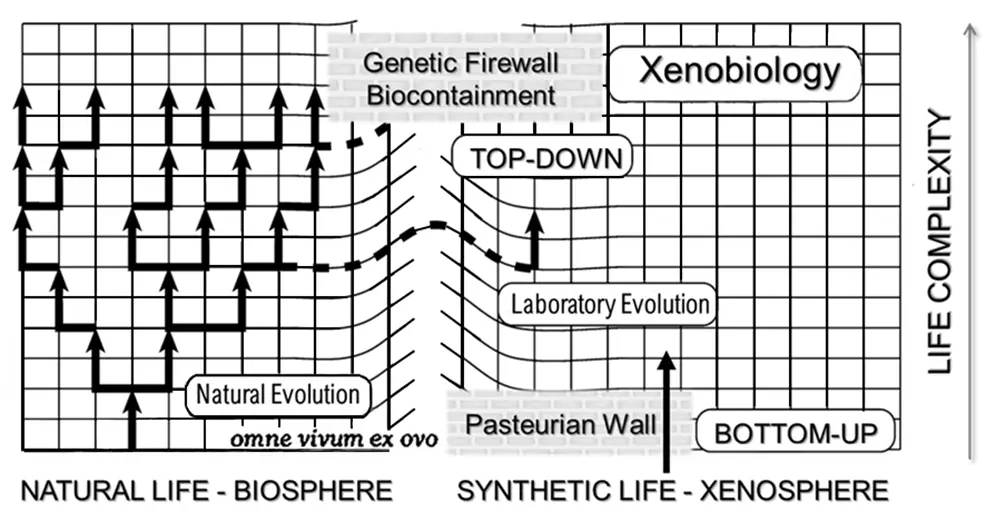
Figure 1. The dual challenges of life synthesis: breaching the Pasteurian Wall, building the Genetic Firewall. The goal of life synthesis is to establish an engineered Xenosphere—a biologically distinct domain isolated from the natural Biosphere. Two strategies confront this challenge: Bottom-up approaches (e.g., protocell research) must breach the Pasteurian Wall (omne vivum ex ovo) by assembling life from nonliving components. Top-down approaches (e.g., xenobiology) start within the Biosphere but engineer orthogonal chemistry to construct a genetic firewall, ensuring evolutionary containment. The arrows represent an increase in the biological complexity of the populations. True synthesis demands both: engineering a living organization de novo while guaranteeing its isolation from natural life (modified after Diwo & Budisa [40]).
2.1.1. The Pasteurian Wall: Life as an Epistemic Boundary
The consolidation of biology as an experimental science in the nineteenth century did more than unify empirical practices; it established new epistemological limits. By excluding metaphysical explanations and grounding life in physico-chemical processes, biology dismantled vitalism. Friedrich Wöhler’s 1828 synthesis of urea demonstrated that organic molecules could be produced outside living organisms, widely interpreted as dissolving the doctrine of vis vitalis [41]. Yet this achievement did not eliminate the distinction between chemistry and life. Instead, it relocated the problem: life no longer required a vital force, but its organization, autonomy, and reproduction remained beyond synthetic reach.
Louis Pasteur sharpened this boundary by decisively rejecting spontaneous generation. Life, he argued, arises only from life (omne vivum ex vivo) [42], reinforcing a strict separation between the biological and chemical domains. While this position laid the foundations of microbiology and experimental rigor, it also crystallized a conceptual threshold between molecular complexity and living organization. We refer to this threshold as the Pasteurian Wall [27].
2.1.2. Bottom-Up Life Synthesis: Attempting to Breach the Wall
Bottom-up approaches—such as protocells, minimal cells, artificial metabolism [43]—explicitly aim to overcome the Pasteurian Wall by constructing living systems de novo. Here, life is not modified but attempted from first principles. The challenge is not merely technical assembly, but the emergence of autonomy, self-maintenance, reproduction, and evolvability. The emergence of such an organization may itself occur through staged transitions in chemical networks. Mathematical models of prebiotic reaction systems have shown that collectively catalytic networks can spontaneously give rise to self-replicating systems, without requiring an initially autonomous genetic template. Liu and Sumpter [44] demonstrated that simple chemical reaction systems can undergo sequential transitions in which catalytic interactions generate increasingly complex self-replicating organizations, suggesting that autonomy emerges as a system-level property rather than from isolated molecular components. Any genetic or biochemical isolation from natural life in such systems tends toward intrinsic incompatibility: a successful de novo organism would, by design, be poorly integrated into existing biological networks. In this sense, a Genetic Firewall would arise as a natural consequence of successful bottom-up life synthesis rather than as an added safety feature. The central irony is that while bottom-up approaches offer the greatest conceptual clarity about what breaching the Pasteurian Wall would entail, they remain experimentally remote, struggling to elicit lifelike organization from complex chemistry.
2.1.3. Top-Down Life Engineering: Building the Genetic Firewall
Top-down strategies take the opposite route. Synthetic biology and xenobiology begin with living organisms and progressively reengineer them—rewriting genomes, expanding genetic codes, introducing noncanonical chemistries [45]. These approaches do not breach the Pasteurian Wall; they operate entirely within its established domain. Life is presupposed, not created. Here, the central challenge is not emergence but containment [40].
Because engineered organisms remain evolutionarily connected to the Biosphere [46], any claim of life synthesis must confront the risk of genetic exchange (‘genetic pollution’), ecological interference, and uncontrolled propagation. This requires distinguishing between different levels of containment. Conventional biocontainment strategies, including synthetic auxotrophies, dependency on non-natural nutrients, and kill switches, establish biological or ecological containment by restricting survival or propagation outside permissive environments [47]. However, such approaches do not necessarily prevent genetic exchange with natural organisms.
In contrast, a Genetic Firewall in the strict sense requires semantic containment: the establishment of informational incompatibility between engineered and natural biological systems. This can be achieved through altered genetic codes, codon reassignment, orthogonal translation systems, xenonucleic acids, or other strategies that prevent transferred genetic information from being correctly interpreted across biological domains. If life is to be chemically estranged rather than merely optimized, such semantic isolation is not simply an additional safety mechanism but a constitutive requirement for defining a distinct engineered living system [28].
2.1.4. Overcoming and Building Walls: A Didactic Distinction
Distinguishing the Pasteurian Wall from the Genetic Firewall clarifies several persistent conceptual errors. Two theses follow directly: (i) Bottom-up life synthesis as pursued in protocell and in vitro self-assembly research [48] must overcome the Pasteurian Wall; genetic isolation is an implicit outcome of success. (ii) Top-down life engineering, the important domain of synthetic biology and xenobiology [49], must deliberately construct Genetic Firewalls, as the Pasteurian Wall remains intact and evolutionary reintegration with the Biosphere remains a central risk (Figure 1). Confusing these barriers leads to inflated claims—declaring “life created” [50] when genomes are merely rearranged or cloned or when engineered biocontainment is mistaken for novelty [51]. Genuine life synthesis, if achievable, will require both a controlled breach of the chemical-biological boundary and the deliberate construction of evolutionary isolation.
2.1.5. Xenobiology as a Transitional Science
Xenobiology occupies a distinctive position between paradigms. It does not create life from scratch but systematically probes how far life can be chemically estranged while remaining viable. In doing so, it tests the limits of the Pasteurian framework while necessitating Genetic Firewalls for containment [19]. Xenobiology thus operationalizes the transition from the natural Biosphere [46] toward a prospective Xenosphere of chemically estranged systems (Figure 1). The central question becomes: how far can a system deviate from canonical biochemistry while preserving core life functions? This “degree of chemical estrangement” [28] can be assessed through the use of noncanonical building blocks [52], altered genetic codes [53], de novo metabolic pathways [54], alternative energy sources [55], novel signal transductions [56], modified boundary conditions, including phase-separated compartments [57], and novel foldamers [58]. Estrangement, in this framework, is not a disqualification from being “alive”; it is a dimension for evaluation [59].
This evaluation must pair with a second dimension: dependence on human agency. A system high in function but low in autonomy—requiring constant intervention—remains a sophisticated artifact [51]. A system achieving high autonomy within its estranged framework moves closer to being a candidate living system [60]. As a provocative heuristic: Life begins where external engineering ends.
Importantly, autonomy does not imply independence from the environment. All living systems exist through ecological dependencies, including nutrient exchange, symbiosis, and planetary-scale biochemical cycles. The relevant distinction is therefore not dependency versus independence, but whether the conditions required for persistence are generated within a self-maintaining organizational network or require continuous external engineering intervention. A xenobiological organism dependent on noncanonical building blocks would therefore approach autonomous life only if such components become part of a sustainable biochemical cycle rather than permanently supplied through technological maintenance.
This is grounded in the observation that life is remarkably self-sustaining [61]—a requisite feature of any persistent living organization [62]. An alternative lifeform meeting Expanded Chemoton criteria (Section 3.4) should exhibit similar capacity for spontaneous propagation [63]. Successful engineering would establish initial conditions—the integrated coupling of metabolism, boundary, and information [64]—allowing autonomous propagation “like an avalanche”. The goal is not perpetual stewardship but the design of a seed capable of sustaining its chemically alien lineage within an isolated Xenosphere. Such autonomy, however, creates a corresponding biosafety challenge: a synthetic life form capable of maintaining its own biochemical regime would also acquire the capacity for persistence, adaptation, and potential ecological interaction, making Genetic Firewalls and evolutionary isolation central design requirements.
This transition serves as a didactic probe: revealing what must change to breach the Pasteurian Wall and what must be isolated to prevent uncontrolled evolution. Current synthetic biology often produces systems high in function but low in autonomy [65], highlighting the gap between bioengineering and alternative life synthesis [45]. By mapping creations along axes of chemical estrangement [66] and autonomy, xenobiology defines conditions for an evolutionarily isolated Xenosphere distinct from the natural Biosphere (Figure 1). Consistent with this view, recent biosecurity analyses increasingly recognize xenobiology as a distinct biological engineering paradigm characterized by engineered genetic isolation, orthogonal biochemistry, and evolutionary containment rather than simply as an extension of conventional genetic engineering [67]. In this sense, xenobiology exposes the limits of current life definitions and clarifies when “life synthesis” might transition from metaphor into empirical reality.
2.2. A Selective Genealogy of Life Synthesis Claims in the Twentieth Century
2.2.1. The Birth of the “Chemical Creation” Narrative
Claims of “life synthesis” have emerged repeatedly over the past century [68], following a stable rhetorical pattern: technical advances are presented as solutions to the problem of life itself, even when they operate entirely within already-living systems. The history of synthetic life is therefore less a record of ontological breakthroughs than a genealogy of escalating claims.
At the turn of the twentieth century, Jacques Loeb demonstrated that sea urchin eggs could be induced to develop parthenogenetically through chemical intervention [69]. Though Loeb emphasized he was activating existing life, public discourse celebrated the work as “chemical creation”. Shortly thereafter, John Butler Burke reported life-like “radiobes” emerging from radium-treated broth [70]. Though quickly discredited, the episode cemented a durable template: ambiguous phenomena met with scientific qualification yet amplified into declarations of artificial life. This template remains operational today in origins-of-life research, where the synthesis of individual biomolecules or pathways—such as RNA replication—is frequently presented as a decisive ‘chemical big bang’ [71], despite operating far from autonomous living systems [72,73].
2.2.2. Morphology Without Organization: The Leduc Lineage
This pattern was reinforced by attempts to mimic life’s forms. Stéphane Leduc produced osmotic growths resembling cell division, arguing life could be reduced to physical forces alone [74]—a view aligned with D’Arcy Thompson’s On Growth and Form [75]. In Leduc’s work, morphological resemblance repeatedly stood in for biological organization [76]—a visual logic persisting in protocell research, where self-organization is often conflated with minimal life [77].
This tradition has diversified. Alongside experimental programs aimed at constructing synthetic cells and exploring cellular organization, physical constraints, and emergent functions, some contemporary approaches seek to identify the general organizational principles underlying living systems. Work on inorganic chemical gardens, chemobrionics [78], assembly theory [79], and self-replicating protocells [80] seeks to demonstrate the emergence of selection and complexity from abiotic reactions. Whether framing life as an inevitable thermodynamic outcome or quantifying molecular complexity [81], these approaches share a reductionist ambition: to show that life-like order arises as an emergent consequence of physical chemistry given appropriate conditions [82].
2.2.3. Structure as Surrogate: Rebuilding Life’s Architecture
A parallel strategy shifted focus to reconstructing life’s canonical structures. In the 1970s, James Danielli’s membrane models grounded cellular boundaries in physical chemistry [83], yet he explicitly advocated for a ‘synthetic biology’ aimed at the rational engineering—the ‘synthesis of life’ itself [84]. Ironically, while his models reinforced the assumption that assembling correct structures might recreate life [85], his programmatic call [86] contained the ontological ambition later researchers would amplify without acknowledgment.
This structuralist legacy finds modern expression in efforts to construct life from non-living parts via programmed self-assembly. Work on reconstituting protein oscillators (e.g., Min systems) and division machinery on synthetic membranes demonstrates exquisite control over biological form-generation [87]. However, popular presentations often conflate achieving self-organization within a boundary with progress toward synthesizing life itself [88]—mistaking one pillar of living systems (Form) for the entire Expanded Chemoton architecture (Section 4.3).
This approach exists in tension with—and is often conflated with—an informational-mechanistic tradition. Since Stent identified a schism between ‘structurists’ and ‘informationists’ [89], synthetic biology has inherited both legacies. The structurist school assumes function emerges from spatial organization [90]; the informationist school treats the cell as a Turing-like machine executing a genetic program, reducing life to an algorithm [91]. Both share a reductionist impulse: the former reduces life to structure, the latter to code. Xenobiology, as we shall argue, challenges both by rewriting the grammatical and material conditions of biological possibility.
2.2.4. Chemical Mastery Without Ontology: Emil Fischer’s Discipline
A more consequential and more disciplined reduction came from chemistry itself. Emil Fischer’s synthesis of sugars, purines, and peptides established that molecules central to life could be designed and built synthetically [92]. His lock-and-key model articulated a precise logic of molecular recognition decades before informational metaphors entered biology [93]. Fischer was fully aware of the transformative power this conferred. As early as 1890, he predicted that chemical control over organisms would enable changes in form and function that would surpass anything achieved by breeding and crossing [94].
By 1907, he had explicitly framed this vision as ‘Chemical Synthetic Biology’ [95]—a program to redesign life’s building blocks and metabolism through synthetic chemistry, foreseeing the creation of novel organisms with ‘fundamental advantages’ over natural forms. This engineered, interventionist ethos was shared by contemporaries such as Jacques Loeb [96], who argued that the artificial production of living beings was not only conceivable but a necessary goal of experimental biology. Together, they laid the epistemological groundwork for a biology aimed not merely at understanding life, but at rewriting its chemical logic [97]. Fischer’s “Chemical Synthetic Biology” aimed to redesign living systems using chemistry, rather than to build life from non-living parts [98]. He sought to influence existing life, not create it from scratch. This clarifies a boundary that later fields often blur rhetorically by conflating assembly with true synthesis [99].
2.2.5. From Chemical Contingency to Ontological Slippage
This boundary is now being tested by chemical biologists who are redesigning life’s informational substrates [100]. Through unnatural nucleobases and alternative backbones, their work establishes that life’s core molecular systems are chemically contingent [101]. Semi-synthetic organisms show that synthetic components can function within natural systems [102], and genetic code expansion demonstrates that protein function can be altered beyond its canonical alphabet [103], challenging the notion that life’s molecular inventory is uniquely optimal.
However, ‘orthogonal’ translation exploits the plasticity of the canonical apparatus [104] rather than establishing autonomous decoding. Suppressor tRNAs [105], engineered synthetases [106], and modified ribosomes [107] introduce context-dependent—often reversible—deviations within pre-existing translational constraints [17], sophisticated contextual recoding, not a truly independent genetic code [8]. This distinction is measurable using parameters such as codon-reading accuracy [108]. The decisive question remains: Can the ribosome be redesigned to actively decode noncanonical amino acids [109], rather than merely accommodate them through errors? This reveals whether xenobiology genuinely rewrites operational logic. Plasticity reveals adaptability; autonomy would require self-sustaining decoding independent of canonical grammar [110]. Autonomous decoding would constitute new organizational closure—a system evolving under synthetically defined rules.
Despite conceptual significance, persistent barriers remain. Unnatural base pairs are often edited out during replication [101]. Fully orthogonal genetics requires at least two stable systems—a hurdle still unmet, reflecting bias rooted in the Watson–Crick paradigm. Researchers can alter life’s chemical parts, but their work remains dependent on evolved systems. The claim of “creating life” reflects narrative ambition, not technical breakthrough.
2.2.6. Displacing the Hard Question: From Assembly to Panspermia
Origins-of-life research nonetheless revived the building-block logic. The Alexander Oparin–J. B. S. Haldane hypothesis [111] framed life as a gradual chemical evolution, a vision operationalized by Stanley Miller’s synthesis of amino acids from simple gases [112]. While scientifically significant, these results were widely portrayed as steps toward life’s creation, despite leaving organization, heredity, and autonomy untouched.
This assembly-line vision defines the most prominent contemporary origins-of-life program: the construction of a protocell. Researchers like Szostak [113] and Deamer [81] aim to integrate self-assembling membranes (lipids), genetic replication (RNA), and metabolism into a minimal evolving system—a physical instantiation of the Oparin-Haldane pathway [114]. Yet even this feat remains within the building-block paradigm: an exquisite assembly of life’s known parts, not a demonstration of how organization emerges from inanimate matter. In the best case, this positions protocells as assembly rather than emergence.
2.2.7. From Origins to Control: Domestication Rebranded as Creation
From the 1970s onward, attention shifted decisively from origins to manipulation. Recombinant DNA technologies enabled unprecedented genetic control, prompting the Asilomar Conference, which explicitly acknowledged that scientists were not creating life but acquiring new powers to modify it [115]. This was not a conceptual rupture, but an intensification of ancient domestication practices [116]. Plant and animal breeders had empirically reshaped living systems for millennia. What changed was not the nature of intervention, but its epistemic and technical basis: deeper mechanistic understanding, molecular tools, and evolutionary theory. Life remained presupposed throughout; only the resolution and scope of its modification increased. Ethical concern centered on containment, not ontology—a clarity later rhetoric would erode. Philosophical reflection at the time, exemplified by Jacques Monod’s Chance and Necessity [117], reinforced molecular determinism while leaving the problem of biological organization largely implicit.
2.2.8. The Return of Ontology by Rhetoric: Venter and the Genome Fallacy
The contrast between Fischer’s restraint and contemporary rhetoric becomes stark in the twenty-first century. When Venter’s group announced the synthesis and transplantation of a bacterial genome [118], the achievement was widely framed as the creation of life (Figure 2). Experimentally, however, the work depended entirely on pre-existing cellular machinery and intact metabolic networks—remaining on Fischer’s side of the boundary: chemical synthesis without generating living organization.
What distinguishes the episode is its rhetorical framing, articulated in Venter’s Life at the Speed of Light [119]. There, genome synthesis—the oligonucleotide-based [120] assembly of complete genomes followed by their transplantation into an enucleated host cell [121]—is presented as the realistic basis for creating artificial life, culminating in the notion of “digital life”. DNA becomes software, cells hardware, and life reducible to information that can be digitized and reconstituted. This framing implicitly revives the verum-factum principle, echoing Feynman’s “what I cannot create, I do not understand”, equating construction with comprehension.
Yet this equation is epistemologically fragile. As Venter acknowledges, a synthesized genome functions only within an already living cellular context. The experiment demonstrates technical mastery, not explanatory closure. Nonetheless, the rhetoric of “booting up” a cell [119] reintroduces ontological claims Fischer avoided. This shift is reinforced by the digital metaphor throughout Life at the Speed of Light [119]. By portraying genomes as executable code, biological organization is flattened into information processing, reviving genetic determinism justified by engineering success rather than theory.
Venter’s contribution thus exemplifies the return of ontology by rhetoric. The Pasteurian Wall is not experimentally crossed but linguistically dissolved [27]. The language of digital life and teleportation fills the conceptual gap left by the absence of a clear definition of life. The achievement remains technically impressive—but its elevation into life creation reflects not new biological insight, but the enduring power of construction metaphors to substitute for conceptual clarity.
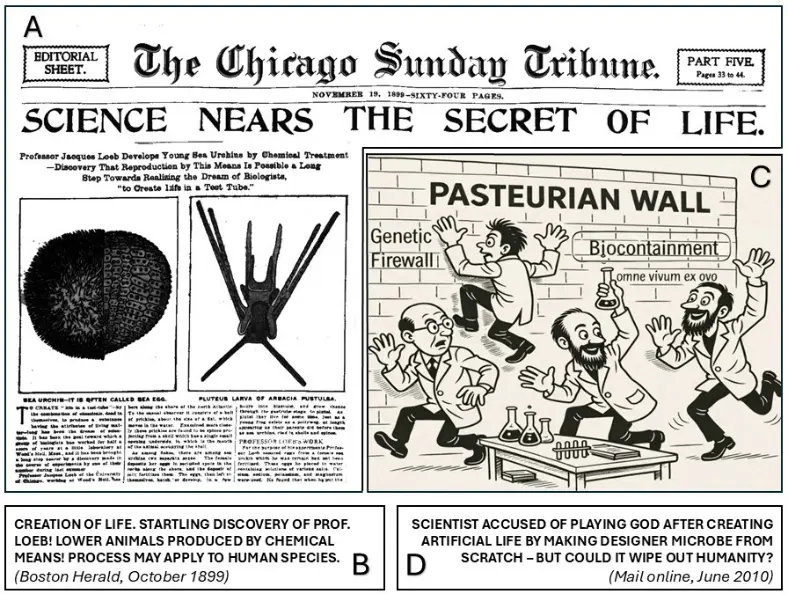
Figure 2. Recurring narratives of “life creation” from early experimental biology to modern synthetic biology. (A) Historical newspaper coverage of Jacques Loeb’s artificial parthenogenesis experiments in sea urchins (1899), presented in the popular press as approaching the “secret of life”, although the experiments chemically activated pre-existing living systems rather than generating life de novo [68,69]. (B) Contemporary headline framing of Loeb’s work as the “creation of life”, illustrating the early emergence of a recurring pattern in which biological intervention was interpreted as synthetic creation. (C) Conceptual illustration of modern synthetic biology at the interface between the Pasteurian Wall and the Genetic Firewall, highlighting the distinction between overcoming the boundary from non-living chemistry to autonomous living organization and engineering containment barriers for modified biological systems. (D) Representative media framing following bacterial genome synthesis and transplantation experiments [122], in which genome reconstruction was frequently described as the creation of “artificial life” or “playing God”. Despite major differences in experimental sophistication between Loeb’s chemical interventions and twenty-first-century genome engineering, both episodes reveal a persistent tendency to interpret technical control over existing living systems as an ontological transition toward the creation of life. This distinction motivates the need for operational criteria separating modification, reconstruction, assembly, and autonomous synthesis. Sources: Panel (A): Chicago Tribune Historical Archive (1849–2012). Panel (C): conceptual illustration generated with ChatGPT AI graphics (OpenAI GPT-5.5). Panels (B,D): historical media quotations as cited.
3. From Historical Claims to Operational Categories
3.1. Repeated Claims and Shifting Meanings of “Life Creation”
Across the twentieth and twenty-first centuries, the same expression—“creating life”—has been used for interventions that differ fundamentally in their level of autonomy. The historical record, therefore, illustrates not a single trajectory, but a persistent conflation of distinct experimental operations. A stable pattern emerges: incremental technical advances are transformed into public spectacles and framed as existential breakthroughs—a recurring pattern in the interaction between laboratory achievement and public interpretation. This pattern is captured in Figure 2. In 1899, headlines heralded Loeb’s chemical induction of sea urchin development as the “Creation of Life”, despite his insistence he was only activating existing organisms. Half a century later, Danielli’s reassembly of an amoeba from parts of three cells was reported as the “first artificial synthesis of a living cell” [123]. In 2010, media worldwide announced Venter’s bacterial genome synthesis [118] as “artificial life”, invoking fears of “playing God” [122]. Notably, recombinant DNA technology—though transformative—was never branded as “life synthesis”, suggesting rhetorical escalation does not necessarily correspond to changes in levels of biological autonomy.
A recurring narrative pattern can be observed: a modest technical step is elevated into a claim about life’s origin, while two foundational distinctions remain absent from public discourse. First, the Pasteurian Wall—separating modification of existing life from de novo synthesis—is never breached, often described in ways that blur this distinction. Second, the practical necessity of engineered genetic firewalls is overshadowed by symbolic anxiety.
3.2. Modification: Alteration of Living Systems and Its Interpretation
Many activities historically described as “creating life” fall operationally into modification: existing organisms are altered while their autonomous organization and lineage continuity remain intact. Classical genetic engineering and modern genome editing, including CRISPR-based interventions, exemplify this level. These approaches transform phenotype and function but do not establish a new origin of biological organization. Because modification can produce profound functional change without generating a new autonomous organization, it is frequently interpreted as “creation”. Standard criteria—metabolism, reproduction, evolution—fail at the margins, undermining certainty. Meanwhile, “creation” remains entangled with theological imaginaries. Research blurs these distinctions; public discourse treats them as absolute. Incentive systems in science communication can structurally reinforce this ambiguity. Works like Regenesis [124], present life as something to be rebooted—collapsing creation, repair, and redesign into a single continuum. This sustains both ambition and spectacle by leaving “life” perpetually undefined.
Ambiguity becomes a resource. Interpretations may vary across scientific and media contexts [125]; synthetic biology gains symbolic distinction from earlier genetic engineering. The spectacle is co-constructed through journal practices and incentive structures rewarding rhetorical novelty. The result is a feedback loop: claims of life creation attract attention; attention rewards symbolic framing; framing perpetuates vagueness [126]. Ethical debate may center on symbolic meanings of “creation” alongside concrete questions of risk and containment. Public concern gravitates toward existential threat while tractable issues of containment are overshadowed [127].
This loop has operated for over a century. Technologies evolve; metaphors persist. Creation language proves irresistible because it channels anxieties far beyond the laboratory. Its persistence reflects the absence of agreed operational criteria.
3.3. Reconstruction: Rebuilding Biological Systems and What It Demonstrates
The Venter announcement was rhetorically anchored to Richard Feynman’s dictum: “What I cannot create, I do not understand” [128]. This appeal to the verum-factum principle [129]—that true knowledge follows from construction—reveals a foundational epistemological assumption: that building life is equivalent to understanding it. Sociologically, this claim is powerful. From a theoretical perspective, the inference is debatable. Venter’s work [118] demonstrated technical mastery of genome assembly yet yielded little new theoretical insight into cellular organization. These studies reconstructed viable organisms but did not establish independent origins of biological organization. The suggestion that it proved cells are “entirely controlled by their genomes” echoed forms of genetic determinism that have long been challenged by epigenetics and systems biology.
This tension manifests in recurring fallacies. First, the illusion of confirmation: successful synthesis is mistaken for validation of underlying theories [130]. Second, the modularity fallacy: treating biological systems as computer-like assemblies [131] of interchangeable parts [132] neglects context dependence and emergent behavior [133]. Third, the knowledge paradox [134]: the more radically a system is engineered, the less existing knowledge may apply [135]. Furthermore, the spectacle obscures a problem of proportionality [136]. Synthetic chemistry aligned novel capabilities with clear needs. Claims of life creation are sometimes presented as broadly transformative without demonstrating superiority over simpler approaches. Reconstructing life at a greater cost is not inherently more useful. Clarifying these distinctions [98] requires explicit conceptual and operational demarcation. Without such criteria, the term “life synthesis” risks remaining rhetorically expansive while experimentally indeterminate.
3.4. From Historical Ambiguity to Operational Demarcation
The recurring difficulty illustrated by these cases is not only conceptual but operational. In contemporary synthetic biology, classification determines regulatory status, containment strategies, and interpretability of experimental outcomes. Therefore, definitions of life function not merely as descriptions but as decision criteria governing safety and engineering practice. Recent interdisciplinary discussions in synthetic biology have emphasized that definitions of life play regulatory and governance roles in addition to descriptive ones [13]. Our framework builds on this insight but focuses specifically on experimentally decidable criteria for laboratory construction. The historical debate over “creating life” therefore reflects terminological compression rather than scientific disagreement. Distinct experimental activities—modification, reconstruction, assembly, and autonomous organization—were described using identical language. The following section introduces operational criteria designed to discriminate these categories experimentally.
4. The Problem of Defining Life and a Proposal for Operational Understanding
The following section translates the previously discussed conceptual distinctions into experimentally testable parameters. Its purpose is not to introduce new theoretical claims, but to translate the previously discussed conceptual distinctions into experimentally testable parameters. The Pasteurian Wall corresponds to achieving autonomous organization (Expanded Chemoton criteria), whereas the Genetic Firewall corresponds to maintaining evolutionary isolation once autonomy is achieved. In this context, historical and sociological analyses are facing an unresolved conceptual core of the problem: the absence of an operational definition of life adequate for contemporary synthetic and xenobiological practice. Rather than seeking an essential or metaphysical definition [19], this section asks a pragmatic question: How far can life be chemically estranged while remaining meaningfully alive? In particular, it examines whether systems produced through genetic code ‘expansion’, alternative monomers, or synthetic metabolism should be regarded as sophisticated biochemical artifacts or as early instantiations of genuinely alternative living systems.
The central claim is that progress in these fields now depends less on new technical capabilities than on empirically grounded conceptual parameters. Much of what is described as “life creation” relies on metaphorical language from theology, literature, and information theory—rhetorically potent but experimentally uninformative [137]. We instead propose a definition based on measurable properties: operational closure, metabolic autonomy, heritable chemical constraints, and system-level robustness. This situates engineered systems along a functional continuum rather than an ill-defined binary threshold. Claims that life requires no definition (e.g., [138]) may suffice when assuming a single evolutionary and chemical trajectory, but become inadequate once multiple non-homologous biological grammars are engineered or compared [8].
This approach does not attempt to define life in an absolute sense but clarifies what researchers modify, measure, and stabilize when engineering biological systems. By parameterizing degrees of chemical and informational divergence from canonical biology, the framework enables comparison across synthetic constructs without inflating technical achievements into ontological claims. Without shared conceptual and terminological ground, synthetic biology and xenobiology risk remaining pre-paradigmatic: technically powerful yet conceptually unstable. A disciplined operational understanding of life is therefore not a philosophical luxury but a practical necessity for the maturation, governance, and self-description of these fields.
4.1. Literature Overview on the Problem of Defining Life
The problem of defining life has accompanied biology since its inception, yet it has acquired renewed urgency in the contexts of origins-of-life research, synthetic biology, and xenobiology. Despite decades of debate, no consensus definition of life has emerged that is simultaneously operational, general, and adequate for both natural and engineered systems, and synthetic achievements have not resolved this conceptual plurality [139]. The literature reveals instead a plurality of partially overlapping frameworks, each capturing important aspects of life while failing to account for others. Broadly, these approaches fall into two dominant traditions: population-level, evolutionary definitions [140] and organizational, autonomy-based definitions rooted in minimal-cell and Chemoton theories [141], as well as alternatives [142].
The definition advanced here is not intended as a universal account of life but arises from a specific experimental context: constructing, modifying, and evaluating biological systems in the laboratory. Whereas explanatory biology emphasizes historical reconstruction and descriptive adequacy, engineering-oriented biology requires experimental discriminability—the ability to determine whether a system has achieved autonomous organization or remains an artifact (Table 1). Accordingly, the framework privileges measurable closure, persistence, and heritable functionality over descriptive completeness. Other approaches—evolutionary, computational, or complexity-based—address different explanatory aims and remain valid within their domains; the present proposal serves as an operational taxonomy for intervention-based sciences.
Because synthetic biology proceeds through deliberate intervention, its criteria must allow experimental rejection. A proposed living system must be capable of failing defined tests of autonomy and persistence; otherwise, the distinction between artifact and organism becomes interpretive rather than empirical. In this sense, the framework follows a Popperian logic of falsifiability [143] by specifying conditions under which claims of life creation can be disproven.
4.1.1. Evolutionary Criteria and Population-Level Definitions
One influential line of thought derives from evolutionary theory, treating life primarily as a population-level process. A widely cited formulation—often called NASA’s working definition—characterizes life as a “self-sustaining chemical system capable of undergoing Darwinian evolution” [144]. Although influential, this formulation has been debated and refined, particularly in discussions of alternative biochemistries and synthetic life [145,146]. This definition has been defended as theoretically mature for linking life directly to reproduction, variation, and selection [147]. However, it has also provoked sustained criticism. A central objection, sometimes termed the “mule problem”, argues that strictly evolutionary definitions exclude infertile yet obviously living organisms [139].
In response, several authors have shown that this critique rests on a category error: reproduction and evolution are properties of populations, not individual organisms [139,148]. From this perspective, infertile individuals remain embedded within evolving populations and therefore do not undermine population-level definitions. This reasoning has been further refined by work emphasizing that life is best understood as a historically extended, population-based process rather than a set of individual attributes [140]. Classical evolutionary syntheses have framed life as a continuous progression from chemistry to mind, with meaning emerging gradually from molecular organization [149].
Closely related evolutionary definitions have been elaborated to include thermodynamic [150] and informational dimensions [151]. Extensions of the NASA definition propose that life must be understood as a far-from-equilibrium chemical system that maintains itself through continuous energy and matter flux [7] while processing environmental information [152] with exotic chemical alternatives [153,154]. Importantly, some authors argue that early life may have evolved through autocatalytic or metabolic networks before the emergence of genetic heredity, suggesting Darwinian evolution is a late achievement rather than an initial condition [155]. These generalized definitions deliberately avoid committing to a specific evolutionary mechanism—Darwinian or Lamarckian [156]—and aim to remain applicable to both natural and synthetic life forms.
4.1.2. Organizational and Autonomy-Based Definitions: Minimal Cells and Chemotons
A second major tradition defines life from the perspective of organization and autonomy rather than population-level evolution. In this framework, life is characterized by a self-maintaining, self-producing organization that regulates internal processes while remaining open to matter and energy exchange with its environment [157]. The Chemoton model [63] and related minimal-cell theories exemplify this approach, identifying a triadic coupling between metabolism, informational control, and boundary maintenance as the minimal organizational substrate of life. Proponents argue that life cannot be reduced to genetic replication alone; autonomy and organizational closure are indispensable [158].
This organizational view implies a fundamental shift in how living systems are conceptualized. Rather than resembling solid-state automata [159], which are geometrically constrained, cells operate as fluid-state automata [63]—dynamic, chemically driven systems whose unity arises from continuous reaction cycles rather than static architecture. In such systems, informational polymers serve not only as templates for heredity but also as semiotic signs within a self-referential network, enabling both stability and interpretative flexibility [160].
Several influential formulations have attempted to integrate these organizational criteria with evolutionary openness. Definitions emphasizing both autonomy and open-ended evolution [161] propose that life requires not only self-maintenance but also the capacity to generate unbounded novelty over time. From this perspective, individual systems must be sufficiently autonomous to persist, while populations must remain evolvable to avoid stagnation. This synthesis seeks to bridge minimal-life research and evolutionary biology [162], but it raises difficult questions about the precise threshold between complex chemistry and genuine life—a threshold that models like the Chemoton help to articulate, even if they do not fully resolve.
4.1.3. The Autonomy–Evolution Tension: Must Life Evolve to Be Alive?
The widely used NASA working definition describes life as “a self-sustaining chemical system capable of Darwinian evolution” [144], thereby treating Darwinian evolution as indispensable, whereas organizational models such as the Chemoton regard self-maintenance and autonomy as the foundational requirements of living systems [63]. As Cornish-Bowden and Cárdenas [163] note, “staying alive was the problem that needed to be solved first: early organisms could not begin to reproduce or evolve until they had learned how to stay alive”.
This tension reflects a deeper epistemological schism [161]. Evolutionary biology is largely a historical science, reconstructing past events from fragmentary traces. In contrast, origins-of-life research seeks physico-chemical principles that must have operated irrespective of contingent history. Extant life reveals a surprisingly standardized biochemistry [164]—a common set of macromolecules, metabolic pathways, and informational polymers—suggesting that life’s emergence was channeled by chemical constraints, not unlimited possibility.
Much contemporary work labeled “artificial life” or “synthetic cells” [165] focuses on heredity, mutation, and differential reproduction—what might more accurately be termed artificial evolution. Such efforts, however, presuppose the prior existence of autonomously organized systems. They manipulate already-living entities rather than grappling with the primordial transition from chemistry to biology [166]—the point at which self-sustaining reaction networks achieved organizational closure.
Thus, while Darwinian evolution is undeniably central to life as we know it, its status as a definitional criterion remains contested. To equate life with evolution risks conflating a downstream historical phenomenon with the upstream organizational achievement that made history possible in the first place.
Attempts to define life have often been criticized because no universal agreement exists regarding necessary and sufficient criteria. However, this limitation does not make definitions scientifically irrelevant. Bich and Green [167] argued that definitions of life can function as operational tools rather than strict ontological demarcations, providing experimentally useful frameworks that guide research in synthetic biology, origins-of-life studies, artificial life, and astrobiology. In this sense, operational definitions should be evaluated by their ability to structure investigation and clarify experimental goals rather than by their capacity to establish a final boundary between life and non-life. The autonomy–evolution debate [168] reflects a recurring pattern in attempts to define life: the elevation of one biological dimension into a sufficient criterion, often at the expense of others. In response, many theorists have pursued more integrative frameworks—cybernetic, informational, or systems-theoretic—that aim to capture life’s multi-level complexity without reducing it to a single property [169]. Yet these approaches, too, reveal persistent tensions between universal aspiration and operational utility.
Xenobiology has been interpreted as an epistemological program testing the multiple realizability of life through progressive biochemical replacement [170]. From this perspective, life is treated as a functionally realizable organizational pattern rather than a chemically constrained phenomenon. The present framework interprets such interventions as probes of the thermodynamic constraints required for autonomous organization.
These conceptual tensions become particularly evident in experimental practice, where claims of “creating life” often refer to fundamentally different levels of intervention. Some studies modify existing organisms, others reconstruct biological subsystems, and still others assemble life-like chemical systems that remain externally maintained. Only a subset of these approaches aims to establish an autonomous organization de novo. For example, recent work on synthetic life forms named “xenobots” constructed from dissociated Xenopus laevis embryonic cells illustrates this distinction [171]. These systems exhibit novel collective behaviors and morphological plasticity but inherit metabolism, membranes, and viability from pre-existing living cells. They therefore represent reconfiguration of already autonomous biological material without de novo establishment of autonomous organization. Within the present taxonomy, such constructs fall under reconstruction or assembly rather than autonomous synthesis.
Pols et al. [172] represent an advanced case of bottom-up functional reconstruction, in which a chemically defined vesicle system was equipped with sustained ATP production and rudimentary physicochemical homeostasis. This work does not yet represent autonomous life synthesis. However, it illustrates how central operational modules of living systems can be progressively reconstituted through modular assembly, while also highlighting the remaining challenge of integrating these modules into a self-maintaining autonomous system. Similarly, recent progress in synthetic cell engineering has produced chemically defined vesicle systems capable of genome replication, growth, genetically encoded division, and genotype-dependent selection across multiple cycles [173]. While representing a major step toward autonomous organization, these systems still depend on externally maintained experimental conditions and therefore do not yet constitute fully autonomous living systems.
Thus, the proposed taxonomy classifies systems by the operational autonomy they have achieved rather than by historical origin or the degree of human intervention. Consequently, to operationalize the autonomy–evolution distinction experimentally, interventions may be classified according to whether autonomy is inherited, preserved, externally sustained, or internally generated. The taxonomy that formalizes this distinction is presented in Table 1.
Table 1. Taxonomy of life construction. Classification of experimental interventions according to the level of biological autonomy established, from modification of existing organisms to de novo autonomous organization. The categories follow the Expanded Chemoton criteria (Section 4.3.2).
|
Term |
Taxonomic Meaning (Operational Framework) |
|---|---|
|
Modification |
Targeted alteration of an existing organism without generating new autonomous organization; lineage continuity is preserved (e.g., CRISPR editing, genetic code expansion). |
|
Reconstruction |
Rebuilding or replacing major biological subsystems while cellular autonomy remains inherited from a pre-existing living cell (e.g., genome transplantation, synthetic minimal genomes, or large-scale genome recoding). |
|
Assembly |
Stepwise construction or reconfiguration of life-like systems from synthetic, purified, or living components * whose persistence depends on external maintenance rather than intrinsic organizational closure (e.g., protocells, cell-free transcription–translation systems, microfluidic synthetic cells, xenobots). |
|
Autonomous Organization |
De novo establishment of a self-maintaining biological organization independent of prior living lineage, capable of regenerating its boundary, sustaining endogenous metabolism, and propagating heritable variation (Expanded Chemoton) (e.g., xenobiological cells ** with genetic firewall, Chemoton-like systems). |
* The chemically defined synthetic cell reported by Gaut et al. [173] represents an advanced bottom-up assembly approaching autonomous organization. It integrates several life-like operational modules, including genome replication, growth, division, and selection, but the transition from externally supported biochemical functionality to self-maintaining autonomous organization remains an unresolved boundary. ** In xenobiological systems employing deep chemical estrangement and genetic firewalls, evolutionary exchange with natural biology becomes increasingly restricted and potentially inaccessible. Although historically derived from living cells, such systems may achieve operational autonomy by establishing an isolated biochemical regime capable of sustaining its own evolutionary trajectory.
4.1.4. Persistence of the Definition Problem: From Universal Definitions to Operational Criteria
Other approaches emphasize cybernetic, informational, or systems-theoretic perspectives, framing life in terms of control, regulation, feedback, and information processing—sometimes explicitly treating living systems as natural computers [174]. While such formulations capture important aspects of biological organization, critics have noted that they risk metaphorical overreach, substituting descriptive analogies for experimentally grounded criteria [175,176]. Related critiques question whether a single, universal definition of life is even meaningful, arguing instead for operational definitions tailored to specific research contexts such as astrobiology, artificial life, or synthetic biology [177,178].
Across this diverse literature, several points of convergence nevertheless emerge. First, there is broad agreement that life cannot be reduced to a single molecule, process, or structure [18]. Second, individual-centric definitions are increasingly recognized as inadequate, particularly in light of evolutionary and ecological considerations that locate life at the level of populations rather than isolated organisms [179]. Third, definitions that rely exclusively on either evolution or organization fail to capture the full phenomenon of life: evolutionary accounts struggle to specify minimal organizational requirements [162], while organizational definitions clarify those requirements but often underdetermine evolutionary openness and long-term persistence [61]. Finally, many authors converge on the view that definitions of life should be operational—capable of enabling empirical discrimination between living and non-living systems rather than serving as purely philosophical statements [180].
Despite these advances, the field remains fragmented. Population-level definitions successfully capture evolution but struggle to specify minimal organizational constraints, while organizational definitions articulate those constraints yet often fail to account for evolutionary novelty and persistence. This unresolved tension becomes critical for synthetic biology and xenobiology, where engineered systems may satisfy only a subset of life’s criteria, blurring the boundary between sophisticated biochemical artifacts and genuinely alternative living systems [77].
In the following sections, we address these perspectives in turn. Section 4.2 develops the population-level conception of life as a historically extended evolutionary process. Section 4.3 introduces an operational definition for engineering practice based on an Expanded Chemoton framework. Together, they aim to replace abstract debates with experimentally grounded criteria capable of distinguishing sophisticated biochemical artifacts from genuinely alternative living systems.
4.2. Life as a Population-Level Process
A persistent obstacle to defining life is a category error deeply embedded in biological intuition: the treatment of life as a property of individual organisms rather than as a process sustained at the population level. From an evolutionary perspective, natural selection does not operate on isolated individuals frozen in time, but on populations of reproducing entities extended across generations [162]. Accordingly, life cannot be adequately defined by the attributes of a single organism alone, but only by the collective dynamics of systems capable of heritable continuity and change.
In this framework, individual organisms are best understood as transient instantiations of life’s processes [181]. Their biological significance arises only insofar as they participate in populations that reproduce, transmit heritable information, and evolve. Figure 3 illustrates this population-centric conception. Vertical gene transfer embeds life in irreversible historical time, while horizontal gene transfer reveals lateral exchange between contemporaneous populations, yielding a network-like evolutionary structure rather than a strictly branching tree [182]. From this perspective, speciation is not the starting point of life but a stabilizing outcome of prolonged population dynamics [183]. Life precedes species; species are contingent organizational states generated by population-level continuity. This reverses a common intuition: rather than life being something species possess, species are transient configurations generated by population-level continuity [184].
Crucially, life does not exist at an instant. It exists only across time, linking an evolutionary past to an open future. Individual organisms appear, persist, and disappear; life continues only if populations maintain themselves through reproduction, heritable variation, and evolutionary change. Evolution, in this sense, does not merely happen to life—it is the process that defines it [179]. Taken together, this yields a minimal but powerful criterion: life is a sustained, heritable, and evolving population of information-bearing systems, coupled by gene flow across time and space. Systems that function autonomously at the individual level but fail to sustain population-level evolution may be biologically sophisticated, yet they fall short of constituting life in the full sense.
However, while population-level evolution is necessary, it is not sufficient as a practical guide for engineering. A population can evolve only if its individual units possess a minimal internal organization enabling self-maintenance, informational stability, and reproduction [180]. The population perspective clarifies where life exists—across time and generations—but not how it is materially instantiated within individual systems. To address this, we turn next to an operational framework suited to engineering practice: life as an expanded Chemoton, where metabolic autonomy, informational closure, and boundary maintenance define the minimal organizational substrate required for population-level evolution to occur [63].
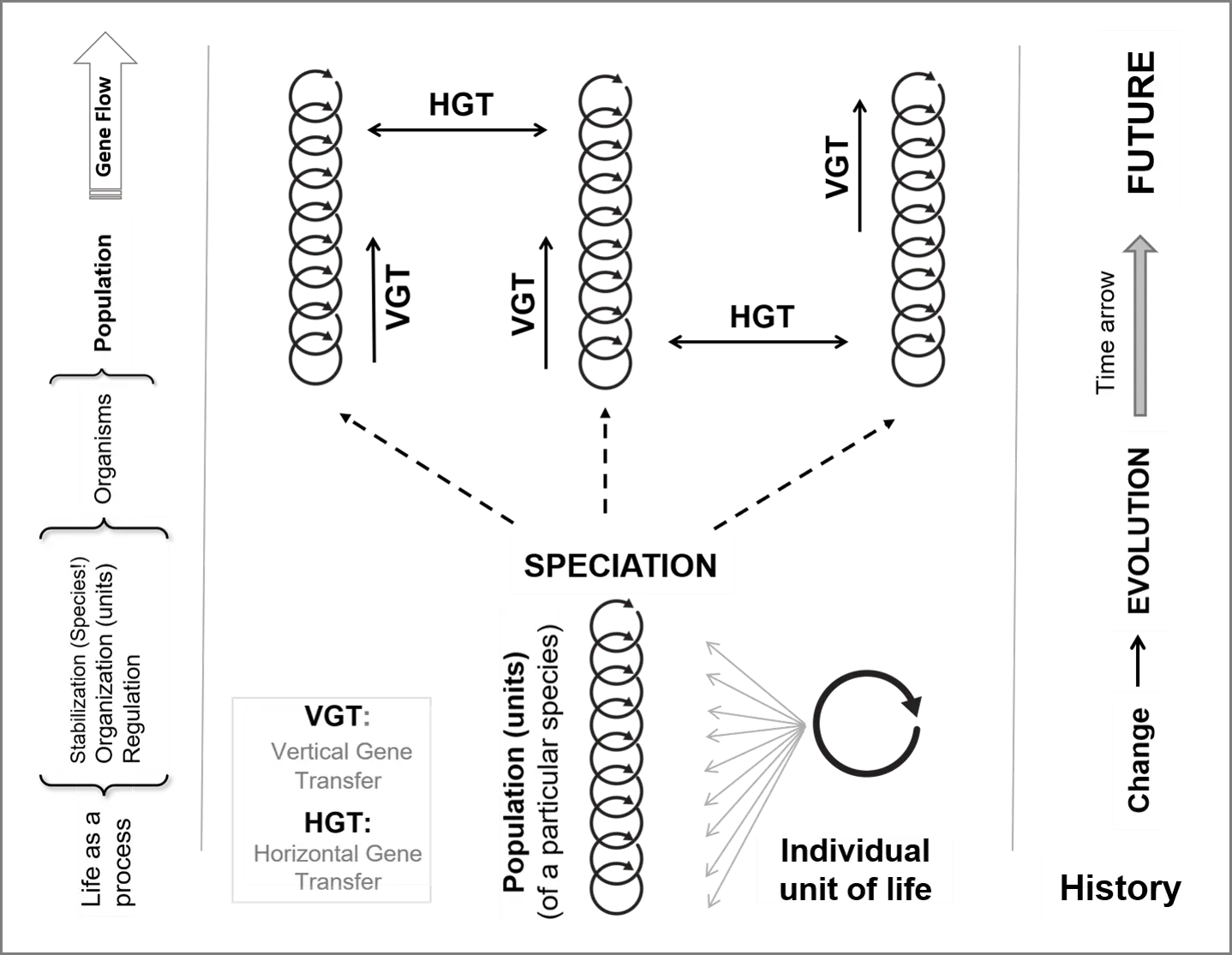
Figure 3. Life as a population-level evolutionary process rather than an individual state. Life is represented as a historically extended process sustained through the continuity of populations over evolutionary time. Gene flow links past, present, and future biological organization: vertical gene transfer (VGT) maintains lineage continuity across generations, whereas horizontal gene transfer (HGT) enables lateral information exchange between coexisting populations. The ability of HGT to integrate genetic information across diverse organisms reflects the shared molecular language of terrestrial life, with the near-universal genetic code functioning as a biochemical lingua franca that enables information exchange throughout the Biosphere [19]. Starting from ancestral populations, evolutionary change and speciation generate divergent lineages that continue to evolve through both vertical inheritance and horizontal genetic interactions. Together, these processes create a network-like continuity of biological information, forming the planetary-scale system that Vernadsky [46] described as the Biosphere: a life-saturated envelope that continuously transforms solar energy and perturbs Earth’s chemical inertia. Individual organisms represent transient units within this ongoing process, whereas populations provide the historical continuity through which adaptation, diversification, and long-term evolution occur. The long-term continuity of life suggests it arose through successive evolutionary transitions, yielding a biospheric system whose dynamics are historically contingent and not fully prestated.
4.3. Definition of Life for Engineers: Life as an Expanded Chemoton
4.3.1. Life as Planetary Chemistry: The Chemical Conservatism of Terrestrial Life
Life on Earth is not a singular event but a planetary-scale chemical transformation—the persistent perturbation of a planet’s surface into a self-maintaining organization that continuously couples matter, energy, and information [31]. In this view, life is a dynamically sustained process, stabilized over geological time. Its historical emergence was non-reproducible; the precise path from geochemistry to biochemistry cannot be replayed. Thus, life’s origin cannot be verified by reenactment, only by identifying general, transferable principles testable through laboratory approximations of minimal life-like organization [185].
Despite its staggering diversity, terrestrial life exhibits a profound chemical conservatism. Tens of millions of species share core metabolic pathways, a nearly universal genetic code, and a limited set of small-molecule intermediates [186]. This four-billion-year continuity suggests life arose through a sequence of chemical transitions that converged into the Biosphere [46]. Life, at its core, is therefore a chemical system, not a genetic abstraction [31]. Its organizational logic is imprinted in the persistent flows and cycles of matter and energy.
In this context, the search for a definition of life has historically been dominated by philosophical debate and lists of observed properties—reproduction, evolution, metabolism, growth. While valuable for description, these approaches fail when confronted with practical engineering challenges: How do we build minimal living systems? How do we measure life in extreme environments or synthetic constructs? How do we regulate entities that blur the conventional boundaries of life?
4.3.2. The Expanded Chemoton: A Process-Based Definition
From an engineering perspective, we need a definition based not on intangible essences but on measurable processes that can be designed, quantified, and standardized. This motivates a process-based framework, formalized here as the Expanded Gánti Chemoton Model [187]. It builds on Gánti’s foundational insight that life’s irreducible core consists of three inseparably coupled subsystems: an autocatalytic metabolic cycle, a hereditary information carrier, and a boundary-forming membrane (Figure 4). From this architecture, Gánti derived a rigorous set of criteria that distinguish between absolute requirements (indispensable for any minimal living unit) and facultative properties (emergent at the population level), as shown in Table 2.
Table 2. Absolute and facultative criteria for life in the Gánti’s Chemoton model.
|
Absolute Criteria (Minimal Living Unit) |
Facultative Criteria (Population Emergence) |
|---|---|
|
Individuality (via boundary) |
Growth, Metamorphosis & Reproduction |
|
Non-Equilibrium Metabolism |
Adaptability & Evolution |
|
Inherent Information Storage |
Robustness & Mortality |
This distinction is crucial: while we recognize life through its facultative properties, these emerge only from systems that first satisfy the absolute criteria through their integrated architecture. Building on Gánti’s theoretical foundation, we define life operationally as the closed and sustained coupling of three core processes within an individuated organizational framework: (i) Non-Equilibrium Self-Sustaining Metabolism, a network of autocatalytic reactions operating far from thermodynamic equilibrium, characterized by continuous energy dissipation and material flux; (ii) Program-Directed Heritability, an information-bearing subsystem enabling reliable replication with finite error rates and creating the potential for open-ended evolution; and (iii) Dynamic Stability Through Turnover which represents continuous component replacement and energy dissipation that maintains the coupled system against decay toward equilibrium. These processes must occur within Boundary-Mediated Individuality, a physicochemical organization that establishes spatial separation, selective exchange with the environment, and maintenance of system identity.
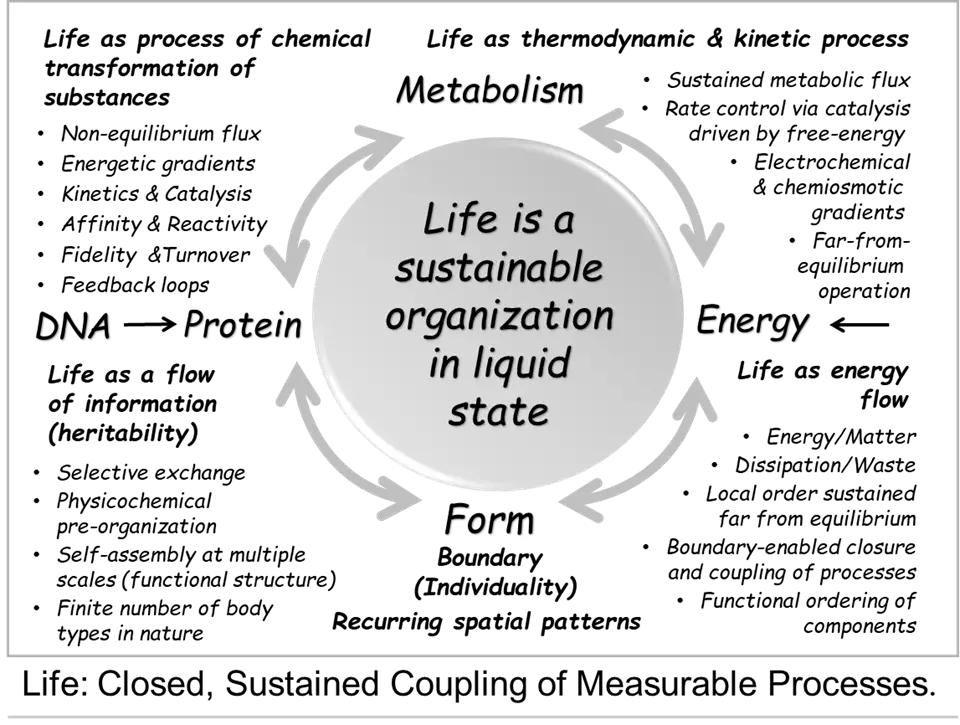
Figure 4. Life as a Chemoton: a closed and sustainable chemical organization in the liquid state. Schematic representation at the system level. In the Expanded Chemoton framework, minimal living systems are defined by the closed coupling of four functional pillars—energy dissipation, metabolism, information processing, and form (compartmental organization)—which together maintain a sustainable organization in the liquid state. While Gánti’s original Chemoton described the logical architecture of such systems, the Expanded Chemoton translates this architecture into operational criteria that allow experimental evaluation of whether a constructed system has achieved minimal living organization. The circular arrows emphasize that life is not a static entity, but a cyclic, far-from-equilibrium process sustained by continuous fluxes of matter and energy. Modified after Budisa, Kubyshkin, and Schmidt (2020).
In this Chemoton-based view, life is defined by the sustained closure of organized chemical cycles under constant turnover, rather than by specific molecular constituents or static structures. Because the definition is grounded in organizational dynamics rather than in particular chemistries, it is, in principle, applicable to any environment that supports matter fluxes, energy gradients, and liquid-state, far-from-equilibrium organization. As originally emphasized by Gánti, the Chemoton model is not Earth-centric but can, in principle, apply to life elsewhere in the universe wherever suitable conditions exist [63]. The experimental consequences of this organizational criterion are formalized in the taxonomy presented in Table 1.
This formulation extends the original Chemoton architecture by explicitly incorporating the energetic and kinetic conditions required to sustain coupling over time. The conceptual motivation for this expansion derives from the “four pillars of life” framework introduced in Budisa, Kubyshkin, and Schmidt (2020) [187], where metabolism, compartmentalization, information, and energy dissipation were identified as jointly indispensable for alternative and parallel life forms. The Expanded Chemoton thus integrates Gánti’s minimal theoretical architecture [63] with an explicitly process-oriented, engineering-compatible perspective.
Importantly, the transition from assembly toward autonomous organization is not simply a matter of increasing the number of components, but of establishing hierarchical dependencies among reusable functional modules. This principle has recently been formalized in the Ladderpath framework of Liu and colleagues [188], which describes complexity generation through sequential construction, reuse, and recombination of previously established structures. Such hierarchical reuse provides a conceptual bridge between component assembly and autonomous organization by explaining how lower-level modules can become functional constraints within higher-order systems.
4.3.3. Operational Decision Procedure
To render the framework experimentally actionable, the Expanded Chemoton architecture can be applied as a sequential decision protocol. A candidate system is first examined for boundary autonomy: the compartment must be regenerated and maintained by internally coupled reactions rather than by external fabrication or repair. Second, the system must sustain a far-from-equilibrium state through endogenous metabolic flux; organization that persists only under continuous external intervention remains an artifact. Third, replication must produce heritable variation that influences system persistence, thereby demonstrating functional integration among the informational, metabolic, and boundary subsystems. Finally, persistence after the withdrawal of control requires that the removal of external interventions (directed assembly, manual replenishment, or programmed steps) does not cause immediate collapse. Instead, the system must continue self-maintained operation within environmental constraints.
Failure at any stage indicates a constructed chemical system that may mimic life-like behaviour without constituting an autonomous living unit. Only systems that satisfy all stages qualify as minimal living organizations under the Expanded Chemoton definition. Table 1 summarizes an operational taxonomy consistent with these criteria.
The Expanded Chemoton framework builds on Tibor Gánti’s classical Chemoton model by integrating it with the four functional pillars of cellular life—energy, metabolism, information, and form [187]. While the original Chemoton described the logical architecture of self-reproducing chemical systems, the expanded formulation (Figure 4) translates this architecture into experimentally assessable criteria suitable for synthetic biology and xenobiology.
Alternative frameworks interpret life as computation [189] or substrate-independent organization [190]. The present definition instead addresses materially instantiated living systems: entities whose persistence depends on thermodynamic self-production and organizational closure in matter. The protocol, therefore, functions as a criterion for autonomous biological organization, without precluding the possibility that other, non-material life-like processes may exist under different theoretical descriptions.
4.3.4. Small Molecules as the Drivers of Organization
The organizational core of living systems is grounded in the dynamic, continuous flux of small-molecule chemistry. Small molecules—chemically durable and evolutionarily conserved—serve as the primary carriers of energy, redox potential, and material transformation [191]. Within an Expanded Chemoton framework, macromolecules (proteins, nucleic acids) are not static foundations. Instead, they are dynamically sustained transient structures whose function is to stabilize, regulate, and kinetically bias the underlying metabolic cycles that continuously regenerate them [192]. Life, in this view, is an organized process in the liquid state, reconstructed from small-molecule chemistry through closed, autocatalytic loops.
Biological organization emerges from the capacity of these molecules to form transient, reversible assemblies. A key driver is amphipathic chemistry, where polar-apolar asymmetry and hydrophilic-hydrophobic interactions spur spontaneous self-organization into membranes and compartments [193]. These structures are not mere add-ons but emergent consequences of non-equilibrium chemistry, providing the essential physical basis for boundary maintenance, selective permeability, and gradient formation—prerequisites for Chemoton-like organizational closure [63].
Taken together, these considerations motivate a minimal, process-based architecture in which metabolic flux, boundary formation, and information are inseparably coupled—formalized in the following section as the Expanded Chemoton model. This organization is ultimately anchored in redox chemistry: the controlled activation of simple substrates like CO2 and H2, the synthesis and splitting of water, and the directed flux of carbon through metabolic networks. Additional elements (N, S, P, metals) are incorporated contingently to stabilize these networks, enable catalysis, and buffer environmental variability [62]. Thus, life’s defining properties—autonomy, persistence, evolvability—arise from the sustained coupling of metabolism, boundary formation, and informational regulation.
4.3.5. Parameterization and the Path to Standards
Each subsystem fulfills an absolute role within Chemoton and admits observable, parameterizable variables. Metabolism sustains non-equilibrium dynamics and can be characterized by reaction fluxes, energy dissipation rates, and distance from thermodynamic equilibrium (ΔG). The boundary subsystem is describable by permeability coefficients, stability constants, and surface-area-to-volume ratios. The stability of the coupled system is measurable through turnover rates, recovery times following perturbation, and persistence of the integrated dynamics. Finally, the information subsystem can be parameterized by replication fidelity, error thresholds, coupling kinetics, and semantic compatibility between genetic codes.
Recent work has begun to formalize such criteria. For example, polarity-based distance metrics between genetic codes (Δcode) provide a quantitative measure of genetic compatibility and thus of the strength of a genetic firewall [194]. This converts a previously qualitative biosafety concept into an experimentally testable parameter, comparable to physicochemical compatibility constraints such as polarity requirement [195], and illustrates how informational isolation can be expressed on a continuous scale rather than as a binary property.
While no complete mathematical theory of life exists, all elements can be measured, perturbed, and modeled. Life is thus defined not by unmeasurable essences but by the closure and sustained coupling of measurable processes. This section specifies architectural principles and parameter classes rather than numerical thresholds. At present, the limitation is not methodological but disciplinary: the field lacks a shared conceptual and terminological framework within which quantitative limits, scaling relations, and failure modes can be meaningfully defined and compared. As with Lavoisier’s systematic abandonment of alchemical speculation [196] in favor of precise measurement and standardized language, progress in this domain will require a collective shift away from metaphor-driven narratives and media inflation toward unambiguous terminology, quantitative rigor, and explicit embedding of biological design within universal physical laws [197].
This framework yields clear absolute criteria for the bottom-up creation of life (overcoming the Pasteurian Wall). A chemically realized system that fulfills the Expanded Chemoton architecture—metabolism, boundary, and information subsystems in sustained mutual coupling (Figure 4)—meets the minimal, non-negotiable conditions for life. However, such a system remains incomplete without Ganti’s facultative criteria, including evolvability, adaptability, and long-term robustness (Table 2). These properties cannot be inferred from structural organization alone and must be demonstrated experimentally.
A standardized route toward such validation is an experimental regime analogous to Adaptive Laboratory Evolution [59], in which precisely defined selection pressures, perturbation protocols, and performance metrics—such as fitness landscapes, robustness to drift, recovery after stress, and capacity for innovation—could be imposed and quantitatively assessed. The same validation logic applies symmetrically to top-down approaches, where deliberate chemical estrangements are introduced at different organizational levels, such as the fixation of a 21st amino acid in protein translation or the integration of a novel metabolic branch or cycle. In these cases, long-term stability, heritability, genetic firewall, and functional integration can be evaluated using serial dilution or continuous-culture schemes in the spirit of Lenski-type experiments [198].
In this way, bottom-up and top-down synthetic life construction converge on a common experimental standard: life is not declared by assembly alone, but by the demonstrable persistence, genetic isolation, evolvability, and functional coherence of an integrated system under sustained evolutionary pressure. What remains is a collective task. Knowledgeable practitioners, observers, and policy makers must explicitly agree on parameter thresholds, acceptable ranges, and design goals. Without such shared calibration of parameters, acceptable ranges, and design goals, operational definitions cannot function as genuine benchmarks for the responsible engineering of life.
4.3.6. Hierarchical Constraint in Living Matter: Implications for Mirror Life and Beyond
Life’s organization is a hierarchy imposed by function, not a random mix of compatible molecules. Different roles demand different chemical solutions: information storage requires polymers with linear encoding and electrostatic stability, favoring polyanionic backbones like nucleic acids. Catalysis and structure need monomers capable of directional interactions and precise folding, as in proteins [17]. Energy storage is similarly partitioned: hydrophilic polymers enable rapid mobilization, while hydrophobic lipids allow dense, long-term storage [199].
Once polymers form, geometry and packing introduce residue propensities: some amino acids are statistically enriched in α-helices (e.g., Ala, Leu), whereas others are more common in β-strands (e.g., Val, Ile), with strong context dependence [200]. Hypothetical models, such as the “Alanine World” [201], explore how emergent structural biases could have shaped the selection of the canonical amino acid repertoire.
This constraint deepens at the level of stereochemistry, which is sometimes oversimplified in proposals for “mirror life” [202]—organisms built from enantiomeric biomolecules [203]. A common assumption is that homochirality can be inverted as a standalone parameter. In practice, chirality is stabilized within a hierarchy of coupled constraints: local stereochemistry shapes helical handedness and packing, which in turn biases compatible interactions across higher-order assemblies (Table 3). Homochirality, therefore, need not arise from a single primordial event; it can emerge and be reinforced through feedback across levels of organization (0D point chirality ↔ 1D helices ↔ 2D/3D assemblies) [204].
This hierarchical coupling entails stereochemical exclusion. D-RNA forms right-handed helices, whereas L-RNA forms mirror-image left-handed helices [205,206]. Mixing enantiomeric building blocks disrupts geometric coherence, thereby impairing helix formation, base pairing, and templated replication in canonical nucleic-acid architectures [207]. The handedness of the helix thus reinforces homochirality at the monomer level, and the constraint propagates bidirectionally across scales. In this way, organismal symmetry becomes the macroscopic expression of atomic-scale stereochemical choice (Table 3). Accordingly, “mirror life” [208] is not a simple inversion but a systems-level re-engineering challenge requiring rigorous analysis of folding, catalysis, and genetics. Simply inverting handedness is unlikely to yield a functional organism without rebuilding the coupled constraint network linking stereochemistry, folding, catalysis, and genetics [209].
Table 3. From chirality to body plan. Hierarchical coupling of symmetry in biological organization: local molecular chirality constrains higher-level structures up to the organismal body plan.
|
Level |
Structural Symmetry Constraint |
Functional Consequence |
Biological Example |
|---|---|---|---|
|
Molecular (0D) |
Point chirality of monomers |
Stereospecific interactions |
L-amino acids, D-sugars |
|
Polymer (1D) |
Helical handedness |
Stable folding & templating |
α-helix proteins, RNA helices |
|
Supramolecular (2D/3D) |
Packing compatibility |
Catalysis & recognition |
Ribosomes, Membranes |
|
Cellular |
Coordinated architecture |
Metabolism & replication |
Cell polarity, Division planes |
|
Organismal |
Body-plan symmetry |
Developmental stability |
Radial organisms, |
The fossil record offers an instructive analogue: after the Cambrian explosion3, innovation proceeded largely within stabilized body plans. Homochirality represents the molecular counterpart of such lock-in—a first constraint amplified through hierarchical organization up to the level of organismal form. For synthetic biology, this suggests a methodological shift. Rather than duplicating Earth’s molecular symmetries in reversed form, a deeper opportunity lies in allowing molecular systems to explore their own stereochemical regimes through environmental selection—for example, in hypothetical sulfur-, silicon-, or ammonia-based life forms [210,211]. The goal is not replication but the stabilization of a new hierarchy in which stereochemistry, architecture, and function co-evolve. Life is a stabilized hierarchy of constraints. Terrestrial biology occupies one regime; synthetic life will succeed as the controlled emergence of another.
4.3.7. Xenobiology’s Core Questions and Strategies: Life as an Engineerable Chemical Frontier
This understanding of hierarchical constraint defines xenobiology’s core challenge: to reconstruct Chemoton-like systems from basic principles and to redirect them toward alternative chemistries while preserving organizational closure [212]. This necessarily reframes the question of life’s original molecular repertoire. Once the constitutive rules of living systems are understood as historically stabilized chemical constraints rather than immutable natural laws, their deliberate revision becomes not a metaphysical transgression but an engineering problem.
A chemically plausible model for early peptides cannot be constructed in isolation from an ancestral RNA world and its cofactors [191]. Peptide synthesis likely originated as a functional ‘accident’, initiated by the electrostatic docking of simple, positively charged polyamides onto RNA scaffolds or early adapters [213]. Such primordial peptides would have been ideally served by a minimal set: an Arg- or ornithine-like residue for charge; Gly for adaptability; Ala for a stable chiral center; and Pro for rigidity and, notably, for catalyzing chirality-transferring aldol condensations [201]. All four are derivable from core metabolites. This quartet could mark the origin of a ‘Protein World’ that subsequently branched through the derivatization of Gly, Pro, or Ala. The ultimate predominance of Ala suggests our known biology is a contingent outcome- an entrenched ‘Alanine-world bubble’ [110].
These evolutionary contingencies motivate two complementary engineering strategies. Bottom-up approaches aim to approximate Chemoton conditions directly, building structure and information around a synthetic metabolism. Top-down approaches chemically alienate existing life by orthogonalizing genetic and metabolic subsystems. Crucially, the roles of information and function need not be biologically orthodox; synthetic scaffolds—foldamers, inorganic surfaces, or electronic substrates—are thus design degrees of freedom, not violations of life’s principles.
The implication is clear: life is engineerable because it is chemical. With growing control over chemical space—including non-biological elements and modern synthetic principles—we can deliberately redesign living processes. Whether through top-down alienation or bottom-up construction, xenobiology offers a route not merely to modify life, but to explore its possible realizations [19]. In doing so, we change more than biological systems. We expand the space of what life can be.
4.3.8. Toward a Parallel Biological World
A core ambition of xenobiology is not merely to modify life, but to explore whether alternative chemistries can sustain autonomous, evolving systems—what might be termed a parallel biological world [214]. This challenges a prevailing dogma in molecular and systems biology: that the chemical framework of life is essentially fixed, and that novel chemistries introduced into living cells offer only marginal variations compared to the functional diversity generated by genetic mutation and recombination [198]. Even highly autonomous experimental platforms remain externally scaffolded discovery engines; they explore chemical space but do not produce self-maintaining organization [215].
Yet history suggests otherwise. As early as the 1950s, experiments demonstrated that non-canonical amino acids could be incorporated into organismal proteomes [52]. More recently, microbial strains have been engineered to depend on synthetic compounds absent from nature, however, these synthetic auxotrophs often revert to canonical metabolism under selective pressure [39]. The key engineering challenge, therefore, is to design conditions that permit indefinite propagation and genetic isolation of such chemically alienated lineages [8].
If successful, such systems would represent more than modified life; they would constitute a divergent tree of organization—a road consciously designed rather than a river shaped by contingent history. Natural evolution follows a historical, contingent course; directed chemical evolution follows a teleological, designed path. In this sense, xenobiology marks a transition from observing life’s given forms to deliberately forging alternative ones—approaching a parallel biological world grounded in alternative chemical logic [216].
5. Ethical and Governance Implications of Engineering Life
The operational classification proposed in this manuscript addresses the type of biological system constructed and the degree of autonomy it achieves, but these criteria alone do not determine whether a technology is socially desirable or how it should be deployed. Functional performance, biological robustness, and containment strategies are necessary considerations for responsible engineering, yet they do not replace broader questions concerning purpose, legitimacy, ownership, accessibility, and societal values. Public responses to emerging biotechnologies, therefore, cannot be reduced to simple acceptance or resistance based on perceived technical risk; they also reflect deeper concerns about responsibility, governance, and the relationship between technological capability and societal priorities.
Accordingly, skepticism toward synthetic life should not automatically be interpreted as irrational fear or resistance to scientific progress. While exaggerated narratives of uncontrolled artificial life can distort public discussion, critical perspectives may also identify legitimate issues concerning governance, distribution of benefits, institutional trust, and acceptable boundaries of technological intervention. Constructive engagement with such perspectives is therefore part of responsible innovation rather than an obstacle to it.
5.1. False Moral Binaries and the Limits of Traditional Ethics
The ethical debate surrounding synthetic biology, particularly the artificial creation of life, often invokes two contrasting moral frameworks. From a deontological perspective, critics argue that synthesizing life may be problematic regardless of consequences, insofar as it risks treating living beings as mere means rather than ends—an argument rooted in Kantian moral philosophy (Kant; see Toepfer [217]). In public discourse, this stance is sometimes framed in theological or “natural order” terms (e.g., life’s sacredness as divine handiwork) or framed as a violation of natural boundaries, despite a long history of human intervention in biology, from selective breeding to genetic engineering.
Conversely, consequentialist critiques focus on outcomes: could synthetic organisms escape lab controls? Might they be weaponized? While legitimate, these concerns [218] are often communicated through culturally familiar narratives, including science-fiction scenarios, which can broaden public engagement but may not always distinguish clearly between speculative and experimentally grounded risks. The coexistence of between these perspectives highlights a broader challenge: ethical debates frequently operate at a level of symbolic meaning, while regulatory practice requires operational criteria addressing risk, governance, and responsibility [98].
5.2. “Playing God” Trope as Cultural Spectacle
At the heart of public unease lies the persistent accusation that scientists are “playing God” [122]. The “playing God” trope is rhetorically powerful but conceptually heterogeneous: it can express concerns about hubris, unintended consequences, control, and accountability. In contemporary debates, it often functions less as a theological claim than as a cultural shorthand for governance anxieties. Moreover, major religious traditions (e.g., Catholic “co-creation” theology [219]) have articulated interpretations compatible with responsible innovation. Its persistence also reflects strong cultural resonance. Literary touchstones such as Frankenstein or Goethe’s Homunculus shape expectations about scientific responsibility and risk. Framing research through such narratives can elevate symbolic concerns while sometimes obscuring distinctions between speculative scenarios and experimentally grounded risks, including laboratory safety and ecological impact [98].
5.3. Commodification, Patents, and the Political Economy of Life
Nowhere is this tension clearer than in the patenting of synthetic life. When Craig Venter filed the first patent for a synthetic bacterial genome in 2006, critics decried the “commodification of life”. Patent law often distinguishes between claims on methods, constructs, and organisms; however, in practice, control over key traits, functions, or reproductive capacity can confer de facto control over the organism and its use. Public concerns about “commodification” therefore reflect not only misunderstandings of legal terminology but also legitimate questions about ownership, access, and power in bioengineering innovation [220].
The central ethical issue lies instead in the effects of patent monopolies: they can stifle global access to technology, exacerbating inequities between wealthy and underfunded labs [221]. In this respect, synthetic biology mirrors broader crises in scientific capitalism, where intellectual property regimes prioritize profit over collective benefit [222]. Open-source initiatives offer alternative models [223], yet unresolved legal and economic structures continue to shape how foundational technologies are governed and accessed [224].
These political-economic challenges are amplified by recurring mismatches between technical classifications, legal categories, and public value commitments. Addressing such tensions requires coordinated engagement among researchers, ethicists, legal scholars, policy makers, and public stakeholders to ensure that regulatory frameworks, innovation practices, and societal expectations remain aligned.
5.4. From Abstract Framing to Pragmatic Governance
The stakes extend beyond synthetic biology. How these debates are framed may influence governance approaches to other frontier technologies, including artificial intelligence and climate engineering. A productive direction is to shift from abstract framing conflicts toward pragmatic governance questions—grounding discourse in risk mitigation, equitable access, and careful assessment of ecological and societal impacts. Such an approach encourages engagement that balances innovation with responsibility [225]. The relevant question, therefore, is not simply whether life can be engineered, but how such capabilities can be developed and governed responsibly.
5.5. Life Beyond the Laboratory: Culture, Design, and Intimacy
These ethical frameworks are not confined to laboratory settings. Speculative design work—such as Kinne’s exploration of ‘biosynthetic luxury’ [226]—illustrates how engineered biological materials could enter everyday cultural contexts, including clothing and personal artifacts. In such cases, debates about the ‘commodification of life’ debate [227] acquire a new dimension, as living or semi-living products may require ongoing maintenance and care. The resulting relationships differ from traditional ownership models: products may simultaneously signify possession while remaining biologically dynamic and dependent. Potential risks likewise shift from unlikely catastrophic scenarios to more immediate concerns, including ecological interactions of novel organisms [228] and implications for human autonomy in responsive or adaptive materials. Considering these scenarios helps frame ethical discussion in practical terms, emphasizing governance of human–designed biological coexistence rather than abstract opposition or endorsement [229].
5.6. Governance by Design and Its Discontents
This subsection clarifies why operational criteria and containment strategies cannot be treated as purely technical matters: they embed governance choices, redistribute responsibility, and shape who bears risk and who benefits. Xenobiological strategies—such as orthogonal genetic codes and synthetic auxotrophies—are motivated by legitimate biosafety concerns, yet they also function as forms of governance by design, embedding normative decisions into technical architectures [2]. In this approach, political and ethical questions are translated into technical constraints hardwired into the organisms themselves [49].
Such strategies may influence how responsibility is framed, emphasizing molecular containment alongside ongoing societal oversight and democratic accountability ongoing societal oversight and democratic accountability [221]. Whether the issue is intellectual property, biosafety, or equitable access [230], technical design and institutional governance remain interconnected, and their coordination benefits from continued public and interdisciplinary deliberation [231].
5.7. Broader Implications and Scope
While biosafety and containment are emphasized here because they directly follow from operational demarcation, broader implications of xenobiology—including ecological transformation, intellectual property regimes, and biodiversity policy—deserve sustained interdisciplinary examination. The present study does not attempt to resolve these questions but argues that clear operational criteria are a precondition for addressing them coherently.
6. Conclusions
This study addressed a persistent disjunction at the core of contemporary life engineering. While biology has increasingly adopted an assembly-line logic oriented toward construction rather than analysis, this technical success has unfolded largely in the absence of an operational definition of life. As a result, incremental engineering achievements are repeatedly inflated into ontological claims of “life creation”, sustained less by experimental evidence than by conceptual indeterminacy.
Our historical analysis shows that this pattern is neither accidental nor merely rhetorical. From early twentieth-century synthesis experiments to contemporary genome construction, claims of life creation often dissolve the Pasteurian Wall linguistically rather than crossing it experimentally. At the same time, such narratives obscure the practical necessity of genetic firewalls and evolutionary containment. Conceptual ambiguity thus becomes a structural enabler of both metaphysical overreach and inadequate governance.
To break this cycle, progress in synthetic biology and xenobiology requires not additional engineering spectacle but greater conceptual discipline. We therefore propose an operational framework for life grounded in two complementary moves. First, life is treated as a population-level evolutionary process rather than a property of isolated organisms. Second, for experimental practice, a minimal living organization is defined through the Expanded Chemoton, characterized by metabolic autonomy, informational closure, boundary maintenance, and energy dissipation. These criteria translate the logical architecture of living systems into experimentally assessable conditions.
This framework allows systematic distinction between sophisticated biochemical artifacts and genuinely autonomous living systems, and between recoding within inherited biological grammars and the establishment of orthogonal biological logics. Its implications are therefore practical rather than metaphysical. Replacing creation narratives with operational criteria enables comparative evaluation, supports regulatory reasoning, and aligns experimental ambition with biocontainment requirements, such as resistance to horizontal gene transfer [8].
Ethical reflection correspondingly shifts from abstract binaries toward questions of risk governance, coexistence, and design responsibility. In this sense, conceptual discipline is not a philosophical constraint on life engineering but the condition for its long-term credibility, safety, and maturation. At the same time, conceptual clarity must remain anchored in technical precision. Here, we propose an operational definition of life tailored to intervention-based sciences—one that engineers can work with while remaining intelligible beyond the laboratory. Within this perspective, xenobiology does not merely extend biotechnology but begins to explore the modifiability of life’s constitutive rules themselves [232]. Such work does not imply technological triumphalism; rather, it reflects a post-natural perspective in which humans increasingly participate in shaping evolutionary trajectories through deliberate design. Conceptual discipline, therefore, becomes essential not only for scientific clarity but also for responsible navigation of this emerging technological epoch.
Statement of the Use of Generative AI and AI-Assisted Technologies in the Writing Process
AI tools (ChatGPT, OpenAI GPT-5.5) were used to assist with language editing, structural organization, and refinement of scientific presentation. The authors conceived all scientific concepts, hypotheses, interpretations, and conclusions, and assume full responsibility for the final manuscript.
Acknowledgments
N.B. gratefully acknowledges three individuals whose intellectual influence over the past decade has been decisive for the conceptual direction of this work. Their perspectives were encountered after N.B. had already been established as an independent researcher, and they helped him maintain a focus on deeper conceptual and foundational questions relevant to xenobiology, alongside his empirical laboratory activity. N.B. is profoundly indebted to Philippe Marlière, whose vision of xenobiology challenged conventional views of the genetic code and provided enduring encouragement to move beyond purely incremental extensions of canonical biology. Deep thanks also go to longtime collaborator and friend, Vladimir Kubyshkin, whose brilliant and unconventional thinking was indispensable in articulating the Alanine World and Expanded Chemoton models. Finally, sincere thanks to Dirk Schulze-Makuch for introducing an astrobiological perspective that helped situate questions of life and its principles within a broader, non-geocentric context.
Author Contributions
N.B. prepared the initial draft and the initial revised draft, and both authors jointly revised and finalized the text.
Ethics Statement
Not applicable.
Informed Consent Statement
Not applicable.
Data Availability Statement
Not applicable.
Funding
N.B. thank the Canada Research Chairs Program (Grant Nr. 950-231971) for support; N.B. and D.B.L. thanks the Natural Sciences and Engineering Research Council (NSERC) of Canada through the Discovery Grant (RGPIN-06459-2026 and RGPIN-04787-2023) for support.
Declaration of Competing Interest
The authors declare that they have no known competing financial interests or personal relationships that could have appeared to influence the work reported in this manuscript.
Footnote
-
The term “assembly line” is used here as an epistemic metaphor describing the methodological shift toward functional disaggregation, modularization, and standardized recombination in experimental biology. It refers to the operational organization of experimental workflows rather than to the industrial mass production of organisms. While the expression historically derives from industrial production systems, its use here is limited to the structuring of biological engineering practices and does not imply an economic model of biological production.
-
A representative example is the coverage in The Times (UK) from 24 January 2026, which stated: “In a breakthrough experiment, molecular biologists and tech entrepreneurs have teamed up to write the genetic code of a virus that destroys killer bacteria”. This formulation conflates the genetic code (the universal mapping between codons and amino acids) with a genome (a particular nucleotide sequence interpreted by that code). In the reported work, AI-assisted design was used to explore sequence variants not sampled by natural evolution, but all constructs remained expressed under the same near-universal genetic code. Such confusion is widespread in public discourse and increasingly appears even in technically adjacent communities, despite the distinction being foundational in molecular biology. The persistence of this error underscores the broader problem addressed here: genome-scale engineering is often framed as alteration of life’s grammar rather than manipulation of sequences written in an unchanged biochemical language (i.e., near-universal genetic code).
-
The Cambrian interval (~541–520 Mya) is widely interpreted as a transient phase during which biological organization had not yet become developmentally constrained. Numerous fundamentally different, now-extinct body architectures (e.g., anomalocaridids, opabiniids, vetulicolians) coexisted before regulatory integration restricted viable forms to a limited set (radial and bilateral). Once these hierarchical dependencies stabilized, evolution no longer operated primarily at the level of overall organization but at the level of refinement. The relevance for Xenobiology is methodological rather than historical. If present life reflects a stabilized regime, alternative chemistries cannot be obtained simply by replacing individual components within it. They require recreating a pre-stabilization phase in which molecular interactions, structural regularities, and functional couplings co-establish one another. In this sense, mirror life is not merely another organism within biology but an origin-level problem: a new hierarchy must first form before it can later be modified.
References
- Budisa N. Life at the Speed of Light. From the Double Helix to the Dawn of Digital Life. Von J. Craig Venter. Angew. Chem. 2014, 126, 9575–9576. DOI:10.1002/ange.201405385 [Google Scholar]
- Endy D. Foundations for engineering biology. Nature 2005, 438, 449–453. DOI:10.1038/nature04342 [Google Scholar]
- Heinemann M, Panke S. Synthetic biology—Putting engineering into biology. Bioinformatics 2006, 22, 2790–2799. DOI:10.1093/bioinformatics/btl469 [Google Scholar]
- Shetty RP, Endy D, Knight TF. Engineering BioBrick vectors from BioBrick parts. J. Biol. Eng. 2008, 2, 5. DOI:10.1186/1754-1611-2-5 [Google Scholar]
- Smolke CD. Building outside of the box: iGEM and the BioBricks Foundation. Nat. Biotechnol. 2009, 27, 1099–1102. DOI:10.1038/nbt1209-1099 [Google Scholar]
- Purnick PEM, Weiss R. The second wave of synthetic biology: From modules to systems. Nat. Rev. Mol. Cell Biol. 2009, 10, 410–422. DOI:10.1038/nrm2698 [Google Scholar]
- Schrödinger E. What Is Life? The Physical Aspect of the Living Cell; Rare Treasure Editions: Online, 2025. [Google Scholar]
- Luu HTL, Karbalaei‐Heidari HR, Budisa N. Essential Logic and Facts Behind the Expansion of the Genetic Code: A Critical Assessment. ChemCatChem 2025, 17, e00809. DOI:10.1002/cctc.202500809 [Google Scholar]
- Lillie RS. Living Systems and Non-Living Systems. Philos. Sci. 1942, 9, 307–322. DOI:10.1086/286778 [Google Scholar]
- Murase A. The Homunculus and the Paracelsian Liber de imaginibus. Ambix 2020, 67, 47–61. DOI:10.1080/00026980.2020.1720359 [Google Scholar]
- Kalra B, Baruah M, Kalra S. The Mahabharata and reproductive endocrinology. Indian J. Endocr. Metab. 2016, 20, 404–407. DOI:10.4103/2230-8210.180004 [Google Scholar]
- Ablondi F. Automata, Living and Non-Living: Descartes’ Mechanical Biology and His Criteria for Life. Biol. Philos. 1998, 13, 179–186. DOI:10.1023/A:1006502002257 [Google Scholar]
- Schmidt M, Pei L, Budisa N. Xenobiology: State-of-the-Art, Ethics, and Philosophy of New-to-Nature Organisms. In Synthetic Biology—Metabolic Engineering; Springer: Cham, Switzerland, 2017; pp. 301–315. DOI:10.1007/10_2016_14 [Google Scholar]
- Zhang Y, Chen Y, Liao B. Analysis of the intrinsic value of life in the context of synthetic biology. Front. Bioeng. Biotechnol. 2025, 13, 1536403. DOI:10.3389/fbioe.2025.1536403 [Google Scholar]
- Kinne-Saffran E, Kinne RKH. Vitalism and Synthesis of Urea. Am. J. Nephrol. 1999, 19, 290–294. DOI:10.1159/000013463 [Google Scholar]
- Buchholz K, Bornscheuer UT. Enzyme Technology: History and Current Trends. In Applied Bioengineering: Innovations and Future Directions; Wiley: Hoboken, NJ, USA, 2017; pp. 11–46. DOI:10.1002/9783527800599.ch2 [Google Scholar]
- Agostini F, Völler J, Koksch B, Acevedo‐Rocha CG, Kubyshkin V, Budisa N. Biocatalysis with Unnatural Amino Acids: Enzymology Meets Xenobiology. Angew. Chem. Int. Ed. 2017, 56, 9680–9703. DOI:10.1002/anie.201610129 [Google Scholar]
- Trifonov EN. Vocabulary of Definitions of Life Suggests a Definition. J. Biomol. Struct. Dyn. 2011, 29, 259–266. DOI:10.1080/073911011010524992 [Google Scholar]
- Budisa N. The genetic code as an operational a priori: Xenobiology and the rewriting of life’s grammar. Front. Synth. Biol. 2026, 4, e1760385. DOI:10.3389/fsybi.2026.1760385 [Google Scholar]
- Kriebisch CME, Bantysh O, Baranda Pellejero L, Belluati A, Bertosin E, Dai K, et al. A roadmap toward the synthesis of life. Chem 2025, 11, 102399. DOI:10.1016/j.chempr.2024.102399 [Google Scholar]
- Kuhn TS. The Structure of Scientific Revolutions; University of Chicago Press: Chicago, IL, USA, 1997. [Google Scholar]
- Lane N. Transformer: The Deep Chemistry of Life and Death; Profile Books: London, UK, 2022. [Google Scholar]
- Schummer J. ‘Are You Playing God?’: Synthetic Biology and the Chemical Ambition to Create Artificial Life. HYLE–Int. J. Philos. Chem. 2016, 22, 149–172. DOI:10.5840/hyle20162218 [Google Scholar]
- Wilkins J. Scientists Say They’ve Created a New Form of Life More Perfect Than the One Nature Made; Futurism: New York, NY, USA, 2025. [Google Scholar]
- Wang K. Welcome to Post-Darwinism: AI Fires Silver Bullet for Creating New Life; The Times: London, UK, 2026. [Google Scholar]
- King SH, Driscoll CL, Li DB, Guo D, Merchant AT, Brixi G, et al. Generative design of novel bacteriophages with genome language models. BioRxiv 2025, 2025-09. DOI:10.1101/2025.09.12.675911 [Google Scholar]
- Budisa N, Levin DB. Historical paradigm shifts in defining life: From spontaneous generation and vitalism to the Pasteurian Wall and the quest for artificial creation. Front. Synth. Biol. 2025, 3, 1692648. DOI:10.3389/fsybi.2025.1692648 [Google Scholar]
- Kubyshkin V, Budisa N. Synthetic alienation of microbial organisms by using genetic code engineering: Why and how? Biotechnol. J. 2017, 12, 1600097. DOI:10.1002/biot.201600097 [Google Scholar]
- White DH. A theory for the origin of a self-replicating chemical system. I: Natural selection of the autogen from short, random oligomers. J. Mol. Evol. 1980, 16, 121–147. DOI:10.1007/BF01731582 [Google Scholar]
- National Research Council. The Limits of Organic Life in Planetary Systems; National Academies Press: Washington, DC, USA, 2007. [Google Scholar]
- Smith E, Morowitz HJ. The Origin and Nature of Life on Earth: The Emergence of the Fourth Geosphere; Cambridge University Press: Cambridge, UK, 2016. [Google Scholar]
- Funk M, Steizinger J, Falkner D, Eichinger T. From Buzz to Burst—Critical Remarks on the Term ‘Life’ and Its Ethical Implications in Synthetic Biology. Nanoethics 2019, 13, 173–198. DOI:10.1007/s11569-019-00361-4 [Google Scholar]
- Bensaude Vincent B. Discipline-building in synthetic biology. Stud. Hist. Philos. Sci. Part C Stud. Hist. Philos. Biol. Biomed. Sci. 2013, 44, 122–129. DOI:10.1016/j.shpsc.2013.03.007 [Google Scholar]
- Heams T. Randomness in biology. Math. Struct. Comp. Sci. 2014, 24, e240308. DOI:10.1017/S096012951200076X [Google Scholar]
- Otto S. An Approach to the De Novo Synthesis of Life. Acc. Chem. Res. 2022, 55, 145–155. DOI:10.1021/acs.accounts.1c00534 [Google Scholar]
- Schwille P, Spatz J, Landfester K, Bodenschatz E, Herminghaus S, Sourjik V, et al. MaxSynBio: Avenues Towards Creating Cells from the Bottom Up. Angew. Chem. Int. Ed. 2018, 57, 13382–13392. DOI:10.1002/anie.201802288 [Google Scholar]
- Luisi PL. Toward the engineering of minimal living cells. Anat. Rec. 2002, 268, 208–214. DOI:10.1002/ar.10155 [Google Scholar]
- Acevedo‐Rocha CG, Budisa N. On the Road towards Chemically Modified Organisms Endowed with a Genetic Firewall. Angew. Chem. Int. Ed. 2011, 50, 6960–6962. DOI:10.1002/anie.201103010 [Google Scholar]
- Karbalaei-Heidari HR, Budisa N. Advanced and Safe Synthetic Microbial Chassis with Orthogonal Translation System Integration. ACS Synth. Biol. 2024, 13, 2992–3002. DOI:10.1021/acssynbio.4c00437 [Google Scholar]
- Diwo C, Budisa N. Alternative Biochemistries for Alien Life: Basic Concepts and Requirements for the Design of a Robust Biocontainment System in Genetic Isolation. Genes 2018, 10, 17. DOI:10.3390/genes10010017 [Google Scholar]
- Haigh E. The roots of the vitalism of Xavier Bichat. Bull. Hist. Med. 1975, 49, 72–86. Available online: https://www.jstor.org/stable/44450204 (accessed on 26 February 2026).
- Monti M, Redi C. The egg. The inside story of a cell. Mol. Reprod. Dev. 2013, 80, 691–697. DOI:10.1002/mrd.22196 [Google Scholar]
- Ivanov I, Castellanos SL, Balasbas S, Otrin L, Marušič N, Vidaković-Koch T, et al. Bottom-Up Synthesis of Artificial Cells: Recent Highlights and Future Challenges. Annu. Rev. Chem. Biomol. Eng. 2021, 12, 287–308. DOI:10.1146/annurev-chembioeng-092220-085918 [Google Scholar]
- Liu Y, Sumpter DJT. Mathematical modeling reveals spontaneous emergence of self-replication in chemical reaction systems. J. Biol. Chem. 2018, 293, 18854–18863. DOI:10.1074/jbc.RA118.003795 [Google Scholar]
- Marliere P. The farther, the safer: A manifesto for securely navigating synthetic species away from the old living world. Syst. Synth. Biol. 2009, 3, 77–84. DOI:10.1007/s11693-009-9040-9 [Google Scholar]
- Vernadsky VI. The Biosphere; Springer Science & Business Media: Berlin/Heidelberg, Germany, 1998. [Google Scholar]
- Handal-Marquez P, Anupama A, Pezo V, Marlière P, Herdewijn P, Pinheiro VB. Beneath the XNA world: Tools and targets to build novel biology. Curr. Opin. Syst. Biol. 2020, 24, 142–152. DOI:10.1016/j.coisb.2020.10.013 [Google Scholar]
- Schwille P. Bottom-Up Synthetic Biology: Engineering in a Tinkerer’s World. Science 2011, 333, 1252–1254. DOI:10.1126/science.1211701 [Google Scholar]
- Schmidt M. Xenobiology: A new form of life as the ultimate biosafety tool. BioEssays 2010, 32, 322–331. DOI:10.1002/bies.200900147 [Google Scholar]
- Danielli JF. The Artificial Synthesis of New Life Forms in Relation to Social and Industrial Evolution. In The Future of Man; Elsevier: Amsterdam, The Netherlands, 1972; pp. 95–112. [Google Scholar]
- Mandell DJ, Lajoie MJ, Mee MT, Takeuchi R, Kuznetsov G, Norville JE, et al. Biocontainment of genetically modified organisms by synthetic protein design. Nature 2015, 518, 55–60. DOI:10.1038/nature14121 [Google Scholar]
- Cowie DB, Cohen GN. Biosynthesis by Escherichia coli of active altered proteins containing selenium instead of sulfur. Biochim. Et. Biophys. Acta 1957, 26, 252–261. DOI:10.1016/0006-3002(57)90003-3 [Google Scholar]
- Pezo V, Metzgar D, Hendrickson TL, Waas WF, Hazebrouck S, Döring V, et al. Artificially ambiguous genetic code confers growth yield advantage. Proc. Natl. Acad. Sci. USA 2004, 101, 8593–8597. DOI:10.1073/pnas.0402893101 [Google Scholar]
- Schwander T, Schada von Borzyskowski L, Burgener S, Cortina NS, Erb TJ. A synthetic pathway for the fixation of carbon dioxide in vitro. Science 2016, 354, 900–904. DOI:10.1126/science.aah5237 [Google Scholar]
- Lovley DR, Nevin KP. A shift in the current: New applications and concepts for microbe-electrode electron exchange. Curr. Opin. Biotechnol. 2011, 22, 441–448. DOI:10.1016/j.copbio.2011.01.009 [Google Scholar]
- Danino T, Mondragón-Palomino O, Tsimring L, Hasty J. A synchronized quorum of genetic clocks. Nature 2010, 463, 326–330. DOI:10.1038/nature08753 [Google Scholar]
- Hyman AA, Weber CA, Jülicher F. Liquid-Liquid Phase Separation in Biology. Annu. Rev. Cell Dev. Biol. 2014, 30, 39–58. DOI:10.1146/annurev-cellbio-100913-013325 [Google Scholar]
- Gellman SH. Foldamers: A Manifesto. Acc. Chem. Res. 1998, 31, 173–180. DOI:10.1021/ar960298r [Google Scholar]
- Agostini F, Sinn L, Petras D, Schipp CJ, Kubyshkin V, Berger AA, et al. Multiomics Analysis Provides Insight into the Laboratory Evolution of Escherichia coli toward the Metabolic Usage of Fluorinated Indoles. ACS Cent. Sci. 2021, 7, 81–92. DOI:10.1021/acscentsci.0c00679 [Google Scholar]
- Hoesl MG, Oehm S, Durkin P, Darmon E, Peil L, Aerni H, et al. Chemical Evolution of a Bacterial Proteome. Angew. Chem. Int. Ed. 2015, 54, 10030–10034. DOI:10.1002/anie.201502868 [Google Scholar]
- Maturana HR, Varela FJ. Autopoiesis and Cognition: The Realization of the Living; Springer Science & Business Media: Berlin/Heidelberg, Germany, 2012. [Google Scholar]
- Schulze-Makuch D, Irwin LN. Life in the Universe; Springer: Berlin/Heidelberg, Germany, 2004. [Google Scholar]
- Gánti T. The Principles of Life; Oxford University Press: Oxford, UK, 2003. [Google Scholar]
- Ma HW, Zeng AP. The connectivity structure, giant strong component and centrality of metabolic networks. Bioinformatics 2003, 19, 1423–1430. DOI:10.1093/bioinformatics/btg177 [Google Scholar]
- Bölker M, Engelhard M, Budisa N. Synthetic Biology: Diverse Layers of Live. In Synthetic Biology Analysed: Tools for Discussion and Evaluation; Springer: Berlin/Heidelberg, Germany, 2016; pp. 27–50. [Google Scholar]
- Marlière P, Patrouix J, Döring V, Herdewijn P, Tricot S, Cruveiller S, et al. Chemical Evolution of a Bacterium’s Genome. Angew. Chem. Int. Ed. 2011, 50, 7109–7114. DOI:10.1002/anie.201100535 [Google Scholar]
- Kambouris ME. Synthetic Biology as a Major Biothreat Enhancer. In Preparing for the Meta-Biothreat: Disruptive Biosecurity; Springer: Cham, Switzerland, 2026; pp. 69–86. [Google Scholar]
- Pauly PJ. Controlling Life: Jacques Loeb and the Engineering Ideal in Biology; Oxford University Press: Oxford, UK, 1987. [Google Scholar]
- Loeb J. On Artificial Parthenogenesis in Sea Urchins. Science 1900, 11, 612–614. DOI:10.1126/science.11.277.612 [Google Scholar]
- Peretó J. Erasing Borders: A Brief Chronicle of Early Synthetic Biology. J. Mol. Evol. 2016, 83, 176–183. DOI:10.1007/s00239-016-9774-4 [Google Scholar]
- Marshall M. A Radical New Theory Rewrites the Story of How Life on Earth Began; NewScientist: London, UK, 2020. [Google Scholar]
- Joyce GF, Orgel LE. Prospects for Understanding the Origin of the RNA World. In The RNA World, 2nd ed.; Gesteland RF, Cech TR, Atkins JF, Eds.; Cold Spring Harbor Laboratory Press: Cold Spring Harbor, NY, USA, 1999; pp. 49–77. [Google Scholar]
- Sutherland JD. The Origin of Life—Out of the Blue. Angew. Chem. Int. Ed. 2016, 55, 104–121. DOI:10.1002/anie.201506585 [Google Scholar]
- Leduc S. La biologie synthétique: A; Poinat: Marseille, France, 1912. [Google Scholar]
- Thompson DAW. On Growth and Form; Beyond Books Hub: Hong Kong, China, 2025. [Google Scholar]
- Cintas P. Chasing Synthetic Life: A Tale of Forms, Chemical Fossils, and Biomorphs. Angew. Chem. 2020, 132, 7364–7372. DOI:10.1002/ange.201915853 [Google Scholar]
- Rasmussen S, Chen L, Nilsson M, Abe S. Bridging Nonliving and Living Matter. Artif. Life 2003, 9, 269–316. DOI:10.1162/106454603322392479 [Google Scholar]
- Cardoso SSS, Cartwright JHE, Čejková J, Cronin L, De Wit A, Giannerini S, et al. Chemobrionics: From Self-Assembled Material Architectures to the Origin of Life. Artif. Life 2020, 26, 315–326. DOI:10.1162/artl_a_00323 [Google Scholar]
- Sharma A, Czégel D, Lachmann M, Kempes CP, Walker SI, Cronin L. Assembly theory explains and quantifies selection and evolution. Nature 2023, 622, 321–328. DOI:10.1038/s41586-023-06600-9 [Google Scholar]
- Luisi PL. The Emergence of Life: From Chemical Origins to Synthetic Biology; Cambridge University Press: Cambridge, UK, 2016. [Google Scholar]
- Deamer D, Weber AL. Bioenergetics and Life’s Origins. Cold Spring Harb. Perspect. Biol. 2010, 2, a004929. DOI:10.1101/cshperspect.a004929 [Google Scholar]
- Kauffman SA. Approaches to the Origin of Life on Earth. Life 2011, 1, 34–48. DOI:10.3390/life1010034 [Google Scholar]
- Stein WD. James Frederic Danielli, 13 November 1911—22 April 1984; The Royal Society: London, UK, 1986 [Google Scholar]
- Danielli JF. Genetic Engineering and Life Synthesis: An Introduction to the Review by R. Widdus and C. Ault. In International Review of Cytology; Elsevier: Amsterdam, The Netherlands, 1974; pp. 1–5. [Google Scholar]
- Robertson JD. The unit membrane and the Danielli-Davson model. In Intracellular Transport; Elsevier: Amsterdam, The Netherlands, 1966; pp. 1–31. [Google Scholar]
- Danielli JF. Artificial Synthesis of New Life Forms. Bull. At. Sci. 1972, 28, 20–24. DOI:10.1080/00963402.1972.11457993 [Google Scholar]
- Loose M, Kruse K, Schwille P. Protein Self-Organization: Lessons from the Min System. Annu. Rev. Biophys. 2011, 40, 315–336. DOI:10.1146/annurev-biophys-042910-155332 [Google Scholar]
- Holmes B. Alive! The Race to Create Life from Scratch; NewScientist: London, UK, 2005. [Google Scholar]
- Stent GS. That Was the Molecular Biology That Was. Science 1968, 160, 390–395. DOI:10.1126/science.160.3826.390 [Google Scholar]
- Vendeville A, Larivière D, Fourmentin E. An inventory of the bacterial macromolecular components and their spatial organization. FEMS Microbiol. Rev. 2011, 35, 395–414. DOI:10.1111/j.1574-6976.2010.00254.x [Google Scholar]
- Binder PM, Danchin A. Life’s demons: Information and order in biology. EMBO Rep. 2011, 12, 495–499. DOI:10.1038/embor.2011.83 [Google Scholar]
- Fischer E. Syntheses in the Purine and Sugar Group; Nobel Lecture: Stockholm, Sweden, 1902; p. 12. [Google Scholar]
- Lichtenthaler FW. 100 Years “Schlüssel‐Schloss‐Prinzip”: What Made Emil Fischer Use this Analogy? Angew. Chem. Int. Ed. Engl. 1995, 33, 2364–2374. DOI:10.1002/anie.199423641 [Google Scholar]
- Fischer E. Die Kaiser-Wilhelm-Institute und der Zusammenhang von organischer Chemie und Biologie. In Untersuchungen aus Verschiedenen Gebieten; Springer: Berlin/Heidelberg, Germany, 1924; pp. 796–809. [Google Scholar]
- Fischer E. Faraday lecture. Synthetical chemistry in its relation to biology. J. Chem. Soc. Trans. 1907, 91, 1749. DOI:10.1039/ct9079101749 [Google Scholar]
- Loeb J. Das Leben: Vortrag gehalten auf dem Ersten Monisten-Kongresse zu Hamburg am 10. September 1911; A. Kröner: Stuttgart, Germany, 1911. [Google Scholar]
- Deichmann U. Chemistry and the Engineering of Life Around 1900: Research and Reflections by Jacques Loeb. Biol Theory 2009, 4, 323–332. DOI:10.1162/BIOT_a_00001 [Google Scholar]
- Schummer J. Das Gotteshandwerk. Die künstliche Herstellung von Leben im Labor; Suhrkamp: Berlin, Germany, 2011; p. 111. [Google Scholar]
- Bundell S. Complex synthetic cells bring scientists closer to artificial cellular life. Nature 2022. DOI:10.1038/d41586-022-02946-8 [Google Scholar]
- Pinheiro VB, Taylor AI, Cozens C, Abramov M, Renders M, Zhang S, et al. Synthetic Genetic Polymers Capable of Heredity and Evolution. Science 2012, 336, 341–344. DOI:10.1126/science.1217622 [Google Scholar]
- Chaput JC, Egli M, Herdewijn P. The XNA alphabet. Nucleic Acids Res. 2025, 53, gkaf635. DOI:10.1093/nar/gkaf635 [Google Scholar]
- Romesberg FE. Creation, Optimization, and Use of Semi-Synthetic Organisms that Store and Retrieve Increased Genetic Information. J. Mol. Biol. 2022, 434, 167331. DOI:10.1016/j.jmb.2021.167331 [Google Scholar]
- Bain JD, Switzer C, Chamberlin R, Benner SA. Ribosome-mediated incorporation of a non-standard amino acid into a peptide through expansion of the genetic code. Nature 1992, 356, 537–539. DOI:10.1038/356537a0 [Google Scholar]
- Koch NG, Budisa N. Evolution of Pyrrolysyl-tRNA Synthetase: From Methanogenesis to Genetic Code Expansion. Chem. Rev. 2024, 124, 9580–9608. DOI:10.1021/acs.chemrev.4c00031 [Google Scholar]
- Murgola E. tRNA, Suppression, and the Code. Annu. Rev. Genet. 1985, 19, 57–80. DOI:10.1146/annurev.genet.19.1.57 [Google Scholar]
- Baumann T, Hauf M, Richter F, Albers S, Möglich A, Ignatova Z, et al. Computational Aminoacyl-tRNA Synthetase Library Design for Photocaged Tyrosine. Int. J. Mol. Sci. 2019, 20, 2343. DOI:10.3390/ijms20092343 [Google Scholar]
- Kolber NS, Fattal R, Bratulic S, Carver GD, Badran AH. Orthogonal translation enables heterologous ribosome engineering in E. coli. Nat. Commun. 2021, 12, 599. DOI:10.1038/s41467-020-20759-z [Google Scholar]
- Grosjean H, Westhof E. An integrated, structure- and energy-based view of the genetic code. Nucleic Acids Res. 2016, 44, 8020–8040. DOI:10.1093/nar/gkw608 [Google Scholar]
- Atkins JF, Gesteland RF, Atkins RFGJF. Recoding; Springer: Berlin/Heidelberg, Germany, 2009. [Google Scholar]
- Kubyshkin V, Budisa N. Anticipating alien cells with alternative genetic codes: Away from the alanine world! Curr. Opin. Biotechnol. 2019, 60, 242–249. DOI:10.1016/j.copbio.2019.05.006 [Google Scholar]
- Miller SL, Schopf JW, Lazcano A. Oparin’s “Origin of Life”: Sixty Years Later. J. Mol. Evol. 1997, 44, 351–353. DOI:10.1007/PL00006153 [Google Scholar]
- Miller SL, Urey HC. Organic Compound Synthesis on the Primitive Earth. Science 1959, 130, 245–251. DOI:10.1126/science.130.3370.245 [Google Scholar]
- Schrum JP, Zhu TF, Szostak JW. The Origins of Cellular Life. Cold Spring Harb. Perspect. Biol. 2010, 2, a002212. DOI:10.1101/cshperspect.a002212 [Google Scholar]
- Fry I. The origins of research into the origins of life. Endeavour 2006, 30, 24–28. DOI:10.1016/j.endeavour.2005.12.002 [Google Scholar]
- Berg P. Asilomar and recombinant DNA. (News). Sci. 2002, 16, 19–20. Available online: https://go.gale.com/ps/i.do?id=GALE%7CA84542712&sid=googleScholar&v=2.1&it=r&linkaccess=abs&issn=08903670&p=AONE&sw=w (accessed on 24 February 2026).
- Gepts P. A Comparison between Crop Domestication, Classical Plant Breeding, and Genetic Engineering. Crop Sci. 2002, 42, 1780–1790. DOI:10.2135/cropsci2002.1780 [Google Scholar]
- Monod J. On Chance and Necessity. In Studies in the Philosophy of Biology: Reduction and Related Problems; Springer: Berlin/Heidelberg, Germany, 1974; pp. 357–375. [Google Scholar]
- Gibson DG, Glass JI, Lartigue C, Noskov VN, Chuang RY, Algire MA, et al. Creation of a Bacterial Cell Controlled by a Chemically Synthesized Genome. Science 2010, 329, 52–56. DOI:10.1126/science.1190719 [Google Scholar]
- Venter JC. Life at the Speed of Light: From the Double Helix to the Dawn of Digital Life; Penguin: London, UK, 2013. [Google Scholar]
- Brown DM. A Brief History of Oligonucleotide Synthesis. In Protocols for Oligonucleotides and Analogs: Synthesis and Properties; Springer: Berlin/Heidelberg, Germany, 2003; pp. 1–18. [Google Scholar]
- Lartigue C, Glass JI, Alperovich N, Pieper R, Parmar PP, Hutchison CA, et al. Genome Transplantation in Bacteria: Changing One Species to Another. Science 2007, 317, 632–638. DOI:10.1126/science.1144622 [Google Scholar]
- Macrae F. Scientist accused of playing God after creating artificial life by making designer microbe from scratch-but could it wipe out humanity. Dly. Mail. 2010, 3. Available online: http://www.dailymail.co.uk/sciencetech/article-1279988/Artificial-life-created-Craig-Venter--wipe-humanity.htm (accessed on 24 February 2026).
- Sullivan W. Bauffalo Scientists Report Synthesis of Living Cell; The New York Times: New York, NY, USA, 1970. [Google Scholar]
- Church GM, Regis E. Regenesis: How Synthetic Biology Will Reinvent Nature and Ourselves; Basic Books: New York, NY, USA, 2014. [Google Scholar]
- Bohannon J. The Life Hacker. Science 2011, 333, 1236–1237. DOI:10.1126/science.333.6047.1236 [Google Scholar]
- Boldt J, Müller O. Newtons of the leaves of grass. Nat. Biotechnol. 2008, 26, 387–389. DOI:10.1038/nbt0408-387 [Google Scholar]
- Bedau MA, Triant M. Social and Ethical Implications of Creating Artificial Cells. In Ethics and Emerging Technologies; Springer: Berlin/Heidelberg, Germany, 2014; pp. 562–574. [Google Scholar]
- Feynman R. What I cannot create, I do not understand. Note on a Caltech blackboard. 1988. Available online: https://library.caltech.edu/archives/home (accessed on 24 February 2026).
- Miner RC. Verum-factum and Practical Wisdom in the Early Writings of Giambattista Vico. J. Hist. Ideas 1998, 59, 53–73. DOI:10.1353/jhi.1998.0006 [Google Scholar]
- Crupi V, Fitelson B, Tentori K. Probability, confirmation, and the conjunction fallacy. Think. Reason. 2008, 14, 182–199. DOI:10.1080/13546780701643406 [Google Scholar]
- Danchin A. Bacteria as computers making computers. FEMS Microbiol. Rev. 2009, 33, 3–26. DOI:10.1111/j.1574-6976.2008.00137.x [Google Scholar]
- Agapakis CM, Silver PA. Synthetic biology: Exploring and exploiting genetic modularity through the design of novel biological networks. Mol. BioSystems 2009, 5, 704–713. DOI:10.1039/B901484E [Google Scholar]
- Barrett HC, Kurzban R. Modularity in cognition: Framing the debate. Psychol. Rev. 2006, 113, 628–647. DOI:10.1037/0033-295X.113.3.628 [Google Scholar]
- Hofstra B, Kulkarni VV, Munoz-Najar Galvez S, He B, Jurafsky D, McFarland DA. The Diversity–Innovation Paradox in Science. Proc. Natl. Acad. Sci. USA 2020, 117, 9284–9291. DOI:10.1073/pnas.1915378117 [Google Scholar]
- Prabhu K. Use of GMOs under containment, confined and limited field trials and post-release monitoring of GMOs. In Biosafety of Genetically Modified Organisms: Basic Concepts, Methods and Issues; Chowdhury MKA, Hoque MI, Sonnino A, Eds.; Food and Agriculture Organization of the United Nations: Rome, Italy, 2009; pp. 157–220. [Google Scholar]
- Hickman T. Problems for proportionality. New Zealand Law. Rev. 2010, 2010, 303–326. DOI:10.3316/agispt.20111111 [Google Scholar]
- McLeod C, Nerlich B. Synthetic biology, metaphors and responsibility. Life Sci. Soc. Policy 2017, 13, 13. DOI:10.1186/s40504-017-0061-y [Google Scholar]
- Szostak JW. Attempts to Define Life Do Not Help to Understand the Origin of Life. J. Biomol. Struct. Dyn. 2012, 29, 599–600. DOI:10.1080/073911012010524998 [Google Scholar]
- Gayon J. Defining Life: Synthesis and Conclusions. Orig. Life Evol. Biosph. 2010, 40, 231–244. DOI:10.1007/s11084-010-9204-3 [Google Scholar]
- Cleland C, Chyba C. Does ‘life’have a definition? In The Nature of Life: Classical and Contemporary Perspectives from Philosophy and Science; Bedau MA, Cleland CE, Eds.; Cambridge University Press: Cambridge, UK, 2010; pp. 326–339. [Google Scholar]
- Laketic D, Tufte G. Autonomous adaptation inspired by the model of a minimal living system provided by chemoton theory. Nano Commun. Netw. 2011, 2, 125–140. DOI:10.1016/j.nancom.2011.05.003 [Google Scholar]
- Cornish-Bowden A. Tibor Gánti and Robert Rosen: Contrasting approaches to the same problem. J. Theor. Biol. 2015, 381, 6–10. DOI:10.1016/j.jtbi.2015.05.015 [Google Scholar]
- Popper KR. Science as falsification. Conjectures Refutations 1963, 1, 33–39. Available online: https://www.stephenhicks.org/wp-content/uploads/2018/09/PopperK-Science-as-Falsification.pdf (accessed on 24 February 2026).
- Joyce GF. The RNA World: Life Before DNA and Protein; NTRS: Chicago, IL, USA, 1993. [Google Scholar]
- Benner SA. Defining Life. Astrobiology 2010, 10, 1021–1030. DOI:10.1089/ast.2010.0524 [Google Scholar]
- Popa R. Between Necessity and Probability: Searching for the Definition and Origin of Life; Springer Science & Business Media: Berlin/Heidelberg, Germany, 2004. [Google Scholar]
- Joyce GF. The antiquity of RNA-based evolution. Nature 2002, 418, 214–221. DOI:10.1038/418214a [Google Scholar]
- Bedau MA. Four Puzzles About Life. Artif. Life 1998, 4, 125–140. DOI:10.1162/106454698568486 [Google Scholar]
- de Duve C. Life Evolving: Molecules, Mind, and Meaning; Oxford University Press: Oxford, UK, 2002. [Google Scholar]
- Sagan D, Whiteside JH. Gradient Reduction Theory: Thermodynamics and the Purpose of Life. In Scientists Debate Gaia: The Next Century; The MIT Press: Cambridge, MA, USA, 2004; pp. 173–186. [Google Scholar]
- Schulze-Makuch D, Irwin LN, Guan H. Search parameters for the remote detection of extraterrestrial life. Planet. Space Sci. 2002, 50, 675–683. DOI:10.1016/S0032-0633(01)00121-0 [Google Scholar]
- Schneider ED, Sagan D. Into the Cool: Energy Flow, Thermodynamics, and Life; University of Chicago Press: Chicago, IL, USA, 2005. [Google Scholar]
- Budisa N, Schulze-Makuch D. Supercritical Carbon Dioxide and Its Potential as a Life-Sustaining Solvent in a Planetary Environment. Life 2014, 4, 331–340. DOI:10.3390/life4030331 [Google Scholar]
- Budisa N, Kubyshkin V, Schulze-Makuch D. Fluorine-Rich Planetary Environments as Possible Habitats for Life. Life 2014, 4, 374–385. DOI:10.3390/life4030374 [Google Scholar]
- Steizinger J. Engineers of Life? A Critical Examination of the Concept of Life in the Debate on Synthetic Biology. In Ambivalences of Creating Life: Societal and Philosophical Dimensions of Synthetic Biology; Springer: Berlin/Heidelberg, Germany, 2016; pp. 275–292. [Google Scholar]
- Noble D. Editorial: Charles Darwin, Jean-Baptiste Lamarck, and 21st century arguments on the fundamentals of biology. Prog. Biophys. Mol. Biol. 2020, 153, 1–4. DOI:10.1016/j.pbiomolbio.2020.02.005 [Google Scholar]
- Morowitz H, Smith E. Energy flow and the organization of life. Complexity 2007, 13, 51–59. DOI:10.1002/cplx.20191 [Google Scholar]
- Griesemer J, Szathmáry E. Gánti’s Chemoton Model and Life Criteria. Protocells 2008, 481–512. DOI:10.7551/mitpress/9780262182683.003.0022 [Google Scholar]
- Von Neumann J, Burks AW. Theory of Self-Reproducing Automata. 1966. Available online: http://www.cba.mit.edu/events/03.11.ASE/docs/VonNeumann.pdf (accessed on 24 February 2026).
- Barbieri M. The Organic Codes: An Introduction to Semantic Biology; Cambridge University Press: Cambridge, UK, 2002. [Google Scholar]
- Ruiz-Mirazo K, Peretó J, Moreno A. Defining Life or Bringing Biology to Life. Orig. Life Evol. Biosph. 2010, 40, 203–213. DOI:10.1007/s11084-010-9201-6 [Google Scholar]
- Szathmáry E, Smith JM. The Major Transitions in Evolution; WH Freeman Spektrum Oxford: Oxford, UK, 1995. [Google Scholar]
- Cornish-Bowden A, Cardenas ML. Bringing Chemistry to Life: What Does It Mean to Be Alive? 2006. Available online: https://www.beilstein-institut.de/download/661/cornish.pdf (accessed on 24 February 2026).
- Pace NR. The universal nature of biochemistry. Proc. Natl. Acad. Sci. USA 2001, 98, 805–808. DOI:10.1073/pnas.98.3.805 [Google Scholar]
- Bedau M, Church G, Rasmussen S, Caplan A, Benner S, Fussenegger M, et al. Life after the synthetic cell. Nature 2010, 465, 422–424. DOI:10.1038/465422a [Google Scholar]
- Spitzer J, Pielak GJ, Poolman B. Emergence of life: Physical chemistry changes the paradigm. Biol. Direct 2015, 10, 33. DOI:10.1186/s13062-015-0060-y [Google Scholar]
- Bich L, Green S. Is defining life pointless? Operational definitions at the frontiers of biology. Synthese 2018, 195, 3919–3946. DOI:10.1007/s11229-017-1397-9 [Google Scholar]
- Ruiz-Mirazo K, Moreno A. Autonomy in evolution: From minimal to complex life. Synthese 2012, 185, 21–52. DOI:10.1007/s11229-011-9874-z [Google Scholar]
- Vitas M, Dobovišek A. Towards a General Definition of Life. Orig. Life Evol. Biosph. 2019, 49, 77–88. DOI:10.1007/s11084-019-09578-5 [Google Scholar]
- Koskinen R. Could We Really Be Made of Swiss Cheese? Xenobiology as an Engineering Epistemology for Biological Realization. ChemBioChem 2020, 21, 2591–2594. DOI:10.1002/cbic.202000063 [Google Scholar]
- Blackiston D, Lederer E, Kriegman S, Garnier S, Bongard J, Levin M. A cellular platform for the development of synthetic living machines. Sci. Robot. 2021, 6, eabf1571. DOI:10.1126/scirobotics.abf1571 [Google Scholar]
- Pols T, Sikkema HR, Gaastra BF, Frallicciardi J, Śmigiel WM, Singh S, et al. A synthetic metabolic network for physicochemical homeostasis. Nat. Commun. 2019, 10, 4239. DOI:10.1038/s41467-019-12287-2 [Google Scholar]
- Gaut NJ, Deich C, Cash B, Hoog T, Engelhart AE, Adamala KP. A Chemically Defined Synthetic Cell Capable of Growth And Replication. BioRxiv 2026. DOI:10.64898/2026.07.01.735724 [Google Scholar]
- Wiener N. Cybernetics or Control and Communication in the Animal and the Machine; MIT Press: Cambridge, MA, USA, 2019. DOI:10.7551/mitpress/11810.001.0001 [Google Scholar]
- Keller EF. The Century of the Gene; Harvard University Press: Cambridge, MA, USA, 2000. DOI:10.4159/9780674039438 [Google Scholar]
- Deacon TW. Incomplete Nature: How Mind Emerged from Matter; W. W. Norton & Company: New York, NY, USA, 2011. [Google Scholar]
- Cleland CE. Life without definitions. Synthese 2012, 185, 125–144. DOI:10.1007/s11229-011-9879-7 [Google Scholar]
- McKay CP. What Is Life—And How Do We Search for It in Other Worlds? PLoS Biol. 2004, 2, e302. DOI:10.1371/journal.pbio.0020302 [Google Scholar]
- Godfrey-Smith P. Darwinian Populations and Natural Selection; Oxford University Press: Oxford, UK, 2009. DOI:10.1093/acprof:osobl/9780199552047.001.0001 [Google Scholar]
- Pross A. What Is Life? How Chemistry Becomes Biology; Oxford University Press: Oxford, UK, 2016. [Google Scholar]
- Mayr E. The Growth of Biological Thought: Diversity, Evolution, and Inheritance; Harvard University Press: Cambridge, MA, USA, 1982. [Google Scholar]
- Woese CR. On the evolution of cells. Proc. Natl. Acad. Sci. USA 2002, 99, 8742–8747. DOI:10.1073/pnas.132266999 [Google Scholar]
- Dobzhansky T. Genetics and the Origin of Species; Columbia University Press: New York, NY, USA, 1982. [Google Scholar]
- Lynch M, Walsh B. The Origins of Genome Architecture; Sinauer Associates: Sunderland, MA, USA, 2007. [Google Scholar]
- Jewett MC, Forster AC. Update on designing and building minimal cells. Curr. Opin. Biotechnol. 2010, 21, 697–703. DOI:10.1016/j.copbio.2010.06.008 [Google Scholar]
- Smith E, Morowitz HJ. Universality in intermediary metabolism. Proc. Natl. Acad. Sci. USA 2004, 101, 13168–13173. DOI:10.1073/pnas.0404922101 [Google Scholar]
- Budisa N, Kubyshkin V, Schmidt M. Xenobiology: A Journey towards Parallel Life Forms. ChemBioChem 2020, 21, 2228–2231. DOI:10.1002/cbic.202000141 [Google Scholar]
- Liu Y, Di Z, Gerlee P. Ladderpath Approach: How Tinkering and Reuse Increase Complexity and Information. Entropy 2022, 24, 1082. DOI:10.3390/e24081082 [Google Scholar]
- y Arcas BA. What Is Life? Evolution as Computation; MIT Press: Cambridge, MA, USA, 2025. [Google Scholar]
- Kempes CP, Krakauer DC. The Multiple Paths to Multiple Life. J. Mol. Evol. 2021, 89, 415–426. DOI:10.1007/s00239-021-10016-2 [Google Scholar]
- Kirschning A. Coenzymes and Their Role in the Evolution of Life. Angew. Chem. Int. Ed. 2021, 60, 6242–6269. DOI:10.1002/anie.201914786 [Google Scholar]
- Bitzenhofer NL, Kruse L, Thies S, Wynands B, Lechtenberg T, Rönitz J, et al. Towards robust Pseudomonas cell factories to harbour novel biosynthetic pathways. Essays Biochem. 2021, 65, 319–336. DOI:10.1042/EBC20200173 [Google Scholar]
- Sackmann E. Physical Basis of Self-Organization and Function of Membranes: Physics of Vesicles. In Handbook of Biological Physics. 1; Elsevier: Amsterdam, The Netherlands, 1995; pp. 213–304. DOI:10.1016/S1383-8121(06)80022-9 [Google Scholar]
- Schmidt M, Kubyshkin V. How To Quantify a Genetic Firewall? A Polarity‐Based Metric for Genetic Code Engineering. ChemBioChem 2021, 22, 1268–1284. DOI:10.1002/cbic.202000758 [Google Scholar]
- Hoesl MG, Larregola M, Cui H, Budisa N. Azatryptophans as tools to study polarity requirements for folding of green fluorescent protein. J. Pept. Sci. 2010, 16, 589–595. DOI:10.1002/psc.1263 [Google Scholar]
- Lavoisier AL. Traité élémentaire de chimie; Chez Deterville: Paris, France, 1864. [Google Scholar]
- Bensaude-Vincent B. A view of the chemical revolution through contemporary textbooks: Lavoisier, Fourcroy and Chaptal. Brit. J. Hist. Sci. 1990, 23, 435–460. DOI:10.1017/S0007087400028089 [Google Scholar]
- Tolle I, Oehm S, Hoesl MG, Treiber-Kleinke C, Peil L, Bozukova M, et al. Evolving a mitigation of the stress response pathway to change the basic chemistry of life. Front. Synth. Biol. 2023, 1, 1248065. DOI:10.3389/fsybi.2023.1248065 [Google Scholar]
- Nelson DL, Lehninger AL, Cox MM. Lehninger Principles of Biochemistry; Macmillan: New York, NY, USA, 2008. [Google Scholar]
- Fasman GD. Circular Dichroism and the Conformational Analysis of Biomolecules; Springer Science & Business Media: Berlin/Heidelberg, Germany, 2013. [Google Scholar]
- Kubyshkin V, Budisa N. The Alanine World Model for the Development of the Amino Acid Repertoire in Protein Biosynthesis. Int. J. Mol. Sci. 2019, 20, 5507. DOI:10.3390/ijms20215507 [Google Scholar]
- Adamala KP, Agashe D, Belkaid Y, Bittencourt DMDC, Cai Y, Chang MW, et al. Confronting risks of mirror life. Science 2024, 386, 1351–1353. DOI:10.1126/science.ads9158 [Google Scholar]
- Li YY, Moradialvand M, Asbridge LA, Frazier KB, Tay FR, Makvandi P. Mirror Life: Bridging Chirality, Ethics, and the Foundations of Life Creation. Adv. Mater. 2025, 38, e10791. DOI:10.1002/adma.202510791 [Google Scholar]
- Liu S. Homochirality Originates from the Handedness of Helices. J. Phys. Chem. Lett. 2020, 11, 8690–8696. DOI:10.1021/acs.jpclett.0c02144 [Google Scholar]
- Neidle S, Sanderson M. Principles of Nucleic Acid Structure; Academic Press: Cambridge, MA, USA, 2021. [Google Scholar]
- Song Y, Wang S, Xu Y. Mirror-Image RNA: A Right-Handed Z-Form RNA and Its Ligand Complex. Molecules 2024, 29, 4900. DOI:10.3390/molecules29204900 [Google Scholar]
- Leslie E. O. Prebiotic Chemistry and the Origin of the RNA World. Crit. Rev. Biochem. Mol. Biol. 2004, 39, 99–123. DOI:10.1080/10409230490460765 [Google Scholar]
- Achenbach J-P. Through the Mirror: Translation with D-Amino Acids; Technische Universitaet Berlin: Berlin, Germany, 2015. [Google Scholar]
- Eschenmoser A. Chemical Etiology of Nucleic Acid Structure. Science 1999, 284, 2118–2124. DOI:10.1126/science.284.5423.2118 [Google Scholar]
- Schulze-Makuch D, Irwin LN. The prospect of alien life in exotic forms on other worlds. Naturwissenschaften 2006, 93, 155–172. DOI:10.1007/s00114-005-0078-6 [Google Scholar]
- Rampelotto PH. The search for life on other planets: Sulfur-based, silicon-based, ammonia-based life. J. Cosmol. 2010, 5, 818–827. Available online: http://plutao.sid.inpe.br/J8LNKAN8RW/37PGAH5?mirror=dpi.inpe.br/plutao@80/2008/08.19.15.01.21&metadatarepository= (accessed on 24 February 2026).
- Irwin LN, Schulze-Makuch D. The Astrobiology of Alien Worlds: Known and Unknown Forms of Life. Universe 2020, 6, 130. DOI:10.3390/universe6090130 [Google Scholar]
- Szathmáry E. Coding coenzyme handles: A hypothesis for the origin of the genetic code. Proc. Natl. Acad. Sci. USA 1993, 90, 9916–9920. DOI:10.1073/pnas.90.21.9916 [Google Scholar]
- Budisa N. Xenobiology, New-to-Nature Synthetic Cells and Genetic Firewall. Curr. Org. Chem. 2014, 18, 936–943. DOI:10.2174/138527281808140616154301 [Google Scholar]
- Smith AA, Wong EL, Donovan RC, Chapman BA, Harry R, Tirandazi P, et al. Using a GPT-5-driven autonomous lab to optimize the cost and titer of cell-free protein synthesis. bioRxiv 2026. DOI:10.64898/2026.02.05.703998 [Google Scholar]
- Budisa N. Parallele biologische Welt mit genetischer Firewall-Wahrheit oder Dichtung? In Blickpunkt: Leben Am Rande des Daseins; Herzog EM, Bauer H-C, Lametschwandtner A, Eds.; Books on Demand (BoD): Norderstedt, Germany, 2014; pp. 93–106. [Google Scholar]
- Toepfer G. Leben. In Historisches Wörterbuch der Biologie; Springer: Berlin/Heidelberg, Germany, 2011; pp. 420–483. DOI:10.1007/978-3-476-00455-0_24 [Google Scholar]
- Aparicio De Narvaez A. ‘Accept No Limits’: Imaginaries of Life, Responsibility and Biosafety in Xenobiology; University College London: London, UK, 2019. [Google Scholar]
- Revol F. Theology of Continuous Creation. Theol. Sci. 2021, 19, 287–299. DOI:10.1080/14746700.2021.1944500 [Google Scholar]
- Höijer B. Emotional anchoring and objectification in the media reporting on climate change. Public. Underst. Sci. 2010, 19, 717–731. DOI:10.1177/0963662509348863 [Google Scholar]
- Jasanoff S. Designs on Nature: Science and Democracy in Europe and the United States; Princeton University Press: Princeton, NJ, USA, 2005. DOI:10.1515/9781400837311 [Google Scholar]
- Rai AK, Eisenberg RS. Bayh-Dole Reform and the Progress of Biomedicine. Law Contemp. Probs. 2003, 66, 289. DOI:10.2139/ssrn.348343 [Google Scholar]
- Contreras JL. Unpacking Open Source Bio. Ind. LJ 2025, 100, 1567. DOI:10.2139/ssrn.5043247 [Google Scholar]
- Sampat BN, Shadlen KC. The COVID-19 Innovation System. Health Aff. 2021, 40, 400–409. DOI:10.1377/hlthaff.2020.02097 [Google Scholar]
- Hoagland H. I. Man's Responsibility to His Future. Bull. At. Sci. 1972, 28, 13. DOI:10.1080/00963402.1972.11457990 [Google Scholar]
- Kinne D. The Balenciaga is flowering: A speculative investigation into biosynthetic luxury. Lux. Stud. Purs. Lux. J. 2025, 4, 31–49. DOI:10.1386/ipol_00042_1 [Google Scholar]
- Rose N. The Value of Life: Somatic Ethics and the Spirit of Biocapital. In The Right to Life and the Value of Life; Routledge: London, UK, 2016; pp. 101–116. DOI:10.4324/9781315553474-9 [Google Scholar]
- Stoate R. Gray Goo and You: The Ecophagy of Global Capital. In Criticism, Crisis, and Contemporary Narrative; Routledge: London, UK, 2011; pp. 120–136. [Google Scholar]
- Dunne A, Raby F. Speculative Everything, with a New Preface by the Authors: Design, Fiction, and Social Dreaming; MIT Press: Cambridge, MA, USA, 2024. [Google Scholar]
- Hurlbut JB. Remembering the future: Science, law, and the legacy of Asilomar. In Dreamscapes of Modernity: Sociotechnical Imaginaries and the Fabrication of Power; University of Chicago Press: Chicago, IL, USA, 2015; pp. 126–151. DOI:10.7208/chicago/9780226276663.003.0006 [Google Scholar]
- Rabinow P, Bennett G. Designing Human Practices: An Experiment with Synthetic Biology; University of Chicago Press: Chicago, IL, USA, 2012. DOI:10.7208/chicago/9780226703152.001.0001 [Google Scholar]
- Budisa N. Commentary: Evolving a mitigation of the stress response pathway to change the basic chemistry of life. Front. Synth. Biol. 2024, 2, 1380879. DOI:10.3389/fsybi.2024.1380879 [Google Scholar]