
Parent-Offspring Conflict and Age at Weaning in a British Cohort

Parent-Offspring Conflict and Age at Weaning in a British Cohort

Received: 11 May 2026 Revised: 05 June 2026 Accepted: 17 July 2026 Published: 30 July 2026

© 2026 The authors. This is an open access article under the Creative Commons Attribution 4.0 International License (https://creativecommons.org/licenses/by/4.0/).
1. Introduction
1.1. Introduction to Parent-Offspring Conflict & Study Aims
From the perspective of evolutionary theory, parent-offspring conflict arises when a parent and their offspring’s genetic interests differ with regard to giving and receiving acts of parental care [1]. In most situations, the infant demands more than their parent is willing to give. Weaning is an example in which such conflict has been observed (reviewed in [2,3]). In this case, it is typical for an infant to benefit from an extended period of breastfeeding, while the mother receives greater benefits by weaning to allow faster recovery from maternal depletion or to produce income that can be distributed beyond her current infant. Parent-offspring conflict theory is based on the concept of inclusive fitness: an individual’s genetic representation in future generations combines their personal reproductive success as well as the reproductive success of their genetic relatives [4]. Hence, evolution is expected to have shaped maternal behaviour such that mothers act to optimise not a single infant’s survival, but instead the fitness gains from parenting a particular infant in the context of the gains from investing energy into future reproduction or existing offspring born before a new infant.
The present research aimed to explore weaning conflict in a cohort of British women, applying evolutionary theory to better understand the roles of conflict arising from variation on the infant side, such as low birthweight and developmental delay in infancy, as well as conflict arising from the maternal side, including the returns to paid work and the number of children in the family.
1.2. Parent-Offspring Conflict Theory and Weaning
Trivers’ weaning conflict argument was based on the changing costs versus benefits of nursing through time from maternal and infant fitness perspectives [1]. Initially, the benefits to both mother and infant far outstrip the costs of feeding a newborn infant: very early weaning will likely result in the death of the infant, and there is no weaning conflict. As the infant grows, their survival chances without mother’s milk increase; they require and can take in more milk due to their increasing body size; and they become increasingly able to eat other foods. At some point, the mother’s fitness returns will be maximised by switching from nursing to producing the next offspring: the fitness returns to her of continued nursing will be lower than shifting her energy to recovery from maternal depletion and investment in future reproduction. But the infant’s interests will not be maximised by their mother’s shift to her future reproduction, and while they remain able to benefit from nursing, they will benefit from later weaning than the timing which maximises maternal fitness. This conflict leads to distress, including higher physiological stress in infants [5,6].
1.3. Maternal Age, Existing Family Size, and Weaning Conflict
Trivers’ weaning conflict argument is straightforward in its evolutionary logic laid out in his 1974 paper, and should apply to all mammal species. But human families differ from those of other mammals in that the existing family size at the time an infant is born should affect weaning conflict. The majority of mammals breed, wean, and raise offspring to independence before beginning the next reproductive bout. In contrast, humans have a long period of juvenile dependency post-weaning, and simultaneously parent a family of children over a lengthy period [7]. This life history pattern of overlapping periods of parental care means that the fitness costs and benefits of care for each child in a family unit will likely influence the optimal weaning time. If older siblings are ‘helpers’ in that they reduce the costs of direct infant care by helping to care for their younger siblings, then having older siblings should be associated with later weaning [8]. If older siblings are not helpers, for example because close birth spacing and small completed family sizes mean that they are not likely to be old enough to help, then having older siblings should exacerbate weaning conflict because the share of maternal care is lower for each new sibling added to the family. This effect should become more apparent with maternal age accounted for: older mothers will both be more likely to wean early with more offspring competing for maternal resources, but will at the same time have lower reproductive value, i.e., be less likely to need to curtail investment in an infant to invest in the next pregnancy, and should therefore wean later. In statistical modelling, a greater number of older siblings should be associated with earlier weaning once maternal age is statistically adjusted for. Older mothers should wean later, as they have less residual reproductive value (see [9,10,11]).
1.4. Income and Weaning
A related complexity in human families is that while breastmilk is non-partible, many other activities that a mother can engage in as parental investment produce partible goods, such as financial resources from paid work. It is well-established that returning to paid employment after birth or the end of paid maternity leave is associated with weaning or not initiating breastfeeding in the first place [12,13,14]. While maternal employment has usually been considered as a binary variable, mothers who gain more from paid work should be more likely to wean early. However, while this may be true, in low income families mothers are more likely to have to return to work to meet basic needs, and hence would be expected to wean early. Consistent with this, higher income families have been found to be more likely to breastfeed than those with very low incomes [15]. At the other end of the income spectrum in highly economically unequal societies, it is possible that phenotypic correlations will mean that wealthy women could tolerate extended breastfeeding as a less important brake on their overall fitness. Consistent with this, existing findings have shown that women in professional occupations are more likely to breastfeed than women in sales, technical, and other lower paid occupations [13]. In sum, while it is clear that maternal and family resources should be important in weaning decisions, optimal weaning times for maternal fitness are likely to be non-linear but important.
1.5. Offspring Vulnerability, Infant Sex, and Weaning Conflict
Preeclampsia, hypertension in late pregnancy, sometimes leads to maternal proteinuria and organ system damage [16]. It can be understood as a result of maternal-foetal conflict where an undernourished foetus risks the mother’s and their own survival in an attempt to secure more nutrients [17,18]. In utero, infants are able to manipulate maternal blood pressure and insulin resistance to increase nutrient flow [19,20]. From birth onwards, infants no longer have the same abilities to directly manipulate maternal physiology, giving mothers the upper-hand in maternal-infant conflict. Thus, earlier weaning would be predicted to occur when there has been preeclampsia.
Infants born following preeclampsia, or those born small, have a lower likelihood of survival and should, as individuals, be more likely to benefit from delayed weaning [21,22]. But from the mother’s inclusive fitness perspective, a small infant contributes less to her fitness, and parent-offspring conflict theory suggests that she should wean early to invest her energy elsewhere [23]. There is existing evidence that infants born low birthweight are weaned at an earlier age: Flacking et al. found in a sample of Swedish births that infants born low weight were twice as likely to have been weaned by six months of age as infants born at higher weights [24].
In mammals not undergoing nutritional or environmental stress, male infants are born larger and grow more rapidly than female infants [25,26,27,28]. As such, there is an increased expectation of weaning conflict for male infants [29].
1.6. Predictions
Predictions derived from parent-offspring conflict theory are summarised in Table 1.
Table 1. Predictions informed by parent-offspring conflict theory.
|
Concept or Variable |
Predicted Direction of Effect on Weaning |
Reasoning from the Parent-Offspring Conflict Theory |
|---|---|---|
|
Maternal age: residual reproductive value |
Later |
Older mothers are less likely to have future offspring to shift reproductive investment to. |
|
Older siblings |
Earlier |
Having older siblings reduces the share of maternal investment to allocate to an infant. |
|
High potential for maternal income |
Earlier |
The fitness returns to income will exceed the returns to continue breastfeeding. |
|
Male infant sex |
Earlier |
Increased conflict as male infants grow more rapidly and are more costly for mothers. |
|
Pre-eclampsia, premature birth, low birth weight, and early developmental delay |
Earlier |
Less viable infants should receive reduced maternal investment as they contribute less to maternal fitness |
|
High family income |
Later |
Phenotypic correlations will allow wealthy mothers to wean later |
2. Methods
2.1. Sample
The Millennium Cohort Study sample (MCS) consisted of 18,552 children born around the year 2000 in the United Kingdom. It is a continuing longitudinal observational cohort study of a nationally representative sample of British children [30]. A detailed cohort profile, including sampling methods, can be found in [31]. Here, the first and second sweeps of the longitudinal study were used, when the children were around nine months old and at three years old. Weaning age was the only variable taken from the three year interview. The dataset includes health-related, family, childcare, work, lifestyle, socio-political attitudes, and socioeconomic variables. Although there were 18,552 successful interviews at 9 months, there was loss to follow up between the two data sweeps, although additional children were added to the cohort at age three [31].
2.2. Predictor Variables
Infant viability indicators were taken from the 9 month interview cross-checked with health records. These were: weight at birth in kilograms; premature birth at less than 37 weeks of gestation; preeclampsia diagnosed in pregnancy; and whether there was early developmental delay. This variable was constructed using indicators of delayed infant development in cognitive and motor skills, similar to those in the Ages and Stages questionnaire [32]. For more details about developmental delay measurement in the MCS, see [33].
Maternal residual reproductive value was included as age and the number of the mother’s children in the household before the cohort member was born. Maternal potential returns to paid work were measured as her last income in British Pounds before the cohort member was born. Family household income was included as equivalised income using the OECD method. Details and discussion of the OECD and other equivalisation methods can be found in [34]. Maternal education was included as the number of completed years of education.
Ethnic, cultural, and family factors were included as statistical covariates. These were the use of childcare help (allocare) by relatives as the infant’s main carer during daytime hours, and the role of the father in infant care. Fathers responded to questions about infant care on six-point scales, including the frequency of changing nappies, getting up at night to care for the infant, feeding the baby, and time spent alone with the infant. The lowest point on the scale denoted never performing the paternal activity, and the highest indicated that he carried out the activity every day or night. These paternal care indicators were summed to produce a single paternal involvement in infant care score. The allocare indicators were predicted to lead to early weaning by reducing the need for full-time maternal care of infants [6,15,35,36]. Father’s absence from the household was included as a binary predictor. The MCS cohort is more than 80% white British ethnicity [31]. Ethnicity was included as a potential confounder, represented by two variables: whether English was spoken in the home (never; bilingual household; English-speaking only), and whether the mother identified herself as white British versus all other ethnicities (including mixed-ethnicity).
2.3. Outcome & Statistical Analysis
Information on breastfeeding was included in the MCS 9-month interview and in the following data sweep when the children were three years old. Weaning is defined here as the maternally reported age at which they last received breast milk. Weaning times from the two interviews were merged into a single dataset and analysed using Cox proportional hazards models. This approach models time to weaning rather than only whether weaning occurred within a specified period.
Around two thirds of infants in the MCS were ever breastfed [37]. Given that a third were never breastfed, a decision had to be made about whether to include all births, or only infants born to women who initiated breastfeeding. Exclusive bottle-feeding from birth can be thought of as immediate weaning, and hence theoretically should not be excluded from the analysis. Second, any pattern of the predictors only being important at birth but not later will be observable in survival plots. A second analysis was carried out to test whether predicted associations changed when the sample was restricted to only those who breastfed for at least the first day of their infant’s life.
Analysis was carried using stset followed by stcox in STATA 16, with model adequacy assessed using the estat concordance command to estimate Harrell’s C, which measures accuracy in predicting the order of events (weaning), and is equivalent to an ROC (receiver operator curve) value in its interpretation.
2.4. Planned Interactions
Older mothers with no or few existing offspring would be expected to wean late. To capture this, a variable was included that was maternal age multiplied by the maximum observed number of older siblings minus number of older siblings. Thus if the largest number of older siblings was ten born to a woman who is currently 40, this case would be 40∗(10 − 10), and if it was a first child of a 40 year old woman it would be 40∗(10 − 0).
Maternal income was included as a continuous variable to address whether a linear association is present. Given the likelihood of nonlinear associations in which mothers who can earn more should wean earlier, yet women in wealthy families can afford to wean late (phenotypic correlation), cut points were made at the 25th and 75th percentiles of maternal income and of family income.
3. Results
3.1. Descriptive Statistics
Descriptive statistics are presented in Table 2, Table 3 and Table 4. The life table in Table 2 shows weaning ages for all infants with data available in either the 9-month or 3-year interview. Only 38% of the MCS sample were still breastfeeding at one month, and 17% were still breastfeeding at six months. The infant’s father was present in around 80% of households, and an allocarer (usually the maternal grandmother) was the main child care provider during working-hours in 16% of households (Table 3).
Table 2. Life table of weaning age.
|
Interval Start Time in Days |
Number Entering Interval |
Number of Weaning Events |
Cumulative Proportion Not Yet Weaned |
|---|---|---|---|
|
0 |
18,201 |
10,061 |
0.45 |
|
30 |
8140 |
1191 |
0.38 |
|
60 |
6949 |
689 |
0.34 |
|
90 |
6260 |
943 |
0.29 |
|
120 |
5317 |
895 |
0.24 |
|
150 |
4422 |
582 |
0.21 |
|
180 |
3840 |
690 |
0.17 |
|
210 |
3150 |
423 |
0.15 |
|
240 |
2727 |
370 |
0.13 |
|
270 |
2357 |
259 |
0.12 |
|
300 |
2098 |
36 |
0.11 |
|
330 |
2062 |
5 |
0.11 |
Table 3. Categorical variable frequencies.
|
Variable Name |
Num. Yes |
% Yes |
Num. No |
% No |
|---|---|---|---|---|
|
Father not in household |
3168 |
16.5 |
15,235 |
79.3 |
|
Kin allocare |
3117 |
16.2 |
15,270 |
79.5 |
|
Eclampsia |
994 |
5.2 |
17,207 |
89.6 |
|
Born <37 weeks of gestation |
1361 |
7.1 |
16,840 |
87.7 |
|
Developmental delay >2SD |
3638 |
18.9 |
14,794 |
77.0 |
|
Ethnicity: White British |
15,034 |
82.7 |
3138 |
17.3 |
|
English is spoken only in the home |
15,511 |
85.2 |
681 |
3.7 |
|
Infant sex |
8864 Female |
48.7% Female |
9337 Male |
51.3% Male |
Table 4. Descriptive statistics for continuous variables.
|
Variable Name |
Mean |
Min |
Max |
SD |
N |
|---|---|---|---|---|---|
|
Mother’s age |
28.1 |
13 |
51 |
5.9 |
18,199 |
|
Number of older siblings the infant has |
0.9 |
0 |
9 |
1.1 |
18,201 |
|
Family weekly income (OECD equivalised) |
289.7 |
13.2 |
1282.8 |
2.0 |
18,024 |
|
Mother’s annual income before the infant was born (in GBP) |
7488.3 |
0 |
450,000.0 |
11,999.3 |
18,019 |
|
Age of mother completed education |
17.6 |
7 |
36 |
2.8 |
18,121 |
|
Paternal direct childcare score |
10.2 |
1 |
21 |
5.9 |
16,255 |
|
Infant birthweight (kg) |
3.3 |
0.4 |
7.2 |
0.6 |
18,382 |
3.2. Cox Regression Results
There were substantial Pearson correlations between maternal and family income (r = 0.40) and between birthweight and premature birth (r = −0.47). Of these, in Cox regression models including both birthweight and prematurity, prematurity was not statistically significant, presumably due to collinearity. Due to this, premature birth and maternal income were dropped from the adjusted Cox regression models, although their individual relationships with time to weaning can be viewed on the left side of Table 5 and Table 6.
Table 5 shows the Cox regression results predicting days breastfed for the entire cohort. The left side of Table 5 displays unadjusted hazard ratios and p-values for each variable on its own, and the right side shows results of a Cox regression model with covariates included. Harrell’s C (which is comparable to ROC) was 0.68, meaning that the Cox model correctly classified weaning times in just over 2/3 of cases. The model’s explanatory power stemmed from statistically significant contributions from 12 out of 16 predictors. Two predictors with large effects were maternal age and birthweight: each kilogram of birthweight decreased the hazard of weaning by 10%. Figure 1 and Figure 2 display survival plots for maternal age, birthweight, and weaning. To visually depict the effects, maternal age was split at the mean (28.1 years, see Table 4), and birthweight was split at 2.5 kg to identify infants with low birthweight. From Figure 1, approximately 30% of infants born to mothers who were younger than average were predicted to still be breastfeeding at 50 days, compared to almost 50% of infants born to mothers above the sample mean maternal age.
The analysis sample size in the Cox regression was reduced by approximately 3000 cases compared to the full sample size possible. This was due to loss to follow-up between the 9-month and 3-year interviews, and to missing values for individual cases spread across the predictor variables.
Table 5. Cox regression results predicting time to weaning. N = 15,825 observations (adjusted model) and 14,032 weaning events. Harrell’s C = 0.68. Hazard ratios above one indicate earlier weaning.
|
Unadjusted Model Results |
Adjusted Model Results |
|||||
|---|---|---|---|---|---|---|
|
Predictor Variable |
Hazard Ratio |
p< |
95% CI |
Hazard Ratio |
p< |
95% CI |
|
Mother’s income above 25th percentile |
0.96 |
0.010 |
0.93–0.99 |
1.03 |
0.143 |
0.99–1.08 |
|
Mother’s income above 75th percentile |
0.80 |
0.001 |
0.77–0.82 |
0.98 |
0.303 |
0.93–1.02 |
|
Age mother completed education |
0.91 |
0.001 |
0.91–0.92 |
0.94 |
0.001 |
0.94–0.95 |
|
Mother’s annual income before infant was born (in GBP/10,000) |
0.92 |
0.001 |
0.90–0.93 |
|||
|
Family weekly income (OECD/100) |
0.90 |
0.001 |
0.90–0.91 |
0.95 |
0.001 |
0.94–0.96 |
|
Father not in household |
1.51 |
0.001 |
1.45–1.57 |
1.39 |
0.001 |
1.30–1.48 |
|
Paternal direct childcare score (higher = more care) |
0.99 |
0.001 |
0.98–0.99 |
1.02 |
0.001 |
1.01–1.02 |
|
Kin allocare during the week |
1.21 |
0.001 |
1.16–1.26 |
1.24 |
0.001 |
1.19–1.30 |
|
Maternal age |
0.96 |
0.001 |
0.95–0.96 |
0.94 |
0.001 |
0.92–0.97 |
|
Number of older siblings |
0.99 |
0.055 |
0.97–1.00 |
1.15 |
0.003 |
1.05–1.25 |
|
Preeclampsia |
1.07 |
0.045 |
1.00–1.15 |
1.05 |
0.163 |
0.98–1.13 |
|
Birthweight (kg) |
0.90 |
0.001 |
0.87–0.92 |
0.90 |
0.001 |
0.88–0.93 |
|
Born <37 weeks gestation |
1.16 |
0.001 |
1.09–1.23 |
|||
|
Infant sex (1 = M; 2 = F) |
0.97 |
0.068 |
0.94–1.00 |
0.97 |
0.057 |
0.94–1.00 |
|
Developmental delay >2SD |
1.01 |
0.486 |
0.98–1.05 |
1.03 |
0.123 |
0.99–1.08 |
|
Mothers ethnicity (white British = 1; all others = 2) |
0.65 |
0.001 |
0.62–0.68 |
0.64 |
0.001 |
0.60–0.69 |
|
Other language spoken in the home |
0.77 |
0.001 |
0.74–0.79 |
0.91 |
0.001 |
0.87–0.96 |
|
Maternal age by parity interaction |
0.99 |
0.001 |
0.99–0.99 |
1.00 |
0.030 |
1.00–1.01 |
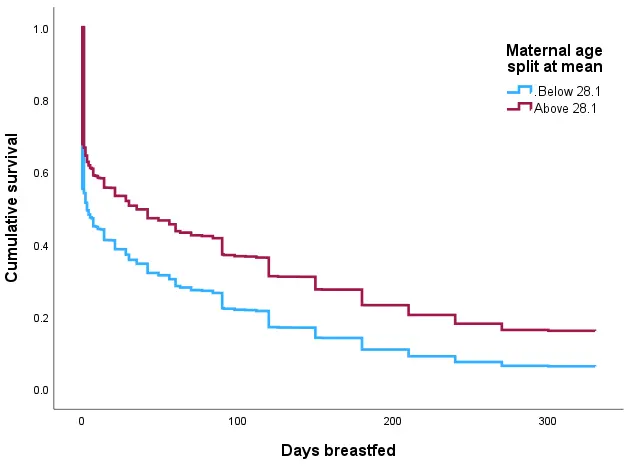
Figure 1. Survival plot displaying the predicted number of days until weaning split by maternal age for the full sample (n = 15,825). Maternal age was split at its mean of 28.1 years. The y-axis shows the predicted proportion weaned by age (days breastfed) on the x-axis.
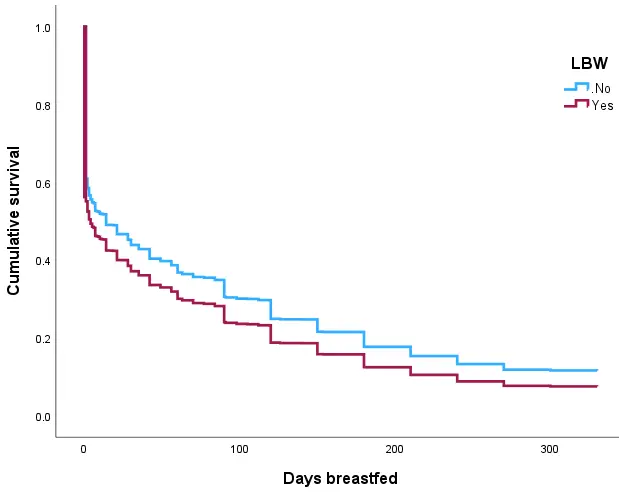
Figure 2. Survival plot displaying the predicted number of days until weaning split by whether the infant was born low birthweight (LBW), defined as born below 2500 g, for the full sample (n = 15,825). The y-axis shows the predicted proportion weaned by age (days breastfed) on the x-axis.
Table 6 displays the results of Cox regression models, with the sample restricted to those who ever breastfed, defined here as having breastfed for at least a day. This reduced the sample size for the analysis by around 6000 cases. Many of the results were similar to the main analysis (see Table 5), but in this subsample, boys were weaned younger than girls. The number of older siblings had the opposite effect to the main analysis result: having more older siblings was associated with later weaning.
Table 6. Cox regression results predicting time to weaning for mothers who initiated breastfeeding. N = 9678 in adjusted model. Harrell’s C = 0.61.
|
Unadjusted Model Results |
Adjusted Model Results |
|||||
|---|---|---|---|---|---|---|
|
Predictor Variable |
Hazard Ratio |
p< |
95% CI |
Hazard Ratio |
p< |
95% CI |
|
Mother’s income above 25th percentile |
1.09 |
0.001 |
1.04–1.13 |
1.05 |
0.098 |
0.99–1.11 |
|
Mother’s income above 75th percentile |
0.95 |
0.028 |
0.91–0.99 |
1.04 |
0.275 |
0.97–1.10 |
|
Age mother completed education |
0.94 |
0.001 |
0.93–0.94 |
0.95 |
0.001 |
0.94–0.96 |
|
Mother’s annual income before infant was born (in GBP/10,000) |
0.99 |
0.121 |
0.97–1.00 |
|||
|
Family weekly income (OECD/100) |
0.96 |
0.001 |
0.95–0.97 |
0.99 |
0.133 |
0.98–1.00 |
|
Father not in household |
1.32 |
0.001 |
1.24–1.41 |
1.41 |
0.001 |
1.28–1.55 |
|
Paternal direct childcare score (higher = more care) |
1.00 |
0.796 |
0.99–1.01 |
1.02 |
0.001 |
1.02–1.03 |
|
Kin allocare during the week |
1.35 |
0.001 |
1.28–1.42 |
1.28 |
0.001 |
1.21–1.36 |
|
Maternal age |
0.96 |
0.001 |
0.95–0.96 |
0.95 |
0.007 |
0.92–0.99 |
|
Number of older siblings |
0.89 |
0.001 |
0.87–0.91 |
1.00 |
0.974 |
0.87–1.15 |
|
Preeclampsia |
1.13 |
0.008 |
1.03–1.23 |
1.08 |
0.045 |
1.00–1.17 |
|
Birthweight (kg) |
0.87 |
0.001 |
0.84–0.91 |
0.89 |
0.001 |
0.86–0.93 |
|
Born <37 weeks gestation |
1.28 |
0.001 |
1.18–1.38 |
|||
|
Infant sex (1 = M; 2 = F) |
0.95 |
0.020 |
0.91–0.99 |
0.95 |
0.013 |
0.90–0.99 |
|
Developmental delay >2SD |
1.07 |
0.009 |
1.02–1.13 |
1.09 |
0.002 |
1.03–1.15 |
|
Mothers ethnicity (white British = 1; all others = 2) |
0.74 |
0.001 |
0.71–0.78 |
0.73 |
0.001 |
0.68–0.79 |
|
Other language spoken in the home |
0.84 |
0.001 |
0.80–0.87 |
0.95 |
0.098 |
0.89–1.01 |
|
Maternal age by parity interaction |
0.99 |
0.001 |
0.99–0.99 |
1.00 |
0.516 |
0.99–1.01 |
4. Summary & Discussion
4.1. Maternal Age
Consistent with expectations about residual reproductive value, older mothers weaned their infants later. This result is consistent with previous studies, but has been argued to be mediated by education ad parity such that maternal age is not in itself important [38]. Here, statistical adjustment for parity and maternal education had little influence on the hazard ratio for maternal age: in the adjusted models (Table 5 and Table 6), every 10 year increase in maternal age approximately halved the hazard of weaning.
4.2. Older Siblings
Having older siblings theoretically reduces the share of maternal investment available to allocate to an infant and would therefore be expected to be associated with earlier weaning in later-born children. The results of the present analysis were mixed: in the main analysis, which included all infants and was adjusted for covariates, later-born children were more likely to be weaned early. When the sample was reduced to include only infants who initially breastfed, there was no statistically significant difference by parity. This suggests that the presence of older siblings affects the decision to breastfeed, but does not affect the time to weaning for infants who breastfed for at least a day following birth. It should be noted that outside of industrially developed economies, there is evidence that later-born infants breastfeed for longer or have complementary foods introduced when they are older [9,35]. Hence, the extent to which older siblings are genuinely competitors for maternal investment is likely to vary according to culture, birth spacing, and economic system.
It was predicted that parity and maternal age together would affect breastfeeding: older mothers with no or few existing offspring would be expected to wean late. The unadjusted analyses on the left side of Table 5 and Table 6 show this pattern, but it was not present in the adjusted models. In the main adjusted analysis, the pattern was opposite to the prediction: older mothers with lower parity weaned earlier, although the statistical effect size was very small (HR = 1.003).
4.3. Maternal Earning Potential
While not an exclusively evolutionarily-derived prediction, it was expected that high maternal earning potential would be associated with early weaning, as the gains to work may exceed the fitness returns to continuing breastfeeding. In the adjusted models, which statistically control for household income, mothers who were in the top quartile for income did not wean earlier, although the trend was in the predicted direction for infants who were ever breastfed. In unadjusted Cox regression models, higher maternal income showed a statistically significant linear association with later weaning. Maternal income before the infant was born and family income reported when the infant was 9 months old were highly correlated and collinear in the Cox regression models; therefore, maternal income was removed from the adjusted models. It should be noted that maternal and family income also showed substantial correlations with most of the other variables included in the study. For example, the Pearson correlation between maternal income and parity was −0.15, and the correlation between maternal income and how much direct care the father provided was 0.18. As such, further analysis would be necessary to tease out the causal pathways between income and age at weaning.
4.4. Sex of Infant
Increased maternal-infant conflict was expected for sons, as male infants grow more rapidly and are hence more costly for mothers. Other work in the UK and systematic reviews have shown that earlier weaning of boys [38,39]. Here, the analysis including all infants did not show a statistically significant effect for sex, but for ever-breastfed infants the results were similar to prior work in showing earlier weaning of boys (see Table 6).
4.5. Indicators of Infant Viability
From an evolutionary perspective, less viable infants should receive reduced maternal investment as they contribute less to maternal fitness. Pre-eclampsia, premature birth, low birth weight, and early developmental delay were included as indicators of infant viability. Pre-eclampsia appears not to have been included in prior studies of breastfeeding, but it is associated with measures of poor foetal growth, and has been interpreted as foetal manipulation of maternal circulation as an attempt to secure more nutrients [17,18]. As such, pre-eclampsia is indicative both of poor foetal viability and maternal-foetal conflict with potential to harm both mother and foetus. The present results showed the predicted statistically significant association in the adjusted models only for infants who were ever breastfed, as well as significant association in both unadjusted analyses. Further analysis would be necessary to understand whether pre-eclampsia is itself important, or whether it was statistically significant here only because it was associated with other indicators of infant viability that were not included or sufficiently statistically adjusted for in the analyses.
Low birthweight and prematurity were too closely associated to include both in Cox regression, but similar to other studies, low birthweight was associated with earlier weaning [24]. This study differs from prior research in that most medical research has compared low birthweight to normal birthweight as a binary predictor [24]. The results reported here imply a linear relationship between birthweight and weaning age, extending to higher birthweights than the 2500 g low birthweight cut-off typically used in medical research. Figure 2 additionally shows the odds of weaning for infants born under 2500 g, similar to past medical research.
It was predicted that developmental delay as a sign of poor viability would be associated with earlier weaning. This was the case for ever-breastfed infants in the present study. It should be noted that causal direction cannot be established with the MCS retrospective study design: it is possible that both developmental delay leads to the decision to wean and that weaning is associated with delay following weaning.
4.6. Allocare and Paternal Involvement
Allocare by relatives, paternal presence, and involvement in childcare were associated with earlier weaning. These predictors were included as they are often associated with reproductive decisions, including in the MCS cohort [40]. The evidence here suggests that using alternative infant care providers may make early weaning a more convenient option, as allocarers can take over infant feeding with formula and/or early supplemental feeding with solid foods. Other research has also highlighted that grandparents, who are the primary family allocare providers in the MCS sample, may verbally encourage infant independence, including the introduction of solid foods and weaning [41]. The statistical models did not fully account for factors that are likely to influence weaning time, including when the mother returned to work, whether she expressed breast milk so that allocarers could feed infants breast milk, and other key aspects of maternal time allocation. Future analysis could provide a more detailed understanding of the role of maternal time-budgets in weaning decisions.
4.7. Ethnic Background
Following prior studies’ adjustment for ethnic background in the UK Millennium cohort, ethnicity was operationalised using two variables, one a binary variable denoting white British maternal ethnic background, and the other representing whether English was spoken in the household [42]. These were associated with weaning in the expected pattern: later weaning was associated with not being white British, and with speaking languages in the household other than English.
5. Limitations and Conclusions
The findings of these analyses generally support the evolutionary theoretical framework: measures of infant viability and maternal age in particular were associated with weaning in the predicted ways. However, other causes of the observed relationships cannot be ruled out. For example, older mothers may wean their infants later due to cultural shifts or changes in economic constraints over time. It is more difficult to envision alternative explanations for the observed effects of birthweight and of pre-eclampsia.
The adjusted Cox regression models were affected by multicollinearity. While Cox regression does not have an option to assess multicollinearity using the Variance Inflation Factor (VIF) or similar measures, income had smaller effects or dropped out of statistical significance in the adjusted models. While it may be the case that income dropped out of models because variation in weaning age is driven by the covariates rather than income itself, the results for individual variables in the adjusted models reported here are likely affected by relationships with weaning that are complex and multifactorial.
While the MCS captures many aspects of health, household economics, behaviour and beliefs, it is self-reported data which, for some variables, is likely to contain inaccuracies. The weaning age data were self-reported and retrospectively collected. One effect of this is that mothers appear to have rounded up or down in their estimates of when their infant last breastfed. This effect can be seen, for example, in Figure 1, where enough women reported weaning at 3 months/90 days for a step to be visible in the hazard plot. This inaccuracy is not likely to result in finding statistical effects that do not exist (statistical Type 1 error), but may obscure relationships that do exist (Type 2 error). Second, the MCS had a loss to follow-up of around 3000 individuals between nine months and three years. For the purposes of the present research, those specifically lost to follow-up will be infants who initiated breastfeeding but then were lost to follow-up. Those who breastfed for only a short period are not lost to follow-up, as their weaning time was recorded.
This analysis aimed to test parent-offspring conflict theory applied to weaning, but also has relevance for breastfeeding promotion in public health, and is one of many examples of why evolutionary thinking is useful in medicine and public health. The most vulnerable infants from a health perspective would stand to benefit the most from later weaning, but weaning conflict theory [1,23] and the evidence here and in similar studies run counter to this [9,24].
The Harrell’s C value of the Cox regression model indicated that the variables included together successfully classified the timing of weaning in around two thirds of cases. This level of model performance is not far below the typical standard for clinical use (eight out of ten successfully classified), and the variables used here could in future inform the basis for a successful algorithm to predict early weaning and target resources to the infants who would benefit the most.
Ethics Statement
The study was conducted according to the guidelines of the Declaration of Helsinki. Ethical approval was obtained for all waves of the Millennium Cohort Study through the National Health Service (NHS) Research Ethics Committee (REC) MCS1 protocol MREC/01/6/19, 9 months 2000/1; MCS2 protocol MREC/03/2/022, MCS2. 3 years. 2003/4. Detailed information can be accessed here: https://cls.ucl.ac.uk/wpcontent/uploads/2017/07/MCS-Ethical-Approval-and-Consent-2019.pdf (accessed 28 July 2026).
Informed Consent Statement
Informed consent was given by the MCS cohort members. For details see: https://cls.ucl.ac.uk/wpcontent/uploads/2017/07/MCS-Ethical-Approval-and-Consent-2019.pdf (accessed 28 July 2026).
Data Availability Statement
The data used in this study are available free of charge via the UK Data Service. https://beta.ukdataservice.ac.uk/datacatalogue/studies/#!?Search=&Rows=10&Sort=0&DataTypeFacet=Cohort%20and%20longitudinal%20studies&Page=1&DateFrom=440&DateTo=2022 (accessed 28 July 2026).
Funding
This research received no external funding.
Declaration of Competing Interest
The author declares no competing interests.
References
- Trivers RL. Parent-Offspring Conflict. Am. Zool. 1974, 14, 249–264. DOI:10.1093/icb/14.1.249 [Google Scholar]
- Maestripieri D. Parent–Offspring Conflict in Primates. Int. J. Primatol. 2002, 23, 923–951. DOI:10.1023/A:1015537201184 [Google Scholar]
- Salmon CA, Malcolm J. Parent–Offspring Conflict. In The Oxford Handbook on Evolutionary Family Psychology; Oxford University Press: Oxford, UK, 2011; pp. 83–96. DOI:10.1093/oxfordhb/9780195396690.013.0006 [Google Scholar]
- Hamilton WD. The genetical evolution of social behaviour. II. J. Theor. Biol. 1964, 7, 17–52. DOI:10.1016/0022-5193(64)90039-6 [Google Scholar]
- Mandalaywala TM, Higham JP, Heistermann M, Parker KJ, Maestripieri D. Physiological and behavioural responses to weaning conflict in free-ranging primate infants. Anim. Behav. 2014, 97, 241–247. DOI:10.1016/j.anbehav.2014.09.016 [Google Scholar]
- Fouts HN, Hewlett BS, Lamb ME. Parent‐Offspring Weaning Conflicts among the Bofi Farmers and Foragers of Central Africa. Curr. Anthropol. 2005, 46, 29–50. DOI:10.1086/425659 [Google Scholar]
- Hill K, Kaplan H. Life History Traits in Humans: Theory and Empirical Studies. Annu. Rev. Anthropol. 1999, 28, 397–430. DOI:10.1146/annurev.anthro.28.1.397 [Google Scholar]
- Kramer KL. Maya Children: Helpers at the Farm; Harvard University Press: Cambridge, MA, USA, 2009; Chapter 1. [Google Scholar]
- Wander K, Mattison SM. The evolutionary ecology of early weaning in Kilimanjaro, Tanzania. Proc. R. Soc. B 2013, 280, 20131359. DOI:10.1098/rspb.2013.1359 [Google Scholar]
- Keller MC, Nesse RM, Hofferth S. The Trivers–Willard hypothesis of parental investment. Evol. Hum. Behav. 2001, 22, 343–360. DOI:10.1016/S1090-5138(01)00075-7 [Google Scholar]
- Piper S, Parks PL. Predicting the Duration of Lactation: Evidence from a National Survey. Birth 1996, 23, 7–12. DOI:10.1111/j.1523-536X.1996.tb00454.x [Google Scholar]
- Baker M, Milligan K. Maternal employment, breastfeeding, and health: Evidence from maternity leave mandates. J. Health Econ. 2008, 27, 871–887. DOI:10.1016/j.jhealeco.2008.02.006 [Google Scholar]
- Kurinij N, Shiono PH, Ezrine SF, Rhoads GG. Does maternal employment affect breast-feeding? Am. J. Public Health 1989, 79, 1247–1250. DOI:10.2105/AJPH.79.9.1247 [Google Scholar]
- Chatterji P, Frick KD. Does Returning to Work After Childbirth Affect Breastfeeding Practices? Rev. Econ. Househ. 2005, 3, 315–335. DOI:10.1007/s11150-005-3460-4 [Google Scholar]
- Celi AC, Rich-Edwards JW, Richardson MK, Kleinman KP, Gillman MW. Immigration, Race/Ethnicity, and Social and Economic Factors as Predictors of Breastfeeding Initiation. Arch. Pediatr. Adolesc. Med. 2005, 159, 255. DOI:10.1001/archpedi.159.3.255 [Google Scholar]
- Martini C, Saeed Z, Simeone P, Palma S, Ricci M, Arata A, et al. Preeclampsia: Insights into pathophysiological mechanisms and preventive strategies. Am. J. Prev. Cardiol. 2025, 23, 101054. DOI:10.1016/j.ajpc.2025.101054 [Google Scholar]
- Odent M. Hypothesis: Preeclampsia as a maternal-fetal conflict. MedGenMed 2001, 3, 2. Available online: https://www.birthpsychology.com/wp-content/uploads/2024/09/xqOTg72y-2.pdf (accessed on 1 February 2026).
- Haig D. Genetic Conflicts in Human Pregnancy. Q. Rev. Biol. 1993, 68, 495–532. DOI:10.1086/418300 [Google Scholar]
- Napso T, Yong HEJ, Lopez-Tello J, Sferruzzi-Perri AN. The Role of Placental Hormones in Mediating Maternal Adaptations to Support Pregnancy and Lactation. Front. Physiol. 2018, 9, 1091. DOI:10.3389/fphys.2018.01091 [Google Scholar]
- Lopez-Tello J, Yong HEJ, Sandovici I, Dowsett GKC, Christoforou ER, Salazar-Petres E, et al. Fetal manipulation of maternal metabolism is a critical function of the imprinted Igf2 gene. Cell Metab. 2023, 35, 1195–1208.e6. DOI:10.1016/j.cmet.2023.06.007 [Google Scholar]
- Jana A, Saha UR, Reshmi RS, Muhammad T. Relationship between low birth weight and infant mortality: Evidence from National Family Health Survey 2019-21, India. Arch. Public Health 2023, 81, 28. DOI:10.1186/s13690-023-01037-y [Google Scholar]
- Harmon QE, Huang L, Umbach DM, Klungsøyr K, Engel SM, Magnus P, et al. Risk of Fetal Death with Preeclampsia. Obstet. Gynecol. 2015, 125, 628–635. DOI:10.1097/AOG.0000000000000696 [Google Scholar]
- Haig D. Brood Reduction and Optimal Parental Investment when Offspring Differ in Quality. Am. Nat. 1990, 136, 550–556. DOI:10.1086/285113 [Google Scholar]
- Flacking R, Nyqvist KH, Ewald U, Wallin L. Long-Term Duration of Breastfeeding in Swedish Low Birth Weight Infants. J. Hum. Lact. 2003, 19, 157–165. DOI:10.1177/0890334403019002004 [Google Scholar]
- Alur P. Sex Differences in Nutrition, Growth, and Metabolism in Preterm Infants. Front. Pediatr. 2019, 7, 22. DOI:10.3389/fped.2019.00022 [Google Scholar]
- Broere-Brown ZA, Baan E, Schalekamp-Timmermans S, Verburg BO, Jaddoe VWV, Steegers EAP. Sex-specific differences in fetal and infant growth patterns: A prospective population-based cohort study. Biol. Sex Differ. 2016, 7, 65. DOI:10.1186/s13293-016-0119-1 [Google Scholar]
- Clarke J, Price R, Register BH. Observations on some causes of the excess of the mortality of males above that of females. By Joseph Clarke, M. D. Physician to the Lying-in Hospital at Dublin. Communicated by the Rev. Richard Price, D. D. F. R. S. in a letter to Charles Blagden, M. D. Sec. R. S. Phil. Trans. R. Soc. 1786, 76, 349–362. DOI:10.1098/rstl.1786.0017 [Google Scholar]
- Moore WMO, Ward BS, Jones VP, Bamford FN. Sex difference in fetal head growth. BJOG Int. J. Obstet. Gynaecol. 1988, 95, 238–242. DOI:10.1111/j.1471-0528.1988.tb06863.x [Google Scholar]
- Furness AI, Pollux BJA. Sex-Specific Parent-Offspring Conflict in Humans. Q. Rev. Biol. 2025, 100, 257–306. DOI:10.1086/738781 [Google Scholar]
- Ketende S, Jones E. User Guide to Analysing MCS Data Using Stata; Centre for Longitudinal Studies: London, UK, 2011. [Google Scholar]
- Connelly R, Platt L. Cohort Profile: UK Millennium Cohort Study (MCS). Int. J. Epidemiol. 2014, 43, 1719–1725. DOI:10.1093/ije/dyu001 [Google Scholar]
- Goldsmith TR. Ages and Stages Questionnaire. In Encyclopedia of Autism Spectrum Disorders; Springer International Publishing: Cham, Switzerland, 2021; pp. 128–131. [Google Scholar]
- Waynforth D. Alloparental Support and Infant Psychomotor Developmental Delay. Hum. Nat. 2024, 35, 43–62. DOI:10.1007/s12110-024-09468-4 [Google Scholar]
- Anyaegbu G. Using the OECD equivalence scale in taxes and benefits analysis. Econ. Lab. Mark. Rev. 2010, 4, 49–54. DOI:10.1057/elmr.2010.9 [Google Scholar]
- Martin MA, Garcia G, Kaplan HS, Gurven MD. Conflict or congruence? Maternal and infant-centric factors associated with shorter exclusive breastfeeding durations among the Tsimane. Soc. Sci. Med. 2016, 170, 9–17. DOI:10.1016/j.socscimed.2016.10.003 [Google Scholar]
- Emmott EH, Page AE, Myers S. Typologies of postnatal support and breastfeeding at two months in the UK. Soc. Sci. Med. 2020, 246, 112791. DOI:10.1016/j.socscimed.2020.112791 [Google Scholar]
- Brown LJ, Sear R. Local environmental quality positively predicts breastfeeding in the UK’s Millennium Cohort Study. Evol. Med. Public Health 2017, 2017, 120–135. DOI:10.1093/emph/eox011 [Google Scholar]
- Pereyra-Elías R, Quigley MA, Carson C. To what extent does confounding explain the association between breastfeeding duration and cognitive development up to age 14? Findings from the UK Millennium Cohort Study. PLoS ONE 2022, 17, e0267326. DOI:10.1371/journal.pone.0267326 [Google Scholar]
- Vail B, Prentice P, Dunger DB, Hughes IA, Acerini CL, Ong KK. Age at Weaning and Infant Growth: Primary Analysis and Systematic Review. J. Pediatr. 2015, 167, 317–324.e1. DOI:10.1016/j.jpeds.2015.05.003 [Google Scholar]
- Waynforth D. Grandparental investment and reproductive decisions in the longitudinal 1970 British cohort study. Proc. R. Soc. B 2012, 279, 1155–1160. DOI:10.1098/rspb.2011.1424 [Google Scholar]
- Moore AP, Nanthagopan K, Hammond G, Milligan P, Goff LM. Influence of weaning timing advice and associated weaning behaviours in a survey of black and minority ethnic groups in the UK. Public Health Nutr. 2014, 17, 2094–2103. DOI:10.1017/S1368980013002383 [Google Scholar]
- Moore AP, Milligan P, Rivas C, Goff LM. Sources of weaning advice, comparisons between formal and informal advice, and associations with weaning timing in a survey of UK first-time mothers. Public Health Nutr. 2012, 15, 1661–1669. DOI:10.1017/S1368980012002868 [Google Scholar]