
Advances and Trends in Intelligent Lower-Limb Prostheses: A Systematic Review of Mechanical Design, Sensing, and Control
Advances and Trends in Intelligent Lower-Limb Prostheses: A Systematic Review of Mechanical Design, Sensing, and Control
Xiaolong Shu
1,2,3
 Shengli Luo
1,2,3
Xu Wang
1,2,3
Qiwen Liu
1,2,3
Yiyao Qin
1,2,3
Qiaoling Meng
1,2,3
Hongliu Yu
1,2,3,*
Shengli Luo
1,2,3
Xu Wang
1,2,3
Qiwen Liu
1,2,3
Yiyao Qin
1,2,3
Qiaoling Meng
1,2,3
Hongliu Yu
1,2,3,*
Received: 26 March 2026 Revised: 26 May 2026 Accepted: 29 June 2026 Published: 09 July 2026

© 2026 The authors. This is an open access article under the Creative Commons Attribution 4.0 International License (https://creativecommons.org/licenses/by/4.0/).
1. Introduction
People with lower-limb amputation often walk with gait asymmetry, elevated metabolic cost, and reduced stability, particularly on uneven terrain and during activities of daily living (ADLs). Passive prostheses offer limited adaptability and cannot deliver net positive work; in contrast, microprocessor-controlled semi-active and powered systems can modulate damping and impedance and inject mechanical work at task-critical phases. Clinical translation, however, still hinges on compact high power-density hardware with low mechanical impedance, robust sensing and control under donning variability and sensor drift, and verifiable fail-safe behavior [1,2]. Accordingly, recent studies increasingly couple multimodal sensing, continuous phase variables, and learning-based adaptation to improve cross-task performance while maintaining safety.
Here, we synthesize advances in powered, semi-active, microprocessor-controlled, and related intelligent lower-limb prosthesis systems through a design, control, and evaluation lens, spanning architecture; sensing and interfaces; state/phase estimation and intent recognition; control and learning; and real-world validation. We also use a modular taxonomy to link clinical endpoints to implementation choices across these layers and discuss a layered safety stack for learning-enabled systems. Hip-level prostheses, especially hip disarticulation and hip-joint-level systems, are discussed separately as a high-consequence “stress test” because they add proximal DOFs, shift mass/inertia toward the trunk, and leave users with fewer compensatory strategies, making transition failures (sit-to-stand, turning, ramps/stairs) more consequential. Section 2 describes the review methodology; Section 3 synthesizes findings by module; and Section 4 discusses open challenges and future directions.
2. Methods
A systematic review was conducted in accordance with the Preferred Reporting Items for Systematic Reviews and Meta-Analyses (PRISMA) guidelines.
2.1. Eligibility Criteria
English-language journal and conference reports published between 1 January 2021 and 1 January 2026 were considered eligible if they addressed powered, semi-active, microprocessor-controlled, or otherwise intelligent lower-limb prosthetic systems, or provided directly relevant evidence for their design, sensing, control, validation, prescription, safety, standardization, or clinical translation. Original research and technical reports were eligible when they reported at least one form of empirical, prototype-level, algorithmic, simulation, benchtop, hardware-in-the-loop, or human-subject/user-evidence support. Reviews, consensus papers, and perspectives were also included when they directly informed the taxonomy, clinical needs, endpoint selection, safety, standardization, or translational context, but they were coded separately from original research/technical reports.
2.2. Search Strategy and Study Selection
Scopus, PubMed, IEEE Xplore, and Web of Science were searched on 10 January 2026, covering publications from 1 January 2021 to 1 January 2026. Search strings were organized into four blocks: A (prosthesis-related terms), B (lower-limb anatomy and amputation level), C (intelligence/actuation/sensing/control/learning terms), and D (exclusion terms). The final query used the Boolean structure A AND B AND C NOT D. Database-specific syntax adaptations were applied where required, and the main search structure is described below.
An example query was: (prosthe* OR “artificial limb” OR “prosthetic limb” OR “prosthetic leg” OR “bionic leg”) AND (knee OR transfemoral OR transtibial OR ankle OR foot OR leg OR “lower limb” OR lower-limb OR “lower extremity” OR lower-extremity OR “lower leg” OR lower-leg) AND (active OR robotic OR adaptive OR intelligent OR power OR bionic OR microprocessor OR “microprocessor-controlled” OR “microprocessor controlled” OR semiactive OR semi-active OR “semi active” OR mechatronic OR actuated OR “variable impedance” OR “variable damping” OR “intent recognition” OR “locomotion mode” OR “mode recognition” OR “gait phase” OR “phase estimation” OR “phase detection” OR “terrain recognition” OR “activity recognition” OR “pattern recognition” OR “sensor fusion” OR “machine learning” OR “deep learning” OR transformer OR “reinforcement learning” OR “online learning” OR “impedance control” OR “model predictive control” OR MPC OR “finite-state machine” OR FSM OR “human-in-the-loop” OR “shared control”) AND NOT (replacement OR arthroplast* OR “joint replacement”).
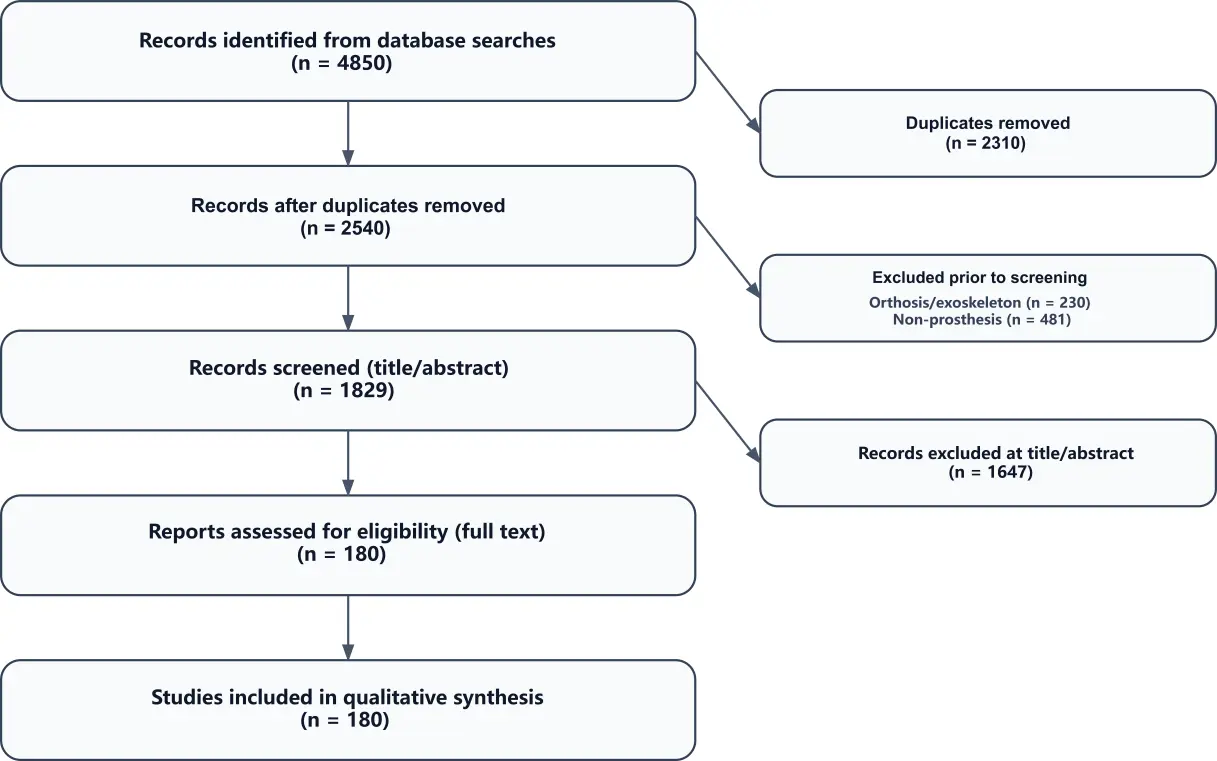
All records were exported to Zotero for deduplication and screening. Two reviewers independently performed title/abstract screening followed by full-text review; disagreements were resolved by discussion and, when required, adjudication by a third reviewer. Forward and backward citation chasing was performed, and the database search was updated on 10 January 2026. PRISMA accounting was as follows: 4850 records identified; 2310 duplicates removed (2540 unique records); 711 records removed before screening for other reasons (orthosis/exoskeleton, n = 230; non-prosthesis, n = 481); 1829 records screened; 1647 records excluded at title/abstract; and 180 full-text reports assessed and included in the synthesis (Figure 1).
The selected databases were intended to cover biomedical, rehabilitation, engineering, robotics, and computer-science-oriented literature. PubMed was used to capture biomedical and rehabilitation studies, IEEE Xplore to capture engineering and robotics reports, and Scopus and Web of Science to provide broader multidisciplinary coverage. Nevertheless, this database selection may have under-retrieved non-English publications, dissertations, patents, technical reports, industry white papers, and papers indexed only in databases such as ACM Digital Library or Google Scholar. This limitation was partly mitigated by backward and forward citation chasing.
2.3. Data Extraction and Synthesis
For each included report, the following items were extracted: device configuration (amputation level, joints, degrees of freedom [DOFs]), actuation and transmission, sensing modalities and human-machine interfaces (HMIs), estimation/recognition methods, control architecture, evaluation setting, and reported outcomes. Given substantial heterogeneity in devices, protocols, and endpoints, meta-analysis was not performed. Instead, a narrative synthesis was conducted and organized by electromechanical design, sensing and human-machine interfaces (HMIs), gait phase/state estimation, intent/mode/terrain recognition, control frameworks, learning-based personalization, and translational considerations (safety, reliability, and standardization).
2.4. Structured Coding of Included Reports
To improve transparency in the evidence synthesis, each included report was coded using a structured coding sheet. Coding fields included publication type (original research/technical report vs. review/consensus/perspective), primary research theme, primary validation setting, prosthesis/device class, joint/application level, sensing modality, control/algorithmic focus, and the manuscript module in which the report provided its most specific evidence. For reports that spanned multiple modules, one primary category was assigned according to the main objective and the strongest evidence contribution, while secondary tags were retained for internal audit. Original research/technical reports were further classified by primary validation setting as follows: human-subject or user-evidence study; benchtop, prototype, mechanical validation, or technical description; or algorithmic, simulation, or offline validation. Reviews, consensus papers, and perspectives were counted separately and were not included in the denominator for primary-theme and validation-setting percentages. When the title and abstract information were insufficient for unique classification, the full text and methods/results sections were checked. The aggregate coding results are summarized in Table 1.
Table 1. Quantitative characteristics of included reports.
|
Category |
Subcategory |
N |
Percentage |
|---|---|---|---|
|
All included reports |
Total included reports |
180 |
100.0% |
|
Publication type |
Original research or technical report |
163 |
90.6% of 180 |
|
Publication type |
Review, consensus, or perspective |
17 |
9.4% of 180 |
|
Primary theme among original reports |
Electromechanical architecture, actuation, or device design |
43 |
26.4% of 163 |
|
Primary theme among original reports |
Control, learning, or personalization |
43 |
26.4% of 163 |
|
Primary theme among original reports |
Clinical needs, endpoints, or user evidence |
26 |
16.0% of 163 |
|
Primary theme among original reports |
Sensing, human-machine interfaces, or feedback |
21 |
12.9% of 163 |
|
Primary theme among original reports |
Intent or terrain recognition |
14 |
8.6% of 163 |
|
Primary theme among original reports |
Phase or state estimation |
11 |
6.7% of 163 |
|
Primary theme among original reports |
Safety, reliability, or standardization |
5 |
3.1% of 163 |
|
Primary validation setting among original reports |
Human-subject or user-evidence study |
99 |
60.7% of 163 |
|
Primary validation setting among original reports |
Benchtop, prototype, mechanical validation, or technical description |
33 |
20.2% of 163 |
|
Primary validation setting among original reports |
Algorithmic, simulation, or offline validation |
31 |
19.0% of 163 |
Note: Percentages for publication type were calculated using all 180 included reports as the denominator. Percentages for primary theme and primary validation setting were calculated using the 163 original research or technical reports as the denominator. Each original report was assigned one primary theme and one primary validation setting according to its main objective and strongest evidence contribution.
3. Results
3.1. Overview
This section summarizes the included reports by module and provides a quantitative overview of the evidence base before the narrative synthesis. Among the 180 included reports, 163 were original research or technical reports, and 17 were reviews, consensus papers, or perspectives. Among the 163 original research or technical reports, the main themes were electromechanical architecture, actuation, or device design (43/163, 26.4%); control, learning, or personalization (43/163, 26.4%); clinical needs, endpoints, or user evidence (26/163, 16.0%); sensing, human-machine interfaces, or feedback (21/163, 12.9%); intent or terrain recognition (14/163, 8.6%); phase or state estimation (11/163, 6.7%); and safety, reliability, or standardization (5/163, 3.1%). By primary validation setting, 99 reports included human-subject or user-evidence data (60.7%), 33 primarily reported benchtop, prototype, mechanical validation, or technical description (20.2%), and 31 relied mainly on algorithmic, simulation, or offline validation (19.0%). These quantitative distributions are summarized in Table 1.
Overall, the distribution of included reports indicates that the field remains weighted toward hardware/control development and short-term validation, whereas safety, standardization, and long-term real-world evidence remain comparatively underrepresented. Therefore, the following synthesis emphasizes not only reported technical advances but also differences in validation depth, clinical relevance, and translational readiness across modules.
Based on this quantitative overview, we organized the narrative synthesis using the modular taxonomy shown in Table 2, which maps each module to typical technical questions, evaluation endpoints, and representative studies. This taxonomy is used consistently throughout Sections 3.2–3.9 to connect clinical needs, implementation choices, and real-world validation evidence (Figure 2).
Table 2. Taxonomy of modules for intelligent lower-limb prosthesis research is reviewed in this paper.
|
Module |
Typical Scope and Endpoints |
Representative Topics/Examples |
|---|---|---|
|
Clinical needs & endpoints |
ADLs; gait symmetry; metabolic cost; safety/falls; patient-reported outcomes; task-specific performance. |
Outcome mismatch across studies; task-dependent benefits. |
|
Electromechanical architecture |
Actuation/transmission; power density; backdrivability; low impedance/noise; mass/volume constraints. |
Powered ankle/knee; SEA; QDD; modular, serviceable designs. |
|
Sensing & human-machine interfaces |
IMU/pressure/load/torque; EMG; vision/LiDAR; sensory feedback; donning/doffing robustness. |
Multimodal fusion; confidence gating; low-burden sensor placement. |
|
Phase/state estimation |
Gait phase variables; continuous phase; event detection; latency and drift management. |
Phase-variable models; hybrid observers; robust event detection. |
|
Intent/mode/terrain recognition |
Locomotion mode, terrain, transitions; generalization and dataset shift. |
IMU+pressure recognition; EMG-assisted intent; context-aware transitions. |
|
Control architectures |
FSM impedance; variable impedance/admittance; trajectory/MPC; shared control; safe fallback. |
Continuous control across tasks; adaptive impedance; transition handling. |
|
Learning & personalization |
HIL tuning; online adaptation; RL/safe learning; calibration burden. |
HIL optimization; safe RL; multi-objective personalization. |
|
End-user & real-world evaluation |
Lab vs. outdoor validation; long-term wear; usability; reporting of adverse events. |
Field trials; standardized protocols; reproducible benchmarks. |
|
Safety, reliability & standardization |
Fail-safe design; fault detection; degradation; logs/traceability; reporting standards. |
Redundant braking; safe fallback; evaluation checklists. |
- (1)
-
Hardware: lightweight, high power-density actuation and low-impedance/low-noise designs (e.g., a low-noise, highly backdrivable knee platform [3]), together with the ability to preserve backdrivability and compliance across multiple tasks (level walking, ramps, stairs, and sit-to-stand transitions), have become shared design objectives for next-generation powered prostheses [4,5,6,7,8].
- (2)
-
Sensing and interfaces: multimodal fusion (e.g., electromyography [EMG], plantar pressure, inertial measurement units [IMUs], and vision) is gradually replacing single-sensor thresholding, with growing emphasis on day-to-day stability, low latency, and deployable sensor placements [9,10,11]. In parallel, sensory feedback and neural interfaces are being explored to enhance embodiment and motor adaptation [12,13].
- (3)
-
Control: data-driven variable-impedance control, phase-variable trajectory generation, and unified control frameworks continue to emerge to reduce manual expert tuning and improve cross-context adaptation [14,15]. Learning-based methods and human-in-the-loop optimization further advance personalization, typically accompanied by explicit discussion of safety constraints and fallback mechanisms [16,17,18].
In addition, recent reviews and new studies indicate that high-level inference and low-level control are converging toward “continuity” and “intermediate representations”. On one hand, intent recognition based on noninvasive interfaces is expanding from discrete mode classification to continuous intent/trajectory regression, with an emphasis on online adaptation and drift compensation [19,20]. On the other hand, frameworks such as synergy representations and bi-level optimization attempt to unify human movement regularities, user adaptation, and controller optimization within a shared modeling language, enabling faster personalization [21,22].
- (4)
-
Validation and standards: An increasing number of studies evaluate multiple tasks with amputee participants and discuss standardized testing requirements and risk frameworks for neural-control and learning modules [23].
Recent systems extend sensing beyond onboard state to environment priors and continuous prediction: in-shoe electrodes estimate ground impedance [24], A-mode ultrasound and proximal sensing support continuous kinematic prediction [25,26], and vision provides obstacle look-ahead for feedforward trajectory updates [27]. For hip-level systems, reliable sensing often must capture trunk-pelvis motion and load transfer in addition to distal joint states, because whole-body coordination and safe transitions dominate performance and risk.
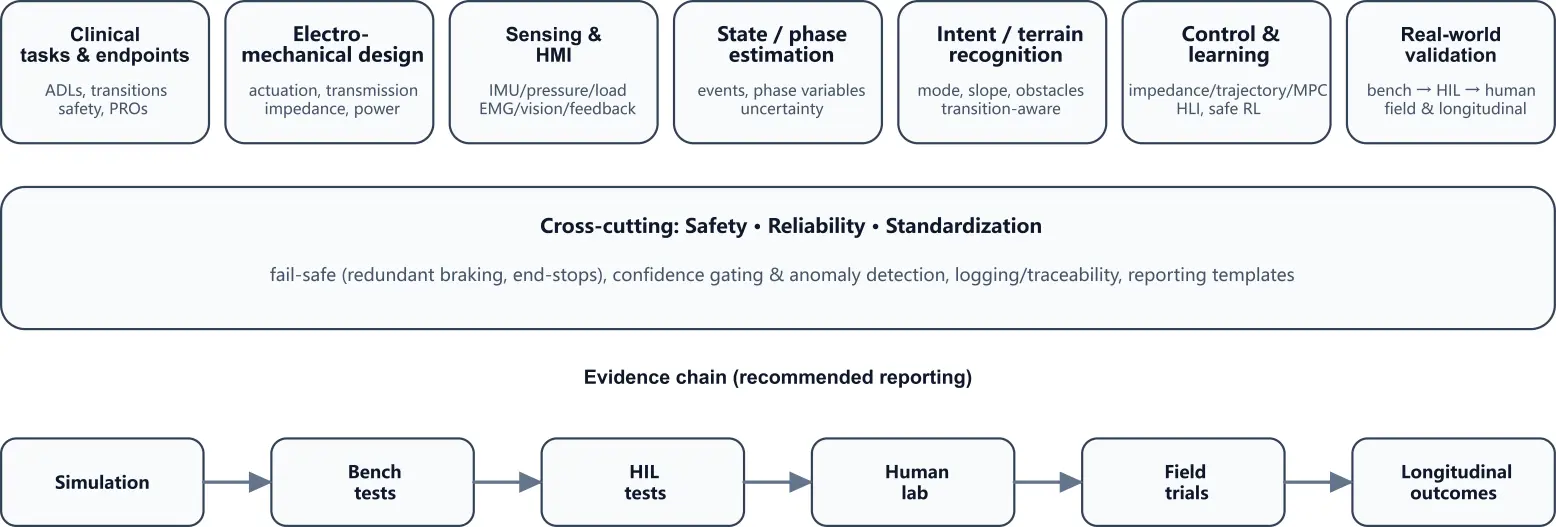
Figure 2. Modular taxonomy used in this review, linking clinical endpoints to hardware design, sensing/HMI, estimation and intent recognition, control and learning, validation, and safety/standardization. Hip-level systems are highlighted as a high-consequence stress test.
3.2. Clinical Needs and Evaluation Criteria
Section 3.2 maps common clinical tasks to outcome metrics and summarizes gaps that limit cross-study comparability.
3.2.1. Needs-to-Metrics Mapping
User priorities are consistent but heterogeneous. Manz et al. (56 studies; 8149 participants) identified stability/fall prevention, comfort (socket/skin), adaptability, fatigue, ease of use, and cost as core needs, with rankings depending on amputation level and activity [28]. Metrics should therefore be reported as a task set paired with endpoints (e.g., ramp/stair switching safety, tolerable mode errors) to enable comparable evidence.
3.2.2. Robustness, Variability, and Recovery Metrics
Metabolic cost and symmetry alone miss transition and perturbation demands. Lee et al. showed that task-redundant variability relates to usability: users preserve goal-equivalent variability to maintain task success, while non-goal-equivalent variability increases cost [29]. Controllers should regulate stability while allowing safe redundancy, and evaluations should include efficiency, stability, and recovery under transitions/perturbations.
3.2.3. Evidence Threads: Safety, Function, Experience
Clinical evidence emphasizes three themes. First, interface load and tissue health motivate pressure-aware design, socket monitoring, and adaptive fitting strategies [9,30,31,32,33]. Second, function beyond level walking requires evaluating transitions, stairs, and volitional shared control rather than level-ground walking alone [34,35,36,37]. Third, prescription and follow-up require clinically interpretable evidence, including user-priority surveys and consensus-based prescription guidance [28,38,39].
3.2.4. Real-World Gap and Long-Term Endpoints
Short-term laboratory evidence often favors quasi-passive/active powered components over purely passive devices, but the strength of evidence is still limited by small samples, methodological limitations (e.g., small samples, limited randomization/blinding), and short follow-up. A review by Lathouwers et al. included 34 studies and reported that quasi-passive and active powered components outperform passive devices on multiple functional and biomechanical measures; however, the overall evidence remains insufficient to directly support long-term clinical adoption. Future work must thus validate performance under real-world conditions across days/weeks and simultaneously report long-term outcomes such as falls/near-falls, pain, skin complications, and maintenance cost; otherwise, “better on average in the lab” may not translate into sustained clinical benefit [40].
3.2.5. Surveys and Fall-Related Endpoints
Surveys refine needs-to-metrics mapping. In 114 transfemoral users, priorities included stability, reduced fatigue, predictable/learnable control, comfort/skin health, weight/noise, reliability, and maintenance cost; preferences varied with activity and context [38]. Evaluations should pair functional outcomes with experiential measures (control, trust, learning burden) and explicitly report falls/near-falls. In six transfemoral users, King et al. induced prosthesis-side trips; observed falls and recovery kinematics highlight transient impedance and swing-clearance limits and motivate perturbation-stability tests and explicit “fall probability” reporting beyond standard gait metrics [41].
3.2.6. Mechanical Properties and Prescription
Foot/ankle stiffness classes affect energy, comfort, and contralateral knee loading, implying individualized trade-offs between performance and intact-limb protection [42,43]. Cubillos et al. reported reliability and minimal detectable change for stiffness measures, enabling credible pre/post comparisons across designs and controllers [44]. Property-validated personalized passive feet further stress linking measured mechanics to clinical endpoints with repeatable protocols [45].
3.2.7. Deployment and Backup Strategies
Clinical choices are often not a single device but a “primary device + backup device” strategy. A qualitative study by Young et al. compared practical considerations when using a microprocessor knee versus a non-microprocessor knee as a backup device, highlighting the real-world weight of cost, maintenance, environmental adaptability, and perceived safety. This indicates that implementation-level configuration strategies can substantially shape real-world outcomes and should be part of the technical discussion rather than treated as external noise [46].
The choice of clinical endpoints directly determines hardware specifications and controller optimization objectives. Future studies should report efficiency, stability, and safety under transitions/perturbations within a unified task set, and build a traceable mapping between engineering metrics and end-user endpoints. Systematic reporting of real-world and long-term outcomes (falls/near-falls, pain, skin complications, maintenance cost) is also essential to improve evidence comparability and clinical translatability.
3.3. Electromechanical Architecture, Actuation, and Power Transmission
Section 3.3 summarizes design trade-offs in actuation, transmission, compliance, and power that set achievable control performance and safety margins.
3.3.1. Wearable Power and Control Metrics
Reporting should therefore extend beyond peak output to include impedance/backdrivability, strength and fail-safe margins, endurance and thermal limits, sealing, and maintenance, since these factors set control bandwidth and real-world usability [4,5,6,7,8,47,48,49,50,51,52,53,54,55,56,57,58,59,60,61,62,63,64,65,66]. Adjacent actuator-engineering studies, such as high-dynamics servo-valve drivers for electrohydraulic actuation, may provide transferable component-level evidence but should not be interpreted as direct prosthesis validation [67].
3.3.2. Multi-Joint and Multi-DOF Topologies
Multi-joint assistance is valuable when it reproduces key biomechanical phases (early-stance knee flexion, plantarflexion push-off, toe rollover), reducing pelvic and contralateral compensation [4,5,6]. Added DOF increases mass, power draw, and failure risk; many designs therefore use underactuation, differentials, and series elasticity to trade peak power for stored energy and backdrivability. Safety constraints during stairs/ramps/transitions should bound topology choices [4,5,6,48].
3.3.3. Actuation and Transmission Trade-Offs
Actuation and transmission must balance high torque/power with low impedance/backdrivability, which sets the feasible control bandwidth and impedance/admittance strategies. Electro-hydraulic hybrids can deliver high damping and impact tolerance but add complexity and sealing/noise/efficiency burdens [50]. Screw drives and torque-sensitive actuators favor quieter, more backdrivable behavior. In practice, gear/belt/screw/differential layouts with compliant elements largely determine the achievable torque-backdrive trade-off and long-term serviceability [48].
3.3.4. Compliance and Energy Management
Compliance and energy-management mechanisms aim to increase safety and economy without increasing the wearing burden. Series elasticity, variable stiffness/damping, and assist-as-needed control reduce peak power and impact loads across speeds and tasks [49,68]. Low-power actuation integrated into ESAR feet further illustrates how energy management can be achieved without excessive distal burden [69]. Parallel springs and adjustable equilibrium positions provide interpretable ramp optimization, while quasi-passive designs use variable stiffness and energy regeneration for low power draw. Semi-active variable-stiffness feet show that speed-impedance coupling can improve gait with little added energy, but multi-task trade-offs should be reported [8,49,70,71,72]. Related passive-compliance concepts inspired by prosthetic-leg design may provide indirect mechanical-design insight, but such non-prosthetic applications should be treated as transferable rather than direct prosthesis evidence [73].
3.3.5. Foot Form Factor and Fitting
Foot-end form factor and clinical fitting strongly influence whether laboratory performance transfers robustly to real-world use. Foot-sized and self-contained powered ankle-foot designs aim to reduce volumetric intrusion and improve long-term wearability, while distal lightweighting and inertia optimization can lessen swing-phase burden and support rapid foot-ground interactions on complex terrain [5,53,58]. More importantly, explicitly incorporating socket alignment and residual-limb loading into mechanical objectives (e.g., co-optimizing powered plantarflexion push-off and alignment capability) can reduce the risk of “fitting variability → control mismatch”. This makes control strategies more robust to clinical fitting and long-term wearing conditions and elevates “easy to wear, easy to fit, easy to maintain” from peripheral considerations to design inputs [7,74].
3.3.6. System-Level Evidence and Benchmarks
Representative systems should link metrics to tasks and risk points, not only list parameters. Powered knees address early-stance knee flexion deficiency and obstacle negotiation, while modeling and optimization show that high peak torque can coexist with low backdrive; noise, size, and maintenance should be treated as primary metrics [3,48,54]. Powered ankle-feet demonstrate net positive work across tasks and enable sensitivity analyses. Quasi-passive and variable-stiffness designs, including parallel-spring and adjustable-equilibrium mechanisms, offer interpretable low-power adaptability [8,49,71,72,75,76]. Low-cost, preliminary, and non-powered mechanical systems further highlight the importance of serviceability, manufacturability, and clinically realistic fitting constraints [77,78,79]. As assistance scales to multi-joint coordination, requirements on structural validation, redundancy, and safety testing increase accordingly.
3.3.7. Hip-Level Constraints and Fail-Safety
Hip-level prostheses impose higher DOF and power demands, and failures during transitions (sit-to-stand, turning, ramps/stairs) have larger consequences. Compared with transfemoral designs, the absence of a residual femur reduces passive mechanical stabilization and shifts load transfer to pelvic interfaces, increasing sensitivity to donning variability and comfort constraints. Designs therefore prioritize proximal lightweighting and inertia shaping, backdrivable/high-peak-power actuation with serviceable transmissions, and architecture-level fail-safety (mechanical end-stops, redundant braking, and conservative degraded modes). System-level optimization under thermal/energy-density and interface constraints is needed to preserve headroom for coordinated hip-knee-ankle power allocation and transition control [80,81,82,83,84,85,86].
Together, backdrivability, compliance, and power density define the feasible set of control strategies, while noise, endurance, serviceability, and clinical fitting/alignment determine long-term usability and translatability. The next section turns to sensing and interfaces, explaining why day-to-day stability and low latency are prerequisites for closed-loop control and real-world robustness [4,48].
3.4. Sensing Systems and Human-Machine Interfaces
Section 3.4 reviews sensing modalities and human-machine interfaces for intent and state estimation under real-world drift, donning variability, and embedded real-time constraints.
3.4.1. Sensing Design and Evaluation
Sensing evaluation is shifting from offline accuracy to closed-loop, long-term usability. Key factors include cross-day drift (e.g., electrode shift and skin changes) [11,87], practical placement and maintenance workflows [9,10,11], and end-to-end real-time behavior (latency, dropouts, anomaly handling) that directly affects safety margins during transitions [88,89]. Studies should report drift, latency, anomalies, and failure modes alongside accuracy.
3.4.2. Biosignal Interfaces and Usability
Biosignal human-machine interfaces (HMIs) remain dominated by surface electromyography (sEMG), but the focus has shifted from offline decoding to drift-robust closed-loop use. Reviews cover paradigms from proportional control to pattern recognition and phase-variable/finite-state machine (FSM) coupling and consistently identify cross-day drift as the main clinical bottleneck [11,87,90]. Robustness improves by combining sEMG with complementary signals (force myography [FMG], bioimpedance, skin deformation) and with inertial measurement units (IMUs) and plantar pressure to form redundant feedforward/feedback channels with safety fallback [91]. For deployment, low channel count and embeddability often matter more than model complexity; single-electrode in-socket control with posture/contact constraints reduces mis-switching in stair tasks [92], and edge recurrent neural network (RNN) pipelines enable on-device inference [93]. Portable bionic-ankle and clinical sEMG-controlled systems further show why volitional control should be tested under amputee-specific conditions [94,95], while reusable dermal surface EMG may reduce signal-acquisition burden [96]. Continuous myoelectric or model-driven control can reduce switching burden but still requires drift handling and safety integration [97,98,99]. Overall, usability depends on online calibration, uncertainty gating, and verifiable fail-safe behavior [11,87,91,93,100].
3.4.3. Mechanical and Kinematic Sensing
Mechanical/kinematic sensing offers low latency and repeatability, making it a strong channel for phase/event estimation and safety fallback. IMU + pressure is a deployable backbone: rule-based IMU event detection achieved ≈10 ms timing error for heel strike/toe-off [101], and integrating pressure with inertial cues supports stable phase estimation in practical foot hardware [102]. Pressure also improves robustness when fused for gait-parameter estimation [9,101,102]. Load and force–moment sensing provides closed-loop variables for control and fault detection; compact force/moment measurement via elastomer deformation has been demonstrated [103]. A common strategy is to anchor stability and fallback on mechanical channels, then layer learning-based recognition or personalization modules on top.
3.4.4. Interface Health and Comfort
Interface health and comfort are safety-critical and should be measured and controlled. Textile pressure sensing enables long-term socket monitoring and links interface load to control parameters [9]. Passive fluid pads redistribute pressure without added control complexity [30], while residual-limb volume changes motivate continuous monitoring and adaptive fit [104]. Active pressure regulation has been demonstrated by estimating internal stress (finite element + support vector machine [SVM]) and modulating pressure via predictive control [33]. Studies should report interface-risk metrics and their sensitivity to control settings to support clinical translation.
3.4.5. Environment Sensing and Fusion
Environment sensing provides a feedforward look-ahead window, but gains depend on redundancy design and integration into real-time safety frameworks. Vision/depth fused with kinematics can support anticipatory terrain perception and smoother transitions [10,88,105]. To complement vision on wet/dry or material changes, shoe-sole electrodes can estimate ground impedance, though repeatability and safety specs need standardization [24]. A-mode ultrasound and proximal minimal sensing extend continuous state observation with low burden [25,26]. Practical stacks often use IMU/pressure/load for closed-loop stability and fallback, augmented by vision/ground-property/ultrasound for feedforward compensation with confidence gating.
3.4.6. Sensory Feedback and Bidirectional Prostheses
Sensory feedback is becoming a core system objective alongside intent decoding. Plantar somatosensory restoration or neural feedback can improve gait, speed perception, and motor adaptation, highlighting the need to co-design efferent (control) and afferent (feedback) pathways [12,13,106]. Because feedback effectiveness depends on controller bandwidth, delay, and stability, it should be optimized with the control architecture rather than added post hoc [13]. Integrable approaches such as TacLeg translate foot–ground contact and terrain cues into discriminable tactile feedback using soft tactile units and vision [107]. Bidirectional closed loops may also reduce cognitive burden and improve safety; thus they should be evaluated as system-level outcomes [57]. Recent haptic-feedback reviews also emphasize that feedback should be evaluated as a combined system-design, user-experience, and clinical-outcome problem [108].
Overall, stable real-world sensing sets the ceiling for estimation, intent recognition, and control. A practical approach is IMU/pressure/load as the low-latency backbone and safety fallback, with biosignals and environment sensing added through redundancy, drift handling, and confidence-gated degradation.
3.5. Gait Phase and State Estimation
Section 3.5 reviews real-time gait representations, from discrete events and finite-state machines to continuous phase variables that support unified control.
3.5.1. Discrete-to-Continuous Phase Variables
Discrete phase/event detection (e.g., heel-strike/toe-off [HS/TO]-triggered finite state machines [FSMs]) offers low latency and is easy to validate, making it suitable for controller switching triggers and safety fallback. However, under speed changes, terrain transitions, and day-to-day drift, it is prone to false triggers and switching jitter [101,102,103,109,110]. By contrast, continuous phase estimation directly outputs a continuous progress variable (typically normalized to 0–1 over a gait cycle), enabling smooth parameter updates and reducing discontinuities caused by discrete switching. Recent approaches implement continuous phase estimation using learning-based models (e.g., long short-term memory [LSTM] networks or temporal convolutional networks [TCNs]) and unified kinematics modeling across speeds and activities. However, their practical value hinges on cross-task robustness and stable deployment [111,112,113,114].
3.5.2. Phase-Based Trajectory Generation
A key advantage of the phase-variable framework is that it can close the loop among estimation, generation, and control: phase is not merely a label but an internal state that drives continuous changes in trajectories and impedance. Kim et al. proposed a real-time phase estimation and speed-adaptive trajectory generation method that combines sequential optimization with Kalman filtering to enable online adaptation across speeds while maintaining smoothness and stability [115].
3.5.3. Phase Variable Construction and Alignment
Phase-variable methods typically build a monotonic mapping between measurable kinematics (e.g., thigh angle) and gait progression, requiring consistent monotonicity and invertibility under varying speeds and slopes. Naeem et al. proposed an improved thigh-based phase-variable estimation method for knee-ankle coordinated prostheses, extending the usable range of conditions and improving alignment robustness [116].
3.5.4. Nonperiodic Tasks and Transitions
Phase modeling faces stronger nonlinearity and event heterogeneity in tasks such as stairs. Using stair descent as an example, Cha and Hur proposed a workflow to extend phase variables to nonlevel-ground tasks, providing a paradigm for transitioning from “level-ground usable” to “multi-task generalizable” phase estimation [117].
3.5.5. State Observation and Uncertainty
Beyond phase, an increasing body of work directly targets continuous kinematic/kinetic variables for estimation, providing finer-grained feedback for control. Ding et al. introduced an attention-based deep learning framework that uses wearable IMUs as input to estimate multi-dimensional kinematic/kinetic variables across multiple activities, highlighting the role of uncertainty-aware continuous observation for robust closed-loop control [112,118,119].
3.5.6. Minimal Sensing and Novel Inputs
Ultrasound provides an input channel for continuous kinematic prediction that is distinct from EMG. Mendez et al. used A-mode ultrasound to capture residual-limb muscle deformation features and trained a neural network to predict prosthetic-side knee/ankle position and velocity for transfemoral amputees, evaluating the approach on nine participants and demonstrating feasibility for continuous state estimation under realistic sensing constraints [25].
3.5.7. Benchmarking and Failure-Mode Reporting
Phase/state estimation is not an isolated module but the hub connecting sensing, control, and validation. In end-user experiments, estimation errors are often amplified into reduced comfort, degraded symmetry, or increased risk of incorrect switching. Therefore, studies should report robustness across tasks and days, explicitly document failure modes, and describe safety fallback mechanisms to support reuse and fair comparison across pipelines [101,102,103,113,115,117,118].
Continuous phase/state observation can provide smoother references and more natural task transitions, but its value hinges on cross-task and day-to-day stability, failure modes, and safe fallback. The next section discusses intent/mode/terrain recognition to clarify how high-level decisions should couple with phase/state estimation in a safety-aware manner.
3.6. Intent, Pattern, and Terrain Recognition
Section 3.6 reviews intent, mode, and terrain recognition methods, with emphasis on latency, robustness, and safe switching constraints.
3.6.1. Classification vs. Regression Formulations
Intent recognition includes both classification of discrete modes/terrains (e.g., level ground, ramp, stairs) and regression of continuous intent variables (e.g., walking speed, slope, continuous phase, or future joint trajectories/kinetics). Compared with pure classification, continuous regression can couple more naturally with phase variables and variable-impedance control, potentially reducing discontinuities and improving adaptability under gradual changes in task demands.
3.6.2. Wearable Signals and Temporal Models
Multimodal fusion of IMU with pressure and/or EMG remains the dominant route. While deep temporal models such as LSTM, TCN, and Transformers can improve offline performance, they also bring interpretability, drift, and out-of-distribution failure to the forefront of engineering translation, especially when sensor placement changes, skin conditions vary, or the environment differs from training. Recent work has also explored unified or adaptive locomotion-mode recognition and mode-unified intent estimation using wearable signals and deep temporal models, highlighting both performance potential and the need for robust generalization [120,121,122,123,124].
3.6.3. Transitions and Safety Fallback
Transitions are the time window where misclassification is most concentrated. Accordingly, practical systems often adopt hierarchical decisions and make safety fallback explicit. Narayan et al. performed real-time hierarchical classification with a convolutional neural network (CNN) in a hierarchical label space and achieved <2 ms embedded inference, trading model complexity for low latency and enabling conservative fallback behavior during uncertain transitions [125]. Complementary work has specifically targeted swing-phase detection and transition recognition for smoother multi-functional switching using wearable sensors, reinforcing the importance of transition-aware design [126,127].
3.6.4. Synergy Representations
Synergy modeling provides an intermediate layer for “low-dimensional representation to control mapping”. By compressing high-dimensional sensing information into a small set of interpretable synergy coefficients, it can serve as features for intent recognition or be used directly to generate joint references or impedance parameters, thereby supporting transferability and reducing dependence on brittle, high-dimensional decision boundaries [21].
3.6.5. Terrain Perception Modalities
Vision/depth vision can provide anticipatory terrain classification and obstacle detection, offering the controller a feedforward time window, but it also introduces challenges such as occlusion, lighting sensitivity, power consumption, and privacy [10,128]. Li et al. stabilized the field of view with a two-DOF gimbal and LADRC, and coupled lightweight perception with locomotion control to improve robustness during outdoor transitions, illustrating a practical path toward vision-enabled prosthetic control under real-time constraints [105,129].
3.6.6. Edge Deployment and Lightweight Models
In prosthesis control, where real-time performance and power are highly constrained, lightweight models and feature engineering/optimization remain competitive. Zhang et al. combined node pruning with metaheuristic optimization to obtain an improved extreme learning machine (ELM), achieving multi-mode recognition with a very small model footprint while meeting embedded deployment requirements [130,131].
3.6.7. Hip-Level Implications for Recognition
Powered hip-disarticulation prostheses have higher degrees of freedom and higher-risk transitions (sit-to-stand, turning, stairs), making them more sensitive to control continuity, power allocation, and tolerance to incorrect switching. Because pelvic/trunk compensations and task boundaries can be less stereotyped, intent recognition for hip-level systems benefits from stronger uncertainty handling (confidence gating), conservative transition rules, and clearly defined fallback behaviors. Meng et al. proposed an SSA-LSTM-based locomotion mode recognition framework for powered hip-disarticulation prostheses, illustrating the need for safety-aware recognition under complex transitions [132].
3.7. Control Framework
Section 3.7 summarizes control architectures from impedance and trajectory control to model predictive control and hybrid schemes, focusing on unified control variables and task transitions.
3.7.1. Hierarchical Control and Safety Envelope
Control structures have evolved from the traditional FSM paradigm of “discrete states with fixed parameters” toward continuous parameterization, phase-driven modulation, and optimal-control formulations such as MPC or quadratic programming (QP). However, mainstream engineering practice is not to substitute stable mechanisms with optimization/learning, but to adopt a layered architecture: keep a verifiable safety layer, and allow adaptation to occur within bounded, interpretable modules. Tracking-control formulations that aim to reproduce target kinematics (e.g., intact-knee profiles) also provide useful methodological references for trajectory tracking and validation in wearable lower-limb devices [133].
3.7.2. Impedance/Admittance and Interaction Control
Variable impedance/admittance is a key handle for adapting across speeds, slopes, and tasks. The goal is to reduce user-specific hand tuning while allowing joint dynamics to change continuously with state and environment, thereby improving robustness on complex terrains. This is particularly emphasized for high-risk tasks such as stairs, where interaction forces, stability margins, and conservative fallback must be explicitly considered [14,134,135,136,137].
3.7.3. High-Risk Task Control
The difficulty of high-risk tasks is not simply “adding one more mode”, but meeting stricter constraints on continuity, power allocation, and fallback behavior. Accordingly, many studies employ task-specific strategies to make the risk points explicit and verifiable [14,134]. For example, Marsh et al. developed a swing-assist controller to enhance knee flexion during the swing phase, thereby improving stair ambulation and demonstrating how targeted control can address a specific risk-dominant phase [138,139]. Impedance-based stair ambulation evaluations further stress the need to quantify stability and interaction forces under realistic transitions [140]. Similarly, unified variable-impedance strategies have been studied for sit-to-stand to improve loading symmetry and timing, illustrating that high-risk transitions require explicit objective definitions and safety-aware control structure [141].
3.7.4. Phase Variables and Virtual Constraints
Phase variables together with virtual constraints or reference-trajectory generation provide an “interpretable continuity”: a single independent variable unifies trajectories, impedance, and factors such as speed/slope into a continuous coordinate system, reducing discontinuities induced by discrete switching [15,116,142,143]. This parameterization also supports smooth modulation across gradual changes in task demand and can be combined with model-based constraints to preserve stability.
3.7.5. Robust and MPC Control
In high-impact and strongly nonlinear scenarios such as foot strike and downhill/stair descent, robust control can still serve as a candidate safety layer. Memarzade et al. compensated dead zones and hysteresis using a disturbance observer and adopted fractional-order dynamic terminal sliding-mode control to improve tracking accuracy and robustness during shock absorption and high-variability interactions [144]. Related adaptive/neural-dynamics control and repetitive learning strategies have also been explored in prosthesis and prosthesis-simulation platforms, reinforcing the value of robustness-oriented design when hardware is non-ideal, and dynamics are uncertain [145,146,147].
3.7.6. Unified Control
Unified control frameworks aim to reduce reliance on explicit terrain/mode classification by shifting complexity from “classification accuracy” to robust design of continuous control laws and reliable event handling. Sullivan et al. proposed a unified controller that enables a powered knee-ankle prosthesis to execute multiple terrains without explicit mode classification, highlighting a direction where continuous control and verifiable transitions become primary design objectives [148,149,150].
3.7.7. Human Factors and Preferences
The quality of a control strategy is reflected not only in mechanical metrics such as torque and power, but also in learnability, interpretability, and subjective burden. Direct myoelectric control has also been explored as a means of modulating prosthetic ankle behavior [97], and Posh et al. compared FSM impedance control, DMC, and a switchable hybrid on the same robotic ankle platform [151].
3.7.8. Biologically Inspired Target Dynamics
To make impedance control “human-like” in a verifiable manner, quantifiable human target dynamics are needed. van der Kooij et al. identified equivalent hip/knee impedance during swing using a low-impedance exoskeleton perturbator and reported ranges across participants, providing measurable references for setting swing-phase impedance and evaluating biological plausibility [152].
3.7.9. Transition-Aware Control
Real-world difficulty is concentrated in transitions between activities and in continuous changes in speed/slope; thus, transitions should be treated as first-class objectives in both design and evaluation. Cheng et al. compared phase-based kinematic control that varies continuously over transition intervals with schemes that switch at discrete events, and reported that continuous schemes can improve comfort and stability without relying on hard switches under certain conditions [153].
3.7.10. Simulation and Offline Priors
To reduce iteration costs and risks from prototypes to human experiments, interpretable closed-loop simulation is becoming an indispensable intermediate layer in control engineering. Driessen et al. proposed a reduced-order closed-loop hybrid dynamics framework that unifies discrete events (e.g., contact/no-contact) with continuous dynamics, enabling systematic sensitivity analysis and risk screening before end-user testing [47].
3.7.11. Hip-Level Power and Fail-Safety
Because hip-disarticulation/hip-level systems have higher degrees of freedom and more severe consequences of transition failures, they more readily expose the tension among discrete mode switching, continuous phase progression, and multi-joint power distribution. Naïvely inheriting local FSM and impedance tuning from knee/ankle systems can amplify discontinuities at task boundaries and create unsafe corner cases when trunk-pelvis dynamics diverge from expected patterns. This motivates integrated system engineering that couples whole-body coordination maps, energy/power distribution across joints, and architecture-driven fail-safe logic (including “graceful exit” strategies) [154,155,156,157,158,159].
3.8. Learning Control and Individualization
Section 3.8 reviews personalization via learning and human-in-the-loop tuning, and outlines mechanisms to enforce safety constraints and fallback behavior.
3.8.1. Closed-Loop Personalization Landscape
From a broader review perspective, Bhoyar et al. summarized potential roles of AI in prosthetics across control, sensing and feedback, personalization, and remote monitoring [160].
3.8.2. Human-in-the-Loop Optimization
The core goal of human-in-the-loop (HIL) optimization and expedited tuning is to converge to more suitable impedance parameters or control policies within a limited number of walking trials, thereby reducing dependence on expert heuristics. At the same time, it must handle real-world learning effects such as fatigue, objective drift, and limited sample budgets, which can otherwise bias conclusions and undermine repeatability [16,18].
3.8.3. Clinical Objectives for Optimization
Compared with optimizing only metabolic cost or subjective preference, anchoring objectives to quantifiable clinical function metrics that relate to compensation and risk can better support a reproducible evidence chain. Li et al. used propulsion impulse symmetry as an optimization endpoint and proposed a hierarchical optimization framework to adjust control parameters, demonstrating how clinically interpretable targets can guide personalization while preserving safety [16,161].
3.8.4. Multimodal Closed Loops
Deployment of learning control often relies on observability and closed-loop correction, which increases the importance of multimodal sensing and feedback channels. Pi et al. coupled HIL tuning with sensory feedback: they estimated cadence from vertical ground reaction forces and used a D-SLIP-based framework to support collaborative control and adaptation, illustrating a direction where personalization and feedback co-evolve in a closed loop [162,163].
3.8.5. RL/IL with Physical Constraints
Optimization and learning-based methods, including hierarchical optimization, reinforcement learning, and imitation-learning-inspired policy generation, are being used to generate or refine control policies. The mainstream trend, however, is not purely data-driven control, but combining learning with physical models, structural priors, and explicit constraints to reduce unpredictable behaviors while improving transferability and safety [161,164,165,166].
3.8.6. End-to-End Learning and Distillation
As control targets shift from discrete mode switching to continuous multivariable control, end-to-end or multitask learning is increasingly used to distill expert rules into unified, deployable policies. This trend also strengthens the requirement for safety gating and fallback mechanisms. For example, Nuesslein and Young proposed a deep learning framework for end-to-end control, emphasizing that deployment must be coupled with confidence estimation, anomaly detection, and conservative fallback [123].
3.8.7. Co-Adaptation and Preference Learning
Learning control and individualization do not imply “handing everything to the algorithm”. Growing evidence suggests that user-controllable feedback channels and algorithm-adjustable control parameters must be co-designed. Fylstra et al. proposed a human-machine co-adaptation paradigm in which users can influence tuning through interpretable interaction channels, while the algorithm adapts parameters within safe bounds, highlighting preference-driven personalization as a system design problem [167,168].
3.8.8. Hip-Level Safety-Critical Endpoints
In hip-disarticulation/hip-level populations, compensation strategies are more heterogeneous, and transition tasks carry a higher risk. End-user validation of learning-based control should therefore include staged testing of high-risk activities (sit-to-stand, turning, ramps/stairs) and report safety-relevant endpoints such as falls/near-falls, recovery behavior after perturbations, and interface comfort over time; otherwise, laboratory gains may not translate to real-world safety [132,154,157,159,169].
Learning methods substantially increase the potential for personalization, but their translational feasibility depends on safety constraints and fallbacks, sample efficiency and trial design (including fatigue/drift management), and observability and edge deployability—not merely on network structure [16,17,18]. The next section returns to safety, reliability, and standardization as system-level prerequisites.
3.9. Safety, Reliability, and Standardization
From combined engineering and regulatory perspectives, this section summarizes key safety and reliability considerations for powered prostheses, including failure modes and risk boundaries, redundant braking and mechanical limits, degraded control and interpretable fallback, online fault detection and confidence estimation, logging and traceability, and standardized evaluation and reporting for regulatory pathways (Figure 3) [89,170,171,172].
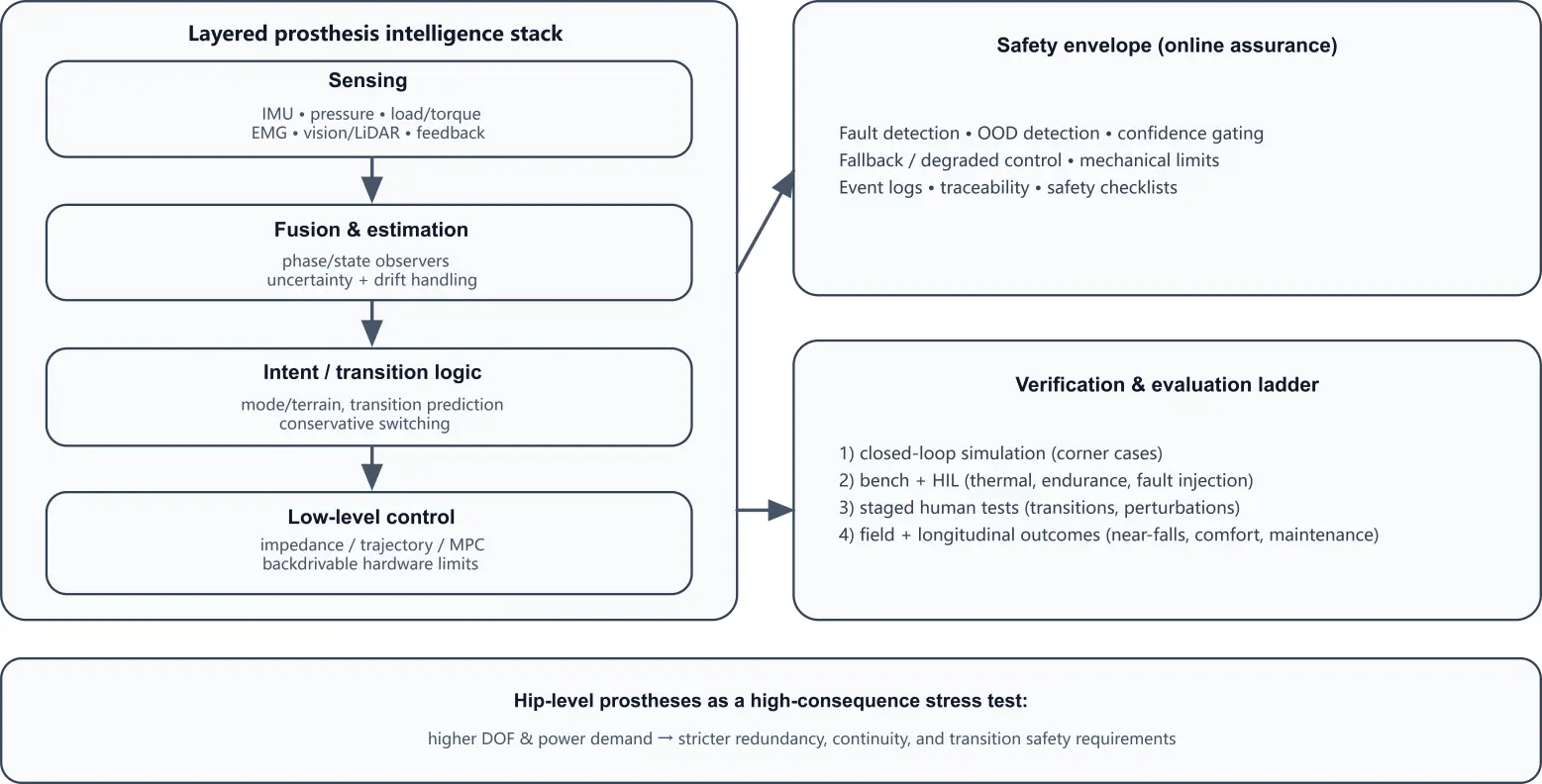
Figure 3. Layered safety/assurance stack for learning-enabled prostheses. A verifiable mechanical and low-level control core is complemented by online monitoring (fault detection, confidence gating), conservative fallback/degraded control, logging and traceability, and standardized evaluation to bound risk, especially for hip-level systems.
3.9.1. Hip-Level Fail-Safety
Fail-safe design for hip-level systems should be consequence-aware and architecture-driven, given the more severe consequences of failure and reduced available compensation. If critical actuation/transmission or sensing fails, proximal compensation margins are limited; beyond conventional strength and fatigue assessment, designs should incorporate redundant braking and/or mechanical locking, hard end-stops, and conservative degraded-control modes that maintain support and allow controlled task exit. Software should complement this with anomaly detection, confidence evaluation, and interpretable rollback logic (e.g., gate high-torque assistance unless state/intent confidence is sufficient) to bound risk during stairs, turning, and sit-to-stand [154,155,156,159,173].
3.9.2. Online Assurance and Traceability
Safety and reliability research commonly spans fault diagnosis, anomaly detection, redundancy and fallback mechanisms, risk assessment, and standardized testing. It also imposes stricter verifiability requirements on learning modules and neural control: risks of misrecognition or policy instability tend to concentrate during transitions and corner cases. Accordingly, online assurance mechanisms, such as confidence gating, out-of-distribution detection, and logging for traceability, should be treated as integral components of the control stack rather than optional add-ons [89,171,174,175].
3.9.3. Standardization and Reporting
On standardization, existing work has proposed roadmaps for neurally controlled prostheses, with a central demand to front-load testable performance/safety endpoints, risk categorization, and consistent reporting templates. Only when studies report under a unified set of tasks and failure scenarios, with consistent definitions (e.g., safety endpoints, transition errors, near-fall events), can evidence become comparable and support regulatory translation [42,171,172].
3.9.4. Reliability and Manufacturing
Mechanical reliability and manufacturing should be integrated into the same safety narrative because structure, control, and clinical outcomes are tightly coupled in powered prostheses. For example, the mechanical behavior and validation of 3D-printed prosthetic-foot components, together with changes in foot stiffness category, can meaningfully alter gait biomechanics, indicating that purely structural qualification is insufficient without closed-loop evaluation under realistic loading and control conditions [47,176].
3.9.5. Unified Verification
From a system-safety viewpoint, standardized mechanical tests and control safety are not independent paths. For instance, the powered hip-joint prototype reported by Brannen et al. included structural strength and mechanical validation; its significance is not only mechanical compliance but also providing a validated platform on which learning control and automatic mode switching can be assessed within a bounded safety envelope [154].
With the introduction of learning and neural interfaces, safety and standardization have shifted from optional extras to front-end constraints of system design. Future work should integrate confidence gating, anomaly detection, fallback strategies, and clinically interpretable reporting into a unified verification framework to support automatic transitions and learning control in real-world environments [42,89,171].
4. Open Challenges and Future Directions
Translation of intelligent lower-limb prostheses is increasingly constrained by system-level issues rather than isolated component performance. Even when actuation, sensing, or control performs well in controlled experiments, deployment often fails at the interfaces: robustness across days and environments, safe and reliable task transitions, and evidence that benefits persist in daily life. This section summarizes cross-cutting open challenges and outlines future directions toward clinically deployable systems. High-level amputations (hip-disarticulation/hip-joint-level) are used in subsection (6) as a high-consequence “stress test” that amplifies these bottlenecks.
- (1)
-
Real-world usability and long-term outcomes: End-user studies now cover a wider set of tasks, but they remain commonly limited by small sample sizes, short follow-up, and insufficient reporting of day-to-day stability. Future work should report traditional endpoints (e.g., metabolic cost and symmetry) alongside safety- and usability-relevant outcomes such as near-falls, task completion under fatigue, and longitudinal comfort. Reporting should be standardized to improve external validity. Notably, how endurance and fatigue endpoints are defined can substantially change the relative ranking of control strategies. Best et al. used the number of laps completed in a multi-task circuit as a primary endpoint, providing a practical template because it naturally integrates task diversity and fatigue into a single, interpretable outcome [34].
- (2)
-
System trade-offs among energy, weight, and form factor: Higher power density and lightweighting remain essential, but low noise, low mechanical impedance, and backdrivable compliance are equally important for comfort and bodily integration. Foot-size devices (e.g., ELSA) and low-power energy-management mechanisms illustrate opportunities to deliver useful assistance in constrained volumes, but they should be evaluated under realistic tasks and long-term wear constraints rather than short laboratory trials [5,8,49,72].
- (3)
-
Day-to-day robustness of sensing and interfaces: Cross-day drift driven by placement variability, skin condition, sweat, and environmental factors remains a primary deployment bottleneck. Studies should explicitly report calibration burden, drift/failure modes, real-time latency (e.g., <2 ms), and uncertainty-aware gating with conservative fallback control [9,11,89,125,175]. Vision can provide look-ahead but must address energy consumption, occlusion, and privacy; in practice, it is most credible when paired with proximal sensing rather than used alone [10,88,105]. Visuotactile designs (e.g., TacLeg) offer an intuitive pathway to translate look-ahead information into wearable feedback [107]. For EMG, electrode shift and fatigue are major sources of drift; mitigation strategies include improved electrodes, multimodal fusion, and online adaptation [87]. HDsEMG supports individualized calibration [177]. Low-channel volitional control and edge RNN pipelines are promising, but amputee validation and cross-day evidence remain necessary [92,93].
- (4)
-
Translational pathways for sensory closed loops and embodiment: Tactile and proprioceptive feedback can shape speed perception, motor adaptation, and long-term usability [12,13]. The bidirectional bionic-limb perspective argues that efferent and afferent pathways should be co-designed and co-evaluated; sensory return should therefore inform core control choices and endpoints rather than remain an add-on module [57]. Future studies should link feedback parameters to acceptability, learning curves, and functional outcomes under explicit safety and ethics constraints. Scalable options include peripheral haptics/vibration and integrable visuotactile devices such as TacLeg [107].
- (5)
-
Verifiable safety for learning-enabled modules: Reinforcement learning (RL) and human-in-the-loop (HIL) optimization can accelerate personalization, but they require explicit safety constraints, online monitoring, and reliable fallback behavior, together with standardized trial designs that limit fatigue and learning confounds [16,18]. Comfort and interface pressure can be optimized as measurable safety objectives, but they require longitudinal and cross-day evidence to be clinically persuasive [9,30,33]. Simulation RL reduces risk during exploration, yet still needs a credible sim-to-real validation chain [165]. End-to-end learned torque control can reduce rule tuning, but it increases demands on interpretability, fault diagnosis, and failure containment; it should be paired with uncertainty estimation, anomaly detection, conservative fallback, and sensitivity analyses grounded in structural testing [47,154].
- (6)
-
Whole-body coordination and validation platforms for hip-level systems (high-consequence case): Hip-disarticulation/hip-joint-level prostheses impose stricter constraints and higher consequences of failure, and therefore expose the hardest system-level bottlenecks. Key challenges include: (i) generating high peak power while limiting proximal mass/inertia and thermal burden; (ii) managing pelvic interface mechanics, donning variability, and long-term comfort/skin health; and (iii) achieving safe multi-task transitions with explicit fail-safe behavior under sensing/actuation uncertainty. Progress will likely require a staged validation toolchain—physics-based simulation, hardware-in-the-loop and bench testing (including failure injection), and carefully phased human studies—paired with conservative front-loaded safety strategies and transparent logging/traceability [159,169].
- (7)
-
Data, benchmarks, and standardization: Although standardization roadmaps have been discussed, cross-study comparability remains insufficient. Open datasets and unified task sets/reporting templates that span centers, devices, and days are urgently needed so that “hardware + sensing + control + learning + validation” can be evaluated and reproduced under a common yardstick. At a macro level, perspective and review articles have reviewed progress in lower-limb prostheses across materials, actuation, control, and clinical needs, emphasizing affordability, maintainability, and standardized evaluation as prerequisites for clinical adoption [178,179]. Benchmark-dataset mapping and open-source leg-prosthesis platforms may further support reusable evaluation resources [172,180].
5. Conclusions
This review synthesized recent progress in intelligent lower-limb prostheses through a system-level lens spanning electromechanical design, sensing and human-machine interfaces, phase/state estimation, intent recognition, control frameworks, learning-based personalization, and safety/standardization. Across these layers, the recent literature suggests a gradual shift from purely discrete mode switching toward continuous phase/state variables and variable-impedance behaviors enabled by multimodal sensing. However, translation to daily use is still constrained by endpoint mismatch, limited external validity across terrains and days, and insufficient reporting of failure modes and fallback behavior. Future advances may depend on integrated co-design of hardware and control, redundancy-aware sensing architectures, confidence-gated decision-making, and benchmarked evaluation protocols that connect laboratory metrics to real-world safety and long-term outcomes, especially for hip-level systems where consequences are amplified.
Statement of the Use of Generative AI and AI-Assisted Technologies in the Writing Process
During the preparation of this manuscript, the author(s) used ChatGPT (OpenAI) in order to improve the clarity, grammar, and readability of the text through language polishing and stylistic refinement. After using this tool/service, the author(s) reviewed and edited the content as needed and take(s) full responsibility for the content of the published article.
Acknowledgments
The authors thank their colleagues for constructive discussions that improved the manuscript.
Author Contributions
X.S.: Conceptualization, Methodology, Investigation, Data curation, Writing—original draft, Visualization. S.L.: Investigation, Data curation, Writing—review & editing. X.W.: Data curation, Formal analysis, Writing—review & editing. Q.L.: Data curation, Writing—review & editing. Y.Q.: Visualization, Writing—review & editing. Q.M.: Supervision, Writing—review & editing. H.Y.: Conceptualization, Supervision, Project administration, Writing—review & editing. All authors reviewed and approved the final manuscript.
Ethics Statement
Not applicable. This article is a systematic review of previously published literature and did not involve any new studies with human participants or animals performed by any of the authors.
Informed Consent Statement
Not applicable. This study did not involve the recruitment of participants or the collection of identifiable personal data.
Data Availability Statement
No new data were generated or analyzed in this study. All information supporting the findings of this review is available within the article.
Funding
This work was supported by the National Natural Science Foundation of China (NSFC) (Grant No. 62473263).
Declaration of Competing Interest
The authors declare that they have no known competing financial interests or personal relationships that could have appeared to influence the work reported in this paper.
References
- Khamis T, Khamis AA, Al Kouzbary M, Al Kouzbary H, Mokayed H, AbdRazak NA, et al. Automated Transtibial Prosthesis Alignment: A Systematic Review. Artif. Intell. Med. 2024, 156, 102966. DOI:10.1016/j.artmed.2024.102966 [Google Scholar]
- Hafner BJ, Halsne EG, Morgan SJ, Morgenroth DC, Humbert AT. Effects of Prosthetic Feet on Metabolic Energy Expenditure in People with Transtibial Amputation: A Systematic Review and Meta-Analysis. PM R 2022, 14, 1099–1115. DOI:10.1002/pmrj.12693 [Google Scholar]
- Fu G, Zhu J, Wang Z, Mai J, Wang Q. Mechatronic Design and Implementation of a Low-Noise Powered Knee Prosthesis with High Backdrivability. IEEE/ASME Trans. Mechatron. 2023, 28, 3180–3190. DOI:10.1109/TMECH.2023.3257194 [Google Scholar]
- Tran M, Gabert L, Hood S, Lenzi T. A Lightweight Robotic Leg Prosthesis Replicating the Biomechanics of the Knee, Ankle, and Toe Joint. Sci. Robot. 2022, 7, eabo3996. DOI:10.1126/scirobotics.abo3996 [Google Scholar]
- Heremans F, Evrard J, Langlois D, Ronsse R. ELSA: A Foot-Size Powered Prosthesis Reproducing Ankle Dynamics During Various Locomotion Tasks. IEEE Trans. Robot. 2025, 41, 415–429. DOI:10.1109/TRO.2024.3508314 [Google Scholar]
- Fagioli I, Lanotte F, Fiumalbi T, Baldoni A, Mazzarini A, Dell’Agnello F, et al. An Underactuated Active Transfemoral Prosthesis with Series Elastic Actuators Enables Multiple Locomotion Tasks. IEEE Trans. Robot. 2024, 40, 3306–3321. DOI:10.1109/TRO.2024.3415228 [Google Scholar]
- Price MA, Sup FC, IV. A Sagittal Planar Ankle–Foot Prosthesis with Powered Plantarflexion and Socket Alignment. IEEE/ASME Trans. Mechatron. 2026, 31, 1731–1740. DOI:10.1109/TMECH.2025.3610547 [Google Scholar]
- Fu G, Zhu W, Wang H, Huang Y, Zhu J, Ruan L, et al. A Robotic Transtibial Prosthesis With Equilibrium-Adjustable Parallel Springs to Improve Energy Efficiency in Slope Walking. IEEE/ASME Trans. Mechatron. 2025, 30, 2210–2221. DOI:10.1109/TMECH.2024.3431277 [Google Scholar]
- Tabor J, Agcayazi T, Fleming A, Thompson B, Kapoor A, Liu M, et al. Textile-Based Pressure Sensors for Monitoring Prosthetic-Socket Interfaces. IEEE Sens. J. 2021, 21, 9413–9422. DOI:10.1109/JSEN.2021.3053434 [Google Scholar]
- Al-Dabbagh AHA, Ronsse R. Depth Vision-Based Terrain Detection Algorithm During Human Locomotion. IEEE Trans. Med. Robot. Bionics 2022, 4, 1010–1021. DOI:10.1109/TMRB.2022.3206602 [Google Scholar]
- Fleming A, Stafford N, Huang S, Hu X, Ferris DP, Huang H. Myoelectric Control of Robotic Lower Limb Prostheses: A Review of Electromyography Interfaces, Control Paradigms, Challenges and Future Directions. J. Neural Eng. 2021, 18, 041004. DOI:10.1088/1741-2552/ac1176 [Google Scholar]
- Kim D, Triolo R, Charkhkar H. Plantar Somatosensory Restoration Enhances Gait, Speed Perception, and Motor Adaptation. Sci. Robot. 2023, 8, eadf8997. DOI:10.1126/scirobotics.adf8997 [Google Scholar]
- Valle G, Saliji A, Fogle E, Cimolato A, Petrini FM, Raspopovic SS. Mechanisms of Neuro-Robotic Prosthesis Operation in Leg Amputees. Sci. Adv. 2021, 7, eabd8354. DOI:10.1126/sciadv.abd8354 [Google Scholar]
- Hood SA, Gabert L, Lenzi T. Powered Knee and Ankle Prosthesis with Adaptive Control Enables Climbing Stairs with Different Stair Heights, Cadences, and Gait Patterns. IEEE Trans. Robot. 2022, 38, 1430–1441. DOI:10.1109/TRO.2022.3152134 [Google Scholar]
- Embry KR, Gregg RD. Analysis of Continuously Varying Kinematics for Prosthetic Leg Control Applications. IEEE Trans. Neural Syst. Rehabil. Eng. 2021, 29, 262–272. DOI:10.1109/TNSRE.2020.3045003 [Google Scholar]
- Li M, Wen Y, Gao X, Si J, Huang H. Toward Expedited Impedance Tuning of a Robotic Prosthesis for Personalized Gait Assistance by Reinforcement Learning Control. IEEE Trans. Robot. 2022, 38, 407–420. DOI:10.1109/TRO.2021.3078317 [Google Scholar]
- Alili A, Nalam V, Li M, Liu M, Feng J, Si J, et al. A Novel Framework to Facilitate User Preferred Tuning for a Robotic Knee Prosthesis. IEEE Trans. Neural Syst. Rehabil. Eng. 2023, 31, 895–903. DOI:10.1109/TNSRE.2023.3236217 [Google Scholar]
- Welker CG, Voloshina AS, Chiu VL, Collins SH. Shortcomings of Human-in-the-Loop Optimization of an Ankle-Foot Prosthesis Emulator: A Case Series. R. Soc. Open Sci. 2021, 8, 202020. DOI:10.1098/rsos.202020 [Google Scholar]
- Xu D, Wang Q. Noninvasive Human-Prosthesis Interfaces for Locomotion Intent Recognition: A Review. Cyborg Bionic Syst. 2021, 2021, 9863761. DOI:10.34133/2021/9863761 [Google Scholar]
- Dey S, Schilling AF. A Function Approximator Model for Robust Online Foot Angle Trajectory Prediction Using a Single IMU Sensor: Implication for Controlling Active Prosthetic Feet. IEEE Trans. Ind. Inform. 2023, 19, 1467–1475. DOI:10.1109/TII.2022.3158935 [Google Scholar]
- Liang F, Mo L, Sun Y, Guo C, Gao F, Liao WH, et al. Interlimb and Intralimb Synergy Modeling for Lower Limb Assistive Devices: Modeling Methods and Feature Selection. Cyborg Bionic Syst. 2024, 5, 0122. DOI:10.34133/cbsystems.0122 [Google Scholar]
- Liu W, Nalam V, Si J, Huang H. Addressing Human–Robot Symbiosis via Bilevel Optimization of Robotic Knee Prosthesis Control. IEEE Trans. Robot. 2026, 42, 170–183. DOI:10.1109/TRO.2025.3634368 [Google Scholar]
- Fleming A, Liu W, Huang H. Neural Prosthesis Control Restores Near-Normative Neuromechanics in Standing Postural Control. Sci. Robot. 2023, 8, eadf5758. DOI:10.1126/scirobotics.adf5758 [Google Scholar]
- Sharma S, George B. Shoes with Integrated Electrodes to Measure Floor Impedance and Its Application to Automatic Pathway Classification. IEEE Trans. Instrum. Meas. 2024, 73, 1500809. DOI:10.1109/TIM.2024.3365573 [Google Scholar]
- Mendez J, Murray R, Gabert L, Fey NP, Liu H, Lenzi T. A-Mode Ultrasound-Based Prediction of Transfemoral Amputee Prosthesis Walking Kinematics via an Artificial Neural Network. IEEE Trans. Neural Syst. Rehabil. Eng. 2023, 31, 1511–1520. DOI:10.1109/TNSRE.2023.3248647 [Google Scholar]
- Mobarak R, Tigrini A, Verdini F, Al-Timemy AH, Fioretti S, Burattini L, et al. A Minimal and Multi-Source Recording Setup for Ankle Joint Kinematics Estimation During Walking Using Only Proximal Information From Lower Limb. IEEE Trans. Neural Syst. Rehabil. Eng. 2024, 32, 812–821. DOI:10.1109/TNSRE.2024.3364976 [Google Scholar]
- Hong Z, Bian S, Xiong P, Li Z. Vision-Locomotion Coordination Control for a Powered Lower-Limb Prosthesis Using Fuzzy-Based Dynamic Movement Primitives. IEEE Trans. Autom. Sci. Eng. 2024, 21, 1188–1200. DOI:10.1109/TASE.2023.3250240 [Google Scholar]
- Manz S, Valette R, Damonte F, Avanci Gaudio L, Gonzalez-Vargas JE, Sartori M, et al. A Review of User Needs to Drive the Development of Lower Limb Prostheses. J. NeuroEng. Rehabil. 2022, 19, 119. DOI:10.1186/s12984-022-01097-1 [Google Scholar]
- Lee IC, Fylstra BL, Liu M, Lenzi T, Huang H. Is There a Trade-off between Economy and Task Goal Variability in Transfemoral Amputee Gait? J. NeuroEng. Rehabil. 2022, 19, 29. DOI:10.1186/s12984-022-01004-8 [Google Scholar]
- Gao R, Rossi EJ, O’Connell ME, Lee PS, Dittmer DK, Schirm AC, et al. Soft Dynamic Fluidic Cushion for Pressure Sore Management in Transtibial Prosthetics—A Proof-of-Concept Study. IEEE Trans. Biomed. Eng. 2026, 73, 1221–1235. DOI:10.1109/TBME.2025.3600562 [Google Scholar]
- Paternò L, Filosa M, Anselmino E, Cecere A, Dell’Agnello F, Gruppioni E, et al. Soft Transfemoral Prosthetic Socket with Sensing and Augmenting Feedback: A Case Study. IEEE Trans. Med. Robot. Bionics 2024, 6, 536–547. DOI:10.1109/TMRB.2024.3381378 [Google Scholar]
- Roehrich K, Goldberg MR, Fiedler G. Robotic-Enhanced Prosthetic Liners for Vibration Therapy: Reducing Phantom Limb Pain in Transfemoral Amputees. Sensors 2024, 24, 5026. DOI:10.3390/s24155026 [Google Scholar]
- Mbithi FM, Chipperfield AJ, Steer JW, Dickinson AS. Developing a Control Framework for Self-Adjusting Prosthetic Sockets Incorporating Tissue Injury Risk Estimation and Generalized Predictive Control. Biomed. Eng. Lett. 2022, 12, 59–73. DOI:10.1007/s13534-021-00211-x [Google Scholar]
- Best TK, Laubscher CA, Cortino RJ, Cheng S, Gregg RD. Improving Amputee Endurance Over Activities of Daily Living with a Robotic Knee-Ankle Prosthesis: A Case Study. In Proceedings of the 2023 IEEE/RSJ International Conference on Intelligent Robots and Systems (IROS), Detroit, MI, USA, 1–5 October 2023. DOI:10.1109/IROS55552.2023.10341643 [Google Scholar]
- Hunt GR, Hood SA, Lenzi T. Stand-Up, Squat, Lunge, and Walk with a Robotic Knee and Ankle Prosthesis under Shared Neural Control. IEEE Open J. Eng. Med. Biol. 2021, 2, 267–277. DOI:10.1109/OJEMB.2021.3104261 [Google Scholar]
- Kibria Z, Kotamraju BP, Commuri S. An Intelligent Control Approach for Reduction of Gait Asymmetry in Transfemoral Amputees. In Proceedings of the 2023 International Symposium on Medical Robotics (ISMR), Atlanta, GA, USA, 19–21 April 2023. DOI:10.1109/ISMR57123.2023.10130204 [Google Scholar]
- Lee J, Goldfarb M. The Effects of Swing Assistance in a Microprocessor-Controlled Transfemoral Prosthesis on Walking at Varying Speeds and Grades. Wearable Technol. 2023, 4, e9. DOI:10.1017/wtc.2023.4 [Google Scholar]
- Fanciullacci C, McKinney Z, Monaco V, Milandri G, Davalli A, Sacchetti R, et al. Survey of Transfemoral Amputee Experience and Priorities for the User-Centered Design of Powered Robotic Transfemoral Prostheses. J. NeuroEng. Rehabil. 2021, 18, 168. DOI:10.1186/s12984-021-00944-x [Google Scholar]
- Earley EJ, Milius DW, Awad ME, Melton DH, Ahmed K, Leijendekkers RA, et al. Establishing Consensus for Prescription of Prosthetic Components for Transfemoral Bone-Anchored Limbs: An International Delphi Method Study. Arch. Phys. Med. Rehabil. 2025, 106, 1565–1574. DOI:10.1016/j.apmr.2025.06.011 [Google Scholar]
- Lathouwers E, Díaz MA, Maricot A, Tassignon B, Cherelle C, Cherelle P, et al. Therapeutic Benefits of Lower Limb Prostheses: A Systematic Review. J. NeuroEng. Rehabil. 2023, 20, 4. DOI:10.1186/s12984-023-01128-5 [Google Scholar]
- King ST, Eveld ME, Zelik KE, Goldfarb M. Factors Leading to Falls in Transfemoral Prosthesis Users: A Case Series of Prosthesis-Side Stumble Recovery Responses. J. NeuroEng. Rehabil. 2024, 21, 117. DOI:10.1186/s12984-024-01402-0 [Google Scholar]
- Prost V, Johnson WB, Kent JA, Major MJ, Amos GWV. Systematic Assessment of Prosthesis Stiffness on User Biomechanics Using the Lower Leg Trajectory Error Framework and Its Implication for the Design and Evaluation of Ankle-Foot Prostheses. J. Biomech. Eng. 2023, 145, 041002. DOI:10.1115/1.4056137 [Google Scholar]
- Slater C, Halsne EG, Czerniecki JM, Morgenroth DC. The Effect of Prosthetic Foot Stiffness Category on Intact Limb Knee Loading Associated with Osteoarthritis in People with Transtibial Amputation. J. Biomech. 2024, 176, 112368. DOI:10.1016/j.jbiomech.2024.112368 [Google Scholar]
- Cubillos LH, Rouse EJ, Augenstein TE, Joshi V, Claflin ES, Krishnan C. Reliability and Minimal Detectable Change of Stiffness and Other Mechanical Properties of the Ankle Joint in Standing and Walking. Gait Posture 2024, 108, 56–62. DOI:10.1016/j.gaitpost.2023.11.008 [Google Scholar]
- Folinus C, Amos V. Design and Mechanical Validation of Commercially Viable, Personalized Passive Prosthetic Feet. J. Mech. Des. 2025, 147, 035001. DOI:10.1115/1.4064073 [Google Scholar]
- Young JL, Guerin E, Besemann M, Dudek N. Microprocessor Knee versus Non-Microprocessor Knee for Backup Device in Lower Limb Prostheses: A Qualitative Study. J. Mil. Veteran Fam. Health 2022, 8, 19–31. DOI:10.3138/jmvfh-2021-0094 [Google Scholar]
- Driessen JJ, Laffranchi M, De Michieli L. A Reduced-Order Closed-Loop Hybrid Dynamic Model for Design and Development of Lower Limb Prostheses. Wearable Technol. 2023, 4, e10. DOI:10.1017/wtc.2023.6 [Google Scholar]
- Zhu J, Jiao C, Dominguez I, Yu S, Su H. Design and Backdrivability Modeling of a Portable High Torque Robotic Knee Prosthesis with Intrinsic Compliance for Agile Activities. IEEE/ASME Trans. Mechatron. 2022, 27, 1837–1845. DOI:10.1109/TMECH.2022.3176255 [Google Scholar]
- Rogers-Bradley E, Yeon SH, Landis C, Herr HM. Design and Evaluation of a Quasi-Passive Variable Stiffness Prosthesis for Walking Speed Adaptation in People with Transtibial Amputation. IEEE/ASME Trans. Mechatron. 2024, 29, 335–346. DOI:10.1109/TMECH.2023.3276710 [Google Scholar]
- Gao S, Mai J, Zhu J, Wang Q. Mechanism and Controller Design of a Transfemoral Prosthesis with Electrohydraulic Knee and Motor-Driven Ankle. IEEE/ASME Trans. Mechatron. 2021, 26, 2429–2439. DOI:10.1109/TMECH.2020.3040369 [Google Scholar]
- Rogers EA, Carney ME, Yeon SH, Clites TR, Solav D, Herr HM. An Ankle-Foot Prosthesis for Rock Climbing Augmentation. IEEE Trans. Neural Syst. Rehabil. Eng. 2021, 29, 41–51. DOI:10.1109/TNSRE.2020.3033474 [Google Scholar]
- Hunt GR, Hood SA, Gabert L, Lenzi T. Can a Powered Knee-Ankle Prosthesis Improve Weight-Bearing Symmetry during Stand-to-Sit Transitions in Individuals with above-Knee Amputations? J. NeuroEng. Rehabil. 2023, 20, 58. DOI:10.1186/s12984-023-01177-w [Google Scholar]
- Jang W, Kim DY, Choi YS, Kim Y. Self-Contained 2-DOF Ankle-Foot Prosthesis with Low-Inertia Extremity for Agile Walking on Uneven Terrain. IEEE Robot. Autom. Lett. 2021, 6, 8134–8141. DOI:10.1109/LRA.2021.3098931 [Google Scholar]
- Chen W, Ma Y, Ren L, Liang W, Wang X, Zhang Y, et al. A Lightweight Powered Knee Prosthesis Replicating Early-Stance Knee Flexion During Level Walking. IEEE Robot. Autom. Lett. 2024, 9, 9693–9700. DOI:10.1109/LRA.2024.3416799 [Google Scholar]
- Kelly DJ, Wensing PM. A Task-Space Control Framework for Powered Ankle Prostheses: Design, Implementation, and Evaluation. IEEE Trans. Med. Robot. Bionics 2025, 7, 1553–1564. DOI:10.1109/TMRB.2025.3604085 [Google Scholar]
- Carney ME, Shu T, Stolyarov R, Duval JF, Herr HM. Design and Preliminary Results of a Reaction Force Series Elastic Actuator for Bionic Knee and Ankle Prostheses. IEEE Trans. Med. Robot. Bionics 2021, 3, 542–553. DOI:10.1109/TMRB.2021.3098921 [Google Scholar]
- Pasluosta CF, Kiele P, C̆vanc̆ara P, Micera S, Aszmann OC, Stieglitz TC. Bidirectional Bionic Limbs: A Perspective Bridging Technology and Physiology. J. Neural Eng. 2022, 19, 013001. DOI:10.1088/1741-2552/ac4bff [Google Scholar]
- Akhmejanov S, Nursultan Z, Sultan A, Zhauyt A, Nurgizat Y, Ozhikenov AK, et al. Design and Analysis of an Autonomous Active Ankle–Foot Prosthesis with 2-DoF. Sensors 2025, 25, 4881. DOI:10.3390/s25164881 [Google Scholar]
- Welker CG, Best TK, Gregg RD. Data-Driven Variable Impedance Control of a Powered Knee-Ankle Prosthesis for Sit, Stand, and Walk with Minimal Tuning. In Proceedings of the 2022 IEEE/RSJ International Conference on Intelligent Robots and Systems (IROS), Kyoto, Japan, 23–27 October 2022. DOI:10.1109/IROS47612.2022.9982037 [Google Scholar]
- Ulhoa P, Fiorezi G, Filho T, Andrade R. Experimental Evaluation of a Lightweight and Backdrivable Powered Knee Prosthesis for Transfemoral Amputees. In Proceedings of the 2023 IEEE Colombian Caribbean Conference (C3), Barranquilla, Colombia, 22–25 November 2023. DOI:10.1109/C358072.2023.10436207 [Google Scholar]
- Sun H, He C, Vujaklija I. Design Trends in Actuated Lower-Limb Prosthetic Systems: A Narrative Review. Expert Rev. Med. Devices 2023, 20, 1157–1172. DOI:10.1080/17434440.2023.2279999 [Google Scholar]
- Shehata EG, William MY, Hassan AAE, Ibrahim K. Development and Control of Concise Semi-Active Ankle Prosthesis. WSEAS Trans. Syst. Control. 2023, 18, 108–120. DOI:10.37394/23203.2023.18.12 [Google Scholar]
- Fiorezi GG, Ulhoa PHF, Filho AB, De Andrade RM. Digital Prototyping of a Microprocessor Controlled Active Knee Prosthesis. In Proceedings of the 2021 IEEE URUCON, Montevideo, Uruguay, 24–26 November 2021. DOI:10.1109/URUCON53396.2021.9647069 [Google Scholar]
- Alves B, Fantoni A, Matos JP, Costa J. A Wearable IoT-Based System for Gait Cycle Duration and Symmetry Assessment in Lower-Limb Amputees. In Proceedings of the 2025 9th International Young Engineers Forum on Electrical and Computer Engineering (YEF-ECE), Caparica/Lisbon, Portugal, 4 July 2025. DOI:10.1109/YEF-ECE66503.2025.11117464 [Google Scholar]
- Evrard J, Heremans F, Ronsse R. Validation of a Heuristic Intention Detection Algorithm for a Powered Ankle Prosthesis Across Various Ambulation Tasks. In Proceedings of the 2024 10th IEEE RAS/EMBS International Conference for Biomedical Robotics and Biomechatronics (BioRob), Heidelberg, Germany, 1–4 September 2024. DOI:10.1109/BioRob60516.2024.10719811 [Google Scholar]
- Koçak M, Gezgin E. Unified Design Methodology for a Polycentric Transfemoral Knee Prosthesis Using Kinematic Synthesis. Machines 2024, 13, 20. DOI:10.3390/machines13010020 [Google Scholar]
- Abdulmalek G, Ammounah A, Oufroukh NA, Alfayad S, Mammar S. Design and Implementation of High Dynamics Servo-Valve Driver for Electro-hydraulic Actuator in Legged Robot’s Applications. In Proceedings of the 2023 3rd International Conference on Electrical, Computer, Communications and Mechatronics Engineering (ICECCME), Tenerife, Canary Islands, Spain, 19–21 July 2023. DOI:10.1109/ICECCME57830.2023.10253324 [Google Scholar]
- Bartlett HL, King ST, Goldfarb M, Lawson BE. Design and Assist-As-Needed Control of a Lightly Powered Prosthetic Knee. IEEE Trans. Med. Robot. Bionics 2022, 4, 490–501. DOI:10.1109/TMRB.2022.3161068 [Google Scholar]
- Mazzarini A, Fagioli I, Eken H, Livolsi C, Ciapetti T, Maselli A, et al. Improving Walking Energy Efficiency in Transtibial Amputees Through the Integration of a Low-Power Actuator in an ESAR Foot. IEEE Trans. Neural Syst. Rehabil. Eng. 2024, 32, 1397–1406. DOI:10.1109/TNSRE.2024.3379904 [Google Scholar]
- Sharma R, Gaur P, Bhatt S, Joshi D. Performance Assessment of Fuzzy Logic Control Approach for MR-Damper Based-Transfemoral Prosthetic Leg. IEEE Trans. Artif. Intell. 2022, 3, 53–66. DOI:10.1109/TAI.2021.3106884 [Google Scholar]
- Brinon JG, Ronsse R. A Novel Concept of Passive Knee Prosthesis with Multiple Stiffnesses to Support Overground Walking and Sit-to-Stand. In Proceedings of the 2024 10th IEEE RAS/EMBS International Conference for Biomedical Robotics and Biomechatronics (BioRob), Heidelberg, Germany, 1–4 September 2024. DOI:10.1109/BioRob60516.2024.10719856 [Google Scholar]
- Leestma JK, Fehr KH, Adamczyk PG. Adapting Semi-Active Prostheses to Real-World Movements: Sensing and Controlling the Dynamic Mean Ankle Moment Arm with a Variable-Stiffness Foot on Ramps and Stairs. Sensors 2021, 21, 6009. DOI:10.3390/s21186009 [Google Scholar]
- Jagannathan Ranganathan S, Fernández-Montoya M, Aguirre ME. Nonlinear Stiffness Walking Cane Inspired by Prosthetic Leg Design. In International Workshop on Medical and Service Robots; Springer: Cham, Switzerland, 2025. DOI:10.1007/978-3-031-96081-9_21 [Google Scholar]
- Klute GK, Mulcahy CW. Sagittal and Transverse Ankle Angle Coupling Can Influence Prosthetic Socket Transverse Plane Moments. Front. Rehabil. Sci. 2024, 5, 1354144. DOI:10.3389/fresc.2024.1354144 [Google Scholar]
- Bartlett HL, King ST, Goldfarb M, Lawson BE. A Semi-Powered Ankle Prosthesis and Unified Controller for Level and Sloped Walking. IEEE Trans. Neural Syst. Rehabil. Eng. 2021, 29, 320–329. DOI:10.1109/TNSRE.2021.3049194 [Google Scholar]
- Song H, Cao Y, Chen W, Ren L, Ma Y, Wang K, et al. Design, Testing and Control of a Magnetorheological Damper for Knee Prostheses. J. Bionic Eng. 2024, 21, 1788–1800. DOI:10.1007/s42235-024-00535-1 [Google Scholar]
- Ryu S, Kim J, Sim WS, Kim SH. Development of Low-Cost Non-Powered Prosthesis Using Multi-Axis System of Toe Joint and Ankle. J. Mech. Sci. Technol. 2022, 36, 1183–1188. DOI:10.1007/s12206-022-0210-y [Google Scholar]
- An H, Zhang J, Wei Q, Ma H. Design and Preliminary Experimental Result of a Lower Limb Prosthesis. In Proceedings of the 2022 7th International Conference on Automation, Control and Robotics Engineering (CACRE), Xi’an, China, 14–16 July 2022. DOI:10.1109/CACRE54574.2022.9834174 [Google Scholar]
- Martínez Romero YL. Adaptive Device for Lower Extremity Prosthetics. Burn. Open 2021, 5, 206–210. DOI:10.1016/j.burnso.2021.08.073 [Google Scholar]
- Li L, Luo H, Luo S, Wang X, Shu X, Meng Q, et al. Design and Swing Control of a Power-Assisted Hip Disarticulation Prosthesis. IEEE/ASME Trans. Mechatron. 2026, 31, 290–300. DOI:10.1109/TMECH.2025.3586300 [Google Scholar]
- Golshan F, Lemaire E, Gholizadeh H, Nielen D, Baddour N. Design and Preliminary Evaluation of a Gait Control Strategy for Hip-Knee-Ankle-Foot Prostheses With Motorized Hip Joint. IEEE Trans. Neural Syst. Rehabil. Eng. 2025, 33, 3432–3442. DOI:10.1109/TNSRE.2025.3602715 [Google Scholar]
- Golshan F, Baddour NC, Gholizadeh H, Lemaire ED. A Pelvic Kinematic Approach for Calculating Hip Angles for Active Hip Disarticulation Prosthesis Control. J. NeuroEng. Rehabil. 2023, 20, 152. DOI:10.1186/s12984-023-01273-x [Google Scholar]
- Luo S, Shu X, Du J, Li H, Yu H. Enhancing Gait Symmetry via Intact Limb Kinematic Mapping Control of a Hip Disarticulation Prosthesis. Biomimetics 2025, 10, 714. DOI:10.3390/biomimetics10100714 [Google Scholar]
- Botros M, Gholizadeh H, Golshan F, Langlois D, Baddour NC, Lemaire ED. Development of a Powered Four-Bar Prosthetic Hip Joint Prototype. Prosthesis 2025, 7, 105. DOI:10.3390/PROSTHESIS7050105 [Google Scholar]
- Luo S, Chen Y, Fan M, Yu H. Design and Control System of a New Hip-Knee Integrated Intelligent Prostheses. In Proceedings of the 16th International Convention on Rehabilitation Engineering and Assistive Technology, Pathum Thani, Thailand, 8–11 August 2023. DOI:10.1145/3628228.3628487 [Google Scholar]
- Song M, Li Z, Jiang J, Chen W, Guo S, Zheng H, et al. Design, Simulation and Kinematic Validation of a Hip Prosthetic Mechanism with a Multimotor Function. J. Bionic Eng. 2024, 21, 1321–1333. DOI:10.1007/s42235-024-00490-x [Google Scholar]
- Yadav D, Veer K. Recent Trends and Challenges of Surface Electromyography in Prosthetic Applications. Biomed. Eng. Lett. 2023, 13, 353–373. DOI:10.1007/s13534-023-00281-z [Google Scholar]
- Krausz NE, Hargrove LJ. Sensor Fusion of Vision, Kinetics, and Kinematics for Forward Prediction During Walking With a Transfemoral Prosthesis. IEEE Trans. Med. Robot. Bionics 2021, 3, 813–824. DOI:10.1109/TMRB.2021.3082206 [Google Scholar]
- Naseri A, Liu M, Lee IC, Huang HH. Development and Online Validation of an Intrinsic Fault Detector for a Powered Robotic Knee Prosthesis. In Proceedings of the 2023 IEEE/RSJ International Conference on Intelligent Robots and Systems (IROS), Detroit, MI, USA, 1–5 October 2023. DOI:10.1109/IROS55552.2023.10342433 [Google Scholar]
- Ahkami B, Ahmed K, Thesleff A, Hargrove L, Ortiz-Catalan M. Electromyography-Based Control of Lower Limb Prostheses: A Systematic Review. IEEE Trans. Med. Robot. Bionics 2023, 5, 547–562. DOI:10.1109/TMRB.2023.3282325 [Google Scholar]
- Heo U, Jeong H, Feng J, Cho J, Park K, Yoon Y, et al. Development of a Bioimpedance and sEMG Fusion Sensor for Gait Phase Detection: Validation with a Transtibial Amputee. In Proceedings of the 2023 45th Annual International Conference of the IEEE Engineering in Medicine & Biology Society (EMBC), Sydney, Australia, 24–27 July 2023. DOI:10.1109/EMBC40787.2023.10340105 [Google Scholar]
- Creveling S, Cowan M, Sullivan LM, Gabert L, Lenzi T. Volitional EMG Control Enables Stair Climbing with a Robotic Powered Knee Prosthesis. In Proceedings of the 2023 IEEE/RSJ International Conference on Intelligent Robots and Systems (IROS), Detroit, MI, USA, 1–5 October 2023. DOI:10.1109/IROS55552.2023.10341615 [Google Scholar]
- Bittibssi TM, Zekry AA, Genedy MA, Maged SA. Implementation of Surface Electromyography Controlled Prosthetics Limb Based on Recurrent Neural Network. Concurr. Comput. Pract. Exp. 2022, 34, e6848. DOI:10.1002/cpe.6848 [Google Scholar]
- Stafford NE, Gonzalez EB, Ferris DP. Walking Ankle Biomechanics of Individuals With Transtibial Amputations Using a Prescribed Prosthesis and a Portable Bionic Prosthesis Under Myoelectric Control. IEEE Trans. Neural Syst. Rehabil. Eng. 2024, 32, 3036–3047. DOI:10.1109/TNSRE.2024.3440257 [Google Scholar]
- Guanipa Garcia ED, Salazar Ramirez CD, Serrezuela RR. Design, Development, and Functional Clinical Assessment of a Lower Limb Prosthetic System with Myoelectric Control via Surface Electromyography (sEMG). In Proceedings of the 2025 IEEE VIII Congreso Internacional en Inteligencia Ambiental, Ingenieria de Software y Salud Electronica y Movil (AmITIC), Neiva, Colombia, 24–26 September 2025. DOI:10.1109/AmITIC68284.2025.11214507 [Google Scholar]
- Park J, Jeong J, Kang M, Pritish N, Cho Y, Ha J, et al. Imperceptive and Reusable Dermal Surface EMG for Lower Extremity Neuro-Prosthetic Control and Clinical Assessment. Npj Flex. Electron. 2023, 7, 49. DOI:10.1038/s41528-023-00282-z [Google Scholar]
- Shu T, Shallal C, Chun E, Shah A, Bu A, Levine D, et al. Modulation of Prosthetic Ankle Plantarflexion Through Direct Myoelectric Control of a Subject-Optimized Neuromuscular Model. IEEE Robot. Autom. Lett. 2022, 7, 7620–7627. DOI:10.1109/LRA.2022.3183762 [Google Scholar]
- Shah C, Fleming A, Nalam V, Liu M, Huang H. Design of EMG-driven Musculoskeletal Model for Volitional Control of a Robotic Ankle Prosthesis. In Proceedings of the 2022 IEEE/RSJ International Conference on Intelligent Robots and Systems (IROS), Kyoto, Japan, 23–27 October 2022. DOI:10.1109/IROS47612.2022.9981305 [Google Scholar]
- Fleming A, Huang S, Buxton ED, Hodges F, Huang H. Direct Continuous Electromyographic Control of a Powered Prosthetic Ankle for Improved Postural Control after Guided Physical Training: A Case Study. Wearable Technol. 2021, 2, e3. DOI:10.1017/wtc.2021.2 [Google Scholar]
- Cimolato A, Driessen JJ, Mattos LS, De Momi E, Laffranchi M, De Michieli L. EMG-driven Control in Lower Limb Prostheses: A Topic-Based Systematic Review. J. NeuroEng. Rehabil. 2022, 19, 43. DOI:10.1186/s12984-022-01019-1 [Google Scholar]
- Gouda A, Andrysek J. Rules-Based Real-Time Gait Event Detection Algorithm for Lower-Limb Prosthesis Users during Level-Ground and Ramp Walking. Sensors 2022, 22, 8888. DOI:10.3390/s22228888 [Google Scholar]
- Fiumalbi T, Martini E, Papapicco V, Dell’Agnello F, Mazzarini A, Baldoni A, et al. A Multimodal Sensory Apparatus for Robotic Prosthetic Feet Combining Optoelectronic Pressure Transducers and IMU. Sensors 2022, 22, 1731. DOI:10.3390/s22051731 [Google Scholar]
- Haque MR, Berkeley G, Shen X. Force-Moment Sensor for Prosthesis Structural Load Measurement. Sensors 2023, 23, 938. DOI:10.3390/s23020938 [Google Scholar]
- Hamzah NA, Abd Razak NA, Ab Karim MS, Salleh SZ. Volume Fluctuations in Active and Nonactive Transtibial Prosthetics Users. BioMed Res. Int. 2022, 2022, 2669484. DOI:10.1155/2022/2669484 [Google Scholar]
- Li L, Wang X, Meng Q, Yu H. A Wearable Computer Vision System with Gimbal Enables Position-, Speed-, and Phase-Independent Terrain Classification for Lower Limb Prostheses. IEEE Trans. Neural Syst. Rehabil. Eng. 2023, 31, 4539–4548. DOI:10.1109/TNSRE.2023.3331273 [Google Scholar]
- Petros E, Miller ME, Dunning JL, Pinault GC, Tyler DJ, Triolo RJ, et al. Long-Term Performance and Stability of Implanted Neural Interfaces in Individuals with Lower Limb Loss. J. Neural Eng. 2025, 22, 016013. DOI:10.1088/1741-2552/ada829 [Google Scholar]
- Duong LV. TacLeg: A Novel Visuotactile Device for Below-Knee Leg Prostheses. IEEE Robot. Autom. Lett. 2024, 9, 8027–8034. DOI:10.1109/LRA.2024.3438038 [Google Scholar]
- Karimi M, Yeganeh N, Makarov IM, Sverrisson AO, Gunnarsson KF, Briem K, et al. Haptic Feedback Systems for Lower-Limb Prosthetic Applications: A Review of System Design, User Experience, and Clinical Insights. Bioengineering 2025, 12, 989. DOI:10.3390/bioengineering12090989 [Google Scholar]
- Hong W, Kumar NA, Hur P. A Phase-Shifting Based Human Gait Phase Estimation for Powered Transfemoral Prostheses. IEEE Robot. Autom. Lett. 2021, 6, 5113–5120. DOI:10.1109/LRA.2021.3068907 [Google Scholar]
- Rattanasak A, Uthansakul P, Uthansakul M, Jumphoo T, Phapatanaburi K, Sindhupakorn B, et al. Real-Time Gait Phase Detection Using Wearable Sensors for Transtibial Prosthesis Based on a kNN Algorithm. Sensors 2022, 22, 4242. DOI:10.3390/s22114242 [Google Scholar]
- Lee J, Hong W, Hur P. Continuous Gait Phase Estimation Using LSTM for Robotic Transfemoral Prosthesis Across Walking Speeds. IEEE Trans. Neural Syst. Rehabil. Eng. 2021, 29, 1470–1477. DOI:10.1109/TNSRE.2021.3098689 [Google Scholar]
- Rai V, Sharma A, Boe D, Preechayasomboon P, Rombokas E. Continuous and Unified Modeling of Joint Kinematics for Multiple Activities. IEEE Access 2022, 10, 47509–47523. DOI:10.1109/ACCESS.2022.3171246 [Google Scholar]
- Kim M, Hargrove LJ. A Gait Phase Prediction Model Trained on Benchmark Datasets for Evaluating a Controller for Prosthetic Legs. Front. Neurorobotics 2023, 16, 1064313. DOI:10.3389/fnbot.2022.1064313 [Google Scholar]
- Chen Y, Li X, Su H, Zhang D, Yu H. Design of a Bio-Inspired Gait Phase Decoder Based on Temporal Convolution Network Architecture with Contralateral Surface Electromyography Toward Hip Prosthesis Control. Front. Neurorobot. 2022, 16, 791169. DOI:10.3389/fnbot.2022.791169 [Google Scholar]
- Kim DJ, Kim JY. Real-Time Gait Phase Estimation and Speed-Adaptive Trajectory Generation for a Robotic Transfemoral Prosthesis. IEEE Access 2025, 13, 178834–178844. DOI:10.1109/ACCESS.2025.3621483 [Google Scholar]
- Naeem A, Rizwan M, Farhan Maqbool H, Ahsan M, Raza A, Abouhossein A, et al. Virtual Constraint Control of Knee-Ankle Prosthesis Using an Improved Estimate of the Thigh Phase-Variable. Biomed. Signal Process. Control 2022, 73, 103366. DOI:10.1016/j.bspc.2021.103366 [Google Scholar]
- Cha M, Hur P. Estimation of Gait Phase of Human Stair Descent Walking Based on Phase Variable Approach. IEEE Robot. Autom. Lett. 2025, 10, 7691–7698. DOI:10.1109/LRA.2025.3579634 [Google Scholar]
- Ding G, Plummer AR, Georgilas IP. Deep Learning with an Attention Mechanism for Continuous Biomechanical Motion Estimation across Varied Activities. Front. Bioeng. Biotechnol. 2022, 10, 1021505. DOI:10.3389/fbioe.2022.1021505 [Google Scholar]
- Lee SW, Asbeck A. A Deep Learning-Based Approach for Foot Placement Prediction. IEEE Robot. Autom. Lett. 2023, 8, 4959–4966. DOI:10.1109/LRA.2023.3290521 [Google Scholar]
- Cheng S, Laubscher CA, Best TK, Gregg RD. Ambilateral Activity Recognition and Continuous Adaptation with a Powered Knee-Ankle Prosthesis. IEEE Trans. Robot. 2025, 41, 2251–2267. DOI:10.1109/TRO.2025.3539206 [Google Scholar]
- Eken H, Lanotte F, Papapicco V, Penna MF, Gruppioni E, Trigili E, et al. A Locomotion Mode Recognition Algorithm Using Adaptive Dynamic Movement Primitives. IEEE Trans. Neural Syst. Rehabil. Eng. 2023, 31, 4318–4328. DOI:10.1109/TNSRE.2023.3327751 [Google Scholar]
- Ahkami B, Kristoffersen MB, Ortiz-Catalan M. Real-Time Locomotion Mode Detection in Individuals with Transfemoral Amputation and Osseointegration. J. NeuroEng. Rehabil. 2025, 22, 142. DOI:10.1186/s12984-025-01672-2 [Google Scholar]
- Nuesslein CPO, Young AJ. A Deep Learning Framework for End-to-End Control of Powered Prostheses. IEEE Robot. Autom. Lett. 2024, 9, 3988–3994. DOI:10.1109/LRA.2024.3374189 [Google Scholar]
- Kim H, Lee D, Maldonado-Contreras JY, Zhou S, Herrin KR, Young AJ. Mode-Unified Intent Estimation of a Robotic Prosthesis Using Deep-Learning. IEEE Robot. Autom. Lett. 2025, 10, 3206–3213. DOI:10.1109/LRA.2025.3535186 [Google Scholar]
- Narayan A, Anaya-Reyes F, Ren M, Yu H. Real-Time Hierarchical Classification of Time Series Data for Locomotion Mode Detection. IEEE J. Biomed. Health Inform. 2022, 26, 1749–1760. DOI:10.1109/JBHI.2021.3106110 [Google Scholar]
- Haque MR, Islam MR, Sazonov ES, Shen X. Swing-Phase Detection of Locomotive Mode Transitions for Smooth Multi-Functional Robotic Lower-Limb Prosthesis Control. Front. Robot. AI 2024, 11, 1267072. DOI:10.3389/frobt.2024.1267072 [Google Scholar]
- Zheng E, Wan J, Gao S, Wang Q. Adaptive Locomotion Transition Recognition with Wearable Sensors for Lower Limb Robotic Prosthesis. IEEE/ASME Trans. Mechatron. 2024, 29, 279–289. DOI:10.1109/TMECH.2023.3278315 [Google Scholar]
- Aldabbagh AH, Ronsse R. Using Depth Vision for Terrain Detection during Active Locomotion. In Proceedings of the 2021 IEEE/RSJ International Conference on Intelligent Robots and Systems (IROS), Prague, Czech Republic, 27 September–1 October 2021. DOI:10.1109/IROS51168.2021.9636077 [Google Scholar]
- Zhang J, Leng Y, Guo Y, Fu C. Feature Matching-Based Gait Phase Prediction for Obstacle Crossing Control of Powered Transfemoral Prosthesis. In Proceedings of the 2025 IEEE/RSJ International Conference on Intelligent Robots and Systems (IROS), Hangzhou, China, 19–25 October 2025. DOI:10.1109/IROS60139.2025.11247543 [Google Scholar]
- Zhang Y, Wang X, Xiu H, Chen W, Ma Y, Wei G, et al. An Improved Extreme Learning Machine (ELM) Algorithm for Intent Recognition of Transfemoral Amputees with Powered Knee Prosthesis. IEEE Trans. Neural Syst. Rehabil. Eng. 2024, 32, 1757–1766. DOI:10.1109/TNSRE.2024.3394618 [Google Scholar]
- Karakish M, Fouz MA, Elsawaf A. Gait Trajectory Prediction on an Embedded Microcontroller Using Deep Learning. Sensors 2022, 22, 8441. DOI:10.3390/s22218441 [Google Scholar]
- Meng Q, Sun Z, Zhao J, Castelli VP, Yu H. SSA-LSTM-based Locomotion Mode Recognition Algorithm for the Control of Powered Hip Disarticulation Prostheses. Biomed. Signal Process. Control 2026, 112, 108583. DOI:10.1016/j.bspc.2025.108583 [Google Scholar]
- Wu R, Yao Z, Si J, Huang H. Robotic Knee Tracking Control to Mimic the Intact Human Knee Profile Based on Actor-Critic Reinforcement Learning. IEEE/CAA J. Autom. Sin. 2022, 9, 19–30. DOI:10.1109/JAS.2021.1004272 [Google Scholar]
- Cortino RJ, Bolívar-Nieto EA, Best TK, Gregg RD. Stair Ascent Phase-Variable Control of a Powered Knee-Ankle Prosthesis. In Proceedings of the 2022 IEEE International Conference on Robotics and Automation (ICRA), Philadelphia, PA, USA, 23–27 May 2022; pp. 5673–5678. DOI:10.1109/ICRA46639.2022.9811578 [Google Scholar]
- Gehlhar R, Yang J, Ames AD. Powered Prosthesis Locomotion on Varying Terrains: Model-Dependent Control with Real-Time Force Sensing. IEEE Robot. Autom. Lett. 2022, 7, 5151–5158. DOI:10.1109/LRA.2022.3154810 [Google Scholar]
- Ma T, Yin S, Hou Z, Yu H, Fu C. Real-World Terrain-Dependent Variable Admittance Model for Amputee-Prosthesis System and Environment Interaction. IEEE/ASME Trans. Mechatron. 2025, 30, 7031–7042. DOI:10.1109/TMECH.2024.3523321 [Google Scholar]
- Best TK, Welker CG, Rouse EJ, Gregg RD. Data-Driven Variable Impedance Control of a Powered Knee–Ankle Prosthesis for Adaptive Speed and Incline Walking. IEEE Trans. Robot. 2023, 39, 2151–2169. DOI:10.1109/TRO.2022.3226887 [Google Scholar]
- Marsh DM, Puliti M, Goldfarb M. A Swing-Assist Controller for Enhancing Knee Flexion in a Semi-Powered Transfemoral Prosthesis. IEEE Trans. Neural Syst. Rehabil. Eng. 2024, 32, 4052–4062. DOI:10.1109/TNSRE.2024.3495517 [Google Scholar]
- Lee JT, Goldfarb M. Effect of a Swing-Assist Knee Prosthesis on Stair Ambulation. IEEE Trans. Neural Syst. Rehabil. Eng. 2021, 29, 2046–2054. DOI:10.1109/TNSRE.2021.3116787 [Google Scholar]
- Camargo J, Bhakta K, Herrin KR, Young AJ. Biomechanical Evaluation of Stair Ambulation Using Impedance Control on an Active Prosthesis. J. Biomech. Eng. 2023, 145, 021007. DOI:10.1115/1.4055759 [Google Scholar]
- Welker CG, Best TK, Gregg RD. Improving Sit/Stand Loading Symmetry and Timing Through Unified Variable Impedance Control of a Powered Knee-Ankle Prosthesis. IEEE Trans. Neural Syst. Rehabil. Eng. 2023, 31, 4146–4155. DOI:10.1109/TNSRE.2023.3320692 [Google Scholar]
- Best TK, Seelhoff CA, Wensman JP, Gregg RD. The Clinical Effects of the Össur Power Knee with Phase-Based and Default Control during Sitting, Standing, and Walking. J. NeuroEng. Rehabil. 2025, 22, 200. DOI:10.1186/s12984-025-01729-2 [Google Scholar]
- Cortino RJ, Best TK, Gregg RD. Data-Driven Phase-Based Control of a Powered Knee-Ankle Prosthesis for Variable-Incline Stair Ascent and Descent. IEEE Trans. Med. Robot. Bionics 2024, 6, 175–188. DOI:10.1109/TMRB.2023.3328656 [Google Scholar]
- Memarzade S, Zarif MH, Alfi A. Observer-Based Fractional-Order Dynamic Terminal Sliding Mode Control of Active Shock Absorbing Prostheses for Lower Limb Amputees. ISA Trans. 2025, 158, 217–226. DOI:10.1016/j.isatra.2025.01.007 [Google Scholar]
- Zhao Q, Lei C, Sun M, Wang F, Guan H, Chan H, et al. Adaptive Neural Dynamic Surface Control for a Prosthetic Thigh Simulation Robot of Gait Simulation and Evaluation System. In Proceedings of the 2024 International Conference on Intelligent Computing and Robotics (ICICR), Dalian, China, 12–14 April 2024. DOI:10.1109/ICICR61203.2024.00040 [Google Scholar]
- Li Q, Zhang T, Li G, Li Z, Xia H, Su CY. Neural-Dynamics Optimization and Repetitive Learning Control for Robotic Leg Prostheses. IEEE/ASME Trans. Mechatron. 2022, 27, 811–822. DOI:10.1109/TMECH.2021.3071936 [Google Scholar]
- Kameni Nteutse P, Geletu A. Investigation of Knee Torque Dynamics in Single-Leg Transfemoral Prosthetic during Walking Using Mathematical Modeling. Complexity 2024, 2024, 8891686. DOI:10.1155/2024/8891686 [Google Scholar]
- Cowan M, Creveling S, Sullivan LM, Gabert L, Lenzi T. A Unified Controller for Natural Ambulation on Stairs and Level Ground with a Powered Robotic Knee Prosthesis. In Proceedings of the 2023 IEEE/RSJ International Conference on Intelligent Robots and Systems (IROS), Detroit, MI, USA, 1–5 October 2023. DOI:10.1109/IROS55552.2023.10341691 [Google Scholar]
- Sullivan LM, Cowan M, Gabert L, Lenzi T. Unified Control of a Powered Knee-Ankle Prosthesis Enables Walking, Stairs, Transitions, and Other Daily Ambulation Activities. IEEE Trans. Neural Syst. Rehabil. Eng. 2025, 33, 3024–3039. DOI:10.1109/TNSRE.2025.3595496 [Google Scholar]
- Sullivan LM, Creveling S, Cowan M, Gabert L, Lenzi T. Powered Knee and Ankle Prosthesis Control for Adaptive Ambulation at Variable Speeds, Inclines, and Uneven Terrains. In Proceedings of the 2023 IEEE/RSJ International Conference on Intelligent Robots and Systems (IROS), Detroit, MI, USA, 1–5 October 2023. DOI:10.1109/IROS55552.2023.10342504 [Google Scholar]
- Posh RR, Schmiedeler JP, Wensing PM. Finite-State Impedance and Direct Myoelectric Control for Robotic Ankle Prostheses: Comparing Their Performance and Exploring Their Combination. IEEE Trans. Neural Syst. Rehabil. Eng. 2023, 31, 2778–2788. DOI:10.1109/TNSRE.2023.3287971 [Google Scholar]
- van der Kooij H, Fricke SS, van ’t Veld RC, Vallinas Prieto A, Keemink AQL, Schouten AC, et al. Identification of Hip and Knee Joint Impedance During the Swing Phase of Walking. IEEE Trans. Neural Syst. Rehabil. Eng. 2022, 30, 1203–1212. DOI:10.1109/TNSRE.2022.3172497 [Google Scholar]
- Cheng S, Laubscher CA, Gregg RD. Controlling Powered Prosthesis Kinematics Over Continuous Inter-Leg Transitions Between Walking and Stair Ascent/Descent. IEEE Trans. Neural Syst. Rehabil. Eng. 2024, 32, 3891–3901. DOI:10.1109/TNSRE.2024.3485643 [Google Scholar]
- Brannen K, Baddour NC, Cho L, Langlois D, Dumond P, Lemaire ED. Development and Evaluation of an Anteriorly Mounted Microprocessor-Controlled Powered Hip Joint Prosthesis. Can. Prosthet. Orthot. J. 2025, 7, 44494. DOI:10.33137/cpoj.v7i2.44494 [Google Scholar]
- Devillez L, Herman B, Ronsse R. Design of a Compact Active Hip Prosthesis with Human-Like Range of Motion and Torque. In Proceedings of the 2024 10th IEEE RAS/EMBS International Conference for Biomedical Robotics and Biomechatronics (BioRob), Heidelberg, Germany, 1–4 September 2024. DOI:10.1109/BioRob60516.2024.10719919 [Google Scholar]
- Bader Y, Langlois D, Baddour NC, Lemaire ED. Development of an Integrated Powered Hip and Microprocessor-Controlled Knee for a Hip–Knee–Ankle–Foot Prosthesis. Bioengineering 2023, 10, 614. DOI:10.3390/bioengineering10050614 [Google Scholar]
- Lv Y, Zhang W, Zhang X, Xu J. Hip-Knee Motion-Lagged Coordination Mapping Enables Speed Adaptive Walking for Powered Knee Prosthesis. IEEE Trans. Neural Syst. Rehabil. Eng. 2024, 32, 2782–2792. DOI:10.1109/TNSRE.2024.3435931 [Google Scholar]
- Keemink AQL, Brug TJH, van Asseldonk EHF, Wu AR, van der Kooij H. Whole Body Center of Mass Feedback in a Reflex-Based Neuromuscular Model Predicts Ankle Strategy During Perturbed Walking. IEEE Trans. Neural Syst. Rehabil. Eng. 2021, 29, 2521–2529. DOI:10.1109/TNSRE.2021.3131366 [Google Scholar]
- He C, Xiao Y, Li X, Deng Z, Qian Y, Zhao J, et al. A Hip Disarticulation Prostheses Test System to Simulate Gait for Prostheses Evaluation. Technol. Health Care 2023, 31, 459–469. DOI:10.3233/THC-220091 [Google Scholar]
- Bhoyar S, Motghare R, Daronde S. A Review on Advancing Prosthetics with Artificial Intelligence: Enhancing Control, Sensory Feedback, and Adaptability. In Proceedings of the 2025 8th International Conference on Trends in Electronics and Informatics (ICOEI), Tirunelveli, India, 24–26 April 2025. DOI:10.1109/ICOEI65986.2025.11013772 [Google Scholar]
- Li M, Liu W, Si J, Stallrich JW, Huang H. Hierarchical Optimization for Control of Robotic Knee Prostheses Toward Improved Symmetry of Propulsive Impulse. IEEE Trans. Biomed. Eng. 2023, 70, 1634–1642. DOI:10.1109/TBME.2022.3224026 [Google Scholar]
- Xia H, Pi M, Jin L, Song R, Li Z. Human Collaborative Control of Lower-Limb Prosthesis Based on Game Theory and Fuzzy Approximation. IEEE Trans. Cybern. 2025, 55, 247–258. DOI:10.1109/TCYB.2024.3483148 [Google Scholar]
- Pi M, Li Z, Li Q, Kang Y, Kan Z, Song R. Human-in-the-Loop Control of Robotic Leg Prostheses With Sensory Feedback. IEEE/ASME Trans. Mechatron. 2024, 29, 1844–1855. DOI:10.1109/TMECH.2023.3321403 [Google Scholar]
- Wu R, Li M, Yao Z, Liu W, Si J, Huang H. Reinforcement Learning Impedance Control of a Robotic Prosthesis to Coordinate with Human Intact Knee Motion. IEEE Robot. Autom. Lett. 2022, 7, 7014–7020. DOI:10.1109/LRA.2022.3179420 [Google Scholar]
- Vree LD, Carloni R. Deep Reinforcement Learning for Physics-Based Musculoskeletal Simulations of Healthy Subjects and Transfemoral Prostheses’ Users During Normal Walking. IEEE Trans. Neural Syst. Rehabil. Eng. 2021, 29, 607–618. DOI:10.1109/TNSRE.2021.3063015 [Google Scholar]
- Ogum BN, Schomaker LRB, Carloni R. Learning to Walk with Deep Reinforcement Learning: Forward Dynamic Simulation of a Physics-Based Musculoskeletal Model of an Osseointegrated Transfemoral Amputee. IEEE Trans. Neural Syst. Rehabil. Eng. 2024, 32, 431–441. DOI:10.1109/TNSRE.2024.3352416 [Google Scholar]
- Alili A, Nalam V, Li M, Liu M, Si J, Huang HH. User Controlled Interface for Tuning Robotic Knee Prosthesis. In Proceedings of the 2021 IEEE/RSJ International Conference on Intelligent Robots and Systems (IROS), Prague, Czech Republic, 27 September–1 October 2021. DOI:10.1109/IROS51168.2021.9636264 [Google Scholar]
- Fylstra BL, Lee IC, Li M, Lewek MD, Huang H. Human-Prosthesis Cooperation: Combining Adaptive Prosthesis Control with Visual Feedback Guided Gait. J. NeuroEng. Rehabil. 2022, 19, 140. DOI:10.1186/s12984-022-01118-z [Google Scholar]
- Li X, Xiao Y, Chen H, Hu B, Yu H. A Gait Simulation and Evaluation System for Hip Disarticulation Prostheses. IEEE Trans. Autom. Sci. Eng. 2021, 18, 448–457. DOI:10.1109/TASE.2020.3035438 [Google Scholar]
- Gehlhar R, Tucker M, Young AJ, Ames AD. A Review of Current State-of-the-Art Control Methods for Lower-Limb Powered Prostheses. Annu. Rev. Control 2023, 55, 142–164. DOI:10.1016/j.arcontrol.2023.03.003 [Google Scholar]
- Lee IC, Liu M, Lewek MD, Hu X, Filer WG, Huang H. Toward Safe Wearer-Prosthesis Interaction: Evaluation of Gait Stability and Human Compensation Strategy Under Faults in Robotic Transfemoral Prostheses. IEEE Trans. Neural Syst. Rehabil. Eng. 2022, 30, 2773–2782. DOI:10.1109/TNSRE.2022.3208778 [Google Scholar]
- Scheidl MA, Wunder P, Czierlinski B, Castellini C. Preliminary Assessment of an Open-Source Leg Prosthesis Based upon the OSL 2.0. In Proceedings of the 2025 IEEE/SICE International Symposium on System Integration (SII), Munich, Germany, 21–24 January 2025. DOI:10.1109/SII59315.2025.10871119 [Google Scholar]
- Chiriac OA, Bucur D, Elfarra M, Şachir Y. Analysis and Evaluation of Hip Disarticulation Prosthesis Based on Computerized Metrics. Case Study. In Proceedings of the 2021 International Conference on E-Health and Bioengineering (EHB), Iasi, Romania, 18–19 November 2021. DOI:10.1109/EHB52898.2021.9657705 [Google Scholar]
- Lee IC, Liu M, Huang H. Enhancing Robot Transparency in Human–Robot Prosthesis Interaction to Mitigate Terrain Misrecognition Error. IEEE Trans. Med. Robot. Bionics 2025, 7, 734–742. DOI:10.1109/TMRB.2025.3552924 [Google Scholar]
- Sherratt F, Plummer AR, Iravani P. Understanding LSTM Network Behaviour of IMU-Based Locomotion Mode Recognition for Applications in Prostheses and Wearables. Sensors 2021, 21, 1264. DOI:10.3390/s21041264 [Google Scholar]
- Al Thahabi ARN, Martulli LM, Rollo G, Romanò J, Sorrentino A, Garavaglia L, et al. Numerical design and experimental validation of a 3D-printed composite energy-storage-and-return prosthetic foot. Compos. Struct. 2025, 358, 118907. DOI:10.1016/j.compstruct.2025.118907 [Google Scholar]
- Kuruganti U, Pradhan A, Toner J. High-Density Electromyography Provides Improved Understanding of Muscle Function for Those with Amputation. Front. Med. Technol. 2021, 3, 690285. DOI:10.3389/fmedt.2021.690285 [Google Scholar]
- Asif M, Tiwana MI, Khan US, Qureshi WS, Iqbal J, Rashid N, et al. Advancements, Trends and Future Prospects of Lower Limb Prosthesis. IEEE Access 2021, 9, 85956–85977. DOI:10.1109/ACCESS.2021.3086807 [Google Scholar]
- Raschke SU. Limb Prostheses: Industry 1.0 to 4.0: Perspectives on Technological Advances in Prosthetic Care. Front. Rehabil. Sci. 2022, 3, 854404. DOI:10.3389/fresc.2022.854404 [Google Scholar]
- Kim M, Hargrove LJ. Deep-Learning to Map a Benchmark Dataset of Non-Amputee Ambulation for Controlling an Open Source Bionic Leg. IEEE Robot. Autom. Lett. 2022, 7, 10597–10604. DOI:10.1109/LRA.2022.3194323 [Google Scholar]