
Community Adaptation and Institutional Response to Flood Risks: A Sociological Perspective from Rural Southeast Sulawesi, Indonesia

Community Adaptation and Institutional Response to Flood Risks: A Sociological Perspective from Rural Southeast Sulawesi, Indonesia
Received: 23 April 2026 Revised: 15 May 2026 Accepted: 21 May 2026 Published: 24 June 2026

© 2026 The authors. This is an open access article under the Creative Commons Attribution 4.0 International License (https://creativecommons.org/licenses/by/4.0/).
1. Introduction
Community adaptation to flood risk in rural areas shows social dynamics in dealing with environmental changes collectively. The results show that rural communities’ adaptation to flood risk through local and institutional strategies improves the environmental resilience of rural communities in Limpopo, South Africa [1]. Flood risk in rural areas creates social dynamics due to limited resources and dependence on village-city relations, which affect the adaptation capacity and resilience of communities [2]. At this tsime, global environmental change demands collective action by remote mountain communities to strengthen adaptive capacity and socio-ecological resilience to realize sustainable development in line with the SDGs [3].
Social awareness, community solidarity, and local knowledge are important factors in strengthening the social resilience of rural communities to flood disasters. A shows that solidarity-based renewable energy communities can increase social awareness, strengthen community solidarity, and promote sustainable development through equitable and inclusive energy independence [4]. In Quebec, Canada, the establishment of an online community for families grieving from COVID-19 fosters social awareness and community solidarity through support, empathy, and advocacy for end-of-life care equity [5]. In addition, local knowledge strengthens social resilience, just as indigenous peoples in Sarawak strengthen social resilience through sustainable resource management, collective action, and preservation of traditions in the face of climate change [6], and sustainable coastal landscape planning based on local knowledge, such as the Dumbeong system in Korea, shows that local wisdom is able to strengthen social resilience to climate change and drought [7].
Institutional responses strengthen coordination between social actors and increase community participation in flood mitigation policies. The experience of socio-environmental disasters in Latin America shows the weak state response, so it is necessary to strengthen coordination between social actors through institutional responses that support the collective action of vulnerable communities [8]. Coordination among social actors and increased community participation, as over the past decade, participatory efforts in Portugal have shown the importance of coordination among social actors to increase inclusivity and expand community participation in public decision-making [9]. Similarly, community participation in decision-making can be strengthened through coordination between social actors that promotes synergy, justice, and shared solutions to socio-environmental degradation [10].
The sociological perspective emphasizes the importance of social interactions and institutional networks in shaping the community’s adaptive behavior to ecological risks. Research shows that social interaction plays an important role in shaping a community’s adaptive behavior in various living environments [11]. Social interventions can strengthen social interactions and shape adaptive community behaviors by fostering support, acceptance, and improved quality of life [12]. At the same time, institutional networks form adaptive communities, just as in the case of climate change threatening the sustainability of forest-based livelihoods, so strengthening institutional networks is needed to form adaptive communities through the improvement of social capacity and human resources [13], and the importance of land use planning and community adaptation to flood risk through institutional capacity building and implementation of sustainable development strategies in the Niger River region [14].
By strengthening social and institutional capacity, rural communities can create sustained collective resilience to the threat of flooding. Research shows that collective action that grows from social capacity and social institutions is able to strengthen collective resilience and increase the adaptability of food systems in a sustainable manner [15]. Increased sustainable intensification, such as the village of potatoes, depends on social and institutional capacity to build collective resilience through adaptive management of agricultural resources [16]. Rural communities can create collective resilience, as the farming activities of people’s plantations in Niger show that rural communities are capable of building collective resilience through cooperation, social networks, and adaptation to economic and environmental challenges [17], through the tradition of mutual cooperation, sustainable food systems, and cultural values of sharing and maintaining balance between generations in life together [18].
However, social realities show that the inability of rural communities to adapt to flood risks shows the weakness of social solidarity in the face of shared ecological threats. The inability of rural communities to adapt to flood risk is reflected in resistance to flood risk mapping due to an unawareness of their adaptability and social impact [19]. There is an ecological crisis that reflects the weakness of social solidarity, when people support the energy transition but reject their financial responsibilities, thus triggering tensions and instability in democratic politics [20]. In accordance with the concept of nudge theory, it shows that weak social solidarity hinders the formation of ecological patriotism that encourages individuals to act rationally and collectively in the face of environmental threats [21].
The absence of an institutional response exacerbates social vulnerability, as communities lose their collective direction in community-based mitigation actions. The case of the Matina community against floods, although the solidarity and social capital of the community still play a role in strengthening resilience to disasters [22], and a collaborative autoethnographic study highlighting how the absence of an institutional response exacerbates the social vulnerability of women of colour through racial treatment work and structural inequities in predominantly white academic institutions [23]. The loss of coastal land in South Louisiana reflects the collective loss of direction in community mitigation actions due to cultural attachments, institutional distrust, and a sense of helplessness in the face of environmental risks [24], Human-elephant conflict demonstrates a loss of collective direction in community-based mitigation when non-lethal electric fence maintenance fails due to mismatches in the perception of shared costs and benefits [25].
From a sociological perspective, the absence of adaptation reflects the disintegration of social norms and the weakening of institutional structures at the local level. The disintegration of social norms and the weakening of local institutional structures in Classical Mayan societies occurred due to the uncertainty of seasonal rainfall and prolonged droughts between 700 and 800 AD [26], The disintegration of Yugoslavia and the Croatian Patriotic War (1991–1995) triggered the weakening of institutional structures and local social norms, prompting communities to rebuild cultural memory through Community participation [27]. After the Russian Revolution of 1917, the debate over the territory of Ukraine reflected the disintegration of social norms and the weakening of local institutional structures due to the tug-of-war between political interests and power strategies [28].
Repeated floods without institutional social response signal the failure of social systems to maintain a balance between humans and the environment. Over the past two decades, the adoption of electronic patient portals reflects the institutional social failure to maintain a human-environmental balance through the transparency of medical information, which has not fully protected adolescent privacy [29]. The work-family imbalance reflects the institutional social failure to maintain harmony between people and the environment due to the burden of dual roles, traditional values, and the demands of the modern economy [30].
As a consequence, the village community not only suffered material losses but also a crisis of trust in collective and institutional capacity. Anthropogenic climate change causes ecosystem damage, reducing environmental services and resulting in material losses and a significant decrease in physical and psychological well-being [31]. Small urban centers in Brazil show that low community resilience to disasters increases material losses, especially in rural communities with limited infrastructure and socio-economic development [32]. The crisis of trust in collective and institutional capacity, as the synthesis of scientific evidence shows that emotional management during the COVID-19 crisis demands strengthening trust in collective and institutional capacity through social support, training, and professional recognition [33].
The solution to the above social reality is to strengthen social solidarity through the formation of mutual cooperation networks, so that communities can build collective resilience to face floods. The results of the study confirm that strengthening social solidarity, collective efficacy, and public trust plays an important role in building collective resilience to violent conflict in Central Nigeria [34]. In the face of the COVID-19 pandemic, strengthening social solidarity and collective resilience is needed so that social restrictions remain effective without weakening social cohesion and a sense of community togetherness [35]. Strengthening social solidarity and collective resilience requires long-term joint action, overcoming selfishness and uncertainty to prevent environmental crises and maintain the sustainability of life together [36]. Crisis management in refugee facilities demonstrates the importance of strengthening social solidarity and collective resilience through coordination between stakeholders to reduce structural vulnerabilities and enhance transformational resilience [37].
Local institutional revitalization is important for strengthening social coordination, clarifying roles, and fostering a sense of shared responsibility. Liberalization challenges the sustainability of collective goods in a coordinated market economy, but through institutional revitalization, the state can strengthen social coordination and the role of voluntary labor associations [38], Through strengthening agricultural cooperatives, they are able to strengthen social coordination, encourage farmers’ collective action, and accelerate the modernization and revitalization of rural areas in a sustainable manner [39]. The role of fostering a sense of responsibility occurs in the German Democratic Republic (GDR) in fostering a sense of collective responsibility through international solidarity education and political awareness from an early age [40], and co-curricular activities at Pilgrim Christian College cultivate students’ hidden abilities, developing teamwork, leadership, and a sense of responsibility through active participation [41].
The sociological approach emphasizes reconstructing social norms based on trust and participation so that society can again be adaptive to ecological risks. Research in Hubei shows that the reconstruction of trust-based social norms and social networks drives farmers’ decisions in land transfers, with the role of the market as a moderator [42]. Similarly, the verification of psychological knowledge, especially games, requires the reconstruction of belief-based social norms through ontological designing for empirical-historical validity and harmony [43]. Furthermore, communities participate and adapt to ecological risks, as a study highlighting the socio-ecological and economic adaptation strategies of Hilsa fishermen in Bangladesh, emphasizing community participation and ecological risk management to climate change [44], and volunteering to support social activities and adaptation to ecological risks, even as land, demographic, and regulatory changes challenge local capacity [45].
The novelty of this study lies in its integrative sociological approach that connects social solidarity strengthening, local institutional revitalization, and social norm reconstruction as a unified framework for rural flood adaptation. Unlike previous studies focusing mainly on technical mitigation, this research emphasizes participation, trust, and mutual cooperation as core elements in building collective resilience and restoring social integration in flood-prone rural communities of Southeast Sulawesi, Indonesia.
This study aims to analyses how strengthening social solidarity, revitalizing local institutions, and reconstructing social norms can improve the adaptability of rural communities to flood risk in Southeast Sulawesi. Through a sociological perspective, this study seeks to understand the dynamics of the relationship between social and institutional structures in forming collective resilience in the face of ecological threats. The main goal is to formulate an adaptation model based on participation, trust, and mutual cooperation that can strengthen institutional social responses and restore social integration in vulnerable rural areas affected by flood disasters.
Theoretical Framework
The theoretical framework of this research emphasizes the role of social structures in shaping community adaptation to flood risk. Referring to Émile Durkheim, rural mechanical solidarity creates a cohesion that strengthens mutual cooperation and collective response in times of crisis. The emergence of the COVID-19 pandemic in Canada triggered panic hoarding that, according to Émile Durkheim’s ideas, showed how social media amplifies collective consciousness and tendencies toward mechanical solidarity [46]. Putnam, Bourdieu, and Coleman reinforced this concept through social capital theory, which highlighted the importance of bonding, bridging, and linking as the foundation of adaptive networks. Integration is influenced by personal conditions, socio-economic context, and social capital, according to Putnam and Bourdieu, to support sustainability [47]. Coleman’s theory of social capital to understand its causes, impacts, and countermeasures more comprehensively [48]. Bonding, bridging, and linking are the foundations of the adaptation network. The results of the qualitative study show that bonding, bridging, and linking as the foundation of the adaptation network strengthen collective resilience in the face of changing contexts, despite being hampered by regulations that have not yet fully supported it [49]. The combination of solidarity and social capital explains how trust, closeness, and external relationships can increase the capacity of communities to organize more effective and sustainable adaptive actions. Community adaptation is also analyzed through Social Resilience Theory, which emphasizes social capabilities, collective learning, and disaster recovery capabilities. The importance of Social Resilience Theory is that the resilience of marginalized adolescents is formed through social identities, collective experiences, and inequalities that affect the effectiveness of their resilience interventions [50]. This perspective shows how village communities are using past experiences to strengthen preparedness. Furthermore, Institutional Theory (Scott, North) explains how indigenous institutions, village governments, and local organizations coordinate and distribute resources during floods. Based on Scott and North’s Institutional Theory, this study assesses how institutional pillars moderate the relationship between financial intermediation and financial inclusion of Uganda’s rural poor in the context of emerging financial markets [51]. Strong institutions facilitate joint action and ensure the sustainability of adaptive responses. The synergy between social resilience and local governance is a key element in understanding the dynamics of rural community adaptation. Changes in social norms and values are understood through the theory of Social Norms and Social Reconstruction, which asserts that adaptation requires redefining collective behavior according to environmental changes. Digital developments shape normative expectations through economic-technological systems, thereby expanding the understanding of social norm theory in explaining the behavior of modern society [52]. And social reconstruction demands a political theory based on creativity and social drive, not competition, through the development of family, education, and religion as the main foundations [53]. The perspective of Social-Ecological Systems (Berkes, Folke) then places village communities as part of a social-environmental system that influences each other, so that adaptation is seen as a dynamic process. In Berkes and Folke’s perspective of Social-Ecological Systems, adaptive management requires dynamic learning across scales that combines traditional and scientific knowledge to deal with ecological-social uncertainties in various contexts [54]. Finally, Collective Action Theory from Moncur Olson explains the factors that drive participation and mutual cooperation. The integration of the whole theory illustrates how solidarity, social capital, institutions, and norms shape social resilience in the face of flood risk. Collective Action Theory Moncur Olson, offering a variety of collaborative options, farmers still opt for individual management due to the lack of trust between actors [55].
2. Research Methods
This study employs a qualitative approach with a descriptive and phenomenological design to obtain a comprehensive understanding of community adaptation and institutional responses to flood risks in rural areas of Southeast Sulawesi. The descriptive approach is applied to identify potentials, challenges, and the level of socio-ecological resilience of flood-affected rural communities through the use of the Village Development Index. This study employs a qualitative approach with a descriptive and phenomenological design to obtain a comprehensive understanding of community adaptation and institutional responses to flood risks in rural areas of Southeast Sulawesi. The descriptive approach is applied to identify potentials, challenges, and the level of socio-ecological resilience of flood-affected rural communities through the use of the Village Development Index (VDI), which consists of three main dimensions: the Social Resilience Index, the Economic Resilience Index, and the Environmental Resilience Index, as regulated under the Regulation of the Ministry of Villages, Development of Disadvantaged Regions, and Transmigration of the Republic of Indonesia Number 2 of 2016. These three dimensions serve as the basis for assessing the capacity of rural communities to cope with environmental pressures caused by recurrent flooding disasters. Meanwhile, the phenomenological approach is used to explore the subjective experiences of the community, risk perceptions, survival strategies, and various forms of social and economic adjustments undertaken in post-disaster situations. This study also examines the role of local institutions, such as village governments, community groups, and social networks, in supporting adaptation processes, disaster risk reduction, and the strengthening of sustainable village resilience and development.
Meanwhile, a phenomenological approach is applied to explore people’s subjective experiences of flooding phenomena holistically without data manipulation, so as to obtain a deep understanding of adaptation patterns, social solidarity, and changes in collective behavior. Data were collected using a participatory and multidimensional approach to ensure a comprehensive understanding of community adaptation strategies toward flood disasters in rural areas of Southeast Sulawesi, Indonesia. The research employed participatory observation to directly capture community activities, local environmental conditions, and patterns of social interaction related to flood mitigation and recovery efforts. In-depth interviews were conducted with village communities, traditional leaders, village government officials, and representatives of relevant institutions to explore perceptions, experiences, and local knowledge regarding disaster preparedness and resilience. Surveys were also administered to obtain broader quantitative support concerning household vulnerability, economic coping mechanisms, and social participation in disaster response. Furthermore, Focus Group Discussions (FGDs) were organized to facilitate collective reflection and validation of findings among stakeholders, while snowball sampling was used to identify key informants with strategic knowledge and influence within the community. Primary data were strengthened by secondary data obtained from village development reports, disaster management records, and official planning documents. Data analysis was carried out qualitatively through phenomenological interpretation to understand lived experiences, combined with SWOT analysis to identify strengths, weaknesses, opportunities, and threats. Additionally, the Building Village Index was applied to assess social, economic, and environmental resilience as the foundation for integrated rural flood disaster management strategies.
3. Results and Discussion
3.1. Strengthening Social Solidarity as the Foundation of Collective Resilience
Strengthening social solidarity is an important foundation for collective resilience in flood-prone areas, especially when the structural capacity of villages is limited. The revitalization of mutual cooperation, social cohesion, and emotional-communal capital allows citizens to respond to threats independently and quickly. Through teamwork, horizontal trust, and strong moral bonds, communities are able to reduce risks, strengthen coordination, and maintain sustainability in the face of repeated floods. This solidarity is what sustains village resilience.
Based on the findings of the research in Table 1, the social resilience of flood-prone village communities can be strengthened through the synergistic strengthening of solidarity, cohesion, and social capital. The revitalization of mutual cooperation in cleaning waterways, improving evacuation access, and assistance between households reflects Durkheim’s still strong mechanical solidarity. Social capital bonding, bridging, and linking [49], as Putnam, Bourdieu, and Coleman describe, appear in informal coordination, early information sharing, and cross-group support networks. Social Capital Theory highlights the importance of bonding, bridging, and linking as the foundation of adaptation networks. Integration is influenced by personal conditions, socio-economic context, and social capital, according to Putnam and Bourdieu, to support sustainability [47]. Coleman’s theory of social capital to understand its causes, impacts, and countermeasures more comprehensively [48]. This dynamic is in line with Social Resilience Theory, where repeated flood experiences shape collective learning and recovery abilities. that the resilience of marginalized adolescents is shaped through social identities, collective experiences, and inequalities that affect the effectiveness of their resilience interventions [50]. Local institutions, following Scott and North’s perspectives, regulate resource allocation as well as joint action. Scott and North’s Institutional Theory, an institutional pillar that moderates the relationship between financial intermediation and the financial inclusion of Uganda’s rural poor in the context of emerging financial markets [51]. In addition, changes in the norms of mutual cooperation show the reconstruction of adaptive social behavior. Overall, the combination of solidarity, social capital, institutions, and norms strengthens the community’s capacity to adapt to floods.
Table 1. Strengthening Social Solidarity as a Foundation for Collective Resilience in Flood-Prone Areas.
|
Aspects |
Research Findings |
|---|---|
|
Revitalization of Mutual Cooperation as a Social Adaptation Mechanism |
Repeated floods along the Konaweha River have encouraged residents to revive the practice of mutual cooperation, especially in cleaning waterways, improving access to evacuation routes, and helping affected families. The lack of infrastructure and limitations of the village government are strong triggers for the emergence of solidarity based on local independence. Gotong royong also serves as an adaptation strategy to reduce risk, especially in villages with high levels of vulnerability, such as Laloika, Lalonggotomi, and Bakutaru. |
|
Social Cohesion and Trust as a Prerequisite for Collective Mobilization |
The occurrence of annual floods fosters horizontal trust between residents, as seen from informal coordination in asset rescue, mapping of vulnerable areas, and early information sharing. Social cohesion strengthens the ability of villages to respond quickly, even without adequate structural support. |
|
Social-Emotional Capital and Communal Morality |
Feelings of sadness due to material losses, damage to agricultural land, and safety threats build strong emotional bonds. Moral values such as care, empathy, and social responsibility encourage participation in mitigation, especially for the most affected groups of farmers. This social-emotional capital is the foundation of collective resilience in village communities. |
3.2. Revitalization of Local Institutions as a Pillar of Coordination and Adaptive Governance
Local institutional revitalization is key to adaptive governance because it presents a coordination mechanism rooted in social beliefs and local norms. The re-involvement of indigenous institutions in conflict mediation and ecological stewardship strengthens the legitimacy of risk reduction. The active role of the Neighborhood association as a community coordination unit increases rapid response during floods. The integration of formal rules with local values fosters shared compliance, while the collective practices of society dynamically renew institutional functions.
Table 2 shows that local institutional revitalization in three flood-affected villages shows that community adaptation is formed through the interaction between solidarity, social capital, and institutional strength. The repositioning of customary institutions that again mediate conflicts and enforce river rules affirms the role of Durkheim’s mechanical solidarity, while this cohesion is strengthened by social capital bonding and linking that facilitates coordination across actors. The role of the Citizens Association as a flood response motor reflects the collective capacity in Social Resilience Theory, where repeated experiences shape adaptive learning. The integration of local values with formal rules indicates an adaptive process of institutionalization, as Scott and North describe, creating governance that is more legitimate and accepted by citizens. Institutional Theory, Scott and North, this study assesses how institutional pillars moderate the intermediation relationship of Uganda’s developing rural poor [51]. The practice of mutual cooperation, participatory mapping, and mine supervision reveals the dynamics of Collective Action, suggesting that strong participation arises when common norms are internalized. Collective Action Theory Moncur Olson, offering a variety of collaborative options, farmers still opt for individual management due to the lack of trust between actors [55]. Overall, the combination of norms, institutions, and social capital forms responsive and sustainable social resilience.
Table 2. Revitalization of Local Institutions as a Pillar of Coordination and Adaptive Governance.
|
Analysis Aspect |
Field Findings |
Adaptive Meaning and Implications |
|---|---|---|
|
Repositioning the Role of Customary Institutions |
Customary institutions began to be reinvolved to mediate conflicts over land use change and encourage compliance with environmental rules based on local wisdom. In flood-affected areas (Laikandonga, Lalonggotomi, Bakutaru), traditional leaders have become moral references in controlling activities on the riverbanks. |
This repositioning strengthens social legitimacy in risk control, because customary values are heard more than formal rules. Indigenous institutions play the role of social supervisors and agents of ecological behaviour change. |
|
Strengthening the Role of Neighbouring Association |
Became the coordination motor for residents during floods: collecting data on victims, preparing evacuation routes, and providing early information based on annual experience. |
It functions as a local governance unit that bridges the needs of residents with the village government. This role accelerates adaptive responses and strengthens community preparedness capacity. |
|
Integration of Formal Rules and Local Values |
Formal rules on mitigation and land use have not been consistent, but are beginning to be integrated with village agreements and customary prohibitions related to riverside activities. |
This integration results in adaptive governance that is more community-accepted and strengthens compliance with flood risk reduction. |
|
Institutions as Structures and Products of Social Agents |
Community practices, such as community service, participatory mapping, and monitoring of sand mining activities, reshape village institutional responses. |
Institutions develop dynamically as a result of the interaction of social agents, so their effectiveness depends on the collective participation and solidarity of citizens. |
3.3. Reconstructing Social Norms to Build Collective Adaptation
The reconstruction of social norms is key in building collective adaptation because it allows people to reorganize their habits, values, and ways of interacting to deal with the risk of floods that are increasingly frequent. Growing ecological awareness, inclusive deliberative communication practices, and the birth of trust-based norms and local leadership encourage stronger solidarity. This process strengthens the community’s capacity to respond to threats in an independent, coordinated, and sustainable manner. Thus, the reconstruction of norms becomes an important social foundation for disaster risk reduction at a resilient village level.
The results of the study in Table 3 show that the reconstruction of social norms is an important foundation for the collective adaptation of communities to flood risk. The findings in Table 3 show a shift in ecological habitus and values, which align with the perspectives of Social Norms and Social-Ecological Systems, as people begin to understand the relationship between environmental damage and flood frequency. An inclusive deliberation process reflects the strengthening of social capital as described by Putnam, Bourdieu, and Coleman, through social capital theory, which highlights the importance of bonding, bridging, and linking as the foundation of adaptation networks. Integration is influenced by personal conditions, socio-economic context, and social capital, according to Putnam and Bourdieu, to support sustainability [47]. Coleman’s theory of social capital to understand its causes, impacts, and countermeasures more comprehensively [48]. Bonding, bridging, and linking are the foundation of adaptation networks, where bonding, bridging, and linking form a dialogue space for risk mapping and participatory mitigation. The results of the qualitative study show that bonding, bridging, and linking as the foundation of the adaptation network, strengthen collective resilience in the face of changing contexts, despite being hampered by regulations that have not yet fully supported it [49]. The emergence of new norms based on trust and local leadership affirms the role of Durkheim’s mechanical solidarity and the relevance of Collective Action Theory in mobilizing mutual cooperation. Moncur Olson’s Collective Action Theory offers a variety of collaborative options, but farmers still opt for individual management due to the lack of trust between actors [55]. All of these dynamics suggest that social resilience, institutional capabilities, and collective learning interact closely to form more organized and sustainable communal adaptations.
Table 3. Reconstruction of Social Norms for Collective Adaptation.
|
Aspects of Social Norm Reconstruction |
Key Findings of the Study |
A Form of Collective Adaptation Built |
|---|---|---|
|
Changes in Habitus and Ecological Values |
The community is beginning to realize that repeated floods are triggered by land conversion, loss of water infiltration, and sand mining activities. So far, the habitus of river and land use does not consider ecological risks. |
There has been a shift in values towards ecological awareness, such as the desire to protect water catchments, encourage the protection of agricultural land, and reject plantation expansion that destroys forests. |
|
Deliberative Communication and Inclusive Participation |
Village head interviews and residents’ experiences show the need for an open deliberation forum involving farmers, village officials, miners, and local governments. Lack of early information and mitigation knowledge weakens preparedness. |
Communities began to build a joint dialogue for flood mapping, identification of vulnerable areas, and developing participatory mitigation based on local knowledge. |
|
Establishing a New Norm Based on Trust and Social Leadership |
Uncertainty due to floods, damage to village facilities, and the government’s slow response have raised the need for trusted local leaders who can mobilize solidarity. |
A collective norm was formed on the importance of mutual cooperation to clean drainage, improve simple infrastructure, and strengthen the trust network between residents and the village government. |
3.4. Synergy of Solidarity and Institutions in Ecological Resilience
Synergy between social solidarity and local institutions plays an important role in strengthening the ecological resilience of villages. The combination of the two allows for the mobilization of resources, coordination of actions, and the formation of collective norms to deal with various environmental pressures. When a solid social network is connected with responsive institutions, adaptation capacity increases, collaboration is more structured, and communities are able to formulate sustainable shared strategies. This synergy also strengthens risk evaluation capabilities, expands citizen participation, and ensures the sustainability of local knowledge-based environmental management practices that continue to be developed together.
Based on the findings in Table 4, the results of the study show that the ecological resilience of rural communities is formed through the synergy between social solidarity, social capital, and local institutions. Repeated experiences of floods give rise to Durkheim-style mechanical solidarity, which encourages mutual cooperation in evacuation, asset protection, and information sharing. This solidarity is strengthened by social capital bonding, bridging, and linking (Putnam; Bourdieu) that expands the adaptation network and pressures governments to improve land governance. Social capital, according to Putnam and Bourdieu, supports sustainability [47]. Coleman’s theory of social capital to understand its causes, impacts, and countermeasures more comprehensively [48]. The interaction of agents and structures is seen when the collective actions of the community are influenced by the capacity of village institutions, as explained by Institutional Theory. Institutional pillars moderate the intermediation relations of Uganda’s rural poor in a developing context [51]. In the perspective of Social Resilience, the resilience of marginalized adolescents is formed through social identities, collective experiences, and inequities that affect the effectiveness of their resilience interventions [50], and Social-Ecological Systems, collective learning, local knowledge, and changing norms form an adaptive response to increased flood risk. Adaptive management demands dynamic learning across scales that blends traditional and scientific knowledge to deal with ecological-social uncertainties in a variety of contexts [54]. The integration explains the formation of joint action as a form of Collective Action that supports socio-ecological resilience. Collective Action Theory Moncur Olson, offering a variety of collaborative options, farmers still opt for individual management due to the lack of trust between actors [55].
Table 4. Synergy of Solidarity and Institutions in Ecological Resilience.
|
Analysis Aspect |
Research Findings |
Agent–Structure Dynamics |
The Role of Social Capital as a Binder |
|---|---|---|---|
|
Community Solidarity |
Solidarity arises because of repeated flood experiences; People helping Each Other evacuate, share information, and protect agricultural assets. |
Agents (farmers, residents) carry out collective action based on social closeness as an adaptive response on the flood risk structure. |
Mutual trust and norms strengthen collective action, especially in the mapping of vulnerable areas and early warning systems. |
|
Local Institutions |
Village institutions are not optimal due to the lack of infrastructure and weak land protection; The government’s response is still reactive. |
The village structure opens up a coordination space but is limited by technical capacity and land regulations that have not been enforced. |
Social networks encourage pressure from residents for the government to improve drainage, irrigation, and land use regulations. |
|
Ecological Resilience |
Floods are increasing due to land conversion and deforestation; Non-structural mitigation is an urgent need. |
Agent–structure interactions shape adaptation through local knowledge, flood mapping practices, and preparedness. |
Social capital connects citizen and institutional solidarity so that a synergy of participatory mitigation is formed. |
3.5. Adaptation Model Based on Social Solidarity and Local Institutions
The Adaptation Model Based on Social Solidarity and Local Institutions is important because it ensures the adaptation process is inclusive, collaborative, and rooted in the community’s social strength. A participatory approach opens up space for the entire group to contribute, while the trust-based principle reinforces the legitimacy of collective action through transparent communication. Structured mutual cooperation makes solidarity not only a value but an effective mechanism of joint work. The integration between formal institutions and local practices allows for more relevant, contextual, and sustainable adaptations in the face of the socio-ecological dynamics of the village.
The Adaptation Model component in Figure 1 is important because it provides a social-institutional foundation that enables villages to respond to flood risk in a collective, structured, and sustainable manner. Through mutual cooperation networks, deliberative forums, and adaptive institutions, communities gain space to strengthen coordination, build consensus, and ensure the legitimacy of actions. Local information systems help transfer experiences and knowledge, while adaptive social norms maintain the ecological discipline of society. Supported by strong social capital and leadership, all of these components form a responsive and inclusive ecosystem of village resilience in the face of threats.
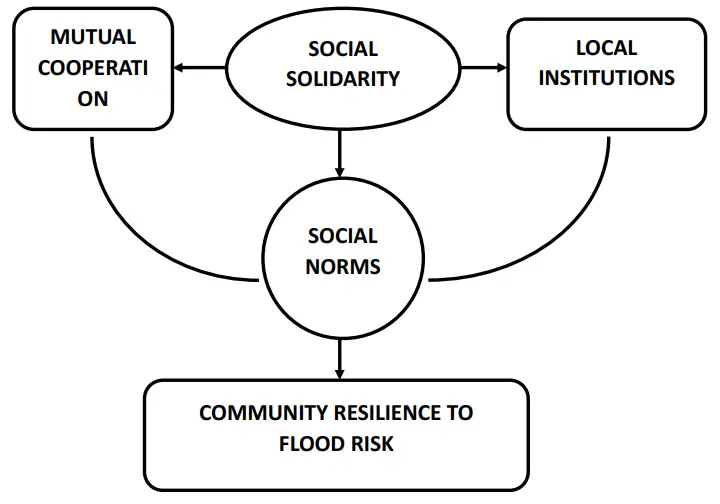
This adaptation model emphasizes that community resilience to flooding is not just the result of technical policies, but the result of a dialectic between social solidarity and local institutions. Social solidarity provides moral energy and collective cohesion, while local institutions provide a coordinating framework and legitimacy for action. Both, when linked through trust and participation, produce dynamic adaptive structures capable of restoring, adapting, and strengthening communities in the face of ecological risks in a sustainable manner.
Adaptation Model Workflow
The adaptation workflow in Figure 2 is important because it provides a systematic framework for village communities to strengthen socio-ecological resilience in a sustainable manner. Starting from the identification of existing risks and social capacities, this process ensures adaptation based on local realities. Strengthening solidarity and institutional revitalization allows for the formation of collaborative networks that are responsive to threats. The reconstruction of adaptive norms helps to instill ecological values in everyday practice. The evaluation stage then ensures that social learning continues to develop. Overall, this flow creates a dynamic, inclusive, and sustainability-oriented adaptation cycle.
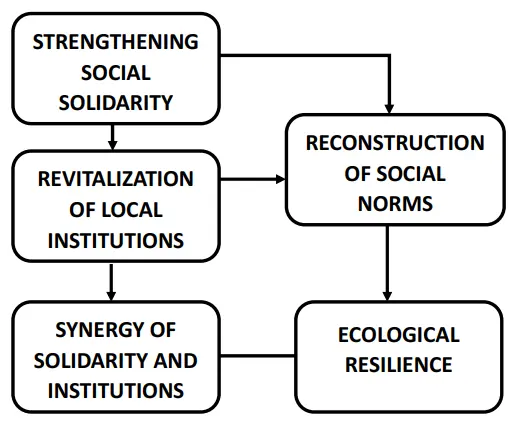
The adaptation workflow in the SKSE-BK model shows how communities systematically build resilience to floods through risk identification, strengthening solidarity, institutional revitalization, and continuous evaluation. This process reflects the intertwined social dynamics between collective action and institutional response. In the context of Community Adaptation and Institutional Response to Flood Risks, the flow affirms the importance of community-based adaptation as a foundation for socio-ecological resilience.
4. Conclusions
The socio-ecological resilience of flood-prone village communities is formed through a synergistic interaction between solidarity, social capital, local institutions, and the reconstruction of evolving norms. The revitalization of Durkheim-style mechanical solidarity is reflected in strong mutual cooperation in cleaning waterways, evacuations, and protecting household assets, which is then strengthened by social capital bonding, bridging, and linking, as explained by Putnam, Bourdieu, and Coleman. This social capital opens up a space for cross-group coordination, early information exchange, and an aid network that strengthens the community’s ability to respond to repeated floods. At the same time, the repositioning of local institutions, both customary institutions and village formal structures, shows adaptive institutional mechanisms as Scott and North describe, through the enforcement of river rules, resource management, and the integration of local values with formal regulations. The reconstruction of ecological norms and participatory deliberation shows a change in habitus and the internalization of new values that foster ecological awareness and strengthen Collective Action. Overall, the results of the study confirm that community adaptation to flood risk is not just a technical response but a social process formed by solidarity, social capital, institutions, and collective learning that reinforce each other in the face of environmental change. The Solidarity-Based Social-Institutional Adaptation Model and local institutions support each other, forming an adaptation framework rooted in collective values and working mechanisms. The Community-Based Social-Ecological Resilience Cycle Model (C-BS-ERCM) emphasizes that resilience is built through an iterative process of risk identification, social capacity building, institutional coordination, and adaptive evaluation. Overall, the findings of the study show that community resilience is not only a product of technical policies, but rather the result of a dialectic between the moral energy of social solidarity, the coordination capacity of local institutions, and the transformation of values that enable the creation of sustainable adaptive village governance.
5. Research Limitations
This study has several limitations that should be acknowledged. First, the research focuses on flood-prone village communities within a specific local context, which may limit the generalizability of findings to other regions with different socio-cultural and ecological conditions. Second, the qualitative emphasis on solidarity, social capital, and institutional adaptation relies heavily on community perceptions and local narratives, which may introduce subjectivity. Third, the dynamic nature of ecological resilience and institutional change requires longer-term observation, while this study captures only a particular period of adaptation. Future studies should incorporate comparative and longitudinal approaches for broader validation.
Statement of the Use of Generative AI and AI-Assisted Technologies in the Writing Process
During the preparation of this manuscript, the authors used ChatGPT to improve the language quality, grammar, readability, and clarity of expression. After using this tool, the authors carefully reviewed and edited the content as needed and take full responsibility for the content of the published article.
Acknowledgments
The authors would like to thank all parties who contributed administrative, technical, and academic support to this research. Special appreciation is extended to the local authorities, village communities, and all respondents who participated in this study for their cooperation and valuable contributions throughout the research process.
Author Contributions
Conceptualization, M.A.; methodology, M.A. and P.P.; investigation, M.A., P.P. and L.P.; formal analysis, M.A. and P.P.; data curation, M.A. and L.P.; writing—original draft preparation, M.A.; writing—review and editing, M.A., P.P. and L.P.; supervision, M.A.; project administration, M.A. All authors have read and agreed to the published version of the manuscript.
Ethics Statement
“Not applicable” for studies not involving humans or animals.
Informed Consent Statement
“Not applicable” for studies not involving humans or animals.
Data Availability Statement
The anonymized research materials and analytical procedures used in this study are provided as supplementary materials accompanying the manuscript submission. All materials have been anonymized to ensure a blind review process. Due to ethical considerations related to confidentiality and the protection of research participants in rural communities, the qualitative data underlying this study are not shared publicly at the time of submission. If the manuscript is accepted for publication, the authors will make anonymized data excerpts or metadata available through a trusted data repository, in accordance with journal policies and applicable ethical guidelines.
Funding
This research received no external funding.
Declaration of Competing Interest
The authors declare that they have no known competing financial interests or personal relationships that could have appeared to influence the work reported in this paper.
References
- Munyai RB, Chikoore H, Musyoki A, Chakwizira J, Muofhe TP, Xulu NG, et al. Vulnerability and Adaptation to Flood Hazards in Rural Settlements of Limpopo Province, South Africa. Water 2021, 13, 3490. DOI:10.3390/w13243490 [Google Scholar]
- Jamshed A, Birkmann J, Feldmeyer D, Rana IA. A Conceptual Framework to Understand the Dynamics of Rural–Urban Linkages for Rural Flood Vulnerability. Sustainability 2020, 12, 2894. DOI:10.3390/su12072894 [Google Scholar]
- Orchard S, Glover D, Thapa Karki S, Ayele S, Sen D, Rathod R, et al. Exploring synergies and trade-offs among the sustainable development goals: collective action and adaptive capacity in marginal mountainous areas of India. Sustain. Sci. 2020, 15, 1665–1681. DOI:10.1007/s11625-019-00768-8 [Google Scholar]
- Kaiser S, Oliveira M, Vassillo C, Orlandini G, Zucaro A. Social and Environmental Assessment of a Solidarity Oriented Energy Community: A Case-Study in San Giovanni a Teduccio, Napoli (IT). Energies 2022, 15, 1557. DOI:10.3390/en15041557 [Google Scholar]
- Ummel D, Vachon M, Guité‐Verret A. Acknowledging bereavement, strengthening communities: Introducing an online compassionate community initiative for the recognition of pandemic grief. Am. J. Community Psychol. 2022, 69, 369–379. DOI:10.1002/ajcp.12576 [Google Scholar]
- Hosen N, Nakamura H, Hamzah A. Adaptation to Climate Change: Does Traditional Ecological Knowledge Hold the Key? Sustainability 2020, 12, 676. DOI:10.3390/su12020676 [Google Scholar]
- Kim G, Kang W, Lee D, Vaswani RT, Chon J. A spatial approach to climate-resilient infrastructure in coastal social-ecological systems: The case of dumbeong in Goseong County, South Korea. Environ. Int. 2019, 131, 105032. DOI:10.1016/j.envint.2019.105032 [Google Scholar]
- Garcia Ferrari S, Crane De Narváez S, Castro Mera WE, Velásquez C, Bain AA. Collective Action Towards Risk Management in Informal Urban Areas in Medellín: COVID-19 Lessons for Reducing Vulnerability and Inequality. Front. Environ. Sci. 2022, 9, 726867. DOI:10.3389/fenvs.2021.726867 [Google Scholar]
- Allegretti G. Common Patterns in Coping with Under-Representation in Participatory Processes: Evidence from a Mutual Learning Space for Portuguese Local Authorities (LAs). Innov. Eur. J. Soc. Sci. Res. 2021, 34, 729–765. DOI:10.1080/13511610.2021.1997573 [Google Scholar]
- Clavijo Rojas DI, Montaño M. Self-organization/self-mobilization of affected communities in impact assessment and decision-making: A case study in the Atrato River (Colombia). Clean. Prod. Lett. 2022, 3, 100022. DOI:10.1016/j.clpl.2022.100022 [Google Scholar]
- Wang Z, Larrazabal MA, Rucker M, Toner ER, Daniel KE, Kumar S, et al. Detecting Social Contexts from Mobile Sensing Indicators in Virtual Interactions with Socially Anxious Individuals. Proc. ACM Interact. Mob. Wearable Ubiquitous Technol. 2023, 7, 1–26. DOI:10.1145/3610916 [Google Scholar]
- Okoye C, Obialo-Ibeawuchi CM, Obajeun OA, Sarwar S, Tawfik C, Waleed MS, et al. Early Diagnosis of Autism Spectrum Disorder: A Review and Analysis of the Risks and Benefits. Cureus 2023, 15, e43226. DOI:10.7759/cureus.43226 [Google Scholar]
- Chisale HLW, Chirwa PW, Kamoto JFM, Babalola FD. Determinants of adaptive capacities and coping strategies to climate change related extreme events by forest dependent communities in Malawi. Wellbeing Space Soc. 2024, 6, 100183. DOI:10.1016/j.wss.2024.100183 [Google Scholar]
- Effiong C, Ngang E, Ekott I. Land use planning and climate change adaptation in river-dependent communities in Nigeria. Environ. Dev. 2024, 49, 100970. DOI:10.1016/j.envdev.2024.100970 [Google Scholar]
- Soubry B, Sherren K, Thornton TF. Farming along desire lines: Collective action and food systems adaptation to climate change. People Nat. 2020, 2, 420–436. DOI:10.1002/pan3.10075 [Google Scholar]
- Goswami R, Roy R, Gangopadhyay D, Sen P, Roy K, Sarkar S, et al. Understanding Resource Recycling and Land Management to Upscale Zero-Tillage Potato Cultivation in the Coastal Indian Sundarbans. Land 2024, 13, 108. DOI:10.3390/land13010108 [Google Scholar]
- Kalidou AI, Qi G, Ibro AA, Buma AA, Toure AR, Ndimbo GK, et al. Securing Agro-Pastoral System and Rural Livelihood Through the Market Gardening in Niger: Unfolding Smallholders’ Resilience to Interwoven Challenges. Agric. Rural Stud. 2024, 2, 14. DOI:10.59978/ar02010005 [Google Scholar]
- Wehi P, Cox M, Whaanga H, Roa T. Tradition and change: celebrating food systems resilience at two Indigenous Māori community events. Ecol. Soc. 2023, 28, 19. DOI:10.5751/ES-13786-280119 [Google Scholar]
- Howard SC, Sherren K. Flood risk mapping in southwestern Nova Scotia: Perceptions and concerns. Can. Geogr. Géogr. Can. 2023, 67, 499–512. DOI:10.1111/cag.12836 [Google Scholar]
- Bordovskikh A. The Phenomenon of Eco-Political Risk Exemplified by Yellow Vests Movement in France. World Econ. Int. Relat. 2020, 64, 36–46. DOI:10.20542/0131-2227-2020-64-3-36-46 [Google Scholar]
- Karnyshev AD, Ivanova EA, Karnysheva OA. Lake Baikal and Psychological Resources to Encourage Environmental Patriotism. Sib. Psikhologicheskiy Zhurnal 2020, 196–214. DOI:10.17223/17267080/77/10 [Google Scholar]
- Cayamanda KJ, Lopez M. Community Resilience to Address Urban Vulnerabilities: A Case Study of Flood-prone Communities. Int. Rev. Soc. Sci. Res. 2022, 2, 1–19. DOI:10.53378/352898 [Google Scholar]
- Mejia A, Balangoy D, Katoch C. “Intensity, anxiety … but also, hope?” Reflections on care, whiteness, and emotions by women of color during the virocene. Gend. Work Organ. 2022, 29, 1386–1403. DOI:10.1111/gwao.12853 [Google Scholar]
- Lambert CE, Holley JR, McComas KA, Snider NP, Tucker GK. Eroding Land and Erasing Place: A Qualitative Study of Place Attachment, Risk Perception, and Coastal Land Loss in Southern Louisiana. Sustainability 2021, 13, 6269. DOI:10.3390/su13116269 [Google Scholar]
- Kamdar A, Baishya HK, Nagendra H, Ratnam J, Smith D, Sekar N. Human–elephant conflict mitigation as a public good: What determines fence maintenance? Ecol. Soc. 2022, 27, 24. DOI:10.5751/ES-13271-270324 [Google Scholar]
- Braun T, Breitenbach SFM, Skiba V, Lechleitner FA, Ray EE, Baldini LM, et al. Decline in seasonal predictability potentially destabilized Classic Maya societies. Commun. Earth Environ. 2023, 4, 82. DOI:10.1038/s43247-023-00717-5 [Google Scholar]
- Jolic A. Bottom-up vs. top-down: How participatory design can be used to help define post-conflict cultural memory in Croatia. Contemp. Mediterr. 2023, 2, 44–60. DOI:10.17818/sm/2023/1.3 [Google Scholar]
- Perekhoda H. The Bolsheviks in Eastern Ukraine and their Competing State Projects (1917–1918): The Case of the Donets-Krivoi Rog Soviet Republic. Connexe 2021, 7, 45–64. DOI:10.5077/journals/connexe.2021.e322 [Google Scholar]
- Puttagunta R, Vodzak J. Unintended Disclosure through the Medical Patient Portal: Adolescent Care Implications of the 21st Century Cures Act based on Charting Practices at a Large Integrated Healthcare System. J. Adolesc. Health 2023, 72, S99–S100. DOI:10.1016/j.jadohealth.2022.11.200 [Google Scholar]
- Nepali TNP. Balancing Work Life and Family Life: Problems and Remedies. Pravaha 2018, 24, 217–232. DOI:10.3126/pravaha.v24i1.20240 [Google Scholar]
- Petzold J, Kosanic A, Rakoto Joseph F, Rajaonarivelo Andrianina P, Ranaivosoa‐Toandro SM, Andriamihaja OR, et al. Nature’s contributions to human well‐being under climate change: Evidence from Central and Eastern Madagascar. People Nat. 2024, 6, 749–761. DOI:10.1002/pan3.10595 [Google Scholar]
- Ribeiro DF, Saito SM, Alvalá RCDS. Community disaster resilience in Brazilian small urban centers. Int. J. Disaster Risk Reduct. 2024, 100, 104200. DOI:10.1016/j.ijdrr.2023.104200 [Google Scholar]
- Brito-Brito PR, Fernández-Gutiérrez DÁ, Cuéllar-Pompa L. Emotional Management of the Health Crisis by Coronavirus: A Narrative Review. Enferm. Clin. 2021, 31, S107–S111. DOI:10.1016/j.enfcli.2020.05.010 [Google Scholar]
- Ojewale O. Correlates of community resilience to violent conflict in north central Nigeria: Evidence from Benue and Plateau states. Violence Int. J. 2024, 5, 48–75. DOI:10.1177/26330024231188376 [Google Scholar]
- Elcheroth G, Drury J. Collective resilience in times of crisis: Lessons from the literature for socially effective responses to the pandemic. Br. J. Soc. Psychol. 2020, 59, 703–713. DOI:10.1111/bjso.12403 [Google Scholar]
- Barfuss W, Donges JF, Vasconcelos VV, Kurths J, Levin SA. Caring for the future can turn tragedy into comedy for long-term collective action under risk of collapse. Proc. Natl. Acad. Sci. USA 2020, 117, 12915–12922. DOI:10.1073/pnas.1916545117 [Google Scholar]
- Gold AW, Bozorgmehr K, Biddle L, Perplies C, Rast E, Jahn R. Early Crisis Response to the COVID-19 Pandemic in Collective Accommodation Facilities for Refugees: Analysis of Cross-Actor Working Arrangements from the Perspective of the Reception Authorities in Germany. Bundesgesundheitsblatt Gesundheitsforschung Gesundheitsschutz 2023, 66, 890–900. DOI:10.1007/s00103-023-03745-w [Google Scholar]
- Busemeyer MR, Carstensen MB, Emmenegger P. Orchestrators of coordination: Towards a new role of the state in coordinated capitalism? Eur. J. Ind. Relat. 2022, 28, 231–250. DOI:10.1177/09596801211062556 [Google Scholar]
- Zhu X, Wang G. Impact of Agricultural Cooperatives on Farmers’ Collective Action: A Study Based on the Socio-Ecological System Framework. Agriculture 2024, 14, 96. DOI:10.3390/agriculture14010096 [Google Scholar]
- Dalljo J. “Solidarity Is a Matter of the Heart”: Anti-Imperialist Solidarity Donations in GDR Children's Magazines. Int. Rev. Soc. Hist. 2024, 69, 159–176. DOI:10.1017/S002085902300069X [Google Scholar]
- Abella FS, Bation ND, Bation WC, Valiente AD, Bation ED, Dimarucut DL. Preparing Tomorrow’s Leaders: The Role of Co-Curricular Activities in Shaping Business and Accountancy Students at Pilgrim Christian College, Cagayan de Oro City, Philippines. Int. J. Soc. Sci. Hum. Res. 2024, 7, 3. DOI:10.47191/ijsshr/v7-i03-30 [Google Scholar]
- Chen Y, Qin Y, Zhu Q. Study on the Impact of Social Capital on Agricultural Land Transfer Decision: Based on 1017 Questionnaires in Hubei Province. Land 2023, 12, 861. DOI:10.3390/land12040861 [Google Scholar]
- Khairulin O. Ontological modeling of the psychological field of a play. Psihologìâ ì Suspìl’stvo 2023, 2, 106–141. DOI:10.35774/pis2023.02.106 [Google Scholar]
- Mozumder MMH, Schneider P, Islam MM, Deb D, Hasan M, Monzer MA, et al. Climate change adaptation strategies for small-scale Hilsa fishers in the coastal area of Bangladesh: social, economic, and ecological perspectives. Front. Mar. Sci. 2023, 10, 1151875. DOI:10.3389/fmars.2023.1151875 [Google Scholar]
- Dickson-Hoyle S, Beilin R, Reid K. A Culture of Burning: Social-Ecological Memory, Social Learning and Adaptation in Australian Volunteer Fire Brigades. Soc. Nat. Resour. 2021, 34, 311–330. DOI:10.1080/08941920.2020.1819494 [Google Scholar]
- Anderson P. A Return to Mechanical Solidarity. Crossing Bord. Stud. Reflect. Glob. Soc. Issues 2020, 2. DOI:10.31542/cb.v2i1.1987 [Google Scholar]
- Machaczek KK, Allmark P, Pollard N, Goyder E, Shea M, Horspool M, et al. Integrating physical activity into the treatment of depression in adults: A qualitative enquiry. Health Soc. Care Community 2022, 30, 1006–1017. DOI:10.1111/hsc.13283 [Google Scholar]
- Maliszewski WJ, Frąckowiak P. Selected Contemporary Social Threats in the Discourse of Social Pedagogues. Lub. Rocz. Pedagog. 2023, 42, 169–180. DOI:10.17951/lrp.2023.42.2.169-180 [Google Scholar]
- Ruiu ML, Seddaiu G, Roggero PP. Developing adaptive responses to contextual changes for sustainable agricultural management: The role of social capital in the Arborea district (Sardinia, Italy). J. Rural Stud. 2017, 49, 162–170. DOI:10.1016/j.jrurstud.2016.11.017 [Google Scholar]
- Bottrell D. Understanding ‘Marginal’ Perspectives. Qual. Soc. Work 2009, 8, 321–339. DOI:10.1177/1473325009337840 [Google Scholar]
- Okello Candiya Bongomin G, Munene JC, Mpeera Ntayi J, Akol Malinga C. Financial intermediation and financial inclusion of the poor. Int. J. Ethics Syst. 2018, 34, 146–165. DOI:10.1108/IJOES-07-2017-0101 [Google Scholar]
- Hydén H. Sociology of Law as the Science of Norms; Routledge: London, UK, 2021. [Google Scholar]
- Russell B. Principles of Social Reconstruction; Psychology Press: New York, NY, USA, 2013. [Google Scholar]
- Folke C. Traditional Knowledge in Social-Ecological Systems. Ecol. Soc. 2004, 9, 7. DOI:10.5751/es-01237-090307 [Google Scholar]
- Lundqvist LJ. Games Real Farmers Play: Knowledge, memory and the fate of collective action to prevent eutrophication of water catchments. Local Environ. 2001, 6, 407–419. DOI:10.1080/13549830120091707 [Google Scholar]