
Reverse Tourism: A New Opportunity for the Sustainable Development of Rural Tourism

Reverse Tourism: A New Opportunity for the Sustainable Development of Rural Tourism
Chao Yu
1,*
 Chenao Yang
1
Zhiyuan Zhou
1
Yi Li
1
Caoying He
1
Yinyao Fang
2
Jinrun Wu
3
Chenao Yang
1
Zhiyuan Zhou
1
Yi Li
1
Caoying He
1
Yinyao Fang
2
Jinrun Wu
3
Received: 28 April 2026 Revised: 26 May 2026 Accepted: 02 June 2026 Published: 16 June 2026

© 2026 The authors. This is an open access article under the Creative Commons Attribution 4.0 International License (https://creativecommons.org/licenses/by/4.0/).
1. Introduction
As the view count of the “Reverse Tourism” topic surges on TikTok and hotel bookings in off-the-beaten-path destinations increase tenfold, the tourism industry is undergoing its most profound transformation since the rise of Mass Tourism [1]. This transformation reflects not only a shift in tourist behavior but also a collective reexamination of the “meaning of travel [2]”. In Greece—instead of flocking to the blue-domed churches of Santorini—travelers now descend into underground mines, imagining the bustling scenes of workers from bygone eras [3]. Similar transformations are occurring in conflict zones. Beyond its pilgrimage tourism, Palestine is leveraging traditional cuisine and rural landscapes to attract visitors, seeking to alter prejudices shaped by conflict [4]. These seemingly “unconventional” travel practices actually represent a critical re-evaluation of the essence of tourism: when Venice’s gondola canals are overwhelmed by giant cruise ships [5], must humanity redefine “the meaning of travel”?
Addressing the challenges of homogenized modern tourism, a return to rural destinations offers compelling solutions [6]. Indeed, global travel patterns increasingly reflect this shift, representing a profound reimagining of the fundamental principles of tourism. Rural areas, characterized by limited modern development, are emerging as vital cultural preservation centers, ecological rehabilitation bases, and community revitalization laboratories [7]. Furthermore, engaging with these environments often prompts a voluntary transformation in visitors, moving them beyond passive consumption towards active stewardship [8]. Through participation in activities such as ecological monitoring or traditional agricultural practices, tourists develop a sense of responsibility for the preservation of these spaces. This evolving role facilitates role-shifting, dissolving the traditional distinction between tourists and residents and fostering a more equitable relationship of co-creation. This form of reverse tourism, focused on rural areas, transcends mere spatial relocation, becoming a laboratory for tourism essence redefinition [9].
Grounded in the aforementioned industrial transformations and critical challenges, this paper employs a research approach centered on conceptual analysis, literature synthesis, and framework innovation. Initially, by examining global instances of reverse tourism, we deconstruct its connotation, analyzing it through three interrelated perspectives: tourism essence reflection, tourism behavior aberration, and tourism experience distinction. This multifaceted approach facilitates a nuanced comprehension of the core principles underpinning reverse tourism. Subsequently, the study synthesizes the existing body of literature on reverse tourism, categorizing research according to geographical scope, subject focus, and methodological approaches. Furthermore, predicated on the central role of tourists, we construct an analytical framework to guide future research on reverse tourism. Finally, we explore the potential of reverse tourism as a novel opportunity for contemporary rural development and its contributions to rural sustainable development. This research contributes to the interdisciplinary field of rural tourism and sustainable development by providing a framework for addressing the challenges of homogenized tourism development and enriching our understanding of the meaning and purpose of travel.
2. The Connotation of Reverse Tourism
While “alternative tourism” in its conventional sense broadly refers to tourism that deviates from the mass tourism model [10], we propose the term “reverse tourism” instead, as it more precisely encapsulates the logic of reverse reconstruction inherent in contemporary tourism transformation. This choice leverages the semantic richness of the Chinese character “反” (fǎn, meaning “reverse” or “opposite”) to vividly convey the systematic reversal of traditional tourism paradigms. This simultaneously echoes the practical trend of tourists actively avoiding popular destinations and pursuing niche experiences, and establishes a unified logical anchor for analyzing shifts in the essence, behavior, and experience of tourism through the core concept of “reverse tourism”. This terminological precision enables us to develop a threefold analytical framework.
Compared with “alternative tourism” in its conventional sense, “reverse tourism” emphasizes the intentional reversal of mainstream tourism norms, highlighting a comprehensive inversion that spans destination selection, experiential forms, and value pursuits. It provides a more targeted conceptual tool for the subsequent in-depth discussions centered around tourism essence, tourism behavior, and tourism experience. These three dimensions correspond respectively to reflection (反思, fǎnsī) on the essence of tourism, aberration (反常, fǎncháng) in tourist behavior, and distinction (反差, fǎnchā) in the tourist experience, accurately capturing the paradigm shift characteristics of twenty-first-century tourism as it evolves towards reverse reconstruction.
2.1. Tourism Essence Reflection
Conflicts of interest among tourists, residents of tourist destinations, and tourism developers, along with the multi-dimensional tensions stemming from these interactions, exert significant impacts on the development of the tourism industry and prompt critical examinations of the essence of tourism [11]. These conflicts are mainly manifested in aspects of development concepts, cultural connotations, and social relations (Table 1), through the mechanisms outlined in the following analysis.
Table 1. The main perspectives of tourism essence reflection.
|
Dimension |
Perspectives |
Explanations |
Cases |
|---|---|---|---|
|
Development Concept |
Growth Priority vs. Protection Priority |
The over-reliance on high-density development models of mass tourism often leads to ecological overload. The adoption of decentralized development models of reverse tourism significantly reduces environmental pressure. |
Kılıçaslan et al., 2011 [12] Pasgaard et al., 2021 [13] |
|
Community Exclusion vs. Community Participation |
Mass tourism generates community exclusion due to capital-driven interests and benefit monopolization. Reverse tourism achieves collaborative governance through community participation and benefit sharing. |
Giampiccoli et al., 2021 [14] Crăciun et al., 2022 [15] |
|
|
Inter-regional Homogeneity vs. Inter-regional Diversity |
The standardized development of mass tourism leads to inter-regional homogeneity. The cultural protection of reverse tourism promotes inter-regional diversity. |
Hong et al., 2024 [16] |
|
|
Cultural Connotation |
Cultural Commodification vs. Commodity Culturalization |
Mass tourism reduces local culture to consumptive symbols of exotic charm. Reverse tourism preserves local cultural authenticity through intact scene experiences. |
Isaac et al., 2019 [17] |
|
Cultural Technologization vs. Technology Culturalization |
Mass tourism drives the full takeover of tourism operations by digital technology. Reverse tourism emphasizes the enablement of sustainable cultural dissemination by digital technology. |
Zhao et al., 2023 [18] |
|
|
Social Relationship |
Guest Mentality vs. Host Mentality |
Tourists consume local culture as “gazers” in mass tourism. Tourists break down geographical barriers as “hosts” in reverse tourism. |
Molz et al., 2013 [19] |
|
Benefit Leakage vs. Benefit Localization |
The operating profits often flow to external enterprises in mass tourism. The local economies are supported through “disintermediation” in reverse tourism. |
Markwick et al., 2001 [20] Mtapuri et al., 2021 [21] |
|
|
Social Exclusion vs. Social Inclusion |
Mass tourism often overlooks the rights of local residents. Reverse tourism focuses on enhancing the participation rights of local residents, especially marginalized groups. |
Kalisch et al., 2023 [22] |
2.1.1. Development Concept Reflection
Reflections on tourism development concepts expose inherent contradictions in the dominant “growth-first” paradigm of mass tourism. Defined by high-density development and driven by external capital [14], mass tourism marginalizes local communities in fair benefit distribution, while standardized scenic development worsens regional cultural homogenization. This logic triggers a vicious cycle: the blind pursuit of scale economies causes ecological degradation [12], capital monopolies intensify community exclusion, and rapid replication leads to unavoidable homogenization. By contrast, reverse tourism centers ecological protection as a core premise: decentralized development and minimal-intervention facilities ease environmental pressure [13,16]. Meanwhile, community-participatory planning breaks capital monopolies to build localized revenue mechanisms [15], fostering differentiated development via unique local cultural assets and shaping a sustainable “protection-empowerment-diversity” trajectory.
2.1.2. Cultural Connotation Reflection
Reflections on cultural connotations highlight the distortion of cultural essence in mass tourism. Obsessed with economic growth, mass tourism often commodifies local culture into consumable symbols for tourists [10]. Moreover, digital technologies used solely for service standardization cause dual alienation: cultural commercialization and technologization. In contrast, reverse tourism innovates by reconstructing culture-tourism relations. It prioritizes authentic, immersive experiences to preserve cultural authenticity [17], turning culture from a “consumed commodity” into a “perceivable way of life”. Digital technology shifts from an efficiency tool to a driver of cultural empowerment, focusing on documenting and spreading local knowledge. This change fundamentally challenges the “development-first” logic, emphasizing cultural value over pure economic gain and enabling sustainable cultural transmission via living inheritance and innovative expression [18].
2.1.3. Social Relationship Reflection
Reflections on tourism social relationships focus on reconstructing host-guest roles [19]. In mass tourism, the binary structure of tourists as “gazers” and locals as “the gazed” leads to superficial tourism consumption, unfair distribution of benefits, social exclusion, and even local discontent [20,21]. By contrast, reverse tourism dismantles geographical and cultural barriers, cultivating a “host mentality” in tourists to build more equitable and interactive host-guest relationships. This role shift creates a disintermediated revenue model, keeping economic benefits within local communities. Meanwhile, local residents, especially marginalized groups, gain social recognition by engaging in tourism services, transforming tourism from a capital-dominated exclusive industry into a community-shared inclusive practice [22]. Essentially, it marks an agency shift, empowering locals from passive recipients of tourism development to active subjects who rebalance rights and interests.
2.2. Tourism Behavior Aberration
The divergent understandings of tourism essence precipitate markedly different patterns of tourist behavior. In tourism practice, diametrically opposed conceptual frameworks emerge: the “attraction-activity-centric” approach, which prioritizes pre-determined itineraries and attraction-based experiences, contrasts with the “local-life-centric” approach, which emphasizes authentic immersive experiences and independent exploration. The former often leads to predetermined itinerary adherence, while the latter fosters engagement with local culture and spontaneous discovery. These differences manifest across multiple dimensions of tourist behavior, including destination selection, activity engagement, and consumption patterns, revealing a spectrum of choices (Table 2).
Table 2. The main perspectives of tourism behavior aberration.
|
Dimension |
Perspectives |
Explanations |
Cases |
|---|---|---|---|
|
Tourism Choice |
High-Profile Attractions vs. Low-Profile Attractions |
Popular attractions are the first choice in mass tourism. Remote villages, ecologically sensitive areas, and even geopolitical conflict zones are beginning to gain favor in reverse tourism. |
Chebli et al., 2021 [23] |
|
Checklist Driven vs. Participation Driven |
“Hit-and-run” photography for quick check-ins constitutes the main content of mass tourism. A shift from “passive sightseeing” to “active participation” emerges in reverse tourism. |
Yang, 2019 [24] |
|
|
Consumption Oriented vs. Goal Oriented |
All-inclusive packages covering food, accommodation, transportation, and sightseeing are the norm in mass tourism. Self-planned low-intervention approaches are the pursuit in reverse tourism. |
Belias et al., 2018 [25] |
|
|
Tourism Activity |
Attraction Activity Centric vs. Local Life Centric |
Tourists are confined to participating in activities dictated by attractions in mass tourism. The active engagement in diverse local festivals and rituals is embraced in reverse tourism. |
Partanen et al., 2025 [26] |
|
Self Isolation vs. Active Engagement |
Tourists flash in and out like bubbles and fail to integrate into the local community in mass tourism. Tourists leverage multiple platforms to break down barriers and actively engage in reverse tourism. |
Stavroula G et al., 2020 [27] |
|
|
Excessive Entertainment vs. Balanced Edutourism |
All aspects of tourism are turned into entertainment in mass tourism. Educational themes are appropriately integrated into tourism activities in reverse tourism. |
Vergopoulos et al., 2019 [28] Medeiros et al., 2021 [29] Jang et al., 2021 [30] |
|
|
Tourism Consumption |
High-Carbon Consumption vs. Low-Carbon Consumption |
High-carbon consumption in mass tourism is driven by high-energy transportation and large-scale facilities. Low-carbon consumption in reverse tourism is achieved through localized travel and eco-friendly facilities. |
Che Leh et al., 2021 [31] |
|
Material Consumption vs. Non-Material Consumption |
Tourists in mass tourism are filled with large quantities of “symbolic” products. Tourists in reverse tourism are more willing to pay a premium for cultural experience programs. |
Kalisch et al., 2023 [22] |
|
|
One-Time Consumption vs. Repeat Consumption |
The one-time check-in visits to standardized attractions prevail in mass tourism. The repeated visits driven by emotional connections emerge in reverse tourism. |
Mtapuri et al., 2021 [21] |
2.2.1. Tourism Choice Aberration
Mass tourism favors popular attractions due to its well-built “convenience ecosystem”. Mature information channels, standardized facilities, and pre-packaged itineraries reduce decision-making costs and improve travel safety, but they also trigger potential experiential crises [23]. Crowded sites push tourists into a “quick check-in and instant sharing” cycle fueled by symbolic competition; widespread commercialization turns destinations into homogenized “souvenir factories”, weakening experiences and stripping cultural connotations. Reverse tourism innovates by resisting this “tyranny of convenience” [24,25]. Avoiding crowded landmarks and embracing “low-convenience”, unstandardized spaces, it drives tourists from passive consumption of ready-made experiences to active creation of unique encounters. With moderate information ambiguity and unstandardized facilities, reverse tourism replaces passive meaning reception with immersive cultural interpretation, revealing a core contradiction: mass tourism undermines authentic experiences by overemphasizing “convenience”, while reverse tourism rebuilds experiential value by consciously embracing “inconvenience”.
2.2.2. Tourism Activity Aberration
Mass tourism, defined by “attraction-centricism”, reduces tourists to passive “landscape consumers”, simplifying host-guest interactions into transactional “service-reception” relations and creating a “tourist bubble” that separates visitors from authentic local life [26,27]. In contrast, reverse tourism centers on “local life involvement”. It encourages active exploration of unstructured scenes and uses social platforms and digital tools to break physical and cultural barriers. Notably, its activities often integrate controversial or educational themes [28,29,30], driving a shift from pure “sensory entertainment” to “critical cognition” and inspiring reflection on the possible “instrumentalization of activities” in tourism.
2.2.3. Tourism Consumption Aberration
Mass tourism follows a “high-carbon, material-intensive, disposable” consumption model. Large-scale transport and facility operations expand ecological footprints, while standardized goods, such as mass-produced souvenirs, prioritize symbolic value over practical use. A “visit-and-leave” mindset further makes consumption transient. By contrast, reverse tourism pursues sustainable transformation via three key shifts. First, it builds low-carbon supply chains by prioritizing public transport and eco-friendly accommodation [31]. Second, it boosts local economic benefits by supporting local handicrafts and community catering. Third, it prioritizes intangible consumption, such as intangible cultural heritage experiences, over material goods [22]. Notably, repeat visits stem not just from attractions but also from an emotional connection to local culture [21]. This marks a fundamental shift in consumption motivation, from “external symbolic display” to “internal value resonance”.
2.3. Tourism Experience Distinction
Tourism experience, as a direct reflection of tourism behavior, profoundly embodies the variations in the underlying concepts. The opposition between egocentrism and ecocentrism not only shapes distinct patterns of tourism behavior but also generates significant disparities in the experiential dimension. These differences clearly epitomize variations in the understanding of tourism essence. Spanning across sensory dimensions from visual experiences to psychological perceptions, each dimension intertwine with the conflict of these two concepts, therefore prompting an in-depth exploration and facilitating a deeper understanding of the underlying mechanisms behind tourism experiences (Table 3).
Table 3. The main perspectives of tourism experience distinction.
|
Dimension |
Perspectives |
Explanations |
Cases |
|---|---|---|---|
|
Visual Experience |
Artificial Landscape vs. Natural Landscape |
Not only bear obvious traces of modification, but they are even completely human-created. Have almost no traces of modification and are even undeveloped. |
Pasgaard et al., 2021 [13] |
|
Standardized Symbols vs. Personalized Symbols |
High uniformity of industrial design dominated by commercialization. Unique adornments filled with a humanistic atmosphere influenced by rural society. |
Eckert et al., 2019 [32] |
|
|
Lifestyle Experience |
Fast-Paced Life vs. Slow-Paced Life |
Fast-paced tourism with constant location changes via hopping on and off vehicles. Slow-paced tourism through staying here or walking through neighborhoods. |
Lazarevic et al., 2024 [33] |
|
Material Excess vs. Minimalist Philosophy |
Material excess involves not only surplus consumption but also substantial waste problems. Minimalism advocates the philosophy of “less is more”, emphasizing sufficiency and a return to authentic needs. |
Pirselimoğlu et al., 2014 [34] Chen et al., 2022 [35] |
|
|
Psychological Experience |
Pursuing Stimulation vs. Desiring Tranquility |
Intense sensory stimulation releases inner stress. Undisturbed plain life restores a fatigued body and mind. |
Huang et al., 2013 [36] |
|
Conquest Feeling vs. Integration Feeling |
Tourists are driven by egocentrism to leave traces everywhere. Tourists are prompted by ecocentrism to achieve identity integration. |
Kaltenborn et al., 2011 [37] |
2.3.1. Visual Experience Distinction
The visual experience of mass tourism suffers from dual flaws: artificialization and standardization. Excessive modification creates artificial landscapes that undermine natural authenticity, while standardized commercial features erase local uniqueness. By contrast, reverse tourism provides a twofold alternative. First, it prioritizes unspoiled natural landscapes, with untouched wilderness and pristine beaches resisting superficial “Instagrammable” makeovers to deliver authentic visual textures [13,32]. Second, it revitalizes cultural visual uniqueness through integrated traditional and modern architecture, immersive intangible cultural heritage displays, and artistic reinterpretation of rural landscapes. This reconstruction creates experiential contrasts rooted in daily authenticity, shifting visual perception from consumption of commercial symbols to the interpretation of local narratives.
2.3.2. Lifestyle Experience Distinction
Mass tourism features accelerated consumption and material excess. Frequent transfers and rigid itineraries limit in-depth engagement, while profit-driven overconsumption causes resource depletion and alienation. By contrast, reverse tourism delivers a paradigm shift via three aspects. First, it adjusts temporal perception, easing urban fast-paced alienation through slow tourism, immersive farming experiences and digital detox programs [33]. Second, it breaks “tourist isolation” by blurring host-guest boundaries, fostering community interaction via shared accommodation, role-reversal activities and intergenerational cultural exchange. Third, it embraces minimalism to reject material excess, using simple eco-lodges [34,35], authentic traditional cuisine, and work-for-stay arrangements to refocus on essential needs. This elevates tourism from indulgent consumption to active life participation.
2.3.3. Psychological Experience Distinction
The psychological experience of mass tourism relies on a unidirectional “stimulation-release” mechanism, using high-intensity entertainment to ease stress through sensory engagement. However, it reinforces tourists’ sense of “otherness” and “conquest mentality”, potentially alienating them from the environment. By contrast, reverse tourism adopts a bidirectional “tranquility-integration” path for well-being. It provides urban residents with a buffer space of undisturbed nature and slow rural life, facilitating physical and mental recovery and alleviating modern life anxieties [36]. Furthermore, it replaces anthropocentrism with ecocentrism, transforming tourists from “landscape conquerors” to “local integrators” via participatory experiences. This fosters existential integration through cultural identification and reverence for nature [37], representing a shift from “external entertainment” to “internal growth” in tourism philosophy.
3. The Analytical Framework of Reverse Tourism
3.1. Summary of the Analytical Framework
Reverse tourism research focuses heavily on rural areas, marginal regions, and ecologically or culturally sensitive zones (Table 4). These areas, preserving natural authenticity, traditional rural cultures, or unique landscapes, embody core principles of reverse tourism: de-standardization and experience prioritization [38]. However, attitudes of tourists, local residents, and tourism practitioners vary notably [39]. Tourists increasingly shift from standardized mass tourism to personalized, immersive reverse tourism for authentic experiences. Driven by market differentiation and competition, practitioners actively develop non-standardized products and services. Meanwhile, residents balance cultural preservation and economic development, leading to mixed views rather than outright rejection of mass tourism [40]. Thus, single qualitative or quantitative methods fail to meet the multi-dimensional research needs for reverse tourism, with mixed-methods research emerging for holistic, nuanced interpretations.
Current reverse tourism research follows an “observe-then-grasp” paradigm, yet it insufficiently emphasizes tourists as core experiential agents. Existing studies mostly conduct retrospective analyses of established phenomena, focusing on descriptive accounts of observed processes. Few explore tourists’ motivations, psychological drivers of behavior, and key experience evaluation dimensions. This post-hoc summarization results in merely phenomenological summaries, lacking prospective analysis of tourist behavioral patterns and hindering systematic practical guidance.
Table 4. Summary of the analytical framework.
|
Section |
Categories |
Characteristics |
Support |
|---|---|---|---|
|
Research Regions |
Urban Areas |
Focus on non-mainstream spaces Issues of over-commercialization or social inequality |
Analyze de-landscaping approaches in urban tourism Reveal the “tourist bubble” phenomenon |
|
Rural Areas |
Preservation of traditional agricultural culture Low-intensity natural ecological development |
Investigate the impact of slow tourism on experiential depth Study the role of agricultural participation models |
|
|
Special Locations |
Dependence on unique natural/cultural heritage Ecologically sensitive environments |
Explore low-intervention tourism models Study mechanisms for balancing ecological protection and experience |
|
|
Peripheral Regions |
Multi-country/cultural comparative research Focus on marginal landscapes |
Validate the universality of reverse tourism theories Analyze the influence of cultural differences |
|
|
Research Subjects |
Tourists |
Shift from standardized to personalized consumption Pursuit of immersive experiences |
Decode driving factors of behavioral motivations Analyze mechanisms of experiential contrast formation |
|
Local Residents |
Support community tourism for cultural preservation Oppose over-development for economic interests |
Evaluate the role of community participation in sustainability Examine the balance between economic benefits and cultural protection |
|
|
Tourism Practitioners |
Promote non-standardized products Focus on market differentiation |
Study the impact of enterprise strategies on model diffusion Analyze market differentiation paths |
|
|
Research Methods |
Qualitative |
Ethnography, in-depth interviews, case studies Focus on cultural decoding and social relations |
Explore experiential essence and cultural connotations Analyze complex issues like host-guest power dynamics |
|
Quantitative |
Questionnaires, statistical models, big data analysis Focus on behavioral patterns and quantitative indicator validation |
Measure experiential indicators Validate sustainability data |
|
|
Mixed |
Combination of qualitative+quantitative Multi-dimensional |
Integrate advantages of qualitative and quantitative data Conduct comprehensive analysis of multi-dimensional correlations |
3.2. Revision of the Analytical Framework
3.2.1. The Basic Model Based on the Central Role of Tourists
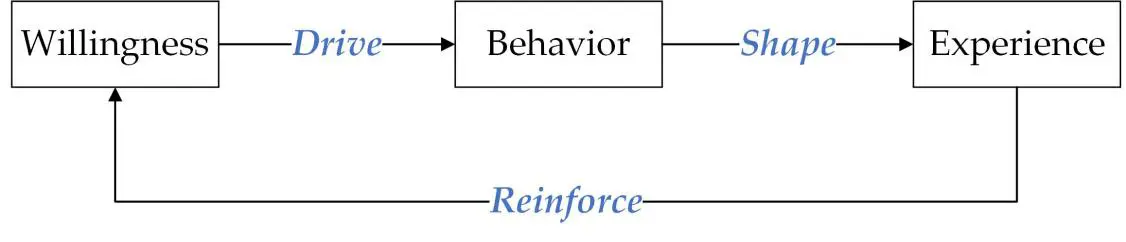
To address prior research limitations, this study refocuses on the tourism core subject: the tourist [41]. Tourism activities stem from tourist needs, so the logic of reverse tourism must also center on tourists as key actors. Tourists’ pursuit of authentic experiences and rejection of standardized offerings reflect their intrinsic motivations [42]. As a starting point, willingness captures tourists’ critique of conventional tourism and their drive for reverse tourism. Behavior embodies this willingness, as seen in choosing rural or marginalized destinations and engaging in distinctive activities such as farming and community interactions. Experience, as behavioral feedback, includes emotional resonance, cultural identification, and environmental responsibility gained from reverse tourism. These three elements form a dynamic cycle: willingness drives behavior, behavior shapes experience, and experience reinforces willingness (Figure 1). This framework (Willingness-Behavior-Experience Model, abbreviated as WBEM) clarifies the internal motivation mechanism of reverse tourism and provides a tourist-centered analytical path, guiding tourism research back to its core principle of prioritizing tourist needs.
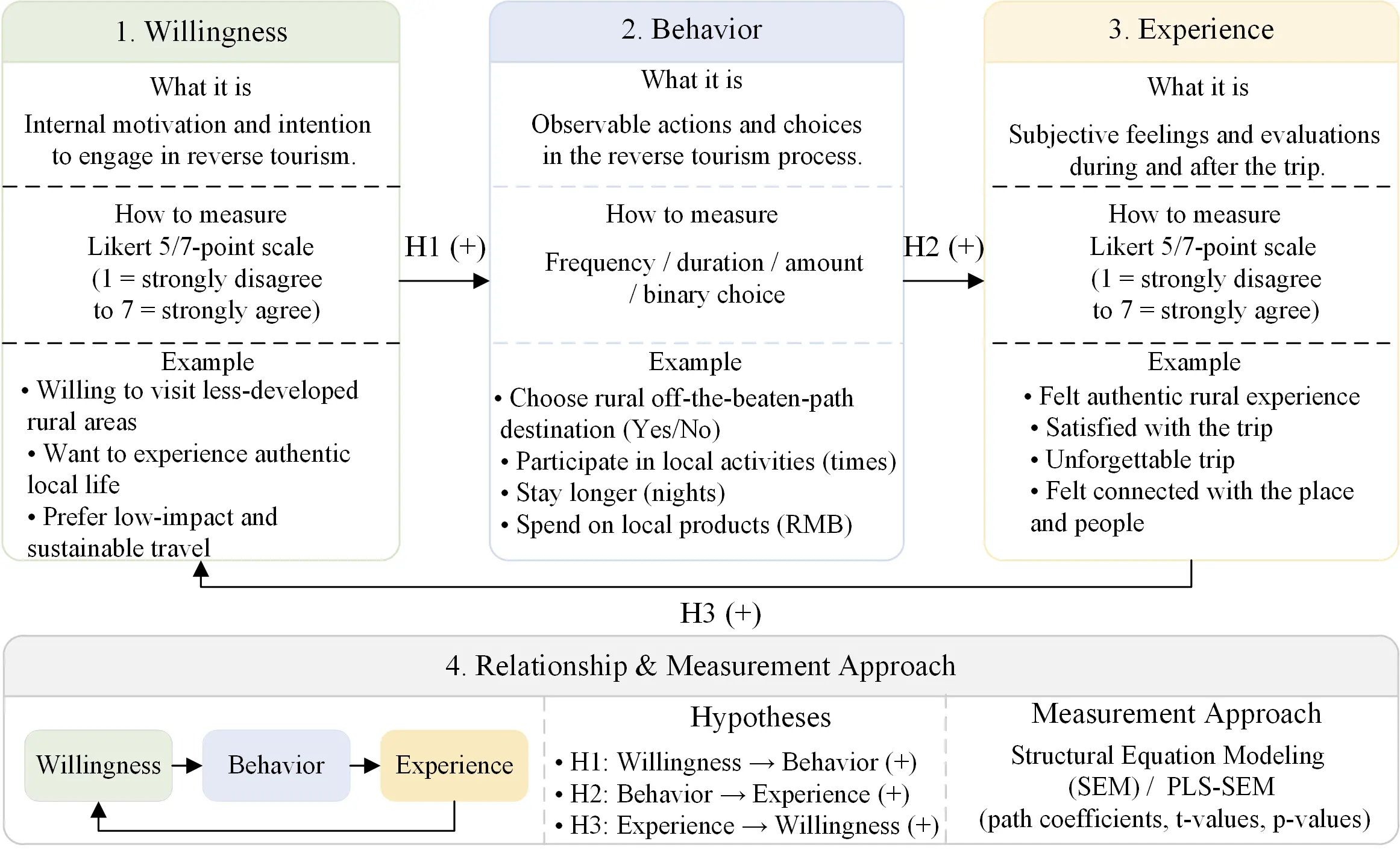
Specifically, the framework operationalizes each construct with clear measurement approaches and testable hypotheses to support empirical validation (Figure 2). Willingness and Experience are measured via 5/7-point Likert scales to capture tourists’ subjective attitudes and evaluations, while Behavior is quantified using objective indicators such as destination choice, activity frequency, stay duration, and local consumption. Three positive hypotheses formalize the reinforcing cycle: H1 (Willingness → Behavior), H2 (Behavior → Experience), and H3 (Experience → Willingness). These relationships will be examined using Partial Least Squares Structural Equation Modeling (PLS-SEM), analyzing path coefficients, t-values, and p-values to empirically verify the endogenous motivational mechanism of reverse tourism.
3.2.2. The Refined Model Based on Categories of Tourist Groups
In the context of system analysis applied to tourism, a tourist’s history of participation serves as a critical anchor for understanding their behavioral logic [43]. Variations in tourists’ perceptions of their travel motivations, destination choices, and experiential preferences are fundamentally rooted in the cumulative experiences shaped by iterative cycles of intention, behavior, and experience [44,45].
Consequently, in the study of reverse tourism, tourists can be categorized based on their participation within the preceding year.
N—first-time participants lacking prior tourism experience;
M—regular experiencers who mainly participate in mass tourism;
R—regular experiencers who mainly participate in reverse tourism;
MR—those with diverse experiences spanning in both.
Drawing on these four categories, this study constructs a multi-dimensional tourist profile framework (Table 5) to hypothesize group-specific traits across motivation, preference, consumption, and intention. N-type first-time participants exhibit curiosity-driven, safety-focused choices with uncertain future travel plans. M-type mass tourism experiencers prioritize mainstream convenience and standardized experiences, tending to repeat mass tourism. R-type reverse tourism experiencers pursue authenticity, favor marginal destinations and local engagement, and intend to continue reverse tourism. MR-type mixed experiencers show flexible, balanced preferences across mainstream and niche travel, with potential shifts toward niche tourism.
Table 5. Profiles of four tourist types.
|
Dimension |
N |
M |
R |
MR |
|---|---|---|---|---|
|
Core Characteristics |
No prior travel experience |
Mainstream travel habits |
Pursuit of authentic experiences |
Flexible and diverse experiences |
|
Travel Motivation |
Curiosity/desire to try |
Relaxation/entertainment |
Authenticity/value resonance |
Balance/multi-purpose |
|
Destination Preference |
Popular places (with high perceived safety) |
Well-known attractions |
Rural areas/marginal destinations |
Combines mainstream and niche |
|
Activity Preference |
Passive sightseeing |
Attraction-based activities |
Local life participation |
Mixed activities |
|
Consumption Pattern |
Budget-sensitive |
Package-oriented |
Experience-oriented/low-impact |
Selective and balanced |
|
Experience Evaluation |
Lack of reference |
Focus on convenience |
Focus on depth and meaning |
Compare and optimize |
|
Future Intention |
Uncertain |
Likely to repeat mass tourism |
Likely to repeat reverse tourism |
May shift toward niche travel |
Based on the static tourist profiles, this study further develops a group transition analysis framework to identify drivers and constraints of shifts between different tourist types (Table 6). As shown, N-type participants’ transitions are shaped by time/budget limits, social influence, and diverse interests; M-type tourists may shift to R-type due to aesthetic fatigue and awakened critical consciousness, while R-type tourists face convenience inertia when returning to mainstream tourism; MR-type mixed experiencers exhibit flexible, bidirectional exploration patterns.
Table 6. Transition drivers of tourist groups in reverse tourism.
|
From\To |
N |
M |
R |
MR |
|---|---|---|---|---|
|
N |
— |
Time/budget limits |
Influenced by others |
Diverse interests |
|
M |
Travel barrier |
— |
Aesthetic fatigue |
Diversified needs |
|
R |
Information gap |
Lack of infrastructure |
— |
Occasional return to mainstream |
|
MR |
Initial trial |
Convenience priority |
Deeper exploration |
— |
To further, the group conversion matrix (Figure 3) developed by above analysis systematically illustrates the dynamic evolution between these distinct roles. Each transition between roles encompasses core triggers (indicated above the transition arrow), auxiliary triggering conditions (indicated below), cyclical pathways, and transformation feature identifiers (represented by ellipses).
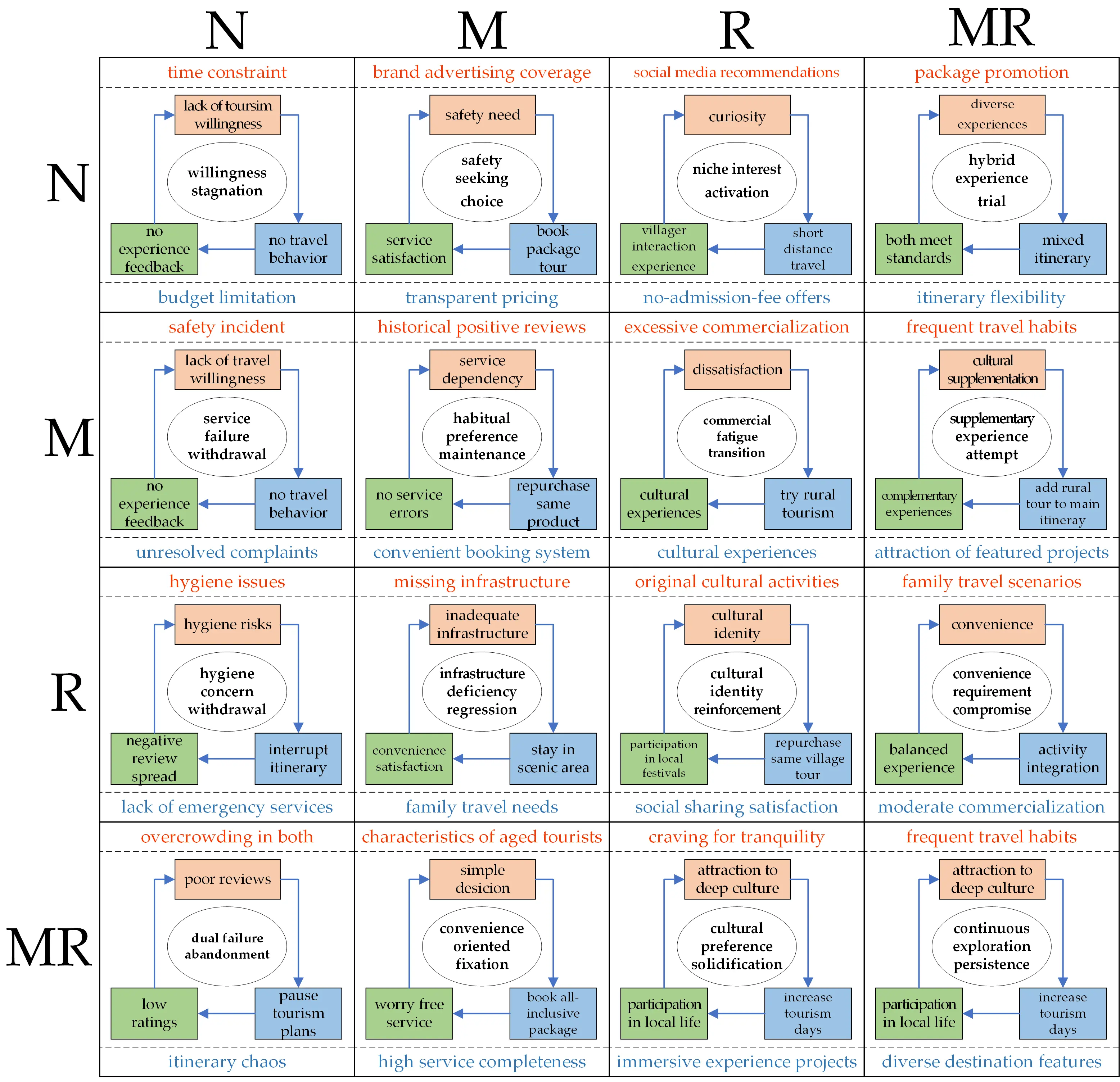
For example, in the N-M transition, limited by time constraints, budget constraints and other practical constraints (trigger), the will to travel that has not yet sprung up comes to a standstill (willingness to freeze), which ultimately manifests itself in the abandonment of the behavioral choice to travel (no travel practice), and the lack of experience prevents the formation of a closed loop of feedback (the continuation of the experience gap). In the M-R transition, the over-commercialization of scenic spots and the homogenization of services lead to the collapse of the willingness to rely on standardized services (standardized service collapse). In the M-R transition, aesthetic fatigue caused by over-commercialization of scenic spots and service homogenization triggers the collapse of reliance on standardized services (awakening of critical consciousness). Tourists then actively choose rural settlements and marginal destinations (behavioral shift), gain cultural identity and value resonance through localized experiences (practice validation) [46], and ultimately reinforce their reverse tourism preference, completing the role transformation.
Built on the “participation history-trigger point-cycle mechanism”, this framework provides a systematic methodological pathway for academic research and practical application. Academically, game-theoretic models analyze interactions between tourist groups and destinations [47]; structural equation modeling validates causal paths [48], and Markov models simulate the dynamic evolution of tourist groups [49]. Grounded theory coding of interview data reveals in-depth mechanisms [50], while complex network analysis identifies key nodes in the transformation network of tourists and attractions [51]. This multi-method approach advances interdisciplinary theoretical development. Practically, the framework guides the creation of differentiated products, niche marketing, and facility optimization based on trigger point features, and facilitates the establishment of a dynamic monitoring system [52]. Supported by experience thresholds and state transition probabilities, the system tracks real-time changes in group structure, delivers early warnings for key triggers, and optimizes resource allocation and service provision [53]. By linking theoretical analysis and real-world practice, this framework forms a sound methodological system. It refocuses tourism research on human behavior and drives the industry toward science-based, evidence-oriented, high-quality development.
4. Discussion
4.1. Why Is a New Opportunity for Rural Revitalization
4.1.1. Existent Demand
The overemphasis of mass tourism on iconic scenic spots sustains the industrial civilization’s material-scarcity mindset. Tourists pursue mainstream landmark attractions to accumulate social capital (especially the conversation fodder), while rural destinations are marginalized due to the lack of recognisable symbols and topical value. Rapid urbanization has reinforced the stereotype of rural backwardness, established urban tourism as the dominant market model, and hindered rural tourism development. Meanwhile, capital monopolies over landscape presentation and information dissemination further reduce the public visibility and market attractiveness of rural tourism destinations.
Nevertheless, societal changes have profoundly transformed such tourism demand patterns. Growing household incomes have shifted tourist pursuits from quantitative experiential accumulation to the qualitative search for unique and authentic travel experiences [54]. Social media generates a disenchantment effect and facilitates reverse grassroots marketing, weakening the popularity of overhyped scenic spots and granting niche rural areas greater public exposure [55]. In addition, post-pandemic psychological stress has made slow-paced, low-risk rural spaces crucial psychological buffers for urban residents [56]. The widespread advocacy of low-carbon, sustainable development has also spurred rising demand for low-intervention tourism. This demand transition represents a shift from industrial to ecological civilization in the tourism industry, allowing rural areas to transform traditional disadvantages into intrinsic strengths. Accordingly, rural spaces have reshaped their developmental identity, evolving from symbols of backwardness into ideal tourist destinations and core carriers of reverse tourism.
4.1.2. Viable Supply
Demand-supply alignment constitutes the foundation of sustainable tourism development, whereas persistent supply-demand mismatch inevitably triggers structural market imbalances [57,58]. Under the mass tourism paradigm, rural areas face inherent developmental constraints, including insufficient spatial resources, supporting facilities, capital, and labor. Coupled with tourists’ negative stereotypes of rural areas, rural regions have long lacked a robust capacity for tourism development.
The rise of reverse tourism enables the systematic transformation of rural supply systems, converting traditional developmental bottlenecks into competitive advantages that adapt to emerging market demands [59]. First, rural depopulation has created abundant idle spaces, which avoid tourism development conflicts and provide exclusive carriers for authentic ecological experiences [60]. Second, the comprehensive implementation of the Rural Revitalization Strategy has upgraded rural infrastructure, including roads, electricity, and communication networks, effectively remedying long-standing public service deficiencies [61]. Third, emerging asset-light operation models and diversified financing channels resolve traditional funding constraints, supporting the construction of small-scale, high-quality rural tourism projects. Fourth, driven by urban employment pressure and rural benefit-sharing mechanisms, local villagers and returning youth have shown strong enthusiasm for participation, forming a collaborative “host-guest co-creation” service model [62]. This systematic restructuring of spatial and human resource supply helps rural areas eliminate supply-side failures, realize effective demand-supply matching, and build solid operational capacity for reverse tourism development.
4.1.3. Feasible Realization
The inherent interplay between demand and supply compels rural reverse tourism toward a “Small yet Beautiful” paradigm [63]. On the demand side, tourists increasingly seek profound local immersion and authentic cultural experiences, necessitating differentiated offerings to satisfy personalized preferences. Concurrently, the characteristics of rural areas, including underutilized resources and infrastructural constraints, naturally favor low-intervention, asset-light development models. This approach mitigates the tensions inherent in large-scale projects while preserving the indigenous character of the locale, making it a compelling choice for both tourists and local communities.
Haotang Village, located in the authors’ region, exemplifies this strategy. This artistically conceived hamlet rigorously adheres to principles of minimal environmental impact, reflected in its policy of “no mountain leveling, no pond filling, and no tree felling”. The village has repurposed vacant farmhouses into accommodations that retain the traditional rammed-earth architectural style of Southern Henan Province, designed agricultural experiences centered around artistic paddy fields and Tea Stream Valley [64], and implemented a “housing equity participation + cooperative operation” model. This model ensures villagers’ active involvement in tourism development and equitable profit-sharing. This asset-light, experience-focused strategy has transformed Haotang Village from a declining rural settlement into a nationally recognized destination.
Since being recognized as a national beautiful rural demonstration village in 2013, Haotang Village has sustained over a decade of stable development. Its long-term operational practice fully validates the practicability and sustainability of the “Small yet Beautiful” reverse tourism model, demonstrating that this community-based, low-intervention development path is not a short-lived trend but a reliable and replicable approach for rural high-quality revitalization.
Inspired by this success, Xinyang City has further implemented a “Courtyard Economy” development strategy, extending rural tourism to the micro-level of individual household courtyards [65]. By encouraging villagers to transform their family compounds into distinctive homestays, intangible-cultural-heritage workshops, and rural restaurants, the strategy cultivates a diversified landscape in which “each household presents unique scenery, each courtyard emanates distinctive charm”, effectively integrating tourism into the fabric of daily life coupled with the extensive, rapid, and precise dissemination of social media: “Scenes everywhere to roam, Affordable joy for all to own”.
4.2. Why Does It Facilitate Rural Sustainable Development
Reverse tourism emphasizes de-commercialization and experiential travel, attracting visitors to rural areas with pristine natural landscapes and distinctive local cultures. Its core concepts of low-impact development and community participation are highly consistent with rural sustainable development theories. It establishes a demand-led and supply-adaptive interactive restraint mechanism [66]. Tourists’ preference for original ecology and authentic rural life motivates local communities to protect ecological and cultural resources and retain local features. This interaction forms a virtuous cycle where protection and development reinforce each other through community participation and sustainable consumption. Ultimately, it guides rural areas toward small-scale, high-quality, and sustainable growth and realizes coordinated development of nature, culture, the economy, and society.
5. Conclusions
This study investigates reverse tourism as a novel paradigm for reshaping rural tourism development and its potential to foster rural sustainable development. The principal findings are threefold.
- (1)
-
A systematic comparison of mass tourism and reverse tourism, focusing on tourist motivations, behaviors, and experiences, elucidates the inherent logic of tourism development transformation. The pursuit of authentic experiences among tourists emerges as the central impetus for this transformation, while the principles of de-commodification and locality emphasis in reverse tourism reflect the evolutionary trend from a capital-driven to a community-co-created paradigm. The resultant bi-directional mechanism of “demand guidance-supply adaptation” offers a robust framework for understanding sustainable tourism transformation. This comparative analysis culminates in a theoretical framework of “motivation-trend-path” for tourism transformation, providing a foundation for future research.
- (2)
-
By centering on tourists, the study develops an analytical framework of “willingness drives behavior—behavior shapes experience—experience reinforces willingness”. Based on their tourism participation history, tourists are categorized into four distinct groups with nuanced differences in their motivational mechanisms identified. This refined framework, viewed through the lens of tourist behavioral dynamics, not only reveals the internal mechanism of reverse tourism but also underscores its forward-looking nature through a differentiated multi-group analysis. This offers operational tools for precise market segmentation and experience design.
- (3)
-
By analyzing the realistic coupling mechanism of demand upgrading and supply transformation, the study demonstrates the feasibility of implementing reverse tourism in rural areas. The alignment between tourists’ experiential needs and rural landscape values fosters demand transformation; the strategic allocation of resources to improve rural infrastructure under the rural revitalization strategy enhances supply capacity; and the replication of successful models such as “Beautiful Countryside” and the “Courtyard Economy” creates conducive conditions for rural reverse tourism. The resultant “protection-development-benefit” closed loop, operating under a logic of “demand-supply-realization”, mitigates the ecological risks associated with large-scale mass tourism and offers a systematic solution for rural sustainable development by restraining unsustainable development pressures.
In summary, through comparative analysis, framework construction, and feasibility demonstration, this study systematically articulates the theoretical logic, mechanism, and practical path of reverse tourism as a novel paradigm for rural tourism transformation. These findings provide both theoretical innovation and practical guidance for promoting rural sustainable development.
Statement of the Use of Generative AI and AI-Assisted Technologies in the Writing Process
During the preparation of this manuscript, the authors used ChatGPT (OpenAI) solely for language editing, including grammar and spelling checks and improving the clarity and readability of the text, as the authors are non-native English speakers. The research conception and design, data collection and organization, data analysis, and interpretation of the results were carried out entirely by the authors. After using this tool, the authors carefully reviewed and edited the content as needed and take full responsibility for the content of the published article.
Acknowledgments
The authors gratefully acknowledge all funding and the Nanhu Scholars Program for Young Scholars of XYNU for their support in this research.
Author Contributions
Conceptualization, C.Y. (Chao Yu) and C.Y. (Chenao Yang); methodology, C.Y. (Chao Yu), C.Y. (Chenao Yang) and Z.Z.; investigation, C.Y. (Chenao Yang), Z.Z., Y.L., C.H., Y.F. and J.W.; resources, C.Y. (Chenao Yang), Z.Z., Y.L., C.H., Y.F. and J.W.; curation, C.Y. (Chao Yu); writing—original draft preparation, C.Y. (Chao Yu) and C.Y. (Chenao Yang); writing—review and editing, Z.Z., Y.L., Y.F. and J.W.; visualization, C.Y. (Chao Yu), C.Y. (Chenao Yang) and Z.Z. All authors have read and agreed to the published version of the manuscript.
Ethics Statement
Not applicable.
Informed Consent Statement
Not applicable.
Data Availability Statement
As a review article, the references cited in the article are all from publicly published papers.
Funding
This research was funded by the Key R&D and Promotion Project (Soft Science Research) in Henan Province, China (242400410100); the Postgraduate Research and Innovation Fund of Xinyang Normal University (2025KYJJ83).
Declaration of Competing Interest
The authors declare that they have no known competing financial interests or personal relationships that could have appeared to influence the work reported in this paper.
References
- Zhou Q, Sotiriadis M, Shen S. Using TikTok in Tourism Destination Choice: A Young Chinese Tourists’ Perspective. Tour. Manag. Perspect. 2023, 46, 101101. DOI:10.1016/j.tmp.2023.101101 [Google Scholar]
- Higgins-Desbiolles F, Carnicelli S, Krolikowski C, Wijesinghe G, Boluk K. Degrowing Tourism: Rethinking Tourism. J. Sustain. Tour. 2019, 27, 1926–1944. DOI:10.1080/09669582.2019.1601732 [Google Scholar]
- Cheirchanteri G. Industrial Cultural Heritage as an Alternative Tourism Model: Case Study of the Wider Lavreotiki Area in Southeastern Attica. IOP Conf. Ser. Mater. Sci. Eng. 2019, 603, 22001. DOI:10.1088/1757-899X/603/2/022001 [Google Scholar]
- Isaac RK. Alternative Tourism: New Forms of Tourism in Bethlehem for the Palestinian Tourism Industry. Curr. Issues Tour. 2010, 13, 21–36. DOI:10.1080/13683500802495677 [Google Scholar]
- Seraphin H, Sheeran P, Pilato M. Over-Tourism and the Fall of Venice as a Destination. J. Destin. Mark. Manag. 2018, 9, 374–376. DOI:10.1016/j.jdmm.2018.01.011 [Google Scholar]
- Sanagustín Fons MV, Fierro JAM, Patiño MGY. Rural Tourism: A Sustainable Alternative. Appl. Energy 2011, 88, 551–557. DOI:10.1016/j.apenergy.2010.08.031 [Google Scholar]
- Djuwendah E, Karyani T, Wulandari E, Pradono P. Community-Based Agro-Ecotourism Sustainability in West Java, Indonesia. Sustainability 2023, 15, 10432. DOI:10.3390/su151310432 [Google Scholar]
- Giampiccoli A, Mtapuri O, Nauright J. Tourism Development in the Seychelles: A Proposal for a Unique Community-Based Tourism Alternative. J. Tour. Cult. Change 2021, 19, 444–457. DOI:10.1080/14766825.2020.1743297 [Google Scholar]
- Cheng M, Zhang L, Zhang X, Li Y. Does rural sports tourism promote the sustainable development of the destination?—Based on Quasi-Experimental Evidence of Sports and Leisure Towns in China. J. Clean. Prod. 2025, 486, 144537. DOI:10.1016/j.jclepro.2024.144537 [Google Scholar]
- Cohen E. “Alternative Tourism”—A Critique. Tour. Recreat. Res. 1987, 12, 13–18. DOI:10.1080/02508281.1987.11014508 [Google Scholar]
- Kruczek Z, Szromek AR, Walas B, Mazanek L. Sources of Conflict among Tourism Stakeholders in Historical Cities. J. Policy Res. Tour. Leis. Events 2024, 16, 117–138. DOI:10.1080/19407963.2022.2027953 [Google Scholar]
- Kılıçaslan Ç, Deniz B, Göktug TH, Kara B, Kutsal E. Evaluation of Tourism Alternatives in the National Park of Dilek Peninsula Büyük Menderes Delta. Procedia Soc. Behav. Sci. 2011, 19, 270–279. DOI:10.1016/j.sbspro.2011.05.132 [Google Scholar]
- Pasgaard JC, Hemmersam P, Nielsen T. New Nordic Stereotypes: In Search of Alternative Design Practices for Tourism in Peripheral Landscapes. J. Landsc. Archit. 2021, 15, 6–19. DOI:10.1080/18626033.2020.1886505 [Google Scholar]
- Giampiccoli A, Mtapuri O. From Conventional to Alternative Tourism: Rebalancing Tourism towards a Community-Based Tourism Approach in Hanoi, Vietnam. Soc. Sci. 2021, 10, 176. DOI:10.3390/socsci10050176 [Google Scholar]
- Crăciun AM, Dezsi Ș, Pop F, Cecilia P. Rural Tourism—Viable Alternatives for Preserving Local Specificity and Sustainable Socio-Economic Development: Case Study—“Valley of the Kings” (Gurghiului Valley, Mureș County, Romania). Sustainability 2022, 14, 16295. DOI:10.3390/su142316295 [Google Scholar]
- Hong Z, Cao W, Chen Y, Zhu S, Zheng W. Identifying Rural Landscape Heritage Character Types and Areas: A Case Study of the Li River Basin in Guilin, China. Sustainability 2024, 16, 1626. DOI:10.3390/su16041626 [Google Scholar]
- Isaac RK, Eid TA. Tourists’ Destination Image: An Exploratory Study of Alternative Tourism in Palestine. Curr. Issues Tour. 2019, 22, 1499–1522. DOI:10.1080/13683500.2018.1534806 [Google Scholar]
- Zhao X, Xie C, Huang L, Wang Y, Han T. How Digitalization Promotes the Sustainable Integration of Culture and Tourism for Economic Recovery. Econ. Anal. Policy 2023, 77, 988–1000. DOI:10.1016/j.eap.2023.01.005 [Google Scholar]
- Molz JG. Social Networking Technologies and the Moral Economy of Alternative Tourism: The Case of Couchsurfing.Org. Ann. Tour. Res. 2013, 43, 210–230. DOI:10.1016/j.annals.2013.08.001 [Google Scholar]
- Markwick M. Alternative Tourism: Change, Commodification and Contestation of Malta’s Landscapes. Geography 2001, 86, 250–255. DOI:10.1080/20436564.2001.12219803 [Google Scholar]
- Mtapuri O, Giampiccoli A. Contextualing a Tourism Development Alternative for Argentina: A Proposal for Community Based Diffused Tourism. J. Spat. Organ. Dyn. 2021, 9, 138–155. Available online: https://journals.cinturs.pt/jtsw/article/view/277 (accessed on 21 June 2025).
- Kalisch AB, Cole S. Gender Justice in Global Tourism: Exploring Tourism Transformation through the Lens of Feminist Alternative Economics. J. Sustain. Tour. 2023, 31, 2698–2715. DOI:10.1080/09669582.2022.2108819 [Google Scholar]
- Chebli A, Kadri B, Ben Said F. Promotion of Domestic Tourism by Enhancing the Practice of Alternative Tourism as a Quality Measure to Satisfy and Retain National Tourists. J. Tour. Serv. 2021, 12, 61–85. DOI:10.29036/jots.v12i23.274 [Google Scholar]
- Yang L. Cultural Tourism in a Replicated Old Town: Tourists’ Views. Tour. Plan. Dev. 2019, 16, 93–111. DOI:10.1080/21568316.2018.1470998 [Google Scholar]
- Belias D, Velissariou E, Kyriakou D, Varsanis K, Vasiliadis L, Mantas C, et al. Tourism Consumer Behavior and Alternative Tourism: The Case of Agrotourism in Greece. In Innovative Approaches to Tourism and Leisure; Katsoni V, Velander K, Eds.; Springer Proceedings in Business and Economics; Springer International Publishing: Cham, Switzerland, 2018; pp. 465–478. ISBN 978-3-319-67602-9 [Google Scholar]
- Partanen M, Kettunen M, Saarinen J. Community Inclusion in Tourism Development: Young People’s Social Innovation Propositions for Advancing Sustainable Tourism. Tour. Recreat. Res. 2025, 50, 58–73. DOI:10.1080/02508281.2023.2226040 [Google Scholar]
- Stavroula G, Vasiliki D. Alternative Forms of Sustainable Development: The Case of Thermal Tourism. Int. J. Sustain. Dev. 2020, 19, 367–377. DOI:10.1504/IJESD.2020.110637 [Google Scholar]
- Vergopoulos H. Alternative Tourism and Civil Society in Athens. Int. J. Tour. Cities 2019, 5, 51–62. DOI:10.1108/IJTC-12-2017-0086 [Google Scholar]
- Medeiros HMN, Guerreiro QLDM, Vieira TA, Silva SMSD, Renda AIDSA, Oliveira-Junior JMB. Alternative Tourism and Environmental Impacts: Perception of Residents of an Extractive Reserve in the Brazilian Amazonia. Sustainability 2021, 13, 2076. DOI:10.3390/su13042076 [Google Scholar]
- Jang K, Sakamoto K, Funck C. Dark Tourism as Educational Tourism: The Case of “Hope Tourism” in Fukushima, Japan. J. Herit. Tour. 2021, 16, 481–492. DOI:10.1080/1743873X.2020.1858088 [Google Scholar]
- Che Leh F, Mohd Isa NK, Ibrahim MH, Ibrahim M, Yunos MYM, Ibrahim JA. Low-Carbon Tourism Approach as an Alternative Form for Tourism Development: A Review for Model Development. Pertanika J. Soc. Sci. Humanit. 2021, 29, 2431–2451. DOI:10.47836/pjssh.29.4.19 [Google Scholar]
- Eckert C, Pechlaner H. Alternative Product Development as Strategy Towards Sustainability in Tourism: The Case of Lanzarote. Sustainability 2019, 11, 3588. DOI:10.3390/su11133588 [Google Scholar]
- Lazarevic S, Stanisic T, Ion RA. Slow Tourism as a Contemporary Tendency in the Tourism Market: Image Content and Geotag Analysis on Instagram. Ekon. Poljopr.-Econ. Agric. 2024, 71, 589–598. DOI:10.59267/ekoPolj2402589L [Google Scholar]
- Pirselimoğlu Z, Demirel Ö. Ecology-Based Tourism Potential with Regard to Alternative Tourism Activities in Altındere Valley (Trabzon—Maçka). Int. J. Sustain. Dev. World Ecol. 2015, 22, 39–49. DOI:10.1080/13504509.2014.948098 [Google Scholar]
- Chen S, Wei H. Minimalism in Capsule Hotels: Enhancing Tourist Responses by Using Minimalistic Lifestyle Appeals Congruent with Brand Personality. Tour. Manag. 2022, 93, 104579. DOI:10.1016/j.tourman.2022.104579 [Google Scholar]
- Huang SCL. Visitor Responses to the Changing Character of the Visual Landscape as an Agrarian Area Becomes a Tourist Destination: Yilan County, Taiwan. J. Sustain. Tour. 2013, 21, 154–171. DOI:10.1080/09669582.2012.687739 [Google Scholar]
- Kaltenborn BP, Nyahongo JW, Kideghesho JR. The Attitudes of Tourists Towards the Environmental, Social and Managerial Attributes of Serengeti National Park, Tanzania. Trop. Conserv. Sci. 2011, 4, 132–148. DOI:10.1177/194008291100400204 [Google Scholar]
- Varjú V, Suvák A, Dombi P. Geographic Information Systems in the Service of Alternative Tourism—Methods with Landscape Evaluation and Target Group Preference Weighting. Int. J. Tour. Res. 2014, 16, 496–512. DOI:10.1002/jtr.1943 [Google Scholar]
- Saxena G. Rural Tourism Partnerships and Actor Mobility. Int. J. Tour. Res. 2014, 16, 488–495. DOI:10.1002/jtr.1942 [Google Scholar]
- Xu Y, Wang C, Zhang T. Tourism-Led Rural Gentrification: Impacts and Residents’ Perception. Tour. Rev. 2022, 77, 256–270. DOI:10.1108/TR-05-2020-0227 [Google Scholar]
- Kimo Boukamba H. Philip L. Pearce on Tourist Behaviour Research: Tourist Behaviour: The Essential Companion. Tour. Geogr. 2022, 24, 179–182. DOI:10.1080/14616688.2020.1826570 [Google Scholar]
- Alegre J, Cladera M, Sard M. Analysing the Influence of Tourist Motivations on Tourist Expenditure at a Sun-and-Sand Destination. Tour. Econ. 2011, 17, 813–832. DOI:10.5367/te.2011.0063 [Google Scholar]
- Rasoolimanesh SM, Ringle CM, Jaafar M, Ramayah T. Urban vs. Rural Destinations: Residents’ Perceptions, Community Participation and Support for Tourism Development. Tour. Manag. 2017, 60, 147–158. DOI:10.1016/j.tourman.2016.11.019 [Google Scholar]
- Ito E, Kono S, Gui J. Psychological Consequences of Tourism Ideal Affect. Curr. Issues Tour. 2023, 26, 468–479. DOI:10.1080/13683500.2021.2023479 [Google Scholar]
- Chen H, Rahman I. Cultural Tourism: An Analysis of Engagement, Cultural Contact, Memorable Tourism Experience and Destination Loyalty. Tour. Manag. Perspect. 2018, 26, 153–163. DOI:10.1016/j.tmp.2017.10.006 [Google Scholar]
- Kim J-H. The Impact of Memorable Tourism Experiences on Loyalty Behaviors: The Mediating Effects of Destination Image and Satisfaction. J. Travel Res. 2018, 57, 856–870. DOI:10.1177/0047287517721369 [Google Scholar]
- Jena SK, Behera C. Mathematical Modelling for Tourism Supply Chain Considering Sustainable Effort. INFOR 2022, 60, 20–51. DOI:10.1080/03155986.2021.2004056 [Google Scholar]
- Fu Y, Gao J, Timothy DJ, Wang Y. Antecedents of Cultural Connectedness in Diaspora Tourism: Perspectives from the Chinese Diaspora. J. Hosp. Tour. Manag. 2025, 62, 34–45. DOI:10.1016/j.jhtm.2024.12.010 [Google Scholar]
- Liu J, Li X, Yang Y, Tan Y, Geng T, Wang S. Short- and Long-Term Prediction and Determinant Analysis of Tourism Flow Networks: A Novel Steady-State Markov Chain Method. Tour. Manag. 2025, 109, 105139. DOI:10.1016/j.tourman.2025.105139 [Google Scholar]
- Wang H, Wang H. Research on the Tourism-Promoting Rural Revitalisation Model Based on Grounded Theory: The Case of Shibadong Village in Huayuan County, Hunan Province. Sustainability 2024, 16, 10942. DOI:10.3390/su162410942 [Google Scholar]
- Vieira DP, Júnior ER, de Lacerda Rangel G. New Entrants for Attractions Network Evolution. Tour. Hosp. Res. 2024, 24, 291–303. DOI:10.1177/14673584231151895 [Google Scholar]
- James L, Halkier H, Sanz-Ibanez C, Wilson J. Advancing Evolutionary Economic Geographies of Tourism: Trigger Events, Transformative Moments and Destination Path Shaping. Tour. Geogr. 2023, 25, 1819–1832. DOI:10.1080/14616688.2023.2285324 [Google Scholar]
- Homburg C, Jozic D, Kuehnl C. Customer Experience Management: Toward Implementing an Evolving Marketing Concept. J. Acad. Mark. Sci. 2017, 45, 377–401. DOI:10.1007/s11747-015-0460-7 [Google Scholar]
- Ma W, Vatsa P, Zhou X, Zhu H. Household Income and Tourism Expenditure: An Unconditional Quantile Regression Approach. Appl. Econ. 2024, 56, 6144–6157. DOI:10.1080/00036846.2023.2267823 [Google Scholar]
- Huang Y, Qian L, Tu H. When Social Media Exposure Backfires on Travel: The Role of Social Media–Induced Travel Anxiety. Tour. Manag. 2025, 110, 105163. DOI:10.1016/j.tourman.2025.105163 [Google Scholar]
- Meenakshi N, Dhir A, Mahto RV, Nicolau JL, Kaur P. Travelers’ Coping Strategies in the Backdrop of Revenge Tourism. J. Travel Res. 2024, 63, 1473–1489. DOI:10.1177/00472875231193596 [Google Scholar]
- Blapp M, Mitas O. Creative Tourism in Balinese Rural Communities. Curr. Issues Tour. 2018, 21, 1285–1311. DOI:10.1080/13683500.2017.1358701 [Google Scholar]
- Michalko G, Irimias A, Timothy DJ. Disappointment in Tourism: Perspectives on Tourism Destination Management. Tour. Manag. Perspect. 2015, 16, 85–91. DOI:10.1016/j.tmp.2015.07.007 [Google Scholar]
- Ruzic P, Demonja D. Economic Impacts of Rural Tourism in Rural Areas of Istria (Croatia). Transform. Bus. Econ. 2017, 16, 31–40. Available online: http://www.transformations.knf.vu.lt/42/se42.pdf (accessed on 21 June 2025).
- Yin B, Shimizu Y. Innovative Land Bank Models for Addressing Vacant Properties in Japan: A Case Study of Six Approaches. Land 2025, 14, 674. DOI:10.3390/land14040674 [Google Scholar]
- Gao J, Duan X, Wang Q, Yang Z, Zhong R, Yuan X, et al. Spatial Mismatch Between Transportation Development and Tourism Spatial Vitality in Yunnan Province in the Context of Urban-Rural Integration. Land 2025, 14, 1017. DOI:10.3390/land14051017 [Google Scholar]
- Iorio M, Corsale A. Rural Tourism and Livelihood Strategies in Romania. J. Rural Stud. 2010, 26, 152–162. DOI:10.1016/j.jrurstud.2009.10.006 [Google Scholar]
- Huang W-J, Beeco JA, Hallo JC, Norman WC. Bundling Attractions for Rural Tourism Development. J. Sustain. Tour. 2016, 24, 1387–1402. DOI:10.1080/09669582.2015.1115510 [Google Scholar]
- Lu Y, Qian J. Towards a Material Approach in Rural Geography: Architectural Experiments in China’s Rural Renaissance and Reconstruction Movements. Geoforum 2020, 116, 119–129. DOI:10.1016/j.geoforum.2020.08.006 [Google Scholar]
- Lulcheva I. Opportunities for the Development of Rural Tourism in Small Settlements. Sci. Pap.-Ser. Manag. Econ. Eng. Agric. Rural Dev. 2018, 18, 283–288. Available online: https://managementjournal.usamv.ro/pdf/vol.18_2/Art37.pdf (accessed on 21 June 2025).
- Zhang J, Dou S, Liu J, Chen Y. Ecological Challenges on Small Tourist Islands: A Case from Chinese Rural Island. Sustain. Dev. 2024, 32, 1723–1742. DOI:10.1002/sd.2745 [Google Scholar]