
Smart Manufacturing for Production Flexibility in Industry 4.0–5.0: A Systematic Review, Gap Analysis, and Framework
Smart Manufacturing for Production Flexibility in Industry 4.0–5.0: A Systematic Review, Gap Analysis, and Framework
Received: 11 May 2026 Revised: 25 May 2026 Accepted: 29 May 2026 Published: 09 June 2026

© 2026 The authors. This is an open access article under the Creative Commons Attribution 4.0 International License (https://creativecommons.org/licenses/by/4.0/).
1. Introduction
Smart manufacturing has emerged as a core paradigm in the digital transformation of industrial systems, enabling intelligent, interconnected, and adaptive production environments. This transformation is driven by the convergence of Industry 4.0 technologies, including cyber-physical systems (CPS), the Industrial Internet of Things (IIoT), artificial intelligence (AI), digital twins, cloud computing, robotics, and advanced analytics, which collectively enable real-time sensing, predictive decision-making, and autonomous control of manufacturing operations [1,2,3,4,5]. These technologies function as tightly coupled socio-technical enablers that reshape production system architecture, operational intelligence, and responsiveness. In this context, smart factories have evolved from conceptual models into deployed industrial systems underpinned by AI, digital infrastructures, and sustainability imperatives [6,7,8].
Rather than constituting incremental automation, smart manufacturing represents a structural reconfiguration of production logic—from centralized, deterministic architectures to distributed, data-driven, and self-organizing ecosystems [9,10,11], in which decision-making is increasingly embedded within cyber-physical infrastructures enabling continuous physical–digital feedback loops [12].
Although the Resource-Based View and Dynamic Capabilities Theory explain how digital technologies enhance competitiveness and adaptability, they remain limited in capturing system-level emergence in highly interconnected manufacturing environments [13]. These perspectives largely emphasize firm-level capabilities while underrepresenting interdependencies among technologies, organizational structures, and human agency.
Accordingly, smart manufacturing is more rigorously conceptualized as a socio-technical system in which value emerges from the dynamic interaction of digital infrastructure, operational processes, and human cognition, rather than from isolated technological components [14,15].
1.1. Industry 4.0–Industry 5.0 Transition and System Evolution
The manufacturing sector is undergoing a paradigm transition from Industry 4.0 to Industry 5.0, reflecting a shift from efficiency-centric automation toward human-centric, resilient, and sustainable production systems [16]. While Industry 4.0 prioritizes productivity, connectivity, and automation, Industry 5.0 extends this paradigm by embedding human–machine collaboration, ethical considerations, and circular economy principles into industrial systems [17,18,19,20].
Industry 4.0 introduced CPS, IIoT, big data analytics, and real-time monitoring, enabling adaptive and predictive production capabilities [21,22,23]. Subsequent advancements in AI, digital twins, and IoT further enhanced system connectivity and intelligence [24,25,26], yet largely remained oriented toward efficiency optimization [16,19,27].
Industry 5.0 addresses these limitations by repositioning manufacturing systems around human-centricity, resilience, and sustainability through collaborative robotics, decentralized decision-making, and adaptive socio-technical architectures [28,29,30]. These principles are operationalized through CPS, IIoT, AI, and energy-aware systems [31,32,33], extended across supply networks and smart products [34,35], and reinforced through circular and sustainable production models [36,37,38,39].
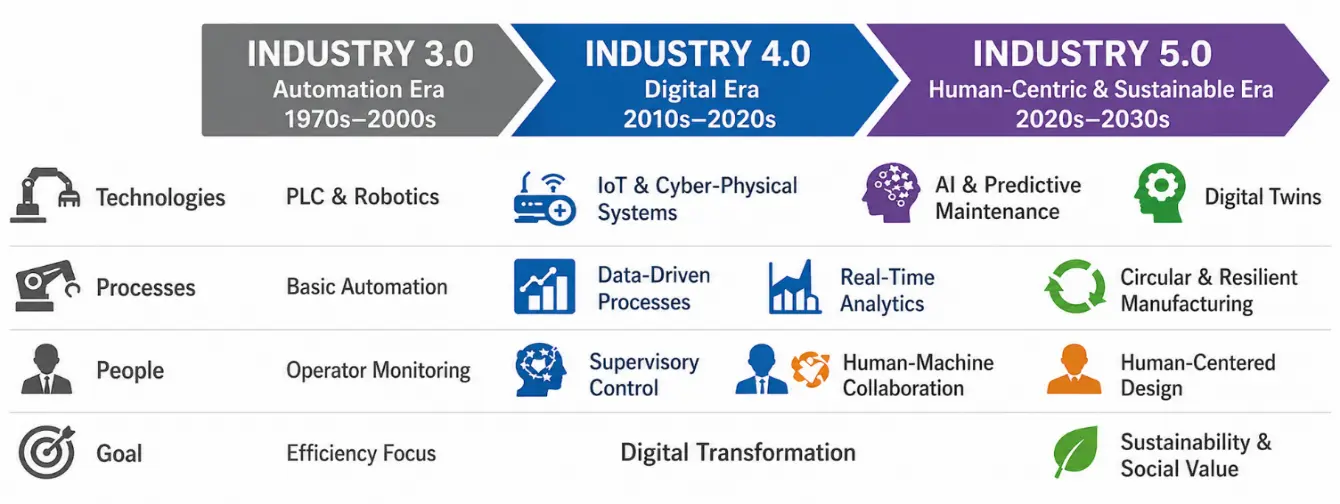
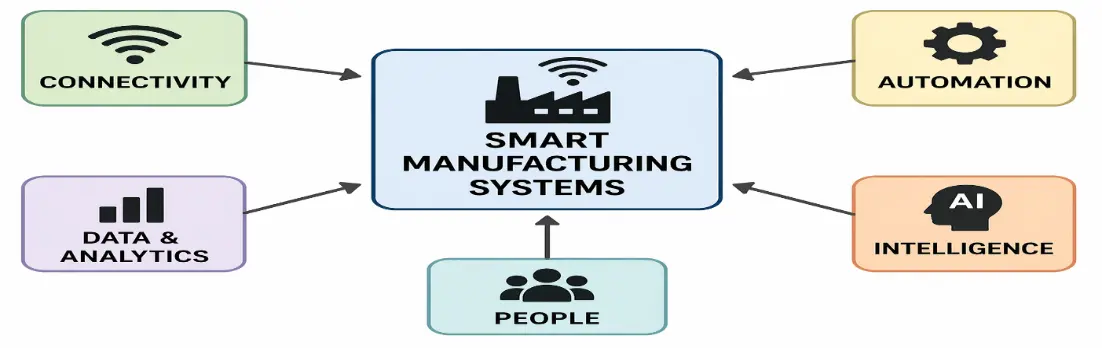
Figure 1 illustrates the evolution of smart manufacturing systems from Industry 3.0 to Industry 5.0, highlighting progressive increases in automation, intelligence, and sustainability integration. Industry 3.0 introduced computer-based automation; Industry 4.0 enabled cyber-physical integration and data-driven decision-making; and Industry 5.0 integrates human-centric intelligence, AI-augmented decision-making, and sustainability-oriented adaptability. Figure 2 further depicts the integrated smart manufacturing ecosystem, comprising connectivity, automation, analytics, AI, and human agency, collectively enabling real-time coordination, predictive control, and adaptive system behavior.
1.2. Production Flexibility as an Emergent System Capability
Within this paradigm, production flexibility has emerged as a critical capability for operating in volatile, uncertain, complex, and ambiguous (VUCA) environments. It refers to the ability of a production system to dynamically respond to changes in demand, product variety, supply disruptions, and operational constraints while sustaining performance across cost, quality, and delivery dimensions [40,41].
Importantly, production flexibility should not be interpreted as a structural attribute or isolated technological outcome. Rather, it is an emergent system-level capability arising from the dynamic interaction of digital infrastructures, operational processes, and human decision-making within cyber-physical environments. It is commonly classified into volume, product mix, and routing flexibility [40,41] and is widely recognized as a key determinant of resilience in high-mix, low-volume manufacturing systems [42].
However, existing research remains fragmented and predominantly technology-centric, emphasizing isolated solutions such as predictive maintenance, AI-based scheduling, digital twins, and IoT-enabled monitoring [43,44], without adequately explaining their systemic interdependencies. Consequently, flexibility is often treated implicitly rather than modeled as an emergent property. Moreover, the lack of standardized multidimensional measurement frameworks limits theoretical accumulation and cross-study comparability [45,46].
1.3. Research Gaps, Questions, and Contribution
This study is motivated by the persistent mismatch between substantial investments in smart manufacturing technologies and the limited realization of production flexibility outcomes [9]. Despite rapid digital adoption, the mechanisms through which system integration translates into flexibility remain insufficiently theorized and empirically validated. The following research questions guide this study:
RQ1: How do smart manufacturing technologies enable production flexibility?
RQ2: Which dimensions of production flexibility are most influenced?
RQ3: What are the key conceptual, methodological, and empirical gaps in the literature?
RQ4: How do integrated smart manufacturing capabilities translate into production flexibility?
RQ5: What underlying mechanisms drive flexibility emergence in digital manufacturing systems?
Three core gaps are identified: (i) weak theoretical integration between enabling technologies and flexibility outcomes, (ii) absence of standardized and multidimensional measurement frameworks, and (iii) limited empirical validation in real-world industrial settings [46,47,48]. To address these gaps, this study synthesizes fragmented literature and develops a unified conceptual framework that positions production flexibility as an emergent capability of smart manufacturing systems within the Industry 4.0–Industry 5.0 transition. The paper is organized as follows: Section 2 reviews the relevant literature, Section 3 presents the gap analysis, Section 4 proposes the conceptual framework, Section 5 discusses the findings, and Section 6 concludes the study.
2. Literature Review and Methodology
Smart manufacturing has emerged as a strategic response to increasing industrial complexity, volatility, and demands for customization. It integrates cyber–physical systems, industrial Internet of Things (IIoT), artificial intelligence, digital twins, and advanced automation technologies to enable adaptive, data-driven, and resilient production systems. Despite significant technological progress, the literature remains fragmented, with a dominant focus on isolated technological enablers rather than system-level capability formation. In particular, the interaction between technological, organizational, and human-centric dimensions remains insufficiently developed. This limitation is especially evident in the transition toward Industry 5.0, where sustainability, resilience, and human-centricity are emphasized but not yet coherently operationalized within production flexibility frameworks. To address this gap, this study employs a PRISMA 2020–aligned systematic literature review, combined with interpretive thematic synthesis, to ensure rigor, transparency, and reproducibility [49].
- (1)
-
Data sources and search strategy: A systematic search was conducted across Scopus, Web of Science, and ScienceDirect, covering studies published between 2011 and 2026. The search strategy was developed iteratively and refined through pilot testing to ensure an optimal balance between recall and precision. Keyword combinations included “smart manufacturing”, “Industry 4.0”, “Industry 5.0”, “production flexibility”, “cyber–physical systems”, “industrial IoT”, “artificial intelligence”, “digital twin”, and “servitization”, applied using Boolean operators and database-specific filters such as subject area, document type, and language to ensure relevance and quality.
- (2)
-
Eligibility criteria: Studies were included if they were peer-reviewed journal articles or high-quality conference proceedings, written in English, and explicitly addressed smart manufacturing and/or production flexibility at technological, organizational, or system levels. Both conceptual and empirical studies were retained to support theory-building and conceptual integration. Studies were excluded if they were non-scholarly, duplicated, lacked methodological transparency, or showed weak alignment with the research scope.
- (3)
-
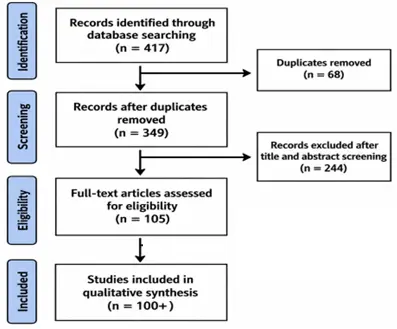
Screening process and PRISMA workflow: The initial search yielded 417 records. After removing 68 duplicates, 349 unique records remained. Title and abstract screening excluded 244 studies due to irrelevance to smart manufacturing, Industry 4.0/5.0, or production flexibility, leaving 105 studies for full-text assessment. At the full-text stage, additional exclusions were made due to methodological limitations, conceptual redundancy, or insufficient alignment with the research objectives. The final dataset comprised over 100 studies included in qualitative synthesis and thematic analysis, ensuring rigor, transparency, and reproducibility in accordance with PRISMA 2020 guidelines. The overall process is illustrated in Figure 3 (PRISMA flow diagram), which supports the traceability and methodological transparency of the review.
- (4)
-
Quality assessment: A structured appraisal framework was applied to evaluate methodological rigor, theoretical contribution, and contextual relevance. Assessment criteria included clarity of research design, analytical robustness, and conceptual depth. Rather than applying strict exclusion thresholds, a weighted inclusion approach was adopted to ensure balanced representation of qualitative and quantitative studies while prioritizing higher-quality contributions and minimizing selection bias.
- (5)
-
Data synthesis: A structured data extraction protocol was used to capture key study attributes, including technological focus, research context, methodological approach, and dimensions of production flexibility. Interpretive thematic synthesis was then conducted using open, axial, and selective coding. This iterative process enabled the identification of recurring patterns, interdependencies, and conceptual gaps across technological, organizational, and human-centric dimensions, leading to the abstraction of higher-order themes that informed the development of the Smart Manufacturing–Production Flexibility (SM–PF) framework.
- (6)
-
Methodological positioning: This study is positioned within theory-building and integrative review research, adopting a systems-oriented and configurational perspective. Rather than aggregating findings descriptively, it conceptualizes production flexibility as an emergent system-level capability arising from dynamic interactions among cyber–physical systems, organizational structures, and human-centric factors. This positioning enables the development of a unified conceptual foundation and evolutionary framework for smart manufacturing across Industry 4.0 and Industry 5.0 paradigms, bridging fragmented research streams and supporting both theoretical advancement and practical application.
Industrial manufacturing has undergone a profound transformation driven by digitalization, automation, globalization, and intensifying competitive pressures. The adoption trend illustrated in Figure 2 indicates sustained growth in smart manufacturing since 2005, reinforcing digital transformation as a strategic imperative, particularly for SMEs [50]. This evolution represents a structural shift from static, resource-based production paradigms toward dynamically reconfigurable, data-driven socio-technical ecosystems in which physical and digital layers are tightly coupled.
Empirical studies confirm widespread diffusion of smart manufacturing technologies across automotive, aerospace, electronics, plastics, and assembly sectors [51,52,53], primarily driven by increasing operational complexity and market volatility [54,55]. However, realized performance gains remain uneven and context-dependent. This heterogeneity is largely explained by differences in organizational readiness, technological maturity, and system integration capability [56,57,58,59,60], implying that smart manufacturing performance is fundamentally an emergent system property rather than a direct technological outcome.
From a theoretical standpoint, Industry 4.0 is defined by cyber-physical integration enabled through CPS, IIoT, AI, and digital infrastructures that support automation and data-driven decision-making [21,22,23]. However, its dominant efficiency-centric orientation limits its explanatory power regarding broader socio-technical requirements such as resilience, sustainability, and human-centricity. Industry 5.0 extends this paradigm by repositioning manufacturing systems as human-centric, resilient, and sustainable socio-technical ecosystems [61,62,63].
The following literature is structured into four analytical dimensions:
-
Enabling Technologies and System Architecture of Smart Manufacturing
-
Operational Characteristics and Smart Factories
-
Sustainability and Human-Centric Manufacturing
-
Production Flexibility, Mechanisms, Servitization, and Research Gaps
2.1. Enabling Technologies and System Architecture of Smart Manufacturing
Smart manufacturing emerges from the convergence of Industry 4.0 technologies that collectively constitute cyber-physical production ecosystems [64,65]. These technologies should be understood not as isolated tools, but as interdependent enablers of sensing, connectivity, intelligence, and autonomous control.
IoT provides real-time physical–digital connectivity [65], while AI enables predictive and prescriptive decision intelligence [4]. Cloud computing supports scalable data orchestration [65], digital twins enable continuous synchronization and system optimization [3], and 5G facilitates ultra-low-latency industrial communication [4]. Collectively, these technologies enable reconfigurable, responsive, and data-driven production systems [64].
At the architectural level, smart manufacturing integrates CPS, IIoT, AI, robotics, cybersecurity, and cloud infrastructures into multilayered cyber-physical production systems [1,5,54,66]. These systems are commonly organized into CPS, IIoT, AI, digital twin, and analytics layers [2,3,67]. CPS and IIoT enable vertical and horizontal integration across organizational boundaries [10], AI enables adaptive autonomy and decision intelligence [13,68], and digital twins ensure closed-loop synchronization between physical and virtual domains [43].
Importantly, recent literature converges on the view that value creation in smart manufacturing emerges from system integration rather than individual technologies [69]. However, this integration remains constrained by interoperability limitations, cybersecurity vulnerabilities, and architectural complexity [70]. In addition, human–machine interaction remains under-theorized, limiting the development of fully integrated socio-technical architectures [71].
2.2. Operational Characteristics and Smart Factories
Smart manufacturing systems are characterized by modularity, heterogeneity, interoperability, and context-awareness [72,73,74]. These characteristics collectively enable configurability and adaptability, although their contribution to systemic resilience remains insufficiently formalized in the literature.
At the operational level, smart manufacturing integrates AI, IoT, sensing systems, and analytics to enable real-time communication, automation, and decision-making across production networks [60,75,76]. This enables end-to-end operational visibility and closed-loop control across the production lifecycle. Computer-integrated manufacturing enhances efficiency and waste minimization [32,77], while real-time analytics supports predictive maintenance, quality assurance, and energy optimization [76,78,79].
Smart factories operationalize these capabilities through CPS, IIoT, AI, robotics, and analytics, resulting in self-organizing and adaptive production systems [80,81,82]. AI enables predictive optimization [26], digital twins support continuous simulation and system refinement [24,25,83], cobots enable safe human–machine collaboration [26,84], and blockchain ensures trusted data exchange [85,86,87]. Cloud/edge computing and 5G/6G networks further enable distributed intelligence and real-time coordination [24,88,89].
Servitization extends manufacturing from product-centric logic to integrated product–service systems [90], including product-, use-, and result-oriented models [91]. Digital servitization integrates IoT, AI, cloud computing, and blockchain to enable lifecycle-oriented value creation [65,92], enhancing customization, responsiveness, and value delivery [93,94,95]. This transition also underpins the implementation of the circular economy and sustainable production networks.
2.3. Sustainability and Human-Centric Manufacturing
Industry 5.0 extends Industry 4.0 by embedding human-centricity, sustainability, and resilience into industrial systems [61,62,63]. It reframes manufacturing as a collaborative socio-technical system in which intelligent technologies augment human cognition and decision-making rather than replace human agency [96,97,98].
Human-centric manufacturing prioritizes workforce empowerment, safety, and continuous capability development [99,100,101], while ethical AI frameworks ensure transparency, fairness, and accountability [102]. Sustainability is operationalized through CPS, IIoT, AI, and digital twins, enabling real-time monitoring of energy, emissions, and material flows [103,104], complemented by blockchain-based traceability systems [105,106,107].
Environmental intelligence integrates analytics with governance structures to enable adaptive sustainability decision-making [37,38,39]. Organizational transformation is supported through maturity models [108], agile organizational structures, and systematic reskilling initiatives [99,100,101]. Reference architectures such as RAMI 4.0 and IIRA provide interoperability and structural standardization [109,110,111]. Policy frameworks including Industrie 4.0, Made in China 2025, Society 5.0, and Industry 5.0, guide global industrial transformation strategies [112,113,114,115,116].
2.4. Production Flexibility, Mechanisms, Servitization, and Research Gaps
Production flexibility is a core dynamic capability that enables manufacturing systems to respond effectively to uncertainty, variability, and disruption. It is commonly conceptualized through volume, product mix, and routing flexibility [40,41] and is strongly associated with resilience and competitive advantage [42]. However, its conceptualization as an emergent, system-level capability remains insufficiently developed.
Smart manufacturing enhances flexibility through multiple enabling mechanisms. CPS and IIoT provide real-time system visibility [10], AI enables adaptive decision-making [13,117], digital twins support simulation-driven reconfiguration [43], and multi-agent systems enable decentralized coordination [118]. However, the literature remains fragmented, with these mechanisms largely examined in isolation rather than as an integrated capability architecture.
Servitization enhances flexibility by enabling dynamic product–service ecosystems [90], supported by digital technologies [65,92]. This improves responsiveness, customization, and lifecycle optimization [93,94,95] while enabling circular economy transitions aligned with Industry 5.0 principles.
Despite these advancements, key structural barriers persist, including integration complexity, strategic misalignment, financial constraints, and workforce skill gaps [119,120,121]. A fundamental limitation remains the dominance of technology-centric perspectives that underrepresent socio-technical interactions [9]. Consequently, production flexibility is still predominantly treated as an outcome variable rather than an emergent system property [14,122]. Moreover, integrated frameworks linking smart manufacturing capabilities to flexibility through structured transformation pathways remain underdeveloped [44,47,123].
According to Gomaa (2026) [124], the field remains fragmented, lacking capability-centric models, empirical validation depth, and unified theoretical foundations. Addressing these gaps requires a shift toward a holistic socio-technical systems perspective in which production flexibility emerges from the coordinated interaction of smart manufacturing capabilities.
3. Challenges and Research Gaps Analysis
Despite substantial progress in smart manufacturing and Industry 4.0 research, the literature remains fragmented across technological, operational, organizational, and theoretical domains. Although enabling technologies such as cyber-physical systems (CPS), industrial Internet of Things (IIoT), artificial intelligence (AI), robotics, and digital twins have significantly reshaped manufacturing paradigms, their collective role in enabling production flexibility as a system-level emergent capability remains insufficiently theorized and empirically substantiated [43,44]. This reveals a persistent misalignment between technological advancement and capability-centric theorization, where smart manufacturing is still predominantly conceptualized as a set of discrete technologies rather than an integrated socio-technical system.
Table 1 synthesizes the key limitations in the literature, linking each gap to its implications for production flexibility. Collectively, the ten identified gaps reflect structural and epistemological deficiencies that hinder the development of production flexibility as an emergent system capability. Addressing these gaps requires a paradigmatic shift from technology-centric analysis toward a holistic, capability-driven socio-technical systems perspective.
- (1)
-
Fragmented technological perspective: Current research tends to analyze CPS, IIoT, AI, robotics, and digital twins in isolation, despite their intrinsic interdependencies in real manufacturing environments. This fragmented treatment obscures system-level interactions and limits the understanding of production flexibility as an emergent property of integrated cyber-physical ecosystems [2,3,9].
- (2)
-
Weak capability transformation mechanisms: The literature predominantly emphasizes operational efficiencies such as automation and optimization, while failing to adequately explain how heterogeneous technologies jointly generate production flexibility as a dynamic capability. As a result, the linkage between dynamic capabilities theory and manufacturing system performance remains underdeveloped [13,47].
- (3)
-
Lack of standardized flexibility measurement: Production flexibility metrics remain fragmented, context-specific, and largely static, preventing cross-study comparability and longitudinal benchmarking. This fragmentation constrains cumulative theory development and limits the assessment of flexibility in dynamic production environments [14,40,41,122].
- (4)
-
Limited empirical validation: A considerable proportion of existing frameworks lacks validation in real industrial environments. Practical constraints such as legacy system integration, organizational inertia, and workforce adaptation challenges further limit external validity and industrial applicability [46].
- (5)
-
Absence of multi-level integrated frameworks: Existing studies rarely integrate technological, operational, and organizational dimensions into a unified analytical architecture. Consequently, the cross-level emergence of production flexibility—from machine-level operations to enterprise and supply chain systems—remains insufficiently theorized [44,123].
- (6)
-
Underdeveloped socio-technical integration: Human-centric dimensions remain insufficiently incorporated, particularly in relation to human–AI collaboration, cognitive augmentation, and organizational learning. This limits the recognition of humans as co-creators of adaptive intelligence within manufacturing systems rather than peripheral operators [14].
- (7)
-
Data interoperability and governance challenges: Heterogeneous data standards, weak interoperability frameworks, cybersecurity vulnerabilities, and insufficient governance mechanisms hinder seamless system integration. These limitations reduce real-time coordination and constrain system-wide responsiveness in smart manufacturing ecosystems [70].
- (8)
-
Lack of longitudinal perspective: Most studies use cross-sectional or static designs, failing to capture the temporal evolution of production flexibility across digital maturity stages. This limits understanding of capability accumulation, organizational learning, and transformation trajectories over time.
- (9)
-
Weak integration of sustainability and flexibility: Sustainability and production flexibility are frequently treated as independent constructs despite their deep interdependence in advanced manufacturing systems. This conceptual separation limits the potential for joint optimization in resource-efficient and adaptive production systems [95].
- (10)
-
Strategic misalignment between investment and outcomes: Despite substantial investments in smart manufacturing technologies, many firms fail to achieve proportional improvements in production flexibility. This reflects a persistent disconnect between technology adoption and capability realization, thereby reducing the effectiveness of digital transformation initiatives [125,126].
Overall, the literature remains fragmented and predominantly technology-centric. Production flexibility is still insufficiently conceptualized as an emergent system-level capability arising from nonlinear interactions among technologies, human agency, organizational structures, and data-driven decision systems. Addressing these gaps necessitates a fundamental shift toward a socio-technical and capability-oriented paradigm. Within this paradigm, smart manufacturing is reconceptualized as an adaptive ecosystem in which production flexibility emerges dynamically through continuous interaction, learning, and reconfiguration, rather than being directly achieved through isolated technological implementations.
Table 1. Research Gaps and Expected Outcomes.
|
No. |
Research Gap |
Description |
Implication |
Expected Outcomes |
|---|---|---|---|---|
|
1 |
Fragmented technological perspective |
Technologies studied in isolation rather than integrated systems |
Limits system-level flexibility understanding |
Integrated smart manufacturing enabling end-to-end flexibility |
|
2 |
Weak capability transformation mechanisms |
Limited explanation of how technologies generate flexibility |
Disconnect between technology and capability |
Self-reconfigurable systems enabling real-time flexibility |
|
3 |
Lack of standardized flexibility measurement |
No unified metrics for production flexibility |
Weak comparability and benchmarking |
Standardized flexibility measurement framework |
|
4 |
Limited empirical validation |
Few real-world industrial validations |
Weak generalizability |
Validated models demonstrating flexibility gains |
|
5 |
Absence of multi-level frameworks |
Lack of integration across system layers |
Prevents holistic understanding |
Multi-layer systems enabling coordinated flexibility |
|
6 |
Underdeveloped socio-technical integration |
Limited focus on human–AI interaction |
Underestimates the human role |
Human-centric adaptive manufacturing systems |
|
7 |
Data interoperability issues |
Lack of standardization and secure integration |
Limits real-time responsiveness |
Interoperable, secure, real-time adaptive systems |
|
8 |
Lack of longitudinal studies |
Static rather than evolutionary analysis |
Weak understanding of maturity development |
Evolutionary flexibility development over time |
|
9 |
Weak sustainability integration |
Flexibility and sustainability treated separately |
Limits joint optimization |
Circular, resource-efficient, flexible systems |
|
10 |
Strategic misalignment |
Investments do not consistently improve flexibility |
Reduces transformation effectiveness |
Value-driven systems with improved flexibility conversion |
4. Roadmap for Smart Manufacturing to Enhance Production Flexibility
The evolution toward smart manufacturing is driven by increasing system complexity, environmental uncertainty, and deepening interdependence within contemporary industrial ecosystems. Modern manufacturing systems are characterized by volatile and unpredictable demand, high product customization, fragmented global supply chains, and continuously shortening product life cycles. These conditions expose the limitations of traditional manufacturing paradigms, which are predominantly rigid, linear, and optimized for static efficiency rather than dynamic adaptability.
In response, smart manufacturing emerges as a systemic transformation enabled by the convergence of cyber-physical systems (CPS), the Industrial Internet of Things (IIoT), artificial intelligence (AI), robotics, digital twins, and cloud–edge computing infrastructures. However, its transformative potential arises not from isolated technologies but from their integration into adaptive, continuously learning socio-technical systems capable of self-monitoring, self-optimization, and structural reconfiguration.
Within this context, production flexibility is conceptualized as an emergent system-level capability that enables manufacturing systems to dynamically adjust production volume, product mix, process routing, and scheduling under both expected variability and unexpected disruptions, while maintaining performance across cost, quality, and delivery dimensions. Accordingly, flexibility is not a static operational attribute but a progressively evolving property emerging from interactions among technological infrastructure, data ecosystems, organizational structures, and human decision-making.
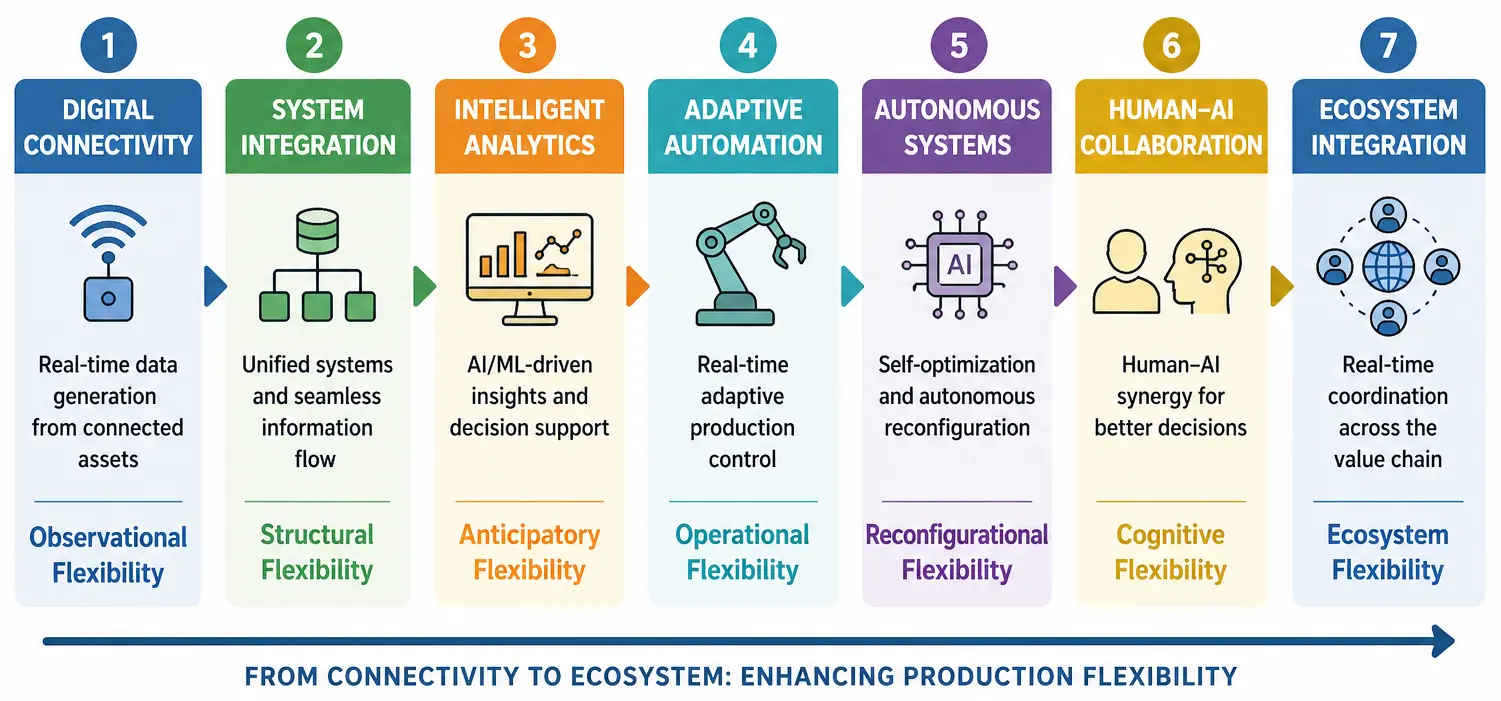
The following seven-stage roadmap (Figure 4 and Table 2) presents a maturity-based framework illustrating the evolution of production flexibility within smart manufacturing systems.
Table 2. Seven-Stage Roadmap for Smart Manufacturing-Driven Production Flexibility.
|
Stage |
Focus Area |
Core Description |
Flexibility Outcome |
|---|---|---|---|
|
1. Digital Connectivity |
Cyber-physical sensing |
Embeds IIoT and connectivity infrastructure into physical assets for real-time data generation. |
Observational flexibility: real-time operational visibility. |
|
2. System Integration |
Enterprise interoperability |
Integrates MES, ERP, PLM, and shop-floor systems into a unified architecture. |
Structural flexibility: synchronized cross-functional processes. |
|
3. Intelligent Analytics |
Predictive intelligence |
Applies AI/ML to generate predictive insights and decision support. |
Anticipatory flexibility: proactive optimization through prediction. |
|
4. Adaptive Automation |
Cyber-physical control |
Uses robotics, cobots, and digital twins for real-time adaptive production control. |
Operational flexibility: dynamic process adjustment. |
|
5. Autonomous Systems |
Self-organization |
Enables decentralized AI-driven self-optimization and autonomous reconfiguration. |
Reconfiguration flexibility: autonomous structural adaptation. |
|
6. Human–AI Collaboration |
Cognitive augmentation |
Integrates human judgment with AI-based decision support systems. |
Cognitive flexibility: enhanced hybrid decision-making. |
|
7. Ecosystem Integration |
Digital ecosystems |
Connects supply networks via interoperable platforms for real-time coordination. |
Ecosystem flexibility: coordinated value-chain adaptation. |
4.1. Stage 1: Digital Connectivity
- (1)
-
Description: Establishes the foundational cyber-physical layer by embedding IIoT sensors, communication protocols, and edge-enabled devices into physical assets, enabling continuous digitization of industrial operations.
- (2)
-
Objective: Achieve real-time operational visibility through continuous data acquisition.
- (3)
-
Key Challenges: Legacy constraints, fragmented infrastructure, low digital maturity, data inconsistency, and cybersecurity risks.
- (4)
-
Key Activities: IIoT deployment, OPC-UA/MQTT/5G integration, edge computing, machine retrofitting, and real-time sensing systems.
- (5)
-
KPIs: Connectivity rate, sensor coverage, data latency, system uptime, data integrity.
- (6)
-
Implementation Logic: Establishes a real-time sensing foundation that converts physical operations into continuous digital signals, enabling system observability.
- (7)
-
Outcome: Observational flexibility through real-time monitoring and anomaly detection.
4.2. Stage 2: System Integration
- (1)
-
Description: Integrates heterogeneous operational and enterprise systems (SCADA, MES, ERP, PLM, SCM) into a unified digital architecture, eliminating data silos.
- (2)
-
Objective: Enable enterprise-wide interoperability and synchronized information flow.
- (3)
-
Key Challenges: System heterogeneity, semantic misalignment, integration complexity, and weak governance.
- (4)
-
Key Activities: API integration, data lakes, ISA-95/RAMI 4.0 frameworks, semantic data models.
- (5)
-
KPIs: Data consistency, synchronization latency, integration coverage, and coordination efficiency.
- (6)
-
Implementation Logic: Builds a unified digital backbone enabling coherent cross-functional information exchange and system-wide alignment.
- (7)
-
Outcome: Structural flexibility through integrated information systems.
4.3. Stage 3: Intelligent Analytics
- (1)
-
Description: Converts integrated data into predictive and prescriptive intelligence using AI and machine learning.
- (2)
-
Objective: Enable anticipatory decision-making and system optimization under uncertainty.
- (3)
-
Key Challenges: Data quality issues, model interpretability, scalability constraints, and limited AI maturity.
- (4)
-
Key Activities: Predictive maintenance, demand forecasting, anomaly detection, quality prediction, optimization models.
- (5)
-
KPIs: Forecast accuracy, prediction error rate, downtime reduction, and decision latency.
- (6)
-
Implementation Logic: Transforms data into actionable intelligence, enabling proactive and optimization-driven decision-making.
- (7)
-
Outcome: Anticipatory flexibility through predictive analytics.
4.4. Stage 4: Adaptive Automation
- (1)
-
Description: Integrates robotics, collaborative robots, and digital twins to enable real-time adaptive control of production processes.
- (2)
-
Objective: Enable dynamic responsiveness under changing operational conditions.
- (3)
-
Key Challenges: Cyber-physical integration, control stability, and cybersecurity risks.
- (4)
-
Key Activities: Robotics integration, cobots, digital twin synchronization, adaptive scheduling.
- (5)
-
KPIs: Cycle time variability, setup time reduction, adaptation speed, process stability.
- (6)
-
Implementation Logic: Establishes closed-loop feedback between analytics and physical systems for real-time adaptive execution.
- (7)
-
Outcome: Operational flexibility through adaptive process control.
4.5. Stage 5: Autonomous Systems
- (1)
-
Description: Enables decentralized, self-organizing manufacturing systems driven by AI agents and modular architectures.
- (2)
-
Objective: Achieve self-optimization, self-healing, and autonomous reconfiguration.
- (3)
-
Key Challenges: Multi-agent coordination, governance of autonomy, cybersecurity, and system complexity.
- (4)
-
Key Activities: Reinforcement learning agents, autonomous scheduling, plug-and-produce systems.
- (5)
-
KPIs: Reconfiguration time, recovery time, autonomy level, intervention rate.
- (6)
-
Implementation Logic: Enables distributed intelligence and autonomous control for continuous system-level optimization and adaptation.
- (7)
-
Outcome: Reconfigurational flexibility through autonomous system behavior.
4.6. Stage 6: Human–AI Collaboration (Industry 5.0)
- (1)
-
Description: Establishes socio-technical systems where human cognitive intelligence and AI jointly support decision-making.
- (2)
-
Objective: Enhance adaptability, innovation, and decision quality through human–AI synergy.
- (3)
-
Key Challenges: Trust in AI, cognitive overload, skill gaps, and ethical governance.
- (4)
-
Key Activities: Explainable AI, collaborative robotics, AR/VR training, human digital twins.
- (5)
-
KPIs: Collaboration efficiency, decision accuracy, trust level, and workforce adaptability.
- (6)
-
Implementation Logic: Integrates human reasoning with AI analytics to enable context-aware, explainable, and collaborative decision-making.
- (7)
-
Outcome: Cognitive flexibility through human–AI co-intelligence.
4.7. Stage 7: Ecosystem Integration
- (1)
-
Description: Extends smart manufacturing into interconnected industrial ecosystems across suppliers, manufacturers, logistics, and customers.
- (2)
-
Objective: Enable end-to-end coordination and network-wide optimization.
- (3)
-
Key Challenges: Cross-organizational governance, interoperability barriers, cybersecurity risks, and trust asymmetry.
- (4)
-
Key Activities: Cloud–edge orchestration, blockchain traceability, AI-driven supply chain optimization, ecosystem platforms.
- (5)
-
KPIs: Lead time, responsiveness, synchronization efficiency, and disruption recovery rate.
- (6)
-
Implementation Logic: Enables cross-organizational interoperability and real-time coordination across distributed value networks.
- (7)
-
Outcome: Ecosystem flexibility through fully connected industrial networks.
In conclusion, the proposed seven-stage roadmap demonstrates that production flexibility in smart manufacturing is not a direct outcome of technological deployment, but a progressively emergent system capability shaped through structured socio-technical transformation. This evolution follows a layered maturity trajectory from digital connectivity and system integration to intelligent analytics, adaptive automation, autonomous systems, human–AI collaboration, and ecosystem integration.
Across these stages, manufacturing systems transition from isolated data generation to integrated information flows, from reactive monitoring to predictive and prescriptive intelligence, from rigid automation to adaptive control, from centralized decision-making to distributed autonomy, and from enterprise-centric optimization to ecosystem-level coordination. Each stage contributes a distinct flexibility dimension—observational, structural, anticipatory, operational, reconfigurational, cognitive, and ecosystemic—reflecting the cumulative and interdependent nature of industrial evolution.
Overall, production flexibility is conceptualized as an emergent socio-technical capability arising from continuous interactions among digital technologies, data infrastructures, human capabilities, organizational structures, and industrial ecosystems. This reinforces the central argument that sustainable flexibility requires holistic, staged, and system-wide integration, aligning the transition from Industry 4.0 to Industry 5.0 paradigms.
5. Discussion
This study advances smart manufacturing theory by redefining production flexibility as a nonlinear emergent socio-technical capability, rather than a direct outcome of digital technology adoption. In contrast to dominant Industry 4.0 assumptions, technologies such as CPS, IIoT, AI, robotics, and digital twins do not independently generate flexibility. Instead, flexibility emerges through recursive feedback loops, cross-layer interaction effects, and structural coupling among technological, organizational, and cognitive subsystems [9,43,44].
A key theoretical contribution is the shift from a technology-centric causality model to an interaction-driven emergence logic. Prior studies largely explain performance improvements by isolating the effects of individual technologies. This study instead conceptualizes production flexibility as a system-level property arising from coordination intensity, integration depth, and dynamic interdependencies across system layers.
By integrating Dynamic Capabilities Theory, Cyber-Physical Systems Theory, and Socio-Technical Systems Theory, this study develops a unified explanation of production flexibility as a co-evolutionary multi-layer capability system. Flexibility is continuously generated through sensing–decision–execution cycles embedded in cyber-physical infrastructures, but is fundamentally shaped by human cognition and organizational coordination mechanisms. Accordingly, flexibility is best understood as a hybrid cognitive–computational–organizational capability rather than a purely operational outcome [13,14,47].
The Industry 4.0–5.0 transition is reconceptualized as a dual-layer evolutionary architecture rather than a linear paradigm shift. Industry 4.0 provides the cyber-physical and computational foundation for connectivity, automation, and data-driven optimization, whereas Industry 5.0 introduces a complementary human-centric layer emphasizing interpretability, ethical governance, and resilience. Production flexibility emerges only when these layers are coherently aligned, positioning flexibility as a co-produced socio-technical state rather than a technology-driven outcome.
The proposed seven-stage roadmap contributes a capability emergence architecture, extending beyond traditional maturity models. Unlike linear progression assumptions, the framework demonstrates that flexibility evolves through threshold effects, dependency hierarchies, and nonlinear reinforcement mechanisms. Early stages enable observability and structural integration, intermediate stages support predictive and adaptive intelligence, and advanced stages enable autonomy, human–AI collaboration, and ecosystem coordination. Importantly, higher-order flexibility cannot emerge without the stabilization of foundational cyber-physical and data integration capabilities, confirming a hierarchical structure of capability development.
From a practical perspective, the findings explain why many smart manufacturing initiatives fail to deliver proportional flexibility gains despite substantial digital investments. The core limitation is not technological insufficiency but architectural fragmentation and weak cross-layer integration governance. Organizations often prioritize technology deployment while underdeveloping system integration, interoperability, and human–AI coordination mechanisms, leading to localized optimization rather than system-wide adaptability.
Human–AI collaboration emerges as a structural requirement for higher-order flexibility, rather than an optional enhancement. In uncertain and volatile environments, human cognition remains essential for contextual interpretation, ethical reasoning, and exception handling. Consequently, advanced flexibility states require embedding human decision authority within AI-augmented systems, particularly in autonomous and ecosystem-level configurations.
Finally, production flexibility is reconceptualized as a multi-level emergent state space, where observational, structural, anticipatory, operational, reconfigurational, cognitive, and ecosystem flexibility represent interdependent and progressively evolving system states. These states are hierarchically structured, with higher-level flexibility enabled and constrained by lower-level infrastructural and cognitive foundations.
Overall, this study establishes that production flexibility is not directly implemented through technology but emerges through sustained socio-technical alignment, interaction intensity, and system integration depth. This reframes digital transformation as a capability formation process governed by systemic coherence rather than a linear technology adoption pathway, offering a more comprehensive explanation of the persistent gap between digital investment and realized operational adaptability.
6. Conclusions and Future Work
This study develops a structured synthesis of smart manufacturing for production flexibility, based on a seven-stage roadmap of industrial transformation. The framework provides a unified analytical lens for explaining how manufacturing systems evolve from foundational digital connectivity to intelligent, autonomous, and ecosystem-integrated production environments. By integrating fragmented Industry 4.0 and Industry 5.0 perspectives, the study establishes that production flexibility is not a localized operational attribute but an emergent system-level capability arising from the co-evolution of digital technologies, organizational structures, human cognition, and inter-organizational ecosystems.
The proposed seven-stage roadmap—comprising (1) digital connectivity, (2) system integration, (3) intelligent analytics, (4) adaptive automation, (5) autonomous systems, (6) human–AI collaboration, and (7) ecosystem integration—captures the progressive formation of production flexibility across maturity levels. Each stage represents a distinct capability layer, evolving from observational and structural flexibility to anticipatory and operational flexibility, and ultimately to reconfigurational, cognitive, and ecosystem-level flexibility. This staged progression clarifies how manufacturing systems progressively enhance adaptability, responsiveness, and resilience in volatile, uncertain, complex, and ambiguous (VUCA) environments.
The primary contribution of this work is the development of a unified capability evolution framework linking smart manufacturing technologies to production flexibility outcomes. Rather than treating enabling technologies such as IIoT, AI, robotics, and digital twins as isolated drivers, the framework situates them within a path-dependent, cumulatively reinforcing transformation process, in which flexibility emerges through cross-layer interactions, structural coupling, and system-wide coherence. This advances socio-technical systems theory by explicitly emphasizing the co-evolution of technological infrastructure, governance mechanisms, and human decision-making in enabling adaptive manufacturing performance.
Theoretical Implications: This study advances theory by repositioning production flexibility as a multi-level emergent capability rather than a direct technological outcome. It extends dynamic capabilities and socio-technical systems perspectives by providing a mechanism-based explanation of how flexibility emerges through interaction density, integration depth, and coordinated alignment across technological, organizational, and human subsystems. This strengthens the explanatory foundation of capability emergence in smart manufacturing environments.
Practical Implications: The proposed roadmap provides practitioners with a structured reference model for guiding smart manufacturing transformation. It enables organizations to assess digital maturity and prioritize investments across connectivity, integration, intelligence, automation, autonomy, human–AI collaboration, and ecosystem coordination. This supports more coherent transformation planning and increases the likelihood of achieving sustained improvements in production flexibility.
Managerial Implications: For managers, the framework functions as a strategic sequencing instrument for digital transformation planning. It clarifies how investments in enabling technologies translate into progressive flexibility gains while emphasizing alignment across operational, IT, and strategic domains. Particular attention is given to governance coherence, capability development, and organizational readiness to ensure that technological adoption translates into system-level performance improvement rather than localized optimization.
Study Limitations: This study is conceptual and based on systematic literature synthesis rather than empirical validation. Consequently, the applicability of the proposed roadmap may vary across industrial contexts, depending on organizational maturity, sectoral characteristics, and digital infrastructure readiness, thereby limiting its generalizability in practice.
Future Research Directions: Future research should empirically validate the proposed seven-stage roadmap across diverse industrial contexts, including discrete, process, and hybrid manufacturing systems. Longitudinal and comparative studies are required to examine transitions between stages and to analyze how production flexibility evolves under different technological and organizational conditions. A critical research direction is the development of standardized, multidimensional measures of flexibility across volume, product mix, and routing dimensions to enable comparability and cumulative theory development. Further research should explicitly incorporate human, organizational, and governance dimensions, given their decisive role in shaping transformation outcomes. In addition, advanced modeling approaches—such as system dynamics, agent-based modeling, reinforcement learning, and digital twin-based simulation—should be employed to operationalize the framework, capture inter-stage dynamics, and optimize transformation pathways toward higher levels of manufacturing maturity.
Statement of the Use of Generative AI and AI-Assisted Technologies in the Writing Process
The author acknowledges that ChatGPT (OpenAI) was used exclusively for language editing and stylistic refinement of the author’s text, including improvements to clarity, grammar, and academic tone. The tool was not used to generate original scholarly content, data, analyses, or references. The author has carefully reviewed and verified the final manuscript and accepts full responsibility for its content.
Ethics Statement
Not applicable.
Informed Consent Statement
Not applicable.
Data Availability Statement
All data supporting this study are contained within the article.
Funding
This research received no external funding.
Declaration of Competing Interest
The author declares that he has no known competing financial interests or personal relationships that could have appeared to influence the work reported in this paper.
Abbreviations
|
Abbreviation |
Full Term |
Short Definition |
|
AI |
Artificial Intelligence |
Systems for reasoning, prediction, and decision-making. |
|
AR |
Augmented Reality |
Digital overlays on physical environments. |
|
CPS |
Cyber-Physical Systems |
Integrated computational–physical systems for real-time control. |
|
DL |
Deep Learning |
Neural network-based learning for complex pattern recognition. |
|
DT |
Digital Twin |
Virtual model of a physical system for monitoring and optimization. |
|
IIoT |
Industrial Internet of Things |
Connected industrial devices enabling data exchange. |
|
IoT |
Internet of Things |
Connected devices enabling sensing and communication. |
|
KPI |
Key Performance Indicator |
Metric for performance evaluation. |
|
ML |
Machine Learning |
Algorithms that learn from data. |
|
OEE |
Overall Equipment Effectiveness |
Measure of manufacturing productivity (availability, performance, quality). |
|
SFS |
Smart Factory System |
Digitally enabled intelligent manufacturing system. |
|
SMEs |
Small and Medium-sized Enterprises |
Firms of moderate scale contributing to innovation. |
|
VR |
Virtual Reality |
Fully immersive simulated environments. |
References
- Bi Z, Zhang WJ, Wu C, Luo C, Xu L. Generic Design Methodology for Smart Manufacturing Systems from a Practical Perspective, Part I—Digital Triad Concept and Its Application as a System Reference Model. Machines 2021, 9, 207. DOI:10.3390/machines9100207 [Google Scholar]
- Deokar S, Bansode V, Wankhede S, Kharche P. Industry 4.0 moving towards smart manufacturing: A comprehensive review. Int. J. Sci. Res. Arch. 2025, 6, 630–642. DOI:10.30574/ijsra.2025.16.3.2596 [Google Scholar]
- Sun X, Zhang F, Wang J, Yang Z, Huang Z, Xue R. Digital Twin for Smart Manufacturing Equipment. Int. J. Adv. Manuf. Technol. 2025, 137, 4929–4946. DOI:10.1007/s00170-025-15468-0 [Google Scholar]
- Fernández-Caramés TM, Fraga-Lamas P. Forging the Industrial Metaverse for Industry 5.0: Where Extended Reality, IIoT, Opportunistic Edge Computing, and Digital Twins Meet. IEEE Access 2024, 12, 95778–95819. DOI:10.1109/ACCESS.2024.3422109 [Google Scholar]
- Zeid A, Sundaram S, Moghaddam M, Kamarthi S, Marion T. Interoperability in smart manufacturing: Research challenges. Machines 2019, 7, 21. DOI:10.3390/machines7020021 [Google Scholar]
- Puviyarasu SA, Da Cunha C. Smart Factory: From concepts to operational sustainable outcomes using test-beds. Logforum 2021, 17, 7–23. DOI:10.17270/J.LOG.2021.545 [Google Scholar]
- Gomaa AH. Advancing manufacturing excellence in the Industry 4.0 era: A comprehensive review and strategic integrated framework. Supply Chain Res. 2024, 2, 1–37. DOI:10.59429/scr.v2i2.10220 [Google Scholar]
- Majeed H, Iftikhar T. Industrial Revolution 4.0, 5.0 Sustainable Transformation into Industrial Revolution 6.0. In Intelligent Manufacturing in Industry 6.0: A Climate Resilience Approach; Springer: Cham, Switzerland, 2026; pp. 55–93. [Google Scholar]
- Frank AG, Thürer M, Godinho Filho M, Marodin GA. Beyond Industry 4.0—Integrating Lean, digital technologies and people. Int. J. Oper. Prod. Manag. 2024, 44, 1109–1126. DOI:10.1108/IJOPM-01-2024-0069 [Google Scholar]
- Qiu F, Kumar A, Hu J, Sharma P, Tang YB, Xu Xiang Y, et al. A review on integrating IoT, IIoT, and Industry 4.0: A pathway to smart manufacturing and digital transformation. IET Inf. Secur. 2025, 2025, 9275962. DOI:10.1049/ise2/9275962 [Google Scholar]
- Gomaa AH. Applications of Industry 4.0 in Smart Manufacturing (Manufacturing 4.0): A Comprehensive Review, Gap Analysis, and Strategic Framework. Innov. Comput. Perspect. 2025, 1, 1–14. DOI:10.64229/rn83ka90 [Google Scholar]
- Zhao L, Liu Y, He M, Zhang D, Liu H, Sun B. From industry 4.0 to 5.0: Exploring the opportunity of biodegradable freshness indicator packaging. Compr. Rev. Food Sci. Food Saf. 2025, 24, e70242. DOI:10.1111/1541-4337.70242 [Google Scholar]
- Lee J, Su H, Macchi M, Polenghi A, Wu W, Zhao Z, et al. 2026 Roadmap on Artificial Intelligence and Machine Learning for Smart Manufacturing. Mach. Learn. Eng. 2026. DOI:10.1088/3049-4761/ae5967 [Google Scholar]
- Leng J, Guo J, Xie J, Zhou X, Liu A, Gu X, et al. Review of manufacturing system design in the interplay of Industry 4.0 and Industry 5.0 (Part I): Design thinking and modeling methods. J. Manuf. Syst. 2024, 76, 158–187. DOI:10.1016/j.jmsy.2024.07.012 [Google Scholar]
- Gomaa AH. Quality Management Excellence in the Era of Industry 4.0 (Quality 4.0): A Comprehensive Review, Gap Analysis, and Strategic Framework. Adv. Sci. Technol. 2025, 1–40. Available online: https://thegeekchronicles.com/wp-content/uploads/2025/09/TGCCCRCR.25.361.pdf (accessed on 20 September 2025).
- Gomaa AH. Transforming Manufacturing from Industry 4.0 to Industry 6.0: A Comprehensive Review, Gap Analysis, and Strategic Framework. Interdiscip. Syst. Glob. Manag. 2025, 1, 29–51. DOI:10.55578/isgm.2508.003 [Google Scholar]
- Singh A, Madaan G, Hr S, Kumar A. Smart manufacturing systems: A futuristics roadmap towards application of industry 4.0 technologies. Int. J. Comput. Integr. Manuf. 2023, 36, 411–428. DOI:10.1080/0951192X.2022.2090607 [Google Scholar]
- Xiang W, Yu K, Han F, Fang L, He D, Han QL. Advanced manufacturing in industry 5.0: A survey of key enabling technologies and future trends. IEEE Trans. Ind. Inform. 2023, 20, 1055–1068. DOI:10.1109/TII.2023.3274224 [Google Scholar]
- Karic H, Schilberg D, Selvakumar Arockiadoss A. Smart factory and Industry 4.0: A survey on advancements, technologies, methods and perspectives of digital transformation in manufacturing. In Proceedings of the 16th International Conference on Applied Human Factors and Ergonomics (AHFE 2025), Orlando, FL, USA, 26–30 July 2025. [Google Scholar]
- Golovianko M, Terziyan V, Branytskyi V, Malyk D. Industry 4.0 vs. Industry 5.0: Co-existence, transition, or a hybrid. Procedia Comput. Sci. 2023, 217, 102–113. DOI:10.1016/j.procs.2022.12.206 [Google Scholar]
- Rejikumar G, Raja Sreedharan V, Arunprasad P, Jinil P, Sreeraj KM. Industry 4.0: Key findings and analysis from the literature arena. Benchmarking Int. J. 2019, 26, 2514–2542. DOI:10.1108/BIJ-09-2018-0281 [Google Scholar]
- Jerman A, Pejić Bach M, Aleksić A. Transformation towards smart factory system: Examining new job profiles and competencies. Syst. Res. Behav. Sci. 2020, 37, 388–402. DOI:10.1002/sres.2657 [Google Scholar]
- Osterrieder P, Budde L, Friedli T. The smart factory as a key construct of industry 4.0: A systematic literature review. Int. J. Prod. Econ. 2020, 221, 107476. DOI:10.1016/j.ijpe.2019.08.011 [Google Scholar]
- Soori M, Arezoo B, Dastres R. Digital twin for smart manufacturing, A review. Sustain. Manuf. Serv. Econ. 2023, 2, 100017. DOI:10.1016/j.smse.2023.100017 [Google Scholar]
- Mügge J, Seegrün A, Hoyer TK, Riedelsheimer T, Lindow K. Digital twins within the circular economy: Literature review and concept presentation. Sustainability 2024, 16, 2748. DOI:10.3390/su16072748 [Google Scholar]
- Baker S, Xiang W. Artificial intelligence of things for smarter healthcare: A survey of advancements, challenges, and opportunities. IEEE Commun. Surv. Tutor. 2023, 25, 1261–1293. DOI:10.1109/COMST.2023.3256323 [Google Scholar]
- Yang L, Zou H, Shang C, Ye X, Rani P. Adoption of information and digital technologies for sustainable smart manufacturing systems for industry 4.0 in small, medium, and micro enterprises (SMMEs). Technol. Forecast. Soc. Change 2023, 188, 122308. DOI:10.1016/j.techfore.2022.122308 [Google Scholar]
- Huang S, Wang B, Li X, Zheng P, Mourtzis D, Wang L. Industry 5.0 and Society 5.0—Comparison, complementation and co-evolution. J. Manuf. Syst. 2022, 64, 424–428. DOI:10.1016/j.jmsy.2022.07.010 [Google Scholar]
- George AS, George AH, Baskar T. The evolution of smart factories: How industry 5.0 is revolutionizing manufacturing. Partn. Univers. Innov. Res. Publ. 2023, 1, 33–53. DOI:10.5281/zenodo.10001380 [Google Scholar]
- Samuels A. Human-centric technologies in sustainable supply chain management: A systematic review of the evolution from Industry 4.0 to 5.0. Int. J. Bus. Ecosyst. Strategy 2024, 6, 285–302. DOI:10.36096/ijbes.v6i4.539 [Google Scholar]
- Fraga-Lamas P, Lopes SI, Fernández-Caramés TM. Green IoT and edge AI as key technological enablers for a sustainable digital transition towards a smart circular economy: An industry 5.0 use case. Sensors 2021, 21, 5745. DOI:10.3390/s21175745 [Google Scholar]
- Büchi G, Cugno M, Castagnoli R. Smart factory performance and Industry 4.0. Technol. Forecast. Soc. Change 2020, 150, 119790. DOI:10.1016/j.techfore.2019.119790 [Google Scholar]
- Leng J, Mourtzis D, Liu A, Gu X, Liu Q, Zhong RY. Manufacturing system design towards Industry 5.0. Int. J. Comput. Integr. Manuf. 2026, 39, 489–493. DOI:10.1080/0951192X.2026.2635891 [Google Scholar]
- Lenz J, MacDonald E, Harik R, Wuest T. Optimizing smart manufacturing systems by extending the smart products paradigm to the beginning of life. J. Manuf. Syst. 2020, 57, 274–286. DOI:10.1016/j.jmsy.2020.10.001 [Google Scholar]
- Bhat SA, Huang NF, Sofi IB, Sultan M. Agriculture-food supply chain management based on blockchain and IoT: A narrative on enterprise blockchain interoperability. Agriculture 2022, 12, 40. DOI:10.3390/agriculture12010040 [Google Scholar]
- Kafetzopoulos D, Gotzamani K. The effect of talent management and leadership styles on firms’ sustainable performance. Eur. Bus. Rev. 2022, 34, 837–857. DOI:10.1108/EBR-07-2021-0148 [Google Scholar]
- Alam SS, Latif MM, Kokash HA, Ahsan MN. Relationship among industrial iot, circular supply chain management practices and sustainable performance of manufacturing companies: An empirical study. Circ. Econ. Sustain. 2025, 5, 3159–3186. DOI:10.1007/s43615-025-00576-6 [Google Scholar]
- Jin W, Zhang Y, Xu Y, Zhang Y, Kim Y, Yan Y. Does Intelligent Manufacturing Contribute to the Enhancement of Carbon Emission Performance? Evidence from Total Factor Carbon Emission Performance. Sustainability 2024, 16, 8443. DOI:10.3390/su16198443 [Google Scholar]
- Tran ML, Vo Thai HC. Future-ready strategies: Dynamic managerial capabilities, digitalization, and green product innovation in building firm resilience. Bus. Ethics Environ. Responsib. 2025. DOI:10.1111/beer.70007 [Google Scholar]
- Höse K, Amaral A, Götze U, Peças P. Manufacturing flexibility through industry 4.0 technological concepts—Impact and assessment. Glob. J. Flex. Syst. Manag. 2023, 24, 271–289. DOI:10.1007/s40171-023-00339-y [Google Scholar]
- Wankhede VA, Agrawal R, Srinivasan K. Digital transformation and sustainability in the automotive industry: Key enablers for Industry 4.0 and circular economy. TQM J. 2025, 1–23. DOI:10.1108/TQM-02-2025-0089 [Google Scholar]
- Musaigwa M, Kalitanyi V. Transforming Manufacturing: A Systematic Literature Review of Industry 4.0 Technologies and Their Impact on Operational Efficiency. Int. J. Appl. Res. Bus. Manag. 2026, 7. DOI:10.51137/wrp.ijarbm.486 [Google Scholar]
- Zhang W, Bao X, Hao X, Gen M. Metaheuristics for multi-objective scheduling problems in industry 4.0 and 5.0: A state-of-the-arts survey. Front. Ind. Eng. 2025, 3, 1540022. DOI:10.3389/fieng.2025.1540022 [Google Scholar]
- Mourtzis D, Wang L. Industry 5.0: Perspectives, concepts, and technologies. In Manufacturing from Industry 4.0 to Industry 5.0; Elsevier: Amsterdam, The Netherlands, 2024; pp. 63–96. [Google Scholar]
- Zheng P, Wang H, Sang Z, Zhong RY, Liu Y, Liu C, et al. Smart manufacturing systems for Industry 4.0: Conceptual framework, scenarios, and future perspectives. Front. Mech. Eng. 2018, 13, 137–150. DOI:10.1007/s11465-018-0499-5 [Google Scholar]
- Mittal S, Khan MA, Purohit JK, Menon K, Romero D, Wuest T. A smart manufacturing adoption framework for SMEs. Int. J. Prod. Res. 2020, 58, 1555–1573. DOI:10.1080/00207543.2019.1661540 [Google Scholar]
- Javaid M, Haleem A, Singh RP. A study on ChatGPT for Industry 4.0: Background, potentials, challenges, and eventualities. J. Econ. Technol. 2023, 1, 127–143. DOI:10.1016/j.ject.2023.08.001 [Google Scholar]
- Xu J, Sun Q, Han QL, Tang Y. When embodied AI meets Industry 5.0: Human-centered smart manufacturing. IEEE/CAA J. Autom. Sin. 2025, 12, 485–501. DOI:10.1109/JAS.2025.125327 [Google Scholar]
- Page MJ, McKenzie JE, Bossuyt M, Boutron I, Hoffmann TC, Mulrow CD, et al. Updating guidance for reporting systematic reviews: Development of the PRISMA 2020 statement. J. Clin. Epidemiol. 2021, 134, 103–112. DOI:10.1016/j.jclinepi.2021.02.003 [Google Scholar]
- Volk AA, Campbell ZS, Ibrahim MY, Bennett JA, Abolhasani M. Flow chemistry: A sustainable voyage through the chemical universe en route to smart manufacturing. Annu. Rev. Chem. Biomol. Eng. 2022, 13, 45–72. DOI:10.1146/annurev-chembioeng-092120-024449 [Google Scholar]
- Shahbazi Z, Byun YC. Integration of blockchain, IoT and machine learning for multistage quality control and enhancing security in smart manufacturing. Sensors 2021, 21, 1467. DOI:10.3390/s21041467 [Google Scholar]
- Del Giudice M, Scuotto V, Papa A, Tarba SY, Bresciani S, Warkentin M. A self-tuning model for smart manufacturing SMEs: Effects on digital innovation. J. Prod. Innov. Manag. 2021, 38, 68–89. DOI:10.1111/jpim.12560 [Google Scholar]
- Parhi S, Joshi K, Akarte M. Smart manufacturing: A framework for managing performance. Int. J. Comput. Integr. Manuf. 2021, 34, 227–256. DOI:10.1080/0951192X.2020.1858506 [Google Scholar]
- Shukla M, Shankar R. Modeling of critical success factors for adoption of smart manufacturing system in Indian SMEs: An integrated approach. Opsearch 2022, 59, 1271–1303. DOI:10.1007/s12597-021-00566-w [Google Scholar]
- Wunderle M, Olmes G, Nabieva N, Häberle L, Jud SM, Hein A, et al. Risk, prediction and prevention of hereditary breast cancer–large-scale genomic studies in times of big and smart data. Geburtshilfe Und Frauenheilkunde 2018, 78, 481–492. DOI:10.1055/a-0603-4350 [Google Scholar]
- Thoben KD, Wiesner S, Wuest T. “Industrie 4.0” and smart manufacturing-a review of research issues and application examples. Int. J. Autom. Technol. 2017, 11, 4–16. DOI:10.20965/ijat.2017.p0004 [Google Scholar]
- Ferrer BR, Mohammed WM, Martinez Lastra JL, Villalonga A, Beruvides G, Castano F, et al. Towards the Adoption of Cyber-Physical Systems of Systems Paradigm in Smart Manufacturing Environments. In Proceedings of the 2018 IEEE 16th International Conference on Industrial Informatics (INDIN), Porto, Portugal, 18–20 July 2018; pp. 792–799. [Google Scholar]
- Davis J, Edgar T, Graybill R, Korambath P, Schott B, Swink D, et al. Smart manufacturing. Annu. Rev. Chem. Biomol. Eng. 2015, 6, 141–160. DOI:10.1146/annurev-chembioeng-061114-123255 [Google Scholar]
- Kinkel S, Baumgartner M, Cherubini E. Prerequisites for the adoption of AI technologies in manufacturing – Evidence from a worldwide sample of manufacturing companies. Technovation 2022, 110, 102375. DOI:10.1016/j.technovation.2021.102375 [Google Scholar]
- Cagliano AC, Mangano G, Rafele C. Determinants of digital technology adoption in supply chain. An exploratory analysis. Supply Chain. Forum Int. J. 2021, 22, 100–114. DOI:10.1080/16258312.2021.1875789 [Google Scholar]
- Agrawal S, Agrawal R, Kumar A, Luthra S, Garza-Reyes JA. Can industry 5.0 technologies overcome supply chain disruptions?—A perspective study on pandemics, war, and climate change issues. Oper. Manag. Res. 2024, 17, 453–468. DOI:10.1007/s12063-023-00410-y [Google Scholar]
- Xu X, Lu Y, Vogel-Heuser B, Wang L. Industry 4.0 and Industry 5.0—Inception, conception and perception. J. Manuf. Syst. 2021, 61, 530–535. DOI:10.1016/j.jmsy.2021.10.006 [Google Scholar]
- Abdel-Basset M, Mohamed R, Chang V. A multi-criteria decision-making framework to evaluate the impact of industry 5.0 technologies: Case study, lessons learned, challenges and future directions. Inf. Syst. Front. 2025, 27, 791–821. DOI:10.1007/s10796-024-10472-3 [Google Scholar]
- Beducci E, Acerbi F, De Carolis A, Taisch M. Exploring the Role of Digital Servitization for Sustainability: A Framework for Environmental and Social Impact. Clean. Environ. Syst. 2025, 17, 100269. DOI:10.1016/j.cesys.2025.100269 [Google Scholar]
- Minaya E, Avella L, Trespalacios JA. Innovation and competitiveness in the industry 4.0 era: The SYNCHRO framework for digital servitization. Bus. Process Manag. J. 2025, 31, 1812–1835. DOI:10.1108/BPMJ-06-2024-0501 [Google Scholar]
- Qu YJ, Ming XG, Liu ZW, Zhang XY, Hou ZT. Smart manufacturing systems: State of the art and future trends. Int. J. Adv. Manuf. Technol. 2019, 103, 3751–3768. DOI:10.1007/s00170-019-03754-7 [Google Scholar]
- Rakic S, Marjanovic U, Medic N. Advancements in Smart Manufacturing and Industry 4.0. Appl. Sci. 2025, 15, 11903. DOI:10.3390/app152211903 [Google Scholar]
- Ramzan F, Reforgiato Recupero D. A Literature Review on Enhancing Predictive Maintenance in Smart Manufacturing Industries: Fostering Human-Technology Collaboration and Overcoming Data Scarcity Limitations with Advanced AI Models. In Operations Research Forum; Springer International Publishing: Berlin/Heidelberg, Germany, 2025; Volume 6, p. 181. [Google Scholar]
- Barua DA, Sami SA, Barua L. Leveraging artificial intelligence for smart production management in industry 4.0. Sci. Rep. 2025, 15, 41559. DOI:10.1038/s41598-025-25413-6 [Google Scholar]
- Herrera-Vidal G, Coronado-Hernández JR, Maheut J. Complexity management challenges in the industry 4.0 era: A systematic review in production systems. Results Eng. 2025, 26, 105329. DOI:10.1016/j.rineng.2025.105329 [Google Scholar]
- Leng J, Zhou M, Xiao Y, Zhang H, Liu Q, Shen W, et al. Digital twins-based remote semi-physical commissioning of flow-type smart manufacturing systems. J. Clean. Prod. 2021, 306, 127278. DOI:10.1016/j.jclepro.2021.127278 [Google Scholar]
- Kotsiopoulos T, Sarigiannidis P, Ioannidis D, Tzovaras D. Machine Learning and Deep Learning in smart manufacturing: The Smart Grid paradigm. Comput. Sci. Rev. 2021, 40, 100341. DOI:10.1016/j.cosrev.2020.100341 [Google Scholar]
- Qiao F, Liu J, Ma Y. Industrial big-data-driven and CPS-based adaptive production scheduling for smart manufacturing. Int. J. Prod. Res. 2021, 59, 7139–7159. DOI:10.1080/00207543.2020.1836417 [Google Scholar]
- Chandra Shekhar Rao V, Kumarswamy P, Phridviraj MSB, Venkatramulu S, Subba Rao V. 5G enabled industrial internet of things (IIoT) architecture for smart manufacturing. In Data Engineering and Communication Technology: Proceedings of ICDECT 2020; Springer: Singapore, 2021; pp. 193–201. [Google Scholar]
- Sivaji A, Razak RA, Mohamad NF, Sazali N, Musa A, Bajuri NM, et al. 2020. Software testing automation: A comparative study on productivity rate of open source automated software testing tools for smart manufacturing. In Proceedings of the 2020 IEEE Conference on Open Systems (ICOS), Kota Kinabalu, Malaysia, 17–19 November 2020; pp. 7–12. [Google Scholar]
- Wang J, Ma Y, Zhang L, Gao RX, Wu D. Deep learning for smart manufacturing: Methods and applications. J. Manuf. Syst. 2018, 48, 144–156. DOI:10.1016/j.jmsy.2018.01.003 [Google Scholar]
- Mehrpouya M, Dehghanghadikolaei A, Fotovvati B, Vosooghnia A, Emamian SS, Gisario A. The potential of additive manufacturing in the smart factory industrial 4.0: A review. Appl. Sci. 2019, 9, 3865. DOI:10.3390/app9183865 [Google Scholar]
- Moshiri M, Charles A, Elkaseer A, Scholz S, Mohanty S, Tosello G. An industry 4.0 framework for tooling production using metal additive manufacturing-based first-time-right smart manufacturing system. Procedia CIRP 2020, 93, 32–37. DOI:10.1016/j.procir.2020.04.151 [Google Scholar]
- Haricha K, Khiat A, Issaoui Y, Bahnasse A, Ouajji H. Towards smart manufucturing: Implementation and benefits. Procedia Comput. Sci. 2020, 177, 639–644. DOI:10.1016/j.procs.2020.10.091 [Google Scholar]
- Rocha AD, Arvana M, Freitas N, Dinis RM, Gouveia T, Machado D, et al. Human-Centric Digital Twin-Driven Approach for Plug-and-Produce in Modular Cyber-Physical Production Systems. In Proceedings of the 2024 IEEE 29th International Conference on Emerging Technologies and Factory Automation (ETFA), Padova, Italy, 10–13 September 2024; pp. 1–7. [Google Scholar]
- Tiwari S, Bahuguna C, Srivastava R. Smart manufacturing and sustainability: A bibliometric analysis. Benchmarking Int. J. 2023, 30, 3281–3301. DOI:10.1108/BIJ-04-2022-0238 [Google Scholar]
- Vance D, Jin M, Price C, Nimbalkar SU, Wenning T. Smart manufacturing maturity models and their applicability: A review. J. Manuf. Technol. Manag. 2023, 34, 735–770. DOI:10.1108/JMTM-03-2022-0103 [Google Scholar]
- Bühler L, Schuster T, Pflaum A. Twin transformation—The case of smart circular economy in manufacturing industries: Insights from an umbrella review. Int. J. Innov. Manag. 2025, 29, 2540007. DOI:10.1142/S1363919625400079 [Google Scholar]
- Rocha MS, Sestito GS, Dias AL, Turcato AC, Brandão D, Ferrari P. On the performance of OPC UA and MQTT for data exchange between industrial plants and cloud servers. Acta IMEKO 2019, 8, 80–87. DOI:10.21014/acta_imeko.v8i2.648 [Google Scholar]
- Perera S, Nanayakkara S, Rodrigo MNN, Senaratne S, Weinand R. Blockchain technology: Is it hype or real in the construction industry? J. Ind. Inf. Integr. 2020, 17, 100125. DOI:10.1016/j.jii.2020.100125 [Google Scholar]
- Rajasekaran AS, Azees M, Al-Turjman F. A comprehensive survey on blockchain technology. Sustain. Energy Technol. Assess. 2022, 52, 102039. DOI:10.1016/j.seta.2022.102039 [Google Scholar]
- Masood AB, Hasan A, Vassiliou V, Lestas M. A blockchain-based data-driven fault-tolerant control system for smart factories in industry 4.0. Comput. Commun. 2023, 204, 158–171. DOI:10.1016/j.comcom.2023.03.017 [Google Scholar]
- Jahid A, Alsharif MH, Hall TJ. The convergence of blockchain, IoT and 6G: Potential, opportunities, challenges and research roadmap. J. Netw. Comput. Appl. 2023, 217, 103677. DOI:10.1016/j.jnca.2023.103677 [Google Scholar]
- Ahrend U, Aleksy M, Berning M, Gebhardt J, Mendoza F, Schulz D. Sensors as the basis for digitalization: New approaches in instrumentation, IoT-concepts, and 5G. Internet Things 2021, 15, 100406. DOI:10.1016/j.iot.2021.100406 [Google Scholar]
- Kowalkowski C, Gebauer H, Kamp B, Parry G. Servitization and deservitization: Overview, concepts, and definitions. Ind. Mark. Manag. 2017, 60, 4–10. DOI:10.1016/j.indmarman.2016.12.007 [Google Scholar]
- Baines T, Ziaee Bigdeli A, Sousa R, Schroeder A. Framing the Servitization Transformation Process: A Model to Understand and Facilitate the Servitization Journey. Int. J. Prod. Econ. 2020, 221, 107463. DOI:10.1016/j.ijpe.2019.07.036 [Google Scholar]
- Frank AG, Mendes GH, Ayala NF, Ghezzi A. Servitization and Industry 4.0 convergence in the digital transformation of product firms: A business model innovation perspective. Technol. Forecast. Soc. Change 2019, 141, 341–351. DOI:10.1016/j.techfore.2019.01.014 [Google Scholar]
- Bonamigo A, Frech CG. Industry 4.0 in Services: Challenges and Opportunities for Value Co-Creation. J. Serv. Mark. 2021, 35, 412–427. DOI:10.1108/JSM-02-2020-0073 [Google Scholar]
- Hallstedt S, Isaksson O, Öhrwall Rönnbäck A. The Need for New Product Development Capabilities from Digitalization, Sustainability, and Servitization Trends. Sustainability 2020, 12, 10222. DOI:10.3390/su122310222 [Google Scholar]
- Schiavone F, Leone D, Caporuscio A, Lan S. Digital Servitization and Sustainable Manufacturing Systems. Technol. Forecast. Soc. Change 2022, 176, 121441. DOI:10.1016/j.techfore.2021.121441 [Google Scholar]
- Mirza F, Ul-Durar S, Jabbar A. The Ideal Quality in Industry 4.0 Model for the Company and Its Meaning in the Client Value Perspective: A Systematic Review. In Quality Management, Value Creation, and the Digital Economy; Routledge: Abingdon, UK, 2023; pp. 153–166. [Google Scholar]
- Passalacqua M, Pellerin R, Magnani F, Doyon-Poulin P, Del-Aguila L, Boasen J, et al. Human-centred AI in industry 5.0: A systematic review. Int. J. Prod. Res. 2025, 63, 2638–2669. DOI:10.1080/00207543.2024.2406021 [Google Scholar]
- Pan Y, Huang Z, Lev B, Xu L, Olson D. A literature review on the artificial intelligence in manufacturing systems under industry 5.0. Int. J. Prod. Res. 2026, 1–42. DOI:10.1080/00207543.2026.2623537 [Google Scholar]
- Machado CG, Kurdve M, Winroth M, Bennett D. Production management and smart manufacturing from a systems perspective. In Advances in Manufacturing Technology XXXII; IOS Press: Amsterdam, The Netherlands, 2018; pp. 329–334. [Google Scholar]
- Grenda D, Tuikka AM. The Relevance of Humans and Structure: Managerial and Organizational Challenges in Smart Factories. In IFIP International Conference on Human Choice and Computers; Springer International Publishing: Cham, Switzerland, 2020; pp. 171–180. [Google Scholar]
- Barlette Y, Baillette P. Big data analytics in turbulent contexts: Towards organizational change for enhanced agility. Prod. Plan. Control 2022, 33, 105–122. DOI:10.1080/09537287.2020.1810755 [Google Scholar]
- Nasir V, Hosseini A, Binfield L, Hasani N, Ghotb S, Diederichs V, et al. Human-centric Industry 5.0 manufacturing: A multi-level framework from design to consumption within Society 5.0. Int. J. Sustain. Eng. 2025, 18, 2551000. DOI:10.1080/19397038.2025.2551000 [Google Scholar]
- Mocanu DE, Preda DM, State O, Țală ML. Digital transformation and sustainability: Mapping research gaps and thematic connections. Cactus Tour. J. 2025, 7, 72–86. DOI:10.24818/CTS/7/2025/1.07 [Google Scholar]
- Saman NRM, Mahmud N, Nor NM. Strategic Technology Adoption for Sustainability Performance in SME: A Comprehensive Review. Int. J. Res. Innov. Soc. Sci. 2025, 9, 1060–1079. DOI:10.47772/IJRISS.2025.9020085 [Google Scholar]
- Sindhwani R, Afridi S, Kumar A, Banaitis A, Luthra S, Singh L. Can industry 5.0 revolutionize the wave of resilience and social value creation? A multi-criteria framework to analyze enablers. Technol. Soc. 2022, 68, 101887. DOI:10.1016/j.techsoc.2022.101887 [Google Scholar]
- Nasiri M, Ukko J, Saunila M, Rantala T. Managing the digital supply chain: The role of smart technologies. Technovation 2020, 96–97, 102121. DOI:10.1016/j.technovation.2020.102121 [Google Scholar]
- Modgil S, Singh RK, Agrawal S. Developing human capabilities for supply chains: An industry 5.0 perspective. Ann. Oper. Res. 2025, 348, 2075–2105. DOI:10.1007/s10479-023-05245-1 [Google Scholar]
- Elhusseiny HM, Crispim J. A review of industry 4.0 maturity models: Theoretical comparison in the smart manufacturing sector. Procedia Comput. Sci. 2024, 232, 1869–1878. DOI:10.1016/j.procs.2024.02.009 [Google Scholar]
- Pedone G, Mezgár I. Model similarity evidence and interoperability affinity in cloud-ready Industry 4.0 technologies. Comput. Ind. 2018, 100, 278–286. DOI:10.1016/j.compind.2018.05.003 [Google Scholar]
- Bodendorf F, Dentler S, Franke J. Digitally enabled supply chain integration through business and process analytics. Ind. Mark. Manag. 2023, 114, 14–31. DOI:10.1016/j.indmarman.2023.07.005 [Google Scholar]
- Matošková J, Crhová Z, Gregar A. Why manufacturers need to engage employees when implementing a smart factory: A case report from the Czech Republic. Res. Technol. Manag. 2023, 66, 51–65. DOI:10.1080/08956308.2023.2188018 [Google Scholar]
- Oldac YI, Yang L. Regionalisation and agency in science space: A historical bibliometric analysis of ASEAN science. Int. J. Educ. Dev. 2023, 97, 102735. DOI:10.1016/j.ijedudev.2023.102735 [Google Scholar]
- Kumar Hajoary P. Strategic response to Industry 4.0—An empirical analysis from a developing country perspective. Technol. Anal. Strateg. Manag. 2024, 36, 4162–4175. DOI:10.1080/09537325.2023.2242520 [Google Scholar]
- Butt J. A strategic roadmap for the manufacturing industry to implement industry 4.0. Designs 2020, 4, 11. DOI:10.3390/designs4020011 [Google Scholar]
- Yao X, Ma N, Zhang J, Wang K, Yang E, Faccio M. Enhancing wisdom manufacturing as industrial metaverse for industry and society 5.0. J. Intell. Manuf. 2024, 35, 235–255. DOI:10.1007/s10845-022-02027-7 [Google Scholar]
- Thompson-Bahm H, Teixeira JE, Lobo RCG. Enhancing sustainability and human centricity through emerging technologies from industry 4.0 to industry 5.0: An integrative literature review. Corp. Gov. Sustain. Rev. 2025, 9, 90. DOI:10.22495/cgsrv9i3p7 [Google Scholar]
- Basingab MS. AI-based data-driven framework optimizing smart manufacturing in industrial systems. J. Ind. Inf. Integr. 2025, 48, 100996. DOI:10.1016/j.jii.2025.100996 [Google Scholar]
- Waseem M, Chang Q. Enhancing Flexibility in Smart Manufacturing: System Property Enabled Multiagent Approach for Mobile Robot Scheduling in Multiproduct Flexible Manufacturing Systems. arXiv 2025, arXiv:2504.20053. DOI:10.48550/arXiv.2504.20053 [Google Scholar]
- Badhotiya GK, Avikal S, Soni G, Sengar N. Analyzing barriers for the adoption of circular economy in the manufacturing sector. Int. J. Product. Perform. Manag. 2022, 71, 912–931. DOI:10.1108/IJPPM-01-2021-0021 [Google Scholar]
- Dey BK, Bhuniya S, Sarkar B. Involvement of controllable lead time and variable demand for a smart manufacturing system under a supply chain management. Expert Syst. Appl. 2021, 184, 115464. DOI:10.1016/j.eswa.2021.115464 [Google Scholar]
- Wang B, Tao F, Fang X, Liu C, Liu Y, Freiheit T. Smart manufacturing and intelligent manufacturing: A comparative review. Engineering 2021, 7, 738–757. DOI:10.1016/j.eng.2020.07.017 [Google Scholar]
- Xu G, Zhang J, Wang S. How digitalization and sustainability promote digital green innovation for Industry 5.0 through capability reconfiguration: Strategically oriented insights. Systems 2024, 12, 341. DOI:10.3390/systems12090341 [Google Scholar]
- Culot G, Podrecca M, Marcuzzi I, Nassimbeni G. Industry 4.0 and Policies: A Classification. In International Symposium on Industrial Engineering and Automation; Springer: Cham, Switzerland, 2023; pp. 209–220. [Google Scholar]
- Gomaa AH. Industry 5.0 in Engineering and Manufacturing: A Comprehensive Review and Strategic Framework. J. Eng. Adv. 2026, 7, 16–28. DOI:10.38032/jea.2026.01.002 [Google Scholar]
- Kumar M, Shenbagaraman VM, Shaw RN, Ghosh A. Digital transformation in smart manufacturing with industrial robot through predictive data analysis. In Machine Learning for Robotics Applications; Springer: Singapore, 2021; pp. 85–105. [Google Scholar]
- Jamwal A, Agrawal R, Sharma M, Giallanza A. Industry 4.0 technologies for manufacturing sustainability: A systematic review and future research directions. Appl. Sci. 2021, 11, 5725. DOI:10.3390/app11125725 [Google Scholar]