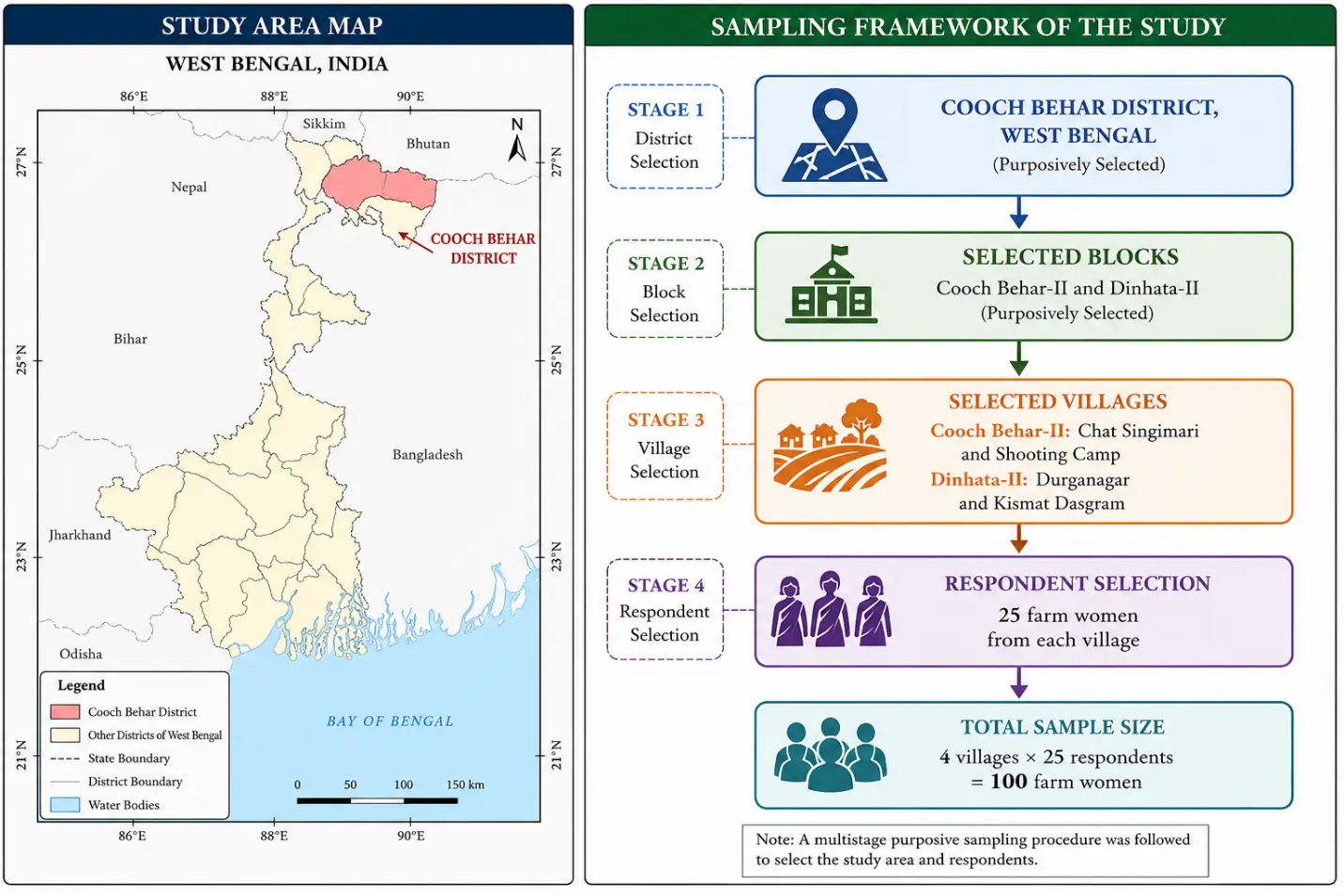
Women may assume a growing share of agricultural work without gaining corresponding control over resources or decisions. This study examines gendered working-hour patterns and perceived drivers of agricultural feminization in Cooch Behar district, West Bengal. An exploratory, ex-post facto investigation covered 100 farm women, with 25 respondents from each of four purposively selected villages in Cooch Behar-II and Dinhata-II blocks. Structured interviews provided information on agricultural working hours for 2022–2023, 2023–2024, and 2024–2025, household male migration and occupational categories, daily wage rates, and agreement with nine proposed drivers. Descriptive statistics, mean-score rankings, and exploratory principal component analysis were used. Reported average annual working hours increased for women from 1668.80 to 1736.50 h, a rise of 4.06%, while men’s hours declined from 1503.20 to 1328.10 h, a decrease of 11.65%. Women reported more hours than men in all three years, and the annual gender gap widened from 165.60 to 408.40 h. The number of households classified as experiencing male out-migration rose from 37 to 49. Male migration received the highest perceived-driver score (4.45 out of 5), followed by poverty (4.29) and declining agricultural profitability (4.11). The reported component structure suggested socio-economic, capacity-related, gendered labour and technological dimensions. These patterns are consistent with an increasing concentration of agricultural labour among women, but do not establish causal effects or demonstrate empowerment. The purposive sample and the exploratory measures limit generalization. The findings motivate attention to women’s workload, remuneration, access to agricultural services, and recognition as farmers.
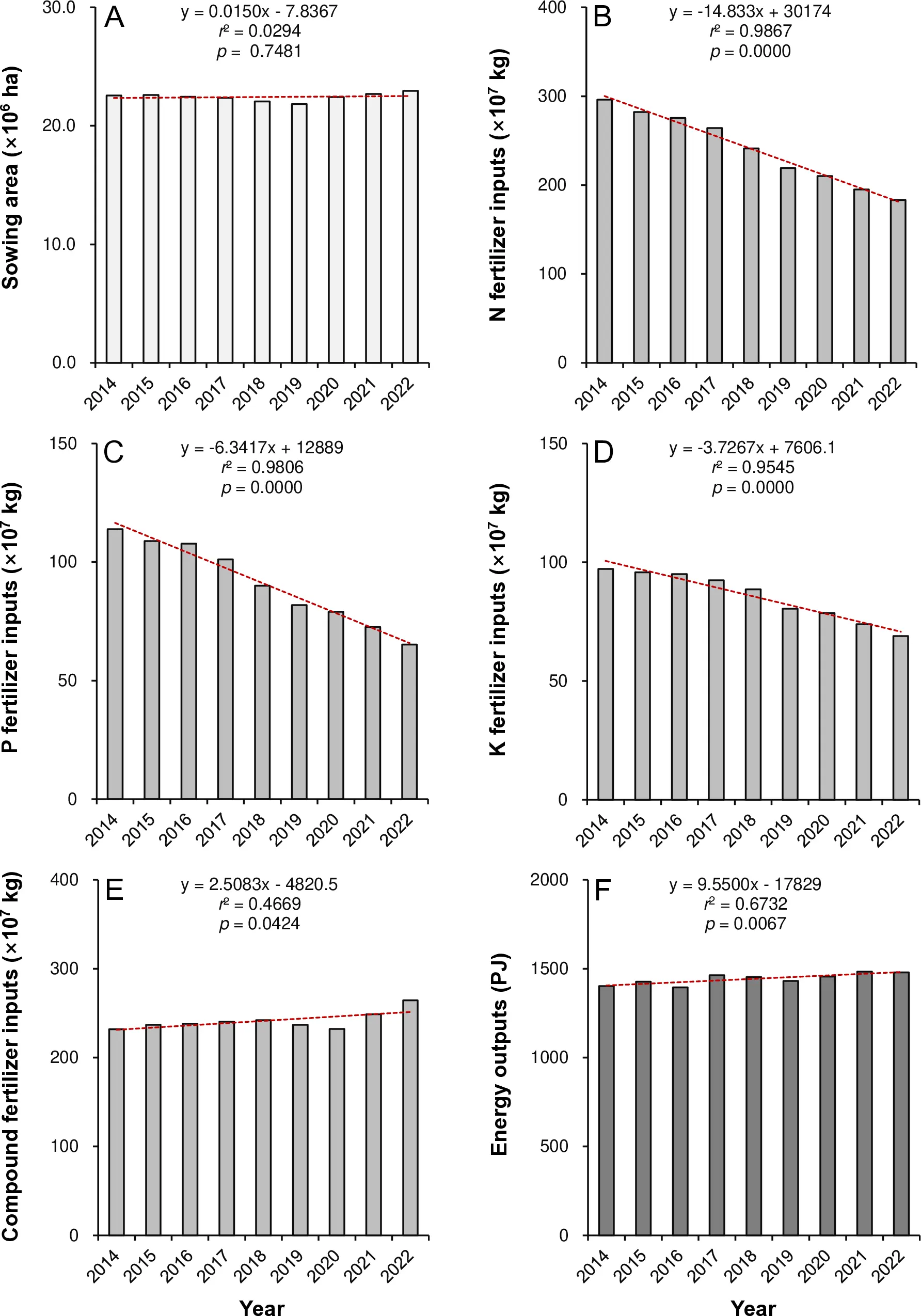
Minimizing energy inputs and greenhouse gas (GHG) emissions is essential for achieving sustainable crop production. This study analyzed changes in energy use and GHG emissions associated with chemical fertilizer application in crop production in the middle reach of the Yangtze River from 2014 (one year before the implementation of zero-growth actions) to 2022. Results revealed significant reductions in both total energy inputs and energy inputs per unit area from chemical fertilizers, with annual declines of 10.72 PJ and 0.48 GJ·ha−1, respectively. The energy use efficiency of chemical fertilizer application increased significantly at an annual rate of 0.40. Concurrently, total GHG emissions, emissions per unit area, and emissions per unit of energy input associated with chemical fertilizer application decreased significantly, with respective annual reductions of 0.31 × 10⁷ kg, 14.08 kg·ha−1, and 0.26 kg·GJ−1. These reductions were primarily due to decreases in inputs of straight nitrogen (N), phosphorus (P), and potassium (K) fertilizers, rather than changes in compound fertilizers, as the input of compound fertilizers saw a significant increase. This study suggests that zero-growth actions, with the substitution of compound fertilizers for straight N, P, and K fertilizers as a key approach, are associated with lower energy inputs and GHG emissions from chemical fertilizer application in the middle reach of the Yangtze River. However, given the descriptive nature of this analysis, these findings should be interpreted as correlational, and further quasi-experimental studies are warranted to confirm causality.
Rural transport infrastructure is widely recognized as an enabler of agricultural productivity and inclusive economic growth. This paper assesses the effects of rural roads on agriculture and related transport operators in Kenya. The study adopted a cross-sectional descriptive survey design and collected primary data from 37 farmers and 40 transport operators active in rural areas. The sample size was more inclusive and representative of major farms and transport operators, and therefore provided sufficient information that led to the study’s conclusions. The sample was determined using standard sample-size procedures, including Cochran’s formula, finite population correction, and proportionate allocation across the participants strata. The findings indicate that rural road conditions, especially during rainy seasons, affect transport efficiency, market access, crop losses, input access, and farm-gate profitability. Earth and marram roads were the dominant access routes, while transport charges increased substantially during wet seasons. Poor roads increased costs and reduced the reliability of agricultural logistics, constrained transport operations, and exposed perishable commodities to delays and spoilage. Conversely, improved rural accessibility was associated with better market participation, increased farmer incomes, and improved capacity of transport operators to serve the value chains in agriculture. The study concludes that targeted investment in all-weather rural roads is essential for strengthening agriculture and rural transport performance in Kenya.
This study examines whether local job creation helps mitigate regional population decline in South Korea. Using annual data for 161 regions from 2008 to 2025, we estimate a panel vector autoregression (PVAR) model to investigate the dynamic relationship between resident population and workplace-based employment. The descriptive analysis shows that 81 regions (50.3%) experienced employment growth despite population decline. The PVAR results indicate that employment growth does not significantly predict subsequent population growth, whereas population growth positively predicts subsequent employment growth. These findings remain similar when metropolitan cities are excluded. Overall, the results provide stronger evidence that population growth precedes employment growth than that employment growth precedes population growth, suggesting that jobs tend to follow people rather than the reverse. Job creation alone may therefore be insufficient to reverse regional population decline.
