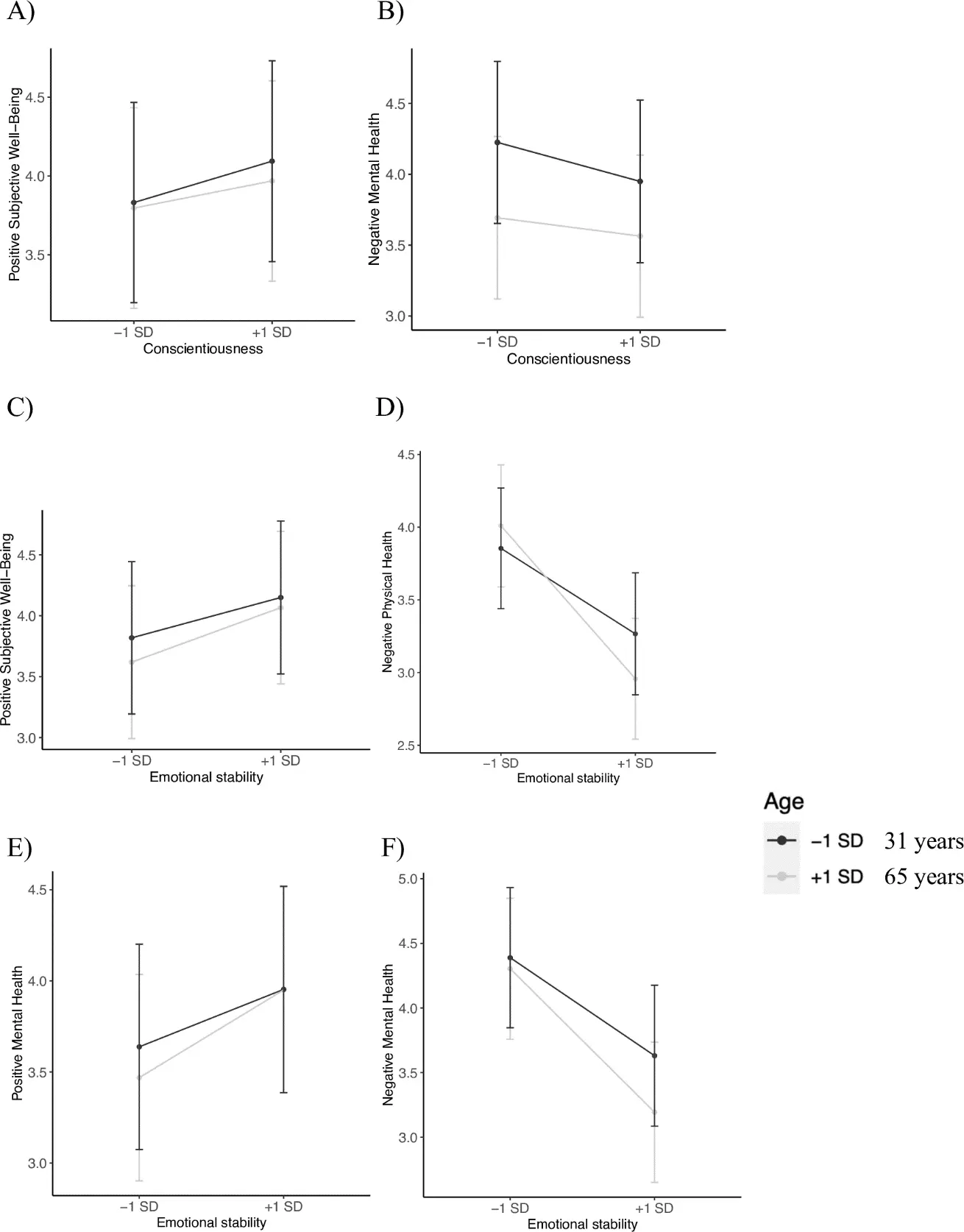
People often evaluate significant life events by the extent to which they believe these events have affected their well-being and health. Such appraisals—rather than the mere occurrence of an event—may be more closely related to well-being and health. Personality may be linked to how people appraise events as having a more positive or negative impact on their well-being and health, and these associations may vary with age. To test this hypothesis, we conducted pre-registered multi-level analyses in a large sample of German-speaking adults (n = 6688; 18–90 years), who identified the most impactful event from the prior two years and rated its positive and negative impact on their subjective well-being, physical health, and mental health. Emotional stability and conscientiousness were the most consistent correlates of more favorable evaluations (i.e., higher positive and lower negative impact). However, these patterns varied with age: conscientiousness was more strongly related to favorable evaluations in younger adults, and emotional stability in older adults. These findings align with regulatory capacities across adulthood: self-regulatory capacities may be particularly relevant when adult roles are being built in young adulthood, whereas affect-regulatory capacities may be particularly relevant when losses loom, and emotion regulation is prioritized in older adulthood.
Empirical research on the effects of exposing children to nudity is sparse, with most suggesting that it may not be as harmful as previously proposed. However, the behaviour is still condemned by society and child welfare organisations. This study aimed to explore how childhood exposure to parental non-sexual nudity (PNSN) affects life outcomes, while controlling for participant engagement in non-sexual nudity (NSN). A sample of 178 adults (M = 49.83, SD = 17.56) were asked to reflect on their exposure to PNSN in their childhood and their current engagement in NSN. The participants were also asked to complete surveys measuring a wide range of life outcomes (body satisfaction, life satisfaction, antisocial behaviour, mental health and sexual adjustment). A two-way Multivariate Analysis of Variance (MANOVA) indicated that exposure to PNSN did not have the harmful effects previously suggested. Furthermore, those engaging in NSN had more positive life outcomes than those who did not. Finally, no interaction effects were found. Explorative analysis indicated that increased frequency and a greater variety of PNSN and NSN settings were associated with more positive life outcomes. This study suggests that it is necessary to dissociate PNSN from childhood abuse in order to better evaluate the effects of this on children. Furthermore, it highlights the need for further research in this area.
Emerging adults are particularly vulnerable to internet addiction, and impulsivity is a well-established risk factor. However, the underlying mechanisms, particularly the mediating role of specific digital behaviors and the moderating role of neurophysiological factors, remain inadequately explored. This study investigated whether smartphone multitasking mediates the relationship between impulsivity and internet addiction, and whether resting high-frequency heart rate variability (HF-HRV) moderates these pathways. A sample of 141 college students completed the Internet Addiction Scale, the Barrett Impulsivity Scale, and the Smartphone Multitasking Scale. The electrocardiogram (ECG) data were collected and resting HF-HRV was computed. The results indicated that smartphone multitasking partially accounted for the association between impulsivity and internet addiction (indirect effect = 0.05, SE = 0.02, 95% [0.005, 0.10]), and that resting HF-HRV moderated the direct association (β = −0.14, SE = 0.07, 95% [−0.28, −0.004]), which was weaker at higher levels of HF-HRV. However, the index of moderated mediation was not significant (index = 0.03, SE = 0.03, 95% CI [−0.01, 0.10]), indicating that the indirect effect did not significantly vary with HF-HRV. These findings suggest a complex pattern of associations in which impulsivity is related to internet addiction both directly and indirectly through smartphone multitasking, while resting HF-HRV, a physiological marker associated with self-regulatory capacity, moderates the direct association. This study provides an integrated perspective, linking personality traits, real-world digital behaviors, and neurophysiological markers to better understand the correlates of internet addiction.
