
The Role of Age and Personality in the Subjective Evaluation of Significant Life Events
The Role of Age and Personality in the Subjective Evaluation of Significant Life Events
Sonja Radjenovic
1,2,*,†
 Marcus Mund
3
Jana Nikitin
1
Received: 12 June 2026 Revised: 22 July 2026 Accepted: 09 October 2026 Published: 20 October 2026

© 2026 The authors. This is an open access article under the Creative Commons Attribution 4.0 International License (https://creativecommons.org/licenses/by/4.0/).
1. Introduction
Significant life events, such as the birth of a child, moving house, or retirement, can disrupt a person’s daily routine and influence their life [1]. Although extensive research examines how personality traits influence the likelihood of these events (selection effects) and how such events, in turn, shape personality (socialization effects) e.g., [2,3,4], little attention has been paid to how personality traits are associated with the subjective impact of these events and to the role of age in these associations. Questions such as “How happy does my new marriage make me?” or “How much do I think a recent injury is impacting my health?” illustrate that these impacts are subjective. We argue that personality is associated with these evaluations, given its relation to how individuals attend to and interpret experiences [5]. In addition, age may moderate the association between personality and the subjective impact of significant life events, although the nature of this relationship remains open. To address these questions, we analyzed data from a large, age-diverse sample of individuals who experienced at least one significant life event in the two years prior to the survey.
1.1. Personality Traits and Life-Event Evaluation
Life events are evaluated subjectively [1,6]. For example, a divorce can be experienced as liberating for one person but as stressful for another [7]. Such differences in appraisal influence how individuals respond emotionally and cognitively to life events [5,8,9], which in turn have important consequences for their well-being and health [1,6,10,11]. Studies using large longitudinal datasets have found little consistent evidence that the Big Five traits systematically moderate changes in well-being following life events [12,13]. This suggests that personality differences may play a more limited role in long-term adaptation and may instead be more relevant to how we evaluate life events.
Accordingly, we argue that personality traits—defined as relatively stable characteristics of thinking, feeling, and behavior across situations [14]—are relevant to the subjective evaluation of life events. Specifically, we propose that personality traits are associated with how individuals evaluate the impact of a life event on their subjective well-being (life satisfaction, positive and negative affect) and on their physical and mental health. We hypothesize that higher levels of openness to experience (curious, creative, willing to embrace new experiences), conscientiousness (orderly, organized, self-disciplined), extraversion (energetic, sociable, outgoing), agreeableness (kind, altruistic, trustworthy), and emotional stability (low in anxiety and with a tendency to experience low negative emotions; [15]) are each associated with more positive evaluations of the impact of significant life events on their subjective well-being and health than lower levels of these traits (H1).
We base our argument on prior empirical findings linking personality traits to event perception and evaluation. Openness to experience is associated with seeing possibilities rather than threats with positive reappraisal of stressful events, and better health outcomes [5,16,17,18]. The latter also holds for conscientiousness, which is additionally linked to a greater mastery and fewer perceived constraints [15,17,19]. In other words, individuals higher in conscientiousness tend to feel more capable of influencing life outcomes, which may be reflected in viewing life events as more manageable and thus evaluating their consequences more favorably. Extraversion is linked to frequent positive emotions and more positive appraisals of events, possibly via an active reward system [20,21]. In addition, individuals high in extraversion often view events as challenges rather than threats [16]. Agreeableness is associated with a higher likelihood of encountering positive situations and avoiding negative ones [22,23], as well as with more adaptive coping strategies [16,24]. Finally, emotional stability is linked to a focus on favorable aspects of events and stronger coping abilities [21].
To our knowledge, no research has systematically investigated the role of personality in the subjective evaluation of a life event’s impact on well-being and health. The most closely related study examined how Big Five traits relate to perceptions of major life events (e.g., valence, impact, or challenge) and to beliefs about event-related personality change [7]. Their findings suggest that personality traits are associated with how people perceive and characterize life events, implying that personality may also be related to how such events are evaluated in terms of their consequences for well-being and health. Consistent with the importance of such subjective evaluations, previous findings suggest that changes in the perceived impact of life events may be more strongly related to subsequent well-being than the mere occurrence of those events [25]. Additionally, we control for perceived event intensity to account for differences in how strongly individuals felt affected by the event [1]. This allows us to examine the association between personality traits and subjective evaluations while controlling for perceived intensity. For example, relocation may be experienced as highly intense for some individuals but less so for others.
Although the Big Five are conceptualized as distinct personality dimensions, they are typically intercorrelated. Higher-order models have proposed that part of this shared variance can be summarized in two broader dimensions—stability (shared variance in conscientiousness, agreeableness, and emotional stability) and plasticity (shared variance in extraversion and openness to experience) [5]. As an exploratory extension of our trait-level approach, we will therefore also examine whether associations with life-event evaluations could be summarized at this higher level of personality organization.
1.2. The Role of Age
Experiences and evaluations of life events vary across adulthood. Part of the difference reflects timing: on-time events (e.g., retiring at a typical age) are usually appraised more positively than off-time events (e.g., early retirement; [26]). Age also affects how people interpret and cope with events [27]—for example, a promotion may elicit self-doubt early in a career but be viewed as deserved recognition in midlife. More broadly, perceptions of life events change with age: events are seen as less predictable and more negative or challenging, particularly in very late life, yet more controllable [28].
The role of personality traits in the evaluation of life events may also vary across age. Although relatively stable, traits have been shown to change across the lifespan due to intrinsic and extrinsic influences [29], and the effects of life events on personality may differ by age [4]. We therefore examine whether associations between personality and the perceived impact of life events on well-being and health vary by age. This expectation is consistent with a lifespan perspective, as individuals face different developmental tasks at different stages of adulthood [30]. For example, younger adults are often focused on forming intimate relationships, midlife adults in career advancement, and older adults in coping with health decline.
Not only that, as people age and perceive a more limited future, they increasingly prioritize emotionally meaningful goals (socioemotional selectivity theory; [31]), often heightening motivation to regulate emotions and maintain well-being. Greater use of emotion-regulation strategies may buffer the adverse effects of some traits (e.g., high neuroticism) in older adulthood, consistent with the Strength and Vulnerability Integration model (SAVI; [32]). Conversely, the focus on maintaining well-being may also correspond to stronger associations between certain traits and event experience. For example, highly conscientious older adults may find relocation particularly disruptive due to reliance on routines and long-established networks [33], whereas younger adults high in conscientiousness may adapt more readily.
Together, these examples suggest several moderation scenarios: links may weaken, strengthen, or even remain stable with age, given trait stability and their role in guiding behavior [34,35]. We therefore investigate age moderation exploratorily (RQ1), using multilevel modelling to separate event-level from person-level variance and to test whether links between personality, age and life event evaluations depend on the specific life event experienced.
2. Materials and Methods
2.1. Participants and Procedure
The sample (n = 6688) included German-speaking individuals (from Germany = 78.9%, Austria = 13.8%, and Switzerland = 7%, others = 0.2%), with 50.9% men, 48.9% women, and 0.2% individuals identifying as non-binary. Concerning age, participants ranged from 18 to 90 years, with a mean age of 48.18 (SD = 16.83). People were distributed fairly equally across all age groups, with approximately 17% falling within each decade, except for those over 70 years, constituting 13.1% of the total sample. Educational backgrounds were diverse, with 31.2% of participants completing vocational training, 28.8% having a college or university education, 16.7% completing high school, and 15.4% graduating from higher vocational school. Few participants (4.4%) had finished compulsory schooling, while 3.5% pursued “other” forms of education. The study protocol was approved by the Ethics Committee of the University of Basel (009-20-1). Participants were recruited from the online access panel maintained by Bilendi (formerly Respondi), an ISO-accredited market research company. Bilendi recruits members for its panel through online campaigns, including social media campaigns. Registered panel members were invited to participate in the present study, with gender quotas and age quotas defined by decade to achieve a balanced distribution across these variables.
Participants provided informed consent at the study’s outset with assurances of confidentiality for their data. The questionnaire, conducted between 23 June and 8 July 2020, took approximately 20 to 30-min and was compensated with €3.60. Selection criteria involved participants reporting the significant life event with most impact in the preceding two years, chosen from a predefined list of life events. Subsequently, participants selected the most impactful event from the same list and responded to follow-up questions concerning that specific life event.
2.2. Measures
2.2.1. Significant Life Events
Participants were presented with a list of 19 impactful life events, including, e.g., the illness of a loved one, a job promotion, or the birth of a child. The compilation of life events drew inspiration from HILDA (Household, Income and Labour Dynamics in Australia; [36]) and SHP (Swiss Household Panel; [37]) datasets (refer to Supplementary Material Table S1 for the comprehensive list of specific life events and their prevalence in the sample). In the survey, participants were asked to select the single life event that had the most significant influence on their lives during the two years preceding the questionnaire. In instances where participants opted for the “other” category, they gave a detailed description of the life event that was not included in the list.
2.2.2. Big Five Personality Traits
Participants expressed the degree to which statements describing personal attributes applied to them. Each set comprised four to five items, describing various personality traits: openness to experience (e.g., “I have an active imagination”; ω = 0.81), conscientiousness (e.g., “I make plans and follow them through”; ω = 0.72), extraversion (e.g., “I am rather reserved”, reverse coded; ω = 0.85), agreeableness (e.g., “I am sometimes rude to others”, reverse coded; ω = 0.69), and emotional stability (e.g., “I am relaxed, handle stress well”; ω = 0.82). Whereas the original BFI-K uses a 5-point response format, items in the present study were rated on a 7-point response scale ranging from 1 = not true at all to 7 = very much true (BFI-K; [38]). Note that we use the term emotional stability rather than its opposite, neuroticism, to make the results easier to report. The items were recoded if necessary, so that higher values express higher openness, conscientiousness, extraversion, agreeableness, and emotional stability, and they were aggregated to one scale per personality trait.
To examine the BFI-K factor structure, we tested the published five-factor model using CFA. Although all items loaded significantly on their intended factors, model fit was inadequate (robust CFI = 0.770, TLI = 0.731, RMSEA = 0.095, SRMR = 0.090). A less restrictive five-factor ESEM allowing cross-loadings showed substantially improved fit (robust CFI = 0.925, TLI = 0.864, RMSEA = 0.074, SRMR = 0.031), and the resulting factors were interpretable as the intended Big Five dimensions. We therefore retained the five-trait scoring.
2.2.3. Self-Reported Impact of the Life Event on Subjective Well-Being, Physical and Mental Health
Participants were asked to what extent the significant life event impacted their subjective well-being, physical and mental health in terms of positive and negative impact (1 = not at all to 7 = very much). The six items were all regarded as separate outcome variables. We conducted a parallel analysis and compared one- and two-factor models using confirmatory factor analysis. Parallel analysis indicated two factors, and the two-factor model distinguishing positive and negative evaluations fit substantially better than the one-factor model (robust CFI = 0.948 vs. 0.863; SRMR = 0.035 vs. 0.059; Δχ2(1) = 790.01, p < 0.001). The two factors were strongly negatively correlated (r = −0.85), indicating substantial overlap while still supporting a distinction between positive and negative evaluations. We therefore retained all items as separate outcome variables. This decision also acknowledges that positive and negative influences of life events on well-being and health can occur simultaneously (similar to positive and negative affect; [39]). For example, retirement can enhance well-being by reducing work stress and increasing free time for hobbies and relationships, while simultaneously posing challenges such as loss of purpose, social isolation, or financial insecurity. By distinguishing the positive and negative valence aspects of well-being, we can determine which aspects of well-being or health (positive or negative) are more strongly associated with personality traits. Moreover, although the factor analyses supported broader positive and negative dimensions, subjective well-being, physical health, and mental health represent distinct domains of perceived event impact that were of separate interest in our analyses. We therefore did not combine the three positive or the three negative items into composite scores.
2.2.4. Covariates
Participants separately rated the impact intensity of the significant life event (1 = not at all to 7 = very much) for each outcome: subjective well-being, physical health, and mental health; thus, the three control variables were considered separately depending on the outcome in question. Participants reported their age in years. It was included as a covariate in the main analyses and was additionally examined as an exploratory continuous moderator of the associations between personality traits and the perceived impact of life events. For a detailed description of the scales and items, see Supplementary Material Table S1.
2.3. Data-Analytical Strategy
To assess the data, we utilized multilevel modelling, treating specific life events as Level 2 factors and the individuals nested within them as Level 1 factors (personality traits, age, and life events’ influence on well-being/health). In this way, we were able to differentiate between variance within life events and variance across life events. Our analysis considered fixed and random effects (mean-centred predictors), and their respective explained variances. Models were built sequentially, beginning with random-intercept models, after which the full set of predictors and covariates was added. Apart from analysing random intercepts (life-event specific), we also investigated the possibility of random slopes in the predictors. This was achieved by comparing models with and without random slopes. Model fit was evaluated using likelihood ratio tests and information criteria (AIC, BIC), with lower values indicating better model fit. If there were a significant random slope, it would show that the effect of the predictor varies based on the specific life event. For the exploratory analysis, age, treated as a continuous variable, was included as a moderator in the models.
As a supplementary exploratory analysis, we examined whether the trait-level associations could be summarized by the higher-order dimensions of stability and plasticity. Stability was calculated from standardized conscientiousness, agreeableness, and emotional stability scores, and plasticity from standardized extraversion and openness scores. The same multilevel models, including age moderation, were repeated using these dimensions.
We grand-mean centred all predictors, moderators, and covariates. The equation of our multilevel model is as follows:
|
```latexLevel\, 1: {Y}_{ij} = {\beta }_{0j} + {\beta }_{1}\left(Intensit{y}_{ij}\right) +{\beta }_{2}\left({Age}_{ij}\right) +\sum_{k=1}^{5}{\beta }_{k}\left(Personalit{y}_{k,ij}\right) + {r}_{ij}``` |
|
|
```latexLevel\, 2: {\beta }_{0j}={\gamma }_{00}+{u}_{0j}``` |
Fixed effects (β) for each predictor and covariate;
Event-specific intercept (combined) (β0j) composed of:
An overall (grand) intercept (γ00);
A random intercept (u0j);
Unexplained variance (residual) rij.
For the exploratory moderation analyses, the model was specified as follows:
|
```latex{Y}_{ij} = {\beta }_{0j} + {\beta }_{1}\left(Intensit{y}_{ij}\right) + {\beta }_{2}\left(Ag{e}_{ij}\right) + \sum _{k=1}^{5}{\beta }_{k+2}\left(Personalit{y}_{k,ij}\right) + \sum_{k=1}^{5}{\beta }_{k+7}\left(Personalit{y}_{k,ij} \times Ag{e}_{ij}\right) + {r}_{ij}``` |
R version 4.2.3 [40] involving the packages “nlme” (v. 3.1-162, [41]), “misty” (v. 0.4.11, [42]), and “reghelper” (v. 1.1.1, [43]) was used for statistical analyses. We preregistered the hypotheses and the analysis plan for this study (any deviations from the preregistration are detailed in Supplementary Material Table S2).
3. Results
3.1. Descriptive Analyses
Across all life events, participants reported more conscientiousness, openness to experience, extraversion, emotional stability, and agreeableness than the scale midpoint (in this order). All personality traits were positively correlated with each other (see Table A1 in the Appendix A). All personality traits correlated with age. With higher age, people reported higher levels in all of traits. Supplementary Material Table S3 provides details on descriptive statistics of individual life events.
The intraclass correlation coefficients (ICC) revealed that a smaller portion of the variance in the subjective evaluation of the significant life events—ranging from 0.21 (subjectively perceived positive and negative impact of the life event on physical health) to 0.45 (subjectively perceived positive impact of the life event on subjective well-being)—is associated with specific life events, with the remaining variance attributable to the individual and error variance. With recommended ICCs greater than 0.05 for outcomes [44], we employed MLM for our subsequent analyses. The ICCs for the predictors (i.e., Big Five personality traits) ranged from 0.1 (all personality traits except for emotional stability) to 0.3 (emotional stability). This means that only a small part of the variance in personality traits is due to differences between groups or contexts. In other words, personality seems to be fairly stable across contexts, which supports our decision to treat personality traits as predictors rather than outcomes. While life events may play a role in how personality is expressed, the low ICCs suggest that these influences are relatively minor compared to the overall stability of personality.
3.2. Personality Traits and Life-Event Evaluation (H1)
According to the fixed-effect results (see Table A2 in the Appendix A), the hypotheses were supported for all associations between emotional stability and the outcomes and for all but one association between conscientiousness and the outcomes (positive mental health). Agreeableness was associated with three of the six outcomes (negative SWB and positive and negative physical health), whereas extraversion showed an association only with positive subjective well-being. No associations were found between openness to experience and any of the outcome variables. There was a systematic difference between the amount of variance explained for the self-reported positive and negative impact of the life event. Specifically, the Big Five traits explained a larger proportion of the variance in the self-reported negative impact than the self-reported positive impact (10% vs. 0% for subjective well-being, 46% vs. 13% for physical health, and 22% vs. 3% for mental health; see Table A2 in the Appendix A). However, as indicated by the regression coefficients, these differences were driven primarily by event intensity (the control variable) and by emotional stability.
Finally, we found improved model fits with random slopes for 25 out of the 30 models (see Supplementary Material Table S4). This suggests that the strength of the associations between personality traits and the self-reported impact of life events varies between different life events.
Supplementary exploratory analyses using the higher-order dimensions of stability and plasticity showed a consistent pattern. Stability (conscientiousness, agreeableness, and emotional stability) was associated with more positive and less negative evaluations across subjective well-being, physical health, and mental health, whereas plasticity (extraversion and openness) was not significantly associated with any of the six outcomes (see Supplementary Material Table S6). Random slopes improved model fit for both higher-order dimensions across all outcomes, indicating that their associations with life-event evaluations varied across specific life events (Table S7).
3.3. The Role of Age (RQ1)
When considering age as a moderator for the associations postulated in H1, the fixed-effect results showed that the associations were stronger for two models with conscientiousness (negative life events’ impact on well-being and mental health) and for four models with emotional stability (negative life events’ impact on well-being, physical health, and mental health; and positive life events’ impact on mental health; see Table A3 in the Appendix A).
As can be seen from the slopes in Figure 1, the negative associations between conscientiousness and the outcomes were stronger for younger adults (slopes in light gray) than for older adults (slopes in black; Figure 1A,B), whereas the associations between emotional stability and the outcomes were stronger for older adults than for younger adults (Figure 1C–F).
There were no other significant moderations of age. In general, the majority of the explained variance for life events’ impact on subjective well-being and health was found at the life-event level (up to 43%; see Table A3), indicating that a significant portion of the differences in how life events are evaluated can be attributed to the life events themselves. The amount of variance explained at the individual level was up to 29%, suggesting that individual differences, such as personality traits and the moderating effect of age, also play a role in how individuals evaluate these life events, but to a lesser extent than life events.
Finally, we found that random slopes of age improved model fit in 23 out of 30 models, indicating that the effects of age were often different across life events, with fewer outcomes that were not life-event specific (see Supplementary Material Table S5).
In the supplementary higher-order analyses, neither stability nor plasticity showed significant interactions with age for any of the six outcomes (see Supplementary Material Table S8). Random slope analyses nevertheless showed that age interactions varied across specific life events for most models (see Supplementary Material Table S9).
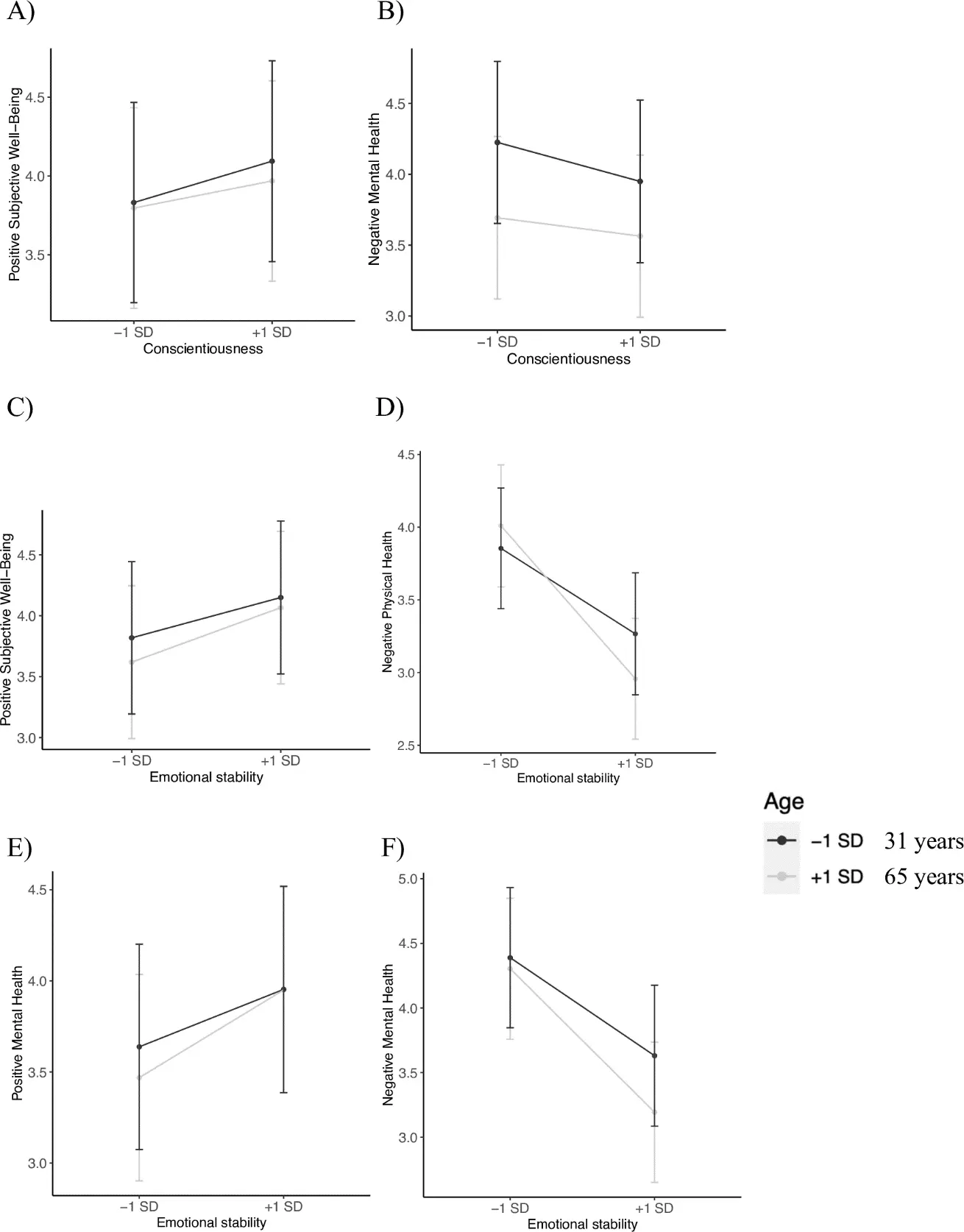
Figure 1. Significant Age Moderations for the Associations Between Personality Traits (Big Five) and Life Events’ Impact on Well-Being and Health. Note: (A) conscientiousness and positive subjective well-being; (B) conscientiousness and negative mental health; (C) emotional stability and positive subjective well-being; (D) emotional stability and negative physical health; (E) emotional stability and positive mental health; (F) emotional stability and negative mental health. The black line; −1 SD of age, the grey line: +1 SD of age.
4. Discussion
Building on work showing that event perceptions relate to well-being [10,11] and that personality traits predict how life events are perceived [7], our study examined how Big Five traits relate to the perceived impact of life events on well-being and health. Conscientiousness and emotional stability were the most consistent positive correlates of the self-reported impact. Effect sizes were larger for the perceived negative than positive impact of life events, particularly for health. Exploratory age moderation revealed that age was trait-specific: conscientiousness was more strongly related to favorable evaluations in younger adults, whereas emotional stability was more strongly related to favorable evaluations in older adults.
Individuals high in conscientiousness may appraise events as eustressful and challenging rather than burdensome [17], which may correspond to more positive event evaluations. Individuals high in emotional stability perceive life events more positively [7], which may be related to better coping abilities and emotional regulation [16,17]. The age moderations of emotional stability align with prior research (e.g., [45]), which shows a stronger association between emotional stability and well-being in older adults. This could suggest that, with increasing age, adults high in emotional stability might be particularly relevant to favorable event evaluations in the context of increasing losses relative to gains [46]. These results do not imply that the overall association between personality and event evaluation depends on age; rather, they indicate a trait-specific role that varies with age.
In terms of emotional stability, the findings are consistent with the Strength and Vulnerability Integration model (SAVI; [32]), which posits that older adults generally benefit from greater emotional stability, whereas those with greater vulnerabilities have more difficulty coping with stress. When older adults experience low levels of persistent emotional arousal—as is often the case with emotional stability [47]—the age-related benefits in emotional well-being are enhanced, and older adults may cope with difficulties better than young adults. This also resonates with the socioemotional selectivity theory [31], which suggests that older adults increasingly prioritize emotionally meaningful goals, further supporting the idea that emotional stability is particularly adaptive for well-being in later life.
The finding that conscientiousness shows stronger positive associations with event evaluation in younger adulthood may reflect the developmental tasks of this period. Younger adults are in a stage of substantial personal and professional development [48], which may make persistence, planning, and goal-directed behavior particularly important when dealing with life events, thus may correspond to the stronger associations with conscientiousness observed in younger than in older adulthood. Empirically, common transitions at this age—entering the workforce, starting a romantic relationship, or attending university—have been associated with increases in conscientiousness [49], supporting the idea that these developmental tasks promote conscientious behavior. However, these interpretations are speculative and require confirmation in future research.
The other personality traits were less consistently associated with event evaluations. Agreeableness showed associations with several well-being and health outcomes, which may relate to individuals higher in this trait approaching stressful situations as less conflictual or threatening [16]. However, it showed associations with only some outcomes, possibly reflecting context-dependent effects, as agreeableness may be more relevant when life events involve interpersonal processes such as relationships, conflict, or social support [50]. Extraversion and openness to experience yielded (almost) no significant results. For extraversion, this departs from prior work (e.g., [15,51,52,53]), whereas the null results for openness align with evidence that this trait is only modestly related to well-being outcomes (e.g., [51,53,54]). One possibility is that extraversion and openness are more strongly related to selection effects—i.e., the likelihood of encountering certain life events potentially related to seeking novelty and diversity [48]—whereas the perceived event impact may be more closely tied to emotional stability, conscientiousness, and agreeableness.
The supplementary higher-order analyses showed a similar pattern. Stability, which includes conscientiousness, agreeableness, and emotional stability, was consistently linked to more favorable event evaluations, whereas plasticity, which includes extraversion and openness, showed no associations. This suggests that the overall pattern may mainly reflect the traits related to stability, although the five-trait analyses show a more differentiated picture of which traits are most relevant. Neither stability nor plasticity was moderated by age, suggesting that the age differences observed for conscientiousness and emotional stability may be specific to these individual traits and are not captured by the broader stability dimension.
Notably, personality traits accounted for a substantial share of variance in event evaluations, especially for perceived negative impact on physical and mental health. Stronger effects for health may reflect personality’s more direct association with health behaviors, whereas well-being is more indirectly related to social support and coping resources [16,55]. Compared with other traits, emotional stability emerged as the strongest personality correlate of event appraisals. Emotionally stable individuals tend to focus less on negative aspects of their experiences [20], which is consistent with its stronger association with lower perceived negative impact on well-being. However, these findings should be interpreted with caution because, unsurprisingly, perceived event intensity was the strongest concomitant of self-reported impact of the life event.
Limitations
The present study has several strengths, including a large sample, a wide range of significant life events across different life domains, consideration of all Big Five personality traits, and multiple outcomes of life-event evaluation. It also has some limitations. Because the design is cross-sectional and questionnaire-based, retrospective recall bias and the inability to draw causal inferences are concerns; longitudinal research is needed to clarify the observed associations. We used a study-specific measure of perceived impact, and each outcome domain (subjective well-being, physical health, and mental health) was assessed with a single item. Single-item measures can capture broad constructs but may lack the reliability and nuances of multi-item scales; still, some evidence suggests comparable performance for certain constructs (e.g., life satisfaction; [56]). Because each participant rated only one life event, we could not determine whether the ratings were specific to that event or also reflected more general tendencies to evaluate experiences positively or negatively. The assessment and structure of the Big Five should also be considered. Although internal consistencies were acceptable to good, the analyses provided only partial support for the expected five-factor structure in the present sample: the restrictive five-factor model showed inadequate fit, and several cross-loadings emerged in the less restrictive model. In addition, the 21-item BFI-K [38] provides less comprehensive trait coverage than longer inventories, and we used a 7-point rather than the original 5-point response format. These aspects, together with the observed intercorrelations among the traits, should be considered when interpreting the trait-specific findings. Given the number of analyses, we did not adjust α levels to avoid loss of power and increased Type II error [57,58]; instead, we prioritized explained variance and effect sizes over dichotomous significance. Data collection occurred early in the COVID-19 pandemic, which may have influenced the prevalence of certain events (e.g., illness or job loss), participants’ well-being and mental health, and how life events were retrospectively perceived and evaluated. The pandemic context may also have altered the observed associations between personality and event evaluations, as personality traits were associated with differences in perceived pandemic stress during this period (e.g., higher emotional stability was associated with lower levels of perceived pandemic stress, whereas higher extraversion was associated with higher levels [59]). Age-related associations may likewise have been affected, as younger and older adults differed in pandemic-related stress, life changes, coping, and psychological well-being [60]. Although the pandemic context was shared by all participants who reported an event in the four to five months prior to the survey, and it was further controlled for the perceived intensity of the life event, this does not account for broader effects of the pandemic on participants’ well-being, mental health, or retrospective evaluations. The findings should therefore be interpreted in light of this particular context. Finally, online recruitment—while efficient—may have introduced selection bias by over-representing younger, more tech-engaged participants and under-representing older adults with limited internet access. Although age and gender quotas were applied, participants were drawn from a self-selected online access panel. Selection effects associated with joining the panel and participating in the present study may, therefore, limit the generalizability of the findings.
5. Conclusions
This study shows that Big Five traits are associated with how adults evaluate significant life events. Conscientiousness and emotional stability—and, to a lesser extent, agreeableness—were consistently linked to more favorable event appraisals (higher positive, lower negative impact). These associations were age-graded: conscientiousness was more strongly related in younger adults, whereas emotional stability was more related in older adults.
Supplementary Materials
The following supporting information can be found at: https://www.sciepublish.com/article/pii/1271, Table S1: German and English Wording of the Items; Table S2: Deviations from the Preregistration; Table S3: Individual Significant Life Events and Their Descriptive Statistics; Table S4: ANOVA Comparison of Models with and without Random Slopes; Table S5: ANOVA Comparison of Models with and without Random Slopes; Table S6: Multilevel Model of Fixed and Random Effects for Higher-Order Factors (Stability & Plasticity) on Life-event Experience; Table S7: ANOVA Comparison of Models with and without Random Slopes (Higher-Order Factors on Life-event Experience); Table S8: Multilevel Model of Fixed and Random Effects for Higher-Order Factors (Stability & Plasticity) on Life-Event Experience Moderated by Age; Table S9: ANOVA Comparison of Models with and without Random Slopes (Higher-Order Factors on Life-Event Experience Moderated by Age).
Appendix A
Table A1. Means, Standard Deviations, and Correlations.
|
Variable |
M |
SD |
1. |
2. |
3. |
4. |
5. |
6. |
7. |
8. |
9. |
10. |
11. |
12. |
13. |
14. |
|---|---|---|---|---|---|---|---|---|---|---|---|---|---|---|---|---|
|
1. Age |
48.18 |
16.83 |
||||||||||||||
|
2. Openness |
5.09 |
1.12 |
0.15 ** |
|||||||||||||
|
3. Conscientiousness |
5.17 |
1.01 |
0.13 ** |
0.28 ** |
||||||||||||
|
4. Extraversion |
4.41 |
1.36 |
0.08 ** |
0.27 ** |
0.30 ** |
|||||||||||
|
5. Agreeableness |
4.19 |
1.19 |
0.19 ** |
0.12 ** |
0.17 ** |
0.24 ** |
||||||||||
|
6. Emotional stability |
4.29 |
1.39 |
0.20 ** |
0.07 ** |
0.26 ** |
0.32 ** |
0.26 ** |
|||||||||
|
7. Positive SWB |
3.63 |
2.23 |
−0.24 ** |
−0.03 * |
0.03 ** |
0.06 ** |
0.00 |
−0.10 ** |
||||||||
|
8. Negative SWB |
4.07 |
2.23 |
0.14 ** |
0.04 ** |
−0.04 ** |
−0.06 ** |
−0.04 ** |
0.19 ** |
−0.78 ** |
|||||||
|
9. Intensity SWB |
5.65 |
1.51 |
0.00 |
0.07 ** |
0.08 ** |
0.04 ** |
0.00 |
0.14 ** |
−0.04 ** |
0.26 ** |
||||||
|
10. Positive Physical Health |
3.22 |
1.97 |
−0.14 ** |
0.01 |
0.05 ** |
0.05 ** |
0.04 ** |
−0.08 ** |
0.65 ** |
−0.52 ** |
−0.02 |
|||||
|
11. Negative Physical Health |
3.69 |
2.12 |
0.10 ** |
0.03 ** |
−0.03 ** |
−0.04 ** |
−0.04 ** |
0.22 ** |
−0.49 ** |
0.64 ** |
0.28 ** |
−0.37 ** |
||||
|
12. Intensity Physical Health |
4.26 |
2.18 |
0.10 |
0.07 ** |
0.05 ** |
0.03 * |
0.01 |
0.17 ** |
−0.11 ** |
0.26 ** |
0.43 ** |
0.07 ** |
0.57 ** |
|||
|
13. Positive Mental Health |
3.54 |
2.19 |
−0.20 ** |
−0.01 |
0.03 ** |
0.06 ** |
0.02 |
−0.11 ** |
0.80 ** |
−0.67 ** |
−0.01 |
0.67 ** |
−0.42 ** |
−0.05 ** |
||
|
14. Negative Mental Health |
4.05 |
2.19 |
0.09 ** |
0.04 ** |
−0.05 ** |
−0.07 ** |
−0.05 ** |
0.25 ** |
−0.66 ** |
0.79 ** |
0.24 ** |
−0.45 ** |
0.67 ** |
0.30 ** |
−0.67 ** |
|
|
15. Intensity Mental Health |
5.37 |
1.78 |
−0.01 |
0.11 ** |
0.02 |
0.00 |
−0.02 |
0.25 ** |
−0.11 ** |
0.27 ** |
0.53 ** |
−0.01 |
0.31 ** |
0.45 ** |
−0.03 ** |
0.40 ** |
Note: SWB, physical health, mental health = Life event’s influence on these variables. n = 6688, * p < 0.05, ** p < 0.01.
Table A2. Multilevel Model of Fixed and Random Effects for Personality Factors on Life-event Experience.
|
Positive SWB |
Negative SWB |
Positive Physical Health |
Negative Physical Health |
Positive Mental Health |
Negative Mental Health |
|
|---|---|---|---|---|---|---|
|
Fixed Effects |
3.919 (0.325) |
3.810 (0.307) |
3.453 (0.200) |
3.505 (0.215) |
3.760 (0.291) |
3.872 (0.275) |
|
Intercept |
3.679 (0.333) |
2.273 (0.302) |
2.707 (0.218) |
1.545 (0.163) |
3.265 (0.303) |
1.915 (0.250) |
|
Life event’s intensity |
0.044 (0.014) |
0.273 (0.014) |
0.178 (0.011) |
0.466 (0.010) |
0.093 (0.012) |
0.365 (0.012) |
|
Openness to experience |
−0.007 (0.019) |
−0.003 (0.019) |
0.014 (0.020) |
−0.002 (0.018) |
0.009 (0.020) |
0.001 (0.019) |
|
Conscientiousness |
0.045 (0.021) |
−0.057 (0.022) |
0.046 (0.022) |
−0.065 (0.021) |
0.020 (0.022) |
−0.059 (0.022) |
|
Extraversion |
0.035 (0.016) |
−0.012 (0.017) |
0.007 (0.017) |
−0.005 (0.016) |
0.024 (0.017) |
−0.012 (0.017) |
|
Agreeableness |
0.012 (0.017) |
−0.044 (0.018) |
0.046 (0.018) |
−0.042 (0.017) |
0.028 (0.018) |
−0.031 (0.018) |
|
Emotional stability |
0.114 (0.016) |
−0.203 (0.016) |
0.104 (0.016) |
−0.171 (0.015) |
0.147 (0.017) |
−0.222 (0.016) |
|
Random Effects |
||||||
|
Intercept |
2.092 (0%) |
1.686 (10%) |
0.895 (13%) |
0.486 (46%) |
1.731 (3%) |
1.157 (22%) |
|
Residual |
2.545 (2%) |
2.674 (10%) |
2.802 (5%) |
2.456 (29%) |
2.841 (2%) |
2.702 (18%) |
Note: SWB, physical health, mental health = Life event’s impact on these variables (controlled for the intensity of the life event’s impact). Fixed effects: Standard errors in parentheses. Random effects: ∆R2 in parentheses. Bold values indicate statistically significant effects (p < 0.05).
Table A3. Multilevel Model of Fixed and Random Effects for Personality Factors on Life-Event Experience Moderated by Age.
|
Positive SWB |
Negative SWB |
Positive Physical Health |
Negative Physical Health |
Positive Mental Health |
Negative Mental Health |
|
|---|---|---|---|---|---|---|
|
Fixed Effects |
3.919 (0.325) |
3.810 (0.307) |
3.453 (0.200) |
3.505 (0.215) |
3.760 (0.291) |
3.872 (0.275) |
|
Intercept |
3.689 (0.327) |
2.279 (0.306) |
2.702 (0.216) |
1.547 (0.167) |
3.257 (0.299) |
1.931 (0.257) |
|
Age |
−0.005 (0.001) |
−0.004 (0.001) |
−0.001 (0.001) |
−0.005 (0.001) |
−0.003 (0.001) |
−0.007 (0.001) |
|
Life event’s intensity |
0.042 (0.014) |
0.272 (0.014) |
0.180 (0.011) |
0.468 (0.010) |
0.094 (0.012) |
0.361 (0.012) |
|
Openness to experience |
−0.005 (0.019) |
0.005 (0.019) |
0.011 (0.020) |
0.009 (0.019) |
0.010 (0.020) |
0.014 (0.019) |
|
Openness ×Age |
−0.002 (0.001) |
0.002 (0.001) |
−0.001 (0.001) |
0.002 (0.001) |
−0.001 (0.001) |
0.002 (0.001) |
|
Conscientiousness |
0.049 (0.021) |
−0.054 (0.022) |
0.049 (0.022) |
−0.063 (0.021) |
0.024 (0.022) |
−0.055 (0.022) |
|
Conscientiousness × Age |
−0.002 (0.001) |
0.004 (0.001) |
−0.001 (0.001) |
0.001 (0.001) |
−0.000 (0.001) |
0.003 (0.001) |
|
Extraversion |
0.036 (0.016) |
−0.015 (0.017) |
0.009 (0.017) |
−0.008 (0.016) |
0.024 (0.017) |
−0.016 (0.017) |
|
Extraversion × Age |
0.002 (0.001) |
−0.001 (0.001) |
0.002 (0.001) |
0.000 (0.001) |
−0.001 (0.001) |
−0.001 (0.001) |
|
Agreeableness |
0.021 (0.018) |
−0.041 (0.018) |
0.049 (0.018) |
−0.037 (0.017) |
0.034 (0.019) |
−0.024 (0.018) |
|
Agreeableness × Age |
−0.001 (0.001) |
−0.001 (0.001) |
−0.002 (0.001) |
0.002 (0.001) |
−0.001 (0.001) |
0.001 (0.001) |
|
Emotional stability |
0.123 (0.016) |
−0.196 (0.016) |
0.106 (0.017) |
−0.161 (0.016) |
0.153 (0.017) |
−0.209 (0.017) |
|
Emotional stability × Age |
0.002 (0.001) |
−0.003 (0.001) |
0.002 (0.001) |
−0.004 (0.001) |
0.003 (0.001) |
−0.003 (0.001) |
|
Random Effects |
||||||
|
Intercept |
2.016 (4%) |
1.735 (7%) |
0.881 (12%) |
0.513 (43%) |
1.690 (0%) |
1.225 (18%) |
|
Residual |
2.540 (2%) |
2.664 (10%) |
2.801 (5%) |
2.444 (29%) |
2.838 (2%) |
2.686 (19%) |
Note: SWB, physical health, mental health = Life event’s impact on these variables (controlled for the intensity of the life event’s impact). × stands for interaction. Fixed effects: Standard errors in parentheses. Random effects: ∆R2 in parentheses. Bold values indicate statistically significant effects (p < 0.05).
Statement of the Use of Generative AI and AI-Assisted Technologies in the Writing Process
During the preparation of this manuscript, the authors used ChatGPT (OpenAI) for proofreading and language editing to improve the clarity and readability of the text. After using this tool, the authors reviewed and edited the content as needed and take full responsibility for the content of the published article.
Author Contributions
Conceptualization, S.R. and J.N.; Methodology, S.R., M.M. and J.N.; Formal Analysis, S.R.; Investigation, S.R.; Data Curation, J.N.; Writing—Original Draft Preparation, S.R.; Writing—Review & Editing, M.M. and J.N.; Visualization, S.R.; Supervision, J.N.; Project Administration, J.N.; Funding Acquisition, J.N.
Ethics Statement
The study was conducted according to the guidelines of the Declaration of Helsinki and approved by the Ethics Committee of the University of Basel (protocol code 009-20-1; 17 April 2020).
Informed Consent Statement
Informed consent was obtained from all subjects involved in the study.
Data Availability Statement
The current study was preregistered (https://osf.io/8x6ug, accessed on 8 October 2026). Material, analysis code, and anonymized dataset are available at OSF (https://osf.io/jz68v/, accessed on 8 October 2026).
Funding
This research was funded by the [Swiss National Science Foundation] grant number [100019_159399] and the [UZH Foundation] grant number [STWF-16-019].
Declaration of Competing Interest
The authors declare that they have no known competing financial interests or personal relationships that could have appeared to influence the work reported in this paper.
References
- Luhmann M, Fassbender I, Alcock M, Haehner P. A dimensional taxonomy of perceived characteristics of major life events. J. Personal. Soc. Psychol. 2021, 121, 633–668. DOI:10.1037/pspp0000291 [Google Scholar]
- Bühler JL, Orth U, Bleidorn W, Weber E, Kretzschmar A, Scheling L, et al. Life Events and Personality Change: A Systematic Review and Meta-Analysis. Eur. J. Pers. 2024, 38, 544–568. DOI:10.1177/08902070231190219 [Google Scholar]
- Schwaba T, Denissen JJA, Luhmann M, Hopwood CJ, Bleidorn W. Subjective experiences of life events match individual differences in personality development. J. Personal. Soc. Psychol. 2023, 125, 1136–1156. DOI:10.1037/pspp0000483 [Google Scholar]
- Specht J, Egloff B, Schmukle SC. Stability and change of personality across the life course: The impact of age and major life events on mean-level and rank-order stability of the Big Five. J. Personal. Soc. Psychol. 2011, 101, 862–882. DOI:10.1037/a0024950 [Google Scholar]
- DeYoung CG. Cybernetic Big Five Theory. J. Res. Personal. 2015, 56, 33–58. DOI:10.1016/j.jrp.2014.07.004 [Google Scholar]
- Kritzler S, Rakhshani A, Terwiel S, Fassbender I, Donnellan MB, Lucas RE, et al. How are common major life events perceived? Exploring differences between and variability of different typical event profiles and raters. Eur. J. Pers. 2023, 37, 171–186. DOI:10.1177/08902070221076586 [Google Scholar]
- Rakhshani A, Lucas RE, Donnellan MB, Fassbender I, Luhmann M. Personality Traits and Perceptions of Major Life Events. Eur. J. Pers. 2022, 36, 683–703. DOI:10.1177/08902070211045825 [Google Scholar]
- Johnston DW, Lee WS. Extra Status and Extra Stress: Are Promotions Good for Us? ILR Rev. 2013, 66, 32–54. DOI:10.1177/001979391306600102 [Google Scholar]
- Kettlewell N, Morris RW, Ho N, Cobb-Clark DA, Cripps S, Glozier N. The differential impact of major life events on cognitive and affective wellbeing. SSM Popul. Health 2020, 10, 100533. DOI:10.1016/j.ssmph.2019.100533 [Google Scholar]
- Haehner P, Pfeifer LS, Fassbender I, Luhmann M. Are changes in the perception of major life events associated with changes in subjective well-being? J. Res. Personal. 2023, 102, 104321. DOI:10.1016/j.jrp.2022.104321 [Google Scholar]
- Radjenovic S, Rupprecht FS, Nikitin J. Navigating life’s twists and turns: Characteristics of life events across adulthood. Eur. J. Ageing 2025, 22, 2. DOI:10.1007/s10433-025-00838-0 [Google Scholar]
- Anusic I, Yap SCY, Lucas RE. Does personality moderate reaction and adaptation to major life events? Analysis of life satisfaction and affect in an Australian national sample. J. Res. Personal. 2014, 51, 69–77. DOI:10.1016/j.jrp.2014.04.009 [Google Scholar]
- Yap SCY, Anusic I, Lucas RE. Does personality moderate reaction and adaptation to major life events? Evidence from the British Household Panel Survey. J. Res. Personal. 2012, 46, 477–488. DOI:10.1016/j.jrp.2012.05.005 [Google Scholar]
- McCrae RR, Costa PT, Jr. Personality in Adulthood: A Five-Factor Theory Perspective; Taylor & Francis: Abingdon, UK, 2003. Available online: https://www.jstor.org/stable/10.1521/jj.41114983? (accessed on 8 October 2026).
- Anglim J, Horwood S, Smillie LD, Marrero RJ, Wood JK. Predicting psychological and subjective well-being from personality: A meta-analysis. Psychol. Bull. 2020, 146, 279–323. DOI:10.1037/bul0000226 [Google Scholar]
- Carver CS, Connor-Smith J. Personality and Coping. Annu. Rev. Psychol. 2010, 61, 679–704. DOI:10.1146/annurev.psych.093008.100352 [Google Scholar]
- Mazaheri M, Afshar H, Roohafza H, Keshteli A, Feizi A, Adibi P. The association of personality traits and coping styles according to stress level. J. Res. Med. Sci. 2015, 20, 353. DOI:10.4103/1735-1995.158255 [Google Scholar]
- Ironson GH, O’Cleirigh C, Weiss A, Schneiderman N, Costa PT. Personality and HIV Disease Progression: Role of NEO-PI-R Openness, Extraversion, and Profiles of Engagement. Psychosom. Med. 2008, 70, 245–253. DOI:10.1097/PSY.0b013e31816422fc [Google Scholar]
- Toyama M, Fuller HR, Hektner JM. Longitudinal Associations of Conscientiousness and Neuroticism With Perceived Mastery and Constraints for Aging Adults. Res. Aging 2022, 44, 83–95. DOI:10.1177/0164027521992892 [Google Scholar]
- Garcia D, Erlandsson A. The Relationship Between Personality and Subjective Well-Being: Different Association Patterns When Measuring the Affective Component in Frequency and Intensity. J. Happiness Stud. 2011, 12, 1023–1034. DOI:10.1007/s10902-010-9242-6 [Google Scholar]
- Magnus K, Diener E, Fujita F, Pavot W. Extraversion and neuroticism as predictors of objective life events: A longitudinal analysis. J. Personal. Soc. Psychol. 1993, 65, 1046–1053. DOI:10.1037/0022-3514.65.5.1046 [Google Scholar]
- Kandler C, Bleidorn W, Riemann R, Angleitner A, Spinath FM. Life Events as Environmental States and Genetic Traits and the Role of Personality: A Longitudinal Twin Study. Behav. Genet. 2012, 42, 57–72. DOI:10.1007/s10519-011-9491-0 [Google Scholar]
- McCrae RR, Costa PT. Adding Liebe und Arbeit: The Full Five-Factor Model and Well-Being. Pers. Soc. Psychol. Bull. 1991, 17, 227–232. DOI:10.1177/014616729101700217 [Google Scholar]
- Buecker S, Maes M, Denissen JJA, Luhmann M. Loneliness and the Big Five Personality Traits: A Meta–Analysis. Eur. J. Pers. 2020, 34, 8–28. DOI:10.1002/per.2229 [Google Scholar]
- Wilkinson R, Cowden RG, Chen Y, VanderWeele TJ. Exposure to negative life events, change in their perceived impact, and subsequent well-being among U.S. adults: A longitudinal outcome-wide analysis. Soc. Sci. Med. 2023, 324, 115861. DOI:10.1016/j.socscimed.2023.115861 [Google Scholar]
- Radl J. Too old to work, or too young to retire? The pervasiveness of age norms in Western Europe. Work. Employ. Soc. 2012, 26, 755–771. DOI:10.1177/0950017012451644 [Google Scholar]
- Cohen S, Murphy MLM, Prather AA. Ten Surprising Facts About Stressful Life Events and Disease Risk. Annu. Rev. Psychol. 2019, 70, 577–597. DOI:10.1146/annurev-psych-010418-102857 [Google Scholar]
- Haehner P, Schaefer B, Brickau D, Kaiser T, Luhmann M. The perception of major life events across the life course. PLoS ONE 2024, 19, e0314011. DOI:10.1371/journal.pone.0314011 [Google Scholar]
- Schwaba T, Bleidorn W. Individual differences in personality change across the adult life span. J. Personal. 2018, 86, 450–464. DOI:10.1111/jopy.12327 [Google Scholar]
- Hutteman R, Hennecke M, Orth U, Reitz AK, Specht J. Developmental Tasks as a Framework to Study Personality Development in Adulthood and Old Age. Eur. J. Pers. 2014, 28, 267–278. DOI:10.1002/per.1959 [Google Scholar]
- Carstensen LL. The Influence of a Sense of Time on Human Development. Science 2006, 312, 1913–1915. DOI:10.1126/science.1127488 [Google Scholar]
- Charles ST. Strength and vulnerability integration: A model of emotional well-being across adulthood. Psychol. Bull. 2010, 136, 1068–1091. DOI:10.1037/a0021232 [Google Scholar]
- Luo M, Yordanova K, Macdonald B, Hülür G. Routineness of Social Interactions Is Associated With Higher Affective Well-Being in Older Adults. J. Gerontol. Ser. B Psychol. Sci. Soc. Sci. 2024, 79, gbae057. DOI:10.1093/geronb/gbae057 [Google Scholar]
- Costa PT, McCrae RR. Influence of extraversion and neuroticism on subjective well-being: Happy and unhappy people. J. Personal. Soc. Psychol. 1980, 38, 668–678. DOI:10.1037/0022-3514.38.4.668 [Google Scholar]
- Isaacowitz DM, Smith J. Positive and Negative Affect in Very Old Age. J. Gerontol. Ser. B 2003, 58, P143–P152. DOI:10.1093/geronb/58.3.P143 [Google Scholar]
- Wooden M, Freidin S, Watson N. The Household, Income and Labour Dynamics in Australia (HILDA) Survey: Wave 1. Aust. Econ. Rev. 2002, 35, 339–348. DOI:10.1111/1467-8462.00252 [Google Scholar]
- Voorpostel M, Tillmann R, Lebert F, Kuhn U, Lipps O, Ryser VA, et al. Swiss Household Panel Userguide (1999–2016), Wave 18; FORS: Lausanne, Switzerland, 2017. [Google Scholar]
- Rammstedt B, John OP. Kurzversion des Big Five Inventory (BFI-K). Diagnostica 2005, 51, 195–206. DOI:10.1026/0012-1924.51.4.195 [Google Scholar]
- Diener E, Larsen RJ, Levine S, Emmons RA. Intensity and frequency: Dimensions underlying positive and negative affect. J. Personal. Soc. Psychol. 1985, 48, 1253–1265. DOI:10.1037/0022-3514.48.5.1253 [Google Scholar]
- R Core Team. R: A Language and Environment for Statistical Computing; R Foundation for Statistical Computing: Vienna, Austria, 2023. Available online: https://www.R-project.org/ (accessed on 8 October 2026).
- Pinheiro J, Bates D, R Core Team. nlme: Linear and Nonlinear Mixed Effects Models. 2023. Available online: https://CRAN.R-project.org/package=nlme (accessed on 8 October 2026).
- Yanagida T. misty: Miscellaneous Functions “T. Yanagida”. 2023. Available online: https://CRAN.R-project.org/package=misty (accessed on 8 October 2026).
- Hughes J, Beiner D. reghelper: Helper Functions for Regression Analysis (Version 1.1.1). 2022. Available online: https://CRAN.R-project.org/package=reghelper (accessed on 8 October 2026).
- Luo W, Lai HC. A Weighted Residual Bootstrap Method for Multilevel Modeling with Sampling Weights. J. Behav. Data Sci. 2021, 1, 89–118. DOI:10.35566/jbds/v1n2/p6 [Google Scholar]
- Gomez V, Krings F, Bangerter A, Grob A. The influence of personality and life events on subjective well-being from a life span perspective. J. Res. Personal. 2009, 43, 345–354. DOI:10.1016/j.jrp.2008.12.014 [Google Scholar]
- Heckhausen J, Dixon RA, Baltes PB. Gains and losses in development throughout adulthood as perceived by different adult age groups. Dev. Psychol. 1989, 25, 109–121. DOI:10.1037/0012-1649.25.1.109 [Google Scholar]
- Kehoe EG, Toomey JM, Balsters JH, Bokde ALW. Personality modulates the effects of emotional arousal and valence on brain activation. Soc. Cogn. Affect. Neurosci. 2012, 7, 858–870. DOI:10.1093/scan/nsr059 [Google Scholar]
- Lüdtke O, Roberts BW, Trautwein U, Nagy G. A random walk down university avenue: Life paths, life events, and personality trait change at the transition to university life. J. Personal. Soc. Psychol. 2011, 101, 620–637. DOI:10.1037/a0023743 [Google Scholar]
- Leikas S, Salmela‐Aro K. Personality Trait Changes Among Young Finns: The Role of Life Events and Transitions. J. Personal. 2015, 83, 117–126. DOI:10.1111/jopy.12088 [Google Scholar]
- Soto CJ. Is Happiness Good for Your Personality? Concurrent and Prospective Relations of the Big Five With Subjective Well‐Being. J. Personal. 2015, 83, 45–55. DOI:10.1111/jopy.12081 [Google Scholar]
- Anglim J, Grant S. Predicting Psychological and Subjective Well-Being from Personality: Incremental Prediction from 30 Facets Over the Big 5. J. Happiness Stud. 2016, 17, 59–80. DOI:10.1007/s10902-014-9583-7 [Google Scholar]
- Hahn E, Johnson W, Spinath FM. Beyond the heritability of life satisfaction—The roles of personality and twin-specific influences. J. Res. Personal. 2013, 47, 757–767. DOI:10.1016/j.jrp.2013.07.003 [Google Scholar]
- Steel P, Schmidt J, Shultz J. Refining the relationship between personality and subjective well-being. Psychol. Bull. 2008, 134, 138–161. DOI:10.1037/0033-2909.134.1.138 [Google Scholar]
- Meléndez JC, Satorres E, Cujiño MA, Reyes MF. Big Five and psychological and subjective well-being in Colombian older adults. Arch. Gerontol. Geriatr. 2019, 82, 88–93. DOI:10.1016/j.archger.2019.01.016 [Google Scholar]
- Kern ML, Friedman HS. Do conscientious individuals live longer? A quantitative review. Health Psychol. 2008, 27, 505–512. DOI:10.1037/0278-6133.27.5.505 [Google Scholar]
- Cheung F, Lucas RE. Assessing the validity of single-item life satisfaction measures: Results from three large samples. Qual. Life Res. 2014, 23, 2809–2818. DOI:10.1007/s11136-014-0726-4 [Google Scholar]
- Gelman A, Hill J, Yajima M. Why We (Usually) Don't Have to Worry About Multiple Comparisons. J. Res. Educ. Eff. 2012, 5, 189–211. DOI:10.1080/19345747.2011.618213 [Google Scholar]
- Nakagawa S. A farewell to Bonferroni: The problems of low statistical power and publication bias. Behav. Ecol. 2004, 15, 1044–1045. DOI:10.1093/beheco/arh107 [Google Scholar]
- Zacher H, Rudolph CW. Big Five traits as predictors of perceived stressfulness of the COVID-19 pandemic. Personal. Individ. Differ. 2021, 175, 110694. DOI:10.1016/j.paid.2021.110694 [Google Scholar]
- Birditt KS, Turkelson A, Fingerman KL, Polenick CA, Oya A. Age Differences in Stress, Life Changes, and Social Ties During the COVID-19 Pandemic: Implications for Psychological Well-Being. Gerontol. 2021, 61, 205–216. DOI:10.1093/geront/gnaa204 [Google Scholar]