
Family Factors and Children’s Academic Performance: The Mediating Role of Anxiety and the Moderating Role of Student Type
Family Factors and Children’s Academic Performance: The Mediating Role of Anxiety and the Moderating Role of Student Type
Zhenfei Zou 1,† Mengmeng Liu 2,3,† Wei Zhao 3 Miao Li 4 Shudong Zhang 1,*
Received: 02 February 2026 Revised: 30 March 2026 Accepted: 17 April 2026 Published: 29 April 2026

© 2026 The authors. This is an open access article under the Creative Commons Attribution 4.0 International License (https://creativecommons.org/licenses/by/4.0/).
1. Introduction
The family is not only the basic unit of society but also a critical environment for an individual’s physical and mental growth. A growing body of research has documented associations between various family-related factors, including parental involvement (PI), parenting styles (PS), and family functioning (FF), and children’s academic performance, such as reading and mathematics outcomes [1,2,3]. Prior studies suggest that a higher level of PI is generally associated with better academic performance, whereas different PS are linked to distinct patterns of learning outcomes. In addition, FF has been shown to be related to children’s educational outcomes through both direct and indirect pathways [4,5].
Beyond family-related factors, children’s mental health, particularly anxiety, has received increasing attention in developmental and educational research. Anxiety is one of the primary components among psychological variables evaluated in the study of children’s mental health. Existing evidence indicates that anxiety experienced in childhood is associated with anxiety in adulthood, accompanied by other mood and externalizing disorders [6]. However, relatively few studies have focused on anxiety among elementary school children, and even fewer have examined its potential role as a mediator linking family-related factors to children’s academic performance. Moreover, it remains unclear whether the associations between family factors and children’s anxiety vary across different student groups. In particular, students with low school performance (LP) may experience family environments and emotional challenges differently from students with typical school performance (TP).
Thus, the present study examines the mediating role of anxiety and the moderating role of student type in the relationships among family-related factors (PI, PS, and FF), children’s anxiety, and academic performance in a sample of Chinese primary school students. Specifically, we investigate whether anxiety mediates the relationships between these family factors and academic performance, and whether these associations differ by student type (LP vs. TP). By addressing these questions, this study aims to contribute to a more nuanced understanding of the roles of family context and children’s anxiety in academic performance.
2. Theoretical Context
The present study focuses on three key family factors, including PI, PS, and FF, selected based on two theoretical perspectives: the family investment model and the family process model.
The family investment model emphasizes that families with greater resources tend to provide more educational materials, cognitively stimulating activities, and parental engagement, which are generally associated with children’s academic performance [7]. In this context, PI represents a key behavioral investment, reflecting parents’ active participation in children’s learning, such as assisting with homework and attending school events [8]. Moreover, the family process model posits that patterns of interaction among family members, communication and conflict resolution strategies, and overall family functioning, all of which have been linked to children’s developmental outcomes [9,10]. Within this framework, PS and FF capture relational and emotional aspects of the family environment that influence children’s cognitive, emotional, and academic development. Authoritative parenting has been associated with higher children’s academic engagement, whereas authoritarian parenting may reduce children’s learning motivation. Similarly, well-functioning families provide children with resources to cope with stress and pursue adaptive behaviors, which in turn support academic achievement [11].
Developing a child as a complex system in which multiple internal (e.g., learning anxiety, learning engagement) and external (e.g., parenting) factors interact continuously [12]. It provides an integrative framework to explain how family factors, through children’s emotional states (e.g., anxiety), are associated with academic achievement. Previous research also suggests that these family factors may be related to children’s academic performance both directly and indirectly through other variables, such as anxiety [7,13]. For example, authoritative parenting, characterized by responsiveness and emotional support, has been associated with higher levels of academic engagement and better learning outcomes, whereas long-term authoritarian parenting, marked by harshness and low responsiveness, may lead to emotional problems such as anxiety and depression, which in turn can negatively affect children’s learning outcomes and overall psychological development [10].
Taken together, these three family factors (PI, PS, and FF) reflect complementary dimensions of the family context, each potentially shaping children’s academic outcomes and anxiety levels.
3. Family Factors and Children’s Academic Performance
3.1. Parental Involvement
PI refers to the active participation of parents in all aspects of their children’s social, emotional, and academic development, including expectations for their academic future, control over homework, assistance with school assignments, and physical presence at school [14]. Research has consistently shown that PI is associated with children’s educational outcomes, including student behavior, student motivation, self-esteem, attitudes to school, school attendance, and drop-out rates [15,16]. Meta-analysis evidence also supports a significant positive relationship between PI and academic achievement (including reading, mathematics, and GPA) for adolescents [17].
In addition, several studies have examined which specific aspects of PI are most strongly associated with children’s academic performance. For example, general supervision of children’s learning activities has been consistently linked to higher achievement [14]. Associations appear particularly strong in families that set high academic expectations, maintain open communication regarding school-related matters, and foster reading habits. A meta-analysis by Boonk et al. [18] differentiated between home-based and school-based PI and found that indicators of home-based involvement were more consistently associated with children’s academic outcomes.
In China, research examining the relationship between PI and children’s academic performance generally aligns with findings from Western contexts. A meta-analysis reported a moderate association between PI and academic performance among Chinese primary school students (r = 0.19) [19]. For example, Zheng and Liu [20] studied 316 5th and 6th-grade students and found that both home-based involvement and home–school collaboration were associated with higher academic performance, whereas school-based involvement showed no significant association. Similarly, Liu et al. [21] examined maternal and paternal involvement and found that engagement from both parents was linked to children’s academic outcomes.
3.2. Parenting Styles
PS refers to a set of attitudes and behaviors toward children that create an emotional climate in which parental behaviors are expressed [22]. Several studies have examined the associations between PS and children’s academic performance. For example, Carreteiro et al. [23] investigated PS and reading achievement among 110 Portuguese primary school students, and results from multiple hierarchical linear analyses indicated that PS were associated with higher-level reading processes (syntactic and semantic), but not with lexical processes. Masud et al. [24] reviewed 35 studies on the association of PS with academic outcomes, results showed that PS are consistently associated with academic outcomes.
According to Baumrind [25], three types of PS are commonly distinguished, namely authoritative, authoritarian, and permissive. Evidence suggests that authoritative PS are associated with better academic performance in both concurrent and longitudinal studies. In contrast, authoritarian and permissive PS tend to be linked to lower academic achievement [5]. Children of authoritative parents often show higher academic engagement, as these parents combine high expectations with substantial emotional support, reflecting greater responsiveness to children’s learning needs compared to authoritarian parents [26,27]. Overall PS characterized by both responsiveness and control have been associated with children’s academic outcomes.
However, findings have not been entirely consistent, indicating that PS may not be strongly associated with academic outcomes in all contexts. For instance, Mantzicopoulos [28] found that PS were not significantly associated with any outcome measures among low-income, predominantly white children in Head Start. Likewise, Hindman and Morrison [29] reported that among predominantly white, middle-class preschool children, parents’ autonomy support or discipline practices were unrelated to literacy and language skills, though they were associated with measures of self-control.
In China, research examining PS and academic performance among primary school students is relatively limited. Most studies have focused on adolescents rather than younger children [30,31] , and only a few have investigated PS among primary school students [32]. A recent meta-analysis of Chinese primary school students found that positive PS, characterized by emotional warmth and understanding, was associated with higher academic performance, whereas negative PS, including punishment, harshness, excessive interference, favoritism, rejection, and denial, was linked to lower academic [33]. These findings underscore the relevance of both supportive and controlling dimensions of parenting for children’s academic outcomes in the Chinese context.
3.3. Family Functioning
FF refers to the quality of family life at both systemic and dyadic levels, encompassing the well-being, competence, strengths, and weaknesses of a family [34]. Higher-quality FF is generally characterized by family members’ willingness to solve problems collaboratively, mutual concern, and relatively low levels of conflicts [35].
Research on elementary-aged children is relatively limited but indicates associations between FF and children’s academic performance [3]. For example, in a study of African American families, children whose parents were actively engaged in their academic activities tended to show higher overall GPAs, as well as better performance in math, science, and verbal tasks [4]. Similarly, Scott [36] reported that children who come from “intact” homes are more likely to demonstrate higher academic achievement. Most research has focused on adolescents and college students, rather than primary school students. Among adolescents, positive interactions with parents have been associated with higher academic performance [37], whereas research among African American and Caucasian college students suggests that family effects on academic outcomes appear to be smaller at the college level [38].
In China, studies on FF and academic performance have also primarily targeted adolescents. For instance, a questionnaire survey of 406 junior high school students and their parents indicated that FF is associated with academic outcomes through the quality of parent–child communication [39]. Furthermore, a recent study found that FF plays a mediating role in the relationship between PS and academic achievement, highlighting FF as an important factor in children’s academic development. [40].
3.4. The Mediating Role of Children’s Anxiety
Previous studies indicate that several family factors are associated with children’s academic performance and may also be linked indirectly through mediating variables. For example, motivation mediates the association between PS and children’s reading performance [7,11] while metacognitive strategies mediate the relationship between PI and children’s academic achievement [41]. PI is also indirectly associated with academic outcomes through student attitudes and behaviors [42].
Despite these findings, few studies have examined children’s mental health, such as anxiety, as a potential mediator between family factors and academic outcomes during primary school and adolescence [43,44]. In the limited literature, a study conducted in Romania reported that test anxiety partially mediates the negative association between poor parental supervision and academic performance among primary school students [13]. Similarly, Vukovic et al. [45] investigated 78 low-income, ethnic minority families and found that parental home support and expectations were associated with children’s mathematics performance on word problems and algebraic reasoning via reductions in mathematics anxiety. Although no studies have directly examined the mediating role of anxiety between FF and academic performance, evidence suggests that lower-quality FF is associated with higher levels of anxiety symptoms, which in turn relate to poorer academic and psychological outcomes [46].
Overall, while prior research has explored the role of children’s anxiety in the links between family factors and academic performance, these studies rarely consider a comprehensive set of family variables or focus specifically on general anxiety. The present study addresses this gap by examining whether children’s anxiety mediates the relationship between family environments and academic outcomes.
3.5. The Moderating Role of Student Type
Previous research indicates that family factors are closely associated with children’s negative emotional outcomes, such as anxiety and depression [43,47]. However, these associations may vary as a function of individual characteristics, including student type [48].
On one hand, compared with high-achieving peers, LP children tend to exhibit poorer academic performance. They also report lower levels of self-efficacy and experience difficulties in emotion regulation, making them more prone to anxiety [49]. Moreover, their parents are more likely to attribute academic difficulties to motivational deficits or ineffective learning habits [10], which may lead to more authoritarian parenting and a tense family atmosphere [50]. These vulnerabilities could render LP children more sensitive to adverse family environments, thereby strengthening the positive association between negative family factors and anxiety. For those positive family factors, however, LP children might benefit less if their cognitive or emotional limitations hinder the absorption of family resources, or more if family support serves as a compensatory buffer [51].
On the other hand, an alternative perspective suggests that student type may not moderate these associations. Previous studies found that family factors have a stable relationship with child mental health [52,53]. This suggests that the influence of family processes may operate as a relatively persistent contextual force in shaping children’s psychological factors. Certainly, families of LP children may face more stress; however, research has shown that their families experience the same levels of family cohesion, family system maintenance, and emphasis on personal growth as families of TP children [54,55] . Similarly, evidence also indicates that parental involvement behaviors operate similarly across LD children and TD children [56].
Given the scarcity of prior studies examining the moderating effect of student type and the mixed results reported, the present study aims to empirically test whether student type (LP vs. TP) moderates the relationships between multiple family factors and child anxiety.
3.6. The Present Study
The present study addresses the following research questions:
-
Do family factors (PI, PS, and FF) separately have direct and indirect associations with children’s academic performance?
-
Do children’s anxiety mediate the relationship between these family factors and academic performance?
-
Does student type (LP vs. TP) moderate the association between family factors and children’s anxiety?
Based on prior research, we hypothesize that:
- a.
-
PI, PS, and FF would all be directly associated with academic performance.
- b.
-
children’s anxiety would mediate the relationships between these three family factors and children’s academic performance, such that more positive family factors are associated with lower anxiety, which in turn is associated with better academic outcomes.
- c.
-
Given inconsistent evidence regarding the moderating role of student type, we explored whether the associations between family factors and children’s anxiety differ between LP and TP children without specifying a directional hypothesis.
4. Methods
4.1. Participants
Participants were recruited using a cluster convenience sampling method from three public primary schools in a medium-sized city in China. The schools were selected because they were under the same administrative authority, used identical textbooks, and served students from families with broadly similar socioeconomic backgrounds. All students in Grades 3 to 5 from the three selected schools were included in the study, yielding a total sample of 1110 participants. Because all participants were under 16 years of age, written informed consent was obtained from their parents or legal guardians prior to participation. Parents or legal guardians also provided consent for their own participation, and students provided assent when appropriate.
Data for the variables included in this study were primarily collected via questionnaires. Questionnaires were distributed to the parents of all 1110 students, with one parent (either the mother or the father) completing the questionnaire for each student. A total of 1083 valid questionnaires were collected, yielding a response rate of 96.23%. Of these students, 426 students were in grade 3 (39.34%), 449 students were in grade 4 (41.46%), and 208 students were in grade 5 (19.21%). Among them, 570 were boys (52.91%), and 513 were girls (47.59%).
Students were classified into LP and TP groups based on their most recent academic exam scores [50]. Specifically, each student’s Chinese and mathematics scores were first converted into z-scores, and the mean of these two z-scores was calculated to create a composite school performance score. Students with composite scores at or above the sample mean were assigned to the TP group, while those with scores below the mean were assigned to the LP group. Based on this, 389 students were classified as the LP group and 694 students as the TP group.
4.2. Measures
Parent Involvement Questionnaire. It was adapted from Kohl et al. [57] to assess various facets of parent–school partnerships. This questionnaire has both parent- and teacher-report versions. The parent version was used in this study. This questionnaire consists of 10 items and is completed online by one of the child’s parents. Responses are rated on a five-point Likert-type scale. The Cronbach’s α for the current sample is 0.95.
Parenting Styles Questionnaire. This questionnaire was adapted from Frick et al. [58]. It consists of 25 items and measures three dimensions, which include involvement (9 items), positive parenting (6 items), and poor monitoring/supervision (10 items). The questionnaire was completed online by one of the child’s parents. This questionnaire employs a four-point Likert-type scale. Items for the poor monitoring/supervision dimension were reverse scored so that higher values reflect better parenting quality. The Cronbach’s α for the current sample is 0.93.
Family Functioning Questionnaire. It was adapted from the McMaster Family Assessment Device [35]. This questionnaire includes 12 items selected from the general functioning dimension in the McMaster Family Assessment Device. It is completed online by one of the child’s parents. Responses are rated on a four-point Likert-type scale. The Cronbach’s α for the current sample is 0.83.
Anxiety. It is from the Multidimensional Anxiety Scale for Children-2nd edition [59]. It is one of the most common measures of anxiety. It includes both self-report and parent-report of anxiety, covering separation anxiety, generalized anxiety disorder, social anxiety, humiliation/rejection, performance fears, obsession and compulsions, physical symptoms, and harm avoidance. In this study, the parent-report version was used. Responses are rated on a four-point Likert-type scale. The Cronbach’s α for the current sample is 0.92.
Academic Performance Test. Children’s academic performance was assessed by the Chinese reading achievement test and the mathematics achievement test. The Chinese achievement test is a subtest of a standardized academic achievement test designed by the National Panel on Chinese Child and Youth Psychological Development Characteristics [60]. This Chinese reading achievement test includes levels of grade 2, grades 3 and 4, grades 5 and 6, and grades 7–9. We used levels of grades 3 and 4 and grades 5 and 6 for the current sample. They consisted of four parts: (1) word knowledge; (2) sentence comprehension; (3) literature; and (4) reading comprehension. The Cronbach’s α for the current sample was 0.79 for grade 3, 0.84 for grade 4, and 0.90 for grade 5.
The mathematics achievement test was developed for the present study based on a previous study [61]. It comprises four sections: (1) fill-in-the-blank items, (2) computational problems, (3) graphing tasks, and (4) applied word problems. The items were designed based on curriculum standards and the grade level of the participating students. The Cronbach’s α for the present sample was 0.80 for Grade 3, 0.86 for Grade 4, and 0.84 for Grade 5.
4.3. Data Analysis
In this study, we used SPSS 23.0 to perform common method bias (CMB), descriptive statistics, and correlation analysis. Mathematics and reading performance scores were standardized into z scores and averaged to form a composite academic performance score.
Subsequently, to examine the direct and indirect effects of family factors on academic performance through anxiety, structural equation modeling (SEM) was conducted using the lavaan package in R. Model fit was evaluated using multiple indices: Chi-square test, Comparative Fit Index (CFI), Tucker-Lewis Index (TLI), Root Mean Square Error of Approximation (RMSEA), and Standardized Root Mean Square Residual (SRMR). Indirect effects were tested using bootstrapping with 5000 resamples.
5. Results
5.1. Common Method Bias, Descriptive Statistics, and Correlation Analysis
In this study, PI, PS, and FF were all self-rated by one of the parents. Although we conducted multiple procedural methods to mitigate CMB, its potential influence could not be entirely ruled out. Therefore, we employed Harman’s single factor test to examine the CMB [62]. Results showed that the first factor explained 32.87% of the total variance, below the threshold of 40%, suggesting no significant CMB issues in this study.
Means, standard deviations (SD), and correlations of variables are presented in Table 1. Results showed that PI, PS, and FF were positively correlated with children’s reading and mathematics performance (p < 0.05). Anxiety was significantly negatively correlated with reading performance (p < 0.01), but its correlation with mathematics performance was not significant. In addition, anxiety was negatively correlated with PI, PS, and FF (p < 0.01).
Table 1. Correlation analysis of Family Factors, Academic Performance, and Anxiety.
|
Variables |
M |
SD |
1 |
2 |
3 |
4 |
5 |
6 |
|---|---|---|---|---|---|---|---|---|
|
1. Parental involvement |
39.77 |
8.10 |
1 |
|||||
|
2. Parenting styles |
89.68 |
9.89 |
0.53 ** |
1 |
||||
|
3. Family functioning |
45.14 |
7.28 |
0.43 ** |
0.48 ** |
1 |
|||
|
4. Mathematics performance |
60.08 |
17.32 |
0.07 * |
0.12 * |
0.09 ** |
1 |
||
|
5. Reading performance |
22.65 |
5.55 |
0.20 ** |
0.23 ** |
0.22 ** |
0.17 ** |
1 |
|
|
6. Anxiety |
49.39 |
9.16 |
−0.10 ** |
−0.20 ** |
−0.17 ** |
−0.06 |
−0.1 ** |
1 |
Note. * p < 0.05, ** p < 0.01.
5.2. Family Factors and Academic Performance
To further examine the specific contributions of family factors, we decomposed this construct into three components (i.e., PI, PS, and FF) and conducted additional SEM analyses by entering each component into the model separately. All three SEM models showed excellent fit, with χ2 values ranging from 5.40 to 10.32 (all ps > 0.05), 0.98 < CFI < 1.00, 0.98 < TLI < 1.00, RMSEA = 0.00, and SRMR ranging from 0.015 to 0.02.
After controlling for grade and gender, the results showed that PI (β = 0.16, SE = 0.002, p < 0.001), PS (β = 0.17, SE = 0.002, p < 0.001), and FF (β = 0.15, SE = 0.002, p < 0.001) significantly predicted academic performance, demonstrating that all family factors were positive predictors of academic performance for Chinese primary school students.
5.3. Mediation Analysis of Anxiety
After controlling for grade and gender, results indicated that PI significantly predicted children’s anxiety (β = −0.09, SE = 0.04, p < 0.01), and anxiety, in turn, negatively predicted academic performance (β = −0.08, SE = 0.002, p < 0.01). The indirect effect via anxiety was small but significant (β = 0.007, SE = 0.001, p < 0.05). PS also significantly predicted children’s anxiety (β = −0.19, SE = 0.04, p < 0.001), and anxiety, in turn, negatively predicted academic performance (β = −0.06, SE = 0.002, p < 0.05). The indirect effect via anxiety was small but significant (β = 0.01, SE = 0.00, p < 0.05). Similarly, results indicated that FF significantly predicted children’s anxiety (β = −0.17, SE = 0.04, p < 0.001), and anxiety, in turn, negatively predicted academic performance (β = −0.07, SE = 0.002, p < 0.05). The indirect effect via anxiety was small but significant (β = 0.01, SE = 0.000, p < 0.05).
Figure 1, Figure 2 and Figure 3 present the mediation models, with anxiety mediating the relationships between PI, PS, and FF, respectively, and academic performance. Table 2 shows the decomposition of total, direct, and indirect effects.
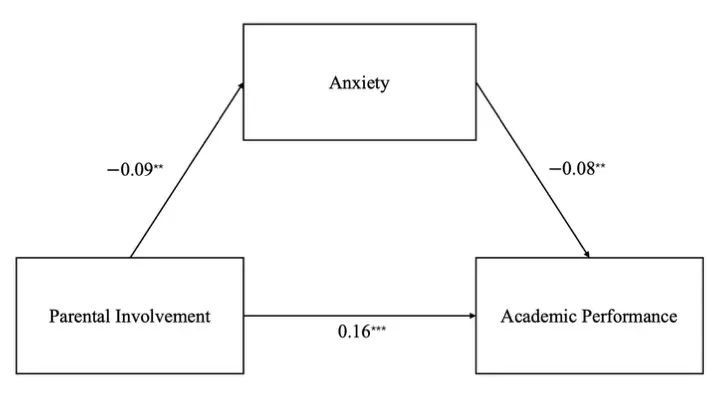
Figure 1. Tested mediating model. Shown is the mediating effect of anxiety on PI and academic performance, i.e., PI predicted academic performance mediated by anxiety. Note. ** p < 0.01, *** p < 0.001.
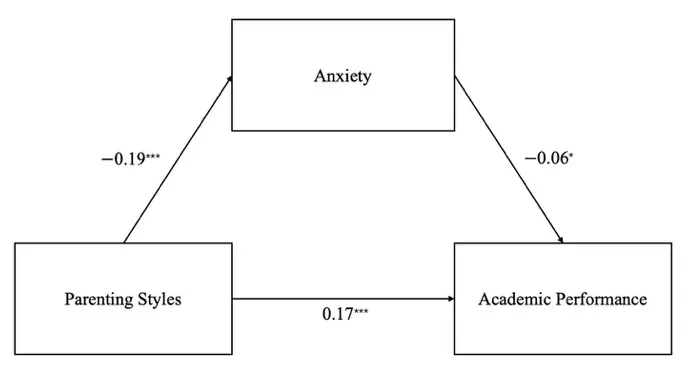
Figure 2. Tested mediating model. Shown is the mediating effect of anxiety on PS and academic performance, i.e., PS predicted academic performance mediated by anxiety. Note. * p < 0.05, *** p < 0.001.
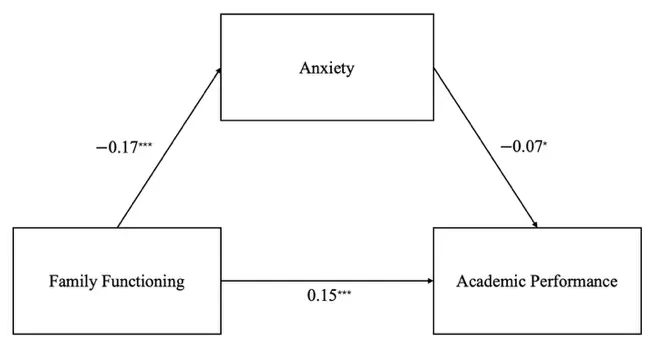
Figure 3. Tested mediating model. Shown is the mediating effect of anxiety on FF and academic performance, i.e., FF predicted academic performance mediated by anxiety. Note. * p < 0.05, *** p < 0.001.
Table 2. Decomposition of Total, Direct, and Indirect Effects.
|
Estimate |
Boot SE |
Boot LLCI |
Boot ULCI |
Relative Effect |
|
|---|---|---|---|---|---|
|
Total effect c |
0.17 |
0.02 |
0.009 |
0.02 |
|
|
Direct effect c’ |
0.16 |
0.002 |
0.008 |
0.02 |
95.7% |
|
Indirect effect ab |
0.007 |
0.000 |
0.000 |
0.001 |
4.3% |
|
Total effect c |
0.19 |
0.002 |
0.009 |
0.02 |
|
|
Direct effect c’ |
0.17 |
0.002 |
0.008 |
0.02 |
93.6% |
|
Indirect effect ab |
0.01 |
0.000 |
0.000 |
0.002 |
6.4% |
|
Total effect c |
0.17 |
0.002 |
0.01 |
0.02 |
|
|
Direct effect c’ |
0.15 |
0.002 |
0.008 |
0.02 |
92.8% |
|
Indirect effect ab |
0.01 |
0.000 |
0.000 |
0.002 |
7.2% |
Note. Boot SE = bootstrap standard error; Boot LLCI/Boot ULCI = lower/upper limits of the 95% bootstrap confidence interval based on 5000 resamples.
5.4. Moderation Analysis of Student Type
Multi-group analysis across student types (LP vs. TP) indicated that the effect of PI on anxiety was not significantly moderated by student type. The path from PI to anxiety was similar in TP (β = −0.08, SE = 0.04, p < 0.05) and LP (β = −0.19, SE = 0.06, p < 0.05) groups. The effect of PS on anxiety was also not significantly moderated by student type. The path from PS to anxiety was similar in TP (β = −0.19, SE = 0.04, p < 0.001) and LP (β = −0.20, SE = 0.04, p < 0.001) groups. Similarly, the effect of FF on anxiety was not significantly moderated by student type. The path from FF to anxiety was similar in TP (β = −0.17, SE = 0.04, p < 0.05) and LP (β = −0.16, SE = 0.04, p < 0.05) groups.
See Table 3 for the results of the moderated mediation analysis.
Table 3. Results of the Moderated Mediation Analysis of Student Type (N = 1083).
|
Path |
Student Type |
β |
SE |
95%CI |
|---|---|---|---|---|
|
Parental involvement→Anxiety |
TP |
−0.08 * |
0.04 |
−0.17, −0.03 |
|
LP |
−0.19 * |
0.06 |
−0.35, −0.15 |
|
|
Index of moderated mediation |
0.001 |
0.001 |
−0.001, 0.003 |
|
|
Parenting styles→Anxiety |
TP |
−0.19 *** |
0.04 |
−0.25, −0.11 |
|
LP |
−0.20 *** |
0.04 |
−0.25, −0.11 |
|
|
Index of moderated mediation |
0.02 |
0.05 |
−0.08, 0.11 |
|
|
Family functioning→Anxiety |
TP |
−0.17 * |
0.04 |
−0.28, −0.14 |
|
LP |
−0.16 * |
0.04 |
−0.28, −0.14 |
|
|
Index of moderated mediation |
−0.006 |
0.05 |
−0.1, 0.1 |
Note. SE = standard error. CI = confidence interval. The index of moderated mediation is not statistically significant. * p < 0.05, *** p < 0.001.
6. Discussion
The results of this study suggested that PI, PS, and FF were each positively associated with children’s academic performance. In addition, anxiety played a partial mediating role in the relationships between each of these three factors and Chinese primary children’s academic performance. However, the results did not support a moderating role of student type in the relationship between PI, PS, or FF and children’s anxiety. These findings highlighted the importance of different aspects of the family environment in relation to children’s academic achievement. Specifically, PI, PS, and FF each had not only a direct relationship with children’s academic performance, but also were indirectly associated with it through children’s anxiety.
6.1. Direct Effects of PI, PS, and FF on Children’s Academic Performance
This study found that PI, PS, and FF were related to children’s academic performance, which is consistent with our hypothesis. As the primary context for children’s daily life and learning, the family plays a crucial role in educational outcomes, with parenting behaviors serving as key factors in children’s academic development [63]. This finding aligns with previous research, indicating that higher PI, supportive and responsive PS, and well-functioning families collectively provide an environment that is associated with children’s cognitive development and academic success [4,14,23].
These findings provide empirical support for both the family investment model and the family process model. Specifically, the significant role of PI supports the family investment perspective, which emphasizes that parents’ behavioral investments, such as engaging in educational activities and providing learning-related support, facilitate children’s cognitive development and academic achievement [7]. At the same time, the associations of PS and FF with academic performance are consistent with the family process model, which highlights the importance of relational and emotional dynamics within the family, including parenting styles, communication patterns, and emotional support [11].
Taken together, these results suggest that children’s academic performance is predicted not only by the availability of parental investments but also by the quality of family interactions and emotional climate. This integrated perspective helps to explain how both behavioral and relational aspects of the family environment are jointly associated with children’s academic development.
6.2. Indirect Effects of Family Factors on Children’s Academic Performance via Anxiety
Previous studies have primarily focused on how family factors may influence children’s academic performance through the mediating effects of motivation and self-efficacy beliefs, with relatively little attention given to the role of children’s anxiety [64]. The results of the present study indicate that children’s anxiety can mediate the relationship between each of the three family factors and academic performance, which is consistent with our hypothesis.
Theoretically, individual development is a complex process in which behavioral, cognitive, and other factors result from the joint influence of internal mechanisms and external factors [65]. Previous research has shown that children’s emotions, such as anxiety, constitute an important component of internal factors, often serving as a mediator between external factors (e.g., parenting styles) and children’s achievement [66]. The results of the present study are consistent with this view, suggesting that external factors (including PI, PS, and FF) are associated with changes in children’s emotional states, which in turn are associated with their academic performance [67].
These findings are also consistent with some previous empirical research. For example, Albulescu et al. [13] found that primary school students’ test anxiety partially mediates the negative association between poor parental supervision and children’s academic performance. Similarly, evidence from research with Chinese adolescents indicates that higher parental authoritarianism is associated with greater academic burnout, and this relationship is significantly mediated by adolescents’ mental health symptoms, including anxiety and depression [68]. Together, these findings suggest that certain family environments are associated with children’s emotional distress, thereby indirectly undermining their academic functioning.
In addition, the results of the present study underscore the negative association between children’s anxiety and academic performance. This finding is consistent with previous research showing that children’s mental health symptoms are linked to poorer academic outcomes [69]. For example, anxious children are more likely to hesitate or avoid problem-solving and have difficulty maintaining attention, which further undermines their problem-solving abilities [70]. Anxious children also tend to have difficulty accepting the emotional states they are experiencing and often rely on inappropriate or ineffective emotion regulation strategies to cope with academic stress [68].
Our findings strongly support the idea that anxiety is an important indicator of children’s mental health and plays a significant role in the relationship between various family factors and children’s academic performance. This not only suggests that the quality of the family is related to the development of children’s mental health, but also further emphasizes the critical role of the family environment in children’s academic achievement.
6.3. Student Type Fail to Moderate the Relation Between Family Factors and Anxiety
The present study did not find that student type (LP vs. TP) moderates the association between family factors and children’s anxiety. That is, the negative association between positive family factors (e.g., PI, authoritative parenting, healthy family functioning) and child anxiety was similar in magnitude for both LP and TP students. This finding is partly consistent with previous studies reporting that family factors may exert a universal rather than conditional influence on children’s anxiety [52,53].
According to the family investment process and family process theory, in family life, parents actively participate in child development through various forms of investment and build a positive family climate, thereby ensuring children’s progress in physical, emotional, and academic domains [7,10]. Our research further emphasizes that such investment does not change as a function of children’s academic performance. That is, regardless of whether children’s current academic performance is high or low, the relationship between family factors and children’s anxiety remains stable. A positive family environment, characterized by warm and supportive parenting, reasonable expectations rather than excessive control, can provide children with a sense of psychological safety, which tends to co-occur with lower anxiety, and this protective effect is independent of children’s academic performance [71]. Regardless of whether children are high-achieving or academically struggling, emotional support and understanding from the family can effectively be associated with lower levels of anxiety. In other words, the foundational role of family in children’s emotional development is relatively independent and is not easily moderated by children’s achieved academic success. Previous studies also found that although families of children with LP may experience greater stress, factors such as PI and family climate remain largely unchanged [55,56].
Thus, the protective or risk patterns of family factors on anxiety may operate similarly for LP and TP students, without being amplified or attenuated by academic performance.
6.4. Limitations and Future Directions
Despite the contributions of the present study, several limitations should be acknowledged. First, this study employed a cross-sectional design, which limits the ability to draw causal inferences from the observed relationships. While mediation analyses can provide insights into potential mechanisms, they are better suited for longitudinal data that capture unfolding developmental processes over time [72]. Therefore, the mediating role of anxiety identified in this study should be interpreted with caution. Future research employing a longitudinal to examine causal relationships among family factors, anxiety, and academic performance. Second, children’s anxiety in the present study was reported by parents, which may differ from children’s self-reports or evaluations provided by other informants. Future research would benefit from incorporating multi-informant assessments, such as reports from teachers and children themselves, to provide a more comprehensive and accurate evaluation of children’s anxiety. Third, while previous research has primarily focused on test anxiety, the present study examined general anxiety as a mediator between family factors and academic performance. Although this broadens the current literature, the precise mechanisms through which general anxiety operates, and how it may differ from or interact with test anxiety, remain unexplored. Future research could compare general and test anxiety within the same design to better understand whether family factors influence academic outcomes through distinct anxiety pathways.
6.5. Implications
Our findings support the view that family factors are closely associated with primary school children’s academic performance in China. These results emphasize that children’s learning and development are shaped by multiple, interacting environmental contexts [11]. When parents demonstrate interest in their children’s education, provide encouragement, and offer stable support, they help establish a solid foundation for academic success. In addition, effective and open communication between families and schools may further promote children’s sense of responsibility and autonomy in the learning process.
Moreover, the study emphasizes the necessity of recognizing and addressing the anxiety of children. Overly stressful or high-pressure family situations can contribute to feelings of anxiety, which may hinder their academic performance and overall development. Children need to feel emotionally supported and understood by their parents, especially when facing challenges. This creates an environment where they can take risks, make mistakes, and grow without the fear of failure.
7. Conclusions
This study examined the associations among family factors, anxiety, and academic performance, as well as the moderating role of student type. The findings indicate that anxiety serves as a significant mediator in the relationship between family factors and children’s academic performance. Family factors were associated with academic performance both directly and indirectly through their association with children’s anxiety. In contrast, no evidence was found to support a moderating effect of student type on the relationship between family factors and anxiety.
Statement of the Use of Generative AI and AI-Assisted Technologies in the Writing Process
During the preparation of this manuscript, the authors used ChatGPT and Grammarly for language editing, grammatical refinement, and improvement of clarity. After using these tools, the authors reviewed and edited the content as needed and take full responsibility for the content of the published article.
Acknowledgements
We sincerely thank all the parents and students who participated in this study. We are also grateful to the principals and teachers at the participating schools for their invaluable support and assistance throughout the data collection process.
Author Contributions
Conceptualization and design: Z.Z., M.L. (Mengmeng Liu), W.Z., M.L. (Miao Li) and S.Z. Data Collection: Z.Z. and M.L. (Mengmeng Liu). Data Analysis: Z.Z., M.L. (Miao Li) and W.Z. Initial draft preparation: Z.Z. and M.L. (Mengmeng Liu). Editing and review: W.Z., M.L. (Miao Li) and S.Z. All authors read and approved the final manuscript.
Ethics Statement
All procedures in studies involving human subjects were conducted in accordance with the ethical standards of the institutional and/or national research committee and with the Helsinki Declaration of 1964 and its subsequent amendments or comparable ethical standards. The Research Ethics Committee of Beijing Normal University approved the research presented in this article (protocol codes: BNU202203100018; date of approval: [04/02/2022]).
Informed Consent Statement
As all students were under the age of 16, participation in the study was permitted only after informed consent had been obtained from their parents or legal guardians. The parents or legal guardians also provided their own informed consent to participate. Students provided assent when appropriate.
Data Availability Statement
The datasets generated and/or analyzed during the current study are not publicly available due to concerns regarding participant privacy, but are available from the corresponding author on reasonable request.
Funding
This research was funded by the Beijing Education and Science Project, grant number CEAA23042.
Declaration of Competing Interest
The authors declare that they have no known competing financial interests or personal relationships that could have appeared to influence the work reported in this paper.
References
-
Deng Y, Cherian J, Khan NUN, Kumari K, Sial MS, Comite U, et al. Family and academic stress and their impact on students’ depression level and academic performance. Front. Psychiatry 2022, 13, 869337. DOI:10.3389/fpsyt.2022.869337 [Google Scholar]
-
Green CL, Walker JMT, Hoover-Dempsey KV, Sandler HM. Parents’ motivations for involvement in children’s education: An empirical test of a theoretical model of parental involvement. J. Educ. Psychol. 2007, 99, 532–544. DOI:10.1037/0022-0663.99.3.532 [Google Scholar]
-
Wentzel KR. Family functioning and academic achievement in middle school: A social-emotional perspective. J. Early Adolesc. 1994, 14, 268–291. DOI:10.1177/027243169401400209 [Google Scholar]
-
Mandara J. The impact of family functioning on African American males’ academic achievement: A review and clarification of the empirical literature. Teach. Coll. Rec. 2006, 108, 206–223. DOI:10.1111/j.1467-9620.2006.00648.x [Google Scholar]
-
Pinquart M. Associations of parenting styles and dimensions with academic achievement in children and adolescents: A meta-analysis. Educ. Psychol. Rev. 2016, 28, 475–493. DOI:10.1007/s10648-015-9338-y [Google Scholar]
-
Carpenter AL, Puliafico AC, Kurtz SM, Pincus DB, Comer JS. Extending parent-child interaction therapy for early childhood internalizing problems: New advances for an overlooked population. Clin. Child Fam. Psychol. Rev. 2014, 17, 340–356. DOI:10.1007/s10567-014-0172-4 [Google Scholar]
-
Conger RD, Donnellan MB. An interactionist perspective on the socioeconomic context of human development. Annu. Rev. Psychol. 2007, 58, 175–199. DOI:10.1146/annurev.psych.58.110405.085551 [Google Scholar]
-
Fan X, Chen M. Parental involvement and students’ academic achievement: A meta-analysis. Educ. Psychol. Rev. 2001, 13, 1–22. DOI:10.1023/A:1009048817385 [Google Scholar]
-
Niehues W, Kisbu-Sakarya Y, Selcuk B. Family cohesion facilitates learning-related behaviors and math competency at the transition to elementary school. Early Educ. Dev. 2021, 32, 134–147. DOI:10.1080/10409289.2020.1739418 [Google Scholar]
-
Pomerantz EM, Moorman EA, Litwack SD. The how, whom, and why of parents’ involvement in children’s academic lives: More is not always better. Rev. Educ. Res. 2007, 77, 373–410. DOI:10.3102/003465430305567 [Google Scholar]
-
Yu L, Huang J, Liu PD, Yeung SS, Lin D, Cheung H, et al. How parenting styles affect the development of language skills and reading comprehension in primary school students. Br. J. Educ. Psychol. 2024, 94, 1245–1270. DOI:10.1111/bjep.12718 [Google Scholar]
-
Smith LB, Thelen E. Development as a dynamic system. Trends Cogn. Sci. 2003, 7, 343–348. DOI:10.1016/S1364-6613(03)00156-6 [Google Scholar]
-
Albulescu I, Labar A-V, Manea AD, Stan C. The mediating role of anxiety between parenting styles and academic performance among primary school students in the context of sustainable education. Sustainability 2023, 15, 1539. DOI:10.3390/su15021539 [Google Scholar]
-
Castro M, Expósito-Casas E, López-Martín E, Lizasoain L, Navarro-Asencio E, Gaviria JL. Parental involvement on student academic achievement: A meta-analysis. Educ. Res. Rev. 2015, 14, 33–46. DOI:10.1016/j.edurev.2015.01.002 [Google Scholar]
-
Buerkle K, Whitehouse EM, Christenson SL. Partnering with families for educational success. In Handbook of School Psychology, 4th ed.; Reynolds CR, Gutkin TB, Eds.; Wiley & Sons: Hoboken, NJ, USA, 2009; pp. 655–680. [Google Scholar]
-
Seginer R. Parents’ educational involvement: A developmental ecology perspective. Parenting 2006, 6, 1–48. DOI:10.1207/s15327922par0601_1 [Google Scholar]
-
Hill NE, Tyson DF. Parental involvement in middle school: A meta-analytic assessment of the strategies that promote achievement. Dev. Psychol. 2009, 45, 740–763. DOI:10.1037/a0015362 [Google Scholar]
-
Boonk L, Gijselaers HJM, Ritzen H, Brand Gruwel S. A review of the relationship between parental involvement indicators and academic achievement. Educ. Res. Rev. 2018, 24, 10–30. DOI:10.1016/j.edurev.2018.02.001 [Google Scholar]
-
Xing T. The influence of parental participation on the academic achievement of primary and middle school students: A meta-analysis based on 29 quantitative studies in China. J. Sch. Stud. 2022, 19, 76–83. DOI:10.3969/j.issn.1005-2232.2022.04.005 [Google Scholar]
-
Zheng W, Liu G. Maternal involvement and primary school students’ academic achievement: The moderating effect of maternal parenting styles. Psychol. Res. 2021, 14, 375–384. DOI:10.3969/j.issn.2095-1159.2021.04.012 [Google Scholar]
-
Liu G, Pan H, Cui X. On the relationship between parental involvement and migrant children’s academic achievement: The mediating role of the importance of intrinsic life goals. J. Qilu Norm. Univ. 2022, 37, 85–91. DOI:10.3969/j.issn.1008-2816.2022.01.013 [Google Scholar]
-
Baumrind D. Effects of authoritative parental control on child behavior. Child. Dev. 1966, 37, 887–907. DOI:10.2307/1126611 [Google Scholar]
-
Carreteiro RM, Justo JM, Figueira AP. Reading Processes and Parenting Styles. J. Psycholinguist. Res. 2016, 45, 901–914. DOI:10.1007/s10936-015-9381-3 [Google Scholar]
-
Masud H, Thurasamy R, Ahmad MS. Parenting styles and academic achievement of young adolescents: A systematic literature review. Qual. Quant. 2015, 49, 2411–2433. DOI:10.1007/s11135-014-0120-x [Google Scholar]
-
Baumrind D. Current patterns of parental authority. Dev. Psychol. 1971, 4, 1–103. DOI:10.1037/h0030372 [Google Scholar]
-
Aram D. Sensitivity and consistency of maternal writing mediation to twin kindergartners. Early Educ. Dev. 2007, 18, 71–92. DOI:10.1080/10409280701274733 [Google Scholar]
-
Bingham GE, Jeon HJ, Kwon KA, Lim C. Parenting styles and home literacy opportunities: Associations with children’s oral language skills. Infant Child Dev. 2017, 26, e2020. DOI:10.1002/icd.2020 [Google Scholar]
-
Mantzicopoulos PY. The Relationship of Family Variables to Head Start Children’s Preacademic Competence. Early Educ. Dev. 1997, 8, 357–375. DOI:10.1207/s15566935eed0804_1 [Google Scholar]
-
Hindman AH, Morrison FJ. Differential contributions of three parenting dimensions to preschool literacy and social skills in a middle-income sample. Merrill-Palmer Q. 2012, 58, 191–223. DOI:10.1353/mpq.2012.0012 [Google Scholar]
-
Fang P, Xiong D, Guo C. The effect of parenting styles on children’s academic achievement. J. Psychol. Sci. 2003, 26, 78–81. DOI:10.3969/j.issn.1671-6981.2003.01.021 [Google Scholar]
-
Guo M, Wu Q. Parenting styles and academic achievement: The mediating role of conscientiousness and motivation. Psychol. Res. 2011, 4, 74–77. Available online: https://jps.ecnu.edu.cn/CN/Y2011/V34/I2/376 (accessed on 16 April 2026).
-
Peng F. The relationship between parenting style and children’s academic performance. China J. Health Psychol. 2015, 23, 945–947. DOI:10.13342/j.cnki.cjhp.2015.06.039 [Google Scholar]
-
Xie Y, Shi Z, Yin L, Lan L. A meta-analysis of the relationship between Chinese parenting styles and children’s academic performance. Psychol. Dev. Educ. 2022, 38, 366–379. DOI:10.16187/j.cnki.issn1001-4918.2022.03.08 [Google Scholar]
-
Shek DTL. Family functioning and psychological well-being, school adjustment, and problem behavior in Chinese adolescents with and without economic disadvantage. J. Genet. Psychol. Res. Theory Hum. Dev. 2002, 163, 497–502. DOI:10.1080/00221320209598698 [Google Scholar]
-
Epstein NB, Baldwin LM, Bishop DS. The McMaster family assessment device. J. Marital. Fam. Ther. 1983, 9, 171–180. DOI:10.1111/j.1752-0606.1983.tb01497.x [Google Scholar]
-
Scott S. The effects of parental dysfunction on children. Child Adolesc. Ment. Health 2004, 9, 198. DOI:10.1111/j.1475-3588.2004.106_9.x [Google Scholar]
-
Duchesne S, Larose S. Adolescent parental attachment and academic motivation and performance in early adolescence. J. Appl. Soc. Psychol. 2007, 37, 1501–1521. DOI:10.1111/j.1559-1816.2007.00224.x [Google Scholar]
-
Walker KL, Satterwhite T. Academic performance among African American and Caucasian college students: Is the family still important? Coll. Stud. J. 2002, 36, 113–129. Available online: https://go.gale.com/ps/i.do?id=GALE%7CA85007775&sid=googleScholar&v=2.1&it=r&linkaccess=abs&issn=01463934&p=AONE&sw=w (accessed on 16 April 2026).
-
Lei L, Wang Z, Liu H, Zhang L. Parent-child communication as the moderate variable between family system and social adaptation of middle school students. Chin. J. Appl. Psychol. 2002, 8, 14–20. DOI:10.3969/j.issn.1006-6020.2002.01.003 [Google Scholar]
-
Huang S, Chen Q, Jia Y, Zeng L. Effects of parenting styles on academic engagement of junior high school students: The mediating role of family function. J. Anshun Univ. 2021, 23, 82–86. DOI:10.3969/j.issn.1673-9507.2021.05.017 [Google Scholar]
-
Veas A, Castejon J-L, Minano P, Gilar-Corb R. Relationship between parent involvement and academic achievement through metacognitive strategies: A multiple multilevel mediation analysis. Br. J. Educ. Psychol. 2019, 89, 393–411. DOI:10.1111/bjep.122452 [Google Scholar]
-
McNeal R. Parent involvement, academic achievement and the role of student attitudes and behaviors as mediators. Univers. J. Educ. Res. 2014, 2, 564–576. DOI:10.13189/ujer.2014.020805 [Google Scholar]
-
Haghshenas R, Fereidooni-Moghadam M, Ghazavi Z. The relationship between perceived parenting styles and anxiety in adolescents. Sci. Rep. 2024, 14, 25623. DOI:10.1038/s41598-024-77268-y [Google Scholar]
-
Li M, Zhao W, Liu M, Zhang L, Li G. Mental health among children with and without reading difficulties. Ann. Dyslexia 2024, 74, 27–46. DOI:10.1007/s11881-023-00296-2 [Google Scholar]
-
Vukovic RK, Roberts SO, Green Wright L. From parental involvement to children’s mathematical performance: The role of mathematics anxiety. Early Educ. Dev. 2013, 24, 446–467. DOI:10.1080/10409289.2012.693430 [Google Scholar]
-
Hughes AA, Hedtke KA, Kendall PC. Family functioning in families of children with anxiety disorders. J. Fam. Psychol. 2008, 22, 325–328. DOI:10.1037/0893-3200.22.2.325 [Google Scholar]
-
Zhang S, Liu J, Duan X, Liu D, Feng D, Gao X, et al. Are parenting style and loneliness associated with depression in children with or without developmental dyslexia? J. Child. Fam. Stud. 2023, 33, 1671–1681. DOI:10.1007/s10826-023-02693-y [Google Scholar]
-
Guo L, Tian L, Scott Huebner E. Family dysfunction and anxiety in adolescents: A moderated mediation model of self-esteem and perceived school stress. J. Sch. Psychol. 2018, 69, 16–27. DOI:10.1016/j.jsp.2018.04.002 [Google Scholar]
-
Klassen RM. Confidence to manage learning: The self-efficacy for self-regulated learning of early adolescents with learning disabilities. Learn. Disabil. Q. 2010, 33, 19–30. DOI:10.1177/073194871003300102 [Google Scholar]
-
Casanova PF, García‐Linares MC, de la Torre MJ, Carpio MDLV. Influence of family and socio-demographic variables on students with low academic achievement. Educ. Psychol. 2005, 25, 423–435. DOI:10.1080/01443410500041888 [Google Scholar]
-
Yazicioğlu T, Sardohan Yildirim AE, Altindağ Kumaş Ö. Family stress and self-efficacy in parents of children with special needs: The regulatory role of perceived social support. Child. Youth Serv. Rev. 2024, 163, 107804. DOI:10.1016/j.childyouth.2024.107804 [Google Scholar]
-
Azman Ö, Mauz E, Reitzle M, Geene R, Hölling H, Rattay P. Associations between Parenting Style and Mental Health in Children and Adolescents Aged 11–17 Years: Results of the KiGGS Cohort Study (Second Follow-Up). Children 2021, 8, 672. DOI:10.3390/children8080672 [Google Scholar]
-
Pribesh SL, Carson JS, Dufur MJ, Yue Y, Morgan K. Family structure stability and transitions, parental involvement, and educational outcomes. Soc. Sci. 2020, 9, 229. DOI:10.3390/socsci9120229 [Google Scholar]
-
Dyson LL. Fathers and mothers of school-age children with developmental disabilities: Parental stress, family functioning, and social support. Am. J. Ment. Retard. 1997, 102, 267–279. Available online: https://www.tandfonline.com/doi/abs/10.1352/0895-8017%281997%29102%3C0267%3AFAMOSC%3E2.0.CO%3B2 (accessed on 16 April 2026)
-
Heiman T, Berger O. Parents of children with Asperger syndrome or with learning disabilities: Family environment and social support. Res. Dev. Disabil. 2008, 29, 289–300. DOI:10.1016/j.ridd.2007.05.005 [Google Scholar]
-
Grüter S, Lütje-Klose B, Wild E, Fritzler NJ. Empowering parents of students with and without learning difficulties to collaborate with schools: How are family–school partnerships related to parents’ motivational beliefs? Eur. J. Spec. Needs Educ. 2025, 40, 605–621. DOI:10.1080/08856257.2024.2402168 [Google Scholar]
-
Kohl GO, Lengua LJ, McMahon RJ. Parent involvement in school conceptualizing multiple dimensions and their relations with family and demographic risk factors. J. Sch. Psychol. 2000, 38, 501–523. DOI:10.1016/S0022-4405(00)00050-9 [Google Scholar]
-
Frick PJ, Christian RC, Wootton JM. Age trends in the association between parenting practices and conduct problems. Behav. Modif. 1999, 23, 106–128. DOI:10.1177/0145445599231005 [Google Scholar]
-
March J. Multidimensional Anxiety Scale for Children, 2nd ed.; Multi-Health Systems (MHS): Toronto, ON, Canada, 2002 [Google Scholar]
-
Dong Q, Lin C. Standardized Instruments for the Psychological Development of Chinese Children and Adolescents; Science Press: Beijing, China, 2011. [Google Scholar]
-
Wu H, Li L. Development of Chinese rating scale of pupil’s mathematic abilities and study on its reliability and validity. Chin. J. Public. Health 2005, 21, 473–475. DOI:10.3321/j.issn:1001-0580.2005.04.045 [Google Scholar]
-
Podsakoff PM, MacKenzie SB, Lee J-Y, Podsakoff NP. Common method biases in behavioral research: A critical review of the literature and recommended remedies. J. Appl. Psychol. 2003, 88, 879–903. DOI:10.1037/0021-9010.88.5.879 [Google Scholar]
-
Yu W, Yao W, Chen M, Zhu H, Yan J. School climate and academic burnout in medical students: A moderated mediation model of collective self-esteem and psychological capital. BMC Psychol. 2023, 11, 77. DOI:10.1186/s40359-023-01121-6 [Google Scholar]
-
Turner EA, Chandler M, Heffer RW. The influence of parenting styles, achievement motivation, and self-efficacy on academic performance of college students. J. Coll. Stud. Dev. 2009, 50, 337–346. DOI:10.1353/csd.0.0073 [Google Scholar]
-
Fogel A, Thelen E. Development of early expressive and communicative action: Reinterpreting the evidence from a dynamic systems perspective. Dev. Psychol. 1987, 23, 747–761. DOI:10.1037/0012-1649.23.6.747 [Google Scholar]
-
Luo W, Ng PT, Lee K, Aye KM. Self-efficacy, value, and achievement emotions as mediators between parenting practice and homework behavior: A control-value theory perspective. Learn. Individ. Differ. 2016, 50, 275–282. DOI:10.1016/j.lindif.2016.07.017 [Google Scholar]
-
Zhang T, Shao W, Zhang J, Zhang Q, Tao Y, Yu X. The longitudinal relationship between family socioeconomic status and students’ academic achievement: The mediating roles of learning anxiety-learning engagement profiles and the moderating role of negative parenting styles. Br. J. Psychol. 2026, 117, 217–239. DOI:10.1111/bjop.70020 [Google Scholar]
-
Liu C, She X, Lan L, Wang H, Wang M, Abbey C, et al. Parenting stress and adolescent academic burnout: The chain mediating role of mental health symptoms and positive psychological traits. Curr. Psychol. 2023, 43, 7643–7654. DOI:10.1007/s12144-023-04961-y [Google Scholar]
-
Lotz C, Sparfeldt JR. Does test anxiety increase as the exam draws near?—Students’ state test anxiety recorded over the course of one semester. Personal. Individ. Differ. 2017, 104, 397–400. DOI:10.1016/j.paid.2016.08.032 [Google Scholar]
-
Romano L, Consiglio P, Angelini G, Fiorilli C. Between academic resilience and burnout: The moderating role of satisfaction on school context relationships. Eur. J. Investig. Health Psychol. Educ. 2021, 11, 770–780. DOI:10.3390/ejihpe11030055 [Google Scholar]
-
Rupesh E, Singh S, Subramanyam AA, Kamath RM. Study of parenting styles, family functioning and its relation to coping strategies in children of specific learning disorder. Int. J. Contemp. Pediatr. 2020, 7, 230. DOI:10.18203/2349-3291.ijcp20200096 [Google Scholar]
-
Li Y, Yoshida K, Kaufman JS, Mathur MB. A brief primer on conducting regression-based causal mediation analysis. Psychol. Trauma Theory Res. Pract. Policy 2023, 15, 930–938. DOI:10.1037/tra0001421 [Google Scholar]