
Optical Fiber Sensing Materials from a Green Chemistry Perspective: Principles, Applications, and a Sustainable Prospectus

Optical Fiber Sensing Materials from a Green Chemistry Perspective: Principles, Applications, and a Sustainable Prospectus
Received: 30 December 2025 Revised: 10 March 2026 Accepted: 24 March 2026 Published: 17 April 2026

© 2026 The authors. This is an open access article under the Creative Commons Attribution 4.0 International License (https://creativecommons.org/licenses/by/4.0/).
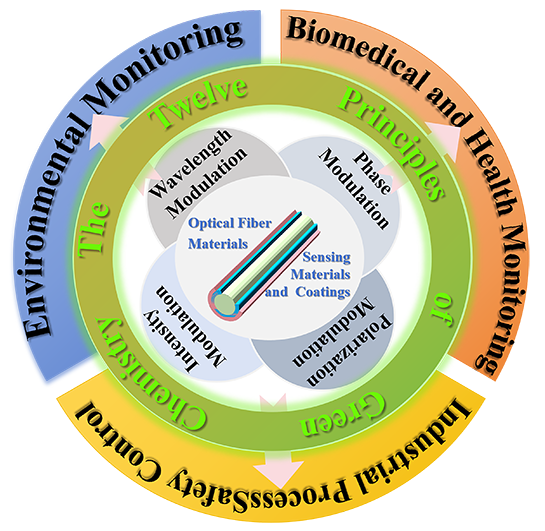
Graphical Abstract
1. Introduction
Optical fiber sensing technology is an interdisciplinary field integrating optics, materials science, electronics, and information processing. Its fundamental principle involves modulating a light wave’s physical parameters, such as intensity, phase, wavelength, polarization state, or transmission modes, as it propagates through an optical fiber waveguide. This modulation is induced by external measurands, which can be physical quantities (e.g., temperature, pressure, strain, vibration) or chemical quantities (e.g., gas concentration, specific biomolecules, pH levels) [1]. Employing high-precision optical detection and advanced signal processing techniques to demodulate these modulated optical signals enables high-resolution, high-accuracy measurements of diverse environmental parameters [2].
Optical fiber sensing technologies are primarily categorized into four types based on the sensing principle, specifically, how external measurands modulate the light wave’s characteristic parameters: intensity modulation, wavelength modulation, phase modulation, and polarization modulation [3]. Intensity-Modulated Sensing represents the most fundamental approach. This method operates by altering the transmitted optical power within the fiber through mechanisms such as microbending, absorption, or reflectance, induced by changes in a physical measurand such as displacement or pressure. While offering advantages of simple structure and low cost, its measurement accuracy and stability are often limited by susceptibility to source fluctuations and connector losses. Consequently, it is predominantly employed in less demanding applications where high precision is non-critical, such as simple switching or displacement detection [4]. Wavelength-Modulated and Phase-Modulated technologies were developed to achieve superior accuracy and stability. A canonical example of wavelength modulation is the Fiber Bragg Grating (FBG). This technology exhibits strong interference resistance and supports the serial connection of multiple gratings at different wavelengths along a single fiber, facilitating quasi-distributed sensing networks widely deployed for structural health monitoring of large-scale infrastructures [5]. Phase-Modulated Sensing offers exceptionally high sensitivity, typically utilizing interferometer configurations such as Michelson or Mach-Zehnder, where a physical measurand, like an acoustic wave or vibration, is converted into a change in interferometric light intensity [6]. Although these systems are complex and present significant signal demodulation challenges, their remarkable sensitivity makes them indispensable for high-performance applications, including hydrophones and fiber-optic gyroscopes. Polarization-Modulated Sensing is primarily utilized for measuring electromagnetic parameters. It exploits effects such as the Faraday or Kerr effect, in which an external magnetic or electric field alters the polarization state of a propagating light wave [7]. By detecting the rotation angle of the polarization plane or the change in polarization state, this technique enables precise measurement of electrical current or voltage. It possesses excellent immunity to electromagnetic interference, making it particularly suitable for harsh electromagnetic environments, such as high-voltage current monitoring in smart grids, where it serves as a critical link bridging optical sensing with power systems [8].
Based on spatial sensing capability, optical fiber sensors are categorized into three primary types: point, quasi-distributed, and distributed sensors. Point sensors, exemplified by a single FBG or a Fabry-Perot interferometer, function as discrete sensing units capable of delivering highly accurate local measurements [9]. However, monitoring large areas requires deploying many of these sensors, leading to high system costs and complex cabling. Quasi-distributed sensors represent a significant evolution, involving serially connecting multiple point sensors (e.g., an FBG array with distinct characteristic wavelengths) along a single optical fiber, enabling simultaneous measurement at multiple discrete points [10].
Distributed sensors utilize the entire optical fiber as a continuous sensing medium, which is operated by analyzing backscattered light generated by a laser pulse within the fiber. Different scattering mechanisms are exploited for different measurands: Raman scattering primarily for temperature measurement, Brillouin scattering for simultaneous temperature and strain measurement, and Rayleigh scattering for vibration monitoring [11]. Analyzing this backscattered light enables the continuous retrieval of physical parameter information along the entire fiber length, effectively creating a “single-line, multi-purpose” sensing system. This technology provides continuous, long-range monitoring capabilities over distances up to hundreds of kilometers with high spatial resolution. Often hailed as an ideal “nervous sensory system”, it finds widespread application in monitoring oil and gas pipelines, temperature monitoring of power cables, perimeter security, structural health monitoring, and early warning systems for geological hazards [12].
The development of optical fiber sensing technology is a process of continuous evolution of the optical fiber from a generic transmission medium into a specialized sensing element. Early research primarily utilized standard telecommunication fibers as both the light transmission path and the basic sensing unit, leading to the development of intensity-modulated and interferometric sensors, which validated the technical feasibility [13]. However, the sensing performance of telecommunication fibers is inherently limited, making it difficult for their sensitivity and stability to meet the more demanding requirements of many applications [14]. This limitation propelled the technology into a phase of specialized design of specialty optical fibers, marking a qualitative leap forward. The FBG constructs a precise, wavelength-encoded refractive index microstructure directly within the fiber core, elevating the optical fiber from a mere light-guiding medium to a precise point sensor and laying the foundation for quasi-distributed sensing networks [10]. Photonic Crystal Fiber (PCF) offers a greater degree of freedom in structural design. Its microstructured air-hole cladding enables unique waveguiding properties such as endless single-mode propagation, high nonlinearity, and controllable dispersion, and has opened new pathways for highly sensitive microfluidic sensing by allowing analytes such as gases or liquids to be introduced directly into the light-guiding region [15]. Polymer Optical Fiber (POF) has established its niche based on advantages including large core diameter, high flexibility, and low cost, making it particularly suitable for short-range, high-intensity sensing applications in industrial and consumer electronics [16].
Optical fiber sensing technology offers significant advantages in modern measurement science. Firstly, regarding performance, it combines high sensitivity with high precision. Interferometric sensors can detect nanoscale displacements or temperature variations on the order of millikelvins, while wavelength-encoded techniques, such as FBGs, support absolute measurement, effectively suppressing signal drift [17]. Secondly, the fundamental composition of optical fibers made from dielectric materials, such as silica glass, confers inherent immunity to electromagnetic interference. This property makes the technology exceptionally suitable for complex electromagnetic environments, including high-voltage substations and areas with strong radiation. Furthermore, the sensing probe itself requires no electrical power at the remote location, ensuring intrinsic safety, critical for applications in flammable and explosive atmospheres found in the petroleum, chemical, and mining industries. Additionally, the high corrosion resistance and chemical stability of silica ensure long-term reliability even in harsh operating conditions [18]. Thirdly, optical fibers are characterized by their miniaturized form factor, lightweight nature, and high flexibility. With a typical diameter of merely 125 μm, they can be embedded within composite materials or woven into smart textiles, enabling seamless integration for in-situ and long-term structural health monitoring. Finally, at the system level, optical fiber sensing is inherently compatible with established optical fiber communication technologies, facilitating large-scale network deployment and remote monitoring [19]. Its distributed sensing capability is particularly powerful. By analyzing backscattered light (Rayleigh, Brillouin, or Raman scattering), these systems enable continuous profiling of parameters such as temperature, strain, and vibration over the entire fiber length, with spatial resolution ranging from meters to millimeters, providing an unprecedented technological solution for comprehensive integrity monitoring of extremely large-scale infrastructure [20].
Current frontier research focuses on the deep integration of functionalized sensing materials, aiming to push sensing boundaries beyond the inherent limits of pure silica. Coating the fiber surface with piezoelectric polymers, water-sensitive layers, fluorescent substances, or integrating two-dimensional materials as graphene constructs, “intelligent” sensing interfaces characterized by high selectivity and superior sensitivity. This strategic direction is propelling the evolution of optical fiber sensing from single-parameter physical monitoring towards versatile and intelligent perceptual systems [21]. Despite significant advancements, a thorough examination of optical fiber sensing technology from a full lifecycle perspective reveals considerable environmental sustainability challenges. Consequently, promoting “green” optical fiber sensing has become essential for the field to address global environmental pressures and advance towards a sustainable future.
Conventional optical fiber materials carry non-negligible environmental costs throughout their lifecycle. Widely used optical fibers and functional materials impose a persistent burden on the ecosystem. These impacts span upstream raw material extraction, midstream high-energy-consumption manufacturing, and downstream end-of-life disposal [22,23,24]. Meanwhile, increasingly stringent international environmental regulations and heightened public sustainability awareness have jointly emerged as powerful external drivers. In this context, systematically integrating green chemistry principles into the optical fiber sensing technology framework constitutes not merely a necessary measure to address regulatory and market pressures but a significant opportunity to lead the next generation of technological innovation [25]. Through such a green transformation, optical fiber sensing technology can maintain its performance advantages while enhancing its environmental compatibility, positioning it for a central role within the future green economy and harmonizing economic and environmental benefits [26]. This represents a strategic imperative for ensuring long-term sustainable development, catalyzing disruptive innovation, unlocking new application domains, and ultimately achieving symbiotic coexistence between technological progress and the natural environment [27].
This review aims to address a critical gap in current optical fiber sensing research, while existing literature predominantly focuses on performance optimization, a systematic assessment of its environmental sustainability from a full life-cycle perspective is notably lacking [28]. This article establishes a systematic assessment framework grounded in the Twelve Principles of Green Chemistry, serving as both its theoretical foundation and design guide [29]. The objective is not only to critically identify the environmental impacts of existing optical fiber sensing materials during resource extraction, manufacturing, and end-of-life disposal but also to guide future innovation of environmentally friendly materials, steering the field towards a strategic transition to sustainable development [30]. While several excellent reviews have surveyed the landscape of optical fiber sensors or catalogued specific environmentally benign materials, a critical gap persists: the absence of a systematic, principle-driven framework that holistically evaluates and guides the sustainable design of all constituent materials across the entire sensor lifecycle. These principles are systematically mapped onto the distinct lifecycle stages—from raw material extraction and synthesis to application and end-of-life—of core sensing components, including fiber matrices (silica, soft glass, polymer), functional coatings, and nanomaterials. This work moves beyond a simple cataloging of “green” alternatives. Instead, it provides a structured methodology for identifying environmental hotspots, navigating performance–sustainability trade-offs, and charting a strategic roadmap for the field’s transition toward a genuinely circular and sustainable future.
This article systematically maps the Twelve Principles of Green Chemistry onto the lifecycle of optical fiber sensing materials to establish a greening framework. It then analyzes sustainable pathways for both matrix and functional materials, supported by practical case studies. A comprehensive sustainability assessment framework is further constructed, addressing performance, environmental, economic, and social dimensions, leading to proposed future development strategies. This review is intended as a comprehensive reference for academic researchers, industrial R&D professionals, and relevant policy makers, fostering collaborative efforts to advance optical fiber sensing technology toward more intelligent, efficient, and environmentally benign development, thereby harmonizing technological advancement with ecological responsibility.
2. Green Chemistry Principles: A Framework for Assessing Optical Fiber Sensing Materials
2.1. A Brief Overview of the Twelve Principles of Green Chemistry
Green Chemistry, formally introduced by Paul Anastas and John Warner in 1998, provides a fundamental theoretical foundation for sustainable chemistry. Its primary objective is not end-of-pipe pollution remediation but the systematic prevention of pollution at the design stage of chemical products and processes [31]. This philosophy is operationalized through twelve interconnected principles establishing a comprehensive design paradigm [32,33,34,35].
At the foundational conceptual level, Green Chemistry emphasizes controlling environmental impacts at their source, specifically: (1) the Prevention principle, (2) the Atom Economy principle, (3) the Less Hazardous Chemical Syntheses principle, (4) the Designing Safer Chemicals principle, (5) the Safer Solvents and Auxiliaries principle. At the process optimization level, related principles strive to enhance synthesis and manufacturing sustainability: (6) the Design for Energy Efficiency principle, (7) the Use of Renewable Feedstocks principle, (8) the Reduce Derivatives principle, (9) the Catalysis principle, (10) the Real-time Analysis for Pollution Prevention principle. At the lifecycle management level, (11) the Design for Degradation principle, (12) the Inherently Safer Chemistry for Accident Prevention principle. Collectively, these twelve principles constitute a systematic guiding framework that provides the theoretical foundation for developing environmentally benign chemical products and processes, thereby steering the evolution of various material systems, including optical fiber sensing materials, toward sustainable development [36].
2.2. Mapping the Principles to the Lifecycle of Optical Fiber Sensing Materials
To translate Green Chemistry philosophy into an actionable pathway, its twelve principles must be systematically mapped onto the entire life cycle of optical fiber sensing materials. This process establishes a comprehensive assessment framework spanning from initial design to final disposal, providing clear environmental performance criteria and sustainable design guidelines for material R&D [37]. However, it is important to recognize that the application of these twelve principles is not uniform; rather, their relevance and priority shift across the lifecycle of an optical fiber sensor. At the foundational design stage, principles focused on source reduction and inherent hazard elimination—specifically, Prevention (Principle 1), Designing Safer Chemicals (Principle 4), and the Use of Renewable Feedstocks (Principle 7)—carry the greatest significance. A design that fundamentally avoids toxic elements or relies on sustainable resources can preemptively address environmental issues that downstream, end-of-pipe treatments cannot resolve. During the manufacturing phase, principles governing process optimization—such as Atom Economy (Principle 2), Safer Solvents (Principle 5), and Energy Efficiency (Principle 6)—take precedence in minimizing the operational footprint. Finally, at the end-of-life stage, Design for Degradation (Principle 11) becomes critical for single-use, bio-integrated sensors, whereas for durable goods, the Prevention principle (Principle 1) re-emerges, necessitating designs that facilitate material recovery and recycling. This life-cycle-dependent framework thus provides a more nuanced and actionable guide for researchers and engineers aiming to develop sustainable sensing technologies.
2.2.1. Raw Material Acquisition and Selection Stage
At the life cycle’s starting point, the principles of Designing Safer Chemicals and Use of Renewable Feedstocks provide core guidance. The selection of fiber matrix or functional materials must undergo source-level screening and assessment [38]. For instance, the resource scarcity of rare-earth elements (e.g., erbium, ytterbium) is used as dopants in silica fibers, and the potential toxicity of components such as tellurium and arsenic in mid-infrared chalcogenide fibers should be critically analyzed. The greening strategy involves substituting these with more abundant and less toxic elements, such as exploring bismuth-doped fibers as alternatives to rare-earth doped ones [39].
In polymer optical fiber systems, the Use of Renewable Feedstocks principle encourages the adoption of bio-based polymers, such as Poly D,L-Lactic Acid (PDLLA), to replace traditional petroleum-based polymethyl methacrylate (PMMA) [40]. Similarly, when developing functional coatings such as Metal-Organic Frameworks (MOFs) or Covalent Organic Frameworks (COFs), building blocks derived from sustainable resources should be prioritized [41,42].
2.2.2. Synthesis and Manufacturing Stage
This stage represents a critical phase for resource consumption and pollutant generation, during which multiple Green Chemistry principles are applied. Prevention serves as the fundamental objective, requiring integrated strategies [43]. Atom Economy requires the evaluation of synthesis pathway atomic utilization efficiency. For instance, when employing the sol-gel method to prepare nano-sensitive materials, reaction routes that generate harmless by-products, such as alcohols or water, should be prioritized [44]. The Safer Solvents and Auxiliaries principal advocates replacing traditional volatile organic solvents (e.g., DMF, toluene) with alternatives such as water, supercritical CO2, or low-toxicity ionic liquids. Design for Energy Efficiency directly addresses the high energy consumption inherent in fiber drawing, promoting novel processes such as energy-efficient furnaces or laser sintering [45].
Concurrently, the Reduce Derivatives principle necessitates simplifying material functionalization steps, e.g., developing one-step in-situ fabrication techniques for fiber gratings to avoid complex coating and stripping processes of photosensitive layers [46]. The Catalysis principle encourages using highly efficient and selective methods, such as enzymatic or photocatalytic synthesis, for producing functional nanomaterials [47]. Finally, Real-time Analysis for Pollution Prevention can be implemented by integrating online spectroscopic monitoring during preform deposition, enabling real-time optimization of process parameters to minimize defective product generation and resource waste at the source [48].
2.2.3. Application and Operation Stage
During the material utilization phase, safety becomes the primary consideration. The principles of Less Hazardous Chemical Syntheses and Designing Safer Chemicals collectively ensure sensors exhibit excellent biocompatibility and environmental safety during operation. Coating materials for optical fiber biosensors intended for in-vivo implantation must be guaranteed not to leach toxic ions or molecules [49]. Furthermore, the Inherently Safer Chemistry for Accident Prevention principle demands that sensors be designed with intrinsic safety characteristics. Sensors deployed in flammable and explosive environments (e.g., oil and gas storage tanks) should be constructed from non-flammable, non-sparking materials [50]. Similarly, sensors for chemical process monitoring must feature corrosion-resistant, leak-proof encapsulation structures for stable operation under extreme conditions, preventing secondary accidents caused by device failure [51].
2.2.4. End-of-Life Disposal Stage
At the life cycle’s endpoint, materials are directed towards returning to the environment or entering recycling loops, where the Design for Degradation and Use of Renewable Feedstocks principles converge [52]. For single-use sensors, such as those employed in medical diagnostics or environmental monitoring, Design for Degradation offers an ideal strategy. For example, the development of biodegradable polymer optical fibers from materials such as polylactic acid (PLA) or modified chitosan, which are engineered to undergo harmless decomposition in the natural environment following their useful life [53].
For sensors containing valuable yet non-degradable components (e.g., precious metal nanoparticles, rare-earth elements), the Prevention principle must be extended to the disposal phase by designing modular, easily disassembled structures coupled with developing economically viable recycling processes (e.g., acid leaching, solvent extraction for recovering rare-earth elements from fibers) [54]. This approach not only advances the practical application of renewable feedstock but also represents a pivotal step in transitioning the entire technological system toward a circular economy [55].
3. Advanced Optical Fiber Sensing Material Systems: Principles and Greening Analysis
3.1. The Green Evolution of Optical Fiber Materials
3.1.1. Silica Glass Optical Fibers: Balancing Performance and Energy Consumption
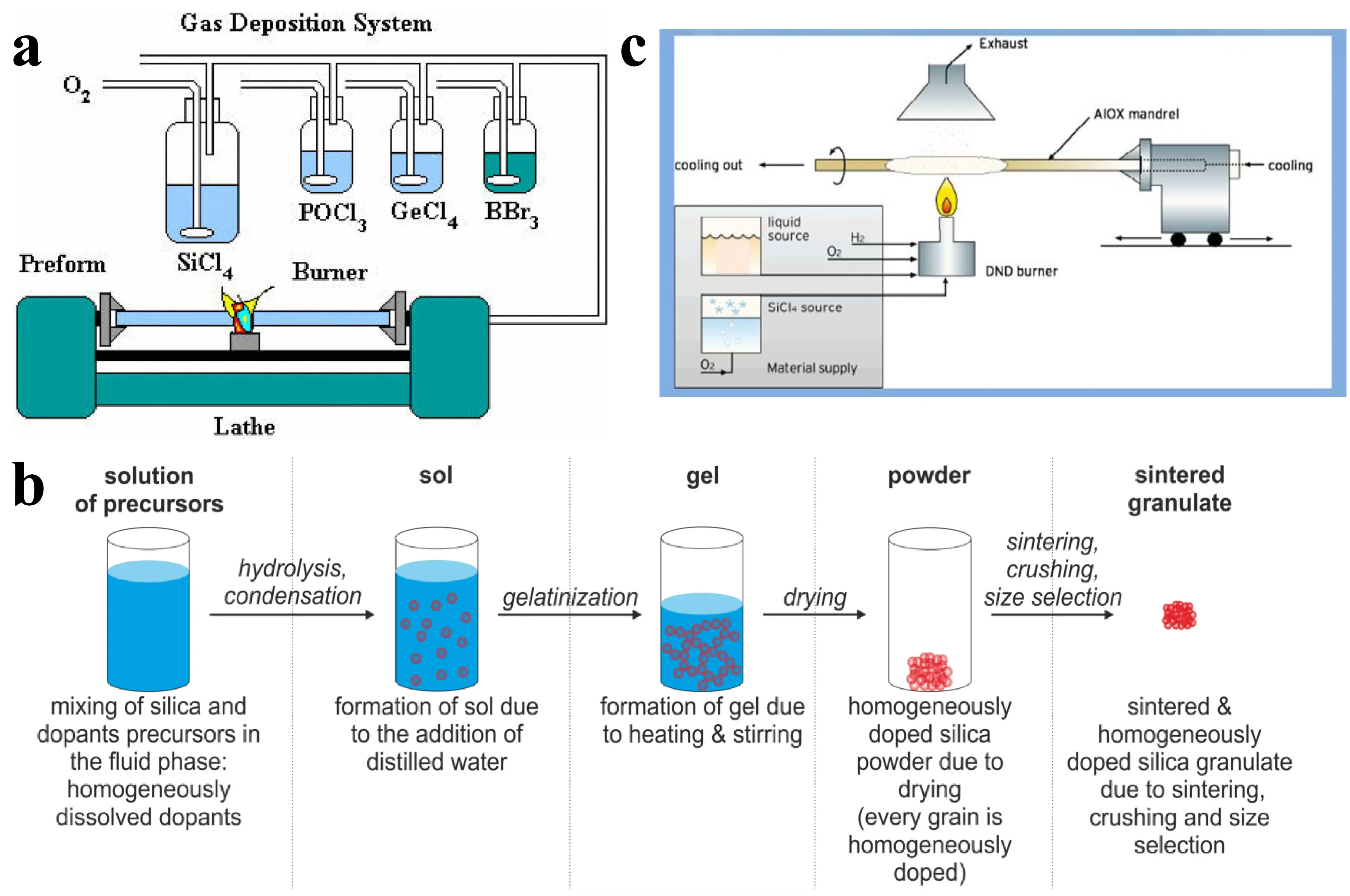
Optical fiber materials serve as the medium for optical signal transmission, and their physicochemical properties, along with manufacturing processes, directly determine the sensor’s fundamental sustainability [56]. Silica glass optical fibers remain dominant in sensing applications due to their comprehensive performance advantages, including a broad transmission window (losses < 0.2 dB/km), high mechanical strength (>5 GPa), excellent thermal stability (softening point > 1600 °C), and good chemical inertness, making them ideal for long-distance, high-precision distributed sensing [57]. However, their conventional manufacturing process carries significant environmental burdens. Figure 1 compares three representative fabrication techniques for silica optical fiber preforms, illustrating the evolution from conventional energy-intensive processes toward greener alternatives. From a green chemistry and life cycle perspective, these techniques exhibit distinct profiles across the raw material acquisition (Stage 1) and synthesis/manufacturing (Stage 2) phases of the assessment framework.
The Modified Chemical Vapor Deposition (MCVD) method (Figure 1a) relies on volatile precursors such as SiCl4 and GeCl4, which hydrolyze to form corrosive HCl and involve toxic, expensive dopants. The process is highly energy-intensive, with deposition and vitrification at 1400–1600 °C and fiber drawing exceeding 2000 °C [58,59]. From a green chemistry perspective, this contravenes Principles 5 (hazardous precursors), 6 (energy efficiency), and 1 (waste prevention). Promising green alternatives have emerged. The sol–gel method (Figure 1b) employs metal alkoxides (e.g., TEOS) as precursors, enabling hydrolysis and condensation to form a gel that is sintered into glass at significantly reduced temperatures (<1000 °C). This approach offers higher atom economy, avoids halide precursors and chlorine emissions, and enables flexible doping for specialty fibers, aligning with Principles 6 and 1, although achieving ultra-low optical losses remains challenging [60,61]. Direct nanoparticle deposition (DND) technology (Figure 1c) represents another advancement. Through flame hydrolysis of SiCl4, silica nanoparticles are deposited at rates approximately an order of magnitude higher than those of MCVD, substantially improving production efficiency and reducing energy consumption per fiber length. Modern closed-loop recycling systems further enable efficient HCl recovery, mitigating environmental impact and enhancing economic viability [62,63,64].
Within the current industrial framework, the most pragmatic pathway toward green manufacturing lies in continuous process optimization and systemic efficiency improvements. Specific measures include AI-assisted parameter optimization to reduce precursor waste, energy-efficient furnace designs (e.g., zirconia induction heating, reducing consumption by >15%), and plant-level waste heat recovery systems [65,66]. Additionally, research into alternative dopants such as aluminum and phosphorus offers source-level greening by reducing reliance on GeCl4. Aluminum co-doping with AlCl3 in erbium-doped fiber amplifiers not only increases refractive index but also enhances Er3+ solubility, exemplifying a dual-benefit strategy that reduces germanium dependence while optimizing performance [67,68].
The greening of silica optical fibers involves a fundamental tension between maintaining the ultra-low loss and high mechanical performance essential for distributed sensing and reducing the environmental footprint of their manufacture. The evolution from conventional MCVD toward sol–gel and DND methods illustrates a shift from end-of-pipe emission control to source-level prevention. Sol–gel offers the most radical departure by eliminating chloride precursors and lowering thermal budgets, yet its inability to match MCVD’s loss performance restricts its use to specialty fiber applications where flexibility and doping homogeneity outweigh attenuation concerns. DND, by contrast, retains chloride chemistry but achieves significant efficiency gains through higher deposition rates and integrated byproduct recycling, representing an incremental yet impactful optimization pathway compatible with existing industrial infrastructure. The core challenge remains the performance–environment trade-off: no single technology simultaneously achieves ultra-low loss, high throughput, and zero hazardous inputs. Future development will likely follow a bifurcated trajectory.
3.1.2. Soft Glass Fibers: Performance Extension and Toxicity Control
Soft glass fibers serve as important alternatives when sensing applications require an operational window beyond silica’s transmission limits or demand enhanced nonlinear performance. As summarized in Table 1, soft glasses primarily include non-oxide compositions (e.g., fluoride, chalcogenide) and oxide glasses with low phonon energy (e.g., germanate, tellurite). Fluoride glasses such as ZBLAN exhibit excellent transmittance in the 2–4 μm mid-infrared region, making them ideal for infrared spectroscopic sensing [69,70]. Chalcogenide glasses (e.g., Ge–As–Se, Ge–Sb–S) extend transmission to the far-infrared (>20 μm) and possess high nonlinear coefficients, offering unique advantages in trace gas detection and nonlinear optics. However, conventional chalcogenide glasses rely on toxic elements such as arsenic and selenium, which pose significant environmental and health risks throughout their lifecycle, conflicting with Green Chemistry Principles 3 (less hazardous synthesis) and 4 (safer chemical design) [71].
Arsenic-free composition design represents the core direction for greening chalcogenide glasses. Optimizing Ge–Sb–Se and Ge–Sb–S systems, along with introducing modifying elements such as gallium, iodine, or bromine, has yielded high-performance arsenic-free glasses. These materials maintain excellent mid-infrared transmittance while exhibiting nonlinear coefficients hundreds of times greater than silica, enabling applications such as mid-infrared supercontinuum generation for multi-component gas detection [72]. Arsenic-free Ge–Sb–S fibers have also shown promise in biosensing, including the detection of gaseous biomarkers from cancer cell metabolism, successfully balancing performance with environmental compatibility [73]. Exploring heavy-metal-free glass systems represents a more transformative objective. Tellurite glasses (TeO2-based) offer good transmittance from 0.4–5 μm and notable nonlinearity for mid-infrared amplifiers and Raman lasers, although far-infrared transmission remains limited [74]. Heavy metal fluoride glasses (e.g., bismuth- or germanium-based) demonstrate outstanding near-infrared performance, with potential to extend into the mid-infrared through nano-crystallization or photonic bandgap engineering [75].
For applications where arsenic-containing chalcogenide glasses remain irreplaceable—such as far-infrared imaging and military technologies—fully enclosed, automated manufacturing systems are imperative. These systems complete all steps from raw material weighing to fiber drawing under vacuum or an inert atmosphere, achieving complete operator-material isolation [76]. All arsenic-bearing waste is collected, solidified, and safely sequestered or recycled, ensuring zero emission of toxic substances and exemplifying Principle 12 (inherently safer chemistry for accident prevention).
The greening of soft glass fibers presents a more complex challenge than that of silica, as their very functionality—extended infrared transmission and high nonlinearity—often derives from precisely the toxic or scarce elements targeted for substitution. A clear hierarchy of strategies has emerged. At the most fundamental level, arsenic-free composition design successfully eliminates the most acute toxicity while preserving key optical properties, representing an ideal application of “designing safer chemicals”. However, this approach is not universally applicable; tellurite and heavy metal fluoride glasses, while free of arsenic, still rely on elements with their own supply chain and toxicity considerations. For applications where no viable heavy-metal-free alternative exists, engineering controls at the manufacturing scale—fully enclosed, automated systems—provide a necessary second line of defense, effectively extending the precautionary principle from the molecular to the industrial level.
Table 1. Comparison of basic physical properties for different glass hosts.
|
Glass |
Transmission Range (μm) |
Infrared Region |
Refractive Index |
Glass Transition Temperature (°C) |
References |
|---|---|---|---|---|---|
|
Silica |
0.2–2.5 |
short-wavelength |
1.46 |
1200 |
[69] |
|
Fluoride |
0.28–4 |
short-wavelength |
1.43–1.5 |
420–480 |
[70] |
|
Chalcogenide |
0.45–11 |
short~long-wavelength |
1.95–2.83 |
305–435 |
[71] |
|
Germanate |
0.38–5 |
short-wavelength |
1.7–1.8 |
387–452 |
[71] |
|
Tellurite |
18–24 |
far |
0.4–5 |
280–430 |
[74] |
3.1.3. Polymer Optical Fibers: Flexibility and Environmental Compatibility Optimization
Polymer optical fibers (POFs), typically composed of a polymer core (e.g., PMMA, polycarbonate) and a low-refractive-index fluorinated polymer cladding, offer high flexibility, impact resistance, large core diameter, light weight, and ease of functionalization. These attributes render them particularly advantageous for short-distance sensing applications, including automotive optical control systems, wearable devices, and biochemical detection as shown in Figure 2a–c [77,78]. However, their environmental sustainability is compromised by their petroleum-based origin. Conventional POFs are derived from non-renewable resources and exhibit high chemical stability, rendering them resistant to degradation and posing risks of long-term environmental pollution if not properly managed at end-of-life—conflicting with Green Chemistry Principles 7 (renewable feedstocks) and 11 (design for degradation) [79].
In response, bio-based biodegradable polymers have emerged as a key research focus. Poly(lactic acid) (PLA) fibers, derived from renewable plant resources, have been demonstrated in single-use medical diagnostic sensors, where they degrade via industrial composting into carbon dioxide and water, mitigating the persistent pollution associated with conventional plastic waste as shown in Figure 2d [80]. Although PLA fibers exhibit limitations in near-infrared transmittance and heat resistance, these properties can be enhanced through copolymerization, polymer blending, or nanocomposite formation.
As alternatives to PMMA-based fibers, PLA and related bio-based materials are viable substitutes under specific conditions: short-distance sensing applications with modest transmission requirements, disposable or short-term use scenarios prioritizing biocompatibility and sustainability, and mild environmental conditions (ambient temperature, low humidity). Conversely, their performance may be compromised under elevated temperatures, high humidity, or corrosive environments, necessitating application-specific validation. Other biodegradable polyesters, such as poly(ε-caprolactone) (PCL), offer viable solutions for short-term environmental monitoring. Furthermore, the design of chemically recyclable polymers—enabling depolymerization of end-of-life fibers into monomers for closed-loop recycling—represents a higher-level realization of atom economy and green design principles [81].
It must be emphasized that the environmental performance of bio-based materials requires systematic evaluation via full life cycle assessment (LCA). Factors such as fertilizer use, land-use change, and energy consumption during feedstock cultivation and polymer processing must be rigorously compared with petroleum-based routes(Figure 2e) [23,40,82]. Thus, the green development of POFs demands a systematic pathway: material selection tailored to application requirements (chemically recyclable polymers for long-term use, biodegradable materials for short-term applications) and integration with complementary technologies (e.g., flexible solar cells for distributed monitoring systems) [83]. Ultimately, enhancing the environmental compatibility of POFs is a lifecycle-wide optimization process that requires multidimensional strategies to harmonize technical performance with ecological benefits.
The greening of polymer optical fibers presents distinct challenges and opportunities compared to inorganic glass fibers. While silica and soft glass greening strategies focus on precursor toxicity and energy-intensive manufacturing, POF sustainability centers on feedstock renewability and end-of-life fate. The evolution from petroleum-based PMMA toward bio-based PLA and other biodegradable polyesters exemplifies a shift from reliance on finite resources to integration with natural carbon cycles. However, this transition reveals a fundamental tension between biodegradability and operational durability. PLA offers end-of-life environmental benefits but exhibits inferior thermal stability and higher optical losses than PMMA, limiting its use to short-term, mild-environment applications. Conversely, chemically recyclable polymers present an alternative paradigm: they maintain performance parity with conventional materials while enabling closed-loop material recovery, aligning more closely with circular economy principles than with biodegradation alone.
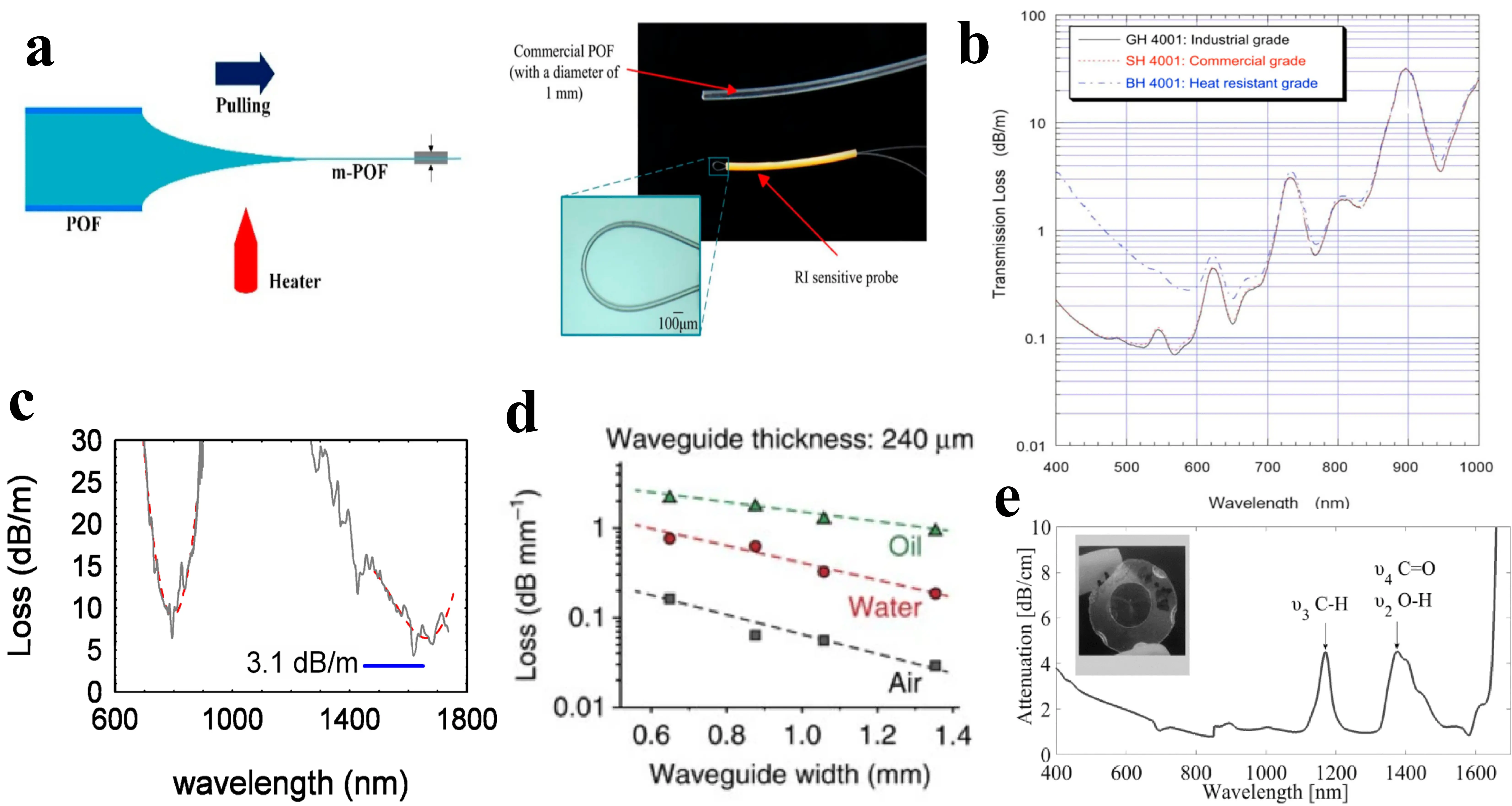
Figure 2. (a) The schematic diagram of the directly drawing process of micro-POF from commercial POF (left), and the photo of the micro-POF (right) and (b) The typical transmission loss spectra of PMMA-based POFs from ESKATM [77]. 2022, Sensors. (c) Cut-back loss measurement of polycarbonate HC-mPOF, and the red and green lines represent fitting curves [79]. 2008, Opt. Lett. (d) Measured propagation of PLA with loss of the waveguides in air, water, and oil [80]. 2016, Nat Commun. (e) Attenuation expressed in dB/cm of a PDLLA bulk sample fabricated by compression molding [82]. 2019, Journal of Lightwave Technology.
3.2. Functionalized Sensing Materials and Coatings
3.2.1. Sensitive Coating Materials: From Traditional to Green Alternatives
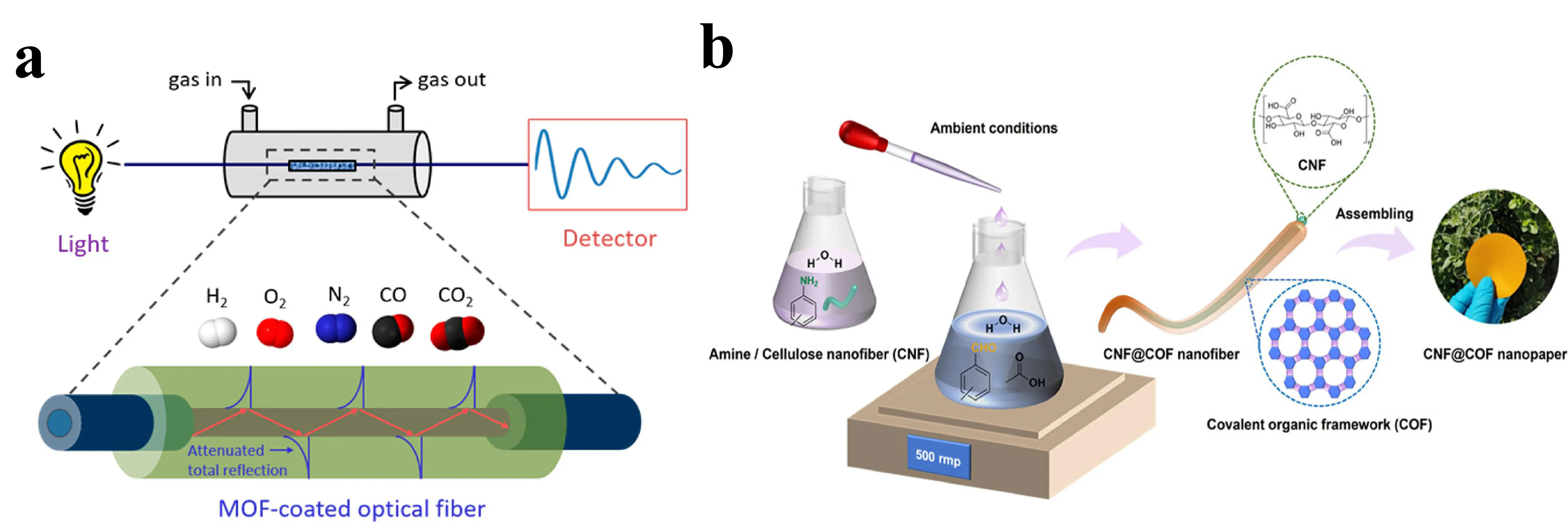
Functional materials are integral components that determine the selectivity and sensitivity of optical fiber sensors, and their green development is therefore essential for enhancing the overall environmental compatibility of sensing systems [84]. In chemical optical fiber sensors, a functional thin film responsive to the target analyte is immobilized on the fiber surface; analyte-film interactions induce changes in the film’s refractive index, thickness, or absorption spectrum, thereby modulating the optical signal. However, the lifecycles of traditional sensitive materials often raise environmental and health concerns. Figure 3 contrasts two prominent classes of porous materials—MOFs and COFs—highlighting how molecular-level composition and synthesis pathways determine their alignment with green chemistry principles across the material lifecycle. While MOFs offer exceptional sensing performance, their environmental footprint during synthesis raises concerns; COFs, by contrast, demonstrate how metal-free design and greener synthesis methods can achieve functional parity while adhering to Principles 3, 4, and 5.
Metal-organic frameworks (MOFs), despite their high specific surface areas and tunable pore structures, are frequently synthesized using toxic heavy metal nodes (e.g., cadmium, lead) and organic solvents such as N,N-dimethylformamide that are difficult to recycle [85]. Similarly, the chemical reduction method for preparing gold and silver nanoparticles for localized surface plasmon resonance (LSPR) involves strong reducing agents such as sodium borohydride, generating multiple byproducts and high solvent consumption—practices that contravene green chemistry principles (Figure 3a) [86]. To replace highly toxic traditional materials, novel materials based on green elements or processes show significant promise. Covalent Organic Frameworks (COFs) are constructed exclusively from lightweight elements (boron, carbon, nitrogen, oxygen, hydrogen) linked by strong covalent bonds, fundamentally eliminating metal toxicity risks. Their synthesis processes are evolving towards greener pathways, exemplified by aqueous-phase synthesis of imine-linked COF thin films for formaldehyde detection and mechanochemical grinding preparation of COF powders for carbon dioxide capture and sensing, eliminating toxic solvents and significantly reducing energy consumption (Figure 3b) [87].
To replace such highly toxic materials, novel systems based on benign elements or greener processes have shown significant promise. Covalent organic frameworks (COFs) are constructed exclusively from lightweight elements (B, C, N, O, H) linked by strong covalent bonds, fundamentally eliminating metal toxicity. Their synthesis is evolving toward greener pathways, including aqueous-phase synthesis of imine-linked COF thin films for formaldehyde detection and mechanochemical grinding for CO2 capture and sensing, thereby eliminating toxic solvents and reducing energy consumption [88]. As shown in Table 2, two prominent classes of porous materials, MOFs and COFs, offer distinct advantages: MOFs provide ultra-high surface area and pore tunability for exceptional sensitivity, but their synthesis relies on toxic metals and solvents; COFs are inherently metal-free and increasingly synthesizable via green routes, though their chemical and thermal stability may be lower. Overall, COFs demonstrate greater alignment with green chemistry principles, whereas MOFs may retain advantages in specific high-performance sensing contexts.
Table 2. Comparison of the advantages of MOFs and COFs materials.
|
Feature |
Composition |
Green Strength |
Green Challenge |
Synthesis |
Application Preference |
References |
|---|---|---|---|---|---|---|
|
MOFs |
Metal ions/clusters linked by organic ligands. |
Ultra-high porosity and structural diversity; well-established synthesis for many structures. |
Potential toxicity of metal nodes (e.g., Cd, Pb, Cr). Synthesis often requires toxic solvents. |
Wide variety of methods, but green routes (e.g., water-based, mechanochemical) are still under development for many structures. |
Excellent for gas storage and sensing, catalysis, and applications where ultra-high surface area is the primary driver. |
|
|
COFs |
Light elements (B, C, N, O, H) linked by strong covalent bonds. |
Inherently metal-free, eliminating heavy metal toxicity concerns. |
Generally lower chemical and thermal stability than many MOFs, which can limit long-term sensor durability. |
Evolving towards greener pathways; aqueous-phase and mechanochemical syntheses are more readily achievable due to the absence of metal coordination chemistry. |
Particularly suited for sensing in biological and environmental contexts where metal ion leaching is a critical concern (e.g., in-vivo or water quality monitoring). |
[87] |
Beyond synthetic frameworks, biomass-derived carbon dots represent another green alternative. Synthesized via one-pot hydrothermal methods using waste biomass such as fruit peels or walnut shells, nitrogen-doped carbon dots have been successfully applied in optical fiber sensors for mercury ion detection via fluorescence quenching, embodying waste valorization and safer chemical design [89]. Directly utilizing natural polymers as sensitive coatings—such as chitosan, cellulose, and sodium alginate—offers additional advantages of renewability, biodegradability, and biocompatibility [90]. Representative applications include chitosan-coated fiber Bragg gratings for carbon dioxide sensing in food packaging and cellulose nanocrystal-based photonic structures for humidity or organic vapor detection [91]. These natural polymer coatings are inherently green and achieve end-of-life degradability, realizing a complete “cradle-to-cradle” closed loop.
The greening of functional materials for optical fiber sensing reveals a clear hierarchy of strategies. At the most fundamental level, molecular design that eliminates toxicity at source—exemplified by COFs versus MOFs—represents the ideal application of Green Chemistry Principles 4 (safer chemicals) and 3 (less hazardous synthesis). COFs demonstrate that high-performance sensing can be achieved without the use of heavy metals, though their stability and structural diversity still lag behind those of MOFs. A second strategy involves green synthesis of inherently functional materials, such as biomass-derived carbon dots or biosynthesized noble metal nanoparticles, which transform waste streams into valuable sensing elements while avoiding hazardous reagents. A third, even more radical approach is the direct use of natural polymers (chitosan, cellulose) as functional coatings, achieving both source renewability and end-of-life degradability without synthetic modification.
3.2.2. Fluorescent and Luminescent Materials: Development of Novel Fluorescent Systems
Fluorescence sensing technology operates by monitoring changes in fluorescent probe parameters, including intensity, lifetime, FRET efficiency, and emission wavelength. Traditional rare-earth-doped luminescent materials (e.g., Er3+:YAG, Eu3+ complexes) offer advantages such as line emission spectra, long fluorescence lifetimes, and large Stokes shifts. However, their dependence on strategic rare-earth resources and the associated environmental impacts of mining have motivated the search for greener alternatives [92].
Carbon quantum dots (CQDs) have emerged as a promising research focus due to their green synthesis characteristics and unique up-conversion luminescence properties. CQD-based upconversion fluorescent nanoprobes, excited by near-infrared light, emit visible light and enable high signal-to-noise ratio detection of tumor microenvironment biomarkers in deep tissues. Dhariwal et al. [93] reported the green synthesis of CQDs using waste biomass of Poa parentis for Mn2+ and Fe3+ ion sensing, wherein complex formation induces charge transfer between CQDs and metal ions via non-radiative recombination, resulting in fluorescence quenching (Figure 4a). Rare-earth- free fluorescent molecules and organic dyes offer another viable pathway. High-performance fluorescence sensing can be achieved through protein engineering of natural fluorescent proteins or by synthesizing organic dyes with aggregation-induced emission (AIE) characteristics [94]. He et al. [95] synthesized two new AIE-active cationic Ir(III) complexes that serve as excellent chemosensors for sensitive and selective detection of picric acid in water, while tetrathiafulvalene (TTF)-type AIE-gens enable detection via FRET (Figure 4b).
Lead-free perovskite quantum dots represent one of the most promising research directions, wherein lead is substituted with elements such as tin, bismuth, or germanium to form materials such as Cs2AgBiBr6 double perovskites or CsSnI3 quantum dots [96]. Although these lead-free variants require further optimization in luminescence efficiency and stability, they have demonstrated significant application potential. Li et al. [97] have demonstrated photodetectors constructed by organicinorganic hybrid perovskite and an organic bulk heterojunction consisting of a lowbandgap nonfullerene and polymer, which can be used for high-quality visible light and near-infrared practical imaging with high sensitivity, ultrafast speed and a large LDR (Figure 4c).
The greening of fluorescence sensing materials reveals a distinct evolutionary trajectory from rare-earth dependence toward sustainable alternatives. Three primary material classes have emerged: carbon quantum dots derived from waste biomass, rare-earth-free organic fluorophores with AIE characteristics, and lead-free perovskite quantum dots. Each presents a unique profile of green attributes and performance trade-offs. CQDs exemplify circular economy principles by valorizing waste streams while avoiding toxic elements entirely. Their upconversion properties enable deep-tissue imaging without UV excitation, yet their quantum yields and spectral tunability remain inferior to traditional rare-earth materials. Rare-earth-free organic dyes and AIEgens offer excellent biocompatibility and molecular design flexibility, achieving performance comparable to conventional probes in specific applications, though photostability remains a concern for long-term measurements. Lead-free perovskites address the acute toxicity of lead-based systems while preserving the exceptional optoelectronic properties of the perovskite structure; however, their luminescence efficiency and operational stability still lag behind their lead-containing counterparts, and the toxicity profiles of alternative elements require further assessment.
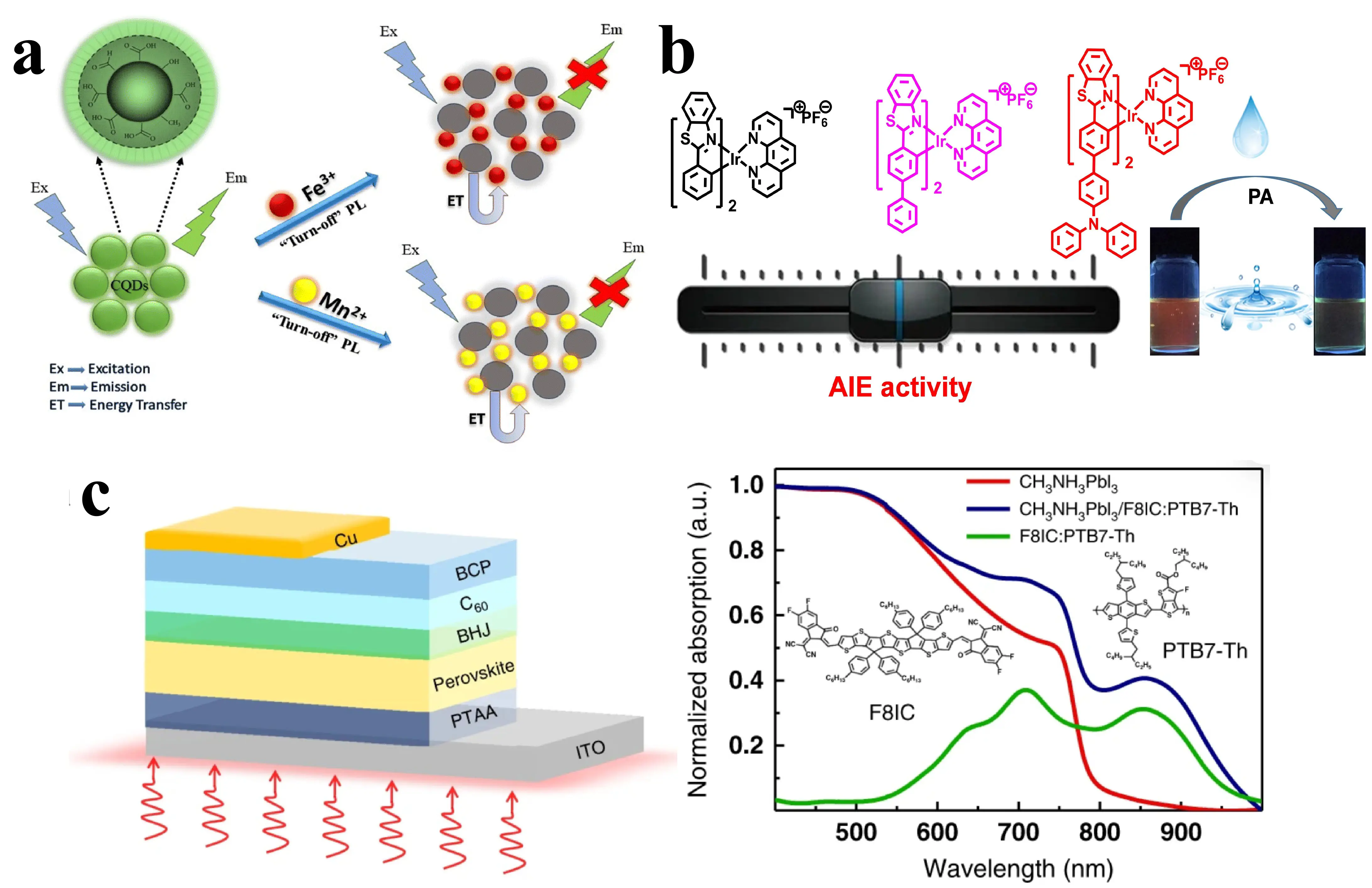
Figure 4. (a) Quenching mechanism of the synthesised CQDs for Mn2+ and Fe3+ ions [93]. 2024, RSC Sustainability. (b) Schematic diagram of AIE-Active Iridium(III) Complexes for Sensing Picric Acid in Water [95]. 2023, Chemosensors. (c) Schematic device structure of the photodetectors (left)and the absorption spectra of different films by spin coating(right) [97]. 2020, Light Sci Appl.
3.2.3. Plasmonic Materials: Green Synthesis and Non-Precious Metal Alternatives
Localized Surface Plasmon Resonance (LSPR) sensing relies on collective electron oscillation in noble metal nanoparticles under specific optical frequencies. Traditional synthesis methods for gold and silver nanoparticles, such as the Turkevich and Brust methods, depend on chemical reducing agents and organic solvents, raising environmental concerns [98]. In response, biosynthesis methods have been developed that utilize biomolecules from plant extracts (e.g., green tea polyphenols, cinnamaldehyde), fungi, or bacteria as natural reducing and stabilizing agents for benign aqueous-phase nanoparticle synthesis. Figure 5 illustrates two complementary strategies for greening plasmonic materials: biosynthesis of noble metal nanoparticles using renewable resources, and substitution of noble metals with earth-abundant alternatives. These approaches address environmental concerns at different lifecycle stages—raw material acquisition (Stage 1) and synthesis (Stage 2)—while balancing performance requirements for specific applications.
Tippayawat et al. [99] synthesized silver nanotriangles using aloe vera extract, which were subsequently integrated into optical fiber sensors for pesticide residue detection. These sensors leverage near-infrared LSPR characteristics and operate under ambient temperature and pressure without hazardous chemicals, representing a model for green synthesis (Figure 5a). Significant progress has also been made in developing non-precious metal plasmonic materials to reduce reliance on scarce noble metals. Earth-abundant metals such as aluminum, copper, nickel, tungsten, and their nitrides or oxides have emerged as viable alternatives [100]. Aluminum nanostructures exhibit strong LSPR effects in the ultraviolet range, and their resonance peaks can be tuned into the visible spectrum through the design of nanoarrays or core-shell structures. LSPR sensors based on aluminum nanoparticle arrays have been successfully used to detect heavy metal ions (e.g., mercury and lead) in water, offering cost-effective solutions for distributed environmental monitoring. Lv et al. [101] have reported an SPR-based CTAB-functionalized ZnO/CNTs nanocomposite and silver-coated optical fiber catechol sensor with enhanced catalytic activity in redox reactions, which enhances the electric field penetration depth of the SPR and yields a highly sensitive, portable, non-enzymatic plasma sensor (Figure 5b). Although these non-precious metal materials generally exhibit lower resonance quality factors than their noble metal counterparts, they represent feasible, greener alternatives for cost-sensitive applications with moderate performance requirements.
The greening of plasmonic materials for LSPR sensing has progressed along two complementary pathways: green synthesis of noble metal nanoparticles and substitution of noble metals with earth-abundant alternatives. Biosynthesis methods address the environmental footprint of nanoparticle fabrication by replacing toxic reducing agents and organic solvents with biomolecules derived from plants or microorganisms. These approaches operate under mild conditions and yield functional nanoparticles with comparable sensing performance, as demonstrated by aloe vera-mediated silver nanotriangles for pesticide detection. However, biosynthesis often faces challenges in controlling size and morphology, which can affect signal reproducibility and limit scalability.
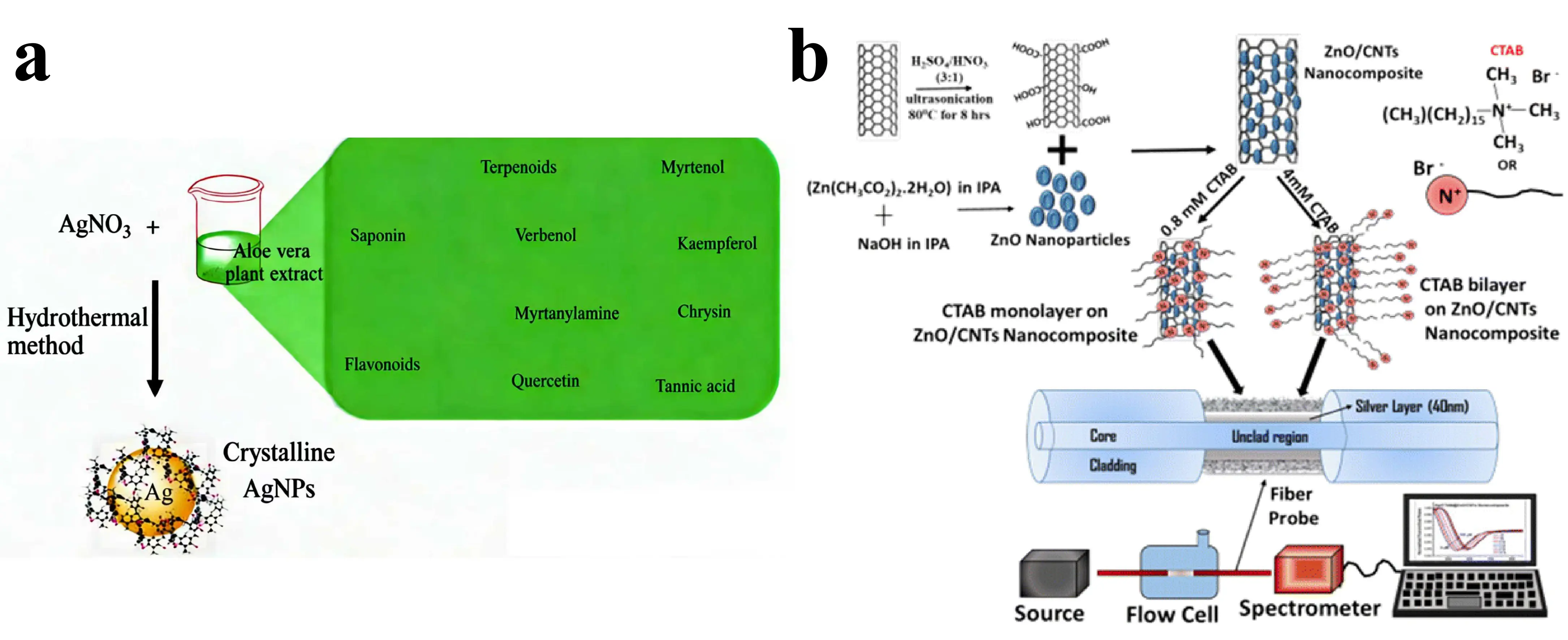
Figure 5. (a) Green synthesis of silver nanoparticles in aloe vera plant extract prepared by a hydrothermal method [99]. 2016, Peer J. (b) Schematic showing the synthesis of functionalized CNTs and ZnO nanoparticles, attachment of ZnO nanoparticles to CNTs walls, CTAB functionalization of the ZnO/CNTs nanocomposite for two concentrations, fiber probe and experimental set-up [101]. 2024, Sens. Diagn.
4. Application Fields of Green Optical Fiber Sensing Materials
The green optical fiber sensing materials effectively integrate environmental attributes with sensing functions, demonstrating broad application prospects in critical fields such as environmental monitoring, biomedicine, and industrial safety, providing innovative technological pathways for achieving the Sustainable Development Goals [102].
4.1. Environmental Monitoring
4.1.1. The Green Evolution of Optical Fiber Matrix Materials
The green optical fiber sensing technology embodies “conservation through monitoring”, enabling highly sensitive, real-time monitoring of water, air, and soil while minimizing the environmental footprint of monitoring activities. The optical fiber matrix serves as the medium for optical signal transmission, whose physicochemical properties and manufacturing processes directly influence the sensor’s fundamental sustainability [56].
Water Quality Monitoring
Green optical fiber sensing offers an environmentally benign solution for water quality monitoring. Unlike traditional electrochemical sensors, which are susceptible to interference and contribute to electronic waste, sensors based on biodegradable polymers such as PLA or polyhydroxyalkanoates (PHA) can prevent secondary pollution [103,104]. A representative application involves biodegradable sensing probes functionalized with a chitosan-carbon dot composite film for heavy metal detection. This design leverages chitosan’s chelating ability and the fluorescence quenching effect of carbon dots to achieve highly selective detection of ions such as Pb2+, Hg2+, and Cd2+. Yong et al. [105] demonstrated that chitosan-derived blue-green fluorescent carbon nanoparticles (chi-CNPs) serve as both efficient indicators and scavengers for heavy metal ions (Figure 6a). Furthermore, distributed monitoring networks employing biodegradable cables enable real-time tracking of pollutant migration and dispersion, providing critical data for water environment management.
Gas Monitoring
Green optical fiber sensing technology utilizes environmentally benign materials for highly selective gas detection. Vitoria et al. [106] have given a complete overview focused on the utilization of LMR- based optical fiber sensors for gas sensing applications, summarizing the materials used for the development of these sensors as well as the fabrication procedures and the performance of these devices (Figure 6b). Optical fibers coated with COF materials deployed along pipelines enable real-time localization of methane leaks through analysis of optical signal changes, offering a promising approach for natural gas infrastructure monitoring [107]. Additionally, natural materials such as porphyrin derivatives serve as renewable sensitive layers for detecting gases as NO2, further expanding the application scope of green materials [108]. Insou et al. [109] reported the design and fabrication of a silica hollow-core anti-resonant fiber featuring eight non-touching capillaries, which was primarily developed for mid-infrared CO2 sensing within engine environments. This advancement could facilitate the integration of such fibers as hybrid transmission links in mid-infrared spectroscopic systems, while also validating the use of numerical simulation as a reliable tool for designing application-specific fibers for in-situ gas monitoring in the mid-infrared region.
Soil Monitoring
Green optical fiber soil monitoring technology promotes smart agriculture through fully biodegradable sensing networks [110]. Optical fiber sensors based on biodegradable polymers can be embedded within the cultivation layer to infer soil moisture content by monitoring dielectric constant changes, or to detect pH and ion concentrations via modified biosensitive coatings. These sensors naturally degrade after the crop growth cycle, preventing electronic waste accumulation. Leone et al. [111] proposed a cost-effective fiber optic platform for continuous soil water content monitoring in precision agriculture (Figure 6c). When integrated into distributed sensing networks, the collected data can be processed using artificial intelligence to generate spatial heat maps of water and nutrient distribution, guiding precision irrigation and fertilization while reducing non-point source pollution [112].
Antimicrobial Agent Monitoring
To address the monitoring of antimicrobial agents such as antibiotics in water bodies, green optical fiber sensing achieves highly specific detection through bio-recognition interfaces [113]. Phages or aptamers immobilized on the fiber surface serve as recognition elements, coupled with green-synthesized silver nanoclusters or carbon dots as signal labels, enabling trace-level detection of antibiotics, including tetracyclines and sulfonamides. Zhao et al. [114] have developed a new method for the sequential detection of Enro and Cip using a portable fiber-optic SPR sensor, which exhibited a sensitivity of 2900 nm/RIU and achieved limits of detection (LODs) of 1.20 ng/mL for Enro and 0.81 ng/mL for Cip, demonstrating significant potential for food safety testing applications (Figure 6d).
The application of green optical fiber sensing across environmental monitoring domains reveals several unifying themes and persistent challenges. Across water, air, soil, and antimicrobial monitoring, a common strategy emerges: integrating biodegradable or bio-derived materials with highly selective recognition elements to create sensing systems that are both functional and environmentally compatible at end-of-life. Several material classes demonstrate particular promise across multiple applications. Biodegradable polymers (PLA, PHA) serve as structural matrices for water and soil probes, while carbon dots derived from waste biomass function as versatile fluorescent reporters for heavy metals and antibiotics. Covalent organic frameworks (COFs) excel in gas sensing due to their tunable porosity and metal-free composition, and natural polymers such as chitosan and cellulose provide renewable platforms for sensor functionalization. The convergence of these materials with distributed sensing networks and AI-powered data analytics enables unprecedented spatiotemporal resolution in environmental monitoring.
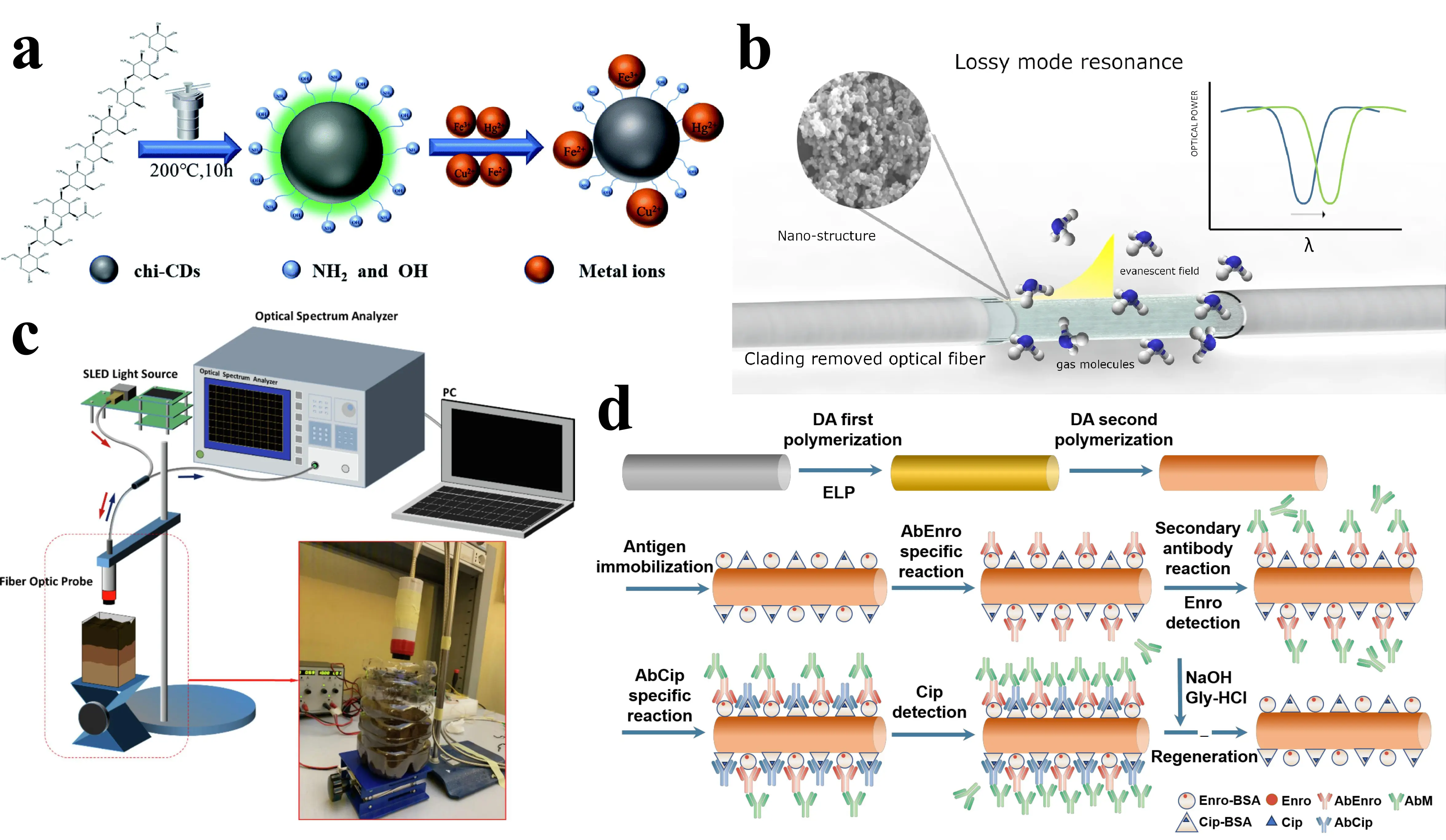
Figure 6. (a) Schematic diagram of synthetic blue-green fluorescent carbon nanoparticles (chi-CNPs) and chelating heavy metal ions [105]. 2021, RSC Adv. (b) Schematic diagram of LMR-based optical fiber sensors for gas sensing applications [106]. 2021, Sensors. (c) Experimental setup and Protection PVC package for validation in soil [111]. 2022, Results Opt. (d) The enrofloxacin/ciprofloxacin detection procedure and fiber-optic SPR sensor regeneration [114]. 2024, Sensors.
4.2. Biomedical and Health Monitoring
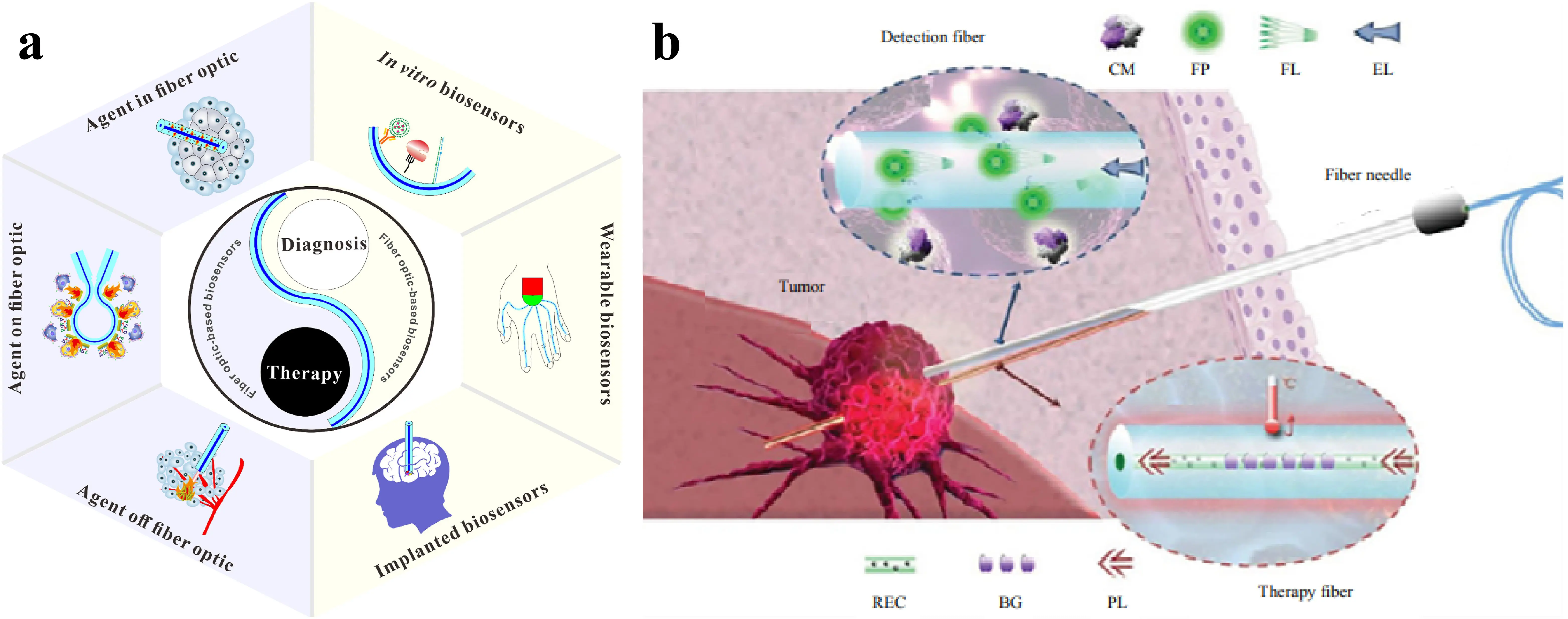
In this field, the biocompatibility and degradability of optical fiber sensing materials directly relate to clinical application safety. Luo et al. [115] systematically summarized ummarized the advances of fiber optic‐based biosensors ranges from point of care testing (POCT) in vitro, wearable detection, and implanted detection to therapy in vivo, as depicted in Figure 7a.
4.2.1. In Vivo Diagnostics and Therapy
For in vivo diagnostics and therapy, optical fiber sensors fabricated from absorbable biomaterials eliminate the need for secondary surgical extraction. Bioactive glass fibers, such as those based on magnesium-calcium-silicate systems, can safely degrade in vivo while promoting tissue regeneration, making them suitable for short-term monitoring of parameters such as intracranial pressure. As shown in Figure 8b, the fiber-optic interstitial needle incorporates hypoxia-sensitive fluorescent probes and encapsulates rare-earth dopants, enabling in vivo tumor combat through a combination of specific cancer sensing and photothermal therapy (PTT). The detection fiber, equipped with a fluorescent probe that responds to tumor hypoxia markers, allows rapid scouting for these markers in the tumor vicinity [116]. Such sensors can be integrated with temporary implants, including orthopedic fixation plates and cardiovascular stents, providing mechanical support while simultaneously monitoring tissue healing status and enabling integrated diagnostics and therapy [117,118].
4.2.2. In Vitro Diagnostics
For in vitro diagnostics, compostable optical fiber sensing chips offer an environmentally sustainable solution for single-use applications. These chips are fabricated on PLA substrates, integrating microfluidic channels and optical waveguides, while utilizing biomass-derived carbon dots as fluorescent probes for rapid sample detection [119]. As all components of this fully green detection system can completely degrade under composting conditions, it is particularly suitable for resource-limited regions, disaster scenarios, and home monitoring applications, significantly reducing the environmental impact of medical waste [120].
The application of green optical fiber sensing in biomedical and health monitoring reveals two distinct but complementary pathways: absorbable sensors for in vivo use and compostable chips for in vitro diagnostics. Both approaches share the common goal of eliminating secondary interventions or waste streams, yet they address fundamentally different clinical requirements. The core challenge across both domains is the inherent tension between functional lifetime and degradation rate. For in vivo sensors, degradation must be delayed until clinical utility is complete; for in vitro devices, stability must be maintained through manufacturing, distribution, and use, with degradation triggered only after disposal. Meeting these divergent requirements demands precise control over polymer chemistry and microstructure, often pushing the limits of current materials science.
4.3. Industrial Process Control and Safety
In industrial process control and safety, the green concept emphasizes material durability, closed-loop recyclability, and inherent safety.
4.3.1. Structural Health Monitoring (SHM)
In SHM, optical fiber sensing technology contributes to sustainability by extending infrastructure service life and enabling material recovery. Bado et al. [121] employed the fact that FBG sensors embedded in structures (e.g., bridges, dams, wind turbine blades, aircraft fuselages, pipes, tunnels) could enable real-time monitoring of strain, temperature, and vibration, facilitating predictive maintenance (Figure 8a–c). Monteiro et al. [122] investigated the use of optical fiber sensors embedded in 3D-printed structures for vibration monitoring as depicted in Figure 8d. The results indicated that structural monitoring in power transformers could be achieved through the application of optical fiber sensors, offering the prospect of real-time monitoring. Monsberg et al. [123] have reported about the design and realization of a distributed fibre optic sensing system for conventional tunnelling, which was designed to allow follow-up measurements after the initial continuous monitoring campaign as shown in Figure 8e. Hence, future research will focus on the long-term monitoring of the instrumented cross-section to assess the further deformation progress inside the shotcrete lining, which will finally lead to a better understanding of the strain distribution of shotcrete linings at conventionally driven tunnels.
Through the design of easily separable coatings or pre-embedded recovery guide wires, valuable materials (e.g., precious metals within sensors) can be efficiently recovered during structural decommissioning, supporting circular economy principles [124,125]. By extending structural service life and deferring the infrastructure renewal cycle, this technology fundamentally helps avoid the massive carbon emissions and resource consumption associated with premature demolition and reconstruction [126].
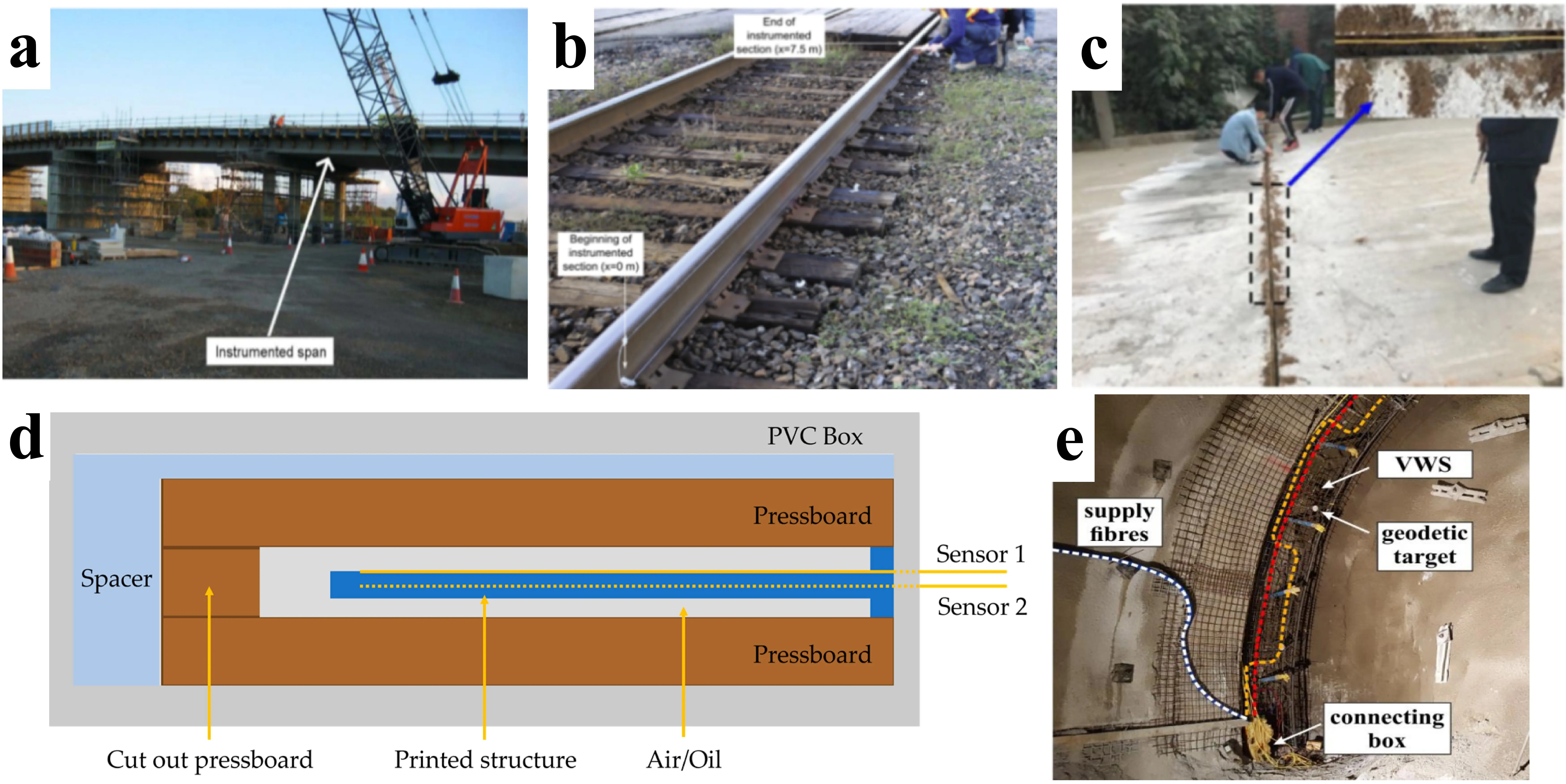
Figure 8. Structural Health Monitoring (SHM) campaigns performed by means of Distributed Optical Fiber Sensors on (a) bridge, (b) rail, (c) roed pavement [121]. 2021, Sensors. (d) Schematic diagram of the simulated environment [122]. 2021, Sensors. (e) Installation of fibre optic sensing system inside the tunnel lining [123]. 2018, In Proceedings of the 9th European Workshop on Structural Health Monitoring.
4.3.2. Chemical Process Monitoring
In chemical process monitoring, lead-free silica glass or fluoride glass optical fiber sensors are particularly suitable for flammable and explosive environments due to their corrosion resistance and inherent safety [127]. Operating exclusively on optical signals eliminates electrical spark risks, enabling intrinsically safe monitoring in hazardous settings. By providing real-time tracking of reaction progress (e.g., temperature) and potential leakages, these systems can issue early warnings when process parameters deviate and initiate automatic adjustments via interlocking control systems. This capability helps prevent safety incidents and pollutant releases at their source, thereby minimizing environmental risks [128].
The application of green optical fiber sensing in industrial contexts reveals a distinct paradigm compared to environmental or biomedical monitoring. Here, sustainability is achieved not primarily through material biodegradability, but through durability, extendable service life, and end-of-life recoverability. This reflects the fundamental difference between consumable and capital-intensive applications: in industrial settings, the most environmentally beneficial sensor is often one that lasts as long as the asset it monitors and whose materials can be fully recovered upon decommissioning.
5. Summary, Challenges and Perspectives
5.1. Summary of This Review
This study systematically demonstrates the necessity and feasibility of integrating the Twelve Principles of Green Chemistry into advanced optical fiber sensing material development. An assessment framework was constructed, with core principles including waste prevention, atom economy, and designing safer chemicals, providing a scientific basis for quantitative evaluation and continuous optimization of material environmental friendliness. The Research has demonstrated significant progress in green innovation across multiple dimensions, encompassing matrix materials from low-melting-point phosphate glasses to biodegradable polycaprolactone polymers, and functional materials from biomass-derived carbon dots to lead-free perovskite quantum dots. These breakthroughs are manifested not only in reduced energy consumption and hazardous substance substitution, but also in the development of highly biocompatible, absorbable sensing systems using renewable raw materials. Successful applications in various fields, such as environmental heavy metal monitoring, post-operative biomarker tracking, and infrastructure health monitoring, provide compelling evidence that green optical fiber sensing technology has transitioned from conceptual exploration to practical engineering applications. The research clearly demonstrates that synergistic enhancement of environmental benefits and sensing performance can be fully achieved through source innovation (e.g., AI-assisted molecular design), process revolution (e.g., low-temperature atomic layer deposition), and system-wide lifecycle optimization (e.g., modular design, recycling systems). Specifically, sensors employing bio-inspired self-healing coatings have exhibited a superior service life compared to conventional devices. Concurrently, diagnostic chips fabricated on compostable substrates have achieved detection sensitivities comparable to those of commercial products. These findings strongly validate the role of green chemistry principles in driving technological innovation.
The proposed framework of Figure 9 encompasses the full life cycle of optical fiber sensing materials, which is divided into three key stages: raw material acquisition, synthesis and manufacturing, and application and operation. At each stage, the environmental impact, economic viability, and social considerations are systematically evaluated. Through this comprehensive approach, the framework provides decision-making support for the sustainable development of green optical fiber sensing technologies.
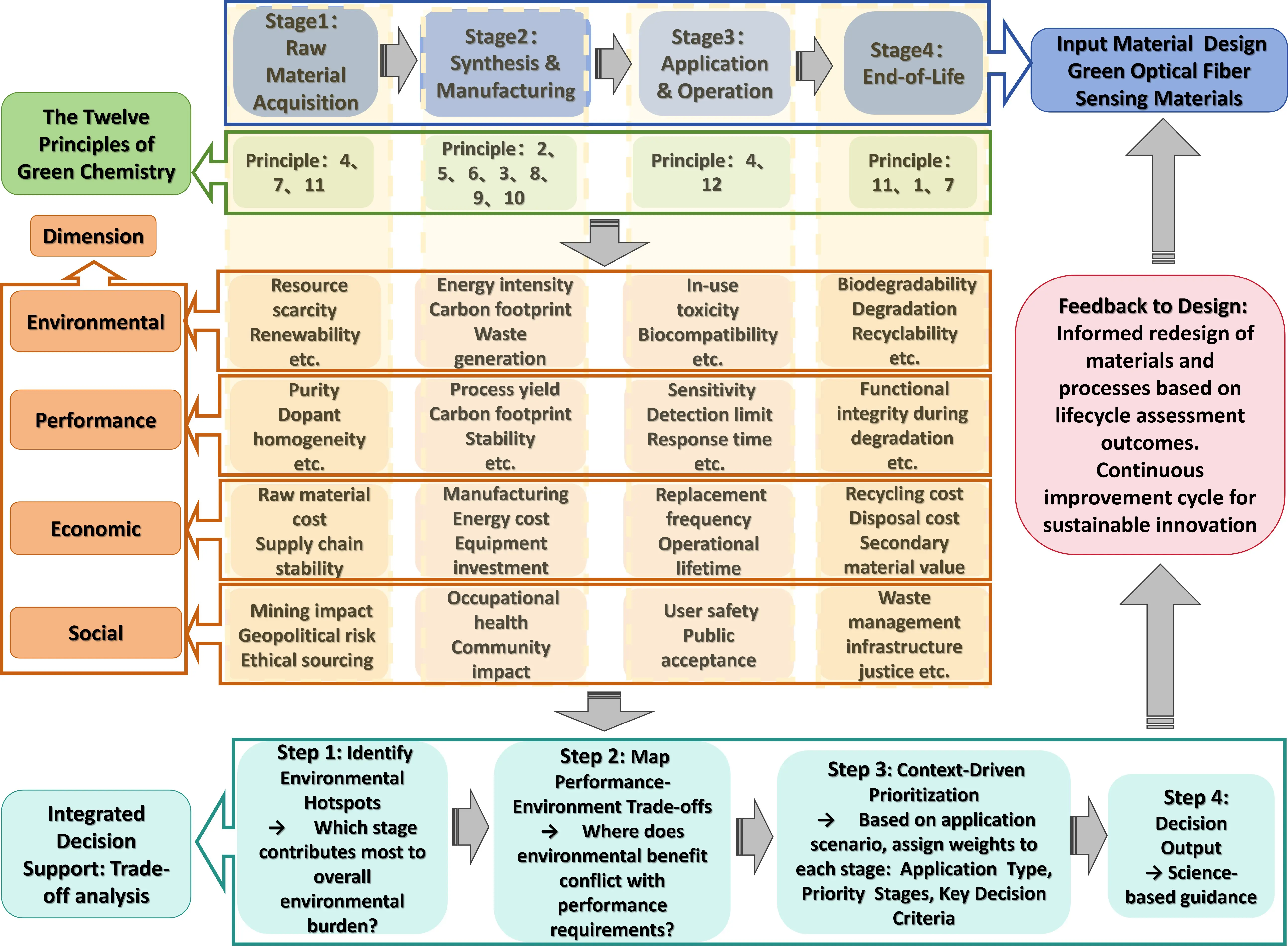
Figure 9. A Unified Life Cycle Assessment Framework for Green Optical Fiber Sensing Materials: From Principles to Decision.
5.2. Challenges and Perspectives
Despite promising development prospects, the transition of green optical fiber sensing technology from laboratory research to large-scale industrial application still faces several critical challenges, with balancing performance and environmental benefits being particularly prominent [129].
-
The significant performance gap between environmentally friendly materials and conventional materials: This performance trade-off is prevalent across multiple material systems. In optical polymers, bio-based PLA fibers exhibit significantly higher optical transmission losses and inferior long-term thermal stability versus petroleum- based PMMA fibers optimized over decades, limiting reliability in long-distance transmission or high-temperature sensing [119,130]. In fluorescent material systems, lead-free perovskite quantum dots (e.g., Cs3Bi2Br9) struggle to match the photoluminescence quantum efficiency and photostability of traditional lead-based perovskites (e.g., CH3NH3PbI3) [131]. Furthermore, nanosensing particles prepared via biosynthetic methods commonly face difficulties in controlling morphology and achieving size uniformity, leading to insufficient signal reproducibility and failing to meet high-precision quantitative detection requirements [132].
-
The significant industrialization constraints of large-scale fabrication technologies and cost control: Many green synthesis processes excellent at laboratory scale (e.g., hydrothermal synthesis of high-quality nanomaterials) encounter challenges when scaling up; process scale-up is hampered by reduced mass/heat transfer efficiency in larger reactors, increasing batch-to-batch variations, and lowering product yields [133]. Concurrently, production costs of key raw materials (e.g., high-purity bio-based monomers, such as L-lactide for PLA, and specialized green solvents, such as ionic liquids) remain significantly higher than those of petroleum-based chemicals used for large-scale production, placing final manufactured green optical fiber sensors at a market price disadvantage [134].
-
Lack of standardized LCA data: Currently, systematic, standardized LCA studies targeting novel green sensing materials remain scarce [135]. If the LCA for a “carbon neutral” bio-based PLGA fiber fails to adequately account for fertilizer application during feedstock crop cultivation, land use changes, and associated carbon emissions, its calculated full life cycle carbon footprint may be severely underestimated [136]. This absence of foundational data makes it challenging for investors and policymakers to make scientifically informed decisions when comparing technology options.
-
Underdeveloped recycling and resource recovery technology systems: Specialized technologies for recycling, separation, and remanufacturing of composite structure optical fiber sensors (e.g., embedded within wind turbine blade composite materials) are currently non-existent [137]. For example, in decommissioned aircraft structural health monitoring systems, embedded optical fiber sensor networks lack economically viable disassembly and separation processes, making it difficult to achieve effective recovery and purification of precious metal components (e.g., gold coating on FBGs) and specialty glass materials [138]. This systemic technological gap subjects the end-of-life management stage to severe challenges, compromising the full life cycle management approach.
-
The development of green optical fiber sensing technology has transcended the purely technical domain, establishing itself as a key enabling technology supporting sustainable development strategies. Within the macro context of addressing global climate change and building a circular economy, this technology directly contributes to the United Nations 2030 Sustainable Development Goals: helping ensure water quality and safety through distributed monitoring networks (Goal 6), promoting Universal Health Coverage (UHC) via absorbable sensors (Goal 3), and fostering green industry transformation using inherently safe sensing systems (Goal 9). Despite persistent challenges (e.g., balancing material properties, scaling up manufacturing processes), its development trajectory is clear and application prospects vast. Advancing this field requires collaborative efforts from industry, academia, research institutions, and end-users, guided by green chemistry principles, to collectively steer optical fiber sensing technology towards a new phase of sustainable development that exists in harmony with the ecological environment.
Author Contributions
Conceptualization, Y.Y., C.Z. and J.Z.; Methodology, Y.Y.; Software, C.Z. and Q.Z.; Formal Analysis, Y.Y.; Investigation, Y.Y., M.S. and C.Z.; Resources, Y.Y. and G.Z.; Data Curation, G.Z.; Writing—Original Draft Preparation, Y.Y.; Writing—Review & Editing, G.Z.; Visualization, Y.Y.; Funding Acquisition, G.Z.
Ethics Statement
Not applicable.
Informed Consent Statement
Not applicable.
Data Availability Statement
Not applicable.
Funding
This work was supported by the Natural Science Foundation of Hebei Province (grant no. E2025209079), Science and Technology Project of Hebei Education Department (grant no. BJ2026077) and Key Research Project of North China University of Science and Technology (grant no. ZD-YG-202301).
Declaration of Competing Interest
The authors declare that they have no known competing financial interests or personal relationships that could have appeared to influence the work reported in this paper.
References
-
Eid MM. Optical fiber sensors: Review of technology and applications. Indones. J. Electr. Eng. Comput. Sci. 2022, 25, 1038–1046. DOI:10.11591/ijeecs.v25.i2.pp1038-1046 [Google Scholar]
-
Udd E. An overview of fiber-optic sensors. Rev. Sci. Instrum. 1995, 66, 4015–4030. DOI:10.1063/1.1145411 [Google Scholar]
-
Pendão C, Silva I. Optical Fiber Sensors and Sensing Networks: Overview of the Main Principles and Applications. Sensors 2022, 22, 7554. DOI:10.3390/s22197554 [Google Scholar]
-
Zawawi MA, O’Keffe S, Lewis E. Intensity-modulated fiber optic sensor for health monitoring applications: A comparative review. Sonser Rev. 2013, 33, 57–67. DOI:10.1108/02602281311294351 [Google Scholar]
-
Berkovic G, Rotter S, Shafir E, Scandale W, Todesco E. Wavelength-modulated fiber optic sensor for high precision displacement measurement. Rev. Sci. Instrum. 2002, 73, 3687–3691. DOI:10.1063/1.1502001 [Google Scholar]
-
Kadhim RA. Strain measurement by using phase modulated fiber optic sensors technology. Diyala J. Eng. Sci. 2015, 8, 3687–3691. DOI:10.24237/djes.2015.08103 [Google Scholar]
-
Caucheteur C, Guo T, Albert J. Polarization-assisted fiber Bragg grating sensors: Tutorial and review. J. Light. Technol. 2017, 35, 3311–3322. DOI:10.1109/JLT.2016.2585738 [Google Scholar]
-
Wen JL, Xi TW, Yang TY, Zheng ZY, Lan LF, Yang B, et al. A Two-Photon 3D printed fiber optic ultrasonic sensor with Lateral-Force resistance for detection in High-Voltage environments. Opt. Laser Technol. 2025, 192, 114032. DOI:10.1016/j.optlastec.2025.114032 [Google Scholar]
-
Fernicola V, Crovini L. Digital optical fiber point sensor for high-temperature measurement. J. Light. Technol. 1995, 13, 1331–1334. DOI:10.1109/50.400680 [Google Scholar]
-
Li CL, Tang JG, Cheng C, Cai LB, Yang MH. FBG Arrays for Quasi-Distributed Sensing: A Review. Photonic Sens. 2021, 11, 91–108. DOI:10.1007/s13320-021-0615-8 [Google Scholar]
-
Lu P, Lalam N, Badar M, Liu B, Chorpening BT, Buric MP, et al. Distributed optical fiber sensing: Review and perspective. Appl. Phys. Rev. 2019, 6, 041302. DOI:10.1063/1.5113955 [Google Scholar]
-
Zhang XH, Zhu HH, Jiang X, Broere W. Distributed fiber optic sensors for tunnel monitoring: A state-of-the-art review. J. Rock Mech. Geotech. Eng. 2024, 16, 3841–3863. DOI:10.1016/j.jrmge.2024.01.008 [Google Scholar]
-
Ferdinand P. The Evolution of Optical Fiber Sensors Technologies During the 35 Last Years and Their Applications in Structure Health Monitoring. In Proceedings of the EWSHM—7th European Workshop on Structural Health Monitoring, Nantes, France, 8–11 July 2014; pp. 914–929. [Google Scholar]
-
Annamdas KKK, Annamdas VGM. Review on developments in fiber optical sensors and applications. In Fiber Optic Sensors and Applications VII; SPIE: Bellingham, WA, USA, 2010; Volume 7677, pp. 205–216. DOI:10.1117/12.849799 [Google Scholar]
-
Portosi V, Laneve D, Falconi MC, Prudenzano F. Advances on Photonic Crystal Fiber Sensors and Applications. Sensors 2019, 19, 1892. DOI:10.3390/s19081892 [Google Scholar]
-
Ngiejungbwen LA, Hamdaoui H, Chen MY. Polymer optical fiber and fiber Bragg grating sensors for biomedical engineering Applications: A comprehensive review. Opt. Laser Technol. 2024, 170, 110187. DOI:10.1016/j.optlastec.2023.110187 [Google Scholar]
-
Malinka F, Vachek O, Krizan D, Stipal J, Marques C, Siska P, et al. Advanced intensity-modulated fiber sensors for scalable sensing. iScience 2025, 28, 113670. DOI:10.1016/j.isci.2025.113670 [Google Scholar]
-
Afroozeh A, Zeinali B. Improving the sensitivity of new passive optical fiber ring sensor based on meta-dielectric materials. Opt. Laser Technol. 2022, 68, 102797. DOI:10.1016/j.yofte.2021.102797 [Google Scholar]
-
Lou JY, Wang YP, Tong LM. Microfiber Optical Sensors: A Review. Sensors 2014, 14, 5823–5844. DOI:10.3390/s140405823 [Google Scholar]
-
Velha P, Nannipieri T, Signorini A, Morosi M, Solazzi M, Barone F. Monitoring Large Rail-ways Infrastructures Using Hybrid Optical Fibers Sensor Systems. IEEE Trans. Intell. Transp. Syst. 2020, 21, 5177–5188. DOI:10.1109/TITS.2019.2949752 [Google Scholar]
-
Niu HS, Yin FF, Kim S, Wang WX, Yoon DY, Wang C. Advances in flexible sensors for intelligent perception system enhanced by artificial intelligence. InfoMat 2023, 5, e12412. DOI:10.1002/inf2.12412 [Google Scholar]
-
Pinto JTM, Amaral KJ, Hartard S, Janissek PR, Helling K. Reducing the environmental impacts of vitreous optical fiber production—A Life Cycle Impact Assessment. J. Clean. Prod. 2017, 165, 762–776. DOI:10.1016/j.jclepro.2017.07.141 [Google Scholar]
-
Pecht M, Shibutani T, Wu LF. A reliability assessment guide for the transition planning to lead-free electronics for companies whose products are RoHS exempted or excluded Micro-electronics Reliability. Microelectron. Reliab. 2016, 62, 113–123. DOI:10.1016/j.microrel.2016.03.020 [Google Scholar]
-
Chen L, Msigwa G, Yang MY, Osman AI, Fawzy S, Rooney DW, et al. Strategies to achieve a carbon neutral society: A review. Environ. Chem. Lett. 2022, 20, 2277–2310. DOI:10.1007/s10311-022-01435-8 [Google Scholar]
-
Sheldon RA. Engineering a more sustainable world through catalysis and green chemistry. J. R. Soc. Interface 2016, 13, 20160087. DOI:10.1098/rsif.2016.0087 [Google Scholar]
-
Chen TL, Kim H, Pan SY, Tseng PC, Lin YP, Chiang PC. Implementation of green chemistry principles in circular economy system towards sustainable development goals: Challenges and perspectives. Sci. Total Environ. 2020, 716, 136998. DOI:10.1016/j.scitotenv.2020.136998 [Google Scholar]
-
Mulvihill JM, Beach ES, Zimmerman JB, Anastas PT. Green Chemistry and Green Engineering: A Framework for Sustainable Technology Development. Annu. Rev. Environ. Resour. 2011, 36, 271–293. DOI:10.1146/annurev-environ-032009-095500 [Google Scholar]
-
Sheldon RA. The E factor 25 years on: The rise of green chemistry and sustainability. Green. Chem. 2017, 19, 18–43. DOI:10.1039/C6GC02157C [Google Scholar]
-
Anastas PT, Kirchhoff MM. Origins, current status, and future challenges of green chemistry. Acc. Chem. Res. 2002, 35, 686–694. DOI:10.1021/ar010065m [Google Scholar]
-
Lee B. Review of the present status of optical fiber sensors. Opt. Fiber Technol. 2003, 9, 57–79. DOI:10.1016/S1068-5200(02)00527-8 [Google Scholar]
-
Anastas P, Eghbali N. Green Chemistry: Principles and Practice. Chem. Soc. Rev. 2010, 39, 301–312. DOI:10.1039/B918763B [Google Scholar]
-
Ivanković1 A, Dronjić A, Bevanda AM, Talić S. Review of 12 Principles of Green Chemistry in Practice. Int. J. Sustain. Green. Energy 2017, 6, 39–48. DOI:10.11648/j.ijrse.20170603.12 [Google Scholar]
-
Martínez J, Cortés JF, Miranda R. Green Chemistry Metrics, A Review. Processes 2022, 10, 1274. DOI:10.3390/pr10071274 [Google Scholar]
-
Abdussalam-Mohammed W, Ali AQ, Errayes AO. Green Chemistry: Principles, Applications, and Disadvantages. Chem. Methodol. 2020, 4, 408–423. DOI:10.33945/SAMI/CHEMM.2020.4.4 [Google Scholar]
-
Wale T, Suryavanshi S, Wavare V, Sharmale M, Phalke P. Review on Green Chemistry. J. Drug Deliv. Ther. 2023, 13, 190–193. DOI:10.22270/jddt.v13i7.5919 [Google Scholar]
-
Ameta R, Ameta C, Tak P, Benjamin S, Ameta R, Ameta SC. Green chemistry: A step towards clean and sustainable development. J. Indian Chem. Soc. 2012, 89, 999–1018. DOI:10.5281/ZENODO.5767140 [Google Scholar]
-
Zimmerman JB, Anastas PT, Erythropel HC, Leitner W. Designing for a green chemistry future. Science 2020, 367, 397–400. DOI:10.1126/science.aay3060 [Google Scholar]
-
Gan JL, Yang AP, Guo QY, Yang ZM. Flexible Optical Fiber Sensing: Materials, Methodologies, and Applications. Adv. Devices Instrum. 2024, 5, 0046. DOI:10.34133/adi.0046 [Google Scholar]
-
Khegai AM, Alyshev SV, Vakhrushev AS, Riumkin KE, Umnikov AA, Firstov SV. Recent advances in Bi-doped silica-based optical fibers: A short review. J. Non-Cryst. Solids X 2022, 16, 100126. DOI:10.1016/j.nocx.2022.100126 [Google Scholar]
-
Gierej A, Rochlitz K, Filipkowski A, Buczyński R, Van Vlierberghe S, Dubruel P, et al. Microstructured Optical Fiber Made from Biodegradable and Biocompatible Poly(D,L-Lactic Acid) (PDLLA). J. Light. Technol. 2022, 41, 275–285. DOI:10.1109/JLT.2022.3205451 [Google Scholar]
-
Kim KJ, Lu P, Culp JT, Ohodnicki PR. Metal–Organic Framework Thin Film Coated Optical Fiber Sensors: A Novel Waveguide-Based Chemical Sensing Platform. ACS Sens. 2018, 3, 386−394. DOI:10.1021/acssensors. 7b00808 [Google Scholar]
-
Li CX, Yang WL, Wang M, Yu XY, Fan JY, Xiong YL, et al. A Review of Coating Materials Used to Improve the Performance of Optical Fiber Sensors. Sensors 2020, 20, 4215. DOI:10.3390/s20154215 [Google Scholar]
-
Li CJ, Anastas PT. Green Chemistry: Present and future. Chem. Soc. Rev. 2012, 41, 1413–1414. DOI:10.1039/C1CS90064A [Google Scholar]
-
Bing W, Yu GB, Zhang HQ. Research on MEMS Kerosene Gas Sensor Technology Based on the Nano Sensitive Material. J. Comput. Theor. Nanosci. 2016, 13, 5676–5681. DOI:10.1166/jctn.2016.5470 [Google Scholar]
-
Choudhury SR, Jaluria Y. Practical aspects in the drawing of an optical fiber. J. Mater. Res. 1998, 13, 483–493. DOI:10.1557/JMR.1998.0063 [Google Scholar]
-
Beckers M, Schlüter T, Vad T, Griesa T, Bunge CA. An overview on fabrication methods for polymer optical fibers. Polym. Int. 2015, 64, 25–36. DOI:10.1002/pi.4805 [Google Scholar]
-
Gangal A, Choudhary K, Duseja M, Shukla RK, Kumar S. Green synthesis of Silver nanoparticles from plant oil for enzyme-functionalized optical fiber biosensor: Improved sensitivity and selectivity in ascorbic acid detection. Opt. Laser Technol. 2025, 186, 112635. DOI:10.1016/j.optlastec.2025.112635 [Google Scholar]
-
Talataisong W, Ismaeel R, Sandoghchi SR, Rutirawut T, Topley G, Beresna M, et al. Novel method for manufacturing optical fiber: Extrusion and drawing of microstructured polymer optical fibers from a 3D printer. Opt. Express 2018, 26, 32007–32013. DOI:10.1364/OE.26.032007 [Google Scholar]
-
Ashraf M, Qureshi KK. Optical fiber sensors in biomedical: Trends and emerging research—A review. Opt. Fiber Technol. 2025, 95, 104404. DOI:10.1016/j.yofte.2025.104404 [Google Scholar]
-
Ashry I, Mao Y, Wang BW, Hveding F, Bukhamsin AY, Ng TK, et al. A Review of Distributed Fiber-Optic Sensing in the Oil and Gas Industry. J. Light. Technol. 2022, 40, 1407–1431. DOI:10.1109/JLT.2021.3135653 [Google Scholar]
-
Mahendran RS, Wang L, Machavaram VR, Pandita SD, Chen R, Kukureka SN, et al. Fiber-optic sensor design for chemical process and environmental monitoring. Opt. Lasers Eng. 2009, 47, 1069–1076. DOI:10.1016/j.optlaseng.2009.05.013 [Google Scholar]
-
Singh S, Subramaniam K, Chittora N, Brolin A, Palani I. Studies on development of NiTi-integrated optical fiber sensor and its life cycle behavior. J. Intell. Mater. Syst. Struct. 2020, 31, 869–881. DOI:10.1177/1045389X20905969 [Google Scholar]
-
Shan DY, Zhang CJ, Kalaba S, Mehta N, Kim GB, Liu ZW, et al. Flexible biodegradable citrate-based polymeric step-index optical fiber. Biomaterials 2017, 143, 142–148. DOI:10.1016/j.biomaterials.2017.08.003 [Google Scholar]
-
Song X, Chang MH, Pecht M. Rare-Earth Elements in Lighting and Optical Applications and Their Recycling. JOM 2013, 65, 1276–1282. DOI:10.1007/s11837-013-0737-6 [Google Scholar]
-
Sheldon RA. Green chemistry and resource efficiency: Towards a green economy. Green. Chem. 2016, 18, 3180–3183. DOI:10.1039/C6GC90040B [Google Scholar]
-
Dragic PD, Cavillon M, Ballato J. Materials for optical fiber lasers: A review. Appl. Phys. Rev. 2018, 5, 041301. DOI:10.1063/1.5048410 [Google Scholar]
-
Zubair HT, Begum M, Moradi F, Rahman AKMM, Mahdiraji GA, Oresegun A, et al. Recent advances in silica glass optical fiber for dosimetry applications. IEEE Photonics J. 2020, 12, 6801525. DOI:10.1109/JPHOT.2020.2985857 [Google Scholar]
-
Ballato J, Hawkins T, Foy P, Kokuoz B, Stolen R, McMillen C, et al. On the fabrication of all-glass optical fibers from crystals. J. Appl. Phys. 2009, 105, 053110. DOI:10.1063/1.3080135 [Google Scholar]
-
Wood D, Walker K, MacChesney J, Simpson J, Csencsits R. Germanium chemistry in the MCVD process for optical fiber fabrication. J. Light. Technol. 1987, 5, 277–285. DOI:10.1109/JLT.1987.1075496 [Google Scholar]
-
Pilz S, Najafi H, Ryser M, Romano V. Granulated Silica Method for the Fiber Preform Production. Fibers 2017, 5, 24. DOI:10.3390/fib5030024 [Google Scholar]
-
Pilz S, Najafi H, El Sayed A, Boas J, Kummer D, Scheuner J, et al. Progress in the fabrication of optical fibers by the sol-gel-based granulated silica method. In Micro-Structured and Specialty Optical Fibres IV; SPIE: Bellingham, WA, USA, 2016; Volume 9886, pp. 173–181. DOI:10.1117/12.2227569 [Google Scholar]
-
Suzuki CK, Torikai D. Vitreous silica processing by vapor phase deposition for optical fiber preform. Radiat. Eff. Defects Solids 1998, 147, 55–63. DOI:10.1080/10420159808226387 [Google Scholar]
-
Tandon P. Fundamental understanding of processes involved in optical fiber manufacturing using outside vapor deposition method. Int. J. Appl. Ceram. Technol. 2005, 2, 504–513. DOI:10.1111/j.1744-7402.2005.02051.x [Google Scholar]
-
Shahin R, Al Alami J, Malahfji A, Helal M, Al Hazza M. The Role of Recycled Glass in Optical Fiber Technology for Circular Economies: A Review. Int. J. Eng. Mater. Manuf. 2025, 10, 35–43. Available online: https://www.deerhillpublishing.com/index.php/ijemm/article/view/291 (accessed on 1 December 2025).
-
Ballato J, Ebendorff-Heidepriem H, Zhao J-B, Petit L, Troles J. Glass and process development for the next generation of optical fibers: A review. Fibers 2017, 5, 11, DOI:10.3390/fib5010011 [Google Scholar]
-
Colangelo S. Reducing the environmental footprint of glass manufacturing. Int. J. Appl. Glass Sci. 2024, 15, 350–366. DOI:10.1111/ijag.16674 [Google Scholar]
-
Kasik I, Peterka P, Mrazek J, Honzatko P. Silica optical fibers doped with nanoparticles for fiber lasers and broadband sources. Curr. Nanosci. 2016, 12, 277–290. DOI:10.2174/1573413711666150624170638 [Google Scholar]
-
Paul M, Kir’yanov A, Barmenkov Y, Pal M, Youngman R, Dhar A, et al. Phase-Separated Alumina–Silica Glass-Based Erbium-Doped Fibers for Optical Amplifier: Material and Optical Characterization along with Amplification Properties. Fibers 2018, 6, 67. DOI:10.3390/fib6030067 [Google Scholar]
-
Wang WC, Zhou B, Xu SH, Yang ZM, Zhang QY. Recent advances in soft optical glass fifber and fifber lasers. Progress Mater. Sci. 2019, 101, 90–171. DOI:10.1016/j.pmatsci.2018.11.003 [Google Scholar]
-
Yang LL, Yan B, Zhao RW, Wu DD, Xu TX, Yang PL, et al. Ultra-low fusion splicing loss between silica and ZBLAN fiber for all-fiber structured high-power mid-infrared supercontinuum generation. Infrared Phys. Technol. 2021, 113, 103576. DOI:10.1016/j.infrared.2020.103576 [Google Scholar]
-
Musgraves JD. Chalcogenide glasses: Engineering in the infrared spectrum. Am. Ceram. Soc. Bull. 2024, 103, 22–28. Available online: https://ceramics.org/wp-content/bulletin/2024/articles/F-Musgraves_may24.pdf (accessed on 1 December 2025).
-
Parnell H, Butterworth JH, Sakr H, Tang Z, Furniss D, Benson TM, et al. Ge-Sb-Se glass fiber-optics for in-vivo mid-infrared optical biopsy. In Optical Biopsy XIV: Toward Real-Time Spectroscopic Imaging and Diagnosis; SPIE: Bellingham, WA, USA, 2016; Volume 9703, pp. 44–57. DOI:10.1117/12.2209044 [Google Scholar]
-
Feng Z, Wang J, Wu GL, Wang JJ, Liang XL, Xu TS, et al. Arsenic-free low-loss sulfide glass fiber for mid-infrared supercontinuum generation. Infrared Phys. Technol. 2021, 113, 103618. DOI:10.1016/j.infrared.2020.103618 [Google Scholar]
-
Lin AX, Zhang AD, Bushong EJ, Toulouse J. Solid-core tellurite glass fiber for infrared and nonlinear applications. Opt. Express 2009, 17, 16716–16721. DOI:10.1364/OE.17.016716 [Google Scholar]
-
Mahltig B. High-Performance Fibres—A Review of Properties and IR-Spectra. Tekstilec 2021, 64, 96–118. DOI:10.14502/Tekstilec2021.64.96-118 [Google Scholar]
-
Churbanov MF, Snopatin GE, Shiryaev VS, Plotnichenko VG, Dianov EM. Recent advances in preparation of high-purity glasses based on arsenic chalcogenides for fiber optics. J. Non-Cryst. Solids 2011, 357, 2352–2357. DOI:10.1016/j.jnoncrysol.2010.11.057 [Google Scholar]
-
Teng CX, Min R, Zheng J, Deng SJ, Li MS, Hou L, et al. Intensity-Modulated Polymer Optical Fiber-Based Refractive Index Sensor: A Review. Sensors 2022, 22, 81. DOI:10.3390/s22010081 [Google Scholar]
-
Yu RJ, Zhang B, Chen MY, Huo L, Tian ZG, Bai XZ. A new solution of reducing polymer optical fiber losses. Opt. Commun. 2006, 266, 536–540. DOI:10.1016/j.optcom.2006.05.045 [Google Scholar]
-
Eijkelenborg MA, Argyros A, Leon-Saval SG. Polycarbonate hollow-core microstructured optical fiber. Opt. Lett. 2008, 33, 2446–2448. DOI:10.1364/OL.33.002446 [Google Scholar]
-
Nizamoglu S, Gather M, Humar M, Choi M, Kim S, Kim KS, et al. Bioabsorbable polymer optical waveguides for deep-tissue photomedicine. Nat. Commun. 2016, 7, 10374. DOI:10.1038/ncomms10374 [Google Scholar]
-
Gierej A, Geernaert T, Vlierberghe SV, Dubruel P, Thienpont H, Berghmans F. Challenges in the Fabrication of Biodegradable and Implantable Optical Fibers for Biomedical Applications. Materials 2021, 14, 1972. DOI:10.3390/ma14081972 [Google Scholar]
-
Gierej A, Vagenende M, Filipkowski A, Siwicki B, Buczynski R, Thienpont H, et al. Poly(D,L-lactic acid) (PDLLA) biodegradable and biocompatible polymer optical fiber. J. Light. Technol. 2019, 37, 1916–1923. DOI:10.1109/JLT.2019.2895220 [Google Scholar]
-
Peters K. Polymer optical fiber sensors—A review. Smart Mater. Struct. 2011, 20, 013002. DOI:10.1088/0964-1726/20/1/013002 [Google Scholar]
-
Zhou YF, Zhang YN, Han B, Cheng LL, Li DX, Zheng WL, et al. Biochemical sensor based on functional material assisted optical fiber surface plasmon resonance: A review. Measurement 2023, 207, 112353. DOI:10.1016/j.measurement.2022.112353 [Google Scholar]
-
Pizzoferrato R. Optical Chemical Sensors: Design and Applications. Sensors 2023, 23, 5284. DOI:10.3390/s23115284 [Google Scholar]
-
Jyoti, Dutta T, Kumar P, Jangra R, Sharma AK, Singh M. Recent advances in Metal-Organic Framework-Based fiber optic sensors and Photodetectors: Synthesis, Properties, and applications. Chem. Eng. J. 2025, 507, 160543. DOI:10.1016/j.cej.2025.160543 [Google Scholar]
-
Kong XY, Wu ZQ, Strømme M, Xu C. Ambient Aqueous Synthesis of Imine-Linked Covalent Organic Frameworks (COFs) and Fabrication of Freestanding Cellulose Nanofiber@COF Nanopapers. J. Am. Chem. Soc. 2024, 146, 742–751. DOI:10.1021/jacs.3c10691 [Google Scholar]
-
Xue R, Liu YS, Huang SL, Yang GY. Recent Progress of Covalent Organic Frameworks Applied in Electrochemical Sensors. ACS Sens. 2023, 8, 2124–2148. DOI:10.1021/acssensors.3c00269 [Google Scholar]
-
Dubey P. An overview on animal/human biomass-derived carbon dots for optical sensing and bioimaging applications. RSC Adv. 2023, 13, 35088–35126. DOI:10.1039/d3ra06976a [Google Scholar]
-
Rivero PJ, Goicoechea J, Arregui FJ. Optical fiber sensors based on polymeric sensitive coatings. Polymers 2018, 10, 280. DOI:10.3390/polym10030280 [Google Scholar]
-
D’Amato R, Polimadei A, Terranova G, Caponero MA. Humidity Sensing by Chitosan-Coated Fibre Bragg Gratings (FBG). Sensors 2021, 21, 3348. DOI:10.3390/s21103348 [Google Scholar]
-
Carrillo-Betancourt RA, López-Camero AD, Hernández-Cordero J. Luminescent Polymer Composites for Optical Fiber Sensors. Polymers 2023, 15, 505. DOI:10.3390/polym15030505 [Google Scholar]
-
Dhariwal J, Rao GK, Vaya D. Recent advancements towards the green synthesis of carbon quantum dots as an innovative and eco-friendly solution for metal ion sensing and monitoring. RSC Sustain. 2024, 2, 11–36. DOI:10.1039/d3su00375b [Google Scholar]
-
Cai XL, Liu B. Aggregation-Induced Emission: Recent Advances in Materials and Biomedical Applications. Angew. Chem. Int. Ed. 2020, 59, 9868–9886. DOI:10.1002/anie.202000845 [Google Scholar]
-
He P, Chen Y, Li X-N, Yan Y-Y, Liu C. Aggregation-Induced Emission-Active Iridium(III) Complexes for Sensing Picric Acid in Water. Chemosensors 2023, 11, 177. DOI:10.3390/chemosensors11030177 [Google Scholar]
-
Rawat S, Pranav SA, Denny T, Bhaskaran M. Perovskite-based photocatalysis for microbial inactivation: Materials, mechanisms, and challenges. Nanoscale Adv. 2026, 8, 361–394. DOI:10.1039/D5NA00737B [Google Scholar]
-
Li CL, Wang HL, Wang F, Li TF, Xu MJ, Wang H, et al. Ultrafast and broadband photodetectors based on a perovskite/ organic bulk heterojunction for large-dynamic-range imaging. Light Sci. Appl. 2020, 9, 31. DOI:10.1038/s41377-020-0264-5 [Google Scholar]
-
Lee WJ, Yeh KC, Wang HY, Hsu HY, Lin MC, Shen JW, et al. Label-free pathogen DNA sensing based on the anodic aluminum oxide (AAO) transferred localized surface plasmon resonance (LSPR) sensor integrating the automated microfluidics and spectra mapping acquisition. Surf. Interfaces 2025, 56, 105675. DOI:10.1016/j.surfin.2024.105675 [Google Scholar]
-
Tippayawat P, Phromviyo N, Boueroy P, Chompoosor A. Green synthesis of silver nanoparticles in aloe vera plant extract prepared by a hydrothermal method and their synergistic antibacterial activity. Peer J. 2016, 4, e2589. DOI:10.7717/peerj.2589 [Google Scholar]
-
Agrawal A, Cho SH, Zandi O, Ghosh S, Johns RW, Milliron DJ. Localized Surface Plasmon Resonance in Semiconductor Nanocrystals. Chem. Rev. 2018, 118, 3121–3207. DOI:10.1021/acs.chemrev.7b00613 [Google Scholar]
-
Lv JW, Wang JX, Yang L, Liu W, Fu HH, Chu PK, et al. Recent advances of optical fiber biosensors based on surface plasmon resonance: Sensing principles, structures, and prospects. Sens. Diagn. 2024, 3, 1369–1391. DOI:10.1039/D4SD00045E [Google Scholar]
-
Butt MA, Voronkov GS, Grakhova EP, Kutluyarov RV, Kazanskiy NL, Khonina SN. Environmental Monitoring: A Comprehensive Review on Optical Waveguide and Fiber-Based Sensors. Biosensors 2022, 12, 1038. DOI:10.3390/bios12111038 [Google Scholar]
-
Lyu DJ, Huang Q, Wu XK, Nie YB, Yang MH. Optical fiber sensors for water and air quality monitoring: A review. Opt. Eng. 2024, 63, 031004. DOI:10.1117/1.OE.63.3.031004 [Google Scholar]
-
Cennamo N, Arcadio F, Perri C, Zeni L, Sequeira F, Bilro L, et al. Water monitoring in smart cities exploiting plastic optical fibers and molecularly imprinted polymers. The case of PFBS detection. In Proceedings of the 2019 IEEE International Symposium on Measurements & Networking (M&N), Catania, Italy, 8–10 July 2019; pp. 1–6. DOI:10.1109/IWMN.2019.8805049 [Google Scholar]
-
Wang PY, Li L, Pang XP, Zhang Y, Zhang Y, Dong WF, et al. Chitosan-based carbon nanoparticles as a heavy metal indicator and for wastewater treatment. RSC Adv. 2021, 11, 12015–12021. DOI:10.1039/D1RA00692D [Google Scholar]
-
Vitoria I, Zamarreño CR, Ozcariz A, Matias IR. Fiber Optic Gas Sensors Based on Lossy Mode Resonances and Sensing Materials Used Therefor: A Comprehensive Review. Sensors 2021, 21, 731. DOI:10.3390/s21030731 [Google Scholar]
-
Mow RE, Russell-Parks GA, Redwine GEB, Petel BE, Gennett T, Braunecker WA. Polymer-Coated Covalent Organic Frameworks as Porous Liquids for Gas Storage. Chem. Mater. 2024, 36, 1579−1590. DOI:10.1021/acs.chemmater.3c02828 [Google Scholar]
-
Chen XY, Zeng M, Yang JH, Hu NT, Duan XY, Cai W, et al. Two-Dimensional Bimetallic Phthalocyanine Covalent-Organic-Framework-Based Chemiresistive Gas Sensor for ppb-Level NO2 Detection. Nanomaterials 2023, 13, 1660. DOI:10.3390/nano13101660 [Google Scholar]
-
Insou X, Méhauté SL, Bodiou L, Claudot S, Provino L, Haboucha A, et al. Silica hollow-core anti-resonant fiber for harsh environment mid-infrared sensing applications. In Micro-Structured and Specialty Optical Fibres VII; SPIE: Bellingham, WA, USA, 2022; Volume 12140, pp. 13−21. DOI:10.1117/12.2621689 [Google Scholar]
-
Leone M, Consales M, Passeggio G, Buontempo S, Zaraket H, Youssef A, et al. Fiber optic soil water content sensor for precision farming. Opt. Laser Technol. 2022, 149, 107816. DOI:10.1016/j.optlastec.2021.107816 [Google Scholar]
-
Leone M. Advances in fiber optic sensors for soil moisture monitoring: A review. Results Opt. 2022, 7, 100213. DOI:10.1016/j.rio.2022.100213 [Google Scholar]
-
Pandey U, Vashisth A, Mishra A. AI and IoT Enabled Soil Health Monitoring System. In Proceedings of the 2024 Second International Conference Computational and Characterization Techniques in Engineering & Sciences (IC3TES), Lucknow, India, 15–16 November 2024; pp. 1–6. DOI:10.1109/IC3TES62412.2024.10877563 [Google Scholar]
-
Sousa RPCL, Figueira RB, Costa SPG, Raposo MMM. Optical fiber sensors for biocide monitoring: Examples, transduction materials, and prospects. ACS Sens. 2020, 12, 3678–3709. DOI:10.1021/acssensors.0c01615 [Google Scholar]
-
Zhao Z, Yin HT, Xiao JZ, Cui M, Huang RL, Su RX. Efficient Sequential Detection of Two Antibiotics Using a Fiber-Optic Surface Plasmon Resonance Sensor. Sensors 2024, 24, 2126. DOI:10.3390/s24072126 [Google Scholar]
-
Luo ZW, Li MY, Kong XY, Li Y, Li WW, Tian Z, et al. Advance on fiber optic‐based biosensors for precisionmedicine: From diagnosis to therapy. Interdiscip. Med. 2023, 5, 1–16. DOI:10.1002/INMD.20230022 [Google Scholar]
-
Jin FZ, Xu ZY, Cao DL, Ran Y, Guan BO. Fiber-Optic Biosensors for Cancer Theranostics: From in Vitro to in Vivo. Photonic Sens. 2024, 14, 240415. DOI:10.1007/s13320-024-0706-4 [Google Scholar]
-
Gharbi A, Kallel AY, Kanoun O, Cheikhrouhou-Koubaa W, Contag CH, Antoniac I, et al. A Biodegradable Bioactive Glass-Based Hydration Sensor for Biomedical Applications. Micromachines 2023, 14, 226. DOI:10.3390/mi14010226 [Google Scholar]
-
Tabassum S, Kumar R. Advances in Fiber-Optic Technology for Point-of-Care Diagnosis and In Vivo Biosensing. Adv. Mater. Technol. 2020, 5, 1900792. DOI:10.1002/admt.201900792 [Google Scholar]
-
Qian F, Jia RY, Cheng MD, Chaudhary A, Melhi S, Mekkey SD, et al. An overview of polylactic acid (PLA) nanocomposites for sensors. Adv. Compos. Hybrid. Mater. 2024, 7, 75. DOI:10.1007/s42114-024-00887-6 [Google Scholar]
-
Tu DR, Tang YW, Huang YY, Tang MY, Li LR, Li Y, et al. Next-Generation Wearable/Implanted Sensors Based on Fiber Optic and Its Application: From In Vitro to In Vivo. ACS Sens. 2025, 10, 3818−3839. DOI:10.1021/acssensors.5c00044 [Google Scholar]
-
Bado MF, Casas JR. A review of recent distributed optical fiber sensors applications for civil engineering structural health monitoring. Sensors 2021, 21, 1818. DOI:10.3390/s21051818 [Google Scholar]
-
Monteiro CS, Rodrigues AV, Viveiros D, Linhares C, Mendes H, Silva SO, et al. Optical Fiber Sensors for Structural Monitoring in Power Transformers. Sensors 2021, 21, 6127. DOI:10.3390/s21186127 [Google Scholar]
-
Monsberger CM, Lienhart W, Kluckner A. Continuous strain measurements in a shotcrete tunnel lining using distributed fibre optic sensing. In Proceedings of the 9th European Workshop on Structural Health Monitoring, Manchester, UK, 10–13 July 2018; pp. 1–13. [Google Scholar]
-
Tan X, Poorghasem S, Huang Y, Feng X, Bao Y. Monitoring of pipelines subjected to interactive bending and dent using distributed fiber optic sensors. Autom. Constr. 2024, 160, 105306. DOI:10.1016/j.autcon.2024.105306 [Google Scholar]
-
Mihailov SJ. Fiber Bragg Grating Sensors for Harsh Environments. Sensors 2012, 12, 1898–1918. DOI:10.3390/s120201898 [Google Scholar]
-
Ye XW, Su YH, Han JP. Structural Health Monitoring of Civil Infrastructure Using Optical Fiber Sensing Technology: A Comprehensive Review. Sci. World J. 2014, 2014, 652329. DOI:10.1155/2014/652329 [Google Scholar]
-
Hocdé S, Boussard-Plédel C, Fonteneau G, Lecoq D, Ma HL, Lucas J. Recent developments in chemical sensing using infrared glass fibers. J. Non-Cryst. Solids 2000, 274, 17–22. DOI:10.1016/S0022-3093(00)00179-4 [Google Scholar]
-
Yang K, Shen Y, He K, Zhang TT, Xu R, Zhao SL, et al. An optical fiber temperature sensor based on fluorescence intensity ratio used for real-time monitoring of chemical reactions. Ceram. Int. 2021, 47, 33537–33543. DOI:10.1016/j.ceramint.2021.08.262 [Google Scholar]
-
Phuong NTT, Dang VQ, Hieu LV, Bach TN, Khuyen BX, Ta HKT, et al. Functionalized silver nanoparticles for SERS amplification with enhanced reproducibility and for ultrasensitive optical fiber sensing in environmental and biochemical assays. RSC Adv. 2022, 12, 31352–31362. DOI:10.1039/d2ra06074d [Google Scholar]
-
Wang Q, Yin XY, Yin P, Ge YQ, Wang L, Zhao Y, et al. Research progress of resonance optical fiber sensors modified by low-dimensional materials. Laser Photonics Rev. 2023, 17, 2200859. DOI:10.1002/lpor.202200859 [Google Scholar]
-
Culshaw B. Optical Fiber Sensor Technologies: Opportunities and-Perhaps-Pitfalls. J. Light. Technol. 2004, 22, 39–50. DOI:10.1109/JLT.2003.822139 [Google Scholar]
-
Wang K, Wang Q, Zou LL, Su Y, Liu KH, Li W, et al. Study on thermal protection and temperature of PMMA plastic optical fiber for concentrated sunlight transmission in daylighting. Sol. Energy 2023, 253, 127–136. DOI:10.1016/j.solener.2023.02.015 [Google Scholar]
-
Patel MS, Singh P, Singh MK, Yadav S, Rawat RK, Kumar A, et al. Experimental and computational investigation of CH3NH3PbI3 material for next-generation fiber optic applications. Chem. Inorg. Mater. 2025, 7, 100129. DOI:10.1016/j.cinorg.2025.100129 [Google Scholar]
-
Jafarzadeh S, Oladzadabbasabadi N, Dheyab MA, Lalabadi MA, Sheibani S, Ghasemlou M, et al. Emerging Trends in Smart and Sustainable Nano-Biosensing: The Role of Green Nanomaterials. Ind. Crops Prod. 2025, 223, 120108. DOI:10.1016/j.indcrop.2024.120108 [Google Scholar]
-
Martins B, Lopes CM, Gomes AC, Lúcio M. Sustainable synthesis of carbon nano-materials: Green methods from biomass waste for theranostic and bioremediation applications. Mater. Today Nano 2025, 32, 100697. DOI:10.1016/j.mtnano.2025.100697 [Google Scholar]
-
Malin N. The cost of green materials. Build. Res. Inf. 2000, 28, 408–412. DOI:10.1080/096132100418564 [Google Scholar]
-
McDowall SC, Lanphear E, Cucurachi S, Blanco CF. T-reX: Quantifying waste and material footprints in current and future Life Cycle Assessment (LCA) databases. Resour. Conserv. Recycl. 2025, 222, 108464. DOI:10.1016/j.resconrec.2025.108464 [Google Scholar]
-
Rabiee N, Dokmeci MR, Zarrabi A, Makvandi P, Saeb MR, Karimi-Maleh H, et al. Green Biomaterials: Fundamental principles. Green. Biomater. 2023, 1, 1–4. DOI:10.1080/29934168.2023.2268943 [Google Scholar]