
Sexual Dimorphism in the Association Between Status Symbols and Body Height in the Early Medieval Avar Population from the Csokorgasse Burial Ground (Vienna, Austria)
Sexual Dimorphism in the Association Between Status Symbols and Body Height in the Early Medieval Avar Population from the Csokorgasse Burial Ground (Vienna, Austria)
Sylvia Kirchengast
1,2,*
 Birgit Bühler
2,3
Dominik Hagmann
2,4
Birgit Bühler
2,3
Dominik Hagmann
2,4
Received: 10 February 2026 Revised: 10 March 2026 Accepted: 16 March 2026 Published: 30 March 2026

© 2026 The authors. This is an open access article under the Creative Commons Attribution 4.0 International License (https://creativecommons.org/licenses/by/4.0/).
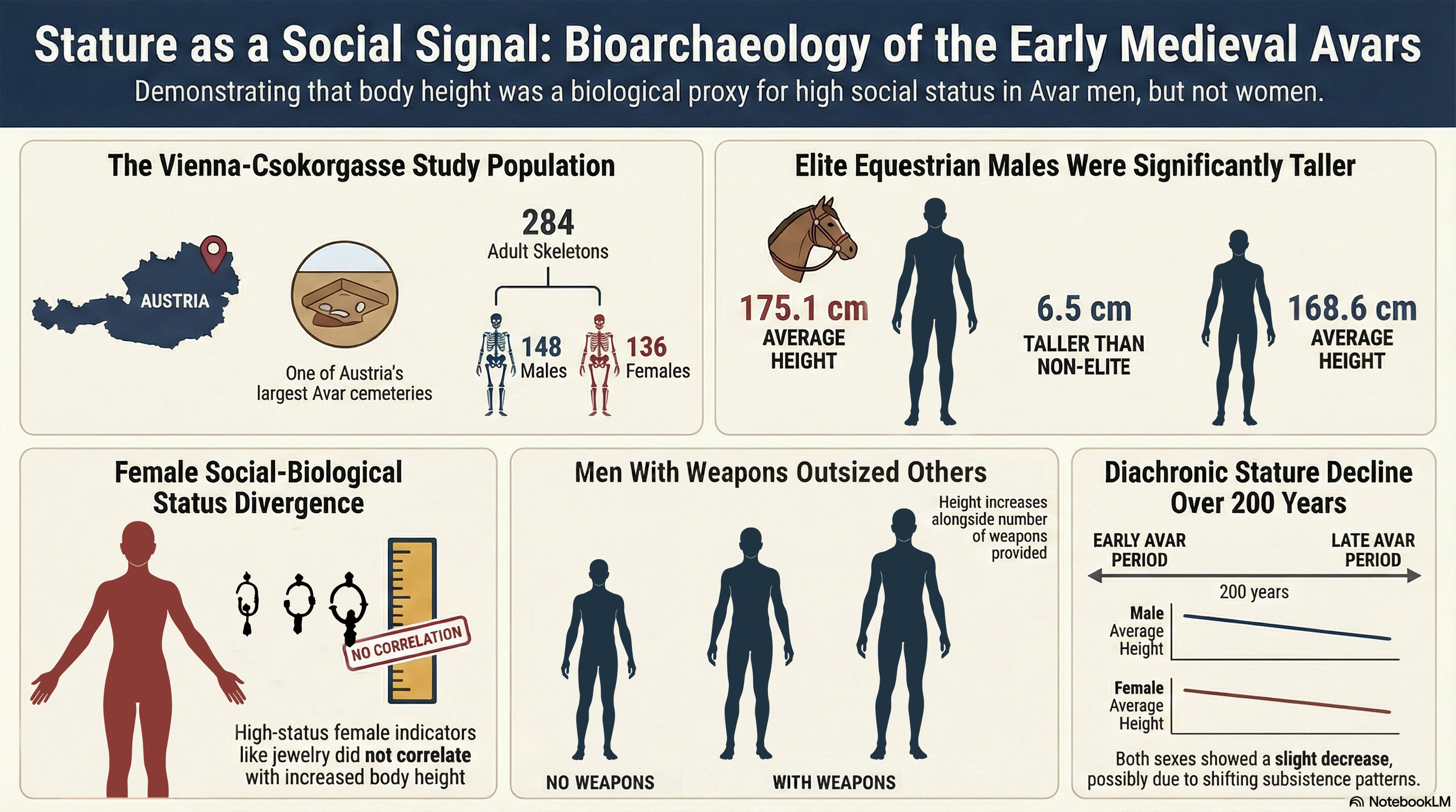
Graphical Abstract
1. Introduction
The fundamental aim of anthropological and bioarchaeological research is to reconstruct the living conditions and environments of past populations, including their subsistence strategies, social stratification, gender roles, and their responses to crises—whether political upheavals, subsistence stress, environmental change, or armed conflict. Methodological advances in paleogenetics, isotope analysis, and proteomics have contributed to new insights into group structures, morbidity and mortality, nutrition, kinship, migration patterns, pathologies, and epidemics [1]. However, material remains cannot be dispensed with, as they are a particularly important source of information on social parameters [2,3]. This is especially true for societies that have left little or no written sources of their own and whose lifestyle and living conditions can only be reconstructed without written information or based on written remains from other populations. A major difficulty here lies in the interpretation of material finds when they are used to reconstruct social structures or gender roles, as these interpretations are usually based on recent patterns, even though we do not know whether these associations between material goods and social status or gender identity also apply to the population under investigation [4].
In recent decades, economic historians have suggested using biological proxies when reconstructing economic and social processes, as these are often associated with the somatic characteristics of the people involved [5,6,7,8,9,10,11]. One parameter that has been used frequently is body height, which results from growth during the subadult phase of life [12]. Since the growth process is influenced not only by genetic and biological components but also by exogenous factors from the social, political, economic, and natural environments [12,13], body height largely reflects living conditions during the subadult phase [14,15]. Body height can thus be interpreted as a biological proxy for childhood and adolescent living conditions, but it also serves as a social signal and has been associated with social status, dominance, and competence [16]. In addition, a positive correlation between body height and the possibility of social mobility has been described [17]. Recently, the association of tallness with competence, economic success, and dominance has led to the current discussion of heightism [18].
In prehistoric and historical populations, analyzing the association between body height and material remains in an archaeological context is a possibility of examining the interaction between biological and social status [19]. On the one hand, it allows us to examine the significance of social inequality for living conditions in childhood and adolescence and thus for the growth process, and, on the other hand, enables conclusions to be drawn about the association between biological and material indicators of social status. This relationship between social-material parameters and biological indicators has been examined relatively rarely to date. Most of these studies have focused on the significance of the Neolithic transition for biological indicators such as body height [20,21,22], with very inconsistent associations being observed [23,24]. Studies of medieval populations also found no significant correlations between body height and material indicators of social status [19,25], although taller stature, better nutritional status, and lower stress levels have repeatedly been described for social elites in historical and prehistoric populations [26,27,28,29,30,31,32].
Such an analysis has not yet been conducted for the Avars, a population without written records that originated in Central Asia and dominated the Carpathian Basin and the Pannonian Basin in eastern Central Europe from the 6th to the early 9th century CE [33]. Therefore, the present study focuses on the interaction between social and biological status based on the association between funerary treatment, grave goods, and skeletal biology in a sample of early medieval Avars from Austria.
The Avars
In the 6th century CE, the Avars reached the Carpathian Basin and eventually the Pannonian Basin in what is now Austria. Their origins had long been the subject of speculation [33], as the Avars themselves left no written sources and historical information came exclusively from the Franks and the Byzantines, who cannot be considered objective, as the Avars were at war with both groups [34]. Recent paleogenetic analyses now prove their origin in Central Asia in the area of present-day Mongolia and a genetic relationship with the Central Asian Rouran [35]. They reached Europe in the fastest long-distance migration ever recorded. They covered more than 5000 km within a few years and had already reached the region of present-day Ukraine by 567 CE [35]. For about 250 years, the Avars dominated an area stretching from the Carpathian Basin to the Alps, encompassing parts of the present-day states of Austria, Bulgaria, Croatia, Czechia, Hungary, Romania, and Serbia [36]. They are documented in the area of present-day Austria until around 800 CE, after which they disappear in the course of Charlemagne’s wars against the Franks, just as suddenly as they had appeared in this region. In the Carpathian region, there is evidence of Avar settlement until the 9th century [33,35,37,38,39]. The fate of the Avars remains unclear to this day. It can be assumed that after the collapse of Avar rule, many Avars were baptized and integrated into the Frankish Empire, while others fled eastward and joined the Bulgarians [40].
Furthermore, little is known about the Avar way of life and social structures. Their rapid movement from Central Asia to Europe was likely due to their specialized warfare tactics, in which horses played a particularly important role. Their enemies, the Byzantines and Franks, described them as brutal horsemen [33,34]. The introduction of the systematic use of iron stirrups gave the Avar horsemen great stability in the saddle and enabled them to wage war efficiently as mounted archers [33,41]. Horses therefore, played a central role in the lives of the Avars, with riding being practiced not only by male warriors but also by women. Traces of habitual riding have also been found on female skeletons [42].
As far as the Avar way of life is concerned, it is assumed that a transition in subsistence took place during the approximately 200 years of settlement in the Carpathians and the Pannonian Basin. The equestrian nomadic lifestyle changed towards a subsistence based on livestock farming and agriculture [33]. Despite this transition, the horse retained a high status in Avar society [36], which can be seen not only from the equestrian characteristics of the skeleton in all periods, but also in the few equestrian burials, which, according to the grave goods, were interpreted as particularly high status [43,44].
However, apart from the great importance of horses, little is known about Avar society. Due to the lack of written sources, we can often only speculate about social structure, gender roles, and lifestyle. Even though a recent paleogenetic analysis provided clear evidence of a patrilineal society with female exogamy but levirate marriages [38], grave inventories are still considered the most frequently used sources for reconstructing social status and social structure. More than 100,000 graves have been identified in the Avar settlement area in Europe, making them the main source of information about the Avar way of life beyond their military successes [33,39]. Numerous Avar-era burial grounds have also been identified and excavated in the eastern part of present-day Austria [45,46,47]. On the one hand, weapons buried with the dead attest to the great importance of warriors in Avar society [33,40]. On the other hand, non-military grave goods such as amphoras, jewelry, in particular gold earrings, bracelets, and—most prominently—their multipart belt sets can be interpreted as indicators of the social status and wealth of the deceased [33,34]. An association between grave goods and social status was described primarily for the male gender due to the high significance of weapons, but especially of multipart belt sets. As far as the social status of Avar women is concerned, only the analysis by Distelberger [48] is available to date for the Avars in the area of present-day Austria. Consequently, relatively little is known about gender roles, social status, and the lives of Avar women in this area.
Hence, this study focuses on sex differences in the interaction between social and biological status based on the association between funerary treatment, grave goods, and skeletal biology in a sample of early medieval Avars. This approach requires interdisciplinary collaboration so that the material, social, and biological aspects can be analyzed competently. Therefore, this study was conducted in collaboration between archaeology and anthropology to relate material and social factors, such as grave goods and burial characteristics, to biological markers, in this case body height and osteological signs of habitual horse riding. The following hypotheses were tested:
-
Body height is positively associated with grave goods, funeral characteristics, and activity indicators that symbolize higher social status.
-
The associations between social and biological parameters are more pronounced in men than in women.
2. Materials and Methods
2.1. The Site—The Avar Cemetery at Csokorgasse, Vienna (Austria)
About 50 years ago, a rescue excavation by the Vienna City Archaeology Department (Museen der Stadt Wien—Stadtarchäologie) in the Csokorgasse area of the 11th district of Vienna, Austria, uncovered an early medieval burial ground at the eastern fringe of the southeastern Upper Danube River Basin (sUDRB), comprising 755 burials in 705 graves (Figure 1 and Figure 2).
Therefore, the Csokorgasse burial ground is one of the largest Avar cemeteries in what is now Austria—almost all the skeletons recovered from the Csokorgasse burial ground are currently housed in the collection of the Department of Evolutionary Anthropology at the University of Vienna. Demographic analyses showed that a typical early medieval population was buried in the Csokorgasse area, comprising 240 adult females, 232 adult males, and 312 subadult individuals. 214 individuals were younger than 6 years. Based on the grave goods, the burial ground was attributed to the Avars [49], and evidence of its use over a period of about 200 years was found. Preliminary analysis of the grave goods [49,50] and zooarchaeological analysis [51] led to a chronological classification of most of the graves recovered, proving that this burial ground was in use for around 200 years. A rough chronological classification indicates an early occupation phase between approximately 625 and 675 CE, a middle phase from 675 to 735 AD, and a late Avar period from approximately 735 to 800 AD. In terms of chronology, the sample is evenly distributed: one-third belongs to the early, middle, and late phases of the burial ground.
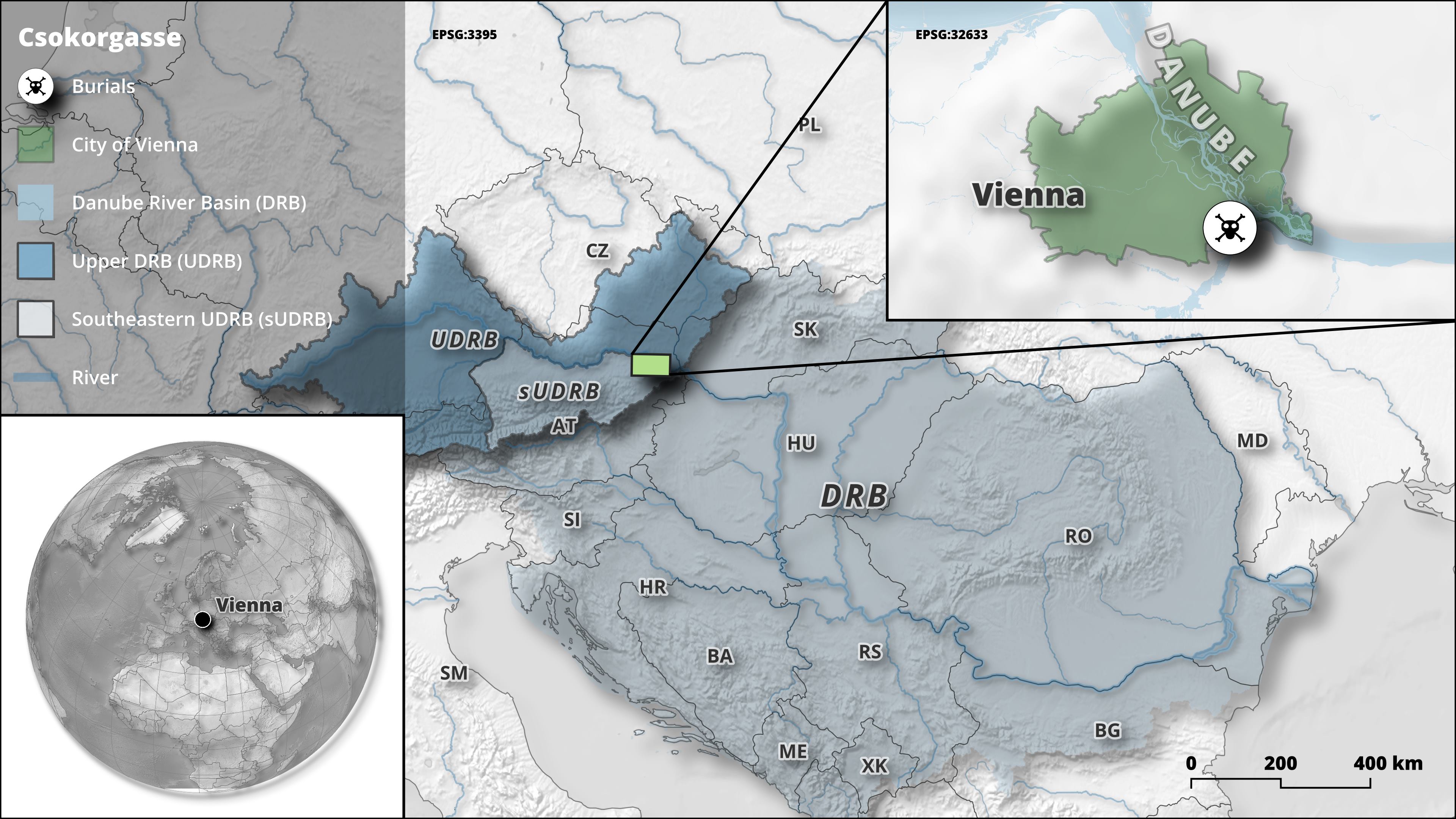
Figure 1. Location of the Csokorgasse burial ground in Vienna (Austria) at the southeastern Upper Danube River Basin (sUDRB) (Dominik Hagmann 2026; sources: Federal Office of Metrology and Surveying, City of Vienna—https://data.wien.gv.at/—accessed on 15 March 2026, Copernicus, Natural Earth).
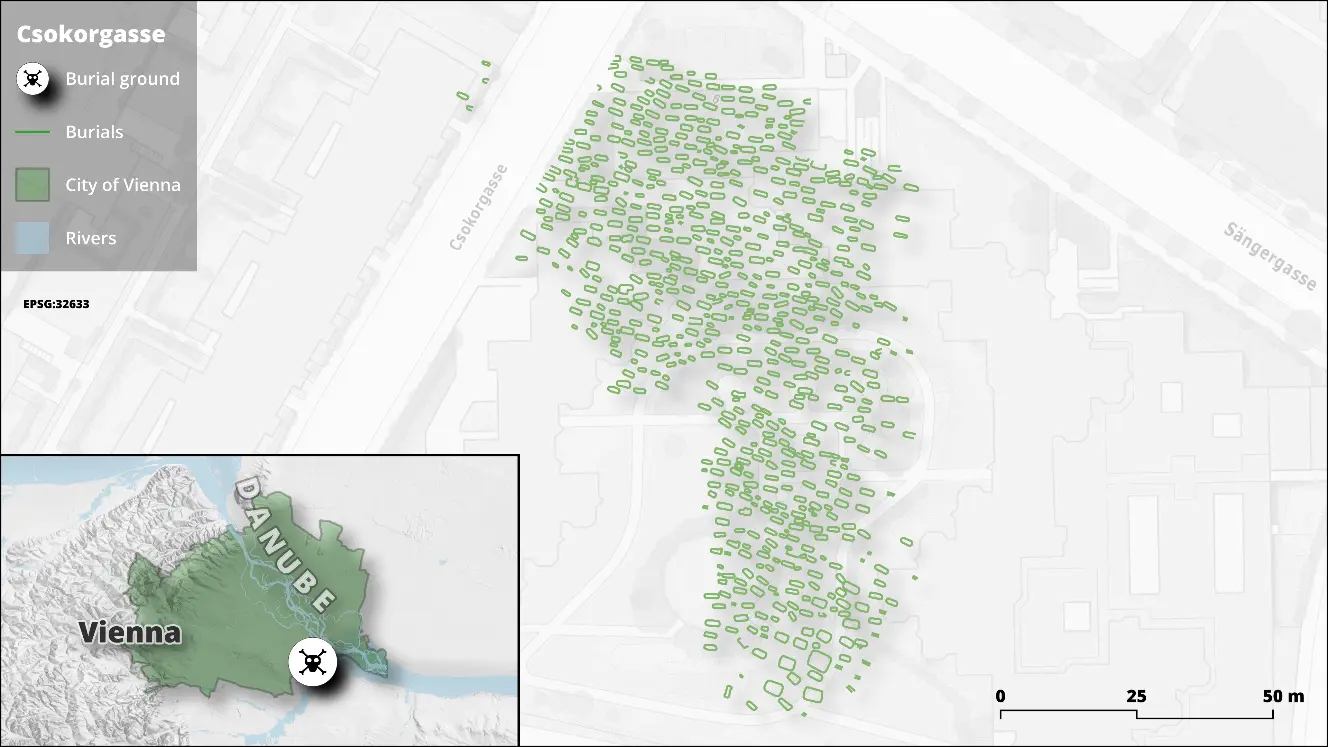
Figure 2. The Vienna-Csokorgasse site in Austria, with more than 700 burials (grave outlines marked in green) excavated in the 1970s during urban redevelopment and the construction of housing estates, is located at the southeastern city border and is today completely built over (Dominik Hagmann 2026; sources: Federal Office of Metrology and Surveying, City of Vienna—https://data.wien.gv.at/—accessed on 15 March 2026, Museums of the City of Vienna—City Archaeology, Copernicus, Natural Earth).
The first comprehensive analysis of the recovered skeletons was carried out in the 1980s [52], and various other issues have been published in numerous studies [42,53,54,55,56,57].
2.2. The Sample
A total of 284 individuals were included in the present study—the strict exclusion criteria are illustrated in Figure 3.
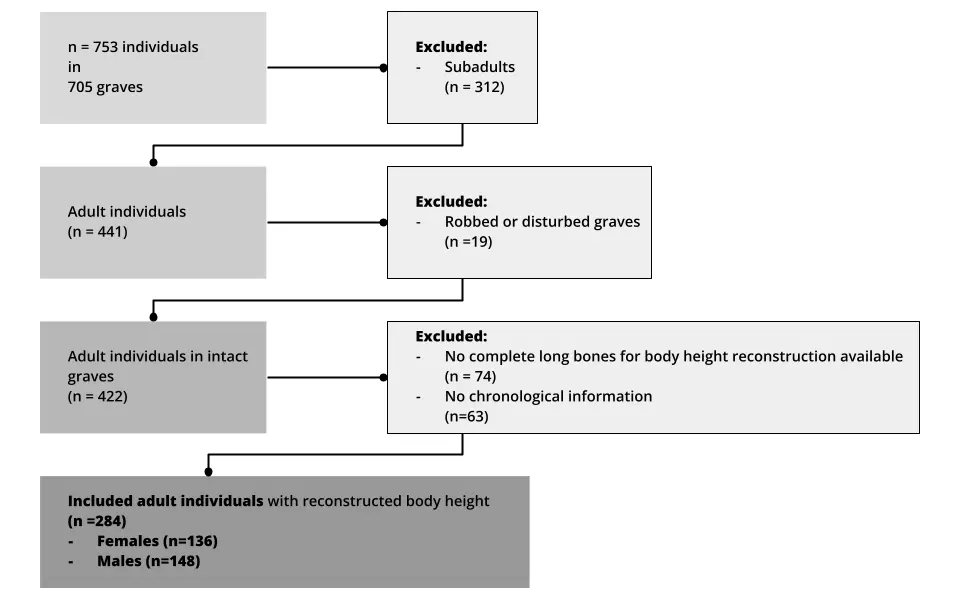
Figure 3. Flow chart of the sampling strategy used to define the individuals included in this study from the Avar burial ground at Vienna-Csokorgasse.
Only adult individuals whose biological skeletons could be analyzed based on morphological characteristics, and whose long bones were preserved in a way that allowed their height to be reconstructed, were included. In addition, individuals who came from disturbed or robbed graves and who could not be assigned to one of the three chronological phases were excluded. Consequently, a total of 284 skeletons were included in the present study. This is 38% of the 755 burials and about 64.4% of the individuals older than 20 years excavated there.
2.3. Sex and Age Determination
Sex and age at death of the individuals were estimated by combining various morphological standard techniques. For sex determination, pelvic bones were classified according to Phenice [58] and Walker [59], and skull morphology according to Walker in Buikstra and Ubelaker [60]. For age at death evaluation, we used the pubic symphysis scoring system according to Brooks and Suchey [61], and the auricular surface of the ilium according to Lovejoy et al. [62]. Furthermore, mandibular and maxillary attrition were used according to Lovejoy [63]. We compared our sex and age at death results with those provided by Großschmidt [52]. Since sex diagnosis was based exclusively on osteological parameters, this study considers only biological sex and uses the term sex.
2.4. Anthropometrics and Body Height Estimation
Body height was estimated by the regression formulas of Breitinger [64] for male classified individuals and the formula of Bach [65] for female classified individuals, although these two determination formulas are mainly used in German-speaking countries. Our decision to use these methods is based on the fact that most older body height estimations of Avar skeletons in Austria are also based on these methods. Therefore, better comparability was one reason to apply these methods. Furthermore, all regression formulas for reconstructing body height are based on data from recent humans and therefore are only of limited applicability to a historical population such as the Avars in question. In general, body heights calculated using formulas based on another reference population are less reliable [66]. To calculate the body height, the following measurements were taken using a standard osteometric board according to the recommendations of Bräuer [67]:
-
-
Femur: maximum length
-
-
Tibia: maximum length
-
-
Humerus: maximum length
-
-
Radius: maximum length
To avoid inter-observer error, only one trained person (S. Kirchengast) carried out all measurements. To ensure the repeatability of metric data, all measurements were taken twice, and the arithmetic mean value was calculated.
2.5. Indicators of Frequent Horse Riding
As indicators of frequent horse riding, we used the non-metric Poirier’s facet of the anterior area of the femoral head-neck junction according to the classification system developed by Radi et al. [68]. According to Radi et al. [68], the characteristics of Poirier’s facet are as follows:
-
The expansion surface on the femoral neck is continuous with the articular surface of the femoral head.
-
The expansion surface on the femoral neck is on the same plane as the femoral head.
-
The expansion surface on the femoral neck is smooth.
As a metric indicator of horse riding, we used the Index of Ovalization of the Acetabulum [IOA] according to Berthon et al. [69]. The IOA quantifies the “vertical elongation of the acetabulum” [“ovalization”] and is defined as the quotient of the “maximum vertical diameter of the acetabulum [VEAC]” and the “maximum horizontal diameter of the acetabulum [HOAC]:”
Only one observer (B. Bühler) took the measurements using a digital caliper, in mm, to 1 decimal. Each VEAC and HOAC was measured twice, and the arithmetic mean value was calculated. The mean values of VEAC and HOAC were then used to calculate the IOA. Intra-observer reliability was measured by conducting a third round of measurements for 10 randomly selected individuals (20 femora), several months after the session for measurements 1 (initial measurement) and 2 (control measurement). Habitual horse-riding was diagnosed if either a Poirier’s facet was present and/or the IOA exceeded 1.05.
2.6. Social Indicators
As characteristics to define the social funerary context, we used grave depth below the excavation horizon, the presence of a coffin, and equestrian burials, defined as graves containing skeletal remains of a horse together with the deceased. A grave depth of more than 1 m below the excavation horizon and the presence of a coffin were interpreted as indicators of higher status, whereas an equestrian burial was regarded as evidence of very high social status. As further indicators of social status, multipart-belt sets were used for males, as these are interpreted as a special status symbol among the Avars. Daim [43] and Baron [51] describe a significant association between belt sets as grave goods and the depth of the grave. The inclusion of jewelry (earrings, fingerings, bracelets, necklaces) was also considered a social indicator. At least one weapon (composite bow remains, arrowheads, sword, saber, sax) as a grave good was considered an indicator of a warrior. In addition, the number of weapons among warriors was also taken into account.
2.7. Data Management and Visualization
Bioarcheological data were stored in XLSX files and managed via the open-source geographic information system QGIS (version 3.44) and Google Drive to ensure centralized access and version control [70]. For spatial data integration and visualization, a scaled digital drawing of the Csokorgasse burial ground (DWG format, courtesy of the Museums of the City of Vienna—City Archaeology) was imported into QGIS to provide the necessary spatial framework. All mappings were conducted using the coordinate reference systems EPSG:3395 (WGS 84/World Mercator) and EPSG:32633 (WGS 84/UTM zone 33N).
2.8. Statistical Analysis
For statistical analyses, we used SPSS for Windows (version 31). After calculating descriptive statistics, the non-parametric Kruskall-Wallis-test and the Mann Whitney U-test were used to test group differences in body height with respect to statistical significance. Fisher’s exact tests were applied to test group differences of non-metric parameters. Variance in body height was evaluated by the coefficient of variation. V* = (1 + 1/4n) × (100sd/mean). (n = sample size, sd = standard deviation) According to Sokal and Rohlf [71]. This method was used in a similar analysis by Sparacello et al. [72]. Linear multiple regression analyses were performed to test the impact of social indicators and chronology on body height. A p-value < 0.05 was considered significant.
3. Results
3.1. Sexual Dimorphism in Biological and Social Parameters
Mean male body height was 168.9 cm (±4.2) and ranged from 156.5 to 180.5 cm, while mean female body height was 158.8 cm (±3.6). Consequently, male individuals were on average 10.1 cm taller than their female counterparts. This difference was statistically significant (p < 0.001). Over 40% of men and women exhibited characteristics of habitual riding, with men exhibiting this characteristic slightly more frequently. An equestrian grave was found among 3 males only. As expected, weapons, indicators of a warrior, and multipart belt sets occurred exclusively among males, while jewelry was found significantly more often in female’s graves (Table 1).
Table 1. Sex differences in biological and social parameters (Fisher exact tests).
|
Non-Metric Parameters |
Males |
Females |
p-Value |
|||
|---|---|---|---|---|---|---|
|
n |
% |
n |
% |
|||
|
Signs of a coffin |
66 |
44.6% |
65 |
47.8% |
0.337 |
|
|
Grave depth |
||||||
|
<1 m |
103 |
70.1% |
89 |
65.4% |
0.240 |
|
|
>1 m |
44 |
29.9% |
47 |
34.6% |
||
|
equestrian grave |
3 |
2.0% |
0 |
0.0% |
0.140 |
|
|
Signs of habitual horse riding |
||||||
|
Yes |
32 |
47.8% |
27 |
43.5% |
0.381 |
|
|
No |
35 |
52.2% |
35 |
56.5% |
||
|
region not present |
83 |
77 |
||||
|
Weapons present |
61 |
41.2% |
1 |
0.7% |
<0.001 |
|
|
Warrior 2 and more weapons present |
21 |
14.2% |
0 |
0.0% |
<0.001 |
|
|
Multipart belt set |
31 |
20.9% |
0 |
0.0% |
<0.001 |
|
|
Jewelry present |
57 |
38.5% |
110 |
80.9% |
<0.001 |
|
3.2. Diachronic Changes in Body Height
The examination of diachronic trends in body height from the early Avar period in the 7th century to the late Avar period in the second half of the 8th century showed no statistically significant changes in body height. Nevertheless, a trend can be observed. There is a reduction in average body height over time. This applies to both sexes, although the reduction in average body height is more pronounced in males. The average body height of males decreased by 1.7 cm from 169.7 to 168 cm, while the average body height of females decreased by only 0.7 cm from 159.1 to 158.4 cm from the early to the late Avar period. Furthermore, the coefficient of variation of body height varies more significantly between the chronological phases in males (Table 2).
Table 2. Body height and chronology for each sex separately (Kruskall-Wallis Tests).
|
Chronology |
Body Height [in cm] |
|||||||
|---|---|---|---|---|---|---|---|---|
|
n |
% |
Mean |
SD |
Median |
Min |
Max |
V* |
|
|
Males |
148 |
|||||||
|
Early Avar period |
60 |
40.5% |
169.7 |
4.3 |
169.1 |
161.5 |
180.5 |
2.54 |
|
Middle Avar period |
47 |
31.8% |
168.7 |
3.8 |
169.0 |
156.5 |
177.3 |
2.26 |
|
Late Avar period |
41 |
27.7% |
168.0 |
4.2 |
167.5 |
160.0 |
178.5 |
2.52 |
|
H = 3.7, p = 0.155 |
||||||||
|
Females |
136 |
|||||||
|
Early Avar Period |
45 |
33.1% |
159.1 |
3.7 |
159.5 |
150.5 |
165.5 |
2.33 |
|
Middle Avar Period |
49 |
36.0% |
158.7 |
3.6 |
158.5 |
152.0 |
169.5 |
2.29 |
|
Late Avar Period |
42 |
30.9% |
158.4 |
3.6 |
158.1 |
151.0 |
166.7 |
2.28 |
|
H-value: 1.99, p = 368 |
||||||||
3.3. Body Height and Indicators of Status
Table 3 demonstrates body heights according to social status associated parameters for males and females separately.
Table 3. Body height and selected indicators of social status for each sex separately (Kruskall wallis tests *, Mann-Whitney U tests **).
|
Status Indicators |
Body Height (in cm) |
||||||||
|---|---|---|---|---|---|---|---|---|---|
|
n |
% |
Mean |
SD |
Min |
Max |
Difference |
p-Value |
||
|
Males |
148 |
||||||||
|
Horse riding |
|||||||||
|
No signs |
35 |
23.6% |
169.4 |
4.4 |
156.5 |
177.5 |
1.4 |
0.084 * |
|
|
Signs of horse riding |
30 |
20.3% |
167.8 |
4.2 |
160.0 |
174.0 |
|||
|
Undeterminable |
83 |
56.1% |
168.7 |
3.9 |
159.3 |
180.5 |
|||
|
equestrian grave |
|||||||||
|
yes |
3 |
2.0% |
175.1 |
2.4 |
172.8 |
177.5 |
6.5 |
0.003 ** |
|
|
no |
145 |
98.0% |
168.6 |
4.0 |
156.5 |
180.5 |
|||
|
Coffin sign |
|||||||||
|
Yes |
66 |
44.6% |
168.3 |
3.9 |
160.0 |
176.8 |
0.7 |
0.147 ** |
|
|
no |
82 |
55.4% |
168.6 |
4.3 |
156.5 |
180.5 |
|||
|
depth |
|||||||||
|
<1 m |
103 |
69.6% |
168.9 |
4.2 |
156.5 |
180.5 |
0.2 |
0.389 ** |
|
|
>1 m |
44 |
29.7% |
169.1 |
4.1 |
160.0 |
177.7 |
|||
|
Warrior |
|||||||||
|
yes |
61 |
41.2% |
169.8 |
3.9 |
161.0 |
180.5 |
1.6 |
0.005 ** |
|
|
no |
87 |
58.8% |
168.2 |
4.1 |
156.5 |
179.5 |
|||
|
Number of weapons |
|||||||||
|
1 |
35 |
23.6% |
167.8 |
4.3 |
160.3 |
179.5 |
0.049 * |
||
|
2 |
17 |
11.5% |
171.1 |
3.5 |
164.5 |
178.3 |
|||
|
≥3 |
9 |
6.1% |
171.4 |
3.9 |
162.2 |
173.9 |
|||
|
Multipart Belt set |
|||||||||
|
yes |
31 |
20.9% |
169.5 |
3.2 |
162.2 |
176.6 |
0.9 |
0.120 ** |
|
|
no |
117 |
79.1% |
168.6 |
4.3 |
156.5 |
180.5 |
|||
|
Jewellery |
|||||||||
|
yes |
57 |
38.5% |
168.8 |
3.4 |
156.5 |
175.7 |
0.1 |
0.321 ** |
|
|
no |
91 |
61.5% |
168.9 |
4.4 |
159.3 |
180.5 |
|||
|
Females |
136 |
||||||||
|
Horse riding |
|||||||||
|
No signs |
35 |
25.7% |
158.8 |
3.2 |
152.0 |
166.0 |
0.9 |
0.188 * |
|
|
Signs of horse riding |
24 |
17.6% |
159.7 |
4.3 |
150.9 |
169.5 |
|||
|
undeterminable |
77 |
56.6% |
158.4 |
3.7 |
150.5 |
167.0 |
|||
|
Coffin sign |
|||||||||
|
Yes |
65 |
47.8% |
158.9 |
3.9 |
150.5 |
169.5 |
0.3 |
0.300 ** |
|
|
no |
71 |
52.2% |
158.6 |
3.3 |
151.0 |
166.7 |
|||
|
depth |
|||||||||
|
<1 m |
89 |
65.4% |
159,1 |
3.7 |
150.9 |
169.5 |
0.8 |
0.096 ** |
|
|
>1 m |
47 |
34.6% |
158.2 |
3.5 |
150.5 |
165.3 |
|||
|
Jewelry |
|||||||||
|
Yes |
110 |
80.9% |
158.5 |
3.7 |
150.5 |
169.5 |
1.3 |
0.042 ** |
|
|
no |
26 |
19.1% |
159.8 |
3.3 |
151.0 |
166.7 |
|||
Among males, the greatest difference in body height was found between individuals who were interred in an equestrian grave together with a horse and those who were buried without horses in non-equestrian graves. The average body height of those buried in an equestrian grave was 175.1 cm, which was on average 6.5 cm taller than that of men who were buried without horses. This difference was highly significant (p = 0.003); however, only 3 equestrian burials were available for comparison. No equestrian burials were identified for women. However, in terms of osteological evidence of frequent horse riding, men and women who were thought to have ridden frequently were shorter than men and women who showed no morphological or metric evidence of habitual horse riding. The difference in body height was 1.6 cm on average for men and 0.9 cm for women. However, these differences were not significant. Regarding jewelry grave goods, there were no differences in body height between men who had been buried with jewelry and those who had not. In contrast, a significant difference in body height was found between women with and without jewelry. Women without jewelry were significantly taller, by an average of 1.3 cm (Table 3).
Among men, there was a highly significant difference (p = 0.005) between warriors, i.e., men who were buried with weapons, and those who were not buried with weapons. Men who carried weapons, or warriors, were on average 1.6 cm taller than men without weapons. Among the warriors, the number of weapons in the grave was also significantly associated with body height. Men who had been buried with three or more weapons were significantly taller, with an average height of 171.4 cm, than men who had been buried with only one weapon and had an average height of only 167.8 cm. In contrast, no significant difference in body height was found between men with a multipart belt set and those without evidence of a belt set (Table 3).
These observations were confirmed by the results of multiple regression analysis (Table 4). In women, there were no significant associations between body height and chronology, equestrian characteristics, and jewelry. In men, however, there was a significant negative diachronic trend in height, as well as a highly significant association between equestrian graves and body height, and a significant negative association between jewelry and body height.
Table 4. Impact of social status on body height for each sex differently (multiple regression analyses).
|
R2 |
B |
p-Value |
95% CI |
|
|---|---|---|---|---|
|
Dependent variable: Body height |
||||
|
males |
||||
|
Chronology |
1.0 |
−1.09 |
0.018 |
−1.99–0.19 |
|
equestrian grave |
7.56 |
0.003 |
2.60–12.52 |
|
|
Grave depth category |
−0.32 |
0.704 |
−1.96–1.32 |
|
|
Coffin signs |
0.84 |
0.311 |
−0.79–2.47 |
|
|
warrior |
−0.79 |
0.640 |
−4.11–2.54 |
|
|
Number of weapons |
0.46 |
0.542 |
−1.01–1.95 |
|
|
Multipart belt set |
0.18 |
0.862 |
−1.84–2.19 |
|
|
Jewellery |
−0.52 |
0.486 |
−1.99–0.95 |
|
|
females |
||||
|
Chronology |
0.5 |
−0.28 |
0.472 |
−1.06–0.49 |
|
Grave depth category |
−1.12 |
0.123 |
−2.55–0.31 |
|
|
Coffin signs |
0.84 |
0.225 |
−0.52–2.19 |
|
|
Jewellery |
−1.40 |
0.077 |
−2.96–0.16 |
|
4. Discussion
This study is the first to analyze the associations between indicators of social and biological status, as reflected by body height, in a sample of Avars from the area of present-day Austria. It focuses on the Avar population of the Vienna-Csokorgasse burial ground, one of the largest Avar cemeteries in Austria. Here, body height is used as a biological proxy for living conditions during childhood and adolescence to examine its relationship with indicators of social status among early medieval Avars. Although major international projects, particularly paleogenetic studies, have recently provided important new insights into Avar history [35,37,38,39], many aspects of Avar society and gender roles remain unresolved.
However, it is known from recent populations that health and disease, but also body height, are closely related to social factors—higher socioeconomic and social status is associated with higher life expectancy, lower disease burden, and greater body height [73,74,75,76,77,78]. The reason for this is lower social and biological stress levels associated with higher socioeconomic and social status. The higher the socioeconomic status, the better the access to medical care, the better the living conditions, the less strenuous and risky the occupations, and often the greater the health awareness, which leads to better nutrition and lower consumption of stimulants and addictive substances [79,80]. But can this pattern, which is valid for recent populations, also be applied to historical and prehistoric populations?
Some studies of historical populations have been able to demonstrate a correlation between biological indicators such as body height and social status [30,31,32,72,81], while others have not [19,21,25]. To date, there have been no studies on body height and social status among the Avars from Austrian sites. In a previous study of our group, the association between biological stress indicators, such as enamel hypoplasia or cribra orbitalia, and body height in the Avar population from the Vienna Csokor Gasse burial ground was tested. But we found no significant correlations between periods of stress in childhood and adult body height [55]. One problem in analyzing associations between social and biological status among the Avars is the limited knowledge of social stratification, social structure, and gender roles.
What is certain is that horses played a central role in Avar society [82], as typical of populations from the steppe areas of central and east Asia [83]. Among the Avars, both men and women were habitual riders [42,44], and that riding was associated with higher social status [56]. In the present study, this pattern is reflected in the significantly greater body height of men buried in equestrian graves: Avar men interred with horses were significantly taller than those not buried with a horse, with an average height difference of 6.5 cm. However, it should be noted that only three men were buried with horses in the present sample, so this sample cannot be interpreted as representative. Similarly, warriors, i.e., men who had been buried with weapons, were significantly taller than men who had been buried without weapons. Body height also increased significantly with the number of weapons. It is possible that tallness led to selection as warriors, or that future warriors received special treatment during the subadult phase, with better nutrition and the prospect of social advancement, thus experiencing an enhanced growth process.
No significant differences in body height were observed depending on the presence of a multipart belt set, although men with belt sets were on average almost 1 cm taller than men without belt sets. Since belt sets are indicators of higher status, this trend is in line with expectations. There was no significant association between grave characteristics, such as signs of a coffin or a grave depth of more than 1 m. Both are considered indicators of higher status, but no differences in body height could be observed. The same applies to the presence of jewelry in men. Osteological evidence of habitual horse riding was insignificantly associated with lower body height.
In females, only a significant correlation between body height and jewelry as grave goods was demonstrated; women who were buried with jewelry were, on average, 1.3 cm shorter than those who were not. However, women with osteological evidence of habitual horse riding were insignificantly taller than women without evidence of frequent horse riding.
Hypothesis 1, which predicted that body height would correlate positively with grave goods symbolizing higher social status, grave characteristics, and activity patterns typical of the Avars, could therefore only be partially verified.
Only very clear indicators of higher social status, such as equestrian burials, show a highly significant positive correlation with male body height. The multipart belt set also shows a positive but not significant correlation with body height. This corresponds to the results of studies that describe a positive correlation between social status and biological characteristics [20,26]. The unproven associations between grave parameters, such as grave depth and coffin remains, and body height correspond to those studies that reported no differences in body height and other stress indicators depending on grave goods symbolizing social status [23,24,25].
One possible explanation for this is that body height reflects living conditions in childhood and adolescence [15]. Somatic and psychological stress during the growth phase has a negative impact on the growth process and results in shorter body heights in adulthood [12]. Since we do not know what stresses Avar children were exposed to, we cannot relate these to social status.
Regarding the spatiotemporal perspective, the Avars occupied the Csokorgasse cemetery for about 200 years; during this period, there was a transition in subsistence, but also repeated armed conflicts. The average body height in the present sample did not change significantly over this period, but there was an insignificant decrease in average body height in both sexes. This result is similar to that of Sparacello et al. [72]. This study analyzed diachronic changes in body height among Iron Age Samnites in Italy. Here, too, despite significant changes in political conditions, no significant change in body height could be detected. This also applied to both males and females. In our sample, the lack of diachronic changes in body height can have various causes:
-
Living conditions in childhood deteriorated during the transition from nomadic horsemen to settled cattle breeders. In his paleopathological analysis, Großschmidt [52] reports a slight deterioration in health during the middle Avar period. This could indicate periods of stress in childhood, regardless of social status, which ultimately resulted in shorter stature in adulthood.
-
Another explanation could be that the population buried in the Csokorgasse area became genetically more heterogeneous. During their migration from Central Asia to Europe, the Avars encountered numerous other populations, both in war and in peace. The population that reached the Pannonian Basin and thus the area of present-day Vienna in the late 6th century was no longer homogeneous. The study by Wang et al. [39] also confirmed genetic heterogeneity in the Avar population in the Pannonian Basin. A genetically heterogeneous population may have influenced both body height and the distribution of grave goods. It should also be noted that, from an archaeological perspective, the attribution of individuals from Avar-era burial grounds to the Avar population is based almost exclusively on cultural characteristics, such as grave goods, and not on biological characteristics. Distelberger [48] even recommends referring to Avar-era populations rather than Avars.
The fact that individuals with osteological evidence of habitual horse riding are, on average, shorter than men with no evidence of habitual horse riding could also be explained by a heterogeneous population. Horse riding was a typical activity of the Avars, especially the warriors. Non-riders may have belonged to a different population that followed tasks other than horse riding in Avar society. However, this is contradicted by the observation that men buried as warriors were, on average, taller than those buried as non-warriors. Tallness is an important social signal that stands for dominance, aggressiveness, but also competence and status [84]. Tall men may have been positively selected as warriors. Female riders in our sample were insignificantly taller than non-riding women. For women who were not warriors, horse riding may indeed have been an indication of higher status [44].
While the first hypothesis could only be partially confirmed, the second hypothesis, that the association patterns between social and biological status differ between men and women, was confirmed. In the biological female sex, hardly any significant associations between social status and body height could be described. It is well described that males and females differ in genetic and environmental factors contributing to body height [85]. In the biological male sex, body height is an important signaling factor that plays a major role in mate selection and is closely linked to social and economic success in recent populations [16,18,84,86,87]. For biological women, body height plays a significantly lesser role in social mobility, economic, and social success. Although this can only be applied to a historical population to a limited extent, it represents an evolutionary selected pattern [88]. Male body height was shaped by intrasexual selection, as taller males are physically stronger and tend to have a better fighting ability than their shorter same sex rivals [89]. Consequently, tallness is related to mating success and was positively selected. Even in the 20th century, body height is significantly positively related to male reproductive success, whereas among females, average body height is associated with increased reproductive success [90]. On the other hand, male tallness signals strength and biological quality and therefore attracts females. A positive association between social status and body height among males is therefore not only the result of environmental conditions during childhood and adolescence, but also a consequence of evolution.
Limitations and Strengths
The present study has some limitations, such as the small sample size, even though it is one of the largest Avar-period cemeteries in Austria. This is due to the very different states of preservation of the skeletons and the strict inclusion criteria. Another weakness was the exclusively morphological analyses. Genetic analyses could not be carried out for cost reasons, but could have provided additional information on population affiliation. The strength of the study is its interdisciplinary approach, which combines biological-anthropological approaches and archaeological approaches in the sense of interdisciplinary collaboration—it is thus the first study to examine this question using an Avar sample.
5. Conclusions
Our study demonstrates an association between distinct status-associated social parameters and body height among early medieval male Avars from the Csokorgasse burial ground in Vienna. In contrast, except for jewelry, no significant correlation between social status indicators and biological status—specifically body height—exists among females from the same site. These results indicate that males and females show different association patterns between material goods and body height. Therefore, the present study provides initial indications of the importance of sex for the association of social and biological status among this Avar period population. However, further research is required to elucidate these relationships.
Acknowledgments
We thank Martin Penz and the Vienna City Archaeology Department (Museen der Stadt Wien—Stadtarchäologie) for their support and for granting access to the archaeological retro-digitized documentation used in this study.
Author Contributions
Conceptualization: S.K., D.H., B.B.; Methodology: S.K., D.H., B.B.; Software: S.K., D.H.; Formal Analysis: D.H., S.K., B.B.; Investigation: S.K., B.B.; Resources: S.K.; Data Curation: D.H.; Writing—Original Draft Preparation: S.K., D.H.; Writing—Review & Editing: S.K., D.H.; Visualization: D.H.; Project Administration: D.H., S.K.; Funding Acquisition: D.H.
Ethics Statement
Not applicable.
Informed Consent Statement
Not applicable.
Data Availability Statement
The dataset presented in this study is not yet publicly available, as they form part of an ongoing project. They will be published at a later stage in PHAIDRA, the repository of the University of Vienna, under https://doi.org/10.25365/phaidra.537 (accessed on 15 March 2026).
Funding
This research was funded by Hochschuljubiläumsfond der Stadt Wien, grant number H-448297/2023.
Declaration of Competing Interest
The authors declare that they have no known competing financial interests or personal relationships that could have appeared to influence the work reported in this paper.
References
- Pilaar Birch SE, Szpak P. Current developments and future directions in archaeological science. Proc. Natl. Acad. Sci. USA 2022, 119, e2212490119. DOI:10.1073/pnas.2212490119 [Google Scholar]
- Beck LA. Regional Perspectives in Mortuary Analysis; Plenum Press: New York, NY, USA, 1995. [Google Scholar]
- Binford LR. Mortuary practices: Their study and their potential. Mem. Soc. Am. Archaeol. 1971, 25, 6–29. DOI:10.1017/S0081130000002525 [Google Scholar]
- Floris M. Narrative Knowledge, Archaeology, and Gender Roles: How We Use Today’s Stories to Make Sense of the Past. Rivista di estetica 2025, 88, 97–111. DOI:10.4000/14kb7 [Google Scholar]
- Komlos J. Stature and nutrition in the Habsburg monarchy: The standard of living and economic development in the eighteenth century. Am. Hist. Rev. 1985, 90, 1149–1161. DOI:10.1086/ahr/90.5.1149 [Google Scholar]
- Komlos J. Height and Social Status in Eighteenth-Century Germany. J. Interdiscip. Hist. 1990, 20, 607–621. DOI:10.2307/204001 [Google Scholar]
- Komlos J, Kriwy P. Social status and adult heights in the two Germanies. Ann. Hum. Biol. 2002, 29, 641–648. DOI:10.1080/03014460210151723 [Google Scholar]
- Komlos J. The height increments and BMI values of elite Central European children and youth in the second half of the 19th century. Ann. Hum. Biol. 2006, 33, 309–318. DOI:10.1080/03014460600619203 [Google Scholar]
- Komlos J. On the Biological Standard of Living of Eighteenth-Century Americans: Taller, Richer, Healthier. In Research in Economic History; Emerald Group Publishing Limited: Leeds, UK, 2003; p. 53. [Google Scholar]
- Steckel RH. New Light on the “Dark Ages”: The Remarkably Tall Stature of Northern European Men during the Medieval Era. Soc. Sci. Hist. 2004, 28, 211–229. DOI:10.1017/S0145553200013134 [Google Scholar]
- Steckel RH. Biological measures of the standard of living. J. Econ. Perspect. 2008, 22, 129–152. DOI:10.1257/jep.22.1.129 [Google Scholar]
- Bogin B. Social-Economic-Political-Emotional (SEPE) factors regulate human growth. Hum. Biol. Public Health 2021, 1, 1–20. DOI:10.52905/hbph.v1.10 [Google Scholar]
- Hermanussen M, Aßmann C, Scheffler C. Avoiding “Too Tall” and “Too Short”: The Effect of the Community on the Regulation of Body Height. Am. J. Hum. Biol. 2025, 37, e70085. DOI:10.1002/ajhb.70085 [Google Scholar]
- Koepke N, Baten J. The biological standard of living in Europe during the last two millennia. Eur. Rev. Econom. Hist. 2005, 49, 61–95. DOI:10.1017/S1361491604001388 [Google Scholar]
- Thompson K, Lindeboom M, Portrait F. Adult body height as a mediator between early-life conditions and socio-economic status: The case of the Dutch Potato Famine, 1846–1847. Econom. Hum. Biol. 2019, 34, 103–114. DOI:10.1016/j.ehb.2019.04.006 [Google Scholar]
- Hermanussen M, Scheffler C. Stature signals status: The association of stature, status and perceived dominance—A thought experiment. Anthrop. Anz. 2016, 73, 265–274. DOI:10.1127/anthranz/2016/0698 [Google Scholar]
- Bielicki T, Charzewski J. Body height and upward social mobility. Ann. Hum. Biol. 1983, 10, 403–408. DOI:10.1080/03014468300006591 [Google Scholar]
- Lasco G. Beyond ‘heightism’ and ‘height premium’: An anthropology and sociology of human stature. Sociol. Compass 2024, 18, E13178. DOI:10.1111/soc4.13178 [Google Scholar]
- Robb J, Bigazzi R, Lazzarini L, Scarsini C, Sonego F. Social “status” and biological “status”: A comparison of grave goods and skeletal indicators from Pontecagnano. Am. J. Phys. Anthropol. 2001, 115, 213–222. DOI:10.1002/ajpa.1076 [Google Scholar]
- Cohen MN. Health and the Rise of Civilization; Yale University Press: New Haven, CT, USA, 1989. [Google Scholar]
- Tornberg A. Stature and the Neolithic transition—Skeletal evidence from southern Sweden. J. Archaeol. Sci. Rep. 2018, 17, 58–67. DOI:10.1016/j.jasrep.2017.10.031 [Google Scholar]
- Cox SL, Nicklisch N, Francken M, Wahl J, Meller H, Haak W, et al. Socio-cultural practices may have affected sex differences in stature in Early Neolithic Europe. Nat. Hum. Behav. 2024, 8, 243–255. DOI:10.1038/s41562-023-01756-w [Google Scholar]
- White CD, Healy PF, Schwarcz HP. Intensive agriculture, social status and Maya diet at Pacbitun, Belize. J. Anthropol. Res. 1993, 49, 347–375. DOI:10.1086/jar.49.4.3630154 [Google Scholar]
- Wilkinson RG, Norelli RJ. A biocultural analysis of social organization at Monte Alban. Am. Antiq. 1981, 46, 743–758. DOI:10.2307/280103 [Google Scholar]
- Niu Y, Schrader S. Social inequality and body mass differences in two post Medieval Dutch populations. Int. J. Osteoarchaeol. 2024, 34, e3320. DOI:10.1002/oa.3320 [Google Scholar]
- Angel JL. Health as a crucial factor in the changes from hunting to developed farming in the Eastern Mediterranean. In Paleopathology at the Origins of Agriculture; Cohen M, Armelagos G, Eds.; Academic Press: New York, NY, USA, 1984; pp. 51–74. [Google Scholar]
- Borgognini Tarli S, Canci A, Francalacci P, Repetto E. Un approccio antropologico integrato alla ricostruzione delle condizioni di vita e del popolamento in Italia durante la media Età del Bronzo. Rass. Archeol. 1991, 10, 593–601. Available online: https://pascal-francis.inist.fr/vibad/index.php?action=getRecordDetail&idt=6119990 (accessed on 15 March 2026).
- Powell M. Status and Health in Prehistory: A Case Study of the Moundville Chiefdom; Smithsonian Institution Press: Washington, DC, USA, 1988. [Google Scholar]
- Powell M. Ranked status and health in the Mississippian chiefdom at Moundville. In What Mean These Bones? Studies in Southeastern Bioarchaeology; Powell M, Bridges P, Mires A, Eds.; University of Alabama Press: Tuscaloosa, Alabama, 1991; pp. 22–51. [Google Scholar]
- Vercellotti G, Stout SD, Boano R, Sciulli PW. Intrapopulation variation in stature and body proportions: Social status and sex differences in an Italian medieval population (Trino Vercellese, VC). Am. J. Phys. Anthropol. 2011, 145, 203–214. DOI:10.1002/ajpa.21486 [Google Scholar]
- Weiss NM, Vercellotti G, Boano R, Girotti M, Stout SD. Body size and social status in medieval Alba (Cuneo), Italy. Am. J. Phys. Anthropol. 2019, 168, 595–605. DOI:10.1002/ajpa.23776 [Google Scholar]
- Brødholt ET, Gautvik KM, Günther CC, Sjøvold T, Holck P. Social stratification reflected in bone mineral density and stature: Spectral imaging and osteoarchaeological findings from medieval Norway. PLoS ONE 2022, 17, e0275448. DOI:10.1371/journal.pone.0275448 [Google Scholar]
- Pohl W. The Avars: A Steppe Empire in Central Europe, 567–822; Cornell University Press: Ithaca, NY, USA, 2018. DOI:10.7591/9781501729409 [Google Scholar]
- Curta F. A social history of the Avars: Historical and archaeological perspectives. Hist. Compass 2021, 19, e12697. DOI:10.1111/hic3.12697 [Google Scholar]
- Gnecchi-Ruscone GA, Szécsényi-Nagy A, Koncz I, Csiky G, Rácz Z, Rohrlach AB, et al. Ancient genomes reveal origin and rapid trans-Eurasian migration of 7th century Avar elites. Cell 2022, 185, 1402–1413.e21. DOI:10.1016/j.cell.2022.03.007 [Google Scholar]
- Faragó N, Gáll E, Gulyás B, Marcsik A, Molnár E, Bárány A, et al. Dietary and cultural differences between neighbouring communities: A case study on the early medieval Carpathian Basin (Avar and post-Avar period, 7th–9th/10th centuries AD). J. Archaeol. Sci. Rep. 2022, 42, 103361. DOI:10.1016/j.jasrep.2022.103361 [Google Scholar]
- Csáky V, Gerber D, Koncz I, Csiky G, Mende BG, Szeifert B, et al. Genetic insights into the social organisation of the Avar period elite in the 7th century AD Carpathian Basin. Sci. Rep. 2020, 10, 948. DOI:10.1038/s41598-019-57378-8 [Google Scholar]
- Gnecchi-Ruscone GA, Rácz Z, Samu L, Szeniczey T, Faragó N, Knipper C, et al. Network of large pedigrees reveals social practices of Avar communities. Nature 2024, 629, 376–383. DOI:10.1038/s41586-024-07312-4 [Google Scholar]
- Wang K, Tobias B, Pany-Kucera D, Berner M, Eggers B, Gnecchi-Ruscone GA, et al. Ancient DNA and interdisciplinary data reveal a genetic barrier despite shared material culture in large early medieval cemeteries. Nature 2025, 638, 1007–1014. DOI:10.1038/s41586-024-08418-5 [Google Scholar]
- Anke B, Révész L, Vida T. Reitervölker im Frühmittelalter. Hunnen—Awaren—Ungarn; Theiss Verlag: Stuttgart, Germany, 2008. [Google Scholar]
- Daim F. Dritte Thomsen-Vorlesung: Des Kaisers ungeliebte Söhne. Eurasia antiqua: Zeitschrift für Archäologie Eurasiens 2011, 17, 1–20. Available online: https://www.academia.edu/download/43242397/Daim__Des_Kaisers_ungeliebte_Sohne..pdf (accessed on 15 March 2026)
- Bühler B, Kirchengast S. Horse-riding as a habitual activity among the early medieval Avar population of the cemetery of Csokorgasse (Vienna): Sex and chronological differences. Int. J. Osteoarcheol. 2022, 32, 821–831. DOI:10.1002/oa.3107 [Google Scholar]
- Daim F. Das awarische Gräberfeld von Leobersdorf, Niederösterreich. Studien zur Archäologie der Awaren 1987, 1, 11–277. [Google Scholar]
- Čilinská Z. Die awarenzeitlichen Frauengräber mit Pferdebestattung in der Slowakei. A Wosinky Mór Múzeum Evkönyve 1990, 15, 135–146. [Google Scholar]
- Grefen-Peters S. Das awarische Gräberfeld von Leobersdorf, Niederösterreich. Anthropologische und zoologische Auswertung. Das awarische Gräberfeld vonLeobersdorf, Niederösterreich. Studien zur Archäologie der Awaren 1987, 2, 79–323. [Google Scholar]
- Pany-Kucera D, Wiltschke-Schrotta K. Die awarische Bevölkerung von Vösendorf/S1. Ann Naturhistorischen Museums in Wien 2017, 119, 5–31. Available online: https://www.jstor.org/stable/26342920 (accessed on 15 March 2026)
- Pany-Kucera D, Wiltschke-Schrotta K. Die awarenzeitlichen Skelettreste (7.-8. Jh. n. Chr.) aus der archäologischen Grabung in Bruckneudorf (Burgenland), Fundstelle 1A. Annalen des Naturhistorischen Museums in Wien 2023, 124, 27–72. Available online: https://www.jstor.org/stable/27213509 (accessed on 15 March 2026)
- Distelberger A. Österreichs Awarinnen: Frauen aus Gräbern des 7. und 8. Jahrhunderts. In Band 3 von Archäologische Forschungen in Niederösterreich; NÖ Institut für Landeskunde: St. Pölten, Austria, 2004. [Google Scholar]
- Streinz L. Wien 11—Csokorgasse. Fundberichte aus Österreich 1977, 16, 475–531. [Google Scholar]
- Streinz L, Daim F. Zur Belegungschronologie der Nekropole von Wien 11—Csokorgasse. In Quasi liber et pictura. Die Tierknochenfunde aus dem Gräberfeld an der Wiener Csokorgasse. Eine anthrozoologische Studie zu den awarischen Bestattungssitten; Baron H, Ed.; Monographien des Römisch-Germanischen Zentralmuseums: Mainz, Germany, 2018; Volume 143, pp. 615–626. [Google Scholar]
- Baron H. Quasi liber et pictura. Die Tierknochenfunde aus dem Gräberfeld an der Wiener Csokorgasse. Eine anthrozoologische Studie zu den awarischen Bestattungssitten; Monographien des Römisch-Germanischen Zentralmuseums: Mainz, Germany, 2018; Volume 143, pp. 1–613. [Google Scholar]
- Großschmidt K. Paläopathologische Untersuchungen an den menschlichen Skeletten des awarenzeitlichen Gräberfeldes Csokorgasse in Wien-Simmering—Schmelzhypoplasien, Cribrosierungen und Harris’sche Linien als Stressindikatoren. Ph.D. Thesis, University of Vienna, Vienna, Austria, 1990. [Google Scholar]
- Waidhofer M, Kirchengast S. Directional asymmetry of the upper limb bones among Avar skeletons from Eastern Austria. Folia Anthropol. 2016, 15, 24–36. [Google Scholar]
- Treffner J, Kirchengast S. Cross asymmetry of the Upper and lower limb bones among medieval Avar skeletons from Austria. Folia Anthropol. 2020, 16, 29–40. Available online: https://ucrisportal.univie.ac.at/en/publications/cross-asymmetry-of-the-upper-and-lower-limb-bones-among-medieval-/ (accessed on 15 March 2026)
- Wiesinger A, Kirchengast S. Stress during subadult phase did not affect final body height among medieval Avar people. Folia Anthropol. 2021, 17, 15–25. Available online: https://www.researchgate.net/profile/Sylvia-Kirchengast/publication/372131155_STRESS_DURING_SUBADULT_PHASE_DID_NOT_AFFECT_FINAL_BODY_HEIGHT_AMONG_MEDIEVAL_AVAR_PEOPLE/links/64a5801fc41fb852dd53eabd/STRESS-DURING-SUBADULT-PHASE-DID-NOT-AFFECT-FINAL-BODY-HEIGHT-AMONG-MEDIEVAL-AVAR-PEOPLE.pdf (accessed on 15 March 2026)
- Bühler B, Kirchengast S. High-status Avar warriors identified. Differences in the prevalence of the horse-riding syndrome in “high-status” vs “low-status” adult male burials in the Avar cemetery of Wien 11-Csokorgasse (7th–8th century AD). Acta Archeol. 2022, 73, 81–92. DOI:10.1556/072.2022.00007 [Google Scholar]
- Becker J, Kirchengast S. A comparative approach to bony changes in maxillary and frontal sinuses as indicators of upper respiratory health. Int. J. Paleopathol. 2025, 49, 1–11. DOI:10.1016/j.ijpp.2025.02.004 [Google Scholar]
- Phenice TW. A newly developed visual method of sexing the os pubis. Am. J. Phys. Anthropol. 1969, 30, 297–301. DOI:10.1002/ajpa.1330300214 [Google Scholar]
- Walker PL. Greater sciatic notch morphology: Sex, age, and population differences. Am. J. Phys. Anthropol. 2005, 127, 385–391. DOI:10.1002/ajpa.10422 [Google Scholar]
- Buikstra JE, Ubelaker DH. Standards for Data Collection from Human Skeletal Remains: Proceedings of a Seminar at the Field Museum of Natural History; Arkansas Archeological Survey: Fayetteville, NC, USA, 1994. [Google Scholar]
- Brooks S, Suchey JM. Skeletal age determination based on the os pubis: A comparison of the Acsadi and Nemeskeri and Sucey Brooks methods. Hum. Evol. 1990, 5, 227–238. DOI:10.1007/BF02437238 [Google Scholar]
- Lovejoy CO. Dental wear in the Libben population: Its functional pattern and role in the determination of adult age at death. Am. J. Phys. Anthropol. 1985, 68, 47–56. DOI:10.1002/ajpa.1330680105 [Google Scholar]
- Lovejoy CO, Meindl RS, Pryzbeck TR, Mensforth RP. Chronological metamorphosis of the auricular surface of the ilium: A new method of the determination of adult skeletal age at death. Am. J. Phys. Anthropol. 1985, 68, 15–28. DOI:10.1002/ajpa.1330680103 [Google Scholar]
- Breitinger E. Zur Berechnung der Körperhöhe aus den langen Gliedmassenknochen. Anthropol. Anz. 1937, 14, 249–274. Available online: https://www.jstor.org/stable/29536541 (accessed on 15 March 2026)
- Bach H. Zur Berechnung der Körperhöhe aus den langen Gliedmaßenknochen weiblicher Skelette. Anthropol. Anz. 1965, 29, 12–21. Available online: https://www.jstor.org/stable/29537886 (accessed on 15 March 2026)
- Vercellotti G, Piperata BA, Agnew AM, Wilson WM, Dufour DL, Reina JC, et al. Exploring the multidimensionality of stature variation in the past through comparisons of archaeological and living populations. Am. J. Phys. Anthropol. 2014, 155, 229–242. DOI:10.1002/ajpa.22552 [Google Scholar]
- Bräuer G. Osteometrie. In Anthropologie; Knussmann R, Ed.; Fischer Verlag: Frankfurt am Main, Germany, 1988; pp. 160–231. [Google Scholar]
- Radi N, Mariotti V, Riga A, Zampetti S, Villa C, Belcastro MG. Variation of the Anterior Aspect of the Femoral Head-Neck Junction in a Modern Human Identified Skeletal Collection. Am. J. Phys. Anthropol. 2013, 152, 261–272. DOI:10.1002/ajpa.22354 [Google Scholar]
- Berthon W, Tihanyi B, Kis L, Révész L, Coqueugniot H, Dutour O, et al. Horse riding and the shape of the acetabulum. Insights from the bioarchaeological analysis of early Hungarian mounted archers (10th century). Int. J. Osteoarchaeol. 2019, 29, 117–126. DOI:10.1002/oa.2723 [Google Scholar]
- Hagmann D, Ankerl B, Greisinger M, Miglbauer R, Kirchengast S. Where are the Roman Women of Ovilava? A Spatio-Temporal Approach to Interpret the Female Deficit at the Eastern Roman Cemetery [Gräberfeld Ost] of Ovilava, Austria. Anthropol. Rev. 2023, 86, 89–118. DOI:10.18778/1898-6773.86.2.08 [Google Scholar]
- Sokal RR, Rohlf FJ. Biometry; WH Freeman and Company: New York, NY, USA, 1981; Volume 14. [Google Scholar]
- Sparacello VA, Vercellotti G, d’Ercole V, Coppa A. Social reorganization and biological change: An examination of stature variation among Iron Age Samnites from Abruzzo, central Italy. Int. J. Paleopathol. 2017, 18, 9–20. DOI:10.1016/j.ijpp.2017.07.003 [Google Scholar]
- Turrell G. Socio-economic position and height in early adulthood. Aust. New Zealand J. Public Health 2002, 26, 468–472. DOI:10.1111/j.1467-842x.2002.tb00349.x [Google Scholar]
- Tyrrell J, Jones SE, Beaumont R, Astley CM, Lovell R, Yaghootkar H, et al. Height, body mass index, and socioeconomic status: Mendelian randomisation study in UK Biobank. BMJ 2016, 352, 582. DOI:10.1136/bmj.i582 [Google Scholar]
- Allen L, Williams J, Townsend N, Mikkelsen B, Roberts N, Foster C, et al. Socioeconomic status and non-communicable disease behavioural risk factors in low-income and lower-middle-income countries: A systematic review. Lancet Glob. Health 2017, 5, e277–e289. DOI:10.1016/S2214-109X(17)30058-X [Google Scholar]
- Sokolow SH, Nova N, Jones IJ, Wood CL, Lafferty KD, Garchitorena A. Ecological and socioeconomic factors associated with the human burden of environmentally mediated pathogens: A global analysis. Lancet Planet. Health 2022, 6, e870–e879. DOI:10.1016/S2542-5196(22)00248-0 [Google Scholar]
- Wronka I. Body height and socioeconomic status of females at different life stages. J. Biosoc. Sci. 2013, 45, 471–480. DOI:10.1017/S0021932012000600 [Google Scholar]
- Peñuelas J, Janssens IA, Ciais P, Obersteiner M, Krisztin T, Piao S, et al. Increasing gap in human height between rich and poor countries associated to their different intakes of N and P. Sci. Rep. 2017, 7, 17671. DOI:10.1038/s41598-017-17880-3 [Google Scholar]
- Singh GK, Lee H. Marked Disparities in Life Expectancy by Education, Poverty Level, Occupation, and Housing Tenure in the United States, 1997–2014. Int. J. Matern. Child Health AIDS 2021, 10, 7–18. DOI:10.21106/ijma.402 [Google Scholar]
- Solovieva S, de Wind A, Undem K, Dudel C, Mehlum IS, van den Heuvel SG, et al. Socioeconomic differences in working life expectancy: A scoping review. BMC Public Health 2024, 24, 735. DOI:10.1186/s12889-024-18229-y [Google Scholar]
- Jaadla H, Shaw-Taylor L, Davenport R. Height and health in late eighteenth-century England. Popul. Stud. 2021, 75, 381–401. DOI:10.1080/00324728.2020.1823011 [Google Scholar]
- Bede I. The status of horses in late Avar-period society in the Carpathian Basin. In The Very Beginning of Europe? Cultural and Social Dimensions of Early Medieval Migration and Colonisation [5th–8th Century]. Archaeology in Contemporary Europe Conference, Brussels May 17–19 2011; Flanders Heritage Agency: Brussels, Belgium, 2012; pp. 41–50. [Google Scholar]
- Li Y, Zhang C, Taylor WTT, Chen L, Flad RK, Boivin N, et al. Early evidence for mounted horseback riding in northwest China. Proc. Natl. Acad. Sci. USA 2020, 117, 29569–29576. DOI:10.1073/pnas.2004360117 [Google Scholar]
- Stulp G, Buunk AP, Verhulst S, Pollet TV. Human height is positively related to interpersonal dominance in dyadic interactions. PLoS ONE 2015, 10, e0117860. DOI:10.1371/journal.pone.0117860 [Google Scholar]
- Silventoinen K, Kaprio J, Lahelma E, Viken RJ, Rose RJ. Sex differences in genetic and environmental factors contributing to body-height. Twin Res. 2001, 4, 25–29. DOI:10.1375/1369052012119 [Google Scholar]
- Melamed T. Personality correlates physical height. Personal. Individ. Differ. 1992, 13, 1349–1350. DOI:10.1016/0191-8869(92)90179-S [Google Scholar]
- Blaker NM, van Vogt M. The status-size Hypothesis: How cues of physical size and social status influence each other. In The Psychology of Social Status; Cheng J, Tracy J, Anderson C, Eds.; Springer: New York, NY, USA, 2014; pp. 119–137. [Google Scholar]
- Pawłowski B, Nowak J, Borkowska B, Augustyniak D, Drulis-Kawa Z. Body height and immune efficacy: Testing body stature as a signal of biological quality. Proc. R. Soc. B Biol. Sci. 2017, 284, 20171372. DOI:10.1098/rspb.2017.1372 [Google Scholar]
- Polo P, Fernandez A, Muñoz-Reyes JA, Dufey M, Buunk AP. Intrasexual Competition and Height in Adolescents and Adults. Evol. Psychol. 2018, 16, 1474704917749172. DOI:10.1177/1474704917749172 [Google Scholar]
- Stulp G, Barrett L, Tropf FC, Mills M. Does natural selection favour taller stature among the tallest people on earth? Proc. R. Soc. B Biol. Sci. 2015, 282, 20150211. DOI:10.1098/rspb.2015.0211 [Google Scholar]