
Rebuilding Community Cohesion in Migrant-Sending Villages: A Theory-of-Change Model for Social Work and Public Policy in Depopulating Rural Romania

Rebuilding Community Cohesion in Migrant-Sending Villages: A Theory-of-Change Model for Social Work and Public Policy in Depopulating Rural Romania
Received: 14 January 2026 Revised: 26 January 2026 Accepted: 27 January 2026 Published: 03 February 2026

© 2026 The authors. This is an open access article under the Creative Commons Attribution 4.0 International License (https://creativecommons.org/licenses/by/4.0/).
1. Introduction
Across Europe and far beyond, rural migration is no longer only a demographic trend; it has become a governability challenge, a stress test for the ability of local institutions to maintain service delivery, social protection, and the everyday infrastructures of trust that make rural life workable. Classic rural development research already warned that out-migration can recalibrate rural productivity, local income distribution, and the viability of place-based livelihoods [1]. What is different today is the scale and durability of mobility regimes, the normalization of migration as a life-course strategy in peripheral regions, and the growing mismatch between mobile labor and immobile institutions, schools, primary care, social services, and local governance structures that must function despite continuous population turnover [2]. In this context, migration is not only “movement”; it is a structural force that reorders the social contract between households, communities, and the state, most visibly in rural areas where institutional density is lower, and the margin for shock absorption is smaller.
Within the European Union, labor mobility is promoted as an economic adjustment mechanism, while locally it is experienced as a process that can hollow out communities. The literature has long mapped both the potentials and strains of European labor mobility, its role in labor market equilibration, the uneven distribution of costs and benefits, and the policy tensions it produces [3,4]. At the same time, European youth unemployment dynamics continue to intersect with mobility decisions in patterned ways, where flexibility demands, educational stratification, family legacies, and policy architectures can channel young adults toward migration as a rational adaptation [5]. Demographic projections further amplify the urgency: macro-regional disparities are expected to persist to 2060, reinforcing selective out-migration, accelerated aging, and spatial inequalities in opportunity [6]. In parallel, rural policy debates increasingly emphasize the need for explicit demographic strategies, recognizing that rural development after the Lisbon era must confront depopulation and demographic imbalance as central, not peripheral, policy problems [7]. The result is a policy landscape in which rural communities may become “functional suppliers” of labor while losing the population base required for local development and institutional continuity.
Yet, migration is not a one-way story. A growing international literature documents reverse and return migration as an emergent corrective dynamic, shaped by behavioral motives, crises, family considerations, and evolving rural opportunity structures. Behavioral accounts of return migration underscore that return is not merely an economic decision but is often driven by identity, aspiration recalibration, and perceived belonging [8]. Recent studies extend this by examining how rural revitalization agendas can be reinforced through labor “reverse migration” and reintegration pathways, linking poverty alleviation gains to longer-term rural development strategies [9]. Empirical work in diverse contexts documents how reverse migration can reshape rural housing markets and settlement patterns [10], how it can be entangled with innovation and sustainable development trajectories, including for women and children during systemic shocks such as the COVID-19 pandemic [11], and how motivations for reverse migration often reflect a composite of economic, social, and place-based drivers [12]. These strands matter because they complicate the simplistic narrative that mobility equals decline: under certain conditions, migration systems can be redirected into return-led regeneration. The key issue, however, is that return migration does not automatically repair the social and institutional fractures created by prolonged out-migration. Without deliberate policy design and community infrastructure, reverse migration can remain episodic, uneven, and weakly translated into social cohesion.
The central tension, therefore, is not whether migration is “good” or “bad”, but whether rural systems can govern the social externalities of mobility. In many migrant-sending communities, the most consequential effects are not measured first in GDP or remittance volumes, but in the disruption of care arrangements, the weakening of trust, and the strain on local institutions tasked with supporting those who remain. This is captured sharply in the concept of a global care crisis, where transnational labor markets reorganize care as a chain, shifting emotional and reproductive labor across borders and producing systemic imbalances in sending regions [13]. Normative political theory has further sharpened this diagnosis through the notion of “care drain”, raising questions of justice and responsibility when children and dependent family members are left behind [14]. Empirically, care drain has been documented as a lived narrative in European care corridors, including Romanian women’s migration into domestic care sectors abroad, where gendered labor markets intersect with family separation and community-level care deficits [15].
These dynamics have direct human consequences that scale up into community-level cohesion outcomes. Research on left-behind children shows that parental migration can restructure childhoods, not only through material changes but through psychosocial vulnerability and altered educational trajectories [16]. Transnational parenting arrangements, often sustained by remittances, can buffer household economies while simultaneously generating psychological strain, ambivalent attachments, and uneven caregiving arrangements for children who remain [17]. Governance responses frequently attempt to manage left-behind childhood through family-centered approaches, revealing how states may responsibilize households while overlooking structural drivers of separation [18]. Qualitative and psychoanalytic work further suggests that left-behind children may develop complex interpretations of parental departure, recognizing necessity while experiencing abandonment and unresolved loss [19]. The care gap extends across the life course: integrative evidence shows that adult children’s migration can negatively affect the mental health of older parents left behind, through loneliness, anxiety, reduced support, and cumulative stress [20]. Cross-national studies in rural settings similarly demonstrate that “left-behind” parents are not uniformly abandoned; rather, they may face significant deficits in everyday assistance and emotional support, depending on household resources and community networks [21]. More recent evidence also ties elderly well-being in migrant-sending contexts to the availability of social capital, showing how weakened networks can reduce psychosocial resilience among older adults left behind [22].
At the community scale, these micro-level disruptions converge into broader questions of cohesion, governability, and sustainable rural futures. Prior work on rural Romania has synthesized how migration reshapes community cohesion through multiple pathways, economic drivers, and institutional deficits as antecedents, and demographic decline, family separation, and trust erosion as downstream consequences [23]. Building on this problem landscape, a crucial next step is to move from diagnosis to actionable reconstruction: the challenge is to specify how policy systems and social work infrastructures can actively reverse the damage migration may impose on community cohesion, while also leveraging the developmental opportunities that mobility and return can introduce. Put differently, if earlier work demonstrates what migration does to cohesion, the pressing policy question is how cohesion can be rebuilt under conditions of ongoing mobility.
This reconstruction problem is fundamentally institutional. Local governments are increasingly expected to deliver complex services under fiscal constraints, demographic decline, and rising needs among vulnerable groups. Yet, evidence on local governance shows that “local” is not automatically “better”: local governments can be agile and context-sensitive, but they can also face limited capacity, uneven professionalization, and constrained resources that impede reliable service delivery [24]. Governance scholarship highlights persistent dilemmas and trade-offs for state and local systems as they adapt to changing demographic and policy environments [25]. These dilemmas become sharper when spending priorities are contested: the allocation between coercive functions (e.g., policing) and welfare functions (e.g., social services) shapes the social ecology of communities and can influence whether vulnerability is managed through support or through control [26]. In migrant-sending rural regions, where needs are concentrated among children, older adults, and households under strain, these spending trade-offs become directly relevant to cohesion outcomes.
For this reason, the present paper advances a Theory of Change (ToC) approach as a policy-analytic and practice-oriented framework capable of linking mobility-driven risks to concrete intervention levers and measurable outcomes. The ToC perspective is increasingly necessary because a single program does not restore cohesion but by coordinated mechanisms across education, social services, community development, and local governance. Community development scholarship provides the practical and critical foundations for this move. Critical approaches emphasize that community development must be understood not merely as service delivery but as power-sensitive work that builds collective agency and counters structural disadvantage [27]. Social work contributions similarly frame community development as a pathway to sustainable development, mobilizing local assets, strengthening participation, and anchoring programs in the lived realities of place [28]. Post-disaster community organizing research reinforces the importance of coordinating actors, building trust quickly, and sustaining long-term social development beyond immediate recovery, lessons that are directly transferable to “slow crises” such as depopulation and care drain [29]. Educational research on social capital within community development highlights the need to clarify theoretical foundations so that “social capital” is not invoked rhetorically but operationalized in practice and learning systems [30]. Foundational texts further systematize community development as a field of theory, practice, and service-learning, offering models for partnership-building, local leadership, and institutional coordination [31]. Importantly, social work education also calls for reflexive, critical teaching of community development so that practitioners can translate theory into interventions without reproducing depoliticized or purely technocratic solutions [32].
A ToC approach also enables the integration of complementary pathways to cohesion that extend beyond social services narrowly defined. Research on collaborative networks and regional cohesion demonstrates that sustainable rural development often depends on multi-actor partnerships capable of aligning local goals with broader institutional resources [33]. Civic ecology studies show that community-based environmental action can simultaneously improve ecosystem services, well-being, and social cohesion, suggesting that cohesion can be rebuilt through shared practices that generate visible, place-based benefits [34]. Recent policy-oriented volumes on revitalizing rural communities emphasize that rural regeneration requires integrated strategies rather than fragmented projects, combining governance reforms, local innovation, and community participation [35]. Emerging research on rural social-ecological resilience further indicates that pro-environmental behavior, place identity, and social cohesion can form reinforcing mechanisms that support community resilience [36]. Related sustainability research suggests that positive environmental changes may influence rural development intentions through pathways involving leisure and quality of life, highlighting the importance of well-being mechanisms in retention and return dynamics [37]. Evidence from spatial justice research, although often urban in empirical site, adds a valuable conceptual lesson: cohesion is strengthened when development strategies are perceived as fair, inclusive, and oriented toward common goods, and these insights can inform rural planning and revitalization models [38].
Against this background, this paper proposes a governance-ready Theory of Change for rebuilding community cohesion in migrant-sending rural contexts, using rural Romania as an illustrative case while developing a model intended to be transferable to similar settings. The ToC explicitly connects (1) structural drivers (labor mobility regimes, rural poverty, demographic hollowing), (2) social mechanisms (family separation, care drain, trust erosion), (3) institutional mediators (local governance capacity, service delivery constraints), (4) human impacts (left-behind children, isolated elderly, fragmented belonging), and (5) actionable levers (social work, education, and community development interventions) aimed at (6) cohesion restoration and sustainable rural life. By integrating insights from migration studies, care and family research, governance theory, and community development practice, the paper contributes a coherent framework for designing interventions that do not merely “cope” with migration but actively convert mobility pressures into pathways of social renewal.
While existing management and governance frameworks tend to address rural depopulation through sectoral interventions, service efficiency, or economic revitalization alone, they rarely account for the cumulative social mechanisms—such as care drain, trust erosion, and relational fragmentation—that undermine community viability. The Theory of Change proposed in this paper responds to this limitation by offering an integrative, cohesion-oriented framework that explicitly links structural mobility, institutional mediation, and social capital regeneration into a single, governable causal architecture.
2. Core Theoretical Engine: Towards a Governance-Ready Theory of Change
Understanding how migration reshapes rural community cohesion requires a theoretical architecture capable of linking structural mobility, social relations, institutional capacity, and human well-being. This paper builds such an architecture by fusing four major literatures, social capital theory, social disorganization theory, rural development and migration studies, and social work–cohesion policy, into a single governance-ready Theory of Change (ToC). While each of these traditions has developed powerful explanatory tools, they have rarely been integrated in ways that allow policymakers and practitioners to design, sequence, and evaluate interventions for cohesion under conditions of sustained mobility.
2.1. Social Capital as the Infrastructure of Cohesion
Social capital theory provides the most widely used conceptual language for understanding how communities hold together under stress. From its early articulation as a resource embedded in social relations [39] to more formalized sociological models, social capital has been theorized as both a structural asset (networks, ties, participation) and a cognitive-relational resource (trust, norms, shared meaning) [40,41,42]. Contemporary formulations distinguish between bonding, bridging, and linking social capital, respectively capturing close-tie solidarity, cross-group connection, and vertical relations with institutions and power holders [43]. These distinctions are essential in migration contexts, where remittance networks may reinforce bonding ties while eroding bridging or linking capital that sustains collective action and institutional trust.
The health and well-being implications of social capital further demonstrate its relevance to migration-affected communities. A large body of epidemiological and sociological research shows that social ties, neighborhood cohesion, and collective trust are strongly associated with mental health, resilience, and population health [44,45,46,47]. Neighborhood-level studies demonstrate that where social capital is depleted, vulnerability rises even when material resources are present. In rural migrant-sending areas, this means that remittances cannot compensate for the loss of everyday reciprocity, shared responsibility, and collective efficacy. Recent expansions of social capital theory into organizational and technological contexts, even into digital and metaverse environments, further underscore that social capital is not static but continuously re-produced or eroded through changing interaction structures [48,49]. For rural regions, migration represents one of the most powerful such restructuring forces.
2.2. Social Disorganization as the Mechanism of Breakdown
Where social capital theory explains what is lost when communities fragment, social disorganization theory explains how that loss occurs. Originally developed to link population turnover, heterogeneity, and poverty to weakened informal social control [50], the theory has evolved into a general framework for understanding how structural instability undermines community capacity [51,52]. Empirical work consistently shows that when residential stability declines and networks thin out, cohesion weakens, fear increases, and collective problem-solving becomes more difficult [53,54].
Importantly, modern formulations emphasize that social disorganization is not simply a crime theory but a theory of community incapacity. Structural conditions such as labor mobility, economic marginalization, and institutional withdrawal disrupt the links between neighbors, families, and local organizations, producing what [55] describe as the core challenge of the theory: translating macro-level forces into micro-level disconnection. Longitudinal and spatial analyses further show that when disorganization interacts with unequal opportunity structures, vulnerability becomes self-reinforcing [56,57,58]. In rural migration systems, the continuous exit of working-age adults creates precisely these conditions, high turnover, weakened supervision of children, shrinking civic participation, and increasing reliance on fragile informal care arrangements.
2.3. Rural Migration as Structural Shock and Developmental Hinge
Rural studies and migration research provide the contextual substrate for these theoretical mechanisms. In peripheral rural regions, migration operates simultaneously as economic adaptation and social disruption. International evidence shows that rural development aid can reduce migration only when it strengthens local opportunity structures rather than merely supplementing household incomes [59]. In Eastern Europe, and especially in Romania, migration has become a deeply embedded cultural and economic strategy. Ref. [60] demonstrated how rural youth internalize migration as a norm, while [61] documented the long-term demographic and social consequences of this mobility regime. Ref. [62] work further shows that migration reshapes local status hierarchies and ethnic relations, producing differentiated communities where mobility becomes a key axis of social stratification. Remittances, while economically vital, also embed communities more deeply into global circuits of dependency and aspiration [63].
At the same time, rural mobility is not simply about leaving. The literature on rural rebound and return migration highlights how demographic flows are cyclical and spatially uneven, producing new forms of rurality that combine movement and fixity [64,65,66]. These dynamics create what can be called a developmental hinge: migration can either lock rural areas into depopulation and care drain, or, if governed well, be converted into pathways of reinvestment, return, and renewal. The missing link is not knowledge about migration’s impacts, but institutional capacity to channel mobility into cohesion-building trajectories.
Contextual Grounding: Socio-Economic Conditions in Rural Romania
The proposed Theory of Change is derived from the structural and institutional realities of migrant-sending rural communities in Romania. These areas are characterized by sustained out-migration of working-age adults, accelerated population aging, and shrinking youth cohorts, a process commonly described as demographic hollowing. While remittances contribute to household survival, they do not replace everyday caregiving, educational supervision, and participation in community life.
A defining challenge in rural Romania is the administrative invisibility of transnational family arrangements. Parents may work abroad for extended periods while children and older adults remain in the community, yet these configurations are often weakly reflected in local administrative records. As a result, schools, social services, and local authorities are frequently unable to plan preventive interventions and instead respond reactively to social risk situations.
In parallel, rural service provision operates under conditions of limited professional capacity, geographic dispersion, and fiscal constraints, which intensify the effects of care drain and institutional overload. These contextual features directly informed the design of the proposed Theory of Change, particularly the emphasis on case management, school–family mediation, migrant family registries, and coordinated community-based support. The framework, therefore, represents a context-sensitive governance model tailored to Romanian rural realities, rather than a generic cohesion intervention.
2.4. Social Work and Cohesion Policy as Governance Instruments
The final pillar of the theoretical engine comes from social work and social cohesion policy, which translates abstract concepts of capital and disorganization into intervention logics. European cohesion policy has long framed social solidarity and territorial balance as central goals, yet its evolution shows persistent tensions between economic convergence and social inclusion [67,68,69]. Social policy scholars have warned that cohesion risks becoming an “orphan” of technocratic governance if it is not anchored in everyday social relations and local institutions [70,71].
Within this policy field, social work occupies a particularly strategic position. Policymakers increasingly expect child and family services to carry the burden of cohesion-building, even when broader structural drivers remain unaddressed [72,73]. This produces contradictory expectations: social workers are asked to repair community fractures without being given the tools to reshape the conditions that cause them. Yet recent work also demonstrates that child and family social work can function as a micro-infrastructure of cohesion, creating spaces where trust, inclusion, and participation are rebuilt through everyday practice [73,74]. At the local government level, policy analysis shows that fostering a sense of belonging through participatory governance, accessible services, and community recognition is a critical yet often underutilized lever of cohesion [75,76,77,78].
Conceptual work on cohesion further reinforces this point. Ref. [79] redefines social cohesion as a multidimensional construct integrating trust, networks, and shared identity, precisely the domains disrupted by migration. Refs. [80,81] add that inclusion and status dynamics mediate whether cohesion stabilizes or fractures under inequality. Critical political analyses caution that cohesion policies can become instruments of state control or symbolic unity unless grounded in genuine redistribution and recognition [82,83,84]. Together, these strands position social work and local governance not as peripheral actors, but as central operators in the cohesion system.
2.5. From Theory to a Governance-Ready Theory of Change
What is novel in this paper is not any single theoretical tradition, but their integration into a Theory of Change that is explicitly designed for governance and practice. Social capital theory specifies what must be rebuilt (bonding, bridging, linking ties). Social disorganization theory explains why these ties erode under migration-driven instability. Rural migration research identifies where and how structural pressures operate. Social work and cohesion policy define who can intervene and with what tools. The ToC framework brings these together into a causal architecture that connects structural drivers (labor mobility, demographic hollowing), social mechanisms (care drain, trust erosion), institutional mediators (local governance capacity, service provision), and human outcomes (children’s well-being, elderly support, community belonging).
Compared to classical management models that prioritize organizational efficiency, output control, or sector-specific performance indicators, the proposed Theory of Change introduces a fundamentally different logic. It is not a management tool for optimizing isolated services, but a governance framework for restoring social cohesion as a system-level outcome. Unlike linear policy models, the ToC explicitly captures feedback loops, cumulative effects, and the interdependence between families, institutions, and community networks. This allows policymakers and practitioners not only to intervene but to understand where, why, and how interventions can interrupt disorganization pathways and regenerate social capital over time.
By converting these interlocking theories into a ToC, the paper moves beyond explanation to design: it provides a map for how targeted investments in social work, education, and community development can interrupt disorganization pathways and regenerate social capital in migrant-affected rural regions. In this sense, the ToC functions as a policy-translation device, allowing abstract theory to become an actionable strategy for restoring cohesion and enabling sustainable rural life under conditions of persistent mobility.
2.6. Theoretical, Methodological, and Practical Contributions of the Proposed Theory of Change
The primary theoretical contribution of this paper lies in the integrative construction of a governance-ready Theory of Change that brings together four strands of literature that are rarely combined in a single explanatory and intervention framework: social capital theory, social disorganization theory, rural migration studies, and social work–based cohesion policy. While each of these traditions has independently contributed to understanding migration-affected communities, they have largely remained analytically fragmented. By embedding bonding, bridging, and linking social capital within a causal architecture that also accounts for structural mobility, institutional capacity, and human vulnerability, the proposed model reframes community cohesion not as a normative ideal or descriptive condition, but as a governable social process that can be intentionally rebuilt through coordinated intervention.
Methodologically, the paper advances the use of the Theory of Change as an operational and evaluable framework for studying and governing migration-induced social fragmentation. Unlike conventional management or policy models that focus primarily on inputs or final outcomes, the proposed ToC explicitly specifies causal mechanisms, intermediate outputs, and measurable indicators linking interventions to cohesion outcomes. This structure enables empirical monitoring, program evaluation, and comparative policy learning, allowing cohesion to be assessed not only as an end state but as a dynamic process shaped by identifiable relational and institutional mechanisms.
From a practical and policy perspective, the proposed Theory of Change offers a coordination framework that aligns social work, education, local governance, civil society, and EU cohesion instruments around a shared objective: the restoration of community cohesion in migrant-sending rural regions. The model is directly usable by policymakers and practitioners because it translates abstract concepts into actionable levers, such as case management for left-behind children, school–family mediation, migrant family registries, and return-migration micro-grants. Although empirically grounded in the Romanian rural context, the framework is designed to be transferable to other migration-affected rural settings across Europe and beyond, where sustained mobility poses similar challenges to social cohesion and institutional resilience.
3. The Theory of Change Model: From Migration-Induced Fragmentation to Restored Rural Cohesion
The Theory of Change (ToC) proposed in this paper constitutes the conceptual and operational backbone of the entire framework. It responds directly to a persistent gap in migration and rural development research: while there is a vast literature documenting how mobility reshapes families, communities, and institutions, far less attention has been given to how these effects can be systematically reversed, mitigated, or transformed through policy and practice. In this sense, the ToC does not merely describe social reality; it provides a causal map that links structural conditions to intervention levers and, ultimately, to socially meaningful outcomes.
A Theory of Change is particularly well suited to the governance challenges created by rural out-migration because migration produces non-linear and cumulative effects. Care drain, school disengagement, elderly isolation, and declining trust do not emerge independently; they interact, reinforce one another, and generate feedback loops that accelerate community fragmentation. Traditional policy approaches, whether focused on employment, infrastructure, or welfare benefits, tend to address these effects in isolation. The ToC framework, in contrast, treats cohesion as a system property shaped by the interactions among families, institutions, and local governance. By doing so, it makes visible the pathways through which migration destabilizes rural systems and, crucially, the pathways through which stability can be restored.
Importantly, the ToC redefines community cohesion from a normative aspiration into a measurable and governable process. Cohesion is often invoked rhetorically in policy discourse, but without a clear specification of how it is produced, maintained, or repaired. In this model, cohesion is operationalized through observable indicators, such as school engagement, participation in community life, intergenerational support, institutional trust, and the reintegration of return migrants. These indicators function as signals of system health, allowing policymakers and practitioners to assess whether interventions are producing the desired social effects.
At the same time, the ToC bridges the divide between theory and implementation. Social capital theory explains why bonding, bridging, and linking ties matter; social disorganization theory explains how these ties erode under conditions of mobility and family disruption; rural migration research identifies where and why these pressures are most acute; and social work and cohesion policy specify who can intervene and how. The ToC integrates these strands into a single governance architecture, in which social services, schools, NGOs, and local authorities are no longer fragmented actors but interdependent components of a cohesion-building system.
In this way, the ToC transforms migration from a problem that must be endured into a process that can be actively governed. It acknowledges that rural communities will continue to experience mobility in an integrated Europe and global economy, but it also demonstrates that the social consequences of this mobility are not inevitable. Through coordinated inputs, activated social capital mechanisms, and strategically designed policy instruments, migration-affected rural regions can move from a trajectory of cumulative decline toward one of adaptive resilience and social renewal.
3.1. The Problem Chain: How Migration Unravels Rural Communities
Sustained rural out-migration initiates a self-reinforcing chain of social, institutional, and relational vulnerabilities that progressively undermines the capacity of communities to function as coherent systems. When working-age adults leave, rural households lose not only income earners but also care providers, emotional anchors, and everyday organizers of family life. This produces what has been widely conceptualized as care drain, a structural deficit in the availability of adults able to provide consistent childcare, educational supervision, and support for elderly family members. In the absence of these caregivers, responsibility is transferred to aging grandparents, extended kin, neighbors, or under-resourced institutions, creating fragile and uneven arrangements that are easily disrupted.
As caregiving capacity weakens, children’s educational trajectories are among the first domains to be affected. Left-behind children often experience reduced supervision, lower academic motivation, and increased emotional stress, all of which contribute to school disengagement and elevated dropout risk. At the same time, older adults, who in many rural communities depend on their adult children for daily assistance, transportation, health monitoring, and emotional companionship, face growing isolation, loneliness, and psychological strain. These vulnerabilities are not merely personal hardships; they represent systemic stresses placed on households and local service providers that are already operating under demographic and fiscal constraints.
Over time, these individual-level strains accumulate into relational erosion at the community level. Everyday practices of reciprocity, looking after one another’s children, sharing labor, participating in communal events, supporting neighbors in times of need, become more difficult to sustain when families are fragmented and key adults are absent. Trust begins to decline, not because of conflict, but because predictability and mutual availability disappear. Participation in schools, associations, churches, and local initiatives falls as people become overburdened, disconnected, or disengaged. What emerges is not a sudden collapse but a gradual hollowing out of social life.
This process culminates in community fragmentation, a condition in which villages may continue to exist as physical settlements but lose their ability to operate as socially integrated and self-regulating systems. Institutions remain, but they serve fewer people; networks persist, but they are thinner and more fragile; shared norms survive, but they are less consistently enacted. The community’s capacity to absorb shocks, coordinate collective action, and reproduce itself across generations is thereby weakened.
This sequence corresponds closely to what social disorganization theory identifies as the breakdown of informal social control and collective efficacy under conditions of high mobility, family disruption, and population turnover. When residential stability declines and key social roles disappear, communities lose their ability to regulate behavior, support vulnerable members, and sustain cooperative norms. At the same time, the process reflects a profound depletion of social capital, especially bonding capital within families and close-knit networks, and linking capital connecting households to institutions and governance structures. These forms of capital normally stabilize rural life by anchoring people in relationships of trust, obligation, and mutual recognition. When they erode, the social fabric of rural communities becomes increasingly porous and brittle, leaving them vulnerable to further cycles of migration, disengagement, and decline.
3.2. Policy Inputs: Rebuilding the Institutional Ecology of Cohesion
The Theory of Change responds to the migration-induced problem cascade not with isolated interventions, but with a multi-sectoral portfolio of policy inputs designed to rebuild what can be described as the institutional ecology of cohesion. In rural communities affected by sustained out-migration, cohesion does not collapse because people leave per se; it collapses because institutions that depend on stable families, predictable participation, and continuous care are no longer able to function as intended. The ToC therefore, focuses on restoring the connective tissue between households, services, and governance structures, so that communities regain their capacity to support children, protect the elderly, and coordinate collective life.
At the core of this architecture lies social work, which provides case management for left-behind children and vulnerable families. In contexts of parental absence, case management does far more than administer welfare benefits: it reconstructs continuity in children’s lives by coordinating psychosocial support, monitoring educational participation, and ensuring that caregiving responsibilities are not fragmented across unconnected actors. Through sustained engagement with families, schools, and health providers, social workers re-establish relational stability in environments where family systems have been disrupted by migration.
Education systems complement this function by creating school–family mediation units. These units operate as institutional bridges between schools and transnational households, compensating for the absence of parents by maintaining communication, monitoring learning progress, and addressing emotional and behavioral difficulties early. In migrant-sending villages, schools often become the primary stable institution in children’s lives; mediation structures allow them to extend beyond instruction into a protective and integrative role, preventing disengagement and dropout while reinforcing children’s sense of belonging.
Local governments play a crucial enabling role through the establishment of migrant family registries. Migration produces a form of administrative invisibility: families continue to exist locally, but their transnational arrangements are not reflected in official records. Registries make these realities visible and governable, allowing municipalities to identify left-behind children, isolated elderly people, and returning migrants. This information is indispensable for planning social services, allocating resources, and coordinating with schools and NGOs. Without such tools, local authorities are forced to respond reactively to crises rather than proactively managing social risk.
Non-governmental organizations and community groups fill critical relational gaps through parent substitution, mentoring, and peer-support programmes. In many rural settings, NGOs, churches, and voluntary associations become surrogate networks of care and socialization, especially for children and older adults who have lost everyday contact with family members. These actors generate bonding and bridging social capital, creating spaces of trust, guidance, and mutual support that sustain emotional well-being and community participation.
Finally, EU and national development funds are mobilized through return-migration micro-grants, which enable households and communities to transform mobility into local reinvestment. These small-scale financial instruments support housing renovation, family businesses, and community projects, reducing the likelihood that return migrants will leave again and strengthening the local economic base. Crucially, when embedded in social work and local governance systems, micro-grants do not merely stimulate entrepreneurship; they reinforce institutional trust and long-term settlement.
Figure 1 visualizes the migration-driven cascade through which structural labor mobility and rural poverty translate into progressive social disorganization, culminating in community fragmentation. The stacked layers represent how demographic hollowing produces care drain, school disengagement, elderly isolation, and erosion of trust, thereby revealing the systemic nature of rural cohesion collapse. This diagnostic structure provides the foundation for the Theory of Change developed in the subsequent sections, in which institutional- and social-capital–based interventions are mapped onto each stage of decline.
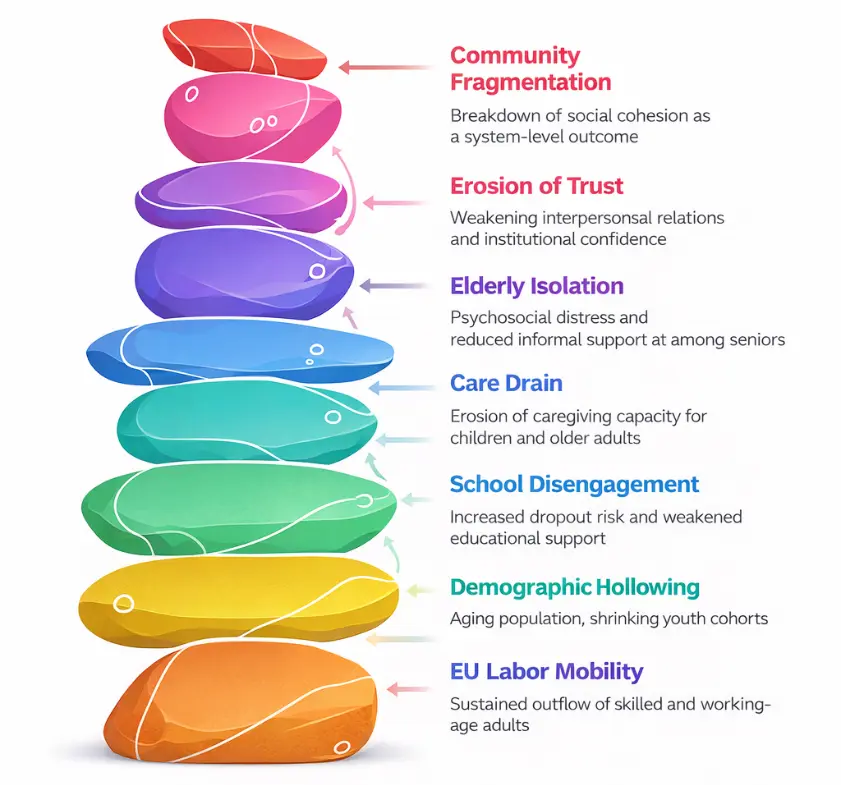
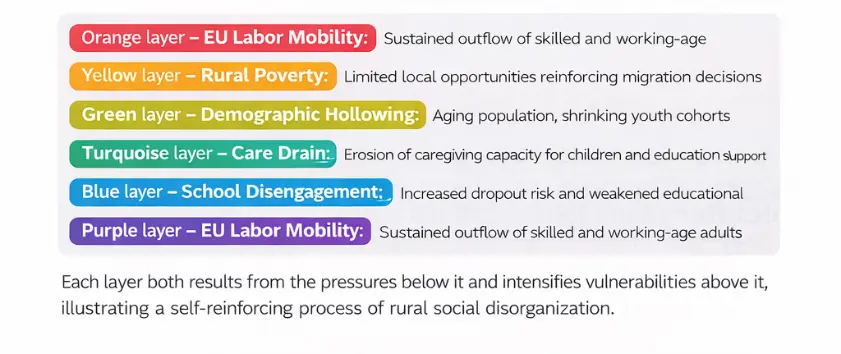
Figure 1 illustrates a cumulative, bottom-up cascade through which sustained EU labor mobility interacts with rural structural vulnerabilities to produce progressive social disorganization and, ultimately, community fragmentation. Each layer represents a distinct but interdependent mechanism, ordered from structural drivers at the base to system-level outcomes at the top. The model visualizes how demographic hollowing, care drain, educational disengagement, and social isolation interact over time, reinforcing the erosion of trust and social cohesion. Some arrows and color gradients in Figure 1 are intentionally non-unique and schematic. Colors are used to visually differentiate layers and to support readability rather than to encode additional constructs beyond those explicitly labeled. Similarly, arrows indicate the direction of cumulative influence across layers and are not intended to represent distinct causal pathways requiring separate explanations. The figure is designed as a diagnostic visualization of interlinked processes rather than a fully parameterized causal diagram.
Figure 1 should be interpreted as a diagnostic cascade rather than a simple linear cause–effect chain. Structural pressures at the base of the model (EU labor mobility and rural poverty) drive demographic hollowing, progressively undermining caregiving capacity and educational support. These disruptions accumulate into psychosocial isolation among older adults and weakening interpersonal and institutional trust, culminating in community fragmentation as a system-level outcome. By visualizing these interlinked mechanisms, the figure clarifies why isolated or sector-specific interventions are insufficient and motivates the Theory of Change developed in Sections 3.2–3.4, which maps coordinated social work, educational, governance, and community development responses to specific stages of the cascade.
These inputs represent a decisive shift from fragmented, sector-specific responses toward a cohesion-oriented governance strategy. Rather than treating migration, education, welfare, and development as separate policy domains, the ToC aligns them around a single organizing principle: the restoration of the social fabric of rural life. By rebuilding the institutional ecology that supports families, learning, care, and participation, these inputs create the conditions for communities to absorb mobility without disintegration and to transform migration from a destabilizing force into a manageable and even regenerative process.
3.3. Mechanisms: Activating Bonding, Bridging, and Linking Capital
The Theory of Change operates through the strategic activation of three interdependent forms of social capital, bonding, bridging, and linking, which together constitute the relational infrastructure of community cohesion. As theorized and systematized in the social capital grid developed by [85], these forms represent qualitatively different but mutually reinforcing dimensions of how individuals and groups connect to one another and to institutions. In migration-affected rural regions, it is precisely the imbalance and erosion of these forms of capital that drive fragmentation; consequently, their coordinated regeneration is the central mechanism for restoring cohesion.
To translate these mechanisms into actionable governance instruments, Table 1 maps each form of social capital to specific interventions, responsible actors, and feasible indicators for monitoring cohesion recovery.
Table 1. Intervention architecture for rebuilding social capital and rural cohesion.
|
Policy System/Sector |
Intervention |
Social Capital Target |
Implementers |
Feasible Indicators |
|---|---|---|---|---|
|
Social services (child and family welfare system) |
Case management for left-behind children |
Bonding + Linking |
Social services, child protection units |
% of children with assigned case manager; school attendance; emotional well-being scales |
|
Education system |
School–family mediation units |
Bridging |
Schools, counselors, NGOs |
Dropout rate, parental contact frequency, and student engagement |
|
Local public administration |
Migrant family registries |
Linking |
Municipalities, social departments |
% migrant households registered; service coverage |
|
Civil society and the community sector |
Mentoring, parent substitution, peer support |
Bonding + Bridging |
NGOs, churches, youth orgs |
Mentoring participation; elderly contact frequency |
|
EU and national development policy instruments |
Return-migration micro-grants |
Linking + Bridging |
Managing authorities, local councils |
returnees funded; business survival; housing reinvestment |
|
Community development ecosystem |
Local associations & civic activities |
Bridging |
Community councils, NGOs |
Event participation: volunteer rates |
|
Inter-institutional governance and coordination |
Service coordination & data sharing |
Linking |
Schools, social work, and municipalities |
Referral efficiency; service overlap reduction |
Bonding capital refers to the dense, emotionally charged ties among family members, close kin, and immediate neighbors. These relationships provide the primary sources of care, identity, and everyday security, especially in contexts of scarcity and vulnerability. Migration disrupts bonding capital by physically separating parents from children, adult children from aging parents, and neighbors from the daily routines that sustain mutual support. Yet this form of capital is also the most directly repairable through targeted interventions such as case management, substitute caregiving, and mentoring. Empirical research shows that strong bonding ties are critical for emotional well-being, resilience, and survival under adverse conditions [86,87,88]. When social work and community organizations step in to recreate stable caregiving and trusted relationships, they effectively reconstruct the micro-foundations of cohesion, allowing individuals to regain a sense of safety and belonging even in the absence of migrant family members.
Bridging capital extends beyond intimate networks to connect households with schools, NGOs, religious institutions, and civic associations. It is this form of capital that enables cooperation across social groups and supports the community’s collective life. In rural areas experiencing high out-migration, bridging ties often weaken as participation declines and institutions struggle to engage fragmented families. However, bridging capital is crucial for maintaining community participation, shared norms, and collective problem-solving capacity [89,90]. Empirical studies further demonstrate that individuals embedded in strong bridging networks have better economic prospects and social well-being because they are connected to wider opportunity structures [91,92]. School–family mediation units and community-based organizations are therefore pivotal in rebuilding these horizontal connections, creating arenas in which isolated households can re-enter community life and re-establish cooperative relationships.
Linking capital connects communities to formal authority and external resources, including local governments, welfare systems, and supranational development instruments. This vertical dimension of social capital is especially important in migrant-sending regions, where vulnerability is often compounded by limited institutional access and weak political voice. Ref. [93] identifies linking capital as the missing link between social participation and development outcomes, while ref. [94] shows that communities with stronger vertical ties are better able to mobilize resources and recover from shocks. Within the ToC, migrant family registries and return-migration micro-grants are designed precisely to strengthen this dimension: registries make transnational households legible to local administrations, while micro-grants provide tangible entry points into development programs. Together, they enable rural communities to access institutional support, assert claims, and rebuild trust in governance structures [95,96].
By deliberately stimulating bonding, bridging, and linking capital simultaneously, the ToC avoids a critical policy failure that has undermined many rural interventions: reliance on family solidarity or NGO activity without institutional anchoring. When informal networks are left to compensate alone for migration-induced strain, they eventually become overburdened and collapse. The ToC’s integrated approach ensures that relational, community, and institutional capacities evolve together, creating a resilient social architecture capable of sustaining cohesion in the face of ongoing mobility.
3.4. Outputs: Early Indicators of Social Repair
When bonding, bridging, and linking capital are successfully regenerated, the Theory of Change predicts a set of early, measurable outputs that function as signals of social recovery. These outputs are not abstract aspirations; they are observable changes in everyday community life that indicate whether cohesion-building mechanisms are working.
The first and most immediate indicator is reduced school dropout and improved educational engagement. As case management, school–family mediation, and mentoring restore continuity of care for left-behind children, emotional stability and learning motivation increase. Schools become not only places of instruction but also hubs of social integration, where children regain a sense of predictability, belonging, and adult support. Declining dropout rates therefore, reflect more than academic success; they signal that the community is once again capable of supporting its youngest members through stable relational networks.
A second key output is increased community participation. As bridging capital is rebuilt, households re-enter the social spaces they had withdrawn from: school meetings, local associations, religious institutions, and civic initiatives. Participation is a critical indicator because it captures the reanimation of horizontal ties across families and social groups. When people attend meetings, volunteer, or collaborate in local projects, they demonstrate that trust and mutual obligation are being restored at the collective level.
A third output is the emergence of stronger intergenerational ties. Through social work interventions, community programs, and NGO-led activities, older residents regain networks of care, recognition, and everyday interaction. Reduced loneliness, increased involvement in family and community life, and renewed informal support exchanges indicate that the vertical bonds between generations, so often damaged by migration, are being repaired. These ties are fundamental for the transmission of local knowledge, norms, and identity, making them central to long-term cohesion.
The reintegration of return migrants constitutes a fourth crucial output. Return migration does not automatically produce development; without institutional mediation, returnees may remain socially marginal or economically precarious. Micro-grants, local registries, and social work support enable return migrants to reconnect with community institutions, establish enterprises, and rebuild social ties. Their successful reintegration is therefore a visible sign that mobility is being converted into local renewal rather than renewed outflow.
Finally, higher institutional trust reflects the recovery of linking capital. As families and individuals engage more frequently with schools, social services, and local authorities, and experience these institutions as responsive and fair, confidence in governance structures increases. Greater service utilization, improved compliance with local regulations, and willingness to cooperate with authorities all signal that the social contract between citizens and institutions is being rebuilt.
Together, these outputs capture the functional core of community cohesion: trust in others and in institutions, active participation in collective life, and the capacity for coordinated action. They provide policymakers and practitioners with concrete benchmarks for assessing whether rural communities are moving from fragmentation toward social repair and sustainable cohesion.
3.5. Outcome: Restored Community Cohesion and Rural Resilience
The ultimate outcome of the Theory of Change is the restoration of community cohesion in migrant-sending rural regions, understood not as a return to an idealized or static past, but as the emergence of a dynamic, resilient social system capable of functioning under conditions of sustained mobility. In this framework, cohesion does not mean sameness, consensus, or the absence of tension. Rather, it refers to the presence of dense and inclusive social networks, shared norms of mutual responsibility, and institutions that are trusted, accessible, and responsive. These elements together determine whether a community can absorb shocks, manage diversity, and reproduce itself across generations without entering a downward spiral of fragmentation.
Empirical research consistently shows that cohesion is a central determinant of how communities respond to stress, disruption, and change. In educational contexts, for example, positive education models demonstrate that when schools operate as cohesive, relational environments, they strengthen not only individual well-being but also the broader resilience of the communities in which they are embedded [97]. This is particularly important in migrant-sending rural regions, where schools often become the most stable and continuous institutional presence in children’s lives. When educational spaces foster trust, belonging, and collaboration, they radiate cohesion outward into families and neighborhoods.
At the same time, critical social theory cautions that cohesion cannot be manufactured through discourse or policy slogans alone. Ref. [98] shows that when cohesion is framed as a moral demand for harmony or conformity, it risks masking inequalities and silencing conflict rather than resolving them. The ToC explicitly avoids this trap by grounding cohesion in material support, institutional accessibility, and relational reconstruction. In other words, cohesion emerges not from rhetorical appeals to togetherness, but from the lived experience of being supported, recognized, and able to participate meaningfully in community life.
The role of cohesion in recovery and resilience is especially evident in crisis and disruption contexts. Systematic reviews and disaster studies demonstrate that communities with stronger social cohesion recover faster, maintain higher levels of well-being, and are better able to coordinate collective action in the face of shocks [99,100]. Even in less dramatic but equally corrosive crises, such as long-term depopulation and care drain, cohesion functions as a protective factor. Neighbourhood-level research shows that when social cohesion is high, people experience greater psychological restoration and a stronger sense of control, even in adverse environments [101]. These findings confirm that cohesion is not merely a social outcome but a core mechanism of adaptive capacity.
In migrant-affected rural regions, cohesion therefore becomes a developmental multiplier. When trust, participation, and institutional legitimacy are restored, the positive effects of remittances are amplified: money sent from abroad is more likely to be invested in housing, education, and local enterprises rather than used solely for survival. Return migrants, instead of remaining socially marginal, are more easily reintegrated into community and economic life, bringing skills, networks, and new aspirations with them. Likewise, environmental, educational, and social innovations, whether introduced by NGOs, local governments, or EU-funded programs, are far more likely to take root when communities possess the relational and institutional capacity to sustain them.
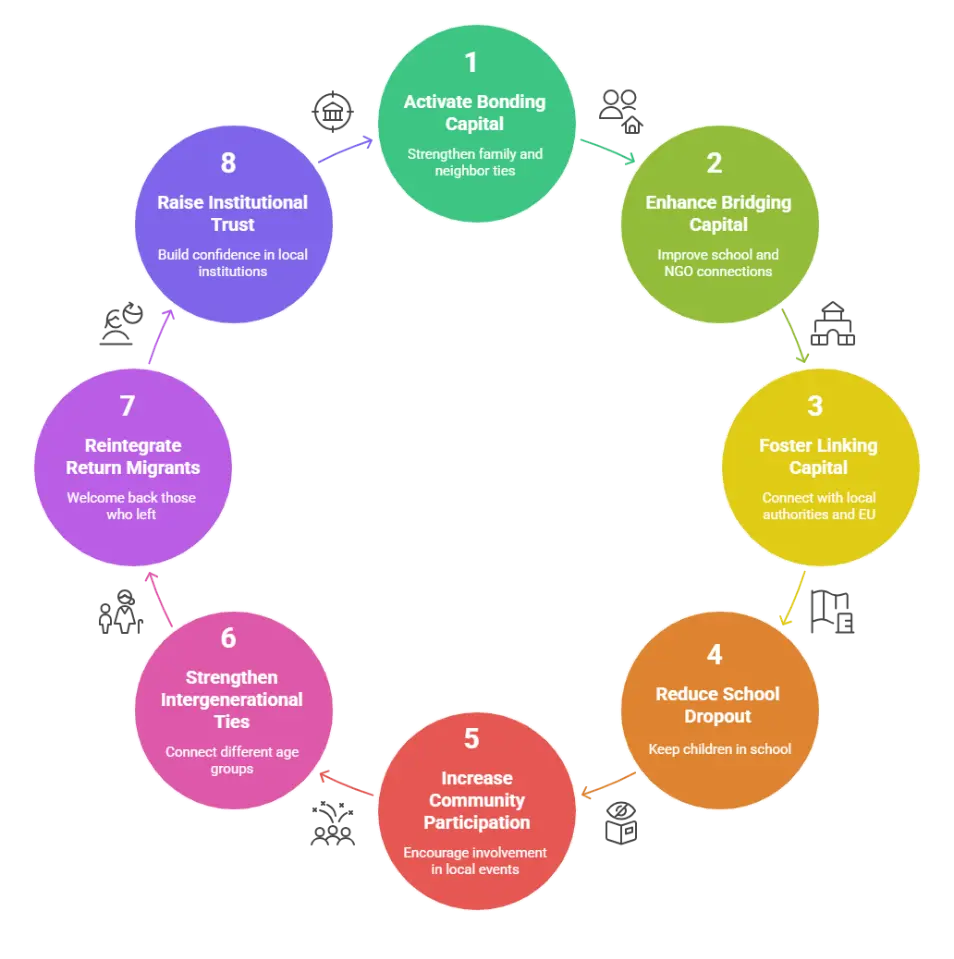
While Figure 1 presents the linear Theory of Change from migration-induced fragmentation to restored cohesion, Figure 2 depicts the dynamic, self-reinforcing nature of this process. Once bonding, bridging, and linking forms of social capital are activated, they generate a virtuous cycle of participation, intergenerational solidarity, return migration, and institutional trust that stabilizes rural communities over time.
By embedding social work, education, community development, and governance within a single, coherent Theory of Change, the model presented in this paper offers more than a conceptual explanation; it provides a practical roadmap for action. It shows how migration, often experienced as a force of loss and dislocation, can be governed in ways that generate social renewal rather than social decay. In this sense, restored cohesion is not only the end point of the ToC; it is the foundation upon which sustainable rural futures can be built in an era of ongoing mobility.
4. Social Work as a Cohesion Infrastructure
In migrant-sending rural regions, social work is no longer merely a safety-net profession; it becomes a core infrastructure of community stability. When families are fragmented by migration, schools face rising dropout, and elderly people become isolated, social workers occupy the pivotal position where human vulnerability intersects with institutional capacity. Contemporary cohesion research increasingly recognizes that child and family social work is not only remedial but also structurally constitutive of social cohesion, because it mediates relationships between households, communities, and the state [72,73]. In contexts of sustained out-migration, this mediating function becomes even more critical.
The fragmentation produced by care drain means that traditional kinship systems no longer guarantee daily support for children and older adults. Case management for left-behind children, central to the proposed Theory of Change, serves as a mechanism for simultaneously restoring bonding and bridging capital. Through continuous monitoring, psychosocial counseling, and coordination with schools, social workers reconstruct functional families even in the absence of biological parents. This role aligns with broader community development theory, which emphasizes that empowering individuals and strengthening relational networks is the foundation of sustainable local development [27,28,32]. Rather than focusing narrowly on deficits, rural social work builds collective capacity, enabling households to remain socially embedded despite physical separation.
Moreover, social workers act as institutional translators in fragmented governance environments. In rural areas, where access to services is limited and bureaucratic complexity is high, they help families navigate education systems, welfare entitlements, and migration-related documentation. This function directly supports the generation of linking social capital, connecting marginalized households to formal authority and development resources [93,94]. Without this relational infrastructure, EU-funded programs and local welfare initiatives often fail to reach the very populations most affected by migration.
Beyond individual casework, rural social work increasingly engages in community organizing and participatory development, especially when NGOs, churches, and local councils are mobilized to compensate for family absence. Research on community organizing in crisis contexts shows that social work is uniquely positioned to coordinate multi-actor networks, rebuild trust, and sustain collective engagement over time [29]. In this sense, rural social work does not simply treat the symptoms of migration, it stabilizes the system, preventing the downward spiral from vulnerability into permanent disorganization.
5. Public Policy Implications
If community cohesion is to be restored in migrant-sending rural regions, public policy must move beyond fragmented, sectoral interventions and adopt a cohesion-oriented governance model. This requires coordinated redesign across Romanian ministries, local governments, and EU cohesion instruments.
At the national level, ministries responsible for education, social protection, and regional development must explicitly integrate migration and care drain into their strategic frameworks. Youth unemployment, educational inequality, and labor mobility are already recognized as interlinked European challenges [3,4,5]. However, demographic projections indicate that without targeted rural strategies, macro-regional disparities will widen further [6,7]. Romania’s rural policy must therefore be recalibrated from a narrow focus on infrastructure toward social investment in children, families, and community institutions that mediate the effects of migration.
At the local government level, municipalities require tools that make transnational family life visible and governable. Migrant family registries, as proposed in the ToC, allow local councils to identify left-behind children, elderly caregivers, and return migrants, enabling evidence-based planning and service delivery. Governance research shows that local authorities can be effective providers of social services only when they possess accurate population data and institutional capacity [24,25]. Moreover, spending priorities matter: allocating resources toward social services rather than solely toward coercive or security functions strengthens social cohesion and reduces long-term vulnerability [26].
At the European level, cohesion policy must more explicitly address mobility-induced social fragmentation. While EU funds have traditionally targeted economic convergence, growing evidence suggests that social cohesion is a necessary precondition for sustainable regional development [67,68,69]. Return-migration micro-grants represent one promising mechanism: by supporting small enterprises, housing renovation, and community projects, they transform mobility into local reinvestment and reduce the risk of permanent depopulation. However, these instruments must be embedded in social work and education systems to ensure that financial capital translates into social capital rather than deepening inequalities.
Finally, policy must recognize that cohesion cannot be legislated into existence. As critical scholarship reminds us, cohesion is undermined when policies impose symbolic unity without addressing structural inequalities and recognition [83,84,98]. Effective cohesion policy, therefore, requires participatory governance, community-based service delivery, and continuous dialogue between institutions and residents.
Limitations and Future Research
This paper proposes a Theory of Change as a conceptual and governance-oriented framework for addressing migration-induced community fragmentation. As such, it does not provide empirical testing of the effectiveness of the proposed intervention pathways. The causal mechanisms and relationships described in the model should therefore be interpreted as theoretically grounded and empirically plausible hypotheses, rather than validated causal claims.
Future research should empirically test the proposed Theory of Change through pilot implementation in migrant-sending rural communities in Romania. Mixed-method research designs could combine quantitative indicators already outlined in Table 1 (e.g., school engagement, service coverage, community participation, institutional trust) with qualitative interviews involving families, professionals, and local authorities. Longitudinal designs would be particularly valuable for assessing whether improvements in bonding, bridging, and linking social capital contribute to sustained recovery of community cohesion over time.
6. Conclusions
Migration has become a defining feature of rural life in Romania and across Europe’s peripheries. While labor mobility offers households economic survival and, in some cases, new opportunities, it simultaneously threatens the social and institutional foundations of rural communities. Care drain, school disengagement, elderly isolation, and the erosion of trust are not marginal side effects; they are the mechanisms through which migration can hollow out community life.
This paper has advanced a governance-ready Theory of Change that integrates social capital theory, social disorganization, rural migration studies, and social work practice into a coherent framework for restoring cohesion. By specifying how targeted interventions activate bonding, bridging, and linking capital, the model demonstrates that cohesion is not an abstract ideal but a practical, measurable outcome of coordinated policy and practice.
Unlike conventional management approaches that seek to mitigate isolated consequences of migration, the proposed Theory of Change provides a structured pathway for governing social regeneration itself. Aligning social work, education, local governance, and development policy within a single causal framework, it offers a more effective and context-sensitive alternative for addressing the long-term cohesion challenges of migrant-sending rural regions.
Social work emerges as a central cohesion infrastructure, translating human vulnerability into collective resilience. Education systems, local governments, and EU development funds, when aligned around this goal, can convert migration from a force of fragmentation into a pathway of renewal. Ultimately, sustainable rural development in migrant-sending regions depends not only on people’s ability to move, but on communities’ ability to remain socially whole while they do so.
Statement of the Use of Generative AI and AI-Assisted Technologies in the Writing Process
During the preparation of this manuscript, ChatGPT (version 5.2, OpenAI) was used to improve language and stylistic clarity only. The authors take full responsibility for the content of the manuscript.
Author Contributions
Conceptualization, E.G. and D.R.; Methodology, E.G.; Software, E.G.; Validation, E.G. and D.R.; Formal Analysis, E.G.; Investigation, E.G.; Resources, E.G.; Data Curation, E.G.; Writing—Original Draft Preparation, E.G.; Writing—Review & Editing, E.G. and D.R.; Visualization, E.G.; Supervision, D.R.; Project Administration, D.R.; Funding Acquisition, D.R.
Ethics Statement
The study was conducted in accordance with the Declaration of Helsinki and approved by the Ethics Committee of the Center of Research Development and Innovation in Psychology, Aurel Vlaicu University of Arad (Approval No. 90/17.12.2025) (date of approval: 17 December 2025). All procedures involving human participants complied with institutional and national ethical standards.
Informed Consent Statement
Not applicable.
Data Availability Statement
This study is based on conceptual analysis, theoretical synthesis, and illustrative models derived from existing literature. No original datasets were generated or analyzed. As such, data sharing is not applicable.
Funding
This research received no external funding.
Declaration of Competing Interest
The authors declare that they have no known competing financial interests or personal relationships that could have appeared to influence the work reported in this paper.
References
-
Lipton M. Migration from rural areas of poor countries: The impact on rural productivity and income distribution. World Dev. 1980, 8, 1–24. DOI:10.1016/0305-750X(80)90047-9 [Google Scholar]
-
Stockdale A. Rural Out-Migration: Community Consequences and Individual Migrant Experiences. Sociol. Rural. 2004, 44, 167–194. DOI:10.1111/j.1467-9523.2004.00269.x [Google Scholar]
-
Zimmermann KF. European labour mobility: Challenges and potentials. De Econ. 2005, 153, 425–450. DOI:10.1007/s10645-005-2660-x [Google Scholar]
-
Kahanec M. Labor mobility in an enlarged European Union. In International Handbook on the Economics of Migration; Edward Elgar Publishing: Cheltenham, UK, 2013; pp. 137–152. [Google Scholar]
-
O’Reilly J, Eichhorst W, Gábos A, Hadjivassiliou K, Lain D, Leschke J, et al. Five characteristics of youth unemployment in Europe: Flexibility, education, migration, family legacies, and EU policy. Sage Open 2015, 5, 2158244015574962. DOI:10.1177/2158244015574962 [Google Scholar]
-
Potančoková M, Stonawski M, Gailey N. Migration and demographic disparities in macro-regions of the European Union, a view to 2060. Demogr. Res. 2021, 45, 1317–1354. DOI:10.4054/DemRes.2021.45.44 [Google Scholar]
-
Dax T, Copus A. European rural demographic strategies: Foreshadowing post-lisbon rural development policy? World 2022, 3, 938–956. DOI:10.3390/world3040053 [Google Scholar]
-
Stark O. Behavior in reverse: Reasons for return migration. Behav. Public Policy 2019, 3, 104–126. DOI:10.1017/bpp.2018.27 [Google Scholar]
-
Dong R. Research on the path of effective connection between consolidating the achievements of tackling key problems and rural revitalization: Taking the reverse “immigration” of labor force as the perspective. Front. Econ. Manag. 2023, 4, 327–331. DOI:10.6981/FEM.202311_4(11).0038 [Google Scholar]
-
Safavi Mirmahaleh SF, Rashid Kalvir H, Ebadollahi Chenzanegh H, Kanani M. Identifying and Measuring the Consequences of Reverse Migration on Rural Housing (Case Study: Villages in The Central Part of Masal City). Haft Hesar J. Environ. Stud. 2024, 13, 119–144. Available online: http://hafthesar.iauh.ac.ir/article-1-2188-en.html (accessed on 22 December 2025).
-
Saha S, Peer K, Saha S. Reverse migration, sustainable development, and innovation during COVID-19 pandemic: A case study of Indian women and children. Int. J. Innov. Sustain. Dev. 2024, 18, 206–226. DOI:10.1504/IJISD.2024.135260 [Google Scholar]
-
Mikhak H, Hafezi F, Sadeghloo T. Investigating the Causes and Motivations of Reverse Migration Among Rural Migrants (The Study Area: Khorramabad County). J. Rural Res. 2020, 11, 270–285. DOI:10.22059/jrur.2020.296106.1445 [Google Scholar]
-
Isaksen LW, Devi SU, Hochschild AR. Global care crisis: A problem of capital, care chain, or commons? Am. Behav. Sci. 2008, 52, 405–425. DOI:10.1177/0002764208323513 [Google Scholar]
-
Gheaus A. Care drain: Who should provide for the children left behind? Crit. Rev. Int. Soc. Political Philos. 2013, 16, 1–23. DOI:10.1080/13698230.2011.572425 [Google Scholar]
-
Panzaru C, Gravina G. “Care Drain” from East to West: The Narrative of Romanian Women Migrant Working in the Italian Domestic Care Sector. Health Soc. Care Community 2024, 2024, 7435493. DOI:10.1155/2024/7435493 [Google Scholar]
-
Jingzhong Y, Lu P. Differentiated childhoods: Impacts of rural labor migration on left-behind children in China. J. Peasant Stud. 2011, 38, 355–377. DOI:10.1080/03066150.2011.559012 [Google Scholar]
-
Castañeda E, Buck L. Remittances, transnational parenting, and the children left behind: Economic and psychological implications. Lat. Am. 2011, 55, 85–110. DOI:10.1353/tla.2011.a706534 [Google Scholar]
-
Gu X. ‘Save the children!’: Governing left-behind children through family in China’s Great Migration. Curr. Sociol. 2022, 70, 513–538. DOI:10.1177/0011392120985874 [Google Scholar]
-
Anagnostaki L, Zaharia A. A psychoanalytic and qualitative research on immigrants’ “left-behind” children: “I understand why they left, but why did they leave?”. Int. J. Appl. Psychoanal. Stud. 2020, 17, 313–327. DOI:10.1002/aps.1646 [Google Scholar]
-
Thapa DK, Visentin D, Kornhaber R, Cleary M. Migration of adult children and mental health of older parents ‘left behind’: An integrative review. PLoS ONE 2018, 13, e0205665. DOI:10.1371/journal.pone.0205665 [Google Scholar]
-
Knodel J, Kespichayawattana J, Saengtienchai C, Wiwatwanich S. How left behind are rural parents of migrant children? Evidence from Thailand. Ageing Soc. 2010, 30, 811–841. DOI:10.1017/S0144686X09990699 [Google Scholar]
-
Dakua M, Karmakar R, Lhungdim H. Social capital and well-being of the elderly ‘left-behind’ by their migrant children in India. BMC Public Health 2023, 23, 2212. DOI:10.1186/s12889-023-17012-9 [Google Scholar]
-
Goldschmidt E, Rad D. The effects of migration on community cohesion in rural romania: Antecedents and consequences. J. Plus Educ. 2025, 39, 437–459. DOI:10.24250/jpe/2/2025/EG/DR [Google Scholar]
-
Steiner R, Kaiser C, Tapscott C, Navarro C. Is local always better? Strengths and limitations of local governance for service delivery. Int. J. Public Sect. Manag. 2018, 31, 394–409. DOI:10.1108/IJPSM-05-2018-226 [Google Scholar]
-
Perlman BJ. Governance challenges and options for state and local governments. State Local Gov. Rev. 2010, 42, 246–257. DOI:10.1177/0160323X10390050 [Google Scholar]
-
Beck B. Local government spending: Policing versus social services. Annu. Rev. Criminol. 2025, 8, 505–528. DOI:10.1146/annurev-criminol-111523-122639 [Google Scholar]
-
Ledwith M. Community Development: A Critical Approach; Policy Press: Bristol, UK, 2011. [Google Scholar]
-
Lawson HA. Empowering people, facilitating community development, and contributing to sustainable development: The social work of sport, exercise, and physical education programs. Sport Educ. Soc. 2005, 10, 135–160. DOI:10.1080/1357332052000308800 [Google Scholar]
-
Pyles L. Community organizing for post-disaster social development: Locating social work. Int. Soc. Work 2007, 50, 321–333. DOI:10.1177/0020872807076044 [Google Scholar]
-
McClenaghan P. Social capital: Exploring the theoretical foundations of community development education. Br. Educ. Res. J. 2000, 26, 565–582. DOI:10.1080/713651581 [Google Scholar]
-
Robinson JW, Green GP. (Eds.). Introduction to Community Development: Theory, Practice, and Service-Learning; Sage: Thousand Oaks, CA, USA, 2011. [Google Scholar]
-
Mendes P. Teaching community development to social work students: A critical reflection. Community Dev. J. 2009, 44, 248–262. DOI:10.1093/cdj/bsn001 [Google Scholar]
-
Hirschi C. Strengthening regional cohesion: Collaborative networks and sustainable development in Swiss rural areas. Ecol. Soc. 2010, 15, 16. DOI:10.5751/ES-03714-150416 [Google Scholar]
-
Davids R, Rouget M, Burger M, Mahood K, Ditlhale N, Slotow R. Civic ecology uplifts low-income communities, improves ecosystem services and well-being, and strengthens social cohesion. Sustainability 2021, 13, 1300. DOI:10.3390/su13031300 [Google Scholar]
-
Williams JM, Chu V, Lam WF, Law W. Revitalising Rural Communities; Springer: Singapore, 2021. [Google Scholar]
-
Sun Y, Zhu L, Zhang N, Wu H, Chen Q, Wang H. Study on pro-environmental behavior to enhance rural social-ecological resilience: The role of place identity and social cohesion as mediating mechanisms. Land 2024, 13, 2144. DOI:10.3390/land13122144 [Google Scholar]
-
Nguyen-Dinh N, Zhang H. Do Positive Environmental Changes Impact Residents’ Intention of Rural Development? Role of Leisure and Quality of Life. Sustainability 2025, 17, 1245. DOI:10.3390/su17031245 [Google Scholar]
-
Andrade Suárez M, López-Mejuto U, García Docampo M, Varela-García FA. Sustainability, Spatial Justice and Social Cohesion in City Planning: What Does a Case Study on Urban Renaturalisation Teach Us? Urban Sci. 2025, 9, 94. DOI:10.3390/urbansci9040094 [Google Scholar]
-
Putnam RD. Social capital and public affairs. Bull. Am. Acad. Arts Sci. 1994, 47, 5. DOI:10.2307/3824796 [Google Scholar]
-
Lin N. Social Capital: A Theory of Social Structure and Action; Cambridge University Press: Cambridge, UK, 2002; Volume 19. [Google Scholar]
-
Dubos R. Social Capital: Theory and Research; Routledge: London, UK, 2017. [Google Scholar]
-
Claridge T. Dimensions of Social Capital-structural, cognitive, and relational. Soc. Cap. Res. 2018, 1-4. Available online: https://www.socialcapitalresearch.com/wp-content/uploads/2018/01/Dimensions-of-Social-Capital.pdf (accessed on 22 December 2025).
-
Claridge T. Functions of social capital–bonding, bridging, linking. Soc. Cap. Res. 2018, 20, 1–7. DOI:10.5281/zenodo.7993853 [Google Scholar]
-
Kawachi I, Berkman L. Social cohesion, social capital, and health. Soc. Epidemiol. 2000, 174, 290–319. DOI:10.1093/med/9780195377903.003.0008 [Google Scholar]
-
Kawachi I, Berkman LF. Social ties and mental health. J. Urban Health 2001, 78, 458–467. DOI:10.1093/jurban/78.3.458 [Google Scholar]
-
Kawachi I, Berkman LF. (Eds.). Neighborhoods and Health; Oxford University Press: Oxford, UK, 2003. [Google Scholar]
-
Kawachi I, Subramanian SV, Kim D. Social capital and health: A decade of progress and beyond. In Social Capital and Health; Springer: New York, NY, USA, 2008; pp. 1–26. [Google Scholar]
-
Van Bakel M, Horak S. Social capital theory. In A Guide to Key Theories for Human Resource Management Research; Edward Elgar Publishing: Cheltenham, UK, 2024; pp. 261–267. [Google Scholar]
-
Sharma S, Singh G, Lim WM, Ali A, Singh R. Metaverse through the integrated theoretical lenses of task technology fit theory, social capital theory, and social cognitive theory: The case of SMEs. J. Innov. Entrep. 2025, 14, 6. DOI:10.1186/s13731-024-00445-w [Google Scholar]
-
Sampson RJ, Groves WB. Community structure and crime: Testing social-disorganization theory. Am. J. Sociol. 1989, 94, 774–802. DOI:10.1086/229068 [Google Scholar]
-
Kubrin CE. Social disorganization theory: Then, now, and in the future. In Handbook on Crime and Deviance; Springer: New York, NY, USA, 2009; pp. 225–236. [Google Scholar]
-
Charis EK, Ronald W. New directions in social disorganization theory. In Recent Developments in Criminological Theory; Routledge: London, UK, 2017; pp. 265–294. [Google Scholar]
-
Markowitz FE, Bellair PE, Liska AE, Liu J. Extending social disorganization theory: Modeling the relationships between cohesion, disorder, and fear. Criminology 2001, 39, 293–319. DOI:10.1111/j.1745-9125.2001.tb00924.x [Google Scholar]
-
Lowenkamp CT, Cullen FT, Pratt TC. Replicating Sampson and Groves’s test of social disorganization theory: Revisiting a criminological classic. J. Res. Crime Delinq. 2003, 40, 351–373. DOI:10.1177/0022427803256077 [Google Scholar]
-
Kubrin CE, Wo JC. Social disorganization theory’s greatest challenge: Linking structural characteristics to crime in socially disorganized communities. In The Handbook of Criminological Theory; Wiley: Hoboken, NJ, USA, 2015; pp. 121–136. [Google Scholar]
-
Kubrin CE, Herting JR. Neighborhood correalates of homicide trends: An analysis using growth-curve modeling. Sociol. Q. 2016, 44, 329–350. DOI:10.1111/j.1533-8525.2003.tb00536.x [Google Scholar]
-
Weisburd D, Maher L, Sherman L, Buerger M, Cohn E, Petrosino A. Contrasting crime general and crime specific theory: The case of hot spots of crime. In New Directions in Criminological Theory; Routledge: London, UK, 2023; pp. 45–70. [Google Scholar]
-
Bruinsma GJ, Pauwels LJ, Weerman FM, Bernasco W. Social disorganization, social capital, collective efficacy and the spatial distribution of crime and offenders: An empirical test of six neighbourhood models for a Dutch city. Br. J. Criminol. 2013, 53, 942–963. DOI:10.1093/bjc/azt030 [Google Scholar]
-
Gamso J, Yuldashev F. Does rural development aid reduce international migration? World Dev. 2018, 110, 268–282. DOI:10.1016/j.worlddev.2018.05.035 [Google Scholar]
-
Horváth I. The culture of migration of rural Romanian youth. J. Ethn. Migr. Stud. 2008, 34, 771–786. DOI:10.1080/13691830802106036 [Google Scholar]
-
Horváth I, Anghel RG. Migration and its consequences for Romania. Comp. Southeast Eur. Stud. 2009, 57, 386–403. DOI:10.1515/soeu-2009-570406 [Google Scholar]
-
Anghel RG. Migration in differentiated localities: Changing statuses and ethnic relations in a multi-ethnic locality in Transylvania, Romania. Popul. Space Place 2015, 22, 356–366. DOI:10.1002/psp.1925 [Google Scholar]
-
Anghel RG, Piracha M, Randazzo T. Migrants’ remittances: Channelling globalization. In Handbook of the International Political Economy of Migration; Edward Elgar Publishing: Cheltenham, UK, 2015; pp. 234–258. [Google Scholar]
-
Milbourne P. Re-populating rural studies: Migrations, movements and mobilities. J. Rural Stud. 2007, 23, 381–386. DOI:10.1016/j.jrurstud.2007.04.002 [Google Scholar]
-
Milbourne P, Kitchen L. Rural mobilities: Connecting movement and fixity in rural places. J. Rural Stud. 2014, 34, 326–336. DOI:10.1016/j.jrurstud.2014.01.004 [Google Scholar]
-
Johnson KM, Cromartie JB. The rural rebound and its aftermath: Changing demographic dynamics and regional contrasts. In Population Change and Rural Society; Springer: Dordrecht, The Netherlands, 2006; pp. 25–49. [Google Scholar]
-
Brunazzo M. The history and evolution of Cohesion policy. Handb. Cohes. Policy EU 2016, 3, 17–35. [Google Scholar]
-
Fiaschi D, Lavezzi AM, Parenti A. Does EU cohesion policy work? Theory and evidence. J. Reg. Sci. 2018, 58, 386–423. DOI:10.1111/jors.12364 [Google Scholar]
-
Bachtler J, Mendez C. Cohesion policy. In Policy-Making in the European Union; Oxford University Press: Oxford, UK, 2020; p. 232. [Google Scholar]
-
White D. Social policy and solidarity, orphans of the new model of social cohesion. Can. J. Sociol./Cah. Can. De Sociol. 2003, 28, 51–76. DOI:10.2307/3341875 [Google Scholar]
-
Ratcliffe P, Newman I. Promoting social cohesion. In Promoting Social Cohesion; Policy Press: Bristol, UK, 2011; pp. 1–12. [Google Scholar]
-
Dierckx M, Vandenbroeck M, Devlieghere J. Policymakers on social cohesion: Contradictory expectations for child and family social work. Eur. J. Soc. Work 2023, 26, 258–271. DOI:10.1080/13691457.2022.2040434 [Google Scholar]
-
Dierckx M, Vandenbroeck M, Devlieghere J. Child and family social work as a space for promoting social cohesion. Child Fam. Soc. Work 2025, 30, 398–409. DOI:10.1111/cfs.13178 [Google Scholar]
-
Dierckx M, Devlieghere J, Vandenbroeck M. Proportionate universalism in child and family social work. Child Fam. Soc. Work. 2020, 25, 337–344. DOI:10.1111/cfs.12689 [Google Scholar]
-
Claridge T. Introduction to social capital theory. Soc. Cap. Res. 2018, 1, 1–51. Available online: https://www.socialcapitalresearch.com/wp-content/uploads/edd/2018/08/Introduction-to-Social-Capital-Theory.pdf (accessed on 22 December 2025).
-
Cloete A. Social cohesion and social capital: Possible implications for the common good. Verbum Et Eccles. 2014, 35, a1331. DOI:10.4102/ve.v35i3.1331 [Google Scholar]
-
Cloete N. Policy expectations. In Transformation in Higher Education: Global Pressures and Local Realities; Springer: Dordrecht, The Netherlands, 2002; pp. 53–65. [Google Scholar]
-
Khaile FT, Roman NV, Davids GJ. The role of local government in promoting a sense of belonging as an aspect of social cohesion: A document analysis. Afr. J. Gov. Dev. 2021, 10, 8–33. DOI:10.10520/ejc-ajgd_v10_n1_a2 [Google Scholar]
-
Fonseca X, Lukosch S, Brazier F. Social cohesion revisited: A new definition and how to characterize it. Innov. Eur. J. Soc. Sci. Res. 2019, 32, 231–253. DOI:10.1080/13511610.2018.1497480 [Google Scholar]
-
Oxoby R. Understanding social inclusion, social cohesion, and social capital. Int. J. Soc. Econ. 2009, 36, 1133–1152. DOI:10.1108/03068290910996963 [Google Scholar]
-
Oxoby RJ. Cognitive dissonance, status and growth of the underclass. Econ. J. 2004, 114, 727–749. DOI:10.1111/j.1468-0297.2004.00241.x [Google Scholar]
-
Burnett J. Community, cohesion and the state. Race Cl. 2004, 45, 1–18. DOI:10.1177/030639680404500301 [Google Scholar]
-
Burnett J. Community cohesion: A new framework for race and diversity. Race Cl. 2007, 48, 115–118. DOI:10.1177/0306396806077102 [Google Scholar]
-
Robinson D. The search for community cohesion: Key themes and dominant concepts of the public policy agenda. Urban Stud. 2005, 42, 1411–1427. DOI:10.1080/00420980500150755 [Google Scholar]
-
Patulny RV, Lind Haase Svendsen G. Exploring the social capital grid: Bonding, bridging, qualitative, quantitative. Int. J. Sociol. Soc. Policy 2007, 27, 32–51. DOI:10.1108/01443330710722742 [Google Scholar]
-
Leonard M. Bonding and bridging social capital: Reflections from Belfast. Sociology 2004, 38, 927–944. DOI:10.1177/0038038504047176 [Google Scholar]
-
Coffé H, Geys B. Toward an empirical characterization of bridging and bonding social capital. Nonprofit Volunt. Sect. Q. 2007, 36, 121–139. DOI:10.1177/0899764006293181 [Google Scholar]
-
Zmerli S. Applying the concepts of bonding and bridging social capital to empirical research. Eur. Political Sci. 2003, 2, 68–75. DOI:10.1057/eps.2003.22 [Google Scholar]
-
Larsen L, Harlan SL, Bolin B, Hackett EJ, Hope D, Kirby A, et al. Bonding and bridging: Understanding the relationship between social capital and civic action. J. Plan. Educ. Res. 2004, 24, 64–77. DOI:10.1177/0739456X04267181 [Google Scholar]
-
Berardo R. Bridging and bonding capital in two-mode collaboration networks. Policy Stud. J. 2014, 42, 197–225. DOI:10.1111/psj.12056 [Google Scholar]
-
Zhang S, Anderson SG, Zhan M. The differentiated impact of bridging and bonding social capital on economic well-being: An individual level perspective. J. Soc. Soc. Welf. 2011, 38, 119. DOI:10.15453/0191-5096.3587 [Google Scholar]
-
Barrios-Hernández K, García-Villaverde PM, Ruiz-Ortega MJ. Impact of Bonding Capital and Bridging Capital on Scientific Results of Research Groups. J. Knowl. Econ. 2024, 15, 14235–14255. DOI:10.1007/s13132-023-01401-x [Google Scholar]
-
Grootaert C. Social capital: The missing link? In Social Capital and Participation in Everyday Life; Routledge: London, UK, 2003; pp. 9–29. [Google Scholar]
-
Kyne D, Aldrich DP. Capturing bonding, bridging, and linking social capital through publicly available data. Risk Hazards Crisis Public Policy 2020, 11, 61–86. DOI:10.1002/rhc3.12183 [Google Scholar]
-
Syaharuddin M, Handy MRN, Abbas EW. Building Linking Capital Through Religious Activity to Improve Educational Character. In Membelajarkan Diri Menulis Membukukan Tulisan; Penerbit NEM: Jawa Tengah, Indonesia, 2023; p. 109. [Google Scholar]
-
Zhang H, Liu Q, Lu D, Wang X, Fan H. Sustainable development perspective of linking natural resources and human capital development: An overview of resources utilization. Resour. Policy 2023, 86, 104097. DOI:10.1016/j.resourpol.2023.104097 [Google Scholar]
-
Auckland S, Kilpatrick S. Restoring community cohesion through positive education: Applying a community resilience model. Int. J. Lifelong Educ. 2021, 40, 561–575. DOI:10.1080/02601370.2021.2009584 [Google Scholar]
-
McGhee D. Moving to ‘our’ common ground–a critical examination of community cohesion discourse in twenty-first century Britain. Sociol. Rev. 2003, 51, 376–404. DOI:10.1111/1467-954X.00426 [Google Scholar]
-
Sobhaninia S. Does social cohesion accelerate the recovery rate in communities impacted by environmental disasters in Puerto Rico? An analysis of a community survey. Environ. Adv. 2023, 13, 100400. DOI:10.1016/j.envadv.2023.100400 [Google Scholar]
-
Sobhaninia S. The social cohesion measures contributing to resilient disaster recovery: A systematic literature review. J. Plan. Lit. 2024, 39, 519–534. DOI:10.1177/08854122241238196 [Google Scholar]
-
Feng N, Zhang A, Cui L, Zeng H, Mankad A. Effects of neighbourhood social cohesion and need for restoration on restorative experiences. Asian J. Soc. Psychol. 2020, 23, 422–434. DOI:10.1111/ajsp.12420 [Google Scholar]