
Regularity of Human Body Temperature Change Induced by Various Aromatic Smokes
Regularity of Human Body Temperature Change Induced by Various Aromatic Smokes
Mingxia Wu
1
Liuqing Yang
1
Xiang Ban
1
Wenli Jin
2,*
 Hui Li
1,3,*
Hui Li
1,3,*
Received: 16 December 2025 Revised: 07 January 2026 Accepted: 29 January 2026 Published: 03 February 2026

© 2026 The authors. This is an open access article under the Creative Commons Attribution 4.0 International License (https://creativecommons.org/licenses/by/4.0/).
1. Introduction
Incense therapy (aromatherapy) is a natural treatment that stimulates the human respiratory system and skin through the natural volatilization or combustion of plants of some animal secretions [1]. It serves as a complementary therapy to help restore the body and mind to a state of balance [2]. However, the systematic mechanism of aromatherapy has seldom been investigated. Traditional Chinese medicine (TCM) posits that aromatherapy may interact with the human meridian [3]. The meridian system is a core component of TCM theory, mainly including the six normal meridian pairs and eight extra meridians, and may be related to the diversity of the transmembrane channels. These views provide a new hypothesis that is worth experimentation and systematic validation.
Transmembrane transportation consumes ATP and generates thermal infrared signals. Infrared thermography, a non-invasive imaging technique, has been progressively introduced into meridian research in recent years [4]. Previously, we successfully used infrared imageries to capture the thermal effects of tea activating the human meridian system. We discovered that after drinking different types of tea, the temperature in both the fingers and organs increased significantly. These temperature changes highly corresponded with the six normal meridian pairs [5].
This study uses natural fragrances as a model to investigate the thermal effects of incense smoke on the human body surface through combustion experiments and infrared thermography, and to determine whether it exhibits consistent, classifiable thermal imaging characteristics.
2. Materials and Methods
The 123 kinds of incense samples selected for the experiment were ground and sieved. Six members of our research group (aged 20–50) served as healthy volunteers (M0–M5). All 123 aromatic smokes were tested in each participant (n = 6 per aromatic smoke). During the experiment, participants were prohibited from consuming any medications, tea, or seasonings to avoid potential interference. Prior to imaging, participants sat quietly in a temperature-controlled room (26–28 °C) for 20 min to stabilize body temperature. Each incense sample (500 mg) was burned in a controlled setting, and thermal images of both ventral and dorsal sides were captured at 10 min of combustion. The infrared camera (Ti450PRO Thermal Imager, Fluke Co., Everett, WA, USA) was fixed three meters from the subject, capturing the head, upper limbs, and torso. To minimize interference, only one fragrance was tested per day.
3. Results
The experiment showed that most natural fragrances induced a localized or systemic increase in temperature after 10 min of burning. Smoke of some fragrances, including Aquilaria sinensis, Santalum album, Osmanthus fragrans, Prunus mume f. alba, Ruta graveolens, Thuja sutchuenensis, Rosa rugosa, and Syzygium aromaticum, produced stable and significant surface warming patterns across multiple subjects (n = 6). These patterns were highly similar to the distribution pathways of the eight extra meridians (Figure 1).
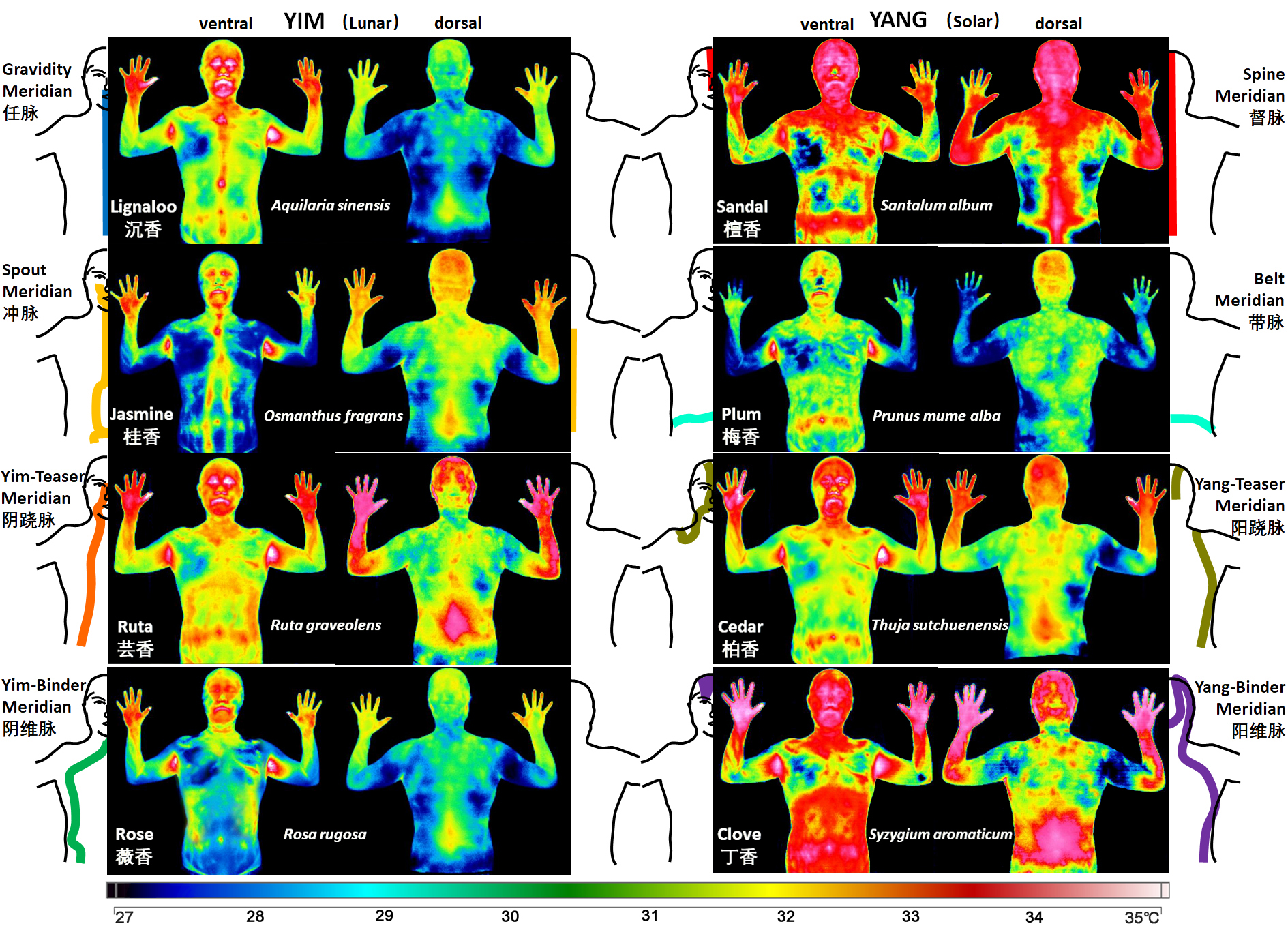
Figure 1. Infrared thermal imaging patterns induced by eight natural fragrances and the according eight extra meridian diagrams.
Images derived from participant M0, illustrating typical warming patterns. The eight representative fragrances shown in Figure 1 are listed in Table 1 using the same Latin names.
The warming induced by lignaloo mainly descends from the face along the midline of the abdomen, consistent with the Gravidity meridian. Sandalwood induces warming in the coccygeal vertebra, along the spinal midline to the head, consistent with the Spine meridian. The warming area of osmanthus (Osmanthus fragrans) is distributed around 3cm lateral to the midline of the abdomen and ascends along the inner side of the spine to the neck, which is consistent with the distribution of the Spout meridian. Plum blossom (Prunus mume f. alba) causes a circumferential warming pattern around the waist, corresponding to the Belt meridian. The warming areas of the common rue leaves are concentrated around 7 cm lateral to the midline of the abdomen, chest, and cheeks, matching the Yim-teaser meridian. Thuja sutchuenensis or cedar primarily warms the hips, shoulders, and eyes, aligning with the Yang-teaser meridian. Rose induces warming in the sides of the abdomen and the upper neck region, corresponding to the Yim-binder meridian. Clove triggers warming in the whole back and abdomen, shoulders, neck, and back side of the head, consistent with the Yang-binder meridian.
Beyond the representative samples above, warming effects of other fragrances can be categorized into one of these eight thermal effect patterns through image comparison or exhibit overlapping patterns (Table 1).
Table 1. Correspondence between the 123 natural fragrances and extraordinary meridians based on thermal imaging.
|
Chinese Name |
Scientific Name |
Family |
Part Used |
Eight Extra Meridians |
Sample Origin |
|---|---|---|---|---|---|
|
星洲沉香 |
Aquilaria malaccensis Lam |
Thymelaeaceae |
stem |
Gravidity |
Indonesia |
|
海南沉香 |
Aquilaria sinensis (Lour.) Spreng |
Thymelaeaceae |
stem |
Gravidity |
Hainan, China |
|
芽庄沉香 |
Aquilaria crassna Pierre ex Lecomte |
Thymelaeaceae |
stem |
Gravidity |
Vietnam |
|
降真香 |
Dalbergia odorifera T.C.Chen |
Fabaceae |
stem |
Gravidity |
Guangxi, China |
|
新山檀香 |
Santalum album L. |
Santalaceae |
stem |
Spine |
Indonesia |
|
老山檀 |
Santalum album L. |
Santalaceae |
stem |
Spine |
India |
|
东加砍片 |
Melaleuca alternifolia (Maiden & Betche) Cheel |
Myrtaceae |
stem |
Spine |
Indonesia |
|
桂花 |
Osmanthus fragrans Lour. |
Oleaceae |
flower |
Spout |
Jiangsu, China |
|
艾草 |
Artemisia argyi H.Lév. & Vaniot |
Asteraceae |
leaf |
Spout |
Hubei, China |
|
薄荷 |
Mentha haplocalyx Briq. |
Lamiaceae |
leaf |
Spout |
Zhejiang, China |
|
洛神花 |
Hibiscus sabdariffa L. |
Malvaceae |
flower |
Spout |
Jiangxi, China |
|
香柏脂 |
Cupressus funebris Endl. |
Cupressaceae |
resin |
Spout |
Hunan, China |
|
佩兰 |
Eupatorium fortunei Turcz. |
Asteraceae |
leaf |
Spout |
Fujian, China |
|
泽兰 |
Eupatorium japonicum Thunb. |
Asteraceae |
leaf |
Spout |
Yunnan, China |
|
茉莉 |
Jasminum sambac (L.) Aiton |
Oleaceae |
flower |
Spout |
Jiangsu, China |
|
细辛 |
Asarum sieboldii Miq. |
Aristolochiaceae |
leaf |
Spout |
Japan |
|
西非乳香 |
Boswellia dalzielii Hutch. |
Burseraceae |
resin |
Spout |
Benin |
|
白梅 |
Prunus mume f. alba (Carrière) Rehder |
Rosaceae |
flower |
Belt |
Jiangsu, China |
|
梅子肉 |
Prunus mume (Siebold) Siebold & Zucc. |
Rosaceae |
fruit |
Belt |
Jiangsu, China |
|
红梅花 |
Prunus mume (Siebold) Siebold & Zucc. |
Rosaceae |
flower |
Belt |
Yunnan, China |
|
芸香 |
Ruta graveolens L. |
Rutaceae |
leaf |
Yim Teaser |
Albania |
|
芸香草 |
Cymbopogon distans (Nees ex Steud.) Will.Watson |
Poaceae |
leaf |
Yim Teaser |
Yunnan, China |
|
陈皮 |
Citrus × aurantium L. |
Rutaceae |
fruit |
Yim Teaser |
Guangdong, China |
|
迷迭香 |
Salvia rosmarinus Spenn. |
Lamiaceae |
leaf |
Yim Teaser |
Albania |
|
百合花 |
Lilium brownii Lemoinier |
Liliaceae |
flower |
Yim Teaser |
Gansu, China |
|
香茅草 |
Cymbopogon citratus (DC.) Stapf |
Poaceae |
leaf |
Yim Teaser |
Myanmar |
|
排草 |
Lysimachia foenum-graecum Hance |
Primulaceae |
leaf |
Yim Teaser |
Guizhou, China |
|
白兰花 |
Magnolia × alba (DC.) Figlar |
Magnoliaceae |
flower |
Yim Teaser |
Shanghai, China |
|
九里香 |
Murraya paniculata (L.) Jack |
Rutaceae |
leaf |
Yim Teaser |
Yunnan, China |
|
瓦苇 |
Lemmaphyllum microphyllum C.Presl |
Polypodiaceae |
leaf |
Yim Teaser |
Jilin, China |
|
淡竹叶 |
Lophatherum gracile Brongn. |
Poaceae |
leaf |
Yim Teaser |
Anhui, China |
|
香阿魏根 |
Ferula assa-foetida L. |
Apiaceae |
root |
Yim Teaser |
Iran |
|
苦楝 |
Melia azedarach L. |
Meliaceae |
flower |
Yim Teaser |
Shanghai, China |
|
香橼 |
Citrus medica L. |
Rutaceae |
fruit |
Yim Teaser |
Yunnan, China |
|
岩兰 |
Chrysopogon zizanioides (L.) Roberty |
Poaceae |
leaf |
Yim Teaser |
Thailand |
|
木姜子 |
Litsea pungens Hemsl. |
Lauraceae |
fruit |
Yim Teaser |
Fujian, China |
|
橙子皮 |
Citrus × sinensis (L.) Osbeck |
Rutaceae |
fruit |
Yim Teaser |
Jiangxi, China |
|
柠檬皮 |
Citrus × limon (L.) Osbeck |
Rutaceae |
fruit |
Yim Teaser |
Guangdong, China |
|
小茴香 |
Foeniculum vulgare Mill. |
Apiaceae |
fruit |
Yim Teaser |
Hunan, China |
|
茶叶 |
Camellia sinensis (L.) Kuntze |
Theaceae |
leaf |
Yim Teaser |
Fujian, China |
|
麝香 |
Moschus moschiferus Linnaeus |
Moschidae |
secretion |
Yim Teaser |
Jilin, China |
|
崖柏 |
Thuja sutchuenensis Franch. |
Cupressaceae |
stem |
Yang Teaser |
Shanxi, China |
|
侧柏叶 |
Platycladus orientalis (L.) Franco |
Cupressaceae |
leaf |
Yang Teaser |
Anhui, China |
|
云杉 |
Picea asperata Mast. |
Pinaceae |
leaf |
Yang Teaser |
Guizhou, China |
|
肉豆蔻 |
Myristica fragrans Houtt. |
Myristicaceae |
fruit |
Yang Teaser |
Molukka, Indonesia |
|
白胶香 |
Liquidambar formosana Hance |
Altingiaceae |
resin |
Yang Teaser |
Türkiye |
|
麝香草粉 |
Thymus zygis L. |
Lamiaceae |
leaf |
Yang Teaser |
Algeria |
|
黄葵 |
Abelmoschus moschatus Medik. |
Malvaceae |
root |
Yang Teaser |
Taiwan, China |
|
荔枝壳香 |
Litchi chinensis Sonn. |
Sapindaceae |
fruit |
Yang Teaser |
Guangdong, China |
|
白芍 |
Paeonia lactiflora Pall. |
Paeoniaceae |
flower |
Yang Teaser |
Anhui, China |
|
枫香 |
Liquidambar formosana Hance |
Altingiaceae |
leaf |
Yang Teaser |
Hunan, China |
|
槐叶萍 |
Salvinia natans (L.) All. |
Salviniaceae |
leaf |
Yang Teaser |
Shanghai, China |
|
井口边草 |
Pteris multifida Poir. |
Pteridaceae |
leaf |
Yang Teaser |
Shanghai, China |
|
龙涎香 |
Ambergris Linnaeus |
Physeteridae |
secretion |
Yang Teaser |
Japan |
|
笃耨香 |
Pistacia terebinthus L. |
Anacardiaceae |
resin |
Yang Teaser |
Jordan |
|
苏合香 |
Liquidambar orientalis Mill. |
Altingiaceae |
resin |
Yang Teaser |
Türkiye |
|
香附子 |
Cyperus rotundus L. |
Cyperaceae |
root |
Yang Teaser |
Guangxi, China |
|
红豆杉 |
Taxus chinensis (Pilg.) Rehder |
Taxaceae |
leaf |
Yang Teaser |
Zhejiang, China |
|
甘松 |
Nardostachys jatamansi (D.Don) DC. |
Caprifoliaceae |
leaf |
Yang Teaser |
Qinghai, China |
|
金银花 |
Lonicera japonica Thunb. |
Caprifoliaceae |
flower |
Yang Teaser |
Hubei, China |
|
百里香 |
Thymus mongolicus (Ronniger) Ronniger |
Lamiaceae |
leaf |
Yang Teaser |
Mongolia |
|
咖啡 |
Coffea arabica L. |
Rubiaceae |
fruit |
Yang Teaser |
Yunnan, China |
|
桃胶 |
Prunus persica (L.) Batsch |
Rosaceae |
resin |
Yang Teaser |
Shanghai, China |
|
雪松 |
Cedrus deodara (Roxb. ex D.Don) G.Don |
Pinaceae |
leaf |
Yang Teaser |
Tibet, China |
|
玫瑰 |
Rosa rugosa Thunb. |
Rosaceae |
flower |
Yim Binder |
Syria |
|
藿香 |
Agastache rugosa (Fisch. & C.A.Mey.) Kuntze |
Lamiaceae |
leaf |
Yim Binder |
Guangdong, China |
|
郁金 |
Curcuma aromatica Salisb. |
Zingiberaceae |
root |
Yim Binder |
Fujian, China |
|
澳檀 |
Santalum spicatum (R.Br.) A.DC. |
Santalaceae |
stem |
Yim Binder |
Australia |
|
娑罗树脂 |
Shorea robusta C.F.Gaertn. |
Dipterocarpaceae |
resin |
Yim Binder |
Malaysia |
|
荷花粉 |
Nelumbo nucifera Gaertn. |
Nelumbonaceae |
flower |
Yim Binder |
Jiangsu, China |
|
白残花 |
Rosa multiflora var. cathayensis Rehder & E.H.Wilson |
Rosaceae |
flower |
Yim Binder |
Anhui, China |
|
川芎 |
Ligusticum chuanxiong S.H.Qiu, Y.Q.Zeng, K.Y.Pan, Y.C.Tang & J.M.Xu |
Apiaceae |
root |
Yim Binder |
Sichuan, China |
|
菊花 |
Chrysanthemum × morifolium (Ramat.) Hemsl. |
Asteraceae |
flower |
Yim Binder |
Zhejiang, China |
|
石榴花 |
Punica granatum L. |
Punicaceae |
flower |
Yim Binder |
Xinjiang, China |
|
七姊妹蔷薇 |
Rosa multiflora var. carnea Thory |
Rosaceae |
flower |
Yim Binder |
Zhejiang, China |
|
烈香杜鹃 |
Rhododendron anthopogonoides Maxim. |
Ericaceae |
flower |
Yim Binder |
Sichuan, China |
|
丁香 |
Syzygium aromaticum (L.) Merr. & L.M.Perry |
Myrtaceae |
flower |
Yang Binder |
Java, Indonesia |
|
尤加利 |
Eucalyptus radiata Sieber ex DC. |
Myrtaceae |
leaf |
Yang Binder |
Australia |
|
花梨香 |
Pterocarpus santalinus L.f. |
Fabaceae |
stem |
Yang Binder |
Hainan, China |
|
麻黄根 |
Ephedra sinica Stapf |
Ephedraceae |
root |
Yang Binder |
Fujian, China |
|
买麻藤 |
Gnetum montanum Markgr. |
Gnetaceae |
stem |
Yang Binder |
Guangxi, China |
|
肉桂 |
Cinnamomum verum J.Presl |
Lauraceae |
stem |
Yang Binder |
Zhejiang, China |
|
红千层 |
Callistemon rigidus R.Br. |
Myrtaceae |
leaf |
Yang Binder |
Australia |
|
夜来香 |
Cestrum nocturnum L. |
Solanaceae |
flower |
Yang Binder |
Yunnan, China |
|
缅栀 |
Plumeria rubra L. |
Apocynaceae |
flower |
Yang Binder |
Singapore |
|
蓝桉 |
Eucalyptus globulus Labill. |
Myrtaceae |
leaf |
Yang Binder |
Yunnan, China |
|
天竺桂 |
Cinnamomum japonicum Siebold |
Rubiaceae |
leaf |
Yang Binder |
Zhejiang, China |
|
木香 |
Aucklandia costus Falc. |
Asteraceae |
flower |
Yang Binder |
Jiangsu, China |
|
木贼 |
Equisetum hyemale L. |
Equisetaceae |
stem |
Yang Binder |
Shanghai, China |
|
柳树花 |
Salix babylonica L. |
Salicaceae |
flower |
Yang Binder |
Shanghai, China |
|
牡丹 |
Paeonia × suffruticosa Andrews |
Paeoniaceae |
flower |
Yang Binder |
Henan, China |
|
灰藓 |
Hypnum plumaeforme Wilson |
Hypnaceae |
leaf |
Yang Binder |
Shanghai, China |
|
桔梗 |
Platycodon grandiflorus (Jacq.) A.DC. |
Campanulaceae |
root |
Yang Binder |
Liaoning, China |
|
腊梅花 |
Chimonanthus praecox (L.) Link |
Calycanthaceae |
flower |
Yang Binder |
Shanghai, China |
|
银杏叶 |
Ginkgo biloba L. |
Ginkgoaceae |
leaf |
Yang Binder |
Shanghai, China |
|
基枝藻 |
Basicladia chelonum (Collins) W.E.Hoffmann & Tilden |
Cladophoraceae |
leaf |
Yang Binder |
Shanghai, China |
|
薰衣草 |
Lavandula angustifolia Mill. |
Lamiaceae |
flower |
Yang Binder |
Spain |
|
醉鱼草 |
Buddleja lindleyana Fortune |
Buddlejaceae |
flower |
Yang Binder |
Shanghai, China |
|
桂皮 |
Cinnamomum cassia (L.) J.Presl |
Lauraceae |
stem |
Yang Binder |
Zhejiang, China |
|
金丝桃 |
Hypericum monogynum L. |
Hypericaceae |
flower |
Yang Binder |
Shanghai, China |
|
苏铁子 |
Cycas revoluta Thunb. |
Cycadaceae |
fruit |
Yang Binder |
Shanghai, China |
|
黄芪 |
Astragalus membranaceus (Fisch.) Bunge |
Fabaceae |
root |
Yang Binder |
Shanxi, China |
|
多香果 |
Pimenta dioica (L.) Merr. |
Myrtaceae |
fruit |
Yang Binder |
Jamaica |
|
草果 |
Amomum tsao-ko Crevost & Lemarié |
Zingiberaceae |
fruit |
Yang Binder |
Yunnan, China |
|
甲香 |
Turbo chinensis Ozawa & Tomida |
Turbinidae |
operculum |
Yang Binder |
Guangdong, China |
|
桃花 |
Prunus persica (L.) Batsch |
Rosaceae |
flower |
Spine + Belt |
Shanghai, China |
|
紫苏 |
Perilla frutescens (L.) Britton |
Lamiaceae |
leaf |
Spout + Yim Teaser |
Shanghai, China |
|
依兰 |
Cananga odorata (Lam.) Hook.f. & Thomson |
Annonaceae |
flower |
Spout + Yim Teaser |
Myanmar |
|
卡式乳香 |
Boswellia sacra Flück. |
Burseraceae |
resin |
Gravidity+ Yang Teaser |
Somalia |
|
泽兰 |
Lycopus lucidus Turcz. var. hirtus Regel |
Lamiaceae |
leaf |
Spout + Yang Teaser |
Yunnan, China |
|
鼠尾草 |
Salvia officinalis L. |
Lamiaceae |
flower |
Spout + Yang Teaser |
Nepal |
|
阿曼乳香 |
Boswellia sacra Flück. |
Burseraceae |
resin |
Spout + Yang Teaser |
Oman |
|
辛夷花 |
Magnolia liliiflora Desr. |
Magnoliaceae |
flower |
Spout + Yang Binder |
Hubei, China |
|
樟木 |
Cinnamomum camphora (L.) J.Presl |
Lauraceae |
stem |
Spout + Yang Binder |
Shanghai, China |
|
山柰 |
Kaempferia galanga L. |
Zingiberaceae |
stem |
Belt + Yim Teaser |
Guangdong, China |
|
马鞭草 |
Verbena officinalis L. |
Verbenaceae |
flower |
Yim Teaser + Yang Teaser |
Zhejiang, China |
|
马缨丹 |
Lantana camara L. |
Verbenaceae |
flower |
Yim Teaser + Yang Teaser |
Jiangxi, China |
|
石楠 |
Photinia serratifolia (Desf.) Kalkman |
Rosaceae |
flower |
Yim Teaser + Yang Teaser |
Shanghai, China |
|
安息香 |
Styrax tonkinensis (Pierre) Craib ex Hartwich |
Styracaceae |
resin |
Yim Teaser + Yang Teaser |
Iran |
|
紫荆 |
Cercis chinensis Bunge |
Fabaceae |
flower |
Yim Teaser + Yang Binder |
Shanghai, China |
|
香石竹 |
Dianthus caryophyllus L. |
Caryophyllaceae |
flower |
Yim Teaser + Yang Binder |
Shanghai, China |
|
白花鬼针 |
Bidens alba (L.) DC. |
Asteraceae |
leaf |
Yang Teaser + Yim Binder |
Yunnan, China |
|
草木樨 |
Melilotus officinalis (L.) Lam. |
Fabaceae |
leaf |
Yim Binder + Yang Binder |
Shanghai, China |
Note: The background colors are corresponding to those of the meridian diagrams in Figure 1.
4. Discussions and Conclusions
This study was the first time to systematically observe and categorize thermal response patterns induced by natural incense smoke in the human body. Results showed that most incense types could be grouped into eight thermal patterns, which highly correspond with the eight extra meridians in TCM. This suggests that natural aromatherapy fragrances may induce localized temperature increases by acting on specific pathways, providing imaging-level observations that resemble classical meridian descriptions. Furthermore, molecules absorbed through the respiratory system trigger entirely different meridian effects from those absorbed through the digestive system, i.e., those through the respiratory system enter the eight extra meridians, while those through the digestive system enter the six normal meridian pairs. These observations further suggest that the traditional classification of TCM meridians may reflect underlying, yet currently undefined, principles of physiological organization, which warrant further systematic investigation.
Although the present study focuses only on the phenomenology of thermal patterns, the observed spatial heterogeneity in surface temperature responses may be contributed to by several biological factors. Regional differences in the types and density of sensory receptors [6,7], autonomic nerve innervation [8,9], microvascular distribution [10,11,12], and tissue metabolic activity could all influence how inhaled aromatic compounds modulate local heat dissipation. These factors may shape reproducible thermal configurations without implying discrete anatomical conduits. At present, such considerations remain speculative and serve primarily to outline biologically plausible contexts for future mechanistic investigations.
Infrared thermography is inherently sensitive to environmental and physiological fluctuations. In this study, reproducibility was evaluated not through absolute temperature values but through the recurrence of spatial thermal configurations across individuals exposed to identical fragrance types. While generalized autonomic responses, such as vasodilation induced by smoke inhalation, may contribute to global warming effects, they are unlikely to fully explain the consistent, pathway-like distributions repeatedly observed. This suggests that the thermal patterns reflect structured physiological responses rather than random or purely systemic effects.
Several limitations must be acknowledged. First, the number of participants was limited, limiting population-level generalization and precluding statistical modeling of inter-individual variability. The present classification emphasizes pattern recurrence rather than quantitative magnitude or prevalence. Second, correspondence between thermal patterns and the eight extra meridians should be interpreted as a conceptual analogy derived from TCM theory, rather than as evidence of discrete physiological structures. Terms such as “meridian-specific warming effects” are used descriptively to facilitate interdisciplinary dialogue, not to assert mechanistic equivalence.
In aromatherapy, the chemical composition and relative abundance of smoke constituents released during the combustion of natural incense are key factors influencing their physiological effects. Future studies should employ gas chromatography–mass spectrometry (GC–MS) to systematically characterize the chemical profiles of smoke derived from different natural incense materials. Comparative analysis of differential components may help elucidate common patterns underlying their physiological effects and potential molecular mechanisms. In parallel, expanding participant cohorts will facilitate quantitative assessment of inter-individual variability, response stability, and statistical robustness. Together, these approaches may help bridge phenomenological observations with molecular and physiological mechanisms.
Author Contributions
Conceptualization, H.L.; Methodology, H.L. and W.J.; Software, W.J.; Validation, H.L., W.J. and L.Y.; Formal Analysis, M.W. and L.Y.; Investigation, L.Y. and X.B.; Resources, H.L. and L.Y.; Data Curation, M.W.; Writing—Original Draft Preparation, M.W.; Writing—Review & Editing, H.L.; Visualization, W.J.; Supervision, H.L.; Project Administration, H.L.; Funding Acquisition, H.L.
Ethics Statement
The study was conducted according to the guidelines of the Declaration of Helsinki, and approved by the Ethics Committee of Fudan University School of Life Sciences (BE1945, 18 December 2019).
Informed Consent Statement
Informed consent was obtained from all subjects involved in the study.
Data Availability Statement
There are no additional data for this paper other than published in the manuscript.
Funding
This work was supported by National Key R&D Program of China (2020YFE0201600).
Declaration of Competing Interest
The authors declare that they have no known competing financial interests or personal relationships that could have appeared to influence the work reported in this paper.
References
- Vora LK, Gholap AD, Hatvate NT, Naren P, Khan S, Chavda VP, et al. Essential oils for clinical aromatherapy: A comprehensive review. J. Ethnopharmacol. 2024, 330, 118180. DOI:10.1016/j.jep.2024.118180 [Google Scholar]
- Long Y, Li D, Yu S, Zhang YL, Liu SY, Wan JY, et al. Natural essential oils: A promising strategy for treating cardio-cerebrovascular diseases. J. Ethnopharmacol. 2022, 297, 115421. DOI:10.1016/j.jep.2022.115421 [Google Scholar]
- Zhu Z, Zhan QC, Cao P. Theoretical Basis, Scientific Connotation and Clinical Application of Aromatic Traditional Chinese Medicine in Preventing and Treating Epidemics. J. Nanjing Univ. Tradit. Chin. Med. 2025, 41, 1429–1440. DOI:10.14148/j.issn.1672-0482.2025.1429 [Google Scholar]
- Wei HN, Jiang LP, Xiong B, Zhou S, Yu L, Huang YM, et al. Characteristic patterns of normal meridian acupoint temperature. J. Chin. Med. Assoc. 2017, 80, 419–426. DOI:10.1016/j.jcma.2016.12.007 [Google Scholar]
- Jin W, Tao Y, Wang C, Wang L, Ao X, Su M, et al. Infrared Imageries of Human Body Activated by Tea Match the Hypothesis of Meridian System. Phenomics 2023, 3, 502–518. DOI:10.1007/s43657-022-00090-x [Google Scholar]
- Kobayashi S. Temperature receptors in cutaneous nerve endings are thermostat molecules that induce thermoregulatory behaviors against thermal load. Temperature 2015, 2, 346–351. DOI:10.1080/23328940.2015.1039190 [Google Scholar]
- Zhang M, Ma Y, Ye X, Zhang N, Pan L, Wang B. TRP (transient receptor potential) ion channel family: Structures, biological functions and therapeutic interventions for diseases. Signal Transduct. Target. Ther. 2023, 8, 261. DOI:10.1038/s41392-023-01464-x [Google Scholar]
- Yang Y, Huang H, Zhu MY, Wei HR, Zhang M, Tang L, et al. A neural circuit for lavender-essential-oil-induced antinociception. Cell Rep. 2024, 43, 114800. DOI:10.1016/j.celrep.2024.114800 [Google Scholar]
- Nagai K, Niijima A, Horii Y, Shen J, Tanida M. Olfactory stimulatory with grapefruit and lavender oils change autonomic nerve activity and physiological function. Auton. Neurosci. 2014, 185, 29–35. DOI:10.1016/j.autneu.2014.06.005 [Google Scholar]
- Crandall CG. Carotid baroreflex responsiveness in heat-stressed humans. Am. J. Physiol. Heart Circ. Physiol. 2000, 279, H1955–H1962. DOI:10.1152/ajpheart.2000.279.4.H1955 [Google Scholar]
- Johnson JM, Kellogg DL, Jr. Thermoregulatory and thermal control in the human cutaneous circulation. Front. Biosci. 2010, 2, 825–853. DOI:10.2741/s105 [Google Scholar]
- Langan SP, Casa DJ, Kwon OS. Thermosensitivity of the Microvasculature: Molecular and physiological mechanisms in skeletal muscle—A narrative review. J. Therm. Biol. 2025, 134, 104331. DOI:10.1016/j.jtherbio.2025.104331 [Google Scholar]