
SciEPublish

Microstructure, Phase Stability, and Mechanical Performance of a Laser Directed Energy Deposition Ti-6Al-4V

Article Open Access

Microstructure, Phase Stability, and Mechanical Performance of a Laser Directed Energy Deposition Ti-6Al-4V

Author Information
1
Engineering Design and Manufacturing Division, Raja Ramanna Centre for Advanced Technology, Indore 452013, India
2
Homi Bhabha National Institute, Anushakti Nagar, Mumbai 400094, India
*
Authors to whom correspondence should be addressed.

Received: 15 September 2026 Revised: 12 October 2026 Accepted: 19 November 2026 Published: 26 November 2026

Creative Commons

© 2026 The authors. This is an open access article under the Creative Commons Attribution 4.0 International License (https://creativecommons.org/licenses/by/4.0/).

Views:180
Downloads:48
Intell. Sustain. Manuf. 2026, 3(2), 10032; DOI: 10.70322/ism.2026.10032
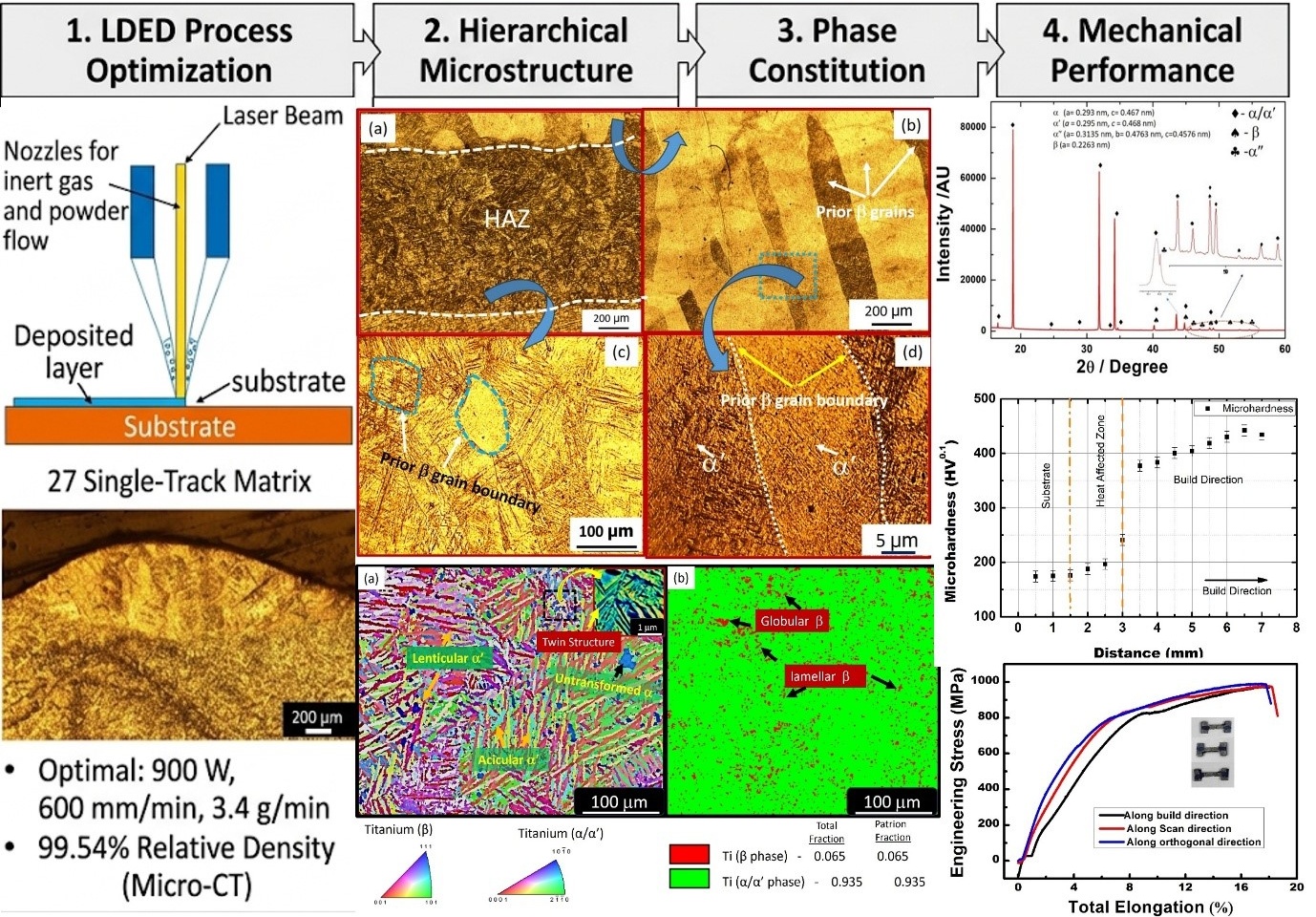
ABSTRACT: This study investigates the process-microstructure-phase-property correlation of Ti-6Al-4V alloy fabricated via Laser Directed Energy Deposition (LDED). A full-factorial 27 single-tracks experimental matrix was initially conducted by varying laser power (700–900 W), scanning speed (500–700 mm/min), and powder feed rate (2.8–4.0 g/min) to determine an optimized deposition condition based on geometrical integrity and cross-sectional morphology. The optimal parameters were identified as 900 W laser power, 600 mm/min scanning speed, and 3.4 g/min powder feed rate. Bulk components fabricated under these conditions achieved a high density of 99.54% (porosity < 0.5%), as confirmed by X-ray micro-computed tomography (micro-CT) and Archimedes’ principle. Microstructural characterisation via optical microscopy, Field Emission Scanning Electron Microscopy (FESEM), Electron Backscatter Diffraction (EBSD), and Synchrotron X-ray Diffraction (XRD) revealed that the deposit features highly elongated prior-β grains oriented along the build direction due to directional solidification and epitaxial growth. The hierarchical intragranular structure is predominantly composed of fine acicular/lenticular α′ martensite variants (93.5% α/α′ phase fraction) containing crystallographic nano-twins to accommodate rapid non-equilibrium transformation strains, alongside a 6.5% fraction of retained β phase in globular and lamellar morphologies. Mechanical evaluation revealed a progressive step-up in microhardness across the boundary zones, rising from 174–176 HV0.1 in the unaffected substrate to 187–241 HV0.1 in the heat-affected zone (HAZ), and peaking at 377–434 HV0.1 within the deposited region. The spatial fluctuations in the deposit’s microhardness profile serve as a mechanical footprint of in-situ tempering and partial α′ martensite decomposition induced by layer-by-layer thermal cycling. Room-temperature tensile testing demonstrated excellent, robust mechanical properties across all primary axes, with ultimate tensile strength (UTS) values ranging from 980 to 1000 MPa and total elongation to failure ranging from 18% to 18.5%. While the ultimate strength and fracture strain values remain highly isotropic, distinct anisotropic behaviour was observed during yielding and early strain-hardening regimes when specimens were loaded parallel to the long axis of the columnar prior-β boundaries along the build direction.
Keywords: Ti-6Al-4V; Laser directed energy deposition (LDED); Process parameter optimization; Synchrotron XRD; Martensitic transformation; Nano-twins; Microhardness heterogeneity; Tensile anisotropy

Graphical Abstract

TOP