Mapping Ecosystem Service Research Gaps of Sacred Groves in the Indian
Himalayan Region: A Bibliometric Review of Biocultural Evidence
Author Information
Other Information
ABSTRACT:
Sacred groves are patches of community-conserved forest maintained
through religious, cultural, and traditional norms, which makes them among the
oldest conservation institutions in the Indian Himalayan Region (IHR). Spanning
the Western Himalayas (Himachal Pradesh, Uttarakhand, Jammu & Kashmir),
Eastern/Northeastern Himalayas (Sikkim, Meghalaya, Nagaland, Manipur, Mizoram,
Arunachal Pradesh), and transitional Himalayan foothills (Assam, Tripura, West
Bengal), these landscapes give twelve analytical units in total (Jammu &
Kashmir and Ladakh are treated as one unit) and constitute a critical but
under-documented component of montane biodiversity conservation. Known
regionally as ‘Dev vans’, ‘Deodars’, ‘Orans’, ‘Law Kyntang’, and ‘Gamkhap’,
they represent the confluence of ecological function and biocultural heritage. This study presents a
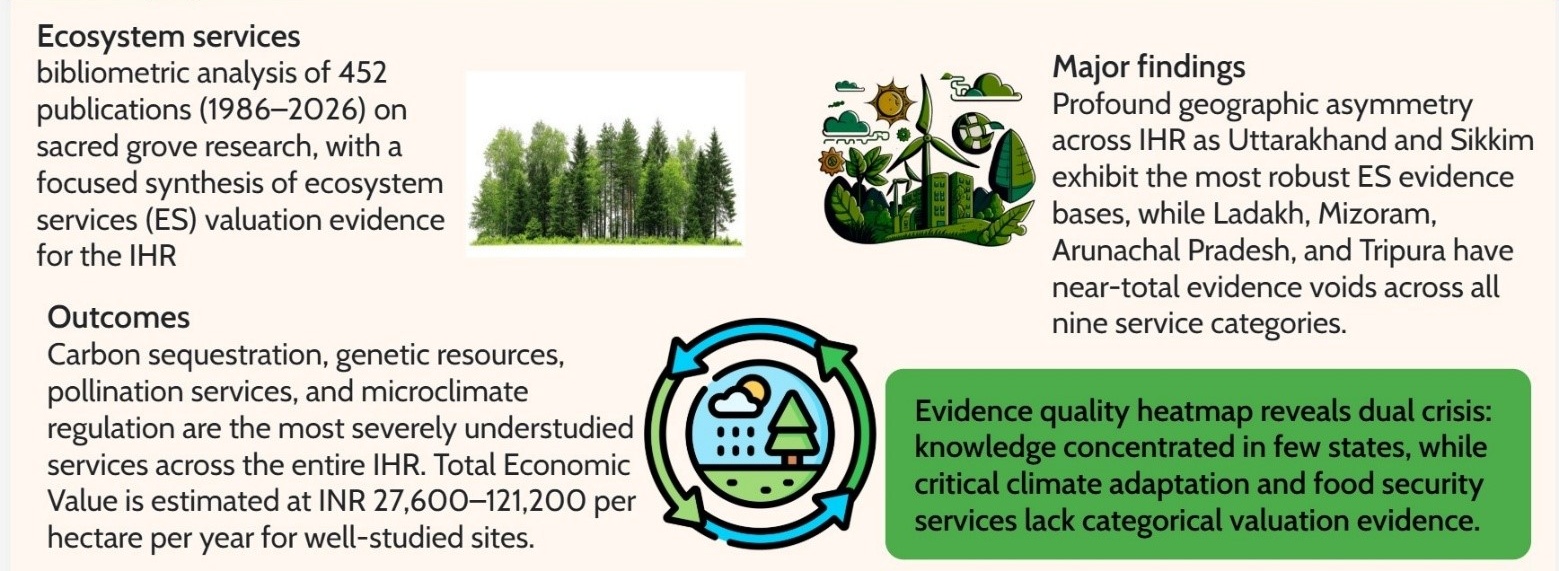
bibliometric analysis of 452 publications (1986–2026) on sacred grove research
in India, with a focused, non-aggregating synthesis of the evidence on
ecosystem services (ES) of sacred groves in the Indian Himalayan Region. A
research evidence heatmap is introduced to show where documentation of nine ES
categories is thin across twelve IHR units. It is a research-mapping aid and
not a valuation or ranking of groves. Bibliometric analyses
were conducted using bibliometrix (R) and VOSviewer, including Multiple
Correspondence Analysis for the thematic map. Publication trends are described
from observed counts only; no growth model or forecast is made. Ecosystem
services were classified using CICES v5.1 (Provisioning, Regulation &
Maintenance, Cultural, etc.). Documentation depth was scored on a
four-level scale (No Study/Anecdotal/Limited/Robust) for each state–ES
combination and visualised as a heatmap. The indexed corpus is
dominated by biophysical and conservation-ecology themes, while
governance-oriented social sciences remain peripheral. Documented ES evidence
is concentrated in Uttarakhand and Sikkim (and in Meghalaya for some services),
whereas Ladakh/Jammu & Kashmir, Mizoram, Arunachal Pradesh and Tripura have
almost no documented evidence for any of the nine categories. This gradient is
consistent with differences in accessibility and research capacity and may
partly reflect indexing and language coverage. Pollination, soil formation and
nutrient cycling, microclimate regulation and genetic resources are the least
documented categories. Monetary valuation covers only a narrow subset of the
values of sacred groves, and no aggregate economic value is estimated. The heatmap indicates
a geographic concentration of documented evidence and thematic gaps in
cultural, spiritual and knowledge-related services. These gaps are better
explained by accessibility, research capacity and the resistance of
taboo-protected sacred values to monetisation than by any lack of importance of
the groves. Closing them calls for supporting community-led documentation of
cultural and spiritual ecosystem services and traditional ecological knowledge,
for example through Biodiversity Management Committees and People’s
Biodiversity Registers, rather than prioritising monetary valuation or
measurement equipment.
Keywords:
Biocultural heritage; Biodiversity conservation; Community-conserved
areas; Ecosystem services; Indian Himalayan
Region; Sacred groves; Traditional
ecological knowledge; Cultural ecosystem services; Biodiversity
Management Committees