
A Brief Review on Engineering Synthetic Regulators for Bi-Directional Gene Expression Regulation

A Brief Review on Engineering Synthetic Regulators for Bi-Directional Gene Expression Regulation

Received: 19 August 2026 Revised: 15 September 2026 Accepted: 15 October 2026 Published: 27 October 2026

© 2026 The authors. This is an open access article under the Creative Commons Attribution 4.0 International License (https://creativecommons.org/licenses/by/4.0/).
1. Introduction
Precise control of protein expression is critical in maintaining healthy function in biosystems, as protein misfolding and abnormal protein homeostasis directly contribute to the pathogenesis of numerous diseases, including cancer, metabolic disorders, and neurodegenerative conditions [1,2,3]. The ability to achieve such precise modulation of gene expression is thus a cornerstone of synthetic biology, necessary for the development of novel diagnostics, therapeutics, and sustainable biomanufacturing processes [4,5,6]. One underdeveloped capability underpinning this objective is to achieve dynamic, reversible, and predictable control over gene expression, with both up- and down-regulation of the target gene, in response to specific signals or environmental cues [7]. This capability is essential for creating robust and adaptable biological systems that can function effectively in complex and changing environments. To meet this challenge, synthetic biologists have focused on developing gene circuits for engineering sophisticated dynamics. Note that while efforts have been made on both single and multiple gene expression regulation, in this review, we focus primarily on single gene expression regulation.
Synthetic gene circuits are composed of genetic parts that can regulate gene expression at transcriptional, translational, and post-translational levels [8] and can be designed to perform complex computations, implement feedback control, and execute dynamic genetic programs [9,10]. The pioneer synthetic gene circuits, the genetic toggle switch, are constructed from two repressible arcs arranged in a mutually inhibitory network, demonstrating the feasibility of engineering bistable systems, but lacked the ability for graded and reversible control [11,12]. Over the past several decades, the complexity of gene circuits has grown exponentially, bringing in multi-layered architectures, logic gates, and intricate feedback loops [7,13].
One class of gene circuits that is well-known for maintaining target gene expression in the presence of disturbance is the antithetic controller, a negative feedback-based gene circuit that leverages molecular sequestration to realize bi-directional regulation. The concept of feedback is central to biological systems, where positive feedback loops can create switch-like behaviors and amplify cellular responses [14,15], and negative feedback loops are essential for maintaining stable protein concentrations and preventing overshoots [16,17]. Inspired by these natural control principles, synthetic biologists have implemented sophisticated feedback strategies in engineered microbial consortia. For instance, Aoki et al. (2019) developed a universal biomolecular integral feedback controller in E. coli, inspired by an antithetic feedback motif, that mathematically ensures robust perfect adaptation, meaning that the system can maintain the target gene expression at the setpoint despite disturbances [18]. Subsequent efforts extended this concept to multicellular systems, in which control functions are distributed across different cell populations to reduce metabolic burden and enhance modularity. In Martinelli et al. (2022), the authors designed a multicellular Proportional-Integral controller where proportional and integral actions were distributed across two different cell populations, and communicated via orthogonal quorum sensing molecules to regulate a third target population [19]. By distributing the sense, actuate, and control functions across different cell populations, these multicellular systems can achieve remarkable precision and stability in gene expression, thereby creating closed-loop feedback systems that enhance circuit robustness and enable the regulation of complex, multi-cellular behaviors.
Instead of focusing on specific types of controllers, such as the antithetic controller described above, this review focuses on key technologies that enable up- and down-regulation of single-gene expression for bi-directional regulation, such as CRISPR-based systems and RNA-based regulatory mechanisms. To complete the discussion, we also examine the application of mathematical modeling to guide the design and characterization of these circuits.
2. RNA-Based Gene Expression Repression and Activation Regulators
Living organisms have evolved intricate regulatory networks that maintain cellular homeostasis and enable adaptation to changing environments through precise control of gene expression in response to internal and external cues [18,20,21,22,23,24,25]. In bacteria, post-transcriptional regulation is achieved through a diverse class of molecules known as regulatory RNAs [26,27,28]. These molecules are commonly grouped into classes according to their mechanism and layer of action: antisense and small RNAs, which base-pair with a target mRNA to repress translation or promote its degradation; small transcription activating RNAs (STARs), which relieve transcription termination to switch on a downstream gene; and toehold switches and related riboregulators, which expose a sequestered ribosome binding site upon binding a trigger RNA to activate translation [26]. These regulatory RNAs traditionally function by targeting mRNAs to induce degradation or suppress translation [27,29,30]. This natural mechanism has provided a foundational blueprint for synthetic biology, where engineered regulatory RNAs with predictable behavior are now routinely used to optimize metabolic pathways, down-regulate competing gene expression, and perform targeted gene knockdowns in complex systems [31]. As a class, these antisense and small regulatory RNAs constitute the repression arm of the RNA toolbox, acting post-transcriptionally and imposing minimum metabolic load because they are encoded as short, non-translated sequences [32,33].
Efforts over the past several decades have expanded the regulatory paradigm beyond gene repression to synthetic modes of activation. Small transcription activating RNAs (STARs), for instance, can be engineered to disrupt intrinsic transcription terminators, leading to robust gene activation, enabling the construction of RNA-only transcriptional logic gates. This evolution from repurposing natural components to forward-engineering novel functions provides a rich, dynamic toolbox for achieving programmable bi-directional control [26,34,35,36]. Besides transcriptional regulation, RNA-based regulators can also operate at the post-transcriptional level, controlling translation initiation or termination. One prominent example is the “toehold switch”, a de-novo-designed riboregulator that can activate gene expression in the presence of a specific trigger RNA [37,38]. These switches exhibit a wide range of dynamics with orthogonality, meaning that they can be designed to respond to unique RNA sequences with minimal crosstalk [39,40]. This capability permits independent regulation of multiple genes within the same cell, as demonstrated by the construction of a four-input AND logic gate [13]. The design principles underlying toehold switches have been further refined, with recent work focusing on optimizing the thermodynamic properties of the RNA structures to maximize dynamic range and minimize leakiness [4,40,41,42]. McSweeney et al. [36] explored the use of short activators and repressors of RNA toehold switches, demonstrating that the length and sequence of the trigger RNA can significantly impact the performance of the switch. Considered together, these tools span complementary layers of control, with antisense and small RNAs repressing post-transcriptional activities, STARs activating during transcription elongation, and toehold switches activating at translation initiation, so that bidirectional regulation at the RNA level is generally realized by pairing an activating and a repressing device rather than by a single part [27,35,37].
As compared to protein-based regulators, these RNA-based devices can offer a complementary and highly programmable approach to gene regulation [26,43]. One example is the combined use of STARs and antisense RNAs [28,31,34,44]. The STAR system provides a method for activating gene expression, which can be combined with traditional antisense RNA-mediated repression to achieve multilevel control, as shown by Lee and Moon [35]. These approaches provide a fast and versatile means of regulation that does not require the expression of bulky protein factors, making them ideal for applications where a rapid response is needed [2]. Their principal limitations, relative to protein- and CRISPR-based regulators, are a susceptibility to incomplete repression or leakage and a reliance on predictable RNA folding, which can restrict dynamic range and portability across host contexts [31,42]. These trade-offs, and how they compare with the protein- and CRISPR-based platforms introduced in the following sections, are discussed in greater detail later in the manuscript.
The scope of RNA-based regulation has been further extended by Simmons et al. [45], who rewired native post-transcriptional global regulators to construct designer, multi-layered genetic circuits, demonstrating that endogenous RNA regulatory networks can be repurposed as programmable circuit components. The use of antisense RNAs for gene regulation has a long history in synthetic biology, and recent work has focused on improving the predictability and efficiency of these systems [29,31,33,38,46,47]. By carefully designing the complementary parts between the antisense RNA and its target mRNA, it is possible to achieve precise control over translation and mRNA stability [31,39].
Another powerful class of RNA-based or RNA-protein hybrid regulators is the CRISPR-Cas system, originally discovered as a bacterial immune system, which has been repurposed into a versatile tool for programmable gene regulation [48]. The most widely used effector, Cas9 from Streptococcus pyogenes, is an RNA-guided endonuclease directed by a single-guide RNA (sgRNA) to a complementary genomic sequence adjacent to a protospacer-adjacent motif (PAM), where it introduces a double-strand break. Catalytic inactivation of its two nuclease domains produces a nuclease-dead variant, dCas9, which retains guide-directed DNA binding but no longer cleaves the target sequence [48,49]. Fusion of dCas9 to transcriptional repressor domains, such as KRAB, or activator domains, such as VP64 or the tripartite VPR complex, converts sequence-specific DNA targeting into programmable gene repression (CRISPR interference, CRISPRi) or activation (CRISPR activation, CRISPRa), respectively [49,50]. The versatility of CRISPR-based tools for controlling gene expression in bacteria has been comprehensively reviewed by Vigouroux and Bikard [6], who highlighted the diversity of Cas proteins and the different mechanisms by which they can be harnessed for synthetic biology applications, from transcriptional regulation to post-transcriptional control. One breakthrough that leverages this versatility is the development of multilayer CRISPRa/i circuits. For instance, Tickman et al. [7] demonstrated that these circuits can operate effectively in both cell-free and bacterial systems, enabling dynamic genetic programs with unprecedented complexity. Their work showed that by carefully tuning the strength of guide RNAs and the architecture of activatable promoters, it is possible to create circuits with multiple layers of regulation, in which the output of one layer serves as the input to the next. This hierarchical organization is reminiscent of natural gene regulatory networks and provides a powerful framework for engineering complex behaviors. In Nielsen and Voigt [51], the authors also provided a foundational framework by building a set of orthogonal dCas9-based NOT gates in E. coli. These repressive modules were layered to create more complex logic, and by targeting the native transcription factor malT, they showed that synthetic circuits could reprogram complex cellular phenotypes, establishing a principle for scalable, programmable genetic control.
Besides independent usage, these RNA-based devices can also be coupled with other regulatory mechanisms for new functions. Hong et al. [4] demonstrated the use of multilevel gene regulation using switchable transcription terminators and toehold switches in E. coli. This approach enabled independent control of transcription and translation, providing a powerful framework for engineering complex regulatory networks. Similarly, Zhao et al. [52] demonstrated the construction of a three-layer cascade circuit and a two-input, three-layer OR logic gate using switchable transcription terminators in a cell-free system, highlighting the potential to create complex, multi-layered circuits. The use of RNA scaffolds has also emerged as a promising strategy for organizing metabolic enzymes and enhancing pathway flux. Mitkas et al. [53] and Pham et al. [46] showed that Cas6-mediated RNA scaffolding can be used to assemble metabolons in yeast, demonstrating the potential of RNA-based approaches for metabolic engineering. Furthermore, Xi et al. [54] demonstrated that guide RNAs can be conditionally deactivated by mRNA and small molecule triggers in S. cerevisiae, providing a strategy for integrating RNA-sensing with CRISPR-based gene regulation. The integration of CRISPR-based regulation with riboswitches and STARs provides a rich palette of tools for engineering sophisticated genetic circuits [34,55]. Figure 1 provides an overview of the aforementioned RNA-based regulators, possible design strategies and applications.
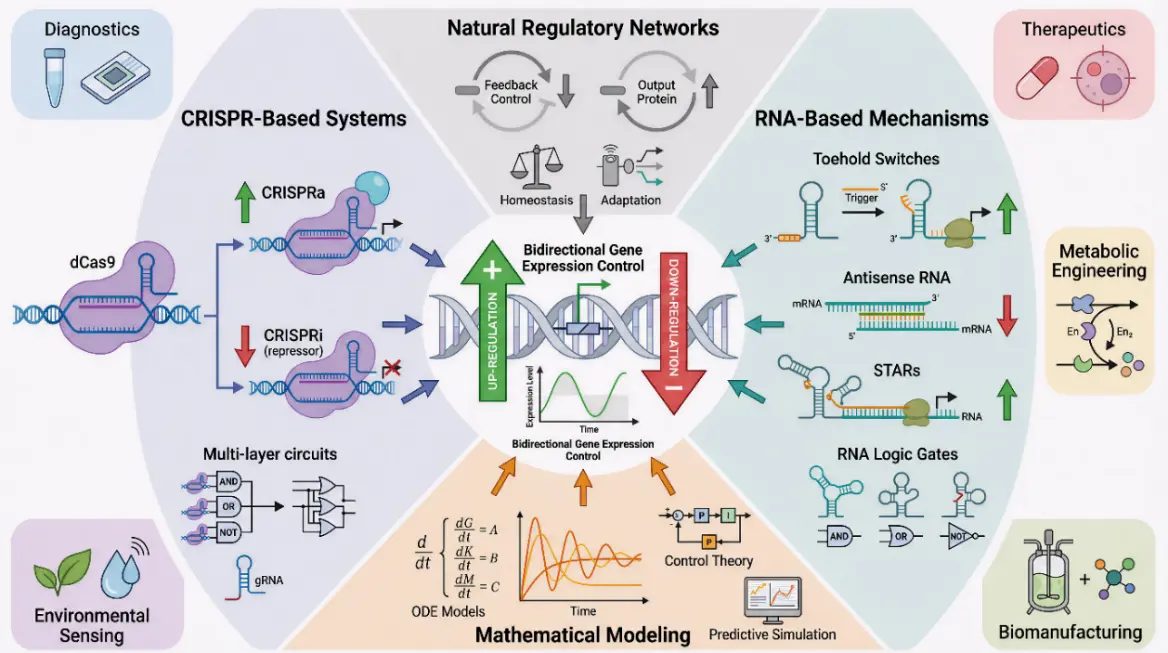
Figure 1. Molecular strategies for bi-directional gene expression control and their applications in synthetic biology. The figure illustrates the two primary molecular platforms for achieving simultaneous up- and down-regulation of gene expression: CRISPR-based systems, in which a catalytically deactivated Cas9 (dCas9) protein is directed by guide RNAs to activate (CRISPRa) or repress (CRISPRi) transcription at specific genomic loci, and RNA-based mechanisms, including toehold switches, antisense RNAs, and STARs, which operate at the post-transcriptional level. Both platforms can be assembled into multilayer logic circuits (AND, OR, NOT gates) for complex regulatory programs. Natural regulatory networks, which achieve homeostasis and adaptation through feedback control, serve as the biological inspiration for these engineered architectures. Mathematical modeling approaches, including ODE-based models and control theory frameworks, provide the computational tools necessary for rational design and performance prediction of these circuits. Together, these strategies find application across diagnostics, therapeutics, environmental sensing, metabolic engineering, and biomanufacturing.
3. Protein-Based Gene Expression Repression and Activation Regulators
Beyond the RNA-based devices discussed in the previous section, which offer high design flexibility and comparatively low metabolic burden [32], protein-based transcription factors have played a central role in synthetic gene regulation since the inception of the field, as exemplified by foundational circuits such as the genetic toggle switch and the repressilator [12,56,57]. However, the repertoire of well-characterized natural regulators is limited, and the simultaneous use of multiple regulators can introduce undesirable crosstalk [58]. To address these limitations, programmable transcriptional regulators have been engineered from modular DNA-binding proteins. Prominent examples include zinc-finger and transcription activator-like effector (TALE) domains fused to activation or repression modules, yielding orthogonal and tunable regulators for both bacterial and eukaryotic systems [59,60,61]. More recently, this strategy has been extended toward therapeutic applications through compact, largely human-derived zinc-finger regulators that enable small molecule-controlled expression of therapeutic genes in primary human T cells [62].
A distinct strategy in bacteria exploits cognate sigma/anti-sigma factor pairs. In this architecture, an alternative sigma factor recruits RNA polymerase to a cognate promoter to activate transcription, whereas the corresponding anti-sigma factor sequesters the sigma factor to repress transcription. This sequestration-based mechanism is conceptually reminiscent of the antithetic controllers discussed previously. Rhodius et al. (2013) systematically characterized 86 extracytoplasmic function (ECF) sigma factors and 62 anti-sigma factors, identifying mutually orthogonal regulator pairs that can function as programmable genetic switches in E. coli [63].
Regulation can also be directed at the transcriptional machinery itself. Bacteriophage T7 RNA polymerase, when split into interdependent fragments, can reconstitute an orthogonal and largely host-independent transcription system in which a shared “core” fragment modulates the overall transcriptional capacity of the circuit. This architecture has been exploited to construct tunable “resource allocators” and orthogonal AND-gate inputs [64,65], and subsequent directed-evolution efforts have expanded the utility of these orthogonal transcription systems for programmable gene expression in both prokaryotic and eukaryotic hosts [66]. Whereas transcriptional and translational regulation primarily control the rate of protein synthesis, the decline of an existing protein pool is governed by dilution and degradation. Active, targeted proteolysis has therefore been used to accelerate protein down-regulation [67,68]. Building on engineered ssrA degradation tags and redesigned protease-recognition sequences [69,70], inducible and orthogonal degradation systems enable the steady-state abundance and active removal rate of target proteins to be tuned with a degree of independence [67,68]. More recent designs have extended inducible degradation to blue-light control in E. coli and to repurposed E3 ubiquitin ligase-based degron systems in mammalian cells [71,72]. By actively removing protein rather than merely halting its synthesis, controlled proteolysis is particularly well suited for rapid and reversible turn-off, a key requirement for symmetric bidirectional regulation.
These protein-based regulators differ fundamentally in the molecular layer at which they act and in the trade-offs they impose, as summarized together with other regulator classes in Table 1. Engineered transcription factors can provide high targeting specificity and support both activation and repression through selection of the effector domain, but they require expression of relatively large protein regulators and may therefore increase cellular burden [58,59,60,61]. Sigma/anti-sigma systems are comparatively compact and readily compatible with feedback architectures, although their action is confined to transcription initiation [63]. Split polymerase systems can partially decouple circuit transcription from host machinery and make resource allocation an explicit design variable, directly linking them to competition for shared transcriptional resources discussed below [64,65,66]. Controlled proteolysis adds a post-translational regulatory layer that can accelerate down-regulation beyond what is typically achievable through repression of synthesis alone [67,68,71,72]. In this respect, controlled proteolysis and sequestration-based regulators are especially relevant to single-target control modes in which reversible turn-off over time is a primary requirement. In practice, these mechanisms are increasingly combined with one another and with RNA- and CRISPR-based regulators to support dynamic and symmetric up- and down-regulation for applications such as reference tracking, disturbance rejection, and stable bidirectional control [8,58].
4. Bi-Directional Gene Expression Regulations
The concept of combining activation and repression within a single genetic circuit has its roots in the study of natural network motifs, such as the incoherent feedforward loop (IFFL), where a single input simultaneously activates a target gene and its repressor. Bleris et al. [73] constructed synthetic IFFL circuits in human HEK293 cells, using a transcription factor to activate the expression of both a reporter gene and its post-transcription repressor microRNA. They found that this architecture can lead to adaptation to gene dosage, with the post-transcriptional miRNA-based version showing superior performance and lower noise. This work established the IFFL as a powerful motif for engineering robustness in synthetic circuits. Building on this, Guo and Murray [74] demonstrated the construction of modular IFFL circuits in an E. coli cell-free transcription-translation (TXTL) system and in living cells. Their circuit used a sigma factor to activate both a repressor (TetR) and a target gene (GFP). This study highlighted the power of cell-free systems for rapid prototyping, as the pulse-like dynamics observed in vitro closely matched the in vivo performance, validating the TXTL system as a reliable proxy for cellular behavior. These early synthetic implementations of the IFFL, while not constituting bidirectional regulation in the strict sense, established a foundational principle: that combining activation and repression within a single genetic circuit can produce functional, predictable outputs. The development of the aforementioned CRISPR-Cas technology and RNA-based devices provided the programmability and scalability that can potentially extend this principle into true multi-target, simultaneous up- and down-regulation of gene expression.
One prominent success is the combined use of the CRISPRi and CRISPRa systems. In Martella et al. [75], the authors systematically evaluated CRISPRa and CRISPRi modalities in human cells, identified dCas9-VPR (activation) and dCas9-KRAB (repression) as the most effective orthogonal pair, and demonstrated simultaneous up-regulation of one endogenous gene and down-regulation of another, showcasing the feasibility of bi-directional CRISPR regulation for controlling complex cellular processes in human cells. However, integrated use of CRISPRi/a systems in one host system is nontrivial, as crosstalk between components and off-target effects can complicate predictable circuit behavior [76]. As demonstrated by Barbier et al. [10], combining CRISPRi with a SoxS-based CRISPRa system in E. coli can lead to unpredictable, context-dependent effects due to different binding affinities of the guide RNAs for the activation and interference complexes. Their work highlighted the importance of component design, showing that a guide RNA with the same scaffold structure for both complexes can mitigate such issues and restore predictable circuit behavior. To further advance the scalability of these systems, Burbano et al. [9] engineered a suite of high-performing, activatable promoters with up to 1000-fold dynamic range, enabling CRISPRa/i circuits that are six layers deep and four branches wide, and demonstrating applicability for complex network topologies including feedback loops, logic gates, and dynamic pulse modulators. Most recently, Pacalin et al. [77] introduced CRISPRai, a system for simultaneous bidirectional epigenetic editing in human primary T cells. Using two orthogonal dCas9 proteins fused to activation (VPR) and repression (KRAB) domains, they performed pooled screens coupled with single-cell RNA sequencing.
This allowed them to map epistatic relationships between genes by observing the transcriptional consequences of activating one gene while repressing another, revealing hierarchies in gene regulation and demonstrating the power of bi-directional perturbation as a tool for fundamental biological discovery. Recent advances have also focused on making CRISPR circuits more responsive to external signals. Kim et al. [78] developed modular and signal-responsive transcriptional regulation systems using CRISPRi-aided genetic switches in E. coli. These switches can be activated by specific small molecules or environmental cues, allowing for the dynamic control of gene expression in response to changing conditions. This capability is essential for applications in biosensing and adaptive biomanufacturing, where the ability to respond to environmental signals is critical.
The practical value of multidirectional regulation is particularly evident in metabolic engineering, where the design objective is often to redirect metabolic flux by up-regulating rate-limiting or committed pathway enzymes while simultaneously repressing competing or by-product-forming branches. This inherently bidirectional control problem can be addressed through complementary classes of regulators. Synthetic small regulatory RNAs, for example, have been used to tune pathway flux by post-transcriptionally suppressing competing genes [33], whereas CRISPR-based platforms enable simultaneous activation and repression of multiple pathway targets within a unified regulatory framework [79]. Lian et al. [79] introduced CRISPR-AID, a tri-functional CRISPR system in Saccharomyces cerevisiae that combined CRISPRa, CRISPRi, and gene knockout in a single framework. Applied to the β-carotene biosynthesis pathway, they achieved a 3-fold increase in production by simultaneously activating three genes, repressing one, and deleting another, showcasing the power of this approach for combinatorial metabolic engineering. Chen et al. [80] applied simultaneous CRISPRa and CRISPRi to improve the performance of the electroactive bacterium Shewanella oneidensis. They activated genes to increase cell length and biofilm formation while repressing a negative regulator of flavin synthesis. This combined perturbation led to a 2.5-fold increase in power density in a microbial fuel cell, illustrating how coordinated multi-directional regulation can optimize complex, multi-trait phenotypes. Extending this to the industrial yeast Yarrowia lipolytica, Chen et al. [81] further developed a CRISPR-STAR platfo that uses a single dCas9 directed by scaffold RNAs (scRNAs) to recruit either an activator (VPR) or a repressor (MXI1). This simplified architecture was used to enhance fatty alcohol production by simultaneously activating a key enzyme and repressing a competing pathway, leading to a 55.7% increase in yield and demonstrating the effectiveness of this platform for metabolic optimization.
Taken together, the systems discussed in this section illustrate how combined activation and repression have evolved from early single-target motifs into programmable platforms capable of regulating multiple genes simultaneously. CRISPR-based tools, in particular, now enable coordinated up- and down-regulation of multiple endogenous targets for applications ranging from epistatic mapping to metabolic engineering. These applications exemplify the multi-target form of bidirectional regulation introduced earlier, which is distinct from reversible control of a single target over time, although the two modes can be combined in practice. As summarized in Table 1, the regulator classes reviewed here generally offer complementary strengths rather than a single universally superior solution: RNA-based devices are highly programmable and can impose relatively low burden, although individual designs may exhibit leakage [31,32]; protein-based regulators can provide broad dynamic range and intrinsic bidirectionality at the cost of greater cellular burden [58,59]; and CRISPR-based systems offer programmable multiplexing while remaining dependent on shared cellular resources [49,82].
Table 1. Comparison of synthetic regulator classes for bidirectional gene expression control.
|
Regulator Class |
Regulatory Layer (Mechanism) |
Direction |
Dynamic Range |
Orthogonality and Multiplexing |
Metabolic Burden |
Programmability |
Representative Examples |
|---|---|---|---|---|---|---|---|
|
Antisense and small regulatory RNAs |
Post-transcriptional; base-pairs with mRNA to block translation or trigger degradation |
Repression |
Set by base-pairing; improved by design rules, not standardized across studies [31] |
Low (short non-coding RNA, no protein product) [32] |
Pathway flux control, gene knockdown, antibacterial sensitization [31,33,47] |
||
|
STARs (small transcription activating RNAs) |
Transcriptional; disrupt intrinsic terminators (anti-termination) |
Activation |
Large; computationally optimized for high activation [34] |
High; orthogonal libraries, multilevel with antisense RNA [34,35] |
Low [32] |
RNA-only transcriptional logic, multilevel STAR and antisense control [28,34,35] |
|
|
Toehold switches and riboregulators |
Translational; trigger RNA exposes the ribosome binding site |
Activation |
Wide and tunable; leakiness reduced by thermodynamic optimization [4,40,42] |
High, minimal crosstalk; four-input AND gate demonstrated [13,39] |
Low [32] |
Ribocomputing logic, native RNA detection, cell-free circuits [13,40,52] |
|
|
CRISPRi and CRISPRa (dCas) |
Transcriptional; dCas fused to repressor or activator effector |
Both (CRISPRi represses, CRISPRa activates); orthogonal dCas9-KRAB and dCas9-VPR pair [75] |
High; activatable promoters up to 1000-fold [9] |
High targeting; six-layer, four-branch circuits [9]; constrained by the shared dCas pool and resource competition [82] |
High (large dCas protein, draws shared resources) [82] |
Bidirectional epigenetic editing [77]; metabolic engineering: 3-fold β-carotene [79], 2.5-fold power density [80], 55.7% fatty alcohol [81]; signal-responsive switches [78] |
|
|
Protein transcription factors (classical and engineered ZF/TALE) |
Transcriptional; sequence-specific DNA binding plus effector |
Both (through effector choice) |
High; broadly tunable [61] |
Limited and crosstalk-prone for natural [58]; expanded by engineered ZF/TALE [59,60,61] |
Moderate to high (expression of large protein factors) [58] |
Moderate; modular ZF/TALE assembly but requires protein engineering [59,60] |
Genetic toggle switch [12], synthetic IFFL [73], therapeutic T-cell circuits [62] |
|
Sigma and anti-sigma factors |
Transcriptional (initiation); redirect RNA polymerase |
Both (sigma activates, anti-sigma represses by sequestration) |
Moderate [63] |
High; 86 ECF sigma and 62 anti-sigma factors mapped to orthogonal pairs [63] |
Moderate (protein factors) |
Low to moderate; requires cognate promoters [63] |
Orthogonal genetic switches [63], IFFL activation module [74] |
|
Split-T7 RNA polymerase |
Transcriptional; orthogonal, largely host-independent polymerase |
Activation and transcriptional-capacity control |
High (strong T7 transcription) |
Split mutants yield AND gates [64] and a tunable resource allocator [65] evolved orthogonal engines [66] |
Moderate to high (possible T7 toxicity, resource draw) [65] |
Low to moderate; T7 promoter variants [64] |
Transcriptional AND logic [64], resource allocation [65], cross-host expression [66] |
|
Controlled proteolysis and degrons |
Post-translational; targeted protein degradation |
Down-regulation (active protein removal) |
Few orthogonal protease and tag pairs; engineered recognition determinants [69,70] |
Moderate (protease and degron expression) |
Broad by tagging, but single direction [68] |
Tunable degradation [67,68] light-inducible LOVdeg [71], E3-ligase degrons in mammalian cells [72] |
5. Mathematical Modeling to Facilitate Circuits Design
The regulatory architectures described here, from RNA-based devices and CRISPR-mediated circuits to their applications in metabolic engineering, share a common challenge: as the number of interacting components increases, the behavior of the system becomes increasingly difficult to predict. Non-linear interactions between activators and repressors, competition for shared molecular resources such as dCas9 or RNA polymerase, etc., and the stochastic nature of gene expression at the single-cell level all contribute to emergent dynamics that cannot be reliably anticipated without a formal quantitative framework [10,82,83,84]. Mathematical modeling and computational simulation therefore serve not merely as complementary tools, but as necessary components of the design cycle, enabling researchers to explore the parameter space of a circuit, identify potential failure modes, and generate testable predictions before committing to the bench [85,86,87].
Predicting the dynamics of bi-directional gene circuits, which simultaneously employ activation and repression, presents a unique set of challenges, including capturing non-linear interactions, predicting emergent behaviors, and accounting for competition between opposing regulatory elements for shared molecular resources [10,82,88]. A purely empirical approach to circuit construction is often inefficient, costly, and susceptible to malfunction due to unexpected interactions between components, context-dependent behavior, and competition for limited cellular resources [82,86]. Mathematical modeling provides a rational framework for abstracting this complexity, enabling engineers to simulate circuit dynamics, perform sensitivity analyses to identify critical parameters, and optimize performance before experimental implementation [89]. Historically, the design of foundational synthetic circuits was tightly coupled with mathematical modeling. Ordinary differential equations (ODEs), which describe the rate of change of molecular concentrations over time, were used to define the parameter space in which landmark circuits like the genetic toggle switch and the repressilator were predicted to function [12,57]. This deterministic framework remains as the most popular type of modeling in synthetic biology due to its simplicity, providing a powerful tool for capturing the average behavior of a cell population. However, deterministic ODEs do not capture the stochastic fluctuations in gene expression that dominate at the single-cell level. Therefore, stochastic simulations emerged as alternative approaches to approximate these probabilistic dynamics [90,91,92,93,94,95,96]. Other studies subsequently demonstrated how to experimentally decouple cellular noise into two components: intrinsic noise arising from the inherent randomness of transcription and translation, and extrinsic noise stemming from fluctuations in the upstream cellular environment, such as variations in ribosome or polymerase concentrations [83,84,97]. The choice of modeling framework thus depends on the specific question, with deterministic models suited for population-level predictions and stochastic models essential for understanding noise propagation and cell-to-cell variability [98]. Beyond defining a circuit’s operating regime, modeling can also specify the control architecture itself. Briat et al. [99] integrated stochastic chemical kinetics with control theory to show that a sequestration-based feedback motif can robustly maintain a target gene at its setpoint despite disturbances and intrinsic biochemical noise, thereby identifying a network topology capable of robust bidirectional regulation before experimental implementation. This theoretical architecture was subsequently realized as a synthetic integral feedback circuit in living cells, closing the loop between model-based design and experimental implementation [18].
As synthetic circuits grow in scale and complexity, particularly with the advent of multiplexed CRISPR and RNA-based regulation, models must account for the competition for shared cellular resources (e.g., dCas9, ribosomes, RNA polymerase) [86], and failure to do so leads to unintended crosstalk and breaks the modularity of circuit components. Model-guided design has been instrumental in addressing this challenge. For instance, a mathematical model of dCas9 competition predicted that a negative feedback loop regulating dCas9 expression could neutralize resource competition, a finding that was experimentally validated, restoring modularity in layered CRISPRi circuits [82]. More recently, Sechkar and Steel [88] used a similar resource-aware model to show that a ‘push-pull’ architecture, where a gene is simultaneously activated and repressed, can confer robustness to resource competition crosstalk. The work further showed that combining positive and negative regulation in feedback loops can overcome trade-offs in robustness to different types of perturbations. Similarly, detailed ODE models have been developed for RNA-based circuits, such as toehold switches and STARs, enabling accurate prediction of their dynamic behavior and the model-guided discovery of previously unknown RNA maturation steps [89]. These models, often parameterized using data from experimental systems, are becoming increasingly sophisticated, forming the basis for computer-aided design tools that accelerate the engineering of complex, multi-layered regulatory networks [100,101]. Furthermore, besides the CRISPR and RNA-based systems, ODE models have also been used to characterize and optimize other bi-directional systems, such as light-activated and repressed promoters, revealing design principles for achieving fast and reversible switching dynamics [102]. These examples underscore the indispensable role of mathematical modeling in moving from the design of simple unidirectional switches to the engineering of sophisticated, robust, and predictable bi-directional regulatory systems [103].
6. Conclusions
The field of synthetic gene circuits has achieved significant breakthroughs over the past several decades, from the advent of the first repressilator to the latest biomolecular neural networks [104,105,106,107]. The underlying principle that enables the functionality of these circuits is the ability to precisely regulate the target gene dynamics. As the field progresses, increasing efforts are being made towards the construction of regulators that can repeatedly activate and repress target gene expression, to achieve properties analogous to mechanical feedback control systems, such as disturbance rejection, reference tracking, system stability, and robustness. The prosperity in the development of the constituent RNA-based regulatory parts such as STAR, riboregulators, and the CRISPR-Cas systems described in this review lays the cornerstone to the realization of advanced circuits for complicated functionalities with ensured properties. As the demand for precise and repeatable regulation of biological process increases, we expect bi-directional repetitive gene expression regulators to play an increasingly important role in future circuits design. Coupling with mathematical modeling and high throughput circuit characterization will be necessary for efficient and reliable design and construction.
Statement of the Use of Generative AI and AI-Assisted Technologies in the Writing Process
During the preparation of this manuscript, the authors used ChatGPT for language editing and references finding. After using this tool/service, the authors reviewed and edited the content as needed and take full responsibility for the content of the published article.
Author Contributions
T.S.: conceptualization, investigation, writing—original draft, writing—review and editing. X.T.: conceptualization, funding acquisition, writing—original draft, writing—review and editing.
Ethics Statement
Not applicable.
Informed Consent Statement
Not applicable.
Data Availability Statement
No data were generated from this work.
Funding
This research was funded by NSF grant number #2223720.
Declaration of Competing Interest
The authors declare that they have no known competing financial interests or personal relationships that could have appeared to influence the work reported in this paper.
References
- Hetz C, Glimcher LH. Protein homeostasis networks in physiology and disease. Curr. Opin. Cell Biol. 2011, 23, 123–125. DOI:10.1016/j.ceb.2011.01.004 [Google Scholar]
- Gregersen N, Bross P, Vang S, Christensen JH. Protein Misfolding and Human Disease. Annu. Rev. Genom. Hum. Genet. 2006, 7, 103–124. DOI:10.1146/annurev.genom.7.080505.115737 [Google Scholar]
- Seo J, Park M. Molecular crosstalk between cancer and neurodegenerative diseases. Cell. Mol. Life Sci. 2020, 77, 2659–2680. DOI:10.1007/s00018-019-03428-3 [Google Scholar]
- Hong S, Kim J, Kim J. Multilevel Gene Regulation Using Switchable Transcription Terminator and Toehold Switch in Escherichia coli. Appl. Sci. 2021, 11, 4532. DOI:10.3390/app11104532 [Google Scholar]
- Morones-Ramírez JR. Biocircuitry and Living Programmable Materials: The Next Frontier in Synthetic Living Systems. ACS Mater. Lett. 2025, 7, 2910–2935. DOI:10.1021/acsmaterialslett.5c00238 [Google Scholar]
- Vigouroux A, Bikard D. CRISPR Tools To Control Gene Expression in Bacteria. Microbiol. Mol. Biol. Rev. 2020, 84, e00077-19. DOI:10.1128/MMBR.00077-19 [Google Scholar]
- Tickman BI, Burbano DA, Chavali VP, Kiattisewee C, Fontana J, Khakimzhan A, et al. Multi-layer CRISPRa/i circuits for dynamic genetic programs in cell-free and bacterial systems. Cell Syst. 2022, 13, 215–229.e8. DOI:10.1016/j.cels.2021.10.008 [Google Scholar]
- Buson F, Gao Y, Wang B. Genetic Parts and Enabling Tools for Biocircuit Design. ACS Synth. Biol. 2024, 13, 697–713. DOI:10.1021/acssynbio.3c00691 [Google Scholar]
- Alba Burbano D, Cardiff RAL, Tickman BI, Kiattisewee C, Maranas CJ, Zalatan JG, et al. Engineering activatable promoters for scalable and multi-input CRISPRa/i circuits. Proc. Natl. Acad. Sci. USA 2023, 120, e2220358120. DOI:10.1073/pnas.2220358120 [Google Scholar]
- Barbier I, Kusumawardhani H, Chauhan L, Harlapur PV, Jolly MK, Schaerli Y. Synthetic Gene Circuits Combining CRISPR Interference and CRISPR Activation in E. coli: Importance of Equal Guide RNA Binding Affinities to Avoid Context-Dependent Effects. ACS Synth. Biol. 2023, 12, 3064–3071. DOI:10.1021/acssynbio.3c00375 [Google Scholar]
- Fiore D, Salzano D, Cristobal-Coppulo E, Olm JM, di Bernardo M. Multicellular Feedback Control of a Genetic Toggle-Switch in Microbial Consortia. IEEE Control Syst. Lett. 2021, 5, 151–156. DOI:10.1109/LCSYS.2020.3000954 [Google Scholar]
- Gardner TS, Cantor CR, Collins JJ. Construction of a genetic toggle switch in Escherichia coli. Nature 2000, 403, 339–342. DOI:10.1038/35002131 [Google Scholar]
- Green AA, Kim J, Ma D, Silver PA, Collins JJ, Yin P. Complex cellular logic computation using ribocomputing devices. Nature 2017, 548, 117–121. DOI:10.1038/nature23271 [Google Scholar]
- Ferrell JE. Self-perpetuating states in signal transduction: Positive feedback, double-negative feedback and bistability. Curr. Opin. Cell Biol. 2002, 14, 140–148. DOI:10.1016/S0955-0674(02)00314-9 [Google Scholar]
- Cinquin O, Demongeot J. Roles of positive and negative feedback in biological systems. Comptes Rendus. Biol. 2002, 325, 1085–1095. DOI:10.1016/S1631-0691(02)01533-0 [Google Scholar]
- Yi TM, Huang Y, Simon MI, Doyle J. Robust perfect adaptation in bacterial chemotaxis through integral feedback control. Proc. Natl. Acad. Sci. USA 2000, 97, 4649–4653. DOI:10.1073/pnas.97.9.4649 [Google Scholar]
- Ma W, Trusina A, El-Samad H, Lim WA, Tang C. Defining Network Topologies that Can Achieve Biochemical Adaptation. Cell 2009, 138, 760–773. DOI:10.1016/j.cell.2009.06.013 [Google Scholar]
- Aoki SK, Lillacci G, Gupta A, Baumschlager A, Schweingruber D, Khammash M. A universal biomolecular integral feedback controller for robust perfect adaptation. Nature 2019, 570, 533–537. DOI:10.1038/s41586-019-1321-1 [Google Scholar]
- Martinelli V, Salzano D, Fiore D, di Bernardo M. Multicellular PI Control for Gene Regulation in Microbial Consortia. IEEE Control Syst. Lett. 2022, 6, 3373–3378. DOI:10.1109/LCSYS.2022.3184922 [Google Scholar]
- Khammash MH. Perfect adaptation in biology. Cell Syst. 2021, 12, 509–521. DOI:10.1016/j.cels.2021.05.020 [Google Scholar]
- López-Maury L, Marguerat S, Bähler J. Tuning gene expression to changing environments: From rapid responses to evolutionary adaptation. Nat. Rev. Genet. 2008, 9, 583–593. DOI:10.1038/nrg2398 [Google Scholar]
- El-Samad H, Goff JP, Khammash M. Calcium Homeostasis and Parturient Hypocalcemia: An Integral Feedback Perspective. J. Theor. Biol. 2002, 214, 17–29. DOI:10.1006/jtbi.2001.2422 [Google Scholar]
- Bhattacharya P, Raman K, Tangirala AK. On biological networks capable of robust adaptation in the presence of uncertainties: A linear systems-theoretic approach. Math. Biosci. 2023, 358, 108984. DOI:10.1016/j.mbs.2023.108984 [Google Scholar]
- Shi W, Ma W, Xiong L, Zhang M, Tang C. Adaptation with transcriptional regulation. Sci. Rep. 2017, 7, 42648. DOI:10.1038/srep42648 [Google Scholar]
- de Nadal E, Ammerer G, Posas F. Controlling gene expression in response to stress. Nat. Rev. Genet. 2011, 12, 833–845. DOI:10.1038/nrg3055 [Google Scholar]
- Li Y, Arce A, Lucci T, Rasmussen RA, Lucks JB. Dynamic RNA synthetic biology: New principles, practices and potential. RNA Biol. 2023, 20, 817–829. DOI:10.1080/15476286.2023.2269508 [Google Scholar]
- Waters LS, Storz G. Regulatory RNAs in Bacteria. Cell 2009, 136, 615–628. DOI:10.1016/j.cell.2009.01.043 [Google Scholar]
- Chappell J, Takahashi MK, Lucks JB. Creating small transcription activating RNAs. Nat. Chem. Biol. 2015, 11, 214–220. DOI:10.1038/nchembio.1737 [Google Scholar]
- Xu JZ, Zhang JL, Zhang WG. Antisense RNA: The new favorite in genetic research. J. Zhejiang Univ. Sci. B 2018, 19, 739–749. DOI:10.1631/jzus.B1700594 [Google Scholar]
- Sczakiel G. The Design of Antisense RNA. Antisense Nucleic Acid. Drug Dev. 1997, 7, 439–444. DOI:10.1089/oli.1.1997.7.439 [Google Scholar]
- Hoynes-O’Connor A, Moon TS. Development of Design Rules for Reliable Antisense RNA Behavior in E. coli. ACS Synth. Biol. 2016, 5, 1441–1454. DOI:10.1021/acssynbio.6b00036 [Google Scholar]
- Chappell J, Watters KE, Takahashi MK, Lucks JB. A renaissance in RNA synthetic biology: New mechanisms, applications and tools for the future. Curr. Opin. Chem. Biol. 2015, 28, 47–56. DOI:10.1016/j.cbpa.2015.05.018 [Google Scholar]
- Yoo SM, Na D, Lee SY. Design and use of synthetic regulatory small RNAs to control gene expression in Escherichia coli. Nat. Protoc. 2013, 8, 1694–1707. DOI:10.1038/nprot.2013.105 [Google Scholar]
- Chappell J, Westbrook A, Verosloff M, Lucks JB. Computational design of small transcription activating RNAs for versatile and dynamic gene regulation. Nat. Commun. 2017, 8, 1051. DOI:10.1038/s41467-017-01082-6 [Google Scholar]
- Lee YJ, Kim SJ, Moon TS. Multilevel Regulation of Bacterial Gene Expression with the Combined STAR and Antisense RNA System. ACS Synth. Biol. 2018, 7, 853–865. DOI:10.1021/acssynbio.7b00322 [Google Scholar]
- McSweeney MA, Zhang Y, Styczynski MP. Short Activators and Repressors of RNA Toehold Switches. ACS Synth. Biol. 2023, 12, 681–688. DOI:10.1021/acssynbio.2c00641 [Google Scholar]
- Green AA, Silver PA, Collins JJ, Yin P. Toehold Switches: De-Novo-Designed Regulators of Gene Expression. Cell 2014, 159, 925–939. DOI:10.1016/j.cell.2014.10.002 [Google Scholar]
- Isaacs FJ, Dwyer DJ, Ding C, Pervouchine DD, Cantor CR, Collins JJ. Engineered riboregulators enable post-transcriptional control of gene expression. Nat. Biotechnol. 2004, 22, 841–847. DOI:10.1038/nbt986 [Google Scholar]
- Mutalik VK, Qi L, Guimaraes JC, Lucks JB, Arkin AP. Rationally designed families of orthogonal RNA regulators of translation. Nat. Chem. Biol. 2012, 8, 447–454. DOI:10.1038/nchembio.919 [Google Scholar]
- Ekdahl AM, Rojano-Nisimura AM, Contreras LM. Engineering Toehold-Mediated Switches for Native RNA Detection and Regulation in Bacteria. J. Mol. Biol. 2022, 434, 167689. DOI:10.1016/j.jmb.2022.167689 [Google Scholar]
- Tabuchi T, Yokobayashi Y. Cell-free riboswitches. RSC Chem. Biol. 2021, 2, 1430–1440. DOI:10.1039/D1CB00138H [Google Scholar]
- Wang T, Simmel FC. Riboswitch-inspired toehold riboregulators for gene regulation in Escherichia coli. Nucleic Acids Res. 2022, 50, 4784–4798. DOI:10.1093/nar/gkac275 [Google Scholar]
- Lee PW, Maerkl SJ. Regulatory Components for Bacterial Cell-Free Systems Engineering. ACS Synth. Biol. 2024, 13, 3827–3841. DOI:10.1021/acssynbio.4c00574 [Google Scholar]
- Lucks JB, Qi L, Mutalik VK, Wang D, Arkin AP. Versatile RNA-sensing transcriptional regulators for engineering genetic networks. Proc. Natl. Acad. Sci. USA 2011, 108, 8617–8622. DOI:10.1073/pnas.1015741108 [Google Scholar]
- Simmons TR, Partipilo G, Buchser R, Stankes AC, Srivastava R, Chiu D, et al. Rewiring native post-transcriptional global regulators to achieve designer, multi-layered genetic circuits. Nat. Commun. 2024, 15, 8752. DOI:10.1038/s41467-024-52976-1 [Google Scholar]
- Pham A, Bassett S, Chen W, Da Silva NA. Assembly of Metabolons in Yeast Using Cas6-Mediated RNA Scaffolding. ACS Synth. Biol. 2023, 12, 1164–1174. DOI:10.1021/acssynbio.2c00650 [Google Scholar]
- Patil SD, Sharma R, Srivastava S, Navani NK, Pathania R. Downregulation of yidC in Escherichia coli by Antisense RNA Expression Results in Sensitization to Antibacterial Essential Oils Eugenol and Carvacrol. PLoS ONE 2013, 8, e57370. DOI:10.1371/journal.pone.0057370 [Google Scholar]
- Barrangou R, Marraffini LA. CRISPR-Cas Systems: Prokaryotes Upgrade to Adaptive Immunity. Mol. Cell 2014, 54, 234–244. DOI:10.1016/j.molcel.2014.03.011 [Google Scholar]
- Qi LS, Larson MH, Gilbert LA, Doudna JA, Weissman JS, Arkin AP, et al. Repurposing CRISPR as an RNA-Guided Platform for Sequence-Specific Control of Gene Expression. Cell 2013, 152, 1173–1183. DOI:10.1016/j.cell.2013.02.022 [Google Scholar]
- Gilbert LA, Larson MH, Morsut L, Liu Z, Brar GA, Torres SE, et al. CRISPR-Mediated Modular RNA-Guided Regulation of Transcription in Eukaryotes. Cell 2013, 154, 442–451. DOI:10.1016/j.cell.2013.06.044 [Google Scholar]
- Nielsen AA, Voigt CA. Multi‐input CRISPR/Cas genetic circuits that interface host regulatory networks. Mol. Syst. Biol. 2014, 10, 11:763. DOI:10.15252/msb.20145735 [Google Scholar]
- Zhao M, Kim J, Jiao J, Lim Y, Shi X, Guo S, et al. Construction of multilayered gene circuits using de-novo-designed synthetic transcriptional regulators in cell-free systems. J. Biol. Eng. 2024, 18, 64. DOI:10.1186/s13036-024-00459-8 [Google Scholar]
- Mitkas AA, Valverde M, Chen W. Dynamic modulation of enzyme activity by synthetic CRISPR–Cas6 endonucleases. Nat. Chem. Biol. 2022, 18, 492–500. DOI:10.1038/s41589-022-01005-7 [Google Scholar]
- Xi C, Chiu S, Voje WE, Carothers JM, Moon TS. Conditional guide RNA deactivation by mRNA and small molecule triggers in Saccharomyces cerevisiae. New Biotechnol. 2025, 89, 105–118. DOI:10.1016/j.nbt.2025.07.004 [Google Scholar]
- Westbrook A, Tang X, Marshall R, Maxwell CS, Chappell J, Agrawal DK, et al. Distinct timescales of RNA regulators enable the construction of a genetic pulse generator. Biotech. Bioeng. 2019, 116, 1139–1151. DOI:10.1002/bit.26918 [Google Scholar]
- Cameron DE, Bashor CJ, Collins JJ. A brief history of synthetic biology. Nat. Rev. Microbiol. 2014, 12, 381–390. DOI:10.1038/nrmicro3239 [Google Scholar]
- Elowitz MB, Leibler S. A synthetic oscillatory network of transcriptional regulators. Nature 2000, 403, 335–338. DOI:10.1038/35002125 [Google Scholar]
- Brophy JAN, Voigt CA. Principles of genetic circuit design. Nat. Methods 2014, 11, 508–520. DOI:10.1038/nmeth.2926 [Google Scholar]
- Khalil AS, Lu TK, Bashor CJ, Ramirez CL, Pyenson NC, Joung JK, et al. A Synthetic Biology Framework for Programming Eukaryotic Transcription Functions. Cell 2012, 150, 647–658. DOI:10.1016/j.cell.2012.05.045 [Google Scholar]
- Garg A, Lohmueller JJ, Silver PA, Armel TZ. Engineering synthetic TAL effectors with orthogonal target sites. Nucleic Acids Res. 2012, 40, 7584–7595. DOI:10.1093/nar/gks404 [Google Scholar]
- Lohmueller JJ, Armel TZ, Silver PA. A tunable zinc finger-based framework for Boolean logic computation in mammalian cells. Nucleic Acids Res. 2012, 40, 5180–5187. DOI:10.1093/nar/gks142 [Google Scholar]
- Li HS, Israni DV, Gagnon KA, Gan KA, Raymond MH, Sander JD, et al. Multidimensional control of therapeutic human cell function with synthetic gene circuits. Science 2022, 378, 1227–1234. DOI:10.1126/science.ade0156 [Google Scholar]
- Rhodius VA, Segall‐Shapiro TH, Sharon BD, Ghodasara A, Orlova E, Tabakh H, et al. Design of orthogonal genetic switches based on a crosstalk map of σs, anti‐σs, and promoters. Mol. Syst. Biol. 2013, 9, 702. DOI:10.1038/msb.2013.58 [Google Scholar]
- Shis DL, Bennett MR. Library of synthetic transcriptional AND gates built with split T7 RNA polymerase mutants. Proc. Natl. Acad. Sci. USA 2013, 110, 5028–5033. DOI:10.1073/pnas.1220157110 [Google Scholar]
- Segall‐Shapiro TH, Meyer AJ, Ellington AD, Sontag ED, Voigt CA. A ‘resource allocator’ for transcription based on a highly fragmented T7 RNA polymerase. Mol. Syst. Biol. 2014, 10, 7:742. DOI:10.15252/msb.20145299 [Google Scholar]
- Kar S, Gardner EC, Javanmardi K, Boutz DR, Shroff R, Horton AP, et al. Directed evolution of an orthogonal transcription engine for programmable gene expression in eukaryotes. iScience 2025, 28, 111541. DOI:10.1016/j.isci.2024.111541 [Google Scholar]
- Grilly C, Stricker J, Pang WL, Bennett MR, Hasty J. A synthetic gene network for tuning protein degradation in Saccharomyces cerevisiae. Mol. Syst. Biol. 2007, 3, 127. DOI:10.1038/msb4100168 [Google Scholar]
- Cameron DE, Collins JJ. Tunable protein degradation in bacteria. Nat. Biotechnol. 2014, 32, 1276–1281. DOI:10.1038/nbt.3053 [Google Scholar]
- Andersen JB, Sternberg C, Poulsen LK, Bjørn SP, Givskov M, Molin S. New Unstable Variants of Green Fluorescent Protein for Studies of Transient Gene Expression in Bacteria. Appl. Environ. Microbiol. 1998, 64, 2240–2246. DOI:10.1128/AEM.64.6.2240-2246.1998 [Google Scholar]
- McGinness KE, Baker TA, Sauer RT. Engineering Controllable Protein Degradation. Mol. Cell 2006, 22, 701–707. DOI:10.1016/j.molcel.2006.04.027 [Google Scholar]
- Tague N, Coriano-Ortiz C, Sheets MB, Dunlop MJ. Light-inducible protein degradation in E. coli with the LOVdeg tag. eLife 2024, 12, RP87303. DOI:10.7554/eLife.87303 [Google Scholar]
- Verbič A, Lebar T, Praznik A, Jerala R. Subunits of an E3 Ligase Complex as Degrons for Efficient Degradation of Cytosolic, Nuclear, and Membrane Proteins. ACS Synth. Biol. 2024, 13, 792–803. DOI:10.1021/acssynbio.3c00588 [Google Scholar]
- Bleris L, Xie Z, Glass D, Adadey A, Sontag E, Benenson Y. Synthetic incoherent feedforward circuits show adaptation to the amount of their genetic template. Mol. Syst. Biol. 2011, 7, 519. DOI:10.1038/msb.2011.49 [Google Scholar]
- Guo S, Murray RM. Construction of Incoherent Feedforward Loop Circuits in a Cell-Free System and in Cells. ACS Synth. Biol. 2019, 8, 606–610. DOI:10.1021/acssynbio.8b00493 [Google Scholar]
- Martella A, Firth M, Taylor BJM, Göppert A, Cuomo EM, Roth RG, et al. Systematic Evaluation of CRISPRa and CRISPRi Modalities Enables Development of a Multiplexed, Orthogonal Gene Activation and Repression System. ACS Synth. Biol. 2019, 8, 1998–2006. DOI:10.1021/acssynbio.8b00527 [Google Scholar]
- McCarty NS, Graham AE, Studená L, Ledesma-Amaro R. Multiplexed CRISPR technologies for gene editing and transcriptional regulation. Nat. Commun. 2020, 11, 1281. DOI:10.1038/s41467-020-15053-x [Google Scholar]
- Pacalin NM, Steinhart Z, Shi Q, Belk JA, Dorovskyi D, Kraft K, et al. Bidirectional epigenetic editing reveals hierarchies in gene regulation. Nat. Biotechnol. 2025, 43, 355–368. DOI:10.1038/s41587-024-02213-3 [Google Scholar]
- Kim SK, Woo SG, Park JH, Lee SG, Lee DH. Modular and signal-responsive transcriptional regulation using CRISPRi-aided genetic switches in Escherichia coli. J. Biol. Eng. 2025, 19, 56. DOI:10.1186/s13036-025-00526-8 [Google Scholar]
- Lian J, HamediRad M, Hu S, Zhao H. Combinatorial metabolic engineering using an orthogonal tri-functional CRISPR system. Nat. Commun. 2017, 8, 1688. DOI:10.1038/s41467-017-01695-x [Google Scholar]
- Chen Y, Niu X, Cheng M, Wang L, Sun P, Song H, et al. CRISPR/dCas9-RpoD-Mediated Simultaneous Transcriptional Activation and Repression in Shewanella oneidensis MR-1. ACS Synth. Biol. 2022, 11, 2184–2192. DOI:10.1021/acssynbio.2c00149 [Google Scholar]
- Chen Y, Li M, Liu X, Duan Q, Xiao L, Wang L, et al. Establishment of CRISPR‐STAR System to Realise Simultaneous Transcriptional Activation and Repression in Yarrowia lipolytica. Microb. Biotechnol. 2025, 18, e70151. DOI:10.1111/1751-7915.70151 [Google Scholar]
- Huang HH, Bellato M, Qian Y, Cárdenas P, Pasotti L, Magni P, et al. dCas9 regulator to neutralize competition in CRISPRi circuits. Nat. Commun. 2021, 12, 1692. DOI:10.1038/s41467-021-21772-6 [Google Scholar]
- Elowitz MB, Levine AJ, Siggia ED, Swain PS. Stochastic Gene Expression in a Single Cell. Science 2002, 297, 1183–1186. DOI:10.1126/science.1070919 [Google Scholar]
- Paulsson J. Summing up the noise in gene networks. Nature 2004, 427, 415–418. DOI:10.1038/nature02257 [Google Scholar]
- Bashor CJ, Collins JJ. Understanding Biological Regulation Through Synthetic Biology. Annu. Rev. Biophys. 2018, 47, 399–423. DOI:10.1146/annurev-biophys-070816-033903 [Google Scholar]
- Sechkar K, Steel H. Model-guided gene circuit design for engineering genetically stable cell populations in diverse applications. J. R. Soc. Interface. 2025, 22, 20240602. DOI:10.1098/rsif.2024.0602 [Google Scholar]
- Del Vecchio D, Dy AJ, Qian Y. Control theory meets synthetic biology. J. R. Soc. Interface. 2016, 13, 20160380. DOI:10.1098/rsif.2016.0380 [Google Scholar]
- Sechkar K, Steel H. Combining positive and negative regulation for modular and robust biomolecular control architectures. bioRxiv 2024, 2024-03. DOI:10.1101/2024.03.22.586143 [Google Scholar]
- Hu CY, Varner JD, Lucks JB. Generating Effective Models and Parameters for RNA Genetic Circuits. ACS Synth. Biol. 2015, 4, 914–926. DOI:10.1021/acssynbio.5b00077 [Google Scholar]
- Gillespie DT. Exact stochastic simulation of coupled chemical reactions. J. Phys. Chem. 1977, 81, 2340–2361. DOI:10.1021/j100540a008 [Google Scholar]
- Raj A, van Oudenaarden A. Nature, Nurture, or Chance: Stochastic Gene Expression and Its Consequences. Cell 2008, 135, 216–226. DOI:10.1016/j.cell.2008.09.050 [Google Scholar]
- Fang Z, Gupta A, Kumar S, Khammash M. Advanced methods for gene network identification and noise decomposition from single-cell data. Nat. Commun. 2024, 15, 4911. DOI:10.1038/s41467-024-49177-1 [Google Scholar]
- Goetz H, Zhang R, Wang X, Tian XJ. Resource competition-driven bistability and stochastic switching amplify gene expression noise. PLoS Comput. Biol. 2025, 21, e1012931. DOI:10.1371/journal.pcbi.1012931 [Google Scholar]
- Schnoerr D, Sanguinetti G, Grima R. Approximation and Inference Methods for Stochastic Biochemical Kinetics. J. Phys. A Math. Theor. 2017, 50, 093001. DOI:10.1088/1751-8121/aab38b [Google Scholar]
- Thattai M, van Oudenaarden A. Intrinsic noise in gene regulatory networks. Proc. Natl. Acad. Sci. USA 2001, 98, 8614–8619. DOI:10.1073/pnas.151588598 [Google Scholar]
- Chu BK, Tse MJ, Sato RR, Read EL. Markov State Models of gene regulatory networks. BMC Syst. Biol. 2017, 11, 14. DOI:10.1186/s12918-017-0394-4 [Google Scholar]
- Swain PS, Elowitz MB, Siggia ED. Intrinsic and extrinsic contributions to stochasticity in gene expression. Proc. Natl. Acad. Sci. USA 2002, 99, 12795–12800. DOI:10.1073/pnas.162041399 [Google Scholar]
- Santos-Moreno J, Tasiudi E, Stelling J, Schaerli Y. Multistable and dynamic CRISPRi-based synthetic circuits. Nat. Commun. 2020, 11, 2746. DOI:10.1038/s41467-020-16574-1 [Google Scholar]
- Briat C, Gupta A, Khammash M. Antithetic Integral Feedback Ensures Robust Perfect Adaptation in Noisy Biomolecular Networks. Cell Syst. 2016, 2, 15–26. DOI:10.1016/j.cels.2016.01.004 [Google Scholar]
- Salis HM. The Ribosome Binding Site Calculator. In Methods in Enzymology; Academic Press Inc.: Cambridge, MA, USA, 2011; Volume 498, pp. 19–42. [Google Scholar]
- McNerney MP, Zhang Y, Steppe P, Silverman AD, Jewett MC, Styczynski MP. Point-of-care biomarker quantification enabled by sample-specific calibration. Sci. Adv. 2019, 5, eaax4473. DOI:10.1126/sciadv.aax4473 [Google Scholar]
- Jayaraman P, Devarajan K, Chua TK, Zhang H, Gunawan E, Poh CL. Blue light-mediated transcriptional activation and repression of gene expression in bacteria. Nucleic Acids Res. 2016, 44, 6994–7005. DOI:10.1093/nar/gkw548 [Google Scholar]
- Santos-Moreno J, Schaerli Y. CRISPR-based gene expression control for synthetic gene circuits. Biochem. Soc. Trans. 2020, 48, 1979–1993. DOI:10.1042/BST20200020 [Google Scholar]
- Pandi A, Koch M, Voyvodic PL, Soudier P, Bonnet J, Kushwaha M, et al. Metabolic perceptrons for neural computing in biological systems. Nat. Commun. 2019, 10, 3880. DOI:10.1038/s41467-019-11889-0 [Google Scholar]
- Moghimianavval H, Gispert I, Castillo SR, Corning OBWH, Liu AP, Cuba Samaniego C. Engineering Sequestration-Based Biomolecular Classifiers with Shared Resources. ACS Synth. Biol. 2024, 13, 3231–3245. DOI:10.1021/acssynbio.4c00270 [Google Scholar]
- Cherry KM, Qian L. Scaling up molecular pattern recognition with DNA-based winner-take-all neural networks. Nature 2018, 559, 370–376. DOI:10.1038/s41586-018-0289-6 [Google Scholar]
- Rizik L, Danial L, Habib M, Weiss R, Daniel R. Synthetic neuromorphic computing in living cells. Nat. Commun. 2022, 13, 5602. DOI:10.1038/s41467-022-33288-8 [Google Scholar]