
AI-Driven Sustainable Procurement Management in Supply Chains: A Systematic Literature Review, Research Gap Analysis, and Future Directions

AI-Driven Sustainable Procurement Management in Supply Chains: A Systematic Literature Review, Research Gap Analysis, and Future Directions
Received: 01 September 2026 Revised: 28 September 2026 Accepted: 08 October 2026 Published: 19 October 2026

© 2026 The authors. This is an open access article under the Creative Commons Attribution 4.0 International License (https://creativecommons.org/licenses/by/4.0/).
1. Introduction
Supply chain management (SCM) encompasses the coordinated planning and management of sourcing, production, logistics, information flows, and interorganizational relationships through which value is created, transferred, and delivered across supply networks. However, intensifying environmental pressures, social expectations, resource constraints, stakeholder demands, and regulatory requirements have progressively shifted SCM beyond its traditional efficiency-oriented paradigm toward sustainable supply chain management (SSCM). SSCM integrates economic, environmental, and social considerations into supply chain strategies, processes, and decisions, requiring organizations to reconcile operational and financial performance with environmental stewardship and social responsibility. Accordingly, contemporary supply chain performance is increasingly evaluated through multidimensional criteria, including carbon emissions, resource efficiency, ethical sourcing, stakeholder accountability, social responsibility, and alignment with the United Nations Sustainable Development Goals (SDGs) [1,2,3,4].
Within this transformation, procurement represents a strategically consequential function because sourcing and purchasing decisions directly influence expenditure, operational continuity, supplier relationships, resource consumption, risk exposure, and a substantial share of upstream sustainability impacts. Procurement has therefore evolved from a predominantly transactional and cost-oriented activity into a strategic organizational capability supporting competitiveness, agility, resilience, innovation, supplier development, risk management, and long-term value creation. Its strategic scope increasingly encompasses sourcing optimization, supplier relationship management, quality assurance, supply continuity, risk mitigation, and sustainability performance. At the same time, the increasing volume, velocity, complexity, and heterogeneity of procurement data have intensified the need for advanced analytical and decision-support capabilities. Against this backdrop, artificial intelligence (AI) has emerged as a potentially transformative capability for prediction, intelligent data analysis, risk identification, decision support, automation, and procurement process optimization [5,6,7].
AI is simultaneously reshaping SCM by altering how organizations sense uncertainty, process information, coordinate activities, and make decisions. Advances in machine learning, predictive analytics, natural language processing (NLP), intelligent automation, computer vision, and generative AI have expanded organizational capacity to forecast demand, identify emerging risks, automate routine activities, support complex decisions, and coordinate supply chain operations. These developments are particularly consequential for procurement because supplier selection, strategic sourcing, contracting, resource allocation, and supply continuity decisions can generate cascading economic, environmental, and social consequences across supply networks [8,9,10,11].
1.1. Artificial Intelligence and Sustainable Procurement in Supply Chains
Digital transformation has further reshaped procurement by integrating enterprise resource planning (ERP) systems, e-procurement platforms, cloud computing, big data analytics, blockchain, the Internet of Things (IoT), and digital twins. These technologies have enhanced procurement visibility, supplier collaboration, process integration, and real-time information exchange across organizational and supply chain boundaries, while generating increasingly large volumes of structured and unstructured data [12,13]. This expanding digital infrastructure and data ecosystem provides a critical foundation for AI adoption by enabling organizations to collect, integrate, process, and analyse complex procurement information at greater speed and scale. AI extends these foundations through predictive analytics, pattern recognition, intelligent automation, anomaly detection, optimization, and data-driven decision support. Digital transformation should therefore be understood not simply as a precursor to AI adoption but as an enabling infrastructure and capability base through which AI can be developed, integrated, and embedded within procurement systems [14,15,16,17].
Bienhaus and Haddud (2018) [18] identify Industry 4.0 as a significant emerging challenge and strategic priority for procurement, emphasizing the transformative role of digital technologies in reshaping procurement processes, strengthening supply chain integration, and enhancing organizational value. In this context, Procurement 4.0 represents the digital transformation of procurement through advanced technologies, integrated systems, and data-driven processes across supply chains [19]. It enables organizations to improve operational efficiency, decision quality, resource utilization, transparency, and process integration while reducing costs, waste, and inefficiencies. Through real-time information exchange and enhanced collaboration among supply chain stakeholders, Procurement 4.0 can also support innovation, competitiveness, and organizational resilience [20]. Moreover, data-driven supplier management, risk assessment, and resource optimization facilitate more agile and sustainable procurement practices. Procurement 4.0, therefore, signifies a transition from traditional transaction-oriented procurement toward digitally enabled, data-driven, sustainable, and strategically integrated procurement, creating value for organizations and their stakeholders [21,22].
The application of AI to procurement consequently extends this transformation from transactional automation toward intelligent, predictive, and adaptive decision-making. AI-enabled applications can support demand forecasting, procurement planning, inventory management, logistics coordination, supplier monitoring, risk identification, sourcing decisions, and end-to-end supply chain visibility. These capabilities can enhance the speed, accuracy, consistency, and analytical depth of procurement decisions while creating opportunities to embed sustainability considerations within sourcing and purchasing activities. Existing research indicates that AI can contribute to economic sustainability through efficiency and cost optimization, environmental sustainability through resource optimization and emissions reduction, and social sustainability through improved compliance, transparency, and traceability [23,24,25,26,27].
The convergence of AI and sustainable procurement is therefore strategically significant. AI can support sustainable supplier selection and evaluation, strategic sourcing, ESG assessment, supplier risk monitoring, transparency and traceability, resource optimization, circular procurement, compliance monitoring, and sustainability performance assessment. Its ability to process large volumes of structured and unstructured data can increase the scale, speed, and analytical sophistication of procurement decision-making. However, AI adoption does not inherently generate sustainable procurement outcomes. Its sustainability implications depend on how technological resources are converted into organizational capabilities, embedded within procurement routines, integrated into buyer–supplier relationships, and governed within organizational and institutional contexts [28,29,30].
Research in this area has expanded considerably since 2020, partly in response to the COVID-19 pandemic and the disruptions it generated across global value chains. These disruptions exposed vulnerabilities in conventional procurement arrangements and accelerated digitalization, strengthening interest in AI-enabled efficiency, resilience, visibility, risk management, and decision-making. Guida et al. (2023) [31] provided an important foundation by reviewing research published up to December 2020 and developing a systematic framework for understanding AI applications and implications within procurement. However, that review predates the substantial expansion of post-pandemic scholarship and the rapid evolution of AI technologies, particularly generative AI and increasingly autonomous intelligent systems. The strategic purchasing process proposed by Spina et al. (2013) [32] provides a complementary foundation for mapping AI applications across the procurement lifecycle.
Institutional guidance further reinforces this strategic shift. ISO 20400:2017 [33], Sustainable Procurement—Guidance, provides a framework for embedding sustainability principles within organizational procurement policies, processes, and decision-making. Its life-cycle perspective emphasizes stakeholder impacts, supply chain due diligence, and non-financial risks while encouraging alignment between procurement practices and broader organizational sustainability objectives. Integrating environmental, social, and governance considerations into supplier selection and evaluation can therefore strengthen responsible sourcing, improve sustainability-risk management, and support long-term value creation throughout supply networks [34].
Table 1 provides an integrated overview of six interconnected procurement domains: planning and strategic sourcing; supplier intelligence and management; purchasing and spend management; contract and governance management; risk and resilience management; and sustainable procurement and ESG management. It highlights how AI-enabled capabilities—including predictive analytics, intelligent automation, supplier analytics, NLP, generative AI, risk intelligence, and sustainability modelling—can enhance decision-making, efficiency, transparency, resilience, and sustainability performance across the procurement lifecycle, thereby supporting the transition toward intelligent, resilient, and sustainable procurement management.
Table 1. Procurement Management Processes and AI-Enabled Capabilities.
|
No. |
Procurement Domain |
Core Processes |
AI-Enabled Capabilities |
Key Value Outcomes |
|---|---|---|---|---|
|
1 |
Planning and Strategic Sourcing |
Procurement planning, demand forecasting, market intelligence, category management, and strategic sourcing |
Predictive analytics, forecasting, optimization, scenario modelling, and decision support |
Efficiency, agility, cost optimization, and decision quality |
|
2 |
Supplier Intelligence and Management |
Supplier discovery, evaluation, selection, monitoring, performance management, and development |
Supplier analytics, AI screening, predictive scoring, risk profiling, NLP, and recommendation systems |
Supplier quality, diversification, resilience, and sustainability |
|
3 |
Purchasing and Spend Management |
Purchasing, ordering, procure-to-pay, spend classification, and expenditure analysis |
Intelligent automation, NLP, spend analytics, anomaly detection, and workflow automation |
Productivity, spend visibility, control, and process efficiency. |
|
4 |
Contract, Compliance, and Governance |
Contract analysis, negotiation support, obligation tracking, compliance monitoring, and governance |
Generative AI, NLP, contract intelligence, automated monitoring, and anomaly detection |
Transparency, compliance, accountability, and risk reduction |
|
5 |
Risk, Resilience, and Performance Management |
Risk assessment, disruption monitoring, performance evaluation, contingency planning, and corrective action |
Predictive analytics, risk intelligence, early-warning systems, scenario modelling, and prescriptive analytics |
Resilience, continuity, responsiveness, and risk reduction |
|
6 |
Sustainable Procurement and ESG Management |
Sustainable sourcing, ESG assessment, responsible sourcing, circular procurement, and sustainability monitoring |
ESG analytics, life-cycle assessment, carbon modelling, sustainability-risk prediction, and optimization |
Emission reduction, resource efficiency, circularity, social value, and sustainable performance |
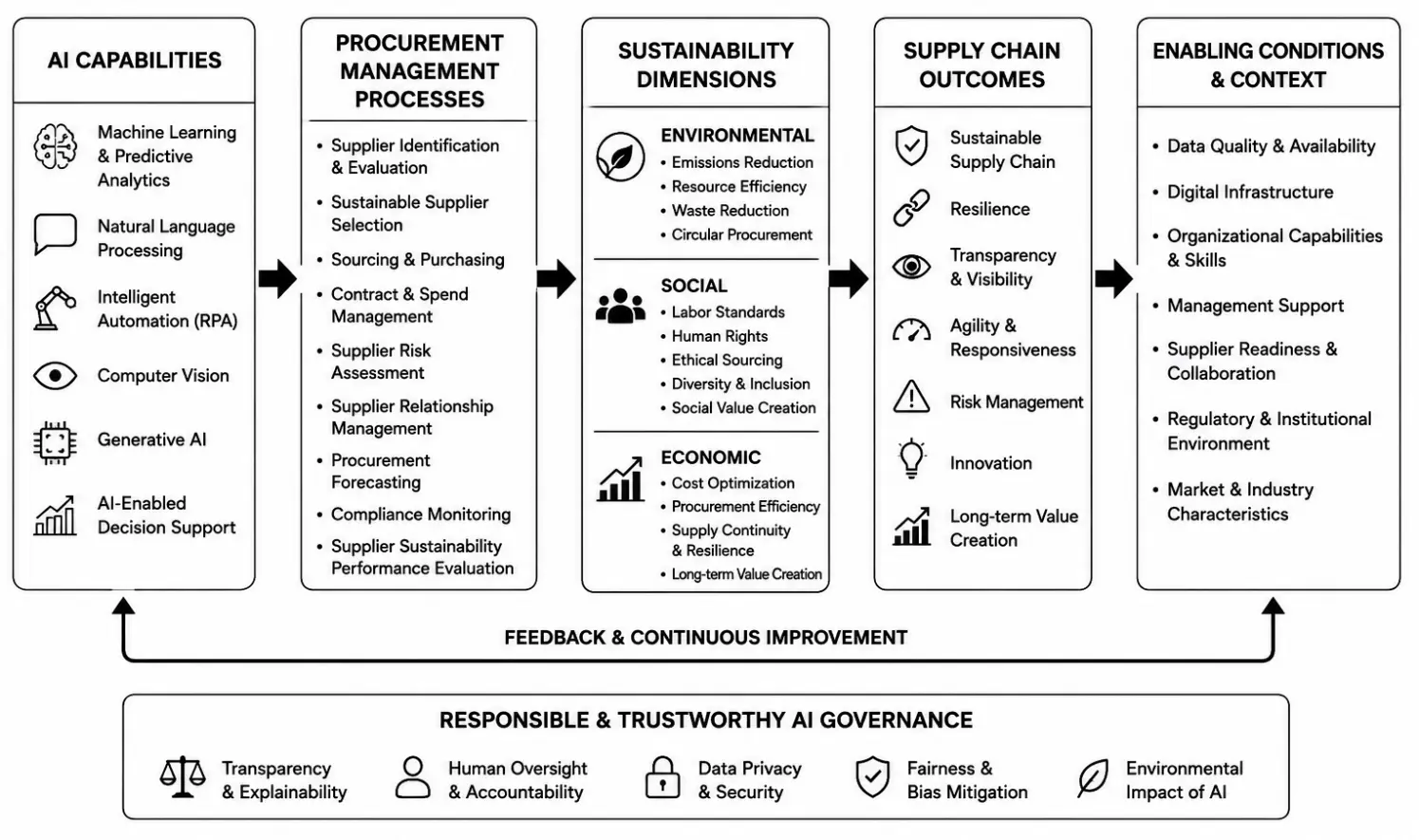
Figure 1 complements Table 1 by conceptualizing the relationships among AI resources, AI-enabled capabilities, procurement transformation, enabling conditions, responsible AI governance, and sustainability outcomes. AI-enabled procurement capabilities are the primary mechanism by which AI resources influence procurement transformation and supply chain outcomes. However, these relationships are shaped by data quality, digital infrastructure, organizational capabilities, supplier readiness, interorganizational collaboration, and institutional conditions. Responsible AI governance—including transparency, explainability, fairness, accountability, security, privacy, and human oversight—provides a cross-cutting foundation for ensuring that AI-enabled procurement is implemented responsibly and contributes to sustainable outcomes.
Despite increasing scholarly attention, research at the intersection of AI, sustainable procurement, and SCM remains fragmented and insufficiently integrated. AI research has predominantly focused on forecasting, automation, efficiency, visibility, resilience, and decision support, whereas sustainable procurement research has concentrated on green purchasing, sustainable supplier selection, ethical sourcing, circular procurement, and sustainability performance. Although these streams are increasingly converging, they remain differentiated in their conceptualizations, theoretical foundations, empirical settings, methodological approaches, technological orientations, and outcome measures. Consequently, the literature provides limited cumulative understanding of how AI-enabled procurement capabilities translate into measurable and sustained sustainable supply chain value [35].
Several gaps are particularly evident. Conceptually, AI capabilities and sustainable procurement have not yet been sufficiently integrated into a coherent analytical framework. Theoretically, limited attention has been given to how AI resources are transformed into organizational procurement capabilities and embedded within procurement routines and buyer–supplier relationships. At the process level, studies frequently examine isolated AI applications rather than treating procurement as an interconnected end-to-end system. Contextually, the roles of organizational capabilities, supplier readiness, digital infrastructure, interorganizational collaboration, and institutional environments remain insufficiently synthesized. From a governance perspective, responsible AI issues—including transparency, explainability, fairness, accountability, privacy, cybersecurity, and human oversight—remain underdeveloped. Methodologically, heterogeneity in research designs, theoretical perspectives, technologies, empirical contexts, and sustainability measures constrains comparison, replication, and cumulative theory development.
1.2. Research Gap, Purpose, and Contributions
Although existing research has generated valuable insights into AI-enabled supply chains, digital procurement, sustainable sourcing, supplier selection, and intelligent decision-making, these streams remain insufficiently integrated. This fragmentation limits the development of a coherent understanding of AI-driven sustainable procurement management as an emerging interdisciplinary research domain. In particular, there is limited synthesis on the relationships among AI resources, AI-enabled capabilities, procurement processes, organizational and contextual conditions, governance mechanisms, and sustainability and resilience outcomes.
To address this limitation, the present study conducts a systematic literature review (SLR) of scholarly research published between 2011 and 30 June 2026. The review examines the evolution and intellectual structure of the field, dominant research themes, theoretical foundations, AI technologies and capabilities, procurement applications, sustainability and resilience outcomes, research contexts, and methodological approaches. It also identifies conceptual, theoretical, methodological, technological, contextual, governance, and empirical gaps and develops a forward-looking research agenda for advancing AI-driven sustainable procurement.
Research Objectives:
RO1: To examine the evolution and development of AI-driven sustainable procurement research.
RO2: To synthesize key AI applications, capabilities, and sustainability outcomes.
RO3: To identify critical gaps in the existing literature.
RO4: To develop an integrated agenda for future research.
Research Questions:
RQ1: How has AI-driven sustainable procurement research evolved?
RQ2: What AI applications and capabilities, and sustainability outcomes, have been examined?
RQ3: What are the critical gaps in the existing literature?
RQ4: What future research directions can advance AI-driven sustainable procurement?
The paper is organized as follows. Section 2 presents the methodology for the systematic literature review. Section 3 synthesizes the literature and presents the principal findings and research gaps. Section 4 develops future research directions and the proposed research agenda. Section 5 concludes the study by discussing the principal findings, theoretical and practical implications, study limitations, and opportunities for future research.
2. Systematic Literature Review Methodology
This study employs a Systematic Literature Review (SLR) to systematically identify, evaluate, synthesize, and critically interpret research on AI-driven sustainable procurement management in supply chains. The review covers peer-reviewed journal articles published from 2011 to 30 June 2026 and follows the Preferred Reporting Items for Systematic Reviews and Meta-Analyses (PRISMA 2020) framework to enhance transparency, rigor, and reproducibility [36]. The review consists of eight interconnected stages: (1) data sources and search strategy, (2) eligibility criteria, (3) screening and PRISMA workflow, (4) quality assessment, (5) data extraction and evidence synthesis, (6) methodological positioning, (7) research-gap analysis, and (8) future research directions. The analytical approach combines descriptive characterization with thematic and critical conceptual synthesis to examine how AI capabilities are integrated into procurement processes and how their outcomes are shaped by organizational resources, technological infrastructure, supplier relationships, institutional conditions, and governance mechanisms. Particular attention is given to the distinction between AI adoption and AI-enabled capability development and to the mechanisms through which AI may contribute to sustainable procurement, supply chain resilience, and economic, environmental, social, and strategic outcomes. The methodology, therefore, provides a structured basis for characterizing the literature, assessing the strength and limitations of the evidence, identifying unresolved research gaps, and developing a theoretically informed future research agenda.
(1) Data Sources and Search Strategy: A systematic literature search was conducted across Scopus, Web of Science, IEEE Xplore, and ScienceDirect to capture interdisciplinary research spanning artificial intelligence, procurement, supply chain management, operations management, and sustainability. The search strategy focused on four conceptual domains: artificial intelligence, procurement management, sustainability, and supply chain management, using relevant keywords, synonyms, related terms, and Boolean operators to account for terminological variations across disciplines. The AI domain included artificial intelligence, machine learning, deep learning, predictive analytics, natural language processing, and intelligent automation; the procurement domain included procurement management, purchasing, strategic sourcing, supplier selection and evaluation, supplier relationship management, and procurement decision-making; the sustainability domain included sustainable, green, and circular procurement, ESG-related considerations, and economic, environmental, and social sustainability; and the supply-chain domain included supply chain management, supply networks, resilience, risk, transparency, traceability, and related outcomes.
(2) Eligibility Criteria: A priori inclusion and exclusion criteria were established to ensure a consistent and transparent evidence boundary. Studies were included if they: (1) were peer-reviewed journal articles; (2) were published between 2011 and 30 June 2026; (3) examined artificial intelligence or AI-enabled capabilities; (4) addressed procurement, purchasing, sourcing, supplier management, or closely related supply-chain activities; and (5) provided substantive conceptual or empirical evidence concerning sustainable procurement and/or economic, environmental, social, resilience, or strategic outcomes. Studies were excluded if they: (1) fell outside the specified publication period; (2) were not peer-reviewed journal articles; (3) addressed AI, procurement, or sustainability independently without establishing a substantive relationship among the focal domains; or (4) lacked sufficient conceptual, theoretical, methodological, or empirical substance to address the review objectives. Eligibility was assessed on the basis of substantive relevance rather than keyword occurrence alone, thereby excluding studies in which the focal concepts were mentioned only incidentally. These criteria provided sufficient interdisciplinary breadth while maintaining analytical focus on AI-enabled sustainable procurement.
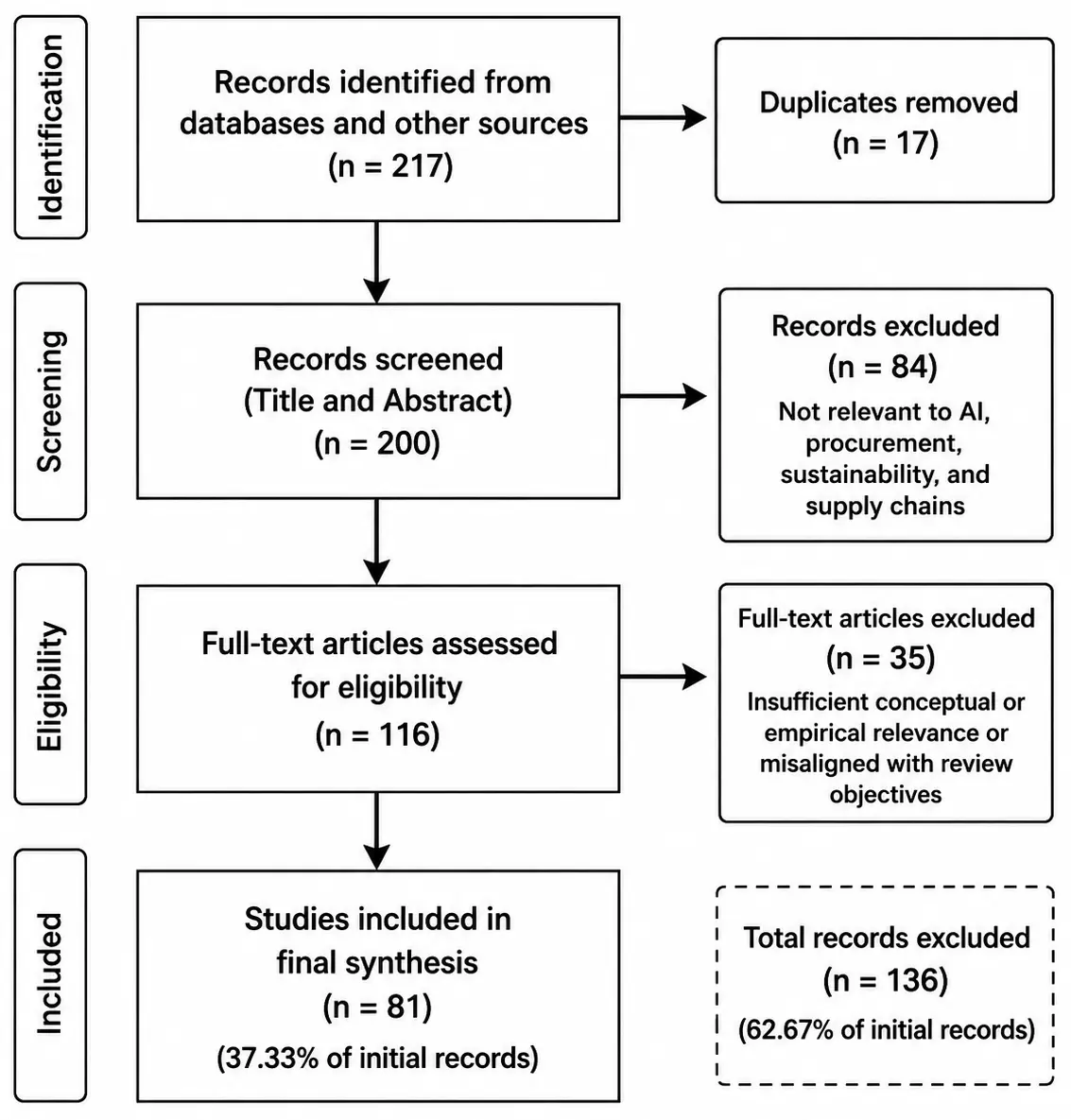
(3) Screening Process and PRISMA Workflow: Study selection followed the PRISMA 2020 framework through sequential identification, duplicate removal, title and abstract screening, full-text assessment, and final inclusion [36]. Of the 217 identified records, 17 duplicates were removed, leaving 200 unique records for title and abstract screening. Applying the predefined eligibility criteria excluded 84 records, leaving 116 articles for full-text assessment. A further 35 articles were excluded following full-text evaluation because of insufficient conceptual or empirical relevance and/or inadequate alignment with the review objectives. The final evidence base comprised 81 eligible studies, representing 37.33% of the initial records, while 136 records (62.67%) were excluded overall; the numerical progression was 217 − 17 − 84 − 35 = 81. The screening procedure applied predefined criteria and documented exclusion decisions to promote consistency and reduce subjective selection. Where independent second-reviewer assessment and inter-rater agreement were not undertaken, this limitation is explicitly acknowledged, together with the procedural measures adopted to mitigate potential single-reviewer bias. The relatively limited number of eligible studies also constrains the breadth and contextual coverage of the synthesis across industries, geographical settings, organizational contexts, and AI applications. Accordingly, the findings should be interpreted within the specified search strategy, eligibility criteria, and review period. Figure 2 presents the complete PRISMA 2020 workflow, with additional screening documentation.
(4) Quality Assessment: The methodological quality of the included studies was assessed using a recognised quality-appraisal instrument appropriate to the methodological diversity of the evidence base. The appraisal considered research objective clarity, theoretical grounding, research design appropriateness, methodological transparency, evidence adequacy, analytical rigor, validity, and coherence among the research questions, methods, analyses, and conclusions. Assessment was adapted to the methodological characteristics of individual studies, with particular attention to construct definition and operationalization, empirical validation, sampling and contextual specification, analytical procedures, theoretical consistency, and the strength of explanatory or causal inference.
(5) Data Extraction and Evidence Synthesis: A structured data-extraction framework was applied to the 81 included studies to support systematic characterization and cross-study synthesis. Extracted information included publication year, geographical and industry context, theoretical foundation, research design and methodology, AI technologies and capabilities, procurement activities and applications, sustainability dimensions, resilience outcomes, governance mechanisms, contextual conditions, and principal findings. The evidence was examined through complementary descriptive, thematic, and critical conceptual analyses. Descriptive analysis characterized temporal, geographical, methodological, and substantive patterns; thematic analysis identified dominant, emerging, convergent, and underdeveloped research themes; and critical conceptual synthesis examined relationships, mechanisms, inconsistencies, limitations, and contextual conditions across studies. Rather than treating individual studies as isolated contributions, the synthesis compares evidence to identify recurring patterns and unresolved tensions concerning AI capabilities, procurement transformation, sustainable procurement practices, resilience, and multidimensional outcomes. This approach shifts the review beyond cataloguing AI applications toward understanding how, why, and under what conditions AI-enabled procurement capabilities may generate sustainable value.
(6) Methodological Positioning: The review adopts an integrative, critical, and theory-informed methodological position that moves beyond descriptive aggregation toward a mechanism-oriented interpretation of AI-driven sustainable procurement. Procurement outcomes are examined as the result of interactions among AI capabilities, organizational resources, procurement processes, human expertise, supplier relationships, institutional conditions, data infrastructures, and governance arrangements. A central analytical distinction is drawn between AI adoption and AI-enabled capability development, recognizing that technological implementation alone does not achieve procurement transformation or deliver sustainability value. This positioning enables the review to examine the mechanisms, enabling conditions, constraints, and boundary conditions associated with the translation of AI deployment into procurement transformation and multidimensional sustainability outcomes.
(7) Research Gap Analysis: The research gap analysis evaluates limitations across conceptual, theoretical, methodological, empirical, technological, governance, and contextual dimensions. Key gaps include insufficient conceptualization of AI capabilities and sustainable procurement; limited theorization of the mechanisms connecting AI capabilities with procurement transformation and sustainability outcomes; relatively limited longitudinal, comparative, mixed-methods, and causal evidence; and fragmented approaches to multidimensional sustainability measurement. Additional gaps concern end-to-end procurement integration, AI capability maturity, data quality and interoperability, predictive sustainability risk management, explainability, transparency, accountability, responsible AI, human oversight, human–AI collaboration, supplier capability development and inclusivity, SMEs, emerging economies, and institutionally diverse contexts. The analysis also considers potential unintended consequences, including algorithmic bias, opacity, supplier exclusion, and data dependency. Collectively, these gaps indicate that the literature has developed more extensively around AI adoption and operational applications than around the mechanisms, governance arrangements, contextual conditions, and longer-term sustainability implications of AI-enabled procurement.
(8) Future Research Directions: Building on the evidence synthesis and identified gaps, the study develops a structured future research agenda centered on AI capability development, explanatory mechanisms, responsible governance, and measurable sustainability value creation. Key directions include AI capability maturity and organizational readiness, end-to-end procurement transformation, predictive sustainability and supply-chain risk management, intelligent supplier evaluation and development, human–AI collaboration, responsible and explainable AI, data governance and interoperability, AI-enabled circular procurement, resilient procurement ecosystems, supplier capability development and inclusivity, and multidimensional sustainability measurement. Future research should employ longitudinal, comparative, mixed-method, experimental, and theory-driven designs to examine causal mechanisms, boundary conditions, dynamic capability development, and sustainability trade-offs across organizational, technological, institutional, industry, and geographical contexts. Greater empirical attention is also needed to the governance and unintended consequences of AI-enabled procurement. Future scholarship should therefore examine not only whether AI is adopted, but how AI capabilities are developed, embedded, governed, scaled, and translated into sustained economic, environmental, social, resilience, and strategic value.
2.1. Artificial Intelligence in Sustainable Procurement in Supply Chains
Artificial intelligence (AI) is emerging as a transformative capability in sustainable procurement, reshaping how organizations identify and evaluate suppliers, assess risks, forecast demand, negotiate with supply-chain partners, monitor transactions, and support strategic sourcing decisions. Its growing importance reflects the convergence of digital procurement infrastructure, advanced analytics, increasingly available supply-chain data, and intelligent decision-support technologies. Unlike conventional digitalization, which primarily facilitates transaction processing, information exchange, and workflow coordination, AI enables organizations to learn from data, identify complex patterns, generate predictions, detect anomalies, and support or automate selected decisions. In sustainable procurement, these capabilities extend beyond operational efficiency by enabling organizations to incorporate economic, environmental, social, ethical, and resilience considerations into procurement decisions. However, AI adoption does not inherently produce sustainable outcomes; its contribution depends on data quality and governance, organizational capabilities, human expertise, supplier readiness, technological maturity, and institutional conditions. Accordingly, the literature is increasingly moving beyond the question of whether AI can improve procurement toward understanding how AI capabilities can be strategically integrated, governed, and translated into measurable, sustained, and sustainable supply-chain value [37,38,39].
2.1.1. From Digital Procurement to AI-Driven Procurement
The digital transformation of procurement has fundamentally reshaped how organizations manage sourcing, purchasing, supplier relationships, and upstream supply-chain activities. Procurement digitalization extends beyond the adoption of individual technologies to the reconfiguration of organizational processes, decision structures, routines, and operating models to capture value from emerging digital capabilities [19,40]. When strategically integrated, these capabilities can generate new procurement value propositions and strengthen the strategic contribution of procurement to organizational performance and supply-chain competitiveness [41]. This evolution has progressively shifted procurement from conventional electronic transactions toward smart procurement, in which digital systems increasingly support automated and, in selected activities, autonomous execution with limited human intervention [42]. Digital procurement has been enabled by infrastructures such as electronic data interchange (EDI), enterprise resource planning (ERP), supplier-management systems, purchasing platforms, and electronic invoicing [43]. At the same time, the volume, velocity, variety, and complexity of supply-chain data have increased substantially, making data availability, quality, integration, and interpretation increasingly important to procurement effectiveness [44]. Greater visibility into expenditure, transactions, suppliers, and procurement activities provides an important foundation for strengthening procurement’s strategic role, while analytics enables organizations to transform complex datasets into actionable intelligence [18,45]. The convergence of digital infrastructure, data, and analytics has laid the foundation for the transition from digitally enabled procurement to intelligent, predictive, and increasingly autonomous procurement management.
AI represents a qualitative advancement beyond conventional digital procurement technologies. Whereas traditional digital systems primarily support information exchange, transaction processing, workflow coordination, and information accessibility, AI-enabled systems can learn from data, identify complex patterns, generate predictions, detect anomalies, and support or automate selected decisions. These capabilities have been applied to supplier identification and evaluation, forecasting, sourcing, risk management, and decision support [46,47,48,49]. However, existing research remains predominantly application-oriented, frequently examining individual technologies, tasks, or procurement stages rather than conceptualizing AI as an interconnected capability spanning the procurement lifecycle. Consequently, the literature provides considerable evidence of what AI can do, but substantially less understanding of how AI capabilities can be integrated, orchestrated, and translated into sustained procurement and supply-chain value.
2.1.2. AI-Driven Sustainable Procurement and Value Creation
The strategic significance of AI becomes particularly evident when procurement is examined through a sustainability perspective. Procurement decisions influence supplier behavior, resource consumption, environmental impacts, labor and social conditions, ethical sourcing, risk exposure, and supply-chain resilience. AI can strengthen the analytical foundation of procurement decisions by processing multidimensional information and enabling organizations to evaluate economic criteria alongside environmental and social considerations. AI-driven procurement can therefore support sustainable supplier identification and evaluation, environmental and social risk assessment, supplier monitoring, transparency and traceability, compliance management, resource optimization, and responsive sourcing. Nevertheless, AI adoption should not be equated with sustainability performance. AI does not inherently generate sustainable outcomes; rather, its contribution depends on data quality, organizational capabilities, procurement maturity, supplier readiness, human expertise, institutional conditions, and governance mechanisms. The central issue is therefore not simply whether AI is adopted, but how AI capabilities are embedded within procurement processes and through which mechanisms they generate measurable and sustained economic, environmental, social, and resilience outcomes.
Despite the growing strategic importance of AI, empirical evidence concerning its implementation, maturity, and realized value in procurement remains comparatively limited. [40] highlight difficulties in systematically establishing the organizational and operational implications of AI-enabled procurement. Much of the existing evidence remains concentrated on individual cases, pilot projects, and application-specific studies, while performance assessment has frequently prioritized efficiency, automation, and cost reduction over environmental, social, ethical, resilience, and governance outcomes. This creates an important evidence gap because AI-driven sustainable procurement should ultimately be evaluated by its contributions to resource efficiency, environmental impact reduction, responsible sourcing, supplier sustainability, transparency, compliance, resilience, and long-term supply chain value.
2.1.3. AI Applications Across the Procurement Lifecycle
The literature identifies supply-risk management and supply-chain resilience as important domains in which AI can contribute to sustainable procurement. Supply risk management is one of the most extensively examined applications of AI in procurement and supply chains [48,49,50,51]. Ivanov and Dolgui (2021) [52] developed a data-driven approach for identifying relationships among risk factors and modelling disruptive events, while Baryannis et al. (2019) [48,49] proposed AI-based approaches to supply-chain risk prediction, including considerations of reliability and interpretability. The relevance of AI-enabled risk management has become particularly pronounced in globally interconnected supply chains, where disruptions can propagate rapidly across organizational and geographical boundaries. COVID-19, semiconductor shortages, raw material scarcity, and the war in Ukraine have further elevated supply risk management as a strategic procurement priority. Dynamic capabilities theory provides an appropriate foundation for understanding this domain because effective risk management requires organizations to integrate, build, and reconfigure resources in response to changing environmental conditions. Within this perspective, collaboration capability can represent a sensing dimension, supply-chain alignment a seizing dimension, and supply-chain risk management a reconfiguring dimension [53]. Digitally enabled process innovation provides an additional perspective on how dynamic capabilities facilitate AI adoption and organizational adaptation [54].
Supplier identification, evaluation, and selection constitute another important domain of AI-enabled sustainable procurement. Existing research has predominantly examined supplier selection from lists of already known potential partners [55,56,57,58], frequently employing multi-criteria decision-making approaches [59]. Pitchipoo et al. (2013) [55] proposed a hybrid model for supplier evaluation and selection, while Scott et al. (2015) [60] developed an integrated approach that combines the analytic hierarchy process and quality function deployment for multi-criteria, multi-stakeholder supplier selection. However, supplier scouting—the systematic discovery of previously unknown suppliers and alternative sources of supply—remains comparatively underexplored. Lorentz et al. (2020) [40] identify supply-market intelligence and the discovery of new external partners as areas with considerable potential for procurement analytics. AI-enabled semantic search, web crawling, and integration of internal and external information can strengthen supplier discovery and supply-market intelligence. Because supplier scouting involves substantial information-processing requirements, uncertainty, multiple decision variables, and diverse stakeholders, information-processing theory provides an appropriate theoretical foundation. Previous applications of this perspective include cloud computing in supply chains [61], sustainable supply-chain management [62], and supply-market intelligence [40]. Future research should examine how AI can align the information-processing requirements of complex supplier-scouting activities with organizational information-processing capabilities while incorporating sustainability, resilience, diversity, ethical sourcing, and responsible-procurement criteria.
AI-enabled supply chain finance (SCF) represents another promising but insufficiently developed domain. The strategic importance of SCF increased following major supply-chain disruptions, including the COVID-19 crisis [63], while AI applications have expanded, particularly in credit risk assessment. AI-based approaches can provide effective predictive performance without requiring strong a priori assumptions regarding data distributions and can remain effective with relatively small datasets [64,65,66]. Song et al. (2021) [67] further demonstrate the potential of AI for assessing SME creditworthiness and identifying appropriate SCF solutions. However, applications beyond credit-risk assessment remain comparatively underexplored. Drawing on the innovation-process perspective and the SCF innovation process proposed by Wuttke et al. (2013) [68], future research should examine how AI influences SCF adoption, implementation, and continuous monitoring, with particular attention to supplier financing, credit assessment, risk mitigation, financial accessibility, and value creation across buyers, suppliers, and financial service providers.
AI also has important implications for procurement negotiation and buyer–supplier collaboration, where outcomes depend on trust, communication, strategic interaction, and contextual judgment. Existing research has devoted comparatively limited attention to negotiation [44,69,70], while Zair et al. (2019) [47] examined an agent-based approach in which negotiation and supplier selection are conducted within a purchasing dyad. Schulze-Horn et al. (2020) [71] demonstrate that AI-driven mechanism design can facilitate complex negotiations and potentially shift bargaining power toward buying organizations. Viale and Zouari (2020) [72], meanwhile, show that robotic process automation can improve relationship quality by reducing repetitive administrative activities and enabling employees to devote greater attention to strategic interaction. Transaction cost economics provides a strong theoretical basis for this domain because AI can potentially reduce transaction costs associated with information search, information asymmetry, uncertainty, negotiation, documentation, and enforcement [73]. AI-enabled semantic search and web crawling can reduce search and information-gathering costs, while enhanced information availability can mitigate bounded rationality. AI may also reduce bargaining costs by supporting negotiation preparation, decision-making, documentation, and selected automated negotiation activities [74]. Future research should therefore investigate the appropriate boundaries between AI augmentation and automation in supplier negotiations, particularly regarding transaction costs, bargaining power, trust, transparency, explainability, ethical decision-making, and sustainable buyer–supplier relationships.
Operational procurement provides another important opportunity for AI-enabled automation, monitoring, and responsible governance. Although Moretto et al. (2017) [70] found limited relevance of analytics in the operational supply phase, Handfield et al. (2019) [75] subsequently highlighted the contribution of analytics to procure-to-pay processes through transactional data utilization, paperwork reduction, and process efficiency improvements. Catalogue management, order management, anomaly detection, and fraud detection represent particularly relevant applications. Procurement fraud can originate from both internal and external actors and generate substantial financial, operational, and reputational consequences. AI-enabled monitoring and anomaly detection can therefore contribute not only to operational efficiency but also to procurement integrity, compliance, accountability, and responsible governance.
2.1.4. AI Adoption in Different Organizational Contexts
Recent advances in AI have made sophisticated digital tools increasingly accessible to SMEs, creating opportunities to improve procurement efficiency, agility, resilience, and strategic decision-making. AI-powered predictive analytics can support demand forecasting, inventory optimization, stockout reduction, waste reduction, and supplier coordination, while firms adopting digital intelligence frameworks demonstrate greater operational resilience and responsiveness [76]. AI-enabled supplier screening can accelerate supplier evaluation by assessing compliance records, certifications, and historical performance, reducing administrative workloads and allowing procurement professionals to focus on strategic activities. Leadership support for digital adoption is positively associated with procurement efficiency [77], while AI-enabled dynamic pricing can help SMEs respond to market fluctuations, manage price volatility, and improve cost and margin stability [76]. Overall, AI can facilitate a shift from reactive procurement toward proactive, intelligent, data-driven, and sustainable procurement, enhancing organizational performance and long-term value creation [78].
Nevertheless, the literature reveals a significant contextual gap concerning SMEs. Although AI adoption research has predominantly focused on larger organizations, SME-specific evidence remains comparatively limited. Liu et al. (2022) [79], for example, address SME requirements via digital platforms that facilitate dynamic supply chain collaboration through capacity pooling. However, much of the existing literature implicitly assumes access to substantial financial resources, specialized expertise, advanced digital infrastructure, and sufficiently extensive datasets. SMEs frequently operate under more constrained conditions, creating unresolved questions concerning the affordability, scalability, digital maturity, data requirements, and organizational feasibility of AI-driven sustainable procurement. This gap is particularly important in emerging and resource-constrained economies, where institutional environments, digital infrastructure, and access to expertise may further condition AI-enabled procurement outcomes.
Public procurement represents another important but distinct context. It is increasingly recognized as a strategic governance mechanism for advancing economic, social, environmental, and policy objectives, moving beyond its traditional transactional role toward innovation, sustainability, and public value creation [80]. Innovative procurement requires organizations to develop capabilities to sense emerging opportunities, seize innovative solutions, and reconfigure resources and processes in response to changing needs and technological developments [81]. AI offers significant potential to enhance citizen engagement, personalize public services, and improve administrative efficiency and innovation [82]. However, realizing these benefits requires effective human–AI interaction and robust governance mechanisms that ensure transparency, accountability, and ethical use [83]. GenAI further reshapes adoption dynamics by enabling individuals to initiate and use AI applications directly, increasing the importance of alignment among individual agency, organizational capabilities, and institutional structures. Evidence from the private sector demonstrates AI’s potential to support demand forecasting, outsourcing, scheduling, routing, cost management, transportation, and supply-chain optimization, while GenAI can enhance visibility, responsiveness, and adaptability in dynamic markets [84]. Within procurement, AI can reduce administrative workloads, improve supplier evaluation, detect anomalies, and strengthen contract management and risk assessment [31]. Despite these opportunities, AI adoption in public procurement remains limited and at an early stage because of stringent IT-security requirements, resource and capability gaps, legal and regulatory constraints, and fragmented organizational structures [85,86].
2.1.5. AI Implementation, Organizational Readiness, and Data Governance
A major limitation in the literature concerns the absence of comprehensive implementation roadmaps and integrative frameworks for AI adoption in procurement. Existing studies have largely emphasized AI’s potential benefits or examined individual applications and use cases, while offering comparatively limited guidance on how organizations can move from experimentation and isolated pilots to integrated, enterprise-level AI capabilities. Guida et al. (2025) [87] identify this limitation, noting that research has concentrated on applications such as spend analysis and routine-task automation rather than developing integrated frameworks for broader implementation. Van Hoek et al. (2022) [88] document the implementation of robotic process automation within Maersk’s procurement function, demonstrating the feasibility and potential value of automation but offering limited guidance for organizations operating under different technological, organizational, resource, and institutional conditions. Van Hoek (2024) [89] reinforces this concern by calling for more structured guidance for procurement managers and researchers. The literature consequently remains underdeveloped regarding implementation sequencing, capability development, process redesign, change management, governance, and AI maturity assessment.
AI implementation is further constrained by gaps in organizational readiness and professional capabilities. Spreitzenbarth et al. (2024) [90] identify a disconnect between priorities emphasized in academic research and those identified by practitioners, suggesting that the research agenda does not fully reflect the challenges experienced by procurement professionals. Van Hoek (2024) [89] reports that only 14% of procurement leaders consider themselves to possess the necessary talent for future AI adoption, highlighting a substantial capability and readiness gap. Colombo et al. (2023) [91] further demonstrate that organizations implementing AI-driven automation must invest in employee upskilling and role redesign to capture the benefits of human–AI augmentation. These findings indicate that AI implementation extends beyond technological availability to encompass analytical skills, leadership, organizational culture, change management, governance, and performance measurement.
Data quality and governance constitute another foundational condition for effective AI-driven procurement. AI effectiveness depends not simply on data volume but on accuracy, completeness, consistency, structure, interoperability, accessibility, timeliness, and relevance. Van Hoek (2024) [89] identifies data availability and quality as important constraints on realizing AI’s potential in procurement, while Pathak (2023) highlights organizational difficulties in extracting strategically relevant information from increasingly large datasets. Guida et al. (2025) [87] further demonstrate the importance of structured data practices through applications such as spend classification. Future research should therefore examine data preparation, classification, integration, validation, interoperability, security, privacy, ownership, and governance as foundational capabilities supporting reliable, explainable, and responsible AI-driven procurement.
2.1.6. Human–AI Collaboration and Responsible Procurement
The human and organizational dimensions of AI adoption represent a further underdeveloped research stream. Employee capabilities, analytical skills, organizational culture, leadership support, professional roles, and resistance to change can substantially influence implementation outcomes. Van Hoek (2024) [89] emphasizes the importance of analytical capabilities and organizational readiness, while Colombo et al. (2023) [91] demonstrate that organizations implementing AI-driven automation must invest in employee upskilling and role redesign to capture the benefits of human–AI augmentation. These findings reinforce the view that AI-driven procurement represents organizational transformation rather than merely technological implementation. Successful adoption requires alignment among technology, people, processes, organizational structures, and strategic objectives. Future research should consequently examine how organizations develop human–AI collaboration capabilities that combine algorithmic intelligence with professional expertise, contextual knowledge, and managerial judgment.
This human–AI perspective becomes particularly important in contract negotiation and buyer–supplier collaboration, where procurement outcomes depend on trust, communication, strategic interaction, and contextual judgment. The appropriate boundary between AI augmentation and automation remains insufficiently understood. AI can support information search, negotiation preparation, decision-making, and documentation, but excessive automation may introduce concerns regarding transparency, accountability, bias, explainability, and relationship quality. Future research should therefore examine how AI can augment procurement professionals while preserving human oversight and strengthening sustainable buyer–supplier relationships.
2.1.7. Theoretical Foundations of AI-Driven Sustainable Procurement
The theoretical foundations of AI-driven sustainable procurement remain insufficiently integrated. Waller and Fawcett (2013) [92] provided an important early contribution by advocating theory-informed research on analytics and supply-chain transformation. Nevertheless, subsequent scholarship remains theoretically dispersed, with limited integration of technological resources, AI capabilities, procurement routines, interorganizational relationships, governance mechanisms, and sustainability outcomes. Dynamic capabilities theory, information-processing theory, transaction cost economics, and agency theory provide valuable but largely isolated explanations of different dimensions of AI-enabled procurement. Dynamic capabilities theory explains how organizations sense, seize, and reconfigure resources in response to changing environments [53]; information-processing theory explains how AI can address information complexity and uncertainty [40,61,62]; transaction cost economics explains how AI can reduce information, search, negotiation, monitoring, and enforcement costs [73]; and agency theory provides a basis for examining information asymmetry, monitoring, control, and governance. However, what remains underdeveloped is an integrative explanation of how AI resources are transformed into organizational capabilities, embedded across procurement processes and supplier relationships, governed responsibly, and translated into sustainable and resilient value.
Taken together, the literature indicates that the central research challenge is no longer simply establishing the potential of AI in procurement, but explaining how, where, under what conditions, and through which organizational and governance mechanisms AI capabilities generate sustainable procurement and supply-chain value. The major gaps include limited end-to-end process integration, insufficient empirical validation of realized outcomes, weak implementation roadmaps, limited understanding of AI maturity, data-governance challenges, organizational-readiness constraints, insufficient SME-specific evidence, underdeveloped sustainable supplier intelligence, limited understanding of human–AI collaboration, emerging responsible-AI governance requirements, and fragmented theoretical foundations. These gaps indicate the need to move beyond a predominantly technology-centric perspective toward an integrated AI capability–procurement process–organizational context–governance–sustainability–resilience perspective.
Overall, the literature suggests that AI-driven sustainable procurement management should not be understood merely as the automation or digitalization of purchasing activities. Rather, it represents an emerging strategic capability through which organizations integrate AI, data, people, processes, supplier relationships, and governance mechanisms to enhance procurement decision-making and generate sustainable supply-chain value. Future research should therefore examine the progression from AI resources and data foundations to AI capabilities, procurement process transformation, organizational and interorganizational mechanisms, governance, and economic, environmental, social, resilience, and long-term supply-chain outcomes. Such an integrated perspective provides a stronger foundation for understanding the evolution of AI-driven sustainable procurement and for identifying the research gaps and future directions addressed by this systematic literature review.
3. Challenges and Research Gaps Analysis
The systematic review highlights the significant potential of artificial intelligence (AI) to transform procurement and advance sustainable supply chain management (SSCM), yet the existing knowledge base remains fragmented across technologies, procurement activities, organizational contexts, data infrastructures, and theoretical perspectives. A central concern is the persistent gap between AI’s technological potential and its demonstrated value realization. While existing studies provide growing evidence of AI applications in specific procurement activities, limited attention has been given to how AI capabilities are developed, integrated across the procurement lifecycle, responsibly governed, and translated into sustained economic, environmental, social, resilience, and strategic outcomes.
As illustrated in Figure 3 and synthesized in Table 2, the overarching research gap lies in the absence of an integrated framework connecting AI resources and capabilities, procurement processes, organizational and contextual conditions, data and human capabilities, governance mechanisms, and sustainability and resilience outcomes. Addressing these gaps requires a shift from an application- and technology-centric perspective toward a capability-, process-, context-, and value-oriented approach that explains how AI can generate responsible, measurable, and sustainable procurement value across supply chains. Accordingly, the following challenges and research gaps define the key priorities for advancing research on AI-driven sustainable procurement management in supply chains.
(1) Limited Empirical Evidence and AI Value Realization: A fundamental limitation of the literature is the scarcity of robust empirical evidence concerning the realized and sustained value of AI-enabled procurement. Existing studies predominantly emphasize anticipated benefits associated with automation, analytics, forecasting, supplier management, risk prediction, and decision support, whereas comparatively few investigate whether such benefits persist over time or translate into broader organizational and supply-chain outcomes. Lorentz et al. (2020) [40] highlighted difficulties in establishing the wider organizational and operational implications of AI-enabled procurement. Thus, the literature currently provides stronger evidence of AI potential than of sustained value realization. This limitation is particularly consequential for sustainable procurement, where performance cannot be reduced to cost savings, processing speed, or automation but must also encompass environmental impact, resource efficiency, social responsibility, supplier sustainability, transparency, compliance, resilience, and strategic value. A critical priority is therefore the development of longitudinal, comparative, mixed-methods, and quasi-experimental research designs capable of establishing causal relationships between AI capabilities and multidimensional procurement outcomes and of identifying the organizational and contextual conditions under which AI investments generate persistent sustainable value.
(2) Fragmented AI Applications and Limited End-to-End Integration: A second major gap concerns the fragmented treatment of AI across procurement activities. Existing research tends to investigate individual technologies, tasks, or procurement stages rather than conceptualizing AI as an interconnected capability spanning the procurement lifecycle [44,46,48,49]. Studies such as Chehbi-Gamoura et al. (2020) [93] and Moretto et al. (2017) [70] provide valuable insights into specific procurement and supply-chain activities, but limited attention has been devoted to the interdependencies among spend intelligence, supplier scouting, sourcing, supplier evaluation, risk management, negotiation, supply chain finance, procure-to-pay operations, fraud detection, and sustainability monitoring. Consequently, it remains unclear whether AI-enabled improvements at individual stages generate complementary, cumulative, or even conflicting effects when integrated across the procurement system. The research challenge is therefore to move from an application-centric view toward an end-to-end capability perspective that explains how AI capabilities interact across strategic, tactical, and operational procurement processes and how such integration influences sustainability, resilience, transparency, and strategic performance.
(3) AI Implementation Roadmaps and Maturity: Despite increasing interest in AI, procurement-specific implementation roadmaps and maturity models remain insufficiently developed. Guida et al. (2025) [87] indicate that existing research has concentrated on applications such as spend analysis and routine task automation rather than providing comprehensive approaches for organization-wide implementation, while Van Hoek (2024) [89] emphasizes the need for structured guidance for procurement managers and researchers. The literature, therefore, offers substantially more knowledge about individual AI use cases than about the organizational pathway from experimentation and pilot projects to scalable, integrated, and strategically embedded AI capabilities. This creates uncertainty regarding sequencing, investment priorities, capability requirements, process redesign, and scaling. Future scholarship should conceptualize AI implementation as a dynamic capability-development trajectory and develop procurement-specific maturity models incorporating technological infrastructure, data readiness, process integration, human competencies, organizational readiness, leadership, investment capacity, governance, and strategic alignment. Such models would enable organizations to diagnose their current maturity, identify capability gaps, prioritize interventions, and systematically progress toward an integrated, AI-enabled procurement transformation.
(4) Data Quality, Integration, and Governance: Data quality, integration, and governance constitute foundational but under-theorized conditions of AI-enabled procurement. AI effectiveness depends not simply on the availability of large datasets but on their accuracy, completeness, consistency, structure, accessibility, interoperability, timeliness, and relevance. Van Hoek (2024) [89] identifies data availability and quality as important constraints, while Pathak (2023) [94] highlights organizational difficulties in extracting strategically meaningful information from increasingly complex datasets; Guida et al. (2025) [87] similarly demonstrate the importance of structured data practices through applications such as spend classification. Yet existing research frequently treats data limitations as technical obstacles rather than as strategic organizational capabilities. This represents an important conceptual deficiency because data governance directly affects model reliability, explainability, scalability, auditability, privacy, security, and accountability. Greater attention is therefore required to data preparation, classification, integration, interoperability, validation, ownership, access, security, privacy, and governance, particularly where AI systems combine internal procurement data with heterogeneous external supplier and market information.
(5) AI-Enabled Supply Risk Management and Resilience: The growing volatility and interconnectedness of global supply networks have elevated AI-enabled supply risk management and resilience to a strategic procurement priority. Supply-risk management is among the most extensively examined AI applications in procurement and supply chains [48,49,50,51,52], with prior research demonstrating AI’s capacity to predict disruptions, identify risk interdependencies, and support early-warning mechanisms. Nevertheless, the literature provides less clarity regarding how predictive intelligence is translated into organizational resilience, adaptive capacity, and sustainable supply-network reconfiguration. This limitation has become more consequential following COVID-19, semiconductor shortages, raw-material scarcity, geopolitical instability, and logistics disruptions. Dynamic capabilities theory provides a strong theoretical foundation because resilience requires firms to integrate, build, and reconfigure resources in response to environmental change [53,54], further highlighting the importance of collaboration, alignment, risk management, and digital process innovation. The next generation of research should therefore examine how AI capabilities interact with dynamic capabilities to enable sensing, anticipation, response, adaptation, and reconfiguration, while simultaneously addressing sustainability objectives and resilience trade-offs.
(6) Supplier Sustainability and Sustainable Sourcing: Supplier sustainability remains insufficiently embedded within AI-driven procurement research, despite suppliers being central to the environmental, social, ethical, and resilience consequences of procurement decisions. Spreitzenbarth et al. (2024) [90] identify supplier sustainability as an under-researched area, while Chiu et al. (2024) [95] demonstrate the potential of combining natural language processing (NLP) and life-cycle assessment (LCA) for intelligent green supplier risk assessment. However, the current evidence base provides limited empirical confirmation that AI-enabled supplier intelligence leads to substantive improvements in supplier sustainability rather than merely increasing the efficiency of supplier assessment. This distinction is critical because analytical sophistication does not necessarily translate into behavioural change or improved sustainability performance. Research should therefore investigate how AI can support dynamic supplier sustainability assessment, continuous monitoring, risk prediction, corrective intervention, and supplier development, while integrating environmental, social, ethical, economic, and resilience criteria into supplier decisions and examining whether such interventions produce measurable improvements across supplier networks.
(7) AI-Enabled Supplier Scouting and Market Intelligence: Supplier scouting and supply-market intelligence represent important but comparatively neglected applications of AI. Existing research has largely concentrated on selecting suppliers from known alternatives [55,56,57,58], with multi-criteria decision-making approaches dominating supplier evaluation and selection research [59]. Although these approaches improve the quality of supplier choice, they do not adequately address the prior problem of identifying previously unknown suppliers and alternative sources of supply. This is particularly important for sustainable and resilient procurement because supplier discovery can reduce concentration risk, strengthen supply continuity, and expand access to suppliers with superior environmental, social, ethical, or geographic characteristics. Information-processing theory provides a useful lens because supplier scouting involves high information-processing requirements, uncertainty, heterogeneous information, and multiple stakeholders. Accordingly, research should investigate how semantic search, NLP, web-based intelligence, external data integration, sustainability screening, and risk analytics can transform supplier scouting from a reactive search activity into a proactive, intelligence-driven procurement capability.
(8) AI-Enabled Supply Chain Finance: AI-enabled supply chain finance (SCF) remains an emerging and insufficiently integrated component of sustainable procurement research. The strategic relevance of SCF increased substantially following major supply-chain disruptions, including those caused by COVID-19 [63], yet AI applications remain largely concentrated on credit risk assessment and selected financial optimization problems. Khashman (2011), Zhu et al. (2016, 2017, 2019), and Chen et al. (2022) [64,65,66,96,97] demonstrate the predictive potential of AI in credit risk assessment. Song et al. (2021) [67] further illustrate applications in SME creditworthiness and SCF solution selection. Nevertheless, comparatively little is known about AI-enabled liquidity management, supplier financing, cash flow forecasting, financial risk mitigation, fraud prevention, and financial inclusion. Future research should therefore examine how AI can strengthen financial resilience across buyer–supplier networks, particularly by improving access to finance for vulnerable suppliers and SMEs while simultaneously contributing to sustainable financial value creation.
(9) Human and Organizational Readiness: The human and organizational dimensions of AI adoption remain insufficiently theorized and empirically examined. Employee competencies, analytical skills, organizational culture, leadership commitment, trust, professional identities, and resistance to change can substantially influence whether AI systems generate their anticipated value. Van Hoek (2024) [89] highlights organizational readiness and capability challenges, while Colombo et al. (2023) [91] demonstrate the importance of employee upskilling and role redesign in AI-driven automation. These findings indicate that AI-enabled procurement should be conceptualized as a socio-technical transformation, rather than as the deployment of a technological solution. The critical issue is therefore how organizations configure people, processes, technology, and structures to support effective human–AI collaboration. Future research should investigate AI-related skills, leadership, training, organizational learning, job redesign, trust, decision authority, and professional adaptation, with particular emphasis on how algorithmic intelligence can complement procurement expertise, contextual knowledge, ethical reasoning, and managerial judgment.
(10) AI-Enabled Negotiation and Buyer–Supplier Relationships: AI-enabled negotiation remains an underdeveloped research domain despite the strategic and relational importance of procurement negotiations. Existing studies devote comparatively limited attention to negotiation (Liu et al., 2011; Moretto et al., 2017; Wang et al., 2016), although Zair et al. (2019) [44,47,69,70] examine agent-based approaches to negotiation and supplier selection. AI can reduce information-search costs, support supplier profiling and negotiation preparation, and potentially automate selected bargaining activities; however, procurement negotiation also involves trust, tacit knowledge, relational capital, power asymmetries, and contextual judgment. Transaction cost economics provides a relevant theoretical foundation [73], particularly regarding reductions in search, information, bargaining, and monitoring costs [74]. Future research should therefore establish the appropriate boundary between AI augmentation and autonomous negotiation, examining how AI affects bargaining power, trust, transparency, explainability, ethical decision-making, negotiation performance, relationship quality, and sustainable buyer–supplier collaboration.
(11) Procurement Fraud Detection and Responsible Governance: AI-enabled procurement fraud detection represents an important opportunity to strengthen transparency, accountability, and organizational integrity, yet empirical and theoretical research in this area remains limited. Handfield et al. (2019) [75] highlight the potential of analytics within procure-to-pay processes, while agency theory explains how AI-enabled monitoring can reduce information asymmetry between principals and agents. AI can potentially detect anomalous transactional, behavioural, and communication patterns and strengthen monitoring of both internal procurement actors and external suppliers [98,99]. However, intensified algorithmic monitoring also introduces risks involving privacy, fairness, false positives, proportionality, and accountability. The research agenda should therefore move beyond simple fraud-detection accuracy toward explainable and human-supervised governance systems that balance fraud prevention with privacy, fairness, transparency, and due process.
(12) SME Adoption and Contextual Gaps: A major contextual gap concerns the limited representation of SMEs and emerging-market settings in AI-enabled procurement research. Existing studies disproportionately emphasize larger organizations with greater financial resources, technological infrastructure, data availability, and specialized expertise, whereas Liu et al. (2022) [79] make an important contribution by addressing SME requirements through digital platforms that support dynamic supply-chain collaboration and capacity pooling. Nevertheless, the evidence remains insufficient regarding the affordability, scalability, data requirements, digital maturity, skills, and organizational feasibility of AI-driven sustainable procurement for smaller firms. This issue is particularly significant in resource-constrained and emerging economies, where institutional environments, infrastructure, regulatory conditions, and digital ecosystems can strongly condition AI adoption. Future research should therefore investigate context-sensitive, modular, affordable, and scalable AI procurement solutions and explicitly examine how firm size, digital maturity, industry characteristics, institutional quality, and supply-network configuration moderate AI-enabled sustainability outcomes.
(13) Academic–Practitioner and Performance Measurement Gaps: A persistent academic–practitioner gap constrains the practical relevance of the existing evidence base. Spreitzenbarth et al. (2024) [90] identify differences between priorities emphasized in academic research and those recognized by procurement practitioners, suggesting that research does not always adequately reflect practical challenges concerning technology selection, implementation, organizational readiness, and capability development. Moreover, AI performance is frequently evaluated through cost reduction, efficiency, processing time, and automation, while environmental, social, resilience, governance, and relational outcomes receive considerably less attention. This creates a measurement problem for sustainable procurement because operational improvement does not necessarily constitute sustainable value creation. Future research should therefore combine industry-based research, longitudinal case studies, action research, mixed-methods designs, and practitioner collaboration with multidimensional performance frameworks that capture economic, environmental, social, resilience, governance, transparency, compliance, and strategic outcomes.
(14) Responsible, Explainable, and Trustworthy AI: The growing autonomy of AI systems creates significant challenges concerning bias, privacy, transparency, explainability, accountability, auditability, and human oversight, particularly because procurement AI can influence consequential decisions concerning suppliers, financing, sustainability, risk, negotiation, and fraud. Existing research has not yet sufficiently clarified how responsible AI principles should be operationalized throughout the procurement lifecycle. A key research priority is therefore to move beyond technical performance indicators toward responsible, explainable, and trustworthy AI governance. Future studies should investigate algorithmic transparency, bias detection and mitigation, privacy protection, auditability, accountability structures, human oversight, ethical standards, and mechanisms for stakeholders to review or challenge AI-generated decisions. Responsible AI should consequently be treated not as a peripheral compliance issue but as a strategic capability embedded within sustainable procurement management.
(15) Theoretical Integration: The theoretical foundations of AI-driven sustainable procurement remain dispersed across multiple partially connected perspectives. Dynamic capabilities theory explains organizational adaptation and resource reconfiguration; information-processing theory addresses information complexity; transaction cost economics (Williamson, 2008) [73] explains search, information, bargaining, and governance costs; agency theory addresses monitoring and information asymmetry; and innovation theory explains adoption and diffusion. Although these perspectives provide valuable explanations of individual aspects of AI-enabled procurement, they have rarely been integrated into a coherent model of sustainable value creation. The unresolved theoretical question is therefore how AI resources are transformed into organizational capabilities, embedded within procurement processes and supplier relationships, conditioned by organizational and institutional contexts, governed responsibly, and ultimately converted into sustainability and resilience outcomes. Future theorizing should consequently move beyond technology adoption toward an integrated capability perspective encompassing AI capability development, deployment, orchestration, governance, and value realization.
(16) Integrating AI, Sustainability, and Resilience: A particularly important gap is the limited integration of AI, sustainability, and supply-chain resilience. Although these domains are increasingly recognized as strategically important, they are frequently examined as separate streams rather than interconnected dimensions of procurement transformation. Modgil et al. (2022) [100] demonstrate AI’s potential for risk sensing, scenario analysis, network reconfiguration, and disruption response, while Chiu et al. (2024) [95] connect AI with sustainable supplier risk assessment; nevertheless, limited research explains how AI capabilities can simultaneously contribute to economic, environmental, social, and resilience objectives. This is especially important because procurement decisions frequently involve trade-offs: supplier diversification may improve resilience but increase coordination costs, while cost minimization may undermine environmental or social performance. Future research should therefore investigate AI-enabled multi-objective procurement decision-making and develop integrated models explaining how AI capabilities can identify and manage trade-offs and synergies among efficiency, sustainability, resilience, and strategic objectives.
(17) Integrated Research Agenda: Taken together, these gaps indicate that the principal limitation of the existing literature is not the absence of evidence that AI can support individual procurement activities, but the absence of an integrated explanation of how AI capabilities generate sustainable procurement value. The research agenda should therefore progress from technology adoption to capability development, isolated applications to end-to-end integration, technological implementation to socio-technical transformation, and efficiency-oriented evaluation to multidimensional value realization. This requires simultaneous consideration of AI capabilities, procurement processes, data governance, organizational readiness, human–AI collaboration, supplier relationships, institutional context, responsible governance, and sustainability and resilience objectives. Accordingly, this review advances an integrated AI capability–procurement process–context–governance–sustainability–resilience perspective, in which AI does not generate sustainable value automatically; rather, value emerges through the interaction between AI capabilities and the organizational, process, relational, contextual, and governance conditions in which those capabilities are deployed. The central research challenge is therefore to explain how, where, when, and under what conditions AI capabilities can be developed and integrated across procurement processes to generate measurable, responsible, and sustained economic, environmental, social, resilience, and strategic value. Addressing this challenge would advance the theoretical maturity of AI-driven sustainable procurement research while providing practitioners with more actionable guidance for designing, implementing, scaling, governing, and evaluating AI-enabled sustainable procurement systems.
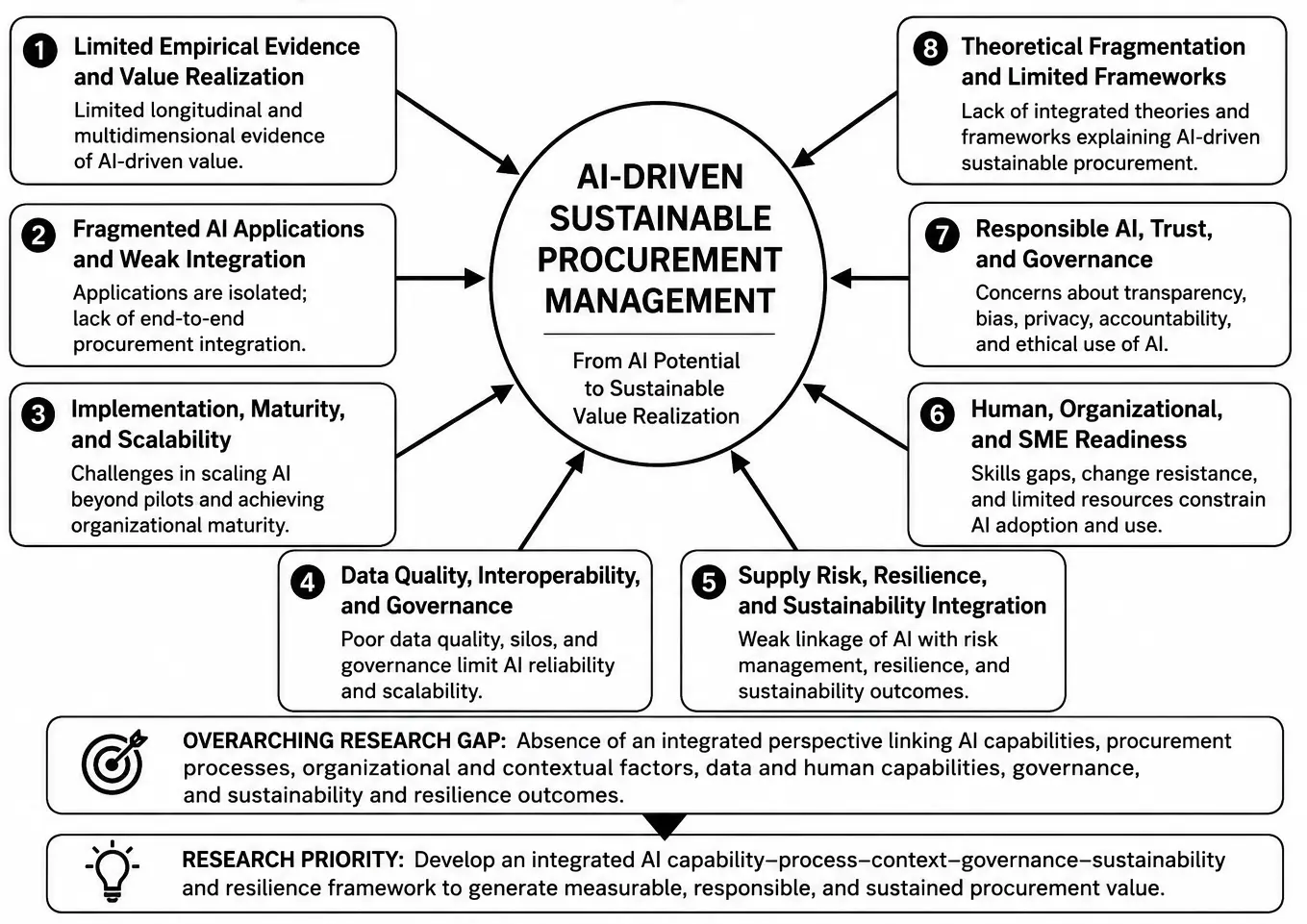
Table 2. Research Challenges, Implications, and Strategic Recommendations.
|
# |
Research Challenge |
Key Implication |
Strategic Recommendation |
|---|---|---|---|
|
1 |
Limited empirical evidence |
AI’s realized procurement and sustainability value remains under-validated. |
Conduct longitudinal, comparative, and multidimensional evaluations. |
|
2 |
Fragmented AI applications |
Isolated applications limit end-to-end procurement insights. |
Develop integrated, lifecycle-based AI procurement frameworks. |
|
3 |
AI implementation and maturity |
Scaling AI beyond pilots remains difficult. |
Establish maturity models, capability stages, and implementation roadmaps. |
|
4 |
Data quality and governance |
Poor, fragmented data limits AI reliability and scalability. |
Strengthen data quality, integration, interoperability, security, and governance. |
|
5 |
Supply risk and resilience |
AI risk prediction is insufficiently connected to proactive resilience. |
Integrate AI with dynamic capabilities and resilience strategies. |
|
6 |
Supplier sustainability |
AI’s contribution to sustainable supplier performance remains unclear. |
Apply AI to supplier screening, monitoring, evaluation, and development. |
|
7 |
Supplier scouting and market intelligence |
Limited supplier discovery constrains diversification and resilience. |
Use AI for supplier discovery, market intelligence, and diversification. |
|
8 |
Supply chain finance |
AI remains concentrated on credit-risk assessment. |
Extend AI to financing, risk mitigation, monitoring, and SME access. |
|
9 |
Human and organizational readiness |
Skills, leadership, and change barriers constrain adoption. |
Strengthen skills, training, change management, and human–AI collaboration. |
|
10 |
AI-enabled negotiation |
Automation may affect trust, judgment, and bargaining relationships. |
Define appropriate boundaries between AI augmentation and human judgment. |
|
11 |
Fraud detection and governance |
AI monitoring raises accountability, privacy, and oversight risks. |
Develop transparent, explainable, auditable, and accountable AI governance. |
|
12 |
SME and contextual limitations |
Existing AI solutions may lack affordability and scalability. |
Develop affordable, scalable, and context-sensitive solutions. |
|
13 |
Academic–practitioner gaps |
Research priorities may not fully reflect industry needs. |
Strengthen industry collaboration and multidimensional evaluation. |
|
14 |
Responsible and trustworthy AI |
Bias, opacity, and privacy risks may undermine trust. |
Embed fairness, explainability, privacy, security, and human oversight. |
|
15 |
Theoretical fragmentation |
Existing theories explain isolated dimensions of AI adoption. |
Integrate complementary theoretical perspectives. |
|
16 |
AI–sustainability–resilience integration |
Their interdependent value remains insufficiently understood. |
Develop integrated models linking AI, sustainability, and resilience. |
|
17 |
Integrated research agenda |
Research remains largely technology- and application-driven. |
Develop an AI capability–process–context–governance–sustainability outcomes framework. |
4. Future Research Directions
The research gaps identified in Section 3 reveal the need for a fundamental shift in the study of AI-driven sustainable procurement management, from a predominantly technology-centric perspective toward a capability-based, process-integrated, ecosystem-oriented, context-sensitive, and sustainability-driven perspective. Future research should move beyond asking whether AI can improve individual procurement activities and instead investigate how AI capabilities are developed, combined, embedded, orchestrated, governed, and continuously renewed to generate measurable and enduring economic, environmental, social, resilience, and strategic value. This perspective recognizes that AI does not create sustainable procurement value independently; rather, its effects are conditioned by the quality of organizational resources, procurement processes, data infrastructures, supplier relationships, human expertise, institutional environments, and governance mechanisms within which AI is deployed. Accordingly, future research should increasingly examine the mechanisms by which AI-enabled capabilities translate into procurement outcomes and the conditions under which these outcomes are sustained across increasingly complex and interconnected supply networks.
Figure 4 presents a strategic research agenda for AI-driven sustainable procurement management by positioning AI-enabled sustainable procurement transformation at the centre of an integrated research framework. The framework encompasses eight interconnected priorities: (1) AI integration and capability development; (2) data governance and responsible AI; (3) supplier sustainability and intelligence; (4) risk management and supply-chain resilience; (5) human–AI collaboration; (6) sustainable procurement performance and value realization; (7) contextual and institutional conditions; and (8) theoretical and methodological advancement. These priorities emphasize that sustainable value cannot be attributed solely to AI adoption. Instead, value emerges from the alignment and orchestration of AI technologies with reliable data, organizational capabilities, procurement processes, supplier networks, human expertise, responsible governance, and institutional support. Table 3 translates these priorities into specific future research directions, highlighting their principal research focus and expected theoretical and practical contributions. Collectively, Figure 4 and Table 3 establish a research roadmap for moving the field from fragmented evidence of individual AI applications toward an integrated and strategically grounded understanding of AI-enabled sustainable procurement transformation.
Future research should consequently focus on identifying the causal mechanisms, capability-building processes, implementation trajectories, and boundary conditions through which AI contributes to sustainable procurement and supply-chain resilience. Rather than treating AI applications as independent technological interventions, researchers should examine how AI becomes embedded across the procurement lifecycle, including spend intelligence, supplier discovery, sourcing, supplier evaluation, contracting, negotiation, supply chain finance, risk monitoring, procure-to-pay operations, fraud detection, supplier development, and sustainability management. Such an end-to-end perspective would enable scholars to examine information flows, process dependencies, feedback mechanisms, cross-functional coordination, decision interdependencies, and the cumulative effects of AI-enabled procurement decisions. It would also help explain why the same AI technology may produce different outcomes across organizations, industries, supply-chain structures, and institutional environments.
A further priority is developing stronger empirical evidence linking AI-enabled procurement capabilities to multidimensional sustainability value. Future studies should move beyond traditional measures of procurement efficiency, cost reduction, automation, and productivity to incorporate environmental outcomes, including carbon-emission reduction, resource efficiency, waste minimization, circularity, and life-cycle performance; social outcomes, including ethical sourcing, labour and human-rights standards, supplier well-being, inclusion, and responsible business practices; and organizational outcomes, including resilience, agility, innovation, adaptability, competitiveness, and long-term value creation. Equally important, future research should investigate trade-offs, unintended consequences, rebound effects, and negative externalities associated with AI-enabled procurement, including algorithmic bias, privacy and data-security concerns, cybersecurity vulnerabilities, supplier exclusion, workforce displacement, technological dependency, and the environmental footprint of AI infrastructure. Such a balanced perspective is necessary to determine whether AI produces substantive sustainability improvements or merely increases short-term procurement efficiency.
Future research should also strengthen the theoretical and methodological foundations of AI-driven sustainable procurement. Theoretical development should move toward integrative perspectives that explain how AI resources are transformed into organizational capabilities, how these capabilities become embedded in procurement routines, and how organizational, relational, and institutional conditions influence their effects. Dynamic capabilities theory, resource orchestration theory, information-processing theory, transaction cost economics, agency theory, stakeholder theory, institutional theory, and the technology–organization–environment framework offer complementary explanations of different dimensions of AI-enabled procurement transformation. Future studies should seek greater theoretical integration rather than applying individual theories to isolated AI use cases. Methodologically, the field would benefit from greater use of longitudinal, mixed-method, multi-level, comparative, cross-country, quasi-experimental, and implementation-oriented research designs. The increased use of objective procurement data, supplier-level information, digital trace data, and independently verified sustainability indicators would further improve measurement validity, causal inference, and generalizability.
(1) Develop Integrated End-to-End AI Procurement Architectures: Future research should conceptualize procurement as an integrated end-to-end system rather than a collection of technologically isolated activities. AI-enabled spend intelligence, supplier scouting, sourcing, supplier evaluation, contracting, negotiation, risk management, supply-chain finance, procure-to-pay operations, fraud detection, supplier development, and sustainability monitoring should be examined as interconnected components of a unified procurement architecture. The key research question should therefore shift from whether AI improves individual procurement activities to how AI capabilities interact across processes and generate cumulative, complementary, synergistic, or potentially conflicting effects. Future studies should investigate information flows, process dependencies, feedback loops, cross-functional coordination, decision interdependencies, and the downstream effects of upstream AI-enabled decisions. Particular attention should be given to how decisions concerning supplier selection, sourcing, and contracting influence subsequent sustainability, financial, risk, and operational outcomes. This direction would establish a stronger foundation for understanding AI as an end-to-end procurement capability rather than a portfolio of disconnected technological applications.
(2) Establish AI Procurement Maturity Models and Implementation Pathways: A critical research priority is the development and empirical validation of AI procurement maturity models and implementation pathways that explain how organizations progress from experimentation and isolated pilots to scalable, integrated, and strategically embedded AI capabilities. Although the literature provides considerable evidence regarding AI applications, comparatively limited attention has been given to the organizational pathways through which AI capabilities are developed, scaled, governed, and renewed. Future maturity models should incorporate technological infrastructure, data readiness, process maturity, AI capabilities, workforce competencies, leadership, organizational culture, governance, investment capacity, supplier readiness, ecosystem support, and strategic alignment. AI maturity should therefore be understood not simply as technological sophistication but as the organization’s capacity to deploy, integrate, govern, scale, learn from, and continuously improve AI capabilities. Longitudinal research should identify maturity thresholds, capability gaps, implementation barriers, investment requirements, and organizational transformations associated with movement across maturity stages.
(3) Shift from AI Adoption to AI Capability Development and Value Realization: Future research should make a fundamental transition from AI adoption toward AI capability development, orchestration, and value realization. Adoption reflects whether an organization implements a technology, whereas capability represents its ability to mobilize, combine, apply, and reconfigure technological resources repeatedly in response to changing procurement requirements. Drawing on dynamic capabilities theory, future studies should examine how AI enables organizations to sense emerging procurement opportunities and threats, seize them through enhanced decision-making, and reconfigure procurement resources, routines, and supplier networks. Particular attention should be given to organizational learning, capability accumulation, capability orchestration, scaling, renewal, path dependence, and complementarities between AI, human, organizational, and relational resources. Future research should also investigate whether AI capability mediates the relationship between technological investment and sustainable procurement performance and explain why organizations with comparable technologies may achieve substantially different levels of value realization.
(4) Position Data Governance as a Strategic Procurement Capability: Data governance should be repositioned from a technical prerequisite to a strategic procurement capability. AI-enabled procurement depends fundamentally on the accuracy, completeness, consistency, timeliness, accessibility, interoperability, security, provenance, and contextual relevance of procurement and supply-chain data. Future research should examine data ownership, classification, integration, validation, privacy, cybersecurity, interoperability, provenance, and cross-organizational data sharing across transactional, supplier, financial, environmental, social, contractual, and operational data sources. Particular attention should be given to integrating structured and unstructured data and overcoming organizational and interorganizational data silos. Future studies should establish how data governance influences AI reliability, explainability, scalability, auditability, model performance, decision quality, and stakeholder trust. Research should also examine whether data governance mediates the relationship between AI investment and procurement outcomes, thereby clarifying why sophisticated AI systems may fail when the underlying data architecture is fragmented or poorly governed.
(5) Advance Predictive and Prescriptive AI for Supply Risk and Resilience: Future research should extend AI-enabled supply-risk management from risk identification and prediction toward predictive–prescriptive resilience. AI can support early-warning systems, disruption forecasting, scenario analysis, alternative supplier identification, inventory optimization, capacity reallocation, and supply-network reconfiguration. However, predictive accuracy does not automatically translate into resilience because organizations must possess the capacity to convert intelligence into timely and coordinated action. Future studies should therefore examine the relationships among AI-enabled sensing, managerial decision-making, organizational response, and resource reconfiguration. Research should integrate geopolitical, environmental, logistical, financial, technological, cyber, and supplier risks, and investigate how organizations balance resilience, efficiency, responsiveness, cost, and sustainability. Particular attention should be directed toward situations in which resilience-enhancing actions generate environmental or social trade-offs and whether AI can support more balanced decision-making under conditions of uncertainty.
(6) Advance AI-Enabled Supplier Sustainability and Responsible Sourcing: Future research should transform supplier sustainability management from periodic and compliance-oriented assessment toward continuous, predictive, and multidimensional supplier intelligence. AI can integrate supplier disclosures, transaction histories, audit results, regulatory information, environmental indicators, social-risk signals, media information, and other external data to identify emerging sustainability risks. Emerging applications combining natural language processing and life-cycle assessment demonstrate the feasibility of intelligent supplier risk assessment [95]. Nevertheless, future research should move beyond model accuracy to examine whether AI-supported supplier intelligence produces measurable changes in supplier behaviour and sustainability performance. Research should investigate closed-loop mechanisms through which AI identifies sustainability risks, prioritizes suppliers, recommends interventions, monitors corrective actions, and evaluates supplier development outcomes across environmental, social, ethical, and governance dimensions. Supplier perceptions of automated sustainability assessment, including fairness, transparency, explainability, and contestability, should also receive greater attention.
(7) Expand AI-Enabled Supplier Scouting and Supply-Market Intelligence: Future research should extend AI-enabled procurement beyond supplier selection within established databases toward intelligent supplier discovery, market sensing, and supply-market intelligence. Semantic search, natural language processing, knowledge graphs, web intelligence, external-data integration, and predictive analytics can increase organizations’ ability to identify previously unknown suppliers, alternative sources, emerging market participants, innovative suppliers, and geographically diversified supply options [40]. Research should evaluate supplier-discovery accuracy alongside its effects on supplier diversification, resilience, innovation, sustainability, ethical sourcing, competition, and continuity of supply. Information-processing theory provides a valuable foundation for examining how AI expands organizational capacity to process complex, uncertain, heterogeneous, and rapidly changing supply-market information. Future research should also investigate whether AI-enabled supplier discovery unintentionally favours digitally visible suppliers while marginalizing smaller or less digitally mature suppliers.
(8) Broaden AI Applications in Supply-Chain Finance: Future research should broaden AI-enabled supply-chain finance beyond traditional credit-risk assessment toward integrated financial intelligence and adaptive decision-making. Emerging applications include cash-flow forecasting, dynamic credit assessment, supplier financing, working-capital optimization, liquidity management, financial-risk monitoring, early-payment decisions, and fraud prevention. Particular attention should be directed toward SMEs and financially constrained suppliers because improved access to finance may strengthen supplier stability, continuity, and resilience. At the same time, AI-enabled financing raises important concerns regarding transparency, fairness, privacy, explainability, data bias, and algorithmic discrimination. Future research should therefore examine whether AI-enabled supply-chain finance can simultaneously enhance financial resilience, supplier inclusion, responsible financing, and sustainable supply-chain value creation rather than prioritizing financial efficiency at the expense of vulnerable suppliers.
(9) Develop Human–AI Complementarity and Organizational Readiness: Future research should position human–AI complementarity and organizational readiness as central mechanisms underlying successful AI-enabled procurement transformation. AI can process large volumes of data, identify patterns, generate predictions, and provide recommendations, whereas procurement professionals contribute contextual knowledge, relational intelligence, ethical reasoning, experience, negotiation expertise, and strategic judgment. Future studies should identify the conditions under which these capabilities are complementary rather than substitutive and determine which procurement activities should be automated, augmented, or retained under human authority. Key issues include AI literacy, reskilling, leadership, organizational learning, trust, algorithmic reliance, job redesign, decision rights, organizational culture, and resistance to technological change. Research should also clarify how accountability should be allocated when AI substantially influences procurement decisions. This direction would strengthen the socio-technical foundations of AI-driven procurement and support the development of human-centred, augmentation-oriented procurement systems.
(10) Redefine AI-Enabled Negotiation and Buyer–Supplier Relationships: AI-enabled negotiation represents an important research frontier because procurement negotiation combines analytical optimization with trust, relational knowledge, strategic interaction, power, and contextual judgment. Future studies should distinguish among AI-supported negotiation preparation, decision-support systems, recommendation-based negotiation, semi-autonomous negotiation, and fully autonomous bargaining. Transaction cost economics (Williamson, 2008) [73] provides a useful theoretical foundation for examining whether AI reduces search, information, bargaining, and monitoring costs. However, efficiency gains should be evaluated alongside implications for bargaining power, information asymmetry, fairness, transparency, trust, supplier perceptions, and relationship quality. The central question should therefore shift from whether negotiation can be automated toward where the optimal boundary between algorithmic efficiency and human relational judgment should be established, particularly across strategic, complex, and relationship-intensive procurement categories.
(11) Institutionalize Responsible, Explainable, and Trustworthy AI Governance: Responsible AI should become a core governance capability within sustainable procurement management, rather than a peripheral compliance requirement. AI increasingly influences supplier selection, sustainability scoring, risk assessment, negotiation, financing, fraud detection, and other decisions with significant consequences for suppliers, employees, and stakeholders. Future research should examine algorithmic transparency, explainability, fairness, accountability, auditability, privacy, cybersecurity, bias mitigation, human oversight, contestability, and mechanisms for reviewing or challenging AI-generated decisions. Responsible governance should be studied throughout the AI lifecycle, from data acquisition and model development to deployment, monitoring, auditing, and continuous improvement. Future studies should also investigate how responsible AI governance influences stakeholder trust, legitimacy, supplier participation, organizational reputation, and sustainability performance, thereby positioning responsible AI as a strategic capability for sustainable procurement.
(12) Advance AI-Enabled Procurement Fraud Detection and Integrity Management: Future research should move from retrospective fraud detection toward proactive AI-enabled procurement integrity management. AI can analyse transactional, behavioural, communication, supplier, and network data to identify anomalies and potential indicators of collusion, conflicts of interest, suspicious payments, duplicate transactions, bid-rigging patterns, and other forms of procurement misconduct. Agency theory provides a useful foundation for examining how AI-enabled monitoring can reduce information asymmetry and strengthen accountability. Nevertheless, researchers must explicitly address false positives, excessive surveillance, privacy violations, algorithmic bias, explainability, and unjustified suspicion. Future research should therefore develop explainable, auditable, and human-supervised integrity systems and evaluate their effects not only on detection accuracy but also on procedural fairness, stakeholder trust, organizational integrity, and governance effectiveness.
(13) Expand Research on SMEs and Emerging-Market Contexts: Future research should substantially expand empirical evidence from SMEs and emerging-market economies, which remain comparatively underrepresented in AI-enabled procurement research. Many existing models implicitly assume advanced digital infrastructure, extensive datasets, specialized analytical capabilities, reliable connectivity, and substantial investment capacity, assumptions that may not hold for resource-constrained organizations. Future studies should investigate affordable, modular, scalable, interoperable, and context-sensitive AI solutions while examining the effects of firm size, industry, digital maturity, institutional quality, infrastructure, managerial capabilities, financing constraints, and ecosystem support. Comparative research across developed and emerging economies would be particularly valuable for distinguishing generalizable mechanisms from context-specific boundary conditions and determining whether AI-enabled procurement transformation contributes to digital inclusion or reinforces existing capability asymmetries across supply networks.
(14) Develop Multidimensional Measures of Sustainable Procurement Value: Future research should establish multidimensional, validated, and longitudinal measures of AI-enabled sustainable procurement value. Existing research often emphasizes cost savings, automation, productivity, and transaction speed, potentially overlooking environmental, social, resilience, governance, and strategic outcomes. Future studies should develop comprehensive indicators encompassing economic efficiency, emissions reduction, resource productivity, waste minimization, circularity, supplier sustainability, labour and human rights performance, ethical compliance, transparency, supply continuity, risk reduction, stakeholder value, innovation, and strategic performance. Crucially, researchers should distinguish among AI adoption, AI capability, AI-enabled process improvement, and actual value realization, because implementing an AI system does not constitute evidence of sustainability improvement. Measurement frameworks should also capture trade-offs across sustainability dimensions and assess whether initial efficiency gains translate into enduring and system-level sustainability outcomes.
(15) Strengthen Theoretical Integration and Explanatory Power: The theoretical development of AI-driven sustainable procurement requires stronger integration among complementary theoretical perspectives. Dynamic capabilities theory can explain sensing, seizing, and resource reconfiguration; information-processing theory can explain how AI addresses procurement complexity, uncertainty, and information overload; transaction cost economics can explain reductions in search, information, bargaining, and governance costs [73]; agency theory can explain monitoring, control, and information asymmetry; stakeholder theory can explain competing sustainability expectations; institutional theory can explain regulatory and normative pressures; and resource orchestration theory can explain how AI resources are structured, bundled, and leveraged. Future research should integrate these perspectives rather than applying them independently to isolated technological applications. A multi-theoretical capability perspective would provide stronger explanations of how AI resources become organizational capabilities, how these capabilities become embedded in procurement routines, how contextual conditions influence their deployment, and how these mechanisms jointly produce sustainable and resilient outcomes.
(16) Strengthen Longitudinal, Comparative, and Real-World Evidence: The field requires substantially stronger longitudinal, comparative, mixed-method, and real-world evidence. Cross-sectional surveys and conceptual studies provide valuable initial insights but offer a limited understanding of capability development, organizational learning, implementation failure, path dependence, and long-term value realization. Longitudinal research should examine how AI capabilities develop and evolve over time, while comparative studies should investigate differences across industries, countries, firm sizes, procurement categories, supply chain configurations, and institutional environments. Organizational case studies, action research, field studies, and implementation research can provide deeper insights into transformation processes, while large-scale quantitative studies can test causal relationships and boundary conditions. Where feasible, quasi-experimental and experimental designs should be used to evaluate specific AI-enabled procurement interventions. Greater use of objective procurement records, supplier-level information, digital trace data, and independently verified sustainability indicators would further strengthen empirical validity, causal inference, and generalizability.
(17) Develop and Validate an Integrated AI–Procurement–Sustainability–Resilience Framework: The ultimate research priority is the development and empirical validation of an integrated AI capability–procurement process–context–governance–sustainability–resilience framework. Rather than assuming a direct relationship between AI adoption and sustainability performance, the framework should explain how AI capabilities are translated through procurement processes, organizational resources, supplier relationships, and governance arrangements into measurable outcomes. It should incorporate AI-enabled spend intelligence, supplier scouting, sourcing, supplier management, risk management, supply-chain finance, negotiation, operational procurement, fraud detection, and sustainability intelligence while accounting for the enabling and moderating roles of data governance, organizational readiness, supplier capabilities, institutional conditions, human–AI collaboration, and responsible AI governance. Future empirical studies should test direct, mediating, moderating, and potentially nonlinear relationships among these constructs across different organizational and institutional settings. Such validation would provide a coherent theoretical basis for explaining how, when, where, and under what conditions AI capabilities generate sustainable, resilient, and strategically valuable procurement outcomes.
Taken together, these research directions establish four fundamental transitions for the field: from AI adoption to capability development; from isolated applications to end-to-end integration; from operational efficiency to multidimensional sustainable value creation; and from technology centred implementation to responsible, human centred, and context-sensitive governance. This trajectory positions AI-driven sustainable procurement management as a strategic organizational and interorganizational capability embedded across procurement processes, supplier ecosystems, and supply networks, rather than as a collection of independent digital technologies. Future research should therefore move beyond asking whether organizations adopt AI and instead examine how AI capabilities are developed, orchestrated, scaled, governed, and renewed; how they interact with organizational, supplier, technological, and institutional conditions; how they influence both intended and unintended sustainability outcomes; and how their contributions can be measured over time. Ultimately, this agenda provides a foundation for advancing the literature from fragmented evidence of individual AI applications toward a coherent, theoretically grounded, empirically validated, responsible, resilient, and sustainability-oriented paradigm of AI-enabled procurement transformation, in which AI is understood not merely as a technological enabler of procurement efficiency but as a strategic capability for creating enduring and balanced value across sustainable supply chains.
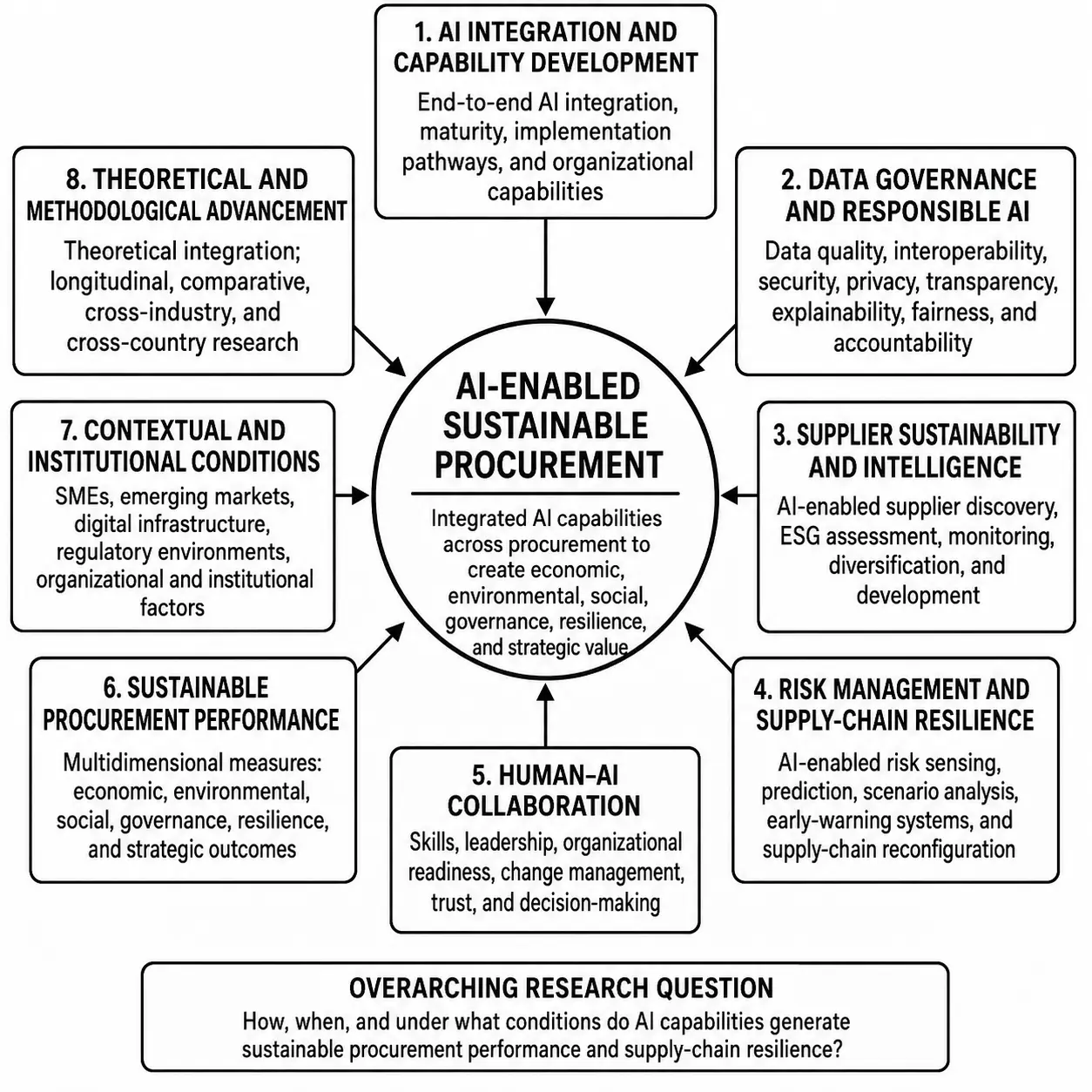
Table 3. Future Research Agenda for AI-Driven Sustainable Procurement.
|
No. |
Research Priority |
Research Focus |
Expected Contribution |
|---|---|---|---|
|
1 |
End-to-End AI Integration |
Integrate AI across the procurement lifecycle. |
Enable integrated procurement transformation. |
|
2 |
AI Maturity and Implementation |
Develop AI maturity models and implementation pathways. |
Guide scalable AI adoption. |
|
3 |
AI Capabilities and Value Creation |
Examine AI capabilities and value-creation mechanisms. |
Explain sustained procurement value. |
|
4 |
Data Governance and Quality |
Address data quality, integration, security, and privacy. |
Enable reliable and responsible AI. |
|
5 |
Supply Risk and Resilience |
Apply AI to risk prediction and supply-chain reconfiguration. |
Strengthen resilience and adaptability. |
|
6 |
Supplier Sustainability |
Apply AI to ESG screening, monitoring, and evaluation. |
Improve supplier sustainability performance. |
|
7 |
Supplier Intelligence and Scouting |
Use AI for supplier discovery, diversification, and market intelligence. |
Enhance sourcing agility and continuity. |
|
8 |
AI-Enabled Supply Chain Finance |
Apply AI to credit, financing, cash flow, and risk management. |
Strengthen financial resilience. |
|
9 |
Human–AI Collaboration |
Examine skills, leadership, readiness, and decision-making. |
Enhance human–AI procurement capabilities. |
|
10 |
AI-Enabled Negotiation |
Examine AI-supported negotiation, trust, and relationships. |
Balance automation with human judgment. |
|
11 |
Responsible and Explainable AI |
Address fairness, bias, explainability, privacy, and accountability. |
Promote trustworthy AI procurement. |
|
12 |
AI-Enabled Fraud Detection |
Develop AI for fraud detection and prevention. |
Strengthen procurement integrity. |
|
13 |
SMEs and Emerging Markets |
Examine affordability, scalability, skills, and institutional conditions. |
Enable inclusive and context-sensitive adoption. |
|
14 |
Sustainable Procurement Performance |
Develop multidimensional sustainability measures. |
Assess value beyond cost and efficiency. |
|
15 |
Theoretical Integration |
Integrate complementary theoretical perspectives. |
Strengthen theoretical coherence. |
|
16 |
Longitudinal and Comparative Evidence |
Conduct longitudinal, cross-industry, and cross-country studies. |
Improve causal understanding and generalizability. |
|
17 |
Integrated AI–Procurement–Sustainability–Resilience Framework |
Link AI capabilities, procurement, governance, sustainability, and resilience. |
Explain how and when AI creates sustainable procurement value. |
5. Conclusions
This systematic literature review (SLR) critically synthesizes the emerging body of research on AI-driven sustainable procurement management in supply chains and clarifies its intellectual development, current limitations, and future trajectory. The evidence indicates that artificial intelligence (AI) is moving beyond its conventional roles in automation, analytics, and decision support toward a potentially strategic capability to transform procurement processes and supply-chain relationships. AI-enabled applications can strengthen supplier intelligence, sourcing and selection, process automation, risk anticipation, financial decision-making, fraud detection, negotiation support, transparency, traceability, and sustainability assessment. However, the literature remains fragmented across technological, procurement, and sustainability perspectives and is characterized by substantial methodological heterogeneity. More importantly, existing research remains disproportionately concerned with AI adoption, technological functionality, and operational efficiency, whereas considerably less attention has been devoted to explaining how AI capabilities are developed, integrated, governed, and converted into sustained sustainability and strategic value.
A central finding of the review is the existence of an AI capability–sustainability value gap. The literature demonstrates considerable confidence in what AI can technically accomplish, but substantially less empirical evidence explains how technological potential becomes measurable and sustained organizational, sustainability, and resilience outcomes. This finding challenges a largely technology-centric view of AI implementation. AI adoption should not be treated as a sufficient condition for procurement transformation; rather, value realization depends on the orchestration of AI capabilities with complementary organizational, technological, human, relational, and institutional resources. Data quality and governance, digital interoperability, procurement maturity, organizational readiness, employee competencies, supplier capabilities, institutional conditions, human–AI collaboration, and responsible governance emerge as critical enabling conditions. AI-driven sustainable procurement is therefore better conceptualized as a socio-technical and interorganizational capability-building process than as a discrete technological intervention.
The review further demonstrates that the field is fragmented by its predominant focus on individual AI applications rather than the interaction of interconnected capabilities across the procurement lifecycle. Research on supplier selection, forecasting, automation, risk management, sustainability assessment, negotiation, or fraud detection frequently examines these applications in isolation, limiting understanding of how their combined effects reshape procurement systems and supply networks. This fragmentation obscures potential complementarities, capability dependencies, feedback effects, trade-offs, and unintended consequences. A more mature research perspective should therefore conceptualize AI-driven procurement as an end-to-end capability architecture that extends from supplier intelligence and strategic sourcing through purchasing, contract management, supplier development, risk monitoring, sustainability evaluation, and continuous performance management.
5.1. Theoretical Implications
The principal theoretical contribution of this study is to reposition AI-driven sustainable procurement from a technology-adoption phenomenon to a capability-orchestration phenomenon. The synthesis suggests that AI generates sustainable value through the interaction among technological resources, organizational capabilities, procurement routines, human expertise, supplier relationships, data infrastructures, and governance mechanisms. An integrated theoretical perspective drawing on dynamic capabilities theory, information-processing theory, transaction cost economics, and agency theory provides a stronger foundation for explaining this process. Dynamic capabilities illuminate how organizations sense emerging procurement and sustainability challenges, seize AI-enabled opportunities, and reconfigure resources and routines; information-processing theory explains how AI expands the capacity to process complex, uncertain, and rapidly changing supply-chain information; transaction cost economics clarifies how AI may alter information asymmetry, monitoring costs, coordination, and supplier governance; and agency theory provides insights into AI-enabled monitoring, accountability, incentive alignment, and decision rights.
Taken together, these perspectives support a conceptual progression from AI resources to AI-enabled capabilities, to procurement process transformation, to sustainable procurement practices, to multidimensional supply-chain outcomes. Importantly, this progression is not deterministic. Its effectiveness depends on complementary resources and contextual conditions that can enable, constrain, or redirect value realization. The study therefore extends conventional AI adoption research by emphasizing capability development, resource orchestration, process integration, interorganizational governance, and sustainable value realization. It also establishes a basis for future theory development concerning the mechanisms and boundary conditions that explain why comparable AI investments may generate different outcomes across organizations, industries, institutional environments, and supply-chain configurations.
5.2. Practical Implications
The findings suggest that organizations should approach AI-enabled procurement as a strategic transformation of the procurement operating model, rather than as a collection of independent digital applications. AI investments should be aligned with procurement strategy and sustainability objectives, and evaluated for their contributions to supplier intelligence, sourcing effectiveness, risk anticipation, resilience, sustainability performance, procurement integrity, financial robustness, and long-term strategic value. This requires complementary investments in data governance, interoperable digital infrastructure, cybersecurity, privacy protection, process redesign, employee capabilities, supplier readiness, human oversight, and responsible AI controls.
AI transformation should also follow a capability-based rather than technology-led implementation logic. Organizations should assess data and organizational readiness, establish appropriate governance structures, develop internal and supplier capabilities, pilot high-value applications, evaluate outcomes, and scale successful capabilities progressively. Such an approach can reduce the risk of investing in sophisticated technologies without the organizational and relational conditions required for value realization. The strategic objective should therefore be to develop an adaptive procurement capability in which AI, people, processes, suppliers, and governance mechanisms evolve together.
5.3. Managerial Implications
For procurement managers, the central implication is that AI should augment professional judgment rather than simply replace procurement decision-makers. AI can provide superior capabilities for prediction, pattern recognition, information processing, anomaly detection, and decision recommendation, while human professionals remain essential for contextual interpretation, negotiation, ethical judgment, relationship management, and strategic decision-making. Hybrid decision structures should therefore be designed to establish appropriate boundaries between algorithmic recommendations and human authority, particularly in supplier selection, negotiation, risk evaluation, sustainability decisions, and high-impact procurement decisions.
Managers should also establish an AI capability maturity roadmap covering data readiness, technological infrastructure, process integration, employee competencies, supplier capabilities, governance, and performance measurement. Evaluation should extend beyond traditional indicators such as cost, cycle time, and productivity to encompass environmental and social outcomes, resilience, transparency, accountability, supplier development, risk reduction, and long-term strategic value. Continuous monitoring of algorithmic performance, explainability, data quality, bias, cybersecurity, model reliability, and unintended consequences should form an integral component of AI-enabled procurement governance.
5.4. Study Limitations
This study has several limitations. First, the review is bounded by the selected evidence base and the publication period ending 30 June 2026, and therefore may not capture relevant evidence outside the defined scope. Second, the reviewed studies exhibit considerable conceptual, theoretical, methodological, and contextual heterogeneity, limiting direct comparability and the strength of cumulative causal inference. Third, empirical evidence remains uneven across industries, organizational sizes, geographical regions, SMEs, and emerging economies, constraining the transferability of findings across different institutional and supply-chain environments. Fourth, the integrated conceptual interpretation advanced by this review is derived from the existing literature and consequently requires further empirical validation.
These limitations also define important directions for future inquiry. Longitudinal research is needed to examine the development and maturation of AI capabilities and their effects over time; comparative and cross-contextual studies can clarify institutional and organizational boundary conditions; mixed-method and case-based research can illuminate underlying mechanisms; and experimental, quasi-experimental, and large-scale empirical designs can strengthen causal inference. Greater use of real-world organizational data and validated economic, environmental, social, resilience, and governance indicators is also required to establish more robust evidence of long-term value realization.
5.5. Overall Contribution and Future Outlook
Overall, this review establishes AI-driven sustainable procurement management as an emerging strategic research domain at the intersection of artificial intelligence, procurement transformation, sustainability, and supply-chain resilience. Its central contribution is to demonstrate that the advancement of this field depends not primarily on identifying additional AI applications, but on explaining the capability architecture, value-creation mechanisms, and governance conditions through which AI can generate sustained and responsible outcomes.
Four fundamental shifts emerge from the synthesis: from AI adoption to capability development; from isolated applications to end-to-end integration; from operational efficiency to multidimensional sustainable value creation; and from technology centred implementation to responsible, human centred, and context-sensitive governance. These shifts provide the foundation for a more mature research paradigm in which AI is understood as an evolving capability embedded within procurement ecosystems rather than as an independent technological input.
The future of AI-driven sustainable procurement research, therefore, lies in explaining how AI capabilities are developed, orchestrated, embedded, governed, and scaled, how they interact with human and organizational capabilities, and under what conditions they generate sustained economic, environmental, social, resilience, and strategic value. Addressing these questions can move the field beyond demonstrating what AI can do toward explaining how, why, and when AI-enabled procurement creates sustainable value. Such a transition would strengthen cumulative theory development, improve empirical rigor, and provide organizations with a more credible pathway toward responsible and resilient AI-enabled procurement transformation.
Statement of the Use of Generative AI and AI-Assisted Technologies in the Writing Process
The authors acknowledge that ChatGPT (OpenAI) was used exclusively for language editing and stylistic refinement of the authors’ manuscript, including improvements to clarity, grammar, structure, and academic tone. The tool was not used to generate original research data, empirical analyses, scholarly references, or research findings. The authors critically reviewed and verified the final manuscript and assume full responsibility for its content, interpretations, and conclusions.
Ethics Statement
Not applicable.
Informed Consent Statement
Not applicable.
Data Availability Statement
All data supporting the findings of this study are contained within the article.
Funding
No external funding was received for this research.
Declaration of Competing Interest
The author declares no conflicts of interest.
References
- Su Z, Zhang M, Wu W. Visualizing Sustainable Supply Chain Management: A Systematic Scientometric Review. Sustainability 2021, 13, 4409. DOI:10.3390/su13084409 [Google Scholar]
- Varriale V, Cammarano A, Michelino F, Caputo M. Industry 5.0 and Triple Bottom Line Approach in Supply Chain Management: The State-of-the-Art. Sustainability 2023, 15, 5712. DOI:10.3390/su15075712 [Google Scholar]
- Siems E, Seuring S, Schilling L. Stakeholder roles in sustainable supply chain management: A literature review. J. Bus. Econ. 2023, 93, 747–775. DOI:10.1007/s11573-022-01117-5 [Google Scholar]
- Leal Filho W, Viera Trevisan L, Paulino Pires Eustachio JH, Dibbern T, Castillo Apraiz J, Rampasso I, et al. Sustainable supply chain management and the UN sustainable development goals: exploring synergies towards sustainable development. TQM J. 2025, 37, 18–41. DOI:10.1108/TQM-04-2023-0114 [Google Scholar]
- Wamba-Taguimdje SL, Fosso Wamba S, Kala Kamdjoug JR, Tchatchouang Wanko CE. Influence of artificial intelligence (AI) on firm performance: the business value of AI-based transformation projects. Bus. Process Manag. J. 2020, 26, 1893–1924. DOI:10.1108/BPMJ-10-2019-0411 [Google Scholar]
- Belhadi A, Mani V, Kamble SS, Khan SAR, Verma S. Artificial intelligence-driven innovation for enhancing supply chain resilience and performance under the effect of supply chain dynamism: An empirical investigation. Ann. Oper. Res. 2024, 333, 627–652. DOI:10.1007/s10479-021-03956-x [Google Scholar]
- Theodorou P, Theodorou P. Artificial intelligence for strategic procurement in energy firms: A modeling framework. Acad. Green Energy 2026, 3, 1–10. DOI:10.20935/AcadEnergy8202 [Google Scholar]
- Duan Y, Edwards JS, Dwivedi YK. Artificial intelligence for decision making in the era of Big Data—Evolution, challenges and research agenda. Int. J. Inf. Manag. 2019, 48, 63–71. DOI:10.1016/j.ijinfomgt.2019.01.021 [Google Scholar]
- Pournader M, Ghaderi H, Hassanzadegan A, Fahimnia B. Artificial intelligence applications in supply chain management. Int. J. Prod. Econ. 2021, 241, 108250. DOI:10.1016/j.ijpe.2021.108250 [Google Scholar]
- Riahi Y, Saikouk T, Gunasekaran A, Badraoui I. Artificial intelligence applications in supply chain: A descriptive bibliometric analysis and future research directions. Expert Syst. Appl. 2021, 173, 114702. DOI:10.1016/j.eswa.2021.114702 [Google Scholar]
- Sharma R, Shishodia A, Gunasekaran A, Min H, Munim ZH. The role of artificial intelligence in supply chain management: Mapping the territory. Int. J. Prod. Res. 2022, 60, 7527–7550. DOI:10.1080/00207543.2022.2029611 [Google Scholar]
- Kache F, Seuring S. Challenges and opportunities of digital information at the intersection of Big Data Analytics and supply chain management. Int. J. Oper. Prod. Manag. 2017, 37, 10–36. DOI:10.1108/IJOPM-02-2015-0078 [Google Scholar]
- Wamba SF, Gunasekaran A, Akter S, Ren SJF, Dubey R, Childe SJ. Big data analytics and firm performance: Effects of dynamic capabilities. J. Bus. Res. 2017, 70, 356–365. DOI:10.1016/j.jbusres.2016.08.009 [Google Scholar]
- Schoenherr T, Speier‐Pero C. Data Science, Predictive Analytics, and Big Data in Supply Chain Management: Current State and Future Potential. J. Bus. Logist. 2015, 36, 120–132. DOI:10.1111/jbl.12082 [Google Scholar]
- Kaur H, Singh SP. Heuristic modeling for sustainable procurement and logistics in a supply chain using big data. Comput. Oper. Res. 2018, 98, 301–321. DOI:10.1016/j.cor.2017.05.008 [Google Scholar]
- Gomaa AH. Artificial Intelligence Applications in Sustainable Reverse Supply Chains: A Systematic Review, Gap Analysis, and Future Research Agenda. Interdiscip. Syst. Glob. Manag. 2026, 2, 127–149. DOI:10.55578/isgm.2605.008 [Google Scholar]
- Saihi A, Hariga M, Daghfous A. The Role of Digital Transformation in Strategic Procurement: Trends, Evidence, and Case Studies. IEEE Access 2026, 14, 29456–29474. DOI:10.1109/ACCESS.2026.3666344 [Google Scholar]
- Bienhaus F, Haddud A. Procurement 4.0: factors influencing the digitisation of procurement and supply chains. Bus. Process Manag. J. 2018, 24, 965–984. DOI:10.1108/BPMJ-06-2017-0139 [Google Scholar]
- Bag S, Wood LC, Mangla SK, Luthra S. Procurement 4.0 and its implications on business process performance in a circular economy. Resour. Conserv. Recycl. 2020, 152, 104502. DOI:10.1016/j.resconrec.2019.104502 [Google Scholar]
- Mavidis A, Folinas D. From Public E-Procurement 3.0 to E-Procurement 4.0; A Critical Literature Review. Sustainability 2022, 14, 11252. DOI:10.3390/su141811252 [Google Scholar]
- Gomaa AH. Towards AI-Driven Sustainable Financial Management in Industry 4.0-5.0: A Systematic Review, Gap Analysis, and Conceptual Framework. Int. J. Humanit. Sci. Innov. Manag. Stud. 2026, 3, 42–64. DOI:10.64137/30508509/IJHSIMS-V3I4P104 [Google Scholar]
- Kumari A, Tiwari M, Jagtap S, Shah B, Yadav VS, Ghoshal S. Securing the future: Navigating blockchain challenges in procurement 4.0 for ensuring food security. J. Glob. Oper. Strateg. Sourc. 2026, 19, 178–197. DOI:10.1108/JGOSS-09-2024-0085 [Google Scholar]
- Kar AK, Choudhary SK, Singh VK. How can artificial intelligence impact sustainability: A systematic literature review. J. Clean. Prod. 2022, 376, 134120. DOI:10.1016/j.jclepro.2022.134120 [Google Scholar]
- Sipola J, Saunila M, Ukko J. Adopting artificial intelligence in sustainable business. J. Clean. Prod. 2023, 426, 139197. DOI:10.1016/j.jclepro.2023.139197 [Google Scholar]
- Kumar A, Shrivastav SK, Shrivastava AK, Panigrahi RR, Mardani A, Cavallaro F. Sustainable Supply Chain Management, Performance Measurement, and Management: A Review. Sustainability 2023, 15, 5290. DOI:10.3390/su15065290 [Google Scholar]
- Daios A, Kladovasilakis N, Kelemis A, Kostavelis I. AI Applications in Supply Chain Management: A Survey. Appl. Sci. 2025, 15, 2775. DOI:10.3390/app15052775 [Google Scholar]
- Teixeira AR, Ferreira JV, Ramos AL. Intelligent Supply Chain Management: A Systematic Literature Review on Artificial Intelligence Contributions. Information 2025, 16, 399. DOI:10.3390/info16050399 [Google Scholar]
- Sanni S. A review on machine learning and artificial intelligence in procurement: Building resilient supply chains for climate and economic priorities. Commun. Phys. Sci. 2024, 11, 1032. Available online: https://journalcps.com/index.php/volumes/article/view/711 (accessed on 1 January 2026).
- Suchith B, Ganesha KS. Adoption of digital platforms and AI tools on sustainable procurement using EATM. In Proceedings of the 2024 First International Conference on Innovations in Communications, Electrical and Computer Engineering (ICICEC), Davangere, India, 24–25 October 2024; pp. 1–8. DOI:10.1109/ICICEC62498.2024.10808509 [Google Scholar]
- Berbig D, Kania A, Mroczek-Dąbrowska K, Bremser K. Artificial intelligence in procurement: A systematic and AI-assisted literature review. Bus. Process Manag. J. 2026, 1–27. DOI:10.1108/BPMJ-10-2025-1701 [Google Scholar]
- Guida M, Caniato F, Moretto A, Ronchi S. The role of artificial intelligence in the procurement process: State of the art and research agenda. J. Purch. Supply Manag. 2023, 29, 100823. DOI:10.1016/j.pursup.2023.100823 [Google Scholar]
- Spina G, Caniato F, Luzzini D, Ronchi S. Past, present and future trends of purchasing and supply management: An extensive literature review. Ind. Mark. Manag. 2013, 42, 1202–1212. DOI:10.1016/j.indmarman.2013.04.001 [Google Scholar]
- ISO. International Organization for Standardization. ISO 20400:2017 Sustainable procurement-guidance. Available online: https://www.iso.org/files/live/sites/isoorg/files/store/en/ISO%2020400_Sustainable_procur.pdf (accessed on 1 January 2026).
- Zorina Y. AI-Driven Sustainable Procurement: Balancing Strategy and ESG Compliance. J. Procure. Supply Chain Manag. 2025, 4, 55–67. DOI:10.58425/jpscm.v4i3.441 [Google Scholar]
- Sanni S. A Review on Sustainable Procurement in the Age of AI: Leveraging Intelligent Systems to Advance US Climate and Economic Resilience. Appl. Sci. Comput. Energy 2025, 3, 431–444. Available online: https://cemrj.com/index.php/volumes/article/view/2025-10-25 (accessed on 1 January 2026).
- Page MJ, McKenzie JE, Bossuyt PM, Boutron I, Hoffmann TC, Mulrow CD, et al. Updating guidance for reporting systematic reviews: Development of the PRISMA 2020 statement. J. Clin. Epidemiol. 2021, 134, 103–112. DOI:10.1016/j.jclinepi.2021.02.003 [Google Scholar]
- Gomaa AH. SCM 4.0 Excellence: A Strategic Framework for Smart and Competitive Supply Chains. Int. J. Manag. Humanit. 2025, 11, 24–44. DOI:10.35940/ijmh.G1798.11080425 [Google Scholar]
- Indrianti TTD. A Bibliometric Analysis of E-Purchasing Implementation in Public Sector Procurement of Goods and Services in Indonesia, 2019–2024. Khazanah J. Manag. 2026, 1, 42–52. DOI:10.31313/kjm.v1i1.9 [Google Scholar]
- Nersesian L, Kalchschmidt M. Artificial Intelligence in Sustainable Procurement: A Systematic Review and Integrative Framework. In Ipsera Proceedings. 2026; pp. 1–25. Available online: https://hdl.handle.net/11311/1313465 (accessed on 1 January 2026).
- Lorentz H, Aminoff A, Kaipia R, Pihlajamaa M, Ehtamo J, Tanskanen K. Acquisition of supply market intelligence—An information processing perspective. J. Purch. Supply Manag. 2020, 26, 100649. DOI:10.1016/j.pursup.2020.100649 [Google Scholar]
- Hallikas J, Immonen M, Brax S. Digitalizing procurement: The impact of data analytics on supply chain performance. Supply Chain Manag. Int. J. 2021, 26, 629–646. DOI:10.1108/SCM-05-2020-0201 [Google Scholar]
- Glas AH, Kleemann FC. The impact of Industry 4.0 on procurement and supply management: A conceptual and qualitative analysis. Int. J. Bus. Manag. Invent. 2016, 5, 55–66. Available online: https://www.ijbmi.org/papers/Vol(5)6/I0506055066.pdf (accessed on 1 June 2026).
- Kosmol T, Reimann F, Kaufmann L. You’ll never walk alone: Why we need a supply chain practice view on digital procurement. J. Purch. Supply Manag. 2019, 25, 100553. DOI:10.1016/j.pursup.2019.100553 [Google Scholar]
- Wang G, Gunasekaran A, Ngai EW, Papadopoulos T. Big data analytics in logistics and supply chain management: Certain investigations for research and applications. Int. J. Prod. Econ. 2016, 176, 98–110. DOI:10.1016/j.ijpe.2016.03.014 [Google Scholar]
- Barrad S, Gagnon S, Valverde R. An Analytics Architecture for Procurement. Int. J. Inf. Technol. Syst. Approach 2020, 13, 73–98. DOI:10.4018/IJITSA.2020070104 [Google Scholar]
- Chowdhary P, Ettl M, Dhurandhar A, Ghosh S, Maniachari G, Graves B, et al. Managing Procurement Spend Using Advanced Compliance Analytics. In Proceedings of the 2011 IEEE 8th International Conference on e-Business Engineering, Beijing, China, 19–21 October 2011; pp. 139–144. DOI:10.1109/ICEBE.2011.57 [Google Scholar]
- Zair F, Nejma M, Fourka M, Cherkaoui A. Conceptual architecture for agent-based modelling of supplier selection conducted by a supply chain dyad. Int. J. Supply Chain Manag. 2019, 8, 483–492. Available online: http://excelingtech.co.uk/ (accessed on 1 June 2026).
- Baryannis G, Dani S, Antoniou G. Predicting supply chain risks using machine learning: The trade-off between performance and interpretability. Future Gener. Comput. Syst. 2019, 101, 993–1004. DOI:10.1016/j.future.2019.07.059 [Google Scholar]
- Baryannis G, Validi S, Dani S, Antoniou G. Supply chain risk management and artificial intelligence: State of the art and future research directions. Int. J. Prod. Res. 2019, 57, 2179–2202. DOI:10.1080/00207543.2018.1530476 [Google Scholar]
- Singh NP, Singh S. Building supply chain risk resilience: Role of big data analytics in supply chain disruption mitigation. Benchmarking Int. J. 2019, 26, 2318–2342. DOI:10.1108/BIJ-10-2018-0346 [Google Scholar]
- Chu CY, Park K, Kremer GE. A global supply chain risk management framework: An application of text-mining to identify region-specific supply chain risks. Adv. Eng. Inform. 2020, 45, 101053. DOI:10.1016/j.aei.2020.101053 [Google Scholar]
- Ivanov D, Dolgui A. A digital supply chain twin for managing the disruption risks and resilience in the era of Industry 4.0. Prod. Plan. Control 2021, 32, 775–788. DOI:10.1080/09537287.2020.1768450 [Google Scholar]
- Gani MO, Takahashi Y, Bag S, Rahman MS. Firms’ dynamic capabilities and supply chain risk management: A B2B perspective. Benchmarking Int. J. 2023, 30, 4119–4139. DOI:10.1108/BIJ-07-2022-0457 [Google Scholar]
- Chirumalla K. Building digitally-enabled process innovation in the process industries: A dynamic capabilities approach. Technovation 2021, 105, 102256. DOI:10.1016/j.technovation.2021.102256 [Google Scholar]
- Pitchipoo P, Venkumar P, Rajakarunakaran S. Fuzzy hybrid decision model for supplier evaluation and selection. Int. J. Prod. Res. 2013, 51, 3903–3919. DOI:10.1080/00207543.2012.756592 [Google Scholar]
- Kannan D. Role of multiple stakeholders and the critical success factor theory for the sustainable supplier selection process. Int. J. Prod. Econ. 2018, 195, 391–418. DOI:10.1016/j.ijpe.2017.02.020 [Google Scholar]
- Allaoui H, Guo Y, Sarkis J. Decision support for collaboration planning in sustainable supply chains. J. Clean. Prod. 2019, 229, 761–774. DOI:10.1016/j.jclepro.2019.04.367 [Google Scholar]
- Brintrup A, Pak J, Ratiney D, Pearce T, Wichmann P, Woodall P, et al. Supply chain data analytics for predicting supplier disruptions: A case study in complex asset manufacturing. Int. J. Prod. Res. 2020, 58, 3330–3341. DOI:10.1080/00207543.2019.1685705 [Google Scholar]
- Ho W, Xu X, Dey PK. Multi-criteria decision making approaches for supplier evaluation and selection: A literature review. Eur. J. Oper. Res. 2010, 202, 16–24. DOI:10.1016/j.ejor.2009.05.009 [Google Scholar]
- Scott J, Ho W, Dey PK, Talluri S. A decision support system for supplier selection and order allocation in stochastic, multi-stakeholder and multi-criteria environments. Int. J. Prod. Econ. 2015, 166, 226–237. DOI:10.1016/j.ijpe.2014.11.008 [Google Scholar]
- Cegielski CG, Allison Jones‐Farmer L, Wu Y, Hazen BT. Adoption of cloud computing technologies in supply chains. Int. J. Logist. Manag. 2012, 23, 184–211. DOI:10.1108/09574091211265350 [Google Scholar]
- Busse C, Meinlschmidt J, Foerstl K. Managing Information Processing Needs in Global Supply Chains: A Prerequisite to Sustainable Supply Chain Management. J. Supply Chain Manag. 2017, 53, 87–113. DOI:10.1111/jscm.12129 [Google Scholar]
- Moretto A, Caniato F. Can Supply Chain Finance help mitigate the financial disruption brought by COVID-19? J. Purch. Supply Manag. 2021, 27, 100713. DOI:10.1016/j.pursup.2021.100713 [Google Scholar]
- Khashman A. Credit risk evaluation using neural networks: Emotional versus conventional models. Appl. Soft Comput. 2011, 11, 5477–5484. DOI:10.1016/j.asoc.2011.05.011 [Google Scholar]
- Zhu Y, Xie C, Sun B, Wang GJ, Yan XG. Predicting China’s SME Credit Risk in Supply Chain Financing by Logistic Regression, Artificial Neural Network and Hybrid Models. Sustainability 2016, 8, 433. DOI:10.3390/su8050433 [Google Scholar]
- Chen R, Wang Z, Yang L, Ng CT, Cheng TCE. A Study on Operational Risk and Credit Portfolio Risk Estimation Using Data Analytics. Decis. Sci. 2022, 53, 84–123. DOI:10.1111/deci.12473 [Google Scholar]
- Song H, Li M, Yu K. Big data analytics in digital platforms: how do financial service providers customise supply chain finance? Int. J. Oper. Prod. Manag. 2021, 41, 410–435. DOI:10.1108/IJOPM-07-2020-0485 [Google Scholar]
- Wuttke DA, Blome C, Foerstl K, Henke M. Managing the Innovation Adoption of Supply Chain Finance—Empirical Evidence From Six European Case Studies. J. Bus. Logist. 2013, 34, 148–166. DOI:10.1111/jbl.12016 [Google Scholar]
- Liu Q, Sun SX, Wang H, Zhao J. A multi-agent based system for e-procurement exception management. Knowl. Based Syst. 2011, 24, 49–57. DOI:10.1016/j.knosys.2010.07.004 [Google Scholar]
- Moretto A, Ronchi S, Patrucco AS. Increasing the effectiveness of procurement decisions: The value of big data in the procurement process. Int. J. RF Technol. 2017, 8, 79–103. DOI:10.3233/RFT-171670 [Google Scholar]
- Schulze-Horn I, Hueren S, Scheffler P, Schiele H. Artificial Intelligence in Purchasing: Facilitating Mechanism Design-based Negotiations. Appl. Artif. Intell. 2020, 34, 618–642. DOI:10.1080/08839514.2020.1749337 [Google Scholar]
- Viale L, Zouari D. Impact of digitalization on procurement: The case of robotic process automation. Supply Chain Forum Int. J. 2020, 21, 185–195. DOI:10.1080/16258312.2020.1776089 [Google Scholar]
- Williamson OE. Outsourcing: Transaction cost economics and supply chain management. J. Supply Chain Manag. 2008, 44, 5–16. DOI:10.1111/j.1745-493X.2008.00051.x [Google Scholar]
- Tate WL, Dooley KJ, Ellram LM. Transaction Cost and Institutional Drivers of Supplier Adoption of Environmental Practices. J. Bus. Logist. 2011, 32, 6–16. DOI:10.1111/j.2158-1592.2011.01001.x [Google Scholar]
- Handfield R, Jeong S, Choi T. Emerging procurement technology: data analytics and cognitive analytics. Int. J. Phys. Distrib. Logist. Manag. 2019, 49, 972–1002. DOI:10.1108/IJPDLM-11-2017-0348 [Google Scholar]
- Sudirman ID, Astuty E, Aryanto R. Enhancing Digital Technology Adoption in SMEs Through Sustainable Resilience Strategy: Examining the Role of Entrepreneurial Orientation and Competencies. J. Small Bus. Strategy 2025, 35, 97–114. DOI:10.53703/001c.124907 [Google Scholar]
- Reynolds S, Cotrino F, Ifedi C, Donthu N. An exploratory study of executive factors that lead to technology adoption in small businesses. J. Small Bus. Strategy 2020, 30, 1–16. Available online: http://www.jsbs.org/ (accessed on 1 June 2020).
- Amarasuriya S, Abston KA. Procurement 4.0: A Three-Pillar Framework for Ethical AI Adoption in Small Businesses. J. Small Bus. Strategy 2026, 36, 27–37. DOI:10.53703/001c.157792 [Google Scholar]
- Liu Z, Sampaio P, Pishchulov G, Mehandjiev N, Cisneros-Cabrera S, Schirrmann A, et al. The architectural design and implementation of a digital platform for Industry 4.0 SME collaboration. Comput. Ind. 2022, 138, 103623. DOI:10.1016/j.compind.2022.103623 [Google Scholar]
- Uyarra E, Flanagan K. Understanding the Innovation Impacts of Public Procurement. Eur. Plan. Stud. 2010, 18, 123–143. DOI:10.1080/09654310903343567 [Google Scholar]
- Loijas K, Jääskeläinen A, Karttunen E. Dyadic capabilities in implementing performance-based public procurement. J. Bus. Ind. Mark. 2024, 39, 128–144. DOI:10.1108/JBIM-09-2023-0542 [Google Scholar]
- Mergel I, Dickinson H, Stenvall J, Gasco M. Implementing AI in the public sector. Public Manag. Rev. 2023, 1–14. DOI:10.1080/14719037.2023.2231950 [Google Scholar]
- Choi H, Park MJ. To govern or be governed: An integrated framework for AI governance in the public sector. Sci. Public Policy 2023, 50, 1059–1072. DOI:10.1093/scipol/scad045 [Google Scholar]
- Modgil S, Gupta S, Kar AK, Tuunanen T. How could Generative AI support and add value to non-technology companies—A qualitative study. Technovation 2025, 139, 103124. DOI:10.1016/j.technovation.2024.103124 [Google Scholar]
- Andersson PE, Arbin K, Rosenqvist C. Assessing the value of artificial intelligence (AI) in governmental public procurement. J. Public Procure. 2025, 25, 120–139. DOI:10.1108/JOPP-05-2024-0057 [Google Scholar]
- Hanninen M, Immonen M, Hallikas J. Artificial intelligence in public procurement: A multilevel dynamic capabilities perspective. Int. J. Public Sect. Manag. 2026, 1–22. DOI:10.1108/IJPSM-10-2025-0467 [Google Scholar]
- Guida M, Caniato F, Moretto A. AI meets spend classification: A new frontier in information processing. J. Purch. Supply Manag. 2025, 31, 100993. DOI:10.1016/j.pursup.2025.100993 [Google Scholar]
- van Hoek R, Gorm Larsen J, Lacity M. Robotic process automation in Maersk procurement–applicability of action principles and research opportunities. Int. J. Phys. Distrib. Logist. Manag. 2022, 52, 285–298. DOI:10.1108/IJPDLM-09-2021-0399 [Google Scholar]
- van Hoek R. Insight from industry-early lessons learned about AI adoption in core procurement processes, directions for managers and researchers. Supply Chain Manag. Int. J. 2024, 29, 794–803. DOI:10.1108/SCM-02-2024-0143 [Google Scholar]
- Spreitzenbarth JM, Bode C, Stuckenschmidt H. Artificial intelligence and machine learning in purchasing and supply management: A mixed-methods review of the state-of-the-art in literature and practice. J. Purch. Supply Manag. 2024, 30, 100896. DOI:10.1016/j.pursup.2024.100896 [Google Scholar]
- Colombo J, Boffelli A, Kalchschmidt M, Legenvre H. Navigating the socio-technical impacts of purchasing digitalisation: A multiple-case study. J. Purch. Supply Manag. 2023, 29, 100849. DOI:10.1016/j.pursup.2023.100849 [Google Scholar]
- Waller MA, Fawcett SE. Data Science, Predictive Analytics, and Big Data: A Revolution That Will Transform Supply Chain Design and Management. J. Bus. Logist. 2013, 34, 77–84. DOI:10.1111/jbl.12010 [Google Scholar]
- Chehbi-Gamoura S, Derrouiche R, Damand D, Barth M. Insights from big Data Analytics in supply chain management: An all-inclusive literature review using the SCOR model. Prod. Plan. Control 2020, 31, 355–382. DOI:10.1080/09537287.2019.1639839 [Google Scholar]
- Pathak P. Understanding the Impact of Digitalization on Buyer Supplier Relationship: A Qualitative Approach. OSCM: Int. J. 2023, 16, 121–132. DOI:10.31387/oscm0520377 [Google Scholar]
- Chiu MC, Tai PY, Chu CY. Developing a smart green supplier risk assessment system integrating natural language processing and life cycle assessment based on AHP framework: An empirical study. Resour. Conserv. Recycl. 2024, 207, 107671. DOI:10.1016/j.resconrec.2024.107671 [Google Scholar]
- Zhu Y, Xie C, Wang GJ, Yan XG. Comparison of individual, ensemble and integrated ensemble machine learning methods to predict China’s SME credit risk in supply chain finance. Neural Comput. Applic 2017, 28, 41–50. DOI:10.1007/s00521-016-2304-x [Google Scholar]
- Zhu Y, Zhou L, Xie C, Wang GJ, Nguyen TV. Forecasting SMEs’ credit risk in supply chain finance with an enhanced hybrid ensemble machine learning approach. Int. J. Prod. Econ. 2019, 211, 22–33. DOI:10.1016/j.ijpe.2019.01.032 [Google Scholar]
- Norrman A. Supply chain risk-sharing contracts from a buyers’ perspective: content and experiences. Int. J. Procure. Manag. 2008, 1, 371. DOI:10.1504/IJPM.2008.018426 [Google Scholar]
- Zsidisin GA, Ellram LM. An Agency Theory Investigation of Supply Risk Management. J. Supply Chain Manag. 2003, 39, 15–27. DOI:10.1111/j.1745-493X.2003.tb00156.x [Google Scholar]
- Modgil S, Singh RK, Hannibal C. Artificial intelligence for supply chain resilience: Learning from COVID-19. Int. J. Logist. Manag. 2022, 33, 1246–1268. DOI:10.1108/IJLM-02-2021-0094 [Google Scholar]