

SCIEPublish

Mitigation of Acrylamide and 5-Hydroxymethylfurfural in Black Garlic by Vacuum Aging

Article Open Access

Mitigation of Acrylamide and 5-Hydroxymethylfurfural in Black Garlic by Vacuum Aging

Author Information
1
Jiangsu Key Laboratory of Huaiyang Food Safety and Nutrition Function Evaluation, College of Life Science, Huaiyin Normal University, Huai’an 223300, China
2
Collaborative Innovation Center of Regional Modern Agriculture & Environmental Protection Co-Constructed by the Province and Ministry, Huaiyin Normal University, Huai’an 223300, China
3
Jiangsu Liming Food Group Co., Ltd., Pizhou 221354, China
*
Authors to whom correspondence should be addressed.

Received: 14 July 2026 Revised: 14 August 2026 Accepted: 22 September 2026 Published: 24 September 2026

Creative Commons

© 2026 The authors. This is an open access article under the Creative Commons Attribution 4.0 International License (https://creativecommons.org/licenses/by/4.0/).
Views:313
Downloads:40
Food Res. Suppl. 2026, 1(3), 10013; DOI: 10.70322/frs.2026.10013
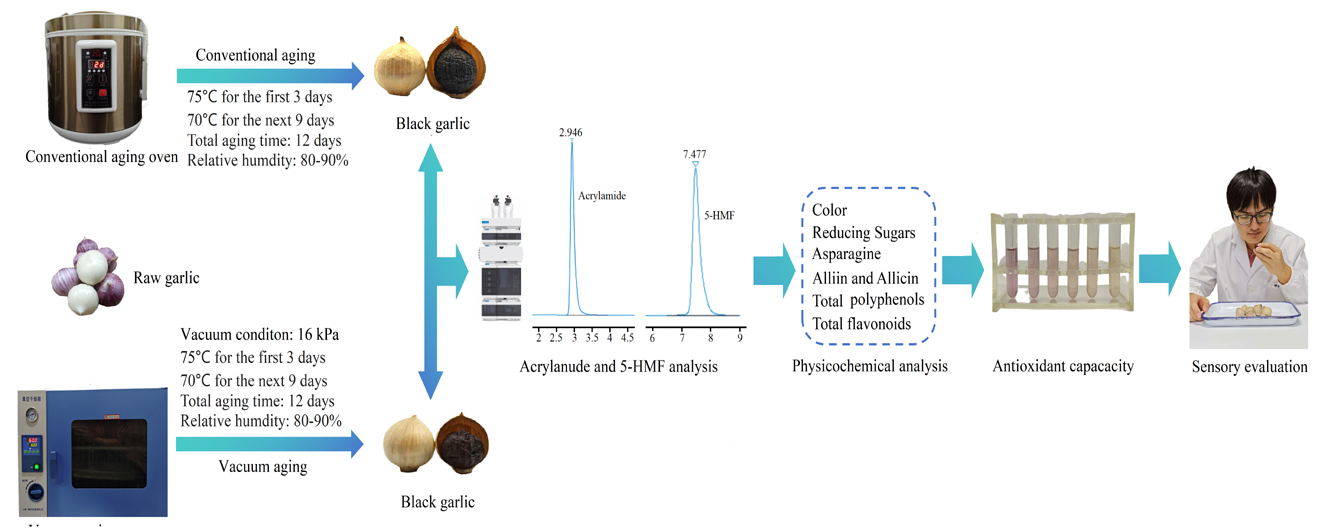
ABSTRACT: Acrylamide and 5-hydroxymethylfurfural (5-HMF) are chemical process contaminants generated in black garlic through the Maillard reaction. Vacuum aging (16 kPa, 70–75 °C for 12 days) was introduced as a new aging technology to mitigate acrylamide and 5-HMF in black garlic. Results showed that vacuum aging suppressed the formation of acrylamide (from 2.86 μg/g to below the detection limit, i.e., 100% reduction) and 5-HMF (from 173.26 μg/g to 7.90 μg/g, i.e., 95.4% reduction) in black garlic due to the reduced thermal exposure. Vacuum aging inhibited the Maillard reaction, and resulted in the higher lightness (L = 22.14) and the lower browning degree (ΔE = 62.76) of black garlic than those (L = 15.16, ΔE = 69.47) prepared by conventional aging. The reduced thermal exposure also restrained the hydrolytic release of fructose, glucose, total polyphenols, and total flavonoids in vacuum-aged black garlic. It reduced them by 95.0%, 100%, 89.9%, and 91.8%, respectively, which in turn diminished its antioxidant capacity by 58.4% and 79.1% based on the 2,2-Diphenyl-1-picrylhydrazyl (DPPH) and 2,2′-Azino-bis (3-ethylbenzothiazoline-6-sulfonic acid) (ABTS) assays. These limitations of vacuum aging, including decreased antioxidant capacity together with sensorial quality reduction, require further process refinement in future work before this technology can be implemented for industrial-scale production of black garlic.
Keywords: Black garlic; Vacuum aging; Acrylamide; 5-HMF; Mitigation; Maillard reaction

Graphical Abstract

TOP