
Views from Up High—Perspectives on Community Planning and Local Governance in the Scottish Highlands and North Carolina High Country
Views from Up High—Perspectives on Community Planning and Local Governance in the Scottish Highlands and North Carolina High Country

Received: 23 July 2026 Revised: 10 August 2026 Accepted: 18 August 2026 Published: 03 September 2026

© 2026 The authors. This is an open access article under the Creative Commons Attribution 4.0 International License (https://creativecommons.org/licenses/by/4.0/).
1. Introduction and Background
Two regions, separated by distance and national boundaries but linked by culture and history, offer an opportunity to probe perceptions of how life and local government work in these environments. The High Country of northwestern North Carolina and the Highlands of Scotland share a mountain setting (once connected as part of the ancient Central Pangean Mountains) and similar landscapes—expansive rural vistas, scattered households, and distinctive towns, along with a handful of small cities. Both regions are largely removed from metropolitan centers, and are reliant on extractive industry or agriculture, tourism and recreation, and service sectors. The two regions share some cultural identity, as well, with Scots heavily represented among immigrants to the Southern Appalachian Mountains over several centuries; the Scots who flowed into the region were more Lowland and Ulster (‘Scotch-Irish’) than Highland, although Highlanders are represented in several pulses of settlement [1,2,3].
The two regions—Highlands and High Country—also display differences relevant to the study and practice of community planning. The U.S. has relatively weak federal planning oversight; states have more, though varied, authority; and local governments (counties and municipalities) are empowered by their states to employ planning, zoning, and other tools. By contrast, Scotland has a flatter hierarchy, with a national planning body, Councils, and other stakeholders operating within the 2023 National Planning Framework 4 (NPF4). Both nations have established yet evolving traditions of participatory planning and creative placemaking [4,5]. Both rural regions have reputations for being proudly independent and self-sufficient.
This study aimed to develop a baseline of understanding on local governance and community planning in two regions with common features as well as notable differences. To that end, planning and related professionals, community leaders, and residents were interviewed to understand and compare perceptions of their communities’ identities, strengths and assets, challenges, economic activity, and expectations for the future. The paper begins with context on planning and public engagement in the two nations and two study areas, then discusses qualitative research methods as employed in relevant disciplines. The methods section discusses site selection, data collection, and coding for thematic analysis. The results sections provide synthesized highlights from interviews and illustrative quotes from key informants, presented sequentially for the two study sites, followed by a discussion of major common themes and distinctive differences. A concise conclusion follows.
1.1. Planning Context in Scotland and the Highlands
Scotland is a nation steeped in history and myth, with strong policy and legislation to protect its natural and cultural heritage. This nation of 5.5 million people with an area of ~30,000 mi2 [6], is known for its sweeping rural landscapes. Yet 91% of the population occupies only 2.3% of the land, in 514 settlements (500 residents or more) [7]. Two major cities—the ancient capital and UNESCO World Heritage Site of Edinburgh and the younger commercial powerhouse of Glasgow—are home to roughly a half-million and million people, respectively. Nearly 30% of the nation’s population resides in these two metros, with the remaining non-rural population in smaller cities. A scant ~9% reside in rural regions, where much of the land remains heavily concentrated in private hands [8], although public agencies also control substantial shares [9].
The Council structure established in 1996 comprises 32 Councils and two national parks [10]. Blackstock et al. [11] explored the authority and legitimacy of designated parks and their contribution to the complexity of rural governance. Councils vary in size—both geographic area and service population. The most densely urban Councils are small in area, while the expansive Highland Council, occupying nearly 10,000 mi2, is home to about a quarter-million people, that is: 1/20 of the population in about one-third of the nation’s area [12]. Much of Scotland’s recent modest population growth has come from immigration, particularly from within the UK, although recent projections suggest this is turning around [13].
The NPF4 of 2023 (https://www.gov.scot/publications/national-planning-framework-4/; accessed on 17 August 2026) offers a national spatial strategy and policy for the next two decades. This framework both explains and supports the planning process, connecting the nation’s history and culture to the challenges facing individuals, communities, and land. Scotland’s spatial strategy couples compact urban growth with rural revitalization, among other goals. The 2015 Community Empowerment (Scotland) Act promotes community engagement in decision-making, while the National Standards for Community Engagement guide organizations in implementing the Act.
Seeking lessons for Scotland, Glass et al. [14] reviewed 10 other European nations for examples of organized support for rural areas and residents, noting that such movements have the power to inform policy from local to national and promote shared learning and knowledge exchange. Copus et al. [15] note the critical role of land-based industry in rural economies, while acknowledging the growth driven by cities.
1.2. Planning Context in the U.S. and North Carolina
Unlike Scotland’s NPF4, the U.S. has devolved state-level planning. The modern U.S. planning profession emerged in the late 19th century as part of a response to the ills of the Industrial Revolution (collectively called the Progressive Era), addressing housing, sanitation, land use, municipal improvements, public art, and more. The century-plus of formal planning in the U.S. has gone through major shifts, first moving from the private largely to the public (government) sector early in the 20th century; then a period of technocratic and top-down practice enjoying mixed success; and a recent swing toward more community-engaged and layered framing that addresses not only nuts-and-bolts tasks but also social networks and human behavior [16].
Community planning is a public-service profession devoted to tackling ‘wicked problems’ that resist neat analysis and clearcut solutions, using an array of tools: asset/need inventories, spatial analysis, design, participatory change, and more. The field is rooted in the notion that physical place and shared space shape communities. The practice of rural planning, long in the shadow of the dominant urban focus of the profession, has gained attention as physical, social, and virtual environments change, and communities experience shifts in population, economic and labor conditions, and policy and regulatory landscapes [15,17].
Though long viewed by the public and some practitioners as a largely urban profession, planning has an ongoing record of deployment in rural regions and small towns. Urban and rural planning are often marked by different priorities and framing, such as congestion and growth management for booming urban centers, and decline and asset protection in more rural regions tied to natural resources. But that distinction does not always hold; some urban areas struggle with decline and distress, while some small towns have distinctly urban features and growth-management needs. Some rural communities struggle with the promise and the peril of being—or becoming—a ‘gateway community’ to recreation or tourism destinations with attendant problems (e.g., congestion, housing shortages, high cost of living) that seem inconsistent with small-town identities [18].
North Carolina is the ninth most populous U.S. state, with over 11 million residents spread from mountains to sea, but it ranks 28th in the U.S. in area, with 49,000 mi2. Like most U.S. states, North Carolina allows municipal- and county-level planning and zoning—both empowered and constrained by state statutes. The two largest cities—the historic capital of Raleigh and the younger, brasher Charlotte—are home to roughly a half-million and million residents, respectively, in a striking parallel to Scotland’s two major cities. Of the state’s 100 counties, 23 fall in the mountain region; seven of those in the northwest corner comprise the High Country, with a regional governing agency—the High Country Council of Governments (HCCOG). The region, several hours’ drive from the state’s largest cities, draws throngs of visitors to its trails and rivers, and the scenic, leisurely Blue Ridge Parkway.
U.S. counties can be seen as roughly parallel to Scottish Councils, with the key difference that counties fall two rungs below the federal government (with an intervening state government that holds most of the governing power), whereas Councils sit just below Scotland’s national government.
1.3. Public Participation in Planning, Community Design, and Placemaking
Public involvement in planning is deeply established in both the U.S. and Scotland. The rise of public engagement in the U.S. expresses both legal requirements and professional expectations. After earlier periods of black-box planning by both private firms and government entities, federal and state mandates made public consultation standard practice in the decades after WWII, aided more recently by technology and a body of best practices and guidance for practitioners.
Public participation is bedeviled by a range of challenges: difficulty getting the public to engage when questions seem small, distant, or irrelevant (until they become large, close, and personal); logistical tasks required to convene events that host meaningful exchanges; and the rules and resources required to conduct it. Arnstein’s [19] seminal ‘ladder of citizen participation’, still taught today in U.S. planning courses, argues that even when planners rise above rungs of tokenism (inform, consult, placate) to partnership, they often fall short of true citizen power and control. Commenting on Arnstein’s ladder a half-century on, Lyles and Swearingen White [20] described an “emotional paradox of public engagement” arising between instincts—informed by training and norms—to maintain a dry professional tone vs. a visceral drive to plan for the good of the entire community. While public involvement is accepted as essential, it may suffer from a lack of clearly articulated goals [4] or formats that miss the mark on design or clarity.
Scotland’s NPF4 called for an extended period of public participation in developing a national planning agenda that accounts for Scotland’s global position after gaining more independence from England. Peel and Lloyd [21] described a national civic exercise of experimentation and learning, relying on a shared vocabulary and principles of “respect and trust, political equality, and a sense of public-spiritedness in preparing the way for active public engagement”. Earlier, MacKinnon [22] discussed rural governance practices and the rising emphasis on community engagement as part of a push for ‘governing through community’ implemented by local and regional agencies in the Scottish Highlands, noting tensions between the goals of local participation and managerial tools to ensure accountability. Allmendinger [23] celebrated ‘the head and the heart’ of Scottish planning—the latter tied to its history and identity, and the former to its recognized need to function in the modern global arena.
Tools have evolved to meet new needs in public engagement. Understanding Scottish Places (https://usp.scot/; accessed 17 August 2026) is “a web-based platform that has become a key tool for evidence gathering, town comparison, knowledge exchange, regeneration planning and informed decision making for Scottish towns” [24]. A guide [25] to design-forward participatory planning supports diverse participants (local authorities, community members, developers) and strengthens the process. AlWaer and Cooper [26,27] assessed this approach for effective facilitation, noting that the literature generally represents community planning as one-off events rather than the goal—stages in a coherent process flowing from earlier (before public involvement) into later decisions.
2. Qualitative Research in Planning and Governance
Quantitative and qualitative methods are rooted in positivism (assuming an objective reality) and interpretivism (where reality is subjective), respectively [28]. Quantitative analysis seeks validity, generalizability, reliability, and objectivity, while qualitative inquiry is judged on credibility, transferability, dependability, and confirmability. Thematic analysis is distinct from other qualitative and mixed methods, including content analysis—“a more descriptive and quantitative analytical approach that relies on quantified measures” [29]. Even in a research landscape of big data and complex modeling, thematic analysis offers value in extracting meaning and discerning patterns in a process where themes emerge from close reading—not organized by instrument questions.
Our studies [30,31] on High Country risks—wildfire and landslides—merged key informant interviews and spatial analysis. Valluri-Nitsch et al. [32] interviewed key informants from Scotland’s major land use sectors on their vision of rural Scotland in 2050, then extract dominant themes relating to policy, process, and collaboration. Focus groups probed how residents of rural Scotland view the circular economy and Zero Waste [33].
Steel et al. [34] conducted a cross-national comparative study of small communities in Cascadia (Oregon/Washington in the U.S.; British Columbia in Canada), surveying mayors to identify a set of sustainability initiatives and the factors that affect their uptake. Another cross-national case study [35] traced the evolution of plans in Scotland and Norway over several years, drawing on a variety of data: key informant interviews, meeting minutes, planning documents, and observed professional routines. They noted tension between two dominant pushes in governance—public participation in planning vs. tighter integration between policy and service authorities.
Specific to planning, qualitative and mixed methods examples include ethnographic and empirical data (artefacts, interviews/surveys, spatial) used to analyze Danish ‘transit towns’ as centers for freight and ferry transit [36]. Rich and Stoker [37] used mixed sources (news stories, documents, meeting minutes) to study Empowerment Zones in Atlanta and Baltimore (U.S.).
Yin [38] described case study methods as both misunderstood and underappreciated, despite well-established methodological guidance and a body of published work. Case study design is “suited to research on complex processes, in which the phenomenon and context are intertwined” [39]. Case studies in the Scottish Highlands and Islands [5] developed narratives of community landownership to catalyze rural reconstruction. Examples of matched-pair multiple case design in planning include a set of 50 New Urbanist (NU) developments matched with conventional low-density neighborhoods to explore how watersheds are protected in green compact areas vs. sprawling suburban areas [40] and how well NU projects employ hazard mitigation tools [41].
3. Methods
This matched-pair multiple case study, using a variety of settlement types in two different nations, is rooted in methodology articulated by Yin [38]. It contributes to the knowledge base on small-town and rural planning and establishes the first known comparison between these two areas, with conditions that are both similar (terrain and, to some extent, culture) and distinct (governance).
This study addresses the question: How do planning-adjacent individuals (planners and related professionals, community leaders, and residents) view their communities? Further, how do themes compare between the two nations, across groups (roles), and over six archetypes?
3.1. Site Selection
Six archetypes of settlements found in these largely rural regions (see study areas, circled in red in illustrative maps in Figure 1) underpin the research design:
-
-
Regional anchor—higher education, medical, retail, services; tourism/recreation; art/culture
-
-
History/nature center
-
-
Revitalizing town
-
-
Recreation gateway
-
-
Tourism hotspot
-
-
Workaday town
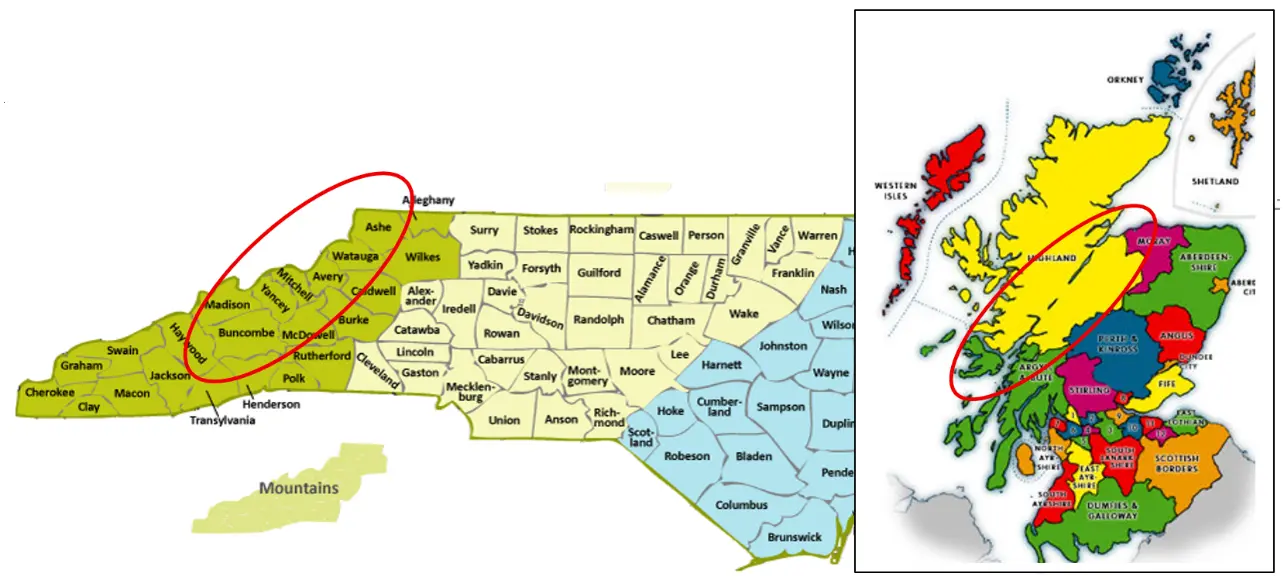
Figure 1. Study regions. (Left): North Carolina counties; (right): Scottish Councils, including Highland Council (yellow). Sources: https://electricscotland.com/council/index.htm; https://www.ncpedia.org/geography/counties; accessed on 17 August 2026.
A set of 60 sites, with associated environmental, economic, and sociodemographic data, provided a pool of towns from which to choose a preferred town for each archetype in the High Country, then identify a Highlands town to form pairs matched on several dimensions.
The construction of archetypes was informed by socio-economic profiles of the two regions, supplemented by maps, firsthand knowledge of the High Country, and consultation with contacts in Scotland. Once archetypes were created, a list of communities in the seven-county High Country Council of Governments (HCCOG) was reviewed, along with secondary data such as population, population density, and regional location (distance to an airport with scheduled service, and a U.S. highway or 2-digit Scottish road). Further vetting considered factors relating to ease of study: available documents, physical access to sites, and interest from relevant professionals. The final High Country set provided a general framework for identifying similar Highlands communities (Table 1). The process was flexible enough to allow iteration and revision. For example, a single administrative unit was targeted in each country (HCCOG; Highland Council), but several towns were selected in other nearby units because they fit the criteria well.
Table 1. Matched pairs of towns by archetype.
|
Archetype |
Location |
Population (Rounded) |
Density, ppl/mi2 (Rounded) |
Miles to Airport (Rounded) |
Median Age, Years |
Hos-Pital |
Notable Feature/s |
Primary Industry |
|---|---|---|---|---|---|---|---|---|
|
Regional anchor |
High Country |
* 19,000 |
3000 |
70 |
***22 |
Yes |
Public university |
Retail, dining/lodging, education |
|
Highland |
** 8000 |
5000 |
90 |
40 |
Yes |
Specialized college |
Wholesale/retail, health, lodging |
|
|
Revitalizing town |
High Country |
2200 |
500 |
60 |
42 |
Yes |
Mining; river |
Retail, health, mining |
|
Highland |
2400 |
4800 |
30 |
45 |
Yes |
National park |
Lodging, health, wholesale |
|
|
History and nature site |
High Country |
550 |
200 |
70 |
46 |
No |
Historic resort; river |
Dining/lodging, retail |
|
Highland |
600 |
1500 |
40 |
46 |
No |
History; iconic loch |
Dining/lodging |
|
|
Recreation gateway |
High Country |
1000 |
500 |
50 |
*** 21 |
Yes |
Skiing; small college |
Dining/lodging, retail |
|
Highland |
3000 |
3000 |
40 |
37 |
Yes |
Skiing and hiking |
Lodging, health, wholesale |
|
|
Tourism hotspot |
High Country |
1400 |
500 |
60 |
63 |
Yes |
Blue Ridge Parkway |
Retail, dining. lodging |
|
Highland |
3000 |
1500 |
70 |
50 |
Yes |
Historic resort |
Dining/lodging, wholesale |
|
|
Workaday town |
High Country |
1300 |
600 |
80 |
42 |
Yes |
**** |
Aviation, bottling, retail |
|
Highland |
1500 |
3000 |
50 |
46 |
No |
National park |
Health, lodging, education |
* Seasonal population of students from a public university; population drops in summer; ** Large tourist population in summer, swelling to >20,000; *** Median age driven down by student population; **** No interviews secured at this site. Sources: US Census: https://data.census.gov; National Records of Scotland: https://www.nrscotland.gov.uk/statistics-and-data; Understanding Scottish Places: https://www.usp.scot. All sources last accessed on 8 August 2026. All but one site was located on or within 1 mile of a 2-digit Scottish trunk road or a U.S. highway (3-digit); exception: High Country (NC) recreation gateway is seven miles from a U.S. highway.
3.2. Data Collection
For each site, informants represented several categories: planning and related professionals (e.g., planner, town/county manager, economic development), community leaders (including elected volunteers), and anonymous residents. Semi-structured interviews were conducted in Scotland in September–October 2023, and in North Carolina in March–July 2024 (IRB HS-23-318). Interviews were conducted either in person or on Zoom, recorded, and then transcribed with a voice-to-text tool. Questions included the community’s strengths/assets and challenges; major economic activities; identity or brand; and where residents turn with questions and problems—to probe how spatial governance hierarchies play out in large rural regions. Finally, informants discussed what it means to be located within/near natural assets (national parks/forests; recreation sites), and expectations for the future. The data were enriched by interviews with professional planners in a small city near but not in the Highlands. Data were cleaned by listening to each recording while reviewing the transcript, making corrections, and noting emergent themes. Clean transcripts were loaded into the software Atlas.ti 26 and coded sequentially by two people to surface major themes, highlight relationships, and tag noteworthy quotes.
3.3. Code Frequencies and Recurrent Themes
This discussion of common themes and differences (across two nations, three groups of informants, and six archetypes) uses code frequencies to provide a general overview of major themes, illustrated below with select quotes from the Highlands and High Country. Code frequencies are representative and illustrative—not intended to be quantitative.
With the caveat (see ‘Limitations’ for more detail) that thematic analysis and text coding are exploratory and limited in generalizability (relating to interview instrument, varying sample size across sites, lumping and splitting of related codes, differences in coding style, and more), a review of code frequencies offers patterns and points of departure for discussion. Table 2 shows the most frequently used codes, broken out in several dimensions, with the 10 most frequent in each column shaded. The leftmost column shows all codes assigned 22 or more times across all interviews. Code frequencies are then broken down for the Highlands and High Country, then by three groups of informants and again by the six archetypes (plus ‘planners’—interviews near but not in study sites). A blank cell may indicate a code never used—or one not in the top 44 for that column.
The clustering of the highest frequencies among the first dozen applied codes suggests these are indeed important concepts relevant across the collection of interviews, particularly for both regions and the three groups of interviewees. That breaks down slightly in some of the archetypes, particularly where small samples (fewer and shorter interviews) offer less narrative data to code. Some codes are specific to the area: ‘Highland Council’ appears only—and frequently—in the Highlands; ‘Blue Ridge Parkway’ and ‘city and county’ only in the High Country (given the U.S.’s county structure). Other codes pop out as dominant in a few cells specific to a town or archetype, such as ‘Highland Games’ in recreation gateways (with both Highland and High Country sites hosting iconic Games). ‘Mining industry’ appeared extensively in the revitalizing archetype—all from the High Country town, which has extensive and growing mining activity.
Dominant themes relate to process (local planning, community planning, community engagement, community/government communication), assets (nature/beauty, conservation, local business), and codes signifying challenges (lack of affordable housing). The dominant sentiment throughout was ‘local’ and ‘community’.
Table 2. Code frequencies.
|
Codes |
Total Count |
Scottish Highlands |
NC High Country |
Planners & Related |
Community Leaders |
Residents |
Regional Anchor |
Planned/ Revitalized |
History & Nature |
Recreation Gateway |
Tourism Hotspot |
Workaday Town |
Planners |
|
|---|---|---|---|---|---|---|---|---|---|---|---|---|---|---|
|
1 |
Local planning |
162 |
73 |
89 |
100 |
48 |
10 |
58 |
27 |
15 |
5 |
20 |
1 |
36 |
|
2 |
Tourism economy |
135 |
56 |
79 |
58 |
42 |
40 |
36 |
21 |
21 |
15 |
30 |
6 |
6 |
|
3 |
Community engagement |
103 |
68 |
35 |
73 |
13 |
12 |
20 |
10 |
13 |
1 |
8 |
3 |
48 |
|
4 |
Housing |
103 |
62 |
41 |
65 |
25 |
13 |
26 |
18 |
6 |
7 |
5 |
41 |
|
|
5 |
Nature/beauty |
92 |
37 |
55 |
41 |
25 |
25 |
20 |
18 |
21 |
5 |
20 |
4 |
4 |
|
6 |
Community planning |
87 |
55 |
32 |
52 |
19 |
8 |
20 |
9 |
16 |
8 |
34 |
||
|
7 |
Community/govt communication |
87 |
48 |
39 |
54 |
21 |
9 |
23 |
14 |
13 |
13 |
3 |
21 |
|
|
8 |
Local business |
83 |
19 |
64 |
42 |
28 |
14 |
24 |
15 |
11 |
3 |
23 |
2 |
5 |
|
9 |
Lack of affordable housing |
82 |
43 |
39 |
47 |
16 |
19 |
19 |
15 |
12 |
4 |
8 |
6 |
18 |
|
10 |
Recreation |
77 |
9 |
68 |
45 |
20 |
12 |
25 |
14 |
13 |
3 |
18 |
2 |
2 |
|
11 |
Conservation |
65 |
23 |
42 |
50 |
7 |
6 |
10 |
15 |
5 |
23 |
3 |
8 |
|
|
12 |
Local government |
65 |
27 |
38 |
39 |
15 |
9 |
18 |
18 |
12 |
1 |
9 |
2 |
5 |
|
13 |
University/college |
50 |
13 |
37 |
24 |
19 |
7 |
36 |
5 |
7 |
||||
|
14 |
Second homes |
45 |
18 |
27 |
29 |
9 |
10 |
9 |
3 |
6 |
17 |
2 |
4 |
|
|
15 |
Generational residents |
43 |
14 |
29 |
21 |
8 |
14 |
11 |
12 |
9 |
7 |
2 |
2 |
|
|
16 |
Community |
41 |
12 |
29 |
18 |
11 |
12 |
14 |
8 |
4 |
4 |
4 |
4 |
|
|
17 |
Government services |
41 |
7 |
34 |
24 |
12 |
5 |
12 |
12 |
5 |
6 |
1 |
3 |
|
|
18 |
Short-term rentals |
41 |
24 |
17 |
25 |
12 |
11 |
3 |
7 |
4 |
12 |
|||
|
19 |
National park |
39 |
39 |
16 |
15 |
8 |
22 |
8 |
7 |
2 |
||||
|
20 |
Road network |
36 |
21 |
15 |
15 |
15 |
6 |
16 |
7 |
5 |
1 |
6 |
||
|
21 |
City and county |
35 |
35 |
14 |
17 |
4 |
21 |
11 |
3 |
|||||
|
22 |
Highland Council |
35 |
34 |
15 |
10 |
7 |
6 |
6 |
9 |
|||||
|
23 |
Funding |
33 |
11 |
22 |
31 |
10 |
11 |
|||||||
|
24 |
Blue Ridge Parkway |
31 |
31 |
30 |
6 |
20 |
||||||||
|
25 |
Government land |
31 |
11 |
20 |
19 |
8 |
7 |
7 |
3 |
12 |
||||
|
26 |
Mountain heritage/identity |
31 |
8 |
23 |
19 |
8 |
4 |
7 |
10 |
5 |
4 |
3 |
||
|
27 |
Unaffordability |
31 |
11 |
20 |
13 |
9 |
9 |
10 |
7 |
8 |
2 |
3 |
||
|
28 |
Water and sewer |
31 |
30 |
16 |
13 |
8 |
8 |
9 |
1 |
5 |
||||
|
29 |
Highland Games |
30 |
28 |
29 |
5 |
28 |
||||||||
|
30 |
Newcomers |
30 |
19 |
13 |
9 |
9 |
6 |
3 |
3 |
2 |
8 |
|||
|
31 |
COVID |
29 |
15 |
18 |
6 |
5 |
4 |
5 |
2 |
9 |
||||
|
32 |
Health care |
29 |
10 |
19 |
18 |
5 |
2 |
10 |
7 |
5 |
1 |
4 |
||
|
33 |
Regulation |
29 |
12 |
17 |
15 |
5 |
10 |
6 |
3 |
4 |
3 |
|||
|
34 |
Climate |
27 |
13 |
17 |
6 |
9 |
6 |
3 |
2 |
5 |
||||
|
35 |
Schools and teachers |
27 |
22 |
19 |
4 |
9 |
10 |
2 |
4 |
|||||
|
36 |
Traffic |
27 |
11 |
16 |
11 |
9 |
9 |
7 |
3 |
2 |
3 |
|||
|
37 |
Trails |
27 |
27 |
23 |
11 |
9 |
||||||||
|
38 |
Geographic constraints |
25 |
7 |
18 |
10 |
9 |
6 |
9 |
5 |
4 |
5 |
1 |
||
|
39 |
Parking |
25 |
24 |
12 |
9 |
7 |
8 |
|||||||
|
40 |
Congestion and speed |
24 |
9 |
15 |
12 |
6 |
8 |
9 |
2 |
|||||
|
41 |
Dining |
24 |
17 |
9 |
7 |
8 |
5 |
3 |
4 |
2 |
||||
|
42 |
Growth management |
23 |
23 |
18 |
7 |
7 |
6 |
|||||||
|
43 |
Mining industry |
23 |
23 |
20 |
23 |
|||||||||
|
44 |
Isolation and distance |
22 |
11 |
7 |
7 |
8 |
4 |
4. Results—Highlands Interviews
Major themes—often recurring across locations and roles—emerged from a close read of transcripts from 20 interviews with 25 people, including planners and other professionals, community leaders, and anonymous residents. Populations range from 600 to 8000.
4.1. Local Planning and Governance
Key informants from planning agencies displayed commitment, creativity, and a future orientation. As in the U.S., Scottish planners’ duties vary within an agency, often including community engagement, which may take a variety of forms and involve experimentation to get more and better resident input. One planner described some skepticism of the people-first bottom-up model: “People will show up, quite fired up. And the first question they’d ask is, ‘So what are you proposing?’. When they learn the planners are there to listen, the attitude may change, and residents may start discussing priorities”. Initial public input informs a draft development plan and site selection: “Then we go back to communities. That’s where there’s going to be more people turning out and also a bit more heated conversations”.
Not to be confused with the 32 Councils that comprise Scotland’s governing structure, local community councils (CC) are advisory, typically with an elected but volunteer chair. One CC chair described their role: “We are the voice of the community. It’s important that we keep the community involved. So it’s not what we, the nine members think, but what the people want”.
Geographically large Councils create distance between some towns and representatives, generating some frustrations. One CC chair asserted their Council “do everything in their power to work against anything that we’re trying to do. That’s why we have no Highland Games left, because the Council imposes so many restrictions on licenses, rules, and regulations that it became completely vulnerable and not viable”. A similar explanation was offered for the demise of a long-running (25 years) derby of hundreds of vintage vehicles that generated high public interest and income for towns on the circuit: Council-mandated fees and event management requirements made it a losing proposition, prompting its cancellation.
Indeed, friction between local advisory bodies and their large—and often distant—Councils was expressed by other CC chairs, such as: “The degree of obfuscation we get from Council offices is absolutely staggering. And they just plow their own path; they refuse to take on board anything else. That’s my impression. So we have no authority. I guess the best thing we can do is listen to people and then try and kick up a fuss on their behalf. But it’s intensely frustrating”. Another CC chair described a flawed process for public review: “An initial consultation wasn’t well organized and publicized. And then the mechanism, the order in which things are done, means that once it does get into the public eye, then we’re told it can’t be reversed. That is scandalous”.
Recurrent themes from CC chairs included lack of Council responsiveness to mundane but critical local needs, bureaucratic complexity, opaque decision-making, and lack of availability to constituents. One described efforts at revitalizing main streets: “We’ve tried to put pressure on Council to reduce the rates to try to encourage people to take up the empty shops. But they’re not playing ball too much”. Also evident was rivalry among towns, with resources and political access perceived as unevenly distributed.
A non-profit director explained how a Scottish law directing some profits from renewable energy projects to communities drove the creation of their organization, which helps match available funds to consensus community priorities, because the CC isn’t allowed to handle the funds: “We have money and the ability to take on a project for the community; we then go to the Council, who are responsible for planning in the area, ask for approval and go through the formal planning process that way”. The organization is responsive to local conditions, such as an aging population, and unmet demand for health services (e.g., dentistry, podiatry, optometry). They also work on asset transfers, in which a community appeals for the right to purchase government-owned property if it can demonstrate it can make better use of it. “One of the thoughts we have is some kind of artists’ studio constructions. There will definitely be some kind of school classroom there for the children—an outdoor classroom. We’re really hoping to get beekeepers involved; maybe a wild swimming pond”. Past projects include workforce housing, a hardware store, and a medical office to replace one that burned down.
Another gap arises between the National and Council authority and local community processes, leaving room for private-sector players who act as consultants or guides. A principal in one such practice described how they work at the community level, often through CCs and sometimes encouraged by local authorities who see a need for aid: “What we do—you might call it consultancy, but it’s essentially community development”.
Although remoteness and distance arose repeatedly as barriers to effective planning and governance, some saw it as the root of a self-sufficient and neighborly community, such as an artist and shopkeeper in the history/nature center: “Everyone looks after everyone; if someone hears that there’s something wrong, everyone sort of pulls together”. Yet the same resident expressed frustration with lack of national attention to local needs: “They’re thinking about the money and tourism. They’re building car parks for caravans. It’s not like they’re helping the locals and sorting out potholes and roads”.
Several sites are located within a national park, raising questions about how planning, permitting, and development are handled with multiple layers of government. A community leader noted: “There are local people who are against the park; you know, ‘What’s the national park ever done for us?’. Yes, there’s a level of bureaucracy because it’s the national park, and the first consultee in planning. But the national park has also brought in new money. Again, you get people going ‘The park doesn’t employ anybody here’. Yes, they’re incomers, because there’s nobody with a PhD in butterfly studies living here. So these people have to come in. They also have to buy food and petrol”. Another community leader was less positive: “The park will come up with an idea and a scheme. They’ll do it all. And once it’s in place, they’ll consult the community, which is not the right way to do it. Because what’s the point? They’ve made up their mind”.
More and better communication may ease this tension. A staff planner at the national park weighed in: “We need to look at placemaking as part of the federal planning process. That’s a few years off, because we’re in the early stages of evidence-gathering and engagement, but that will mean going out to communities and talking about place specifically, and how to address issues there”. The planner noted that as the park attracts visitors, it brings in more and better services and job opportunities, as well as attendant pressures on land and house prices. “From an administration perspective, it brings a unified form of management for a particularly sensitive area, because there are multiple local authorities that cover the national park. From a planning perspective, it’s one way of managing all that”, guided by the National Park Partnership plan.
4.2. Community Identity
Responses to the identity/brand question suggested the archetypes were relatively sound.
An informant described the history/nature center as lacking coherence, with a mix of building styles, but agreed with a resident that the town’s identity lies in an iconic loch and water engineering history. Several informants in the revitalizing town referenced its history as an 18th-century planned village as well as an iconic high street, recreation, and restored distillery.
Residents of the tourism hotspot agreed it is a classic tourist town that leans into its historic role as a royal stopover; one said: “I think we have the identity of being a wee Highland town”. A recreation gateway resident called it a holiday destination, while an informant there tagged it for year-round mountain sports—climbing and cycling, hiking and skiing—plus a party-town reputation.
A resident of the workaday town referenced the clan-based rivalries of small Highland towns and the Games. Another informant noted the town’s rich military, historic, and cultural assets, describing it as welcoming but not tourist-focused. Finally, the regional anchor has more varied assets and economic activity than the smaller towns, with a history of trades as well as prospects for new industry and technology; still, all informants described it as heavily reliant on tourism.
4.3. Community Assets and Strengths
The natural environment was acclaimed by all as a key asset, as expressed by one CC chair: “We rely heavily on fishing, grouse shooting, deer stalking. Salmon fishing is very important. That brings a lot of money into the town. We have the Highlands, mountains, and beautiful walks. People come for recreation. Farming is important. We have a lot of good stock funds and large estates in the area, which creates employment”. A recreation gateway resident offered a similar sentiment: “Being right next to the mountains; nice fresh air, greenery, and open spaces; safeness”.
Appreciation for town assets mixed with regret for the loss of small-town sociability, such as this shopkeeper: “We have got a fabulous high street; we’ve got really nice individual shops, coffee shops, businesses, and people just need to use them. I think there are lots of people in houses up the back that don’t actually come down and use the high street, because online is killing everything. I notice that even when people come into the shop, you say hello and you don’t get anything back. It’s almost like they’re used to the supermarket, where they don’t need to speak to somebody because they just go up to a self-service till. I think that’s a shame in a small place”.
4.4. Challenges
Key informants and residents named various challenges: housing, transit (availability and cost), traffic congestion and parking demand, and lack of elder care, along with social shifts such as a youth exodus and impacts of changing technology.
Housing was a dominant concern, as expressed by a resident within the park: “There’s very little affordable housing round here because it’s such a desirable area to live in, and it is rural and there are limits. Housing is at a premium”. A recreation gateway resident cited the same problem: “Affordable housing for locals who live here and work here, because there are too many people who have got second homes here that use them once or twice a year”. The park planner noted: “One of our aims is to try and at least stabilize the population because, like many rural areas, we have an aging population”. They aim for 75% of all new housing to be affordable by 2030.
Another resident of the recreation gateway described a changing economy: “When I was young, in October, all the hotels used to shut down because nobody came to visit. Now the hotels are open all year round, and the bus trips come through”. The downsides? Cost of living and accommodation: “It’s people with money coming in and buying in the area, buying the places up. The young people here can’t get good jobs, so it’s difficult. A lot of people come up here on holiday and say ‘What a wonderful place this is; when we retire, we’ll buy a place and come up here and live’. And that’s what kind of happens. Property down in England is so much more expensive than here; sell a wee house and buy a big mansion here”.
The housing shortage ties in with other challenges, as described by a community leader in the revitalizing town: “The cost of housing—that’s a common problem throughout the Highlands. Because you’ve got a lot of second homes, and community is not sustainable if young people don’t stay”. A resident of the regional anchor noted changing conditions and attitudes: “The young ones pretty much have to go away. And when they do go to uni or to college or whatever, they rarely come back because the work isn’t here for them. We’re very much a tourist town. People don’t do apprenticeships the same as they used to. They’re getting pushed to school, any school, to go to uni. And they’ve forgotten that we need joiners, plumbers, electricians”.
A dominant sub-theme was the damage short-term lets (e.g., Airbnb) inflict on the housing stock—reducing availability and affordability for long-term renters. A Council-level planner noted the social and economic aspects of a sharp rise in properties converted from long-term to vacation or short-term rentals: “The people who have the Airbnbs think it’s great because it’s obviously a source of income for them. Tourists probably think it’s great. But there is a feeling amongst the communities, especially the long-standing members—they don’t want to see all these properties emptied”. Remedies are not clearcut, given the risk that stronger regulation to rein in short-term lets and protect housing for year-round residents could burden traditional small hospitality providers, as expressed by a B&B operator: “In the process of trying to regulate Airbnbs, that sucks in almost everybody else. In the Highlands traditionally, little rural B&Bs have been a great source of accommodation, but also really quality experiences for visitors, because they get a chance to chat to locals and find out how locals actually live. We have regs; we’ve got all the fire alarms and drills, and the health and safety requirements are there. But we’re having to jump through hoops now. And people like ourselves—we’ve decided, probably we’re going to park this now and retire. Too much legislation—a sledgehammer to crack a nut”. A regional anchor resident referenced proliferating Airbnbs: “Because people were buying these flats and houses for Airbnb, many young people in the town couldn’t afford to put in for a flat or a house; they just couldn’t come up with the money”. A CC chair acknowledged the value of tourism, but “It’s beginning to suffer a bit because of the holiday homes, short-term lets. We have a situation where people who want to work here cannot find somewhere to live”.
Towns that have navigated development pressures with some success often deal with follow-on effects. A CC chair described parking as “largely ignored by Council. Because they’ve halved the number of traffic wardens, it’s just not enforced”. Residents noted congestion: “In the summertime, we have huge queues there; it takes half an hour or more to get to this side of town. Traffic is a big problem. All the big lorries; everything that has to be delivered has to come right through town. There’s no other way”.
A recreation gateway resident listed other challenges: “We have nowhere designated for coaches—and we have lots of coach parties, especially through the summer. Lack of public toilets. Restaurants—people have to wait hours to get in. A lot of people have to take their food back to where they’re staying because the restaurants can’t cope with demand. A good thing, I know—but a problem”.
A resident in the revitalizing town addressed changing economies and technology: “Five years ago, we had three banks. Now we have none. The Bank of Scotland has a van that comes in every fortnight. So if you’ve got cash, you have to go to the post office to bank that cash. But that’s everybody’s fault—because every deal is online”.
A community leader there lamented the loss of local accents and the erosion of culture. “Places, names, pronunciation will change, because people come from the south, and they bring their own accents with them. The local accents are disappearing. My grandson doesn’t speak as I speak”.
4.5. Planning for the Future
The national park planner predicted future economic activity: “Probably over the next few years, the biggest change to the economy is going to be around how land is managed. Because a lot of the estates are being bought by companies or organizations that want to use them to offset their carbon emissions through carbon credits, such as by restoring peatland or hunting and harvesting. But at the moment, it’s the visiting economy that’s the big one”.
Small towns grapple with how to grow—or not, and how to balance the qualities that bind communities together with the need for income and opportunity, as expressed by a B&B operator: “I think, in many ways, we feel we have the balance right between the kind of quality of life and care for the environment. We need to improve that and make it better. I think that’s a big issue for every community in Scotland. But I wouldn’t say we’re complacent”.
A regional anchor resident called it “a place for tourists. But it has to sustain its own population for the entire year. One problem is depopulation: We’re losing youngsters. They find it difficult to find housing and permanent jobs. Has Council given any thought to stimulating the introduction of suitable small industries? If you’re going to have industries compatible with the region, then that would make a significant difference. If you want to want to bring modern industries, like tech, into a town like ours, communication is important. You’ve got to make it more accessible”.
5. Results—High Country Interviews
The 26 key informants (20 interviews) for the High Country included the same groups: planners and related professionals, community leaders, and residents. Many themes are common to the dozen towns in the two nations, although differences in how communities are planned and governed are reflected in some responses. Towns ranged in population from 550 to 19,000.
5.1. Local Planning and Governance
At the local level, professionals and community leaders pursue effective, creative planning and governance. A resident of the history/nature center applauded local and regional efforts: “There are 10-year plans for what the community wants and where they want to be in 10 years. Most of it is about housing, parking, and public access to the river”.
In the revitalizing town, the town manager explained that with no formal planning department—town or county—planning is an informal collaboration with the Chamber of Commerce (Chamber) and the Tourist Development Authority (TDA). The economic development (ED) director described the two parallel streets that constitute the town center: “The lower street is more condensed, and it’s where the restaurants are; it’s a little easier to stroll up and down. The upper street has more uses where you’re not getting that synergy back and forth”. They are seeking new anchor tenants on the upper street and more downtown workforce housing.
A planning commissioner in the regional anchor described the planning department as efficient, effective, and forward-looking. A county commissioner hailed the county process: “We’re in a better place than we were 10 years ago. And there’s been a lot more thoughtful planning as we go forward. We’ve got people on our planning board that literally have been doing it 40 years”.
Zoning practices vary. Chamber officials in the tourism hotspot anticipated changes: “It’s going to have to be more dense and go up”. The town wrestles with competing demands, including residents who resist change: “The town has been very deliberate in its codes and its planning. Our Council and Planning work with every department to maintain that unique feel and look. We don’t want to become Anytown USA”. The mayor of the recreation gateway cheered their active zoning: “We are a real town. That’s because we have kept a tight lock on ‘this is who we are and if you buy property, you will go before our planning commission, and you will follow our rules and regulations, or you won’t build that’”. But regulation is a delicate matter in the revitalizing town, according to the ED director: “The zoning thing needs to be a town/county effort so that they’re not taking all the heat”. Zoning is resisted by some, while others find it protective, such that lack of land use controls may threaten investment: “People may not want to invest here, or build their home or their second home here, if they see we don’t have those kinds of controls”.
On the question of where residents turn for answers and assistance, many informants described a relaxed, pass-it-around model for fielding inquiries, moving across government levels (municipal and county) and agencies. Chamber officials in the tourism hotspot say calls often start with the Chamber: “We’re kind of a quasi-arm of the local government, appointed by Council. The beauty of it is if you want the mayor’s cell number, he’ll give it to you. Town manager—same. It’s such a small town that everybody kind of knows everybody”.
The manager in the revitalizing town said: “Certainly local and city government can get you to the right people”. Residents offered more: “You call the town council; town hall. There’s town police and county police; local fire departments in every community”. Assistance is available from the Chamber, Economic Development Commission, and Small Business Center. The nearby county manager takes many calls: “I might give them the mayor’s number because it may be something like trash pickup in the town limits, whereas we do recycling centers. So we’ll differentiate on what the need is, whether it’s looking for a birth certificate or registered deeds, property. It could be the Sheriff’s Department; it could be an animal control issue”.
Elected officials in the history/nature center earned plaudits for their accessibility, as expressed by this resident: “It’s a small community; everyone pretty much knows everybody. They would go and talk to the aldermen and the mayor. They live right here in the community”.
In the regional anchor, a deputy planning director says the planning department may refer calls to town manager or clerk to sort: “Okay, that’s a public works issue. That’s planning. That’s police”. A town councilor had a more colorful take: “The first place they go when they have an issue is one of the 17 Facebook groups that exist. They vent, the usual curmudgeons feed on that, and it just becomes a gripefest, and nothing gets resolved. I think we need to do a better job in creating a website—a clearinghouse of information”. A county commissioner points to the county: “If a person or business has a question or problem, the first place I send them is the county planning office because they handle everything. It’s pretty much a one-stop shop, and they can facilitate them out if they need to”.
While interactions across government levels were generally described in positive terms, one informant commented on town/county tensions. “If you can’t figure out how to start working, we’re just going to do another 10 years of bickering while things fall down around us”. This tension has a history: “We’ve seen other smaller communities essentially stripped of their charter, and county government takes over and does what they want. So some Council members are scared of that: What happens if we really push hard on something important to us and they decide they’ll just pull our charter? That would be devastating for everyone”.
A regional planner noted a COG (council of governments) functions differently from counties and municipalities, and is often not well known or understood by residents: “Nobody knows: What are you? We’re a really interesting middle ground, but very grant-dependent. Our bosses are local elected officials. So if somebody has a question, they contact their town manager or the county. A lot of people don’t know the resources we can provide. We’re a good funnel of info for things that require more than just a town or county lens; kind of a connector to the state”.
5.2. Community Identity
For the High Country, too, responses relating to identity or brand suggested the archetypes are useful. A resident of the revitalizing town said the brand is clear: the mining that has put the town in the worldwide news, with massive new investment: “The challenge is, this is one of the most economically depressed counties in the state. Why is everything shuttered? This is the mine that provides the quartz for every computer chip in the world”.
The nearby county manager says while they don’t have a formal brand, there is history and tradition aplenty: “Being mountaineers, the connotation is: We’re rugged, independent, sometimes fiery. Mountain folks up here have got a lot of Scotch-Irish in them. You’ve got some of that Chaucer Old English mixed in. That pronunciation in the mountains, that Scotch-Irish connection, that’s dying out”.
Chamber officials in the tourism hotspot noted a 225-year history as a resort destination: “People came here to escape the heat of the Piedmont. That’s still basically what we are”.
In the regional anchor, informants tagged nature and recreation as the brand. A planning commissioner highlighted friendliness and general goodwill: “Small-town atmosphere, outdoor recreation, fresh air, cool summers. More and more that’s identified from outside as an asset people want to buy into”.
5.3. Community Assets and Strengths
The regional planner listed the assets as outdoor recreation, tourism, colleges, and universities. And opportunities: tourism, agricultural activity, undeveloped property, and occupancy tax.
Officials in the history/nature center listed “wilderness, hiking, canoeing. All businesses are local. Very good artists. A rich musical history”. A resident agreed: “Wilderness: hiking, biking, rafting, fishing, hunting—anything outdoors”. Another said: “The big draw is the mountains. I think people love the landscape. They like the bars and the restaurants”. The distinctive music and musicology tradition is valued: “The music scene is very strong. If you go down to the railroad depot every weekend, it’s a fiddle get-together. Some of the guys who are on the national circuit show up there to play. Some of that history would have been lost, so it’s nice to have had it recorded. The library does oral histories”. Several residents called out the sense of community: “We’re a very close community; we pull together for those that are in need”.
A resident of the revitalizing town discussed an arc of vitality, then distress, and new life: “Everybody seems very concerned about the future of the community; you have a lot of vested interest in seeing it do well here. I think the challenge is that there’s no agreement on what that action is to make it do well”. New assets include a hotel developed jointly with a community college, a derelict conference center rehabbed as a small business center and event venue, and a YMCA with a slate of programs. Other residents praised the people: “We’ve been through many economic downfalls here. Their resiliency and ability to always persevere and make it through makes us kind of unique. Trade skills like builders, welders, and makers of all sorts. Sense of community to help one another when they need it. Preserving traditions; other crafts and skills you might not see in other places”.
The ED director named their many assets: “We’ve got a strong heritage here; people own land for generations”. The mining industry, natural beauty, quality education, and the arts are other major assets. The town manager noted a goal of balanced development: “We’d love to find that sweet spot that is a financial plus without depleting or damaging all these natural resources. We’ve opened a new river-based park. Rafting, kayaking, and fishing have been growing. It’s really crucial for us to be able to shift to nature- and environment-based resources”. A non-profit director cheered strong government: “We’ve got a really good local government. Another big plus is the High Country COG. If we identify an issue like septic or water, that’s who you go to; they have great planning and are very approachable”. The county manager noted assets: “We have that identity with our heritage, our mountain values, dependability, independent spirit; that self-sufficient nature”. Rural gentrification is a concern: “We’re an economically disadvantaged county, and we’re in a growth cycle: Can we manage growth, and still retain our identity?”.
The planning director in the tourism hotspot cited: “Charm, character, natural beauty. The people—a lot of different backgrounds. And a great history”. The challenge is in managing assets for the future: “How do you preserve and allow for growth? Preservation without stagnation”.
In the regional anchor, a town councilor named the public university as a major asset: “You have to address so many needs when you have a college or university, as opposed to a town that struggles because there isn’t that economic engine”. A former planning official: “The location, the beauty. The clean air, clean water. Low population density. It seems safe, peaceful for the most part. And people are generous”. A deputy planning director noted community spirit: “I’ve worked in multiple municipalities and for the state. The engagement we have here: A lot of people don’t like meetings; don’t like the government telling them what they can or can’t do. But they make their voice heard. And it’s not always negative”.
The regional planner described major economic activities as agriculture, small manufacturing, hospital and clinics, the regional public university, and smaller institutions and schools.
The ED director in the revitalizing town identified mining and expanding healthcare as the top private-sector industries; arts and education are also strong. The town manager concurred. The nearby county manager described regionwide impact of the mining, with specialized high-paying positions bringing in outside labor, as well as strong local hiring: “Downstream, you’ve got the subcontractors coming in; trucking companies; supplies sold from retailers into the mining companies. So the trickle-down economic impact of that really does help the county”.
In the regional anchor, a former planning official described major activities as education, health, hospitality, and tourism, and non-profits, with limited manufacturing and industry aside from a few niche operations. The deputy planning director and county commissioner concurred, noting limited access to regional and interstate highways. A planning commissioner identified local commerce with successful start-ups: “The brewery scene has grown pretty wildly. But with tourism, the challenge is always around the quality of the jobs—the pay and hours”.
As in the Highlands, some High Country towns have transitioned from seasonal to year-round economies. Chamber officials in the tourism hotspot recalled just two year-round restaurants a half-century ago, but more than two dozen now. Ski facilities tie into town services: “They come to town, do a little shopping and have dinner. Plenty of skiers stay in our local hotels”. A county commissioner with decades in the region observed: “There’s no off-season anymore. Any time of day now—people everywhere”. A county manager in the mining region reported a similar shift, with a May–October season in past years: “January through April? If you had a business, you had to figure out what to do with that low-revenue time. A lot couldn’t survive. When you’ve got local money now in your economy rather than tourism dollars only, we’re starting to talk about sustainability”.
Natural and environmental assets arose in every interview. Chamber officials in the tourism hotspot called the Blue Ridge Parkway “the number one economic driver. And the most visited unit within the National Park System, period: 16 million people last year. We consider ourselves a hub-and-spoke community. You hub here and then venture out”. The town recognizes its value: “We’re leaning heavily into leave-no-trace principles and protecting our natural assets”.
A non-profit director recounts a stream restoration effort that turned into a trail project: “It may never be longer than two miles, but it is an asset to that community, because it’s beautiful”. Resistant landowners may observe a successful project, and sign on themselves: “Over time, they’ll see that there’s not all the problems they think come along with a trail. The more eyes on it, the more people, the less likely it is to be misused”. Likewise with a river: “The industry realized that the reason they’re here—they need clean water to run their processes. So they have really turned around, and the pollution is way down. They know that should something come downriver, people are gonna see it, and they’re gonna call somebody”.
A land conservancy project manager noted the economic value of natural assets, citing a recent study: “$1.38 billion spent in western North Carolina on trout fishing: 25 counties, 1.38 billion-with-a-B dollars annually, every single year. The outdoor industry is huge. Why do people come to Western North Carolina? For this sense of place, this tapestry of landscapes that are woven together, whether it’s forest or agricultural fields, rivers. We have to protect what we have so people still want to come here”.
Informants described strategies for managing growth to protect rivers and other natural assets and to promote responsible tourism and hospitality. A county commissioner said: “The big thing is leveraging all the recreation we have around here, with the trails and streams and fishing and hiking, and the rafting; there’s just so much outdoor activity. We’ve got multiple bike parks now, skate parks. And skiing during the winter. The beauty just lends itself to being a natural tourist place and that’s why we’ve seen our sales tax dollars go up”. The land conservancy project manager described one goal as “not just to protect a little parcel over here, a parcel over there; we want to look at big contiguous tracts and how can we connect to lands that are already protected, and have these corridors”.
Small towns experience this nestling within the landscape as positive and negative: constrained development and distance from goods and services, and the gift of living in nature and benefiting from associated economic activities. Officials in the history/nature center saw surrounding public lands as a useful boundary: “We don’t want to grow too much. But we do need to grow. And the town is busier than it used to be”. And yet: “That’s our bread and butter for our local restaurants and overnighters. So yes—a problem, but not a bad problem. It’s what stimulates the economy”.
5.4. Challenges
Challenges are many, as ticked off by a regional planner: “Workforce housing, limited and aging infrastructure, lack of commercial property, labor shortage, and childcare. Other threats: aging population, strain on emergency services, decreasing school enrollment, and less farmland. Schools and hospitals are threatened with closure. Overused recreational facilities; reliance on tourism. Lack of multimodal connectivity. Difficulty funding transit. Lack of regional connectivity; work/home location disconnect—so people commute 50 miles”.
The history/nature center gets heavy traffic through the small downtown. A resident noted: “Parking and congestion—always an issue. Way too many disrespectful drivers come through way too fast”. With no public transportation, those who don’t drive have few options.
The planning director of the tourism hotspot called parking the top challenge: “It’s gotten to be more difficult—but not unsolvable. We’re hiring a firm that does this for a living, targeted at parking and behavior”, with a goal of park-once options in a connected network. A town councilor in the regional anchor also tagged parking—citing cost, supply, and management.
Infrastructure came up frequently, such as this resident of the history/nature center: “The utility systems here are very old and dated. We currently have a sewer moratorium in town because it can’t handle any more taps. The mayor and aldermen have been working really hard” on grants. Infrastructure presents both burden and opportunity: another town earns income by providing water/sewer to prisons beyond the town.
In the revitalizing town, less reliant on tourism, residents listed other challenges: “Jobs, opioid epidemic, generational poverty. There are people who are land-rich, but don’t have any money. If they sell their land, they don’t have anywhere to go”. A resident commented on how the mine expansion raises questions about school capacity, road infrastructure, and medical care, as well as the long-term outlook for natural resource extraction: “Someday, it’s gonna be empty, and then you have nothing”. Resistance to change was described as both a challenge and a defining characteristic rooted in geography and culture. The town manager said: “Like most small towns in North Carolina, we’ve lost the furniture industry that was a backbone for our area. We’re not close to the interstate, so roadways and transportation are one of our biggest challenges. We have aging water and sewer lines in the ground and a lot of water line breaks”. A non-profit director noted empty buildings as well as shoots of revitalization in the town.
In the regional anchor, a retired planning official listed challenges: “It’s not easy to get here. The topography is a real challenge for building. It’s expensive to live here. Traffic seems bad. There’s a shortage of childcare, and there’s no workforce”. A planning commissioner offered the perspective of a 35-year resident: “When I moved to town there were small businesses such as hardware, grocery, soda fountain. Every business was there for the community. That’s all gone”.
Housing was a universal concern across communities that otherwise vary in resources and wealth, location, and size. Officials in the history/nature center are working to reduce lot size and increase housing: “We have a minimum lot size for the entire town, which makes development tough”. Out-of-towners buy up housing from online listings: “They’ll buy property and never set foot on it. Then they get here and go, ‘Where’s the hospital?’. There’s no hospital in the county!”
The manager in the revitalizing town described higher-level jobs bringing in outside workers, with no available housing: “We’d love to have those folks and their kids in our schools. And we’d love to have housing available to keep some of these paying jobs local”. The ED director tied services to growth, citing a need to “get additional people living here, more folks paying into the economy, more kids in the school system, potentially even more transportation dollars”. The nearby county manager affirmed the housing crisis in a region preparing for heavy new investment: “Those industries require workers, and they pay good salaries, benefits. But we don’t have workforce housing for our teachers, young professionals, and our kids coming back. The folks who are buying the property, paying the property tax, and able to generate sales tax and get money back in: They don’t have housing right now. There’s a lot of those vacation and second homes in our area and that’s pricing us out of the market for our workforce housing”.
The planning director in the tourism hotspot described limited housing for their workforce: “People with means can build anything they want; the recession does not bother them. They’re paying cash in a lot of cases for a second or third home. But there’s very few that work for the town that live in town; they just can’t afford it”. Room to grow is limited: “If we don’t add more density and we don’t go up and out, those property values are just going to continue to rise”. That squeezes out employees and small business owners from living in town. Wealthy owners of seasonal homes are part-time residents who spend freely when they come but are insulated from economic downturns: “Because they leave that McMansion empty for half the year or more, locals look at them almost like tourists. They don’t really help our local economy”.
A town councilor in the regional anchor was clear: “Our housing issue is far and away our biggest challenge”. A deputy planning director addressed land as part of the crisis: “A lot of developable land is outside of town limits. We’re not gonna go and force, annex in these properties. So we have to wait for somebody who wants to come in”. A county commissioner highlighted housing and infrastructure: “The big one is affordable housing, then water and sewer—big challenges once you get outside the towns”. A deputy planning director reflected: “There’s probably 10 families that built this town. But these people might be forced out; it’s getting too expensive”.
The turnover of rentals into the short-term market is a clear and growing problem. The manager in the revitalizing town describes it as “a moving target for us”, on Chamber and TDA radars. A non-profit director there noted: “We have a good bit of Airbnb, and the TDA is hoping to get a better understanding of that, with an eye on occupancy tax. But for people who live here, renting is disastrous; it’s just non-existent. There’s waiting lists; we really need more downtown housing”.
Chamber officials in the tourism hotspot reported downtown apartments being converted to short-term rentals: “Thirty-five years ago, a lot of the workforce lived in town. And you had owners who lived in town and owned other properties that were rented out for the long term. Well, not anymore. They can make a whole lot more renting that out just for a weekend”.
A planning commissioner in the regional anchor described tourism as “a double-edged sword, bringing in money for businesses more focused toward tourism”, and pushing down wages for everyone. Another commissioner identified growth—and resistance to it—as major challenges: “Nobody wants anything built. Whether it’s a big hotel or a pocket neighborhood: ‘not in my neighborhood’”. A recent example is resistance to a proposed small retirement project. “They say ‘this will ruin my neighborhood’. The building is 350’ from the closest house, with a lot of landscaping in between. And it’s for 55-and-above owners. You’re talking about potentially 90 people being able to live in this space when we’re in a very challenging housing situation. I understand there are effects on the neighborhood, but we have to weigh the broader context”.
Beyond the transition away from seasonal is a shift from resident services to tourist, with Chamber officials in the tourism hotspot noting the loss of key services in a place “regularly ranked the prettiest small town in the state. At the end of the day, we don’t have those services. There used to be a barber shop, a pharmacy, a hardware store. We don’t have any of that now. Folks have leaned into the tourism—the stuff you don’t need. I guess there’s more money in it”. Mom-and-pop hotels give way to out-of-state corporations: “At the end of the day, their kids don’t go to our school. And they’re not going to be cutting a check for the Little League team. They’re not coming to the school fundraiser; they’re not helping raise money for the fire department”.
5.5. Planning for the Future
“What do you see in your community’s future?” elicited a range of responses. Officials in the history/nature center are seeking to acquire land for a park with public river access, vehicle parking, and other amenities. The mayor is working on infrastructure: “We have a new five-year plan and funding for water and sewer systems. We’re looking for new well sites all the time”.
The ED director in the revitalizing town highlighted school and recreation projects, as well as quality-of-life initiatives. The town manager noted a YMCA project with afterschool, employment, and health and fitness services, adding: “The county has some huge things: New middle school; recreation center—lots of quality-of-life things coming for elderly and young people”. A resident anticipated new attitudes: “I see a significant social shift over the next few years with the types of skills possessed and encouraged in this area seen as more desirable and smarter than getting into debt to go to a four-year institution”. A non-profit director expected growing public interest in caring for land and ecosystem services; they continue work on a trail that knits together the environment, recreation, and history. The nearby county manager anticipated stronger hospitality and retail, with new and rehabbed schools and recreation facilities, plus a venue to seat 500: “That will feed into the tourism. The recreational options, hopefully, will feed into youth retention. We really hate that talent drain, those youth going off the mountain”. The hope is that an economic base of jobs with decent salaries plus affordable housing may keep youth in the area.
Chamber officials in the tourism hotspot leaned into environment with concrete actions: “We replaced every water meter in town to save water, trying to be more efficient. And we have one of the cleanest water systems anywhere in the state. We’re getting ready for electric vehicles”.
A deputy planning director for the regional anchor reported the entire office preparing for the future, planning for housing and flood control. A planning commissioner noted solar energy, a climate action plan, and Housing Commission initiatives. Another informant called out missed opportunities to capitalize on a reputation for natural beauty and recreation, and tie in the arts: “I think we could do better. You have families here who want to have a place to take the kids; you have 20,000 young people across the street looking for something all the time. Do some cool midnight concerts, other things to draw people into town; have businesses stay open to accommodate them”.
A county commissioner referenced the last strategic plan in 2010: “A lot of what is in that plan has not really changed. Water has always been a challenge. Housing seems to have always been a challenge—now it’s way worse. We’ve got a lot of schools we’re trying to help with infrastructure, so we’re trying to save for that. We’ve been trying to meet the parking need downtown; it’s just never-ending”. Some planning is on hold, pending Department of Transportation actions.
6. Discussion
The 40 interviews with 51 individuals in two regions were marked more by common themes and shared sentiments than by differences. Moreover, those differences were organic expressions of specific sites, reflecting particular economic, sociocultural, or landscape features.
Threaded throughout informants’ observations—but expressed indirectly—are community resilience and social capital. These valuable, communally held resources shone through in descriptions of how residents interact amongst themselves and with authorities and outside parties, and how they understand and act on challenges they face as individuals and communities. Major themes that emerged in both regions included a strong attachment to the landscape and mountain life, with an attendant desire to protect them. A related and recurrent sentiment was a strong sense of community and mountain identity, cautiously open to newcomers and visitors.
Tourism and recreation are strong economic drivers as well as part of local identity in most of the sites, albeit with complex relationships to that reality. Tourism can be a powerful economic engine, with high potential reward as well as clear risks: local culture swamped, goods and services shifted to cater to tourists, traffic congestion and parking shortages, and rising cost of living. Housing—availability and cost—was a universally cited serious concern, exacerbated by short-term lets, seasonal and second homes, and in some cases regulation and red tape. Other concerns were loss of local culture and small-town relations in a changing economy, and a steady exodus of youth who, even when interested in staying in or returning to their home region, often cannot secure employment or afford housing. Informants in both regions reported on a lack of respect for—and possible welcome resurgence of—traditional trades and skills.
Some sites in the High Country are seeing new investment in industry, including extractive, while tourism and immigration are major drivers for growth in some Highlands towns.
While challenges to local planning and governance were raised at all sites, Scottish informants expressed more frustration and disappointment about representation, access to officials, and support at the local level, while High Country informants and residents seemed relatively more satisfied with local planning and governance across the spatial hierarchy.
The dominant theme of the mountain landscape, central to shared identity and individual lives, raises questions of how governing authorities can measure and manage the risks to people living—and visiting—near and among natural hazards. Disaster preparedness and recovery, hazard mitigation, and emergency management are part of the work of local governments and relevant for planners—but play out in various ways across different contexts. In rural regions, these functions may be covered by a variety of agencies and officials—often as part of multi-jurisdictional arrangements. When disaster strikes, response involves public and private players, who may improvise minute-to-minute as events unfold. Understanding the complex and layered socio-ecological systems at play may help build community resilience and inform effective policy [42]. The authentic public engagement pursued by planners may support a shared, clear-eyed grasp of current and future risks in a changing climate and of how communities can prepare for and weather disasters, which typically fall hardest on those farther from urban centers and with fewer resources.
Earlier research applied similar methods on related questions. Interviews [5] collected in multiple case studies (Scottish Highlands and Islands) yielded goals for sustainable community landownership: rebuild community capacity; redefine participatory governance and partnerships; build a framework for economic development; and reconfigure community-natural resource relationships. Valluri-Nitsch et al. [32] queried key informants about rural Scotland’s future, extracting points of agreement that echo themes that emerged in this study: “importance of the environment; the wish for more partnerships, dialogue and collaboration; the desire for society to be more engaged and aware about land use; and a strong need for short-, medium, and long-term policies”. A cross-national study [35] comparing documents and processes in Scotland and Norway revealed government processes at odds with one another—the push for more public engagement (recognized as a necessary but sometimes slow and messy component of sound community planning), squared off against a goal of more integrated policy and service functions of government.
Limitations
This study employed thematic and content analysis software to code interviews with 51 individuals. Code frequencies serve illustrative compare-and-contrast purposes rather than supporting quantitative analysis, which is ill-suited for such exploratory data, given convenience samples of informants, varying length and detail of interviews, and different coding styles where coders may lump or split related themes, or use a variety of labels (e.g., neutral vs. positive/negative casting). Nevertheless, the matched-pair multiple case design may offer useful analytical context and instructive themes to consider in studying other mountain and rural communities facing similar economic and social landscapes. The thematic analysis employed in this study surfaced themes and patterns for further elaboration for the two study regions.
7. Conclusions
Local and site-specific particularities notwithstanding, revealed themes were largely constant for the two study regions, across types of informants, and over the six archetypes. Planners in both nations were knowledgeable and committed to both public involvement and best professional practices.
Informants and residents in every community cited key assets to be nature and environment, and community and culture, with strong identification as Highlanders and with the mountain landscape. Highland informants and residents expressed rather more frustration on accessing services and on being heard, while High Country interviewees were more sanguine.
Across the collection (51 informants and residents in 40 interviews), concerns were generally related to housing, employment, and access to goods and services. Housing challenges included second homes (seasonal residents who don’t participate in or contribute much to the local community, yet may consume services) and short-term lets, which put pressure on the stock of long-term rentals and drive up prices. In addition, towns with heavy tourism activity experienced serious challenges relating to traffic congestion and parking demand in places that may not have the infrastructure or labor force to absorb heavy patronage from tourists and adventurers.
Sentiments across sites and indeed over national borders (and an ocean) were consonant, differing primarily in degree or expression. At the same time, many of the challenging conditions discussed here are often framed in public discourse as urban woes, and yet clearly impact these rural communities. A key difference is that rural settlements and small towns are typically farther from representation and services and lack the resources that more urban places can marshal in pursuit of community goals and needs.
Acknowledgments
The author thanks the following for assistance with data collection: S. Bruer, S. Lawing, A. Monrreal, W. Rhea-Unruh, D. Wilson. T. Combs provided expert critical comments.
Ethics Statement
The study was conducted according to the guidelines of the Declaration of Helsinki, and approved by the Institutional Review Board of Appalachian State University (HS-23-318, 2 March 2024).
Informed Consent Statement
Informed consent was obtained from all subjects involved in the study.
Data Availability Statement
The data for this study were collected and stored for confidentiality and security, in accordance with the IRB application from the author’s home institution. Text files derived from original audio files for key informants were deidentified; residents were interviewed anonymously.
Funding
This work was partially funded by the Appalachian State University Research Council and Office of International Programs.
Declaration of Competing Interest
The author declares no known competing financial interests or personal relationships that could have appeared to influence the work reported in this paper.
References
- Brown S, Hirschman EC, Maclaran P. Two Continents, One Culture: The Scotch-Irish in Southern Appalachia; Overmountain Press: Johnson City, TN, USA, 2006. [Google Scholar]
- McLarney R, Street LG. A Literary Field Guide to Southern Appalachia; University of Georgia Press: Athens, GA, USA, 2019. [Google Scholar]
- Vann B. Rediscovering the South’s Celtic Heritage; Overmountain Press: Johnson City, TN, USA, 2004. [Google Scholar]
- Gordon E, Schirra S, Hollander J. Immersive Planning: A Conceptual Model for Designing Public Participation with New Technologies. Environ. Plan. B Plan. Des. 2011, 38, 505–519. DOI:10.1068/b37013 [Google Scholar]
- Mc Morran R, Scott AJ, Price MF. Reconstructing sustainability; participant experiences of community land tenure in North West Scotland. J. Rural. Stud. 2014, 33, 20–31. DOI:10.1016/j.jrurstud.2013.10.006 [Google Scholar]
- National Records of Scotland. Scotland’s Population Over 5.5 Million. Available online: https://www.nrscotland.gov.uk/latest-news/scotland-s-population-over-55-million-people/ (accessed on 20 July 2026).
- National Records of Scotland. Population Estimates for Settlements and Localities in Scotland, Mid-2020. Available online: https://www.nrscotland.gov.uk/media/afphdsyl/report.pdf (accessed 17 August 2026). [Google Scholar]
- Skerratt S, Atterton J, McCracken DI, McMorran R, Thomson SG. Rural Scotland in Focus; SRUC: Edinburgh, UK, 2016. [Google Scholar]
- Sutherland LA, Barnes A, McCrum G, Blackstock K, Toma L. Towards a cross-sectoral analysis of land use decision-making in Scotland. Landsc. Urban Plan. 2011, 100, 1–10. DOI:10.1016/j.landurbplan.2010.10.005 [Google Scholar]
- Scottish Government. Local Government. Available online: https://www.gov.scot/policies/local-government/ (accessed on 20 July 2026).
- Blackstock KL, Dinnie E, Dilley R. Governing the Cairngorms National Park—Revisiting the neglected concept of authority. J. Rural. Stud. 2017, 52, 12–20. DOI:10.1016/j.jrurstud.2017.03.005 [Google Scholar]
- National Records of Scotland. Council Area Profiles. Available online: https://www.nrscotland.gov.uk/statistics-and-data/council-area-profiles/ (accessed on 20 July 2026).
- National Records of Scotland. Projected Population of Scotland, 2024-Based. Available online: https://www.nrscotland.gov.uk/publications/mid-2025-population-estimates/ (accessed on 20 July 2026).
- Glass J, Atterton J, Shucksmith MD. Learning from European Rural Movements: Research to Inform a Scottish Approach; SRUC: Edinburgh, UK, 2019. [Google Scholar]
- Copus A, Kahila P, Fritsch M. City region thinking, a zombie idea in regional and rural development? Scotland and Finland compared. J. Rural. Stud. 2022, 89, 348–356. DOI:10.1016/j.jrurstud.2021.11.019 [Google Scholar]
- Berke PR. The Evolution of Green Community Planning, Scholarship, and Practice: An Introduction to the Special Issue. J. Am. Plan. Assoc. 2008, 74, 393–407. DOI:10.1080/01944360802381751 [Google Scholar]
- Mulrooney T, Liang CL, Kurkalova LA, McGinn C, Okoli C. Quantitatively defining and mapping rural: A case study of North Carolina. J. Rural. Stud. 2023, 97, 47–56. DOI:10.1016/j.jrurstud.2022.11.011 [Google Scholar]
- Stoker P, Rumore D, Romaniello L, Levine Z. Planning and Development Challenges in Western Gateway Communities. J. Am. Plan. Assoc. 2021, 87, 21–33. DOI:10.1080/01944363.2020.1791728 [Google Scholar]
- Arnstein SR. A Ladder Of Citizen Participation. J. Am. Inst. Plan. 1969, 35, 216–224. DOI:10.1080/01944366908977225 [Google Scholar]
- Lyles W, Swearingen White S. Who Cares? J. Am. Plan. Assoc. 2019, 85, 287–300. DOI:10.1080/01944363.2019.1612268 [Google Scholar]
- Peel D, Lloyd G. Civic Formation and a New Vocabulary for National Planning. Int. Plan. Stud. 2007, 12, 391–411. DOI:10.1080/13563470701745538 [Google Scholar]
- MacKinnon D. Rural governance and local involvement: Assessing state—Community relations in the Scottish Highlands. J. Rural. Stud. 2002, 18, 307–324. DOI:10.1016/S0743-0167(01)00048-1 [Google Scholar]
- Allmendinger P. The Head and the Heart. National Identity and Urban Planning in a Devolved Scotland. Int. Plan. Stud. 2001, 6, 33–54. DOI:10.1080/13563470120026523 [Google Scholar]
- Findlay A, Jackson M, McInroy N, Prentice P, Robertson E, Sparks L. Putting Towns on the Policy Map: Understanding Scottish Places (USP). Scott. Aff. 2018, 27, 294–318. DOI:10.3366/scot.2018.0245 [Google Scholar]
- AlWaer H, Cooper I, Wright F, Murray K, MacPherson I. Shaping Better Places Together: Research into Facilitating Participatory Placemaking; University of Dundee: Dundee, UK, 2017. [Google Scholar]
- Alwaer H, Cooper I. A Review of the Role of Facilitators in Community-Based, Design-Led Planning and Placemaking Events. Built Environ. 2019, 45, 190–211. DOI:10.2148/benv.45.2.190 [Google Scholar]
- AlWaer H, Cooper I. Changing the Focus: Viewing Design-Led Events within Collaborative Planning. Sustainability 2020, 12, 3365. DOI:10.3390/su12083365 [Google Scholar]
- Paraskevaidis P, Andriotis K. Rethinking the evaluation criteria for qualitative tourism research: Introducing resynthesis. J. Qual. Res. Tour. 2023, 4, 36–51. DOI:10.4337/jqrt.2023.01.03 [Google Scholar]
- Christou PA. How to use thematic analysis in qualitative research. J. Qual. Res. Tour. 2022, 3, 79–95. DOI:10.4337/jqrt.2023.0006 [Google Scholar]
- Andersen LM, Bonevac AN, Thompson LK, Dempsey KE, Shay ED, Sugg MM. Understanding Key-Informant Experiences and Perceptions of the 2016 Drought and Wildfires in Western North Carolina. Weather.Clim. Soc. 2019, 11, 229–241. DOI:10.1175/WCAS-D-18-0061.1 [Google Scholar]
- Bonevac A, Shay E, Combs T. Key Informant Perceptions of Flooding and Landslides in Western North Carolina Following 2018 Floods and Landslides. Southeast. Geogr. 2022, 62, 111–127. DOI:10.1353/sgo.2022.0011 [Google Scholar]
- Valluri-Nitsch C, Metzger MJ, McMorran R, Price MF. My land? Your land? Scotland?—Understanding sectoral similarities and differences in Scottish land use visions. Reg. Environ. Change 2018, 18, 803–816. DOI:10.1007/s10113-018-1279-9 [Google Scholar]
- Malcolm Z, Macaulay B, Todd M. Towards a circular economy and just transition to net-zero in rural Scotland: Resident perspectives on policy and practice. J. Rural. Stud. 2024, 108, 103300. DOI:10.1016/j.jrurstud.2024.103300 [Google Scholar]
- Steel BS, Lovrich NP, Pierce JC. Rural Local Government Institutional Sustainability Programs and Plans in Cascadia: A Comparative Analysis. Rural. Reg. Dev. 2025, 3, 10021. DOI:10.70322/rrd.2024.10021 [Google Scholar]
- Abram S, Cowell R. Dilemmas of Implementation: ‘Integration’ and ‘Participation’ in Norwegian and Scottish Local Government. Environ. Plann. C Gov. Policy 2004, 22, 701–719. DOI:10.1068/c0350 [Google Scholar]
- Gøtzsche Lange IS, Lassen C, Laursen LLH, Jensen OB. Lost in transit?—Effects of a highly transit-affected town. Int. Plan. Stud. 2022, 27, 303–319. DOI:10.1080/13563475.2022.2099352 [Google Scholar]
- Rich MJ, Stoker RP. Introduction. In Collaborative Governance for Urban Revitalization: Lessons from Empowerment Zones; Cornell University Press: Ithaca, NY, USA, 2014. DOI:10.7591/cornell/9780801452505.001.0001 [Google Scholar]
- Yin RK. Case Study Research: Design and Methods; Sage: Thousand Oaks, CA, USA, 2014. [Google Scholar]
- Appelhans N. Research Design. In Urban Planning and Everyday Urbanisation: A Case Study on Bahir Dar, Ethiopia; Transcript Verlag: Bielefeld, Germany, 2016. [Google Scholar]
- Berke PR, Macdonald J, White N, Holmes M, Line D, Oury K, et al. Greening Development to Protect Watersheds: Does New Urbanism Make a Difference? J. Am. Plan. Assoc. 2003, 69, 397–413. DOI:10.1080/01944360308976327 [Google Scholar]
- Stevens MR, Berke PR, Song Y. Creating disaster-resilient communities: Evaluating the promise and performance of new urbanism. Landsc. Urban Plan. 2010, 94, 105–115. DOI:10.1016/j.landurbplan.2009.08.004 [Google Scholar]
- Tampekis S, Sakellariou S, Palaiologou P, Arabatzis G, Kantartzis A, Malesios C, et al. Building wildland–urban interface zone resilience through performance-based wildfire engineering. A holistic theoretical framework. Euro-Mediterr. J. Environ. Integr. 2023, 8, 675–689. DOI:10.1007/s41207-023-00385-z [Google Scholar]