
Control of Infectious Disease Outbreaks and Pandemics: Aligning Scientific Innovation, Regulatory Agility, and Manufacturing Capacity

Control of Infectious Disease Outbreaks and Pandemics: Aligning Scientific Innovation, Regulatory Agility, and Manufacturing Capacity

Received: 24 July 2026 Accepted: 27 July 2026 Published: 14 August 2026

© 2026 The authors. This is an open access article under the Creative Commons Attribution 4.0 International License (https://creativecommons.org/licenses/by/4.0/).
Vaccines represent one of the greatest achievements in the history of medicine [1,2,3,4,5,6]. From the historic eradication of smallpox [1] to the near-elimination of poliomyelitis in many regions, and the substantial control of numerous diseases, including measles, diphtheria, tetanus, pertussis, invasive pneumococcal disease, meningococcal disease, and Hemophilus influenzae type b infections, and hepatitis B, human papillomavirus-associated cancers [7], their impact is undeniable. Beyond direct protection, vaccines generate herd immunity, reduce antimicrobial use and antimicrobial resistance, and protect vulnerable populations who cannot be vaccinated.
Despite these extraordinary successes, experience suggests that vaccines alone may not always provide the optimal or most timely solution for rapidly evolving outbreaks. The principal challenge is temporal: even when developed at unprecedented speed, vaccines require months for clinical evaluation, manufacturing, and deployment, leaving a critical vulnerability during the early phases of an outbreak. Emerging biological technologies now offer opportunities to complement vaccination strategies and strengthen global preparedness.
Specific infectious diseases illustrate that some pathogens are not readily amenable to vaccine-based prevention alone, highlighting the importance of complementary biological interventions.
-
-
HIV: More than four decades after the identification of the virus, an effective preventive HIV vaccine remains unavailable [8]. In contrast, antiretroviral therapies have transformed HIV infection from a fatal disease into a manageable chronic condition, dramatically reducing mortality worldwide [9].
-
-
Seasonal Influenza: Despite widespread vaccination programs, influenza continues to impose a substantial global burden. Influenza vaccine effectiveness varies considerably from year to year and frequently falls below 45% [10]. This is driven by persistent antigenic drift, strain mismatch, manufacturing-induced egg adaptations, waning immunity, and complex immunological barriers—such as regulatory T-cell activation and suboptimal memory B-cell responses in older adults following repeated serial vaccination [10,11]. Recent analyses have highlighted the need for complementary approaches, including improved vaccine platforms, antiviral therapeutics, and passive immunization strategies [10,12].
-
-
Respiratory syncytial virus (RSV): RSV demonstrates that biological countermeasures other than vaccines can provide highly effective protection and may, in certain populations, offer practical advantages over active immunization. After decades of unsuccessful vaccine development efforts, effective maternal vaccines and long-acting monoclonal antibodies have become available [13,14,15,16,17]. Notably, nirsevimab has demonstrated substantial effectiveness in preventing severe RSV disease in infants, illustrating how passive immunization can provide immediate protection during periods of highest vulnerability [14,15,16,17].
The lessons from pandemic responses may be even more compelling. During the 2009 H1N1 influenza pandemic, vaccines became available only after substantial transmission had already occurred [18]. During the COVID-19 pandemic, vaccine development proceeded at unprecedented speed, yet widespread deployment still required approximately one year from the identification of the pathogen [19]. Demonstrating the safety and efficacy of the newly developed vaccines in the event of a pandemic requires thousands of individuals and several months.
In contrast, therapeutic monoclonal antibodies offer distinct clinical and regulatory advantages over vaccines, particularly in risk–benefit assessment [10]. Unlike vaccines, which are administered broadly to healthy individuals for prophylaxis, monoclonal antibodies are typically given to patients who are already infected or at high risk of severe disease. Monoclonal antibody therapy also provides immediate passive immunity, delivering protection or treatment without the lag period required for an adaptive immune response to develop after vaccination. This is especially advantageous in immunocompromised or elderly individuals who may have a suboptimal response to vaccination. Moreover, monoclonal antibodies can be rapidly tailored against emerging variants. Advances in antibody engineering, including half-life extension technologies and multispecific antibody formats, further enhance their potential utility for both prophylaxis and treatment. Together, these attributes position therapeutic monoclonal antibodies as a complementary and, in certain contexts, superior intervention to vaccination, particularly for vulnerable or acutely infected populations where rapid, targeted, and risk-justified immune protection is required.
Advances in recombinant technology, the development of Antibody Phage Display technology, and the delivery of monoclonal antibodies via mRNA have now made it possible to reduce the cost and time required to generate monoclonal antibodies [10,20,21,22,23,24,25,26]. mRNA-encoded antibodies are an emerging therapeutic platform that enables rapid in situ production of potent neutralizing antibodies within the body [27,28]. The potential of modern antibody platforms is illustrated by advances in human monoclonal antibody discovery [12,29] and uncovered key sites of vulnerability across an array of high-consequence pathogens, including:
-
-
Influenza: Discovering cross-reactive, neutralizing monoclonal antibodies capable of treating severe influenza and guiding universal vaccine design.
-
-
Hantaviruses: Neutralizing highly lethal strains like the Sin Nombre virus.
-
-
Emerging Threats: Rapidly deploying functional countermeasures for outbreaks such as Marburg virus, Ebola, and measles.
These experiences suggest that future pandemic preparedness and response to outbreaks caused by high-consequence pathogens such as the Ebola virus, hantaviruses, Marburg virus, and other emerging infectious threats should adopt an Integrated Multi-Layered Biological Countermeasure Strategy. Rapid pathogen identification, genomic surveillance, and scalable diagnostics should serve as the first line of defense. Simultaneously, investments should support the accelerated development of antiviral drugs and monoclonal antibodies that provide immediate protection or treatment while vaccines are being developed, evaluated, manufactured, and distributed. Vaccines remain essential for long-term population-level protection, but therapeutics can fill the critical gap during the early phases of an outbreak.
Therefore, to achieve effective pandemic preparedness and better control of disease outbreaks and seasonal epidemics, we must transition to an integrated, multi-layered defense strategy, as shown in Figure 1:
-
Early Detection, Preventive Measures, and Surveillance: Rapid Diagnostics, Public health interventions (including behavioral measures), and detecting outbreaks at the source before they scale.
-
Immediate Therapeutic and Passive Protection: Prioritizing the rapid development of antivirals and therapeutic monoclonal antibodies.
-
Long-Term Vaccine-Mediated Protection: Developing active vaccines in parallel, recognizing their longer development timelines.
The future of infectious disease control should not be framed as a choice between vaccines and therapeutics. Rather, the most effective strategy will likely involve the coordinated deployment of vaccines, monoclonal antibodies, antiviral agents, hyperimmune immunoglobulins, diagnostics, and public health interventions, including behavioral measures such as quarantining, mask-wearing, handwashing, and social distancing or contact avoidance. Each modality addresses different stages of disease emergence and transmission, contributing unique strengths to the overall response.
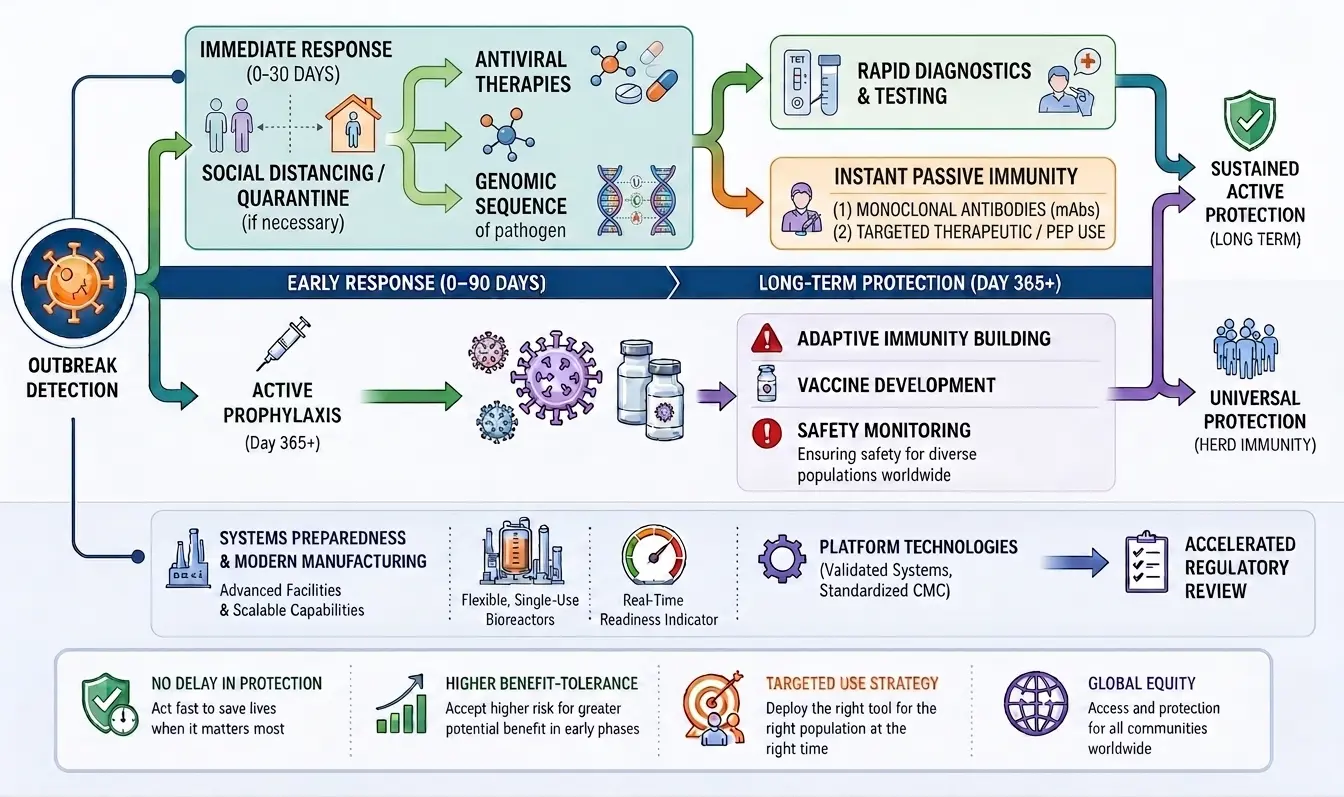
Figure 1. An integrated, multi-layered defense strategy for effective pandemic preparedness and better control of disease outbreaks and seasonal epidemics. Immediate response includes preventive behavioral measures, such as social distancing, mask-wearing, hand washing, contact avoidance, and quarantine, as necessary; detecting outbreaks at the source before they scale; genomic sequencing of the pathogen; development of rapid diagnostics; and use of antivirals. During the next 90 days, monoclonal antibodies need to be developed for therapeutic and passive protection, in parallel with the development of vaccines for long-term protection and herd immunity, recognizing their longer development timelines. Using this strategy, along with system preparedness for manufacturing using flexible single-use bioreactors and obtaining accelerated regulatory review and approval using platform technologies. There will be no delays in protection from the use of antivirals and monoclonal antibodies, with long-term protection provided by vaccines. This target strategy uses the right tool at the right time and would be helpful for global equity. (The figure was generated with the help of Google Gemini and ChatGPT).
The COVID-19 pandemic demonstrated that scientific innovation alone is insufficient without corresponding advances in regulatory science and manufacturing preparedness. Future outbreak responses will require regulatory frameworks capable of rapidly evaluating vaccines, monoclonal antibodies, hyperimmune globulins, and antiviral agents while maintaining rigorous standards of safety, quality, and efficacy [30,31]. Using the Platform Technology Designation Program of the 2022 “Prepare for and Respond to Existing Viruses, Emerging New Threats”, PREVENT Pandemics Act, Section 506K of the Federal Food, Drugs & Cosmetics Act [30,31], products could be rapidly approved by the regulatory agencies. The successful use of emergency use authorizations, rolling submissions, adaptive clinical trial designs, platform technology assessments, and international regulatory collaboration during COVID-19 provides a foundation for accelerating access to critical countermeasures during future public health emergencies.
Equally important is the establishment of a flexible and scalable manufacturing infrastructure. Unlike traditional vaccine production, which may require pathogen-specific process development and lengthy scale-up, modern biologics platforms—including recombinant protein vaccines, mRNA vaccines, monoclonal antibodies, and plasma-derived immunoglobulins—can potentially be adapted more rapidly to emerging pathogens. Investment in modular manufacturing facilities, standardized platform technologies, distributed production networks, and strategic stockpiles of critical raw materials could substantially reduce the time between pathogen identification and product deployment.
Ultimately, a comprehensive preparedness strategy must extend beyond research and development to include regulatory harmonization, manufacturing surge capacity, supply chain resilience, and global technology transfer mechanisms. The ability to rapidly develop, evaluate, manufacture, and distribute multiple classes of biological countermeasures may prove as important as the scientific discovery of the countermeasures themselves. Future pandemic preparedness will depend not only on which products can be developed but also on how quickly they can be authorized, produced at scale, and delivered to populations in need. Vaccines remain indispensable for long-term population protection, but true global health security depends on a fully integrated defense ecosystem.
Statement of the Use of Generative AI and AI-Assisted Technologies in the Writing Process
During the preparation of this manuscript, the author used ChatGPT and Google Gemini in order to do research on the topics discussed in the article and find published references. After using this tool/service, the author reviewed all references, edited the content as needed, and takes full responsibility for the content of the published article.
Declaration of Competing Interest
The author declares that there are no known competing financial interests or personal relationships that could have appeared to influence the work reported in this paper.
References
-
Fenner F, Henderson DA, Arita I, Jezek Z, Ladnyi ID. (Eds.). Smallpox and Its Eradication; World Health Organization: Geneva, Switzerland, 1988. Available online: https://iris.who.int/handle/10665/39485 (accessed on 26 July 2026).
-
Plotkin SA. Vaccines: Past, present and future. Nat. Med. 2005, 11 (Suppl. 4), S5–S11. DOI:10.1038/nm1209 [Google Scholar]
-
Plotkin S. History of vaccination. Proc. Natl. Acad. Sci. USA 2014, 111, 12283–12287. DOI:10.1073/pnas.1400472111 [Google Scholar]
-
Andre FE, Booy R, Bock HL, Clemens J, Datta SK, John TJ, et al. Vaccination greatly reduces disease, disability, death and inequity worldwide. Bull. World Health Organ. 2008, 86, 140–146. DOI:10.2471/blt.07.040089 [Google Scholar]
-
Greenwood B. The contribution of vaccination to global health: Past, present and future. Philos. Trans. R. Soc. Lond. B Biol. Sci. 2014, 369, 20130433. DOI:10.1098/rstb.2013.0433 [Google Scholar]
-
Roush SW, Murphy TV. Historical comparisons of morbidity and mortality for vaccine-preventable diseases in the United States. JAMA 2007, 298, 2155–2163. DOI:10.1001/jama.298.18.2155 [Google Scholar]
-
Becker W, Rathmell WK. Vaccines in cancer treatment and prevention: the time is now. J. Clin. Investig. 2025, 135, e195673. DOI:10.1172/JCI195673 [Google Scholar]
-
Ng’uni T, Chasara C, Ndhlovu ZM. Major Scientific Hurdles in HIV Vaccine Development: Historical Perspective and Future Directions. Front. Immunol. 2020, 11, 590780. DOI:10.3389/fimmu.2020.590780 [Google Scholar]
-
Saag MS, Gandhi RT, Hoy JF, Landovitz RJ, Thompson MA, Sax PE, et al. Antiretroviral Drugs for Treatment and Prevention of HIV Infection in Adults: 2020 Recommendations of the International Antiviral Society-USA Panel. JAMA. 2020, 324, 1651–1669. DOI:10.1001/jama.2020.17025 [Google Scholar]
-
Gupta RK, Alugupalli KR, Cowell JL. Low effectiveness of influenza vaccines vis-à-vis mechanism of protection by vaccines—Potential causes and recommendations to improve control of influenza. Front. Immunol. 2026, 17, 1816148. DOI:10.3389/fimmu.2026.1816148 [Google Scholar]
-
Song JY, Cheong HJ. Understanding the low effectiveness of influenza vaccines in older adults of South Korea: an exploration of contributing factors. Vaccine 2026, 71, 128076. DOI:10.1016/j.vaccine.2025.128076 [Google Scholar]
-
Crowe JE, Jr. Principles of Broad and Potent Antiviral Human Antibodies: Insights for Vaccine Design. Cell Host Microbe 2017, 22, 193–206. DOI:10.1016/j.chom.2017.07.013 [Google Scholar]
-
Xu W, Katte RH, Lu M. RSV vaccine development: advances and fusion protein-focused strategies. Front. Immunol. 2026, 17, 1710895. DOI:10.3389/fimmu.2026.1710895 [Google Scholar]
-
Hammitt LL, Dagan R, Yuan Y, Baca Cots M, Bosheva M, Madhi SA, et al. Nirsevimab for Prevention of RSV in Healthy Late-Preterm and Term Infants. N. Engl. J. Med. 2022, 386, 837–846. DOI:10.1056/NEJMoa2110275 [Google Scholar]
-
Griffin MP, Yuan Y, Takas T, Domachowske JB, Madhi SA, Manzoni P, et al. Single-Dose Nirsevimab for Prevention of RSV in Preterm Infants. N. Engl. J. Med. 2020, 383, 415–425. DOI:10.1056/NEJMoa1913556; Erratum in N. Engl. J. Med. 2020, 383, 698. DOI:10.1056/NEJMx200019 [Google Scholar]
-
Simões EAF, Madhi SA, Muller WJ, Atanasova V, Bosheva M, Cabañas F, et al. Efficacy of nirsevimab against respiratory syncytial virus lower respiratory tract infections in preterm and term infants, and pharmacokinetic extrapolation to infants with congenital heart disease and chronic lung disease: a pooled analysis of randomised controlled trials. Lancet Child. Adolesc. Health 2023, 7, 180–189. DOI:10.1016/S2352-4642(22)00321-2 [Google Scholar]
-
Lien HC, Lien CH, Liu TY, Weng SL, Tai YL, Huang YN, et al. Efficacy of nirsevimab for the prevention of RSV disease in infants: A systematic review, meta-analysis of randomized controlled trials, and global perspectives on recommendations and unmet needs. Pediatr. Neonatol. 2026, 67, 299–304. DOI:10.1016/j.pedneo.2025.10.004 [Google Scholar]
-
Petrovsky N. Lessons learned from the H1N1 2009 pandemic. Hum. Vaccines 2010, 6, 780–783. DOI:10.4161/hv.6.10.12981 [Google Scholar]
-
Kuter BJ, Offit PA, Poland GA. The development of COVID-19 vaccines in the United States: Why and how so fast? Vaccine 2021, 39, 2491–2495. DOI:10.1016/j.vaccine.2021.03.077 [Google Scholar]
-
McCafferty J, Griffiths AD, Winter G, Chiswell DJ. Phage antibodies: filamentous phage displaying antibody variable domains. Nature 1990, 348, 552–554. DOI:10.1038/348552a0 [Google Scholar]
-
Breitling F, Dübel S, Seehaus T, Klewinghaus I, Little M. A surface expression vector for antibody screening. Gene 1991, 104, 147–153. DOI:10.1016/0378-1119(91)90244-6 [Google Scholar]
-
Barbas CF, 3rd., Kang AS, Lerner RA, Benkovic SJ. Assembly of combinatorial antibody libraries on phage surfaces: The gene III site. Proc. Natl. Acad. Sci. USA 1991, 88, 7978–7982. DOI:10.1073/pnas.88.18.7978 [Google Scholar]
-
Alfaleh MA, Alsaab HO, Mahmoud AB, Alkayyal AA, Jones ML, Mahler SM, et al. Phage display derived monoclonal antibodies: from bench to bedside. Front. Immunol. 2020, 11, 1986. DOI:10.3389/fimmu.2020.01986 [Google Scholar]
-
Tan KW, Ji P, Qian Z, Gao Q, Wang S, Li Q, et al. Rapidly accelerated development of neutralizing COVID-19 antibodies by reducing cell line and CMC development timelines. Biotechnol. Bioeng. 2025, 122, 2287–2296. DOI:10.1002/bit.28302 [Google Scholar]
-
Yuan TZ, Garg P, Wang L, Willis JR, Kwan E, Hernandez AGL, et al. Rapid discovery of diverse neutralizing SARS-CoV-2 antibodies from large-scale synthetic phage libraries. mAbs 2022, 14, 2002236. DOI:10.1080/19420862.2021.2002236 [Google Scholar]
-
Hamamichi S, Uno N, Shimoya K, Fukushima T, Abe M, Watanabe A, et al. Rapid immunization and antibody redesign platform discovers broadly neutralizing antibodies against non-immunized SARS-CoV-2 variant. Mol. Ther. 2026, 34, 620–638. DOI:10.1016/j.ymthe.2025.10.020 [Google Scholar]
-
Singh D. mRNA-Encoded antibodies as a next-generation therapeutic paradigm: A rapid and adaptive platform for the prevention and treatment of emerging and re-emerging infectious diseases—A critical review. Immunol. Res. 2026, 74, 7. DOI:10.1007/s12026-025-09737-z [Google Scholar]
-
Tkaczyk C, Newton M, Patnaik MM, Thom G, Strain M, Gamson A, et al. In vivo mRNA expression of a multi-mechanistic mAb combination protects against Staphylococcus aureus infection. Mol. Ther. 2024, 32, 2505–2518. DOI:10.1016/j.ymthe.2024.05.036 [Google Scholar]
-
Crowe JE, Jr. Human Antibodies for Viral Infections. Annu. Rev. Immunol. 2022, 40, 349–386. DOI:10.1146/annurev-immunol-042718-041309 [Google Scholar]
-
Federal Register. Platform Technology Designation Program; Draft Guidance for Industry; Availability; Agency Information Collection Activities; Proposed Collection; Comment Request, Federal Register/Vol. 89, No. 104/Wednesday, May 29, 2024/[Docket No. FDA–2024–D–1829]. Available online: https://www.federalregister.gov/documents/2024/05/29/2024-11686/platform-technology-designation-program-draft-guidance-for-industry-availability-agency-information (accessed on 26 July 2026).
-
FDA Guidance for Industry. Platform Technology Designation Program for Drug Development. May 2024. Available online: https://www.fda.gov/regulatory-information/search-fda-guidance-documents/platform-technology-designation-program-drug-development (accessed on 26 July 2026).