
The Residual Role of Doxorubicin–Cisplatin in Endometrial Cancer in the TC Plus Immunotherapy Era
The Residual Role of Doxorubicin–Cisplatin in Endometrial Cancer in the TC Plus Immunotherapy Era

Received: 21 April 2026 Revised: 27 July 2026 Accepted: 03 August 2026 Published: 11 August 2026

© 2026 The authors. This is an open access article under the Creative Commons Attribution 4.0 International License (https://creativecommons.org/licenses/by/4.0/).
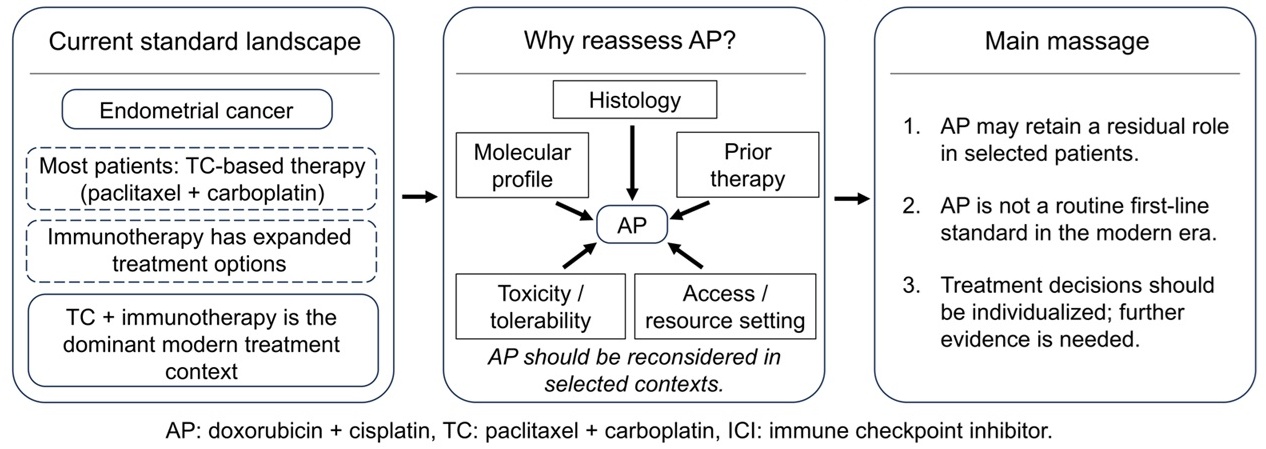
Graphical Abstract
1. Introduction
Systemic therapy for advanced and recurrent endometrial cancer has undergone a substantial shift over the past two decades. Doxorubicin plus cisplatin (AP) once held a central position in the treatment of extra-uterine disease and played an important part in establishing chemotherapy as a meaningful therapeutic approach in this setting [1]. Subsequently, carboplatin plus paclitaxel (TC) became widely adopted in routine practice and is now the cytotoxic backbone on which many contemporary treatment strategies are built [2,3].
However, the transition from AP to TC should not be reduced to a simplistic narrative in which an ineffective or inferior regimen was merely discarded. AP had genuine historical importance, and its former status helps explain why it continued to be regarded as a relevant option in some clinical contexts even after TC became dominant [1]. At the same time, present-day clinical practice and therapeutic development are increasingly organized around a TC backbone, reflecting not only comparative efficacy but also differences in tolerability, administration, and suitability for combination treatment [2,3].
The context in which these regimens are evaluated has also changed substantially. The Cancer Genome Atlas established four major molecular groups of endometrial cancer, now commonly represented by POLE-mutated (POLEmut), mismatch repair-deficient (MMRd), p53-abnormal (p53abn), and no specific molecular profile (NSMP) tumors [4]. Molecular classification has subsequently been incorporated into contemporary staging, risk stratification, and treatment recommendations [5,6]. In parallel, immune checkpoint inhibitors have reshaped the treatment landscape of advanced and recurrent disease, with modern first-line combination strategies generally retaining TC as their chemotherapy platform. Nevertheless, no validated molecular subgroup has been established in which AP should be preferred to TC. Moreover, the pivotal trials that defined the historical roles of AP and TC largely predated routine molecular classification, limiting retrospective assumptions about subtype-specific comparative efficacy.
Accordingly, the central question is not whether AP should be portrayed as superior or equivalent to TC in a purely binary sense. Rather, the more clinically relevant task is to determine where AP now stands within a molecularly informed and immunotherapy-based treatment landscape. This Communication therefore re-examines the historical role of AP, the evidentiary and practical factors that led to the predominance of TC, and the limited circumstances in which AP may retain residual clinical relevance. It also considers whether contemporary molecular and therapeutic advances have created a new biological niche for AP or, conversely, have further narrowed its role to that of an exceptional alternative or backup option.
2. How Does Doxorubicin–Cisplatin (AP) Become a Historical Standard
AP did not become historically central by accident. In advanced or recurrent endometrial cancer, both doxorubicin and cisplatin have recognized activity, and Gynecologic Oncology Group trials helped translate that activity into a reproducible combination regimen [7]. Compared with doxorubicin alone, the addition of cisplatin improved response rate and progression-free survival, although at the cost of greater toxicity and with only a limited effect on overall survival [7]. In the therapeutic context of that period, when effective systemic options were relatively limited, these findings were sufficient to position AP as a regimen with meaningful antitumor activity rather than merely a fallback treatment.
Its standing was reinforced when AP was carried forward into later pivotal studies as a reference regimen. In GOG-122, doxorubicin plus cisplatin was compared with whole-abdominal irradiation for stage III or IV endometrial carcinoma with minimal residual disease after surgery, and chemotherapy was associated with superior progression-free and overall survival [1]. In practical terms, this study helped establish combination chemotherapy, and specifically AP, as a serious standard for extra-uterine disease. Likewise, when intensified multi-agent strategies were subsequently evaluated, AP remained the control backbone against which newer regimens were judged [8]. This historical sequence is important because it helps explain why AP retained clinical legitimacy even as the field later moved in other directions (Figure 1).
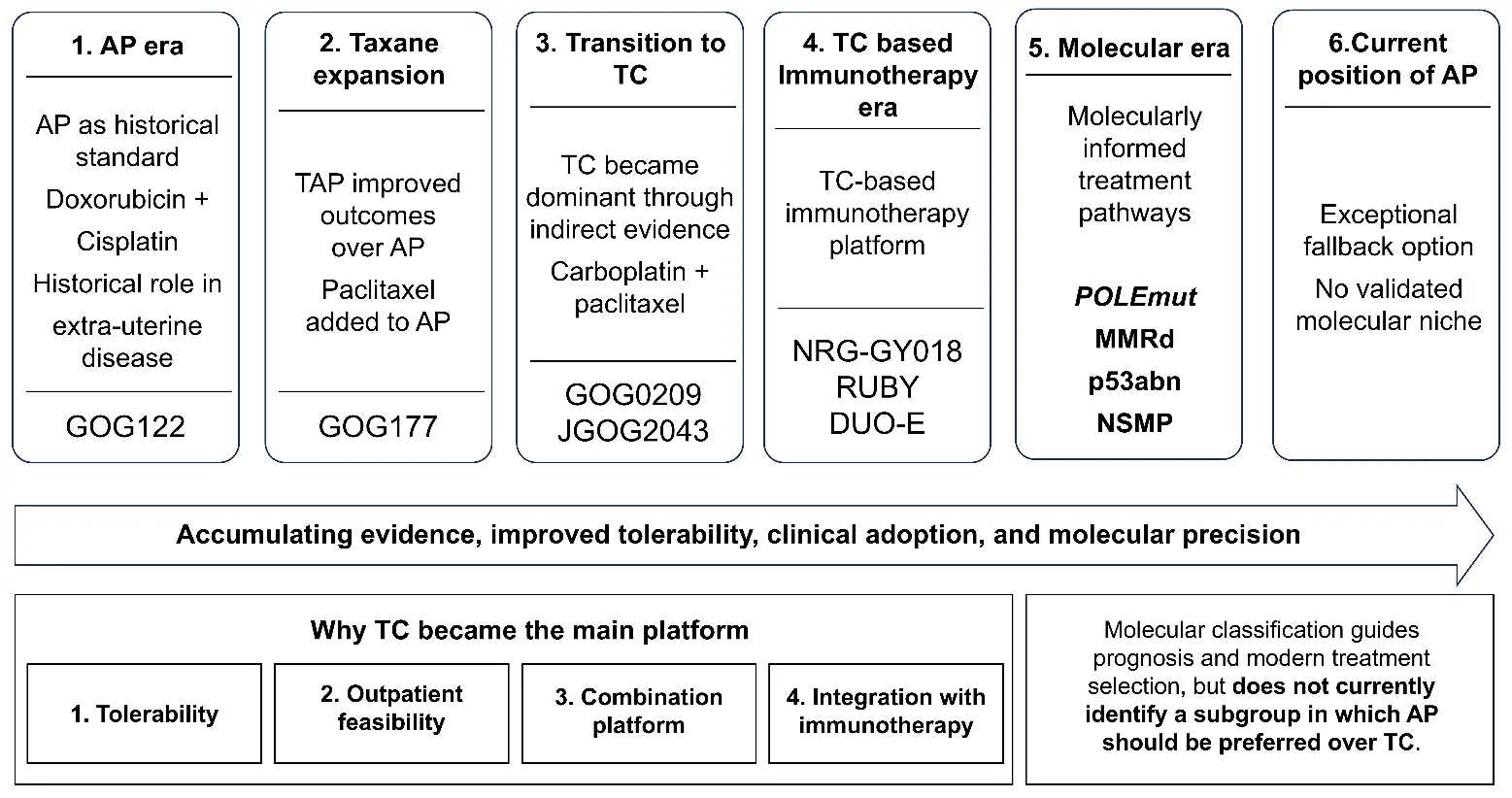
Figure 1. Evolution of systemic therapy in endometrial cancer: from doxorubicin–cisplatin (AP) to carboplatin–paclitaxel (TC)-based immunotherapy and molecularly informed treatment.
In this sense, AP was not simply an outdated regimen awaiting replacement. It was a treatment that had accumulated trial-based legitimacy across successive studies and had become embedded in the clinical management of advanced disease [1,7,8]. In Japan as well, AP retained a stronger historical presence than is sometimes appreciated, reflecting both the influence of earlier evidence and the persistence that often accompanies an established regimen in routine oncology practice. The later emergence of TC should therefore be understood against the background of AP’s prior success: AP mattered because it helped define the chemotherapy era in endometrial cancer before its role began to narrow.
3. Why Clinical Practice Shifted from Doxorubicin–Cisplatin (AP) to Carboplatin–Paclitaxel (TC) Despite the Lack of a Definitive AP-Versus-TC Trial
3.1. The Limits of Direct Evidence
The transition from AP to TC is often described as if a single decisive head-to-head trial had supported it. In fact, the direct evidence is more limited. No dedicated two-arm randomized trial was designed to establish the superiority or noninferiority of TC relative to AP across the full clinical spectrum of advanced or recurrent endometrial cancer. JGOG2043 provides the closest randomized comparison, but it was a three-arm trial conducted in the postoperative adjuvant setting and compared AP with docetaxel plus cisplatin (DP) and TC in patients at high risk of progression [9].
In the final randomized analysis, neither taxane-plus-platinum regimen demonstrated a statistically significant survival advantage over AP, and the regimens were interpreted as reasonable alternatives with different toxicity profiles [9]. However, the absence of a statistically significant difference should not be interpreted as formal evidence of equivalence or noninferiority. Moreover, findings from the postoperative adjuvant setting cannot automatically be extrapolated to patients receiving systemic therapy for measurable advanced or recurrent disease. Thus, JGOG2043 did not establish that TC had conclusively defeated AP, but neither did it demonstrate that AP and TC were clinically interchangeable.
Two subsequent post hoc analyses have further refined the interpretation of the JGOG2043 population. Among 250 patients who underwent pelvic lymphadenectomy without para-aortic lymphadenectomy, resection of 20 or more pelvic lymph nodes was independently associated with improved overall survival (hazard ratio [HR], 0.49; 95% confidence interval [CI], 0.24–0.99; p = 0.048), whereas the association with disease-free survival did not reach statistical significance (HR, 0.57; 95% CI, 0.31–1.07; p = 0.080) [10]. In a separate analysis, multiple para-aortic lymph-node metastases, defined as two or more positive nodes, were independently associated with inferior disease-free survival (HR, 1.72; 95% CI, 1.10–2.72; p = 0.019), although the association with overall survival was not statistically significant [11]. These findings indicate that surgical and nodal factors contributed meaningfully to prognosis and underscore the clinical heterogeneity of the JGOG2043 cohort.
Nevertheless, neither post hoc analysis evaluated a formal interaction between these prognostic factors and the assigned chemotherapy regimen. They therefore do not demonstrate that the extent of lymphadenectomy or the burden of nodal metastasis modified the comparative treatment effect of AP versus TC. The updated evidence adds important prognostic context to JGOG2043, but it neither invalidates the original randomized comparison nor provides evidence that AP should be preferred over TC [9,10,11]. JGOG2043 is therefore best interpreted as showing that no survival advantage of the taxane-plus-platinum regimens was demonstrated in that specific adjuvant population, rather than as proving equivalence among the regimens.
3.2. The Chain of Evidence That Favored TC
If the direct AP-versus-TC evidence was incomplete, why did TC nevertheless become dominant? The answer lies in a broader evidentiary sequence. First, GOG-177 showed that adding paclitaxel to AP to create TAP improved response rate, progression-free survival, and overall survival compared with AP alone, although at the expense of substantially greater toxicity [8]. This established an important principle: incorporation of a taxane could improve efficacy beyond the earlier AP backbone.
The next major step came from GOG0209, which compared TC with TAP in stage III, stage IV, or recurrent disease. TC was studied as a less burdensome alternative to TAP and ultimately showed similar survival outcomes, while offering a more favorable adverse-event and tolerability profile [2]. That result did not prove that TC was directly superior to or noninferior to AP. Nonetheless, once TAP had been shown to improve outcomes relative to AP, and TC had shown comparable efficacy to TAP with better tolerability, the cumulative logic strongly favored TC as the more practical regimen for routine care.
This indirect but persuasive sequence is crucial. TC replaced AP not because of one decisive direct trial, but because converging clinical evidence made taxane-based platinum therapy increasingly difficult to ignore. In that sense, the field moved by accumulation rather than by a single formal adjudication.
3.3. Why TC Won in Practice
Practice patterns are shaped not only by efficacy signals but also by how treatment can actually be delivered. Here, TC had several advantages. Compared with cisplatin-containing therapy, carboplatin simplified administration, reduced the logistical burden associated with hydration, and fit more naturally into outpatient practice. Avoidance of routine anthracycline exposure also reduced concern about cumulative cardiotoxicity in patients who might later require additional therapy. These considerations did not by themselves invalidate AP, but they made TC easier to use repeatedly and at scale.
Toxicity profiles also influenced adoption. TAP, although more active than AP, was associated with substantially increased toxicity, including neuropathy [8]. TC offered a more acceptable balance between activity and tolerability in GOG0209 [2]. Contemporary guideline frameworks have therefore continued to favor carboplatin-paclitaxel as a preferred first-line regimen, explicitly noting that outcomes are similar to those of older multi-agent comparators, while tolerability is better [12]. Once such a regimen becomes easier to deliver, easier to justify, and easier to build upon, it naturally becomes the backbone for subsequent clinical pathways.
Accordingly, the dominance of TC in routine practice should not be misread as proof that AP was ineffective or irrelevant. Rather, TC prevailed because the totality of the evidence, together with practical advantages in toxicity, administration, and scalability, pushed clinicians toward it. The historical transition was therefore incremental but decisive in effect: AP was displaced not by one direct knockout trial, but by the convergence of data and day-to-day clinical reality.
4. Where AP May Still Remain Relevant: An Exceptional Clinical Fallback
AP no longer occupies a central position in the systemic treatment of advanced or recurrent endometrial cancer. Its residual role should therefore not be framed as that of a co-equal alternative to TC or as a molecularly selected treatment. Rather, AP may remain relevant only in exceptional circumstances in which taxane-containing treatment cannot reasonably be administered, and other contemporary treatment options are unsuitable or unavailable. The principal situations in which AP might be considered as a clinical fallback are summarized in Table 1.
Table 1. Potential clinical circumstances in which doxorubicin–cisplatin (AP) might be considered as an exceptional fallback in endometrial cancer.
|
Potential Clinical Circumstance |
Why TC May Be Unsuitable |
Possible Rationale for Considering AP |
Major Limitation |
|---|---|---|---|
|
Severe taxane hypersensitivity when rechallenge, desensitization, or an alternative taxane strategy is not feasible |
Continued paclitaxel exposure may be unsafe or impractical. |
AP is a taxane-free regimen with established historical activity in endometrial cancer. |
Evidence supporting AP specifically in this setting is indirect. Desensitization can permit continuation of standard taxane-based treatment in selected patients, and AP should not be regarded as a routine substitute for TC. |
|
Functionally significant pre-existing peripheral neuropathy for which further taxane exposure is considered unacceptable |
Paclitaxel may aggravate pre-existing neuropathy and impair treatment continuation. |
AP avoids additional taxane exposure and may be considered when taxane avoidance is clinically necessary. |
Cisplatin itself causes dose-related and potentially irreversible peripheral neuropathy; therefore, AP is not a neuropathy-sparing regimen and requires careful neurologic and renal assessment. |
|
Postoperative high-risk disease in a patient with a genuine contraindication to taxane therapy |
A standard taxane–platinum regimen cannot be safely administered. |
AP has historical randomized evidence in the postoperative setting and may remain an individualized taxane-free fallback. |
JGOG2043 did not establish superiority, equivalence, or noninferiority of AP relative to TC. Contemporary molecular and risk-adapted treatment options should be considered before AP. |
Note: These circumstances represent pragmatic and highly individualized considerations rather than evidence-based indications for AP. No molecular subtype has been validated as a basis for selecting AP over TC.
The most defensible circumstance is a genuine inability to receive a taxane. Severe taxane hypersensitivity may occasionally make further paclitaxel exposure unsafe, although rechallenge, desensitization, or alternative taxane strategies should generally be considered before abandoning the established TC-based pathway. When these approaches are not feasible, AP offers a taxane-free regimen with historical antitumor activity. Nevertheless, evidence supporting AP specifically as a substitute after taxane hypersensitivity is indirect, and such use should remain individualized.
Pre-existing peripheral neuropathy represents a more complex situation. Avoiding further paclitaxel exposure may be reasonable when neurologic symptoms are already functionally limiting. However, AP should not be described as a neuropathy-sparing regimen because cisplatin itself can produce cumulative and potentially irreversible peripheral neurotoxicity. Consideration of AP in this setting would therefore require a judgment that the need to avoid taxane exposure outweighs the neurologic, renal, emetic, and cardiac risks associated with cisplatin and doxorubicin.
The postoperative setting also requires careful interpretation. JGOG2043 did not demonstrate a survival advantage for either taxane-plus-platinum regimen over AP, nor did it establish equivalence or noninferiority among the regimens [9]. Subsequent post hoc analyses further showed that surgical and nodal factors were associated with prognosis, but did not demonstrate that these factors modified the comparative effect of AP versus TC [10,11]. Accordingly, the JGOG2043 evidence may support the historical legitimacy of AP as an adjuvant regimen, but it does not justify routine AP use in contemporary postoperative care. AP might be considered only when taxane therapy is genuinely contraindicated and after molecularly informed and risk-adapted alternatives have been evaluated.
Thus, any contemporary role for AP is defined primarily by clinical constraints rather than by evidence of superior efficacy or a validated molecular indication. Its residual value lies in rare exception handling, not in routine competition with TC. At present, no molecular subgroup has been shown to derive preferential benefit from AP, and the expanding availability of TC-based immunotherapy and biomarker-directed treatment is likely to narrow this fallback role further.
5. AP in the Era of Molecular Classification and TC-Based Immunotherapy
5.1. Molecular Classification and the Absence of a Validated Molecular Niche for AP
The introduction of molecular classification has fundamentally changed how endometrial cancer is understood and treated. POLE-mutated (POLEmut), mismatch repair-deficient (MMRd), p53-abnormal (p53abn), and no specific molecular profile (NSMP) tumors differ in prognosis, biological behavior, and the relevance of immunotherapy or treatment intensification [4,5,6]. However, this progress has not created a molecularly defined indication for AP. The pivotal trials that established the historical roles of AP and TC predated routine molecular classification, and no prospective or retrospective analysis has demonstrated that any of the four molecular groups derive preferential benefit from AP rather than TC.
The implications of molecular classification for AP should therefore be interpreted cautiously. POLEmut tumors generally have a favorable prognosis, particularly in early-stage disease, but their relative sensitivity to AP and TC has not been established. MMRd tumors have become especially relevant to immune checkpoint inhibition, which further reduces the rationale for prioritizing an older cytotoxic regimen without subtype-specific evidence. Although p53abn tumors are associated with an adverse prognosis and may derive benefit from chemotherapy in the adjuvant setting, this does not identify AP as the preferred chemotherapy backbone. NSMP tumors are biologically heterogeneous, and no biomarker within this group currently supports the selection of AP over TC.
It is also important not to equate the trial-defined category of mismatch repair-proficient (pMMR) disease with a single TCGA molecular group. The pMMR population includes most NSMP and p53abn tumors and may also contain other molecularly distinct cancers, depending on the classification method used. Consequently, treatment effects reported by MMR status cannot be directly translated into evidence for AP within a specific TCGA subtype. At present, molecular classification informs prognosis and the use of immunotherapy or targeted approaches, but not the choice of AP over TC. The implications of the four molecular subgroups for the potential reserve value of AP are summarized in Table 2.
Table 2. Molecular classification and the potential reserve value of AP.
|
Molecular Subgroup |
Current Therapeutic Relevance |
Evidence Comparing AP with TC |
Implication for the Potential Reserve Value of AP |
|---|---|---|---|
|
POLEmut |
Generally favorable prognosis, particularly in early-stage disease, and may support treatment de-escalation in selected postoperative settings. Advanced or recurrent POLEmut disease is uncommon, and treatment evidence is limited. |
No direct molecular subtype-specific comparison of AP and TC. The pivotal trials defining the historical roles of AP and TC predated routine molecular classification. |
No molecular rationale to prefer AP. Any residual use would be determined by clinical constraints rather than POLEmut status. |
|
MMRd |
Strong predictive relevance for immune checkpoint inhibition in advanced or recurrent disease. Contemporary first-line strategies commonly use TC plus an immune checkpoint inhibitor, followed by maintenance therapy. |
No direct AP-versus-TC evidence by MMRd status. Historical chemotherapy trials did not prospectively classify tumors by mismatch repair status. |
Immune-based treatment further narrows the role of AP. MMRd status does not provide a basis for selecting AP over a TC-based treatment pathway. |
|
p53abn |
Adverse-prognosis group is often considered for treatment intensification. Emerging data on immune checkpoint blockade plus PARP inhibition are promising but remain investigational. |
No direct AP-versus-TC evidence by p53abn status, and no validated biomarker demonstrates preferential sensitivity to AP. |
Potential future precision strategies do not establish a molecular niche for AP. AP remains an exceptional fallback when established options cannot reasonably be used. |
|
NSMP |
Biologically heterogeneous group; treatment relevance may depend on stage, grade, hormone-receptor status, and additional biomarkers. Mismatch repair-proficient disease is not synonymous with NSMP. |
No direct AP-versus-TC evidence within NSMP, and no validated NSMP biomarker supports the selection of AP. |
No molecular rationale to prefer AP. Reserve use should remain individualized and driven by clinical feasibility rather than NSMP classification. |
Note: No molecular subgroup has been validated as a basis for selecting AP over TC. The table summarizes current clinical interpretation rather than evidence-based indications for AP. Abbreviations: AP, doxorubicin plus cisplatin; TC, carboplatin plus paclitaxel; POLEmut, POLE-mutated; MMRd, mismatch repair-deficient; p53abn, p53-abnormal; NSMP, no specific molecular profile.
5.2. Updated First-Line Evidence: TC Remains the Development Platform
Recent phase III evidence has strengthened the position of carboplatin–paclitaxel as the platform for first-line therapeutic development. In NRG-GY018, pembrolizumab combined with carboplatin–paclitaxel followed by pembrolizumab maintenance improved progression-free survival in both the dMMR and pMMR populations [13]. In the updated 2025 analysis, overall survival data remained immature, although the hazard ratios favored pembrolizumab in both MMR populations. Blinded independent central review also confirmed progression-free survival benefit in both dMMR and pMMR disease [14]. These results support the durability of the TC-based immunotherapy framework but should not be described as demonstrating a definitive overall survival benefit at that analysis.
The updated results of the RUBY trial provide stronger evidence of overall survival. Dostarlimab plus carboplatin–paclitaxel followed by dostarlimab maintenance significantly improved overall survival in the overall study population, with a particularly substantial benefit in dMMR/MSI-H tumors [15,16]. The findings reinforce the principle that molecular status may affect the magnitude of benefit from immunotherapy, while the chemotherapy platform remains TC rather than AP.
The DUO-E trial extended this approach by evaluating durvalumab with carboplatin–paclitaxel followed by maintenance durvalumab with or without olaparib [17]. Exploratory subgroup analyses suggested that the addition of durvalumab was particularly active in dMMR disease, whereas the addition of olaparib may provide further benefit in some pMMR tumors. These findings are hypothesis-generating with respect to molecular selection and PARP inhibition, but they do not establish pMMR disease as a homogeneous biological group or justify a molecularly defined role for AP.
The negative LEAP-001 trial is also informative. First-line lenvatinib plus pembrolizumab did not improve progression-free or overall survival compared with carboplatin–paclitaxel in either the pMMR or overall population [18]. Thus, not every immunotherapy-based or chemotherapy-free strategy can replace TC in the first-line setting. Taken together, the positive TC-based combination trials and the negative chemotherapy-free comparison indicate that TC remains not merely a historical cytotoxic standard, but the active reference platform against which new first-line strategies are developed.
5.3. Later-Line Treatment and the Diminishing Competitiveness of AP
The treatment landscape after disease progression has also narrowed the potential reserve value of AP. In previously treated advanced endometrial cancer, lenvatinib plus pembrolizumab improved progression-free survival, overall survival, and objective response compared with physician’s-choice doxorubicin or paclitaxel in KEYNOTE-775, including in the pMMR population [19]. Although this trial did not compare lenvatinib plus pembrolizumab with the AP combination, it demonstrates that modern later-line treatment is supported by randomized evidence, which is not available for the contemporary use of AP.
The contrast between LEAP-001 and KEYNOTE-775 illustrates the importance of treatment setting. Lenvatinib plus pembrolizumab did not replace TC as first-line therapy, but it remains an evidence-based option after previous systemic treatment, particularly in pMMR disease. In dMMR disease, immune checkpoint inhibition has an even more prominent therapeutic role. Accordingly, the availability of biomarker-informed and later-line systemic options makes it increasingly difficult to regard AP as a competitive contemporary regimen. AP may retain a place only when established TC-based, immune-based, or targeted strategies cannot reasonably be used.
Emerging data in p53abn disease further illustrate the direction of precision treatment, although the evidence remains preliminary. A single-arm phase II trial evaluated olaparib plus pembrolizumab in patients with persistent or recurrent copy-number-high/p53abn, mismatch repair-proficient, and POLE-negative endometrial cancer. Among 25 patients evaluable for efficacy, two achieved a complete response, and six achieved a partial response, corresponding to an objective response rate of 32%; the median duration of response was 11.2 months, whereas the median progression-free survival was 3.9 months [20]. Exploratory genomic analyses showed a numerically higher frequency of homologous recombination deficiency among responders than among nonresponders, but the small sample size and nonrandomized design preclude establishing either p53abn status or homologous recombination deficiency as a validated predictive biomarker.
These findings suggest that combined PARP inhibition and immune checkpoint blockade warrants further investigation in molecularly selected p53abn endometrial cancer. However, the strategy remains investigational, has not been compared with AP or TC, and cannot currently be regarded as a standard treatment or as evidence for a molecularly defined role of AP.
5.4. Emerging Biomarkers of Cisplatin Sensitivity
Biomarkers of cisplatin sensitivity could theoretically identify a future subgroup in which an AP-containing strategy deserves reconsideration. One recent study developed a G2/M-checkpoint classifier using genomic and transcriptomic data and identified a high-activity subgroup associated with poorer prognosis and lower predicted responsiveness to cisplatin, radiotherapy, and immunotherapy [21]. In HEC-1A endometrial cancer cells, knockdown of the classifier gene KIF23 increased sensitivity to cisplatin and radiation, suggesting that KIF23-related checkpoint activity may contribute to treatment resistance.
These findings provide a mechanistic rationale for further investigation, but their clinical implications remain limited. The classifier was derived primarily from bioinformatic analyses, and the cisplatin experiments were conducted in a single cell-line model. The study did not evaluate patients treated with AP, did not validate KIF23 as a clinical predictive biomarker, and did not compare AP with TC. Furthermore, sensitivity to cisplatin alone cannot be assumed to predict the efficacy of the combined AP regimen. KIF23 and related G2/M-checkpoint markers should therefore be viewed as research hypotheses rather than current criteria for selecting AP.
Overall, molecular classification and recent therapeutic advances have not restored AP to a central role. Instead, they have created increasingly effective and biologically informed pathways built around TC, immunotherapy, and targeted treatment. AP has no validated molecular niche and remains best regarded as an exceptional fallback for selected patients in whom the contemporary treatment pathway cannot reasonably be followed.
6. Conclusions
AP was historically important in endometrial cancer because it helped establish combination chemotherapy as an effective treatment for advanced and extra-uterine disease [1,7]. Its subsequent displacement by TC should not be attributed to a single definitive AP-versus-TC trial. Rather, the transition resulted from the cumulative effects of indirect comparative evidence, improved tolerability, simpler administration, and greater suitability for outpatient treatment and combination development [2,8,12]. JGOG2043 did not demonstrate a survival advantage of taxane–platinum regimens over AP in its postoperative population, but it also did not establish equivalence or noninferiority [9]. Subsequent post hoc analyses added prognostic context without demonstrating that surgical or nodal factors modified the comparative treatment effect of AP versus TC [10,11].
Molecular classification and modern systemic therapy have further narrowed the potential role of AP. Although POLEmut, MMRd, p53abn, and NSMP tumors differ in prognosis and therapeutic relevance, no molecular subgroup has been shown to derive preferential benefit from AP rather than TC [4,5,6]. Contemporary first-line immunotherapy strategies remain organized around a carboplatin–paclitaxel backbone, while immune-based and targeted options have expanded the evidence-based treatment pathway after progression [13,14,15,16,17,18,19]. Emerging approaches involving PARP inhibition and immune checkpoint blockade in selected p53abn tumors, as well as putative biomarkers of cisplatin sensitivity such as KIF23-related G2/M-checkpoint activity, remain investigational and cannot currently guide selection of AP [20,21].
Accordingly, precision medicine has not created a new molecularly defined indication for AP; instead, it has further restricted its place in contemporary care. AP should not be regarded as a co-equal modern standard or as a routine substitute for TC. Its residual role is best limited to an exceptional, highly individualized fallback when established taxane-based, immune-based, or biomarker-directed strategies cannot reasonably be used and when the renal, neurologic, emetic, and cardiac risks of AP remain clinically acceptable.
Statement of the Use of Generative AI and AI-Assisted Technologies in the Writing Process
During the preparation of this manuscript, the author used ChatGPT (OpenAI) in order to improve language expression and article structure. After using this tool, the author reviewed and edited the content as needed and takes full responsibility for the content of the published article.
Ethics Statement
Not applicable.
Informed Consent Statement
Not applicable.
Data Availability Statement
Not applicable. No new datasets were generated or analyzed in this study.
Funding
This research received no external funding.
Declaration of Competing Interest
The author declares that he has no known competing financial interests or personal relationships that could have appeared to influence the work reported in this paper.
References
- Randall ME, Filiaci VL, Muss H, Spirtos NM, Mannel RS, Fowler J, et al. Randomized Phase III Trial of Whole-Abdominal Irradiation Versus Doxorubicin and Cisplatin Chemotherapy in Advanced Endometrial Carcinoma: A Gynecologic Oncology Group Study. J. Clin. Oncol. 2006, 24, 36–44. DOI:10.1200/JCO.2004.00.7617 [Google Scholar]
- Miller DS, Filiaci VL, Mannel RS, Cohn DE, Matsumoto T, Tewari KS, et al. Carboplatin and Paclitaxel for Advanced Endometrial Cancer: Final Overall Survival and Adverse Event Analysis of a Phase III Trial (NRG Oncology/GOG0209). J. Clin. Oncol. 2020, 38, 3841–3850. DOI:10.1200/JCO.20.01076 [Google Scholar]
- Endometrial Cancer Treatment (PDQ®)-Health Professional Version. National Cancer Institute. Available online: https://www.cancer.gov/types/uterine/hp/endometrial-treatment-pdq (accessed on 16 April 2026).
- Cancer Genome Atlas Research Network, Kandoth C, Schultz N, Cherniack AD, Akbani R, Liu Y, et al. Integrated genomic characterization of endometrial carcinoma. Nature 2013, 497, 67–73. DOI:10.1038/nature12113 [Google Scholar]
- Berek JS, Matias‐Guiu X, Creutzberg C, Fotopoulou C, Gaffney D, Kehoe S, et al. FIGO staging of endometrial cancer: 2023. Int. J. Gynecol. Obstet. 2023, 162, 383–394. DOI:10.1002/ijgo.14923 [Google Scholar]
- Concin N, Matias-Guiu X, Cibula D, Colombo N, Creutzberg CL, Ledermann J, et al. ESGO–ESTRO–ESP guidelines for the management of patients with endometrial carcinoma: update 2025. Lancet Oncol. 2025, 26, e423–e435. DOI:10.1016/S1470-2045(25)00167-6 [Google Scholar]
- Thigpen JT, Brady MF, Homesley HD, Malfetano J, DuBeshter B, Burger RA, et al. Phase III Trial of Doxorubicin With or Without Cisplatin in Advanced Endometrial Carcinoma: A Gynecologic Oncology Group Study. J. Clin. Oncol. 2004, 22, 3902–3908. DOI:10.1200/JCO.2004.02.088 [Google Scholar]
- Fleming GF, Brunetto VL, Cella D, Look KY, Reid GC, Munkarah AR, et al. Phase III Trial of Doxorubicin Plus Cisplatin With or Without Paclitaxel Plus Filgrastim in Advanced Endometrial Carcinoma: A Gynecologic Oncology Group Study. J. Clin. Oncol. 2004, 22, 2159–2166. DOI:10.1200/JCO.2004.07.184 [Google Scholar]
- Nomura H, Aoki D, Michimae H, Mizuno M, Nakai H, Arai M, et al. Effect of Taxane Plus Platinum Regimens vs. Doxorubicin Plus Cisplatin as Adjuvant Chemotherapy for Endometrial Cancer at a High Risk of Progression. JAMA Oncol. 2019, 5, 833. DOI:10.1001/jamaoncol.2019.0001 [Google Scholar]
- Konno Y, Mayama M, Takehara K, Yokoyama Y, Suzuki J, Susumu N, et al. Prognostic impact of the number of resected pelvic nodes in endometrial cancer: Japanese Gynecologic Oncology Group Study JGOG2043 post hoc analysis. J. Gynecol. Oncol. 2025, 36, e3. DOI:10.3802/jgo.2025.36.e3 [Google Scholar]
- Konno Y, Mayama M, Takehara K, Yokoyama Y, Suzuki J, Susumu N, et al. Prognostic significance of para-aortic node metastasis in endometrial cancer: Japanese Gynecologic Oncology Group Study JGOG2043 post hoc analysis. J. Gynecol. Oncol. 2025, 36, e57. DOI:10.3802/jgo.2025.36.e57 [Google Scholar]
- Uterine Neoplasms. NCCN Clinical Practice Guidelines in Oncology, Version 2.2026. National Comprehensive Cancer Network. Available online: https://www.nccn.org/guidelines/guidelines-detail?category=1&id=1473 (accessed on 16 April 2026).
- Eskander RN, Sill MW, Beffa L, Moore RG, Hope JM, Musa FB, et al. Pembrolizumab plus Chemotherapy in Advanced Endometrial Cancer. N. Engl. J. Med. 2023, 388, 2159–2170. DOI:10.1056/NEJMoa2302312 [Google Scholar]
- Eskander RN, Sill MW, Beffa L, Moore RG, Hope JM, Musa FB, et al. Pembrolizumab plus chemotherapy in advanced or recurrent endometrial cancer: overall survival and exploratory analyses of the NRG GY018 phase 3 randomized trial. Nat. Med. 2025, 31, 1539–1546. DOI:10.1038/s41591-025-03566-1 [Google Scholar]
- Mirza MR, Chase DM, Slomovitz BM, dePont Christensen R, Novák Z, Black D, et al. Dostarlimab for Primary Advanced or Recurrent Endometrial Cancer. N. Engl. J. Med. 2023, 388, 2145–2158. DOI:10.1056/NEJMoa2216334 [Google Scholar]
- Powell MA, Bjørge L, Willmott L, Novák Z, Black D, Gilbert L, et al. Overall survival in patients with endometrial cancer treated with dostarlimab plus carboplatin–paclitaxel in the randomized ENGOT-EN6/GOG-3031/RUBY trial. Ann. Oncol. 2024, 35, 728–738. DOI:10.1016/j.annonc.2024.05.546 [Google Scholar]
- Westin SN, Moore K, Chon HS, Lee JY, Thomes Pepin J, Sundborg M, et al. Durvalumab Plus Carboplatin/Paclitaxel Followed by Maintenance Durvalumab with or Without Olaparib as First-Line Treatment for Advanced Endometrial Cancer: The Phase III DUO-E Trial. J. Clin. Oncol. 2024, 42, 283–299. DOI:10.1200/JCO.23.02132 [Google Scholar]
- Marth C, Moore RG, Bidziński M, Pignata S, Ayhan A, Rubio MJ, et al. First-Line Lenvatinib Plus Pembrolizumab Versus Chemotherapy for Advanced Endometrial Cancer: A Randomized, Open-Label, Phase III Trial. J. Clin. Oncol. 2025, 43, 1083–1100. DOI:10.1200/JCO-24-01326 [Google Scholar]
- Makker V, Colombo N, Herráez AC, Monk BJ, Mackay H, Santin AD, et al. Lenvatinib Plus Pembrolizumab in Previously Treated Advanced Endometrial Cancer: Updated Efficacy and Safety From the Randomized Phase III Study 309/KEYNOTE-775. J. Clin. Oncol. 2023, 41, 2904–2910. DOI:10.1200/JCO.22.02152 [Google Scholar]
- Rubinstein MM, Ge JY, Zhou Q, Iasonos A, Weigelt B, Selenica P, et al. A Phase II Trial of Olaparib plus Pembrolizumab in Patients with Recurrent Copy Number–High/p53-Abnormal Endometrial Cancer. Clin. Cancer Res. 2026, 32, 2362–2371. DOI:10.1158/1078-0432.CCR-25-4467 [Google Scholar]
- Liu Y, Wang Y, Tan S, Shi X, Wen J, Chen D, et al. Characterization of G2/M checkpoint classifier for personalized treatment in uterine corpus endometrial carcinoma. Cancer Cell Int. 2025, 25, 34. DOI:10.1186/s12935-025-03667-4 [Google Scholar]