
Psychophysiological Pathways Linking Physical Activity and Mental Health in Adolescents: A Narrative Review of Autonomic Regulation, Hypothalamic–Pituitary–Adrenal Axis Function, Neuroplasticity, and Sleep Rhythms
Psychophysiological Pathways Linking Physical Activity and Mental Health in Adolescents: A Narrative Review of Autonomic Regulation, Hypothalamic–Pituitary–Adrenal Axis Function, Neuroplasticity, and Sleep Rhythms

Received: 08 May 2026 Revised: 02 June 2026 Accepted: 15 June 2026 Published: 08 July 2026

© 2026 The authors. This is an open access article under the Creative Commons Attribution 4.0 International License (https://creativecommons.org/licenses/by/4.0/).
1. Introduction
Adolescence is not only a transitional period between childhood and adulthood; it is also a crucial developmental phase, both biologically and psychologically. During this time, neural systems linked to reward processing, emotion regulation, cognitive control, social evaluation, and the stress response are still maturing. According to developmental neuroscience, the behavior of teenagers is partly determined by the asynchronous development of subcortical emotional and reward systems and the prefrontal regulatory systems [1,2,3,4]. This developmental imbalance can improve sensitivity to peer evaluation, novelty, reward, and stress, while executive control and long-term self-regulation are still consolidating [1,2,3,4]. Meanwhile, during adolescence, there are notable changes in stress physiology, including an enhanced HPA axis response and shifting relationships among pubertal hormones, cortisol, sleep, and emotional functioning [5]. These developmental features make adolescence vulnerable, but health behaviors may have long-term effects.
Mental health problems among adolescents are now a major public health concern. Worldwide data reveal that mental disorders and high levels of depressive symptoms are prevalent among children and adolescents, though the rates differ depending on the country, tools used, diagnostic criteria, and research methods [6,7]. Evidence from meta-analyses shows that the COVID-19 pandemic led to an increase in depressive and anxiety symptoms among young people, heightening pre-existing mental health concerns [8]. In the daily lives of adolescents, issues like depression, anxiety, perceived stress, sleep disturbances, fatigue, low self-esteem, and social withdrawal frequently intersect. These challenges are seldom separate from wider developmental and lifestyle contexts. The interaction of academic stress, family disputes, worries about body image, peer comparisons, exposure to social media, less time spent outdoors, lack of physical activity, and limited sleep is common.
Physical activity is one modifiable behavior with potential relevance for adolescent mental health. According to the World Health Organization (WHO), children and adolescents between 5 and 17 years old should aim for an average of 60 min per day of mostly aerobic physical activity at a moderate to vigorous intensity each week, and include vigorous aerobic activity and muscle- and bone-strengthening activities on at least three days per week [9,10]. However, global surveillance shows that most adolescents do not meet physical activity guidelines [11]. A comprehensive review on adolescent physical activity behaviors identified adolescent physical inactivity as a worldwide issue and highlighted that research on physical activity during adolescence is unevenly spread across various countries, age groups, and environments [12]. The problem is not only that adolescents move too little. A 24-h behavioral pattern that encompasses sedentary behavior, sleep schedules, recreational screen time, school obligations, active commuting, family routines, and access to safe activity spaces includes physical inactivity [13,14].
A growing body of evidence links physical activity to better mental health in children and adolescents. Reviews and meta-analyses have associated physical activity and exercise programs with reduced symptoms of depression and anxiety, decreased psychological distress and perceived stress, and improved cognitive abilities, self-esteem, and overall wellbeing [15,16,17,18,19,20]. However, an outcome question dominates the literature: does physical activity improve adolescent mental health? This question is required but insufficient. A more robust scientific inquiry is: what psychophysiological processes allow physical activity to impact adolescent mental health, and in what circumstances are these processes most effective?
This mechanistic shift is necessary because adolescent mental health, physical activity, and development are all multidimensional. Depression, anxiety, stress, fatigue, sleep disturbance, emotional dysregulation, low self-worth, and weak social belonging are related but distinct outcomes, and they may respond differently to different forms of physical activity [21]. Physical activity is also not a single exposure: frequency, intensity, duration, timing, type, enjoyment, competition, and social context may all shape psychological and physiological responses [21]. These issues are especially important during adolescence, when self-regulation systems are still shaped by social and environmental experience [22], pubertal development is linked with changes in reward and circadian systems [23], stress reactivity and HPA-axis regulation continue to develop [24], sleep timing and insomnia vulnerability are changing [25], body image concerns become more salient during puberty [26], and autonomic heart-rate modulation continues to mature across childhood and adolescence [27].
Thus, this narrative review examines adolescent psychophysiological pathways linking physical activity and mental health. The focus is on five primary mechanisms: autonomic nervous system control, HPA axis activity, inflammatory and immune pathways, neuroplasticity and brain growth, and sleep-circadian rhythm regulation. Moderators like individual variations, the amount of exercise, the kind of activity, family and school contexts, relationships with peers, digital lifestyles, and wearable technology are also considered. The central argument is that physical activity should not be regarded as a generic prescription or a universal solution. Its value for mental health hinges on whether it helps teenagers control arousal, bounce back from stress, sleep well, experience competence, build social bonds, and engage without excessive shame, coercion, or performance pressure. This proposed conceptual framework is summarized in Figure 1.
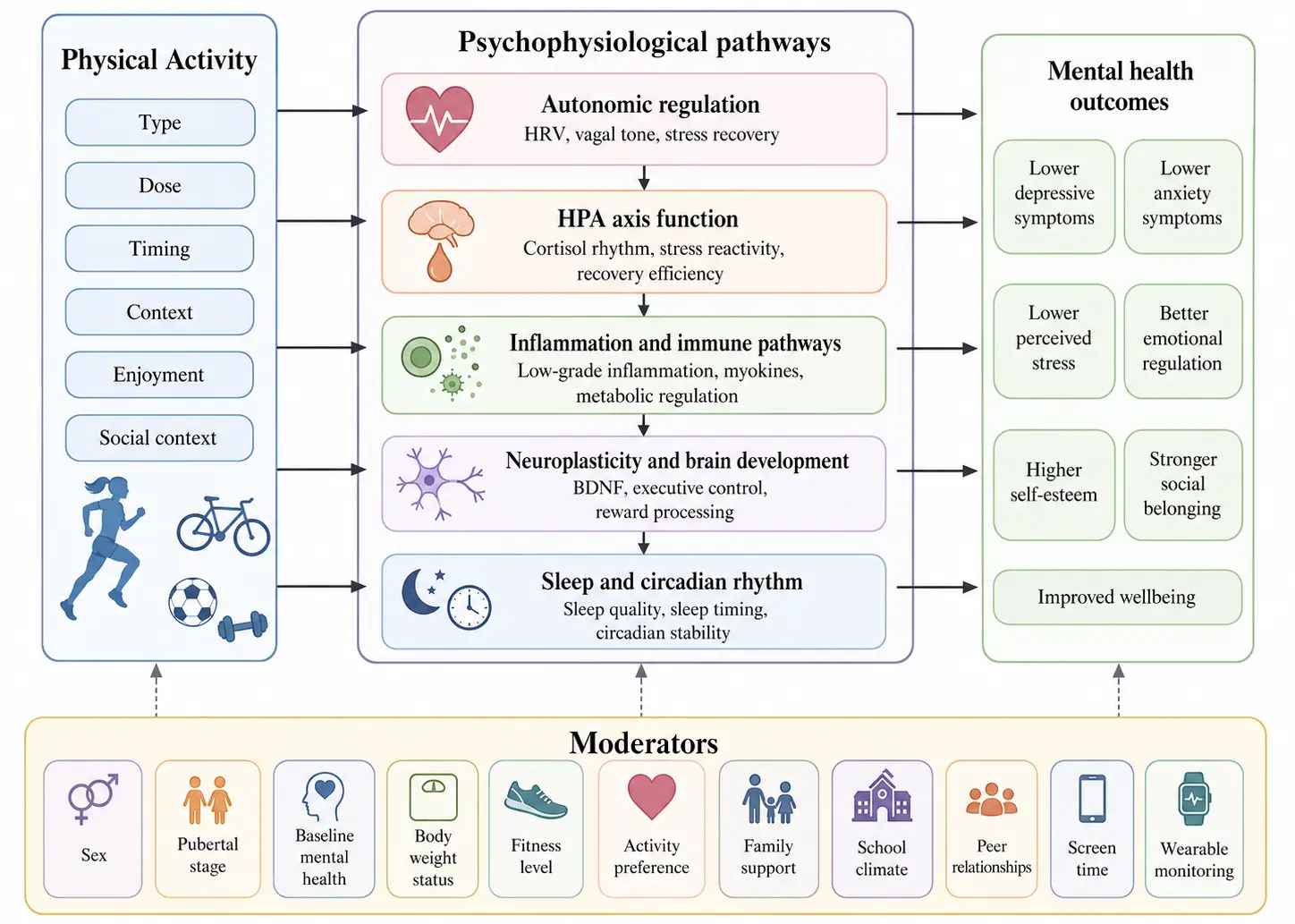
Figure 1. Conceptual framework of psychophysiological pathways linking physical activity and mental health in adolescents. Physical activity may influence adolescent mental health through interacting pathways involving autonomic regulation, HPA-axis function, inflammatory and immune processes, neuroplasticity and brain development, and sleep–circadian rhythm regulation. These associations may be shaped by activity characteristics, including type, dose, timing, context, enjoyment, and social setting, as well as moderators such as sex, pubertal stage, baseline mental health, body weight status, fitness, activity preference, family support, school climate, peer relationships, screen exposure, and wearable monitoring.
2. Methods
This narrative review was conducted to integrate evidence on psychophysiological pathways linking physical activity with mental health in adolescents. Peer-reviewed literature was searched in PubMed, Web of Science, Scopus, and Google Scholar. The search covered publications from database inception to 31 August 2025. Search terms included combinations of the following keywords: “adolescent”, “youth”, “physical activity”, “exercise”, “mental health”, “depression”, “anxiety”, “stress”, “heart rate variability”, “HRV”, “autonomic regulation”, “HPA axis”, “cortisol”, “inflammation”, “immune function”, “BDNF”, “neuroplasticity”, “brain development”, “sleep”, and “circadian rhythm”. Reference lists of relevant reviews and key theoretical papers were also examined to identify additional studies.
The initial database search identified 412 records. After removing duplicates, 286 records were screened based on their titles and abstracts. Of these, 132 full-text articles were assessed for relevance, and 77 publications were retained for narrative synthesis. The retained literature included systematic reviews, meta-analyses, longitudinal studies, randomized or controlled trials, observational studies, and major theoretical papers relevant to adolescent development, physical activity, mental health, and psychophysiological mechanisms.
Studies were included when they met at least one of the following criteria: they examined adolescents or school-aged youth; assessed physical activity, exercise, sport participation, sedentary behavior, or 24-h movement behaviors; reported mental health-related outcomes such as depressive symptoms, anxiety symptoms, perceived stress, psychological distress, self-esteem, wellbeing, sleep problems, or social functioning; or addressed candidate psychophysiological pathways, including autonomic regulation, HPA-axis function, inflammatory and immune processes, neuroplasticity, brain development, or sleep–circadian rhythms. Studies were excluded when they focused exclusively on adult populations, elite adult athletes, non-health-related performance outcomes, or clinical conditions not directly relevant to adolescent mental health. Articles not available in English were also excluded. Adult and animal studies were used only when they provided a mechanistic background that could not be adequately addressed using adolescent evidence alone.
A narrative synthesis was chosen because the review aimed to integrate heterogeneous evidence across multiple outcomes, mechanisms, developmental stages, and activity contexts rather than estimate a single pooled effect size. The included literature varied substantially in study design, exposure measurement, outcome assessment, participant characteristics, and mechanistic indicators. Therefore, no formal meta-analysis was conducted. Instead, evidence was organized around five major psychophysiological domains: autonomic regulation, HPA-axis function, inflammatory and immune pathways, neuroplasticity and brain development, and sleep–circadian rhythm regulation. Potential moderators, including sex, pubertal stage, baseline mental health, body weight status, fitness, activity type, dose, timing, family support, school climate, peer relationships, digital lifestyle, and wearable monitoring, were also considered.
Because this was a narrative rather than a systematic review, no formal risk-of-bias assessment or quantitative certainty grading was performed. This approach allows conceptual integration across diverse bodies of evidence but may be affected by selection bias, publication bias, heterogeneity in measurement methods, and uneven availability of adolescent-specific evidence across mechanisms. For this reason, mechanistic interpretations were presented cautiously, and established findings were distinguished from plausible hypotheses or indirect evidence.
3. Results
3.1. Physical Activity and Mental Health Outcomes in Adolescents
3.1.1. Physical Activity and Negative Psychological Symptoms
Depressive symptoms, anxiety symptoms, perceived stress, psychological distress, and fatigue are the mental health outcomes most often studied in adolescent physical activity research. Meta-analytic evidence generally reports that youth who participate in physical activity and organized exercise interventions tend to have better mental health outcomes, but the impact varies depending on the study’s design, the format of the intervention, the characteristics of the participants, and the methods used to measure outcomes [15,16,17,18,19,20]. More recent meta-analytic evidence similarly suggests that physical activity interventions may improve several aspects of mental health in typically developing children and adolescents, including anxiety, depression, stress, self-esteem, and social competence. However, the certainty of evidence remains limited by methodological weaknesses in the included studies [21]. The overall pattern is supportive but not simple. Since much of the evidence is cross-sectional, establishing causality is challenging. Adolescents with better mental health might be more inclined to engage in physical activities, which could also cause improved mental health. Both directions are plausible.
Depressive symptoms have received the most sustained attention. Physical activity may reduce depressive symptoms through several interacting processes, including behavioral activation, reduced rumination, greater exposure to rewarding experiences, improved sleep, stronger self-efficacy, increased social interaction, and changes in stress-related, inflammatory, and neuroplasticity-related pathways [15,16,17,18,19,20,21]. Regular, supervised, acceptable, and moderate-intensity exercise interventions for depressed adolescents often work [19,20]. However, the evidence should not be exaggerated. Some studies have small sample sizes, brief intervention periods, varied exercise protocols, and restricted long-term follow-up. Additionally, physical activity interventions might contain non-exercise elements, like adult attention, peer interaction, novelty, and structured routine, which also cause mental health outcomes.
The impact of physical activity on anxiety symptoms may differ from its effect on depression. When engaging in physical activity, adolescents experience bodily sensations such as an elevated heart rate, perspiration, rapid breathing, and muscle tension. In some adolescents, repetition of these sensations in a safe environment may decrease physiological arousal, fear, and improve stress-related bodily cue tolerance. By enhancing autonomic regulation, sleep quality, perceived competence, and social belonging, exercise may decrease anxiety. However, the same physical arousal can be intimidating for teenagers who have high anxiety, lack motor skills, worry about social evaluation, or have had negative experiences in physical education. Hence, the context of the activity is important. A humiliating, competitive, or mandatory activity may increase anxiety, while a supportive one may decrease it.
Perceived stress and psychological fatigue are significant because adolescents have chronic academic and social demands. Physical activity can relieve cognitive load, release emotions, provide mastery, and foster peer connection. However, incorporating additional activities into an already busy schedule may not be advantageous if it exacerbates sleep deprivation or stress. This highlights the significance of the 24-h movement perspective. Time is a factor they contend with, and they interact biologically. Substituting evening screen time with outdoor activities could boost mood and sleep, whereas engaging in vigorous late-night exercise following prolonged study hours might yield little advantage or even lead to increased tiredness.
Thus, a cautious conclusion is necessary: physical activity is typically linked to a reduction in negative psychological symptoms among adolescents, though the relationship is probabilistic, contextual, and complex in its mechanisms. It should be interpreted as part of a broader developmental and lifestyle system rather than as an isolated behavioral exposure.
3.1.2. Physical Activity and Positive Psychological Resources
The developmental value of physical activity is overlooked in symptom reduction. Physical activity may boost self-esteem, self-efficacy, physical self-concept, resilience, peer belonging, and life satisfaction [15,28]. These results are crucial for adolescent growth as mental health encompasses more than just the lack of depression or anxiety. It includes skills, independence, connections, emotional resilience, physical self-assurance, and a sense of purpose.
Self-efficacy is one plausible mechanism. Adolescents who acquire a motor skill, enhance their fitness, overcome a challenge, or feel physically competent might strengthen their belief in their ability to impact results. This feeling of control can extend to managing stress and academic performance. However, the emergence of self-efficacy from movement isn’t automatic; it hinges on activities being developmentally suitable, progressively structured, and evaluated with an emphasis on improvement over comparison. Physical self-concept is another significant pathway. Adolescents are acutely aware of their body image, peer comparisons, appearance assessments, and perceived physical abilities. Puberty-related changes in height, weight, body shape, and muscle development may intensify body image concerns, making the psychological climate of physical activity especially important during this developmental stage [26]. Positive experiences with physical activities can enhance body confidence and decrease avoidance, while negative experiences may increase avoidance. For adolescents facing obesity, poor motor skills, atypical pubertal development, or past teasing, the psychological environment surrounding physical activity may hold greater significance.
Organized sport and team-based activities may provide additional benefits through social connection. Reviews of youth sport reveal that involvement is frequently linked to reduced anxiety and depression symptoms, although the impact differs based on the type of sport, level of competition, and social environment [29]. Team sport participation during adolescence may improve adult mental health, especially in adversity-exposed youth [30]. Cross-sectional evidence suggests that team sport athletes may report lower anxiety or depression than individual sport athletes [31]. However, this association should be interpreted cautiously because of possible confounding and self-selection. Adolescents with stronger social skills, higher baseline wellbeing, better family support, or greater confidence in group settings may be more likely to enter and remain in team sports. Thus, the apparent mental health advantage of team sport may reflect both social features of team participation and pre-existing differences among participants [29,30,31]. However, not all sports are protective. Exclusion, bullying, injury, overspecialization, coach pressure, and performance-based self-worth harm mental health.
The most defensible position is that engaging in physical activity boosts positive psychological resources in adolescents by offering them a sense of mastery, autonomy, enjoyment, social connection, and confidence in their bodies. However, if it leads to feelings of humiliation, coercion, overtraining, or social comparison, the psychological benefits may disappear.
3.1.3. Hypothesized Differences Across Types of Physical Activity
Different forms of physical activity may plausibly influence adolescent mental health through partially different pathways, but these activity-specific claims should be interpreted as mechanistic hypotheses rather than established comparative effects. Aerobic activity is often discussed in relation to cardiorespiratory fitness, autonomic regulation, cerebral blood flow, neurotrophic signaling, and sleep quality [32,33]. Resistance training may be relevant to perceived strength, self-efficacy, and physical self-concept [34,35]. Team and group-based activities may support belonging, shared identity, and social support [28,29,30,31], whereas outdoor activity may combine movement with daylight exposure, natural environments, reduced screen time, and emotional restoration [36,37,38]. However, relatively few adolescent studies directly compare activity types while also measuring psychophysiological mediators. Therefore, activity-type recommendations should be framed as hypotheses requiring further testing. A more precise research question is not whether “exercise improves mental health” in general, but which type, intensity, frequency, timing, and social context are most appropriate for which adolescents and which outcomes [15,16,17,18,19,20,21,35,39,40].
Therefore, research and intervention design should move beyond broad statements like “exercise improves mental health”. A more specific inquiry is: what kind of activity, with what intensity and frequency, in what social environment, is best suited for which teenager and which psychological effect? Table 1 summarizes the main mental health outcomes discussed in the adolescent physical activity literature and highlights the likely mechanisms and evidence limitations.
Table 1. Summary of physical activity exposures, adolescent mental health outcomes, and evidence limitations.
|
Mental Health Outcome |
Common Physical Activity Exposures |
Proposed Pathways |
Overall Interpretation |
Key Limitations |
References |
|---|---|---|---|---|---|
|
Depressive symptoms |
MVPA; structured exercise; aerobic exercise; sport participation; school-based activity |
Behavioral activation; reduced rumination; improved sleep; self-efficacy; social contact; stress regulation; inflammation and neuroplasticity-related pathways |
Generally supportive evidence, including some intervention effects |
Cross-sectional evidence remains common; intervention protocols vary; long-term follow-up is limited; non-exercise components may contribute to effects |
|
|
Anxiety symptoms |
Aerobic exercise; structured exercise; sport participation; gradual exposure to bodily arousal |
Autonomic regulation; reduced anxiety sensitivity; improved sleep; perceived competence; social belonging |
Physical activity may reduce anxiety symptoms, but effects depend strongly on context and individual experience |
Bodily arousal may worsen anxiety in some adolescents; competitive or evaluative settings may be harmful |
|
|
Perceived stress and psychological distress |
Regular MVPA; aerobic exercise; school-based activity; recreational activity |
Stress recovery; HPA-axis flexibility; emotional discharge; break from cognitive load; social support |
Physical activity is plausibly beneficial when it supports recovery rather than adding burden |
Effects depend on dose, timing, sleep, school demands, and whether activity is experienced as manageable |
|
|
Fatigue and low energy |
MVPA; reduced sedentary behavior; daytime activity; outdoor activity |
Sleep pressure; circadian stability; reduced sedentary exposure; metabolic regulation |
Physical activity may reduce fatigue indirectly through improved sleep and daily rhythm |
Fatigue may worsen if activity displaces sleep or is added to an overloaded schedule |
|
|
Self-esteem, self-efficacy, and physical self-concept |
Resistance training; skill-based activity; sport; school PE; progressive exercise |
Mastery; competence; bodily confidence; autonomy; visible progress |
Benefits are most likely when activity emphasizes improvement, competence, and inclusion |
Public ranking, body comparison, teasing, or weight-focused messaging may undermine benefits |
|
|
Peer belonging and social connectedness |
Team sport; group-based recreational activity; peer-led programs |
Social identity; belonging; shared goals; peer support; accountability |
Team and group activity may support mental health through social mechanisms |
Evidence is often cross-sectional; self-selection and confounding are likely; sport may also involve exclusion, bullying, injury, or coach pressure |
|
|
Cognitive function and executive control |
Aerobic activity; physical fitness; school-based activity |
Neuroplasticity; BDNF; cerebral blood flow; executive control; attention regulation |
Physical activity may support cognitive and regulatory capacities relevant to mental health |
Evidence is heterogeneous; cognition and mental health are often studied separately |
|
|
Wellbeing and life satisfaction |
General physical activity; sport; outdoor activity; recreational activity |
Enjoyment; autonomy; competence; social connection; outdoor exposure |
Physical activity may support positive wellbeing, not only symptom reduction |
Measures vary widely; causal direction is difficult to establish |
3.2. Psychophysiological Mechanisms Linking Physical Activity and Adolescent Mental Health
The mechanisms reviewed below should not be read as independent or fully established causal chains. Autonomic regulation, HPA-axis activity, inflammatory signaling, neuroplasticity, sleep, and social-affective experience are biologically and behaviorally interconnected [23,24]. For example, poor sleep may alter HRV, cortisol rhythms, inflammatory regulation, and emotional control, while stress exposure may influence sleep, immune function, and motivation for activity [25,27]. Therefore, the following sections distinguish between relatively well-supported associations, plausible mechanistic pathways, and hypotheses that require more direct testing in adolescent samples.
3.2.1. Autonomic Nervous System Regulation
The autonomic nervous system links physical activity, stress, and emotional regulation. Stress causes sympathetic activation, increased heart rate, and reduced parasympathetic regulation. To function adaptively, one must be able to both engage physiological resources during challenges and relax them after stress. Heart rate variability, especially vagally mediated HRV, is widely used as an indicator of parasympathetic regulation and flexible physiological control [61,62,63].
From a psychophysiological perspective, HRV is relevant because it has been proposed as a peripheral marker of flexible physiological regulation. In line with neurovisceral integration models, vagally mediated HRV is thought to reflect functional coordination between prefrontal regulatory circuits and autonomic systems involved in adapting to environmental demands [62]. Lower resting HRV has been associated with poorer emotion regulation and psychopathology, whereas higher HRV is often interpreted as an indicator of greater regulatory flexibility, although this interpretation depends on measurement context and population characteristics [61,62,63,64,65].
Physical activity may influence autonomic regulation by improving cardiorespiratory fitness, vagal tone, and recovery following physiological arousal. A systematic review and meta-analysis in children and adolescents reported associations between physical activity and HRV indices, but findings were heterogeneous [66]. Exercise training studies in children and adolescents with obesity also suggest possible effects on HRV, although results vary by intervention duration, intensity, baseline fitness, and body composition [67]. One plausible hypothesis is that repeated cycles of exercise-induced arousal and post-exercise recovery may train psychophysiological flexibility over time. However, direct longitudinal evidence testing this pathway in adolescents remains limited.
However, HRV should not be regarded as a direct mental health score. A typical but grave error is made here. HRV is impacted by sleep, hydration, breathing patterns, body position, caffeine consumption, illness, menstrual cycle phase, time of day, the measurement device, fitness level, and pubertal development [61,66]. Recent developmental evidence also indicates that autonomic heart-rate modulation shows age-related patterns across childhood and adolescence, reinforcing the need to interpret HRV in relation to developmental stage rather than as a fixed individual trait [27]. A low HRV value in one adolescent does not automatically suggest poor mental health, and a high HRV value does not guarantee resilience. Tracking changes in HRV over time within the same person is more beneficial than using it to compare adolescents. This point is particularly relevant to wearable monitoring. Consumer devices increasingly provide ‘stress’ scores based on HRV, but the outputs are limited. Physiological arousal can impact anxiety, excitement, physical exertion, heat, sleep deprivation, illness, or caffeine intake. HRV lacks the ability to determine psychological significance without contextual data. It should be analyzed in conjunction with self-reports, sleep patterns, activity context, and long-term trends in both research and practice.
3.2.2. HPA Axis and Stress-Related Endocrine Regulation
The HPA axis is another key pathway connecting physical activity with adolescent mental health. It controls cortisol release in response to stress and follows a daily rhythm, with cortisol levels usually increasing after waking and decreasing throughout the day. This rhythm is affected by sleep, light, stress, puberty, illness, and daily routines. Adolescence changes HPA axis activity, including basal cortisol and stress reactivity [68,69]. A recent developmental review further highlights that stress reactivity and stress regulation continue to mature throughout childhood and adolescence, and that early experiences, adversity, and regulatory contexts can shape HPA-axis functioning and broader stress physiology [24].
It is inaccurate to claim that exercise only lowers cortisol. Intense physical activity, particularly when it’s vigorous, can raise cortisol levels since exercise poses a physiological challenge. The key question is whether consistent, well-regulated exercise enhances the adaptability of the stress system. In this context, flexibility means responding appropriately to challenge and recovering quickly. Systematic reviews reveal that regular exercise and fitness may decrease stress reactivity, but results vary by protocol and population [42]. A meta-analysis on physical activity and cortisol regulation indicated that engaging in physical activity might be linked to healthier daily cortisol rhythms, although results vary based on how cortisol is measured, how activity is assessed, and the characteristics of the sample [43].
Experimental work also reports that aerobic exercise may impact cortisol responses to psychosocial stress [44]. This pathway is particularly significant for adolescents since academic demands, peer assessments, family tensions, sleep limitations, and puberty interact with stress physiology. Evidence from early-adolescent studies suggests that physical activity may be linked to HPA axis function, but correlations can differ by sex, developmental stage, and measurement context [45]. Recent evidence on acute exercise and psychosocial stress in children suggests that chronic stress levels and personal traits might influence the ability to buffer stress [46]. Physical activity should improve stress recovery, not just increase physiological load. Moderate, enjoyable, regular exercise may help teens cope with daily stress. Conversely, engaging in excessive physical activity, late-night vigorous exercises, obligatory training, or high-pressure competitive scenarios might elevate allostatic load, especially when coupled with lack of sleep and academic demands.
Thus, a mechanism-based interpretation is better than “exercise reduces stress hormones”. Adolescent mental health may benefit from physical activity that regulates stress reactivity and recovery. Factors like dose, timing, sleep, developmental stage, and whether the adolescent finds the activity manageable rather than threatening play a role.
3.2.3. Inflammation and Immune Pathways
Inflammation is a candidate biological pathway that may help explain some links between movement behavior and mental health, particularly where low-grade inflammation, fatigue, depressive symptoms, cognitive dysfunction, obesity, poor sleep, and chronic stress overlap. In children and adolescents, a meta-analysis reported that inflammation is linked to depression, but the magnitude of this effect and its causality should be interpreted carefully [70]. Evidence on depression in children has also considered inflammatory markers within the larger biological framework of mood disorders [71].
Adolescence may be significant for immune–brain interactions. Adolescent neuroimmune development is affected by stress, sleep deprivation, obesity, diet, and sedentary behavior [72]. Not all adolescent depression is inflammatory. Such a view would be too simplistic. At present, causal evidence demonstrating a complete pathway from adolescent physical activity to reduced inflammation and subsequently to improved mental health remains limited. Much of the available evidence is indirect, cross-sectional, or extrapolated from broader child, adult, obesity-related, or clinical literatures. Therefore, inflammation should be treated as a candidate mechanism within a multi-system model rather than as a confirmed explanatory pathway for most adolescents [70,71,72,73,74,75]. Inflammation could serve as a pathway linking lifestyle, stress, obesity, sleep, and mood biologically. Physical exercise might decrease inflammation indirectly through various channels. Contracting skeletal muscle generates myokines, and exercise can impact immune and metabolic function [73]. Engaging in regular physical exercise can help decrease chronic low-grade inflammation by enhancing body composition, insulin sensitivity, autonomic balance, and stress recovery [74]. Physical fitness in childhood and adolescence is a marker of metabolic and cardiovascular health [75]. Inflammatory pathways may explain why lifestyle patterns are linked to psychological symptoms because obesity, sedentary behavior, poor sleep, and depression often cluster. For a sport and exercise psychology review, the main point is to steer clear of a strictly biomedical conversation. The pertinent psychological issue is how inflammation could play a role in causing fatigue, low mood, diminished motivation, and impaired cognitive control in adolescents. These symptoms are psychologically meaningful but also physiologically embedded. The biological context of a sedentary adolescent with insufficient sleep, high stress, and obesity may differ from that of an active adolescent who recovers well. This could partially account for the differences in physical activity effects among individuals.
Hence, inflammation should be part of a multi-system model. It affects the HPA axis, autonomic regulation, sleep, adiposity, diet, and neuroplasticity. Future research on adolescent physical activity should include more than just mental health outcomes. It should also incorporate inflammatory markers, psychological assessments, sleep patterns, heart rate variability, cortisol levels, and objective activity data.
3.2.4. Neuroplasticity and Brain Development
Adolescence is a sensitive period for brain development. Recent developmental neuroscience further emphasizes that adolescent self-regulation is experience-dependent and shaped by social, cultural, socioeconomic, and interpersonal contexts, which supports the view that physical activity should be understood not only as a biological stimulus but also as a structured developmental experience [22]. Prefrontal regions involved in executive control continue to mature, while limbic and reward systems remain highly responsive to emotion, novelty, and social evaluation [1,2,3,4]. Depression, anxiety, impulsivity, rumination, reward sensitivity, and emotion regulation are directly connected to these developmental traits. Physical activity may impact mental health, in part, by supporting brain plasticity, cognitive control, and reward processing.
Brain-derived neurotrophic factor (BDNF) is one mechanism that has attracted considerable attention. BDNF promotes neuronal survival, synaptic plasticity, and learning. Systematic reviews highlight that aerobic exercise, particularly at moderate to high intensity, has the potential to raise BDNF levels in young people, although the results are mixed and the evidence is not comprehensive [76]. A recent RCT-focused systematic review suggests that evidence for exercise-induced changes in BDNF among adolescents remains mixed, with effects likely depending on exercise modality, intensity, intervention duration, and participant characteristics [77]. These findings are promising, but they should be interpreted cautiously. Peripheral BDNF serves as an indirect indicator of central neuroplasticity, with adolescent BDNF responses potentially influenced by factors like puberty, sex, sleep, nutrition, and baseline fitness. Exercise might also impact cognition and executive function. Reviews of the adolescent brain reveal that physical activity and aerobic fitness may be linked to brain structure, brain function, and cognitive performance [57]. The systematic review of children’s physical activity, fitness, cognition, and academic outcomes found evidence of positive relationships, although the results were mixed and methodological problems were noted [58]. Broader neuroscience work also promotes links between exercise, brain health, and cognition [59]. Executive function is crucial for adolescent mental health as it aids in regulating emotions, controlling attention, planning, inhibiting impulses, and breaking away from rumination.
Animal and developmental evidence further reveals that exercise during adolescence may have various neural effects from exercise during adulthood, including impacts on memory and BDNF [60]. These results, though not directly applicable to human adolescents without careful consideration, reinforce the general idea that adolescence might be a crucial time when movement behavior impacts neurodevelopmental development. Reward processing is also relevant. Adolescents are sensitive to reward, peer approval, novelty, and social status [4]. Physical activity can offer adaptive rewards through mastery, bodily pleasure, group identity, and visible progress. Nevertheless, if activity is tied to shame, failure, exclusion, or pressure, it can become undesirable. Hence, interpreting the neuroplasticity pathway requires considering its psychological significance. Exercise serves as more than a mere biological stimulus, it is also a social and emotional experience.
The strongest interpretation is that physical activity may support adolescent mental health by enhancing neurobiological systems involved in plasticity, executive control, and reward. Yet, the context plays a crucial role in these biological effects. Enjoyable, mastery-focused, and socially supportive physical activities are more likely to engage adaptive motivational systems compared to those that feel punitive or humiliating.
3.2.5. Sleep and Circadian Rhythm Regulation
Sleep is one of the most significant pathways linking physical activity and adolescent mental health. Adolescents typically experience delayed sleep timing, insufficient sleep, irregular routines, academic stress, and exposure to screens at night. Adolescent sleep has been described as a “perfect storm” of biological, psychological, and social pressures that delay sleep timing and reduce sleep opportunity [47,48]. Reviews of adolescent sleep report that sleep problems are general and closely linked to mood, cognitive performance, irritability, and emotional regulation [49,50]. Recent reviews of adolescent sleep deprivation and insomnia also emphasize that insufficient sleep may function both as a contributor to, and a consequence of, mental health problems, especially mood disturbance, emotional dysregulation, and self-injury risk [25].
Physical activity may improve sleep through several mechanisms. Engaging in physical activity could heighten sleep pressure, lower stress levels, stabilize circadian rhythms, elevate mood, and cut down on evening screen time. However, the link between exercise and sleep varies. Timing, intensity, baseline sleep quality, and daily schedule matter. For some adolescents, vigorous exercise performed late at night could delay the onset of sleep, whereas regular outdoor activities during the day may aid in aligning their circadian rhythms. The 24-h movement behavior framework is valuable here because it treats physical activity, sedentary behavior, and sleep as interdependent behaviors within a fixed day [13,14]. It is suggested that the combined effects of physical activity, sedentary time, and sleep be evaluated to better understand their impact on depressive symptoms in youth [51]. Other reviews of 24-h movement behaviors and health indicators also support the significance of considering movement, sedentary behavior, and sleep as a combined behavioral system [52]. Screen exposure is also important. Research has shown that screen time is linked to negative sleep outcomes in children and adolescents, notably causing shorter sleep durations and later sleep timings [53]. A meta-analysis of portable screen-based media device access or use found correlations with inadequate sleep quantity, poor sleep quality, and excessive daytime sleepiness [54]. The significance of these findings lies in the fact that insufficient sleep can undermine several systems that physical activity could bolster for mental well-being, including HRV, cortisol rhythm, inflammatory regulation, executive function, and emotion regulation.
Thus, sleep is not only another outcome. It is a central regulator of psychophysiological functioning. Physical activity could potentially enhance sleep, thereby indirectly benefiting mood, stress recovery, and cognitive control. Conversely, if exercise is poorly timed or crammed into a hectic schedule, it might lead to worse sleep and reduced mental health advantages. Hence, adolescent physical activity interventions should be designed with sleep timing, screen behavior, and daily rhythm in mind. Table 2 summarizes the psychophysiological pathways reviewed above and distinguishes relatively stronger evidence from more tentative mechanistic claims.
Table 2. Psychophysiological pathways linking physical activity and adolescent mental health.
|
Pathway |
Main Indicators |
Proposed Role of Physical Activity |
Evidence Strength |
Main Caveats |
|---|---|---|---|---|
|
Autonomic nervous system regulation |
Resting HRV; vagally mediated HRV; heart rate recovery; parasympathetic activity |
Regular physical activity may improve cardiorespiratory fitness, vagal tone, autonomic flexibility, and recovery after physiological arousal [61,62,63,64,65,66,67] |
Moderate |
HRV is affected by sleep, respiration, posture, puberty, menstrual cycle, caffeine, illness, device type, and fitness. It should not be treated as a direct mental health score [61,66] |
|
HPA-axis and cortisol regulation |
Diurnal cortisol; cortisol awakening response; cortisol stress reactivity; post-stress recovery |
Acute vigorous exercise can increase cortisol, whereas regular and appropriately dosed activity may support more flexible stress-system regulation and recovery [42,43,44,45,46,68,69] |
Limited to moderate |
Findings depend on cortisol sampling time, exercise intensity, chronic stress, sex, pubertal stage, sleep, and baseline mental health. Evidence in adolescents remains mixed [42,43,44,45,46,68,69] |
|
Inflammatory and immune pathways |
CRP; IL-6; TNF-α; other inflammatory markers |
Physical activity may reduce chronic low-grade inflammation indirectly through improved fitness, body composition, metabolic regulation, autonomic balance, and stress recovery [70,71,72,73,74,75] |
Limited |
Causal evidence linking adolescent physical activity to reduced inflammation and, in turn, to improved mental health remains limited. Much evidence is indirect or extrapolated from adult, obesity-related, or clinical studies [70,71,72,73,74,75] |
|
Neuroplasticity and brain development |
BDNF; executive function; cognitive control; brain structure and function indicators |
Physical activity may support neurotrophic signaling, executive control, reward processing, and experience-dependent brain plasticity [1,2,3,4,57,58,59,60,76,77] |
Limited to moderate |
Peripheral BDNF is only an indirect proxy for central neuroplasticity. Effects may vary by puberty, sex, sleep, nutrition, fitness, exercise type, and social context [57,58,59,60,76,77] |
|
Sleep and circadian rhythm regulation |
Sleep duration; sleep quality; sleep timing; daytime sleepiness; circadian regularity |
Daytime physical activity may increase sleep pressure, reduce stress, stabilize daily rhythm, and reduce sedentary screen exposure [13,14,47,48,49,50,51,52,53,54] |
Moderate to relatively strong |
Effects depend on activity timing and intensity. Late-night vigorous exercise may worsen sleep onset for some adolescents, especially when combined with delayed screen use or academic overload [47,48,49,50,51,52,53,54] |
|
Social-affective regulation |
Belonging; perceived competence; autonomy; enjoyment; social safety |
Group activity, sport, and school PE may provide mastery, shared identity, peer support, and emotional reward [28,29,30,31,55,56,78] |
Moderate but context-dependent |
Sport and PE can also produce exclusion, bullying, shame, injury, comparison, coach pressure, or performance-based self-worth. Cross-sectional evidence is vulnerable to self-selection [29,30,31,55,56] |
3.3. Moderators of the Psychophysiological Effects of Physical Activity
3.3.1. Individual Differences
Physical activity does not impact all adolescents in the same way. Psychological and physiological responses can be influenced by factors like sex, stage of puberty, initial mental health, body weight, motor skills, self-perception of physical abilities, fitness, sleep quality, and activity preferences. This is not a minor methodological issue. Adolescence is a period of rapid and uneven development, and treating all adolescents as a homogeneous group weakens interpretation.
Pubertal development is particularly important. During puberty, there are alterations in sex hormones, body composition, sleep patterns, stress physiology, social awareness, and body image, with changes in HPA axis function occurring as one transitions into adolescence [68,69], and adolescent brain systems involved in emotional regulation and reward sensitivity continue to develop [1,2,3,4,5]. Recent evidence further suggests that pubertal maturation may intersect with reward sensitivity and circadian rhythm features in relation to depressive symptoms, indicating that puberty should be treated as a biologically and psychologically meaningful moderator rather than merely an age marker [23]. Hence, a physical activity program may not have identical effects in early and late adolescence. While younger adolescents may rely heavily on family and school frameworks, older adolescents might be more swayed by autonomy, peer identity, academic pressures, and digital habits. Attention should also be given to differences between sexes. Girls often report higher rates of depressive and anxiety symptoms during adolescence [6,7,8], and may face stronger appearance-related pressures. Boys may face various pressures linked to muscularity, competitiveness, and emotional expression. Physiological indicators like HRV and cortisol may also vary by sex and pubertal stage [42,43,44,45,64,65,66,67,68,69]. Failure to measure or adjust for these factors may obscure significant subgroup differences, with baseline mental health serving as a crucial moderator. Adolescents with mild stress or subclinical depressive symptoms may benefit from school-based or community physical activity. Adolescents with severe depression, trauma, eating disorders, self-harm risk, or disabling anxiety may require clinical care, with physical activity used only as an adjunct. It is careless to propose exercise as an alternative to professional treatment in high-risk scenarios. Motor abilities and physical self-image also impact responses. Adolescents who see themselves as capable may find moderate-to-vigorous activity energizing and rewarding. Adolescents with low motor competence, obesity, body shame, or negative physical education experiences may experience the same activity as threatening. Hence, participation quality matters as much as participation quantity. Environments that are inclusive, support autonomy, and build competence tend to provide more mental health benefits than those focused on comparison, exclusion, or public assessment.
Finally, adolescent health should be viewed through a broader developmental lens. The evidence emphasized that investments in adolescent health can yield benefits during adolescence, in adulthood, and for the next generation [79]. Engaging in physical activity aligns with this reasoning, as it serves not only as a short-term mood enhancer but also as a developmental behavior that influences habits, identity, social connections, sleep patterns, and physiological regulation.
3.3.2. Exercise Dose and Activity Type
Exercise dose is often discussed using frequency, intensity, time, and type. Public health guidelines provide a valuable benchmark, but the impact on mental health may not follow a straightforward linear dose-response relationship. The WHO suggests that an average of at least 60 min of moderate-to-vigorous physical activity per day is a suitable general population goal [9,10]. However, for mental health, more is not always better. Excessive, compulsory, or highly competitive activity may increase stress, injury risk, fatigue, body dissatisfaction, or sleep disruption.
Evidence from child and adolescent health research promotes the significance of moderate-to-vigorous physical activity, cardiorespiratory fitness, and muscular fitness [32,33,34]. There is growing discussion about using resistance training as a mental health intervention for young individuals, as it could boost their perceptions of strength, self-efficacy, and confidence in their bodies [35]. Broader reviews of physical activity interventions for depression, anxiety, and distress also reveal that exercise can have meaningful psychological effects, though most evidence is stronger in adults than in adolescents [39,40].
Therefore, the dose should be individualized. For an inactive adolescent with low confidence, beginning with light activity or short bouts may be more effective than prescribing vigorous exercise. Adolescents dealing with significant stress and insufficient sleep might find regular moderate daytime exercise more advantageous than vigorous evening workouts. Progressive resistance training can improve competence in those with low self-esteem. For a socially isolated adolescent, group-based recreational activity may be more beneficial than solitary exercise. For an adolescent with anxiety sensitivity, gradual exposure to bodily arousal may be appropriate.
Activity type should be matched cautiously to the target outcome and proposed mechanism. Aerobic activity may be most relevant when the goal is to improve cardiorespiratory fitness, sleep, and stress recovery; resistance training may be useful when competence, strength perception, and physical self-concept are central concerns; and group-based activities may be appropriate when social belonging is a priority. These links should be treated as practice-oriented hypotheses rather than definitive prescriptions, because direct comparative evidence in adolescents remains limited [21,32,33,34,35,36,37,38]. Engaging in outdoor activities can impact circadian rhythms, provide exposure to green spaces, and aid in emotional recovery. Activities conducted in schools can focus on accessibility and fairness. This method, based on specific mechanisms, is more accurate than the general suggestion to “exercise more”.
3.3.3. Family, School, and Peer Environments
Adolescent physical activity is not only an individual behavior. Family support, school climate, peer norms, teacher behavior, community safety, urban design, and socioeconomic resources shape it. Reviews focusing on adolescent physical activity underscore the necessity of supportive schools, social contexts, and accessible locations [12]. Empirical research also demonstrates that support from parents, teachers, and peers is connected to adolescent physical activity behavior [55].
Family support may operate through transportation, encouragement, modeling, payment for activities, and emotional climate. Parents who value physical activity without imposing excessive pressure may support participation. Conversely, placing too much importance on weight, appearance, or performance can heighten shame. Schools play a crucial role as they influence adolescents irrespective of family wealth. Physical education can promote health, but it can also produce avoidance if it emphasizes public comparison, fitness testing, or competitive performance without adequate support.
Peer relationships may be especially powerful during adolescence. Peer-led health behavior interventions have been examined as a way to impact adolescent mental health and health behaviors [56]. In the realm of physical activities, peers can provide a sense of belonging, hold each other accountable, offer encouragement, and foster a shared identity. However, they can also lead to exclusion, comparisons, bullying, and anxiety related to performance. Hence, researchers should measure not only whether adolescents participate in physical activity, but also how they experience the social climate.
There are direct consequences for schools. When school physical education centers on performance ranking, it could advantage students who are already confident while excluding those who are more vulnerable. If it is designed around mastery, inclusion, autonomy, and enjoyment, it may support both physical and mental health. To support mental health, a physical education framework should feature stress control, body awareness, collaborative activities, inclusive games, and options for students with varying abilities.
3.3.4. Digital Lifestyles and Wearable Monitoring
Digital lifestyle is now inseparable from adolescent physical activity and mental health. Screen time, sedentary behavior, social media comparison, late-night device use, and disrupted sleep often cluster together. Yearly assessments of adolescent mental health in the digital era caution against oversimplified statements and stress the importance of investigating who is impacted, in what situations, and by what means [80]. Systematic reviews reveal that social media use may be linked to depression, anxiety, and psychological distress in adolescents, although effect sizes and causality remain debated [81]. Large-scale evidence also suggests that the association between digital technology use and wellbeing is usually small but heterogeneous [82].
The relevant issue is not whether screen exposure is uniformly harmful, but how specific digital habits may displace physical activity, delay sleep, intensify social comparison, increase sedentary time, or fragment attention. These effects may interact with psychophysiological pathways. Exposure to screens in the evening might postpone sleep, while losing sleep could reduce HRV and change cortisol patterns; extended periods of inactivity might negatively impact metabolic and inflammatory health; comparing oneself to others socially might heighten stress and dissatisfaction with one’s body.
Wearable devices introduce both opportunities and risks. Accelerometers and wearable sensors can offer objective data on physical activity, sedentary behavior, heart rate, and sleep. Systematic reviews of accelerometer methods report that device-based measurement can improve behavioral assessment, but methodological choices strongly impact estimates [83]. Ecological momentary assessment can also capture mood, stress, context, and behavior in daily life, allowing researchers to test within-person correlations between activity and mental health [78]. However, while wearable devices can measure movement and physiological arousal, they are not capable of diagnosing psychological conditions like anxiety, excitement, shame, motivation, or social connectivity in teenagers. For some adolescents, wearable feedback may increase motivation. For some individuals, it might increase body monitoring, perfectionism, or anxiety. Therefore, digital tracking should be considered alongside self-reports, developmental context, sleep, and qualitative experiences.
The future of adolescent physical activity research will likely involve multimodal data: accelerometry, HRV, sleep, cortisol, mood diaries, ecological momentary assessment, and contextual information. This is promising, but only if researchers avoid reducing adolescents to data streams. The goal is not only to collect more data; it is to understand how daily movement, stress, sleep, and social experience interact in real adolescent lives. For readability, these moderators are divided into individual and developmental factors and contextual and behavioral factors. Table 3 summarizes individual and developmental moderators, whereas Table 4 summarizes contextual and behavioral moderators that should be considered when translating physical activity evidence into adolescent mental health research and practice.
Table 3. Individual and developmental moderators of physical activity–mental health associations in adolescents.
|
Moderator |
Why It Matters |
Potential Risk If Ignored |
Practical Implication |
References |
|---|---|---|---|---|
|
Sex |
Girls and boys may differ in depressive and anxiety symptoms, body image pressures, pubertal timing, HRV, cortisol regulation, and social experiences of activity. |
Average effects may hide sex-specific benefits or harms |
Analyze sex-specific patterns where possible; avoid assuming that one activity model fits all adolescents |
|
|
Pubertal stage |
Puberty affects hormones, sleep timing, stress physiology, body composition, reward sensitivity, circadian rhythm, and self-consciousness |
Treating early and late adolescents as one homogeneous group weakens interpretation |
Measure pubertal stage or developmental phase; tailor activity expectations to early, middle, and late adolescence |
|
|
Baseline mental health |
Adolescents with mild stress may respond differently from those with severe depression, trauma, eating disorders, self-harm risk, or disabling anxiety |
Physical activity may be wrongly presented as a substitute for clinical care |
Use physical activity as an adjunct to evidence-based psychological or medical care when indicated, not as a replacement; tailor intensity and context to symptom severity and safety |
|
|
Body weight status and motor competence |
Obesity, poor motor skills, low fitness, and body shame can change how adolescents experience activity |
Activity may become humiliating, threatening, or avoidant rather than rewarding |
Use inclusive, progressive, non-shaming activity formats; emphasize competence, function, and improvement |
|
|
Physical self-concept and body image |
Adolescents are sensitive to appearance, peer comparison, perceived competence, and puberty-related body changes |
Weight-focused or appearance-focused activity may worsen shame and avoidance |
Frame activity around function, strength, mood, sleep, skill learning, and mastery rather than appearance |
|
|
Fitness level |
Baseline cardiorespiratory and muscular fitness may influence exercise tolerance, perceived effort, recovery, and enjoyment |
Prescribing activity that is too intense may increase fatigue, failure experience, or dropout |
Start with tolerable doses and progress gradually; match intensity to baseline fitness and confidence |
|
|
Activity preference and motivation |
Enjoyment, autonomy, and perceived relevance influence adherence and psychological response |
A disliked or imposed activity may increase resistance, shame, or dropout |
Offer choices among aerobic, resistance, outdoor, recreational, and group-based activities where feasible |
Table 4. Contextual and behavioral moderators of physical activity–mental health associations in adolescents.
|
Moderator |
Why It Matters |
Potential Risk If Ignored |
Practical Implication |
References |
|---|---|---|---|---|
|
Exercise dose |
Mental health effects may not follow a simple “more is better” pattern |
Excessive, compulsory, or intense activity may increase fatigue, injury risk, stress, body dissatisfaction, or sleep disruption |
Start with tolerable doses; prioritize regularity, enjoyment, and recovery rather than maximum intensity |
|
|
Activity timing |
Physical activity interacts with sleep, circadian rhythm, screen time, and academic schedule |
Late-evening vigorous activity or overloaded schedules may worsen sleep and fatigue |
Prefer daytime or early-evening activity when sleep is a target; consider 24-h movement behavior |
|
|
Activity type |
Aerobic activity, resistance training, team sport, outdoor activity, and school PE may work through partly different mechanisms |
Generic advice to “exercise more” may fail because the activity does not match the target problem |
Match activity cautiously to the target mechanism: aerobic activity for stress recovery and sleep, resistance training for competence, group activity for belonging, and outdoor activity for circadian and restorative effects |
|
|
Family support |
Parents influence transportation, encouragement, modeling, fees, routines, and emotional climate |
Lack of support may reduce adherence; excessive pressure may increase shame or resistance |
Encourage supportive involvement without weight stigma, appearance pressure, or performance pressure |
|
|
School and PE climate |
Schools reach adolescents across socioeconomic groups and can shape long-term attitudes toward physical activity |
Public ranking, fitness testing, and competitive pressure may alienate vulnerable students |
Design PE around mastery, inclusion, autonomy, body awareness, cooperation, and stress recovery |
|
|
Peer relationships |
Peers can provide belonging, accountability, shared identity, and support, but also comparison and exclusion |
Group activity may harm adolescents exposed to bullying, teasing, or status pressure |
Assess the social climate, not just participation; use cooperative and peer-supportive formats |
|
|
Digital lifestyle and screen exposure |
Screen use, sedentary time, social media comparison, and late-night device use interact with sleep and mood |
Physical activity effects may be reduced if sleep remains poor and sedentary time remains high |
Integrate activity promotion with sleep education and screen-time management |
|
|
Wearable monitoring |
Devices can measure movement, heart rate, HRV, and sleep, but cannot determine psychological meaning on their own |
Over-reliance on device scores may increase surveillance, perfectionism, anxiety, or misinterpretation |
Combine wearable data with self-report, mood diaries, sleep context, developmental information, and qualitative experience |
3.4. Practical Implications, Research Limitations, and Future Directions
3.4.1. Implications for School Physical Education and Health Promotion
The evidence discussed here supports a wider role for school physical education and the encouragement of physical activity among youth. Physical activity should not be limited to just preventing obesity, conducting fitness tests, or enhancing sports performance. It can also function as a setting for emotional regulation, stress recovery, social connection, competence development, and sleep support [9,10,11,12,15].
A mental health-oriented physical education model would have several features. First, inclusivity is key, so students with low fitness levels, motor competence, disabilities, obesity, anxiety, or negative experiences in sports should not be publicly ranked or humiliated. Second, it would emphasize mastery rather than comparison. Improvement, effort, skill learning, and self-monitoring should matter more than outperforming peers. Third, it would educate students on body awareness and recovery, helping them understand the interactions between breathing, heart rate, fatigue, sleep, and stress. Fourth, it would include varied activity options. Some teenagers might not like competitive sports and instead favor activities like dance, walking, resistance training, yoga, cycling, outdoor games, or non-competitive group activities. Additionally, it would combine movement with education on sleep and screen time.
This approach is not a soft alternative to physical education. It is a more developmentally realistic model. Adolescents tend to continue engaging in physical activities when they find them meaningful, enjoyable, socially safe, and in harmony with their identities. If school programs make these activities undesirable, they might hinder lifelong involvement.
3.4.2. Implications for Adolescent Mental Health Interventions
Physical activity may be valuable as an adjunctive strategy for adolescents with mild to moderate depressive symptoms, anxiety symptoms, perceived stress, low self-esteem, and sleep problems [15,16,17,18,19,20,35,39,40]. By promoting behavioral activation, minimizing sedentary rumination, improving sleep, enhancing self-efficacy, aiding physiological regulation, and facilitating social connections can support psychological interventions. However, physical activity should not be prescribed carelessly. For adolescents with severe depression, in cases of self-harm risk, trauma, eating disorders, compulsive exercise, or severe anxiety, integrating physical activity with professional psychological or medical care is essential. Exercise should not replace clinical intervention when it is required.
Intervention design should begin with the target mechanism. For problems related to low mood and withdrawal, the objective could be to promote behavioral activation and reconnect socially. In cases of anxiety sensitivity, gradual exposure to physical arousal might help. Addressing poor sleep might involve managing daytime activities and evening screen exposure. If low self-worth is the concern, activities that build competence may be helpful. If the problem is chronic stress, moderate activity combined with recovery education may be more valuable than intense training. The key clinical takeaway is that physical activity is more than just a prescribed behavior; it is a psychophysiological and social experience. Its impact relies on the adolescent’s sense of safety, competence, autonomy, connection, and ability.
In practice, physical activity recommendations should begin with the adolescent’s primary difficulty and safety profile. For low mood and withdrawal, structured moderate-intensity activity combined with social support may support behavioral activation. For anxiety sensitivity, gradual and tolerable exposure to exercise-related bodily arousal may be considered, rather than sudden vigorous training. For sleep problems, daytime or early-evening activity should be prioritized over late-night vigorous exercise, especially when screen exposure and delayed sleep timing are present. For low self-esteem or poor physical self-concept, progressive resistance training or skill-based activities may be useful if they emphasize mastery rather than appearance or comparison [21,35,39,40,47,48,49,50,51,52,53,54].
Psychophysiological markers may support individualized planning, but they should not be used diagnostically in isolation. For example, within-person HRV trends, sleep timing, sleep duration, perceived stress, and activity logs may help identify whether an adolescent is recovering well or accumulating fatigue. However, single HRV values or wearable “stress” scores should be interpreted cautiously and combined with self-report, sleep data, illness status, menstrual cycle context, caffeine use, activity history, and contextual information [41,61,66,78,83].
3.4.3. Limitations of Existing Research
Several limitations weaken current evidence. Many studies are cross-sectional. This restricts the ability to draw causal conclusions. Teens with superior mental health might be more physically active, and those who are active might experience improvements in mental health. Longitudinal and experimental studies are necessary to distinguish between selection effects and intervention effects. Second, measurement of physical activity is inconsistent. Some studies use self-report questionnaires, others use accelerometers, intervention attendance, sport participation, or broad activity categories. These measures capture various constructs. While self-reports may affect perceptions of activity and its social context, accelerometry records movement intensity without capturing enjoyment, autonomy, or peer interactions. Third, psychological and physiological indicators are typically analyzed independently. Studies in exercise psychology may focus on depression and anxiety without including HRV, cortisol, sleep, inflammation, or BDNF. The measurement of biomarkers in biomedical evidence often lacks an assessment of activity meaning, motivation, or social context, limiting the ability to test mechanisms effectively. Furthermore, adolescence is typically viewed as one age category. Early, middle, and late adolescence differ in puberty, autonomy, peer influence, sleep timing, academic pressure, and brain development [1,2,3,4,5,68,69]. Evidence that fails to measure pubertal stage or sex differences may miss significant developmental effects. Fifth, many studies focus on average effects. This is inadequate for practice. An overall small effect could conceal substantial benefits for some teenagers and no benefit or even negative effects for others. Studies should aim to identify moderators and mechanisms rather than just estimating overall associations.
3.4.4. Future Directions
Future research should move from association-based models to mechanism-oriented models. Robust designs would integrate objective physical activity metrics, HRV, cortisol levels, sleep indicators, inflammatory markers, BDNF, mood journals, perceived stress, ecological momentary assessment, and contextual data. Such designs might investigate whether physical activity forecasts mood on the same day, whether HRV mediates the recovery from stress, whether sleep accounts for prolonged changes in anxiety, and whether inflammatory markers influence depressive symptoms, and whether social context determines adherence. Longitudinal evidence is particularly important. Physical activity may have acute, short-term, and long-term effects. Engaging in one exercise session can temporarily boost mood. Consistent activity over several weeks might affect sleep and stress recovery. Long-term involvement over the years can influence identity, social connections, fitness, and self-perception. These time scales should not be collapsed. Future intervention evidence should also compare activity contexts. Different mechanisms may be at play in aerobic exercise, resistance training, team sports, outdoor activities, school physical education, active commuting, and digital exercise programs. Researchers should measure enjoyment, autonomy support, perceived competence, peer belonging, coach or teacher climate, and perceived pressure. In the absence of these measures, it’s difficult to ascertain if mental health benefits stem from the movement, social connections, competence, routine, outdoor exposure, or reduced sedentary time. Finally, future work should integrate physical activity with sleep, stress management, and digital lifestyle. Adolescents do not live in isolated behavioral domains. The interplay of their movement, screen habits, educational requirements, social interactions, sleep, and stress responses forms a linked system. The crucial future inquiry is not solely about whether physical activity enhances adolescent mental well-being. The more useful question is: what type of physical activity, at what dose and timing, benefits which adolescents, through which psychophysiological pathways, and under what developmental and social conditions?
4. Conclusions
Physical activity is a promising but context-dependent strategy for supporting adolescent mental health. Its potential benefits are unlikely to arise from a single mechanism; rather, they may involve interacting pathways related to autonomic regulation, HPA-axis function, inflammation, neuroplasticity, sleep–circadian rhythms, and social-affective experience. However, the strength of evidence differs across pathways, and causal evidence remains limited for several proposed mechanisms, especially inflammation and activity-type-specific effects. Physical activity should therefore not be framed as a universal remedy or a substitute for clinical care. Its mental health value depends on dose, timing, activity type, developmental stage, baseline mental health, sleep, digital behavior, and social context. Future research should test which forms of physical activity benefit which adolescents, through which mechanisms, and under what conditions.
Statement of the Use of Generative AI and AI-Assisted Technologies in the Writing Process
During the preparation of this manuscript, the author used ChatGPT to assist with language editing, grammar correction, readability improvement, and organizational refinement of selected passages. The tool was also used to obtain non-substantive suggestions for improving the clarity of the conceptual framework and table presentation. It was not used to generate original data, conduct literature searches, select studies for inclusion, perform analyses, or verify references. All AI-assisted content was reviewed, edited, and checked against the cited sources by the author. The author takes full responsibility for the accuracy, integrity, and final content of the manuscript.
Ethics Statement
Not applicable. This article is a narrative review and did not involve new studies with human participants or animals performed by the author.
Informed Consent Statement
Not applicable. This article is a narrative review and did not involve human participants.
Data Availability Statement
No new data were created or analyzed in this study. Data availability is not applicable to this article.
Funding
This research received no external funding.
Declaration of Competing Interest
The author declares no known competing financial interests or personal relationships that could have appeared to influence the work reported in this paper.
References
- Casey BJ, Jones RM, Hare TA. The adolescent brain. Ann. N. Y. Acad. Sci. 2008, 1124, 111–126. DOI:10.1196/annals.1440.010 [Google Scholar]
- Konrad K, Firk C, Uhlhaas PJ. Brain development during adolescence: Neuroscientific insights into this developmental period. Dtsch. Ärzteblatt Int. 2013, 110, 425–431. DOI:10.3238/arztebl.2013.0425 [Google Scholar]
- Ahmed SP, Bittencourt-Hewitt A, Sebastian CL. Neurocognitive bases of emotion regulation development in adolescence. Dev. Cogn. Neurosci. 2015, 15, 11–25. DOI:10.1016/j.dcn.2015.07.006 [Google Scholar]
- Galván A. Adolescent development of the reward system. Front. Hum. Neurosci. 2010, 4, 6. DOI:10.3389/neuro.09.006.2010 [Google Scholar]
- Romeo RD. The teenage brain: The stress response and the adolescent brain. Curr. Dir. Psychol. Sci. 2013, 22, 140–145. DOI:10.1177/0963721413475445 [Google Scholar]
- Polanczyk GV, Salum GA, Sugaya LS, Caye A, Rohde LA. Annual research review: A meta-analysis of the worldwide prevalence of mental disorders in children and adolescents. J. Child Psychol. Psychiatry 2015, 56, 345–365. DOI:10.1111/jcpp.12381 [Google Scholar]
- Shorey S, Ng ED, Wong CHJ. Global prevalence of depression and elevated depressive symptoms among adolescents: A systematic review and meta-analysis. Br. J. Clin. Psychol. 2022, 61, 287–305. DOI:10.1111/bjc.12333 [Google Scholar]
- Racine N, McArthur BA, Cooke JE, Eirich R, Zhu J, Madigan S. Global prevalence of depressive and anxiety symptoms in children and adolescents during COVID-19: A meta-analysis. JAMA Pediatr. 2021, 175, 1142–1150. DOI:10.1001/jamapediatrics.2021.2482 [Google Scholar]
- Chaput J-P, Willumsen J, Bull F, Chou R, Ekelund U, Firth J, et al. 2020 WHO guidelines on physical activity and sedentary behaviour for children and adolescents aged 5–17 years: Summary of the evidence. Int. J. Behav. Nutr. Phys. Act. 2020, 17, 141. DOI:10.1186/s12966-020-01037-z [Google Scholar]
- Bull FC, Al-Ansari SS, Biddle S, Borodulin K, Buman MP, Cardon G, et al. World Health Organization 2020 guidelines on physical activity and sedentary behaviour. Br. J. Sports Med. 2020, 54, 1451–1462. DOI:10.1136/bjsports-2020-102955 [Google Scholar]
- Guthold R, Stevens GA, Riley LM, Bull FC. Global trends in insufficient physical activity among adolescents: A pooled analysis of 298 population-based surveys with 1.6 million participants. Lancet Child Adolesc. Health 2020, 4, 23–35. DOI:10.1016/S2352-464230323-2 [Google Scholar]
- van Sluijs EMF, Ekelund U, Crochemore-Silva I, Guthold R, Ha A, Lubans D, et al. Physical activity behaviours in adolescence: Current evidence and opportunities for intervention. Lancet 2021, 398, 429–442. DOI:10.1016/S0140-673601259-9 [Google Scholar]
- Tremblay MS, Carson V, Chaput J-P, Connor Gorber S, Dinh T, Duggan M, et al. Canadian 24-h movement guidelines for children and youth: An integration of physical activity, sedentary behaviour, and sleep. Appl. Physiol. Nutr. Metab. 2016, 41, S311–S327. DOI:10.1139/apnm-2016-0151 [Google Scholar]
- Carson V, Hunter S, Kuzik N, Gray CE, Poitras VJ, Chaput J-P, et al. Systematic review of sedentary behaviour and health indicators in school-aged children and youth: An update. Appl. Physiol. Nutr. Metab. 2016, 41, S240–S265. DOI:10.1139/apnm-2015-0630 [Google Scholar]
- Lubans D, Richards J, Hillman C, Faulkner G, Beauchamp M, Nilsson M, et al. Physical activity for cognitive and mental health in youth: A systematic review of mechanisms. Pediatrics 2016, 138, e20161642. DOI:10.1542/peds.2016-1642 [Google Scholar]
- Rodríguez-Ayllón M, Cadenas-Sánchez C, Estévez-López F, Muñoz NE, Mora-Gonzalez J, Migueles JH, et al. Role of physical activity and sedentary behavior in the mental health of preschoolers, children and adolescents: A systematic review and meta-analysis. Sports Med. 2019, 49, 1383–1410. DOI:10.1007/s40279-019-01099-5 [Google Scholar]
- Biddle SJH, Ciaccioni S, Thomas G, Vergeer I. Physical activity and mental health in children and adolescents: An updated review of reviews and an analysis of causality. Psychol. Sport Exerc. 2019, 42, 146–155. DOI:10.1016/j.psychsport.2018.08.011 [Google Scholar]
- Andermo S, Hallgren M, Nguyen TT, Jonsson S, Petersen S, Friberg M, et al. School-related physical activity interventions and mental health among children: A systematic review and meta-analysis. Sports Med.—Open 2020, 6, 25. DOI:10.1186/s40798-020-00254-x [Google Scholar]
- Wang X, Cai ZD, Jiang WT, Fang YY, Sun WX, Wang X. Systematic review and meta-analysis of the effects of exercise on depression in adolescents. Child Adolesc. Psychiatry Ment. Health 2022, 16, 16. DOI:10.1186/s13034-022-00453-2 [Google Scholar]
- Li J, Zhou X, Huang Z, Shao T. Effect of exercise intervention on depression in children and adolescents: A systematic review and network meta-analysis. BMC Public Health 2023, 23, 1918. DOI:10.1186/s12889-023-16824-z [Google Scholar]
- Fu Q, Li L, Li Q, Wang J. The effects of physical activity on the mental health of typically developing children and adolescents: A systematic review and meta-analysis. BMC Public Health 2025, 25, 1514. DOI:10.1186/s12889-025-22690-8 [Google Scholar]
- Meredith WJ, Silvers JA. Experience-dependent neurodevelopment of self-regulation in adolescence. Dev. Cogn. Neurosci. 2024, 66, 101356. DOI:10.1016/j.dcn.2024.101356 [Google Scholar]
- Maddox MA, Walsh RFL, Smith LT, Olino T, Zee PC, Nusslock R, et al. Reward sensitivity, pubertal development, and circadian rhythms: A window into adolescent risk for depressive symptoms. J. Youth Adolesc. 2025, 54, 2467–2480. DOI:10.1007/s10964-025-02224-6 [Google Scholar]
- Filetti C, Kane-Grade F, Gunnar MR. The development of stress reactivity and regulation in children and adolescents. Curr. Neuropharmacol. 2024, 22, 395–419. DOI:10.2174/1570159X21666230808120504 [Google Scholar]
- Uccella S, Cordani R, Salfi F, Gorgoni M, Scarpelli S, Gemignani A, et al. Sleep deprivation and insomnia in adolescence: Implications for mental health. Brain Sci. 2023, 13, 569. DOI:10.3390/brainsci13040569 [Google Scholar]
- Roberts SR, Gorrell S, Le Grange D. Body image during puberty: What happens to how kids feel about their bodies? Front. Young Minds 2024, 12, 1178387. DOI:10.3389/frym.2024.1178387 [Google Scholar]
- Helánová K, Šišáková M, Hnatkova K, Novotný T, Andršová I, Malik M. Development of autonomic heart rate modulations during childhood and adolescence. Pflügers Arch.—Eur. J. Physiol. 2024, 476, 1187–1207. DOI:10.1007/s00424-024-02979-0 [Google Scholar]
- Eime RM, Young JA, Harvey JT, Charity MJ, Payne WR. A systematic review of the psychological and social benefits of participation in sport for children and adolescents. Int. J. Behav. Nutr. Phys. Act. 2013, 10, 98. DOI:10.1186/1479-5868-10-98 [Google Scholar]
- Panza MJ, Graupensperger S, Agans JP, Doré I, Vella SA, Evans MB. Adolescent sport participation and symptoms of anxiety and depression: A systematic review and meta-analysis. J. Sport Exerc. Psychol. 2020, 42, 201–218. DOI:10.1123/jsep.2019-0235 [Google Scholar]
- Easterlin MC, Chung PJ, Leng M, Dudovitz R. Association of team sports participation with long-term mental health outcomes among individuals exposed to adverse childhood experiences. JAMA Pediatr. 2019, 173, 681–688. DOI:10.1001/jamapediatrics.2019.1212 [Google Scholar]
- Pluhar E, McCracken C, Griffith KL, Christino MA, Sugimoto D, Meehan WP, III. Team sport athletes may be less likely to suffer anxiety or depression than individual sport athletes. J. Sports Sci. Med. 2019, 18, 490–496. Available online: https://pmc.ncbi.nlm.nih.gov/articles/PMC6683619/ (accessed on 8 June 2026).
- Janssen I, LeBlanc AG. Systematic review of the health benefits of physical activity and fitness in school-aged children and youth. Int. J. Behav. Nutr. Phys. Act. 2010, 7, 40. DOI:10.1186/1479-5868-7-40 [Google Scholar]
- Poitras VJ, Gray CE, Borghese MM, Carson V, Chaput J-P, Janssen I, et al. Systematic review of the relationships between objectively measured physical activity and health indicators in school-aged children and youth. Appl. Physiol. Nutr. Metab. 2016, 41, S197–S239. DOI:10.1139/apnm-2015-0663 [Google Scholar]
- Smith JJ, Eather N, Morgan PJ, Plotnikoff RC, Faigenbaum AD, Lubans DR. The health benefits of muscular fitness for children and adolescents: A systematic review and meta-analysis. Sports Med. 2014, 44, 1209–1223. DOI:10.1007/s40279-014-0196-4 [Google Scholar]
- Marinelli R, Parker AG, Levinger I, Woessner MN. Resistance training and combined resistance and aerobic training as a treatment of depression and anxiety symptoms in young people: A systematic review and meta-analysis. Early Interv. Psychiatry 2024, 18, 255–267. DOI:10.1111/eip.13528 [Google Scholar]
- Zhang Y, Mavoa S, Zhao J, Raphael D, Smith M. The association between green space and adolescents’ mental well-being: A systematic review. Int. J. Environ. Res. Public Health 2020, 17, 6640. DOI:10.3390/ijerph17186640 [Google Scholar]
- Vanaken GJ, Danckaerts M. Impact of green space exposure on children’s and adolescents’ mental health: A systematic review. Int. J. Environ. Res. Public Health 2018, 15, 2668. DOI:10.3390/ijerph15122668 [Google Scholar]
- Coventry PA, Brown JVE, Pervin J, Brabyn S, Pateman R, Breedvelt J, et al. Nature-based outdoor activities for mental and physical health: Systematic review and meta-analysis. SSM—Popul. Health 2021, 16, 100934. DOI:10.1016/j.ssmph.2021.100934 [Google Scholar]
- Singh B, Bennett H, Miatke A, Dumuid D, Curtis R, Ferguson T, et al. Systematic umbrella review and meta-meta-analysis: Effectiveness of physical activity in improving depression and anxiety in children and adolescents. J. Am. Acad. Child Adolesc. Psychiatry 2026, 65, 171–186. DOI:10.1016/j.jaac.2025.04.007 [Google Scholar]
- Purgato M, Cadorin C, Prina E, Cabral Ferreira M, Del Piccolo L, Gerber M, et al. Umbrella systematic review and meta-analysis: Physical activity as an effective therapeutic strategy for improving psychosocial outcomes in children and adolescents. J. Am. Acad. Child Adolesc. Psychiatry 2024, 63, 172–183. DOI:10.1016/j.jaac.2023.04.017 [Google Scholar]
- Li K, Cardoso C, Moctezuma-Ramirez A, Elgalad A, Perin E. Heart rate variability measurement through a smart wearable device: Another breakthrough for personal health monitoring? Int. J. Environ. Res. Public Health 2023, 20, 7146. DOI:10.3390/ijerph20247146 [Google Scholar]
- Mücke M, Ludyga S, Colledge F, Gerber M. Influence of regular physical activity and fitness on stress reactivity as measured with the Trier Social Stress Test protocol: A systematic review. Sports Med. 2018, 48, 2607–2622. DOI:10.1007/s40279-018-0979-0 [Google Scholar]
- Moyers SA, Hagger MS. Physical activity and cortisol regulation: A meta-analysis. Biol. Psychol. 2023, 179, 108548. DOI:10.1016/j.biopsycho.2023.108548 [Google Scholar]
- Gerber M, Imboden C, Beck J, Brand S, Colledge F, Eckert A, et al. Effects of aerobic exercise on cortisol stress reactivity in response to the Trier Social Stress Test in inpatients with major depressive disorders: A randomized controlled trial. J. Clin. Med. 2020, 9, 1419. DOI:10.3390/jcm9051419 [Google Scholar]
- Martikainen S, Pesonen A-K, Lahti J, Heinonen K, Feldt K, Pyhälä R, et al. Physical activity and hypothalamic-pituitary-adrenocortical axis function in early adolescents. Psychoneuroendocrinology 2014, 49, 96–105. DOI:10.1016/j.psyneuen.2014.06.023 [Google Scholar]
- Hanke M, Schwarz A, Looser VN, Gerber M, Ludyga S. Does a single exercise session reduce the reactivity to acute psychosocial stress in children? Eur. J. Sport Sci. 2025, 25, e12273. DOI:10.1002/ejsc.12273 [Google Scholar]
- Carskadon MA. Sleep in adolescents: The perfect storm. Pediatr. Clin. North Am. 2011, 58, 637–647. DOI:10.1016/j.pcl.2011.03.003 [Google Scholar]
- Gradisar M, Gardner G, Dohnt H. Recent worldwide sleep patterns and problems during adolescence: A review and meta-analysis of age, region, and sleep. Sleep Med. 2011, 12, 110–118. DOI:10.1016/j.sleep.2010.11.008 [Google Scholar]
- Crowley SJ, Wolfson AR, Tarokh L, Carskadon MA. An update on adolescent sleep: New evidence informing the perfect storm model. J. Adolesc. 2018, 67, 55–65. DOI:10.1016/j.adolescence.2018.06.001 [Google Scholar]
- Dewald JF, Meijer AM, Oort FJ, Kerkhof GA, Bögels SM. The influence of sleep quality, sleep duration and sleepiness on school performance in children and adolescents: A meta-analytic review. Sleep Med. Rev. 2010, 14, 179–189. DOI:10.1016/j.smrv.2009.10.004 [Google Scholar]
- Sampasa-Kanyinga H, Chaput J-P, Goldfield GS, Janssen I, Wang J, Hamilton HA, et al. Combinations of physical activity, sedentary time, and sleep duration and their associations with depressive symptoms in children and adolescents. Int. J. Behav. Nutr. Phys. Act. 2020, 17, 72. DOI:10.1186/s12966-020-00976-x [Google Scholar]
- Saunders TJ, Gray CE, Poitras VJ, Chaput J-P, Janssen I, Katzmarzyk PT, et al. Combinations of physical activity, sedentary behaviour and sleep: Relationships with health indicators in school-aged children and youth. Appl. Physiol. Nutr. Metab. 2016, 41, S283–S293. DOI:10.1139/apnm-2015-0626 [Google Scholar]
- Hale L, Guan S. Screen time and sleep among school-aged children and adolescents: A systematic literature review. Sleep Med. Rev. 2015, 21, 50–58. DOI:10.1016/j.smrv.2014.07.007 [Google Scholar]
- Carter B, Rees P, Hale L, Bhattacharjee D, Paradkar MS. Association between portable screen-based media device access or use and sleep outcomes: A systematic review and meta-analysis. JAMA Pediatr. 2016, 170, 1202–1208. DOI:10.1001/jamapediatrics.2016.2341 [Google Scholar]
- Pluta B, Korcz A, Krzysztoszek J, Bronikowski M, Bronikowska M. Associations between adolescents’ physical activity behavior and parental, teacher, and peer support. Arch. Public Health 2020, 78, 106. DOI:10.1186/s13690-020-00490-3 [Google Scholar]
- Brinsley J, Schmidt M, Curtis R, Simpson CEM, Edwards J, Eglitis EE, et al. Effectiveness of peer-led health behaviour interventions on adolescents’ mental health and wellbeing: A systematic review and meta-analysis. Sci. Rep. 2025, 15, 16480. DOI:10.1038/s41598-025-01053-8 [Google Scholar]
- Herting MM, Chu X. Exercise, cognition, and the adolescent brain. Birth Defects Res. 2017, 109, 1672–1679. DOI:10.1002/bdr2.1178 [Google Scholar]
- Donnelly JE, Hillman CH, Castelli D, Etnier JL, Lee S, Tomporowski P, et al. Physical activity, fitness, cognitive function, and academic achievement in children: A systematic review. Med. Sci. Sports Exerc. 2016, 48, 1197–1222. DOI:10.1249/MSS.0000000000000901 [Google Scholar]
- Hillman CH, Erickson KI, Kramer AF. Be smart, exercise your heart: Exercise effects on brain and cognition. Nat. Rev. Neurosci. 2008, 9, 58–65. DOI:10.1038/nrn2298 [Google Scholar]
- Hopkins ME, Nitecki R, Bucci DJ. Physical exercise during adolescence versus adulthood: Differential effects on object recognition memory and brain-derived neurotrophic factor levels. Neuroscience 2011, 194, 84–94. DOI:10.1016/j.neuroscience.2011.07.071 [Google Scholar]
- Task Force of the European Society of Cardiology, The North American Society of Pacing and Electrophysiology. Heart rate variability: Standards of measurement, physiological interpretation, and clinical use. Circulation 1996, 93, 1043–1065. DOI:10.1161/01.CIR.93.5.1043 [Google Scholar]
- Thayer JF, Lane RD. Claude Bernard and the heart-brain connection: Further elaboration of a model of neurovisceral integration. Neurosci. Biobehav. Rev. 2009, 33, 81–88. DOI:10.1016/j.neubiorev.2008.08.004 [Google Scholar]
- Appelhans BM, Luecken LJ. Heart rate variability as an index of regulated emotional responding. Rev. Gen. Psychol. 2006, 10, 229–240. DOI:10.1037/1089-2680.10.3.229 [Google Scholar]
- Koenig J, Kemp AH, Beauchaine TP, Thayer JF, Kaess M. Depression and resting state heart rate variability in children and adolescents: A systematic review and meta-analysis. Clin. Psychol. Rev. 2016, 46, 136–150. DOI:10.1016/j.cpr.2016.04.013 [Google Scholar]
- Baumeister-Lingens L, Rothe R, Wolff L, Gerlach AL, Koenig J, Sigrist C. Vagally mediated heart rate variability and depression in children and adolescents: A meta-analytic update. J. Affect. Disord. 2023, 339, 237–255. DOI:10.1016/j.jad.2023.07.027 [Google Scholar]
- Chen H, Xu J, Xie H, Huang Y, Shen X, Xu F. Effects of physical activity on heart rate variability in children and adolescents: A systematic review and meta-analysis. Ciência Saúde Coletiva 2022, 27, 1827–1842. DOI:10.1590/1413-81232022275.10402021 [Google Scholar]
- Dias RM, Moraes B, Martins RA, Mota J, Duncan MJ. Influence of chronic exposure to exercise on heart rate variability in children and adolescents affected by obesity: A systematic review and meta-analysis. Int. J. Environ. Res. Public Health 2021, 18, 11065. DOI:10.3390/ijerph182111065 [Google Scholar]
- Gunnar MR, Wewerka S, Frenn K, Long JD, Griggs C. Developmental changes in hypothalamus-pituitary-adrenal activity over the transition to adolescence: Normative changes and associations with puberty. Dev. Psychopathol. 2009, 21, 69–85. DOI:10.1017/S0954579409000054 [Google Scholar]
- Klein ZA, Romeo RD. Changes in hypothalamic-pituitary-adrenal stress responsiveness before and after puberty in rats. Horm. Behav. 2013, 64, 357–363. DOI:10.1016/j.yhbeh.2013.01.012 [Google Scholar]
- Colasanto M, Madigan S, Korczak DJ. Depression and inflammation among children and adolescents: A meta-analysis. J. Affect. Disord. 2020, 277, 940–948. DOI:10.1016/j.jad.2020.09.025 [Google Scholar]
- Kim JW, Szigethy EM, Melhem NM, Saghafi EM, Brent DA. Inflammatory markers and the pathogenesis of pediatric depression and suicide. J. Clin. Psychiatry 2014, 75, 1242–1253. DOI:10.4088/JCP.13r08898 [Google Scholar]
- Brenhouse HC, Schwarz JM. Immunoadolescence: Neuroimmune development and adolescent behavior. Neurosci. Biobehav. Rev. 2016, 70, 288–299. DOI:10.1016/j.neubiorev.2016.05.035 [Google Scholar]
- Pedersen BK, Febbraio MA. Muscle as an endocrine organ: Focus on muscle-derived interleukin-6. Physiol. Rev. 2008, 88, 1379–1406. DOI:10.1152/physrev.90100.2007 [Google Scholar]
- Gleeson M, Bishop NC, Stensel DJ, Lindley MR, Mastana SS, Nimmo MA. The anti-inflammatory effects of exercise: Mechanisms and implications for disease prevention and treatment. Nat. Rev. Immunol. 2011, 11, 607–615. DOI:10.1038/nri3041 [Google Scholar]
- Ortega FB, Ruiz JR, Castillo MJ, Sjöström M. Physical fitness in childhood and adolescence: A powerful marker of health. Int. J. Obes. 2008, 32, 1–11. DOI:10.1038/sj.ijo.0803774 [Google Scholar]
- de Azevedo KPM, de Oliveira VH, de Medeiros GCBS, Mata ÁNS, García DÁ, Martínez DG, et al. The effects of exercise on BDNF levels in adolescents: A systematic review with meta-analysis. Int. J. Environ. Res. Public Health 2020, 17, 6056. DOI:10.3390/ijerph17176056 [Google Scholar]
- Rico-González M, González-Devesa D, Gómez-Carmona CD, Moreno-Villanueva A. Exercise as modulator of brain-derived neurotrophic factor in adolescents: A systematic review of randomized controlled trials. Sports 2025, 13, 253. DOI:10.3390/sports13080253 [Google Scholar]
- Shiffman S, Stone AA, Hufford MR. Ecological momentary assessment. Annu. Rev. Clin. Psychol. 2008, 4, 1–32. DOI:10.1146/annurev.clinpsy.3.022806.091415 [Google Scholar]
- Patton GC, Sawyer SM, Santelli JS, Ross DA, Afifi R, Allen NB, et al. Our future: A Lancet Commission on adolescent health and wellbeing. Lancet 2016, 387, 2423–2478. DOI:10.1016/S0140-673600579-1 [Google Scholar]
- Odgers CL, Jensen MR. Annual research review: Adolescent mental health in the digital age: Facts, fears, and future directions. J. Child Psychol. Psychiatry 2020, 61, 336–348. DOI:10.1111/jcpp.13190 [Google Scholar]
- Keles B, McCrae N, Grealish A. A systematic review: The influence of social media on depression, anxiety and psychological distress in adolescents. Int. J. Adolesc. Youth 2020, 25, 79–93. DOI:10.1080/02673843.2019.1590851 [Google Scholar]
- Orben A, Przybylski AK. The association between adolescent well-being and digital technology use. Nat. Hum. Behav. 2019, 3, 173–182. DOI:10.1038/s41562-018-0506-1 [Google Scholar]
- Migueles JH, Cadenas-Sánchez C, Ekelund U, Delisle Nyström C, Mora-Gonzalez J, Löf M, et al. Accelerometer data collection and processing criteria to assess physical activity and other outcomes: A systematic review and practical considerations. Sports Med. 2017, 47, 1821–1845. DOI:10.1007/s40279-017-0716-0 [Google Scholar]