
Fuzzy Cognitive Mapping of Stakeholder Governance Perceptions: A Causal Architecture for Managing Pinctada radiata in the Eastern Mediterranean
Fuzzy Cognitive Mapping of Stakeholder Governance Perceptions: A Causal Architecture for Managing Pinctada radiata in the Eastern Mediterranean
Received: 24 March 2026 Revised: 12 May 2026 Accepted: 26 May 2026 Published: 04 June 2026

© 2026 The authors. This is an open access article under the Creative Commons Attribution 4.0 International License (https://creativecommons.org/licenses/by/4.0/).
1. Introduction
Marine and coastal ecosystems are shaped by tightly coupled interactions among physical processes, ecological dynamics, and human activity across multiple spatial and temporal scales. These systems provide essential ecosystem services, including food provision, biogeochemical regulation, and coastal protection, which are fundamental to coastal livelihoods and regional economies [1,2]. This growing pressure has increasingly pushed hydroecological governance toward more adaptive and integrative approaches capable of responding to ecological uncertainty and competing stakeholder priorities. This shift is not only a consequence of ecological change itself but also of the difficulty institutions face in interpreting ecological signals, reconciling competing stakeholder priorities, and responding effectively under conditions of uncertainty [3,4].
In this context, hydroecology has increasingly moved beyond a purely biophysical perspective toward a more integrated understanding of coupled human–aquatic systems [5]. Contemporary hydroecological governance therefore depends not only on ecological knowledge, but also on the ways that knowledge is framed, communicated, and translated into management decisions through institutional processes and stakeholder interactions [6]. Although current governance frameworks increasingly emphasise participation, adaptation, and social learning [7,8], they often pay limited attention to a central source of governance friction, namely that stakeholders do not necessarily understand ecological problems, causal relationships, or management consequences in the same way.
The Mediterranean Sea offers a particularly relevant setting in which to examine this problem. As one of the fastest-warming marine regions and one of the most biologically invaded basins worldwide, it is experiencing rapid ecological transformation alongside intense and longstanding human use [9,10]. Since the opening of the Suez Canal, more than 600 Indo-Pacific species have entered the basin, altering benthic communities, ecosystem functioning, and local economies [11]. These changes have challenged governance systems that were largely designed around more stable ecological categories and clearer distinctions between native and non-native species. As ecological roles shift over time, management is increasingly shaped not only by biological evidence, but also by divergent interpretations of what a species represents, what risks it poses, and what forms of intervention are justified.
The Indo-Pacific pearl oyster, P. radiata, exemplifies this challenge. Although non-indigenous to the Mediterranean, the species has become functionally embedded in many Eastern Mediterranean coastal systems, where it contributes to water filtration, substrate stability, and, in some areas, artisanal fisheries [12,13]. As a result, P. radiata is not perceived in a single, stable way. Depending on the context of the actor and governance, it may be understood as an invasive species, a useful ecological component, or a valuable economic resource. This creates a form of governance ambiguity that cannot be resolved through ecological data alone, because it is rooted in different understandings of causality, responsibility, and acceptable management outcomes.
Addressing such ambiguity requires attention to stakeholder mental models. Mental models are internal representations through which individuals organise causal relationships, interpret feedback, and anticipate how systems respond to intervention [14]. They are shaped by experience, knowledge, values, and institutional position, and they influence how environmental problems are diagnosed, how risks are prioritised, and which management options appear legitimate or feasible [15,16]. In governance settings where multiple actors are involved, differences in mental models can become highly consequential. Unrecognized divergence may undermine trust, coordination, and compliance, whereas explicit recognition of cognitive differences can support learning, negotiation, and more adaptive forms of governance [17].
Recent research in the Eastern Mediterranean has shown that stakeholder perceptions surrounding P. radiata management are characterised less by simple polarization than by structured cognitive diversity [18]. Fishers, scientists, and government officials around Evia Island were found to share some common perceptual foundations while differing in the weight they assigned to collaboration, institutional coordination, and adaptive stewardship [18]. That work demonstrated that variation in stakeholder perspectives is patterned and governance relevant. However, it did not examine how those perspectives are organized as causal reasoning systems, nor how differences in stakeholder reasoning may shape the dynamics of governance under alternative intervention pathways.
This study builds on that earlier empirical foundation by representing stakeholder mental models as causal cognitive maps linking ecological processes, institutional mechanisms, and socio-economic outcomes. Rather than treating stakeholder perceptions only as attitudinal differences, the study formalizes them as structured causal networks through which actors interpret system dynamics and management consequences. In doing so, it seeks to bridge an important gap between stakeholder-based perception research and governance analysis: while social–ecological systems frameworks are well suited to describing cross-scale interactions, they generally do not specify how actors cognitively structure causality within governance processes; conversely, participatory and mental-model-based approaches, including fuzzy cognitive mapping, can capture stakeholder reasoning but often give less explicit attention to institutional configuration, governance authority, and regulatory interaction. Bringing these dimensions together is important for understanding how cognitive diversity may influence governance performance in practice.
To address this challenge, the study develops a Causal Cognitive–Institutional Architecture (CICA) that integrates stakeholder-derived causal reasoning into a unified governance representation. The framework is designed to examine how heterogeneous stakeholder perspectives relate to broader governance structure, and how these relationships may shape leverage points, feedback, and potential areas of misalignment across ecological, social, and regulatory domains. Within the CICA framework, the study links three analytical steps: first, it represents stakeholder mental models as causal networks; second, it integrates these stakeholder-specific perspectives into a unified governance architecture; third, it uses this integrated model to identify leverage points through which cognitive diversity may support adaptive hydroecological governance.
Specifically, the study aims to represent stakeholder mental models as causal networks linking ecological, institutional, and socio-economic processes, integrate heterogeneous stakeholder perspectives into a unified governance architecture, and identify leverage points through which cognitive diversity may support more adaptive hydroecological governance.
This paper contributes more than a conventional stakeholder-based elicitation of perceptions. It develops a Causal Cognitive–Institutional Architecture (CICA) framework that integrates cognition, institutions, and ecological processes into a unified governance model for contested marine socio-ecological systems. In doing so, it extends participatory fuzzy cognitive mapping beyond the comparison of isolated stakeholder mental models by combining stakeholder-specific maps, integrated causal architecture, and scenario-based analysis to identify governance leverage points. The novelty of the study lies in showing how cross-stakeholder causal reasoning can be translated into a system-level diagnostic framework for adaptive governance, revealing not only where actors differ, but also which relational pathways may support or constrain effective management of P. radiata.
By pursuing these objectives, the study contributes to the growing literature on cognition in socio-ecological governance by showing that marine governance depends not only on ecological conditions or regulatory design, but also on how causal relationships are understood, negotiated, and operationalized across stakeholder groups. Although developed for the case of P. radiata, the framework may also be relevant, with appropriate contextual adaptation, to other marine governance settings marked by contested knowledge, institutional fragmentation, and socio-ecological uncertainty.
2. Materials and Methods
This section describes the empirical, conceptual, and computational procedures used to construct and analyse stakeholder-specific and unified Fuzzy Cognitive Maps (FCMs) for the governance of P. radiata in the Eastern Mediterranean. The workflow was organised sequentially to move from study-system definition and stakeholder selection to concept elicitation, model construction, model integration, and diagnostic analysis. This ordering ensured that the concept set was first grounded in the study system, then applied consistently across stakeholder groups, and finally analysed both separately and in integrated form to compare stakeholder-specific reasoning with system-level governance structure.
2.1. Study System and Governance Context
The study focuses on the governance of the Indo-Pacific pearl oyster P. radiata in the coastal waters of Evia Island, Greece, in the Eastern Mediterranean. The case was selected because the species occupies an ecologically and institutionally ambiguous position: although non-indigenous, it is functionally embedded in local coastal systems and is also associated with artisanal fisheries and livelihood value. This combination creates a governance challenge in which ecological risk, economic utility, and regulatory obligations must be considered simultaneously.
In the Eastern Mediterranean, P. radiata has become part of a rapidly changing marine socio-ecological setting shaped by biological invasions, environmental variability, and competing governance priorities. In this setting, management cannot be reduced to a simple distinction between conservation and exploitation, because the species is interpreted differently across ecological, institutional, and livelihood contexts. As a result, governance responses must accommodate uncertainty not only about ecological effects, but also about what constitutes an appropriate management objective.
On Evia Island, governance processes involve continuing interaction among small-scale fishers, marine scientists, and public authorities operating across different institutional levels. These actors differ in their practical experience, formal responsibilities, and interpretations of ecological change. The case is therefore well suited to stakeholder-based causal analysis, as governance outcomes emerge not from a single decision centre, but from the interaction of heterogeneous perspectives, institutional arrangements, and ecological feedback.
2.2. Participants and Ethical Considerations
A total of 80 participants were purposively selected to represent three stakeholder groups directly involved in, or knowledgeable about, the governance of P. radiata: small-scale fishers (n = 30), marine scientists (n = 25), and government officials (n = 25). The sampling strategy was designed to capture the principal epistemic and institutional perspectives relevant to small-scale fisheries governance in the Eastern Mediterranean rather than to support statistical generalisation.
Stakeholder inclusion was based on direct professional involvement, demonstrated knowledge of the resource system, or formal institutional responsibility for fisheries, marine ecology, or environmental governance. Given the objectives of the study, analytical depth and representation across key governance positions were prioritised over broad population-level inference.
The Fuzzy Cognitive Map (FCM) analysis was grounded in a structured stakeholder questionnaire developed specifically for this study and used as the primary data-elicitation instrument. The questionnaire was designed to capture stakeholder perceptions of the causal relationships among ecological, institutional, social, and economic factors relevant to the governance and management of P. radiata in the Eastern Mediterranean.
The instrument comprised three main components: (i) participant background characteristics, (ii) a predefined set of governance-relevant concepts (C1–C16), and (iii) a structured series of pairwise causal relationship questions. For each proposed relationship, participants were asked to indicate whether a direct causal effect exists, whether the effect is positive or negative, and to assess its strength using a discrete scale ranging from −3 to +3.
This elicitation design enabled the systematic translation of stakeholder knowledge and perceptions into weighted causal links, thereby providing the empirical basis for FCM construction. Questionnaire responses were subsequently coded, standardised, and aggregated to construct stakeholder-specific adjacency matrices. These matrices were then used for network analysis, comparative structural interpretation, and scenario-based simulations.
Participation was voluntary and based on informed consent. The study involved questionnaire-based elicitation with professional stakeholders and did not collect sensitive personal data, biological samples, health information, or personally identifiable questionnaire responses. Any recruitment information was used only to confirm stakeholder category and eligibility and was not linked to questionnaire responses or analytical outputs. All responses were anonymised before analysis and aggregated at stakeholder-group level. No individual participant is identifiable in the dataset, results, tables, or figures. According to the applicable institutional procedures and the ethical principles of the Hellenic National Commission for Bioethics and Technoethics, formal ethical review was not required for this anonymous, non-sensitive, non-interventional stakeholder questionnaire study.
2.3. Conceptual Foundation and Modelling Approach
The analytical framework of this study is based on the Causal Cognitive–Institutional Architecture (CICA), which is used to connect stakeholder reasoning, institutional mechanisms, and ecological feedback within a common causal representation. In operational terms, CICA represents governance as a causally connected architecture linking ecological processes, institutional configurations, and cognitive–social drivers within a single socio-ecological system. These dimensions are not treated as separate subsystems, but as interdependent components of a shared governance problem, consistent with social–ecological and adaptive governance perspectives [19,20,21,22].
Within this framing, governance outcomes are understood as emerging from the interaction between how actors interpret the system, how institutions structure action, and how ecological processes generate constraints, risks, and feedback. The analytical focus, therefore, extends beyond governance instruments alone to include the causal reasoning through which management problems are perceived, evaluated, and acted upon by different stakeholder groups [20,21,22,23]. The purpose of CICA is not simply to classify governance variables by domain, but to make their cross-domain causal interactions analytically explicit.
To formalise the CICA framework, Fuzzy Cognitive Mapping (FCM) was used to represent stakeholder-perceived causal structure as a directed weighted network. In an FCM, concepts are represented as nodes and perceived causal influences as signed weighted edges. This approach is suitable for governance settings characterised by feedback, uncertainty, and multiple stakeholder interpretations, because it allows qualitative knowledge to be translated into a computational structure for structural and scenario-based analysis [24,25,26].
In the present study, FCMs were used to represent stakeholder-perceived causal structure rather than empirically validated ecological causation. The aim was therefore not to estimate biophysical effect sizes directly, but to examine how stakeholder groups organise governance-relevant reasoning about P. radiata and how these interpretations can be integrated into a unified analytical model for structural and dynamic analysis [20,24,25,27].
2.4. Concept Elicitation and Knowledge-Base Construction
2.4.1. Identification and Refinement of System Concepts
The concept set used in the FCM analysis was developed through a structured three-stage elicitation procedure.
In the first stage, domain mapping was conducted to identify the major dimensions of the governance system relevant to P. radiata, drawing on marine governance literature, social–ecological systems research, non-indigenous species management frameworks, and prior empirical work on stakeholder cognition in the Eastern Mediterranean.
In the second stage, candidate concepts were extracted and screened for inclusion. Concepts were retained only if they met three conditions: (i) direct relevance to governance outcomes; (ii) conceptual grounding in the ecological, institutional, or socio-economic literature; and (iii) capacity to participate meaningfully in causal relationships within the system. Concepts were excluded when they were redundant, weakly defined, or insufficiently distinct from other concepts.
In the third stage, the preliminary concept set was reviewed by three senior experts in marine governance and social–ecological systems. Their role was to assess clarity, construct validity, and conceptual independence. Minor refinements in terminology and clustering were made following expert review, producing a parsimonious concept set suitable for FCM construction [20,21,24,27].
The final concept set used in the FCM analysis was retained as the common analytical basis for all stakeholder interviews. Concepts were selected based on their relevance to governance outcomes, their conceptual distinctiveness, and their suitability for causal interpretation within the CICA framework. The same final concept architecture was consistently applied across all interviews to preserve comparability among stakeholder responses and support subsequent aggregation and structural analysis.
2.4.2. Final Concept Set
The final knowledge base consisted of 16 concepts grouped into four analytical clusters: ecological processes, institutional mechanisms, cognitive–social drivers, and economic–livelihood outcomes. This structure was intended to preserve interpretive breadth while maintaining analytical tractability within the FCM framework. The final concepts and their operational definitions are presented in Table 1.
The four clusters capture the core components through which governance dynamics emerge in the case of P. radiata:
- (i).
-
Ecological processes, representing system stability, pressures, and environmental sensitivity;
- (ii).
-
Institutional mechanisms, reflecting regulatory capacity, coherence, and legitimacy;
- (iii).
-
Cognitive–social drivers, capturing cooperation, norms, and compliance behaviour; and
- (iv).
-
Economic–livelihood outcomes, representing incentives, effort, and socio-economic returns.
Table 1 presents the complete set of concepts, their coding, and concise operational definitions as used in the FCM analysis.
Table 1. Core concepts used in the Fuzzy Cognitive Mapping analysis of P. radiata governance.
|
Cluster |
Code |
Concept |
Concept Description |
|---|---|---|---|
|
Ecological |
C1 |
Ecological Stability |
Overall capacity of the marine ecosystem to maintain structure, function, and resilience under harvesting pressure and environmental variability. |
|
C2 |
Overharvesting Pressure |
Intensity of extraction exceeding ecologically sustainable levels, leading to population decline and ecosystem stress. |
|
|
C3 |
Habitat Impacts |
Physical and biological alterations of benthic habitats resulting from harvesting activities, species proliferation, or related ecological processes. |
|
|
C4 |
Environmental Change Sensitivity |
The degree to which stakeholders and governance processes recognise and respond to climatic variability, environmental stressors, and ecological feedback. |
|
|
Institutional |
C5 |
Enforcement |
Effectiveness of monitoring, control, and sanctioning mechanisms regulating harvesting activities. |
|
C6 |
Regulatory Coherence |
Consistency and alignment of rules, policies, and management objectives across institutional levels. |
|
|
C7 |
Institutional Trust |
Level of confidence among stakeholders in governing institutions, rules, and decision-making processes. |
|
|
C8 |
Policy Effectiveness |
The extent to which governance interventions achieve intended ecological and socio-economic outcomes. |
|
|
Cognitive Social |
C9 |
Collaboration |
Degree of cooperation and information exchange among stakeholders involved in resource governance. |
|
C10 |
Community Education |
Availability and effectiveness of knowledge dissemination and learning processes within local communities. |
|
|
C11 |
Stewardship Norms |
Social norms and values promoting responsible resource use and long-term ecological care. |
|
|
C12 |
Compliance Motivation |
Willingness of resource users to comply with regulations based on norms, incentives, and legitimacy. |
|
|
Economic Livelihood |
C13 |
Livelihood Security |
Stability and reliability of income and subsistence derived from fisheries-related activities. |
|
C14 |
Market Value |
Economic value of P. radiata products within local and regional markets. |
|
|
C15 |
Fishing Effort |
Level of labour and capital devoted to harvesting activities. |
|
|
C16 |
Socio-Economic Benefits |
Broader economic and social gains are generated by the fishery at the community level. |
The sequence of concept elicitation, stakeholder-based FCM construction, model integration, and subsequent structural and dynamic analysis is illustrated in Figure 1.
2.5. Construction of Stakeholder-Specific Fuzzy Cognitive Maps
An FCM was defined as a directed weighted graph in which nodes correspond to system concepts and edges represent perceived causal influence between concepts. Edge weights ranged from −1 to +1, where negative values denote inhibiting effects, positive values denote reinforcing effects, and values near zero indicate weak influence [19,20].
Separate maps were constructed for fishers, scientists, and government officials. Elicitation was conducted through individual semi-structured sessions to reduce conformity effects that may arise in group workshops. Participants were asked to evaluate a pre-screened set of theoretically and empirically plausible causal relationships between concept pairs. This screening step was used to reduce cognitive burden and focus assessment on governance-relevant links, while preserving comparability across stakeholder groups. The candidate link set was therefore constrained to governance-relevant concept pairs that satisfied these screening criteria, rather than requiring participants to evaluate the full set of all possible pairwise relationships among the 16 concepts.
A causal relationship was retained for stakeholder evaluation when it was supported by at least one of the following: (i) practical or experiential knowledge, (ii) observed institutional interaction, or (iii) a mechanism documented in the relevant literature. For each assessed relationship, participants assigned a causal weight using a seven-point fuzzy linguistic scale ranging from very strong negative to very strong positive. These linguistic judgements were then transformed into numerical values using a standard symmetric scale over the interval [−1, +1] [20,24,26,27].
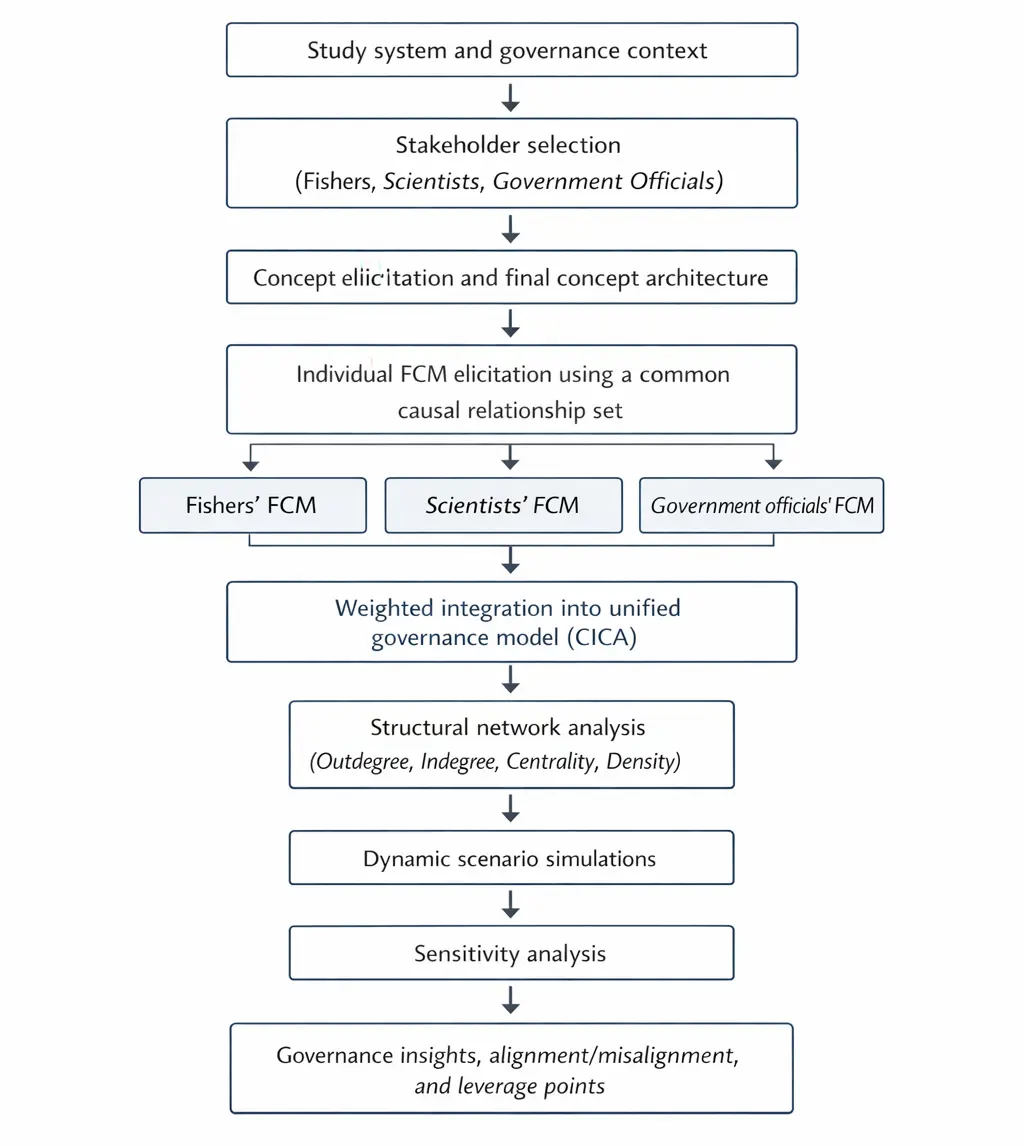
Figure 1. Methodological workflow used to construct and analyse stakeholder-specific and unified Fuzzy Cognitive Maps within the CICA framework. The workflow begins with the definition of the study system and stakeholder selection, followed by concept elicitation and individual FCM assessment using a common set of governance-relevant causal relationships. Stakeholder responses were aggregated into group-specific adjacency matrices, which were then integrated into a unified governance model. The resulting models were analysed through structural metrics, dynamic scenario simulations, and sensitivity analysis in order to identify governance leverage points, cross-stakeholder convergence and divergence, and system-level implications for adaptive marine governance.
Within each stakeholder group, individual responses were aggregated using arithmetic means to construct group-level adjacency matrices for fishers, scientists, and government officials. This procedure produced stakeholder-specific causal models that retained differences in emphasis and perceived system structure while allowing direct comparison across groups. The arithmetic mean was selected to generate a group-level representation of shared stakeholder judgement while preserving comparability across respondents exposed to the same elicitation instrument and candidate relationship set.
All participants were assessed using the same final elicitation instrument and the same pre-screened set of causal relationships. This ensured that differences across stakeholder groups reflected variation in perceived causal direction and strength rather than differences in questionnaire structure or concept exposure. Individual responses were then aggregated within each stakeholder group to produce directly comparable group-level adjacency matrices.
Causal strength was elicited using a seven-point fuzzy linguistic scale and transformed into numerical values over the interval [−1, +1] as follows: very strong negative = −1.00; strong negative = −0.66; moderate negative = −0.33; neutral = 0.00; moderate positive = +0.33; strong positive = +0.66; and very strong positive = +1.00.
2.6. Integration of Stakeholder Models
To support system-level analysis, the three stakeholder-specific adjacency matrices were integrated into a unified governance matrix using a weighted linear fusion procedure within the CICA framework [20,22]. No optimisation or machine-learning algorithm was applied; the procedure consisted of a predefined weighted aggregation of the three stakeholder-specific adjacency matrices. The unified matrix was therefore used as an analytical integration of stakeholder-perceived causal structure rather than as an empirically learned or optimised model.
Let $${W}^{\left(F\right)}$$, $${W}^{\left(S\right)}$$, and $${W}^{\left(G\right)}$$ denote the adjacency matrices for fishers, scientists, and government officials, respectively. The unified matrix $${W}^{\left(U\right)}$$ was defined as:
|
```latex{W}^{\left(U\right)}={\beta }_{F}{W}^{\left(F\right)}+{\beta }_{S}{W}^{\left(S\right)}+{\beta }_{G}{W}^{\left(G\right)}``` |
subject to:
|
```latex{\beta }_{F}+{\beta }_{S}+{\beta }_{G}=1``` |
In the baseline model, near-equal weights were assigned to fishers, scientists, and government officials to reflect a normative co-management assumption. This choice was analytical rather than empirical: it was not intended to reproduce real-world power relations, institutional authority, or decision-making influence in the field. Instead, the purpose was to integrate the three stakeholder perspectives without privileging one group at the aggregation stage and to identify leverage points emerging from the combined stakeholder-perceived causal structure. Alternative weighting schemes were examined in the sensitivity analysis.
2.7. Structural Network Analysis
For concept-level structural analysis, outdegree, indegree, and centrality were calculated using the absolute values of causal weights, so that metric values reflected the magnitude of causal influence regardless of whether effects were reinforcing or inhibiting. This approach was adopted because the objective of the structural analysis was to identify influential and highly connected concepts within each FCM, whereas the direction of causal effects was examined separately through the signed adjacency matrices and dynamic scenario simulations. Network density was calculated using the proportion of non-zero directed links relative to all possible links in the corresponding matrix. For comparative interpretation, concepts with relatively high centrality were treated as structurally prominent governance nodes, while density was used as an indicator of overall causal connectedness across stakeholder-specific and unified models. To characterise the structure of the stakeholder-specific and unified causal networks, three concept-level metrics and one network-level metric were calculated: outdegree, indegree, centrality, and density. These measures are widely used in FCM studies to identify influential nodes, distinguish drivers from receivers, and compare the overall connectedness of alternative cognitive maps [19,20,23,26].
2.7.1. Outdegree
Outdegree measures the cumulative magnitude of influence that a concept exerts on other concepts:
|
```latexO{D}_{i}=\sum _{j=1}^{N}\mid {w}_{ij}\mid``` |
Concepts with high outdegree values were interpreted as potential drivers of system behaviour.
2.7.2. Indegree
Indegree measures the cumulative magnitude of influence received by a concept from the rest of the network:
|
```latexI{D}_{i}=\sum _{j=1}^{N}\mid {w}_{ji}\mid``` |
Concepts with high indegree values were interpreted as outcome-sensitive or response-oriented variables.
2.7.3. Centrality
Concept-level centrality was calculated as the sum of indegree and outdegree:
|
```latex{C}_{i}=O{D}_{i}+I{D}_{i}``` |
High-centrality concepts were interpreted as structurally important nodes with potential leverage for governance intervention. In the Results section, this standard FCM centrality measure is reported using the label Causal Centrality Index (CCI). The term is used here as a reporting convention for concept-level structural prominence rather than as a distinct or novel graph-theoretic metric. Thus, for each concept i, CCIi = IDi + ODi, where IDi and ODi are the indegree and outdegree values calculated from the absolute causal weights.
2.7.4. Network Density
Network density was calculated as the proportion of realised causal links relative to the total number of possible directed links:
|
```latexD=\frac{L}{N\left(N-1\right)}``` |
where $$L$$ is the number of non-zero links and $$N$$ is the number of concepts. Higher density values indicate a more tightly connected causal structure.
2.8. Computational Implementation
All matrix construction, network calculations, and iterative simulations were implemented in Python 3.12 [28]. Numerical array operations were performed using NumPy 2.4.3 [29], tabular data handling was performed using pandas 3.0.1 [30], and network-level calculations were supported using NetworkX 3.6.1 [31]. Custom Python routines were used to construct stakeholder-specific and unified FCM adjacency matrices, calculate structural metrics, implement the FCM update rule, apply scenario perturbations, and perform convergence checks. To support reproducibility, all reported structural metrics, scenario simulations, and sensitivity checks were generated using this computational environment.
2.9. Dynamic Simulation Framework
Dynamic simulations were conducted for both stakeholder-specific and unified FCMs to examine how the governance system responds to alternative intervention pathways and disturbance conditions. The system state at time $$t$$ was represented by the activation vector:
|
```latexA\left(t\right)=\left[{A}_{1}\left(t\right),{A}_{2}\left(t\right),\dots ,{A}_{N}\left(t\right)\right]``` |
where each $${A}_{i}\left(t\right)$$ denotes the activation level of the concept $$i$$ on the interval [0, 1].
Unless directly perturbed by a scenario, all concepts were initialised at a neutral baseline value of 0.5, following common practice in governance-oriented FCM simulations to avoid biasing trajectories toward predefined states [20,24]. System dynamics were updated synchronously according to the standard iterative FCM update rule [19,20,25,26,27]:
|
```latex{A}_{i}^{\left(t+1\right)}=f\left({A}_{i}^{\left(t\right)}+\sum\nolimits _{j=1}^{N}{w}_{ji}{A}_{j}^{\left(t\right)}\right)``` |
where $${w}_{ji}$$ is the causal influence of the concept $$j$$ on concept $$i$$, and $$f\left(x\right)$$ is a sigmoid transfer function:
|
```latexf\left(x\right)=\frac{1}{1+{e}^{-\lambda x}}``` |
The simulations used the modified FCM update rule of Papageorgiou et al. [27], in which the previous activation level $${A}_{i}^{\left(t\right)}$$ is explicitly retained in the updating process, thereby incorporating memory of each concept’s prior state.
The sigmoid parameter was set to $$\lambda =1.0$$, representing a balanced response between excessive damping and over-amplification of causal inputs and providing stable bounded dynamics under repeated iteration [24,25,26,27]. Simulations were run for a maximum of 100 iterations or until convergence, defined as a maximum absolute difference below ε = 10−4 between successive activation vectors. This stopping rule was adopted to ensure numerical stability and comparability across stakeholder-specific and unified models.
The simulations are interpreted as model-based explorations of stakeholder-perceived governance dynamics rather than empirical forecasts.
2.10. Governance Scenarios
Five scenarios were designed to represent contrasting governance interventions or disturbance conditions relevant to small-scale fisheries and marine resource governance. Each scenario was implemented as a one-step exogenous perturbation applied at the initial iteration ($$t=0$$), after which system behaviour evolved endogenously through the network update rule.
Positive perturbations were implemented as an increase of +0.30 above baseline activation, while negative perturbations were implemented as a decrease of −0.30 below baseline activation. Given the baseline value of 0.5, positively perturbed concepts were initialised at 0.8 and negatively perturbed concepts at 0.2. All non-target concepts remained at baseline (0.5). This perturbation magnitude was selected as a moderate intervention strength sufficient to generate visible but non-saturating system responses across scenarios [20,24,25].
The five scenarios were defined as follows:
- S1.
- Enhanced Environmental Change Sensitivity
Positive perturbation of Environmental Change Sensitivity (C4), representing increased stakeholder and institutional responsiveness to environmental variability and ecological signals. This scenario does not treat C4 as monitoring itself, but as the system’s perceived sensitivity to environmental change and its capacity to recognise environmentally driven shifts relevant to governance.
- S2.
- Strengthened collaboration
Positive perturbation of Collaboration (C9) and Community Education (C10), representing participatory governance, social learning, and knowledge co-production.
- S3.
- Increased enforcement
Positive perturbation of Enforcement (C5) and Regulatory Coherence (C6), representing a compliance-oriented governance strategy.
- S4.
- Institutional trust erosion
Negative perturbation of Institutional Trust (C7), representing declining legitimacy and confidence in governing institutions.
- S5.
- Ecological stress event
Negative perturbation of Ecological Stability (C1) combined with positive perturbation of Environmental Change Sensitivity (C4), representing an external ecological shock under heightened environmental stress.
Scenario effects were evaluated by comparing resulting steady-state activation patterns across stakeholder-specific and unified models. In the Results section, scenario effects are reported as directional changes in steady-state concept activation relative to the corresponding baseline equilibrium configuration.
2.11. Sensitivity Analysis
A limited sensitivity analysis was conducted to assess the robustness of the unified model to key modelling assumptions.
First, stakeholder fusion weights were varied across alternative weighting schemes to test whether the ranking of highly central concepts and the qualitative direction of scenario responses remained stable. In addition to the baseline near-equal weighting scheme ($${\beta }_{F}=0.34$$, $${\beta }_{S}=0.33$$, $${\beta }_{G}=0.33$$), two alternative schemes were examined: a Fisher-emphasised configuration (0.50, 0.25, 0.25) and a government-emphasised configuration (0.25, 0.25, 0.50).
Second, the sigmoid slope parameter was varied across λ = 0.5, 1.0, and 2.0 to evaluate whether the main qualitative conclusions were sensitive to the steepness of the activation function. The baseline value used in the main simulations was included within this range. These values were selected to span lower, intermediate, and higher nonlinearity regimes commonly used in FCM simulations [24,25,26,27].
Sensitivity analysis focused on the stability of the most central concepts and the comparative pattern of responses across the five governance scenarios. The objective was not to eliminate all parameter dependence, but to assess whether the principal interpretive findings were robust to plausible variation in the main modelling assumptions.
2.12. Analytical Outputs
Outputs were used to evaluate both structural properties of the networks and model responses under scenario conditions. Structural outputs included concept-level outdegree, indegree, and centrality (reported in the Results as the Causal Centrality Index, CCI), together with network density. Dynamic outputs consisted of changes in concept activation values under each scenario relative to baseline equilibrium conditions. These outputs were used to identify influential governance nodes, diagnose potential bottlenecks, and compare how different intervention logics propagate through stakeholder-specific and unified models.
3. Results
3.1. Overview of Stakeholder-Specific Fuzzy Cognitive Maps
The stakeholder-specific Fuzzy Cognitive Maps reveal three coherent yet substantively distinct causal architectures, reflecting differentiated cognitive–institutional interpretations of governance within the same socio-ecological system. Across all stakeholder groups, Ecological Stability (C1), Collaboration (C9), and Community Education (C10) emerge as foundational components of sustainable management. Beyond this shared recognition, however, the internal causal organization of each map diverges markedly.
Fishers primarily framed governance in terms of livelihood security and stewardship concerns, whereas scientists emphasized ecological feedback and environmental sensitivity. Government officials, by contrast, focused more strongly on enforcement and regulatory coherence.
These differences indicate that governance cognition is contextually shaped by institutional position and epistemic orientation, consistent with the assumptions of the CICA framework. The stakeholder-specific causal structures are illustrated in Figure 2.
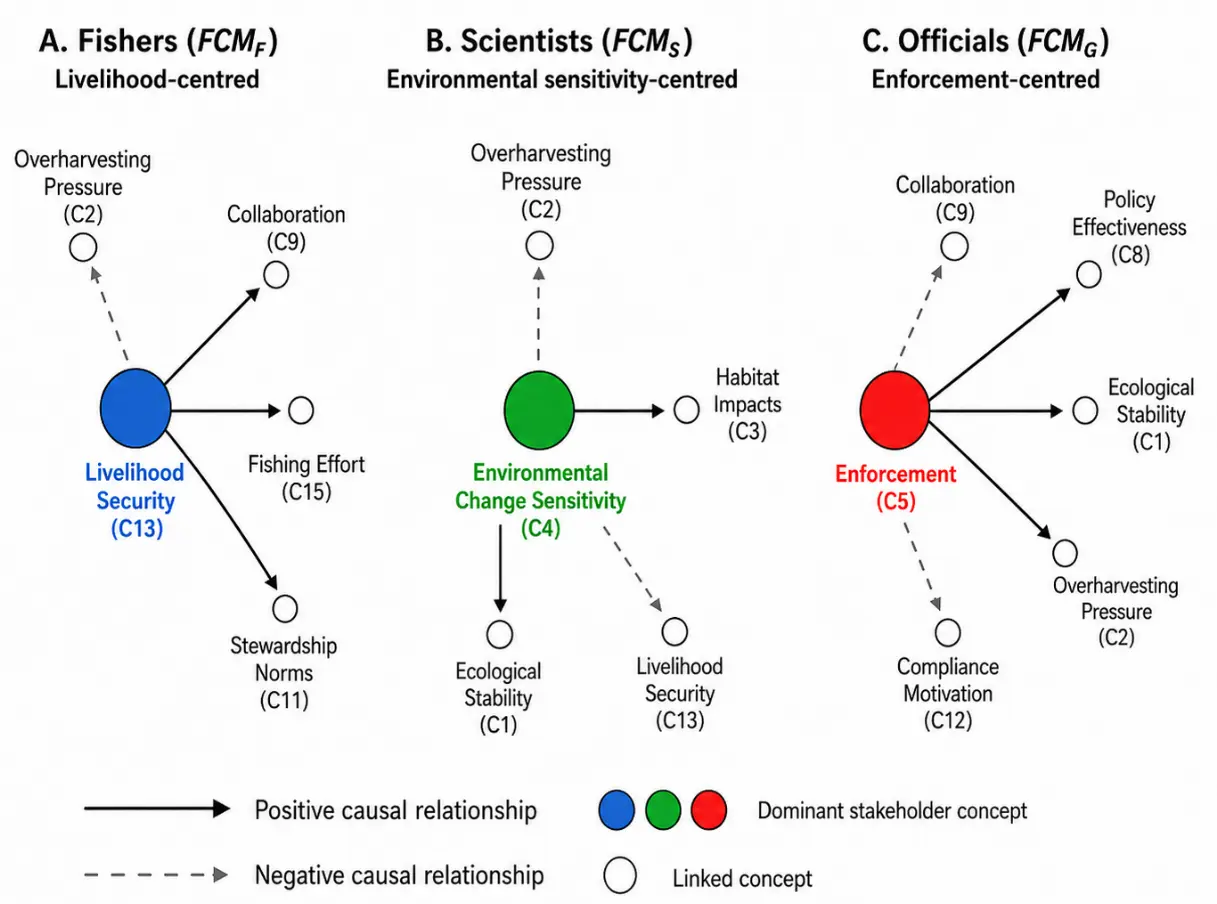
Figure 2. Stakeholder-specific Fuzzy Cognitive Maps (FCMs) of P. radiata governance. The figure shows the dominant causal architecture identified within each stakeholder group: (A) fishers, (B) scientists, and (C) government officials. Nodes correspond to the formal C1–C16 concepts defined in Table 1, and directed edges represent stakeholder-perceived causal relationships. Only high-strength causal relationships (|w| > 0.6) are displayed to enhance clarity and highlight differences in stakeholder-specific governance logics. In the fishers’ model, Livelihood Security (C13) occupies a prominent position; in the scientists’ model, Environmental Change Sensitivity (C4) and Ecological Stability (C1) are central; and in the government officials’ model, Enforcement (C5) and Regulatory Coherence (C6) structure the dominant institutional pathway.
To identify the concepts that play a structurally dominant role in each governance model, a Causal Centrality Index (CCI) analysis was applied to all stakeholder-specific Fuzzy Cognitive Maps and to the unified model. CCI integrates both incoming and outgoing causal influences, allowing comparisons of how different stakeholder groups prioritize socio-economic, ecological, and institutional mechanisms within their cognitive representations of governance. Table 2 presents the most central concepts for each model along with an interpretive summary, highlighting systematic differences in governance logics across stakeholders and the emergence of bridging mechanisms in the unified governance structure.
Table 2. Stakeholder-specific central concepts identified through Causal Centrality Index (CCI) analysis.
|
Stakeholder Group |
Central Concepts |
Governance Interpretation |
|---|---|---|
|
Fishers |
Livelihood Security (C13) Stewardship Norms (C11) Collaboration (C9) |
Governance is perceived primarily through a socio-economic and relational lens, where livelihood stability underpins stewardship behaviour and voluntary compliance. Collaboration is viewed as a mechanism for reinforcing trust, shared responsibility, and long-term resource sustainability. |
|
Scientists |
Ecological Stability (C1) Environmental Change Sensitivity (C4) Habitat Impacts (C3) |
Governance effectiveness is framed in terms of ecological feedback and system dynamics. Scientific reasoning emphasizes monitoring and sensitivity to environmental change as prerequisites for maintaining ecosystem stability and preventing irreversible degradation. |
|
Government officials |
Enforcement (C5) Regulatory Coherence (C6) Policy Effectiveness (C8) |
Governance is conceptualized through regulatory and institutional logic, where rule enforcement and policy coherence are seen as primary levers for achieving compliance and management objectives. |
|
Unified model (FCM-U) |
Collaboration (C9) Ecological Stability (C1) Environmental Change Sensitivity (C4) Community Education (C10) |
When stakeholder perspectives are integrated, governance centrality shifts toward bridging mechanisms that connect ecological feedback with social learning and institutional coordination, highlighting collaboration and information flow as system-wide leverage points. |
3.2. Strongest Causal Links by Stakeholder Group
To identify the causal mechanisms that most strongly structure stakeholder-specific governance perspectives, we examined the highest-magnitude causal relationships within each Fuzzy Cognitive Map. Analysis focused on causal links with absolute weights exceeding a conservative threshold (|w| ≥ 0.66), which captures the dominant interactions shaping system behaviour while preserving model interpretability.
Table 3 summarises the strongest causal relationships identified for each stakeholder group, together with their qualitative interpretation. These high-strength links form the structural backbone of each governance model and reveal how different actors conceptualize leverage, responsibility, and system control within the same socio-ecological context.
Table 3. High-strength causal relationships across stakeholder groups ($$\mid w\mid \mathrm{ }\ge 0.66$$).
|
Stakeholder |
Strong Causal Link |
Weight |
Interpretation |
|---|---|---|---|
|
Fishers |
Community Education → Stewardship Norms |
+0.83 |
Education increases local stewardship. |
|
Fishers |
Collaboration → Compliance Motivation |
+0.78 |
Cooperative governance boosts compliance. |
|
Fishers |
Livelihood Security → Fishing Effort |
+0.71 |
Higher livelihood security supports continued fishing effort by maintaining access to labour, gear, and market participation. |
|
Scientists |
Environmental Change Sensitivity → Ecological Stability |
+0.91 |
Greater sensitivity and responsiveness to environmental change supports ecological stability by improving recognition of ecological signals and adaptive governance responses. |
|
Scientists |
Environmental Change Sensitivity → Habitat Impacts |
+0.88 |
Climate stress increases habitat degradation. |
|
Scientists |
Overharvesting Pressure → Ecological Stability |
−0.79 |
Harvest pressure reduces stability. |
|
Government |
Enforcement → Compliance Motivation |
+0.86 |
Enforcement improves rule adherence. |
|
Government |
Regulatory Coherence → Policy Effectiveness |
+0.88 |
Harmonised regulation increases policy success. |
|
Government |
Institutional Trust → Collaboration |
+0.74 |
Trust enables inter-agency cooperation. |
In addition, Livelihood Security (C13) positively influences Fishing Effort (C15), indicating that greater economic stability may support continued fishing activity by maintaining access to labour, gear, and market participation. This relationship should therefore be interpreted as an activity-maintaining effect rather than as a direct reduction in harvesting pressure.
The dominant causal pathways underlying these stakeholder-specific governance logics are visualized in Figure 3, which highlights the structural backbone of each Fuzzy Cognitive Map.
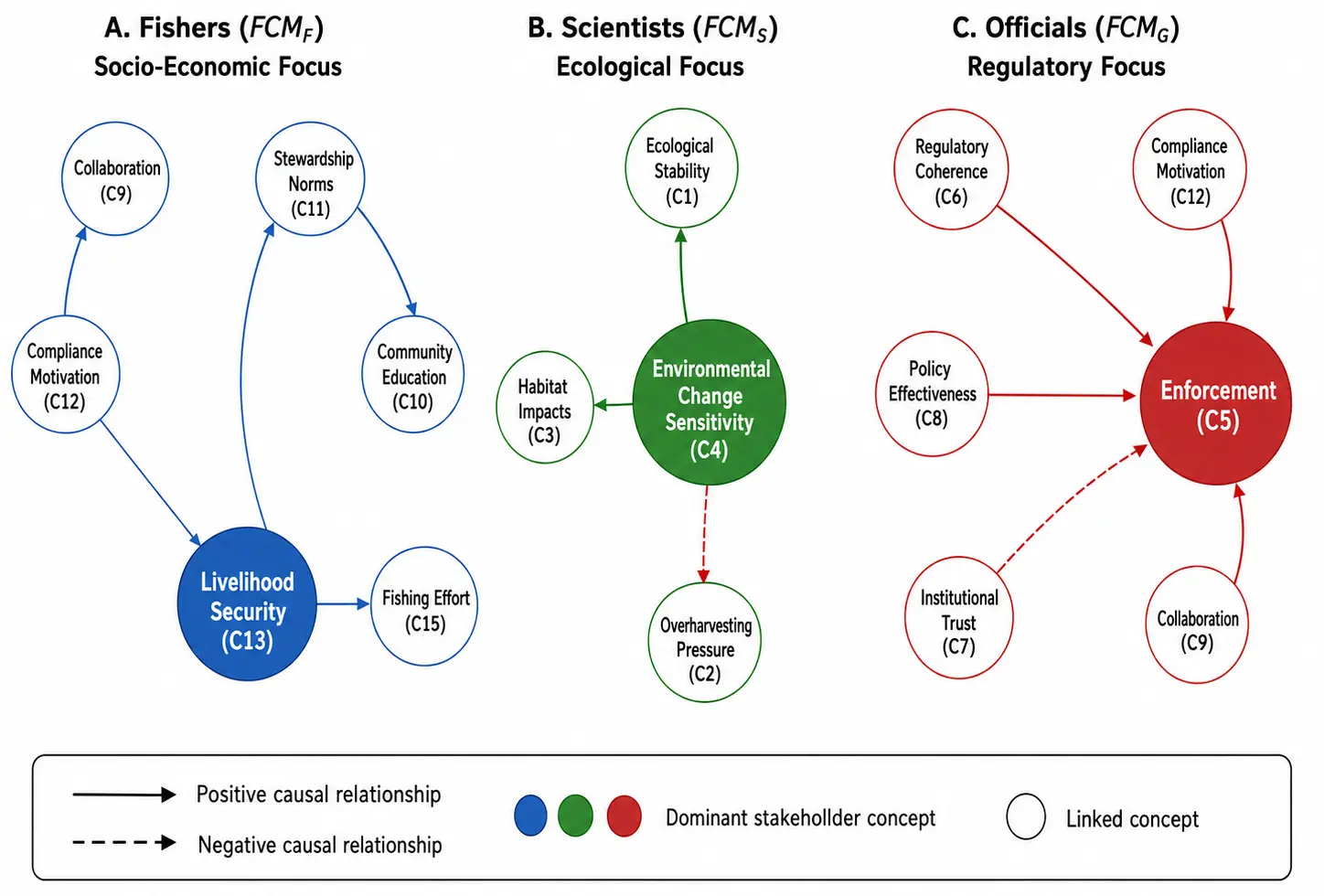
Figure 3. Stakeholder-specific Fuzzy Cognitive Maps revealing divergent governance structures. Visualization of the strongest causal pathways (|w| > 0.6) identified in the stakeholder-specific Fuzzy Cognitive Maps for P. radiata governance. Labels correspond to the formal concept names and codes defined in Table 1. (A) Fishers (FCM_F): The causal structure reflects a socio-economic governance logic anchored in Livelihood Security (C13), which functions as a dominant organising concept linking economic wellbeing to Stewardship Norms (C11), Collaboration (C9), Compliance Motivation (C12), Community Education (C10), and Fishing Effort (C15). (B) Scientists (FCM_S): The topology is ecologically centred, structured around Environmental Change Sensitivity (C4), Ecological Stability (C1), Habitat Impacts (C3), and Overharvesting Pressure (C2), emphasising the role of ecological feedback and responsiveness to environmental variability. (C) Government officials (FCM_G): The causal architecture exhibits a regulatory-focused configuration, with Enforcement (C5) acting as the principal institutional lever linked to Compliance Motivation (C12), Policy Effectiveness (C8), Regulatory Coherence (C6), Institutional Trust (C7), and Collaboration (C9).
Ecological feedback mechanisms dominate the scientists’ model. Environmental Change Sensitivity (C4) is interpreted here as the perceived capacity to recognise and respond to environmental variability and ecological signals. Its positive relationship with Ecological Stability (C1) therefore reflects a stabilising responsiveness mechanism, rather than a direct positive effect of environmental stress on ecosystem stability. These relationships reflect a system-dynamics perspective in which governance effectiveness depends on responsiveness to environmental signals and the management of cumulative ecological stressors.
In contrast, the government officials’ model foregrounds institutional control and coordination mechanisms. Enforcement strongly increases compliance motivation, while regulatory coherence enhances policy effectiveness. Institutional trust further facilitates collaboration, highlighting its role as an enabling condition for effective inter-institutional coordination.
Collectively, these patterns demonstrate that each stakeholder group prioritizes a distinct governance mechanism as the primary source of leverage: social cooperation among fishers, ecological feedback among scientists, and regulatory authority among government officials. The divergence in dominant causal links underscores the importance of integrating heterogeneous cognitive perspectives when designing adaptive and co-management-oriented governance strategies.
3.3. Stakeholder Cognitive Structures: Causal Topology
Differences in stakeholder reasoning were further examined through analysis of the causal topology of the stakeholder-specific Fuzzy Cognitive Maps. Structural properties were quantified using the Causal Centrality Index (CCI), together with in-degree, out-degree, and causal density metrics. These indicators allow systematic comparison of how different stakeholder groups organize causal influence within their governance representations and which concepts occupy structurally dominant positions. Figure 4 summarises the comparative CCI profiles for key governance concepts across stakeholder models, highlighting contrasts in governance priorities and interpretive logics rather than absolute measures of importance.
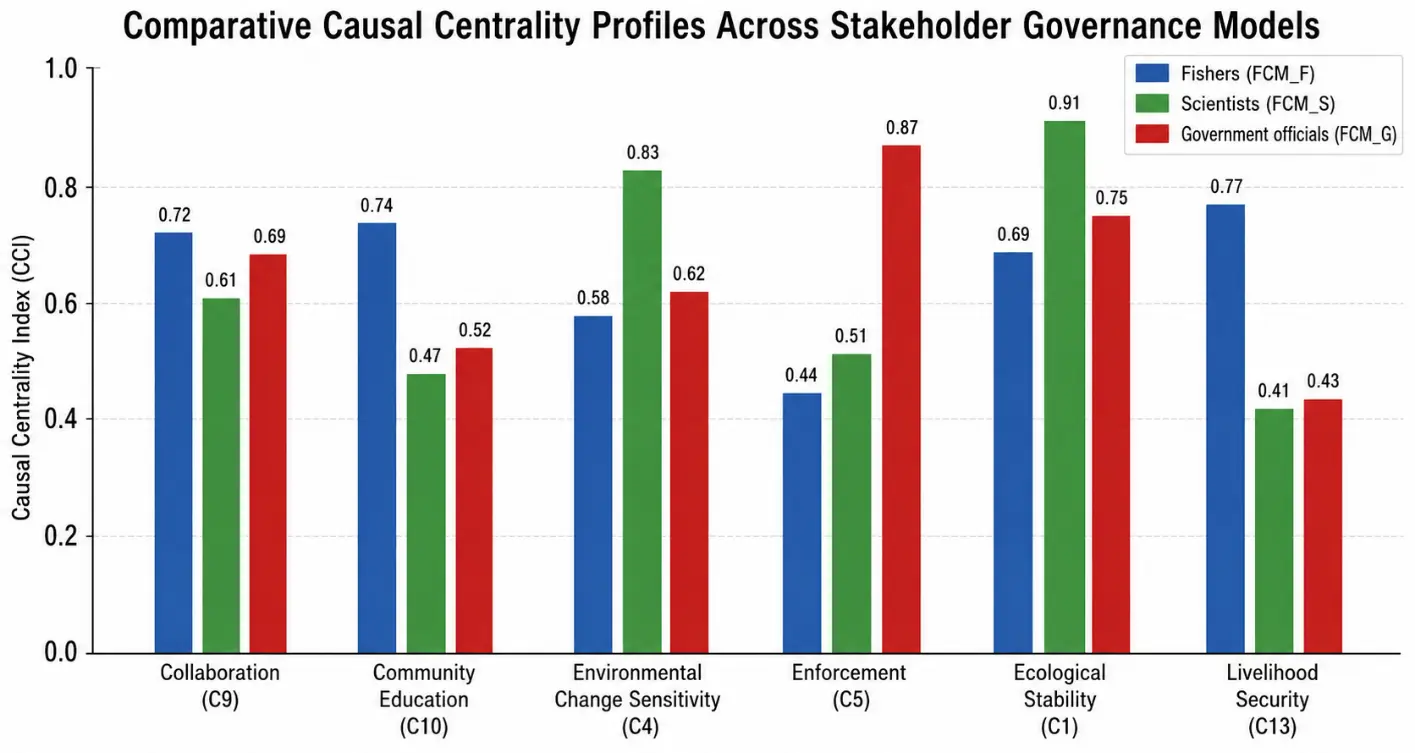
Figure 4. Comparative Causal Centrality Index (CCI) profiles across stakeholder-specific governance models.
The figure compares the relative centrality of selected governance concepts across the stakeholder-specific Fuzzy Cognitive Maps for fishers, scientists, and government officials. Shown concepts are Collaboration (C9), Community Education (C10), Environmental Change Sensitivity (C4), Enforcement (C5), Ecological Stability (C1), and Livelihood Security (C13). The figure highlights systematic differences in governance priorities across stakeholder groups: fishers assign relatively high centrality to Livelihood Security (C13) and Community Education (C10), scientists to Ecological Stability (C1) and Environmental Change Sensitivity (C4), and government officials to Enforcement (C5). Collaboration (C9) remains comparatively central across all three stakeholder groups.
Figure 4 presents the Causal Centrality Index (CCI) for selected governance concepts in the stakeholder-specific Fuzzy Cognitive Maps. Bars represent relative centrality values, allowing direct comparison of structurally influential concepts across governance perspectives. Government officials assign disproportionately high centrality to Enforcement (C5) (CCI = 0.87), reflecting a predominantly regulatory and top-down interpretation of compliance dynamics. In contrast, fishers attribute their highest centrality to Livelihood Security (C13) (CCI = 0.77), underscoring the socio-economic foundations of stewardship behaviour and voluntary rule adherence in small-scale fisheries.
Despite these differences, Collaboration (C9) exhibits consistently high centrality across models, identifying it as a bridging mechanism capable of aligning regulatory objectives with community-based motivations and ecological considerations. This convergence suggests that collaborative processes play a structurally integrative role within the governance system, even where underlying cognitive priorities diverge. Table 4 presents the comparative CCI values across the stakeholder-specific governance models.
Table 4. Comparative Causal Centrality Index (CCI) values across stakeholder-specific governance models.
|
Concept |
CCI (Fishers) |
CCI (Scientists) |
CCI (Government) |
|---|---|---|---|
|
Collaboration |
0.72 |
0.61 |
0.69 |
|
Community Education |
0.74 |
0.47 |
0.52 |
|
Environmental Change Sensitivity |
0.58 |
0.83 |
0.62 |
|
Enforcement |
0.44 |
0.51 |
0.87 |
|
Ecological Stability |
0.69 |
0.91 |
0.75 |
|
Livelihood Security |
0.77 |
0.41 |
0.43 |
The comparative CCI profiles reveal a clear differentiation in how stakeholder group’s structure causal influence within their governance representations. Fishers assign the highest centrality to livelihood security, community education, and collaboration, indicating a governance logic grounded in socio-economic stability and collective action. Scientists prioritize ecological stability and sensitivity to environmental change, reflecting an ecosystem-based reasoning in which governance effectiveness depends on responsiveness to ecological feedback. In contrast, government officials attribute dominant centrality to enforcement, highlighting a predominantly institutional and compliance-oriented governance perspective.
Taken together, these patterns illustrate a systematic divergence in cognitive emphasis across stakeholder groups, consistent with the proposition that governance reasoning is shaped by institutional role and epistemic orientation. Rather than indicating conflicting objectives, this divergence underscores the presence of complementary governance logics that must be integrated to achieve adaptive and resilient management outcomes.
3.4. Integrated Governance Model (FCM-U)
Fusion Results
Application of the weighted linear fusion procedure produced a unified governance matrix that integrates the structural logic of the three stakeholder-specific Fuzzy Cognitive Maps. The resulting unified causal architecture exhibits greater coherence and cross-domain connectivity than the individual models, revealing governance levers that are less apparent when stakeholder perspectives are examined in isolation.
Analysis of the Causal Centrality Index (CCI) in the unified model indicates that a limited set of concepts exerts disproportionate structural influence on overall system dynamics. The most central concepts in the integrated governance model are summarised in Table 5.
Table 5. Most influential concepts in the unified governance model (FCM-U) based on Causal Centrality Index (CCI).
|
Concept |
Unified CCI |
|
|---|---|---|
|
1 |
Ecological Stability (C1) |
0.84 |
|
2 |
Collaboration (C9) |
0.81 |
|
3 |
Environmental Change Sensitivity (C4) |
0.79 |
|
4 |
Community Education (C10) |
0.76 |
|
5 |
Enforcement (C5) |
0.69 |
These results indicate that effective governance in the unified model is simultaneously ecological, collaborative, and information-driven, rather than being dominated by a single institutional or socio-economic mechanism. Ecological stability represents the primary system outcome, while collaboration and community education function as key social conduits through which ecological feedback and institutional interventions are translated into adaptive governance responses. Enforcement retains structural importance but operates most effectively when embedded within broader feedback-rich and trust-dependent governance pathways.
Figure 5 visualises the unified Fuzzy Cognitive Map (FCM-U), illustrating the integrated causal structure of the governance system. Nodes are colour-coded by functional domain (ecological, institutional, cognitive–social, and economic–livelihood), while edge polarity distinguishes reinforcing from inhibitory causal relationships. The topology highlights the central role of Collaboration (C9), Ecological Stability (C1), and Environmental Change Sensitivity (C4), together with the contribution of institutional variables such as Enforcement (C5), Regulatory Coherence (C6), and Policy Effectiveness (C8). Overall, the unified map shows how ecological feedback, social learning, and institutional coordination interact within a shared governance architecture, rather than operating as isolated policy mechanisms.
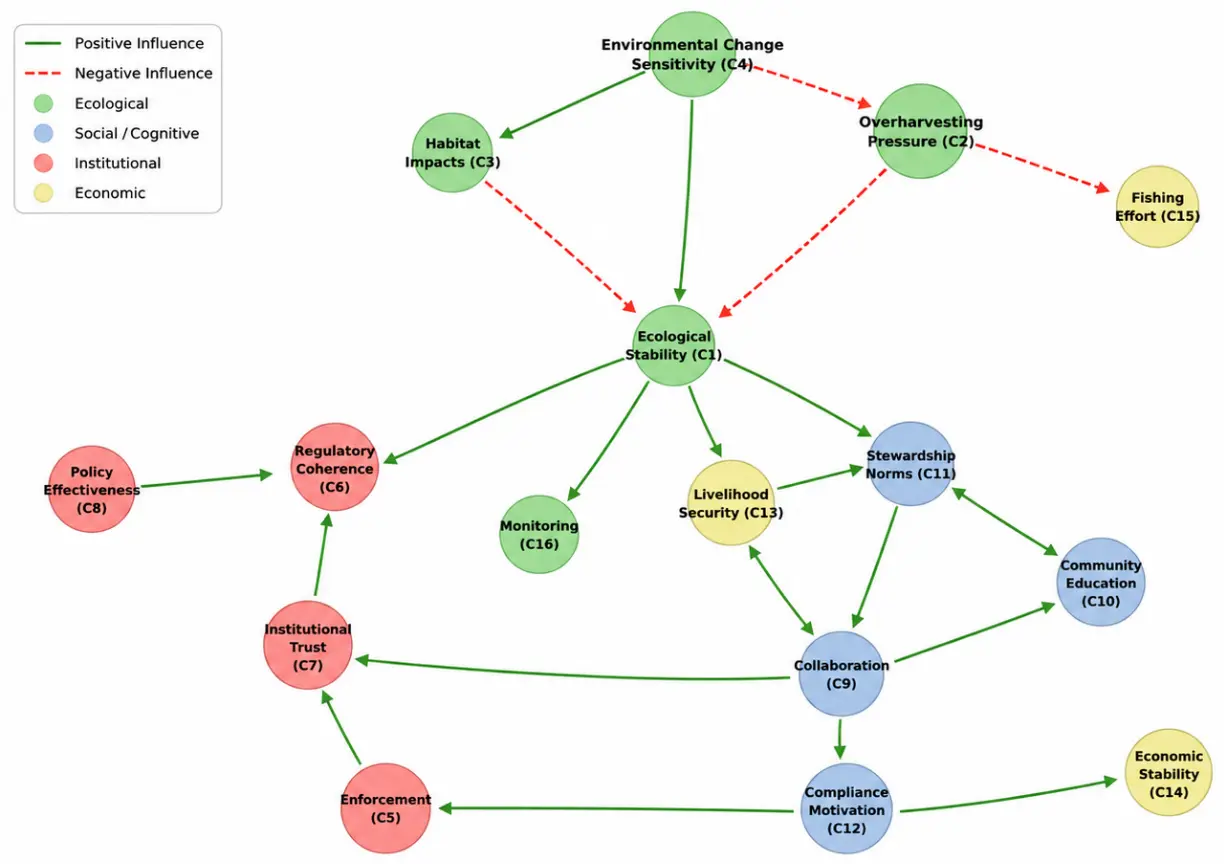
Figure 5. Unified Fuzzy Cognitive Map (FCM-U) for P. radiata governance. Visualization of the integrated governance network generated through the weighted linear fusion procedure. Nodes are colour-coded by functional domain: ecological, institutional, cognitive–social, and economic–livelihood. Directed edges represent perceived causal relationships among the 16 concepts defined in Table 1, with edge polarity distinguishing reinforcing and inhibitory effects. The map highlights the central position of Collaboration (C9), Ecological Stability (C1), and Environmental Change Sensitivity (C4), and illustrates how ecological, institutional, social, and livelihood-related concepts interact within the unified governance model.
3.5. Structural Properties of the Unified FCM
Causal Density
Causal density, defined as the proportion of activated (nonzero) causal relationships relative to all possible links in the network, increases substantially in the unified governance model compared to the stakeholder-specific FCMs:
-
-
Fishers: 0.42
-
-
Scientists: 0.51
-
-
Government Officials: 0.47
-
-
Unified model: 0.58
The higher causal density of the unified FCM indicates a more interconnected causal structure, characterised by a greater number of feasible feedback pathways and cross-domain interactions. This increase reflects the integration of ecological, social, and institutional reasoning into a single governance architecture.
The dynamic implications of this increased connectivity are illustrated through scenario-based simulations. Figure 6 presents the internal dynamics under a collaboration-focused intervention (Scenario 2), while Figure 7 contrasts the time-series behaviour of collaborative versus enforcement-centred governance pathways.
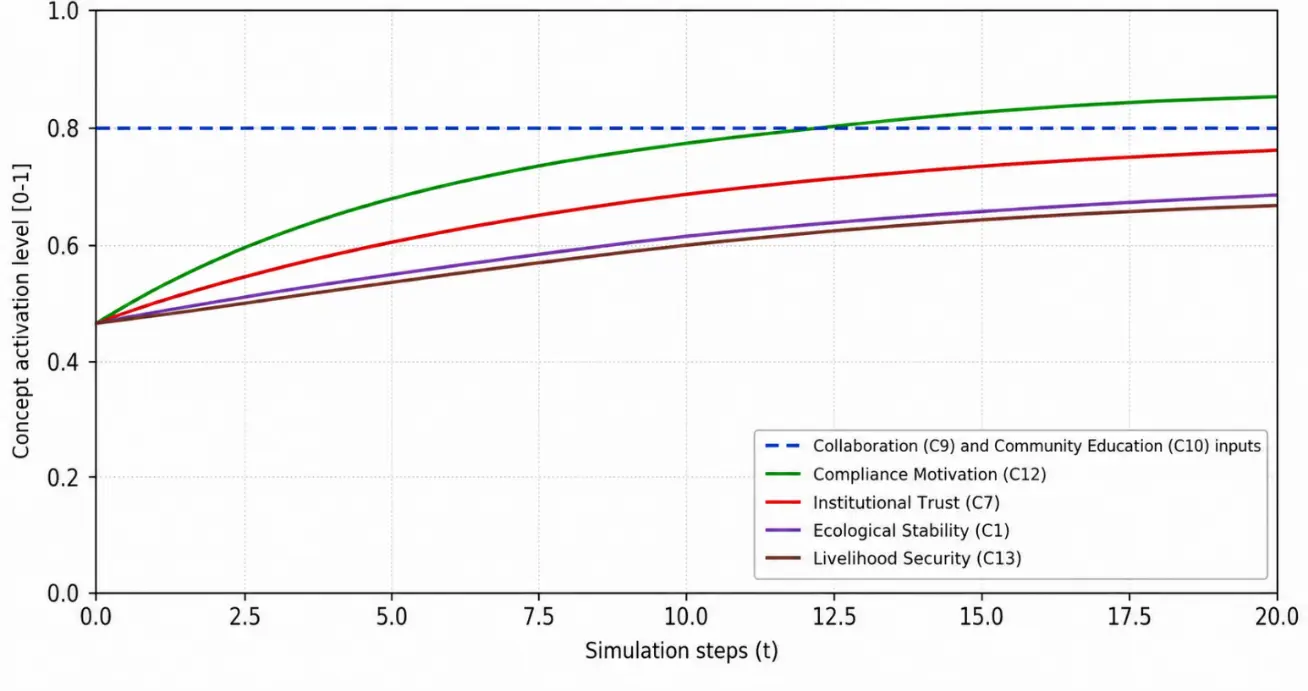
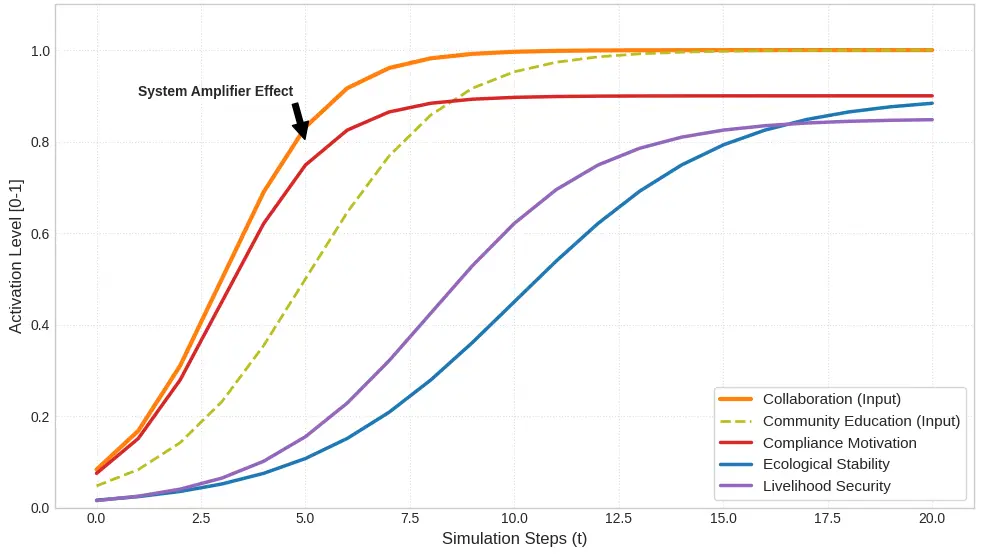
Time-series simulation results showing the response of the unified FCM to positive perturbations of Collaboration (C9) and Community Education (C10). Dashed lines represent the externally activated scenario inputs, while solid lines depict endogenous responses of selected governance and socio-ecological variables. Strengthened collaboration is associated with increases in Compliance Motivation (C12), Institutional Trust (C7), Ecological Stability (C1), and Livelihood Security (C13), indicating reinforcing feedback through which social cooperation and community learning support broader governance performance.
Under Scenario 2, positive perturbation of Collaboration (C9) and Community Education (C10) generated reinforcing responses across social, institutional, ecological, and livelihood-related variables. Compliance Motivation (C12) and Institutional Trust (C7) increased rapidly, while Ecological Stability (C1) and Livelihood Security (C13) showed more gradual positive responses. These trajectories indicate that collaboration-centred intervention operates as a cross-domain amplifier within the unified model, linking social learning, trust, compliance, and ecological outcomes.
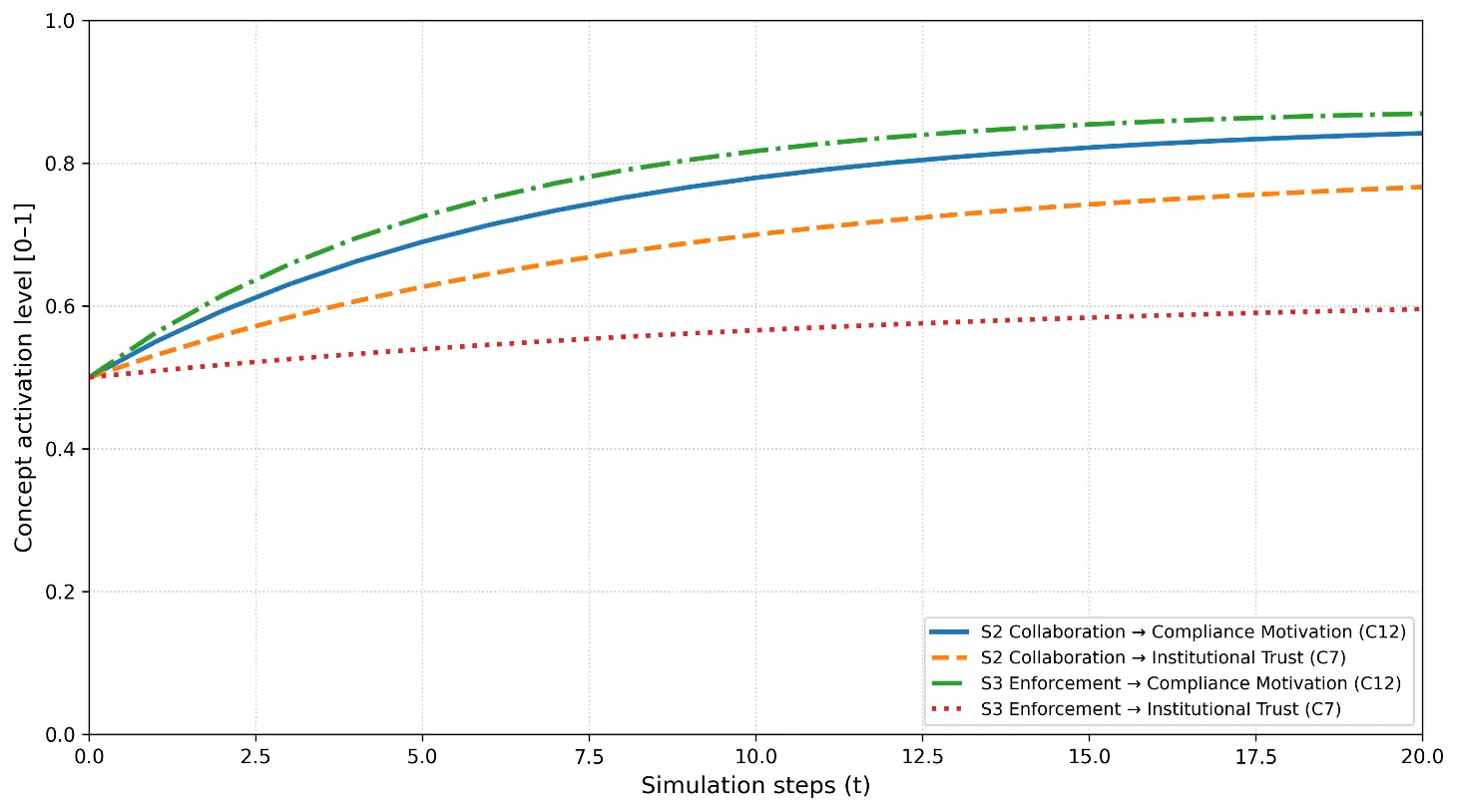
Time-series comparison between Scenario 2, strengthened Collaboration (C9) and Community Education (C10), and Scenario 3, increased Enforcement (C5) and Regulatory Coherence (C6). The figure compares the responses of Compliance Motivation (C12) and Institutional Trust (C7) under the two intervention pathways. Enforcement-centred intervention produces a strong increase in Compliance Motivation (C12), whereas its effect on Institutional Trust (C7) remains limited. In contrast, collaboration-centred intervention generates simultaneous increases in both Compliance Motivation (C12) and Institutional Trust (C7), indicating a broader trust-supported governance response within the unified model.
Figure 7 compares the trajectories of Compliance Motivation (C12) and Institutional Trust (C7) under the collaboration-centred and enforcement-centred scenarios. Both scenarios increase Compliance Motivation (C12), but they differ in their effect on Institutional Trust (C7). The collaboration-centred pathway produces a stronger trust response, whereas the enforcement-centred pathway generates a narrower compliance-oriented effect. This contrast suggests that enforcement may improve short-term rule adherence, while collaboration is more likely to reinforce the social and institutional conditions associated with durable governance performance.
3.6. Scenario Simulations
Dynamic simulations (S1–S5) were conducted to examine system responsiveness under alternative governance intervention pathways. Each scenario represents a plausible governance or ecological perturbation commonly observed in marine socio-ecological systems and allows assessment of short-term responses, longer-term trajectories, and emergent feedback dynamics within the unified Fuzzy Cognitive Map.
3.6.1. Enhanced Environmental Change Sensitivity (Scenario 1)
Increased activation of Environmental Change Sensitivity (C4) generated stabilising responses across the governance system by increasing the modelled responsiveness of stakeholders and institutions to environmental variability and ecological signals. Ecological Stability increased markedly (+0.41), accompanied by improvements in Policy Effectiveness (+0.29) and Collaboration (+0.22). These responses indicate that Environmental Change Sensitivity (C4) functions as a system-level responsiveness mechanism, supporting adaptive governance by aligning institutional responses with environmental signals. The time-series dynamics of Scenario 1 are shown in Figure 8.
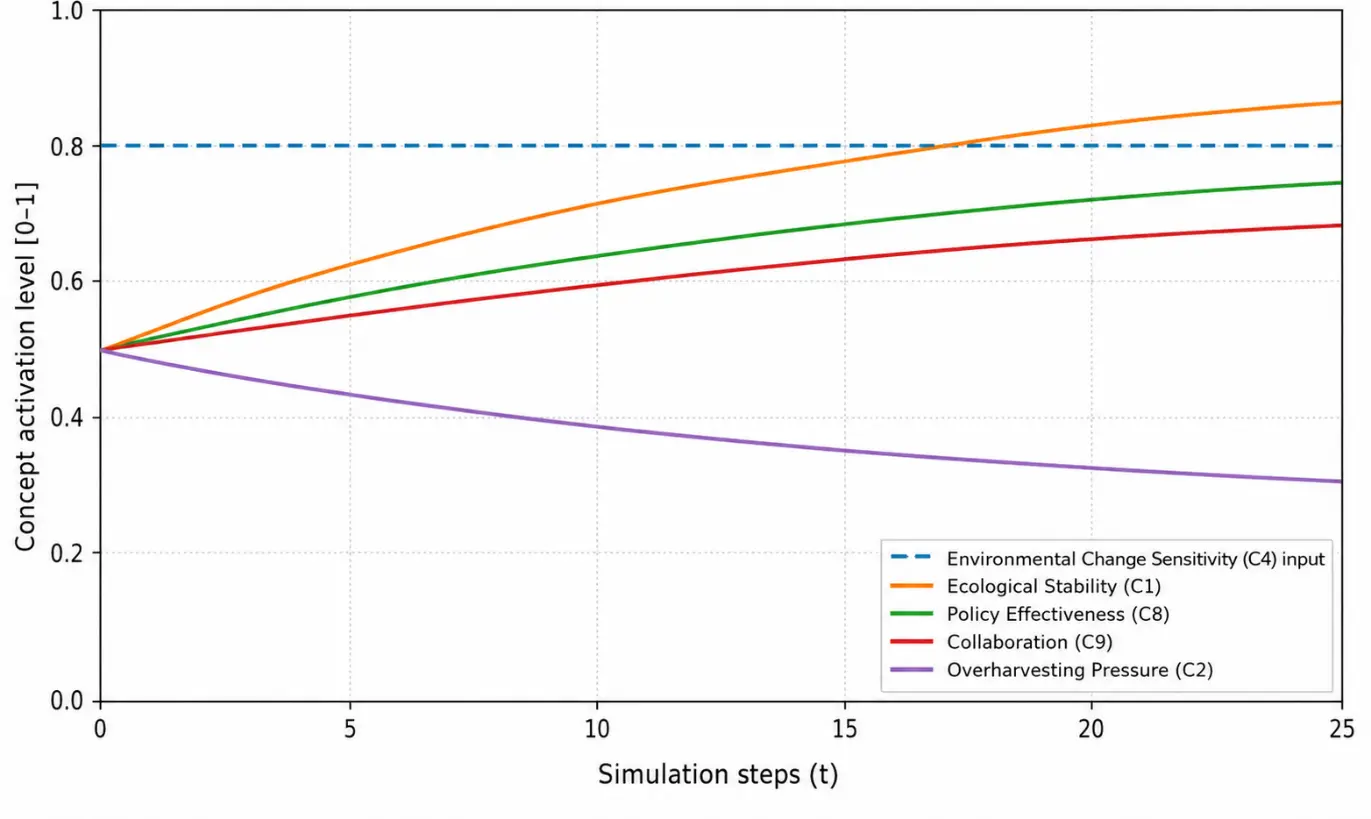
Time-series simulation results illustrating the response of the unified FCM to a positive perturbation of Environmental Change Sensitivity (C4). In this scenario, C4 represents the perceived sensitivity and responsiveness of stakeholders and governance processes to environmental variability and ecological signals, rather than scientific monitoring itself or environmental stress. Increased activation of C4 is associated with higher Ecological Stability (C1), improved Policy Effectiveness (C8), increased Collaboration (C9), and reduced Overharvesting Pressure (C2), indicating a stabilising responsiveness mechanism within the modelled governance system.
3.6.2. Scenario 2: Strengthened Collaboration
Enhanced activation of Collaboration (C9) produced a nonlinear cascade of positive effects across social, institutional, and economic dimensions. Compliance Motivation increased (+0.36), Institutional Trust strengthened (+0.30), and Livelihood Security improved (+0.21). The magnitude and coherence of these responses indicate that collaboration operates as a system amplifier, activating reinforcing feedback loops that simultaneously enhance governance effectiveness and socio-ecological resilience. The corresponding simulation trajectories are presented in Figure 9.
Time-series simulation results for Scenario 2 (Strengthened Collaboration) illustrating system response to increased activation of Collaboration (C9) and Community Education (C10) (inputs). Solid lines represent endogenous responses of governance and socio-ecological variables. Enhanced collaboration triggers a rapid, nonlinear increase in Compliance Motivation (C12), followed by delayed yet sustained gains in Ecological Stability (C1) and Livelihood Security (C13). The staggered convergence of these variables reflects reinforcing feedback loops through which social cooperation amplifies institutional effectiveness and ecological outcomes. The observed dynamics illustrate collaboration operating as a system-level amplifier, activating multiple interconnected pathways rather than functioning as a single causal lever.
3.6.3. Increased Enforcement (Scenario 3)
Increased activation of Enforcement (C5) produced heterogeneous system responses across governance and socio-economic dimensions. Compliance Motivation (C12) increased (+0.38), indicating improved short-term rule adherence. However, these gains were accompanied by reductions in Fishing Effort (C15) (−0.17) and Livelihood Security (C13) (−0.09), alongside only marginal improvement in Institutional Trust (C7) (+0.12). Notably, the rapid increase in compliance motivation reflects a short-term behavioral response to coercive incentives, whereas the limited gains in trust and declining livelihood security indicate weaker long-term governance sustainability. The time-series response under Scenario 3 is shown in Figure 10.
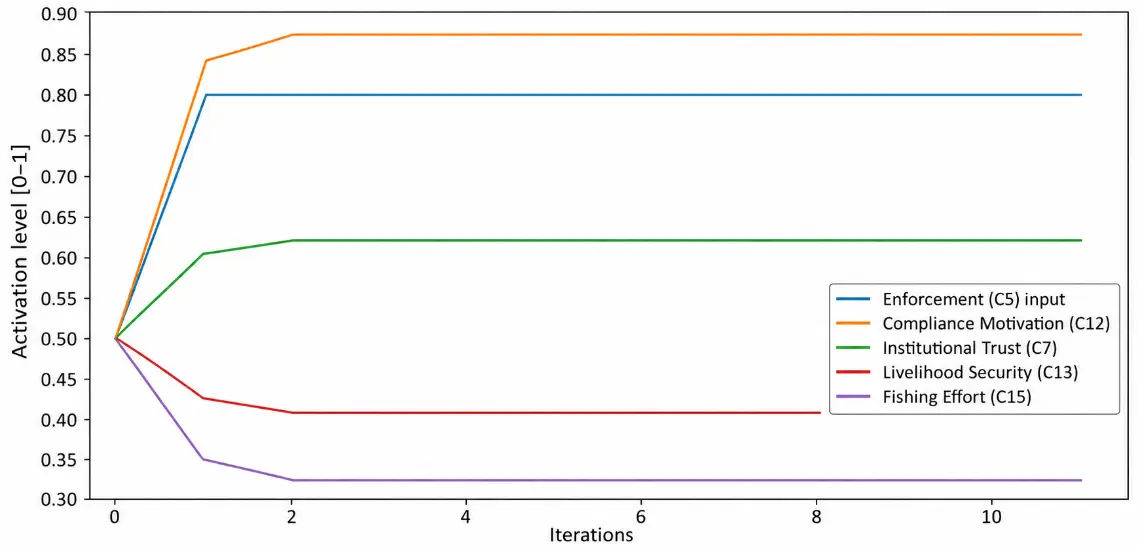
Time-series simulation results illustrating the response of the unified FCM to a positive perturbation of Enforcement (C5). The figure shows the externally activated enforcement intervention together with endogenous responses of Compliance Motivation (C12), Institutional Trust (C7), Livelihood Security (C13), and Fishing Effort (C15). Increased enforcement produces a rapid increase in Compliance Motivation (C12), while Institutional Trust (C7) shows only limited improvement. At the same time, Livelihood Security (C13) and Fishing Effort (C15) decline, indicating a trade-off between short-term compliance gains and socio-economic stability within the modelled governance system.
Under Scenario 3, increased activation of Enforcement (C5) generated a strong short-term increase in Compliance Motivation (C12). However, this response was accompanied by weaker improvement in Institutional Trust (C7) and declines in Livelihood Security (C13) and Fishing Effort (C15). These trajectories indicate that enforcement-centred intervention can strengthen rule adherence but may also generate socio-economic trade-offs if not combined with trust-building and collaborative mechanisms.
Together, these dynamics illustrate a classical enforcement trade-off, in which coercive governance mechanisms enhance compliance but may simultaneously weaken socio-economic stability and constrain longer-term adaptive capacity if not complemented by trust-building and collaborative processes.
3.6.4. Breakdown of Institutional Trust (Scenario 4)
Negative perturbations of Institutional Trust (C7) revealed it as a highly fragile, system-critical node. Trust erosion led to substantial declines in Collaboration (−0.33), Policy Effectiveness (−0.28), and Ecological Stability (−0.19), indicating cascading destabilization across governance and ecological domains. This scenario highlights the sensitivity of the system to legitimacy loss and the central role of trust in maintaining coherence, as shown in Figure 11.
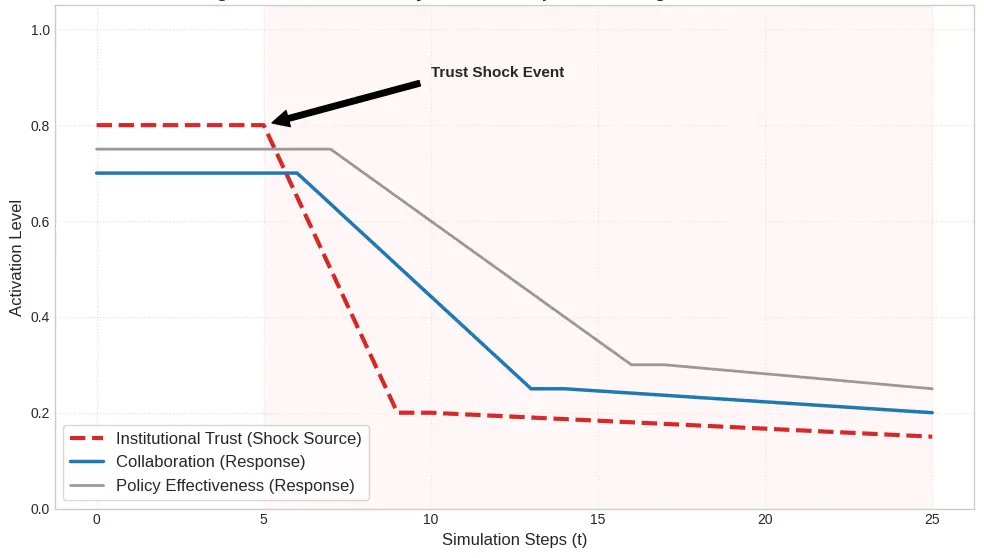
Time-series simulation results for Scenario 4 (Breakdown of Institutional Trust) illustrating system response to a negative perturbation of Institutional Trust (C7). The dashed red trajectory represents the exogenous trust shock, while solid lines depict endogenous responses of Collaboration (C9) and Policy Effectiveness (C8). The abrupt decline in institutional trust triggers cascading reductions in collaborative capacity and governance effectiveness, thereby activating destabilising feedback mechanisms. The sustained low activation levels following the shock indicate limited endogenous recovery, highlighting institutional trust as a structurally fragile and system-critical node within the governance network.
Institutional Trust behaved as a system-critical and vulnerable node in the unified model: under Scenario 4, trust erosion triggered declines in Collaboration (−0.33), Policy Effectiveness (−0.28), and Ecological Stability (−0.19), indicating cascading destabilisation across governance and ecological domains.
3.6.5. Ecological Stress Event (Scenario 5)
Simulated ecological shock through reduced Ecological Stability (C1) combined with heightened Environmental Change Sensitivity (C4) resulted in rapid system degradation. Habitat Impacts increased (+0.27), Overharvesting Pressure intensified (+0.19), and Livelihood Security declined (−0.23). In the absence of compensatory institutional or collaborative buffering mechanisms, the system converged toward a low-resilience equilibrium, characterised by ecological stress and socio-economic vulnerability. The time-series response under Scenario 5 is presented in Figure 12.
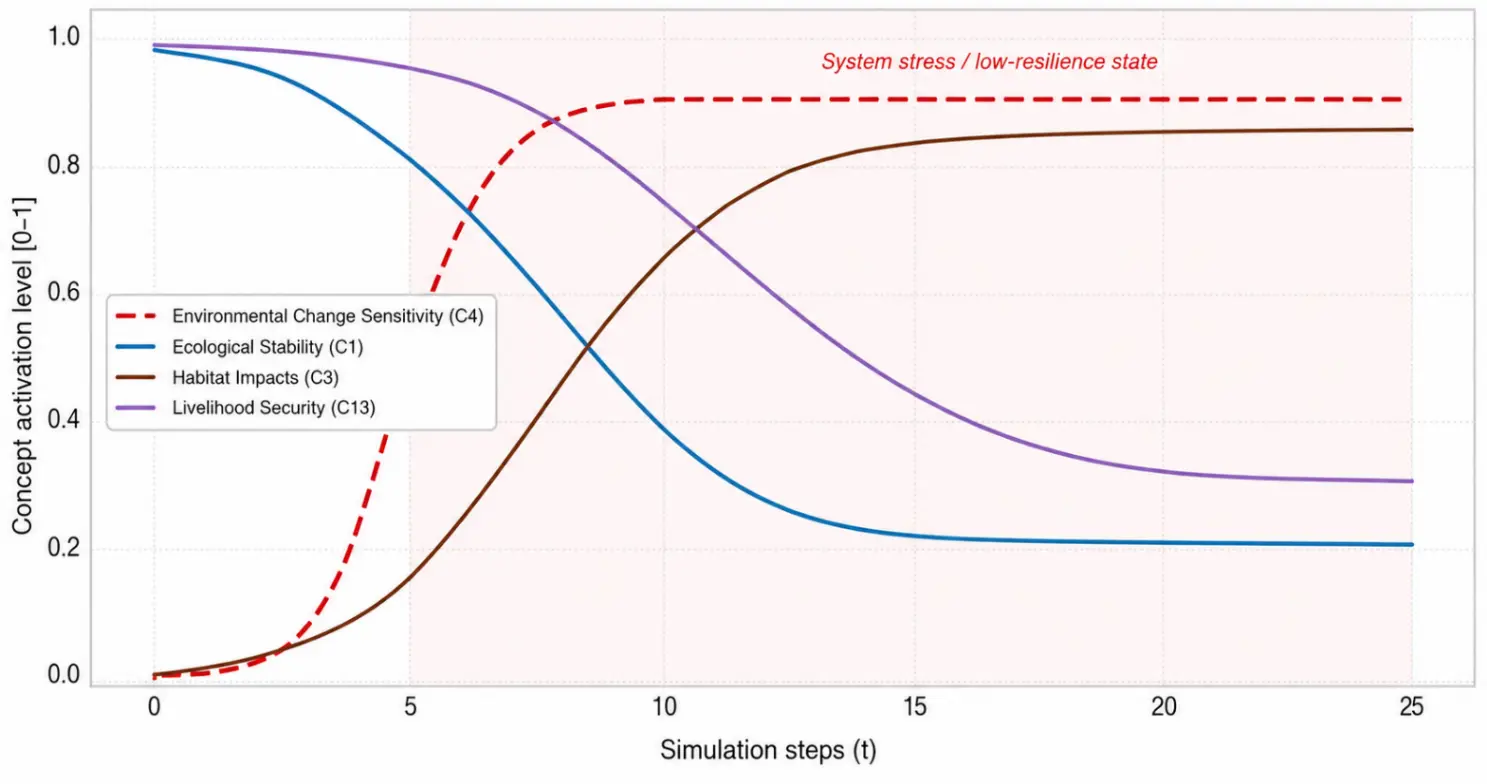
Time-series simulation results illustrating the response of the unified FCM to reduced Ecological Stability (C1) combined with increased Environmental Change Sensitivity (C4). The dashed trajectory represents the positive perturbation of in Environmental Change Sensitivity (C4) under the ecological stress-event scenario, while the solid lines depict endogenous responses of Ecological Stability (C1), Habitat Impacts (C3), and Livelihood Security (C13). Increased activation of Environmental Change Sensitivity (C4) in this scenario represents heightened system responsiveness to ecological stress signals, not environmental stress itself. The simulation shows declining Ecological Stability (C1), increasing Habitat Impacts (C3), and reduced Livelihood Security (C13), indicating a stressed system configuration under limited collaborative and institutional buffering.
Figure 13 provides the final unified FCM using the standardised C1–C16 concept set, domain classification, and edge conventions described in the Methods.
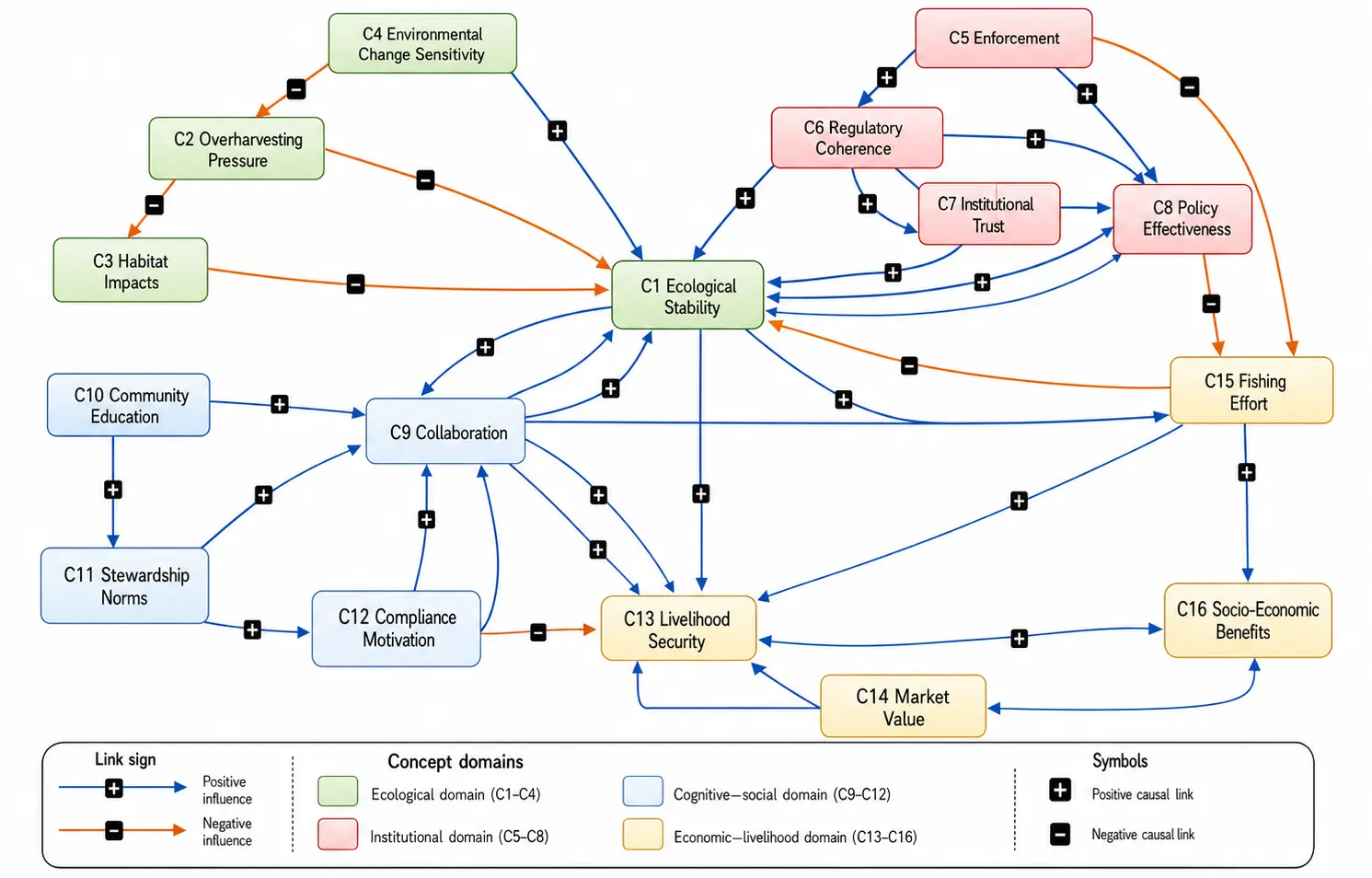
The figure presents the integrated governance model using the standardised C1–C16 concept set defined in Table 1. Nodes are grouped by domain: ecological processes (C1–C4), institutional mechanisms (C5–C8), cognitive–social drivers (C9–C12), and economic–livelihood outcomes (C13–C16). Directed links represent perceived causal relationships in the unified FCM, with positive and negative signs indicating reinforcing and inhibitory causal influences, respectively. The map highlights the central role of Collaboration (C9), Ecological Stability (C1), and Environmental Change Sensitivity (C4), while showing how institutional variables, social learning mechanisms, and livelihood-related concepts interact within the integrated governance architecture.
3.7. Cross-Scenario Synthesis
Comparative analysis across all simulated governance scenarios reveals a consistent pattern in system responsiveness. Collaboration (C9), Environmental Change Sensitivity (C4), and Community Education (C10) repeatedly emerge as high-leverage governance nodes, whose activation generates stabilizing feedback across ecological, institutional, and socio-economic domains. Rather than operating as isolated interventions, these mechanisms function synergistically by enhancing information flow, social learning, and collective action capacity within the governance system.
In contrast, Institutional Trust (C7) exhibits characteristics of a systemically vulnerable node. Perturbations affecting trust propagate rapidly through the causal network, triggering cascading declines in collaboration, policy effectiveness, and ecological stability. The asymmetric response of the system is robust to moderate enhancements in collaborative and informational mechanisms but highly sensitive to trust erosion, which underscores the central role of legitimacy and confidence in sustaining adaptive governance.
Together, these findings indicate that governance effectiveness in complex socio-ecological systems is less dependent on singular regulatory instruments and more contingent on maintaining feedback-rich, trust-supported processes that integrate ecological signals with collective decision-making. Comparison between stakeholder-specific and unified maps indicates a shift from group-specific priorities toward bridging mechanisms: whereas fishers emphasised livelihood security and collaboration, scientists emphasised ecological sensitivity, and government officials emphasised enforcement, the unified model elevated Collaboration, Environmental Change Sensitivity, and Community Education as system-wide leverage points. Analysis of the unified model shows that governance influence is concentrated in a limited set of cross-domain concepts. Collaboration (CCI = 0.81), Environmental Change Sensitivity (CCI = 0.79), and Community Education (CCI = 0.76) rank immediately below Ecological Stability (CCI = 0.84), whereas Enforcement, although still important, occupies a lower position (CCI = 0.69). This pattern indicates that the integrated governance structure is organised less around a single regulatory lever and more around mechanisms that connect ecological feedback, social learning, and coordinated action.
All scenarios examined represent stylized governance interventions in which mechanisms are activated in isolation. While this approach facilitates causal interpretation, real-world governance typically combines enforcement, collaboration, and informational instruments. Future extensions of the model should explore mixed-intervention scenarios to assess interaction effects among governance strategies.
4. Discussion
The stakeholder-specific FCMs show that fishers, scientists, and government officials converge on Ecological Stability (C1) as a shared governance objective, but differ in the causal pathways they believe can achieve it. Fishers emphasise Livelihood Security (C13), Collaboration (C9), and socially grounded compliance; scientists prioritise Environmental Change Sensitivity (C4), Habitat Impacts (C3), and ecological feedback; while government officials assign greater importance to Enforcement (C5), Regulatory Coherence (C6), and Policy Effectiveness (C8). This pattern is consistent with social–ecological systems and adaptive governance scholarship, which treats governance outcomes as emergent from interactions among actors, institutions, and ecological dynamics rather than as the direct product of isolated policy instruments [32,33,34]. These differences should not be interpreted as direct evidence of stable underlying psychological motivations, but rather as structured governance-oriented interpretations articulated within specific institutional and socio-ecological contexts [32,33].
The comparison across stakeholder-specific maps suggests that the central governance challenge is not the absence of a shared objective, but the coexistence of different causal interpretations of how that objective should be pursued. This finding aligns with broader work on knowledge systems and environmental governance, showing that actors embedded in different institutional and experiential contexts often organise environmental problems through partially different epistemic frames [35,36,37]. In the present case, divergence is consequential because the model indicates that interventions grounded in one governance logic may produce weak, incomplete, or countervailing responses when interpreted through another.
This tension is especially visible in the contrast between collaboration-centred and enforcement-centred intervention pathways. In the scenario analysis, strengthened collaboration generated positive cross-domain responses, including higher compliance motivation, stronger institutional trust, and improved livelihood security, whereas the enforcement scenario produced a narrower response profile in which compliance increased but gains in trust remained limited and livelihood security declined. Under the assumptions of the model, this suggests that enforcement may strengthen short-term rule adherence without necessarily reinforcing the social and institutional conditions associated with more durable governance performance. This interpretation is consistent with the literature, which shows that compliance is shaped not only by deterrence but also by legitimacy, trust, perceived fairness, and the broader governance environment in which rules are implemented [37,38,39,40].
A related finding is the prominent structural role of collaboration in both the stakeholder-specific and unified models. In the unified map, collaboration, community education, and environmental change sensitivity remain among the most central concepts, while scenario-based activation of collaboration produces reinforcing effects across institutional, social, and ecological variables. Within this modelling architecture, collaboration functions as a connective mechanism linking domains that are otherwise only partially aligned. This should not be interpreted as evidence that collaboration is universally superior in all governance settings. Rather, in this case, it indicates that participatory and learning-oriented mechanisms occupy positions in the causal structure from which they can influence multiple governance pathways simultaneously. That interpretation is compatible with research on adaptive co-management, collaborative governance, and social learning, all of which emphasise the value of coordination, information exchange, and cross-actor problem solving under conditions of uncertainty [32,33,41,42].
The results also draw attention to the importance of institutional trust. In the trust-breakdown scenario, the model produced cascading declines in collaboration, policy effectiveness, and ecological stability, with only limited endogenous recovery once trust was disrupted. Within the present framework, this identifies trust as a fragile but highly consequential governance variable. This reading is plausible considering broader work on legitimacy, procedural justice, fisheries governance, and water governance, where trust is repeatedly shown to influence willingness to cooperate, comply, and remain engaged in collective management processes [37,39,43,44,45]. In this sense, trust appears less as an auxiliary social variable than as a condition that shapes whether governance interventions can be socially absorbed and institutionally sustained.
At the whole-system level, the unified model is more densely connected than the stakeholder-specific models, indicating a richer causal structure with more pathways through which effects may propagate across governance domains. This interpretation should remain cautious. Higher density does not by itself demonstrate greater resilience, nor does it automatically imply better governance. It does, however, suggest that the integrated model captures a broader set of interacting mechanisms than any single stakeholder map alone. In that narrower sense, the unified model offers a more complete representation of governance interdependence. This interpretation is consistent with resilience and complexity scholarship, which emphasises feedback, connectivity, redundancy, and cross-scale interaction as important features of social–ecological systems, while also warning against treating complexity as equivalent to robustness [33,35,42,46].
From a governance design perspective, these findings support a more balanced interpretation of marine management for socio-economically embedded non-indigenous species. The analysis does not suggest that enforcement is unnecessary, nor does it imply that collaboration alone is sufficient. Instead, it indicates that policing-centred strategies may be more effective when embedded within broader arrangements that also support trust, learning, and the integration of ecological feedback. In practical terms, these findings point toward governance designs that combine monitoring, participatory knowledge production, institutional coordination, and sustained community-facing education rather than relying exclusively on top-down control. Similar arguments appear in the literature on adaptive governance and small-scale fisheries, where legitimacy and sustained stakeholder engagement are considered central to the quality of implementation and long-term governability [32,37,41,43].
Several limitations should be considered when interpreting these findings. First, the FCMs represent stakeholder-perceived causal structure rather than empirically validated ecological causation, and the simulations should therefore be understood as diagnostic explorations rather than predictive forecasts. Second, the purposive sampling strategy was designed to capture key stakeholder perspectives, not to support statistical generalisation. Third, the integrated model depends on the selected concept set, the elicited network topology, and the assumptions used to aggregate stakeholder-specific matrices, although alternative weighting schemes were examined through sensitivity analysis. Finally, the scenarios represent stylised interventions applied in isolation, whereas real-world governance usually combines enforcement, collaboration, monitoring, and learning mechanisms in mixed and sequential ways.
5. Conclusions
For Mediterranean marine systems increasingly shaped by ecological uncertainty, biological invasions, and institutional fragmentation, governance effectiveness depends not only on regulation but also on how ecological feedback, stakeholder reasoning, and collective learning are integrated. By translating stakeholder mental models into Fuzzy Cognitive Maps, this study provides a structured diagnostic approach for examining how ecological, institutional, cognitive–social, and livelihood-related processes interact within the governance of P. radiata.
This contribution aligns with broader social–ecological systems and adaptive governance literature, which emphasises feedback, learning, institutional flexibility, and cross-actor coordination as key conditions for managing environmental change and uncertainty [32,33,34,47,48,49].
The results show that fishers, scientists, and government officials share concern for Ecological Stability (C1), but emphasise different causal pathways for achieving it. Fishers foreground Livelihood Security (C13) and Collaboration (C9), scientists prioritise Environmental Change Sensitivity (C4) and ecological feedback, while government officials emphasise Enforcement (C5), Regulatory Coherence (C6), and Policy Effectiveness (C8). The unified FCM demonstrates that these perspectives are complementary rather than mutually exclusive, supporting the view that heterogeneous knowledge systems can strengthen environmental governance when they are made explicit and integrated within a common analytical framework [35,47,48,50,51].
Scenario simulations further suggest that collaboration- and learning-oriented interventions generate broader stabilising responses than enforcement-centred interventions alone. Enforcement remains important, but the model indicates that it is likely to be more effective when embedded within governance arrangements that also support trust, legitimacy, ecological responsiveness, and stakeholder coordination. This interpretation is consistent with research on collaborative governance, adaptive co-management, legitimacy, and compliance, which shows that durable governance performance depends not only on formal authority, but also on trust, perceived fairness, knowledge exchange, and sustained participation [36,37,38,39,40,41,42,43,50,51,52].
Institutional Trust (C7) appears particularly consequential, as its erosion produces cascading effects across Collaboration (C9), Policy Effectiveness (C8), and Ecological Stability (C1). This finding reinforces the importance of legitimacy and confidence in institutions as enabling conditions for adaptive governance, especially in contested marine socio-ecological systems where ecological change, livelihood dependence, and regulatory uncertainty interact [37,39,43,44,45]. In practical terms, the results support governance designs that combine enforcement with co-management forums, participatory monitoring, fisher–scientist communication, community education, and adaptive local policy arrangements.
The study should be interpreted as diagnostic rather than predictive. The FCMs represent stakeholder-perceived causal structures rather than empirically validated ecological causation, and the scenarios are stylized representations of possible governance interventions. Within these limits, the CICA–FCM approach offers a transferable framework for analyzing contested marine socio-ecological systems where ecological uncertainty, stakeholder diversity, and institutional fragmentation interact. Ultimately, the study shows that resilient marine governance depends less on any single policy instrument and more on the alignment of ecological feedback, institutional legitimacy, stakeholder reasoning, and collective learning [33,45,48,49,50,53,54,55].
Statement of the Use of Generative AI and AI-Assisted Technologies in the Writing Process
AI-assisted tools were used only to support language editing and editorial clarity. The authors reviewed, verified, and approved all AI-assisted changes and remained fully responsible for the scientific content, analyses, interpretations, and conclusions of the manuscript.
Acknowledgments
The authors would like to thank all participating fishers, scientists, and government officials from Evia Island for their valuable insights, collaboration, and contribution to this study.
Author Contributions
Conceptualization, D.P. and D.K.; Methodology, D.P.; Software, D.P.; Validation, D.P. and D.K.; Formal analysis, D.P.; Investigation, D.P. and D.K.; Resources, D.K.; Data curation, D.P.; Writing original draft preparation, D.P.; Writing review and editing, D.K.; Visualization, D.P.; Supervision, D.K.; Project administration, D.P.; Funding acquisition, not applicable. All authors have read and agreed to the published version of the manuscript.
Ethics Statement
Ethical review and approval were waived for this study because it involved anonymous, non-sensitive, non-interventional, questionnaire-based stakeholder elicitation. The study was conducted in accordance with the ethical principles of the Hellenic National Commission for Bioethics and Technoethics and the EU General Data Protection Regulation (GDPR, Regulation (EU) 2016/679). No sensitive personal data, health-related information, biological samples, vulnerable participants, or personally identifiable questionnaire responses were collected. Participation was voluntary and based on informed consent. All responses were anonymised before analysis and reported only at the stakeholder-group level; therefore, no individual participant can be identified in the dataset, results, tables, or figures.
Informed Consent Statement
Informed consent was obtained from all participants before questionnaire completion. Participation was voluntary, and participants were informed about the purpose of the study, the anonymous treatment of their responses, and their right not to answer any question. No personally identifiable questionnaire responses were collected, and all data were analysed and reported only in aggregated form.
Data Availability Statement
The data supporting the findings of this study are available from the corresponding author upon reasonable request. The data are not publicly available because they contain stakeholder questionnaire responses that, although anonymised, relate to specific professional stakeholder groups and governance perceptions. Access may be provided for legitimate research purposes subject to reasonable request and appropriate confidentiality considerations.
Funding
This research received no external funding.
Declaration of Competing Interest
The authors declare that they have no known competing financial interests or personal relationships that could have appeared to influence the work reported in this paper.
References
- Cooley SR, Schoeman DS, Bopp L, Boyd PW, Donner SD, Ghebrehiwet DY, et al. Chapter 3: Oceans and coastal ecosystems and their services. In Climate Change 2022: Impacts, Adaptation and Vulnerability. Contribution of Working Group II to the Sixth Assessment Report of the Intergovernmental Panel on Climate Change; Pörtner H-O, Roberts DC, Tignor M, Poloczanska ES, Mintenbeck K, Alegría A, et al, Eds.; Cambridge University Press: Cambridge, UK, 2022. [Google Scholar]
- Barbier EB, Hacker SD, Kennedy C, Koch EW, Stier AC, Silliman BR. The value of estuarine and coastal ecosystem services. Ecol. Monogr. 2011, 81, 169–193. DOI:10.1890/10-1510.1 [Google Scholar]
- Pahl-Wostl C. A conceptual framework for analysing adaptive capacity and multi-level learning processes in resource governance regimes. Glob. Environ. Change 2009, 19, 354–365. DOI:10.1016/j.gloenvcha.2009.06.001 [Google Scholar]
- Kates RW, Clark WC, Corell R, Hall JM, Jaeger CC, Lowe I, et al. Sustainability science. Science 2001, 292, 641–642. DOI:10.1126/science.1059386 [Google Scholar]
- Sivapalan M, Savenije HHG, Blöschl G. Socio-hydrology: A new science of people and water. Hydrol. Process. 2012, 26, 1270–1276. DOI:10.1002/hyp.8426 [Google Scholar]
- Akamani K. Adaptive water governance: Integrating the human dimensions into water resources governance. J. Contemp. Water Res. Educ. 2016, 158, 2–18. DOI:10.1111/j.1936-704X.2016.03215.x [Google Scholar]
- Dietz T, Ostrom E, Stern PC. The struggle to govern the commons. Science 2003, 302, 1907–1912. DOI:10.1126/science.1091015 [Google Scholar]
- Huitema D, Mostert E, Egas W, Moellenkamp S, Pahl-Wostl C, Yalcin R. Adaptive water governance: Assessing the institutional prescriptions of adaptive (co-)management from a governance perspective and defining a research agenda. Ecol. Soc. 2009, 14, 26. DOI:10.5751/ES-02827-140126 [Google Scholar]
- MedECC. Climate and Environmental Change in the Mediterranean Basin—Current Situation and Risks for the Future: First Mediterranean Assessment Report; Union for the Mediterranean, Plan Bleu, UNEP/MAP: Marseille, France, 2020. [Google Scholar]
- Simon A, Pires C, Frölicher TL, Russo A. Long-term warming and interannual variability contributions’ to marine heatwaves in the Mediterranean. Weather. Clim. Extrem. 2023, 42, 100619. DOI:10.1016/j.wace.2023.100619 [Google Scholar]
- Katsanevakis S, Coll M, Piroddi C, Steenbeek J, Ben Rais Lasram F, Zenetos A, et al. Invading the Mediterranean Sea: Biodiversity patterns shaped by human activities. Front. Mar. Sci. 2014, 1, 32. DOI:10.3389/fmars.2014.00032 [Google Scholar]
- Moutopoulos DK, Ramfos A, Theodorou JA, Katselis G. Biological aspects, population and fishery dynamics of the non-indigenous pearl oyster Pinctada imbricata radiata (Leach, 1814) in the Eastern Mediterranean. Reg. Stud. Mar. Sci. 2021, 45, 101821. DOI:10.1016/j.rsma.2021.101821 [Google Scholar]
- Theodorou JA, Minasidis V, Ziou A, Douligeri AS, Gkikas M, Koutante E, et al. Value chain for non-indigenous bivalves in Greece: A preliminary survey for the pearl oyster Pinctada imbricata radiata. J. Mar. Sci. Eng. 2023, 11, 95. DOI:10.3390/jmse11010095 [Google Scholar]
- Moon K, Guerrero AM, Adams VM, Biggs D, Blackman DA, Craven L, et al. Mental models for conservation research and practice. Conserv. Lett. 2019, 12, e12642. DOI:10.1111/conl.12642 [Google Scholar]
- Jones NA, Ross H, Lynam T, Perez P, Leitch A. Mental models: An interdisciplinary synthesis of theory and methods. Ecol. Soc. 2011, 16, 46. DOI:10.5751/ES-03802-160146 [Google Scholar]
- van den Broek KL, Luomba J, van den Broek J, Fischer H. Content and complexity of stakeholders’ mental models of socio-ecological systems. J. Environ. Psychol. 2023, 85, 101906. DOI:10.1016/j.jenvp.2022.101906 [Google Scholar]
- Steger C, Gebrehiwot K, Chengere SA, Marinkovich J, Dullo BW, Zewde SW, et al. Mental models of a social-ecological system facilitate social learning among a diverse management team. Environ. Sci. Policy 2021, 122, 127–138. DOI:10.1016/j.envsci.2021.04.006 [Google Scholar]
- Pafras D, Conides A, Theocharis A, Vafidis D, Klaoudatos D. Stakeholder mental models for sustainable management of the invasive pearl oyster Pinctada radiata in the Eastern Mediterranean. Hydroecol. Eng. 2025, 2, 10016. DOI:10.70322/hee.2025.10016 [Google Scholar]
- Kosko B. Fuzzy cognitive maps. Int. J. Man-Mach. Stud. 1986, 24, 65–75. DOI:10.1016/S0020-7373(86)80040-2 [Google Scholar]
- Özesmi U, Özesmi SL. Ecological models based on people’s knowledge: A multi-step fuzzy cognitive mapping approach. Ecol. Model. 2004, 176, 43–64. DOI:10.1016/j.ecolmodel.2003.10.027 [Google Scholar]
- Gray SA, Gray S, De Kok JL, Helfgott AER, O'Dwyer B, Jordan R, et al. Using fuzzy cognitive mapping as a participatory approach to analyze change, preferred states, and perceived resilience of social-ecological systems. Ecol. Soc. 2015, 20, 11. DOI:10.5751/ES-07396-200211 [Google Scholar]
- Jetter AJ, Kok K. Fuzzy cognitive maps for futures studies—A methodological assessment of concepts and methods. Futures 2014, 61, 45–57. DOI:10.1016/j.futures.2014.05.002 [Google Scholar]
- Papageorgiou EI, Kontogianni AD. Using fuzzy cognitive mapping in environmental decision making and management: A methodological primer and an application. In International Perspectives on Global Environmental Change; Young SS, Ed.; IntechOpen: London, UK, 2012. DOI:10.5772/29375 [Google Scholar]
- Dickerson JA, Kosko B. Virtual worlds as fuzzy cognitive maps. Presence Teleoperators Virtual Environ. 1994, 3, 173–189. DOI:10.1162/pres.1994.3.2.173 [Google Scholar]
- Stylios CD, Groumpos PP. Modeling complex systems using fuzzy cognitive maps. IEEE Trans. Syst. Man Cybern. Part A Syst. Hum. 2004, 34, 155–162. DOI:10.1109/TSMCA.2003.818878 [Google Scholar]
- Papageorgiou EI, Salmeron JL. A Review of Fuzzy Cognitive Maps Research During the Last Decade. IEEE Trans. Fuzzy Syst. 2013, 21, 66–79. DOI:10.1109/TFUZZ.2012.2201727 [Google Scholar]
- Papageorgiou EI, Stylios CD, Groumpos PP. Active Hebbian learning algorithm to train fuzzy cognitive maps. Int. J. Approx. Reason. 2004, 37, 219–249. DOI:10.1016/j.ijar.2004.01.001 [Google Scholar]
- Python Software Foundation. Python Language Reference, Version 3.12. Python Software Foundation. 2024. Available online: https://www.python.org (15 January 2026). [Google Scholar]
- Harris CR, Millman KJ, van der Walt SJ, Gommers R, Virtanen P, Cournapeau D, et al. Array programming with NumPy. Nature 2020, 585, 357–362. DOI:10.1038/s41586-020-2649-2 [Google Scholar]
- McKinney W. Data structures for statistical computing in Python. In Proceedings of the 9th Python in Science Conference, Austin, TX, USA, 28 June–3 July 2010; pp. 56–61. DOI:10.25080/Majora-92bf1922-00a [Google Scholar]
- Hagberg AA, Schult DA, Swart PJ. Exploring network structure, dynamics, and function using NetworkX. In Proceedings of the 7th Python in Science Conference; Varoquaux G, Vaught T, Millman J, Eds.; SciPy: Pasadena, CA, USA, 2008; pp. 11–15. [Google Scholar]
- Folke C, Hahn T, Olsson P, Norberg J. Adaptive governance of social-ecological systems. Annu. Rev. Environ. Resour. 2005, 30, 441–473. DOI:10.1146/annurev.energy.30.050504.144511 [Google Scholar]
- Ostrom E. A general framework for analyzing sustainability of social-ecological systems. Science 2009, 325, 419–422. DOI:10.1126/science.1172133 [Google Scholar]
- Berkes F, Ross H. Community resilience: Toward an integrated approach. Soc. Nat. Resour. 2013, 26, 5–20. DOI:10.1080/08941920.2012.736605 [Google Scholar]
- Cash DW, Clark WC, Alcock F, Dickson NM, Eckley N, Guston DH, et al. Knowledge systems for sustainable development. Proc. Natl. Acad. Sci. USA 2003, 100, 8086–8091. DOI:10.1073/pnas.1231332100 [Google Scholar]
- Ansell C, Gash A. Collaborative governance in theory and practice. J. Public Adm. Res. Theory 2008, 18, 543–571. DOI:10.1093/jopart/mum032 [Google Scholar]
- Turner RA, Addison J, Arias A, Bergseth BJ, Marshall NA, Morrison TH, et al. Trust, confidence, and equity affect the legitimacy of natural resource governance. Ecol. Soc. 2016, 21, 18. DOI:10.5751/ES-08542-210318 [Google Scholar]
- Sutinen JG, Kuperan K. A socio-economic theory of regulatory compliance. Int. J. Soc. Econ. 1999, 26, 174–193. DOI:10.1108/03068299910229569 [Google Scholar]
- Murphy K, Tyler TR, Curtis A. Nurturing regulatory compliance: Is procedural justice effective when people question the legitimacy of the law? Regul. Gov. 2009, 3, 1–26. DOI:10.1111/j.1748-5991.2009.01043.x [Google Scholar]
- Hauck M. Rethinking small-scale fisheries compliance. Mar. Policy 2008, 32, 635–642. DOI:10.1016/j.marpol.2007.11.004 [Google Scholar]
- Armitage DR, Plummer R, Berkes F, Arthur RI, Charles AT, Davidson-Hunt IJ, et al. Adaptive co-management for social-ecological complexity. Front. Ecol. Environ. 2009, 7, 95–102. DOI:10.1890/070089 [Google Scholar]
- Reed MS, Evely AC, Cundill G, Fazey IRA, Glass J, Laing A, et al. What is social learning? Ecol. Soc. 2010, 15. DOI:10.5751/ES-03564-1504r01 [Google Scholar]
- Plummer R, Armitage DR, de Loë RC. Adaptive comanagement and its relationship to environmental governance. Ecol. Soc. 2013, 18, 21. DOI:10.5751/ES-05383-180121 [Google Scholar]
- Borrini-Feyerabend G, Pimbert M, Farvar MT, Kothari A, Renard Y. Sharing Power: Learning-by-Doing in Co-Management of Natural Resources Throughout the World; IIED and IUCN/CEESP/CMWG: London, UK, 2004. [Google Scholar]
- Plummer R, Crona B, Armitage DR, Olsson P, Tengö M, Yudina O. Adaptive comanagement: A systematic review and analysis. Ecol. Soc. 2012, 17, 11. DOI:10.5751/ES-04952-170311 [Google Scholar]
- Walker B, Holling CS, Carpenter SR, Kinzig A. Resilience, adaptability and transformability in social-ecological systems. Ecol. Soc. 2004, 9, 5. DOI:10.5751/ES-00650-090205 [Google Scholar]
- Karpouzoglou T, Dewulf A, Clark J. Advancing adaptive governance of social-ecological systems through theoretical multiplicity. Environ. Sci. Policy 2016, 57, 1–9. DOI:10.1016/j.envsci.2015.11.011 [Google Scholar]
- Schultz L, Folke C, Österblom H, Olsson P. Adaptive governance, ecosystem management, and natural capital. Proc. Natl. Acad. Sci. USA 2015, 112, 7369–7374. DOI:10.1073/pnas.1406493112 [Google Scholar]
- House J, Kleiber D, Steenbergen DJ, Stacey N. Participatory monitoring in community-based fisheries management through a gender lens. Ambio 2023, 52, 300–318. DOI:10.1007/s13280-022-01783-3 [Google Scholar]
- Cooke SJ, Nguyen VM, Chapman JM, Reid AJ, Landsman SJ, Young N, et al. Knowledge co-production: A pathway to effective fisheries management, conservation, and governance. Fisheries 2021, 46, 89–97. DOI:10.1002/fsh.10512 [Google Scholar]
- Alexander KA, Hobday AJ, Cvitanovic C, Ogier E, Nash KL, Cottrell RS, et al. Progress in integrating natural and social science in marine ecosystem-based management research. Mar. Freshw. Res. 2018, 70, 71–83. DOI:10.1071/MF17248 [Google Scholar]
- d’Armengol L, Prieto Castillo M, Ruiz-Mallén I, Corbera E. A systematic review of co-managed small-scale fisheries: Social diversity and adaptive management improve outcomes. Glob. Environ. Change 2018, 52, 212–225. DOI:10.1016/j.gloenvcha.2018.07.009 [Google Scholar]
- Pollard S, Du Toit D, Biggs H, Cousins T, Jewitt G. Toward adaptive water governance: The role of systemic feedback for learning and adaptation. Ecol. Soc. 2023, 28, 47. DOI:10.5751/ES-13820-280147 [Google Scholar]
- Gjerde KM, Yadav SS. Polycentricity and regional ocean governance. Front. Mar. Sci. 2021, 8, 704748. DOI:10.3389/fmars.2021.704748 [Google Scholar]
- Faber M, Peeters W. (Eds.). Transformation, Governance, Ethics, and Law; Springer: Cham, Switzerland, 2024. DOI:10.1007/978-3-031-62711-8 [Google Scholar]