
Industry 4.0 Technologies as Drivers of Innovation in the Automotive Industry: Experiences of China and the United States
Industry 4.0 Technologies as Drivers of Innovation in the Automotive Industry: Experiences of China and the United States

Received: 16 January 2026 Revised: 25 March 2026 Accepted: 15 May 2026 Published: 25 May 2026

© 2026 The authors. This is an open access article under the Creative Commons Attribution 4.0 International License (https://creativecommons.org/licenses/by/4.0/).
1. Introduction
Industry 4.0 represents the most profound transformation of manufacturing systems in the modern era of industrial development. It is based on the integration of digital, physical, and intelligent systems, through which traditional production models are being reshaped into flexible, interconnected, and data-driven processes. In the automotive industry, the implementation of Industry 4.0 concepts has led to significant structural changes through the adoption of cyber-physical systems (CPS), the Internet of Things (IoT), artificial intelligence (AI), digital twins, and advanced robotics, resulting in enhanced productivity, operational efficiency, and adaptability of manufacturing facilities [1,2,3]. Digital transformation and automation enable the transition from rigid mass-production systems to smart, highly adaptable, and interconnected production chains. These changes extend beyond purely technical innovations and have become an integral part of national industrial strategies, particularly in sectors with high added value such as the automotive industry [4,5,6]. The contemporary automotive industry is simultaneously facing multiple challenges, including the digital transformation of manufacturing processes, the transition toward sustainable mobility solutions, and the restructuring of global value chains. In this context, the ability to effectively implement Industry 4.0 technologies has become a decisive factor distinguishing technological leaders from manufacturers still in the process of adaptation. Industry 4.0-driven automation and digitalization are increasingly recognized as key enablers of intelligent and sustainable manufacturing in the automotive sector. Industrial robotics, as one of the core technologies of this transformation, enables high levels of automation, precision, and flexibility, which are especially critical in assembly, welding, painting, and quality inspection processes [7,8]. According to data from the International Federation of Robotics (IFR), the automotive sector consistently records the highest level of robotization compared to other industrial branches, making it a representative environment for examining the impacts of Industry 4.0. The selection of China and the United States as case studies in this research is based on their dominant yet contrasting positions within the global industrial and technological landscape. China has emerged as the world’s leading vehicle producer and the largest market for industrial robots, supported by strong governmental policies aimed at accelerating automation and digital industrial transformation [9,10]. In contrast, the United States is characterized by a strong focus on technological innovation, the development of smart factories, and the integration of IoT and AI solutions into highly automated and flexible manufacturing systems [2]. A comparative analysis of these two models provides valuable insights into the different approaches to digital transformation and their implications for the competitiveness of the automotive industry. The main research questions addressed in this paper include: (1) how Industry 4.0 technologies are implemented in the automotive industries of China and the United States; (2) the differences in the intensity of industrial robot adoption and smart manufacturing technologies; and (3) the extent to which national digital transformation strategies contribute to the competitiveness and long-term sustainability of the automotive sector. The objective of this study is to provide a comparative analysis of the degree of Industry 4.0 integration and to identify key factors that determine the success or limitations of its implementation. Particular emphasis is placed on robotics as a central component of smart manufacturing, while also considering the broader context of digital infrastructure, educational capacities, and investment policies that support technological advancement. The methodological framework of the study is based on a combination of descriptive, comparative, and longitudinal analyses. Statistical data from relevant international sources, including the International Federation of Robotics (IFR), the Organisation Internationale des Constructeurs d’Automobiles (OICA), as well as national databases and industry reports, were used. In addition, a review of peer-reviewed scientific literature was conducted, with a particular focus on studies addressing robotics, artificial intelligence, and smart manufacturing applications in automotive production facilities [11,12,13]. The analysis includes quantitative indicators such as vehicle production volumes and robot density (number of robots per 10,000 employees), as well as qualitative indicators related to innovation policies and digitalization strategies. This paper contributes to the existing literature by providing a structured, indicator-based comparative analysis of Industry 4.0 implementation in the automotive industries of China and the United States. Unlike previous studies that mainly examine individual Industry 4.0 technologies or single-country cases, this study develops an integrated comparative framework combining robot density, smart manufacturing integration, digital maturity indicators, and industrial policy analysis to evaluate different models of technological competitiveness in the automotive industry. The originality of the paper lies in linking quantitative automation indicators with qualitative dimensions of digital transformation and national industrial strategies, thereby providing a multidimensional interpretation of Industry 4.0 implementation in China and the United States. Unlike previous studies that primarily focus on single-country analyses or isolated technologies, this work integrates robot density, smart manufacturing adoption, and national policy frameworks to explain different models of intelligent and sustainable manufacturing. The findings offer policy-relevant insights into how automation strategies shape industrial competitiveness and resilience. The structure of the paper is organized into several thematic sections. Following the introductory section, Section 2 presents the theoretical framework and an overview of key Industry 4.0 technologies, with a particular emphasis on robotics as the backbone of smart manufacturing systems. Section 3 outlines the comparative research methodology, indicator selection, and data sources. Subsequent chapters provide an in-depth analysis of the automotive industries of China and the United States, focusing on industrial robot density, smart manufacturing integration, and national digital transformation strategies. This is followed by a comparative discussion highlighting structural differences in automation intensity, technological maturity, and policy-driven development models. Finally, the concluding section synthesizes the main findings and discusses their implications for industrial competitiveness, sustainability, and future research on the digital transformation of the global automotive industry.
2. Theoretical Foundations and Conceptual Framework of Industry 4.0
Industry 4.0 (4IR—Fourth Industrial Revolution) represents a new phase in the evolution of manufacturing systems, in which the boundaries between the physical and digital worlds are increasingly blurred. It is grounded in the integration of cyber-physical systems (CPS), robotics technologies, the Internet of Things (IoT), artificial intelligence (AI), big data analytics, simulation, digital twins, automation, and advanced robotic systems. These technologies enable manufacturing facilities to become intelligent, flexible, self-regulating, and capable of real-time responsiveness, while simultaneously improving resource efficiency and resilience. As a result, production systems are better aligned with dynamic market demands and sustainability requirements.
2.1. From Industrial Revolutions to Industry 4.0: Definition and Evolution
Industry 4.0 is commonly defined as an integrated concept that combines advanced digital technologies with manufacturing processes to achieve automation, connectivity, visualization, and autonomous control. Cyber-physical systems and IoT technologies facilitate seamless data exchange among machines, user devices, and infrastructure, while artificial intelligence and machine learning enable the analysis of this data and support intelligent decision-making. Digital twins further enhance system performance by enabling real-time simulation, monitoring, and prediction of manufacturing behavior. The evolution toward Industry 4.0 can be traced through previous industrial revolutions—from mechanization driven by steam power, through electrification and mass production, to automation and computerization culminating in the current phase characterized by connectivity, interoperability, and adaptive intelligence [14].
2.2. Core Enabling Technologies of Industry 4.0
The Industry 4.0 paradigm is supported by a set of interrelated technologies that jointly transform manufacturing systems:
Cyber-Physical Systems (CPS): The integration of physical equipment with embedded software and communication capabilities, enabling real-time monitoring, control, and optimization of production processes.
Robotics Technologies: The application of industrial, collaborative, and mobile robots for automating manufacturing and logistics operations. Robots in Industry 4.0 environments are distinguished by high precision, adaptability, and the ability to interact with humans and other machines through advanced sensors and AI-based algorithms. Their deployment contributes to higher productivity, reduced error rates, and improved workplace safety.
Internet of Things (IoT): A network of interconnected sensors, devices, and machines that continuously collect and transmit data for monitoring, resource management, maintenance, and automation.
Artificial Intelligence (AI) and Machine Learning: Advanced data analytics, predictive maintenance, process optimization, and decision support. AI enables autonomous systems and enhances the flexibility and robustness of manufacturing operations.
Digital Twins and Simulation: The creation of virtual representations of manufacturing systems or individual machines, allowing testing, validation, and optimization without interrupting real production processes.
Big Data and Real-Time Analytics: The processing of large volumes of data generated by sensors, IoT devices, and production systems to improve quality, detect faults, reduce waste, and optimize energy consumption.
The literature emphasizes that while each of these technologies can be studied and implemented independently, their successful integration into a coherent system is essential for unlocking the full potential of Industry 4.0 [15,16].
2.3. Robotics and Automation as Catalysts of Manufacturing Transformation
Robotics constitutes the backbone of automation within the Industry 4.0 framework, encompassing industrial robots, collaborative robots, autonomous robotic systems, and automated workflows. The deployment of robotics enables high levels of precision and consistency, reduces human error, accelerates production cycles, and minimizes human involvement in hazardous or repetitive tasks. When combined with IoT and AI technologies, robotics supports predictive maintenance and the development of adaptive production lines capable of responding dynamically to changing conditions.
Moreover, robotics contributes to improved energy efficiency, waste reduction, and enhanced product quality, directly linking automation not only to productivity gains but also to sustainability objectives. Recent reviews highlight significant advancements in robotic systems for smart manufacturing, while also identifying challenges related to interoperability, system security, maintenance complexity, and workforce skills required for operating highly automated environments [17].
2.4. Industry 4.0 and Sustainable Development in the Automotive Sector
Industry 4.0 extends beyond a purely technological paradigm and is closely associated with sustainable development across environmental, economic, and social dimensions. In the automotive industry, the implementation of IoT, AI, robotics, and digital twin technologies reduces energy consumption, optimizes material use, lowers waste generation, and decreases emissions through real-time monitoring and intelligent maintenance strategies. From an economic perspective, these technologies enhance productivity, competitiveness, and operational resilience, while socially they create new employment opportunities in advanced technological domains, even as they pose challenges related to job displacement and workforce transformation. Reviews of existing studies [17,18,19] indicate that although the body of literature on Industry 4.0 and sustainability is expanding, the relationship between advanced manufacturing technologies and sustainable practices remains partially fragmented, leaving substantial room for further research, particularly within the automotive industry.
3. Research Methodology and Data Sources
3.1. Comparative Research Design and Indicator Selection
To analyze the level and characteristics of industrial robotization in the automotive industry, a comparative research design was adopted, enabling systematic comparisons across selected countries based on a set of key indicators. This approach allows for the identification of structural patterns, technological trends, and cross-country differences in the adoption of advanced manufacturing technologies. The analysis focuses on China and the United States as two globally dominant yet structurally distinct automotive manufacturing systems. The selected indicators include annual vehicle production, the number of installed industrial robots, robot density (number of robots per 10,000 industrial employees), and the degree of integration of smart manufacturing technologies and digitalization policies. Together, these indicators provide a comprehensive assessment of automation intensity and digital maturity within the automotive sector. In order to ensure analytical rigor, the comparative framework was designed to capture both scale-related effects (e.g., production volume and total robot installations) and intensity-based measures (e.g., robot density and digital maturity indicators). This dual-level approach enables a balanced evaluation of quantitative capacity and qualitative technological advancement.
The analytical framework combines quantitative indicators (vehicle production, robot installations, robot density, IoT adoption rates, and R&D investment levels) with qualitative dimensions such as national industrial strategies, policy coordination mechanisms, and smart manufacturing initiatives. Quantitative indicators were interpreted comparatively to assess automation intensity and technological scale, while qualitative indicators were used to evaluate strategic orientation and digital transformation models. Digital maturity was assessed through a composite interpretation of smart factory adoption, AI integration, IoT implementation, and digital infrastructure investment indicators. The comparative approach therefore integrates both technological capacity and institutional support dimensions in order to explain differences in industrial competitiveness between China and the United States.
3.2. Research Hypothesis
Based on the theoretical framework of Industry 4.0 and existing empirical evidence, this paper formulates the following overarching research hypothesis:
Hypothesis 1 (H1). Higher levels of industrial robot density, combined with stronger investments in digital infrastructure and research and development, are associated with more advanced integration of smart manufacturing technologies and higher digital maturity, leading to distinct models of competitiveness and technological specialization in the automotive industry.
This hypothesis provides an integrated analytical framework for interpreting the observed differences between China and the United States and for linking empirical findings with broader theoretical perspectives on digital transformation and industrial competitiveness.
3.3. Data Collection and Sources
The empirical analysis is based on data obtained from internationally recognized and authoritative sources:
International Federation of Robotics (IFR): Provides global statistics on industrial robotics, including robot installations, robot density, and market analyses by country and industry sector [20].
Organisation Internationale des Constructeurs d’Automobiles (OICA): Supplies official data on annual vehicle production across countries and regions [21].
National Statistical and Industrial Databases: Offer country-specific information on industrial robotization, manufacturing capacity, and digital transformation initiatives.
Academic Literature: Serves as a secondary source for understanding theoretical frameworks and previous empirical findings related to robotization, automation, and digital transformation in the automotive industry.
To enhance data reliability, only datasets with transparent methodologies and regular updates were selected. Cross-referencing between multiple sources was applied wherever possible to minimize inconsistencies and reporting bias.
3.4. Evaluation Criteria and Analytical Indicators
3.4.1. Annual Vehicle Production
Annual vehicle production represents a fundamental indicator of the scale and capacity of a country’s automotive industry. The data, collected from OICA and national statistical offices, provide insight into the relative importance of automotive manufacturing within national industrial structures [21]. Table 1 presents annual vehicle production in China and the United States for 2024, alongside global production figures.
Table 1. Motor Vehicle Production in China, the United States, and Worldwide (2024).
|
Country |
Vehicles Produced (2024) |
|---|---|
|
China |
31,281,592 |
|
United States |
10,562,198 |
|
Worldwide total |
93,546,599 |
Source: OICA (International Organization of Motor Vehicle Manufacturers), 2024.
This indicator primarily reflects production scale rather than technological sophistication; therefore, it is interpreted in conjunction with automation and digitalization indicators.
3.4.2. Installed Industrial Robots
This indicator evaluates the total number of industrial robots deployed in automotive manufacturing facilities. The data are derived from IFR reports, which provide detailed and comparable statistics on robot installations by country and industrial sector. Table 2 illustrates the implementation of industrial robots in China and the United States, as well as the global total for 2024 [22].
Table 2. Annual Industrial Robot Installations in China, the United States, and Worldwide in 2024 (Units).
|
Country |
Industrial Robot Installations (2024) |
|---|---|
|
China |
295,000 |
|
United States |
34,000 |
|
Worldwide total |
541,000 |
Note: Industrial robot installations refer to annual newly installed industrial robots, not cumulative operational stock. Data are based on IFR World Robotics reports (2024–2025).
Installed robot counts serve as a proxy for capital-intensive automation but are complemented by robot density metrics to account for workforce size differences.
Robot density measures the number of industrial robots per 10,000 employees in the manufacturing sector and is widely used as a benchmark for comparing automation levels across countries. This indicator allows for a normalized assessment of robot adoption independent of workforce size. Table 3 presents robot density figures for China and the United States, along with the global average [23,24].
Table 3. Industrial Robot Density per 10,000 Manufacturing Employees in Manufacturing Industry (2023).
|
Country |
Robots per 10,000 Employees (2023) |
|---|---|
|
China |
470 |
|
United States |
295 |
|
Global average |
162 |
Note: Robot density indicates the number of operational industrial robots per 10,000 manufacturing employees.
Robot density is treated as a normalized indicator of automation intensity, allowing meaningful cross-country comparison independent of absolute production volume.
3.5. Integration of Smart Manufacturing Technologies and Digitalization Policies
This indicator assesses the degree to which smart technologies—such as the Internet of Things (IoT), artificial intelligence (AI), and digital industrial platforms—are integrated into manufacturing processes. The integration of smart technologies represents one of the most critical dimensions of digital transformation in contemporary industry. These technologies collectively enable production optimization, cost reduction, predictive maintenance, enhanced system flexibility, and data-driven decision-making. The evaluation of smart technology integration is conducted using a combination of quantitative and qualitative indicators derived from international databases and national digitalization strategies. Table 4 summarizes the main indicators related to smart manufacturing integration and digitalization policies in China and the United States.
Table 4. Indicators for Assessing the Level of Smart Technology Integration (2024).
|
Indicator |
United States |
China |
Source/Note |
|---|---|---|---|
|
Share of smart factories in total industry (%) |
38% |
42% |
PwC (2023); OECD (2024) |
|
Adoption of IoT systems in production lines (%) |
68% |
71% |
McKinsey (2023); IFR (2024) |
|
Use of AI and predictive analytics in manufacturing (%) |
54% |
61% |
WEF (2024); Statista (2024) |
|
Investment in digital infrastructure (billion USD) |
125 |
210 |
IMF Digital Economy Report (2024) |
|
Number of smart industrial zones/clusters |
48 |
62 |
UNIDO (2024) |
|
R&D expenditure (% of GDP) |
3.5% |
2.6% |
OECD (2024) |
|
Number of industrial IoT devices (million) |
1150 |
1460 |
Statista (2024) |
|
Industrial digital maturity level (scale 1–5) |
4.6 |
4.4 |
Deloitte Industry 4.0 Index (2024) |
The assessment of smart technology integration combines data from international databases [25,26,27,28], sectoral reports [29,30,31,32], and national digitalization strategies. Particular emphasis is placed on policy frameworks that promote public–private collaboration, encourage investment in research and development (R&D), and support the development of digital competencies within the industrial workforce. The evaluation combines quantitative indicators (e.g., adoption rates of IoT and AI systems, investment volumes) with qualitative indicators (e.g., national Industry 4.0 strategies, policy coherence, and public–private collaboration frameworks). This mixed-method approach improves construct validity and reduces the limitations of single-metric assessments.
3.6. Indicator Validation, Methodological Limitations, and Replicability
To validate the selected indicators, consistency checks were conducted across multiple data sources, and trends were examined over several consecutive years where data availability permitted. The robustness of the findings was further strengthened through the triangulation of quantitative statistical indicators with qualitative analyses of national policies and strategic documents. At the same time, certain methodological limitations must be acknowledged, including differences in data reporting standards, time lags in statistical publication, and variations in the definitions of “smart factories” and “digital maturity” across data sources, which may affect direct cross-country comparability. These constraints are addressed by emphasizing relative trends and comparative patterns rather than absolute rankings. The applied methodological framework is designed to be transparent, replicable, and adaptable to other countries or industrial sectors. The use of standardized international indicators provided by organizations such as IFR, OICA, and OECD ensures methodological consistency and allows future research to extend the comparative analysis or incorporate additional variables.
The comparison presented in Table 4 and Figure 1 indicates that China and the United States lead global efforts in the integration of smart technologies, although their underlying models differ significantly, particularly regarding industrial policy coordination, innovation ecosystems, and approaches to smart manufacturing deployment.
The United States primarily relies on market-driven innovation and a strong private sector, whereas China adopts a state-led approach based on coordinated national development programs. The data and observed trends suggest that both China and the United States dominate the implementation of smart technologies, albeit through distinct strategic pathways:
The United States emphasizes decentralized innovation ecosystems, with the private sector playing a central role in driving digital transformation.
China pursues a strategic state-oriented model, characterized by large-scale deployment of 5G infrastructure, the development of domestic AI chips, and global leadership in the implementation of Internet of Things (IoT) technologies.
Cumulative evidence points to a transition from the phase of digital adoption to a stage of intelligent industrial optimization, in which AI and IoT technologies no longer serve merely as supporting tools but become integral components of core business logic. Both China and the United States clearly demonstrate that digital policies and sustained investments in research and development (R&D) are decisive in strengthening industrial competitiveness and resilience. Nevertheless, China is increasingly assuming a leading position in the global digital economy due to the combination of a coherent industrial strategy and techno-economic synergy. Although the analysis is primarily comparative in nature, the selected indicators allow for analytical inference regarding structural differences in automation intensity, digital maturity, and strategic orientation of intelligent manufacturing systems.
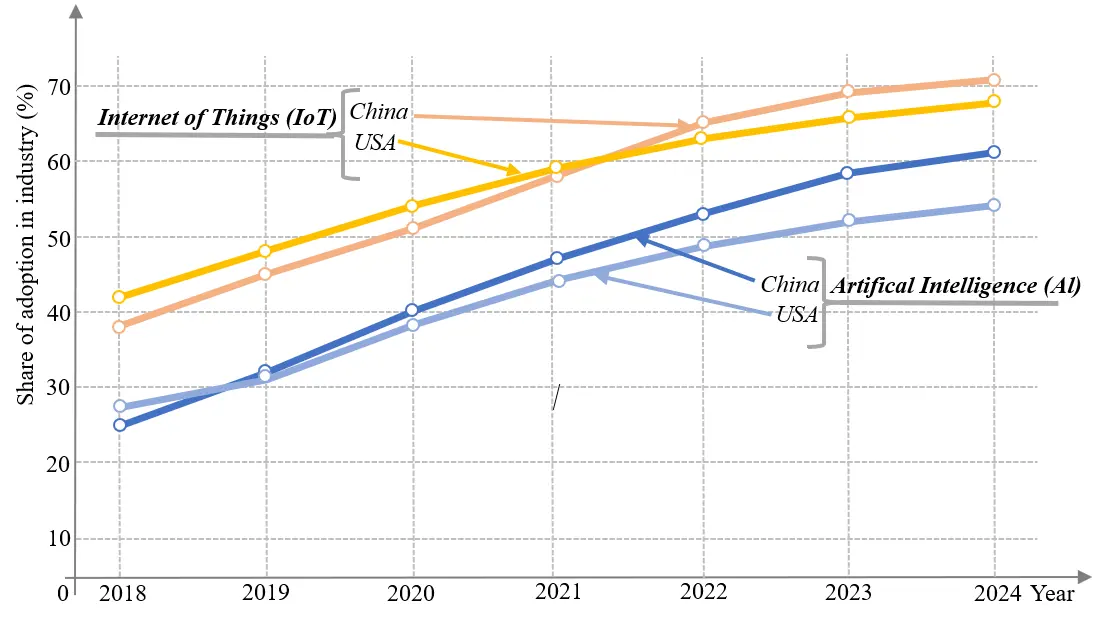
Figure 1. Growth Trends in the Integration of IoT and AI Technologies in Industry in China and the United States (2018–2024).
4. China’s Strategic Leadership in Automation and Industry 4.0 Manufacturing Systems
The analysis of China’s automotive industry is conducted in line with the research hypothesis, focusing on the relationship between robot density, smart manufacturing integration, and national industrial strategies.
4.1. Dynamics of Automotive Output and Capital Investment in Automation Technologies
Over the past eight years, China has consolidated its position as a global leader in vehicle production and the deployment of robotic technologies. As the world’s largest automotive manufacturer, China accounts for a substantial share of global vehicle output, while simultaneously emerging as the largest market and producer of industrial robots. This dual growth reflects China’s strategic alignment with the principles of Industry 4.0, in which automation, data exchange, and advanced manufacturing technologies constitute core pillars of industrial development. Nevertheless, the automation market has recently faced challenges, including a slowdown in growth in 2024, necessitating strategic adjustments and continued innovation [33].
4.2. National Strategies: “Made in China 2025” and the “New Generation AI Plan”
Driven by national strategic initiatives such as Made in China 2025 and its successor programs, China has intensively pursued the implementation of so-called “enabling technologies”, including robotics, the Internet of Things (IoT), big data analytics, artificial intelligence (AI), digital twins, and 5G networks. Chinese automotive manufacturers (such as BYD, Geely, SAIC, among others) have made substantial investments in robotized production lines that integrate physical manufacturing processes with digital monitoring and control systems, thereby enhancing responsiveness, flexibility, and quality control. The New Generation Artificial Intelligence Development Plan is specifically oriented toward advancing AI technologies and accelerating their integration across multiple industrial sectors, including manufacturing. Collectively, these strategies have enabled China to achieve a high level of digital maturity and global competitiveness in advanced manufacturing [34,35].
In practical terms, China’s industrial policy framework supports robotization through direct subsidies for smart factory development, preferential loans for high-tech manufacturers, and tax incentives for companies investing in industrial automation and AI-based manufacturing systems. Regional governments additionally support the establishment of industrial robotics clusters and digital innovation hubs, enabling faster diffusion of Industry 4.0 technologies across automotive supply chains. These policy instruments contribute directly to the rapid increase in robot density and IoT integration observed in Chinese manufacturing facilities [9,10].
4.3. Annual Vehicle Production and the Role of Collaborative Robots in the Automotive Sector
Vehicle production in China has fluctuated in response to global market dynamics. After reaching a peak prior to the COVID-19 pandemic, the automotive sector experienced a decline during 2018–2019, followed by a more pronounced contraction in 2020 due to pandemic-related disruptions. Since 2021, production has gradually recovered, reaching or slightly exceeding previous peak levels during the 2023–2024 period, as shown in Table 5. Table 5 presents trends in the annual deployment of industrial robots in China, as well as the implementation of industrial robots specifically within the automotive sector over the past eight years [20,21,22,23]. The data indicate a consistent year-on-year increase in the adoption of industrial robots across all industrial sectors, including the automotive industry.
Table 5. Annual Vehicle Production and Annual Industrial Robot Installations in China’s Automotive Industry (2017–2024).
|
Year |
Vehicle Production (Million Units) |
Industrial Robot Installations (Units) |
Industrial Robot Installations in the Automotive Industry (Units) |
|---|---|---|---|
|
2017 |
~29.0 |
138,000 |
42,000 |
|
2018 |
~28.1 |
154,000 |
39,000 |
|
2019 |
~25.7 |
140,000 |
31,000 |
|
2020 |
~25.2 |
168,000 |
30,000 |
|
2021 |
~26.1 |
243,000 |
58,000 |
|
2022 |
~27.0 |
290,000 |
73,000 |
|
2023 |
~28.3 |
276,000 |
65,000 |
|
2024 |
~30.0 |
295,000 |
57,000 |
Note: Vehicle production values are approximate and expressed in million units. Industrial robot installation data represent annual installations in the automotive sector.
In 2017, approximately 138,000 industrial robots were installed in China, whereas by 2024 this number had increased to 295,000 units, accounting for approximately 54% of total global industrial robot installations [36,37,38]. This positions China as the world leader in industrial robot deployment. These robots enable high levels of precision and efficiency in vehicle assembly, welding, and painting processes. In addition, collaborative robots (cobots) are increasingly important, working alongside human operators to enhance flexibility, safety, and adaptability in automotive production lines [39].
4.4. Distribution of Robots Across Industrial Sectors
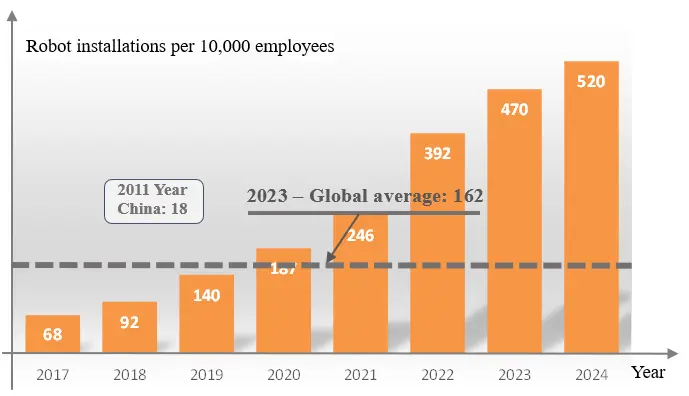
Based on the data presented in Figure 2, it can be concluded that since 2020, China has surpassed the global average in industrial robot deployment per 10,000 manufacturing employees. While robot density in China amounted to only 18 units in 2011, by 2024 the country had reached third place globally with 520 robots per 10,000 employees, ranking immediately behind the Republic of Korea (first place, 1012 units) and Singapore (second place, 770 units). This upward trajectory in industrial robot adoption in China is expected to continue in the coming years.
According to the sectoral data presented in Figure 3, the electrical and electronics industry remains the largest user of industrial robots in China; during 2024, a total of 82,993 units were installed, accounting for approximately 28% of all robot installations. The automotive industry follows with around 57,196 units, representing approximately 19% of total installations. Domestic robot manufacturers are increasingly gaining market share, not only in supplying the automotive sector but also across a broader spectrum of Chinese manufacturing industries.
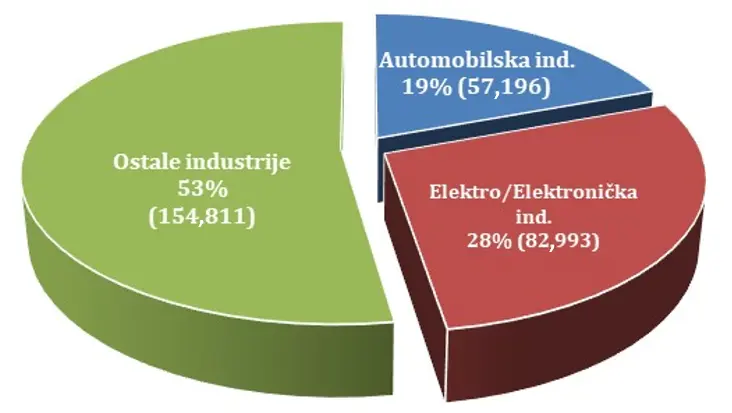
Figure 3. Trend in the Deployment of Industrial Robots in the Automotive, Electrical/Electronics, and Other Industries in China during 2024.
4.5. Trends in Robotization in the Automotive Industry
Over the past eight years, robot density in China’s automotive industry has increased significantly, in line with global automation trends. The share of robot installations in the automotive sector within global totals remains substantial, confirming that this industry continues to serve as a primary driver of robotic adoption. The growing uptake of collaborative robots (cobots), artificial intelligence (AI)-based quality control systems, digital twins, and automated supply chains indicates simultaneous quantitative growth and qualitative advancement of manufacturing systems [40,41,42,43]. China’s development trajectory over the last eight years clearly demonstrates that growth in vehicle production and the implementation of robotics are mutually reinforcing processes. Through sustained investments in robotics and Industry 4.0 technologies, China is not only expanding its manufacturing capacity but also raising technological standards within the automotive industry, thereby positioning itself as a global industrial power and a leading actor in the field of automation.
5. The United States: Digital Integration and Technological Convergence in Automotive Manufacturing
The analysis of the automotive industry in the United States was carried out in accordance with the stated hypothesis, with an emphasis on the relationship between the integration of smart manufacturing, the density of robots, and national industrial strategies.
5.1. Trends in Automotive Production and Investment in Automation
The United States represents a global leader in the digital transformation of manufacturing, particularly within the automotive industry, where companies such as General Motors (GM), Ford, and Tesla have made substantial investments in automation and digitally enabled production systems. These companies were among the first to implement advanced robotic systems, autonomous assembly lines, and digitally controlled manufacturing processes, enabling higher levels of flexibility and precision [43]. Tesla, for example, employs highly automated systems for body welding and painting, while GM integrates robotics and data analytics to optimize material flows and reduce production downtime [44]. Through such practices, the United States exemplifies a successful synergy between traditional industrial manufacturing and advanced digital technologies, resulting in increased productivity and improved product quality.
5.2. National Policy Frameworks: Institutional Support for Smart Manufacturing
At the national level, the advancement of smart manufacturing in the United States is institutionally supported through initiatives such as the Advanced Manufacturing Initiative, Manufacturing USA, and the Smart Manufacturing Leadership Coalition (SMLC). These programs promote collaboration among industry, academia, and government institutions with the objective of accelerating the adoption of advanced technologies in manufacturing processes. The U.S. Department of Commerce and the Department of Energy support projects focused on the development and deployment of digital twins, artificial intelligence (AI), the Internet of Things (IoT), and 5G infrastructure to enhance manufacturing efficiency and system intelligence [45]. Programs such as the Clean Energy Smart Manufacturing Innovation Institute (CESMII) encourage companies to deploy smart sensors, advanced analytics, and automated control systems, thereby reducing energy consumption and optimizing process parameters [46].
In the United States, digital transformation is primarily stimulated through public–private partnerships, federal innovation programs, R&D tax incentives, and technology consortiums such as Manufacturing USA and CESMII. These initiatives support collaboration among universities, research centers, and industrial companies to develop advanced robotics, AI applications, and digital twin technologies. Unlike the centralized Chinese model, the U.S. approach emphasizes decentralized innovation ecosystems and private-sector-driven technological development, which contributes to high levels of smart manufacturing flexibility and software-oriented industrial innovation.
5.3. Vehicle Production Dynamics and the Expanding Role of Collaborative Robotics
The automotive industry in the United States has historically served as a central driver of industrial automation. Vehicle production exhibits cyclical fluctuations, largely influenced by global economic conditions, supply chain disruptions, and fluctuations in domestic demand. Trends in annual robot installations illustrate an increasing reliance on automation across both automotive and non-automotive sectors Table 6.
Table 6. Summarizes trends in vehicle production and industrial robot installations in the U.S. automotive industry between 2017 and 2024 [20,21,22,23].
|
Year |
Vehicle Production (Million Units) |
Industrial Robot Installations (Units) |
Industrial Robot Installations in the Automotive Industry (Units) |
|---|---|---|---|
|
2017 |
~11.19 |
36,437 |
12,524 |
|
2018 |
~10.99 |
40,373 |
14,472 |
|
2019 |
~10.53 |
33,378 |
12,870 |
|
2020 |
~8.82 |
31,000 |
10,500 |
|
2021 |
~9.17 |
39,987 |
9782 |
|
2022 |
~10.06 |
40,576 |
14,467 |
|
2023 |
~10.61 |
38,303 |
12,283 |
|
2024 |
~11.21 |
34,000 |
13,700 |
Following a peak in total robot installations in 2018, exceeding 40,000 units, installations declined during 2019 and 2020 due to trade tensions and the impacts of the COVID-19 pandemic. A recovery phase began in 2021, supported by growing demand for automation across multiple industrial sectors. Although the automotive industry remains the dominant user of industrial robots, other sectors such as electronics, metal processing, plastics, and chemicals have steadily increased their share of total installations. The years 2022 and 2023 marked a particularly strong rebound, with robot installations again surpassing 40,000 units, indicating renewed investment momentum in automation technologies. Industrial robots play a critical role in transforming the U.S. automotive industry. Over the past decade, there has been a pronounced increase in the adoption of collaborative robots (cobots), which enable direct human–machine interaction and enhance worker safety and productivity [47]. Ford and GM deploy cobots in engine assembly and final assembly processes, while Tesla develops proprietary robotic platforms for high-precision tasks, including autonomous component testing and AI-based quality control. Advances in AI analytics, sensor technologies, and digital twins further facilitate deeper integration between physical and virtual systems, enabling greater precision and predictive maintenance capabilities.
5.4. Sectoral Distribution of Industrial Robots and Automation Intensity
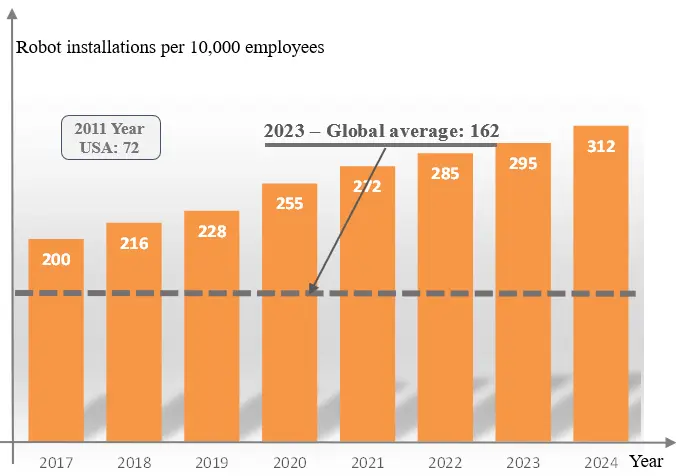
Beyond absolute installation figures, robot density—defined as the number of robots per 10,000 manufacturing employees—provides insight into the structural level of automation. Figure 4 illustrates the evolution of robot density in the United States from 2017 to 2024. As shown in Figure 4, robot density in U.S. manufacturing has increased steadily, rising from approximately 200 robots per 10,000 employees in 2017 to an estimated 312 units in 2024 [20,21,22,23]. The most pronounced growth occurred between 2019 and 2021, largely as companies accelerated automation efforts in response to labor shortages and production disruptions caused by the COVID-19 pandemic. This trend underscores the strategic importance of industrial robotics in sustaining the competitiveness and resilience of U.S. manufacturing.
The structure of robot installations in the United States indicates a strong concentration across several key sectors: the automotive industry (the largest single share), the electrical and electronics industry, metal processing and machinery manufacturing, as well as the plastics and chemical industries. The share of the automotive sector in total robot installations varies over time; however, in most years it has accounted for one-third or more of all new installations, as illustrated in Figure 5 for 2024. In parallel, the adoption of robots in the electronics manufacturing sector has increased, driven by growing demand for higher precision and increased production of electronic components for electric vehicles (EVs) and electronics more broadly.
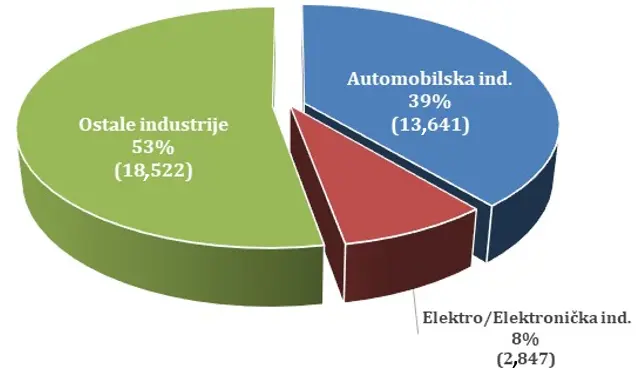
Figure 5. Trends in the Deployment of Industrial Robots in the Automotive, Electrical/Electronics, and Other Industries in the United States during 2024.
Overall, the structure of robot installations in 2024 highlights two key dynamics:
Quantitative expansion—the automotive industry continues to lead in the total number of robot installations.
Qualitative transformation—robotic applications are becoming increasingly sophisticated through the deployment of collaborative robots (cobots), the integration of artificial intelligence in visual inspection and quality control, and the development of automated production cells tailored to the requirements of electric vehicle manufacturing.
These developments underscore the central role of robotics in maintaining the competitiveness of U.S. manufacturing, while also reflecting sectoral shifts associated with broader technological and industrial transformation.
5.5. Trends in Robotics within the Automotive Industry
The automotive industry in the United States exhibits several clearly identifiable trends [48,49,50]:
Continuous modernization of production lines through the replacement or upgrading of conventional robots with more advanced systems capable of flexible manufacturing.
Increased use of collaborative robots (cobots) for tasks requiring fine manipulation and assembly.
Integration of artificial intelligence into visual inspection and quality control processes.
Growth in robot installations is linked to the transition toward electric vehicles, which require new assembly processes and automated production cells.
These trends indicate not only a quantitative increase in the number of deployed robots but also a significant rise in the technological sophistication of their applications. The U.S. automotive industry, along with the broader manufacturing sector, is intensively implementing key Industry 4.0 technologies, including industrial robots, IoT sensors and platforms, big data–based manufacturing analytics, digital twins, and artificial intelligence algorithms for visual inspection and process optimization. Automotive manufacturers and their supply chains are investing in flexible, modular production cells that integrate robots with advanced real-time monitoring and control systems. Such integration enables faster adaptation to new vehicle models and variants, reduces setup times, and enhances overall quality consistency.
6. Comparative Analysis and Discussion
The comparative analysis between China and the United States reveals distinct development models in automation, robotization, and industrial digital transformation. China has positioned itself as a global leader in the implementation of smart manufacturing through strong state-driven strategies such as Made in China 2025 and the New Generation AI Plan, while the United States demonstrates strong capabilities in highly automated, flexible, and intelligently networked manufacturing systems through market-driven innovation and private investment. China and the United States exhibit high robot density and sustained productivity growth. In 2024, China surpassed 295,000 new robot installations, whereas the United States recorded approximately 34,000 installations, reflecting different levels of technological maturity. Robotics in China and the United States not only enhances productivity but also enables the development of innovative manufacturing models, such as autonomous factories and collaborative human–machine systems.
The observed differences in robot density and digital maturity are not determined solely by economic scale, but also by the structure of industrial policy instruments. China achieves rapid industrial deployment through coordinated state subsidies and strategic investment programs, while the United States relies more heavily on innovation ecosystems, venture capital, and university–industry collaboration models. These contrasting approaches generate different patterns of technological specialization and manufacturing flexibility.
With regard to national strategies and models of digital transformation, the United States relies on public–private initiatives such as the Advanced Manufacturing Initiative and the Smart Manufacturing Leadership Coalition, whereas China applies a more centralized approach focused on strategic self-sufficiency. The geopolitical and economic implications of technological differentiation are reshaping global value chains, with China strengthening its position as a supplier of advanced technologies, while the United States maintains an advantage in research and software-based solutions. Common trends include increasing investment in automation, the development of artificial intelligence, and the expansion of digital platforms. Divergent approaches are reflected in the degree of state intervention, the pace of implementation, and strategic orientations toward global competitiveness and technological sovereignty. From a sustainable manufacturing perspective, the observed increase in automation and smart technology integration contributes to improved energy efficiency, reduced material waste, and enhanced process stability. The adoption of digital twins, predictive maintenance, and AI-based quality control enables more efficient resource utilization and supports the transition toward environmentally sustainable automotive production systems. These effects are particularly relevant in the context of electric vehicle manufacturing, where process optimization and energy management are critical. The integration of advanced robotics, artificial intelligence, and digital twins enables intelligent manufacturing by allowing real-time monitoring, adaptive control, and data-driven optimization of automotive production systems. At the same time, improvements in energy efficiency, together with the transition toward electric vehicle manufacturing, support sustainable manufacturing by reducing resource consumption, emissions, and environmental impacts across the automotive value chain.
Table 7 summarizes the fundamental structural differences between the Chinese and U.S. approaches to Industry 4.0 implementation in the automotive industry. While China emphasizes large-scale industrial deployment supported by centralized state policies and strategic investment programs, the United States relies more strongly on decentralized innovation ecosystems, flexible manufacturing.
Table 7. Comparative Framework of Industry 4.0 Implementation in China and the United States.
|
Dimension |
China |
United States |
|---|---|---|
|
Industrial policy model |
State-driven |
Market-driven |
|
Robot installations |
Very high |
High |
|
Robot density |
Very high |
Moderate–high |
|
Smart factory expansion |
Rapid large-scale deployment |
Flexible decentralized deployment |
|
AI and IoT integration |
State-supported expansion |
Innovation ecosystem driven |
|
Main competitive advantage |
Scale and speed |
Flexibility and software integration |
|
Manufacturing orientation |
Mass industrial deployment |
High-value intelligent manufacturing |
|
Strategic focus |
Technological self-sufficiency |
Innovation leadership |
7. Conclusions
The comparative analysis of China and the United States demonstrates that the global automotive industry is undergoing a dynamic phase of transformation driven by automation, robotics, and digital technologies. China leads through strategic state-led initiatives and the accelerated implementation of smart manufacturing, while the United States sustains its competitive advantage through innovation and flexible, market-driven models of robotization. Robotics is confirmed as a key driver of the future of the automotive industry, enabling higher productivity, improved quality control, greater flexibility of manufacturing processes, and the transition toward sustainable technologies, including electric vehicles. The integration of collaborative robots (cobots), artificial intelligence, and digital factories not only reduces costs and downtime but also enhances resilience against global disruptions, such as pandemics and supply chain interruptions. From the perspective of industrial policy, the results highlight the need for strategic investment in research, development, and workforce education in the fields of robotics and automation. Countries that successfully combine state support, private-sector innovation, and international cooperation will be better positioned to achieve sustainable industrial growth and technological independence. For future research, a deeper analysis of the interconnections between robotics, artificial intelligence, and the green transition in the automotive industry is recommended. Particular attention should be devoted to the socioeconomic effects of high levels of automation, including changes in employment structures, emerging skill requirements, and ethical considerations related to human–technology integration. From a policy and industry perspective, the results underline the importance of coordinated investment in automation technologies, digital infrastructure, and workforce upskilling. Policymakers and industry leaders should prioritize strategies that combine intelligent automation with sustainability objectives in order to enhance long-term industrial resilience and competitiveness. Ultimately, robotics should be viewed not merely as a technological tool but as a fundamental component of a sustainable, intelligent, and competitive industry of the future.
Statement of the Use of Generative AI and AI-Assisted Technologies in the Writing Process
During the preparation of this manuscript, the author used ChatGPT (OpenAI) exclusively for language editing, grammar checking, and translation support. The tool was not used for generating scientific content, data analysis, or research conclusions. The author takes full responsibility for the originality, accuracy, and integrity of the manuscript.
Ethics Statement
Not applicable.
Informed Consent Statement
Not applicable.
Data Availability Statement
Data available on request.
Funding
This research received no external funding.
Declaration of Competing Interest
The author declares that he has no known competing financial interests or personal relationships that could have appeared to influence the work reported in this paper.
References
-
Karabegović I, Kovačević A, Banjanović-Mehmedović L, Dašić P. Integration Industry 4.0 in Business and Manufacturing; IGI Global: Hershey, PA, USA, 2020. [Google Scholar]
-
Barari A, Tsuzuki MSG. Smart Manufacturing and Industry 4.0. Appl. Sci. 2023, 13, 1545. DOI:10.3390/app13031545 [Google Scholar]
-
Karabegović I, Karabegović E, Mahmić M, Husak E. The Implementation of Industry 4.0 by Using Industrial and Service Robots in the Production Processes. In Integration Industry 4.0 in Business and Manufacturing; Karabegović I, Kovačević A, Banjanović-Mehmedović L, Dašić P, Eds.; IGI Global: Hershey, PA, USA, 2020; pp. 1–30. DOI:10.4018/978-1-7998-2725-2.ch001 [Google Scholar]
-
Liu D, Cao J. Determinants of Collaborative Robots Innovation Adoption in Small and Medium-Sized Enterprises: An Empirical Study in China. Appl. Sci. 2022, 12, 10085. DOI:10.3390/app121910085 [Google Scholar]
-
Xia Q, Zhang B, Zhang X, Li L, Wu C. Investigation on Robotic Cells Design Improvement in the Welding Process of Body-in-White. Int. J. Intell. Robot. Appl. 2024, 8, 322–333. DOI:10.1007/s41315-023-00317-8 [Google Scholar]
-
Galin R, Meshcheryakov R. Automation and Robotics in the Context of Industry 4.0: The Shift to Collaborative Robots. IOP Conf. Ser. Mater. Sci. Eng. 2019, 537, 032073. DOI:10.1088/1757-899X/537/3/032073 [Google Scholar]
-
Karabegović I, Majstorović V. (Eds.). Industry 4.0: Digital Transformation Shaping the Future; Society for Robotics in Bosnia and Herzegovina: Bihać, Bosnia and Herzegovina; Academy of Sciences and Arts of Bosnia and Herzegovina: Sarajevo, Bosnia and Herzegovina, 2024. [Google Scholar]
-
Bagheri Rad N, Behnamian J. Real-Time Multi-Factory Scheduling in Industry 4.0 with Virtual Alliances. Eng. Appl. Artif. Intell. 2023, 125, 106636. DOI:10.1016/j.engappai.2023.106636 [Google Scholar]
-
Andreoni A, Frattini F, Prodi G. Getting Robots in “Our Own Hands”: Structural Drivers, Spatial Dynamics and Multi-Scalar Industrial Policy in China. Compet. Change 2026, 30, 177–199. DOI:10.1177/10245294241261878 [Google Scholar]
-
Chen Y, Dai X, Fu P, Luo G, Shi P. A Review of China’s Automotive Industry Policy: Recent Developments and Future Trends. J. Traffic Transp. Eng. 2024, 11, 867–895. DOI:10.1016/j.jtte.2024.09.001 [Google Scholar]
-
Papulova Z, Gažova A, Šufliarsky L. Implementation of Automation Technologies of Industry 4.0 in Automotive Manufacturing Companies. Procedia Comput. Sci. 2022, 200, 1488–1497. DOI:10.1016/j.procs.2022.01.350 [Google Scholar]
-
Jadoon G, Ud Din I, Almogren A, Almajed H. Smart and Agile Manufacturing Framework: A Case Study for the Automotive Industry. Energies 2020, 13, 5766. DOI:10.3390/en13215766 [Google Scholar]
-
Tao B, Zhao X, Ding H. Mobile-Robotic Machining for Large Complex Components: A Review Study. Sci. China Technol. Sci. 2019, 62, 1388–1400. DOI:10.1007/s11431-019-9510-1 [Google Scholar]
-
Piccarozzi M, Aquilani B, Gatti C. Industry 4.0 in Management Studies: A Systematic Literature Review. Sustainability 2018, 10, 3821. DOI:10.3390/su10103821 [Google Scholar]
-
Jagatheesaperumal S, Rahouti M, Ahmad K, Al-Fuqaha A, Guizani M. The Duo of Artificial Intelligence and Big Data for Industry 4.0: Review of Applications, Techniques, Challenges, and Future Research Directions. arXiv 2021, arXiv:2104.02425. DOI:10.48550/arXiv.2104.02425 [Google Scholar]
-
Bai C, Dallasega P, Orzes G, Sarkis J. Industry 4.0 Technologies Assessment: A Sustainability Perspective. Int. J. Prod. Econ. 2020, 229, 107776. DOI:10.1016/j.ijpe.2020.107776 [Google Scholar]
-
Soori M, Ghaleh Jough F, Dastres R, Arezoo B. Intelligent Robotic Systems in Industry 4.0: A Review. J. Adv. Manuf. Sci. Technol. 2024, 4, 2024007. DOI:10.51393/j.jamst.2024007 [Google Scholar]
-
Ghobakhloo M, Iranmanesh M, Grybauskas A, Vilkas M. Industry 4.0, Innovation, and Sustainable Development: A Systematic Review and a Roadmap to Sustainable Innovation. Bus. Strategy Environ. 2021, 30, 4237–4257. DOI:10.1002/bse.2867 [Google Scholar]
-
Naseem MH, Yang J. Role of Industry 4.0 in Supply Chains Sustainability: A Systematic Literature Review. Sustainability 2021, 13, 9544. DOI:10.3390/su13179544 [Google Scholar]
-
International Federation of Robotics (IFR). Global Robot Density in Factories Doubled in Seven Years; World Robotics Executive Summary; IFR: Frankfurt, Germany, 2024. Available online: https://ifr.org/worldrobotics/ (accessed on 1 October 2025).
-
International Organization of Motor Vehicle Manufacturers (OICA). Production Statistics 2023; OICA: Paris, France, 2024. Available online: https://www.oica.net/production-statistics/ (accessed on 27 September 2025)
-
International Federation of Robotics (IFR). World Robotics 2025: Industrial Robots; IFR: Frankfurt, Germany, 2025. Available online: https://ifr.org/worldrobotics/ (accessed on 1 October 2025).
-
International Federation of Robotics (IFR). World Robotics 2024: Industrial Robots; IFR: Frankfurt, Germany, 2024. Available online: https://ifr.org/worldrobotics/ (accessed on 1 October 2025)
-
Karabegović I. A Comparative Analysis of the Role of Industrial and Humanoid Robots as Drivers of Efficiency and Flexibility in the Automotive Industry. Mobility Veh. Mech. 2025, 51, 31–45. DOI:10.24874/mvm.2025.51.01.03 [Google Scholar]
-
Karabegović I, Karabegović E, Mahmić M, Husak E. Implementation of Industry 4.0 and Industrial Robots in Manufacturing Processes. In New Technologies, Development and Application II; Lecture Notes in Networks and Systems; Springer: Cham, Switzerland, 2020; Volume 76. DOI:10.1007/978-3-030-18072-0_1 [Google Scholar]
-
McKinsey & Company. The Rise of Smart Manufacturing: Integrating AI and IoT in Global Production; McKinsey Global Institute: New York, NY, USA, 2024. Available online: https://www.eseye.com/resources/blogs/the-rise-of-smart-manufacturing-insights-from-eseyes-state-of-iot-adoption-report/ (accessed on 10 October 2025).
-
PwC. Digital Trends in Operations Survey 2024; PricewaterhouseCoopers International Ltd.: London, UK, 2024. Available online: https://supplychaindigital.com/operations/pwc-digital-trends-in-operations-2024 (accessed on 10 October 2025).
-
PwC. Global Digital Trust Insights 2024; PricewaterhouseCoopers International Ltd.: London, UK, 2024. Available online: https://www.pwc.com/hu/hu/kiadvanyok/assets/pdf/pwc-2024-global-digital-trust-insights.pdf (accessed on 10 October 2025).
-
World Economic Forum. Shaping the Future of Advanced Manufacturing and Production; WEF White Paper Series; WEF: Geneva, Switzerland, 2024. Available online: https://www.weforum.org/videos/shaping-the-future-of-advanced-manufacturing/ (accessed on 10 October 2025).
-
OECD. OECD Digital Economy Outlook 2024: Embracing the Technology Frontier; OECD Publishing: Paris, France, 2024. DOI:10.1787/a1689dc5-en [Google Scholar]
-
NITI Aayog. National Strategy for Artificial Intelligence—#AIForAll; Government of India: New Delhi, India, 2023. Available online: https://www.niti.gov.in/sites/default/files/2023-03/National-Strategy-for-Artificial-Intelligence.pdf (accessed on 5 October 2025).
-
Shah S, Madni HHS, Hashim ZMS, Ali J, Faheem M. Factors Influencing the Adoption of Industrial Internet of Things in Manufacturing SMEs. IET Collab. Intell. Manuf. 2024, 6, e12093. DOI:10.1049/cim2.12093 [Google Scholar]
-
MIRDATABANK. China’s Automation Market Trends 2024. Available online: https://www.mirdatabank.ca/News/NewsDetail?id=150117 (accessed on 6 October 2025).
-
Karabegović I, Husak E, Karabegović E, Mahmić M. China as the Leading Country in the Implementation of Robotic Technology as a Core Industry 4.0 Technology. In Machine and Industrial Design in Mechanical Engineering—KOD 2024; Mechanisms and Machine Science; Springer: Berlin/Heidelberg, Germany, 2024; Volume 174; pp. 612–621. DOI:10.1007/978-3-031-80512-7_60 [Google Scholar]
-
China Briefing. Understanding China’s AI Manufacturing Roadmap and Implications for FIEs. 2024. Available online: https://www.china-briefing.com/news/understanding-chinas-ai-manufacturing-roadmap-implications-on-fies/ (accessed on 10 October 2025).
-
International International Federation of Robotics (IFR). World Robotics 2018: Industrial Robots; IFR: Frankfurt, Germany, 2018. Available online: https://ifr.org/worldrobotics/ (accessed on 1 October 2025).
-
Karabegović I, Karabegović E. The Role of Collaborative Service Robots in the Implementation of Industry 4.0. Int. J. Robot. Autom. Technol. 2019, 6, 40–46. DOI:10.31875/2409-9694.2019.06.5 [Google Scholar]
-
International Federation of Robotics (IFR). World Robotics 2023: Industrial Robots; IFR: Frankfurt, Germany, 2023. Available online: https://ifr.org/worldrobotics/ (accessed on 1 October 2025)
-
Robotics247. Report: Collaborative Robots Market Poised for New Growth Cycle. 2024. Available online: https://www.robotics247.com/article/report_collaborative_robots_market_poised_for_new_growth_cycle (accessed on 10 October 2025).
-
Yao JF, Yang Y, Wang XC, Zhang XP. Systematic Review of Digital Twin Technology and Applications. Vis. Comput. Ind. Biomed. Art 2023, 6, 10. DOI:10.1186/s42492-023-00137-4 [Google Scholar]
-
Karabegović I. The Role of Industry 4.0 in the Modernization of Industrial Production in China. J. Sci. Eng. Res. 2017, 4, 177–186. Available online: http://jsaer.com/download/vol-4-iss-9-2017/JSAER2017-04-09-177-186.pdf (accessed on 1 October 2025).
-
Malik AA, Brem A. Digital Twins for Collaborative Robots: A Case Study in Human–Robot Interaction. Robot. Comput. Integr. Manuf. 2021, 68, 102092. DOI:10.1016/j.rcim.2020.102092 [Google Scholar]
-
Miranda J, Brynjolfsson E, Seamans R, Buffington C, Goldschlag N. Adoption of Automation Technologies by U.S. Firms: Evidence from the 2019 Annual Business Survey; Working Paper CES-22-12R; U.S. Census Bureau: Washington, DC, USA, 2022. Available online: https://www.census.gov/ces (accessed on 1 October 2025).
-
Stevens M. Supporting Robotics Adoption Would Boost the U.S. Economy; Information Technology & Innovation Foundation (ITIF): Washington, DC, USA, 2023. Available online: https://itif.org/publications/2023/ (accessed on 1 October 2025).
-
U.S. Department of Commerce. CHIPS for America Announces New Proposed $285 Million Award for CHIPS Manufacturing USA Institute for Digital Twins. 2024. Available online: https://www.commerce.gov/news/press-releases/2024/11/chips-america-announces-new-proposed-285-million-award-chips (accessed on 1 October 2025).
-
U.S. Department of Energy. Energy Department Manufacturing Institute Selects Projects to Advance U.S. Leadership in Smart Manufacturing. 2020. Available online: https://www.energy.gov/eere/articles/energy-department-manufacturing-institute-selects-projects-advance-us-leadership-0 (accessed on 1 October 2025).
-
Rose J, Lukic V, Knizek C, Milon T, Melecki A, Choset H. Advancing Robotics to Boost U.S. Manufacturing Competitiveness; Boston Consulting Group: Boston, MA, USA, 2018. Available online: https://www.bcg.com/publications/2018/advancing-robotics-boost-us-manufacturing-competitiveness (accessed on 1 October 2025).
-
You J, Wu Z, Wei W, Li N, Yang Y. Evolution of Industrial Robots from the Perspective of the Metaverse: Integration of Virtual and Physical Realities and Human–Robot Collaboration. Appl. Sci. 2024, 14, 6369. DOI:10.3390/app14146369 [Google Scholar]
-
Karabegović I, Karabegović E, Mahmić M, Husak E. Innovative Automation of Production Processes in the Automotive Industry. Int. J. Eng. Works 2018, 5, 240–247. DOI:10.5281/zenodo.1486145 [Google Scholar]
-
Puttero S, Verna E, Genta G, Galetto M. Collaborative Robots for Quality Control: An Overview of Recent Studies and Emerging Trends. J. Intell. Manuf. 2026, 37, 1345–1381. DOI:10.1007/s10845-025-02600-w [Google Scholar]