Deadline for manuscript submissions: 30 April 2027.





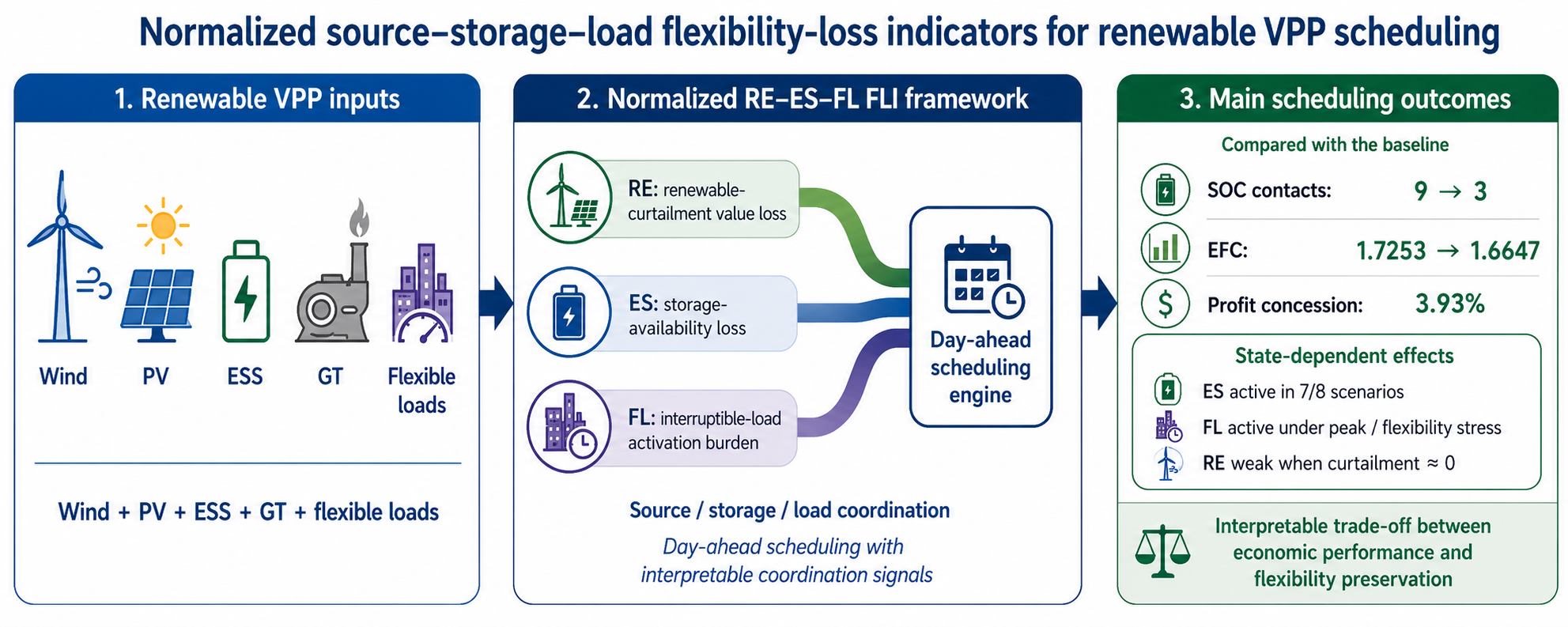
Renewable virtual power plants (VPPs) require day-ahead schedules that coordinate renewable generation, storage, gas turbines, and demand-side flexibility while retaining interpretable operating signals. This paper develops a normalized source-storage-load flexibility-loss-indicator (FLI) framework for renewable VPP scheduling. The indicators are engineering proxies for renewable-curtailment value loss, storage availability loss, and interruptible-load activation burden, rather than market-settled opportunity costs or a complete uncertainty-risk measure. The scalar objective combines net operating cost, operating coordination cost, and normalized FLI terms with reference scales fixed within each comparative setting. In a PJM-scaled day-ahead scheduling case, the baseline, scalarized multi-term reference, and proposed FLI schedules achieved net operating profits of 69,590.98 USD, 60,377.26 USD, and 66,856.81 USD. The proposed schedule reduced SOC boundary contacts from 9 to 3 and equivalent full cycles from 1.7253 to 1.6647, with a 3.93% profit concession relative to the baseline. Weight sensitivity, channel ablation, and eight representative operating and stress-test scenarios show state-dependent effects: the storage channel was active in seven scenarios, the interruptible-load channel under peak and flexibility-stressed conditions, and the renewable channel remained weak because curtailment was nearly zero. The framework provides a diagnostic coordination signal for renewable VPP operation.
The increasing penetration of renewable resources in smart energy systems has increased the need for accurate forecasting of photovoltaic (PV) power to reduce uncertainty and improve operational planning. Rapid changes in atmospheric conditions, especially cloud movement, cause severe fluctuations and pose a significant challenge to PV power forecasting in the short term. In this paper, an integrated Deep Learning-based framework for short-term PV power forecasting is proposed that models the relationships among sky conditions, solar irradiance, and PV power. First, the cloud movement is forecasted based on the Optical Flow algorithm using sky images. Then, the forecasted images are fed into a ResNet50 network to estimate the solar irradiance. Finally, the forecasted solar irradiance, meteorological parameters, and historical PV power data are fed into the CNN-BiGRU-Attention model, whose hyperparameters are optimized using Bayesian Optimization to forecast the PV power for the next hour. The performance of the proposed model was evaluated under different atmospheric conditions and compared with other benchmark models. The results showed that the proposed model achieves high forecasting accuracy, obtaining a R2 of 0.987 and RMSE, MAE, and MAPE error values of 0.231 Kw, 0.147 Kw, and 8.69%, respectively, and outperforming benchmark models.