Refractory Raw Materials for Future High Temperature Processes

Deadline for manuscript submissions: 31 March 2027.

Guest Editors (3)

Erwan  Gueguen
Dr. Erwan Gueguen 
Refractory expert, Belgium
Interests: Refractory Materials; Refractory Processing
Christopher  Parr
Mr. Christopher Parr 
Imerys Aluminates, France
Interests: Refractory Materials; Ceramics; Refractories Industry
Charlie  Semler
Dr. Charlie Semler 
Semler Materials Services
Interests: Refractories testing, properties, microstructure, recycling, & novel/creative developments
Website:

Special Issue Information

This special issue, "Refractory Raw Materials for Future High-Temperature Processes," examines the refractory industry's transition from traditional performance metrics to prioritizing sustainability. It explores next-generation raw materials—including aggregates, binders, and functional additives—designed for modern high-temperature industrial applications. Key focus areas include:
 
  • Intrinsically Sustainable Products: Leveraging materials through new and existing raw materials 
  • Low-Carbon Enablers: Introducing novel systems  that reduce the carbon footprint of refractories while improving technical performance, predictable wear, safety, reduced downtime, and energy efficiency through enhanced insulation.
Driven by a strategic blend of market demand and technological innovation, this edition examines recent breakthroughs across the spectrum of refractory raw materials ( alumina-silicate, alumina,  zirconia, Magnesia, Carbon containing compositions). By bridging the gap between fundamental science and industrial practice through academic-industry partnerships, these developments provide a vital roadmap for modernizing refractory technology. Join us in analyzing how this synergy of expertise continues to advance high-temperature solutions for a sustainable future.

Topics to include
  • Fundamentals and Selection
  • Engineered raw materials
  • Modelling and system effectiveness
  • Future trends and industrial implementation
Manuscript Submission Information:
To submit to the issue, click here:
https://www.sciepublish.com/index/user/login.html
For more information on Author Instruction, please visit the following page:
https://www.sciepublish.com/journals/htm/instructions

The submission deadline is 31 March 2027, papers will be published on an ongoing basis (i.e., immediately after acceptance and proofreading) with 100% discount. An earlier submission would be appreciated. However, if need be, please feel free to let us know if your need an extension.


Published Papers (1 Papers)

Open Access

Review

09 November 2026

Review on High-Temperature Porous Media Materials for Clean Combustion of Hydrogen and Ammonia Fuels

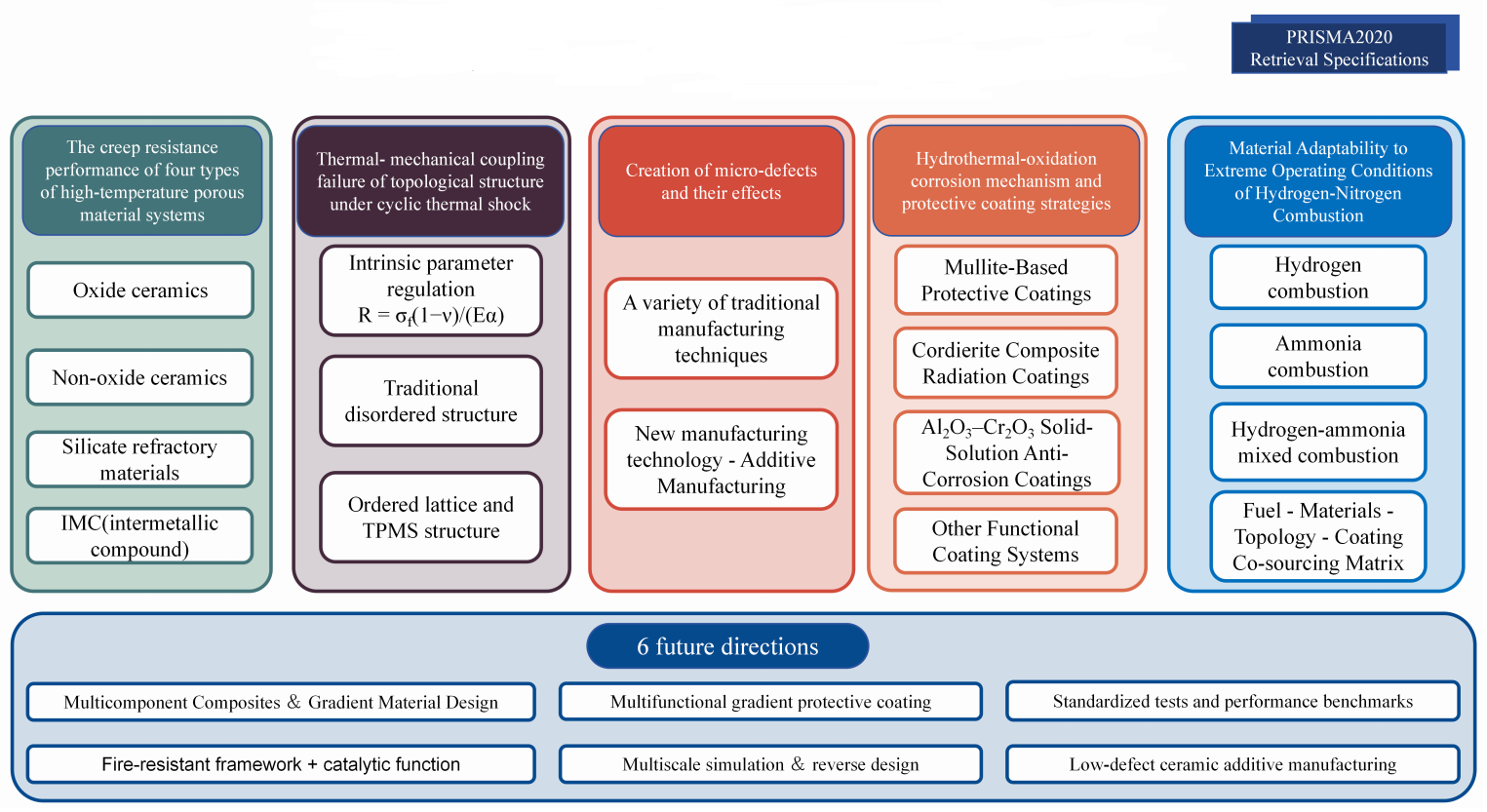
Porous media combustion technology is regarded as one of the promising routes for efficient thermochemical conversion of hydrogen and ammonia fuels. However, porous skeletal materials are exposed to demanding service conditions including temperatures of 900–1500 °C, high-concentration water-vapor atmospheres, and frequent cyclic thermal shock, which can promote sintering, hydrothermal corrosion, oxidation, and thermomechanical fatigue cracking. Reviews addressing high-temperature material degradation, topological thermomechanical failure, manufacturing-induced defects and surface protection remain comparatively limited in the literature surveyed. In this work, four categories of high-temperature porous materials, i.e., oxide ceramics, non-oxide ceramics, silicate refractories and intermetallic compounds, are comprehensively reviewed. The thermomechanical failure mechanisms of conventional disordered structures and novel additively-manufactured ordered topologies (including triply periodic minimal surfaces, TPMS) under cyclic thermal shock are discussed based on thermal-shock-resistance figure-of-merit R. High-temperature micro-defects originating from replica impregnation, extrusion, and lithography-based ceramic manufacturing (LCM) additive manufacturing are analyzed. Special attention is paid to the hydrothermal-volatilization corrosion mechanism of SiC in water-vapor-rich atmosphere generated by ammonia combustion, together with the performance of multi-layer protective coatings including mullite, cordierite, Al2O3–Cr2O3 solid-solution and rare-earth silicate systems. A synergistic fuel-material-topology-coating selection matrix is proposed for hydrogen, ammonia and blended fuels. Finally, key bottlenecks and future research directions, covering composite ultra-refractory ceramics, self-healing environmental barrier coatings, high-temperature additive manufacturing, and catalytic-refractory integrated porous architectures, are put forward. This review aims to provide material-oriented references to support the development of porous media operating under the conditions of hydrogen–ammonia combustion.

Cheng Ma
Liping Pan*
Enjie Wang
Congjie Liu
Yawei Li*
Xiong Liang
Yajie Dai
Pengxiang Zhao
High-Temp. Mater.
2026,
3
(4), 10027; 
TOP