Found 1 results
Open Access
Review
07 November 2025Value Engineering in the Era of Industry 4.0: From Gap Analysis to Research Methodologies and Strategic Framework
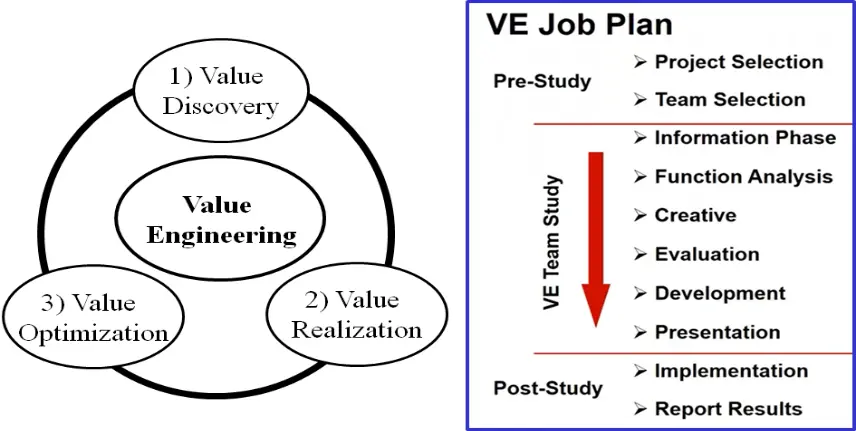
Traditional Value Engineering (VE) has long focused on optimizing the function-to-cost ratio but faces limitations in digitalized industrial contexts. Conventional VE lacks integration with advanced technologies, empirical validation in smart environments, and alignment with sustainability and circular economy objectives. The emergence of Industry 4.0—driven by cyber-physical systems, IoT, big data analytics, digital twins, and artificial intelligence—has transformed industrial ecosystems, necessitating a redefinition of VE practices. This study employs a systematic literature review and structured gap analysis to examine the evolution, applications, and challenges of VE across manufacturing, construction, supply chain, and service sectors. The analysis identifies three key deficiencies in conventional VE: (i) absence of integrated digital frameworks, (ii) limited empirical validation in smart environments, and (iii) weak incorporation of sustainability and circular economy principles. To address these gaps, Value Engineering 4.0 (VE 4.0) is proposed as a function-driven, data-intelligent, and human-centric methodology. It is structured around a six-component strategic framework: (1) digital foundations for technological readiness and organizational alignment; (2) smart VE processes leveraging AI, IoT, and advanced analytics for predictive, connected decision-making; (3) an enhanced Job Plan integrating AR/VR, NLP, and blockchain for improved speed, accuracy, and lifecycle alignment; (4) a phased implementation roadmap; (5) real-time DMAIC integration for continuous optimization; and (6) enablers covering leadership, skills, infrastructure, and cybersecurity. VE 4.0 provides both a research agenda and a practical roadmap, enabling organizations to innovate, enhance resilience, and achieve sustainable competitiveness in Industry 4.0 ecosystems.