Found 1 results
Open Access
Article
19 March 2026Intelligent Real-Time Kanban Automation Using Ultra-Wideband Positioning: Methodologies and Performance Evaluation
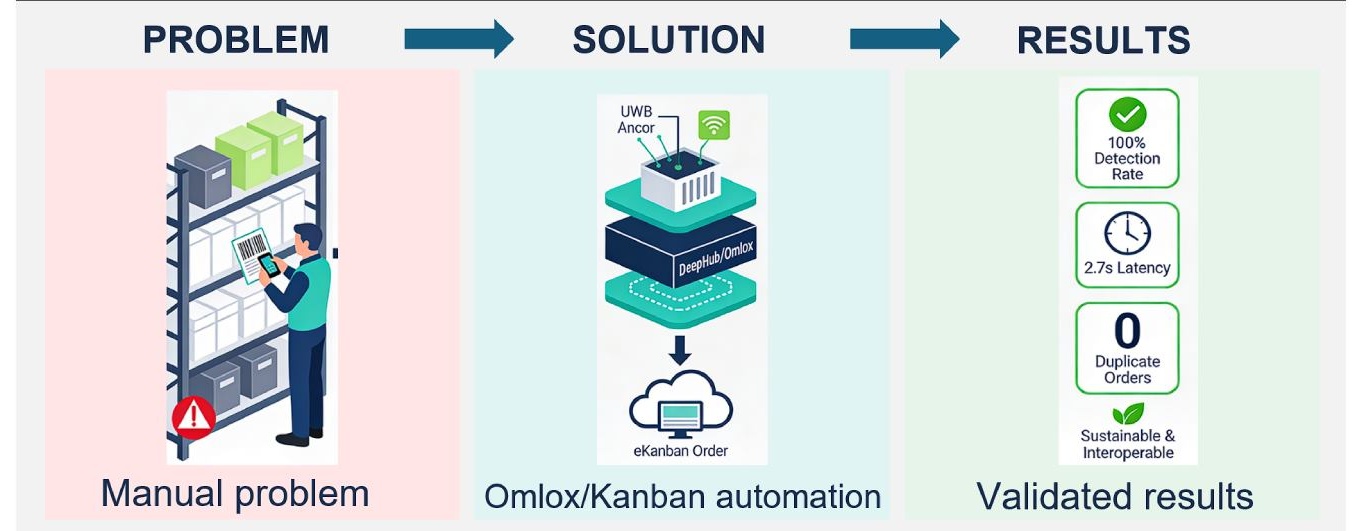
Traditional electronic Kanban (eKanban) systems depend on manual scans and offer only discrete material visibility, limiting responsiveness and automation in lean manufacturing environments. These operational bottlenecks are magnified in high-mix contexts, where delayed replenishment signals degrade flow stability, increase work-in-progress, and hinder sustainable material handling. Furthermore, vendor-specific systems lack interoperability for scalable automation, constraining the development of intelligent manufacturing solutions. This work investigates whether zone-based replenishment automation can be enabled through real-time locating systems (RTLS) using open interoperability standards, addressing a gap in empirical validation of such approaches. A middleware architecture was developed that integrates ultra-wideband (UWB) positioning, an Omlox-compliant location middleware (DeepHub), and a cloud-based eKanban system to replace manual triggers with geofence-driven order creation. The novelty of this study lies in demonstrating a fully automated Kanban signaling loop built on the open Omlox standard, providing vendor-independent RTLS interoperability and eliminating human intervention in replenishment signaling. This contributes new knowledge on how continuous location data can be converted into actionable replenishment events in a standards-based, modular manner, enabling more intelligent and autonomous material-flow control. A controlled proof-of-concept experiment simulating shop-floor conditions showed that the system achieved a 100% detection success rate, zero duplicate orders, and an average trigger-to-action latency of 2.7 s, while automatically recovering from authentication and WebSocket failures. These results provide the first empirical evidence that Omlox-compliant RTLS middleware can reliably support zone-based eKanban automation. The findings have direct implications for intelligent and sustainable manufacturing by demonstrating a scalable pathway toward interoperable, real-time material-flow systems that reduce manual intervention, avoid unnecessary handling, and lower work-in-progress. More broadly, the work addresses the current lack of empirical validation of open-standard RTLS integration within lean and sustainable production environments.