Found 13 results
Open Access
Article
28 August 2024Overcoming SME Legal and Regulatory Challenges and Fostering Sustainable Collaboration and 7PS Engineering in the Digital Age through Integrating the X.0 Wave Theory & SME 5.0 Concept
Technological innovations, education, business and society change quickly and often unpredictably. The fusion of artificial intelligence (AI), machine learning, augmented reality (AR), virtual reality (VR) and augmented reality (XR) opens a new era in which work, production, communication and thought processes are massively transformed. In this context, the challenge arises: How can small and medium-sized enterprises (SMEs) adapt to this accelerated change? This study highlights a path forward and introduces the concept of “SME 5.0” or “Hybrid SME” or “SME of Tomorrow” as a comprehensive solution to address the complexities of the digital age. In this integrated exploration of the X.0 Wave Theory and SME 5.0 Concept, the framework for human civilization’s evolution and technological shifts converges with a practical roadmap for small and medium-sized enterprises (SMEs) navigating the dynamic digital landscape. Acknowledging transformative waves in technology, economics, and societal structures within the X.0 Wave Theory, the study accentuates the ongoing nature of these shifts. It advocates for a long-term perspective, urging policymakers and industry leaders to consider potential future scenarios to devise strategies fostering innovation, competitiveness, and privacy safeguards. Simultaneously, the study introduces SME 5.0 as a holistic solution for SMEs, aligning with the transformative success envisioned by the X.0 Wave Theory. Proposing the Seven Pillars of Sustainability (7PS) framework tailored to SMEs, the concept emphasizes digitalization and sustainable technology. The title, “Harmonizing the X.0 Wave Theory and SME 5.0 Concept”, encapsulates the synergy between theoretical underpinnings and practical solutions. The subtitle, “Fostering Sustainable Collaboration, 7PS Engineering, and Overcoming Legal Challenges in the Digital Age”, provides a glimpse into the study’s focus on practical implications, sustainability, engineering, and legal considerations for SMEs in the rapidly evolving digital era.
Open Access
Article
10 July 2024Documenting the Changing Floodplain of Nileas Basin in North Euboea (Greece) before and after Storms Daniel and Elias
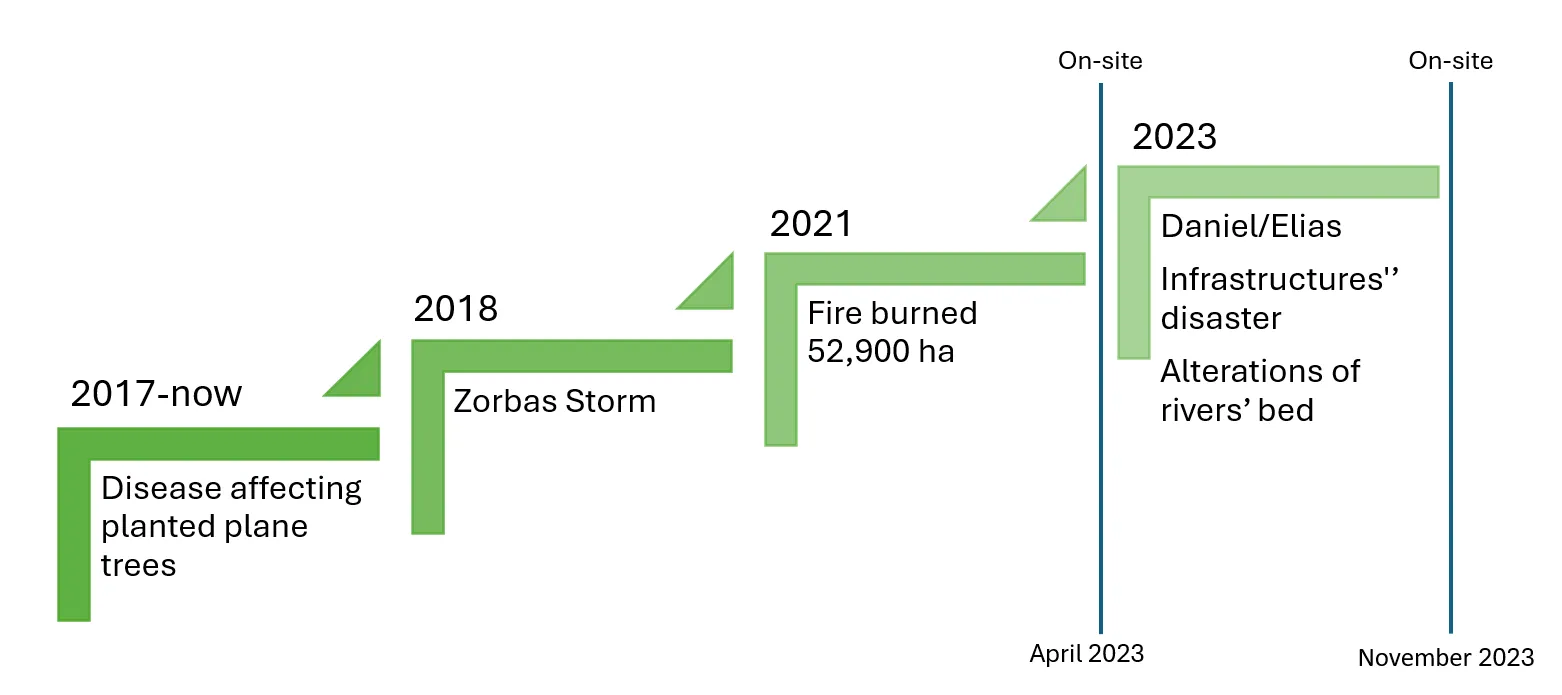
The area of north Euboea is characterized by its intense relief, dense hydrographic network, and rich flora and fauna. In the mid-2010s, the region was struck by a plane tree disease that withered the large population of plane trees in the area, while in 2021, a large wildfire completely burned the forest. These unfortunate events depleted the landscape’s natural ability to manage and mitigate flood phenomena. Observing the landscape’s vulnerability to floods, in April 2023, we conduct on-site field inspections in the rivers of the area. In September 2023, a major flood hit the area, causing in dramatic changes to the landscape. Therefore, in November 2023, we conducted follow-up on-site field inspections in the area, in order to trace the differences, present the damages the phenomenon left behind. These inspections allowed to document the landscape changes from the combination of all previous events and identify any associated pathologies. Site visits and comparisons before and after the Daniel/Elias storm revealed dramatic changes in the riverbed width at lower altitudes, significant sediment accumulation in the Voudouros River delta, alterations in the natural landscape along the river and its floodplain, destruction of the arable land, and road collapses in several locations.
Open Access
Article
30 April 2024Arrestin beta 1 Regulates Alveolar Progenitor Renewal and Lung Fibrosis
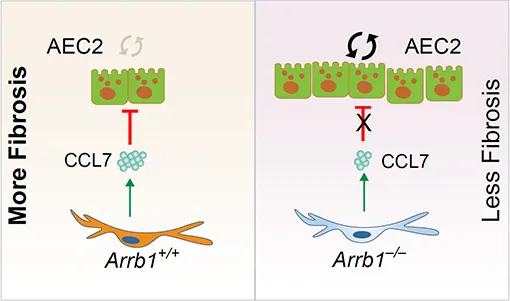
The molecular mechanisms that regulate progressive pulmonary fibrosis remain poorly understood. Type 2 alveolar epithelial cells (AEC2s) function as adult stem cells in the lung. We previously showed that there is a loss of AEC2s and a failure of AEC2 renewal in the lungs of idiopathic pulmonary fibrosis (IPF) patients. We also reported that beta-arrestins are the key regulators of fibroblast invasion, and beta-arrestin 1 and 2 deficient mice exhibit decreased mortality, decreased matrix deposition, and increased lung function in bleomycin-induced lung fibrosis. However, the role of beta-arrestins in AEC2 regeneration is unclear. In this study, we investigated the role and mechanism of Arrestin beta 1 (ARRB1) in AEC2 renewal and in lung fibrosis. We used conventional deletion as well as cell type-specific deletion of ARRB1 in mice and found that Arrb1 deficiency in fibroblasts protects mice from lung fibrosis, and the knockout mice exhibit enhanced AEC2 regeneration in vivo, suggesting a role of fibroblast-derived ARRB1 in AEC2 renewal. We further found that Arrb1-deficient fibroblasts promotes AEC2 renewal in 3D organoid assays. Mechanistically, we found that CCL7 is among the top downregulated cytokines in Arrb1 deficient fibroblasts and CCL7 inhibits AEC2 regeneration in 3D organoid experiments. Therefore, fibroblast ARRB1 mediates AEC2 renewal, possibly by releasing chemokine CCL7, leading to fibrosis in the lung.