
Recycling of Post-Consumer Cotton Waste
Recycling of Post-Consumer Cotton Waste

Received: 06 March 2026 Revised: 27 March 2026 Accepted: 22 April 2026 Published: 06 May 2026

© 2026 The authors. This is an open access article under the Creative Commons Attribution 4.0 International License (https://creativecommons.org/licenses/by/4.0/).
1. Introduction
The manufacture of textiles, including natural and synthetic fibres, and the Preparation, finishing, and garmenting procedures are some of the stages that contribute to the textile industry’s significant pollution. Furthermore, the environmental issues associated with this business are exacerbated by the problem of textile waste, particularly post-consumer waste. Achieving a zero-waste goal requires innovative strategies for post-consumer waste. Textile waste should be considered a new source of energy and carbon in the circular economy framework. Textile consumption is increasing daily; a new idea is needed to address the rise in post-consumer waste. Due to the fast fashion cycle and the production of less expensive, shorter-lived textile products, post-consumer textile waste has increased. Concerns about pollution reduction led to upcycling textile waste to recover, at least in part, the materials and energy used in their production, hence lowering the products’ carbon and water footprints [1]. In addition to the environmental impacts of textile production, the issue of textile waste management has become a global sustainability challenge. Rapid industrialisation and increasing consumer purchasing behaviour have accelerated textile consumption across the world. Used apparel, home textiles, and other fabric-based items that are thrown away after usage are all considered post-consumer textile waste. Recycling of clothes is difficult because they are made of different materials. For example, a t-shirt can be made of cotton and polyester mixed together. This makes it tricky to recycle. Therefore, developing innovative recycling technologies that can efficiently recover fibres and valuable materials from textile waste is essential for sustainable resource management.
The three necessities of humans are clothes, food, and shelter. The textile industry meets people’s basic clothing needs. The textile and garment industry has produced more clothes at lower prices due to globalisation [2]. The textile industry is now creating a significant amount of environmental pollution while meeting the increased demand for garments. A significant amount of energy and water is consumed in the synthesis and manufacture of textile fibres and converting them into fashion items [3,4]. By recycling or at least partially recovering the resources and energy used in creating these things, this transformation aims to value post-consumer waste. Reaching a zero-waste target requires efficient handling of post-consumer textile waste [5].
In addition, after use, millions of tons of textile items are discarded annually. Incineration is one of the primary strategies for managing post-consumer textile waste, although each approach has its disadvantages. In addition to the sluggish and drawn-out process of fibre degradation in landfills, burning textile waste increases air pollution and exacerbates the greenhouse gas impact [6]. Still, no complete sustainable recycling alternative exists for this substantial amount of post-consumer textile waste. Recycling textile waste has been a significant concern for many years, despite several obstacles. Furthermore, the concept of circular economy has gained significant attention as a sustainable alternative to the traditional linear production model of “take–make–dispose”. Circular economy tactics in the textile industry place a strong emphasis on prolonging product life cycles, enhancing recyclability, and recovering valuable materials from waste streams. Because it is renewable and has a high cellulose content, post-consumer cotton waste is a great feedstock for the creation of value-added materials. The textile sector may create economic possibilities and drastically lessen its environmental impact by combining cutting-edge recycling technology with sustainable production methods. Research on innovative recycling pathways for cotton-based textile waste has increased in recent years, with a focus on upcycling of discarded materials into functional fibres, chemicals, and advanced biomaterials [7]. This review aims to address the environmental issues associated with the textile sector and explores innovative and optimal approaches for the zero-waste recycling of post-consumer cotton waste. The textile industry can transition toward a circular economy by implementing various recycling techniques. This will significantly cut the waste and raw material consumption, while promoting sustainability and environmental responsibility in textile manufacturing and consumption practices. This study focuses on several key techniques, including producing carbon fibres from waste, which provides a sustainable alternative to petroleum-based precursors. in addition, the regeneration of viscose fibres by chemical recycling of cotton waste, enzymatitc recycling, Method of Gasification and Thermochemical Valorisation, and the ioncell process is discussed, emphasizing its potential to encourage resource conservation and lessen dependency on virgin resources. It also explains how cellulose nanofibrils (CNFs) can be extracted from post-consumer textiles and utilised to produce high-performance materials. Additionally, despite difficulties in preserving fibre quality, the potential of mechanical recycling techniques to yield viable yarns from recycled fibres is investigated.
2. Need for Waste Recycling of Textile Waste
The fashion industry is one of the most polluting industries, with one of the largest supply chains [8]. Its operations produce a substantial amount of trash, including both liquid and solid waste, with a low recycling rate of 15%. These factors make the fashion and apparel industry an ideal place to implement the principles of the circular economy (CE) [9]. Plant-based and synthetic cellulosic fibres accounted for 36% of the 109 million tonnes of fibre produced worldwide in 2020. Cotton remains the most widely used fibre, with a yearly output of 26.2 million tonnes [10]. According to a study by the Ellen MacArthur Foundation, only a very small portion of post-consumer textile waste was recycled in 2017 (14%); the rest was burnt or disposed of in landfills. Only about 1% of the fibres used to create clothing are derived from recycled materials, and others are categorised as downcycled materials. Some experts even assert that the amount may be as low as 0.1%. The value-adding of waste and abandoned goods has several advantages from an economic, social, and environmental standpoint [11,12].
In addition to its negative effects on the environment, textile waste represents a significant loss of valuable raw materials and financial resources. Land, water, fertilisers, and pesticides are just a few of the many agricultural inputs needed for cotton production. The resources used to manufacture cotton-based textiles are lost when they are thrown away after only a few uses. By reducing the need for virgin cotton production, recycling cotton waste can help preserve natural resources and lessen the negative effects of agriculture on the environment. Additionally, recycling procedures frequently utilise less energy than manufacturing fibres from raw materials, which helps reduce greenhouse gas emissions along the whole textile production chain [13]. Concern over landfill capacity and waste management infrastructure is a major driving force for the recycling of textile waste. Particularly when textiles contain synthetic mixes, large amounts of textile waste build up in landfills, where degradation happens extremely slowly. Long-term environmental damage and the emission of greenhouse gases like methane can be caused by this gradual degradation. Further environmental risks might result from textile dyes and finishing chemicals seeping into groundwater and soil. Therefore, improving textile recycling technologies is crucial to address these environmental risks while promoting sustainable waste management practices [14].
3. The Difficulties in Recycling Post-Consumer Textiles
-
-
Recycling of post-consumer cotton waste is a major problem. The main issue with recycling post-consumer fabric is that it is made up of different fibres, including cotton and synthetic fibres like polyester. This makes it difficult to separate and recycle.
-
-
The dyes and other chemicals used on post-consumer waste create a challenge for recycling and extracting high-quality fibres from it. When we try to recycle post-consumer cotton waste mechanically, the fibres get weaker, which limits the usability of the fibres.
-
-
Chemical methods of recycling post-consumer cotton waste are a better option, but they use a lot of energy and chemicals that create adverse effects on the environment. The real fact is that we are still lagging in an efficient system for collecting, sorting, and categorising post-consumer cotton waste, which is the biggest obstacle in recycling a lot of textiles.
-
-
Economic feasibility is another critical challenge, as recycled fibres often struggle to compete with low-cost virgin cotton in the global market [15].
4. Innovative Approaches Can Be Adopted for Recycling Post-Consumer Cotton Waste
Ongoing developments in material science and chemical engineering have enabled the exploration of innovative and effective approaches to recovering textile waste. In addition to recovering fibres, these technologies aim to convert textile waste into advanced materials with better useful properties. A number of studies have concentrated on turning cotton waste into valuable goods, including carbon-based compounds, nanomaterials, and regenerated fibres. Depending on the intended end-use applications, each recycling method has special benefits. Therefore, identifying suitable recycling approaches is important for maximising the value recovered from post-consumer cotton waste while ensuring environmental sustainability.
Post-consumer cotton waste can be recycled in different ways into valuable end products. This paper focuses on different interesting methods and their benefits of recycling cotton waste, each of which will be discussed sequentially.
4.1. The Formation of High-Value Carbon Fibres from Cotton Waste
Cotton-based post-consumer textile can also be used to produce carbon material by pyrolysis in nitrogen at higher temperatures, resulting in the best structural quality and the highest carbon content. Carbon fibres are lightweight, strong, and resistant to heat, chemicals, and corrosion, making them useful in industries such as sports, construction, and electronics. Although conventional precursors available on the market, such as PAN and pitch, produce fibres with high strength, they rely on non-renewable, polluting, and expensive methods. By using bio-based materials like cotton waste offers a more eco-friendly alternative that works on lower carbonisation temperatures, though the resulting fibres have comparatively lower tensile strength. The overall process includes cleaning and drying the waste fabric, then heating it in a nitrogen-filled furnace to produce sustainable carbon fibres [16].
4.2. Hydrated Zinc Chloride Converts Cotton Waste into Viscose Staple Fibre
Chemical recycling is one of the most appealing options, which converts the waste cellulosic textiles into fibres like Modal, Lyocell, or viscose. It is estimated that the need for raw wood in the production of viscose fibres can be eliminated by recycling 25% of cotton and rayon waste [17].
In this approach of recycling, the treatment of cotton waste can be done by either low-consistency or high-consistency treatment. Low and high-consistency pulp preparation from cotton waste textiles utilising a ZnCl2·4H2O solution shows an efficient and sustainable method for recycling textile waste for advanced material fabrication. In the low-consistency approach, a smaller amount of cotton by weight (approximately 2%) is gradually incorporated into a ZnCl2 solution. In the high-consistency process, we use a stronger ZnCl2 solution, and a larger amount of textile waste is added in batches up to 4.3% cotton. After precipitation, the pulp undergoes several washes to remove residual chemicals. Each process offers an adaptable route to generate clean pulp from cotton waste, providing a highly valuable fibre production and other sustainable material developments [18].
Solvents are essential to chemical recycling because they allow cellulose fibres to dissolve and regenerate. Hydrated zinc chloride (ZnCl2·4H2O) is one of the better solvent systems because of its ability to break up cellulose’s large hydrogen bonding network, which makes cellulose easier to dissolve. ZnCl2 functions as a Lewis acid, as it interacts with the hydroxyl groups in cellulose to promote swelling and fibre solubilization. The ZnCl2-based method provides a more safer and environmental friendly alternative forconventional viscose processing, which is done by carbon disulfide, but efficient recovery and recycling of zinc salts are still essential for process sustainability [19]. However, these traditional solvents present several limitations, including toxicity, high energy consumption, and challenges in solvent recovery, which raise environmental and occupational health concerns.
Preparation of Viscose Fibre
The pulp made with zinc chloride is washed with water and a dilute sodium hydroxide solution to remove zinc salts (if any). The cleaned pulp is then air-dried & to make viscose, the pulp goes through modified processing steps:
-
-
Spends a longer time in the alkali solution (Mercerisation) to swell properly.
-
-
Pre-aged at a lower temperature to prevent excessive breakdown of the cellulose.
-
-
Less carbon disulfide is required in the xanthation step to maintain high-quality viscose.
-
-
Extruded through a spinneret with many small holes into a warm spin bath.
4.3. Recycling of Cotton Waste into Anionic and Cationic Nanofibrils
Extracting cellulose nanofibrils (CNFs) from discarded cotton textiles offers a sustainable route for transforming waste into valuable resources. The process typically employs one of two chemical treatments: 1. cationization, which involves applying (2,3-epoxypropyl) trimethylammonium chloride to produce positively charged CNFs (Cat-CNFs); and 2. oxidation through TEMPO/NaBr, resulting in negatively charged CNFs (TO-CNFs).
Cotton has a high cellulose content of over 90% of its mass, and these fibres are a perfect source for nanofibril production. The structural composition of cellulose allows for the breakdown into nano-sized fibrils, which can be classified by their shape as cellulose nanocrystals (CNCs) or cellulose nanofibrils (CNFs). CNFs typically extend up to 100 µm in length and 3–100 nm in diameter. Creating charged groups on the fibre surface through chemical pre-treatment enhances mechanical separation efficiency by reducing fibre-fibre bonding. These methods have garnered attention for their potential use in developing sustainable, high-performance materials, thereby reducing reliance on fossil fuel-derived products [20].
Benefits of this method of recycling:
-
-
Even when CNFs are in low amounts in water, they can form gels.
-
-
This is because they are long, bendable, and have little twists and branches that make them easy to tangle.
-
-
CNFs are great building blocks for making various materials, such as fibres, thin sheets, and foams.
-
-
They are strong, have a large surface area, and a flexible fibre structure.
-
-
Using CNFs, it is possible to make new types of materials that combine the unique shapes of these materials with the special properties of CNFs.
4.4. Mechanical Recycling
The technique of turning textile fabric back into fibres without chemicals is known as mechanical recycling. This procedure includes shredding cloth; however, it shortens the fibres and diminishes their quality. Fabrics manufactured from mechanically recycled fibres can not be very robust as a result. Both new items and discarded cotton clothing can be recycled mechanically. This can be the best chemical-free approach demonstrated for creating textiles and goods from recycled cotton. Mechanical recycling is chemical free recycling, but it shows many technological challenges. It affects fibre quality and product performance. The fiber length is drastically shortened during the shredding and opening procedures, which lowers yarn strength and spinning efficiency.
Furthermore, impurities like stitching threads, accessories, or finishing chemicals are frequently present in recycled fibers and need to be eliminated during the preparation phase. Advanced sorting technologies, such as near-infrared spectroscopy and automated optical systems, are being developed to improve the separation of textile materials by fibre type and colour. These technologies may significantly enhance the efficiency and quality of mechanically recycled fibres in the future. At least 80% cotton was utilized in the fabrics created from worn clothing. In this recycling method, first, Yarns are manufactured by combining fresh cotton with both pre- & post-consumer recycled cotton on a ring spinning machine, as seen in Figure 1 [21].
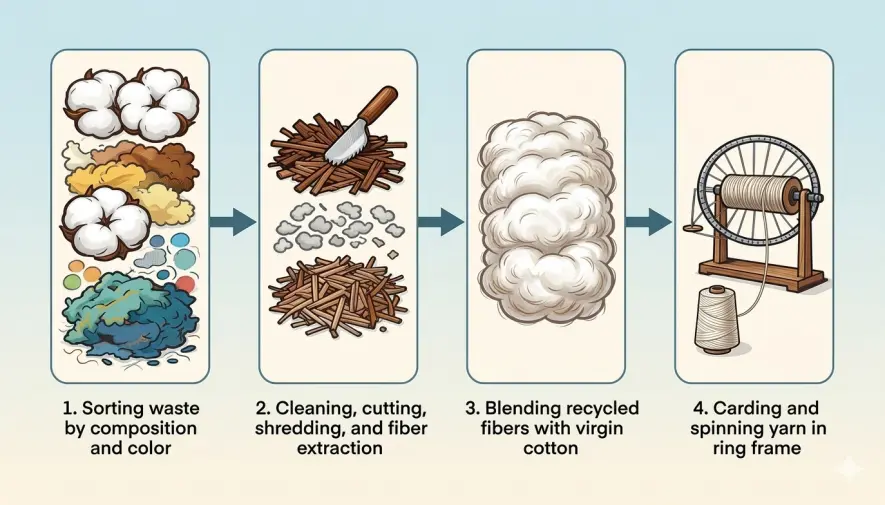
The following procedures are used in recycling industries for the mechanical conversion of textile waste into recycled cotton. Following sorting, a cutter is used to reduce the discarded materials into tiny pieces. In order to prevent any fire incidents during shredding, waste has to be conditioned. The resulting extracted fibres are formed into bundles and sent to the mixing room [22]. Flow chart of mechanical recycling has showm in Figure 2.
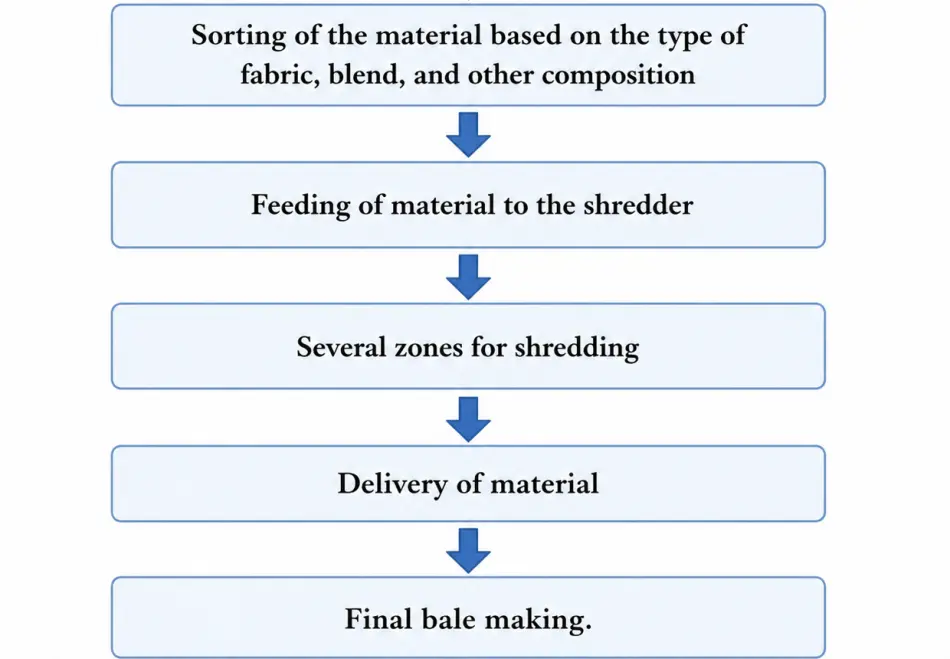
Recycled fibres still included a lot of hard fibre lumps even after being crushed and opened violently in a shredding machine.
The properties of recycled cotton from cotton waste and virgin cotton differ significantly, making it more difficult to obtain the exact functional qualities of virgin cotton. However, recycled cotton can be blended with virgin cotton for everyday use or other applications.
4.5. Enzymatic and Biological Recycling
For the purpose of valuing post-consumer cotton waste, enzymatic recycling has become a viable, sustainable substitute for traditional chemical procedures. This technique uses cellulase enzymes to hydrolyse cellulose specifically into glucose or oligosaccharides under mild working conditions. Enzymatic systems operate at neutral pH and require less energy than chemical recycling, since they function at lower temperatures. According to recent studies, cotton-rich textile waste may be successfully handled by enzymatic hydrolysis, particularly if it is pre-treated to eliminate dyes and finishes. The resultant sugars can be transformed into biopolymers or used to manufacture bioethanol, thereby extending the textile recycling value chain [23].
Limitations like sluggish reaction kinetics, expensive enzymes, and contaminant sensitivity, however, continue to be major obstacles. Enzyme engineering and process optimisation are the main areas of ongoing research to improve productivity and industrial viability.
4.6. Hydrothermal and Solvolysis Recycling
By treating textile waste with water at high temperatures and pressures, hydrothermal recycling breaks down cellulose into smaller molecules, such as hydrochar, sugars, and platform chemicals. This approach is environmentally appealing as it doesn’t call for extra chemicals [24]. In contrast, solvolysis uses organic solvents (such as ethanol and methanol) to separate mixed fibres and depolymerise cellulose. This technique is especially helpful for cotton-polyester blends [25]. These methods can be used for blending textile with a lower amount of chemicals. Large-scale adoption is still hampered by high energy needs and reactor prices.
4.7. Gasification and Thermochemical Valorisation
Thermochemical processes such as gasification provide an alternative route for converting cotton waste into energy and valuable chemicals. In gasification, textile waste is heated to high temperatures (700–1000 °C) in an oxygen-controlled atmosphere to create synthesis gas (CO and H2), which may be used to make chemicals or fuel.
Gasification has more product uses and a greater energy recovery efficiency than pyrolysis.
Compared to pyrolysis, gasification offers higher energy recovery efficiency and broader product applications. Additionally, this method can handle contaminated and blended textile waste streams that are difficult to recycle mechanically or chemically [26].
However, the process requires significant capital investment and advanced emission control systems, limiting its widespread adoption.
4.8. Ioncell Process
In recent years, significant attention has been directed toward the development of green solvent systems that offer improved sustainability and efficiency in textile recycling processes. Recent advancements in textile recycling have focused on fibre-to-fibre closed-loop systems, where post-consumer cotton waste is directly converted into new textile fibres of comparable quality. Technologies such as Ioncell, Refibra™, and Circulose® represent significant progress in this area [27].
Ionic liquids are used in the Ioncell process to break down cellulose and produce fibres with superior mechanical qualities that are on par with commercial lyocell fibres. Similarly, industrial-scale textile recycling is made possible by Circulose® technology, which transforms cotton waste into dissolving pulp for the manufacturing of viscose fibre. Although these technologies are a significant step toward the manufacture of circular textiles, issues with cost, scalability, and infrastructure integration still exist.
Ionic liquids (ILs) that dissolve cellulose without derivatisation, such as 1-ethyl-3-methylimidazolium acetate [EMIM][OAc], have become very successful solvents. Because these solvents have strong hydrogen bond disruption properties, cotton fibres may be immediately dissolved and regenerated into better cellulose materials [28]. Additionally, ionic liquids have shown potential in selectively dissolving cellulose from blended textiles such as polycotton, enabling efficient separation of fibres.
In case of Deep eutectic solvents (DESs), formed by combining hydrogen bond donors and acceptors (e.g, choline chloride and urea), represent another class of green solvents for cellulose processing. Compared to traditional solvents, DESs are economical, biodegradable, and less hazardous. In blends of textiles, these technologies have proven to be able to dissolve cellulose selectively while maintaining polyester components, making fibre separation and recycling easier. However, high viscosity and slower dissolution kinetics remain challenges that require further optimisation for industrial-scale applications [29].
Despite these advantages, challenges such as high solvent cost, viscosity, and recycling efficiency remain barriers to large-scale industrial adoption.
5. Comparison of the Above Discussed Approaches for Recycling of Waste
Various approaches have been developed for the recycling of cotton waste, each based on different principles such as mechanical, chemical, thermal, and biological processes. These methods vary in terms of efficiency, environmental impact, cost, and suitability for specific applications. A comparative overview of these recycling techniques, along with their advantages, limitations, and key applications, is presented in Table 1.
Table 1. Comparison of different approaches for the recycling of cotton waste.
|
Method |
Working Principle |
Advantages |
Limitations |
Best Applications |
|---|---|---|---|---|
|
Carbon Fibre (Pyrolysis) |
Heating cotton waste in nitrogen (no oxygen) at high temperature to convert into carbon fibres |
Eco-friendly alternative to PAN, lightweight, good thermal & chemical resistance |
Lower strength than commercial carbon fibres, energy intensive |
Sports goods, construction, electronics |
|
ZnCl2-Based Viscose Process |
Dissolving cellulose using hydrated zinc chloride and regenerating fibres |
Safer than conventional viscose, efficient cellulose dissolution, reduces wood usage |
ZnCl2 recovery needed, still involves chemicals |
Regenerated fibres (viscose, modal) |
|
Nanofibrils (CNFs/CNCs) |
Chemical + mechanical treatment to break cotton into nano-sized fibrils |
High strength, large surface area, forms gels, versatile material |
Costly processing requires chemical pretreatment |
Composites, coatings, biomedical materials |
|
Mechanical Recycling |
Physical shredding and re-spinning of fibres without chemicals |
Low cost, no chemicals, simple process |
Fibre damage, reduced strength, contamination issues |
Blended yarns, low-value textiles |
|
Enzymatic Recycling |
Cellulase enzymes break cellulose into sugars under mild conditions |
Low energy, eco-friendly, high selectivity |
Slow process; expensive enzymes, sensitive to impurities |
Bioethanol, biopolymers |
|
Hydrothermal Recycling |
High temperature & pressure water breaks cellulose into smaller molecules |
No chemicals needed; handles mixed waste |
High energy requirement; expensive reactors |
Biofuels, platform chemicals |
|
Solvolysis |
Organic solvents dissolve cellulose and separate blended fibres |
Effective for cotton–polyester blends, good fibre recovery |
Solvent recovery needed, cost issues |
Fibre separation, recycling blends |
|
Gasification |
High-temperature partial oxidation produces syngas (CO + H2) |
High energy recovery; handles contaminated waste |
High capital cost, emission control needed |
Fuel production, chemicals |
|
Ioncell/IL/DES Process |
Ionic liquids or green solvents dissolve cellulose and regenerate fibres |
High-quality fibres; closed-loop recycling; sustainable |
High solvent cost; viscosity issues; scaling challenges |
Textile-to-textile recycling |
6. Conclusions
Recycling post-consumer cotton waste is a viable technique to apply the circular economy and produce textiles in a sustainable manner. The methods included in this study, such as chemical regeneration, mechanical recycling, thermochemical conversion, and nanomaterial extraction, show promise for turning textile waste into products with additional value. These technologies lower the demand for virgin raw materials, preserve resources, and lessen their negative effects on the environment.
But despite tremendous progress, there are still a number of important obstacles that prevent these recycling systems from being widely used. The diverse makeup of textile waste, especially the pervasiveness of mixed materials like cotton-polyester, which makes fibre separation more difficult and lowers recycling efficiency, is one of the main problems. Furthermore, the quality of regenerated goods and processing efficiency are negatively impacted by dyes, finishing chemicals, and pollutants found in post-consumer textiles. In particular, for mixed textiles, future research should concentrate on creating effective and selective fibre separation methods. Ionic liquids and deep eutectic solvents are examples of advanced solvent systems with great potential, but more work is needed to increase their affordability, recyclability, and large-scale application.
Solvent recovery and process sustainability are another significant obstacle. Solvents used in many chemical recycling processes are either ecologically toxic or require a lot of energy to recover. There is a need to develop closed-loop, less energy-consuming solvent recovery systems for industrial applications in the aspect of sustainability. Maintaining fibre tensile strength and length remains a major challenge in mechanical recycling. More future research and development is needed, and should include hybrid recycling techniques that combine mechanical and chemical treatments to preserve fibre properties while improving process efficiency. The absence of effective mechanisms for collecting, classifying, and sorting textile waste remains a major obstacle from an industrial standpoint. Recycling efficiency and material recovery rates might be greatly increased by using cutting-edge technology like near-infrared spectroscopy and artificial intelligence-based sorting.
Life cycle assessment (LCA) is also necessary to analyse the actual environmental benefits of new recycling technologies and ensure that reductions in carbon and water footprints are achieved without unforeseen trade-offs. In conclusion, a different strategy that incorporates technical innovation, industrial scalability, regulatory intervention, and consumer awareness is mandatory to achieve a sustainable and circular textile industry. To overcome current problems and efficiently recycle waste, further research and cooperation between academics and industry will be necessary.
Statement of the Use of Generative AI and AI-Assisted Technologies in the Writing Process
During the preparation of this manuscript, the author(s) used Grammarly to improve grammar, clarity, and language quality. After using this tool, the author(s) carefully reviewed and edited the content as needed and take full responsibility for the content of the published article.
Acknowledgments
The authors would like to acknowledge the support of institute of chemical technology, mumbai.
Author Contributions
All authors have contributed equally.
Ethics Statement
Not applicable.
Informed Consent Statement
Not applicable.
Data Availability Statement
The data used in this study are publicly available from the sources cited in the reference list.
Funding
This research received no external funding.
Declaration of Competing Interest
The authors declare that they have no known competing financial interests or personal relationships that could have appeared to influence the work reported in this paper.
References
-
Stanescu MD. State of the art of post-consumer textile waste upcycling to reach the zero waste milestone. Environ. Sci. Pollut. Res. 2021, 28, 14253–14270. DOI:10.1007/s11356-021-12416-9 [Google Scholar]
-
Juanga-Labayen JP, Labayen IV, Yuan Q. A review on textile recycling practices and challenges. Textiles 2022, 2, 174–188. DOI:10.3390/textiles2010010 [Google Scholar]
-
Khude P. A review on energy management in textile industry. Innov. Energy Res. 2017, 6, 2. DOI:10.4172/2576-1463.1000169 [Google Scholar]
-
Appannagari RR. Environmental pollution causes and consequences: A study. North Asian Int. Res. J. Soc. Sci. Humanit. 2017, 3, 151–161. Available online: https://www.researchgate.net/profile/Ramamohana-Reddy-Appannagari/publication/323944189_Environmental_Pollution_Causes_and_Consequences_A_Study/links/5ab3dfeea6fdcc1bc0c3f043/Environmental-Pollution-Causes-and-Consequences-A-Study.pdf (accessed on 8 August 2025).
-
Koszewska M. Circular economy in textiles and fashion—The role of a consumer. In Circular Economy in Textiles and Apparel; Woodhead Publishing: Sawston, UK, 2019; pp. 183–206. [Google Scholar]
-
Zamani B. Towards Understanding Sustainable Textile Waste Management: Environmental Impacts and Social Indicators; Chalmers University of Technology: Gothenburg, Sweden, 2014. [Google Scholar]
-
Koszewska M. Circular economy—Challenges for the textile and clothing industry. Autex Res. J. 2018, 18, 337–347. DOI:10.1515/aut-2018-0023 [Google Scholar]
-
Jia F, Yin S, Chen L, Chen X. The circular economy in the textile and apparel industry: A systematic literature review. J. Clean. Prod. 2020, 259, 120728. DOI:10.1016/j.jclepro.2020.120728 [Google Scholar]
-
Barla F, Nikolakopoulos A, Kokossisa A. Design of circular economy plants—The case of waste textiles to chemicals. In Computer Aided Chemical Engineering; Elsevier: Amsterdam, The Netherlands, 2018; Volume 44, pp. 1153–1158. [Google Scholar]
-
Sillanpää M, Ncibi C. The Circular Economy: Case Studies About the Transition from the Linear Economy; Academic Press: Cambridge, MA, USA, 2019. [Google Scholar]
-
Zhang B, Zhang Y, Zhou P. Consumer attitude towards sustainability of fast fashion products in the UK. Sustainability 2021, 13, 1646. DOI:10.3390/su13041646 [Google Scholar]
-
Palmer S, Herritt C, Cunningham-Sabo L, Stylianou KS, Prescott MP. A systems examination of food packaging and other single-use item waste in school nutrition programs. J. Nutr. Educ. Behav. 2021, 53, 380–388. DOI:10.1016/j.jneb.2021.01.009 [Google Scholar]
-
Sandin G, Peters GM. Environmental impact of textile reuse and recycling—A review. J. Clean. Prod. 2018, 184, 353–365. DOI:10.1016/j.jclepro.2018.02.266 [Google Scholar]
-
Abtew MA, Atalie D, Dejene BK. Recycling of cotton textile waste: Technological process, applications, and sustainability within a circular economy. J. Ind. Text. 2025, 55, 15280837251348663. DOI:10.1177/15280837251348663 [Google Scholar]
-
Loo SL, Yu E, Hu X. Tackling critical challenges in textile circularity: A review on strategies for recycling cellulose and polyester from blended fabrics. J. Environ. Chem. Eng. 2023, 11, 110482. DOI:10.1016/j.jece.2023.110482 [Google Scholar]
-
Khan A, Iftikhar K, Mohsin M, Ahmad J, Sahar N, Rovere M, et al. Low temperature synthesis of carbon fibres from post-consumer textile waste and their application to composites: An ecofriendly approach. Diam. Relat. Mater. 2022, 130, 109504. DOI:10.1016/j.diamond.2022.109504 [Google Scholar]
-
Hugill R, Ley K, Rademan K. Coming full circle: Innovating towards sustainable man-made cellulosic fibres. Fash Good 2020. Available online: https://reports.fashionforgood.com/report/coming-full-circle-innovating-towards-sustainable-man-made-cellulosic-fibres/ (accessed on 15 January 2022).
-
Bågenholm-Ruuth E, Sanchis-Sebastiá M, Hollinger N, Teleman A, Larsson PT, Wallberg O. Transforming post-consumer cotton waste textiles into viscose staple fibre using hydrated zinc chloride. Cellulose 2024, 31, 737–748. DOI:10.1007/s10570-023-05646-2 [Google Scholar]
-
Ma W, Li X, Zhang L, Zheng Y, Xi Y, Ma J, et al. Novel insights on room temperature-induced cellulose dissolution mechanism via ZnCl2 aqueous solution: Migration, penetration, interaction, and dispersion. Int. J. Biol. Macromol. 2024, 272, 132912. DOI:10.1016/j.ijbiomac.2024.132912 [Google Scholar]
-
Ruiz-Caldas MX, Apostolopoulou-Kalkavoura V, Pacoste L, Jaworski A, Mathew AP. Upcycling textile waste into anionic and cationic cellulose nanofibrils and their assembly into 2D and 3D materials. ChemSusChem 2025, 18, e202402103. DOI:10.1002/cssc.202402103 [Google Scholar]
-
Arafat Y, Uddin AJ. Recycled fibres from pre-and post-consumer textile waste as blend constituents in manufacturing 100% cotton yarns in ring spinning: A sustainable and eco-friendly approach. Heliyon 2022, 8, e11275. DOI:10.1016/j.heliyon.2022.e11275 [Google Scholar]
-
Kanan M, Wannassi B, Azouz B, Hassen MB, Assaf R, Barham AS. Cotton recycling: An experimental study of the mechanical preparation process. Case Stud. Chem. Environ. Eng. 2024, 10, 100849. DOI:10.1016/j.cscee.2024.100849 [Google Scholar]
-
Haslinger S, Hummel M, Anghelescu-Hakala A, Määttänen M, Sixta H. Upcycling of cotton polyester blended textile waste to new man-made cellulose fibers. Waste Manag. 2019, 97, 88–96. DOI:10.1016/j.wasman.2019.07.040 [Google Scholar]
-
González-Arias J, Sánchez ME, Cara-Jiménez J, Baena-Moreno FM, Zhang Z. Hydrothermal carbonization of biomass and waste: A review. Environ. Chem. Lett. 2022, 20, 211–221. DOI:10.1007/s10311-021-01311-x [Google Scholar]
-
Leenders N, Moerbeek RM, Puijk MJ, Bronkhorst RJA, Bueno Morón J, van Klink GPM, et al. Polycotton waste textile recycling by sequential hydrolysis and glycolysis. Nat. Commun. 2025, 16, 738. DOI:10.1038/s41467-025-55935-6 [Google Scholar]
-
Moustakas K, Rehan M, Loizidou M, Nizami AS, Naqvi M. Energy and resource recovery through integrated sustainable waste management. Appl. Energy 2020, 261, 114372. DOI:10.1016/j.apenergy.2019.114372 [Google Scholar]
-
Barbosa de Brito B, Krüger B, Souza da Silva L, Marangoni C, Cristiane Krause Bierhalz A. Regenerated Cellulose Filaments from the Recycling of Textile Cotton Waste Using Ionic Liquids. ACS Omega 2025, 10, 19983–19991. DOI:10.1021/acsomega.5c01867 [Google Scholar]
-
Silva FA, Schlapp-Hackl I, Nygren N, Heimala S, Leinonen A, Dourado F, et al. Upcycling of cellulosic textile waste with bacterial cellulose via Ioncell® technology. Int. J. Biol. Macromol. 2024, 271, 132194. DOI:10.1016/j.ijbiomac.2024.132194 [Google Scholar]
-
Mnasri A, Dhaouadi H, Khiari R, Halila S, Mauret E. Effects of Deep Eutectic Solvents on cellulosic fibres and paper properties: Green “chemical” refining. Carbohydr. Polym. 2022, 292, 119606. DOI:10.1016/j.carbpol.2022.119606 [Google Scholar]