SciEPublish

An Integrated Machine Learning and Mixed-Integer Linear Programming Framework for Intelligent Production Scheduling and Resource Allocation in the Beverage Manufacturing Industry

Article Open Access

An Integrated Machine Learning and Mixed-Integer Linear Programming Framework for Intelligent Production Scheduling and Resource Allocation in the Beverage Manufacturing Industry

Author Information
Department of Mechanical Engineering, Federal University of Technology, Owerri 460261, Imo State, Nigeria
*
Authors to whom correspondence should be addressed.

Received: 31 August 2026 Revised: 26 October 2026 Accepted: 05 November 2026 Published: 16 November 2026

Creative Commons

© 2026 The authors. This is an open access article under the Creative Commons Attribution 4.0 International License (https://creativecommons.org/licenses/by/4.0/).

Views:150
Downloads:20
Intell. Sustain. Manuf. 2026, 3(2), 10030; DOI: 10.70322/ism.2026.10030
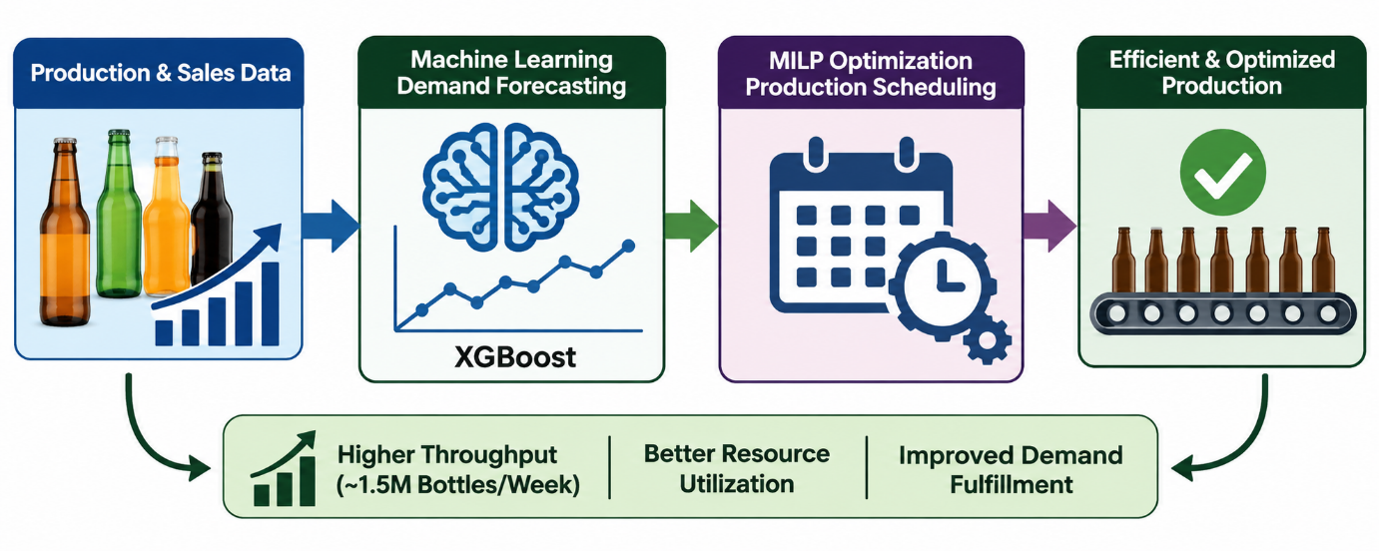
ABSTRACT: Efficient production scheduling and resource allocation remain central challenges in manufacturing systems, particularly in fast-moving consumer goods industries, where demand fluctuations can disrupt production operations and resource utilization. To address these challenges, this study developed an integrated machine learning (ML) and mixed-integer linear programming (MILP) framework for improving demand forecasting, production scheduling, and resource allocation at AMA Brewery, Enugu State, Nigeria. First, weekly production schedules and sales data for ten products covering the period 2022–2024 were analyzed using four machine learning algorithms: Extreme Gradient Boosting (XGBoost), Decision Tree Regressor (DTR), Random Forest Regressor (RFR), and Gradient Boosting Regressor (GBR). The predictive performance of these models was evaluated using appropriate forecasting accuracy metrics. XGBoost emerged as the best-performing model, reducing Mean Absolute Error (MAE) by 58% and Symmetric Mean Absolute Percentage Error (SMAPE) by more than 57% compared with the benchmark methods. Its SMAPE values, approximately 2% across product categories, demonstrated strong predictive accuracy. Secondly, the selected XGBoost model was integrated into a MILP optimization framework to generate production schedules while satisfying operational and capacity constraints. The resulting optimization model comprised 1914 decision variables and 1884 constraints and generated a baseline production output of approximately 1,352,250 bottles per week. Furthermore, scenario analysis demonstrated the framework’s potential to improve production throughput, with output approaching 1.5 million bottles under improved operating conditions. Sensitivity analysis also revealed the system’s response to variations in key production parameters, providing insights into capacity limitations, operational vulnerabilities, and opportunities for improved resource allocation. Finally, the findings demonstrate that integrating machine learning-based demand forecasting with mathematical optimization provides a practical decision-support approach for enhancing production planning, demand fulfillment, and operational resilience in beverage manufacturing. The framework offers both tactical and strategic insights for production managers and planners. Future research should incorporate production costs, profitability measures, and real-time operational data to extend the framework towards more comprehensive and adaptive manufacturing decision-making.
Keywords: Machine learning forecasting; Mixed integer linear programming; Production scheduling; Capacity optimization; Smart manufacturing

Graphical Abstract

TOP