Residential Radon Exposure and Lung Cancer Prevention: From
Environmental Risk to Public Health Implementation
Author Information
Other Information
ABSTRACT:
Residential radon is an established environmental carcinogen and
preventable cause of lung cancer, yet it remains incompletely integrated into
routine prevention. Because radon is imperceptible and indoor concentrations
vary between buildings, quality-assured dwelling-specific measurement is
essential; however, a household concentration does not by itself determine
cumulative exposure, radiation dose, or individual cancer risk. This
Perspective examines radon prevention at the interface of radiation biology,
risk communication, environmental health literacy, and implementation. We
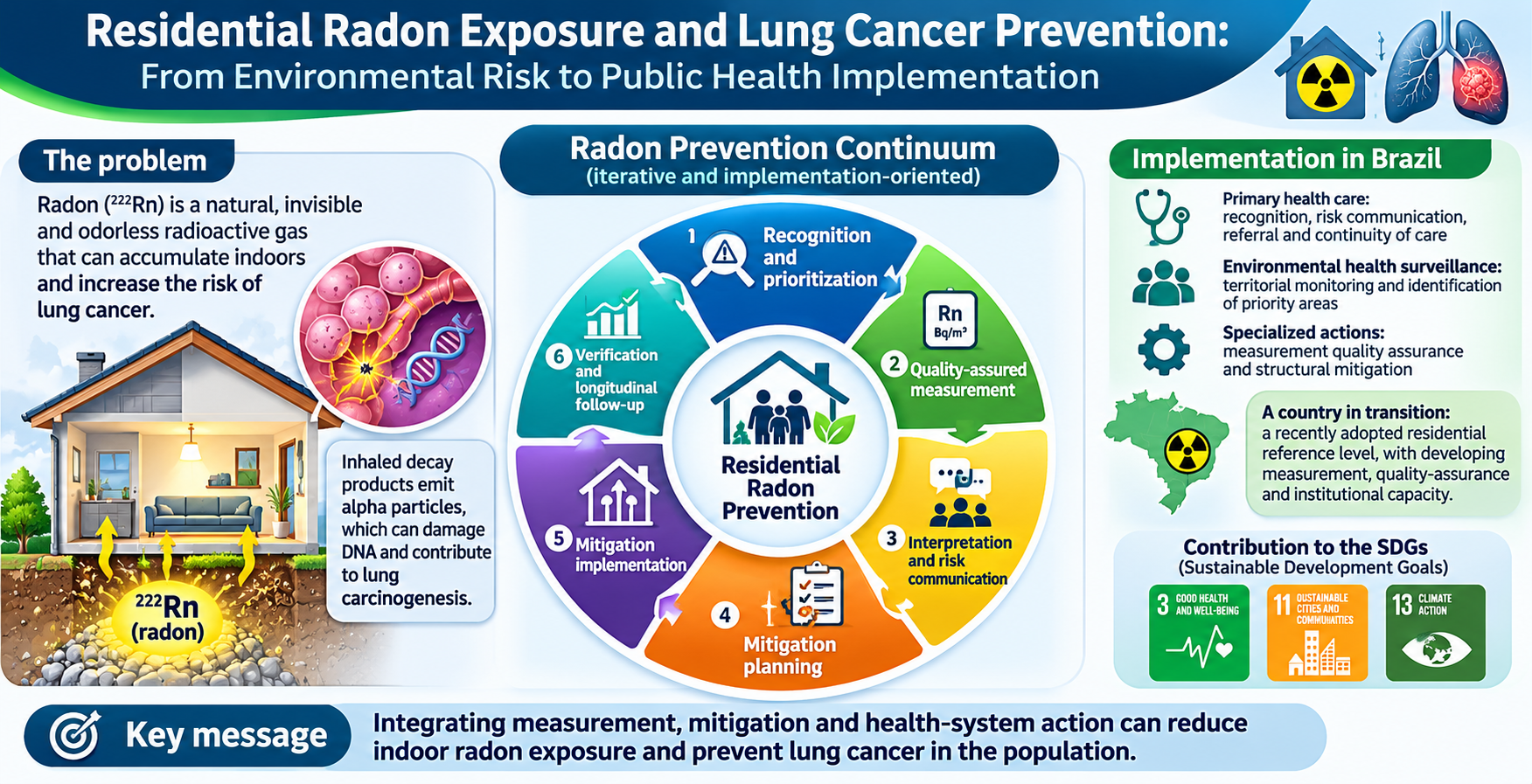
propose a six-stage Radon Prevention Continuum linking risk recognition and
prioritization, quality-assured measurement, interpretation and risk
communication, mitigation planning, mitigation implementation, and verification
with longitudinal follow-up. The framework is iterative, allowing return to
earlier stages when measurements are uncertain, mitigation is ineffective, or
building conditions change. Primary health care and environmental health
surveillance may support recognition, communication, referral, and continuity,
while measurement quality assurance and structural mitigation remain
specialized functions. Brazil is examined as an implementation case in
transition, where a recently adopted residential reference level coexists with
developing measurement, quality-assurance, and institutional capacity. The
framework aims to connect established evidence with coordinated health-system
and built-environment action, using verified, sustained reductions in indoor
radon concentration as a proximal implementation endpoint.
Keywords:
Residential radon; Lung cancer; Radiation
protection; Environmental health; Risk communication; Primary health care;
Cancer prevention; Implementation science