
Effects of Manipulating Water and Temperature on Soil Nematode Communities of Heterogeneous Karst Habitats in Southwest China

Effects of Manipulating Water and Temperature on Soil Nematode Communities of Heterogeneous Karst Habitats in Southwest China
Received: 01 July 2026 Revised: 09 July 2026 Accepted: 13 July 2026 Published: 23 July 2026

© 2026 The authors. This is an open access article under the Creative Commons Attribution 4.0 International License (https://creativecommons.org/licenses/by/4.0/).
1. Introduction
The devastating consequences of global warming caused by rising global greenhouse gas emissions are detailed in the Sixth Assessment Report released by the IPCC (2023). Global temperatures have already risen by 1.1 °C, and all regions of the world are facing unprecedented changes in the climate system, such as frequent extreme weather events. Further increases in temperature will further exacerbate these changes. Extreme heat, heavy rainfall, and regional droughts are the main forms of global climate change.
Recently, the relationship between soil nematodes and global change has been receiving increasing attention. The impacts of climate change on soil nematodes are complex and sensitive, covering multiple dimensions, including community structure, trophic levels, and species diversity [1]. Precipitation has been demonstrated in numerous studies to be the primary factor determining soil nematode properties, including structure, abundance, and population [2,3,4]. Guan et al. (2023) conducted a field survey at six representative sites along a precipitation gradient ranging from 300 to 900 mm across northeastern China, and the results showed that precipitation was positively correlated with soil nematode abundance [5]. In the experiment with increased precipitation, a 100 mm increase in mean annual precipitation resulted in a 149% increase in total soil nematode abundance. This finding was confirmed by another study showing that soil nematode abundances increased with increasing mean annual precipitation in forest ecosystems in New Jersey, USA, and that nematodes were more sensitive to changes in mean annual precipitation than soil microorganisms [6].
Karst landscapes account for about 15% of the world’s total land area [7], and are mainly concentrated in low-latitude regions, including Southeast Asia, the Mediterranean in Europe, the east coast of North America, the west coast of South America, and the fringes of Australia. In particular, southwestern China has the largest concentrated and continuous karst area [8,9]. Karst areas are characterized by serious rock desertification, a high degree of exposed bedrock, a weak capacity for self-regulation and resistance to disturbance, shallow and discontinuous soils, and low vegetation cover, which is highly susceptible to soil and water erosion in southwest China [10,11]. The special conditions of geomorphic topography (especially slope), vegetation, climate, and anthropogenic disturbances have also led to karst peaks exhibiting a high degree of habitat heterogeneity at small scales [12,13]. For instance, the soil on karst mountain peak experiences rapid wet-dry cycles due to frequent rainfalls and great evapotranspiration in summer, and the soil of karst piedmont can still maintain a relatively constant and high soil moisture level due to low evapotranspiration under thick soil and high vegetation cover conditions [14]. The soil moisture dynamics have significant impacts on soil communities [15,16]. On karst mountain peaks, intermittent drought has filtered out biological taxa with low tolerance to water deficits, resulting in a community composition exhibiting relatively high drought resistance [14]. Thus, the differences in water supply stability between mountain peak and piedmont soils may be one of the key ecological drivers shaping their distinct soil food web structure.
Soil nematodes are widely distributed in soil ecosystems worldwide. They are among the most abundant and functionally diverse metazoans and occupy multiple trophic levels ranging from primary decomposers to high trophic level predators, are not only involved in the regulation of microbial community structure and nutrient cycling processes, but also play a key role in maintaining the stability of soil ecosystems [17,18,19]. Meanwhile, they have been widely used as bioindicators of soil health and environmental change due to their sensitivity to soil disturbance, pollution and climate change [17,20,21]. Environmental factors such as elevation, temperature, and precipitation have important effects on controlling the composition and distribution of soil biota (including nematodes), especially at large spatial scales [22,23,24,25]. Bakonyi et al. (2007) found that the structure and diversity of nematode communities are more sensitive to small fluctuations in soil moisture and temperature [26]. Temperature is an important abiotic factor for nematode growth and development because nematodes are thermophilic organisms [27]. Temperature changes affect nematode distribution and result in shorter generation times [28,29]. Furthermore, several studies have shown that soil moisture is crucial for maintaining nematode survival and biological activity in arid habitats [30,31,32]. It has also been reported that temperature is more important than soil moisture for the migration of nematode communities [1]. However, most of the studies employed correlation analyses rather than experimental manipulations to examine the relationships between temperature/moisture and soil nematodes. A knowledge gap persists regarding how soil moisture and temperature directly influence nematode communities of different ecosystems in controlled conditions.
In the present study, soils were collected from the mountain peak and piedmont of a karst hill. The contrasting environmental conditions between the karst mountain peak and the piedmont areas resulted in significantly divergent soil nematode community compositions. A microcosm experiment was conducted to manipulate soil temperature and moisture conditions of the karst mountain peak and piedmont. The objective of this study was to explore how soil temperature and moisture affect nematode communities across three soil types: mountain peak soils, piedmont soils, and their mixture. We attempt to address the following ecological questions: (1) How do soil temperature and moisture individually and interactively affect soil nematode community composition? and (2) how nematode communities from different habitats adapt to favorable and harsh environmental changes. Accordingly, we hypothesized that: (1) Soil moisture exerts a stronger influence than temperature on nematode community composition, due to nematodes’ reliance on water for activity and survival; (2) Nematode communities from mountain peak soils are more tolerant to low moisture conditions than those from piedmont soils, reflecting long-term adaptation to habitat-specific environmental stress.
2. Materials and Methods
2.1. Soil Collection
The soil used in this study was collected from the Huanjiang Observation and Research Station for Karst Ecosystems (107°51′–108°43′ E, 24°44′–25°33′ N), Chinese Academy of Sciences (CAS), Guangxi Province, China. The watershed is a typical peak-cluster depression area of karst regions in southwest China. The climate is subtropical monsoon, with a distinct wet season (from April to September) and a dry season (from October to March). The watershed is a peak-cluster depression area typical of karst regions. The mean annual temperature and precipitation are 18.5 °C and 1389 mm, respectively. The calcareous soil developed from a dolostone base [12,33].
In a representative karst peak-cluster depression area, we selected a hill approximately 200 m in elevation for soil sampling. The hill exhibits contrasting soil habitats between the mountain peak and piedmont, reflecting variations in topography, vegetation cover, and soil moisture regimes. Particularly, the karst mountain peak experiences severe dry-wet cycles and extremely high temperatures in summer (wet season) [14]; and its soil water content could be reduced to 9.0% in mid-August 2012, which was three to four times lower than that of the karst piedmont soils [14]. Therefore, the soil habitat is much drier on the karst mountain peak but relatively moist on the karst piedmont, leading to contrasting soil biota compositions between the two soil types [14,34].
2.2. Experimental Design
In April 2022, soils were collected from the peaks and piedmont of the karst hill, respectively, and a microcosm experiment was conducted using 50-mL clear plastic centrifuge tubes, each containing 100 g of soil. The experiment was conducted in a randomized complete block design (n = 4) with 12 treatments, including three soil sources, two temperature treatments (high and moderate), and two water treatments (high and low), resulting in a 3 × 2 × 2 factorial complete set. Thus, there were 48 samples in total. The three soils are mountain peak soil, piedmont soil, and a 1:1 mixture of these two soils. This design aimed to simulate the ecotonal transition zone that may exist between contrasting habitats in karst landscapes. Moreover, the mixed soil served to explore whether environmental effects on soil nematode communities were additive, synergistic, or buffered in heterogeneous substrate conditions. The high temperature manipulating treatment (HT) was implemented via placing the microcosms outside to obtain natural sunlight irradiation and ambient temperature, resulting in an average soil temperature of 45 °C throughout the experiment time. The moderate temperature manipulating treatment (LT) was implemented via placing the microcosms in an air-conditioned greenhouse to control daytime temperature and obtain sunlight irradiation, resulting in an average soil temperature of 20 °C throughout the experiment time. The high water manipulating treatment (HW) was implemented by adding distilled water every 2–3 days to maintain a relatively high soil moisture (65% soil water content). The low water manipulating treatment (LW) was implemented by adding distilled water to the microcosms according to the rainfall amount after each rainfall event. All the microcosms (i.e., the 50-mL clear plastic centrifuge tubes) were sealed with nylon mesh (1 mm mesh size). Prior to formal incubation, a temperature logger iButton (Dallas Semiconductor Corp., Dallas, TX, USA) was buried in soil in a microcosm representing a treatment. A total of twelve temperature logger iButtons were buried. All microcosms were placed in the dark at 25 °C for 1 week to restore biological activity. The soil culture experiment lasted 162 days from 5 April through 15 September. On 16 September, all soil in each microcosm was collected for soil nematode analysis and soil moisture analysis.
Nematodes were extracted from 50 g of fresh soil using the Baermann funnel method. After nematodes were fixed in 4% formalin solution, they were counted at low magnification (100×) using an inverted microscope (Eclipse Ts100, Nikon, Yokohama city, Japan). The nematodes were then identified at the genus level using a DIC microscope (Eclipse 80 i, Nikon, Yokohama city, Japan) at high magnification (400×) [35,36,37] and categorized by trophic groups and ecological life strategy [18,20,38]. The functional guild is defined by the nematode’s trophic behavior and by its ecological life strategy as a colonizer or persister (as indicated by its “cp” value).
The soil nematode ecological indices: Simpson Dominance Index (λ), Richness of genera (S), Pielou evenness index (J), Enrichment index (EI), structure index (SI), maturity index (MI) and plant parasitic index (PPI) were computed based on the weighted composition of the nematode community [19,39,40,41]. The EI reflects the degree of food availability and nutrient enrichment; lower SI may indicate greater disturbance of the soil food web, whereas a higher MI suggests a lesser impact of the disturbance; PPI is a plant parasitism index that reflects the structure and complexity of the soil food web.
2.3. Data Analysis
Before analysis, data for the abundances of total nematodes and different trophic groups were log(x+1) transformed when required to improve normality and homogeneity of variance. Two-way ANOVA was used to investigate the main and interaction effects of soil temperature and moisture on soil nematode variables of each soil type. One-way ANOVA followed by the least significant differences (LSD) post hoc test was employed to explore the effects of the four treatments on soil nematode variables of each soil type. Tamhane’s T2 post hoc test was used to test differences among treatments when the variances of transformed data were not equal. Statistical significance was determined at p < 0.05. The ANOVA was performed with R version 4.2.0 (R Core Team, 2022, Vienna, Austria).
Variation partitioning was employed to distinguish the contributions of water and temperature to the explained variation in soil nematode assemblages. This approach is based on redundancy analysis (RDA) [42,43]. For each nematode assemblage and soil type, three separate RDAs were conducted. The total variation explained (VETotal) was obtained from an RDA in which both water and temperature variables constrained the nematode assemblage. The variation uniquely explained by water (VEWater) was derived from an RDA constrained by water, with temperature included as a covariable. Similarly, the variation uniquely explained by temperature (VETemperature) was obtained from an RDA constrained by temperature, with water treated as a covariable. The variation jointly explained by water and temperature was then calculated as VETotal − VEWater − VETemperature, while the unexplained variation was computed as 100 − VETotal. All RDA analyses were carried out using Canoco 5.0 software (Microcomputer Power, Ithaca, NY, USA). Prior to analysis, all variables were log10-transformed, and the significance of the canonical axes was tested with 999 unrestricted Monte Carlo permutations under the reduced model.
3. Results
3.1. The Abundances of Total Nematodes and Each Trophic Group
In the mountain peak soil, nematode communities responded strongly to soil moisture, which significantly influenced the total abundance, bacterivores, fungivores, and omnivore-predators (Table 1). Total nematode abundance was significantly higher under HW-HT compared to LW-HT (Figure 1A), suggesting that high moisture effectively counteracts the negative impact of elevated temperature. Bacterivore abundance showed a similar pattern, with significantly greater values under HW-HT than all other treatments (Figure 1D). Fungivore abundance was also significantly enhanced by high moisture, with HW-HT significantly exceeding LW-HT and LW-LT (Figure 1G). Omnivore-predator abundance increased significantly under HW-HT compared to LW-HT (Figure 1M). In contrast, herbivore abundance showed no significant variation across treatments (Figure 1J). The nematode abundance results indicate that a shift from dry to wet soil conditions promotes higher community density in mountain peak soils.
In the piedmont soil, moisture significantly affected total nematode abundance, bacterivores, and fungivores (Table 1). Total abundance was significantly higher in HW-LT than in LW-HT (Figure 1B), indicating that moderate temperature combined with high water availability favors nematode survival. Bacterivore abundance under HW-HT was significantly higher than under LW-HT and LW-LT (Figure 1E), while fungivore abundance under HW-HT was also significantly greater than LW-HT and LW-LT (Figure 1H). No significant treatment differences were observed for herbivores or omnivore-predators (Figure 1K,N). These results indicate that a shift from wet to dry soil conditions reduces community density in piedmont soils.
In the mixed soil, total nematode abundance and bacterivore and fungivore abundances were all significantly influenced by moisture (Table 1). Total abundance was significantly greater under HW-LT than under LW-HT (Figure 1C). For bacterivores, HW-LT supported significantly higher abundance than LW-HT (Figure 1F). Similarly, fungivores under HW-LT were significantly more abundant than in LW-HT (Figure 1I). Herbivores and omnivore-predators in this soil type showed no significant differences among treatments (Figure 1L,O).
Table 1. Summary of analyses of variance (Two-way ANOVA) of nematode variables in mountain peak soils, piedmont soils, and mixed soils of these two. Listed are F values and p values. T: Temperature (high and moderate temperature) and W: Water (high and low water content). T×W denotes interaction effect.
|
Variables of Soil Nematodes |
Mountain Peak Soil |
Piedmont Soil |
Mixed Soil |
|||||||||||||||
|---|---|---|---|---|---|---|---|---|---|---|---|---|---|---|---|---|---|---|
|
T |
W |
T×W |
T |
W |
T×W |
T |
W |
T×W |
||||||||||
|
F |
p |
F |
p |
F |
p |
F |
p |
F |
p |
F |
p |
F |
p |
F |
p |
F |
p |
|
|
Total nematode abundance |
0.364 |
0.558 |
64.059 |
<0.001 |
3.736 |
0.077 |
1.202 |
0.296 |
5.727 |
0.036 |
0.720 |
0.414 |
3.643 |
0.081 |
17.197 |
0.001 |
0.308 |
0.589 |
|
Bacterivore abundance |
4.285 |
0.061 |
43.742 |
<0.001 |
0.422 |
0.528 |
1.363 |
0.268 |
5.158 |
0.044 |
1.735 |
0.215 |
4.086 |
0.066 |
7.177 |
0.020 |
0.002 |
0.961 |
|
Fungivore abundance |
0.279 |
0.607 |
82.485 |
<0.001 |
6.685 |
0.024 |
2.137 |
0.172 |
0.755 |
0.403 |
6.594 |
0.026 |
2.447 |
0.144 |
11.348 |
0.006 |
0.069 |
0.797 |
|
Herbivore abundance |
0.436 |
0.522 |
0.346 |
0.567 |
0.557 |
0.470 |
4.347 |
0.061 |
1.399 |
0.262 |
0.147 |
0.708 |
0.002 |
0.967 |
0.033 |
0.858 |
0.788 |
0.392 |
|
Omnivore-predator abundance |
0.356 |
0.562 |
4.853 |
0.048 |
1.410 |
0.258 |
1.416 |
0.259 |
3.164 |
0.103 |
0.864 |
0.373 |
0.650 |
0.436 |
4.280 |
0.061 |
0.001 |
0.982 |
|
Richness of genera (S) a |
0.832 |
0.380 |
23.120 |
<0.001 |
0.007 |
0.935 |
5.244 |
0.043 |
0.809 |
0.388 |
0.167 |
0.690 |
17.055 |
0.001 |
2.315 |
0.154 |
0.756 |
0.402 |
|
Pielou evenness index (J) |
1.142 |
0.306 |
27.274 |
<0.001 |
2.771 |
0.122 |
1.312 |
0.276 |
0.055 |
0.819 |
1.310 |
0.277 |
0.071 |
0.795 |
30.149 |
<0.001 |
0.384 |
0.547 |
|
Simpson dominance index (λ) |
1.315 |
0.274 |
13.890 |
0.003 |
0.740 |
0.407 |
1.418 |
0.259 |
1.359 |
0.268 |
0.397 |
0.541 |
13.992 |
0.003 |
7.020 |
0.021 |
0.024 |
0.879 |
|
Maturity index (MI) |
0.143 |
0.712 |
9.985 |
0.008 |
1.619 |
0.227 |
1.898 |
0.196 |
5.457 |
0.039 |
1.241 |
0.289 |
1.162 |
0.302 |
0.882 |
0.366 |
0.005 |
0.943 |
|
Plant-parasite index (PPI) |
1.200 |
0.295 |
<0.001 |
1.000 |
1.200 |
0.295 |
3.531 |
0.087 |
0.729 |
0.411 |
0.029 |
0.867 |
0.231 |
0.640 |
0.231 |
0.064 |
0.231 |
0.640 |
|
Enrichment index (EI) |
0.754 |
0.402 |
17.367 |
0.001 |
10.884 |
0.006 |
0.866 |
0.372 |
1.707 |
0.218 |
12.049 |
0.005 |
0.198 |
0.665 |
12.226 |
0.004 |
0.022 |
0.883 |
|
Structure index (SI) |
0.373 |
0.553 |
9.865 |
0.009 |
1.725 |
0.214 |
3.355 |
0.094 |
18.290 |
0.001 |
0.796 |
0.391 |
2.065 |
0.176 |
0.632 |
0.442 |
0.198 |
0.664 |
a The community may occasionally contain a very small number of entomopathogenic nematodes.
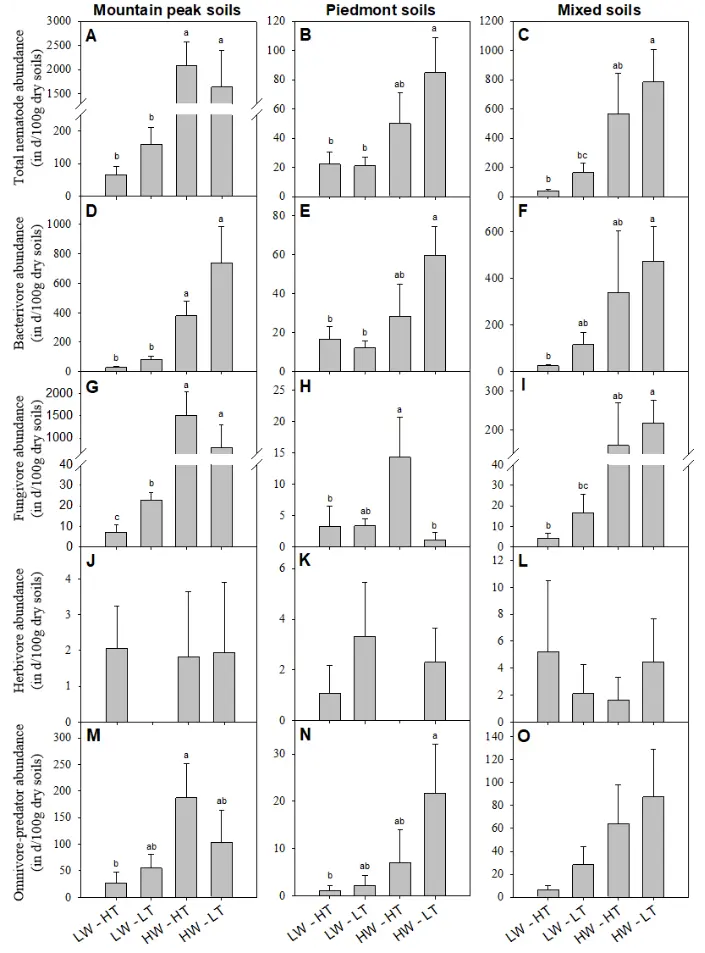
Figure 1. Abundance of total nematodes (A–C), bacterivores (D–F), fungivores (G–I), herbivores (J–L), and omnivore-predators (M–O) of mountain peak soils, piedmont soils, and mixed soils under low water high temperature (LW-HT), low water moderate temperature (LW-LT), high water high temperature (HW-HT), and high water moderate temperature (HW-LT) treatments. Bars indicate standard errors of means. Values with different letters are significantly different at p < 0.05 level by the LSD test.
3.2. The Diversity of Soil Nematodes
In mountain peak soils, soil moisture had a significant effect on the richness and composition of nematode communities, while temperature and the interaction between temperature and moisture showed limited influence (Table 1). Specifically, the richness of nematode genera (S), Pielou evenness index (J), Simpson dominance index (λ), and enrichment index (EI) were all significantly higher under high water (HW) conditions than under low water (LW) conditions, regardless of temperature level (Figure 2A,D,G). For example, HW-HT and HW-LT treatments both led to significantly higher genus richness and lower community evenness compared to LW treatments, indicating a moisture-driven shift toward increased diversity but decreased distributional balance within the community. Correspondingly, Simpson’s dominance index was also elevated under HW treatments, suggesting that a few fast-growing genera may have dominated under moist conditions. These results indicate that a shift from dry to wet soil conditions promotes higher community diversity in mountain peak soils.
In piedmont soils, nematode community diversity indices were generally less responsive to environmental treatments. While water treatment had a significant effect on the total nematode abundance and enrichment index, as well as marginally affected the maturity index (MI) and bacterivore abundance, no significant effects were observed on richness (S), evenness (J), or dominance (λ) (Table 1, Figure 2B,E,H). This indicates that nematode communities in piedmont soils were more structurally stable and less sensitive to short-term fluctuations in soil moisture and temperature.
In mixed soils, the effects of water availability were again evident. The genus richness (S) and enrichment index (EI) were significantly higher under HW conditions, whereas evenness (J) and dominance (λ) were significantly altered, particularly under HW-HT treatment (Table 1, Figure 2C,F,I). Richness increased notably in HW-LT, whereas HW-HT led to increased dominance and reduced evenness, indicating that under high water and high temperature conditions, the nematode community tended toward functional simplification and competitive exclusion. These results parallel the patterns observed in mountain peak soils, suggesting that moisture is a primary environmental filter shaping nematode diversity in both homogenous and heterogeneous soil systems.
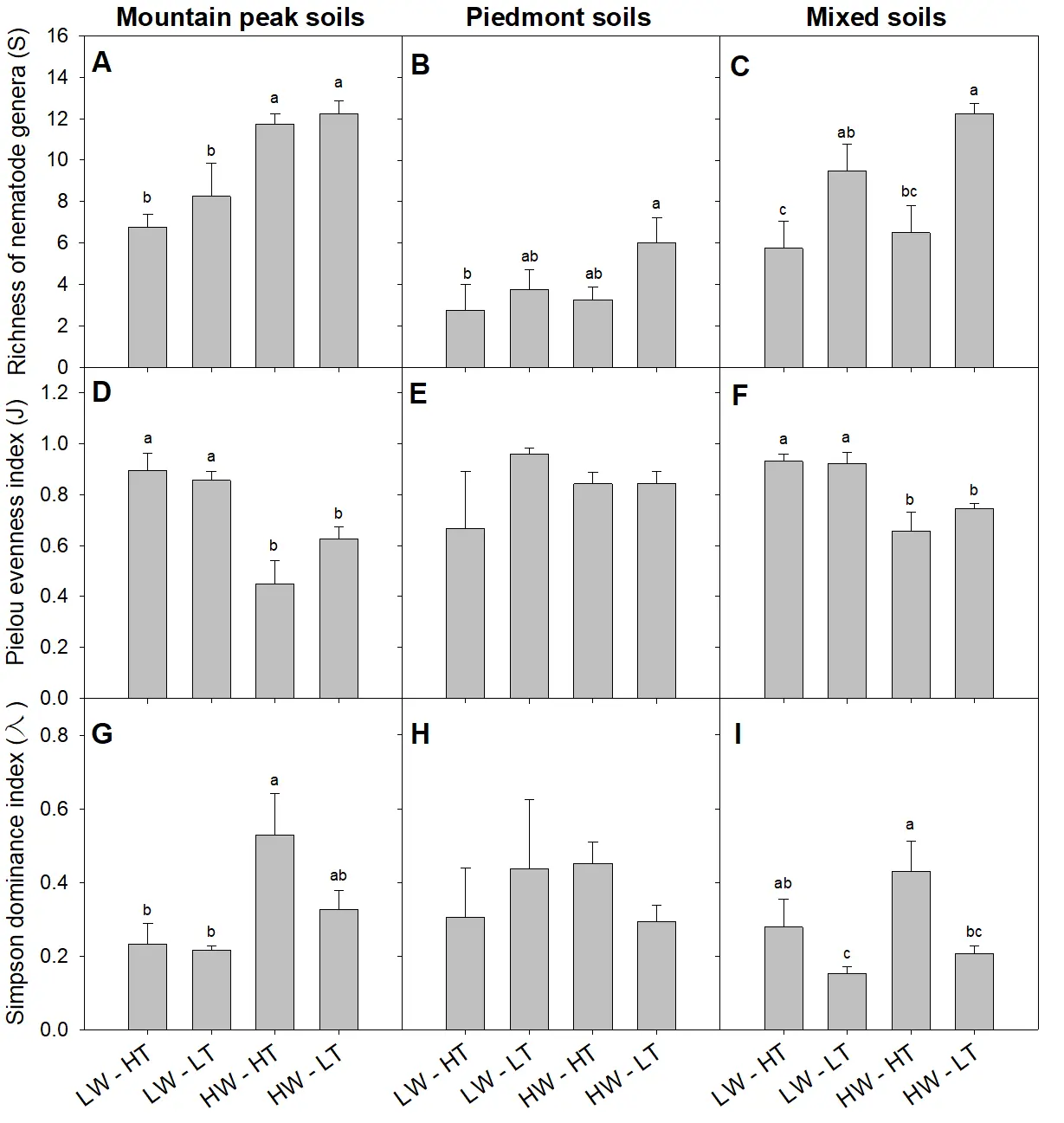
Figure 2. Nematode richness (A–C), Pielou evenness index (D–F), and Simpson dominance index (G–I) of mountain peak soils, piedmont soils, and mixed soils of these two under low water high temperature (LW-HT), low water moderate temperature (LW-LT), high water high temperature (HW-HT), and high water moderate temperature (HW-LT) treatments. Bars indicate standard errors of means. Values with different letters are significantly different at p < 0.05 level by the LSD test.
3.3. The Nematode Community Maturity and Structure
In mountain peak soils, moisture had a significant effect on multiple nematode community parameters, while temperature and the interaction between temperature and moisture played relatively minor roles. The maturity index (MI) was significantly higher under the LW-LT treatment than under HW treatments (Figure 3A), suggesting that nematode communities were more structured and ecologically mature under dry, cool conditions. Similarly, both the enrichment index (EI) and structure index (SI) were significantly greater under LW than HW (Table 1). In the faunal profile (Figure 4A), the LW-LT treatment was located in quadrant III with higher SI and moderate EI, reflecting a stable, structured food web. In contrast, HW-HT treatments were situated in quadrant IV, indicating a disturbed system with reduced structural complexity and enrichment.
In piedmont soils, moisture again emerged as the primary factor influencing nematode community responses. The MI was higher under HW-LT than LW treatments (Figure 3B), suggesting that lower moisture led to less mature communities in the piedmont. Additionally, EI and SI were significantly reduced under LW treatments (Table 1). The faunal profile (Figure 4B) showed LW placed in quadrant IV, suggesting a disturbed and poorly structured soil food web, while HW treatments were located in quadrant III, indicating relatively higher community stability.
In mixed soils, nematode community responses to environmental treatments were generally less pronounced. Only the enrichment index (EI) showed significantly higher values under HW than LW (Table 1), suggesting that high moisture is suitable for nematodes to acquire and use nutrients. No significant differences in MI were observed among treatments (Figure 3C), indicating that the mixed soils maintained a stable maturity level across conditions. The faunal profile (Figure 4C) showed all treatments clustering in quadrant III, with relatively minor differences between treatments, reflecting the buffering capacity of mixed soils in maintaining food web stability.
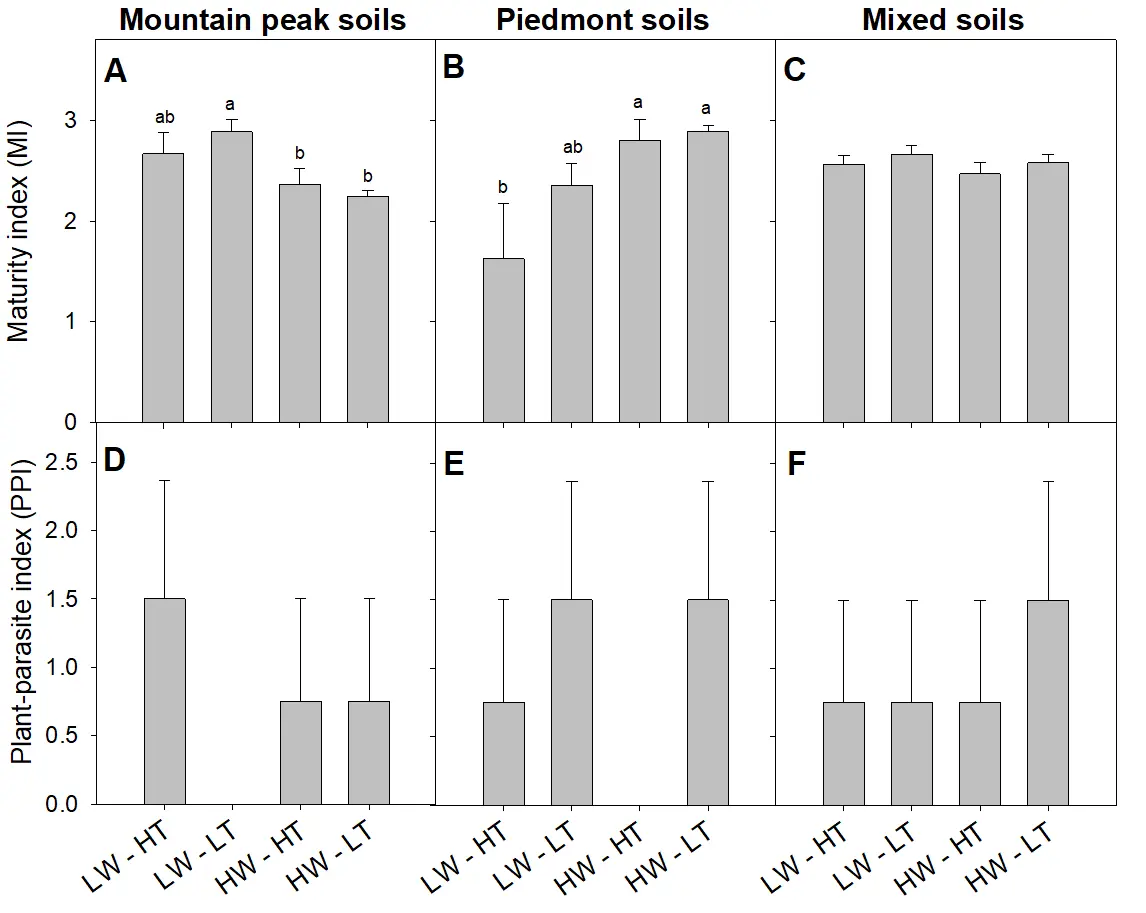
Figure 3. Nematode maturity index (A–C) and plant-parasite index (D–F) of mountain peak soils, piedmont soils, and mixed soils of these two under low water high temperature (LW-HT), low water moderate temperature (LW-LT), high water high temperature (HW-HT), and high water moderate temperature (HW-LT) treatments. Bars indicate standard errors of means. Values with different letters are significantly different at p < 0.05 level by LSD test.
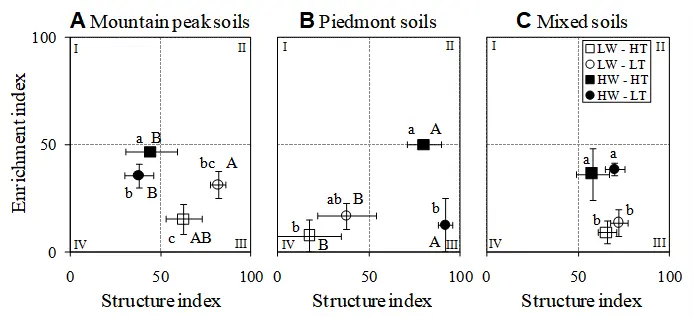
Figure 4. Weighted soil nematode faunal analysis of mountain peak soils (A), piedmont soils (B), and mixed soils of these two (C) under low water high temperature (LW-HT), low water moderate temperature (LW-LT), high water high temperature (HW-HT), and high water moderate temperature (HW-LT) treatments. Bars indicate standard errors of means. Points with different lowercase and uppercase letters indicate that nematode enrichment index and structure index are significantly different at p < 0.05 level by LSD test, respectively.
3.4. Variation Partitioning of Water and Temperature on Nematode Trophic Groups
In mountain peak soils, water emerged as the primary driver of genus-level community composition, accounting for significantly more variation than temperature across total nematodes and three trophic groups (bacterivores, fungivores, and omnivore-predators) (p < 0.05) (Table 2). Neither temperature nor water had a statistically significant effect on herbivore composition, although temperature did explain a marginally higher amount of variation (Table 2). In piedmont soils, water explained a greater amount of variations than temperature across total nematodes and bacterivores (p < 0.05) (Table 2). For fungivores, neither water nor temperature was a statistically significant predictor, although the RDA results did not reach statistical significance (Table 2). In mixed soils, temperature emerged as the primary driver of the total nematode community (Table 2). Temperature and water explained 20.2% and 14.8% of the variation in total nematode communities, respectively (p < 0.05) (Table 2). In addition, temperature explained a greater amount of variation than water across bacterivores, and water explained a greater amount of variation than temperature across omnivore-predators (Table 2).
Table 2. Results of variance partitioning for all nematodes and four trophic groups (i.e., bacterivores, fungivores, herbivores, and omnivore-predators) of mountain peak soils, piedmont soils, and mixed soils of these two in terms of the fractions of variation explained. Variation of the nematode generic data matrix is explained by two variables: temperature and water.
|
Soil Types |
Nematode Variables |
Total Explained Variation |
p Value |
Temperature |
Water |
Joint Effect of Temperature and Water |
Unexplained Variation |
||
|---|---|---|---|---|---|---|---|---|---|
|
Explained Variation |
p Value |
Explained Variation |
p Value |
||||||
|
Mountain peak soils |
All nematodes |
39.9% |
0.002 |
6.0% |
0.222 |
33.1% |
0.002 |
0.8% |
60.1% |
|
Bacterivores |
37.5% |
0.002 |
8.9% |
0.092 |
27.5% |
0.002 |
1.1% |
62.5% |
|
|
Fungivores |
56.0% |
0.004 |
1.4% |
0.812 |
53.9% |
0.002 |
0.7% |
44.0% |
|
|
Herbivores |
15.7% |
0.586 |
9.5% |
0.350 |
6.0% |
0.472 |
0.2% |
84.3% |
|
|
Omnivore-predators |
30.2% |
0.026 |
1.5% |
0.970 |
28.5% |
0.004 |
0.2% |
69.8% |
|
|
Piedmont soils |
All nematodes |
27.7% |
0.008 |
7.2% |
0.314 |
19.5% |
0.002 |
1.0% |
72.3% |
|
Bacterivores |
36.3% |
0.004 |
5.7% |
0.478 |
28.5% |
0.002 |
2.1% |
63.7% |
|
|
Fungivores |
21.8% |
0.170 |
5.5% |
0.330 |
14.5% |
0.110 |
1.8% |
78.2% |
|
|
Herbivores |
20.3% |
0.246 |
13.5% |
0.148 |
4.5% |
0.442 |
2.3% |
79.7% |
|
|
Omnivore-predators |
12.5% |
0.416 |
8.6% |
0.308 |
3.1% |
0.748 |
0.8% |
87.5% |
|
|
Mixed soils |
All nematodes |
35.8% |
0.004 |
20.2% |
0.010 |
14.8% |
0.028 |
0.8% |
64.2% |
|
Bacterivores |
38.8% |
0.008 |
25.6% |
0.006 |
12.6% |
0.068 |
0.6% |
61.2% |
|
|
Fungivores |
34.4% |
0.040 |
13.2% |
0.136 |
19.6% |
0.062 |
1.6% |
65.6% |
|
|
Herbivores |
6.0% |
0.852 |
2.2% |
0.846 |
3.6% |
0.640 |
0.2% |
94.0% |
|
|
Omnivore-predators |
32.8% |
0.060 |
10.3% |
0.194 |
21.9% |
0.030 |
0.6% |
67.2% |
|
4. Discussion
4.1. Water Is More Important Than Temperature in Shaping Soil Nematode Communities
The present study clearly showed that the effect of soil moisture on soil nematode community composition was more significant than that of temperature across all three soil sources. Specifically, soil nematodes live in the soil water film [44], and their feeding and movement behaviors are theoretically restricted by soil water content. In fact, water availability is a major constraint on biological activity [6]. In an experiment with gradually increasing soil moisture content, the degree of response of soil microorganisms gradually increased from 7% to 266%, and the greater the magnitude of soil moisture, the greater the degree of response of microorganisms [31,45,46]. Consistent with these reports, higher soil water content maintained greater abundance and genus richness of soil nematodes in this study. It is noteworthy that different trophic groups and species of nematodes respond differently to soil moisture. Environments with higher soil moisture content favor the growth of bacterivorous nematodes [47]. This is also reflected in our study. Similarly, Ruan (2012) found that increased precipitation significantly increased the number of herbivorous nematodes and decreased the number of bacterivorous and omnivorous-carnivorous nematodes in semi-arid grasslands [4].
Soil temperature mainly affected the nematode richness rather than nematode abundance in the present study. In particular, extremely high temperatures reduced nematode genus richness in piedmont soil and mixed mountain peak-piedmont soil. This may be due to the fact that soil nematodes can withstand the thermal stress (high temperature) [28,48]. However, the relationships between temperature and nematodes are not clear. Several previous studies have reported that elevated temperatures affect nematode growth and reproduction, thereby increasing the abundance of nematodes [49,50], while others have found that temperature increases have no significant effect on soil nematodes [26,51]. These conflicting results may be due to the fact that soil nematodes are tolerant to a wide range of simulated temperatures. Furthermore, temperature may have an indirect effect on soil biota by changing soil water content. In our study, interaction effects between temperature and water on fungivorous nematode abundance and enrichment index were detected in the mountain peak soil and piedmont soil, which may be evidence of the indirect effects of temperature on soil nematodes. Similarly, the impacts of temperature on soil nematode abundance are indirect, via modifications to soil characteristics, rather than having direct effects at a global scale [17].
Interestingly, plant-parasitic nematodes showed no significant response to either soil moisture or temperature across all soil types. This suggests that this trophic group is more resistant to short-term environmental changes, potentially due to their specialized plant-host associations. These results collectively support our first hypothesis that soil moisture has a greater influence than temperature on nematode community composition. Across different soils, moisture consistently affected nematode abundance, diversity, and functional indices, whereas temperature had more limited and indirect effects. This highlights the critical role of water availability as the primary environmental driver of nematode dynamics in karst ecosystems.
4.2. Nematodes from Contrasting Habitats Respond Differently to Water Changes
Soil nematode communities on mountain peaks were highly structured under low moisture conditions, while soil nematode communities on piedmonts were highly structured under high moisture conditions (Figure 4). When the mountain peak soil moisture condition became better, the number of nematodes with low cp values increased, which led to a decrease in SI; and the increase in mountain peak soil moisture increased the abundances of fast-growing cp1 bacterial-feeding nematodes and cp2 fungivorous nematodes, which resulted in the increases in the enrichment index. When Piedmont soil moisture conditions deteriorated, the lower SI resulted primarily from a lower number of high cp values (omnivores and predators). The recovery rate of high trophic level nematodes is slower than that of low trophic level nematodes [52]. Many nematodes can survive for long periods of time in unusually stressful environments by experiencing temporary quiescence under environmental stress and entering dehydration or other extreme states [28]. A number of physiological and behavioral responses make nematodes more responsive to environmental stress. For instance, Austin et al. (2009) found that the majority of nematodes extracted from the surface of granite flatrock outcrops in the eastern Piedmont region of the United States were in curled form (33–89%), suggesting that they use dehydration to survive in this unique environment [53]. Therefore, we suggest that piedmont environments are more difficult for nematode communities to recover when subjected to extreme rainfall or drought. In contrast, mountain peak nematodes are more tolerant to changes in environmental moisture.
These observations support our second hypothesis which proposed that nematode communities from mountain peak soils are more tolerant to low moisture than those from piedmont soils. The higher ecological maturity and structure of nematode communities in peak soils under dry conditions, compared to their piedmont counterparts under similar stress, suggest long-term adaptation to drought. This indicates that summit-dwelling nematodes may possess intrinsic resilience traits shaped by the harsh microenvironmental conditions of karst mountain peaks.
Moreover, we observed that nematode abundance significantly increased in mixed soils under moderate temperature conditions. This finding indicates that the heterogeneous substrate formed by combining summit and piedmont soils may buffer against environmental stress. The mixed soil likely provides more complementary microhabitats and resource niches, facilitating nematode activity and survival in otherwise less favorable conditions. Such heterogeneity might enhance system resilience through trophic and structural diversity. This result supports the ecological role of transitional or ecotonal zones in karst landscapes, where the mixing of soils from contrasting habitats can lead to greater biological responses under climate stress. Furthermore, the lack of response in plant-parasitic nematodes across all soil types, regardless of hydrothermal treatment, reinforces their functional stability and suggests a unique resilience mechanism within this group. Nematodes’ ability to enter cryptobiotic states also allows them to survive extreme environments, such as deserts, and recover rapidly [54,55]. Thus, soil nematodes may contribute to ecosystem resistance under climate change and serve as indicators of environmental resilience.
5. Conclusions
In summary, this study demonstrates that soil moisture exerts a stronger and more direct influence on soil nematode communities than temperature does, with moisture primarily driving abundance, richness, and functional indices, whereas temperature plays a secondary, often indirect role through its interaction with water availability. These findings highlight water as the key environmental filter in karst ecosystems, where projected shifts in precipitation regimes may pose greater threats to belowground biota than warming alone. Importantly, nematode responses were habitat-dependent. Specifically, nematode communities from mountain peak soils showed greater stability under low moisture, as these soils are adapted to harsh conditions. Piedmont communities were more vulnerable to moisture reduction and lost more high-trophic-level taxa. Mixed soils had higher nematode abundance under moderate conditions, suggesting habitat heterogeneity buffers environmental stress. Notably, plant-parasitic nematodes remained unresponsive across all treatments, indicating strong physiological or ecological buffering that may render them useful as indicators of acute disturbance, though their long-term sensitivity requires further scrutiny.
Given the short-term nature of our microcosm experiment, we caution against overgeneralization to long-term field dynamics, and we emphasize the need for extended, multi-factor studies that incorporate plant-soil interactions and biogeochemical feedbacks. Future research should also investigate the physiological mechanisms underlying nematode resilience across habitats and identify critical thresholds beyond which community structure undergoes irreversible change. Integrating such knowledge with ecosystem process measurements will be essential for accurately predicting the responses of soil food webs to ongoing climate change.
Acknowledgments
We are grateful to Kunping Liu and Haifei Lin for their technical helps.
Author Contributions
Conceptualization, J.Z.; Methodology, J.Z.; Software, S.W. and J.Z.; Validation, S.W. and J.Z.; Formal Analysis, S.W. and J.Z.; Investigation, J.Z.; Resources, J.Z.; Data Curation, S.W. and J.Z.; Writing—Original Draft Preparation, S.W.; Writing—Review & Editing, J.Z.; Writing, S.W. and J.Z.; Visualization, S.W. and J.Z.; Supervision, J.Z.; Project Administration, J.Z.; Funding acquisition, J.Z.
Ethics Statement
Not applicable.
Informed Consent Statement
Not applicable.
Data Availability Statement
Data will be made available on request.
Funding
This study was supported by the National Natural Science Foundation of China (42377284); the Key Research and Development Program of Hechi city (HeKe AB240715); the Guangxi Bagui Young Scholars Special Funding given to Jie Zhao; and the Science and Technology Innovation Program of Hunan Province (2023RC1076).
Declaration of Competing Interest
The authors declare that they have no known competing financial interests or personal relationships that could have appeared to influence the work reported in this paper.
References
- Bakonyi G, Nagy P. Temperature‐ and moisture‐induced changes in the structure of the nematode fauna of a semiarid grassland—Patterns and mechanisms. Glob. Change Biol. 2000, 6, 697–707. DOI:10.1046/j.1365-2486.2000.00354.x [Google Scholar]
- Bai Y, Wu J, Xing Q, Pan Q, Huang J, Yang D, et al. Primary production and rain use efficiency across a precipitation gradient on the mongolia plateau. Ecology 2008, 89, 2140–2153. DOI:10.1890/07-0992.1 [Google Scholar]
- Liu T, Hu F, Li H. Spatial ecology of soil nematodes: Perspectives from global to micro scales. Soil Biol. Biochem. 2019, 137, 107565. DOI:10.1016/j.soilbio.2019.107565 [Google Scholar]
- Ruan WB, Sang Y, Chen Q, Zhu X, Lin S, Gao YB. The Response of Soil Nematode Community to Nitrogen, Water, and Grazing History in the Inner Mongolian Steppe, China. Ecosystems 2012, 15, 1121–1133. DOI:10.1007/s10021-012-9570-y [Google Scholar]
- Guan P, Li J, Hao C, Yang J, Song L, Niu X, et al. Precipitation regulated soil nematode community and footprint in cropland ecosystems. Soil Ecol. Lett. 2023, 5. DOI:10.1007/s42832-023-0177-3 [Google Scholar]
- Landesman WJ, Treonis AM, Dighton J. Effects of a one-year rainfall manipulation on soil nematode abundances and community composition. Pedobiologia 2011, 54, 87–91. DOI:10.1016/j.pedobi.2010.10.002 [Google Scholar]
- Wu Y, Wu Y. The Diversification of Adaptive Strategies for Karst-Adaptable Plants and the Utilization of Plant Resources in Karst Ecosystems. Agronomy 2023, 13, 2135. DOI:10.3390/agronomy13082135 [Google Scholar]
- He XY, Wang KL, Zhang W, Chen ZH, Zhu YG, Chen HS. Positive correlation between soil bacterial metabolic and plant species diversity and bacterial and fungal diversity in a vegetation succession on Karst. Plant Soil 2008, 307, 123–134. DOI:10.1007/s11104-008-9590-8 [Google Scholar]
- Zhao J, Li S, He X, Liu L, Wang K. The Soil Biota Composition along a Progressive Succession of Secondary Vegetation in a Karst Area. PLoS ONE 2014, 9, e112436. DOI:10.1371/journal.pone.0112436 [Google Scholar]
- Li J, Chen S, Long X, Hu P, Xiao D, Zhang W, et al. Linking rock outcrop size and distance to soil multifunctionality in mountain ecosystems. Funct. Ecol. 2025, 39, 1288–1301. DOI: 10.1111/1365-2435.70034 [Google Scholar]
- Long X, Zhao J, Li J, Liao X, Wang J, Fu Z, et al. Disturbance intensity shapes the soil micro-food web compositions and energy fluxes during seven-year land use changes. Soil Biol. Biochem. 2024, 194, 109424. DOI:10.1016/j.soilbio.2024.109424 [Google Scholar]
- Zhang W, Chen HS, Wang KL, Su YR, Zhang JG, Yi AJ. The Heterogeneity and Its Influencing Factors of Soil Nutrients in Peak-Cluster Depression Areas of Karst Region. Agric. Sci. China 2007, 6, 322–329. DOI:10.1016/S1671-2927(07)60052-2 [Google Scholar]
- Zhu X, Zhu D, Zhang Y, Lynch EM. Tower Karst and Cone Karst. Treatise Geomorphol. 2013, 327–340. DOI:10.1016/B978-0-12-374739-6.00141-X [Google Scholar]
- Zhao J, He X, Nie Y, Zhang W, Fu Z, Wang K. Unusual soil nematode communities on karst mountain peaks in southwest China. Soil Biol. Biochem. 2015, 88, 414–419. DOI:10.1016/j.soilbio.2015.06.020 [Google Scholar]
- Lu L, Li G, He N, Li H, Liu T, Li X, et al. Drought shifts soil nematodes to smaller size across biological scales. Soil Biol. Biochem. 2023, 184, 109099. DOI:10.1016/j.soilbio.2023.109099 [Google Scholar]
- Zhou J, Wu J, Huang J, Sheng X, Dou X, Lu M. A synthesis of soil nematode responses to global change factors. Soil Biol. Biochem. 2022, 165, 108538. DOI:10.1016/j.soilbio.2021.108538 [Google Scholar]
- van den Hoogen J, Geisen S, Routh D, Ferris H, Traunspurger W, Wardle DA, et al. Soil nematode abundance and functional group composition at a global scale. Nature 2019, 572, 194–198. DOI:10.1038/s41586-019-1418-6 [Google Scholar]
- Bongers T, Bongers M. Functional diversity of nematodes. Appl. Soil Ecol. 1998, 10, 239–251. DOI:10.1016/S0929-1393(98)00123-1 [Google Scholar]
- Bongers T, Ferris H. Nematode community structure as a bioindicator in environmental monitoring. Trends Ecol. Evol. 1999, 14, 224–228. DOI:10.1016/S0169-5347(98)01583-3 [Google Scholar]
- Ferris H, Bongers T, de Goede RGM. A framework for soil food web diagnostics: Extension of the nematode faunal analysis concept. Appl. Soil Ecol. 2001, 18, 13–29. DOI:10.1016/S0929-1393(01)00152-4 [Google Scholar]
- Siebert J, Ciobanu M, Schädler M, Eisenhauer N. Climate change and land use induce functional shifts in soil nematode communities. Oecologia 2020, 192, 281–294. DOI:10.1007/s00442-019-04560-4 [Google Scholar]
- Altieri GM, Garrido J, Mato S, Soto B, Santarcangelo V, Bari G, et al. Monitoring Soil Biodiversity and Biological Resilience in Disturbed Ecosystems: First Application of the BSR Index. Soil Syst. 2025, 9, 134. DOI:10.3390/soilsystems9040134 [Google Scholar]
- Altieri GM, Garrido González J, Moino Junior A, Tkaczuk C, Mato de la Iglesia S, Santarcangelo V, et al. Can a Soil Index Reveal Ecosystem Recovery? The Biodiversity Soil Resilience Index: A new index to assess resilience in environmentally stressed ecosystems. Int. J. Zool. Anim. Biol. 2025, 8, 000663. DOI:10.23880/izab-16000663 [Google Scholar]
- Griffiths B, Neilson R, Bengough AG. Soil factors determined nematode community composition in a two year pot experiment. Nematol 2003, 5, 889–897. DOI:10.1163/156854103773040808 [Google Scholar]
- Liu T, Chen X, Gong X, Lubbers IM, Jiang Y, Feng W, et al. Earthworms Coordinate Soil Biota to Improve Multiple Ecosystem Functions. Curr. Biol. 2019, 29, 3420–3429.e5. DOI:10.1016/j.cub.2019.08.045 [Google Scholar]
- Bakonyi G, Nagy P, Kovács-Láng E, Kovács E, Barabás S, Répási V, et al. Soil nematode community structure as affected by temperature and moisture in a temperate semiarid shrubland. Appl. Soil Ecol. 2007, 37, 31–40. DOI:10.1016/j.apsoil.2007.03.008 [Google Scholar]
- Nisa RU, Tantray AY, Kouser N, Allie KA, Wani SM, Alamri SA, et al. Influence of ecological and edaphic factors on biodiversity of soil nematodes. Saudi J. Biol. Sci. 2021, 28, 3049–3059. DOI:10.1016/j.sjbs.2021.02.046 [Google Scholar]
- McSorley R. Adaptations of nematodes to environmental extremes. Fla. Entomol. 2003, 86, 138–142. DOI:10.1653/0015-4040(2003)086[0138:AONTEE]2.0.CO;2 [Google Scholar]
- Treonis AM. Soil Nematodes and Desiccation Survival in the Extreme Arid Environment of the Antarctic Dry Valleys. Integr. Comp. Biol. 2005, 45, 741–750. DOI:10.1093/icb/45.5.741 [Google Scholar]
- Liang W, Steinberger Y. Temporal changes in nematode community structure in a desert ecosystem. J. Arid Environ. 2001, 48, 267–280. DOI:10.1006/jare.2000.0758 [Google Scholar]
- Song M, Li X, Jing S, Lei L, Wang J, Wan S. Responses of soil nematodes to water and nitrogen additions in an old-field grassland. Appl. Soil Ecol. 2016, 102, 53–60. DOI:10.1016/j.apsoil.2016.02.011 [Google Scholar]
- Yeates GW, Dando JL, Shepherd TG. Pressure plate studies to determine how moisture affects access of bacterial‐feeding nematodes to food in soil. Eur. J. Soil Sci. 2002, 53, 355–365. DOI:10.1046/j.1365-2389.2002.00466.x [Google Scholar]
- Zhao J, Zhang W, Wang K, Song T, Du H. Responses of the soil nematode community to management of hybrid napiergrass: The trade-off between positive and negative effects. Appl. Soil Ecol. 2014, 75, 134–144. DOI:10.1016/j.apsoil.2013.10.011 [Google Scholar]
- Wang W, Peng P, Li J, Liao X, Zhang W, Wang K, et al. Effects of Vegetation Succession on Soil Microbial Communities on Karst Mountain Peaks. Forests 2024, 15, 586. DOI:10.3390/f15040586 [Google Scholar]
- Bongers T. De Nematoden van Nederland; KNNV Uitgeverij: Schoorl, The Netherlands, 1988. [Google Scholar]
- Jairajpuri MS, Ahmad W. Dorylaimida: Free-Living, Predaceous and Plant-Parasitic Nematodes; Brill Academic Pub: Leiden, The Netherlands, 1992. [Google Scholar]
- Mai W. Plant-Parasitic Nematodes: A Pictorial Key to Genera; Comstock Publishing Associates: Ithaca, NY, USA, 1996. [Google Scholar]
- Yeates GW, Bongers T, De Goede RG, Freckman DW, Georgieva S. Feeding Habits in Soil Nematode Families and Genera-An Outline for Soil Ecologists. J. Nematol. 1993, 25, 315–331. Available online: https://pmc.ncbi.nlm.nih.gov/articles/PMC2619405/ (accessed on 12 January 1993).
- Bongers T. The maturity index: An ecological measure of environmental disturbance based on nematode species composition. Oecologia 1990, 83, 14–19. DOI:10.1007/BF00324627 [Google Scholar]
- Simpson EH. Measurement of Diversity. Nature 1949, 163, 688–688. DOI:10.1038/163688a0 [Google Scholar]
- Yeates GW. Nematodes as soil indicators: Functional and biodiversity aspects. Biol Fertil Soils 2003, 37, 199–210. DOI:10.1007/s00374-003-0586-5 [Google Scholar]
- Chen D, Pan Q, Bai Y, Hu S, Huang J, Wang Q, et al. Effects of plant functional group loss on soil biota and net ecosystem exchange: A plant removal experiment in the Mongolian grassland. J. Ecol. 2016, 104, 734–743. DOI:10.1111/1365-2745.12541 [Google Scholar]
- Liao X, Song T, Xiong Y, Zou D, Wang K, Du H, et al. Soil nematode communities on five oceanic islands across a latitudinal gradient in the north of the South China Sea: Influence of biotic and abiotic factors. Ecol. Indic. 2021, 129, 107619. DOI:10.1016/j.ecolind.2021.107619 [Google Scholar]
- Neher DA. Ecology of Plant and Free-Living Nematodes in Natural and Agricultural Soil. Annu. Rev. Phytopathol. 2010, 48, 371–394. DOI:10.1146/annurev-phyto-073009-114439 [Google Scholar]
- Cherwin K, Knapp A. Unexpected patterns of sensitivity to drought in three semi-arid grasslands. Oecologia 2012, 169, 845–852. DOI:10.1007/s00442-011-2235-2 [Google Scholar]
- Evans SE, Byrne KM, Lauenroth WK, Burke IC. Defining the limit to resistance in a drought‐tolerant grassland: Long‐term severe drought significantly reduces the dominant species and increases ruderals. J. Ecol. 2011, 99, 1500–1507. DOI:10.1111/j.1365-2745.2011.01864.x [Google Scholar]
- Kardol P, Cregger MA, Campany CE, Classen AT. Soil ecosystem functioning under climate change: Plant species and community effects. Ecology 2010, 91, 767–781. DOI:10.1890/09-0135.1 [Google Scholar]
- Darby BJ, Neher DA, Housman DC, Belnap J. Few apparent short-term effects of elevated soil temperature and increased frequency of summer precipitation on the abundance and taxonomic diversity of desert soil micro- and meso-fauna. Soil Biol. Biochem. 2011, 43, 1474–1481. DOI:10.1016/j.soilbio.2011.03.020 [Google Scholar]
- Mueller KE, Blumenthal DM, Carrillo Y, Cesarz S, Ciobanu M, Hines J, et al. Elevated CO2 and warming shift the functional composition of soil nematode communities in a semiarid grassland. Soil Biol. Biochem. 2016, 103, 46–51. DOI:10.1016/j.soilbio.2016.08.005 [Google Scholar]
- Simmons BL, Wall DH, Adams BJ, Ayres E, Barrett JE, Virginia RA. Long-term experimental warming reduces soil nematode populations in the McMurdo Dry Valleys, Antarctica. Soil Biol. Biochem. 2009, 41, 2052–2060. DOI:10.1016/j.soilbio.2009.07.009 [Google Scholar]
- De Keersmaecker W, Lhermitte S, Tits L, Honnay O, Somers B, Coppin P. A model quantifying global vegetation resistance and resilience to short‐term climate anomalies and their relationship with vegetation cover. Glob. Ecol. Biogeogr. 2015, 24, 539–548. DOI:10.1111/geb.12279 [Google Scholar]
- Li G, Wilschut RA, Luo S, Chen H, Wang X, Du G, et al. Nematode biomass changes along an elevational gradient are trophic group dependent but independent of body size. Glob. Change Biol. 2023, 29, 4898–4909. DOI:10.1111/gcb.16814 [Google Scholar]
- Austin E, Semmens K, Parsons C, Treonis A. Granite rock outcrops: An extreme environment for soil nematodes? J. Nematol. 2009, 41, 84–91. Available online: https://pmc.ncbi.nlm.nih.gov/articles/PMC3365297/ (accessed on 29 December 2008).
- Freckman DW, Womersley C. Physiological Adaptations of Nematodes in Chihuahuan Desert Soils; CABI Databases: Wallingford, UK, 1983; pp. 396–404. [Google Scholar]
- Wall DH, Virginia RA. Controls on soil biodiversity: Insights from extreme environments. Appl. Soil Ecol. 1999, 13, 137–150. DOI:10.1016/S0929-1393(99)00029-3 [Google Scholar]