
Driving Factors of Copper Surface Restructuring During Electrochemical CO2 Reduction
Driving Factors of Copper Surface Restructuring During Electrochemical CO2 Reduction
Received: 30 January 2026 Revised: 11 March 2026 Accepted: 22 April 2026 Published: 22 May 2026

© 2026 The authors. This is an open access article under the Creative Commons Attribution 4.0 International License (https://creativecommons.org/licenses/by/4.0/).
1. Introduction
Global industrialization, fueled by fossil fuels, has led to escalating greenhouse gas emissions. To counter this, researchers are exploring electrochemical CO2RR, to get valuable fuels and chemicals [1,2,3,4,5]. This approach offers a pathway to reduce reliance on fossil fuels, cut carbon emissions, and transition towards a sustainable, carbon-neutral future [6]. However, the efficiency of electrochemical CO2RR is hindered by low catalyst activity and selectivity [1,2,6]. Various catalytic materials were employed to enhance activity and selectivity until 1989, when Hori et al. discovered that Cu was capable of producing multi-carbon products. Since then, Cu has emerged as a promising catalyst for the conversion of CO2 into multi-carbon products [1].
Despite these favorable outcomes, Cu undergoes surface restructuring, as observed by Zhang (Cu(100) single crystal) [7], Eren (Cu(111) surface) [8], Auer (polycrystalline Cu electrodes) [9], Wang (nanostructured Cu catalysts) [10], Wilde [11], and many others [3,12,13,14,15]. This restructuring behavior has been widely observed in oxide-derived Cu catalysts, grain-boundary-rich Cu surfaces, and stepped Cu electrodes during CO2RR [16,17,18]. Also, it is important to distinguish between “surface reconstruction” and “surface restructuring”. Surface reconstruction typically refers to well-defined atomic rearrangements on single-crystal surfaces, resulting in ordered structures that differ from the bulk lattice. In contrast, surface restructuring is a broader term describing dynamic morphological and compositional changes in nanostructured or polycrystalline catalysts, including nanoparticles and oxide-derived Cu, under reaction conditions. In this review, the term “restructuring” is used unless referring specifically to single-crystal systems reported in the literature.
Currently, researchers are exploring the reasons behind Cu restructuring, and multiple studies have proposed different factors [9,10,11,12,13]. These include the influence of hydroxide (OH) [9,12,15,19], CO adsorption [13], the applied potential [7,11], surface oxidation [20,21,22], electrolyte composition [23,24,25,26], and current density [27,28], each suggested to play a role in the observed restructuring of Cu. In fact, the literature gives conflicting explanations of the way and reason behind the restructuring of Cu. This knowledge gap needs to be filled in not only to provide a basic understanding of surface science but also to enable a rational development of Cu-based catalysts with enhanced stability, selectivity, and scalability. To gain a better idea of restructuring, it is important to unravel the individual and joint effects of the forces that drive surface evolution or determine in what situations a certain mechanism is in control.
In this review, we assess the existing knowledge on the subject of Cu surface restructuring with special reference to six contributors (Figure 1), which include: (i) hydroxyl species, (ii) applied potential, (iii) adsorbed CO, (iv) surface oxidation processes, (v) electrolyte composition, and (vi) current density. Comparison of experimental and theoretical knowledge in these fields will help us understand which facts are confirmed and which are not, which questions remain unanswered, and which approaches can be used to go beyond the current black box and develop a more predictive model of dynamic Cu surfaces.
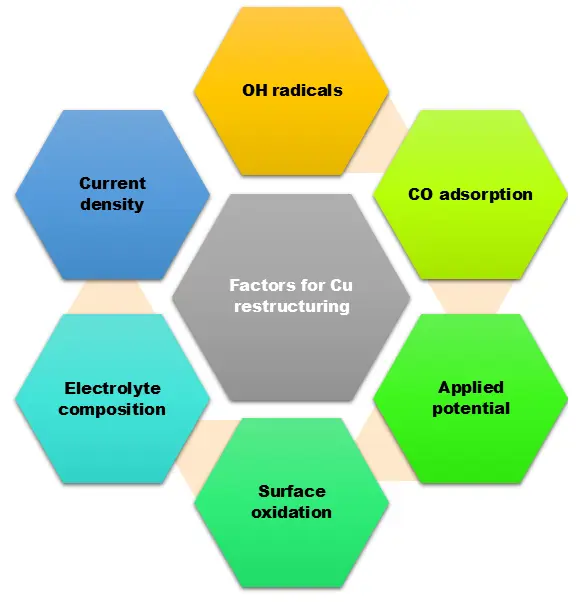
Figure 1. Key factors influencing Cu restructuring include OH radicals, current density, electrolyte composition, applied potential, and surface oxidation.
2. Factors for Cu Restructuring
A growing body of experimental and theoretical work suggests that restructuring does not stem from a single origin but is influenced by multiple, often interdependent variables at the electrochemical interface. Among these, adsorbed hydroxyl species, applied potential, CO intermediates, surface oxidation processes, electrolyte composition, and current density have emerged as key contributors. Figure 2 illustrates the dynamic nature of Cu surface restructuring under CO2RR conditions, emphasizing that catalyst evolution initiates during the transition from open-circuit potential to cathodic operating potentials. During the start-up phase, the reduction of pre-existing oxide layers leads to the dissolution of Cu species, whereas under steady-state CO2RR conditions, restructuring is dominated by adsorbate-induced processes, particularly the strong interaction between CO intermediates and the Cu surface [29]. This induces continuous dissolution–redeposition cycles and enhances surface atom mobility, resulting in significant morphological changes [29]. Furthermore, the emergence of an amorphous interfacial layer comprising mixed Cu0/Cu+ oxidation states highlight the non-equilibrium nature of the catalyst surface under reaction conditions. These findings collectively demonstrate that Cu restructuring is governed by a complex interplay of electrochemical driving forces and adsorbate effects, reinforcing its dynamic and condition-dependent behavior [30]. In the following sections, we examine how each of these factors affects surface energetics, atomic mobility, and interfacial chemistry, and we highlight where interpretations converge or diverge across the literature.
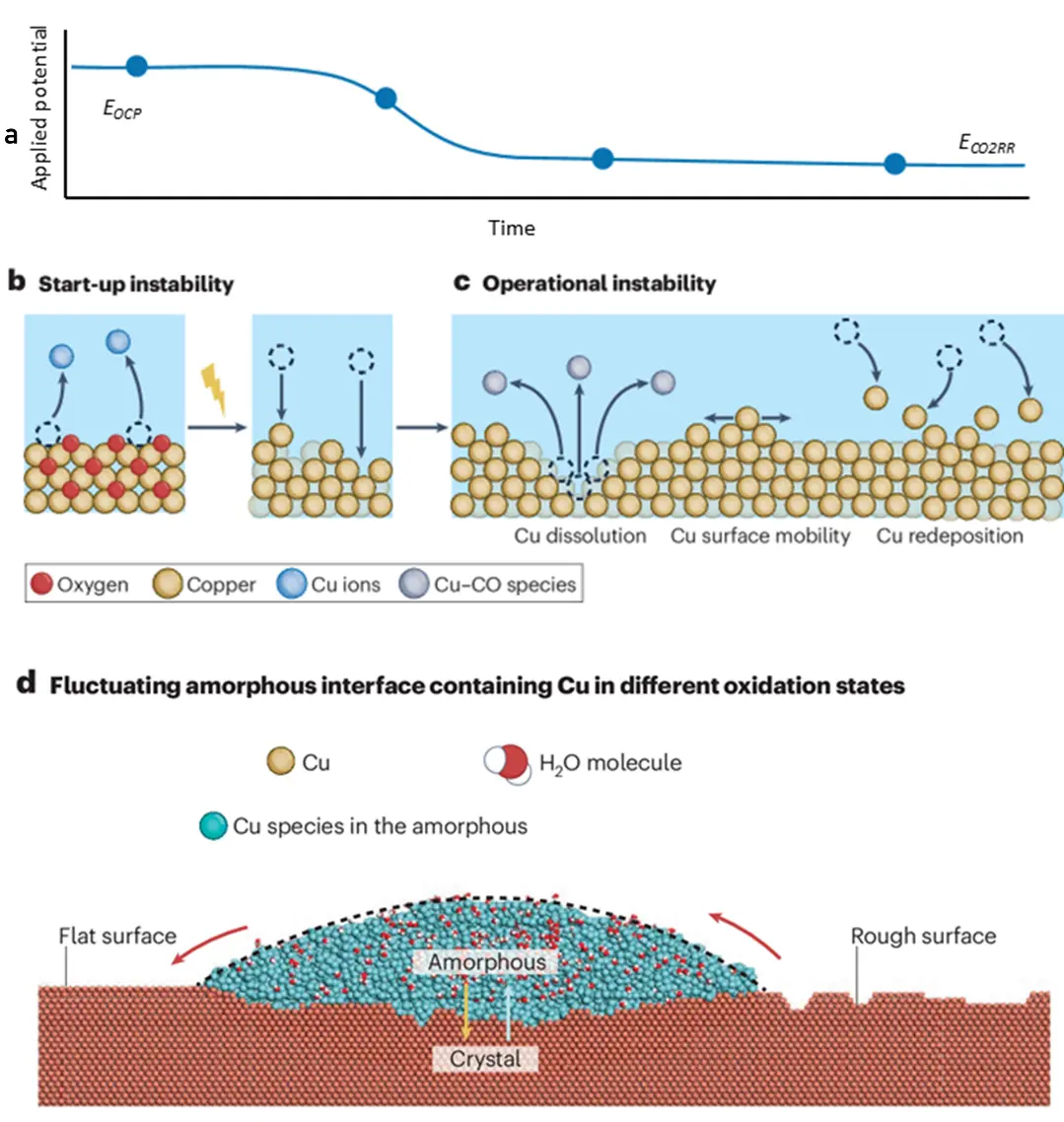
Figure 2. Atomistic picture of the Cu intrinsic instability during CO2RR. (a), The applied voltage evolves from open-circuit potential to operating cathodic potential over time. (b,c), Cu undergoes dissolution and redeposition both during the start-up phase (b) and during CO2RR operation (c). Adopted from ref. [29]. (d), The formation of an amorphous interface containing Cu in a mix of 0 and +1 oxidation states as a result of CO2RR. Adopted from ref. [30].
2.1. OH Radicals
On nanostructured Cu catalysts and oxide-derived Cu systems, OH radicals are important intermediates in the electrochemical reduction of CO2, and this determines the surface restructuring and the overall catalytic efficiency [3,15,19]. The adsorption of the OH radicals that are usually formed during the process of the electrolysis of water and during the HER on the Cu surface results in the creation of Cu hydroxides (CuOH) or Cu oxides (CuO) [15,19]. Such surface species may interfere with the active sites during CO2 reduction, thus lowering the catalyst’s performance and stability.
The capacity of Cu to lower CO2 to multi-carbon products is attributed to a large extent by the fact that Cu has the best binding energies to key intermediates of CO, CHO, and *COOH. The adsorption of OH radicals on Cu surfaces, however, can also substantially influence the binding of these intermediates, producing competing products like hydrogen via HER or inhibiting the production of C2+ products like ethylene and alcohols [19]. Research has revealed that the surface oxidation or hydroxylation by OH radical could result in the restructuring of the Cu catalyst, which can impede the CO2RR by either obstructing the active sites or changing the electronic characteristics of the catalyst [3,15,19].
The action of OH radicals on the Cu surface restructuring is time-dependent, and the effects of the radicals are strongly dependent on the electrochemical conditions. The adsorption of OH radicals on the Cu surface can allow the creation of surface defects, including vacancies, step edges, and dislocations, which, under certain circumstances, may increase CO2RR activity by increasing the number of active sites to which intermediates can bind [3,15,19,31]. Nevertheless, such flaws may also lead to the dissolution and deposition of Cu during electrochemical cycling, thereby deteriorating the catalyst in the long run. Moreover, when the concentration of OH radicals is high, thick oxide layers may be formed, and the accessibility to the active Cu surface is restricted, and the selectivity towards C2+ products is lowered [4,19].
Compositional tuning and surface coatings are some of the strategies that are being considered to enhance the stability and selectivity of Cu catalysts in CO2RR. Catalysts used in the reaction can be alloyed with other metals [32,33,34,35,36,37,38] or a protective coating to prevent excessive oxidation, and the resistance to degradation can be increased. These methods are aimed at stabilizing Cu atoms and lattices, and keep them active in their active form during long durations of operation. By regulating the action of OH radicals on the restructuring of Cu surfaces, researchers will be able to create more effective and long-lasting Cu-based catalysts in CO2RR and eventually bring the technology to the level of practical, industrial-scale applications.
2.2. Applied Potential
The potential applied is an important factor in stabilizing and catalyzing the Cu electrocatalysts in reaction to reduce CO2 [7]. When electrochemical processes are applied, the applied potential directly determines the electron density of the catalyst surface, which subsequently controls the adsorption and desorption of CO2 and reaction intermediates. In the case of Cu-based catalysts, the applied potential relates to both the oxidation state of the metal, the creation of surface oxides or hydroxides, as well as the extent of surface reconstruction, which has a significant effect on both the efficiency and selectivity of the CO2RR [7,39].
Cu oxidation at more positive potentials, leading to the formation of Cu2O or CuO phases, has been widely reported in electrochemical environments. These oxides can cover active sites, reducing the number of available sites for CO2 adsorption and, consequently, the reaction rate. With increased potentials, Cu surface may oxidize and result in loss of catalytic activity and growth in HER rather than the intended CO2RR. This results in an unstable surface of the catalyst as well, since the layers of CuO or CuOH fail to reduce CO2 as readily as the metallic Cu surface, which is known to be capable of C–C coupling reactions to produce C2+ products (ethylene, ethanol, etc.) [3,7,15,19,31,39,40,41].
Conversely, Cu will remain in the metallic form at even more negative potentials, which is desirable in CO2RR. Cu, in its metallic [3,15,19,31] state, can adsorb CO2 and its intermediates (CO, CHO, and *COOH) better to facilitate C–C coupling and the formation of multi-carbon products. In such a situation, the Cu surface is relatively stable, and the active sites needed to reduce CO2 can form. As the potential becomes more negative, however, other problems, including enhanced HER, might occur as the competition between the protons and CO2 to gain access to surface sites. Also, even with long-term exposure to highly negative potentials, surface roughening and the formation of defects that can worsen catalytic activity can still occur.
An important finding in recent literature is that some of the possible windows can stabilize Cu and increase its selectivity towards C2+ products. An example is that it is possible to run Cu catalysts under certain potential conditions to minimize the development of oxides on the surface and ensure a single, active Cu surface to reduce CO2 [42]. Through a careful optimization of the potential applied, researchers have been able to show that the stability of Cu can be increased, which has increased the operational period of Cu and selectivity to desired products. Nevertheless, this balance can be determined by a more in-depth insight into the influence of various potentials on the surface structure of Cu and the impact that these variations have on the reaction pathways constituting CO2R.
In general, the applied potential can be considered a key factor that dictates the electrochemical stability and activity of Cu-based catalysts in CO2RR. The selective reduction of CO2 to high-value multi-carbon products can be optimized by tuning the potential to optimize the morphology and electronic structure of the catalyst. Long-term stability and high selectivity, however, can only be maintained through careful regulation of the applied potential in order to decrease the adverse effects associated with the process, e.g., oxidation and over restructuring of surfaces. More studies should be conducted in order to determine the best possible ranges that balance high activity with long-term stability in reducing CO2 at the industrial level.
During CO2RR, the oxidation state of Cu is highly dynamic, typically fluctuating between Cu0, Cu+, and, under certain conditions. While metallic Cu0 is generally considered the active phase for C–C coupling, Cu+ species have been reported to stabilize key intermediates and influence selectivity. The coexistence of multiple oxidation states under reaction conditions reflects a non-equilibrium surface, often associated with continuous restructuring and redox cycling.
2.3. CO Adsorption
Carbon monoxide (CO) serves a central function in the electrochemical reduction of CO2 of Cu catalysts as a central intermediate in the production of multi-carbon products [43]. CO2RR is a process in which CO is produced by the reduction of CO2, and it is then used in other reactions that result in the synthesis of valuable chemicals, including ethylene, ethanol, and propanol [43,44]. Adsorption of CO on the Cu surface has a large impact on the reaction pathway, selectivity, as well as the overall efficiency of the whole process.
The CO adsorption on Cu surfaces well-defined Cu single-crystal surfaces (e.g., Cu(111), Cu(100)) and nanostructured Cu catalysts is a key procedure in the generation of C2+ products because it enables C–C coupling reactions, which is required in the generation of multi-carbon products [43,44]. Strong dependence on potential, pH, and composition of the electrolyte on the binding of CO to the Cu surface is observed. At the correct applied potentials, the CO adsorbs onto the Cu surface in an optimal manner, thus allowing the C–C coupling with high efficiency. Cu surface is adsorbed with CO, and its dimerization results in the formation of the C2 intermediate, which can be further reduced to form C2+ products. The adsorption process depends on the surface structure of Cu, and various Cu facets have different CO adsorption affinities and catalytic performance [43,44].
Overloading of CO may cause surface congestion in which more than the active sites are occupied by the CO molecules, thus preventing the adsorption of the reaction intermediates, and thus inhibiting a high catalytic efficiency. Such excessive coverage of the surface may cause a distribution shift in the product, suppressing C2+ products formation and causing an augmentation in side reactions like HER [45]. CO adsorption versus HER competition is one of the most significant reasons that inhibit the usefulness of Cu electrocatalysts at high-density currents [45]. The competition between the intermediates with the competing ones like OH can also affect the interaction between the CO and Cu, and could adsorb on the surface, hence interfering on the CO adsorption process [3,15,19].
To sum up, CO is an important intermediate in the CO2RR process on Cu catalysts, and its adsorption on the Cu surface is important in the formation of multi-carbon products. Although moderate CO adsorption is required to obtain efficient CO2RR, a high level of CO adsorption may cause surface congestion, a change in the distribution of the product, and catalyst instability. The CO adsorption of Cu electrocatalysts needs to be explained and regulated in order to enhance the efficiency and the stability of the CO2RR.
2.4. Cu Surface Oxidation
Surface oxidation of Cu is an essential factor in the electrochemical reduction of CO2 [20] and in the activity and stability of Cu-based electrocatalysts. The imposed potential, the pH of the local environment, and the presence of adsorbed species, such as oxygen-carrying molecules, influence the Cu surface to a great extent during CO2RR, promoting oxidation and influencing the catalytic activity of this type of surface. The ability of Cu to reduce CO2 to multi-carbon products depends on the metallic nature of the material, which is however impeded by oxidation processes that change the surface structure and electronic characteristics of Cu [20,21,22].
One of the greatest challenges facing CO2RR is the instability of Cu oxide phases during the reaction conditions. Continuous formation and dissolution of Cu oxides may occur in case of longer exposure to high potentials or severe conditions of reaction, a process that results in surface rebuilding and catalyst degradation [22]. During this dissolution-redeposition process, where Cu atoms are lost at the surface and re-deposited in a less active form, this leads to the build-up of gradual degradation of the catalyst with time. This problem is enhanced by the large current densities, which increase the rate of dissolution of Cu species, causing the loss of material and the overall performance of the catalyst to be reduced [46].
In an attempt to reduce the negative outcomes of Cu oxidation, a number of strategies have been suggested [20,21,22]. One of them is maximizing the potential applied to reduce oxidation while still encouraging CO2RR. The ability to work under a possible range in which Cu is in the metallic state can minimize the level of surface oxidation and maintain the activity of the catalyst. Also, Cu alloys or surface coats can be used to ensure that oxidation is not excessive, as these stabilize the Cu surface [47]. Indicatively, Cu-based alloying [32,33,34,35,36] can be used to modify the surface electronic structure and to reduce oxidability of the surface as well as to enhance degradation resistance. The Cu surface can also be coated with surface materials [48,49,50] that assist in preventing oxidation of the surface to provide better stability and performance by the Cu during the CO2RR.
Under CO2RR conditions, Cu surfaces undergo continuous dissolution–redeposition processes driven by electrochemical potential and adsorbate interactions. Cu atoms can dissolve into the electrolyte as ionic species and subsequently redeposit onto the surface, leading to the formation of new morphologies such as clusters, adparticles, and roughened surfaces. This dynamic process contributes significantly to catalyst restructuring and can either enhance activity by generating new active sites or lead to long-term instability. Finally, the oxidation of Cu surfaces is also a vital parameter that affects the stability and activity of Cu-based electrocatalysts in CO2RR. Although oxidation may cause passivation of the catalysts and the loss of the ability to form multi-carbon products, in some cases, oxidation may be helpful. A close control of the oxidation process in terms of potential optimization, electrolyte control, or protective coating or alloying strategy is necessary in order to stabilize and optimize the Cu-based catalysts towards CO2RR. These methods will contribute to the better performance of Cu-based catalysts in the long term and will bring CO2RR to the next stage of use at an industrial level.
2.5. Electrolyte Composition
The efficiency, selectivity, and stability of Cu catalysts during CO2RR are determined by the electrolyte composition. The electrolyte also influences the electrochemical environment as well as the adsorption behavior of CO2 and reaction intermediates on the Cu surface, which in turn affects the performance of the catalyst [23,24,25]. The pH, ionic strength, the availability of a particular ion, and the solubility of CO2 in the electrolyte are the crucial parameters that influence the surface of Cu and electronic properties directly during CO2RR [23].
One of the strongest factors that affect CO2RR includes the pH of the electrolyte. During acidic electrolytes, the concentration of protons is great and thus usually results in the simultaneous HER. Although it encourages the production of hydrogen, it may also lead to oxidation of Cu and result in the passivation of the surface and reduced catalytic activity. In acidic medium, Cu can form Cu oxides (CuO) or Cu hydroxides (CuOH), not as effective as the metallic Cu surface in the reduction of CO2. Conversely, in alkaline electrolytes, the occurrence of hydroxide ions keeps Cu in its metallic form, which favors CO2RR and discourages HER. Excessive hydroxide concentration under alkaline conditions has been reported to promote the formation of surface oxide or hydroxide layers on Cu, which can block active sites and influence catalytic performance [23,24,25,26].
The concentration of ions in the electrolyte, termed ionic strength, is also important in stabilizing the catalyst and reaction kinetics. Increasing ionic strength minimizes the action of the potential applied to the electrochemical double layer at the catalyst surface to give a more stable electrochemical environment. It, in its turn, minimizes surface oxidation and allows for reducing CO2 more efficiently [25]. In addition, the ionic strength is high, which facilitates the conduction of ions, amplifying the entire process of CO2RR, favoring the transfer of charges, and decreasing the number of losses.
Cu surface restructuring and CO2RR activity can further be altered by the presence of certain ions in the electrolyte [26]. The CO2RR electrolytes can contain bicarbonate, carbonate, and others, because these ions can promote the reaction of CO2 and stabilize the intermediates of the reaction, e.g., CO and COOH [26]. The buffer of interest is bicarbonate, which causes the pH to stay constant in CO2RR, and helps to reduce CO2 to the final product, *CO. These ions can be used to control the Cu surface electronic structure, favoring the production of C2+ products. Also, the cations potassium, sodium, and lithium may play a role in changing the adsorption process of CO2 and reaction intermediates by modulating the electrostatic potential of the catalyst. For example, lithium has been observed to stabilize some intermediates, thereby increasing selectivity toward multi-carbon products. The electrolyte may also be stabilized by adding additives like surfactants or certain ions to allow the Cu surface to stabilize and prevent the development of undesired Cu oxides. Surfactants may alter the interface between the catalyst and electrolyte and affect the adsorption of CO2 plus reaction intermediates, and enhance the stability and selectivity of the catalyst. To conclude, the electrolyte make-up is one of the key factors in the functioning of Cu electrocatalysts in CO2RR. The PH, ionic strength, existence of certain ions, CO2 level, and electrolyte additives also have a major role in the determination of the catalyst surface structure, reactivity, and stability. These factors can be optimized to increase selectivity of C2+ products, reduce side reactions, e.g., HER, and the general stability and effectiveness of Cu-based catalysts. The ability to adjust the electrolyte composition to achieve a stable, active Cu surface is essential for developing CO2RR technology to the industrial level.
2.6. Current Density
The electrochemical CO2RR on Cu catalysts is a significant parameter, as current density is directly associated with reaction rate, product distribution, and overall performance. It is the current that flows through a catalyst per unit area of the electrode and is normally expressed in milliamps per square centimeter (mA·cm−2). The rate of conversion of CO2 to different products, including multi-carbon products (ethylene, ethanol, and propanol) tend to be higher in the presence of higher current densities. Nevertheless, the correlation between the current density and the selectivity of the products is not so straightforward, since the rise in current density may also cause the improvement in the HER, rival to the CO2RR [27,28].
Cu-based catalysts may be selective to a C2+ product at moderate current densities due to the generation of intermediates that are required in the process of C–C coupling, such as CO and CH3O. But, the competition between CO2RR and HER increases with an increase in the current density [27,28]. The enhanced HER with higher current densities can readily boost the production of hydrogen instead of multi-carbon products. Besides impacting the selectivity of products, current density also has an impact on the stability and morphology of Cu electrocatalysts. Dissolution-redeposition cycles can be used in high current densities to speed up surface restructuring, resulting in the loss of Cu material and surface morphology alterations. This rebuilding usually creates surface defects, like vacancies and dislocations, which in the first place increase the catalytic activity, as they offer more active sites to which the intermediate can be adsorbed. Nevertheless, with a long-term use of the high current densities, the catalyst might degrade, which will result in the reduction of the performance and stability [51].
Attempts to optimize the current density of stable, efficient CO2RR entail balancing the reaction rate and catalyst degradation. By working within a limited range where Cu remains largely metallic, it can be beneficial to minimize the extent to which oxides form on the surface and to preserve the catalyst itself. Also, it is possible to stabilize the Cu surface and reduce side reactions, e.g., HER, by altering the electrolyte composition or through the addition of electrolyte additives. These strategies are capable of providing high current densities at high selectivity and stability, as seen in recent studies [27,28,51,52,53].
To conclude, current density is a very important variable, which determines the rate and selectivity of CO2RR on Cu electrocatalysts. Although it is good to have a high current density in order to increase the reaction throughput of a reaction, maintaining catalyst stability and selectivity also proves to be a problem. The optimization of the operating conditions and the current density is necessary to get efficient and long-lasting Cu-based electrocatalysts to reduce CO2.
Figure 3 establishes a direct link between catalyst restructuring and CO2RR performance by correlating structural evolution with product selectivity and current density. Post-reaction analysis reveals pronounced morphological transformations, including the formation of adparticles, increased surface roughness, and grain reorganization across Cu–X catalysts (X = Ag, Fe, Zn, Pd). High-resolution TEM and FFT patterns indicate the coexistence of metallic Cu and oxidized phases (e.g., Cu2O), highlighting the dynamic redox environment during CO2RR [52]. Notably, the extent and nature of restructuring vary with alloy composition, suggesting that secondary metal incorporation modulates both surface stability and reconstruction pathways [52]. These structural differences translate directly into variations in product distribution and catalytic efficiency, demonstrating that catalyst composition plays a critical role in governing the evolution of active sites under reaction conditions. This figure underscores the strong coupling between structural dynamics and catalytic performance in Cu-based systems.
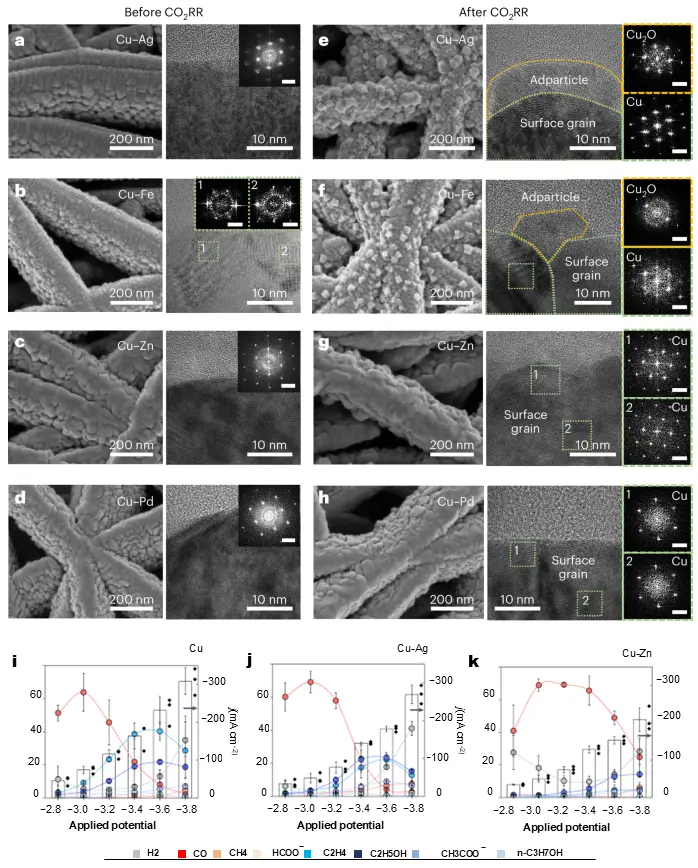
Figure 3. (a–h), Top-view SEM images (left) and cross-sectional-view high-resolution TEM images (right) of Cu–X, X = Ag (a,e), Fe (b,f), Zn (c,g) and Pd (d,h); before (a–d) an after (e–h) 1 h of CO2RR at a full cell potential of −3.6 V using 0.1 M KHCO3. Adapted from ref. [52]. (i–k), Correlation between CO2RR performance and the reconstruction of Cu and Cu–X catalysts. Adapted from ref. [52].
The factors discussed above do not operate independently; rather, they are strongly interrelated under practical CO2RR conditions. For instance, the applied potential not only determines the oxidation state of Cu but also governs the adsorption strength of key intermediates such as CO and OH−, thereby influencing both surface stability and reaction pathways. Similarly, electrolyte composition and local pH affect the availability of hydroxyl species and the ionic environment, which in turn modulate surface oxidation, CO binding, and mass transport behavior. The interplay between CO and OH adsorption can lead to competition for active sites, altering surface coverage and restructuring dynamics. Furthermore, current density influences local reaction conditions, including pH gradients, gas bubble formation, and reactant availability, all of which can accelerate dissolution–redeposition processes and morphological evolution. As a result, Cu surface restructuring should be viewed as a dynamic, multivariate process governed by the coupled effects of electrochemical, chemical, and transport phenomena rather than isolated driving forces.
3. Challenges and Future Perspectives
Although great progress has been made in operando characterization and theoretical modeling, the issue of Cu surface restructuring under electrochemical conditions is still a long way to being predictively understood. The main problem here is that the restructuring process is not controlled by one variable but is a complex and dynamic interaction due to electrochemical potential, adsorbates, electrolyte environment, and catalyst history. One of the most important challenges to the field is disentangling these interdependent effects.
3.1. Challenges
-
-
Among the most significant issues is that the contemporary characterization methods are not well-temporally and spatially resolved. Surface restructuring can take place over timescales between milliseconds and minutes and can encompass heterogeneity at the nanoscale over the catalyst surface. Although operando X-ray, spectroscopic, and microscopy methods have proved to be invaluable, they typically average over large regions or cannot give the time resolution required to track transient intermediates and fast structural changes. Consequently, important steps during the restructuring pathway can be experimentally invisible, which adds to the contradicting representations of active surface states.
-
-
The ambiguity that has persistently plagued the literature is whether surface structures seen are the catalytic drivers or simply the results of reaction conditions. CO coverage, OH adsorption, and changes in local pH are examples that are usually correlated with restructuring, and whose mechanistic functions are hard to isolate due to their changes along with surface structure.
-
-
The restructuring of Cu is extremely sensitive to the composition of the electrolyte, mass transport, cell geometry, and current density, but the parameters differ greatly among studies. Various local reaction conditions may be achieved due to differences in hydrodynamics, placement of reference electrode, and buffering of the electrolyte, and as a result, cross-comparison of results is not easy, leading to conflicting inferences.
-
-
The majority of computational investigations continue to characterize catalyst surfaces in the quasi-equilibrium or stationary state, when in reality, electrochemical interfaces can be dynamic, field-driven, and sensitive to the structure of the solvent and ion distributions. The restructuring of it thus necessitates theoretical techniques that extend beyond the usual surface energy calculations.
-
-
In addition to the factors discussed above, several practical aspects further complicate the understanding of Cu surface restructuring under CO2RR conditions. Catalyst morphology plays a crucial role, as nanostructured, defect-rich, and roughened surfaces exhibit higher atomic mobility and are more susceptible to restructuring compared to well-defined surfaces. Moreover, local pH variations near the electrode–electrolyte interface can significantly alter reaction pathways, intermediate stabilization, and Cu oxidation states, particularly under high current densities where pH gradients become pronounced. Gas bubble formation during CO2RR also introduces additional complexity by affecting mass transport, blocking active sites, and inducing local fluctuations in concentration and potential. These factors collectively highlight the importance of considering realistic operating environments when interpreting Cu restructuring behavior.
3.2. Future Directions
-
-
Future directions include the creation of high-time-resolution operando techniques, including time-resolved TEM, ambient pressure XPS, and rapid X-ray scattering, in combination with same-location microscopy and correlative microscopy, which will be essential in order to trace restructuring in real time, instead of before-and-after images.
-
-
Well thought model experiments, which manipulate a single parameter at a time, e.g., controlled CO dosing, electrolyte exchange at constant potential, or pulsed potential experiments, would aid in decoupling confounding effects. Combination with isotope labeling and surface-specific probes can also help in understanding whether adsorbates induce restructuring or stabilize structures induced by electrochemical driving forces.
-
-
Standardized benchmarking of the CO2RR and an associated reaction, such as the local pH estimates, mass-transport conditions, and catalyst pre-treatment history, would help in enhancing the reproducibility and would further help in identifying the trends of restructuring.
-
-
Constant-potential DFT, ab initio molecular dynamics, and grand-canonical methods will have to be improved further in order to model restructuring in natural electrochemical conditions. Combining these with microkinetic and mass-transport models may assist in determining what factors are the dominating ones in certain operating regimes.
4. Conclusions
Cu surface restructuring under electrochemical conditions represents one of the most significant unresolved challenges in modern electrocatalysis. A growing body of evidence shows that the active surface of Cu during operation often differs fundamentally from its initial structure, undergoing continuous restructuring driven by electrochemical bias, adsorbates, electrolyte effects, and catalyst history. Despite widespread recognition of this dynamic behavior, the field remains characterized by contradictory interpretations regarding the dominant driving forces and the nature of the true active state.
In this review, we examined six key contributors to Cu surface restructuring: hydroxyl species, applied potential, adsorbed CO, surface oxidation processes, electrolyte composition, and current density. Each of these factors has been shown to influence surface evolution, yet their effects are strongly interdependent and highly sensitive to experimental conditions. This complexity explains why different studies, often performed under slightly different environments, can reach divergent conclusions about the same catalyst system. Consequently, Cu restructuring continues to be treated as a poorly understood but unavoidable phenomenon, a “black box” that complicates the establishment of clear structure–performance relationships.
Progress toward resolving this challenge will require a shift from static descriptions of catalyst surfaces to a dynamic, condition-dependent framework. Future advances in time-resolved operando characterization, standardized electrochemical protocols, and realistic theoretical modeling of electrified interfaces will be critical for identifying causal relationships rather than correlations. Ultimately, a predictive understanding of how and why Cu surfaces reconstruct could transform this phenomenon from an obstacle into a powerful design principle, enabling the deliberate engineering of adaptive catalyst surfaces that evolve toward optimal active states during operation.
Such a transition from observing restructuring to controlling it will be essential for the rational development of next-generation Cu-based electrocatalysts and for achieving reliable performance under technologically relevant conditions.
Statement of the Use of Generative AI and AI-Assisted Technologies in the Writing Process
During the preparation of this manuscript, the author used ChatGPT in order to improve language clarity and writing flow. After using this tool/service, the author reviewed and edited the content as needed and takes full responsibility for the content of the published article.
Ethics Statement
Not applicable.
Informed Consent Statement
Not applicable.
Data Availability Statement
No new data were generated or analyzed in this review article.
Funding
This work is supported by the Fundamental Research Funds for the Central Universities (No. 2682024CG007).
Declaration of Competing Interest
The author declares that he has no known competing financial interests or personal relationships that could have appeared to influence the work reported in this paper.
References
-
Nitopi S, Bertheussen E, Scott SB, Liu X, Engstfeld AK, Horch S, et al. Progress and perspectives of electrochemical CO2 reduction on copper in aqueous electrolyte. Chem. Rev. 2019, 119, 7610–7672. DOI:10.1021/acs.chemrev.8b00705 [Google Scholar]
-
Lai W, Qiao Y, Wang Y, Huang H. Stability issues in electrochemical CO2 reduction: Recent advances in fundamental understanding and design strategies. Adv. Mater. 2023, 35, 2306288. DOI:10.1002/adma.202306288 [Google Scholar]
-
Yue Y, Wu Z, Ye Z, Li Z, Wang X, Xie K, et al. Identifying Cu reconstruction mechanism in CO2 and CO electroreduction via Cu+ detection and in situ atomic force microscopy. Sci. China Mater. 2025, 68, 2381–2387. DOI:10.1007/s40843-025-3412-2 [Google Scholar]
-
Wang L, Chen J-L, Wang J, Dong Y-L, Xiong W-F, Li Z, et al. Stabilized Cuδ+–OH species on Cu nanoparticles encapsulated in porous carbon nitride for electrocatalytic reduction of CO2 to ethylene. Inorg. Chem. Front. 2026, 13, 1938–1945. DOI:10.1039/D5QI02105G [Google Scholar]
-
Ahmed N, Luo W, Zhao R, Zhang Q, Wu D, Zheng X, et al. Role of Plasma in Catalyst Preparation and Modification for Oxygen Evolution Reaction. Precis. Chem. 2024, 3, 110–127. DOI:10.1021/prechem.4c00075 [Google Scholar]
-
Zhang W, Yang Y, Guo D, Liu L. Recent progress on copper catalysts with different surface states for CO2 electroreduction. J. Energy Chem. 2024, 88, 10–27. DOI:10.1016/j.jechem.2023.09.002 [Google Scholar]
-
Zhang Z, Wei Z, Sautet P, Alexandrova AN. Hydrogen-induced restructuring of a Cu(100) electrode in electroreduction conditions. J. Am. Chem. Soc. 2022, 144, 19284–19293. DOI:10.1021/jacs.2c06188 [Google Scholar]
-
Eren B, Zherebetskyy D, Patera LL, Wu CH, Bluhm H, Africh C, et al. Activation of Cu(111) surface by decomposition into nanoclusters driven by CO adsorption. Science 2016, 351, 475–478. DOI:10.1126/science.aad8868 [Google Scholar]
-
Auer A, Andersen M, Wernig E-M, Hörmann NG, Buller N, Reuter K, et al. Self-activation of copper electrodes during CO electro-oxidation in alkaline electrolyte. Nat. Catal. 2020, 3, 797–803. DOI:10.1038/s41929-020-00505-w [Google Scholar]
-
Wang Y, Wang Z, Dinh C-T, Li J, Ozden A, Golam Kibria M, et al. Catalyst synthesis under CO2 electroreduction favours faceting and promotes renewable fuels electrosynthesis. Nat. Catal. 2020, 3, 98–106. DOI:10.1038/s41929-019-0397-1 [Google Scholar]
-
Wilde P, O’Mara PB, Junqueira JR, Tarnev T, Benedetti TM, Andronescu C, et al. Is Cu instability during the CO2 reduction reaction governed by the applied potential or the local CO concentration? Chem. Sci. 2021, 12, 4028–4033. DOI:10.1039/D0SC05990K [Google Scholar]
-
Li M, Kuang S, Liu H, Fan Q, Zhang S, Ma X. Stabilizing Cu Catalysts for Electrochemical CO2 Reduction Using a Carbon Overlayer. J. Phys. Chem. C 2023, 127, 3952–3959. DOI:10.1021/acs.jpcc.2c08305 [Google Scholar]
-
Zhong D, Cheng D, Fang Q, Liu Y, Li J, Zhao Q. Understanding the restructuring and degradation of oxide-derived copper during electrochemical CO2 reduction. Chem. Eng. J. 2023, 470, 143907. DOI:10.1016/j.cej.2023.143907 [Google Scholar]
-
Amirbeigiarab R, Tian J, Herzog A, Qiu C, Bergmann A, Roldan Cuenya B, et al. Atomic-scale surface restructuring of copper electrodes under CO2 electroreduction conditions. Nat. Catal. 2023, 6, 837–846. DOI:10.1038/s41929-023-01009-z [Google Scholar]
-
Mu S, Lu H, Wu Q, Li L, Zhao R, Long C, et al. Hydroxyl radicals dominate reoxidation of oxide-derived Cu in electrochemical CO2 reduction. Nat. Commun. 2022, 13, 3694. DOI:10.1038/s41467-022-31498-8 [Google Scholar]
-
Choi C, Kwon S, Cheng T, Xu M, Tieu P, Lee C, et al. Highly active and stable stepped Cu surface for enhanced electrochemical CO2 reduction to C2H4. Nat. Catal. 2020, 3, 804–812. DOI:10.1038/s41929-020-00504-x [Google Scholar]
-
Li CW, Ciston J, Kanan MW. Electroreduction of carbon monoxide to liquid fuel on oxide-derived nanocrystalline copper. Nature 2014, 508, 504–507. DOI:10.1038/nature13249 [Google Scholar]
-
Mariano RG, McKelvey K, White HS, Kanan MW. Selective increase in CO2 electroreduction activity at grain-boundary surface terminations. Science 2017, 358, 1187–1192. DOI:10.1126/science.aao3691 [Google Scholar]
-
Wang L, Chen Z, Xiao Y, Huang L, Wang X, Fruehwald H, et al. Stabilized Cuδ+-OH species on in situ reconstructed Cu nanoparticles for CO2-to-C2H4 conversion in neutral media. Nat. Commun. 2024, 15, 7477. DOI:10.1038/s41467-024-52004-2 [Google Scholar]
-
Liu J, Gao N, Sui Y, Duan S, Jin K, Li S, et al. In Situ Repair and Reconstruction of Copper Surface Enhanced Its Anti-Oxidation Properties and Stability for Deep Learning-Powered Anti-Counterfeiting Labels. Adv. Mater. 2025, 37, 2500920. DOI:10.1002/adma.202500920 [Google Scholar]
-
Sun H, Wei Z, Fei L, Wei Z, Zhang Z, Sun M, et al. Balancing Electronic Structure and Surface Reconstruction of Cu-based Nanostructure for Iodide Oxidation Reaction. Chem. Commun. 2025, 61, 10997–11000. DOI:10.1039/D5CC02121A [Google Scholar]
-
Li M, Curnan MT, Saidi WA, Yang JC. Uneven oxidation and surface reconstructions on stepped Cu(100) and Cu(110). Nano Lett. 2022, 22, 1075–1082. DOI:10.1021/acs.nanolett.1c04124 [Google Scholar]
-
Han Z, Han D, Chen Z, Gao J, Jiang G, Wang X, et al. Steering surface reconstruction of copper with electrolyte additives for CO2 electroreduction. Nat. Commun. 2022, 13, 3158. DOI:10.1038/s41467-022-30819-1 [Google Scholar]
-
Zhou H, Xi W, Yang P, Huang H, Tian J, Ratova M, et al. Electrolyte manipulation on Cu-based electrocatalysts for electrochemical CO2 reduction. J. Energy Chem. 2024, 99, 201–222. DOI:10.1016/j.jechem.2024.07.055 [Google Scholar]
-
Fu J, Yin Q, Yao H, Hu H. Reconstruction of helmholtz plane to stabilize zinc metal anode/electrolyte interface. Energy Storage Mater. 2023, 59, 102774. DOI:10.1016/j.ensm.2023.102774 [Google Scholar]
-
Ma S, Hu H, Shen F, Chen Z, Hu J. Bicarbonate-Stabilized Cu2O/Cu Heterointerfaces Enable Efficient Ethylene Electrosynthesis From Carbon Capture Solutions. Small 2025, 21, e11008. DOI:10.1002/smll.202511008 [Google Scholar]
-
Gan L, Zhang X, Guo L, Ajmal M, Jia R, Guo X, et al. Redirecting surface reconstruction of CoP-Cu heterojunction to promote ammonia synthesis at industrial-level current density. Chem. Eng. J. 2024, 487, 150429. DOI:10.1016/j.cej.2024.150429 [Google Scholar]
-
Sun J, Zhou S, Zhao Z, Qin S, Meng X, Tung C-H, et al. Deep reconstruction of a Mo-based electrocatalyst for high-performance water/seawater oxidation at ampere-level current density. Energy Environ. Sci. 2025, 18, 1952–1962. DOI:10.1039/D4EE04941A [Google Scholar]
-
Kok J, Albertini PP, Leemans J, Buonsanti R, Burdyny T. Overcoming copper stability challenges in CO2 electrolysis. Nat. Rev. Mater. 2025, 10, 550–563. DOI:10.1038/s41578-025-00825-y [Google Scholar]
-
Zhang Q, Song Z, Sun X, Liu Y, Wan J, Betzler SB, et al. Atomic dynamics of electrified solid–liquid interfaces in liquid-cell TEM. Nature 2024, 630, 643–647. DOI:10.1038/s41586-024-07479-w [Google Scholar]
-
Cai Z, Li L, Ding P, Pang D, Xu M, Xu Z, et al. High-valence Cu induced by photoelectric reconstruction for dynamically stable oxygen evolution sites. J. Am. Chem. Soc. 2024, 146, 19295–19302. DOI:10.1021/jacs.4c04975 [Google Scholar]
-
Chen L, Pan T, Jin J, Yang X, Sun W, Wanyan Z, et al. Ultrasmall glutathione-protected Au/Cu and their alloy nanoclusters with specific ROS generation. Nanoscale 2026, 18, 712–717. DOI:10.1039/D5NR04022A [Google Scholar]
-
Jin G, Chen P, Tong Y. Reconstructed Cu2O@CuCo Heterostructure with Accelerated Hydrogenation Kinetics for Air Plasma-Derived Ammonia Synthesis. ACS Sustain. Chem. Eng. 2026, 14, 1991–2000. DOI:10.1021/acssuschemeng.5c10521 [Google Scholar]
-
Javed M, Akbar N, Ahmed N, Masood A, Khan AA, Alomayri T, et al. Electro-thermally assisted charge carrier dynamics and dielectric relaxation response of CuAl2O4 spinel aluminate. J. Alloys Compd. 2025, 1012, 178429. DOI:10.1016/j.jallcom.2024.178429 [Google Scholar]
-
Javed M, Akbar N, Khan AA, Masood A, Ahmed N, Khan MJ, et al. Tailoring structural and optical properties of Cu(II)-induced MgAl2O4 nanoparticles and their response to toxic dyes under solar illumination. Environ. Sci. Pollut. Res. 2024, 31, 53532–53551. DOI:10.1007/s11356-024-34753-1 [Google Scholar]
-
Akbar N, Javed M, Ahmed N, Dong L, Abid R, Alomayri T, et al. Optimized multifunctional TbCrO3/graphene oxide nanocomposites for synergistic photocatalytic dye degradation and electrocatalytic water splitting. Int. J. Hydrogen Energy 2026, 204, 153298. DOI:10.1016/j.ijhydene.2025.153298 [Google Scholar]
-
Dong L, Akbar N, Javed M, Ahmed N, Abid R, Haris H, et al. Anisotropic Al-doped ZnO@CoCr2O4 Heterostructures for Efficient Organic Pollutant Degradation and Water Splitting. Colloids Surf. A Physicochem. Eng. Asp. 2026, 740, 140228. DOI:10.1016/j.colsurfa.2026.140228 [Google Scholar]
-
Dong L, Javed M, Moualhi Y, Akbar N, Ahmed N, Masood A, et al. Electrical Properties and Dielectric Relaxation Analysis of ZnAl2O4@ZnO Core–Shell Heterostructures. Precis. Chem. 2026, 4, 439–455. DOI:10.1021/prechem.5c00196 [Google Scholar]
-
Cheng D, Wei Z, Zhang Z, Broekmann P, Alexandrova AN, Sautet P. Restructuring and activation of Cu(111) under electrocatalytic reduction conditions. Angew. Chem. 2023, 135, e202218575. DOI:10.1002/ange.202218575 [Google Scholar]
-
Bhagat BR, Das B. Role of Cuδ+ sites for a favorable electrocatalytic CO2 reduction on CuSiO3 surface. Appl. Phys. Rev. 2026, 13, 011410. DOI:10.1063/5.0284285 [Google Scholar]
-
Ding Q, Lin J, Li X, Dong Y, Bao Y, Liang H, et al. Surface reconstruction of copper(Ⅰ) sulfide electrode regulated electroreduction CO2 selectivity. Appl. Surf. Sci. 2025, 686, 162139. DOI:10.1016/j.apsusc.2024.162139 [Google Scholar]
-
Jun M, Kundu J, Kim DH, Kim M, Kim D, Lee K, et al. Strategies to modulate the copper oxidation state toward selective C2+ production in the electrochemical CO2 reduction reaction. Adv. Mater. 2024, 36, 2313028. DOI:10.1002/adma.202313028 [Google Scholar]
-
Liu Q, Zang J, Ye W, Li L, Wang C, Jin J, et al. Universal Formation, Dynamics, and Reactivities of *CObridge Accompanying Spontaneous Reconstruction of Cu during Electrochemical CO2 or CO Reduction. J. Am. Chem. Soc. 2025, 147, 31497–31508. DOI:10.1021/jacs.5c03886 [Google Scholar]
-
Long C, Wan K, Chen Y, Li L, Jiang Y, Yang C, et al. Steering the reconstruction of oxide-derived Cu by secondary metal for electrosynthesis of n-propanol from CO. J. Am. Chem. Soc. 2024, 146, 4632–4641. DOI:10.1021/jacs.3c11359 [Google Scholar]
-
Feng J, Wang X, Pan H. In-situ reconstruction of catalyst in electrocatalysis. Adv. Mater. 2024, 36, 2411688. DOI:10.1002/adma.202411688 [Google Scholar]
-
Choi W, Chae Y, Liu E, Kim D, Drisdell WS, Oh H-S, et al. Exploring the influence of cell configurations on Cu catalyst reconstruction during CO2 electroreduction. Nat. Commun. 2024, 15, 8345. DOI:10.1038/s41467-024-52692-w [Google Scholar]
-
Zhao Y, Dai Y, Bu Y. Advances in Cu-based Catalysts for Electroreduction of CO2 to C2H4 in Flow Cells. Green Energy Environ. 2025, 10, 1648–1673. DOI:10.1016/j.gee.2025.01.003 [Google Scholar]
-
Masood A, Ahmed N, Shahid F, Mohd Razip Wee M, Patra A, Siow KS. Atmospheric Pressure Plasma Polymerization of Carvone: A Promising Approach for Antimicrobial Coatings. Coatings 2023, 13, 1112. DOI:10.3390/coatings13061112 [Google Scholar]
-
Masood A, Ahmed N, Razip Wee MM, Patra A, Mahmoudi E, Siow KS. Atmospheric Pressure Plasma Polymerisation of D-Limonene and Its Antimicrobial Activity. Polymers 2023, 15, 307. DOI:10.3390/polym15020307 [Google Scholar]
-
Masood A, Ahmed N, Mohd Razip Wee MF, Haniff MASM, Mahmoudi E, Patra A, et al. Pulsed plasma polymerisation of carvone: Characterisations and antibacterial properties. Surf. Innov. 2023, 11, 339–351. DOI:10.1680/jsuin.22.00042 [Google Scholar]
-
Zang Y, Wang S, Sang J, Wei P, Zhang X, Wang Q, et al. Illustration of the intrinsic mechanism of reconstructed Cu clusters for enhanced CO2 electroreduction to ethanol production with industrial current density. Nano Lett. 2024, 24, 7261–7268. DOI:10.1021/acs.nanolett.4c01239 [Google Scholar]
-
Kim I, Lee GB, Kim S, Jung HD, Kim JY, Lee T, et al. Unveiling the reconstruction of copper bimetallic catalysts during CO2 electroreduction. Nat. Catal. 2025, 8, 697–713. DOI:10.1038/s41929-025-01368-9 [Google Scholar]
-
Liu J, Duan S, Chen A, Liu X, Tian C, Gao N, et al. Unveiling the valid active site of copper nano-electrocatalysts by surface reconstruction for enhanced nitrate reduction to ammonia. J. Energy Chem. 2026, 116, 339–346. DOI:10.1016/j.jechem.2026.01.001 [Google Scholar]