Deadline for manuscript submissions: 31 December 2026.

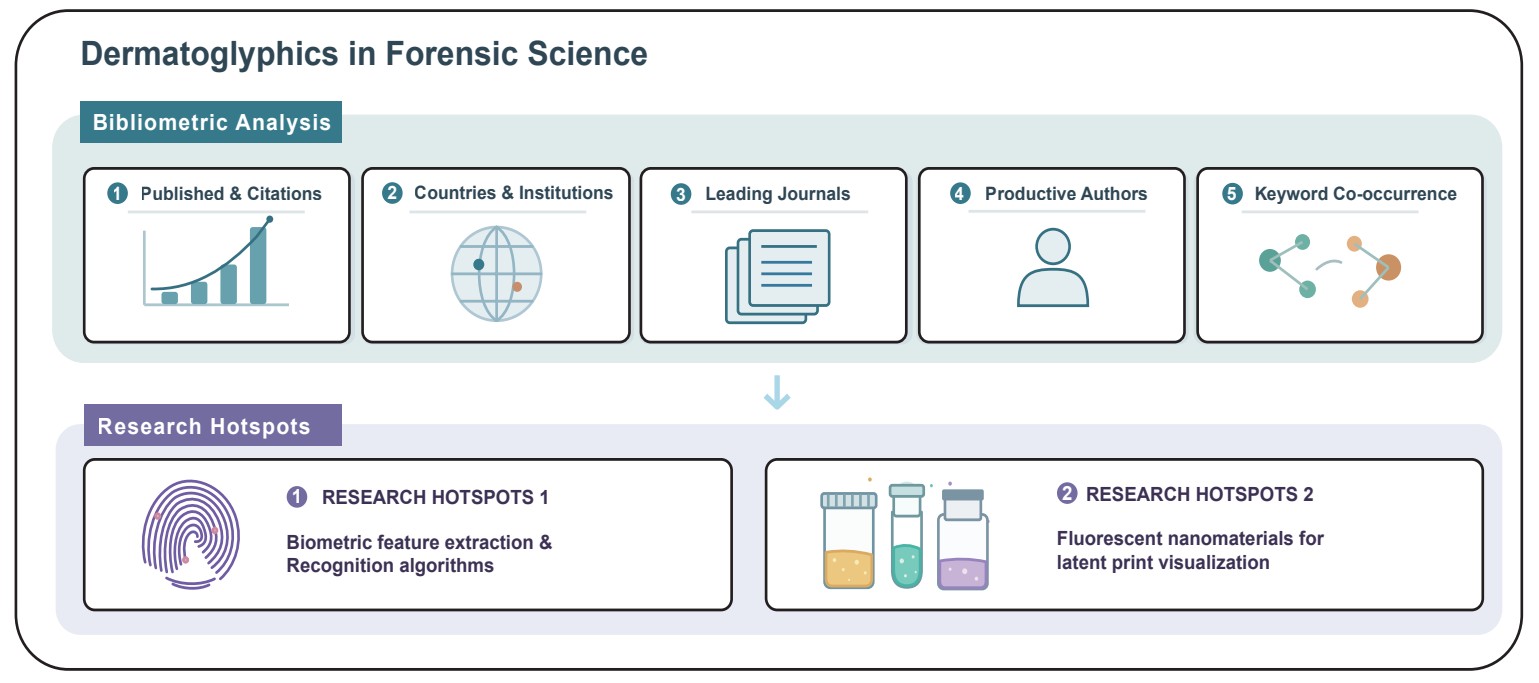
Dermatoglyphics traits—including fingerprints, palmprints, and footprints—are highly specific biometric markers that serve as critical evidence for individual identification in criminal investigations. To map the intellectual trajectory of this field, we conducted a bibliometric analysis of 796 publications indexed in the Web of Science Core Collection from 1976 to 2025. Since its emergence, research output has grown substantially. While India leads in total publications (207) and citations (3579)—largely driven by highly productive institutions such as Tumkur University and Jain University—the United States maintains the highest average citations per paper (36.8). Forensic Science International and the Journal of Forensic Sciences remain the core publishing venues. Notably, A. Jain’s 1997 work on automated fingerprint recognition remains the field’s most impactful publication, while N. Hanumanthappa has emerged as the most prolific and highly cited contemporary author. Keyword analysis reveals a distinct paradigm shift: early research focused on foundational identification principles, whereas recent hotspots center on dermatoglyphics feature extraction, algorithmic optimization, and the application of novel fluorescent nanomaterials for latent fingerprint visualization. This multidisciplinary evolution highlights an urgent paradigm shift: future advancements must bridge the translational gap between laboratory innovation and practical forensic demands by improving the transparency and judicial reliability of AI-assisted fingerprint analysis, establishing standardized evaluation systems for novel nanomaterials, and ensuring analytical compatibility with downstream genomic and multi-omics workflows.