SciEPublish

Surveys of Pectobacteriaceae in Lake Water over Consecutive Years Show That Lake-Specific Populations Survive the Winter

Article Open Access

Surveys of Pectobacteriaceae in Lake Water over Consecutive Years Show That Lake-Specific Populations Survive the Winter

Author Information
Microbiologie Adaptation et Pathogénie, Unité Mixte de Recherche 5240, Centre National de la Recherche Scientifique, Institut National des Sciences Appliquées de Lyon, Université Lyon 1, 69622 Villeurbanne, France
*
Authors to whom correspondence should be addressed.

Received: 16 September 2026 Revised: 19 October 2026 Accepted: 05 November 2026 Published: 18 November 2026

Creative Commons

© 2026 The authors. This is an open access article under the Creative Commons Attribution 4.0 International License (https://creativecommons.org/licenses/by/4.0/).


Views:57
Downloads:16
Ecol. Divers. 2026, 3(4), 10016; DOI: 10.70322/ecoldivers.2026.10016
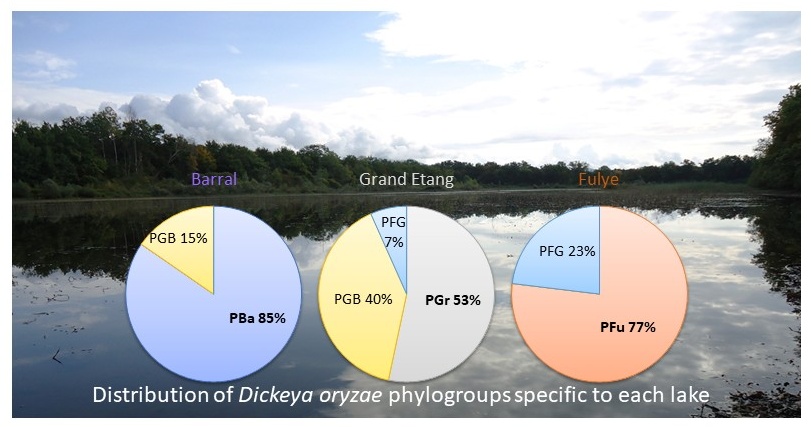
ABSTRACT: The Pectobacteriaceae family includes plant pathogenic bacteria of the genera Pectobacterium and Dickeya that cause plant maceration due to their pectinolytic activity. To gain information on their presence in surface water, four surveys were performed to collect water samples in three lakes included in a nature reserve. Most water samples contained pectinolytic bacteria, including six Pectobacteriaceae species. While Pectobacterium isolates dominated at the end of winter, their proportion decreased in early summer, and Dickeya reached up to 100% in late summer. The Pectobacterium isolates mostly consisted of the species P. quasiaquaticum, with a low proportion of P. aquaticum and P. versatile. The Dickeya isolates mostly belonged to the species D. oryzae, with a low occurrence of D. chrysanthemi and D. aquatica. Phenotypic and phylogenetic analysis disclosed the presence of D. oryzae subgroups differently distributed in the three lakes, each lake containing a specific subpopulation. The same subpopulation was recovered in the same lake in surveys conducted in two successive years, showing the recovery of the lake-specific population after the winter season. These data indicate that D. oryzae populations can survive the annual cold period and resume multiplication in the same lake the following year.
Keywords: Plant pathogens; Dickeya; Pectobacterium; Lake water; Winter survival; Bacterial population; Seasonal distribution

Graphical Abstract

TOP