
The Journal of Advanced Materials and Intelligent Manufacturing, a Critical Platform for Interdisciplinary Research on Materials Frontiers and Intelligence Manufacturing
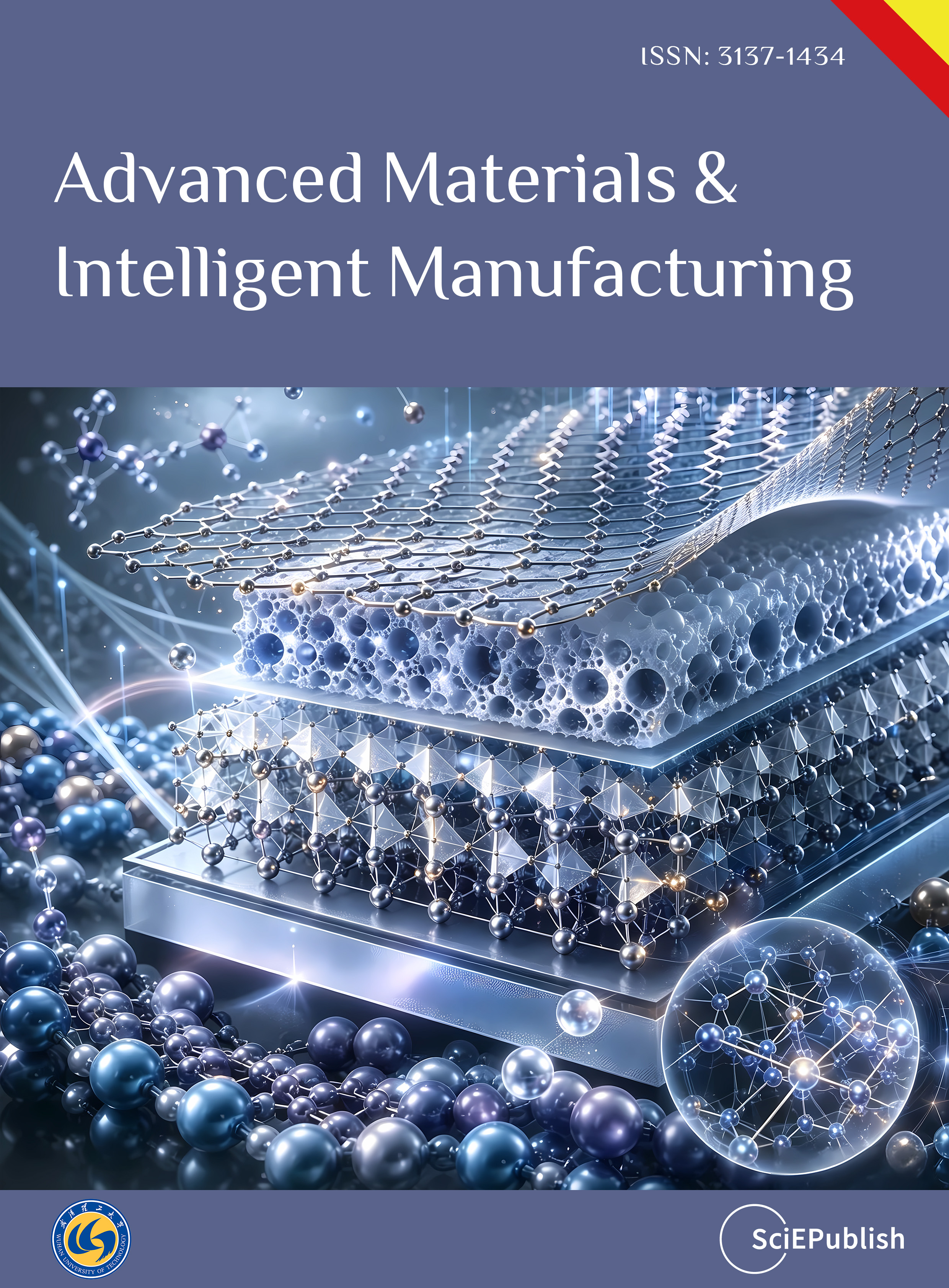
The Journal of Advanced Materials and Intelligent Manufacturing, a Critical Platform for Interdisciplinary Research on Materials Frontiers and Intelligence Manufacturing
Lin Hua 1,2,* Lai-Chang Zhang 3,*
Received: 28 October 2026 Accepted: 28 October 2026 Published: 28 October 2026

© 2026 The authors. This is an open access article under the Creative Commons Attribution 4.0 International License (https://creativecommons.org/licenses/by/4.0/).
1. Introduction
Manufacturing stands as the engine driving the advancement of human civilization, while advanced materials form the irreplaceable cornerstone that underpins every transformative leap in industrial progress. From the earliest bronze casting that defined ancient civilizations to the cutting-edge aerospace systems that explore the boundaries of space, every milestone of human technological evolution has always been tied to our growing mastery over matter and manufacturing precision.
Nowadays, at the historic intersection of the new global scientific and technological revolution, the interdisciplinary between materials science and advanced manufacturing becomes more popular. Traditional materials journals primarily focus on fundamental synthesis and characterization, while manufacturing journals concentrate on process optimization and equipment innovation. This long-standing gap has created a need for a dedicated, high-impact international platform that integrates the entire innovation chain: materials design, performance regulation, intelligent manufacturing, and engineering application.
Under this situation, “Advanced Materials and Intelligent Manufacturing (AMIM)” officially launches its inaugural issue.
2. Why Choose Advanced Materials and Intelligent Manufacturing?
The founding of AMIM is an inevitable product driven by the global technological transformation. In the new round of technological revolution, the boundaries between advanced materials and manufacturing technologies are rapidly blurring. In these cutting-edge fields, there is an urgent need for a full-chain publication channel covering “materials–structure–function–manufacturing” to fill a gap in international journals.
AMIM aims to build a bridge between basic research and engineering applications. It will focus on the design, synthesis, and characterization of advanced materials, and is more concentrated on the advanced manufacturing processes that transform these materials into actual devices and systems. Whether it is atomic manipulation at the microscopic scale or the integration of intelligent equipment at the macroscopic scale, this journal is committed to publishing high-quality research results that are original, forward-looking, and have significant application value.
We maintain a strict, constructive peer review system that upholds top academic standards, while offering a dedicated fast-track channel for high-impact breakthrough results. Your manuscript can complete the full review and online publication process as soon as possible. This lets you secure full public priority for your novel discoveries without unnecessary delays.
As a fully open-access journal, every published paper is freely accessible to all researchers at universities, research institutes, and leading manufacturing enterprises worldwide. This drastically expands the global reach of your work, significantly boosts citation potential, and directly connects your lab-scale research to industry teams, accelerating the path from academic discovery to real industrial implementation.
Besides, AMIM owns World-Class Editorial Board Backing, High-Growth Impact Potential, and Direct Industry Translation Pathway, which can promote the extensive publicity and engineering application of your work.
3. Scope and Innovation Pathways
Key areas of interest in AMIM include, but are not limited to:
- (1)
-
Advanced Structural Materials: metallic materials, polymers, ceramics, semiconductor materials, intermetallic compounds, composite materials, etc.
- (2)
-
Advanced Functional Materials: thermal materials, electronic materials, magnetic materials, acoustic materials, biological materials, high-entropy alloys, intelligent responsive materials, 2D functional materials, etc.
- (3)
-
Materials Structure and Properties: microstructure, physical properties, mechanical properties, fatigue properties, corrosion properties, etc.
- (4)
-
Advanced Processing Technologies: plastic deformation, heat treatment, electromagnetic shock treatment, laser process, etc.
- (5)
-
Advanced Manufacturing Technologies: atomic-level manufacturing, additive manufacturing, 3D/4D printing, ultrasound manufacturing, optoelectronic manufacturing, electromagnetic manufacturing, etc.
- (6)
-
Materials + Artificial intelligence (AI): intelligent materials, future materials, material structural design, extreme condition materials, material structural optimization, metamaterials, machine learning, etc.
- (7)
-
Manufacturing + AI: multifield manufacturing, intelligent manufacturing, extreme manufacturing, robot processing, intelligent green manufacturing, digital twin, low-carbon production technologies, etc.
- (8)
-
Intelligent Materials Joining and Connection Technology: advanced welding, brazing, solid-state joining, and heterogeneous material connection processes, targeting extreme service conditions for aerospace, new energy, and high-end equipment sectors, etc.
- (9)
-
Micro-Nano and Optoelectronic Manufacturing:micro-nano fabrication, laser precision manufacturing, photoelectronic co-processing, and advanced semiconductor packaging technologies, supporting the development of next-generation microelectronic and optoelectronic devices, etc.
- (10)
-
Extreme Manufacturing for Strategic Applications: Key manufacturing technologies for materials and components that serve extreme environments, including ultra-high temperature, ultra-high pressure, strong radiation and ultra-low temperature scenarios, to support major strategic fields such as deep space exploration, deep-sea engineering and new energy systems.
4. Our Commitment
We advocate interdisciplinary integration and encourage materials scientists, manufacturing engineers, and information experts to join hands and jointly explore key core technologies such as advanced metal materials, optoelectronic materials, artificial intelligence with materials and manufacturing. We aim to promote the transformation of scientific and technological achievements into real productive forces through an academic exchange platform and contribute to global sustainable development.
As a fully open-access, peer-reviewed international journal, we are committed to serving the global academic community with rigorous ethical standards, fast and fair review processes, and maximum visibility for every published breakthrough.
5. Join Advanced Materials and Intelligent Manufacturing
AMIM’s core mission is to break down the long-standing disciplinary barrier between fundamental materials research and industrial manufacturing practice. It provides a unified, high-visibility academic platform for global researchers, aiming to accelerate the transformation of cutting-edge material discoveries into scalable, high-performance manufacturing technologies that deliver real-world engineering impact.
AMIM is scheduled to launch its first issue in March 2027. We invite you to join us as an editorial board member, reviewer, or contributor.
Declaration of Competing Interest
The authors declare that they have no known competing financial interests or personal relationships that could have appeared to influence the work reported in this paper.