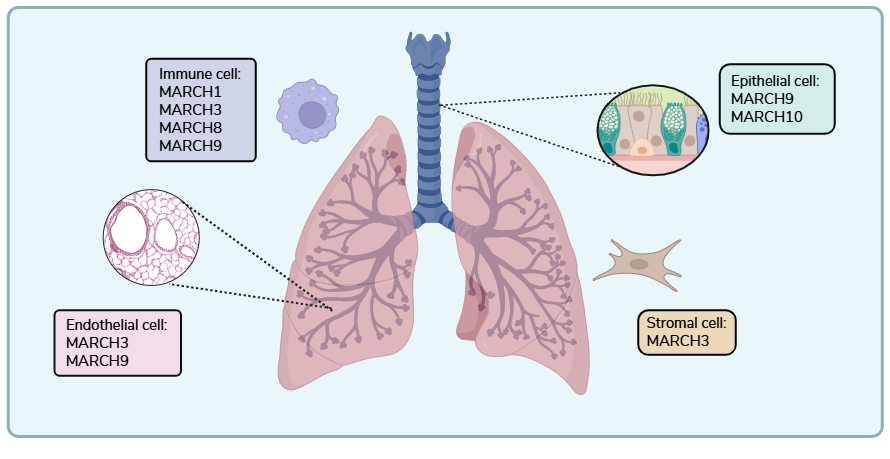
Membrane-associated RING-CH (MARCH) ligases are a family of 11 ubiquitin E3 ligases that regulate protein stability, trafficking, and signaling across diverse cellular contexts. Although MARCH ligases have been studied most extensively in immune regulation, antigen presentation, viral restriction, and cellular homeostasis, their roles in pulmonary biology remain incompletely defined. The lung is a highly specialized environmental interface that must preserve gas exchange while continuously responding to infectious, inflammatory, and sterile insults. These demands require careful regulation of epithelial and endothelial barrier integrity, innate and adaptive immune activation, and tissue repair. Current work suggests that MARCH ligases influence many of these processes by regulating inflammatory responses, cytokine receptors, antiviral signaling mediators, viral proteins, mitochondrial fission or fusion, junctional molecules, ciliary components, and remodeling pathways. In this review, we summarize current knowledge and highlight gaps in the understanding of MARCH ligase expression and function in lung-relevant cell types and disease contexts. Defining how MARCH ligases operate within specific lung compartments may reveal new regulatory mechanisms governing pulmonary immunity, barrier function, host defense, and lung remodeling.
Pulmonary microvasculature, which is intimately associated with the alveoli, carries the entire cardiac output through an extensive capillary network and plays a pivotal role in gas exchange by maintaining the structural and functional integrity of the alveolar-capillary barrier. Preservation of cell-cell junctions is essential for preventing paracellular leakage and leukocyte infiltration, which are characteristic features of acute lung inflammatory disorders, including acute respiratory distress syndrome (ARDS) and acute exacerbations of chronic lung diseases. Epigenetic regulation serves as a fundamental mechanism linking chromatin dynamics to endothelial barrier function. By modulating gene expression and downstream processes, including protein stability, subcellular localization, and enzymatic activity, epigenetic pathways regulate cell-cell junctions, ultimately determining microvascular endothelial barrier integrity. This review provides an in-depth overview of the molecular regulation of cell-cell junction dynamics in pulmonary endothelial cells under acute inflammatory stress, with a focus on the roles of epigenetic modifications. In addition, it evaluates current therapeutic strategies targeting microvascular endothelial barrier dysfunction and discusses their translational and clinical limitations. By integrating recent advances in cellular and preclinical research with translational efforts, this review identifies key knowledge gaps and outlines future directions for developing precision therapeutics to preserve microvascular endothelial barrier integrity in acute inflammatory diseases.
Respiratory viral infections are a major cause of public health concern worldwide. With the appearance of COVID-19 in 2019, the whole world has experienced severe and long-term complications associated with these infections. These respiratory viruses, their types and sub types are prevalent throughout the year and at varied seasons, and our body continues to fight against these pathogens through innate and adaptive immune responses. Facing multiple viral pathogens with a varied constitution of antigenic epitopes, the infected person generates a number of cytokines and also different paratopic induced antibodies, creating an immunological chaos. To understand this, the present study was undertaken. The antibodies against five major respiratory viruses, commonly reported in India, were targeted viz; SARS-CoV-2, rhinovirus, influenza virus, parainfluenza, and respiratory syncytial virus. An ELISA assay for the detection of all these viruses was made. It was observed that in most cases, there was a presence of antibodies against respiratory viruses (more than 3 respiratory viruses). When the overall status was checked, it was observed that the presence of IgG for Parainfluenza A virus was present in maximum study subjects (92.30 to 100%), along with IgG for SARS-CoV-2 (50–76.92%). We may thus assume that co-infection by multiple viruses may trigger the risk of multiple antibodies and an immunological chaos. Comorbidities that exist in the patients can also enhance the additional stress on the immune cells, with a possibility of B-cells losing their specificity to generate epitope specific antibodies.
